Balkinization
an unanticipated consequence of
Jack M. Balkin
Balkinization Symposiums: A Continuing List
E-mail:
Jack Balkin:
jackbalkin at yahoo.com
Bruce Ackerman
bruce.ackerman at yale.edu
Ian Ayres
ian.ayres at yale.edu
Corey Brettschneider
corey_brettschneider at brown.edu
Mary Dudziak
mary.l.dudziak at emory.edu
Joey Fishkin
joey.fishkin at gmail.com
Heather Gerken heather.gerken at yale.edu
Abbe Gluck abbe.gluck at yale.edu
Mark Graber
mgraber at law.umaryland.edu
Stephen Griffin
sgriffin at tulane.edu
Jonathan Hafetz
jonathan.hafetz at shu.edu
Jeremy Kessler
jkessler at law.columbia.edu
Andrew Koppelman
akoppelman at law.northwestern.edu
Marty Lederman
msl46 at law.georgetown.edu
Sanford Levinson
slevinson at law.utexas.edu
David Luban
david.luban at gmail.com
Gerard Magliocca
gmaglioc at iupui.edu
Jason Mazzone
mazzonej at illinois.edu
Linda McClain
lmcclain at bu.edu
John Mikhail
mikhail at law.georgetown.edu
Frank Pasquale
pasquale.frank at gmail.com
Nate Persily
npersily at gmail.com
Michael Stokes Paulsen
michaelstokespaulsen at gmail.com
Deborah Pearlstein
dpearlst at yu.edu
Rick Pildes
rick.pildes at nyu.edu
David Pozen
dpozen at law.columbia.edu
Richard Primus
raprimus at umich.edu
K. Sabeel Rahmansabeel.rahman at brooklaw.edu
Alice Ristroph
alice.ristroph at shu.edu
Neil Siegel
siegel at law.duke.edu
David Super
david.super at law.georgetown.edu
Brian Tamanaha
btamanaha at wulaw.wustl.edu
Nelson Tebbe
nelson.tebbe at brooklaw.edu
Mark Tushnet
mtushnet at law.harvard.edu
Adam Winkler
winkler at ucla.edu
Compendium of posts on Hobby Lobby and related cases
The Anti-Torture Memos: Balkinization Posts on Torture, Interrogation, Detention, War Powers, and OLC
The Anti-Torture Memos (arranged by topic)
Recent Posts
"Interconstitutionalism" in Yale Law Journal
Rooting Meaning in History and Tradition Imposes “Embarrassing” Limitations on Constitutional Vitality: Reflections for LevinsonFest
Response to the symposium on Burning Down the House: How Libertarian Philosophy Was Corrupted by Delusion and Greed
Challenging the Monopoly of Arms: Reflections on Sandy Levinson and the Embarrassing Second Amendment
Andrew Koppelman’s Half-Way Hayekianism
Appraising Sandy’s Call to “Arms”: Success in the Academy … Not So Much in the Courts
LevinsonFest on the Second Amendment
"American Founding Son" Audiobook
The Grotesque, Wonderful Respect for Marriage Act
Wither Friedman?
Balkinization Symposium on James E. Fleming, Constructing Basic Liberties: A Defense of Substantive Due Process-- Collected Posts
Constructing Basic Liberties: A Response to Eight Comments
Libertarian Insights, Errors, and Calamities
Donald Trump's Provisional Candidacy
Retrieving Democracy: Andrew Koppelman and C.B. Macpherson’s Reformulation of Libertarian Political Thought
Communication Nation
Assessing Libertarianism Requires Engagement with Modern Libertarian Political Thought
Two Cheers for Radical Libertarianism
The Journal of American Constitutional History
McCarthy’s Minefields
Libertarianism or Callousness
Saving the House From Destruction A Classical Liberal Response to Andrew Koppelman
Balkinization Symposium on Andrew Koppelman, Burning Down the House: How Libertarian Philosophy Was Corrupted by Delusion and Greed
Disorganizing the New House
Tradition and the establishment clause
![[Powered by Blogger]](https://lh3.googleusercontent.com/blogger_img_proxy/AEn0k_ufybnUnJ_D3ciVd-hW0x1SDdiz7RKhwqj8_ChAgHZl3I-G-USA7R0MKZs4o9p-ckofzggfIWh2vB4TvBq1kHWF-bIHvib-RvqDB8A2jFih=s0-d)
Just A Few Blogs
ACS Blog
Alas, a Blog
Althouse
Arts and Letters Daily
Atrios (Eschaton)
Bill of Health
Buzzflash.com
Buzz Machine
Cato at Liberty
Juan Cole (Informed Comment)
Concurring Opinions
The Constitution in 2020
Corrente
Crooked Timber
Daily Howler
Daily Kos
Dana Boyd
Brad DeLong
Digby (Hullabaloo)
Discriminations
Daniel Drezner
Kevin Drum (Mother Jones)
Electrolite
En Banc
Eunomia (Daniel Larison)
Fafblog
Michael Froomkin (Discourse.net)
GovLab (Beth Noveck)
Rick Hasen (Election Law)
History News Network
How Appealing
Ignatz (Sam Heldman)
The Importance of (Ernie Miller)
Infolaw
Instapundit
International Economic Law and Policy Blog
IntLawGrrls
Jacob Levy
Jesus' General
Jurisdynamics
The Kitchen Cabinet
Mark Kleiman
Law Blog Central
Larry Lessig
Lawyers, Guns and Money
Liberal Oasis
Brian Leiter's Law School Reports
The Leiter Reports
Marginal Revolution
Megan McArdle
Memeorandum
Metafilter
Mirror of Justice
The New Republic
Newseum
No More Mister Nice Blog
Brendan Nyhan
Opinio Juris
Orcinus
The Originalism Blog
Pandagon
Passport (Foreign Policy)
Overcoming Bias
Political Animal (Washington Monthly)
Political Theory Daily Review
Political Wire (Taegan Goddard)
The Poor Man
Virginia Postrel
Prawfsblawg
Public Reason
Jonathan Rauch
Raw Story
Redstate
ReligiousLeftLaw.com
Reporters Committee For Freedom of the Press
Reproductive Rights Blog
Rothman's Roadmap to the Right of Publicity
SCOTUS Blog
Seeing the Forest
Clay Shirky
The Shifted Librarian
The Situationist
Larry Solum (Legal Theory)
Andrew Sullivan
Talking Points Memo
Talk Left
Tapped
Tbogg
TechPresident
The Paper Chase (Jurist)
Tom Paine
Tom Tomorrow (This Modern World)
Eve Tushnet
Uggabugga
University of Chicago Law School Faculty Blog
Unqualified Offerings
The Volokh Conspiracy
War and Piece (Laura Rozen)
Wampum
Oliver Willis
Wonkette
Written Description
Matthew Yglesias
Yin
Your Choice of Feeds
1. XML
powered by

2. Atom Feed
3. RSS 2.0
"Interconstitutionalism" in Yale Law Journal
Jason Mazzone
My article, "Interconstitutionalism," with Cem Tecimer (S.J.D. candidate at Harvard), appears in the current issue of the Yale Law Journal. The article abstract is below. Balkinization authors and readers gave us helpful feedback on early drafts of the article. We're now planning some additional pieces from the same project and so further comments and suggestions are very welcome. Interconstitutionalism, 132 Yale L.J. 326 (2022) New constitutions aim to break from the past, but they rarely do. Instead, predecessor constitutions routinely influence how a new constitution is interpreted and applied. Past constitutions linger, even when the new constitution is the product of revolution or civil war. To explore this phenomenon, we take up a prevalent yet understudied practice of constitutional interpretation that we call “interconstitutionalism.” By interconstitutionalism, we mean the use of a polity’s antecedent constitution(s) to generate meaning for that same polity’s current constitution. Courts and other interpreters regularly engage in interconstitutionalism, keeping alive the seemingly dead constitutions of the past. Interpretations of the U.S. Constitution regularly make use of the Articles of Confederation; state constitutional interpretation regularly involves comparison to predecessor state constitutions; and abroad, past constitutions play a starring role in making sense of nations’ current governing charters. This Article examines the multiple and often surprising dimensions of interconstitutional interpretive practices, drawing on examples from federal, state, and foreign courts. Understanding interconstitutionalist practices informs and challenges existing accounts of constitutional interpretation and adjudication. It also sheds light on the very nature of constitutional governance. A core commitment of modern constitutionalism is self-rule: government by the people. But interconstitutionalist practices challenge the very possibility of constitutions as self-governing charters. Interconstitutionalism means that past constitutions—those written and adopted by other people, for another political system, and now superseded—continue to hold sway. Yet, as the Article concludes, interconstitutionalism reveals a path forward for meaningful popular sovereignty and a basis for securing constitutional legitimacy.
Posted
10:40 AM
by Jason Mazzone [link]
Rooting Meaning in History and Tradition Imposes “Embarrassing” Limitations on Constitutional Vitality: Reflections for LevinsonFest
Guest Blogger
This post
was prepared for a roundtable on
the Second Amendment, convened as part of LevinsonFest
2022—a year-long series gathering scholars from diverse
disciplines and viewpoints to reflect on Sandy Levinson’s influential work in
constitutional law. Renée M.
Landers I am
honored to take part in this tribute to someone who has achieved iconic status
in the Pantheon of constitutional law scholars. While I mostly lurk and only
occasionally engage, the discussions Professor Levinson initiates and pursues--with
seemingly endless energy and unlimited time—on the AALS constitutional law
professors’ list are sources of information and insight that probe the raw
edges of disagreement about constitutional analysis and debate. For these
efforts to engage colleagues, I am also grateful. I am still
a bit puzzled by the invitation to participate in the LevinsonFest on
the subject of the Second Amendment as I have mentioned it in writings only in
passing. Despite this puzzlement, I decided to accept the invitation and to
approach the subject from the perspective of health law and policy—one of the
other areas in which I teach.
Posted
9:30 AM
by Guest Blogger [link]
Response to the symposium on Burning Down the House: How Libertarian Philosophy Was Corrupted by Delusion and Greed
Andrew Koppelman
Thanks to Richard
Epstein, Christina
Mulligan, James
Hackney, Matt
Zwolinski, Ilya
Somin, Jamie
Mayerfeld, Jennifer Burns,
and Jonathan Adler for
their thoughtful responses to my book, Burning
Down the House: How Libertarian Philosophy Was Corrupted by Delusion and Greed. It’s an honor to be able to engage with such
an impressive group. The book is a critical history of libertarian philosophy. It argues that modern libertarianism began as
a corrective to the Depression-era vogue for central economic planning. It
showed how individual liberty and free markets could improve life for everyone,
especially the poorest. I trace its evolution
from Friedrich Hayek’s moderate pro-market ideas to the romantic fabulism of
Murray Rothbard, Robert Nozick, and Ayn Rand, and Charles Koch’s aggressive promotion
of climate change denial. Today it has
become a toxic blend of irresponsible anarchism, cruel disdain for the weak,
and rationalization for environmental catastrophe. The notion of a minimal
state has attracted a new form of parasite: the dishonest businessman who wants
to deceive his customers or poison his neighbors without being bothered by the
police. Unsurprisingly, the libertarians who participated in this
symposium are unpersuaded.
Posted
10:00 AM
by Andrew Koppelman [link]
Challenging the Monopoly of Arms: Reflections on Sandy Levinson and the Embarrassing Second Amendment
Guest Blogger
This post was prepared for a roundtable on the Second Amendment,
convened as part of LevinsonFest 2022—a year-long series gathering scholars from diverse
disciplines and viewpoints to reflect on Sandy Levinson’s influential work in
constitutional law. Robert J. Cottrol When I first received the invitation
to participate in the LevinsonFest and to discuss Sandy Levinson’s critical
role in the world of Second Amendment scholarship, many thoughts raced through
my mind on how I might begin and focus this short discussion. Sandy Levinson’s
1989 essay, “The Embarrassing Second Amendment” played a critical role in
taking the Second Amendment from what had been a state of academic neglect and
judicial desuetude to the triumph of the individual rights position that we saw
in June of this year with the Supreme Court’s decision in New York State Rifle and Pistol Association v. Bruen. A discussion
focused on the role Sandy’s essay played in stimulating Second Amendment
scholarship and how that scholarship caused the courts to re-examine the right
to keep and bear arms, a re-examination that ultimately brought us Heller and now Bruen would have been entirely appropriate. Along the way I could
commend Sandy for the intellectual and moral courage it took to embark on such
a venture. I recall being at a dinner with Sandy at an academic conference in
1988 or 1989 when he indicated that he was working on an article on the Second
Amendment and that the short of it was that the NRA was probably right at least
in broad terms about the amendment having been intended to protect an
individual right. A number of people suggested that he shouldn’t go through
with the project saying that it would probably bring about a fair amount of
ostracism and opprobrium from liberals in the legal academy. To his great
credit, Sandy ignored that advice and by doing so produced that rare
occurrence, a piece of scholarship that made history.
Posted
9:30 AM
by Guest Blogger [link]
Andrew Koppelman’s Half-Way Hayekianism
Guest Blogger
For the Balkinization Symposium on Andrew Koppelman, Burning Down the House: How Libertarian Philosophy Was Corrupted by Delusion and Greed (St. Martin’s Press, 2022). Jonathan H. Adler Andrew Koppelman’s Burning Down the House is a
simultaneously engaging and frustrating book. It offers a refreshing
center-left appreciation F.A. Hayek and provides insightful critiques of more rigid
and radical libertarian thinkers. Yet it also strangely resists serious
consideration of the broader application of Hayekian insights and is too quick
to assume a conscientious Hayekian would be part of the today’s center-left
coalition. Part of what is so refreshing about Koppelman’s book is that
his appreciation of Hayekian insights is so rare in center-left discourse. He
understands that liberals should be more
concerned with poverty than inequality. Market-driven increases in
standards of living around the world have been a boon for humanity, increasing
lifespans and reducing human suffering. Moreover, there can be no meaningful
wealth redistribution if there is not sufficient wealth to redistribute.
Koppelman also appreciates that the
benefits of markets are not purely economic. “In a diverse society, markets facilitate
peaceful cooperation among people who radically disagree about fundamental
values,” he observes. (175) As a consequence, the market “stimulates not only
competition but empathy.” (176)
Posted
8:30 PM
by Guest Blogger [link]
Appraising Sandy’s Call to “Arms”: Success in the Academy … Not So Much in the Courts
Guest Blogger
This post was prepared for a roundtable on the Second Amendment,
convened as part of LevinsonFest 2022—a year-long series gathering scholars from diverse
disciplines and viewpoints to reflect on Sandy Levinson’s influential work in
constitutional law. Joseph
Blocher In
1989, Sandy Levinson published “The Embarrassing
Second Amendment”
in the Yale Law Journal. It remains the most-cited law review article on
the right to keep and bear arms and, while not always described accurately or deployed faithfully, has played a
significant role in the development of scholarship and doctrine in the decades
since. Writing today from within the scholarly field that Sandy helped create,
my hope here is to offer a few broad observations—through the lens of his work—about
how firearms scholarship and doctrine have changed.
Posted
9:30 AM
by Guest Blogger [link]
LevinsonFest on the Second Amendment
Guest Blogger
Ashley Moran We’re pleased to share essays from
our recent LevinsonFest 2022 roundtable
on the Second Amendment. The roundtable includes essays from Joseph Blocher
(Duke University), Robert Cottrol (George Washington University),
Renée Landers (Suffolk University), and Darrell Miller (Duke
University), as well as a response from Sandy Levinson (University of
Texas at Austin). The event discussion broached an
even wider range of topics and is available on the panel webpage. We hope
you enjoy the discussions! Ashley Moran is a Lecturer and Postdoctoral
Fellow with the Comparative Constitutions Project at UT-Austin and
Distinguished Scholar with UT’s Robert Strauss Center for International
Security and Law. You can contact her at ashleymoran@utexas.edu.
Posted
9:00 AM
by Guest Blogger [link]
"American Founding Son" Audiobook
Gerard N. Magliocca
I am excited to say that my biography of John Bingham is now available as an audiobook, read by me. Happy Thanksgiving to all of our readers and contributors.
Posted
9:51 PM
by Gerard N. Magliocca [link]
(0) comments
The Grotesque, Wonderful Respect for Marriage Act
Andrew Koppelman
The Respect for Marriage Act (RFMA), which Congress is on the verge of passing after the Senate moved forward on it last week, takes a grotesquely roundabout approach to the problem it addresses. It is also a great moral achievement. I explain at The American Prospect, here.
Posted
3:53 PM
by Andrew Koppelman [link]
Wither Friedman?
Guest Blogger
For the Balkinization Symposium on Andrew Koppelman, Burning Down the House: How Libertarian Philosophy Was Corrupted by Delusion and Greed (St. Martin’s Press, 2022). Jennifer Burns Andrew
Koppelman has given us a polemical, lively, and smart take on the various
political traditions, ideologies, ideas, and irritable impulses captured by the
general category of “libertarianism” in the contemporary United States. The book’s greatest contribution is to break
up the static category of libertarian.
It’s a little too neat to separate libertarianism into two warring
camps, but the heuristic does offer a useful way into an ideological and
political space that could use more curious visitors and analytic legal
minds. Koppelman also makes a useful
intervention when he pulls libertarianism across the partisan divide, not only
by expressing his own appreciation of the creed from a leftist position, but in
his arguments for libertarian’s influence on American liberalism. In his telling, what was most valuable in the
libertarian tradition was absorbed into the political mainstream; Koppelman
denounces the leftover bits. Several
commentators are skeptical of this argument, but Koppelman’s narrative is
echoed by new interpretations of the late twentieth century like Gary Gerstle’s
Rise and Fall of the Neoliberal
Order and
Elizabeth Popp Berman’s Thinking Like an Economist. Which
brings me to a central hole in Koppelman’s account… where is the discipline of
economics? Where is Milton
Friedman? Perhaps it’s inevitable that
having just finished writing an intellectual biography of Milton Friedman, I
see the world through that lens.
Nonetheless, I do believe there is a case to be made that Friedman plays
a central role in Koppelman’s story. In many
ways he could be swapped in for Hayek – yet Friedman was far more
central than Hayek to modern economics and American political debate. As both a dominant force in economics from
the mid 1960s to the early 1970s, and one of the most visible public figures
advocating free markets in the following decades, Friedman played a central
role in articulating libertarian ideas and in tempering their excesses.
Posted
9:30 AM
by Guest Blogger [link]
Balkinization Symposium on James E. Fleming, Constructing Basic Liberties: A Defense of Substantive Due Process-- Collected Posts
JB
1. Jack M. Balkin, Introduction to the Symposium. 2. Carlos A. Ball, We Are All Constitutional Libertarians Now. 3. Douglas NeJaime and Reva Siegel, The Wages of Crying Lochner!. 4. Ilan Wurman, Whose Substantive Due Process?. 5. Serena Mayeri, Equality and Liberty After Dobbs. 6. Cathleen Kaveny, The World Turned Upside Down: What’s Up with the Harm Principle?. 7. Sanford Levinson, Constructing Basic Liberties: A Meta Review. 8. Guha Krishnamurthi, Pluralism, the Common Law, and Substantive Due Process. 9. Aziza Ahmed, Erasing the Past, Rethinking the Future. 10. James E. Fleming, Constructing Basic Liberties: A Response to Eight Comments.
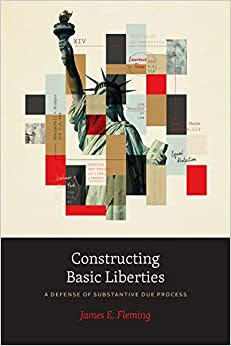
Here are the collected posts for our Balkinization symposium on Jim Fleming's new book, Constructing Basic Liberties: A Defense of Substantive Due Process (University of Chicago Press, 2022).
Posted
12:30 PM
by JB [link]
Constructing Basic Liberties: A Response to Eight Comments
Guest Blogger
For the Balkinization symposium on James E. Fleming, Constructing Basic Liberties: A Defense of Substantive Due Process (University of Chicago Press, 2022). James E. Fleming I
am enormously grateful to Jack Balkin for hosting this symposium on my new
book, Constructing Basic Liberties: A Defense of
Substantive Due Process (University of Chicago Press, 2022) and to the
contributors for commenting on it. In this brief response, I cannot possibly do
justice to all of the thoughtful criticisms they make. Instead, I will address
some of the most salient and recurring issues they raise. My primary aim will
be to make clarifications where these careful readers have shown the need to do
so. I will take up the comments in the order in which they were posted.
Posted
9:30 AM
by Guest Blogger [link]
Libertarian Insights, Errors, and Calamities
Guest Blogger
For the Balkinization Symposium on Andrew Koppelman, Burning Down the House: How Libertarian Philosophy Was Corrupted by Delusion and Greed (St. Martin’s Press, 2022). Jamie Mayerfeld Andrew
Koppelman has done us an invaluable service by tracing the development of
libertarianism, capturing its appeal, diagnosing where it went wrong, and
underscoring the terrible price to be paid for adopting its more extreme versions.
Burning Down the House is packed with information, insight, and wisdom. It
is a brilliant and necessary book that everyone should read. One
of many reasons to admire the book is Koppelman’s commitment to addressing people
across the political spectrum. He does not prescreen his audience in advance,
for example, by starting with the assumption that either capitalism or
socialism is a dirty word. His message to libertarians is that they should prefer
moderate to extreme libertarianism. His message to moderate libertarians is
that they should still relax some of their resistance to regulation and
redistribution. His message to leftists (among whom he counts himself) is that they
should support capitalism in view of its demonstrated power to alleviate domestic
and global poverty. Because most conservative libertarians and left-wing
progressives share a commitment to freedom and equality, he regards their
disagreements as a “family quarrel” amenable to evidence and reasoning. Koppelman
advocates what he calls a “moderate libertarianism” for which he finds a model
in Scandinavia’s social democratic yet indisputably capitalist economies,
combining regulated free markets with generous social welfare programs.
Posted
9:30 AM
by Guest Blogger [link]
Donald Trump's Provisional Candidacy
Gerard N. Magliocca
Tonight Donald Trump is expected to announce his third bid for the White House. Whatever you think of his prospects, there is a more basic question: Is Trump even eligible to serve again as President? Or does Section Three of the Fourteenth Amendment bar him from office because of his role in January 6th? When people want to vote when there are legal doubts about their eligibility, they cast a provisional ballot. When people want to run for office when there are legal doubts about their eligibility, the best description is that they are provisional candidates. The Supreme Court must decide as soon as possible if Donald Trump's provisional candidacy is a real one. It would be unfortunate if people gave money, volunteered for, or voted for a presidential candidate who was then deemed ineligible under the Constitution. Obtaining a prompt ruling on Trump's eligibility will be difficult. The practice of presidential campaigns far outpaces the formalities. Candidates declare well before the primaries and caucuses are held. There will not be a filing deadline for months that could be the basis of a cause of action. But there may be some creative ways to get the issue before the Court sooner. More on that soon.
Posted
10:13 AM
by Gerard N. Magliocca [link]
(0) comments
Retrieving Democracy: Andrew Koppelman and C.B. Macpherson’s Reformulation of Libertarian Political Thought
Guest Blogger
For the Balkinization Symposium on Andrew Koppelman,
Burning Down the House: How Libertarian Philosophy Was Corrupted by Delusion and Greed (St. Martin’s Press, 2022). James Hackney Burning Down the House serves the noble purpose of putting the analysis of
political theory to work in helping us better think through our contemporary
political morass. It also invites us to
think afresh about the implications of political theory. Provocatively, Andrew Koppelman tells us: “I’m
going to try to persuade leftists and libertarians that your ideals are not so
far from each other as you believe, and that you need not be enemies”. (pg. 9) In large part, Koppelman is seeking to help
us find a way to reclaim our democracy from distorted forms of libertarianism. As I read Burning Down the House, it
reminded me of another similar attempt, C.B. Macpherson’s essay “Berlin’s
Division of Liberty” published in Democratic Theory: Essays in Retrieval.[1] It’s useful to compare these two efforts, shedding
light on Koppelman’s project and perhaps furthering his goals.
Posted
9:30 AM
by Guest Blogger [link]
Communication Nation
Guest Blogger
Nick Frisch One of the more elusive words in Mandarin is jiaotong. It means, roughly,
“communications,” both in the sense of moving physical objects, and also the
flow of information—think “traffic,” “connectivity,” “transport,” and
“infrastructure.” In the names of Chinese institutions, the word occurs in
contexts that an English-speaker might find puzzling. China has several
dedicated jiaotong universities, and
a behemoth jiaotong bank. Today,
Beijing’s official department for jiaotong
translates its name as the Ministry of Transport. This huge bureau reflects the
Chinese state’s obsession with managing flows of people, products, information,
and capital: the Ministry has a heritage that dates back to imperial China,
older than either the People’s Republic (founded 1949) or the Communist Party
(founded 1921) its bureaucrats now serve. In the 21st century, in places like Silicon Valley, we have
come to see the spread of modern communications and logistics infrastructure
across borders as an unalloyed good. China has not always viewed jiaotong with such enthusiasm. China’s jiaotong institutions have roots in a
painful history that inverts the West’s narrative of borderless
techno-optimism. During Europe’s colonial expansions, China learned hard
lessons about jiaotong—and what
happens when you don’t control it on your own sovereign territory. These
lessons guide the Communist Party’s current decisions on access to, and control
over, the traffic of both physical goods and information flows.
Posted
9:30 AM
by Guest Blogger [link]
Assessing Libertarianism Requires Engagement with Modern Libertarian Political Thought
Guest Blogger
For the Balkinization Symposium on Andrew Koppelman, Burning Down the House: How Libertarian Philosophy Was Corrupted by Delusion and Greed (St. Martin’s Press, 2022).
Ilya Somin Andrew Koppelman’s Burning
Down the House makes some worthwhile points, and I agree with more of it
than I would have expected. But it is also something of a missed opportunity.
Koppelman attempts a critical analysis of libertarian political thought and its
impact on public policy. But he overlooks major aspects of both. Let’s start with a
few points of agreement. Early in the book, Koppelman recognizes that free
markets have made enormous contributions to human freedom and welfare (he calls
it “the Great Enrichment”). He also notes the validity of F.A. Hayek’s classic
critique of economic central planning, on the ground that governments lack the
knowledge needed to plan economic production competently. Perhaps most
strikingly, he points out that many on the left fail to recognize the
contradiction between their support for diversity and their sympathy for socialism;
the latter is likely to stifle the former. As Koppelman puts it, “[m]any on the
left repudiate capitalism because they don’t grasp the anti-socialist logic of
their present views.” If I have a quarrel
with this part of the book, it is that it overstates the extent to which much
of the rest of the left has internalized these points. Koppelman insists that
mainstream modern left-liberals – including even self-described “democratic socialist”
Bernie Sanders have mostly accepted Hayek’s key insights, and mostly reject
central planning. In reality, much of the left still advocates centralized
control of large parts of the economy – most notably health care and education
– and Sanders’ supposedly new version of socialism includes policies that
collectively would amount to a government takeover of the majority of
the US economy. Much of the
political right – especially in its
Trump-era incarnation, with its love of “industrial policy” – is
guilty of similar sins. Koppelman is overly optimistic when he writes that appreciation for the (limited) virtues he sees
in market processes has “prevailed across the political spectrum.”
Posted
9:00 AM
by Guest Blogger [link]
Two Cheers for Radical Libertarianism
Guest Blogger
For the Balkinization Symposium on Andrew Koppelman, Burning Down the House: How Libertarian Philosophy Was Corrupted by Delusion and Greed (St. Martin’s Press, 2022). Matt Zwolinski Ed Crane, one of the
co-founders of the libertarian Cato Institute, once
quipped that as a libertarian he always knew that it was important to be
tolerant of alternative lifestyles, but until he walked into the conventional
hall of the Libertarian Party, he had no idea just how many alternatives there
were. In the course of writing
our book on the history of libertarian thought, The
Individualists: Radicals, Reactionaries, and the Struggle for the Soul of
Libertarianism, John Tomasi and I had much the same experience. Both of
us were already familiar with the main libertarian thinkers of the 20th
century: Robert Nozick, Murray Rothbard, Ayn Rand, Ludwig von Mises. But
neither of us had sufficiently appreciated just how many differences there were
between these thinkers. And we certainly didn’t realize how much deeper,
messier, and more interesting this diversity would become once we expanded the
scope of our vision. Libertarianism, we came to realize, was not the creation
of 20th century American intellectuals. Libertarianism was born in
the 19th century, and first came on to the scene in Britain and France, only
later making its way to the United States, where it took on a strikingly
different form.
Posted
9:30 AM
by Guest Blogger [link]
The Journal of American Constitutional History
Richard Primus
I'm proud and excited to be part of the launch of a new journal, called the Journal of American Constitutional History. A number of Balkinization bloggers are editors of the journal, including Mary Dudziak, Mark Graber, Sandy Levinson, Gerard Magliocca, John Mikhail, and Mark Tushnet. You can read more about the journal at its website, which is here. Please find the first Call for Papers below. --------------------------------- Journal
of American Constitutional History Call for
Papers You are cordially invited to
submit articles to the Journal of American Constitutional History, a new
online peer-reviewed journal. At a time when law office history is increasingly
casting its shadow over both scholarship and jurisprudence, the Journal of
American Constitutional History will offer a space for scholarship that
tries to understand the past, rather than to distort it to influence present
controversies. The Journal seeks to promote
inter- and multi-disciplinary scholarly dialogue on constitutional history, and
we therefore invite submissions from disciplines outside of law, including
history and political science. The Journal will publish articles of all
lengths, from shorter essays and thought-pieces in the 4,000-to-6,000-word
range to longer, traditional articles. Authors will be able to conform to the
norms and citation styles of their respective fields. Why this
journal? The Journal of American
Constitutional History offers a serious alternative to student-edited law
reviews and the constraining expectations of student editors. Authors will not
need to erect elaborate scaffolding that shows some present-day “doctrinal
payoff.” Nor will authors have to devote thousands of words to well-known
background material, unnecessary footnotes, or literature reviews. The Journal offers much
faster publication decisions and time-to-publication than most peer-reviewed
journals. Authors can expect to receive first-level decisions within a week of
submission, and articles submitted for double-blind peer review will receive a
decision within 3-4 weeks. Each author will receive written feedback explaining
our publication decision. Articles will be published via the Journal
website as soon they are completed rather than awaiting compilation of a full
issue. Each article will be assigned a unique page range for citation purposes,
and published articles will be carried by Hein Online and other searchable
electronic databases. The Journal’s Board of
Editors comprises leading scholars in the field of constitutional history.
(Please see listing on reverse page.) Authors can thus be assured of reaching
their target audience from a distinguished platform and need not associate
“prestige” with killing trees. To submit articles, please visit our website, https://jach.law.wisc.edu,
starting December 1, 2022. For questions, please contact the Journal’s
editor-in-chief, David Schwartz, at
Posted
3:56 PM
by Richard Primus [link]
McCarthy’s Minefields
David Super
With the latest
projections showing House Republicans likely to take a five-seat majority, it
seems worth considering what their impending reign might resemble. Those concerned with the nation’s well-bring
will surely be disappointed. Those
hoping for a Democratic rebound in the 2024 elections should be buoyed. And those that enjoy political slapstick may
want to make extra popcorn. At the top line, a
majority is a majority. The House of
Representatives is designed around the same principles of “democratic
centralism” that made the Supreme Soviet all that it was. Only a simple
majority is required to elect a speaker.
My guess is that Representative McCarthy becomes speaker,
notwithstanding internal anger over the lack of a “red wave”, because of the
absence of a clear, credible alternative.
If McCarthy falls, each faction will want to put forward its own candidate
and will start trashing those of the other factions. (Liz Truss, anyone?) In some state legislatures
with tenuous majorities, the minority party has made deals with a faction of
majority-party legislators to elect one of the faction’s number to lead the
chamber in lieu of the majority party’s leader.
That is not possible here because of the lack of genuine moderates
within the House Republicans and the certainty that any Members in such a hypothetical
rump caucus would be primaried and defeated in two years. And the Democratic Party is not cohesive
enough to offer such hypothetical breakaways immunity from serious challenge in
2024. The new majority
will have little procedural difficulty bringing whatever legislation it pleases
to the floor and blocking legislation it disfavors. Because the House lacks a filibuster, the
minority has no say in how the chamber is organized. This means the majority can and typically
does give itself majorities on key committees far greater that its proportion of
the total membership of the House. Ways
and Means, Appropriations, and other priority committees will all have Republican
majorities of sixty percent or more.
(Proportionate committee membership in the Senate results from the
minority’s ability to filibuster each session’s organizing resolution and delay
the start of legislative business indefinitely if it is not treated fairly.) The House Rules
Committee likely will have a 9-4 Republican majority – the same five-vote
margin as the chamber as a whole – and will be stacked with Members absolutely
loyal to the speaker. The Rules
Committee makes grand juries look like paragons of independence: it would (and actually once did) report out a
ham sandwich. Any unwelcome amendments
that somehow get added in substantive committees may be stripped out in the Rules
Committee before the legislation goes to the floor. Knowing that, Republican Members on those
substantive committees may see little advantage to defying their committee’s leadership.
Because of their
extreme vulnerability to defections, and their inability to give endangered
Members permission to cast dissenting votes that will be politically popular
back home, the Republican leadership is likely to direct the Rules Committee to
bring almost all legislation to the floor under closed rules or “modified open
rules” that sharply limit amendments.
The relatively slender House majorities of recent years on both sides
have greatly reduced opportunities for Members to bring amendments to a vote
that could be uncomfortable for majority-party legislators; that process of
curating democracy will surely accelerate. One large open
question is the fate of motions to recommit.
One House tradition that both Democrats and Republicans have held
sacrosanct when leading the House has been that, prior to final passage, the
minority party may offer one motion to recommit that legislation to committee. This is, in effect, a single opportunity for
an amendment. Rather than directly
adding or subtracting text to a bill, or offering a substitute, a motion to recommit
sends the legislation back to committee with instructions to make the desired
additions or subtractions or to report out the desired substitute. (Some motions to recommit are offered without
instructions, but that serves little purpose as it merely duplicates the vote on
final passage.) The motion to recommit forces
a vote of the full body on one change or package of changes desired by the
minority. When they were in
the minority from 1994 to 2006 and from 2010 to 2018, Democrats’ motions to
recommit have largely sought to give their own Members opportunities to vote
for things their base desired rather than to force Republicans to cast
difficult votes. Many were wholly new
versions of the pending legislation, including provisions Republicans could safely
cite as reasons to vote “no.” Others were
cartoonish protest resolutions that posed no threat to Republican cohesion and
that no objective observer would criticize Republican Members for voting
down. Democrats’ inability to resist
including unpopular items in their motions to recommit have made these motions
politically harmless. Republican motions
to recommit, by contrast, have often been much smarter, proposing changes in
legislation with considerable public appeal and forcing Democrats to cast politically
costly votes to defeat the motion. With such a slender
majority, a Republican Rules Committee may be reluctant to continue to allow
motions to recommit on all major legislation.
If it does, the Democrats’ ability to craft more viable, reasonable
motions that stress the majority’s cohesion will depend on the willingness of
the entire Democratic caucus to vote for motions to recommit that leave intact many
troubling parts of the pending Republican legislation. The House
Republican leadership will have absolutely no capacity to discipline its Members
for pretty much anything. No matter how
egregious the conduct, an aggrieved Member can paralyze the House by getting
just two friends to join in withholding votes.
The Members will know this, and acting out by the (numerous) Members with
weak impulse control is likely to crescendo.
If the Democrats are effective at hanging the failure to punish bad behavior
on individual Members, this could help in marginal districts in 2024. Of course, that strategy will depend on
Democrats’ having the discipline only to make an issue out of behavior that
would genuinely shock swing voters rather than everything that irritates some
part of the Democratic base. The leadership
likely will struggle to move major legislation.
The Trumpist wing of the Party likely will insist on some other
constraint on deals with Democrats. Such
constraints will magnify the power of their threats to withhold votes. Perhaps mildest restraint the leadership can
hope for is reinstatement of the “Hastert Rule,” which allows legislation to
move if but only if it enjoys majority support within the majority party. Crucial may be whether primary-fearing Republican
Members are forced to declare publicly their support for legislation proceeding
publicly: if they must, the leadership
may face continual deadlock. Appropriations
bills typically have remained at least somewhat bipartisan even in a sharply
polarized House: they provide the ideal
vehicle for buying off Members of the minority party without either side making
ideological concessions. But if some
far-right Republican Members refuse to vote for appropriations bills that fail to
defund investigations of former President Trump (or of themselves), the leadership
may struggle to get their primary-fearing Members to vote for a bill dependent
on many Democratic votes to pass. Funding
for Ukraine, which enjoys significant Republican support, seems secure; if the pro-Russian
faction cannot find a political “off-ramp” to allow such legislation to move,
they may make Democrats’ votes even more indispensable to their own leadership
and hence strengthen Democrats’ bargaining positions. To minimize the
number of divisive votes required, the leadership may largely abandon the
annual appropriations process in favor of a single catch-all omnibus
appropriations bill in the fall. Perhaps
they will seek the appearance of normality by passing a few smaller
appropriations bills for less controversial agencies in the interim. On the other hand, the leadership may try to
fund Ukraine entirely through separate supplemental appropriations so that
their need for bipartisanship on that funding does not force them to reach broader
appropriations deals with Democrats. Non-appropriations
bills will be even harder. Various House
Republican factions will have demands about what conditions to place on legislation
raising the Debt Limit, due fairly early next year. The leadership will struggle to get them down
to a single demand even though a laundry list would surely be difficult to defend
to the public and especially to business-oriented donors unwilling to risk a
default. The most likely scenario, once those
donors weigh in, may be for the House to pass highly conditional, politically
infeasible debt limit bill with only Republican votes, go to conference with
the Senate, and bring back a “clean” debt limit increase that achieves final
passage largely with Democratic votes.
The dissention that would bring likely would imperil the leadership’s ability
to move legislation for some weeks or months thereafter. Disruptive
investigations should be easy to maintain:
they require only the initiative of the pertinent committee chairs and
can significantly hobble the Biden Administration’s capacity to function. On the other hand, impeachment, whether of
President Biden or Administration officials, could pose serious challenges for
the leadership. It likely will have many
Members in marginal districts that are leery of voting for an unsupported
impeachment. Bringing impeachment to the
floor and losing would intensify right-wing activists’ cries of “RINO”. But getting incoming Judiciary Chairman Jim Jordan
to slow-walk impeachment to save his marginal colleagues from difficult votes
seems unlikely. Because House
rules so completely entrench the majority party’s power, transitioning from
majority to minority or vice versa is extremely challenging. Few Members, and even fewer leaders, do it
well because the two roles require fundamentally different skill sets. Speaker Pelosi is one of the few adept at both
jobs: indeed, as gifted a Speaker as she
has been, she was the most effective Minority Leader in many, many decades. Many Republican
bomb-throwers that have thrived in the minority will have extremely difficult
paths to the lower-profile, more cooperative profile needed to have an impact
in the majority. If they fail to make
the transition, they will hand President Biden and their Democratic challengers
in 2024 the perfect “do-nothing Congress” piñata to bash for failure to respond
to the likely economic downturn. If I
were Representative McCarthy, I might well be quietly rooting for the remaining
toss-up races to break for the Democrats and save me from embarrassing failure
leading this caucus with a slender majority.
@DavidASuper1
Posted
10:05 AM
by David Super [link]
Libertarianism or Callousness
Guest Blogger
Koppelman
opens Burning Down the House with a true story meant to horrify us,
about a man, Gene Cranick, whose house burned down because he had forgotten to
pay the fire department’s bill. Painted as the consequence of everything wrong
with libertarianism, the story more evokes the recurring theme of libertarian
darling Frédéric Bastiat’s pamphlet What is seen and what is not seen
(“Ce qu'on voit et ce qu'on ne voit pas”), admittedly not from his economic
perspective. What is seen in Koppelman’s story is fire; what is not
seen is the consequence of not paying one’s local taxes. The
purpose of telling the fire story is to illustrate that it is monstrous to let
supposed “libertarian idealism” result in someone’s house burning down because
they didn’t pay their fire bill. But complicating this story is that Cranick’s
wife offered to pay “whatever the cost” on the spot if the fire department
came, and that the fire department now will show up to a non-payer’s house for
$3,500. Libertarian philosophy does not require the fire department to refuse to
show up at the house despite the caller offering to pay a profitable sum for
the service. And while there’s a fair moral argument to be had about price
gouging, the fact that the house didn’t need to burn down even within an
extreme libertarian framework should be a clue that the villain of Koppelman’s
story isn’t actually libertarianism.
Posted
9:30 AM
by Guest Blogger [link]
Saving the House From Destruction A Classical Liberal Response to Andrew Koppelman
Guest Blogger
For the Balkinization Symposium on Andrew Koppelman, Burning Down the House: How Libertarian Philosophy Was Corrupted by Delusion and Greed (St. Martin’s Press, 2022). Richard A. Epstein In
writing this short commentary on Andrew Koppelman’s provocative book, Burning Down The House: How Libertarian
Philosophy Was Corrupted by Delusion and Greed, I will start by
addressing Koppelman’s opening story of the house that burned down. Gene Cranick of Obion, Tennessee succumbed to financial
ruin after a fire levelled his house in 2010. He had inadvertently forgotten to
pay the $75 premium to renew his fire insurance policy from a private carrier. Cranick’s
wife called 911 and offered to pay “whatever the cost,” but, according to
Koppelman, that was “not an option.” In response to the incident, conservative
commentators like Glenn Beck and Jonah Goldberg represented, it appears,
delusion and greed when they insisted that the individual tragedy was in
service of a higher purpose, since it ensured that the fire department had the
revenues to maintain its services in the long run. Their fear was that once it
was known that the service could be secured for free, no one would pay for it, thus
effectively creating a nation of freeloaders. Koppelman
insists that this one incident captures the theoretical bankruptcy of
libertarian theory, insofar as that theory rests on two key tenets: first, that
people are on their own in the world, responsible for their own fate, and second,
that their need does not make a claim on others’ resources. That callous
position obviously spells doom for any system of comprehensive health care,
workplace injuries, fire, or disease. Koppelman’s broadside, however, does not consider
how these systems are put together or justified in a classical liberal as
opposed to a libertarian framework. So
it behooves us to take a closer look at Cranick’s disaster. First, it is
immediately obvious that no one in 2010 should be required to renew his fire
insurance annually in a separate transaction. The standard practice allows for
automatic renewal precisely to avoid the trap that doomed the Cranicks. Markets
can supply that solution without any form of government regulation. Second,
Koppelman does not explain why payment of whatever it costs was not an “option”
for the Cranicks, even though it surely should have been. The standard rules of
restitution make it very clear that a company that puts out fires without
an invitation can recover the reasonable costs of its services (including a
normal profit) from the property owner who is in no position to defend his own
property. The same proposition thus applies a fortiori to the case where
the services are explicitly requested. The price need not be determined at the
time of the disaster, but it can be set afterwards by arbitration or judicial determination.
Any professional fire department should know these ropes and thus should be
able to proceed in putting out the fire in perfect confidence that it could
have a lien on the burning property (whose land surely has value) for the
payment of services. The Cranick’s case is a regrettable outlier, but similar
cases can be handled properly by recourse to sound and well-established legal
principles.
Posted
9:30 AM
by Guest Blogger [link]
Balkinization Symposium on Andrew Koppelman, Burning Down the House: How Libertarian Philosophy Was Corrupted by Delusion and Greed
JB
At the conclusion, Andy will respond to the commentators.
This week at Balkinization we are hosting a symposium on Andy Koppelman's new book, Burning Down the House: How Libertarian Philosophy Was Corrupted by Delusion and Greed (St. Martin’s Press, 2022).
We have assembled a terrific group of commentators, including Jonathan Adler (Case Western), Jennifer Burns (Stanford), Richard Epstein (Chicago/Hoover/NYU), James Hackney (Northeastern), Jamie Mayerfeld (Univ. of Washington), Christina Mulligan (Brooklyn), Ilya Somin (George Mason), and Matt Zwolinski (San Diego).
Posted
9:00 AM
by JB [link]
Disorganizing the New House
Gerard N. Magliocca
With control of the new House of Representatives still in doubt, I am reposting this old post of mine from August. The chances that there will be serious Section 3 challenges in January are growing. ----------------------------------------------------------------------------------- The latest election chatter is that Democratic prospects are improving. Maybe they can hold the House of Representatives or keep Republican gains to a minimum. Who knows. But there is a problem lurking. It is likely that a couple of Republican House members will be challenged on Section Three grounds in January. In other words, a House Democrat will say that Representative so-and-so is ineligible to serve in the House because of his or her participation in the insurrection. Then the House will have to set up some process to address the challenge. Here's the tricky part: As I understand past practice, a challenged member-elect may not serve until the challenge is resolved. In a very closely divided House, this could mean that a Republican majority of say, 3 seats, is no majority at all because at least 3 GOP Members will be challenged. The seats will be vacant until the challenge is resolved. And who knows how long that could drag out (or be dragged out). In the meantime, the House will be even more chaotic than usual. Of course, if the Democrats retain their House majority in November, then one or more GOP House members may be excluded on Section 3 grounds and will then challenge that exclusion in the courts. The issue of whether Powell v. McCormack applies to Section Three is unresolved. UPDATE: Of course,Brian Kalt has a draft paper up that covers various scenarios about organizing a closely divided Congress.
Posted
6:52 AM
by Gerard N. Magliocca [link]
(0) comments
Tradition and the establishment clause
Andrew Koppelman
These days, the Supreme Court presents itself as faithfully
following the law, while it does pretty much whatever it wants to. For example, it invokes tradition as a constraint
on its discretion, while manipulating its meaning in order to avoid enforcing
constitutional provisions it doesn’t like – such as the Establishment Clause. I elaborate in a new column at The Hill.
Posted
11:18 AM
by Andrew Koppelman [link]
Books by Balkinization Bloggers

Gerard N. Magliocca, The Actual Art of Governing: Justice Robert H. Jackson's Concurring Opinion in the Steel Seizure Case (Oxford University Press, 2025)

Linda C. McClain and Aziza Ahmed, The Routledge Companion to Gender and COVID-19 (Routledge, 2024)

David Pozen, The Constitution of the War on Drugs (Oxford University Press, 2024)

Jack M. Balkin, Memory and Authority: The Uses of History in Constitutional Interpretation (Yale University Press, 2024)
Mark A. Graber, Punish Treason, Reward Loyalty: The Forgotten Goals of Constitutional Reform after the Civil War (University of Kansas Press, 2023)
Jack M. Balkin, What Roe v. Wade Should Have Said: The Nation's Top Legal Experts Rewrite America's Most Controversial Decision - Revised Edition (NYU Press, 2023)
Andrew Koppelman, Burning Down the House: How Libertarian Philosophy Was Corrupted by Delusion and Greed (St. Martin’s Press, 2022)

Gerard N. Magliocca, Washington's Heir: The Life of Justice Bushrod Washington (Oxford University Press, 2022)
Joseph Fishkin and William E. Forbath, The Anti-Oligarchy Constitution: Reconstructing the Economic Foundations of American Democracy (Harvard University Press, 2022)
Mark Tushnet and Bojan Bugaric, Power to the People: Constitutionalism in the Age of Populism (Oxford University Press 2021).

Mark Philip Bradley and Mary L. Dudziak, eds., Making the Forever War: Marilyn B. Young on the Culture and Politics of American Militarism Culture and Politics in the Cold War and Beyond (University of Massachusetts Press, 2021).

Jack M. Balkin, What Obergefell v. Hodges Should Have Said: The Nation's Top Legal Experts Rewrite America's Same-Sex Marriage Decision (Yale University Press, 2020)

Frank Pasquale, New Laws of Robotics: Defending Human Expertise in the Age of AI (Belknap Press, 2020)

Jack M. Balkin, The Cycles of Constitutional Time (Oxford University Press, 2020)

Mark Tushnet, Taking Back the Constitution: Activist Judges and the Next Age of American Law (Yale University Press 2020).

Andrew Koppelman, Gay Rights vs. Religious Liberty?: The Unnecessary Conflict (Oxford University Press, 2020)

Ezekiel J Emanuel and Abbe R. Gluck, The Trillion Dollar Revolution: How the Affordable Care Act Transformed Politics, Law, and Health Care in America (PublicAffairs, 2020)

Linda C. McClain, Who's the Bigot?: Learning from Conflicts over Marriage and Civil Rights Law (Oxford University Press, 2020)
Sanford Levinson and Jack M. Balkin, Democracy and Dysfunction (University of Chicago Press, 2019)

Sanford Levinson, Written in Stone: Public Monuments in Changing Societies (Duke University Press 2018)

Mark A. Graber, Sanford Levinson, and Mark Tushnet, eds., Constitutional Democracy in Crisis? (Oxford University Press 2018)

Gerard Magliocca, The Heart of the Constitution: How the Bill of Rights became the Bill of Rights (Oxford University Press, 2018)

Cynthia Levinson and Sanford Levinson, Fault Lines in the Constitution: The Framers, Their Fights, and the Flaws that Affect Us Today (Peachtree Publishers, 2017)

Brian Z. Tamanaha, A Realistic Theory of Law (Cambridge University Press 2017)

Sanford Levinson, Nullification and Secession in Modern Constitutional Thought (University Press of Kansas 2016)

Sanford Levinson, An Argument Open to All: Reading The Federalist in the 21st Century (Yale University Press 2015)

Stephen M. Griffin, Broken Trust: Dysfunctional Government and Constitutional Reform (University Press of Kansas, 2015)

Frank Pasquale, The Black Box Society: The Secret Algorithms That Control Money and Information (Harvard University Press, 2015)

Bruce Ackerman, We the People, Volume 3: The Civil Rights Revolution (Harvard University Press, 2014)
Balkinization Symposium on We the People, Volume 3: The Civil Rights Revolution

Joseph Fishkin, Bottlenecks: A New Theory of Equal Opportunity (Oxford University Press, 2014)

Mark A. Graber, A New Introduction to American Constitutionalism (Oxford University Press, 2013)

John Mikhail, Elements of Moral Cognition: Rawls' Linguistic Analogy and the Cognitive Science of Moral and Legal Judgment (Cambridge University Press, 2013)

Gerard N. Magliocca, American Founding Son: John Bingham and the Invention of the Fourteenth Amendment (New York University Press, 2013)

Stephen M. Griffin, Long Wars and the Constitution (Harvard University Press, 2013)

Andrew Koppelman, The Tough Luck Constitution and the Assault on Health Care Reform (Oxford University Press, 2013)

James E. Fleming and Linda C. McClain, Ordered Liberty: Rights, Responsibilities, and Virtues (Harvard University Press, 2013)
Balkinization Symposium on Ordered Liberty: Rights, Responsibilities, and Virtues

Andrew Koppelman, Defending American Religious Neutrality (Harvard University Press, 2013)

Brian Z. Tamanaha, Failing Law Schools (University of Chicago Press, 2012)

Sanford Levinson, Framed: America's 51 Constitutions and the Crisis of Governance (Oxford University Press, 2012)

Linda C. McClain and Joanna L. Grossman, Gender Equality: Dimensions of Women's Equal Citizenship (Cambridge University Press, 2012)

Mary Dudziak, War Time: An Idea, Its History, Its Consequences (Oxford University Press, 2012)

Jack M. Balkin, Living Originalism (Harvard University Press, 2011)

Jason Mazzone, Copyfraud and Other Abuses of Intellectual Property Law (Stanford University Press, 2011)

Richard W. Garnett and Andrew Koppelman, First Amendment Stories, (Foundation Press 2011)

Jack M. Balkin, Constitutional Redemption: Political Faith in an Unjust World (Harvard University Press, 2011)

Gerard Magliocca, The Tragedy of William Jennings Bryan: Constitutional Law and the Politics of Backlash (Yale University Press, 2011)

Bernard Harcourt, The Illusion of Free Markets: Punishment and the Myth of Natural Order (Harvard University Press, 2010)

Bruce Ackerman, The Decline and Fall of the American Republic (Harvard University Press, 2010)
Balkinization Symposium on The Decline and Fall of the American Republic

Ian Ayres. Carrots and Sticks: Unlock the Power of Incentives to Get Things Done (Bantam Books, 2010)

Mark Tushnet, Why the Constitution Matters (Yale University Press 2010)

Ian Ayres and Barry Nalebuff: Lifecycle Investing: A New, Safe, and Audacious Way to Improve the Performance of Your Retirement Portfolio (Basic Books, 2010)
.jpg)
Jack M. Balkin, The Laws of Change: I Ching and the Philosophy of Life (2d Edition, Sybil Creek Press 2009)

Brian Z. Tamanaha, Beyond the Formalist-Realist Divide: The Role of Politics in Judging (Princeton University Press 2009)
Andrew Koppelman and Tobias Barrington Wolff, A Right to Discriminate?: How the Case of Boy Scouts of America v. James Dale Warped the Law of Free Association (Yale University Press 2009)

Jack M. Balkin and Reva B. Siegel, The Constitution in 2020 (Oxford University Press 2009)

Heather K. Gerken, The Democracy Index: Why Our Election System Is Failing and How to Fix It (Princeton University Press 2009)

Mary Dudziak, Exporting American Dreams: Thurgood Marshall's African Journey (Oxford University Press 2008)

David Luban, Legal Ethics and Human Dignity (Cambridge Univ. Press 2007)

Ian Ayres, Super Crunchers: Why Thinking-By-Numbers is the New Way to be Smart (Bantam 2007)

Jack M. Balkin, James Grimmelmann, Eddan Katz, Nimrod Kozlovski, Shlomit Wagman and Tal Zarsky, eds., Cybercrime: Digital Cops in a Networked Environment (N.Y.U. Press 2007)

Jack M. Balkin and Beth Simone Noveck, The State of Play: Law, Games, and Virtual Worlds (N.Y.U. Press 2006)

Andrew Koppelman, Same Sex, Different States: When Same-Sex Marriages Cross State Lines (Yale University Press 2006)

Brian Tamanaha, Law as a Means to an End (Cambridge University Press 2006)

Sanford Levinson, Our Undemocratic Constitution (Oxford University Press 2006)

Mark Graber, Dred Scott and the Problem of Constitutional Evil (Cambridge University Press 2006)

Jack M. Balkin, ed., What Roe v. Wade Should Have Said (N.Y.U. Press 2005)

Sanford Levinson, ed., Torture: A Collection (Oxford University Press 2004)
Balkin.com homepage
Bibliography
Conlaw.net
Cultural Software
Writings
Opeds
The Information Society Project
BrownvBoard.com
Useful Links
Syllabi and Exams
