Balkinization
an unanticipated consequence of
Jack M. Balkin
Balkinization Symposiums: A Continuing List
E-mail:
Jack Balkin:
jackbalkin at yahoo.com
Bruce Ackerman
bruce.ackerman at yale.edu
Ian Ayres
ian.ayres at yale.edu
Corey Brettschneider
corey_brettschneider at brown.edu
Mary Dudziak
mary.l.dudziak at emory.edu
Joey Fishkin
joey.fishkin at gmail.com
Heather Gerken heather.gerken at yale.edu
Abbe Gluck abbe.gluck at yale.edu
Mark Graber
mgraber at law.umaryland.edu
Stephen Griffin
sgriffin at tulane.edu
Jonathan Hafetz
jonathan.hafetz at shu.edu
Jeremy Kessler
jkessler at law.columbia.edu
Andrew Koppelman
akoppelman at law.northwestern.edu
Marty Lederman
msl46 at law.georgetown.edu
Sanford Levinson
slevinson at law.utexas.edu
David Luban
david.luban at gmail.com
Gerard Magliocca
gmaglioc at iupui.edu
Jason Mazzone
mazzonej at illinois.edu
Linda McClain
lmcclain at bu.edu
John Mikhail
mikhail at law.georgetown.edu
Frank Pasquale
pasquale.frank at gmail.com
Nate Persily
npersily at gmail.com
Michael Stokes Paulsen
michaelstokespaulsen at gmail.com
Deborah Pearlstein
dpearlst at yu.edu
Rick Pildes
rick.pildes at nyu.edu
David Pozen
dpozen at law.columbia.edu
Richard Primus
raprimus at umich.edu
K. Sabeel Rahmansabeel.rahman at brooklaw.edu
Alice Ristroph
alice.ristroph at shu.edu
Neil Siegel
siegel at law.duke.edu
David Super
david.super at law.georgetown.edu
Brian Tamanaha
btamanaha at wulaw.wustl.edu
Nelson Tebbe
nelson.tebbe at brooklaw.edu
Mark Tushnet
mtushnet at law.harvard.edu
Adam Winkler
winkler at ucla.edu
Compendium of posts on Hobby Lobby and related cases
The Anti-Torture Memos: Balkinization Posts on Torture, Interrogation, Detention, War Powers, and OLC
The Anti-Torture Memos (arranged by topic)
Recent Posts
Originalism, Meet the Federalist Constitution
Dobbs, the Politics of Constitutional Memory, and the Future of Reproductive Justice
A Constitutional Blog in Constitutional Time
Why Jack Balkin is Kindling
A Napoleon Complex
Toward Public Identity Constitutionalism
Giving Up on the Supreme Court is the Beginning, Not the End, of Progressive Constitutional Theory in the 21st Century
The Original Meaning of Enumerated Powers
The Constitution is in Trouble
Follow the French! : The Urgent Need to Rethink America’s System of Political Primaries
What Roe v. Wade Should Have Said - Revised Edition
Legitimating and Delegitimating Constitutional Theory
When History Becomes Precedent in the OLC
Theorizing Context
Does it really take a Theory to beat a Theory?
Constitutional Theory in Crisis?
The State of Constitutional Theory
How to Choose a Theory of Constitutional Interpretation
The Balkinization 20th Anniversary Symposium on the Present State of Constitutional Theory
LevinsonFest on Federation and Secession Collected Posts
![[Powered by Blogger]](https://lh3.googleusercontent.com/blogger_img_proxy/AEn0k_spkjOwvN1KGkHtjcD50pmzNYu1zuc_XD_yY6AleKi1HKQLmmpx4HKroQR4XnLYY5aFSKxcmFUMPkqFv-9ZTa_ckkD-bNn0LV_Zm-ccpmTo=s0-d)
Just A Few Blogs
ACS Blog
Alas, a Blog
Althouse
Arts and Letters Daily
Atrios (Eschaton)
Bill of Health
Buzzflash.com
Buzz Machine
Cato at Liberty
Juan Cole (Informed Comment)
Concurring Opinions
The Constitution in 2020
Corrente
Crooked Timber
Daily Howler
Daily Kos
Dana Boyd
Brad DeLong
Digby (Hullabaloo)
Discriminations
Daniel Drezner
Kevin Drum (Mother Jones)
Electrolite
En Banc
Eunomia (Daniel Larison)
Fafblog
Michael Froomkin (Discourse.net)
GovLab (Beth Noveck)
Rick Hasen (Election Law)
History News Network
How Appealing
Ignatz (Sam Heldman)
The Importance of (Ernie Miller)
Infolaw
Instapundit
International Economic Law and Policy Blog
IntLawGrrls
Jacob Levy
Jesus' General
Jurisdynamics
The Kitchen Cabinet
Mark Kleiman
Law Blog Central
Larry Lessig
Lawyers, Guns and Money
Liberal Oasis
Brian Leiter's Law School Reports
The Leiter Reports
Marginal Revolution
Megan McArdle
Memeorandum
Metafilter
Mirror of Justice
The New Republic
Newseum
No More Mister Nice Blog
Brendan Nyhan
Opinio Juris
Orcinus
The Originalism Blog
Pandagon
Passport (Foreign Policy)
Overcoming Bias
Political Animal (Washington Monthly)
Political Theory Daily Review
Political Wire (Taegan Goddard)
The Poor Man
Virginia Postrel
Prawfsblawg
Public Reason
Jonathan Rauch
Raw Story
Redstate
ReligiousLeftLaw.com
Reporters Committee For Freedom of the Press
Reproductive Rights Blog
Rothman's Roadmap to the Right of Publicity
SCOTUS Blog
Seeing the Forest
Clay Shirky
The Shifted Librarian
The Situationist
Larry Solum (Legal Theory)
Andrew Sullivan
Talking Points Memo
Talk Left
Tapped
Tbogg
TechPresident
The Paper Chase (Jurist)
Tom Paine
Tom Tomorrow (This Modern World)
Eve Tushnet
Uggabugga
University of Chicago Law School Faculty Blog
Unqualified Offerings
The Volokh Conspiracy
War and Piece (Laura Rozen)
Wampum
Oliver Willis
Wonkette
Written Description
Matthew Yglesias
Yin
Your Choice of Feeds
1. XML
powered by

2. Atom Feed
3. RSS 2.0
Originalism, Meet the Federalist Constitution
Andrew Coan
(co-authored with David S. Schwartz) A growing literature aims to excavate and recover “the Federalist Constitution”—that is, the “vision of the Constitution held between 1787 and 1800 by leading figures in the struggle for constitutional ratification and, thereafter, by leading figures in the Federalist Party.” This literature has done much to unsettle received Jeffersonian-Madisonian narratives of the American founding which treat a limiting enumeration of powers as “the essential characteristic” of the national government established by the Constitution. In fact, many prominent Federalists of the founding generation took a very different view, as their Anti-Federalist opponents well recognized. But thus far, this literature has been predominantly historical and historiographical. As such, it has mostly focused on the views, intentions, and political projects of particular individuals and groups. It has not frontally engaged originalist arguments for limited, enumerated powers on their own terms—that is, in terms of original public meaning. Our new draft article takes up this gauntlet. We begin by demonstrating that the original semantic meaning of enumeration was fundamentally indeterminate. All of the standard textual arguments for limited, enumerated powers—what one of us has called “enumerationism”—require that the reader presuppose or assume their conclusion. Read without a presupposition of enumerationism, the original semantic meaning of the text is perfectly consistent with a federal government empowered to address all important national problems. Indeed, several of the Constitution’s provisions—including the General Welfare Clause, the Necessary and Proper Clause, and the Preamble—are most naturally read to create just such a government, though their semantic meaning does not decisively resolve the question.
Posted
9:30 AM
by Andrew Coan [link]
Dobbs, the Politics of Constitutional Memory, and the Future of Reproductive Justice
Guest Blogger
For the Balkinization 20th Anniversary Symposium Reva Siegel
In Dobbs, the Supreme Court justified its decision to overrule Roe
by claiming it was aligning America’s constitutional law with its history and
traditions. Dobbs proclaimed that it was cleansing the law of
politics. But in fact Dobbs was playing Memory
Games in which “originalist judges ventriloquize historical sources.” Dobbs’s claims about America’s history and
traditions are constructions designed to justify the Court’s decision to
overrule Roe. Constitutional memory
has a politics. Constitutional interpreters continuously make claims on our
past in arguing about who we are and what we should do. These claims on the
past—in originalist and other modes of constitutional argument, inside and
outside the courts—legitimate the exercise of state power. For this reason, constitutional
memory claims are value laden and interested—whether true, false, or as they
most commonly are, selective in their account of the historical record. To commemorate Roe’s fiftieth
anniversary—and to illustrate the critical and constructive power of the
concept of constitutional memory—I show how Dobbs’s employed selective
claims about America’s “history and
traditions” to celebrate inequality as freedom, and I suggest how different
claims on constitutional memory might mobilize critique and resistance to the
vision of America Dobbs celebrates.
Posted
9:30 AM
by Guest Blogger [link]
A Constitutional Blog in Constitutional Time
Guest Blogger
For the Balkinization 20th Anniversary Symposium David
Pozen Balkinization isn’t what it
used to be. When
I was a law student, from 2004 to 2007, I thought Balkinization was riveting stuff. I visited the site regularly. I
read every post. I admired the authors. I felt like they were my teachers, as
well as models of engaged scholars, and their time-stamped entries an important
supplement to my formal legal education. Fifteen-odd
years later, it’s hard to imagine my own students feeling that way. The vast
majority of them say they have never heard of Balkinization. The vast majority of posts, Blogger tells me, are perused
by fewer than 200 people; many have “view counts” in the double digits. I don’t
have directly comparable data from the mid-aughts, but it appears the
readership was a good deal larger then. Paul Caron reported in October 2008
that over the previous twelve months, Balkinization
had received 1,132,377 visitors and 1,962,322 page views. Qualitatively,
too, the blog loomed larger. It was routinely characterized as
“influential.” “‘Balkinization,’” Lyle Denniston wrote in 2006, “is
often visited, and deservedly so.” The Weekly
Standard described Balkinization as “much-read.” Richard
Posner sang its praises. Professional
journalists and congressional staffers looked to it for legal
guidance. The blog’s arguments, the Washington
Post observed on the day of
President Obama’s first inauguration, are “often cited by members of the Obama
team.” The
contributors to Balkinization are as
smart as ever. The subjects of discussion are as vital as ever. And the
eponymous Jack Balkin has only become more renowned over the past two decades.
Yet whereas the blog helped shape the constitutional conversation in the
mid-2000s, at least in certain elite circles, it now seems to play a more
peripheral role. What explains the apparent decline in influence, and what might
this suggest about the state of American constitutionalism?
Posted
9:30 AM
by Guest Blogger [link]
Why Jack Balkin is Kindling
Guest Blogger
For the Balkinization 20th Anniversary Symposium After Jack invited me to join
Balkinization in 2007, he had to work pretty hard to get me to do it. Resistance was foolish. My work here led me to produce my two books
on libertarianism – most recently Burning
Down the House: How Libertarian Philosophy Was Corrupted by Delusion and Greed. I became
interested in libertarianism by accident.
In 2010 I was invited to give a presentation about recent constitutional
challenges to Obamacare. I hadn’t
followed that litigation. I looked at
the objections and concluded that they were nonsense, as many other scholars
did. Then, to the surprise of many, two
federal district courts declared the law unconstitutional. I got upset. The reasoning was flagrantly bad, manifestly
driven by the judges’ political views. So
I wrote up my responses to those decisions and posted
them
on the blog. More such decisions kept coming. With only a few exceptions, judges appointed
by Republicans accepted arguments that were inconsistent with nearly two
hundred years of settled law. Had I not had the privilege of
easily publishing short, technical legal analyses, I wouldn’t have started
working in this area. But I did, and
eventually, as the Obamacare litigation built up momentum, I became a prominent
enough voice that Oxford University Press solicited a book, which became The
Tough Luck Constitution and the Assault on Health Care Reform.
Posted
9:00 AM
by Guest Blogger [link]
A Napoleon Complex
Guest Blogger
For the Balkinization 20th Anniversary Symposium Gerard Magliocca Congratulations
to Balkinization on its 20th anniversary. Really, congratulations to Jack, who
started this community and was the only blogger for its first few years. That’s
the good news. The bad news is that a constitutional problem that has consumed
much of our attention since 2003 is still alive and well. The
problem is the unbounded presidency. Balkinization began against the backdrop
of preparations for the Second Gulf War and hit its stride in posts that criticized
the Bush Administration’s overreach on issues such as torture, executive
detention, and warrantless surveillance. While the aftermath of the September
11th terrorist attacks was bound to produce a more assertive Executive Branch,
peace did not fully reset the constitutional balance. Instead, presidents of
both parties have increasingly turned to dubious executive orders and emergency
powers to achieve goals that Congress would not pass. Sometimes the courts
eventually block these executive measures, but too often they do not. What
explains this trend? If President Trump were the only culprit, then you could
just blame his bizarre psychology. But he is just the worst--not the only--example.
Political polarization is partly to blame. Past presidents wielded less power
over their administrations because of the strength of rival factions within
their parties. Many presidents could not simply fire a senior Cabinet member or
afford to let one resign in protest over a controversial decision. If either type
of acrimonious departure happened, then the faction that the former official
represented could bring down the Administration. In this sense, many
presidencies functioned like or even modeled themselves on the British Cabinet
system. Not anymore. The party unity created by polarization removes this internal
political constraint on the President. Today only the threat of widespread
resignations with the Executive Branch, including some senior civil servants, seems
to give presidents pause.
Posted
11:00 AM
by Guest Blogger [link]
Toward Public Identity Constitutionalism
Guest Blogger
For the Balkinization 20th Anniversary Symposium Paul Gowder I'd like to
sketch out a preliminary outline of a different way to think about the
relationship between constitutional law and democracy, one inspired by some of
James Baldwin's remarks about the relationship between the struggle for racial
equality and American political identity. This is something I've been vaguely
groping toward through a variety of articles and bits of the most recent book for a few years. For present purposes, we could call
it "public identity constitutionalism," although that name is
tentative at best.
Begin with some context. The critics of contemporary Warren-Court-and-beyond
left-leaning constitutionalism love to portray it as an enterprise without
principled legal foundations.
Originalists insist that progressive constitutional jurisprudence is
just unbounded "living constitutionalism" in which left-wing judges
impose their politics (or their moral values or whatever) on the rest of us.
But critics of originalism from both the left and, more recently, the right
(the most prominent example of the latter being Vermeule's "common good
constitutionalism") have tended to observe that originalists too are
imposing their politics/morals on the public, because originalism is far less
determinate and constraining than its proponents take it to be.
Posted
9:30 AM
by Guest Blogger [link]
Giving Up on the Supreme Court is the Beginning, Not the End, of Progressive Constitutional Theory in the 21st Century
Guest Blogger
Posted
11:00 AM
by Guest Blogger [link]
The Original Meaning of Enumerated Powers
Andrew Coan
The powers of Congress are limited to those enumerated in the Constitution and must not be construed as the equivalent of a general police power. This doctrine of “enumerationism” is the linchpin of a multi-decade conservative assault on the broad conception of federal powers recognized by the Supreme Court since 1937. The loudest champions of enumerationism are originalists. But even critics of originalism generally accept that enumerationism is rooted in the original public meaning of the Constitution. Indeed, it is difficult to think of a stronger—or broader—consensus on an important question of original meaning. In a new draft article, David Schwartz and I challenge that consensus. Despite its wide acceptance, the originalist case for enumerationism is remarkably weak and under-theorized. At the same time, enumerationists have largely ignored strong arguments that the original public meaning of enumeration was indeterminate. The constitutional text nowhere says that the federal government is limited to its enumerated powers. To the contrary, several provisions—the General Welfare Clause, the Necessary and Proper Clause, and the Preamble—could plausibly be read to support a congressional power to address all national problems. The historical context of the founding era is similarly ambiguous. Many readers certainly understood the Constitution to presuppose some form of enumerationism, but many did not. If these arguments are correct, enumerationism falls into the “construction zone,” where history, judicial precedent, and other sources fill the gaps in original public meaning. It is history and precedent, not original meaning, that supply the strongest arguments for enumerationism. Yet the history of enumerationism is complex and fraught with contestation. For most of that history, Congress has routinely legislated as if it possessed the power to address all national problems. The Supreme Court has generally followed suit, embracing enumerationism in theory while circumventing it in practice. A constitutional construction that followed this traditional approach would pose no substantial obstacle to any important federal legislation. For a fuller explanation, see our draft article “The Original Meaning of Enumerated Powers.”
Posted
9:30 AM
by Andrew Coan [link]
The Constitution is in Trouble
Guest Blogger
Posted
11:00 AM
by Guest Blogger [link]
Follow the French! : The Urgent Need to Rethink America’s System of Political Primaries
Guest Blogger
For the Balkinization 20th Anniversary Symposium Bruce Ackerman Americans confronts
a host of problems in their struggle to sustain their democracy in the twenty-first
century – from partisan gerrymandering to presidential war-making to …. (I
leave it to you to fill in the blank.) But
one big problem has escaped attention: the fact that the two major parties hold
separate primaries at which voters choose the Democratic and Republican candidates
who will compete for the presidency in the general election. This is a
big mistake. The two-party primary system is one of the most serious real-world
threats to American democracy. The
French organize their election system in a very different fashion – and one that
makes it far harder for nationalist demagogues to gain the presidency. [1] Call it the “unified primary” system. In contrast to the United States, a wide range of political parties offer up their presidential nominees in a single primary in which all voters cast their ballots. The top two candidates who win the most votes then compete for the presidency at the general election, while the others are eliminated from the final ballot. But the runners-up remain very influential -- since they will mobilize their followers to back the final-candidate whose policies are closer to their own political program. This dynamic of runner-up coalition-formation is a fundamental feature of the unified system, and I hope to persuade you that it would make it much harder for Trumpish authoritarians to win the White House over the coming generation – long after Trump himself passes into history.
Posted
9:30 AM
by Guest Blogger [link]
What Roe v. Wade Should Have Said - Revised Edition
JB
The contributors include Anita Allen, Akhil Amar, Teresa Stanton Collett, Michael Stokes Paulsen, Jeffrey Rosen, Jed Rubenfeld, Reva Siegel, Cass Sunstein, Mark Tushnet, Robin West, and myself. This book is part of a trilogy on important Supreme Court cases. The other two volumes are What Brown v. Board of Education Should Have Said and What Obergefell v. Hodges Should Have Said.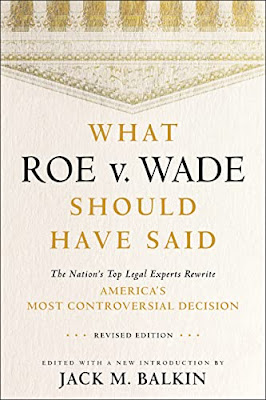
NYU Press has just published a new revised edition of my 2005 book, What Roe v. Wade Should Have Said. The book features eleven opinions by legal scholars explaining how they would have written Roe v. Wade. For this edition I've written a revised introduction that tells the the story of the constitutional struggles over abortion leading up to the 2022 decision in Dobbs v. Jackson Women's Health Organization.
Posted
11:00 AM
by JB [link]
Legitimating and Delegitimating Constitutional Theory
Guest Blogger
For the Balkinization 20th Anniversary Symposium Michael C. Dorf Constitutional
law mostly comprises the rules and standards that courts purport to derive from
the constitutional text, as informed by original understanding, historical
development, judicial precedent, and normative considerations. I say “mostly”
because courts are not the only actors who make constitutional meaning and some
exceptionally clear constitutional rules need not be derived at all; no
substantial contests arise over such questions as when a new Congress begins or
the age requirements for being a representative, Senator, or President.
Nonetheless, the Constitution is short; governing a modern country with a
population of a third of a billion people is complex; and as Tocqueville
observed long ago, “[s]carcely any political question arises in the United
States that is not resolved, sooner or later, into a judicial question.” Thus,
the body of court-made constitutional law that fills in textual gaps is very
substantial. Constitutional
theory is more abstract than constitutional law, but pinning down
the precise difference poses challenges because the two realms overlap. We
might say that constitutional theory concerns how to decide questions of
constitutional law, but questions about the nature of interpretation,
construction, and judicial review—which might be thought to lie at the core of
constitutional theory—are also internal to constitutional law. Landmark cases
from the early republic like Calder v. Bull
and McCulloch
v. Maryland are remembered more for their contribution to the debate
over interpretation, construction, and judicial review than for their
particular holdings. More recent examples abound as well. For example, an
assertive conservative Court eager to move the law with respect to abortion,
affirmative action, church-state separation, gun control, and more has lately
sparked debates within constitutional law about originalism and stare
decisis—matters that also figure centrally in constitutional theory. Luckily,
for most purposes it is not especially important to draw a sharp boundary
between constitutional law and theory. Even so, as I explain below, those
constitutional theories that have the greatest overlap with constitutional law
will also have the greatest tendency to work as justifications of the work of
the Supreme Court (whether or not they are intended for that purpose).
Depending on one’s view of the Court’s work, that is either a feature or a bug
of a constitutional theory.
Posted
9:30 AM
by Guest Blogger [link]
When History Becomes Precedent in the OLC
Guest Blogger
For the Balkinization 20th Anniversary Symposium Mary Dudziak Congratulations
to Jack on Balkinization’s 20th anniversary! This essay
takes up an important methodological problem in the way history is relied on in
legal interpretation. History matters to legal outcomes – for example in
originalism and in “gloss of history” analysis in the separation of
powers. Historical ideas can become embedded in precedent – but history itself
is not law. It is evidentiary. Understandings of history evolve over time as
new evidence is uncovered and historians employ revised methods. What should
happen when legal interpretation is informed by ideas about history that
historians have revised or discarded? In caselaw, lawyers
and historians can rely on new historical evidence to challenge previous
rulings, as the Organization for Americans Historians did in Obergefell v. Hodges. In the war powers context, however,
the most relevant opinions are usually written by the Office of Legal Counsel, often
relying on gloss of history analysis. When outdated historical understandings
are embedded in OLC opinions, there is no open and transparent adversary
process, and no corrective. Instead, the outdated history is built into OLC
precedent, and lives on.
Posted
9:30 AM
by Guest Blogger [link]
Theorizing Context
Guest Blogger
For the Balkinization 20th Anniversary Symposium Lawrence Lessig We
still need a way to theorize about context: That’s my plea. Here’s an example
to suggest what I mean. Consider
two opinions by Justice Scalia. The first, familiar to all; the second, the
most revealing of all. In
the first, United States v. VMI (1996), Scalia dissented from the
Court’s rendering more vigorous its protection against sex discrimination. The
framers of the 14th Amendment, Scalia tells us, took for granted that the
amendment would not change the sex-based inequality of its time. Their “fixed
notions,” as the Court criticizes them and Scalia describes them, saw women in
a particular place within society, and believed the law could regulate to keep
women in that place. Scalia doesn’t deny that those “fixed notions” have
changed. He simply denies that that change is relevant to how the case should
be resolved. The Constitution, he instructs, is to prevent us from
“backsliding.” It is not the role of the Court to use its more modern,
enlightened views, to push us forward. But
it is this passage in that opinion that is most revealing: Much of the Court’s opinion is
devoted to deprecating the closed-mindedness of our forebears with regard to
women’s education, and even with regard to the treatment of women in areas that
have nothing to do with education. Closed-minded they were — as every age is,
including our own, with regard to matters it cannot guess, because it simply
does not consider them debatable. The virtue of a democratic system with a
First Amendment is that it readily enables the people, over time, to be
persuaded that what they took for granted is not so, and to change their laws
accordingly. That system is destroyed if the smug assurances of each age are
removed from the democratic process and written into the Constitution. So to
counterbalance the Court’s criticism of our ancestors, let me say a word in
their praise: They left us free to change. We’re
not bound, on this account, to embrace 19th-century views about women. But on
this account, until amended, the Constitution is. We can, of course, pass laws
that are sex neutral; but the Constitution, in Scalia’s view, can’t force sex
neutrality into the law, because the framers of the 14th Amendment viewed sex
inequality as not “debatable.” Sex inequality was part of the furniture of
their moral universe. In Scalia’s view, that furniture is nailed to the floor.
The only thing that can rearrange that furniture is an amendment to the
Constitution. Until amended, the job of the Court is simply to read the text in
light of the undebatables at the time the text was written. Both the text and
those undebatables continue to bind until explicitly changed.
Posted
9:30 AM
by Guest Blogger [link]
Does it really take a Theory to beat a Theory?
Guest Blogger
For the Balkinization 20th Anniversary Symposium Mark Tushnet For quite a while I’ve been irritated by the aphorism that
“it takes a Theory to beat a Theory” in constitutional law and interpretation.[1]
It strikes me as the sort of false profundity that gets thrown around in
first-year college dormitories. And it also seems to have links to the silly
historical tradition of attempting to treat law as a discipline akin to the
physical sciences. This post could be treated as a promissory note for a longer
law-review style essay were I interested, as I am not, in developing them into
that form (where the arguments would admittedly be more qualified and have some
nuances that the post will omit).
Posted
9:30 AM
by Guest Blogger [link]
Constitutional Theory in Crisis?
Guest Blogger
For the Balkinization 20th Anniversary Symposium
Julie C. Suk When I graduated from law school twenty years ago, as
Balkinization emerged in the blogosophere, con law folks were still reeling
from the Supreme Court’s latest crisis of legitimacy known as Bush v. Gore. Bruce Ackerman advised aspiring
constitutional theorists of my generation to learn German. French and Spanish, too. If you want to do constitutional scholarship,
look elsewhere, he urged. For a field that had long been about court-watching,
the U.S. Supreme Court was not much to look at. Constitutional theory
desperately needed some better things to watch.
Posted
11:00 AM
by Guest Blogger [link]
The State of Constitutional Theory
Guest Blogger
For the Balkinization 20th Anniversary Symposium Richard Fallon Although I have never before written anything for inclusion
in a blog, I am pleased by this opportunity to celebrate Balkinization
for its remarkable contributions over the past twenty years. As per the invitation of Jack Balkin, I write
to offer a few observations about the nature of U.S. constitutional theory, the
current state of the discipline, and likely future developments, especially
involving originalism. The Nature of Constitutional Theory Despite my having written about constitutional
theory for nearly forty years, the nature of the field has always struck me as
parochial. Although there are
distinguished exceptions, most U.S. constitutional theorists do not concern themselves
much with constitutionalism in a conceptual, global, or comparative sense, or
with the optimal contents of a well-designed constitution. Instead, we tend to focus almost exclusively
on how the Justices of the Supreme Court ought to interpret, implement, or
apply the Constitution of the United States.
Posted
9:30 AM
by Guest Blogger [link]
How to Choose a Theory of Constitutional Interpretation
Guest Blogger
For the Balkinization 20th Anniversary Symposium Cass Sunstein How should we choose a theory of
constitutional interpretation? The answer is simple: Judges (and
others) should choose the theory that would make the American constitutional
order better rather than worse. That answer is meant to emphasize that when
people disagree about constitutional interpretation, they sare actually
disagreeing about what would make the American constitutional order better
rather than worse. That claim is not at all innocuous.
It has bite. It rejects a widespread view, which is that a theory of
constitutional interpretation might be “read off” the Constitution itself, or
come from some abstract idea like “legitimacy,” or from the very idea of
interpretation. For example, many “originalists” believe that their preferred
approach is not a product of a choice; they insist that the Constitution makes
that choice. The problem is that the
Constitution does not contain the instructions for its own interpretation. You might want to ask: Who decides what would make the American
constitutional order better rather than worse? If you ask that question, you
might mean to offer an objection to my argument. Please stand down. The answer
is: Anyone trying to choose a theory of interpretation. Judges; legislators;
presidents; you; me; us. That’s all there is. There’s no else.
Posted
1:30 PM
by Guest Blogger [link]
The Balkinization 20th Anniversary Symposium on the Present State of Constitutional Theory
JB
For our 20th anniversary, we are holding a symposium on the state of constitutional theory today. I've asked over thirty people to contribute short essays, which will appear over the course of this month. I originally began this blog as a solo blogger, but within a year Balkinization became a group blog, with a handful of regular bloggers and a much larger number of guest bloggers. The many brilliant people who have written for the blog over the years is a particular source of pride. In the last five years or so the blog has increasingly featured symposiums on recent books and on various interesting topics. This past year, for example, we've hosted LevinsonFest, with a large and wonderfully diverse group of different contributors. These symposiums have two advantages. First, law reviews don't review as many books as they used to, but discussing books is often a great way to talk about ideas. Second, through our many symposiums, the blog can feature a much larger group of writers than just the regular contributors. This 20th Anniversary Symposium is no exception. I hope you enjoy the essays!
Posted
1:05 PM
by JB [link]
LevinsonFest on Federation and Secession Collected Posts
Guest Blogger
Ashley Moran Below are collected posts on the LevinsonFest 2022 roundtable on federation and
secession. 1. Ashley Moran, LevinsonFest on
Federation and Secession 2. Erin
F. Delaney, Managing Federation:
Prenups and Marriage Counseling 3. Paul
Finkelman, Making Constitutional
and Legal Sense of Secession and the Problem of Crybaby Losers of a Legitimate
Election 4. Alison
L. LaCroix, Federation,
Secession, and Union 5.
Cynthia Nicoletti, Why Can’t We Take
Secession Seriously? 6.
Rebecca E. Zietlow, Federation,
Individual Rights and State Borders 7. Sanford Levinson, Secession, Marriage,
and Counseling Ashley Moran is a Lecturer and Postdoctoral Fellow with the
Comparative Constitutions Project at UT-Austin and Distinguished Scholar with
UT’s Robert Strauss Center for International Security and Law. You can contact
her at ashleymoran@utexas.edu.
Posted
9:30 AM
by Guest Blogger [link]
Books by Balkinization Bloggers

Gerard N. Magliocca, The Actual Art of Governing: Justice Robert H. Jackson's Concurring Opinion in the Steel Seizure Case (Oxford University Press, 2025)

Linda C. McClain and Aziza Ahmed, The Routledge Companion to Gender and COVID-19 (Routledge, 2024)

David Pozen, The Constitution of the War on Drugs (Oxford University Press, 2024)

Jack M. Balkin, Memory and Authority: The Uses of History in Constitutional Interpretation (Yale University Press, 2024)
Mark A. Graber, Punish Treason, Reward Loyalty: The Forgotten Goals of Constitutional Reform after the Civil War (University of Kansas Press, 2023)
Jack M. Balkin, What Roe v. Wade Should Have Said: The Nation's Top Legal Experts Rewrite America's Most Controversial Decision - Revised Edition (NYU Press, 2023)

Andrew Koppelman, Burning Down the House: How Libertarian Philosophy Was Corrupted by Delusion and Greed (St. Martin’s Press, 2022)

Gerard N. Magliocca, Washington's Heir: The Life of Justice Bushrod Washington (Oxford University Press, 2022)
Joseph Fishkin and William E. Forbath, The Anti-Oligarchy Constitution: Reconstructing the Economic Foundations of American Democracy (Harvard University Press, 2022)
Mark Tushnet and Bojan Bugaric, Power to the People: Constitutionalism in the Age of Populism (Oxford University Press 2021).

Mark Philip Bradley and Mary L. Dudziak, eds., Making the Forever War: Marilyn B. Young on the Culture and Politics of American Militarism Culture and Politics in the Cold War and Beyond (University of Massachusetts Press, 2021).

Jack M. Balkin, What Obergefell v. Hodges Should Have Said: The Nation's Top Legal Experts Rewrite America's Same-Sex Marriage Decision (Yale University Press, 2020)

Frank Pasquale, New Laws of Robotics: Defending Human Expertise in the Age of AI (Belknap Press, 2020)

Jack M. Balkin, The Cycles of Constitutional Time (Oxford University Press, 2020)

Mark Tushnet, Taking Back the Constitution: Activist Judges and the Next Age of American Law (Yale University Press 2020).

Andrew Koppelman, Gay Rights vs. Religious Liberty?: The Unnecessary Conflict (Oxford University Press, 2020)

Ezekiel J Emanuel and Abbe R. Gluck, The Trillion Dollar Revolution: How the Affordable Care Act Transformed Politics, Law, and Health Care in America (PublicAffairs, 2020)

Linda C. McClain, Who's the Bigot?: Learning from Conflicts over Marriage and Civil Rights Law (Oxford University Press, 2020)
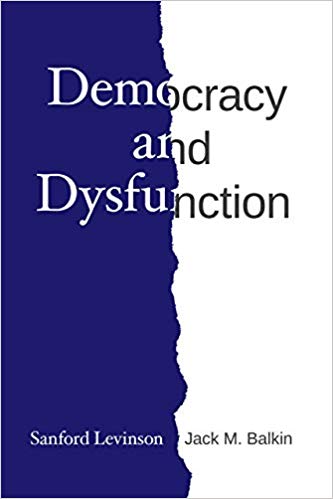
Sanford Levinson and Jack M. Balkin, Democracy and Dysfunction (University of Chicago Press, 2019)

Sanford Levinson, Written in Stone: Public Monuments in Changing Societies (Duke University Press 2018)

Mark A. Graber, Sanford Levinson, and Mark Tushnet, eds., Constitutional Democracy in Crisis? (Oxford University Press 2018)

Gerard Magliocca, The Heart of the Constitution: How the Bill of Rights became the Bill of Rights (Oxford University Press, 2018)

Cynthia Levinson and Sanford Levinson, Fault Lines in the Constitution: The Framers, Their Fights, and the Flaws that Affect Us Today (Peachtree Publishers, 2017)

Brian Z. Tamanaha, A Realistic Theory of Law (Cambridge University Press 2017)

Sanford Levinson, Nullification and Secession in Modern Constitutional Thought (University Press of Kansas 2016)

Sanford Levinson, An Argument Open to All: Reading The Federalist in the 21st Century (Yale University Press 2015)

Stephen M. Griffin, Broken Trust: Dysfunctional Government and Constitutional Reform (University Press of Kansas, 2015)

Frank Pasquale, The Black Box Society: The Secret Algorithms That Control Money and Information (Harvard University Press, 2015)

Bruce Ackerman, We the People, Volume 3: The Civil Rights Revolution (Harvard University Press, 2014)
Balkinization Symposium on We the People, Volume 3: The Civil Rights Revolution

Joseph Fishkin, Bottlenecks: A New Theory of Equal Opportunity (Oxford University Press, 2014)

Mark A. Graber, A New Introduction to American Constitutionalism (Oxford University Press, 2013)

John Mikhail, Elements of Moral Cognition: Rawls' Linguistic Analogy and the Cognitive Science of Moral and Legal Judgment (Cambridge University Press, 2013)

Gerard N. Magliocca, American Founding Son: John Bingham and the Invention of the Fourteenth Amendment (New York University Press, 2013)

Stephen M. Griffin, Long Wars and the Constitution (Harvard University Press, 2013)

Andrew Koppelman, The Tough Luck Constitution and the Assault on Health Care Reform (Oxford University Press, 2013)

James E. Fleming and Linda C. McClain, Ordered Liberty: Rights, Responsibilities, and Virtues (Harvard University Press, 2013)
Balkinization Symposium on Ordered Liberty: Rights, Responsibilities, and Virtues

Andrew Koppelman, Defending American Religious Neutrality (Harvard University Press, 2013)

Brian Z. Tamanaha, Failing Law Schools (University of Chicago Press, 2012)

Sanford Levinson, Framed: America's 51 Constitutions and the Crisis of Governance (Oxford University Press, 2012)

Linda C. McClain and Joanna L. Grossman, Gender Equality: Dimensions of Women's Equal Citizenship (Cambridge University Press, 2012)

Mary Dudziak, War Time: An Idea, Its History, Its Consequences (Oxford University Press, 2012)

Jack M. Balkin, Living Originalism (Harvard University Press, 2011)

Jason Mazzone, Copyfraud and Other Abuses of Intellectual Property Law (Stanford University Press, 2011)

Richard W. Garnett and Andrew Koppelman, First Amendment Stories, (Foundation Press 2011)

Jack M. Balkin, Constitutional Redemption: Political Faith in an Unjust World (Harvard University Press, 2011)

Gerard Magliocca, The Tragedy of William Jennings Bryan: Constitutional Law and the Politics of Backlash (Yale University Press, 2011)

Bernard Harcourt, The Illusion of Free Markets: Punishment and the Myth of Natural Order (Harvard University Press, 2010)

Bruce Ackerman, The Decline and Fall of the American Republic (Harvard University Press, 2010)
Balkinization Symposium on The Decline and Fall of the American Republic

Ian Ayres. Carrots and Sticks: Unlock the Power of Incentives to Get Things Done (Bantam Books, 2010)

Mark Tushnet, Why the Constitution Matters (Yale University Press 2010)

Ian Ayres and Barry Nalebuff: Lifecycle Investing: A New, Safe, and Audacious Way to Improve the Performance of Your Retirement Portfolio (Basic Books, 2010)
.jpg)
Jack M. Balkin, The Laws of Change: I Ching and the Philosophy of Life (2d Edition, Sybil Creek Press 2009)

Brian Z. Tamanaha, Beyond the Formalist-Realist Divide: The Role of Politics in Judging (Princeton University Press 2009)
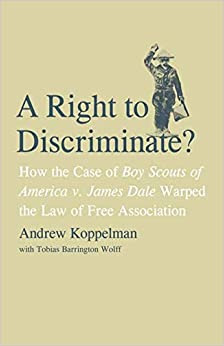
Andrew Koppelman and Tobias Barrington Wolff, A Right to Discriminate?: How the Case of Boy Scouts of America v. James Dale Warped the Law of Free Association (Yale University Press 2009)

Jack M. Balkin and Reva B. Siegel, The Constitution in 2020 (Oxford University Press 2009)

Heather K. Gerken, The Democracy Index: Why Our Election System Is Failing and How to Fix It (Princeton University Press 2009)

Mary Dudziak, Exporting American Dreams: Thurgood Marshall's African Journey (Oxford University Press 2008)

David Luban, Legal Ethics and Human Dignity (Cambridge Univ. Press 2007)

Ian Ayres, Super Crunchers: Why Thinking-By-Numbers is the New Way to be Smart (Bantam 2007)

Jack M. Balkin, James Grimmelmann, Eddan Katz, Nimrod Kozlovski, Shlomit Wagman and Tal Zarsky, eds., Cybercrime: Digital Cops in a Networked Environment (N.Y.U. Press 2007)

Jack M. Balkin and Beth Simone Noveck, The State of Play: Law, Games, and Virtual Worlds (N.Y.U. Press 2006)

Andrew Koppelman, Same Sex, Different States: When Same-Sex Marriages Cross State Lines (Yale University Press 2006)

Brian Tamanaha, Law as a Means to an End (Cambridge University Press 2006)

Sanford Levinson, Our Undemocratic Constitution (Oxford University Press 2006)

Mark Graber, Dred Scott and the Problem of Constitutional Evil (Cambridge University Press 2006)

Jack M. Balkin, ed., What Roe v. Wade Should Have Said (N.Y.U. Press 2005)

Sanford Levinson, ed., Torture: A Collection (Oxford University Press 2004)
Balkin.com homepage
Bibliography
Conlaw.net
Cultural Software
Writings
Opeds
The Information Society Project
BrownvBoard.com
Useful Links
Syllabi and Exams
