Balkinization
an unanticipated consequence of
Jack M. Balkin
Balkinization Symposiums: A Continuing List
E-mail:
Jack Balkin:
jackbalkin at yahoo.com
Bruce Ackerman
bruce.ackerman at yale.edu
Ian Ayres
ian.ayres at yale.edu
Corey Brettschneider
corey_brettschneider at brown.edu
Mary Dudziak
mary.l.dudziak at emory.edu
Joey Fishkin
joey.fishkin at gmail.com
Heather Gerken heather.gerken at yale.edu
Abbe Gluck abbe.gluck at yale.edu
Mark Graber
mgraber at law.umaryland.edu
Stephen Griffin
sgriffin at tulane.edu
Jonathan Hafetz
jonathan.hafetz at shu.edu
Jeremy Kessler
jkessler at law.columbia.edu
Andrew Koppelman
akoppelman at law.northwestern.edu
Marty Lederman
msl46 at law.georgetown.edu
Sanford Levinson
slevinson at law.utexas.edu
David Luban
david.luban at gmail.com
Gerard Magliocca
gmaglioc at iupui.edu
Jason Mazzone
mazzonej at illinois.edu
Linda McClain
lmcclain at bu.edu
John Mikhail
mikhail at law.georgetown.edu
Frank Pasquale
pasquale.frank at gmail.com
Nate Persily
npersily at gmail.com
Michael Stokes Paulsen
michaelstokespaulsen at gmail.com
Deborah Pearlstein
dpearlst at yu.edu
Rick Pildes
rick.pildes at nyu.edu
David Pozen
dpozen at law.columbia.edu
Richard Primus
raprimus at umich.edu
K. Sabeel Rahmansabeel.rahman at brooklaw.edu
Alice Ristroph
alice.ristroph at shu.edu
Neil Siegel
siegel at law.duke.edu
David Super
david.super at law.georgetown.edu
Brian Tamanaha
btamanaha at wulaw.wustl.edu
Nelson Tebbe
nelson.tebbe at brooklaw.edu
Mark Tushnet
mtushnet at law.harvard.edu
Adam Winkler
winkler at ucla.edu
Compendium of posts on Hobby Lobby and related cases
The Anti-Torture Memos: Balkinization Posts on Torture, Interrogation, Detention, War Powers, and OLC
The Anti-Torture Memos (arranged by topic)
Recent Posts
A Salute to the Heroism of Chinese Lawyers, and a Timeless Lesson About the Rule of Law
An Originalist Argument Against Rigid Originalism
Fidelity to The Constitution And Constraining Judges-- Not the Same Thing
(Alumni) Democracy at Dartmouth
Pluto and Constitutional Theory
My defense of originalism (and the living constitution)
New Orleans Plus One
Originalism, History, and Objectivity
Evidence and ideology
Dicey Versus Posner On Ordinary Courts
Why Should We be "Boxed In" by the Constitution and Laws of the United States?
Will the Geneva Conventions Be the First "Universally Accepted" Treaties?
Is a Federal Tax on Damages for Emotional Distress Unconstitutional?
Cheering for the Evil Empire
The 1% solution and the marginalization of civil liberties
Confusion about Originalism?
The Bloggerati response to Judge Taylor's ruling in the NSA Case
Legal Realism and the Press (II)
![[Powered by Blogger]](https://lh3.googleusercontent.com/blogger_img_proxy/AEn0k_s-XTpUU4WL37WAZdRw9gkr3690P0C4YPMDYNQNNwSn1popGkn1PqDNxD26uN2TdG0zk7Drw0flMpLyZiMVTPvpLjK-l5-jWtABvqC_peIH=s0-d)
Just A Few Blogs
ACS Blog
Alas, a Blog
Althouse
Arts and Letters Daily
Atrios (Eschaton)
Bill of Health
Buzzflash.com
Buzz Machine
Cato at Liberty
Juan Cole (Informed Comment)
Concurring Opinions
The Constitution in 2020
Corrente
Crooked Timber
Daily Howler
Daily Kos
Dana Boyd
Brad DeLong
Digby (Hullabaloo)
Discriminations
Daniel Drezner
Kevin Drum (Mother Jones)
Electrolite
En Banc
Eunomia (Daniel Larison)
Fafblog
Michael Froomkin (Discourse.net)
GovLab (Beth Noveck)
Rick Hasen (Election Law)
History News Network
How Appealing
Ignatz (Sam Heldman)
The Importance of (Ernie Miller)
Infolaw
Instapundit
International Economic Law and Policy Blog
IntLawGrrls
Jacob Levy
Jesus' General
Jurisdynamics
The Kitchen Cabinet
Mark Kleiman
Law Blog Central
Larry Lessig
Lawyers, Guns and Money
Liberal Oasis
Brian Leiter's Law School Reports
The Leiter Reports
Marginal Revolution
Megan McArdle
Memeorandum
Metafilter
Mirror of Justice
The New Republic
Newseum
No More Mister Nice Blog
Brendan Nyhan
Opinio Juris
Orcinus
The Originalism Blog
Pandagon
Passport (Foreign Policy)
Overcoming Bias
Political Animal (Washington Monthly)
Political Theory Daily Review
Political Wire (Taegan Goddard)
The Poor Man
Virginia Postrel
Prawfsblawg
Public Reason
Jonathan Rauch
Raw Story
Redstate
ReligiousLeftLaw.com
Reporters Committee For Freedom of the Press
Reproductive Rights Blog
Rothman's Roadmap to the Right of Publicity
SCOTUS Blog
Seeing the Forest
Clay Shirky
The Shifted Librarian
The Situationist
Larry Solum (Legal Theory)
Andrew Sullivan
Talking Points Memo
Talk Left
Tapped
Tbogg
TechPresident
The Paper Chase (Jurist)
Tom Paine
Tom Tomorrow (This Modern World)
Eve Tushnet
Uggabugga
University of Chicago Law School Faculty Blog
Unqualified Offerings
The Volokh Conspiracy
War and Piece (Laura Rozen)
Wampum
Oliver Willis
Wonkette
Written Description
Matthew Yglesias
Yin
Your Choice of Feeds
1. XML
powered by

2. Atom Feed
3. RSS 2.0
A Salute to the Heroism of Chinese Lawyers, and a Timeless Lesson About the Rule of Law
Brian Tamanaha
A recent NY Times article reported that a blind, self-taught Chinese rights advocate, Chen Guangcheng, was sentenced to four years in prison by a Chinese court:He earned the enmity of local Communist Party leaders in Shandong Province, in eastern China, when he sought to organize a class-action lawsuit against forced abortions and sterilizations there....
Though central government investigators later found that abuses had occurred in enforcing population policies there, local authorities put Mr. Chen under house arrest for months, and then charged him with destroying property and blocking traffic.
A team of top rights lawyers in the country came to Mr. Chen's aid. They argued that the charges against him were fabrications. The crimes would have been difficult for him to commit, they said, given that he cannot see and was under constant police guard at the time.
But the Beijing lawyers were harassed, beaten and prevented from gathering evidence to support Mr. Chen in court, numerous people involved in his defense said.
On the eve of Mr. Chen's trial last week, three of his lawyers were accused by local thugs of stealing property. The lawyers were then detained by the local police and one of them was held until after Mr. Chen's trial had ended.
When his other lawyers complained to the court that the harassment made a mockery of the legal proceedings and called for a delay, the court appointed new lawyers.
The appointed defense lawyers did not contest any of the charges against Mr. Chen and did not call any witnesses on his behalf.
In recent years, China has made a big show of its commitment to develop the rule of law, signing a cooperation agreement with the U.N. to conduct training programs for judges. President Hu Jintao, soon after his elevation, made a public statement that "We must build a system based on the rule of law and should not pin our hopes on any particular leader."
The rule of law is an inconvenience to governments and their leaders. That is its greatest benefit. Establishing and preserving the rule of law requires courageous lawyers who are willing to risk everything to hold the government to the law. China is fortunate to have such lawyers.
Posted
1:19 PM
by Brian Tamanaha [link]
(5) comments
An Originalist Argument Against Rigid Originalism
Brian Tamanaha
James Madison wrote in Federalist 14:Is it not the glory of the people of America, that whilst they have paid a decent regard to the opinions of former times and other nations, they have not suffered a blind veneration for antiquity, for custom, or for names, to overrule the suggestions of their own good sense, the knowledge of their own situation, and the lessons of their own experience?
Madison was not presenting a theory of consitutional interpretation in this passage; rather, he was making a more general observation about the entire constitutional design.
On originalist terms, it is fair [and perhaps required] to ask whether a person who wrote these words would have signed up for a theory of interpretation, like Scalia's original meaning theory, if the result of such a theory would be a "veneration for antiquity...[or] names" that would "overrule the suggestions of [our] own good sense, the knowledge of our situation, and the lessons of [our] own experience"? What would Jefferson--who repeated that the world belongs to the living and not the dead--have thought about a theory of interpretation that directs us to search through two century old texts to divine answers to questions they never conceived of or entertained?
Interestingly--and once again demonstrating that originalist theories can operate at various levels of abstraction--this way of framing the issue shifts the question away from an inquiry into Madison's specific theory of how a written Constitution should be interpreted. Instead, it poses the more general question of whether Madison would have endorsed a particular original meaning theory of interpretation if, in practice (given the reality of the extreme difficulty and rarity of amending the constitution), it would commit our constitutional system to a decision-making process that relies upon old and spotty sources to trump our present knowledge and experience.
As Jack points out in his detailed posts on the subject, no one engaged in this discussion denies that the Constitution is binding law. The dispute is over how the language of that binding text should be interpreted. Relying upon the above quote (and other ideas circulating at the time, which can be found in Bailyn, To Begin the World Anew), my sense is that Madison (to invoke a venerated "name") would be on Jack's side, at least on the core proposition that the Constitution is a legal document for our time and should be interpreted as such.
I'm not a constitional theorist or a historian--so I'll duck now and get out of the way.
Posted
4:04 PM
by Brian Tamanaha [link]
(24) comments
Fidelity to The Constitution And Constraining Judges-- Not the Same Thing
JB
In previous posts, I've argued against forms of originalism that look to the original expected application of the Constitution in favor of an original meaning approach, which I call text-and-principle, that is also a form of living constitutionalism. A pretty familar objection to original meaning approaches is that they are indeterminate when the constitutional text employs abstract standards like "equal protection" rather than concrete rules; therefore, expectation originalists complain, original meaning (or text-and-principle in my version) does not sufficiently constrain judges. That might be so if text and principle were the only things that judges consulted when they interpreted the Constitution. But in practice, judges (and other constitutional interpreters as well) draw on a rich tradition of sources that guide and constrain interpretation. These include pre- and post-enactment history, original expected application, previous constitutional constructions and implementations, structural and intertextual arguments, and judicial and non-judicial precedents, to name only a few. In practice, judges that look to text and principle will face constraints very much like those faced by judges who purport to rely on original expected application. As I've pointed out before, the latter judges can not and do not use original expected applications for a very large part of their work, because a very large part of modern doctrine isn't consistent with original expected application. So even those judges like Scalia and Thomas who claim to follow the original understanding are guided and constrained in most cases by essentially the same sources and modalities of argument as judges who employ the method of text and principle. I think there is a deeper problem with the objection that the method of text and principle does not sufficiently constrain judges. Many theories of constitutional interpretation conflate two different questions. The first is the question of what the Constitution means and how to be faithful to it. The second asks how a person in a particular institutional setting- like an unelected judge with life tenure- should interpret the Constitution and implement it through doctrinal constructions and applications. The first is the question of fidelity; the second is the question of institutional responsibility. Theories about constitutional interpretation that conflate these two questions tend to view constitutional interpretation from the perspective of judges and the judicial role; they view constitutional interpretation as primarily a task of judges and they assess theories of interpretation largely in terms of how well they guide and limit judges. For example, one of the standard arguments for expectations-based originalism is that it will help constrain judges in a democracy. Alexander Bickel's theory of the passive virtues and Cass Sunstein's idea of "minimalism," although often described as theories of constitutional interpretation, are actually theories about the judicial role and how judges should interpret the Constitution. So, too, obviously, are other theories of "judicial restraint." From the perspective of these theories, non-judicial interpreters are marginal or exceptional cases that we explain in terms of the standard case of judicial interpretation. I reject this approach. Theories of constitutional interpretation should start with interpretation by citizens as the standard case; they should view interpretation by judges as a special case with special considerations created by the judicial role. In like fashion, constitutional interpretations by executive officials and members of legislatures are special cases that are structured by their particular institutional roles. Instead of viewing constitutional interpretation by citizens as parasitic on judicial interpretation, we should view it the other way around. Why emphasize the citizen's perspective? Each generation must figure out what the Constitution's promises mean for themselves. Many of the most significant changes in constitutional understandings (e.g., the New Deal, the Civil Rights Movement, the second wave of American feminism) occurred through mobilizations and counter-mobilizations by social and political movements who offered competing interpretations of what the Constitution really means. Social and political movements often understand their grievances and their demands in constitutional terms- they argue for either a restoration of constitutional principles or a redemption of constitutional commitments. They make claims about how the Constitution's text and principles should be cashed out in present-day circumstances. Social and political movements argue that the way that Constitution has been interpreted and implemented before- for example, by judges or other political actors- is wrong- and that we need either to return to the Constitution's correct meaning or to fulfill the promises that the Constitution has made in our own day. Often people do not make these claims in lawyerly ways; and usually they are not constrained by existing understandings and existing doctrine in the way that we want judges to be constrained. In fact, when social movements initially offer their constitutional claims, many people regard them as quite radical or "off the wall." There was a time, for example, when the notion that the Constitution prohibited what we now call sex discrimination seemed quite absurd. Yet it is from these protestant interpretations of the Constitution that later constitutional doctrines emerge. Many of the proudest achievements of our constitutional tradition came from constitutional interpretations that were at one point regarded as crackpot and "off the wall." I hasten to add that most of these arguments go nowhere. Only a few have significantly changed how we look at the Constitution. Successful social and political movements must persuade other citizens that their views are correct; or, at the very least they must convince people to compromise and modify their views. If movements are successful, they change the minds of the general public, politicians and courts. This influence eventually gets reflected in new laws, new constitutional doctrines and new constitutional constructions. Successful social and political mobilization changes political culture, which changes constitutional culture, which, in turn changes constitutional practices outside of the courts and constitutional doctrine within them. The causal influences, of course, do not run in only one direction. Judicial interpretations like those in Brown v. Board of Education or Miranda v. Arizona can become important parts of our constitutional culture. They can be absorbed into ordinary citizens' understandings of what the Constitution means, and they can act as focal points for citizen reaction. Nevertheless, we cannot understand how constitutional understandings change over time unless we recognize how social movements and political parties articulate new constitutional claims, create new constitutional regimes and influence judicial constructions. To understand how these changes could be faithful to the Constitution, we need a theory that makes the citizen's perspective primary. I don't claim that all social mobilizations that produce changes in doctrine are equally legitimate or equally admirable. But some are both legitimate and admirable, and a theory of constitutional interpretation-which is also a theory of constitutional fidelity-must account for them. The text-and-principle approach can offer a much better explanation of how successful social and political movements make claims that are faithful to the Constitution than expectations-based originalism can. Indeed, expectations-based originalism is virtually useless for this purpose, because it views many of the most laudatory changes in our understandings of the Constitution as not faithful to the Constitution and therefore as illegitimate. For similar reasons, expectations-based originalism cannot really constrain judges because too many present-day doctrines are simply inconsistent with it; as a result judges must pick and choose based on pragmatic justifications that are exceptions to the theory. Because expectations-based originalism conflates the question of constitutional fidelity with the question of judicial constraint, it offers the wrong answer to both questions. Constraining judges in a democracy is important. But in practice most of that constraint does not come from theories of constitutional interpretation. It comes from institutional features of the political and legal system. Some of these are internal to law and legal culture, like the various sources and modalities of legal argument I mentioned above. Others are "external" to legal reasoning but nevertheless strongly influence what judges produce as a group. First, judges are subject to the same cultural influences as everyone else-- they are socialized both as members of the public and as members of particular legal elites. Second, the system of judicial appointments and the practices of partisan entrenchment determine and limit who gets to serve as a judge. Third, lower federal courts are bound to apply Supreme Court precedents. Fourth, the Supreme Court is a multi-member body whose decisions in contested cases are usually decided by the median or "swing" Justice. Over time, this keeps the Court's work near the center of public opinion. This combination of internal and external features constrains judicial interpretation in practice far more effectively than any single theory of interpretation ever could; it does much of the work in constructing which constitutional interpretations are reasonable and available to judges and which are "off the wall." Equally important, this combination of internal and external factors keeps judicial decisions in touch with popular understandings of our Constitution's basic commitments, continually translating, shaping and refining constitutional politics into constitutional law. In short, we shouldn't confuse the question of what it takes for actors in the system-- including those actors who are not judges-- to be faithful to the Constitution with the question of what features of the system constrain judicial interpretation. We must separate these questions to understand how constitutional fidelity occurs over time. When we do, we can also see why fidelity to original meaning and belief in a living Constitution are not at odds.
Posted
9:35 AM
by JB [link]
(6) comments
(Alumni) Democracy at Dartmouth
Mark Graber
The most recent issue of the Dartmouth Alumni Magazine has two two page advertisements urging alumni to vote for and against the new Alumni Constitution. I have received several mailings urging me to vote for and against, and read a number of prominent blogs on the subject. Even the New York Times appears to be taking some notice. Both sides insist that a correct vote on the Alumni Constitution is necessary to ensure "democracy at Dartmouth" and "an effective alumni voice." Neither side, nor any other alumni association that I know of, seems that concerned about the problematic nature of alumni democracy.
Alumni democracy is highly likely to be bad democracy. Alumni have almost every characteristic that bodes ill for democratic governance. Most of us are poorly informed about the issues facing our alma mater, get what information we have from very biased sources, do not spend a much time becoming informed about the issues, and have little material incentive in the outcome of university controversies. In short, it is hard to think of an association more ripe for takeover by groups with unrepresentative agendas than an alumni democracy. Maybe I should form an association of Dartmouth alums in the teaching business that, in the guise of complaining about educational standards, would force Dartmouth professors to assign more of our writings. Would not be all that hard to do, which is one thing wrong with alumni democracy.
More significantly, alumni democracy is not democracy. A central feature of democracy is that the people whose lives are affected by the policy get to vote for the people who make the policy. Democracies are hardly perfect in this sense. Consider how many Iraqis got to vote in the 2004 election, even though the results may have been more important for their lives than most Americans. Still, the notion of alumni democracy seems akin to granting all Americans who served at least a year in Iraq a permanent vote in Iraqi elections. My life is insufficiently affected by what goes on at Dartmouth to justify my having an effective voice in college policy. As alumni, we ought to be more concerned about having an effective voice where we are, not where we were. It is as if the only persons allowed to vote in Maryland elections were people who left Maryland. Of course, one may want to involve alumni because they make donations, and people who donate like to have a say in what they are paying for. Whatever the virtues of that argument, however, that is not an argument commonly used to justify democracy.
If I had unlimited money, I would be tempted to buy a two page advertisement in the next Dartmouth Alumni Magazine proclaiming: NONE OF OUR BUSINESS: LET STUDENTS, FACULTY, ADMINISTRATIVE, AND STAFF DECIDE WHAT DARTMOUTH WILL BE TODAY. The Dartmouth I went to had much good and some bad. Nothing I can do will change that past. But outside of giving advice, I think the present of Dartmouth and other universities should be decided by those who are there, not by those of us who want to impose unrepresentative agendas on young men and women.
Posted
3:27 PM
by Mark Graber [link]
(4) comments
Pluto and Constitutional Theory
Mark Graber
The New York Times reports that Pluto has been reclassified as one of three dwarf planets in the solar system, ending a controversy among astronomers over that sphere's status. Pluto was not reclassified, as I understand the Times story, because scientists discovered some fact about Pluto that was inconsistent with existing definitions of "planet." Rather, discoveries over the past generation have raised problems with existing definitions of "planet," requiring astronomers to adjust general understandings of what constitutes a planet before determining whether Pluto should be considered a planet.
The reclassification of the solar system and Pluto raise some questions about any variation of original meaning, whether we focus on specific expectations or general principles. Imagine that astronomers had discovered that, contrary to previous knowledge, Pluto did not actually revolve around the sun. In which case, Pluto could have been reclassified consistent with the original meaning of "planet." That the persons responsible for the original meaning of planet (or the most recent authoritative definition) thought Pluto met the conditions for being a planet is of no relevance to whether Pluto is a planet, if new evidence reveals that Pluto does not meet the general conditions for being a planet. Similarly, whether the persons responsible for the Fourteenth Amendment thought the equal protection clause protects abortion rights is of no relevance to whether the Fourteenth Amendment protects abortion rights if, on reflection, we come to believe that abortion rights are consistent with the general conditions for being an equal protection rights or, more accurately, the general principles underlying equal protection. This, I think, is the attraction of the new improved originalism.
The problem, in the case of Pluto, is that what astronomers discovered was that the existing principles of astronomy did not adequately describe astronomic phenomenon. Their discoveries meant that they could determine whether Pluto was a planet only by adjusting the broader principles determining what constituted a planet. The same phenomenon is likely to occur in constitutional societies. Constitutional developments do not simply create conditions under which practices originally classified as constitutional must be reclassified as unconstitutional (and vice versa), new conditions also challenge the capacity of existing constitutional principles to provide adequate criteria for classifying practices as constitutional or unconstitutional. For example, constitutional principles that insist we protect speech but not property do not resolve issues of campaign finance, where the question is whether the regulation is of speech or property. Unless we decide the framers were committed to such abstractions as equality, liberty or human dignity, abstractions that might justify any policy, we are likely to discover that principles the framers in 1789 or 1868 thought would be sufficient to classify practices as unconstitutional or constitutional no longer do so, that as was the case with Pluto, when determining whether abortion is an equal protection right, we will have to adjust general principles as well as specific applications.
Let me be clear on one point. My argument is not that the proponents of abortion cannot rely on the original meaning of the Fourteenth Amendment. My claim is that no one can because the original meaning of the Fourteenth Amendment, understood even in terms of general principles, cannot fully resolve modern problems. Constitutional theory, Pluto suggests, needs a theory of political development which cannot simply be a theory that relies on improved understandings of the general principles underlying constitutional norms.
Posted
10:41 AM
by Mark Graber [link]
(4) comments
My defense of originalism (and the living constitution)
JB
For the past year I've been rethinking my views on constitutional interpretation, and rereading some of the very rich literature that has developed in the past fifteen years or so, as well as studying the history of the Fourteenth Amendment.
This summer, I wrote up the results, offering a method of interpretation I call text and principle, which is both a form of originalism and a form of living constitutionalism.
Many faithful readers of this blog know that I have been very critical of originalism as it has been practiced, and have defended the idea of a living constitution. But I have gradually become convinced that these two positions are not really inconsistent with each other; only particular versions of them are. This article gives a fuller account of my views.
Not shying away from a challenge, I then decided to take on one of the defining constitutional controversies of the day, namely the constitutional right to abortion. It seemed to me that no attempt to offer a method of constitutional interpretation these days would be worthwhile unless one can explain how it applies to the constitutional controversies that concern people the most. If a theory can give a reasonable account of the right to abortion-- whether for or against-- most other issues will probably be a lot easier.
The second half of the paper applies the theory, first giving an account of the original meaning of the fourteenth amendment and then applying the theory to the right to abortion. (Actually, I conclude that there are two different rights).
About three years ago, I wrote up my best arguments for the right to abortion and published them in my edited collection, What Roe v. Wade Should Have Said. Because my views on interpretation have changed in the interim, this argument is has some important differences from the one I gave there.
I don't contend that reasonable people using my method of interpretation could not disagree with my conclusions about the right to abortion. The point of such a method is that different people using it can have a common language for discussion and analysis. I do claim that my arguments about abortion are consistent with the original meaning of the Constitution, and that, in my opinion, they are a better interpretation.
Here is the abstract for the article:
This article argues that the debate between originalism and living constitutionalism offers a false dichotomy. Many originalists and their critics improperly conflate fidelity to the original meaning of the constitutional text with fidelity to how people living at the time of adoption expected that it would be applied. That is, they confuse original meaning with original expected application.
Constitutional interpretation requires fidelity to the original meaning of the Constitution and to the principles that underlie the text, but not to original expected application. This general approach to constitutional interpretation is the method of text and principle. This approach is faithful to the original meaning of the constitutional text, and to its underlying purposes. It is also consistent with the idea of a basic law that leaves to each generation the task of how to make sense of the Constitution's words and principles in their own time. Although the constitutional text and principles do not change without subsequent amendment, their application and implementation can. That is the best way to understand the interpretive practices characteristic of our constitutional tradition and the work of the many political and social movements that have transformed our understandings of the Constitution's guarantees. It explains, as other versions of originalism cannot, why these transformations are not simply mistakes that we must grudgingly accept out of respect for settled precedent, but are significant achievements of our constitutional tradition.
The article applies this method to the most contentious constitutional issue of our generation-- the constitutional right to abortion. It concludes, contrary to conventional wisdom, that the constitutional right to abortion is consistent with the original meaning of the Fourteenth Amendment, and, in particular, its prohibition on class legislation that is embodied in the Equal Protection Clause.
The article criticizes Roe v. Wade's original trimester system, arguing that there are actually two rights to abortion instead of one. Finally, it explains how courts might have better implemented the constitutional guarantee of the two rights to abortion in ways that are more respectful of democratic politics.
UPDATE: Both Randy Barnett and Larry Solum have graciously recommended this piece, and in return I want to thank both of them for the influence they have had on my thinking on these questions. Randy's book, Restoring the Lost Constitution, was a real advance in the debate about originalism, and showed how nonoriginalists could come to terms with the arguments that originalists were making; he has elaborated these themes in various blog posts on The Volokh Conspiracy. Larry and I engaged in a long (and to my mind, very interesting) debate on our respective blogs about formalism and historicism in constitutional interpretation that also helped me sharpen my thinking. This is one example where the combination of traditional scholarship and blogging can really help scholarship.
Posted
8:31 AM
by JB [link]
(8) comments
New Orleans Plus One
Anonymous
In the next week, everyone will be inundated with images and stories about New Orleans, plus one year after Katrina. President Bush has been busy already preemptively defending himself against charges that the recovery of the city has been going too slowly. The most important positive step Bush and Congress have taken so far is provide billions for a state-run program that provides a minimum amount for rebuilding for those who did not have flood insurance. But sadly, the federal government has paid too little attention to certain preconditions essential for full recovery. I’ll review those preconditions in this post, saving for another day the failures of local and state government.
In general, the problem with the national response is not enough attention to looking around corners, to anticipating problems before they occur. One doesn’t need hindsight here. All of the preconditions for recovery I mention here were fully anticipated last fall, just one or two months after the storm.
Electricity. It’s very difficult for a city to recover without reliable electrical power. But many areas of New Orleans either have no power or no reliable electrical power one year after. The local utility declared bankruptcy in late September and sent all out of state crews home, stretching the initial recovery out by months. The utility is still hoping to be bailed out by the federal government and has not yet been required to file a bankruptcy plan. Whatever the merits of a bailout, local takeover, or a takeover by the utility’s larger parent, it is long past time for the executive branch to take an interest, knock some heads together, and get this problem behind us.
Criminal Justice. It actually looks like some officials expected the normal “let’s skate by with a system that barely functions” to be adequate for recovery. Hasn’t worked out that way. Police incompetence pre-Katrina and during the storm has remained a topic unexplored in the various government investigations. The public defender system collapsed and is being rebuilt only slowly. Despite widespread public unhappiness, cooperation among the different parts of the system remains poor. Here is a system in which a relatively small amount of federal money with some accompanying performance conditions could still make a real difference.
Medical Care. More hospitals are open but the crucial supporting facilities, such as long-term care and mental health, are still doing poorly. Too many doctors, especially mental health professionals, have left town. And this is a system profoundly influenced by federal funding. This is the most obvious example of where confident, proactive federal leadership could have made a real difference to the state of the city a year later.
No one of these failures alone would be enough to suggest negligence and inattention on the part of President Bush. But collectively, they speak of a continuance of the failure of will and moral imagination that has plagued the federal effort from the moment the storm passed. Polls and anecdotal evidence suggest strongly the public still cares about the effects of Katrina and whether New Orleans recovers. But it has evidently been a low priority for political elites in Washington, and I do not except the Democrats. They have been willing to let Republicans take the blame without offering any solutions of their own.
One more point worth mentioning about the federal government. As a recent book review in The New Republic points out, Congress is one of the main culprits in the tragedy of Katrina. Congress controls the Army Corps of Engineers and it is that body that is ultimately responsible for the failure of the levees. But I don't believe we've seen any intensive investigations of Congress. . .by Congress and I don't expect we will. Our system expects the executive to execute the law. When Congress executes the law by controlling executive agencies, there's no other branch to provide oversight. It would be nice if some foundation were to exercise countervailing power to fund an inquiry, but I won't hold my breath.
Posted
10:14 PM
by Anonymous [link]
(2) comments
Originalism, History, and Objectivity
Mark Graber
Originalism promises to constrain justices more than theories of constitutional interpretation or constitutional adjudication (the two are not identical as Keith Whittington and others remind us) that depend on contested moral and political theories. Consider, however, three problems.
First, objectivity is contested in both history and philosophy. The debates are not identical. Still, the overlap suggests that claims that we can have an objective understanding of history sufficient to have an objective understanding of the original public meaning of, say, "cruel and unusual punishment" are likely to be similar to claims that we can have an objective understanding of what ethically constitutes cruel and unusual punishment. Put simply, solving the objectivity problem in history is likely (though only likely) to go a long way toward resolving the objectivity problem in philosophy. (there is a more general lesson here. Lawyers who look to another discipline to solve legal debates are likely to discover either that an analogous debate exists in the other discipline or, at any event, that they must rely on a theory that is contested within the other discipline).
Second, and more significantly, historians who are committed to objectivity nevertheless vigorously dispute the best interpretation of crucial moments in American constitutional development. Moreover, dominant histories change and those changes typically reflect, consciously or unconsciously, changes in dominant political coalitions. Winners write history (I think it was C.Vann Woodward who described historians as "camp followers of victorious armies") and who the winners are in American politics changes. Both Randy Kennedy (a review essay in Harvard 15 years ago reviewing Eric Foner) and Pamela Brandwein (Reconstructing Reconstruction) have written wonderful histories demonstrating how historical memory changes (and even how what constitutes the relevant history changes). The book to the right of this blog offers a revisionist history of the original meaning of the constitution (eventually, I'll explain why you should buy the thing). Most of my friends (see, i.e., Howard Gillman, Ken Kersch, Julie Novkov) have written similar revisionist histories. Others will revise us. A constitution that depends on the dominant interpretation of the framing or post-Civil War regime is unlikely to be more stable than the one we have.
Third, one might note that originalism in practice does not seem all that objective. Several years ago, I wrote an essay on Justice Thomas in Maltz, REHNQUIST JUSTICE (University of Kansas Press) detailing how Thomas relied extensively on history when the history supported his conservative convictions, consistently relied on the most conservative historian around on matters in which historians disagreed (consider originalism and Brown) and when discussing affirmative action and advertising, matters on which history favors liberals, ignored history altogether. In short, given the choices, originalism in practice is not likely to constrain justices any more than moral philosophy.
The main lesson of the above may be that, whatever the merits of originalism in theory compared to other theories in practice, originalism in practice so far has not looked much different from more Dworkian theories in practice. History is not identical to philosophy, but the practice of both is more closely connected than much debate suggests. If justices in practice are going to rely heavily on the respectable historian whose conclusions best support preexisting philosophical understandings, I'd like their justifications to defend those philosophical understandings as well as the historian selected.
Posted
8:52 PM
by Mark Graber [link]
(4) comments
Evidence and ideology
Sandy Levinson
Mark Graber's post explaining his otherwise inexplicable devotion to a team I have loathed for roughly 55 years actually raises interesting issues about commitments far more important (if such is possible) than one's devotion to the Yankees, Red Sox, or any other team. Jack's Yale colleague Dan Kahan has energetically argued (often in articles with Donald Granham), with regard particularly to the debates concerning gun policy, that evidence is basically 'irrelevant," that one's commitments concerning the extent to which firearms should be regulated have far more to do with one's underlying values, or ideology, that with the evidence submitted by either side of the debate. (E.g., proponents of gun control, who often cite the number of children killed by guns, simply refused to confront seriously the fact that more children die in backyard swimming pools every year than are killed by guns; opponents of gun control policy tend to dismiss the importance of the fact that guns do in fact account for the death of X number of "innocent" persons every year, and so on.) It may be that the discussion going on right now on another thread about "1% solutions, civil liberties, environmentalism, etc." is an illustration of Kahan's basic point. (What sort of empirical evidence, if any, would persuade a strong civil libertarian to bend his/her principles or Christopher Caldwell that one should indeed continue to honor the rights of criminal defendants even when they are suspected of terrorism. Indeed, I suggested in an article in the University of Pennsylvania Law Review responding to one of Dan's pieces that his argument might well apply to the debate about Iraq more generally, particularly in 2003, when I wrote the reply. What now seems clear to almost everybody--that the Bush Administration was basically indifferent to evidence, that their zeal to invade was based on the same kind of emotion and ideology that describes Mark's commitment to the Yankees--seemed absolutely clear to me then, but, of course, many people, perhaps plausibly, would have argued that I was too consumed by loathing for the hBush Administration to credit them as making a good case. We want to believe that our political commitments are "evidence based" and not comparable to our decisions to root for sports teams. But Kahan, who is not alone, would challenge this. I take it that no amount of evidence about the "objective" awfulness of George Steinbrenner and the loathesomeness of the Yankee's using their market dominance to crush the opposition could overcome the emotions generated by his youth as a New Yorker.
One wants to believe--or at least I want to believe--that Kahan is wrong, and that we can make public policy arguments on the basis of "rational evidence." Paradoxically or not, I think the evidence is far too mixed to allow any confident conclusion that Kahan is wrong. But if he is not, then we have to reconceive what we think "democratic deliberation" is really about.
Posted
7:37 PM
by Sandy Levinson [link]
(3) comments
Dicey Versus Posner On Ordinary Courts
Brian Tamanaha
Marty offers a detailed response to Judge Posner's WSJ Op-Ed piece below. I will focus on a very narrow point. Posner argues:As a judge I cannot comment on the correctness of her decision. But I can remark on the strangeness of confiding so momentous an issue of national security to a randomly selected member of the federal judiciary's corps of almost 700 district judges, subject to review by appellate and Supreme Court judges also not chosen for their knowledge of national security.
A further strangeness is that the Foreign Intelligence Surveillance Court and the Foreign Intelligence Surveillance Court of Review (which hears appeals from FISC) have been bypassed, with regard to adjudicating the legality of the NSA program, in favor of the federal district court in Detroit. The reason is that the jurisdiction of those courts is limited to foreign intelligence surveillance warrants, and the NSA program under attack involves warrantless surveillance.
....
Five years after the 9/11 attacks, the institutional structure of U.S. counterterrorism is in disarray. The Department of Homeland Security remains a work in progress -- slow and painful progress -- and likewise for the restructuring of the intelligence community decreed by Congress in the Intelligence Reform and Terrorism Prevention Act of 2004. And now, in the wake of Hamdan and the Detroit case, we learn that we do not have a coherent judicial dimension to our efforts to combat terrorism. (One reason may be that there is no official with overall responsibility for counterterrorism policy.) Other than the judges assigned to the two foreign intelligence courts, federal judges do not have security clearances and, more to the point, have no expertise in national security matters. Moreover, the criminal justice system is designed for dealing with ordinary crimes, not today's global terrorism, as is shown by the rules, for example, that entitle a person who is arrested to a prompt probable-cause hearing before a judge and require that criminal trials be open to the public....
At first blush, it might appear odd that an arguably momentous decision for national security could be rendered by a randomly selected lowly district judge with no particular expertise in such matters. Posner proposes that "The dilemma of defeating terrorism while respecting essential civil liberties can perhaps be resolved by a change of focus from the adjudicative process to executive and congressional oversight." He suggests that, at the very least, such decisions should be made by judges with special knowledge about national security.
That sounds sensible, but is it right? A.V. Dicey, the conservative English constitutional law giant, identified the following as the core element of the rule of law: "no man is punishable or can be lawfully made to suffer in body or goods except for a distinct breach of law established in the ordinary legal manner before the ordinary Courts of the law." Dicey repeatedly emphasized the significance of ordinary courts in maintaining the rule of law: "In England the rule of law is coterminous with the cognizance of ordinary courts: it is the rule of the judicature."
Dicey insisted that government officials must be accountable before courts, and he was wary of specialized courts as--to put it in modern terms--susceptible to capture. Posner's position runs counter to both of these ideas.
I do not pretend to know what Dicey would say about these matters today; nor would I say that he was always right. But there is wisdom in his insight that the rule of law is preserved by a decentralized system comprised of a multitude of ordinary judges rendering decisions--including decisions regarding the propriety of the actions of government officials--on a range of issues according to their best reading of law.
Posted
4:08 PM
by Brian Tamanaha [link]
(6) comments
Why Should We be "Boxed In" by the Constitution and Laws of the United States?
Marty Lederman
In today's Wall Street Journal, Judge Richard Posner laments the fact that the federal courts are available to adjudicate whether the President's chosen methods of fighting the war on terror are consistent with the Constitution and laws of the United States. (Thanks to Howard Bashman for the link.)
Referring to what he obviously views as the misguided decisions of the Supreme Court in Hamdan and Judge Taylor in ACLU v. NSA, Posner complains that "we are boxed in by our revered 18th-century Constitution as interpreted by the Supreme Court." He further objects that the majority of the Hamdan Court was "unsympathetic to arguments that our understanding of certain provisions of the Constitution needs to be revised to meet contemporary needs." He hopes that the Court will eventually "bow" to the President's judgment, but warns that "we cannot wait for that to happen." Presumably this is a not-so-veiled suggestion that Congress should attempt to strip the federal courts of jurisdiction to hear claims challenging the legality of the Executive's conduct.
Regardless of its merits, Judge Posner's complaint is slightly off-the-mark in one important respect: The Court in Hamdan did not rule that the President's commissions were inconsistent with an 18th-Century Constitution -- it ruled that the commissions violated statutes enacted by a 20th-Century Congress (and a treaty ratified by a 20th-Century Senate), with the approval of 20th Century Presidents. And although Judge Taylor's decision was largely based on the Fourth Amendment, the central and clear problem with the NSA program (which Judge Taylor also emphasized, albeit not as much as she should have) is that it is in violation of another statute, FISA, which was carefully enacted, over a long period of time and after extensive deliberation and investigation of past abuses, by yet another (late) 20th-Century Congress, with the approbation of two late-20th-Century Presidents.
The courts in these cases, in another words, are merely requiring the Executive branch to follow the law enacted by the political branches. Why on earth should Congress seek to strip the courts of the power to ensure that its own enactments are honored? Judge Posner does not say. (He obviously is not fond of those statutes, enacted as they were decades before 9/11/01; but if he's right that they're obsolete, why is the proper remedy not a legislative (and public) debate about whether and how to amend them to respond to modern exigencies?)
Judge Posner's principal complaint is that it is "strange" to "confid[e] so momentous an issue of national security to a randomly selected member of the federal judiciary's corps of almost 700 district judges, subject to review by appellate and Supreme Court judges also not chosen for their knowledge of national security."
Of course, it is not "strange" at all to give federal courts the jurisdiction to adjudicate whether the President is abiding by duly enacted laws in times of war. As countless Supreme Court cases challenging Executive conduct during war will attest, that has been the ordinary course of things since the founding. What would be strange, and fairly unprecedented, would be for Congress to attempt to strip the courts of such power, and thereby allow the President free reign to mangle or ignore congressionally enacted statutes as he sees fit.
Contrary to Judge Posner's suggestion, the courts in these and related cases are not simply second-guessing the President on "issues of national security," such as by overturning his judgments as to the extent of a threat or the efficacy of an Executive response to the threat. It's not as if five Justices of the Supreme Court, or Judge Taylor, disagree with the President on the nature of the Al Qaeda threat, on how effective the NSA surveillance program would be at detecting terrorists, or at how efficient it would be to convict detainees under the President's military commissions. Indeed, there's no reason to think that the judges would not substantially agree with the President on all such factual assessments.
Instead, what these courts are doing is vindicating the judgments that Congress has made, in conjunction with the President, on questions relating to the proper balance between addressing an external threat and preserving constitutional, statutory, and treaty-based protections of individuals.
It appears not even to occur to Judge Posner that perhaps the Executive's judgments during a time of war might occasionally be less than ideal, not only with respect to preserving individual rights, but also with regard to how to best defeat the enemy -- and that the Executive's judgments will be most suspect, and least reliable, where they are made and implemented in secret, and in the heat of battle, and are not subject to the ordinary checks and balances of our constitutional system. It is conceivable, mind you, that, left to his own devices, a President might actually make poor decisions concerning how best to prosecute a war. (Just hypothetically speaking, of course.) There is, in other words, some practical value in prosecuting a war "by the books," i.e., in accord with the rule of law. Or so our "18th Century Constitution" presumes, anyway. As Justice Kennedy explained in Hamdan, the Constitution's structure of war powers stresses "the importance of standards deliberated upon and chosen in advance of crisis, under a system where the single power of the Executive is checked by other constitutional mechanisms":Where a statute provides the conditions for the exercise of governmental power, its requirements are the result of a deliberative and reflective process engaging both of the political branches. Respect for laws derived from the customary operation of the Executive and Legislative Branches gives some assurance of stability in time of crisis. The Constitution is best preserved by reliance on standards tested over time and insulated from the pressures of the moment. . . . If Congress, after due consideration, deems it appropriate to change the controlling statutes, in conformance with the Constitution and other laws, it has the power and prerogative to do so.
[UPDATE: I should clarify that Judge Posner does not expressly advocate unchecked Executive authority. In this Op-Ed and in other places, he has proposed a new statute that would theoretically minimize potential abuses of warrantless surveillance, "without judicial intervention, by rules limiting the use of intercepted communications to national security, requiring that the names of persons whose communications are intercepted (and the reasons for and results of the interception) be turned over to executive and congressional watchdog committees, and imposing draconian penalties on officials who violate civil liberties in conducting surveillance." This is certainly a proposal worthy of serious consideration in Congress. Three questions, however: (1) Why exclude judicial review to ensure that the President at least abides by such requirements? (2) This Administration would never agree to provide Congress with "the names of persons whose communications are intercepted (and the reasons for and results of the interception)" -- indeed, they would likely contend that such a requirement is unconstitutional. Therefore either the Posner proposal would be a nonstarter (because of a veto threat), or there would be a good chance of Executive nonenforcement. (3) Until the day that Congress enacts such a law, and the Executive abides by it, what is wrong with permitting the courts to hold the President to the laws that are currently in place?]
Posted
1:54 PM
by Marty Lederman [link]
(12) comments
Will the Geneva Conventions Be the First "Universally Accepted" Treaties?
Marty Lederman
This announcement just in from the International Committee of the Red Cross:For the first time in modern history an international treaty has achieved universal acceptance. The recent accessions by the Republic of Nauru and the Republic of Montenegro to the 1949 Geneva Conventions confirm the status of these conventions as the most widely accepted international treaties and represent a landmark in the development of protection for victims of armed conflict. . . . Nauru acceded to the four Geneva Conventions on 27 June and Montenegro on 2 August, bringing the number of States party to these instruments to 194.
Perfect timing, isn't it, for the Administration and Congress to now enact a law authorizing the CIA to violate the Geneva prohibition on "cruel treatment" of detained persons?
[UPDATE: I just noticed that Michael Froomkin offered the same juxtaposition this morning.]
Posted
1:45 PM
by Marty Lederman [link]
(17) comments
Is a Federal Tax on Damages for Emotional Distress Unconstitutional?
Marty Lederman
The U.S. Court of Appeals for the District of Columbia Circuit today held that a federal statute, which imposes a tax on awards of compensatory damages for emotional distress and loss of reputation, is unconstitutional because such awards are not "income" within the meaning of the Sixteenth Amendment.
I know very, very little about tax, and not much more than that about the Sixteenth Amendment, so please excuse me if the following question is obviously ridiculous for one reason or another:
Assuming the court is correct that such an award is not "income" for purposes of the Sixteenth Amendment -- which I will assume because I don't know enough about the meaning of "income" in that Amendment -- why does it follow that the tax is unconstitutional?
[I have edited this post to elaborate on certain points.] To say, as the court of appeals does, that "[t]he Sixteenth Amendment simply does not authorize the Congress to tax as 'incomes' every sort of revenue a taxpayer may receive," is not to explain why Congress is prohibited from doing so. The Sixteenth Amendment is not a limitation on congressional powers -- it's an authorization, or, more precisely, a clarification. Thus, even if the court of appeals were correct that an award for emotional distress is not "income" in a constitutional sense, the next question should be "SO WHAT?" After all, the federal government taxes plenty of things other than income, and those taxes are not all unconstitutional.
Congress has the power under Article I, section 8 to lay and collect Taxes. This, in and of itself, is presumably sufficient authority for the tax in the Murphy case, for "[t]he subject-matter of taxation open to the power of the Congress is as comprehensive as that open to the power of the states, though the method of apportionment may at times be different." Charles C. Steward Machine Co., 301 U.S. at 581. Indeed, the tax in that case was on a damage award provided by a federal agency (the Department of Labor), pursuant to a federal law, and therefore Congress could impose a tax on that federally-authorized award under the Necessary and Proper Clause, too (i.e., Congress obviously was not required to provide a mechnaism by which Ms. Murphy could recover damages in the first instance, and thus it can decide that it will not provide full compensation for injuries to emotion and reputation, but will instead direct that some of the "compensation" be remanded to the federal government itself).
So where does the Sixteenth Amendment come into play? It was ratified in order to clarify that income taxes may be assessed whether or not they are direct taxes. The constitutional restriction on Congress's power appears, not in the Sixteenth Amendment, but in Article I, section 9, which provides that "direct" taxes must be proportional to census results. The Sixteenth Amendment was ratified in order to effectively overturn the Supreme Court's 1895 decision in Pollock v. Farmers' Loan and Trust Co. -- a mistaken, outlier decision -- that a personal income tax was "direct" and therefore had to be apportioned by state census figures.
[Next three paragraphs updated.] Prior to Pollock, the Court had regularly held, beginning in the 1796 case of Hylton v. United States, that numerous taxes were not "direct," and thus did not have to be apportioned by census. So, for example, the Court held that federal taxes on corporate capital (Pacific Insurance v. Soule), estates (Scholey v. Rew), and even personal income (Springer), were not "direct." The general consensus during this century had been that the term "direct taxes" as used in Article I referred only to taxes on real estate and poll or capitation taxes.
Pollock, a 5-4 decision, took a sharp turn away from this long line of cases: The Court held that a tax on property-based income was a "direct" tax, prohibited by Article I, section 9 because it was not apportioned by state population. Pollock was widely criticised and reviled. President Taft would later say that "[n]othing has ever injured the prestige of the Supreme Court more."
The Court heard the criticism. After Pollock, the Court in effect returned to the Hylton line of cases. Between 1899 and 1911, it held that a trade tax on the Chicago Board of Trade (Nicol v. Ames), a graduated estate tax (Knowlton v. Moore), and a tax on a corporation's gross receipts (Spreckels Sugar Refining), were all not direct taxes, and thus permissible even if not apportioned. (Thanks to Calvin Johnson's 2004 article Fixing the Constitutional Absurdity of the Apportionment of Direct Tax for some of these historical details.) Finally, in 1911 the Court more or less relegated Pollock to its facts, by holding in Flint v. Stone Tracy Co. that a tax on corporate income was not a "direct tax."
In other words, even before ratification of the Sixteenth Amendment in 1913, virtually no federal taxes other than the personal income tax were deemed "direct." In 1913, the Sixteenth Amendment put the final nail in Pollock's coffin, by declaring that Congress could tax income without regard to census figures, i.e., whether or not it was a "direct" tax.
Thus, in order to invalidate the tax in the Murphy case, it is not enough to hold that the award is not "income." It would be necessary further to hold that the tax is a "direct" one, prohibited by Article I -- and to explain why it is not otherwise authorized by the Necessary and Proper Clause. The court of appeals did not peform these analyses, and thus its opinion is woefully incomplete. My rough sense is that the tax on the award in Murphy is authorized by Article I, section 8, and by the Necessary and Proper Clause, and, more importantly, is not a prohibited "direct" tax under Article I, section 9, just as with estate taxes (see Manufacturers National Bank, 363 U.S. 194) and gift taxes (see Bromley v. McCaughn, 280 U.S. 124). (In addition to the Johnson article cited above, see Bruce Ackerman's 1999 article Taxation and the Constitution.) Indeed, even the Court in Pollock acknowledged that taxes on "gains or profits from business, privileges, or employments" are not direct, and thus can be assessed without apportionment. 158 U.S. at 635. The award of damages in the Murphy case is a "privilege" created by federal law, and thus a tax on such damages would not appear to run afoul of any apportionment limitation in Article I.
If I'm correct about this, then the tax on the award of damages therefore is constitutional, wholly without regard to whether it is a tax on "income" -- although, again, I caution that I'm out of my league on this question, and would appreciate further information or clarification in the comments.
In any event, even if I'm wrong and the direct/indirect question is closer than that, the court's opinion today does not so much as mention Article I, or the direct/indirect distinction. Indeed, the court does not even acknowledge Congress's broad taxing power under Article I, section 8, nor does it identify where in the Constitution any restriction on such taxing power might appear, or describe the nature of that constitutional limitation. Thus, even if the judgment is correct because this is a "direct" tax and the award is not "income," the court's reasoning leaves a great deal to be desired. And this inexplicable failure in the opinion is especially conspicuous in light of the fact that the district court judge in the case, Judge Lamberth, specifically noted that the possible constitutional limitation derived from the apportionment requirement of Article I, and indicated that the tax was permissible either if it was assessed on "income" or if it was not "direct." 362 F. Supp. 2d at 217. Judge Ginsburg simply ignores one half of the equation -- and without that, he's provided no reason to invalidate the federal statute. [UPDATE: Surprisingly, the court of appeals judges are not the only ones who skipped right over the central question. In her brief, appellant Murphy stated, in a footnote and without any authority, that "[t]he taxation of damages received on account of personal injuries or personal sickness is a direct tax." But DOJ does not appear to have contested that assertion in its brief, which appears to (implictly) suggest that the constitutionality of the statute turns entirely on whether the award was "income." It's safe to predict, I think, that DOJ won't repeat that mistake in its petition for rehearing.]
If I'm right about all this -- and again, that remains to be seen -- it'll be interesting to see if Judge Ginsburg comes in for the same blogospheric slam-down that greeted Judge Taylor's craftwork in her recent opinion on the NSA surveillance question.
UPDATE: A commentor correctly notes that, in addition to section 9, section Section 2, clause 3 of Article I also provides that "direct Taxes shall be apportioned among the several States which may be included within this Union, according to their respective Numbers." This reminds me that, if I recall correctly, the census-based requirement for direct taxes in Article I was crafted as a protection against congressional discrimination against particular states. If this is correct, then it would be very odd to impose such a restriction, not simply on property held pursuant to state law, but on an award issued by a federal agency pursuant to federal law. That is to say, the rationale of the proportionality requirement of the direct-tax provisions of Article I appears at first glance to be especially ill-adapted to taxes on federally prescribed awards of money.
Posted
12:41 PM
by Marty Lederman [link]
(32) comments
Cheering for the Evil Empire
Mark Graber
These are glorious days for true fans of the evil empire, sometimes known as the New York Yankees. The hated Red Sox, humilitated on Friday and Saturday, had their hearts broken on Sunday and Monday. ESPN, committed to discovering every imaginable statistic possible (are any of their research assistants interested in going my law school!), points out that the Yankees have not won five from the Sox in more than a half century and that this is the first time since 1923 that a first place team has swept a 5 game series from a second place team.
Vigorous support for the New York Yankees is not politically correct in many progressive circles. How, I am often told, can I cheer madly for a team that succeeds by outspending its opponents. Besides the owner donates to Republican causes and our sacred manager, Joe Torre, has a public friendship with Rudy Guiliani. One response is that better an owner who spends lots of money trying to win than an owner interested only in profit lines (the Yankees also make a nice profit), and that the star of the Red Sox, the politically correct team, publicly used the one success the Red Sox ever enjoyed to push the re-election of George Bush. The better response is that the United States is too polarized already and that choosing our sports teams (or matinee movie idols) on the basis of politics will further aggravate things. Sports has historically provided what Robert Putnam describes as bridging social capital, a means for bringing persons of different races, ethnicities, and politics together. My passion for the Yankees (NY Giants, Ny Knicks, NY Rangers) reflects an identification as a traditional New Yorker, even though I have not lived in New York for almost 30 years. Given the great difficulty many Americans and many self-identified traditional New Yorkers have talking with each other on such issues as abortion, the war in Iraq, and welfare, preserving a space where we can celebrate and mourn together seems valuable. Cross-cutting identities are good for democratic societies and sports are a major source of such identities.
So, fellow Yankee fans, whether you be democratic socialists, libertarians, militant supporters of the Iraqi war, committed Zionists, proponents of bans on abortions ofr gay marriage, let us rejoice together in the success of Derek Jeter and company, and remind Red Sox fans, be they advocates of complete withdrawal from Iraq or President Bush's wiretapping program, that they will again have reason to celebrate, though only in May, when the games do not really matter.
Posted
9:09 AM
by Mark Graber [link]
(9) comments
The 1% solution and the marginalization of civil liberties
Sandy Levinson
An article in today's New York Times by a British writer, Christopher Caldwell, is, I suspect, symptomatic of the declining support for civil liberties even among elites. The key part of his article comes toward the end: "Blair’s opponents equate today’s civil liberties protections with core British values." Caldwell appears to believe that they are best conceived only as "temporary adjustments that were useful under certain specific circumstances in part of Europe between World War II and the late 20th century.
"Even before Sept. 11, social critics noted that our culture has tended to mistake relatively ephemeral 20th-century phenomena for eternal truths. " Caldwell offers an analogy to modernism in art, borrowed from the writings of art historian T.J. Clark. "Modernism, after all, was presented to every educated Westerner born after 1930 as a new canon that would permanently overshadow the old one. But one could infer from Clark’s reading that, after the fall of the Berlin Wall, much of 20th-century art and culture would be revealed as a timebound fad, albeit a big and influential one. As indeed it was. "
"Some of Britain’s Muslim leaders may also be susceptible to this mistake. Muslims have, after all, been present in Europe en masse for only a very few decades. Many community leaders have rightly understood that contemporary Britain’s commitment to multiculturalism and tolerance hardly amounts to a license of lawlessness. But not all. The sharp-tongued chairman of the Birmingham Central Mosque, Mohammad Naseem, greeted the worries about the potential mass murder of flying civilians with a cavalierness almost unbelievable under the circumstances. “With the track record of the police,” Naseem told The Guardian, “one doesn’t have much faith in the basis on which people are detained. And it poses the question whether the arrests are part of a political objective, by using Muslims as a target, using the perception of terrorism to usurp all our civil liberties and get more and more control while moving towards a totalitarian state.” Until five years ago, this kind of talk might have won him a few allies, as well as enemies. Now it is hard even to understand. If Naseem thinks that the rights of defendants are a cause around which 21st-century Britons will rally, he is making a minor misjudgment. If he thinks that the Britain he is addressing is the same Britain that existed from the 1940’s until a few years ago, eager to build bridges between communities and classes, no matter the cost, he is making a major one."
Perhaps one should commend the Times for opening its pages to all points of view. But Caldwell is not contributing the equivalent of an op-ed. He is a "contributing editor" of the Times Magazine, and one presumes that he is viewed as someone whose perceptions about politics should be taken with due seriousness. So the bottom line is whether Caldwell would just as easily condemn Judge Taylor and Laurence Tribe for believing that 21st century Americans should really care about rights of defendants and/or people suspected of complicity with terror. But we should ask ourselves what the right language of response is to Caldwell. Do we make arguments along the lines that we have to bear certain risks (including increasing the probability of serious terrorist incidents) in order to maintain a free society? Or do we say that respecting civil liberties does not in fact increase such risks? Is the latter argument really plausible? (Isn't it like arguing that criminals do not in fact ever go free (merely) because the constable blundered, to quote Cardozo's critique of exclusionary rules?) If we must address the former argument, how do we frankly confront what level of risk is worth running? (Regular readers of Balkinization will recognize the structural similarity of the argument to the debate about torture and whether there are ever any costs (as well as obvious moral gains) to an absolute prohibition on torture.)
This, then, brings me to my title and its reference to the 1% solution, which has gained currency because of its use--and implicit criticism--in Ron Suskind's recent book about the "Cheney doctrine," which is that we must engage in pre-emptive attacks whenever there is a 1% risk of something truly untoward happening. Many of Cheney's critics attacked that notion because of the way it leads to a paranoid form of politics. But don't we all engage in such analysis, depending on the magnitude of the risks involved? Lawyers in the audience will recognize this as the question posed by Learned Hand in his opinion in the Dennis case, in which he reconfigured the "clear and present danger" test to include a multiplication of the probability p by the gravity g of the risk. Obviously, if g approaches infinity, then the weighted number is very high even if p is quite low, including only 1%.
As Cass Sunstein and others have pointed out, many environmentalists, writing about global warming, embrace the "precautionary principle," which suggests that quite drastic action be taken even if there is only a relatively low risk of, say, rising ocean levels and the like. The strong appeal of Al Gore's movie, which I was much impressed by, ultimately rests on a version of the "1% solutioin."
So, returning to Caldwell, how do we decide what incursions on our liberties are worth paying, given very low p's but quite high g's? And how do we weigh in our analyses the costs c to individuals whose liberties are being infringed? Consider the triviality of no longer being able to bring toothpaste onto airplanes in carryons. For many, including myself, this is a considerable inconvenience that imposes considerable costs on each and every traveller in terms of time spent either checking (and then waiting around for) one's bag or having to purchase toothpaste whenever one arrives at one's destination. Presumably we accept the inconvenience because the cost to the "innocent" individual is very low. But what if c is considerably higher, involving deprivation of liberty for, say, 28 days, without a lawyer and confronting police interrogation? And so on. Caldwell apparently believes that the gravity of a blown-up plane is sufficiently close to, say, a Nazi takeover of Europe so that it justifies a similar decline in respect for civil liberties. Is he correct? As Bruce Ackerman argues in his new book, no one can seriously argue that al Qaeda is trying to displace the US government. But is an attempt functionally to shut down much of American society as we ordinary conceive it, including readily available air travel, to be dismissed "merely' because bin Laden is making no effort to march onto Washington and take over the White House?
I ask these as genuine questions. They are obviously linked to the rise of the National Surveillance State about which Jack and I have begun writing. How is what Foucault called the "gaze" of the state being "renormalized" to make decidedly "old-fashioned" the kind of respect for civil liberties, including the necessity for a decisive congressional role in their diminution, displayed in Judge Taylor's opinioni and Professor Tribe's defense?
A final analogy: Frank Michelman's perhaps best known article is his 1968 piece in the Harvard Law Review "Protecting the Poor Through the Fourteenth Amendment," in which he set out the basic arguments for "constitutionalizing" the welfare state. Cass Sunstein has recently argued that if Hubert Humphrey had won the 1968 election, then it is altogether possible that Michelman's vision (and FDR's call for a "Second Bill of Rights in 1944) would have been realized with the replacement of Warren, Fortas, Harlan and Black by judges quite diferent from Burger, Blackmun, Rehnquist and Powell. That obviously did not happen, and Michelman's arguments were decisively rejected by the Supreme Court in 1973. But the real point is that by the 1990s, Michelman's arguments were basically "unsayable," at least by "mainstream" law professors (including Michelman himself). Ronald Dworkin seemed almost to take delight in pointing out in 1996 that his "moral reading" of the Constitution didn't include anything so outlandish as "welfare rights," and most liberal law professors spent most of their time, like Dworkin, in demonstrating how the Constitution, properly read, protected sexual autonomy and reproductive choice. And, of course, it ws Clinton himself who led the attack on the "welfare system as we knew it." Similarly, if Bill Clinton had an agenda in his appointments to the bench, it was making sure that Roe would be protected (even though some of us believe that that has in fact worked contrary to the institutional interest of the Democratic Party). He might also have been concerned to protect affirmative action. Otherwise, he certainly exhibited no interest in the judicial expansion of welfare rights and was, moreover, the most anti-civil libertarian president since World War II, as seen in his willingness to support and sign various "anti-terrorism" legislation that basically eviscerated habeas corpus as a meaningful protection for criminal defendants deprived of their constitutional rights in state and federal courts.
So at what point will the "standard-form" ACLU arguments on civil liberties become equally marginalized and sound anachronistic? When will proponents of such views be told, dismissively, that they are sooo 20th century? And, more to the point, when will the proponents accept their own marginalization and stop making them? We're clearly not at that point yet. But, frankly, Professor Tribe, like myself, is now a "senior citizen," socialized in a different era. There are clearly some younger professors who are admirably continuing in that tradition. I think especially of David Cole and Neal Katyal. But how representative are they? And how representative are Christopher Caldwell and the legal academics who almost certainly share his views, including, say, Eric Posner and Adrien Vermeule? Who will more successfully shape the views of the next generation of lawyers (and law-oriented journalists and pundits)?
Posted
10:37 PM
by Sandy Levinson [link]
(24) comments
Confusion about Originalism?
JB
Larry Solum asks why nonoriginalists still talk about "original intentions" when in fact most legal theorists who are originalists have long ago moved on to some variety of original public meaning. There are two reasons. One is that most nonoriginalists don't see much difference *in practice* between the positions of those who used to talk about the intentions of the framers those who talk about original understanding and those who talk about original meaning, even though these positions are theoretically distinct and have different theoretical weaknesses. Hence they use the expressions "original intent" and "original understanding" and "original meaning" interchangeably (albeit incorrectly). They may or may not be right about the practical difference with respect to any number of situations and thinkers (Randy Barnett comes immediately to mind), but I think that is pretty much what is going on. There is a hermeneutics of suspicion going on that is the mirror image of the suspicion that many conservatives tend have about why liberals are nonoriginalists. The second reason for the conflation by nonoriginalists, however, is far more important. Many people who call themselves original public meaning originalists-- and here I have Justice Scalia particularly in mind-- tend to conflate two related but distinct questions: the original public meaning of the constitutional text, and the original expected application of the text. These two ideas are quite different in practice, and the difference between them becomes increasingly important as we move further and further away from the generation that produced a constitutional text. When originalists like Scalia conflate these two ideas, and insist that we are bound by original expected application (except of course, when we aren't), nonoriginalists figure that there isn't much practical difference between today's original meaning adovcates and yesterday's original intentions advocates. I myself believe that constitutional interpretation should be consistent with original public meaning and underlying principles behind the text, but I don't accept that original expected application is binding. I don't think that fidelity to text and principle requires fidelity to the specific set of applications that persons living at the time of adoption would have expected. Therefore I don't agree with Scalia's form of originalism, even though he calls it original meaning. I believe that Scalia engages in precisely the conflation between text and expected applications that I indentified above. My position is closer to Randy Barnett's and Akhil Amar's, with differences that aren't relevant for purposes of this discussion. What is most important, however, is that this version of originalism is not inconsistent with many different forms of living constitutionalism. I promise to say more on this topic later.
Posted
5:07 PM
by JB [link]
(19) comments
The Bloggerati response to Judge Taylor's ruling in the NSA Case
Guest Blogger
Laurence Tribe
[This posting was based on an e-mail addressed to Adam Liptak at the New York Times]
Dear Adam,
Good story on this morning's front page about Judge Taylor's unusually casual and surprisingly breezy way of dispatching the Bush administration's legal defense of its NSA warrantless surveillance program,. However, I have a reaction that may not be exactly what the "doctor" ordered -- or what you might have anticipated -- that I wanted to share with you and with some of those you quoted, as well as with a couple of other friends and that you should feel free to use as you wish.
It's altogether too easy to make disparaging remarks about the quality of the Taylor opinion, which seems almost to have been written more to poke a finger in the President's eye than to please the legal commentariat or even, alas, to impress an appellate panel, although I certainly agree with the many who predict that, while her reasoning is bound not to be embraced, her bottom line is very likely to survive appellate review.
Had I been in her place, I never would have reached the difficult First and Fourth Amendment issues that she disposed of so summarily when a powerful, and indeed all but impregnable, statutory path to decision at least appeared to be available under the FISA. I also would have been less ready to find standing on the part of the complainants without much more meticulous analysis than Judge Taylor undertook; I would obviously have grappled with the "special needs" exception if I had reached the Fourth Amendment claim; and I can't imagine not addressing the 2002 decision by the FSIA Court of Review. But as legal academics many of us -- and I don't exclude myself from this observation -- sometimes miss the forest for the trees and act as though making an argument water-tight is more important than steering the legal boat in the right direction, much less reaching the correct shore.
When a presidential program that wouldn't have been exposed at all but for leaks that the administration is trying not just to plug but to prosecute is manifestly lawless in the most fundamental respects; when that program challenges constitutional as well as statutory constraints on executive authority; when it is promulgated by an executive branch in the hands of characters who care little about the rule of law, much less about legal nuance; and when the lawmakers who are posturing as the program's critics have in fact engineered a statutory "fix" that amounts to little more than a whitewash in the offing -- when all these things are true, it's not costless to harp on the details of a basically correct legal denunciation of that program to the point of ridiculing the motives and capacities of the judge delivering the blow. Taking that tack is likely to play into the hands of the administration that was caught red-handed.
My point isn't that judges who play the role Judge Taylor did should never be held to account for the shoddy quality of their legal analysis; of course they should, especially in the context of sober second thoughts offered in law reviews and other scholarly venues. But It's those with constitutional blood on their hands who deserve to be chastized most insistently in the public press, and it seems to me something of an indulgence to spend so much time complaining in the media that the judge who called foul used some ill-chosen rhetoric, and that she stuttered and sputtered a bit more than necessary, when the principal effects might well be to underscore one's own professional credentials and one's cleverness and even-handedness and fair-mindedness at the expense of distracting the general public from the far more important conclusion that the nation's chief executive has been guilty of a shamelessly unlawful power grab.
Even at the level of legal analysis, it's a bit much to treat Judge Taylor as though she idiotically and gratuitously injected the Constitution into her argument when all she needed to do was rely on the FISA. Even the FISA, after all, is subject to constitutional restictions to the degree that a particular presidential maneuver that it purports to forbid is arguably immune under Article II from the particular exercise of Article I power on which the FISA prohibition rests. And although Judge Taylor's opinion doesn't do a good job of explaining just why the administration was wrong in arguing that FISA would be unconstitutional to the degree it has the effect claimed by the critics of the NSA program, it remains the case that no explanation of that conclusion would be possible without undertaking a constitutional rather than entirely statutory dissection of the relevant materials.
Moreover, it seems to me misguided to say that Judge Taylor's reliance on the chilling effects of the government's eavesdropping program represents poor legal argument simply because it isn't deeply rooted in settled precedent or entails what Jack Balkin described as a "rather innovative" line of argument. Before many of us grew accustomed to the Rehnquist Court's unfortunately dismissive reaction to "chilling effect" arguments of the sort that were routine in Justice Brennan's day and that came to seem adventuresome only in an era that could take decisions like Laird v. Tatum more or less for granted, the argument that struck Judge Taylor as compelling would have been regarded as altogether routine.
Finally, it's something of a cheap shot to chide Judge Taylor for her failure to exploit Justice Stevens' more than mild hint, in his Hamdan v. Rumsfeld opinion, that the administration's reading of the AUMF was too sweeping by a country mile. Of course Hamdan offered a major crutch that Judge Taylor failed to grab. But, by all accounts, she is no fool. My immediate assumption -- an assumption that explains why I praised her opinion and not just her result in my remarks to Charlie Savage of the Boston Globe the other day -- was that Judge Taylor was being rather clever in her seemingly deliberate and rather daring decision to reject the administration's far-fetched construction of the AUMF without relying on the Supreme Court's June 2006 pronouncement on the subject.
Although my good friend Cass Sunstein, whom I admire in more ways than I can count, seems to remain of the view that the administration's invocation of the AUMF was at least a plausible way around the prohibitive effect of the FISA prior to the rejection of that reading in Hamdan, I was among those -- including some of those whom you quote as critical of the Taylor opinion -- who had no doubt whatsoever, long before Hamdan was handed down a couple of months ago, that the administration was reading the AUMF for vastly more than it could conceivably have been worth and, in the bargain, was twisting Justice O'Connor's words and the Court's conclusions from Hamdi v. Rumsfeld in treating that earlier decision's analysis of the AUMF as support for the far-reaching use the administration sought to make of it. I took the view, in talking with the Boston Globe, that the principal effect of Judge Taylor's admittedly risky decision to go after the government's reading of the AUMF without relying on Hamdan was to make the point, none too subtly, that the administration had been not just skating on thin legal ice all along but had been skating well below the surface of the water, and that it didn't take any hint from Justice Stevens this June to establish the point.
That's a matter of more than academic interest, for it bears on the bedrock question whether the President and his advisors were merely failing to anticipate an invariably controversial recent ruling of a closely divided Supreme Court or were instead, as I believe, betraying a contemptuous disregard for law and a willingness to grasp at legal straws in order to mask a naked assertion of boundless power.
Posted
3:10 PM
by Guest Blogger [link]
(41) comments
Legal Realism and the Press (II)
Sandy Levinson
Lyle Denniston, the dean of Supreme Court reporters (and someone whose writing I've long admired), posted a long and thoughtful reply to my previous post. I am taking the liberty of answering it in a "full-scale" posting of my own, given the importance of the issues raised.
Mr. Denniston believes that "most of the nation's leading news outlets have for years been wrong -- from the perspective of journalism -- on the subject of identifying the president, the president's party affiliation, and, if known, the party affiliation of the federal judge when a newsworthy opinion emerges.... This pattern of partisan identification of judges invites the reader -- and this is well known in newsrooms -- to conclude that the judge is probably incapable of detachment from partisan instincts or habits, and thus will predictably toe the party (or the White House) line."
Although I agree that there is some danger that readers will have such unsophisticated views triggered by the reporter's supplying of the mentioned information, I think that the cue being sent is considerably more subtle. There is no plausible argument, for example, that an appointee of Presidents Carter, Reagan, George H.W. Bush or Bill Clinton will be motivated to meet the expectations of their appointing presidents, who, among other things, can do nothing to help or hinder their future prospects. But that's not really the point: As Jack Balkin and I have argued, there is now overwhelming evidence that presidents generally make their judicial appointments to assure what we call the "partisan entrenchment" of the judiciary, where "partisan" is defined in terms of a sincere and genuine commitment to the constitutional vision of the party in power. There are increasingly distinct "Democratic" and "Republican" views of the Constitution with regard to a number of important issues, as demonstrated in recent scholarship by my colleagues Scot Powe and HW Perry and elsewhere by Clayton and Pickerell.
I note, for example, that a story in today's NYTimes concerns the appointment by Gov. George Pataki of a fifth Republican to the New York State Court of Appeals (NY's highest court, which has a total of seven members) even though that required turning down a request by the one African-American on the Court, appointed by Mario Cuomo, for reappointment. As the Times noted, the judge would have to retire next year, at the age of 70, and that would open a vacancy for presumptive Democratic Governor Spitzer. Pataki, undoubtedly lying through his teeth, said that he was unaware until the end that his appointee was a Republican, but he admitted that he wanted to make sure that judges who shared his (Pataki's vision) would be able in effect to lock up the Court at least until 2012, the first time that a Democratic governor would be able to have appointed a majority of the court. He clearly believes that he can predict with some accuracy the likely voting patterns of the judge in question with regard to the issues Pataki most care about.
There is nothing particularly new in attempts at such partisan entrenchment. After all, the background of Marbury v. Madison is the Federalist attempt to seize control of the federal judiciary as a way of staving off the hated Jeffersonian takeover of the White House and Congress. But one can argue that modern presidents have become considerably more sophisticated in identifying candidates for the judiciary who share their agendas, and that they have become considerably more sophisticated as well in discerning the importance of appointments to what the Constitution callsl the "inferior" appellate and district judges who, functionally, are far more important for most Americans than the Delphic oracles in Washington. Moreover, one of the less edifying aspects of the contemporary federal judiciary is the patent "auditioning" by district and courts of appeals judges for "promotion." Such auditioning can take the form, in the current administration, of speeches at the Federalist Society gatherings or, more to the point, writing opinions that fit the appointing president's preferences. Can anyone seriously doubt that John Roberts would not have been appointed to the US Supreme Court had he written a vigorous dissent in the Hamdan case attacking the overreaching by the Executive? One need not attack Judge Roberts' integrity. I have no doubt that, like John Yoo, he is sincerely and deeply comomitted to executive power and that raw opportunism explains little or nothing about his vote. But that indeed is the central point: "partisanship" in the sense that Jack and I are using the term is something that is deeply ingrained and genuinely believed. So identifying the appointing president is a proxy for identifying the likely (though not certain) ideological commitments that might well (though not certainly) explain why the judge was appointed in the first place.
As a matter of fact, I doubt that Jimmy Carter cared all that much about ideological agendas; he was more concerned to "diversify" the federal judiciary, though that necessarily meant bringing to the bench judges who had had a different set of experiences than the white males who tended to dominate the judiciary up to that point. It was surely relevant to Judge Taylor's selection that she is an African-American woman, and I assume that those charged with judicial appointments in the Carter Admninnistration believed that she would bring a different perspective to the bench. One can also wonder, incidentally, how much Clinton had a worked-out notion of what he really intended to do when making judicial appointments. From my perspective, this is a criticism of Clinton, just another way in which he let down some of his own "base." In any event, there is a strong scholarly literature on the deliberate attempt by the Reagan Administration to seize control of the judiciary, and there is every reason to believe that the current Bush Administration is basically using their playbook.
Mr. Denniston also writes: "In this [realist] perception, there is no reason ever to suspect a judge of being good at the craft of judging; however many years may have passed since the judge's pre-bench career, and however distinguished that judicial career may have been, the reader is invited to look to a solitary determinant of judicial behavior -- the irresistible urge to see that my party's agenda (or my president's) is achieved judicially." This invites a debate about what exactly constitutes "the craft of judging." The most caustic attack on such a notion of which I am aware is by Judge Richard Posner, first in a chapter in his book some years ago, Overcoming Law [a remarkable title for a book by a sitting judge, of course], and then, more recently, in his "foreword" to the November 2005 issue of the Harvard Law Review. He argues, I believe persuasively, that "craft" is least likely to explain divided decisions of the Supreme Court, which almost by defintion gets the most complicated and controversial decisions. It makes little sense to say that Chief Justice Roberts is a "better lawyer" than John Paul Stevens or vice versa. They are both fine craftsmen who have strikingly different constitutional visions. And it is the emphasis on a judge's own constitutional vision--linked, more often than ever, to the political party to which he or she owes appointment--that constitutes the realist insight. Moreover, there is ample scholarly evidence that the party background of appellate judges helps to explain the actual opinions in cases. Even though most appellate decisions are in fact unanimous, decisions written by "split panels" (i.e., 2 Republicans and a Democrat or vice versa) will be less "extreme" than decisions emanating from panels of three members of a given political party.
"This perception," continues Mr. Denniston, "has contributed to the poisoning of the judicial nomination and confirmation process. and nurtured the lunacy among senators of talking about "Republican judges" and "Democratic judges." I am not sure, though, that the judicial nomination is more "poisoned" today than in the past, given the rejection rates of past nominees for the Supreme Court. What is certainly different is the extension of such battles to the appellate and, occasionally, even district judge arena, but this reflects, as noted above, a thoroughly rational perception that the inhabitants of such offices are far more important than they were formerly thought to be. I have no hesitation in agreeing that there is much "lunacy among senators," but, overall, I think it makes more sense to refer, say, to "Republican and Democratic judges" than to "restrained" versus "activist" judges. As Jeff Rosen and many others have noted, there is not a single member of the current Court who can legitimately be described as a devotee of Frankfurterian judicial restraint. The Republicans are simply committed to a different form of activism than are the two Democrats and two nominal Republicans.
Mr. Denniston also writes that
"I might suggest that too much of the commentary about Bush v. Gore over the years has focused upon the majority being a group of "Republican Justices" -- as if that were enough of an explanation. That is, simply put, a canard. Had any of those who loosely make such a claim been intimate with the proceedings in Bush v. Gore, closely understood the internal perception (at the Court) of a genuine constitutional crisis (whether or not that was exaggerated), realized the enormous difficulty in analyzing legal and constitutional issues in the midst of a media circus (with the courthouse ringed by TV satellite trucks and klieg lights as if the Court were hosting a political convention or a military skirmish, and knew the Justices well enough to perceive the difference between sincerity and chicanery, the outcome is explainable by far more respectable reasons than a shameless wish for a George W. Bush Presidency. It is one thing, perhaps, for a serious scholar to use partisan identification in analyzing the outcome in Bush v. Gore, perhaps as part of a broader inquiry into judicial motivation; it is quite another thing for a newspaper, magazine or broadcast outlet (or a blogger) to tell a lay audience that has only a few minutes to digest a news item that a court decision in a complex case with much, legally and constitutionally, at stake that the outcome is best explained by partisan affiliation or affection."
Here I am afraid I have to disagree, though I do agree that any full explanation of Bush v. Gore has to take into account such factors as the Court's own institutional interests and the like. This explains, I believe, why Scalia, Rehnquist, and Thomas signed an opinion that they could not possibly have agreed with, based on an aggressive reading of the Equal Protection Clause, in order to avoid the embarrassing spectacle of a 5-judge majority comprised of two different opinions the argumetns of which were soundly rejected by a majority of the justices. I also suspect that it's true that at least some justices genuinely believed that we were faced with a "constitutional crisis." The best defense by far of Bush v. Gore is, I believe, by the aforementioned Judge Posner, who by and large expresses utter contempt for the quality of legal reasoning even as he defends the Court's staving off of an alleged political crisis. But one still has to explain why the perception of political crisis was limited to five conservative Republicans who undoubtedly voted for George W. Bush and not shared by the other four justices. Similarly, as I suggested in my original post, I believe that an explanation for Justice Kennedy's opinion in the Perry reappointment case is his psychological identification with the Republicans who had been victimized by the Democrats in the 1990 reapportionment. The votes of other justices in the majority, who simply and, I think, genuinely believe that redistricting should be nonjusticiable, are less explained by any such identification.
Mr. Denniston concludes by writing that "I did not insult the intelligence of my readers by implying to them that this decision emerged because this is what Jimmy Carter, the Democratic party, or the civil rights movement would have wanted this judge to do." I think that any such argument would indeed be an insult to the intelligence, but I think the "rabbit in the hat" is the term "would have wanted this judge to do." But, as I hope I have made (relatively) clear, I do not think the "realist" analysis requires any reference to such conscious motivations. Partisan entrenchment requires a far deeper commitment to principle, including what counts as proper interpretation of the Constitution. I suspect that few people who supported Judge Taylor's original appointment were disappointed by her sensitivity to civil liberties and, concomitantly, her relative lack of sympathy for unfettered executive power.
Posted
2:19 PM
by Sandy Levinson [link]
(6) comments
Books by Balkinization Bloggers

Mark Tushnet and Bojan Bugaric, Constitutionalism and Its Discontents (University of Chicago Press, 2026)

Gerard N. Magliocca, The Actual Art of Governing: Justice Robert H. Jackson's Concurring Opinion in the Steel Seizure Case (Oxford University Press, 2025)

Linda C. McClain and Aziza Ahmed, The Routledge Companion to Gender and COVID-19 (Routledge, 2024)

David Pozen, The Constitution of the War on Drugs (Oxford University Press, 2024)

Jack M. Balkin, Memory and Authority: The Uses of History in Constitutional Interpretation (Yale University Press, 2024)
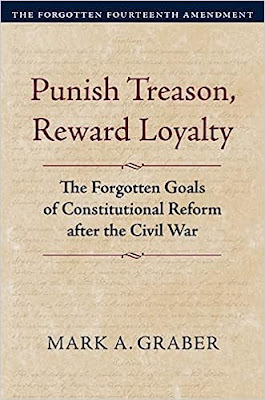
Mark A. Graber, Punish Treason, Reward Loyalty: The Forgotten Goals of Constitutional Reform after the Civil War (University of Kansas Press, 2023)
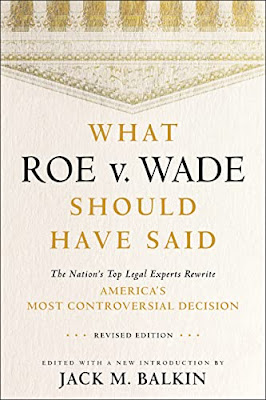
Jack M. Balkin, What Roe v. Wade Should Have Said: The Nation's Top Legal Experts Rewrite America's Most Controversial Decision - Revised Edition (NYU Press, 2023)

Andrew Koppelman, Burning Down the House: How Libertarian Philosophy Was Corrupted by Delusion and Greed (St. Martin’s Press, 2022)

Gerard N. Magliocca, Washington's Heir: The Life of Justice Bushrod Washington (Oxford University Press, 2022)
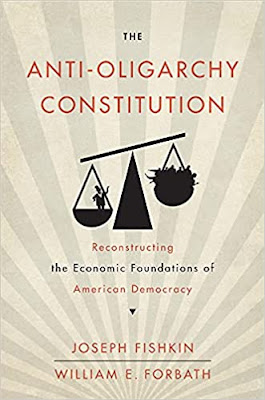
Joseph Fishkin and William E. Forbath, The Anti-Oligarchy Constitution: Reconstructing the Economic Foundations of American Democracy (Harvard University Press, 2022)
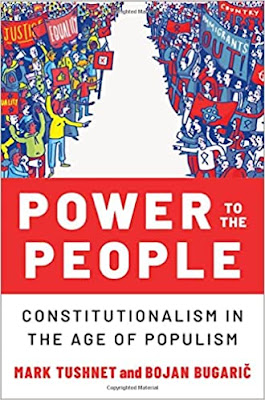
Mark Tushnet and Bojan Bugaric, Power to the People: Constitutionalism in the Age of Populism (Oxford University Press 2021).

Mark Philip Bradley and Mary L. Dudziak, eds., Making the Forever War: Marilyn B. Young on the Culture and Politics of American Militarism Culture and Politics in the Cold War and Beyond (University of Massachusetts Press, 2021).

Jack M. Balkin, What Obergefell v. Hodges Should Have Said: The Nation's Top Legal Experts Rewrite America's Same-Sex Marriage Decision (Yale University Press, 2020)

Frank Pasquale, New Laws of Robotics: Defending Human Expertise in the Age of AI (Belknap Press, 2020)

Jack M. Balkin, The Cycles of Constitutional Time (Oxford University Press, 2020)

Mark Tushnet, Taking Back the Constitution: Activist Judges and the Next Age of American Law (Yale University Press 2020).

Andrew Koppelman, Gay Rights vs. Religious Liberty?: The Unnecessary Conflict (Oxford University Press, 2020)

Ezekiel J Emanuel and Abbe R. Gluck, The Trillion Dollar Revolution: How the Affordable Care Act Transformed Politics, Law, and Health Care in America (PublicAffairs, 2020)

Linda C. McClain, Who's the Bigot?: Learning from Conflicts over Marriage and Civil Rights Law (Oxford University Press, 2020)
Sanford Levinson and Jack M. Balkin, Democracy and Dysfunction (University of Chicago Press, 2019)

Sanford Levinson, Written in Stone: Public Monuments in Changing Societies (Duke University Press 2018)

Mark A. Graber, Sanford Levinson, and Mark Tushnet, eds., Constitutional Democracy in Crisis? (Oxford University Press 2018)

Gerard Magliocca, The Heart of the Constitution: How the Bill of Rights became the Bill of Rights (Oxford University Press, 2018)

Cynthia Levinson and Sanford Levinson, Fault Lines in the Constitution: The Framers, Their Fights, and the Flaws that Affect Us Today (Peachtree Publishers, 2017)

Brian Z. Tamanaha, A Realistic Theory of Law (Cambridge University Press 2017)

Sanford Levinson, Nullification and Secession in Modern Constitutional Thought (University Press of Kansas 2016)

Sanford Levinson, An Argument Open to All: Reading The Federalist in the 21st Century (Yale University Press 2015)

Stephen M. Griffin, Broken Trust: Dysfunctional Government and Constitutional Reform (University Press of Kansas, 2015)

Frank Pasquale, The Black Box Society: The Secret Algorithms That Control Money and Information (Harvard University Press, 2015)

Bruce Ackerman, We the People, Volume 3: The Civil Rights Revolution (Harvard University Press, 2014)
Balkinization Symposium on We the People, Volume 3: The Civil Rights Revolution

Joseph Fishkin, Bottlenecks: A New Theory of Equal Opportunity (Oxford University Press, 2014)

Mark A. Graber, A New Introduction to American Constitutionalism (Oxford University Press, 2013)

John Mikhail, Elements of Moral Cognition: Rawls' Linguistic Analogy and the Cognitive Science of Moral and Legal Judgment (Cambridge University Press, 2013)

Gerard N. Magliocca, American Founding Son: John Bingham and the Invention of the Fourteenth Amendment (New York University Press, 2013)

Stephen M. Griffin, Long Wars and the Constitution (Harvard University Press, 2013)

Andrew Koppelman, The Tough Luck Constitution and the Assault on Health Care Reform (Oxford University Press, 2013)

James E. Fleming and Linda C. McClain, Ordered Liberty: Rights, Responsibilities, and Virtues (Harvard University Press, 2013)
Balkinization Symposium on Ordered Liberty: Rights, Responsibilities, and Virtues

Andrew Koppelman, Defending American Religious Neutrality (Harvard University Press, 2013)

Brian Z. Tamanaha, Failing Law Schools (University of Chicago Press, 2012)

Sanford Levinson, Framed: America's 51 Constitutions and the Crisis of Governance (Oxford University Press, 2012)

Linda C. McClain and Joanna L. Grossman, Gender Equality: Dimensions of Women's Equal Citizenship (Cambridge University Press, 2012)

Mary Dudziak, War Time: An Idea, Its History, Its Consequences (Oxford University Press, 2012)

Jack M. Balkin, Living Originalism (Harvard University Press, 2011)

Jason Mazzone, Copyfraud and Other Abuses of Intellectual Property Law (Stanford University Press, 2011)

Richard W. Garnett and Andrew Koppelman, First Amendment Stories, (Foundation Press 2011)

Jack M. Balkin, Constitutional Redemption: Political Faith in an Unjust World (Harvard University Press, 2011)

Gerard Magliocca, The Tragedy of William Jennings Bryan: Constitutional Law and the Politics of Backlash (Yale University Press, 2011)

Bernard Harcourt, The Illusion of Free Markets: Punishment and the Myth of Natural Order (Harvard University Press, 2010)

Bruce Ackerman, The Decline and Fall of the American Republic (Harvard University Press, 2010)
Balkinization Symposium on The Decline and Fall of the American Republic

Ian Ayres. Carrots and Sticks: Unlock the Power of Incentives to Get Things Done (Bantam Books, 2010)

Mark Tushnet, Why the Constitution Matters (Yale University Press 2010)

Ian Ayres and Barry Nalebuff: Lifecycle Investing: A New, Safe, and Audacious Way to Improve the Performance of Your Retirement Portfolio (Basic Books, 2010)
.jpg)
Jack M. Balkin, The Laws of Change: I Ching and the Philosophy of Life (2d Edition, Sybil Creek Press 2009)

Brian Z. Tamanaha, Beyond the Formalist-Realist Divide: The Role of Politics in Judging (Princeton University Press 2009)
Andrew Koppelman and Tobias Barrington Wolff, A Right to Discriminate?: How the Case of Boy Scouts of America v. James Dale Warped the Law of Free Association (Yale University Press 2009)

Jack M. Balkin and Reva B. Siegel, The Constitution in 2020 (Oxford University Press 2009)

Heather K. Gerken, The Democracy Index: Why Our Election System Is Failing and How to Fix It (Princeton University Press 2009)

Mary Dudziak, Exporting American Dreams: Thurgood Marshall's African Journey (Oxford University Press 2008)

David Luban, Legal Ethics and Human Dignity (Cambridge Univ. Press 2007)

Ian Ayres, Super Crunchers: Why Thinking-By-Numbers is the New Way to be Smart (Bantam 2007)

Jack M. Balkin, James Grimmelmann, Eddan Katz, Nimrod Kozlovski, Shlomit Wagman and Tal Zarsky, eds., Cybercrime: Digital Cops in a Networked Environment (N.Y.U. Press 2007)

Jack M. Balkin and Beth Simone Noveck, The State of Play: Law, Games, and Virtual Worlds (N.Y.U. Press 2006)

Andrew Koppelman, Same Sex, Different States: When Same-Sex Marriages Cross State Lines (Yale University Press 2006)

Brian Tamanaha, Law as a Means to an End (Cambridge University Press 2006)

Sanford Levinson, Our Undemocratic Constitution (Oxford University Press 2006)

Mark Graber, Dred Scott and the Problem of Constitutional Evil (Cambridge University Press 2006)

Jack M. Balkin, ed., What Roe v. Wade Should Have Said (N.Y.U. Press 2005)

Sanford Levinson, ed., Torture: A Collection (Oxford University Press 2004)
Balkin.com homepage
Bibliography
Conlaw.net
Cultural Software
Writings
Opeds
The Information Society Project
BrownvBoard.com
Useful Links
Syllabi and Exams
