Balkinization
an unanticipated consequence of
Jack M. Balkin
Balkinization Symposiums: A Continuing List
E-mail:
Jack Balkin:
jackbalkin at yahoo.com
Bruce Ackerman
bruce.ackerman at yale.edu
Ian Ayres
ian.ayres at yale.edu
Corey Brettschneider
corey_brettschneider at brown.edu
Mary Dudziak
mary.l.dudziak at emory.edu
Joey Fishkin
joey.fishkin at gmail.com
Heather Gerken heather.gerken at yale.edu
Abbe Gluck abbe.gluck at yale.edu
Mark Graber
mgraber at law.umaryland.edu
Stephen Griffin
sgriffin at tulane.edu
Jonathan Hafetz
jonathan.hafetz at shu.edu
Jeremy Kessler
jkessler at law.columbia.edu
Andrew Koppelman
akoppelman at law.northwestern.edu
Marty Lederman
msl46 at law.georgetown.edu
Sanford Levinson
slevinson at law.utexas.edu
David Luban
david.luban at gmail.com
Gerard Magliocca
gmaglioc at iupui.edu
Jason Mazzone
mazzonej at illinois.edu
Linda McClain
lmcclain at bu.edu
John Mikhail
mikhail at law.georgetown.edu
Frank Pasquale
pasquale.frank at gmail.com
Nate Persily
npersily at gmail.com
Michael Stokes Paulsen
michaelstokespaulsen at gmail.com
Deborah Pearlstein
dpearlst at yu.edu
Rick Pildes
rick.pildes at nyu.edu
David Pozen
dpozen at law.columbia.edu
Richard Primus
raprimus at umich.edu
K. Sabeel Rahmansabeel.rahman at brooklaw.edu
Alice Ristroph
alice.ristroph at shu.edu
Neil Siegel
siegel at law.duke.edu
David Super
david.super at law.georgetown.edu
Brian Tamanaha
btamanaha at wulaw.wustl.edu
Nelson Tebbe
nelson.tebbe at brooklaw.edu
Mark Tushnet
mtushnet at law.harvard.edu
Adam Winkler
winkler at ucla.edu
Compendium of posts on Hobby Lobby and related cases
The Anti-Torture Memos: Balkinization Posts on Torture, Interrogation, Detention, War Powers, and OLC
The Anti-Torture Memos (arranged by topic)
Recent Posts
Disorganizing the New House
The Abortion Emergency in the Federal Courts
Art Leff’s Dictionary of Law: A Very Belated Review
Cheney v. Trump
Increasingly Dangerous on Volokh Conspiracy
Religion and the wrong defense of abortion rights
The Closure of the Supreme Court
Some Lessons Taught by an American Shtetl
Democrats in Array: How the Climate Bill Finally Passed
LevinsonFest on Wrestling with Religious Diversity -- Collected Posts
Wrestling with Diversity in the Contemporary World
Can We All Get Along? A Tribute and a Question
Climate change and the Supreme Court’s version of police abolitionism
Wrestling with Religious Opposition to Leviathan
E Unum Pluribus: Comparative Textualism & Constitutional Faiths
![[Powered by Blogger]](https://lh3.googleusercontent.com/blogger_img_proxy/AEn0k_uWadbxQehQzLe_8u5aYNiVe8IGLYkUbEjFCYVZg_DldICroD0ZqW3h1uxs7Vc9gi7JryCwLLbIOCY-JgK_UovrJ8wkptWRtSNiIhpvboU1=s0-d)
Just A Few Blogs
ACS Blog
Alas, a Blog
Althouse
Arts and Letters Daily
Atrios (Eschaton)
Bill of Health
Buzzflash.com
Buzz Machine
Cato at Liberty
Juan Cole (Informed Comment)
Concurring Opinions
The Constitution in 2020
Corrente
Crooked Timber
Daily Howler
Daily Kos
Dana Boyd
Brad DeLong
Digby (Hullabaloo)
Discriminations
Daniel Drezner
Kevin Drum (Mother Jones)
Electrolite
En Banc
Eunomia (Daniel Larison)
Fafblog
Michael Froomkin (Discourse.net)
GovLab (Beth Noveck)
Rick Hasen (Election Law)
History News Network
How Appealing
Ignatz (Sam Heldman)
The Importance of (Ernie Miller)
Infolaw
Instapundit
International Economic Law and Policy Blog
IntLawGrrls
Jacob Levy
Jesus' General
Jurisdynamics
The Kitchen Cabinet
Mark Kleiman
Law Blog Central
Larry Lessig
Lawyers, Guns and Money
Liberal Oasis
Brian Leiter's Law School Reports
The Leiter Reports
Marginal Revolution
Megan McArdle
Memeorandum
Metafilter
Mirror of Justice
The New Republic
Newseum
No More Mister Nice Blog
Brendan Nyhan
Opinio Juris
Orcinus
The Originalism Blog
Pandagon
Passport (Foreign Policy)
Overcoming Bias
Political Animal (Washington Monthly)
Political Theory Daily Review
Political Wire (Taegan Goddard)
The Poor Man
Virginia Postrel
Prawfsblawg
Public Reason
Jonathan Rauch
Raw Story
Redstate
ReligiousLeftLaw.com
Reporters Committee For Freedom of the Press
Reproductive Rights Blog
Rothman's Roadmap to the Right of Publicity
SCOTUS Blog
Seeing the Forest
Clay Shirky
The Shifted Librarian
The Situationist
Larry Solum (Legal Theory)
Andrew Sullivan
Talking Points Memo
Talk Left
Tapped
Tbogg
TechPresident
The Paper Chase (Jurist)
Tom Paine
Tom Tomorrow (This Modern World)
Eve Tushnet
Uggabugga
University of Chicago Law School Faculty Blog
Unqualified Offerings
The Volokh Conspiracy
War and Piece (Laura Rozen)
Wampum
Oliver Willis
Wonkette
Written Description
Matthew Yglesias
Yin
Your Choice of Feeds
1. XML
powered by

2. Atom Feed
3. RSS 2.0
Disorganizing the New House
Gerard N. Magliocca
The latest election chatter is that Democratic prospects are improving. Maybe they can hold the House of Representatives or keep Republican gains to a minimum. Who knows. But there is a problem lurking. It is likely that a couple of Republican House members will be challenged on Section Three grounds in January. In other words, a House Democrat will say that Representative so-and-so is ineligible to serve in the House because of his or her participation in the insurrection. Then the House will have to set up some process to address the challenge. Here's the tricky part: As I understand past practice, a challenged member-elect may not serve until the challenge is resolved. In a very closely divided House, this could mean that a Republican majority of say, 3 seats, is no majority at all because at least 3 GOP Members will be challenged. The seats will be vacant until the challenge is resolved. And who knows how long that could drag out (or be dragged out). In the meantime, the House will be even more chaotic than usual. Of course, if the Democrats retain their House majority in November, then one or more GOP House members may be excluded on Section 3 grounds and will then challenge that exclusion in the courts. The issue of whether Powell v. McCormack applies to Section Three is unresolved.
Posted
1:57 PM
by Gerard N. Magliocca [link]
(0) comments
The Abortion Emergency in the Federal Courts
Andrew Koppelman
It is now notorious that the criminalization of abortion, in the
wake of the Supreme Court’s overruling of Roe v. Wade, doesn’t do
much to lower the abortion rate but has had devastating effects on the
ability of doctors to treat pregnancies that go wrong. Horror
stories accumulate. Opponents of abortion have claimed that the
press has exaggerated the danger. Yet
two recent lawsuits have made clear that this harm is very real. Efforts to preserve women’s health are being
resisted, with some success, even in cases where the fetus is doomed. The Supreme Court indicated in Dobbs v. Womens Health Center
that it wanted to stay away from the abortion issue. Yet it is certainly coming back there, and soon,
because of a new division between two lower federal courts. I explain in a new column at The Hill.
Posted
9:23 PM
by Andrew Koppelman [link]
Art Leff’s Dictionary of Law: A Very Belated Review
Mark Tushnet
Arthur Leff taught contracts and related subjects at Yale
Law School from 1968 until his death at age 46 in 1981. During the last years
of his life he worked on a dictionary of law. The completed entries for letters
A, B, and C (the first seemingly near complete, the third clearly still in
progress) were published in the Yale Law Journal in 1985. After saying a bit
about Leff as a teacher-scholar, I’ll speculate about the seemingly odd
enterprise of a major scholar turning to writing a legal dictionary in an era
when even writing treatises had fallen out of favor at the highest levels of
the legal academy. Leff’s obituary in the New York Times rightly said that he
was “among the Law School’s most popular professors.” I may be misremembering
but I think he smoked while he was teaching, and he certainly paced across the “stage”
with (again as I recall) something of a tic (perhaps because he couldn’t
smoke?). Someone described him as, in class, examining some current legal doctrine
in enormous detail, holding it up for examination as if it were the rotting
corpse of a dead rat. As that might suggest, Leff was fundamentally a legal
realist, skeptical about the ability of law as administered by ordinary mortals
to accomplish what its defenders asserted it could. He was also an accomplished
self-trained “law and economics” person who could play the Chicago-school game
with the best of the then-current crop. Among his important works were a major article on the
unconscionability doctrine, at the time touted as rule embedded in ordinary
contract law that could be turned to use as a device to protect consumers (and
redistribute wealth) [Leff didn’t think it could], and review essays of works
by Richard Posner and Roberto Unger. (I read the latter as rather sympathetic
to Unger’s project but skeptical about Unger’s purported solutions – though in
my view Unger didn’t really attempt to offer solutions.) Why would someone like Leff try to write a legal dictionary?
In a letter to a publisher quoted in the prefatory materials to the Law Journal’s
publication, Leff said that at the rate he was going he would be done by 2075.
The task was obviously impossible on the terms he set. So, what was going on? It’s important to emphasize that the dictionary isn’t modeled
on Ambrose Bierce. There are occasional turns of phrase that catch one’s
attention. The final entry, on “Chiltern hundreds,” is too long to reproduce
here, but it concludes – in the dictionary’s last words, “Ah, the English….”
Almost all the entries, though, are sober descriptions of legal terms, some
familiar, most not. There are scattered mini-essays running to perhaps a half-page
where Leff expands upon the doctrine associated with a term, writing in a
reasonably colloquial style. But one wouldn’t read the dictionary for chuckles. A dictionary of law has to have some principles of
inclusion and exclusion narrower than those used, for example, in compiling the
Oxford English Dictionary. And the principles one can infer from the product
itself might reveal something about the jurisprudence underlying the effort. There are some pretty clear idiosyncratic inclusions. Perhaps
derived from his interest in scams and swindles (many terms associated with
them are included), Leff included a non-trivial number of terms drawn from
psychology (“altruism”). And there are more than a few that are time-limited (“Brezhnev
doctrine” and quite a few entries for then-important U.S. Supreme Court
decisions). The time-limited entries also hint at the underlying jurisprudence.
“BASIC: In computer programming, a popular and comparatively simple computer
language; almost anyone (under forty) can learn to use it quite easily.” The jurisprudence, as I discern it, is this: Leff wanted to
write something that practicing lawyers could use. (He explained his interest
in including terms primarily located in psychology and economics as helpful to
lawyers who needed to carry on cocktail party conversations; I’m skeptical that
that’s all that it was.) Why, though, would an ordinary practicing lawyer have
to know the dozens and dozens of terms used in law French and legal Latin? I think the answer may be that such a lawyer might
occasionally (rarely) run across one of those terms in some old case that had
some bearing on the problem she was facing, or in deeds relevant to a property
transaction. The implication (for me) is that all law is always
available for a lawyer to use; some obscure case from 1635 might turn out to
give you just the right concept to use to help your client’s case today. You’d
have to update it of course, but the techniques for updating are also
available. And that, I think, might well be compatible with legal realism as I
understand it. There’s another component of Leff’s jurisprudence as
revealed in the dictionary. He was a proponent of then-prevalent views about
how often ambiguity arose in legal documents (a lot, and particularly when the
stakes were high enough), and of then-standards for resolving ambiguity. Meaning
in these cases came from context and purpose: What were the parties trying to
do? What was the legislature trying to do when it used this language? This is the
domesticated version that legal realism took when legal academics tried to sand
down its rough edges. (I learned that from Duncan Kennedy and Jan Deutsch.) My sense is that the Dictionary basically sank like a stone
and that Leff himself is no longer thought of as a significant figure in either
jurisprudence or more narrowly in private law scholarship (I might be wrong
about the latter). I’m not adept at this sort of thing, but I did try to search
Westlaw and Hein for references to the Dictionary – I found ten citations in
state cases, five in federal ones, and about a hundred citations in secondary
sources (the modal citation in the latter was to Leff’s entry of “balancing”). Is there a lesson in all this? Maybe that – except for a
tiny handful of “world historical” scholars – a scholar’s reputation, and
perhaps influence, depends a great deal on his or her personal charisma and
dies down as those who knew the scholar pass from the scene. (One can read
Thomas Kuhn to be making a similar point.) So, what are we doing as legal scholars? I’ve described what
I do as “turn out widgets” (in the pre-computer sense of little doodads that play
some small part in keeping a machine running) – and I confess that I find that
description more satisfying than one (that sometimes flits into my mind) that
connotes some grander contribution to the world.
Posted
8:34 PM
by Mark Tushnet [link]
Cheney v. Trump
Gerard N. Magliocca
In the wake of her primary defeat, Representative Cheney is floating the idea of running against Donald Trump for the 2024 Republican nomination. That may seem like a pointless protest campaign. But given her role on the January 6th Committee, she may have another goal in mind. In some states, only a primary candidate has standing to raise an eligibility challenge against another candidate. Thus, Representative Cheney may decide to run just so she can sue Donald Trump as ineligible under Section Three of the Fourteenth Amendment to serve again as President. Indeed, you can imagine a case captioned "Cheney v. Trump" reaching the Supreme Court next year or early in 2024. If she is serious about preventing Trump from returning to the Oval Office (which is what she and her father said in recent weeks), a presidential campaign may be her best option. No Republican candidate who is trying to win the nomination (in other words, Ron DeSantis) will make a Section Three argument. Suing Trump on that basis would make it impossible for that candidate to win the votes of lukewarm Trump supporters. Representative Cheney, though, won't be worried about them.
Posted
10:41 AM
by Gerard N. Magliocca [link]
(0) comments
Increasingly Dangerous on Volokh Conspiracy
Andrew Koppelman
Eugene Volokh has kindly invited me to contribute a series of posts to his blog, Volokh Conspiracy, summarizing my forthcoming article, "The Increasingly Dangerous Variants of the "Most-Favored-Nation" Theory of Religious Liberty." There is a link to the full article, which is on SSRN, but the article is a little long and this version provides the gist for the busy executive.
Posted
7:55 AM
by Andrew Koppelman [link]
Religion and the wrong defense of abortion rights
Andrew Koppelman
With respect to many issues, including some involving abortion, Americans who differ on moral fundamentals should be able to work together. We will inevitably disagree about whether personhood begins at the moment of conception. But defenses of abortion should focus not on the allegedly improper ideals of those who would restrict it but on the liberty and equality of women.
I elaborate in a new column at The Hill, here.
Posted
12:25 PM
by Andrew Koppelman [link]
The Closure of the Supreme Court
Gerard N. Magliocca
The Supreme Court is still closed to the public due to the pandemic. This is in sharp contrast to the other major public institutions in Washington D.C. The Capitol is open to visitors. The White House is open to tours. The Smithsonian is open, the Library of Congress is open, and the national monuments are open. So what's going on? Maybe the Court is simply getting more cautious advice from medical experts. Or maybe they have an imminent plan to reopen. Unfortunately, it's hard to avoid the conclusion that the real reason for the Court's continued closure is to prevent protesters from expressing their views inside the building. Free speech for thee but not for me.
Posted
10:38 AM
by Gerard N. Magliocca [link]
(0) comments
Some Lessons Taught by an American Shtetl
Sandy Levinson
Summer is an occasion, at least for academics, for reading big books, and I'm happy to say that I've just finished one of the major books on my list, American Shtetl: The Making of Kiryas Joel, a Hasidic Village in Upstate New York, by Nomi Stolzenberg and David Myers. I adverted to it in my response to the "Levinsonfest" on religious diversity, in which Nomi participated, but I had not yet finished it. I had at that time read only enough to know that it was fascinating. But I'm now in a position to be able to recommend it to anyone seriously interested not only in the central topic of religious diversity, whether in the United States or elsewhere, but also the various uses (and abuses) of litigation. The Satmar Hasids (who get their name from their "origin community in Romania) is now "the most populous Hasidic group in the world today" (p. 370). They imagine themselves as being a tightly-knit community wholly set apart from the ordinary world, speaking Yiddish and devoted exclusively to carrying out their religious duties. Yet a major theme of the book is the fact that they have created an American shtetl in significant measure because of their adaptation to certain important aspects of American culture. These include knowledge about how to work within the particular world of New York politics and, over the years, an increasing willingness to engage in active litigation in order to attain their goals. In addition, Stolzenberg and Myers emphasize as well what might be "exceptional" American laws concerning private property and land-use. This is not intended to be a full-scale review of a long, complex, and nuanced book. Much of it is devoted to explicating the particularities (and peculiarities) of the Satmar approach to the world. Events in Europe obviously destroyed the foundations of the Satmar order; they were certainly among the victims of World War II and the Holocaust,. However, their leader, Rabbi Joel Teitelbaum (whose name is memorialized in the name of the up-state New York village Kiryat Joel), moved to New York and, to an almost incredible degree, flourished in his desire to recreate the equivalent of a European shtetl composed exclusively of fellow members of the Satmar community and, as much as possible, free from the incursions of "gentile" leadership (or, for that matter, other Jews scarcely recognized as such by the Satmars). To describe Teitelbaum as a "leader" is an understatement: Chasidic communities are basically under the iron rule of singular quasi-monarchical rabbis, and Teitelbaum had the kind of sway over members of his community that no modern king or queen can dream of. There is a good reason that one speaks of rabbinic "courts" atop any given Chasidic movement. His words were almost literally law; more to the point, they were viewed as such by most members of the community. Unlike the probably better known Lubavitch Chasids, the Satmars did not view their rebbe as in fact the Messiah, but, while alive, he certainly exercised complete authority. Part of the drama of the book is the fragmentation within the Satmar community following his death and the rise of remarkably hostile factions headed by two different grandchildren of Teitelbaum (the Aronites and the Zalites). Indeed, Joel Teitelbaum's widow turns out to be a major figure in the infighting. If one were reading a novel called American Shtetl, there would be a temptation to describe some of the events described as "unrealistic" or "over-the-top," but truth really is often stranger than fiction,. A central tenet of Satmar theology is unmitigated opposition to Zionism, because, among other things, it rejects the command to await God's own decision as to when a messiah might come and restore Israel as an independent nation. Not only were most original Zionists secular; even the so-called "religious Zionists" rejected the command of political quietism, at least with regard to establishing a "Jewish state," in favor of human action. Although there are in fact some Satmars in Israel, they are among that group of the ulttra-Orthodox (the "haredi") who disdain the idea that Israel is a "Jewish state." Viewers of the justifiably popular Israeli series Shtisel, brought to America by Netflix, will be familiar with the fact that some of the most militant anti-Zionists in Israel in fact come from within the community of religious Jews. Stolzenberg and Myers do not mention the fact that the politicians from whom the Satmars seek (and often find) support are often themselves strong "supporters of Israel." They are more than happy to accept their support for what might be termed their "domestic" project of creating autonomous communities in New York. All politics are simply transactional. The Satmars are completely "American" in terms of being the epitome of a Madisonian "faction" concerned only with their own welfare; it is not at all clear that they have a genuinely "American" identity that might require any subordination of group interests to those of the "general welfare." But, then, that may make them not "un-American" at all, but only a clear illustration of the kind of "interest-group" politics that have made the Madisonian vision set out in Federalist 10 a delusional fantasy. It would be a mistake, though, to compare the the Satmars to the Amish (and Stolzenberg and Myers do not). The Amish want primarily to be let alone; they do not involve themselves in politics in any ordinary sense. Although apparently some individual Amish vote--they appear to have been strong supporters of Donald Trump, as were the Satmars in Kiryat Joel, who gave him 99% of their votes (!)--apparently most Amish sat on the sidelines. The Satmars, however, have proved extraordinarily skilled in using their political clout to get what they want from the gentiles. Both Mario Cuomo and his Republican successor George Pataki, for example, were key to their ability to develop Kiryat Joel as a basically autonomous community, described by some as a "theocracy," that, nonetheless, could benefit from a variety of programs of the state of New York, including aid to disabled children. (It was this issue that precipitated the creation of an "independent school district" at Kiryat Joel that ran a program for such children.) The ability of the Chasidic rabbis in effect to control a significant bloc of votes, especially in local elections, means that they are figures to be reckoned with in any politician's calculations. This is thought to have played a role in Bill Clinton's decision, as he was leaving his presidency, to commute the sentences of four (non-Satmar) Chasids who had been convicted of bilking the United States out of millions of dollars. His wife, embarking on her own political career in New York, benefitted from her close ties with the Chasidic community even as most of them increasingly described themselves as Republican. American Shtetl is a "must-read" book for anyone interested in the realities of religious pluralism in America. "Identity politics" is often associated with the left, but Stolzenberg and Myers correctly note that among the most skillful users of the "identitarian" trope are religious groups attempting to resist what they view as a decadent secular culture. One of their concluding paragraphs is worth quoting at length: Although "mullti-culturalism" may be viewed as a "left" or "progressive" trope, it is obvious that its most truly effective adherents come from the religious sector. Indeed, as I elaborated in my own response to the "Levinsonfest" presentations, my friends Doug Laycock and Michael McConnell persuaded me back in the 1980s that a commitment to "cultural pluralism" did require a greater sensitivity to the claims, for example, of religious parents of modest means who could not afford to take advantage of their formal constitutional right, protected since the 1920s, to educate their children in religious schools. McConnell in particular emphasized that most political progressives (including myself) supported state-subsidized abortions lest reproductive choice become simply a formal right enjoyed primarily by the well-off. So why didn't we as well support greater subsidization of educational choice that would allow more parents to send their children to religious schools? Part of American Shtetll sets out the collapse of an older liberal consensus on the meaning of "separation of church and state," encapsulated in the rhetoric (if not necessarily the result) in Everson v. Board of Education (1947) that suggested that no public funds should ever go to help fund religious schools. That vision, for better or worse, is in complete tatters, especially following the recent decision (obviously issued after the publication of American Shtetl) forcing Maine to direct funds to sectarian schools if the state gives funds to any private schools at all. There is surprisingly little discussion in the book about the deepening acrimonious conflicts concerning what might be called the monitoring of the education received in Satmar and other Hasidic schools. There is no real effort to educate the Satmar young, especially males, in any skills relevant to becoming full members of what is viewed as a decadent and basically goyish American society. Time spent on "secular" education is time taken away from what is really important, at least for males--the study of Torah and the Talmud, where the languages of instruction are Yiddish and Hebrew. (Here there may be an analogy with the Amish, whose Court-protected freedom from the "tyranny" of state compulsory education laws means that most of the Amish young also have few of the skills necessary for membership in the contemporary American economy or polity.) Many struggles over educational policy are between adult parents and adult politicians over who should have ultimate control; few people genuinely speak up for the children whose lives are obviously most affected by the decisions reached by their adult superiors. New York politicians, aware of the importance of the Hasidic bloc vote and the importance the rebbes attach to control of what outsiders might well describe as a totalitarian educational system, are averse to enforcing laws on the books that might seemingly rein in the power of the rebbes to reign over one of the central institutions by which groups (including, obviously, the Satmars) perpetuate themselves. High birth rates by themselves would be ineffective if the kids were in fact exposed to the lures of outside society. That must be prevented, and New York, at least practically speaking, seems willing to accommodate the Satmars and other such groups. A long chapter detailing literally decades of litigation involving the Satmars both in Kiryat Joel (now called Palm Tree as the former "village" has become an incorporated "town") and Brooklyn--will be of special interest to any lawyer. Many of us are trained to believe that what "cases" are really about is a result at the end indicating who wins and who loses. That is certainly not the case with regard to the Satmar litigation. A loss at the United States Supreme Court about the validity of a New York state law allowing Kiryat Joel to operate as a separate school district was followed by years of further litigation involving new legislation designed to get around the Court's decision. But, as Stolzenberg and Myers insightfully demonstrate, at least as important as final decisions, practically speaking, may be the issuance of "stay" orders that leave in place a status quo even as the litigation proceeds. Moreover, the key event in central litigation between Satmars themselves, and not simply between outsiders and the Satmars, was a settlement that literally drove one of the lawyers to tears because of what he viewed as its surrender on absolutely key points. (The settlement apparently took place in negotiations among the Satmars, without participation by any of the lawyers involved.). There is also fascinating discussion of the interplay between New York State courts and federal courts. In every way, then, this is a long book very much worth reading. It is a mistake to treat the Satmars as a basically irrelevant "exotic" group of religious zealots. Their ability to maintain a remarkable degree of independence from general American culture--in part because of their skill in using American mechanisms of politics and litigation--in fact illuminates a great deal about the contemporary divides in American society and whether it is in fact thinkable that they will be genuinely overcome in our lifetimes. [B]oth sides of the culture wars that have dominated American politics for half a century espouse the politics of group identity. The battle is not between identitarians and anti-identitarians. Nor is it between those who espouse the value of religious freedom and those who don't. It is, rather, a fight between those who see themselves as protecting traditional beliefs, practices, and cultural identity from the corrosive force of secular modernity and those who seek to assert personal cultural or religious identities that are anathema to religious traditionalists. (p. 378)
Posted
12:48 PM
by Sandy Levinson [link]
Democrats in Array: How the Climate Bill Finally Passed
David Super
As readers
presumably know, the Senate today passed the Inflation Reduction Act, a budget reconciliation
bill that has been in the works for a year and a half. Although far less ambitious than the Build
Back Better agreement Democrats reached then abandoned
a year ago, it still includes transformational changes in energy policy to
combat climate change. It also reduces
prescription drug prices for both Medicare beneficiaries and the federal
government itself as well as extending enhanced premium tax credits that
originated in the American Rescue Plan Act of early 2021. It also reduces the deficit by raising taxes
on the affluent and repairing some of the damage Republican appropriators have
done over the past decade to the Internal Revenue Service’s capacity to curb
tax evasion. Superficially, everything
went largely according to script: all
Democratic senators supported the bill, all Republicans opposed it, and Vice
President Harris broke the tie in favor of passage. The House will reconvene later this week to
pass the bill and send it on to the President.
Beneath the
surface, however, this legislation is not just a substantive tour de force
but a strategic one as well. It also
suggests that, after decades of headlines about their supposed “disarray”,
Democrats are developing the pragmatism and strategic judgment necessary for them
to do much more going forward if they can manage to win elections. This post is a set of observations on how
this happened. First, notwithstanding
the determined talk about bipartisanship from President Biden and his two immediate
Democratic predecessors, the Democrats recognized early on that they were
completely alone. Under no circumstances
would any Republicans help out in any way; historically, senators
from the minority party will sometimes help craft parts of legislation, or
defeat nefarious amendments, even if they do not plan to vote for final
passage. Here, every single Republican
move, from threatening to hold hostage other legislation to crafting amendments
designed solely to splinter the Democratic caucus, sought to undermine the
legislation. Supposed Senate Republican moderates
played along all the way. (Sen. Collins
voted against a few extreme amendments when the Democrats had demonstrated they
had the fifty votes to defeat it, but she never committed herself in advance –
suggesting that she might have changed her vote had it been decisive.) Second, Democrats
showed remarkable unity. Adoption of any
Republican poison-pill amendments might have doomed final passage in the Senate
and almost certainly would have done so in the House. Democrats had two
means available to pass a “clean” bill:
defeat every amendment as it came up or support a comprehensive superseding
amendment at the end from Senate Majority Leader Schumer to strip out all
amendments adopted along the way. Many of
us assumed the senators would want to vote for many Republican amendments and
then adopt the “king-of-the-hill” strategy at the end. That, however, would have put a majority of
the Senate on record favoring this or that problematic policy and all but
inviting Republicans to force them to vote on those same policies during
consideration of future must-pass legislation.
To their credit,
Democratic senators recognized this danger, held hands and voted down everything. Sen. Bernie Sanders (I-VT) gave moderate and
endangered Democrats cover by offering up several amendments to make the
legislation more liberal. Consistent
with the Democrats’ agreement to oppose all amendments, the Sanders Amendments
were voted down 99-1 or thereabouts.
This allowed all senators to say that they were protecting the
underlying bill by opposing amendments they liked as well as those they did not
– a claim made more credible when they rejected appealing liberalizing amendments. Democratic
senators’ unity, and clear focus on the need to enact the climate bill, was so
powerful that Senator Schumer elected not to use several lifelines he had
available. In particular, many Republican
amendments violated the Senate’s rules; by raising a point of order against
them, Senator Schumer could force the Republicans to seek the sixty votes needed
to waive the Congressional Budget Act.
That framing made “no” votes easier to explain, and the higher threshold
allowed up to nine Democrats to cast politically convenient votes with the
Republicans while still allowing the amendment to fail. Yet that device, too, would put Democrats on
record supporting policies they disfavored, opening the door to on-going
Republican attempts to force votes on future legislation. On several Republican amendments containing overt,
even outlandish violations of Senate Rules, the Democratic leadership elected
not to raise the point of order, fighting the amendment with a fifty-vote threshold
for success. To the amazement of those of
us beseeching the leadership to invoke available points of order, every such
amendment failed. Only on two Republican
amendments did the Democrats give themselves a margin of error by raising a
point of order. Most observers
became convinced that the legislation was going to pass after Democrats voted
down the seventh offered amendment, which would have reinstated President Trump’s
“remain-in-Mexico” policy. That policy polls
extremely well but is difficult to reconcile with our international obligations
to those fleeing oppression. Democrats
have been leery about opposing it in the past, but this time they voted
it down without dissention (and also without help from any purportedly moderate
Republicans). This amendment blatantly
violated section
313(b)(1)(D) of the Congressional Budget Act, but Democrats declined to
raise a point of order that could have allowed nine of them to vote for it. On the other hand,
half of the Democratic amendments came to the floor needing sixty votes to
pass. At least one of these did irredeemably
violate Senate rules, but some others probably could have been reframed to
require only fifty votes to pass. The leadership
recognized, however, that adoption of these amendments would blow up their
carefully-honed deal and that no Democrat wanted to be recorded as the one to
scuttle important Democratic priorities.
By bringing their amendments to the floor in a form requiring sixty
votes, Democrats could vote for the amendments and still know that nothing would
rupture their agreement. Third, Democrats
showed impressive preparation. The bill
threatened to unravel near the end of the “vote-a-rama” on amendments when Sen.
Kyrsten Sinema unexpectedly decided to support an amendment from Senate Republican
Whip John Thune. The Thune Amendment
would narrow the bill’s corporate minimum tax and pay for it by extending caps
on deductions for State and Local Taxes (SALT).
SALT caps are intensely unpopular with Democrats from high-tax states,
and extending them could have jeopardized the bill in both chambers. Once Sen. Sinema broke ranks, six other purple-state
Democrats followed suit. The leadership was
ready, however, and as soon as the Thune Amendment passed Sen. Mark Warner
offered an amendment to strip out Sen. Thune’s SALT caps and replace them with an
alternative revenue source. All
Democrats supported the change, and the underlying bill was again free of
poison pills. Had the leadership not
prepared amendments with alternative revenue sources and had them costed out in
advance, it would have had few good options for salvaging the bill. After Sen. Thune’s
SALT gambit failed, Senate Minority Leader McConnell terminated the Republicans’
fourteen-hour amendment campaign and allowed a final vote. All told, Republicans offered twenty-seven amendments
and Democrats brought ten to a vote; all except Sen. Thune’s and Sen. Warner’s
failed. @DavidASuper1
Posted
6:18 PM
by David Super [link]
LevinsonFest on Wrestling with Religious Diversity -- Collected Posts
Guest Blogger
Ashley Moran Below are the collected posts on the LevinsonFest 2022 roundtable constitutional faith
and veneration: 1. Ashley Moran, LevinsonFest on Wrestling
with Religious Diversity 2. John Adenitire, Wrestling with
Religion in Law 3. Douglas Laycock, On Friendship,
Tolerance, and Religious Liberty 4. Carol Nackenoff, Stiff Joints Don’t
Bend Anymore 5. Jaclyn Neo, Wrestling
with Religious Diversification 6. Intisar Rabb, E Unum Pluribus: Comparative
Textualism & Constitutional Faiths 7. Mark Scarberry, Wrestling with
Religious Opposition to Leviathan 8. Nomi Stolzenberg, Can We All Get Along? A Tribute and a Question 9. Sanford Levinson, Wrestling with
Diversity in the Contemporary World Ashley Moran is a Postdoctoral Fellow with the Comparative
Constitutions Project and Distinguished Scholar with UT’s Robert Strauss Center
for International Security and Law. You can contact her at
ashleymoran@utexas.edu.
Posted
9:30 AM
by Guest Blogger [link]
Wrestling with Diversity in the Contemporary World
Guest Blogger
Sanford Levinson This post was prepared for a
roundtable on Wrestling with Religious
Diversity, convened as part of LevinsonFest 2022. I begin by expressing
my deepest gratitude first to Richard Albert and Ashley Moran for organizing
this event and to the irreplaceable Trish Do for actually making it happen,
technologically. And, of course, I’m grateful to each and every one of you of
the participants. I am delighted that their appearance on Balkinization will
bring them to the attention of a wider community that will much benefit from
reading and thinking about them. I want to engage in a
special recognition of Doug Laycock. It’s not only that we’ve been friends and
colleagues now for forty years. It’s also true that there is probably no single
individual in the academy who has so obviously affected the way I think about
the general issues surrounding law and religion. That being said, I find myself
even more perplexed and ambivalent than usual at the present moment about what
the relationship between law and religion should be, not least because of a lot
of developments over these forty years or even more recently. I published a
group of essays, Wrestling with Diversity, in which I expressed a
variety of quite “Laycockian” views about how best to treat that relationship. But
it turns out that the wrestling match has not ended! I am increasingly
dissatisfied with the relevance of most standard-form legal doctrine, which
seems to me to evade many central questions, beginning, for that matter, with the
Supreme Court’s almost insouciant inability to offer a cogent definition of
“religion.” I suspect that Carol Nackenoff is correct in some of her comments
about the present (and future) Court, but, save for their obvious power in the
American legal order, I’m increasingly uncertain why I should take any of their
opinions truly seriously, even when I might agree with the particular outcome. It
is worth noting that our gathering occurred before the late-June blockbuster of
the Court and, particularly with regard to Carol’s paper, its opinion in the Kennedy
“praying coach” case. Many of us were perplexed why the Court took the case
at all, given that its facts were quite peculiar and there was nothing close to
a “conflict in the circuits” that demanded judicial intervention. It appears
quite clear, though, that the majority of the Court was quite determined to
intervene in order to write a broad opinion that served to upend many basic
understandings of religion and state built up over the past half century. In no
sense does the present Court seem interested in displaying any “passive
virtues.” It has power and it seemingly wishes to use it. It is foolhardy to
deny the continued relevance of W. E. B. DuBois’s emphasis on the importance of
the “color line,” even in the 21st century. But Jaclyn Neo’s fascinating paper about religious
diversification across the world demonstrates that, whatever may have been our
expectations fifty years ago, “the religion line” will play an ever more
important role. Perhaps academics are becoming ever more secular and
“cosmopolitan,” but that definitely does not seem to be the case for the nation
or world at large. And Nomi Stolzenberg’s remarkable survey of my work over
many years asks a truly crucial question: Is it possible for intellectually
committed “secularists” and what might be called the “seriously religious” to
get along at the present time, which I must say is very different from, say,
the world in which the central law-and-religion case was Yoder?
Posted
9:30 AM
by Guest Blogger [link]
Can We All Get Along? A Tribute and a Question
Guest Blogger
This post was prepared for a
roundtable on Wrestling with
Religious Diversity, convened as part of LevinsonFest 2022—a
year-long series gathering scholars from diverse disciplines and viewpoints to
reflect on Sandy Levinson’s influential work in constitutional law. Nomi Maya Stolzenberg On March 3, 1991, Rodney King, an African
American man driving on a Los Angeles freeway, was chased and then savagely
beaten by the police. A videotape of the beating ignited widespread criticism
and charges were brought against the participating police officers for assault
and excessive use of force. The trial, which took place one year later,
culminated in acquittals of the four officers who were charged,[1] in reaction to which thousands
of people took part in five days of civil disturbances known variously as the
LA Uprising or the LA riots of 1992. On the third day of the uprising, King
gave an impromptu news conference, deploring the shooting of a security guard
that had taken place and pleading for an end to the violence. The speech is
famously remembered for one line, oft-misquoted as: “Can’t we all just get
along?” In fact, the question that Rodney King posed was not “can’t we get
along?,” but rather, “can we get along?” The latter conveys the same longing
for peaceful coexistence that the mistaken paraphrase does, and indeed, King
went on to say, wishfully, “we can get along. We all can get along. We just
gotta. We gotta. I mean, we’re all stuck here for a while. Let’s, you know,
let’s try to work it out.” But unlike the mistaken paraphrase, “can’t we get
along?,” “can we get along?” is less a rhetorical question to which the answer
must be yes than it is a genuine question, the answer to which remains very
much in doubt. In roughly the same time period, Professor
Sanford Levinson—Sandy, to his friends—published a set of essays posing
essentially the same question, with one key difference. Whereas Rodney King
expressed the desire to overcome the racial divisions that scar American
society, these essays that Sandy wrote in the early 1990s were focused on the
problem of religious division.[2] More precisely, they examined
the divide that exists between what Sandy described as “secularist,
accommodationist liberals like myself”[3]
and “those who are religious.”[4] They gave voice to his concern
about whether these groups can get along, as opposed to splintering apart into
mutually indifferent, or worse, warring camps. And they expressed the desire
not just to confront the divide between secularism and religious belief but to
explore the possibility of bridging it.
Posted
9:30 AM
by Guest Blogger [link]
Climate change and the Supreme Court’s version of police abolitionism
Andrew Koppelman
West
Virginia v. Environmental Protection Agency, which in June gutted
the Biden Administration’s ability to reduce the electrical power industry’s
carbon emissions, may be the Supreme Court’s most reckless and lawless decision
(in an extremely competitive field). The Court comes close to anarchism,
crippling Congress’s capacity to protect the country from disaster, and
undermining the fundamental purpose of the Constitution. I explain in a new column at The Hill, here.
Posted
8:33 AM
by Andrew Koppelman [link]
Wrestling with Religious Opposition to Leviathan
Guest Blogger
This post was prepared for a
roundtable on Wrestling with
Religious Diversity, convened as part of LevinsonFest 2022—a
year-long series gathering scholars from diverse disciplines and viewpoints to
reflect on Sandy Levinson’s influential work in constitutional law. Mark
S. Scarberry[1] This
paper considers Professor Levinson’s (Sandy’s) treatment of Federalist No. 2 in
his book on the Federalist,[2]
and also his inaugural lecture at Touro Law School’s Jewish Law Institute,
“Divided Loyalties: The Problem Of ‘Dual Sovereignty’ and Constitutional
Faith.”[3]
The Federalist extolls American religious unity as a basis for maintaining and
deepening the American union. Sandy’s Touro lecture explores the conflict
inherent in a religiously diverse nation, where loyalty to God and loyalty to
the State—loyalty pledged pursuant to every government official’s oath (or
affirmation) to support the Constitution—may conflict. (In this regard, we
could consider the addition of “under God” to the Pledge of Allegiance during
the Cold War struggle against totalitarian adversaries that demanded total
loyalty to the State, but that would be a different paper.) I
would like to say something about the role of minority Christian faiths—key
elements of our religious diversity—in the development of First Amendment
principles. I will suggest that the contribution of those faiths in wrestling
with “Leviathan” may have made it possible for us all to live in peace, with a
degree of unity. Little
of this will be original. On an irreligiously religious note, consider Mark
Twain’s Notebook comment on Adam in the Garden of Eden: “How lucky Adam was. He
knew when he said a good thing, nobody had said it before.” Whether this paper
includes any “good thing[s]” will be for others to say. In
Federalist No. 2, John Jay, writing of course as Publius, asserted that the
Constitution had to be ratified, or else the unity of the United States, such
as it was, would be lost. The result? Separated, vulnerable and potentially
hostile states or confederations. Unity was possible because Americans were
“one united people”—setting aside the native American population and the
enormity of the evil of slavery—who, among other commonalities “profess[ed] the
same religion.” Sandy points out that “it would be easy to demonstrate the utter
fatuity” of Publius’s assertion of these commonalities.[4]
Most free Americans indeed were Christians of various sorts, though one might
doubt that persecuted Baptists and Quakers considered themselves to be united
by faith with Anglicans and Congregationalists. Nor, of course, would Jews. And
the English Civil War, with its religious struggle—not nearing in ferocity the
religious wars on the Continent but ending in the same year as publication of
Hobbes’s Leviathan—would not have been far from their minds.
Posted
9:30 AM
by Guest Blogger [link]
E Unum Pluribus: Comparative Textualism & Constitutional Faiths
Guest Blogger
This post was prepared for a
roundtable on Wrestling with
Religious Diversity, convened as part of LevinsonFest 2022—a
year-long series gathering scholars from diverse disciplines and viewpoints to
reflect on Sandy Levinson’s influential work in constitutional law. Intisar
A. Rabb From one text comes many interpretations: e
unum pluribus. This formula is of course an inversion of e pluribus unum
(“from many, one”)—the motto for American democracy emblazoned on our money
to provide as often a reminder to [property-owning] adherents of America’s
“civil religion” of shared constitutional ideals, constitutional aspirations, constitutional
faiths.[1] By making faiths
plural, I am in part ceding the about-face that Sandy Levinson, former
adherent, made in his Foreword to a new edition of his book Constitutional
Faith. There, he concluded that, although the Constitution’s generalities
are still fluid and thus negotiable, many of its structural elements have
settled in ways that make governance and addressing problems of injustice hard.[2]
The Supreme Court’s Term this year perhaps proves the point.[3] Taking
up Sandy’s charge that scholars rarely discuss the general elements that make
interpretation hard, I offer some comparative perspective from a seemingly
unlikely place—Islam’s pluralistic legal system—to suggest that in any legal
interpretation, including the most controversial in the U.S., difficult interpretive
elements are never about a single constitutional faith. Nor are they even about
religion, per se, even when they seem to be. They are about a plurality of
constitutional faiths despite a single legal text. Those elements motivate core
differences in the Court’s interpretive debates over fundamental privileges
versus promises, textualism versus purposivism, status quo-preserving
originalism vs. rights-promoting pragmatism.[4] I
aim to explore those elements with an eye to the plurality of opinions that
emerge from shared legal texts, now that stare decisis is in question as
a way to settle them and now that interpretations of history and tradition
matter a lot toward the same end. Consider
Dobbs v. Jackson Women’s Health Organization, the Court’s recent
decision overturning its 1973 decision Roe v. Wade and its companion
1992 decision Planned Parenthood v. Casey.[5]
Differing interpretive approaches and conclusions in its majority and
dissenting opinions display competing visions of “history and tradition.”[6]
Those competing visions reflexively drive the interpretive approaches that
dictate which history and which traditions to adopt—in Dobbs,
a supermajority adopted an originalism that somehow excluded the history of
slavery and its ongoing consequences, as well as the Constitution’s
Reconstruction Amendments meant to address it, as Professor Michelle
Goodwin has powerfully pointed out.[7]
And both sides reveal competing accounts of the otherwise agreed-upon common
law doctrine of stare decisis and when to forego it. In the end, all of
these disagreements about history and interpretive method reveal differing
value commitments in the guise of competing beliefs, not explicitly in
religious faith (despite its obvious relevance to abortion),[8]
but in the Constitution and the role of the Court: that is, competing constitutional
faiths, plural.[9] As
with the popular religious and political polarization about abortion,
interpretive polarization was evident in the questions presented before the
Court, with no room for nuance, discussion, or compromise. Each side was at
pains to point out that only one position should and could reign supreme, and Justice
Alito was happy to oblige in Dobbs.[10]
But in reality, on the court, judges must wrestle with diversity.[11]
Posted
9:30 AM
by Guest Blogger [link]
Books by Balkinization Bloggers

Gerard N. Magliocca, The Actual Art of Governing: Justice Robert H. Jackson's Concurring Opinion in the Steel Seizure Case (Oxford University Press, 2025)

Linda C. McClain and Aziza Ahmed, The Routledge Companion to Gender and COVID-19 (Routledge, 2024)

David Pozen, The Constitution of the War on Drugs (Oxford University Press, 2024)

Jack M. Balkin, Memory and Authority: The Uses of History in Constitutional Interpretation (Yale University Press, 2024)
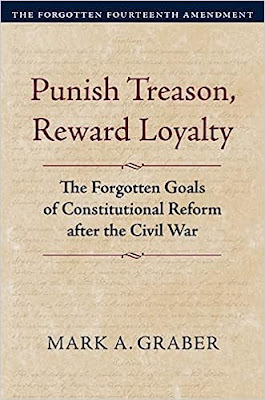
Mark A. Graber, Punish Treason, Reward Loyalty: The Forgotten Goals of Constitutional Reform after the Civil War (University of Kansas Press, 2023)
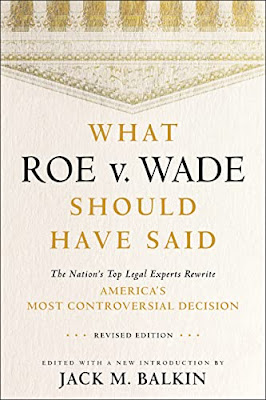
Jack M. Balkin, What Roe v. Wade Should Have Said: The Nation's Top Legal Experts Rewrite America's Most Controversial Decision - Revised Edition (NYU Press, 2023)

Andrew Koppelman, Burning Down the House: How Libertarian Philosophy Was Corrupted by Delusion and Greed (St. Martin’s Press, 2022)

Gerard N. Magliocca, Washington's Heir: The Life of Justice Bushrod Washington (Oxford University Press, 2022)
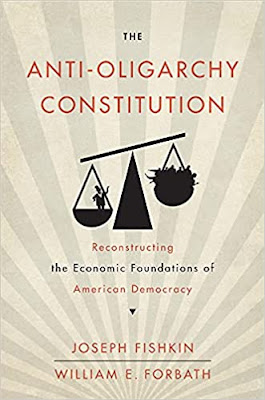
Joseph Fishkin and William E. Forbath, The Anti-Oligarchy Constitution: Reconstructing the Economic Foundations of American Democracy (Harvard University Press, 2022)
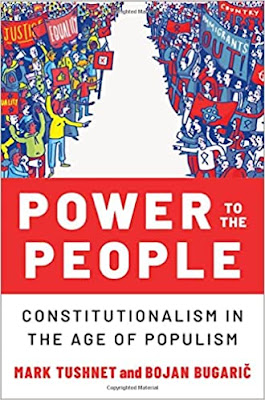
Mark Tushnet and Bojan Bugaric, Power to the People: Constitutionalism in the Age of Populism (Oxford University Press 2021).

Mark Philip Bradley and Mary L. Dudziak, eds., Making the Forever War: Marilyn B. Young on the Culture and Politics of American Militarism Culture and Politics in the Cold War and Beyond (University of Massachusetts Press, 2021).

Jack M. Balkin, What Obergefell v. Hodges Should Have Said: The Nation's Top Legal Experts Rewrite America's Same-Sex Marriage Decision (Yale University Press, 2020)

Frank Pasquale, New Laws of Robotics: Defending Human Expertise in the Age of AI (Belknap Press, 2020)

Jack M. Balkin, The Cycles of Constitutional Time (Oxford University Press, 2020)

Mark Tushnet, Taking Back the Constitution: Activist Judges and the Next Age of American Law (Yale University Press 2020).

Andrew Koppelman, Gay Rights vs. Religious Liberty?: The Unnecessary Conflict (Oxford University Press, 2020)

Ezekiel J Emanuel and Abbe R. Gluck, The Trillion Dollar Revolution: How the Affordable Care Act Transformed Politics, Law, and Health Care in America (PublicAffairs, 2020)

Linda C. McClain, Who's the Bigot?: Learning from Conflicts over Marriage and Civil Rights Law (Oxford University Press, 2020)
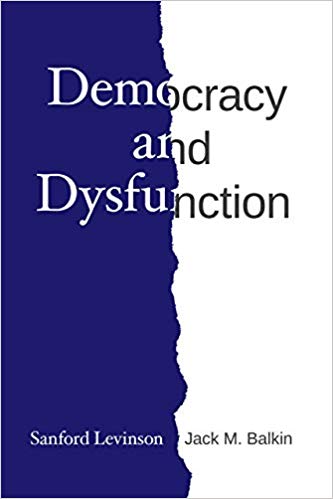
Sanford Levinson and Jack M. Balkin, Democracy and Dysfunction (University of Chicago Press, 2019)

Sanford Levinson, Written in Stone: Public Monuments in Changing Societies (Duke University Press 2018)

Mark A. Graber, Sanford Levinson, and Mark Tushnet, eds., Constitutional Democracy in Crisis? (Oxford University Press 2018)

Gerard Magliocca, The Heart of the Constitution: How the Bill of Rights became the Bill of Rights (Oxford University Press, 2018)

Cynthia Levinson and Sanford Levinson, Fault Lines in the Constitution: The Framers, Their Fights, and the Flaws that Affect Us Today (Peachtree Publishers, 2017)

Brian Z. Tamanaha, A Realistic Theory of Law (Cambridge University Press 2017)

Sanford Levinson, Nullification and Secession in Modern Constitutional Thought (University Press of Kansas 2016)

Sanford Levinson, An Argument Open to All: Reading The Federalist in the 21st Century (Yale University Press 2015)

Stephen M. Griffin, Broken Trust: Dysfunctional Government and Constitutional Reform (University Press of Kansas, 2015)

Frank Pasquale, The Black Box Society: The Secret Algorithms That Control Money and Information (Harvard University Press, 2015)

Bruce Ackerman, We the People, Volume 3: The Civil Rights Revolution (Harvard University Press, 2014)
Balkinization Symposium on We the People, Volume 3: The Civil Rights Revolution

Joseph Fishkin, Bottlenecks: A New Theory of Equal Opportunity (Oxford University Press, 2014)

Mark A. Graber, A New Introduction to American Constitutionalism (Oxford University Press, 2013)

John Mikhail, Elements of Moral Cognition: Rawls' Linguistic Analogy and the Cognitive Science of Moral and Legal Judgment (Cambridge University Press, 2013)

Gerard N. Magliocca, American Founding Son: John Bingham and the Invention of the Fourteenth Amendment (New York University Press, 2013)

Stephen M. Griffin, Long Wars and the Constitution (Harvard University Press, 2013)

Andrew Koppelman, The Tough Luck Constitution and the Assault on Health Care Reform (Oxford University Press, 2013)

James E. Fleming and Linda C. McClain, Ordered Liberty: Rights, Responsibilities, and Virtues (Harvard University Press, 2013)
Balkinization Symposium on Ordered Liberty: Rights, Responsibilities, and Virtues

Andrew Koppelman, Defending American Religious Neutrality (Harvard University Press, 2013)

Brian Z. Tamanaha, Failing Law Schools (University of Chicago Press, 2012)

Sanford Levinson, Framed: America's 51 Constitutions and the Crisis of Governance (Oxford University Press, 2012)

Linda C. McClain and Joanna L. Grossman, Gender Equality: Dimensions of Women's Equal Citizenship (Cambridge University Press, 2012)

Mary Dudziak, War Time: An Idea, Its History, Its Consequences (Oxford University Press, 2012)

Jack M. Balkin, Living Originalism (Harvard University Press, 2011)

Jason Mazzone, Copyfraud and Other Abuses of Intellectual Property Law (Stanford University Press, 2011)

Richard W. Garnett and Andrew Koppelman, First Amendment Stories, (Foundation Press 2011)

Jack M. Balkin, Constitutional Redemption: Political Faith in an Unjust World (Harvard University Press, 2011)

Gerard Magliocca, The Tragedy of William Jennings Bryan: Constitutional Law and the Politics of Backlash (Yale University Press, 2011)

Bernard Harcourt, The Illusion of Free Markets: Punishment and the Myth of Natural Order (Harvard University Press, 2010)

Bruce Ackerman, The Decline and Fall of the American Republic (Harvard University Press, 2010)
Balkinization Symposium on The Decline and Fall of the American Republic

Ian Ayres. Carrots and Sticks: Unlock the Power of Incentives to Get Things Done (Bantam Books, 2010)

Mark Tushnet, Why the Constitution Matters (Yale University Press 2010)

Ian Ayres and Barry Nalebuff: Lifecycle Investing: A New, Safe, and Audacious Way to Improve the Performance of Your Retirement Portfolio (Basic Books, 2010)
.jpg)
Jack M. Balkin, The Laws of Change: I Ching and the Philosophy of Life (2d Edition, Sybil Creek Press 2009)

Brian Z. Tamanaha, Beyond the Formalist-Realist Divide: The Role of Politics in Judging (Princeton University Press 2009)
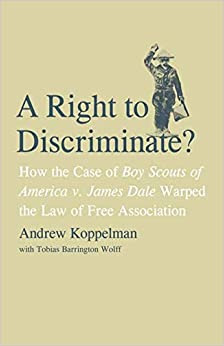
Andrew Koppelman and Tobias Barrington Wolff, A Right to Discriminate?: How the Case of Boy Scouts of America v. James Dale Warped the Law of Free Association (Yale University Press 2009)

Jack M. Balkin and Reva B. Siegel, The Constitution in 2020 (Oxford University Press 2009)

Heather K. Gerken, The Democracy Index: Why Our Election System Is Failing and How to Fix It (Princeton University Press 2009)

Mary Dudziak, Exporting American Dreams: Thurgood Marshall's African Journey (Oxford University Press 2008)

David Luban, Legal Ethics and Human Dignity (Cambridge Univ. Press 2007)

Ian Ayres, Super Crunchers: Why Thinking-By-Numbers is the New Way to be Smart (Bantam 2007)

Jack M. Balkin, James Grimmelmann, Eddan Katz, Nimrod Kozlovski, Shlomit Wagman and Tal Zarsky, eds., Cybercrime: Digital Cops in a Networked Environment (N.Y.U. Press 2007)

Jack M. Balkin and Beth Simone Noveck, The State of Play: Law, Games, and Virtual Worlds (N.Y.U. Press 2006)

Andrew Koppelman, Same Sex, Different States: When Same-Sex Marriages Cross State Lines (Yale University Press 2006)

Brian Tamanaha, Law as a Means to an End (Cambridge University Press 2006)

Sanford Levinson, Our Undemocratic Constitution (Oxford University Press 2006)

Mark Graber, Dred Scott and the Problem of Constitutional Evil (Cambridge University Press 2006)

Jack M. Balkin, ed., What Roe v. Wade Should Have Said (N.Y.U. Press 2005)

Sanford Levinson, ed., Torture: A Collection (Oxford University Press 2004)
Balkin.com homepage
Bibliography
Conlaw.net
Cultural Software
Writings
Opeds
The Information Society Project
BrownvBoard.com
Useful Links
Syllabi and Exams
