Balkinization
an unanticipated consequence of
Jack M. Balkin
Balkinization Symposiums: A Continuing List
E-mail:
Jack Balkin:
jackbalkin at yahoo.com
Bruce Ackerman
bruce.ackerman at yale.edu
Ian Ayres
ian.ayres at yale.edu
Corey Brettschneider
corey_brettschneider at brown.edu
Mary Dudziak
mary.l.dudziak at emory.edu
Joey Fishkin
joey.fishkin at gmail.com
Heather Gerken heather.gerken at yale.edu
Abbe Gluck abbe.gluck at yale.edu
Mark Graber
mgraber at law.umaryland.edu
Stephen Griffin
sgriffin at tulane.edu
Jonathan Hafetz
jonathan.hafetz at shu.edu
Jeremy Kessler
jkessler at law.columbia.edu
Andrew Koppelman
akoppelman at law.northwestern.edu
Marty Lederman
msl46 at law.georgetown.edu
Sanford Levinson
slevinson at law.utexas.edu
David Luban
david.luban at gmail.com
Gerard Magliocca
gmaglioc at iupui.edu
Jason Mazzone
mazzonej at illinois.edu
Linda McClain
lmcclain at bu.edu
John Mikhail
mikhail at law.georgetown.edu
Frank Pasquale
pasquale.frank at gmail.com
Nate Persily
npersily at gmail.com
Michael Stokes Paulsen
michaelstokespaulsen at gmail.com
Deborah Pearlstein
dpearlst at yu.edu
Rick Pildes
rick.pildes at nyu.edu
David Pozen
dpozen at law.columbia.edu
Richard Primus
raprimus at umich.edu
K. Sabeel Rahmansabeel.rahman at brooklaw.edu
Alice Ristroph
alice.ristroph at shu.edu
Neil Siegel
siegel at law.duke.edu
David Super
david.super at law.georgetown.edu
Brian Tamanaha
btamanaha at wulaw.wustl.edu
Nelson Tebbe
nelson.tebbe at brooklaw.edu
Mark Tushnet
mtushnet at law.harvard.edu
Adam Winkler
winkler at ucla.edu
Compendium of posts on Hobby Lobby and related cases
The Anti-Torture Memos: Balkinization Posts on Torture, Interrogation, Detention, War Powers, and OLC
The Anti-Torture Memos (arranged by topic)
Recent Posts
A Very Strange Debate
The Impeachment Oath and the Article VI Oath
Invisible Workers on the Global Assembly Line: Behind the Screen
Obamacare, Separation of Powers, and Accountability
The problem isn't GOP Senators' lack of "impartiality"--it's that they're all insisting the President did nothing wrong
Withholding the Articles of Impeachment
How Will the Senate Proceed on Impeachment?
The Good Ol' Days of Solicitor General Humility (and Reconsideration): Some Things You Probably Didn't Know About Myers v. United States [UPDATED]
Symposium on Mary Anne Franks, The Cult of the Constitution: Collected Posts
Involving Orcs
Analyzing the Articles of Impeachment
Constitutional Reckoning
Fairness for All, a good idea nearly everyone hates
The Constitutional Politics of Impeachment
Symposium on David Schwartz, The Spirit of the Constitution-- Collected Posts
Fair Play or the Rule of Law?
Drafting Articles of Impeachment
Burying McCulloch?
![[Powered by Blogger]](https://lh3.googleusercontent.com/blogger_img_proxy/AEn0k_sI9Usp__L5qreKIwydQ9E3u9unHZWYM6ha02aiUjhmmZqLJStM9kF4WfmpQoGkbqC66vSEwkDC7003Stx85nYlDRb6kNLFhs-ewEYT9jCa=s0-d)
Just A Few Blogs
ACS Blog
Alas, a Blog
Althouse
Arts and Letters Daily
Atrios (Eschaton)
Bill of Health
Buzzflash.com
Buzz Machine
Cato at Liberty
Juan Cole (Informed Comment)
Concurring Opinions
The Constitution in 2020
Corrente
Crooked Timber
Daily Howler
Daily Kos
Dana Boyd
Brad DeLong
Digby (Hullabaloo)
Discriminations
Daniel Drezner
Kevin Drum (Mother Jones)
Electrolite
En Banc
Eunomia (Daniel Larison)
Fafblog
Michael Froomkin (Discourse.net)
GovLab (Beth Noveck)
Rick Hasen (Election Law)
History News Network
How Appealing
Ignatz (Sam Heldman)
The Importance of (Ernie Miller)
Infolaw
Instapundit
International Economic Law and Policy Blog
IntLawGrrls
Jacob Levy
Jesus' General
Jurisdynamics
The Kitchen Cabinet
Mark Kleiman
Law Blog Central
Larry Lessig
Lawyers, Guns and Money
Liberal Oasis
Brian Leiter's Law School Reports
The Leiter Reports
Marginal Revolution
Megan McArdle
Memeorandum
Metafilter
Mirror of Justice
The New Republic
Newseum
No More Mister Nice Blog
Brendan Nyhan
Opinio Juris
Orcinus
The Originalism Blog
Pandagon
Passport (Foreign Policy)
Overcoming Bias
Political Animal (Washington Monthly)
Political Theory Daily Review
Political Wire (Taegan Goddard)
The Poor Man
Virginia Postrel
Prawfsblawg
Public Reason
Jonathan Rauch
Raw Story
Redstate
ReligiousLeftLaw.com
Reporters Committee For Freedom of the Press
Reproductive Rights Blog
Rothman's Roadmap to the Right of Publicity
SCOTUS Blog
Seeing the Forest
Clay Shirky
The Shifted Librarian
The Situationist
Larry Solum (Legal Theory)
Andrew Sullivan
Talking Points Memo
Talk Left
Tapped
Tbogg
TechPresident
The Paper Chase (Jurist)
Tom Paine
Tom Tomorrow (This Modern World)
Eve Tushnet
Uggabugga
University of Chicago Law School Faculty Blog
Unqualified Offerings
The Volokh Conspiracy
War and Piece (Laura Rozen)
Wampum
Oliver Willis
Wonkette
Written Description
Matthew Yglesias
Yin
Your Choice of Feeds
1. XML
powered by

2. Atom Feed
3. RSS 2.0
A Very Strange Debate
David Super
Even before last
week’s impeachment vote in the House, a strange debate had begun about how the
House should proceed with its articles of impeachment. Some have suggested that the House should
never send those articles to the Senate to trigger a trial on whether President
Trump should remain in office. Others
have suggested that the House should wait until later in the year or somehow
hold those articles hostage until Senator McConnell agrees to trial procedures
to the Democrats’ liking. Some have
suggested that the Senate could go ahead and hold an impeachment trial without
the House forwarding its articles of impeachment. In the course of this debate, scholars have
opined on such esoteric questions as when is a president truly impeached.
Many of the commentators
participating in this debate rely on misunderstandings of congressional
procedure. Others operate on rather fanciful
understandings of politics. And all too
many are trying to find a clear legalistic answer to a question that is
essentially one of public perceptions. I
believe that the House should present its articles of impeachment to the Senate
as soon as possible after Congress returns in January and that failing to do so
is likely to undermine the very purposes the House has sought to serve through
impeachment.
Any analysis must,
of course, start with the question of what those purposes are or should be. It is not, as some Republicans like to claim,
reversing the result of the 2016 election.
The most impeachment could possibly achieve would be to install Vice
President Pence, who prevailed in that same election and has enthusiastically
supported President Trump’s policies without exception. And even if the indications of Vice President
Pence’s involvement in extorting Ukraine blossomed into something worthy of
impeachment, the Republican Senate would never remove him from office before he
had had the chance to appoint, and Congress to confirm, a new Republican vice
president.
The realistic goal
also cannot be removal of Donald Trump from office before the expiration of his
current term. We have absolutely no
indications that anything like twenty Republican senators would even consider
removing him from office. Some have
suggested that postponing the trial until after the Senate primaries will free
Republican senators to vote to remove President Trump. That is unrealistic for several reasons. First, many of the primaries are quite late: more than half are during or after
August. Holding an impeachment trial in
the summer to foreshorten presidency subject to the voters’ review a few months
later will strike many voters, including plenty who are skeptical of President
Trump, as gratuitous. Second, even apart
from primaries, Republican senators in contested races will fear dampened
enthusiasm among the President’s base should they vote to remove the President could
dampen general election turn-out. Third,
the numbers are wrong: the number of
Republican senators up for re-election is just barely enough to supply the
votes needed to convict, and that is counting some of the President’s biggest
congressional supporters. Finally, and
most crucially, very, very few Republican senators have given even the
slightest indication that they have any interest in removing the
President. This Trump exceptionalism –
the delusion that the President is an aberrational figure in a largely
wholesome Republican Party – is one of the greatest impediments to thoughtful
responses to the current situation. I
have yet to hear a plausible list of potential removal-voting Republican
senators with even a dozen names, much less twenty.
The Democrats’
plausible goals for impeachment are, and have always been, considerably more
modest: to better inform the U.S. electorate
of some of the unlawful and unethical actions taken in their name, to compel congressional
Republicans to choose between defending the Constitution and defending the
President, and to deter this sort of behavior in the future. The cost of achieving these goals has always
been steep: forcing Democrats in
pro-Trump districts to cast difficult, perhaps lethal, votes and increasing the
cynicism of relatively apolitical voters who condemn “squabbling” without
looking thoughtfully at the merits.
For many months
after last year’s election, Speaker Nancy Pelosi took the view that this price
was too high, that congressional Democrats would damage themselves more than
they would the President by pursuing impeachment. As one of the most successful politicians of
our era – one who led Democrats to a House majority not once but twice and who
has remained true to Democratic priorities throughout her career – the Speaker’s
voice bears careful consideration.
The combination of
the President’s brazenness in seeking to extort Ukraine into helping his
re-election and ceaseless pressure from Democratic activists persuaded her to reverse
course. In the process, she brought
along every Democrat except Rep. Colin Peterson, whose Minnesota district
is deeply conservative, Rep. Jeff Van Drew, who turned
out not to really want to be a Democrat, and Rep. Tulsi Gabbard, who long
ago demonstrated that she has a very different agenda. Forcing Democrats in conservative districts to
cast votes that their opponents will portray as ultra-partisan and
mean-spirited could cost Democrats enough seats to lose control of the House in
the next Congress; even if it does not, it could leave them with a bare
majority but little ability to win controversial votes.
It seems quite
remarkable that some voices are now suggesting that the House Democrats, having
paid this price for impeachment, should give up the benefits of holding a
Senate trial to further educate the electorate and to force Republican senators
to decide whether to declare the President’s conduct acceptable. (Until the House “exhibit[s]” authenticated articles
of impeachment to the Senate, Senate rules make no provision for holding an
impeachment trial – and Senate Republicans clearly would not want to do so in
any event.) If House Democrats did not
want a Senate trial, they should have passed a resolution of censure instead,
putting their endangered Members in much less of a bind. Playing arcane procedural games that few
voters will understand seems likely only to exacerbate public cynicism and the
difficulties of endangered House Democrats.
The notion that,
by withholding the articles of impeachment, House Democrats can extract procedural
concessions from Senator McConnell, is preposterous. As Senator McConnell has pointed
out repeatedly,
threatening to withhold something he does not want provides little
leverage. It is like my saying I will refuse to dump a thousand gallons of
toxic sludge on your lawn unless you give me a million dollars. On the other hand, as I previously explained
here and further elaborated
in the Washington Post, permanent
Senate rules
and the decisions of Chief Justice Roberts, not Senator McConnell, will set the
rules for a Senate trial and are likely to give the House’s impeachment
managers ample opportunity to subpoena Administration officials. Senator McConnell clearly knows
this; the Democrats would do well to tailor their strategy accordingly.
As for the
questions of whether President Trump really has been impeached if the House never
sends articles of impeachment to the Senate and whether the President would
prefer to prevail in a Senate trial or to never have one, I do not know and I
do not care. The former is a question of
empty symbolism: the President’s place
in history will not be determined by such technicalities but rather by his unprecedented
relationship with Russia, by his transformation of the mores of the presidency,
and by his throwing sobbing immigrant children into cages. The second question represents an unhealthy substitution
of personal concerns for advancing the well-being of the country: we should be focusing on restoring our
political institutions – which includes in part communicating with voters in ways
they understand – and on ending our shameful treatment of immigrants rather
than on the vanity of one man.
A Senate trial is
no panacea. It will end with
acquittal. But voters who discounted the
House hearings as a partisan spectacle may find a Senate trial, with the
President fully represented and the Chief Justice presiding, much more
persuasive. And establishing once and
for all which senators are willing to accept what the President has done may
play an important role in reforming or replacing the Republican Party.
@davidasuper1
Posted
5:18 PM
by David Super [link]
The Impeachment Oath and the Article VI Oath
David Pozen
Posted
11:43 AM
by David Pozen [link]
Invisible Workers on the Global Assembly Line: Behind the Screen
Guest Blogger
Catherine Powell and Abigail Van Buren
Posted
3:00 PM
by Guest Blogger [link]
Obamacare, Separation of Powers, and Accountability
Abbe Gluck
Yesterday, the Fifth Circuit finally issued a decision Texas v. U.S, the latest existential challenge to the Affordable Care Act---which many forget was entirely struck off the books last year by a federal judge in Texas known for his anti-ACA rulings. Rather than reverse the lower court outright, however, the Fifth Circuit sent it back down, effectively kicking the case--and the Trump Administration's accountability for its efforts to destroy the law--until after the election, just as the Administration had hoped.
The opinion is important because it correctly chides the lower court for ignoring the position of the 2017 Congress when the court decided that the entire ACA must fall simply because Congress zeroed out the penalty that was to enforce the ACA's insurance-purchase requirement. The case also illustrates the very important role that severability doctrine plays in separation of powers-- the lower court substituted its own policy judgment about the ACA for the clearly expressed position of the 2017 Congress (a position notably taken after more than 60 failed attempts to repeal the law) that the ACA should remain in place. I have more to say about it in this op-ed, just published in the NY Times, which begins as follows.
Who will Americans blame when they lose their health care?
Almost exactly a year ago, a federal judge in Texas who is widely known for his anti-Affordable Care Act rulings wiped the entire health care law off the books. That’s right. Not only the quality-control measures and the requirements of coverage for pre-existing-conditions and that young adults can remain on their parents’ plans but also the Medicaid expansion, Medicare’s new drug benefits and countless other reforms. Many Americans don’t realize how many benefits they currently enjoy come from the Affordable Care Act, which has given tens of millions access to health care over the past decade.
On Wednesday, the federal appellate court reviewing the case finally issued its decision. It refused to reverse the lower court outright. Instead, it did President Trump and Republicans a big favor and sent the case back down to the same judge and in so doing all but ensured that there would be no ruling on the law’s fate until after the 2020 election. The court has enabled Mr. Trump to escape accountability to the voters for his efforts to destroy the law.
More here.
Posted
4:01 PM
by Abbe Gluck [link]
The problem isn't GOP Senators' lack of "impartiality"--it's that they're all insisting the President did nothing wrong
Marty Lederman
David suggests this could present a problem for Lindsey Graham, who's already declared he's "not trying to pretend to be a fair juror here” and will vote against removing the President. Perhaps. But I'm not sure the absence of "impartiality" is the crux of the real concern here.
Read more »
Posted
8:39 AM
by Marty Lederman [link]
Withholding the Articles of Impeachment
Gerard N. Magliocca
The question on the table now that President Trump is impeached is when the trial might occur. I say "might" because some members of the House are arguing that managers should not be appointed to prosecute the case until the Senate gives some assurances about the trial process. Taking that point one step further, others are claiming that the House can refuse to appoint managers and that (if none are selected) no trial can occur and no acquittal can be rendered.
I don't think that this latter claim this is correct. The Constitution grants the Senate the sole power to try impeachments, subject to only the requirements listed in Article One, Section Three. The House can choose to boycott a Senate trial, I suppose. But I don't see why the Senate cannot hold a trial based on the articles of impeachment themselves and the existing written record. Granted, trials in absentia invariably involve defendants who boycott the proceedings, not prosecutors. To hold that the House's presence at the trial is constitutionally required, though, strikes me as an infringement upon the Senate's exclusive power over impeachment trials.
Posted
10:00 PM
by Gerard N. Magliocca [link]
(122) comments
How Will the Senate Proceed on Impeachment?
David Super
With Senate
Majority Leader Mitch McConnell declaring
that there is no daylight between his and the White House’s plans for an
impeachment trial, many Democrats have begun raising the specter of a sham
trial that leaves the President’s conduct all but unexamined. Senate Minority Leader Charles Schumer drew
headlines with a letter
to Senator McConnell setting out his caucus’s desires for how a trial should
proceed. Sen. McConnell’s negative response
brought Democratic charges of a cover-up.
Strikingly missing
from this coverage is a realization that Sens. McConnell and Schumer are, in
fact, two of the least-important figures in determining how an impeachment
trial would occur. This trial, like most
trials, will be governed by standing procedural rules, the presiding judge, and
the initiatives of the parties to the proceedings. Those will be Chief Justice Roberts, the impeachment
managers appointed by the House, and President Trump. Senator McConnell is little more than the
equivalent of the foreman of the jury.
Read more »
Posted
3:41 PM
by David Super [link]
The Good Ol' Days of Solicitor General Humility (and Reconsideration): Some Things You Probably Didn't Know About Myers v. United States [UPDATED]
Marty Lederman
I was just rereading the briefs and arguments in the landmark Myers v. United States (1926) case, and ran across a small thing I thought some readers might appreciate, reflecting how very different Supreme Court practice is today than it was a century ago.
Posted
9:56 AM
by Marty Lederman [link]
Symposium on Mary Anne Franks, The Cult of the Constitution: Collected Posts
JB

Here are the collected posts for our Balkinization symposium on Mary Anne Franks' new book, The Cult of the Constitution (Stanford University Press, 2019).
Frank Pasquale and Danielle Keats Citron, Introduction to the Symposium
Anupam Chander, Mary Anne Franks as Constitutional Truth-Teller
Joseph Blocher, The Second Amendment of Things (and Grievances)
Claudia Haupt, First Amendment Fundamentalism and Doctrinal Disarray
Jack Balkin, An Anti-fundamentalist Believer in the Church of the American Constitution
Leslie Kendrick, A Tale of Two Cities: Mary Anne Franks’s The Cult of the Constitution
Jeff Kosseff, The View from the Cult
Frank Pasquale and Danielle Keats Citron, Making a Virtue Out of Neglect: How Laissez-Faire Constitutionalism Exacerbates Big Tech’s Absentee Ownership Problem
Sanford Levinson, It's So Difficult to Break Free of a Cult
Mary Anne Franks, Constitutional Reckoning
Posted
9:30 AM
by JB [link]
Involving Orcs
Andrew Koppelman
Posted
4:01 PM
by Andrew Koppelman [link]
Analyzing the Articles of Impeachment
Stephen Griffin
Posted
6:15 PM
by Stephen Griffin [link]
Constitutional Reckoning
Guest Blogger
For the Symposium on Mary Anne Franks, The Cult of the Constitution (Stanford University Press, 2019).
Mary Anne Franks
Mary Anne Franks is Professor of Law & Dean's Distinguished Scholar at the University of Miami School of Law. You can reach her by e-mail at mafranks at law.miami.edu
Posted
1:25 PM
by Guest Blogger [link]
Fairness for All, a good idea nearly everyone hates
Andrew Koppelman
Posted
6:07 PM
by Andrew Koppelman [link]
The Constitutional Politics of Impeachment
Mark Graber
My thoughts over on Jurist
Posted
5:29 PM
by Mark Graber [link]
Symposium on David Schwartz, The Spirit of the Constitution-- Collected Posts
JB

1. John Mikhail, Introduction to the Symposium on David Schwartz, The Spirit of the Constitution
2. Richard Primus, Marshaling McCulloch
3. Mark R. Killenbeck, Accidents of History?
4. Franita Tolson, What is "Appropriate" Legislation?: McCulloch v. Maryland and the Redundancy of the Reconstruction Amendments
5. Kurt Lash, McCulloch v. Madison: John Marshall’s Effort to Bury Madisonian Federalism
6. Sandy Levinson, Does Importance Equal Greatness? Reflections on John Marshall and McCulloch v. Maryland
7. Victoria Nourse, McCulloch v. Maryland: Not Only Right, But Inevitable
8. Mark Graber, McCulloch and Fundamental Rights Regimes
9. John Mikhail, McCulloch, Slavery, and the Sweeping Clause
10. David Schwartz, McCulloch’s “Perpetually Arising” Questions
11. David Schwartz, Burying McCulloch?
Posted
1:30 PM
by JB [link]
Fair Play or the Rule of Law?
Gerard N. Magliocca
The rule of law is at the center of modern constitutional thought. The phrase "rule of law" was coined in the late nineteenth century by A.V. Dicey, the influential British constitutional scholar. People have different views about what this ideal means today, but the importance of the rule of law is not denied. Indeed, we often hear worries that government actions pose a threat to the rule of law or are vital to protecting that principle.
If you look back at the leading democratic leaders of the twentieth century, though, they said little about the rule of law. Instead, they emphasized the importance of "fair play." For instance, in his 1937 Constitution Day Address, President Franklin D. Roosevelt said: "The surest protection of the individual and of minorities is that fundamental tolerance and feeling for fair play which the Bill of Rights assumes. But tolerance and fair play would disappear here as it has in some other lands if the great mass of people were denied confidence in their justice, their security and their self-respect." In 1946, Winston Churchill told a Dutch audience that one of his tests for a successful democracy was whether independent courts “administer public and well-established laws associated in the human mind with the broad principles of fair play and justice? Will there be fair play for the poor as well as the rich? Will there be fair play for private persons as well as for Government officials?"
I do not know why fair play fell into decline as a democratic principle or why the rule of law became the slogan of choice. There is, though, an important difference between the two. The rule of law says nothing about the substance of the law or about governmental norms. By contrast, fair play is a test that governs all official actions and does speak to the substance of what they do. One might say that the rule of law is a necessary, but not a sufficient, condition for constitutional democracy.
Consider the current impeachment inquiry. When people allege that the President abused his power, they do not mean that he violated a statute or a court order. They are saying instead that he was being deeply unfair to the other party--it was not fair play. There are many legal actions that can be seen as not fair play (including FDR's own Court-packing plan, defeated in 1937). But how should fair play be defined? How did these past leaders define that idea? These are important questions worth asking.
Posted
9:20 PM
by Gerard N. Magliocca [link]
(113) comments
Drafting Articles of Impeachment
Stephen Griffin
Posted
10:29 AM
by Stephen Griffin [link]
Burying McCulloch?
Guest Blogger
For the symposium on David S. Schwartz, The Spirit of the Constitution: John Marshall and the 200-Year Odyssey of McCulloch v. Maryland (Oxford University Press, 2019).
Posted
9:30 AM
by Guest Blogger [link]
Books by Balkinization Bloggers

Gerard N. Magliocca, The Actual Art of Governing: Justice Robert H. Jackson's Concurring Opinion in the Steel Seizure Case (Oxford University Press, 2025)

Linda C. McClain and Aziza Ahmed, The Routledge Companion to Gender and COVID-19 (Routledge, 2024)

David Pozen, The Constitution of the War on Drugs (Oxford University Press, 2024)

Jack M. Balkin, Memory and Authority: The Uses of History in Constitutional Interpretation (Yale University Press, 2024)
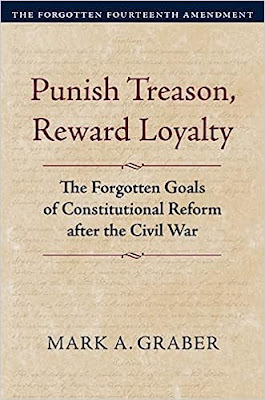
Mark A. Graber, Punish Treason, Reward Loyalty: The Forgotten Goals of Constitutional Reform after the Civil War (University of Kansas Press, 2023)
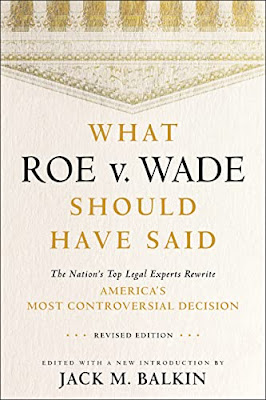
Jack M. Balkin, What Roe v. Wade Should Have Said: The Nation's Top Legal Experts Rewrite America's Most Controversial Decision - Revised Edition (NYU Press, 2023)

Andrew Koppelman, Burning Down the House: How Libertarian Philosophy Was Corrupted by Delusion and Greed (St. Martin’s Press, 2022)

Gerard N. Magliocca, Washington's Heir: The Life of Justice Bushrod Washington (Oxford University Press, 2022)
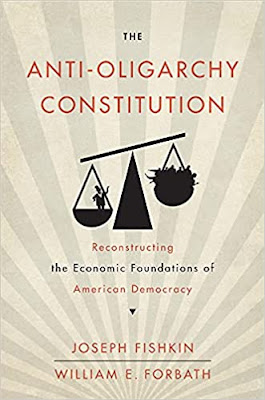
Joseph Fishkin and William E. Forbath, The Anti-Oligarchy Constitution: Reconstructing the Economic Foundations of American Democracy (Harvard University Press, 2022)
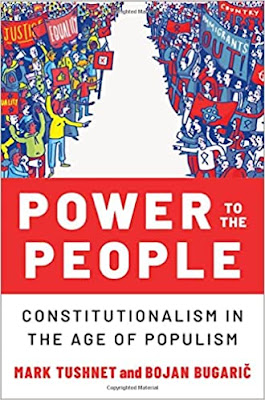
Mark Tushnet and Bojan Bugaric, Power to the People: Constitutionalism in the Age of Populism (Oxford University Press 2021).

Mark Philip Bradley and Mary L. Dudziak, eds., Making the Forever War: Marilyn B. Young on the Culture and Politics of American Militarism Culture and Politics in the Cold War and Beyond (University of Massachusetts Press, 2021).

Jack M. Balkin, What Obergefell v. Hodges Should Have Said: The Nation's Top Legal Experts Rewrite America's Same-Sex Marriage Decision (Yale University Press, 2020)

Frank Pasquale, New Laws of Robotics: Defending Human Expertise in the Age of AI (Belknap Press, 2020)

Jack M. Balkin, The Cycles of Constitutional Time (Oxford University Press, 2020)

Mark Tushnet, Taking Back the Constitution: Activist Judges and the Next Age of American Law (Yale University Press 2020).

Andrew Koppelman, Gay Rights vs. Religious Liberty?: The Unnecessary Conflict (Oxford University Press, 2020)

Ezekiel J Emanuel and Abbe R. Gluck, The Trillion Dollar Revolution: How the Affordable Care Act Transformed Politics, Law, and Health Care in America (PublicAffairs, 2020)

Linda C. McClain, Who's the Bigot?: Learning from Conflicts over Marriage and Civil Rights Law (Oxford University Press, 2020)
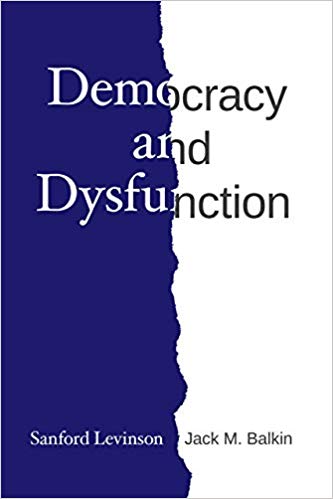
Sanford Levinson and Jack M. Balkin, Democracy and Dysfunction (University of Chicago Press, 2019)

Sanford Levinson, Written in Stone: Public Monuments in Changing Societies (Duke University Press 2018)

Mark A. Graber, Sanford Levinson, and Mark Tushnet, eds., Constitutional Democracy in Crisis? (Oxford University Press 2018)

Gerard Magliocca, The Heart of the Constitution: How the Bill of Rights became the Bill of Rights (Oxford University Press, 2018)

Cynthia Levinson and Sanford Levinson, Fault Lines in the Constitution: The Framers, Their Fights, and the Flaws that Affect Us Today (Peachtree Publishers, 2017)

Brian Z. Tamanaha, A Realistic Theory of Law (Cambridge University Press 2017)

Sanford Levinson, Nullification and Secession in Modern Constitutional Thought (University Press of Kansas 2016)

Sanford Levinson, An Argument Open to All: Reading The Federalist in the 21st Century (Yale University Press 2015)

Stephen M. Griffin, Broken Trust: Dysfunctional Government and Constitutional Reform (University Press of Kansas, 2015)

Frank Pasquale, The Black Box Society: The Secret Algorithms That Control Money and Information (Harvard University Press, 2015)

Bruce Ackerman, We the People, Volume 3: The Civil Rights Revolution (Harvard University Press, 2014)
Balkinization Symposium on We the People, Volume 3: The Civil Rights Revolution

Joseph Fishkin, Bottlenecks: A New Theory of Equal Opportunity (Oxford University Press, 2014)

Mark A. Graber, A New Introduction to American Constitutionalism (Oxford University Press, 2013)

John Mikhail, Elements of Moral Cognition: Rawls' Linguistic Analogy and the Cognitive Science of Moral and Legal Judgment (Cambridge University Press, 2013)

Gerard N. Magliocca, American Founding Son: John Bingham and the Invention of the Fourteenth Amendment (New York University Press, 2013)

Stephen M. Griffin, Long Wars and the Constitution (Harvard University Press, 2013)

Andrew Koppelman, The Tough Luck Constitution and the Assault on Health Care Reform (Oxford University Press, 2013)

James E. Fleming and Linda C. McClain, Ordered Liberty: Rights, Responsibilities, and Virtues (Harvard University Press, 2013)
Balkinization Symposium on Ordered Liberty: Rights, Responsibilities, and Virtues

Andrew Koppelman, Defending American Religious Neutrality (Harvard University Press, 2013)

Brian Z. Tamanaha, Failing Law Schools (University of Chicago Press, 2012)

Sanford Levinson, Framed: America's 51 Constitutions and the Crisis of Governance (Oxford University Press, 2012)

Linda C. McClain and Joanna L. Grossman, Gender Equality: Dimensions of Women's Equal Citizenship (Cambridge University Press, 2012)

Mary Dudziak, War Time: An Idea, Its History, Its Consequences (Oxford University Press, 2012)

Jack M. Balkin, Living Originalism (Harvard University Press, 2011)

Jason Mazzone, Copyfraud and Other Abuses of Intellectual Property Law (Stanford University Press, 2011)

Richard W. Garnett and Andrew Koppelman, First Amendment Stories, (Foundation Press 2011)

Jack M. Balkin, Constitutional Redemption: Political Faith in an Unjust World (Harvard University Press, 2011)

Gerard Magliocca, The Tragedy of William Jennings Bryan: Constitutional Law and the Politics of Backlash (Yale University Press, 2011)

Bernard Harcourt, The Illusion of Free Markets: Punishment and the Myth of Natural Order (Harvard University Press, 2010)

Bruce Ackerman, The Decline and Fall of the American Republic (Harvard University Press, 2010)
Balkinization Symposium on The Decline and Fall of the American Republic

Ian Ayres. Carrots and Sticks: Unlock the Power of Incentives to Get Things Done (Bantam Books, 2010)

Mark Tushnet, Why the Constitution Matters (Yale University Press 2010)

Ian Ayres and Barry Nalebuff: Lifecycle Investing: A New, Safe, and Audacious Way to Improve the Performance of Your Retirement Portfolio (Basic Books, 2010)
.jpg)
Jack M. Balkin, The Laws of Change: I Ching and the Philosophy of Life (2d Edition, Sybil Creek Press 2009)

Brian Z. Tamanaha, Beyond the Formalist-Realist Divide: The Role of Politics in Judging (Princeton University Press 2009)
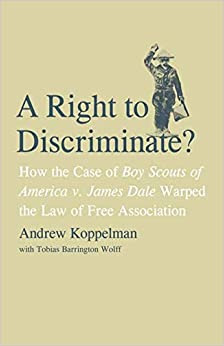
Andrew Koppelman and Tobias Barrington Wolff, A Right to Discriminate?: How the Case of Boy Scouts of America v. James Dale Warped the Law of Free Association (Yale University Press 2009)

Jack M. Balkin and Reva B. Siegel, The Constitution in 2020 (Oxford University Press 2009)

Heather K. Gerken, The Democracy Index: Why Our Election System Is Failing and How to Fix It (Princeton University Press 2009)

Mary Dudziak, Exporting American Dreams: Thurgood Marshall's African Journey (Oxford University Press 2008)

David Luban, Legal Ethics and Human Dignity (Cambridge Univ. Press 2007)

Ian Ayres, Super Crunchers: Why Thinking-By-Numbers is the New Way to be Smart (Bantam 2007)

Jack M. Balkin, James Grimmelmann, Eddan Katz, Nimrod Kozlovski, Shlomit Wagman and Tal Zarsky, eds., Cybercrime: Digital Cops in a Networked Environment (N.Y.U. Press 2007)

Jack M. Balkin and Beth Simone Noveck, The State of Play: Law, Games, and Virtual Worlds (N.Y.U. Press 2006)

Andrew Koppelman, Same Sex, Different States: When Same-Sex Marriages Cross State Lines (Yale University Press 2006)

Brian Tamanaha, Law as a Means to an End (Cambridge University Press 2006)

Sanford Levinson, Our Undemocratic Constitution (Oxford University Press 2006)

Mark Graber, Dred Scott and the Problem of Constitutional Evil (Cambridge University Press 2006)

Jack M. Balkin, ed., What Roe v. Wade Should Have Said (N.Y.U. Press 2005)

Sanford Levinson, ed., Torture: A Collection (Oxford University Press 2004)
Balkin.com homepage
Bibliography
Conlaw.net
Cultural Software
Writings
Opeds
The Information Society Project
BrownvBoard.com
Useful Links
Syllabi and Exams
