Balkinization
an unanticipated consequence of
Jack M. Balkin
Balkinization Symposiums: A Continuing List
E-mail:
Jack Balkin:
jackbalkin at yahoo.com
Bruce Ackerman
bruce.ackerman at yale.edu
Ian Ayres
ian.ayres at yale.edu
Corey Brettschneider
corey_brettschneider at brown.edu
Mary Dudziak
mary.l.dudziak at emory.edu
Joey Fishkin
joey.fishkin at gmail.com
Heather Gerken heather.gerken at yale.edu
Abbe Gluck abbe.gluck at yale.edu
Mark Graber
mgraber at law.umaryland.edu
Stephen Griffin
sgriffin at tulane.edu
Jonathan Hafetz
jonathan.hafetz at shu.edu
Jeremy Kessler
jkessler at law.columbia.edu
Andrew Koppelman
akoppelman at law.northwestern.edu
Marty Lederman
msl46 at law.georgetown.edu
Sanford Levinson
slevinson at law.utexas.edu
David Luban
david.luban at gmail.com
Gerard Magliocca
gmaglioc at iupui.edu
Jason Mazzone
mazzonej at illinois.edu
Linda McClain
lmcclain at bu.edu
John Mikhail
mikhail at law.georgetown.edu
Frank Pasquale
pasquale.frank at gmail.com
Nate Persily
npersily at gmail.com
Michael Stokes Paulsen
michaelstokespaulsen at gmail.com
Deborah Pearlstein
dpearlst at yu.edu
Rick Pildes
rick.pildes at nyu.edu
David Pozen
dpozen at law.columbia.edu
Richard Primus
raprimus at umich.edu
K. Sabeel Rahmansabeel.rahman at brooklaw.edu
Alice Ristroph
alice.ristroph at shu.edu
Neil Siegel
siegel at law.duke.edu
David Super
david.super at law.georgetown.edu
Brian Tamanaha
btamanaha at wulaw.wustl.edu
Nelson Tebbe
nelson.tebbe at brooklaw.edu
Mark Tushnet
mtushnet at law.harvard.edu
Adam Winkler
winkler at ucla.edu
Compendium of posts on Hobby Lobby and related cases
The Anti-Torture Memos: Balkinization Posts on Torture, Interrogation, Detention, War Powers, and OLC
The Anti-Torture Memos (arranged by topic)
Recent Posts
Constructing Constitutional Authority
Chomsky and Moral Philosophy
Can Originalists Promote Originalism through Strategic Judging?
Obergefell, Fisher, and the Inversion of Tiers
"The Second Freedmen's Bureau Bill's Constitution"
The Zubik supplemental reply briefs
Texas’s radical argument on work authorization--and its inconsistency with the 1990 Family Fairness program
Does Texas have Article III standing to challenge DAPA?
History, Rights and the Moral Reading
Making sense of the supplemental filings in Zubik
Randy Barnett's Republican Constitution
The “Lawfully Present” Confusion in the DAPA Case
To Alter or Abolish
What Obergefell v. Hodges Should Have Said
The Digital Transformation of Education
Expressive Legislation
RBG, Originalist
Sixth Annual Book Review Issue of Tulsa Law Review Now Available
John Kasich and the Natural-Born Citizen Clause
Counting All Persons is the “Theory of the Constitution” When It Comes to Representation
![[Powered by Blogger]](https://lh3.googleusercontent.com/blogger_img_proxy/AEn0k_vd4xwXvbdtzACoCNs2PyP79UsgZmL58Z92fAgWpKT8YPDFV19oYCgCgupauMPKs33x2B3qeFgG7dMMbOG1N-G21gz4qcsJwTmXB9tj2rWd=s0-d)
Just A Few Blogs
ACS Blog
Alas, a Blog
Althouse
Arts and Letters Daily
Atrios (Eschaton)
Bill of Health
Buzzflash.com
Buzz Machine
Cato at Liberty
Juan Cole (Informed Comment)
Concurring Opinions
The Constitution in 2020
Corrente
Crooked Timber
Daily Howler
Daily Kos
Dana Boyd
Brad DeLong
Digby (Hullabaloo)
Discriminations
Daniel Drezner
Kevin Drum (Mother Jones)
Electrolite
En Banc
Eunomia (Daniel Larison)
Fafblog
Michael Froomkin (Discourse.net)
GovLab (Beth Noveck)
Rick Hasen (Election Law)
History News Network
How Appealing
Ignatz (Sam Heldman)
The Importance of (Ernie Miller)
Infolaw
Instapundit
International Economic Law and Policy Blog
IntLawGrrls
Jacob Levy
Jesus' General
Jurisdynamics
The Kitchen Cabinet
Mark Kleiman
Law Blog Central
Larry Lessig
Lawyers, Guns and Money
Liberal Oasis
Brian Leiter's Law School Reports
The Leiter Reports
Marginal Revolution
Megan McArdle
Memeorandum
Metafilter
Mirror of Justice
The New Republic
Newseum
No More Mister Nice Blog
Brendan Nyhan
Opinio Juris
Orcinus
The Originalism Blog
Pandagon
Passport (Foreign Policy)
Overcoming Bias
Political Animal (Washington Monthly)
Political Theory Daily Review
Political Wire (Taegan Goddard)
The Poor Man
Virginia Postrel
Prawfsblawg
Public Reason
Jonathan Rauch
Raw Story
Redstate
ReligiousLeftLaw.com
Reporters Committee For Freedom of the Press
Reproductive Rights Blog
Rothman's Roadmap to the Right of Publicity
SCOTUS Blog
Seeing the Forest
Clay Shirky
The Shifted Librarian
The Situationist
Larry Solum (Legal Theory)
Andrew Sullivan
Talking Points Memo
Talk Left
Tapped
Tbogg
TechPresident
The Paper Chase (Jurist)
Tom Paine
Tom Tomorrow (This Modern World)
Eve Tushnet
Uggabugga
University of Chicago Law School Faculty Blog
Unqualified Offerings
The Volokh Conspiracy
War and Piece (Laura Rozen)
Wampum
Oliver Willis
Wonkette
Written Description
Matthew Yglesias
Yin
Your Choice of Feeds
1. XML
powered by

2. Atom Feed
3. RSS 2.0
Constructing Constitutional Authority
Gerard N. Magliocca
Governor Greg Abbott of Texas is in the news again. After endorsing Sandy's project of calling for a constitutional convention, he recently spoke at an event on the state's challenge to the President's plan on illegal immigration and said that he "double-dare[d] the United States Supreme Court to reduce the Bill of Rights to the first nine amendments." Setting aside the language on double-dares (is raising that a triple-dare or a double-double-dare?), one interesting question his statement raises is this: How do we know that the Bill of Rights consists of the first ten amendments.
This is one of the issues that I'm writing about in my next book (now very much in progress), and it is fiendishly difficult. Some Court decisions and commentators said that the Bill of Rights was the first ten amendments. Others said that the Bill of Rights was only the first eight amendments. And one Supreme Court case from 1904 did say that the Bill of Rights was only the first nine. Some of this reflects disagreement on the importance of the Tenth Amendment and some of this reflects a similar disagreement on the status of unwritten rights pursuant to the Ninth Amendment.
Why then do we all think (as I think we all do) that the Bill of Rights is the first ten amendments? Not because the text says so. And not because there is clear case law or history saying so. Notable people who said that only the first eight amendments were the Bill of Rights include Justice Hugo Black, Judge Learned Hand, and John Bingham (though not consistently), who are hardly chumps. Moreover, if you go to the National Archives to see the copy of the Bill of Rights that sits alongside the Declaration and the Constitution under glass, what you see are 12 amendments--the twelve that Congress proposed in 1789. So was there a particular moment or person that settled the question. The answer may surprise you--I'll save that for another post.
Posted
4:15 PM
by Gerard N. Magliocca [link]
(185) comments
Chomsky and Moral Philosophy
John Mikhail
Some Balkinization readers might be interested in "Chomsky and Moral Philosophy," a new paper I recently posted to SSRN. It will appear in the second edition of The Cambridge Companion to Chomsky (J. McGilvray, ed.), which is due out later this year. Among other things, the chapter draws links between aspects of the natural law tradition in moral philosophy and Chomsky's naturalistic approach to the study of language and mind. It also responds to some of Bernard Williams' skeptical remarks about rule following in Ethics and the Limits of Philosophy. Here is the abstract:
Every great philosopher has important things to say about moral philosophy. Chomsky is no exception. Chomsky’s remarks on this topic, however, are not systematic. Instead, they consist mainly of brief and occasional asides. Although often provocative, they tend to come across as digressions from his central focus on linguistics and related disciplines, such as epistemology, philosophy of language, and philosophy of mind. Perhaps as a result, moral philosophers have paid relatively little attention to Chomsky over the past sixty years.
This neglect is unfortunate. Chomsky’s insights into the nature and origin of human morality are fundamental and penetrating. They address deep philosophical problems that have shaped the aims of moral philosophy for centuries. They also reinforce many of the lessons Chomsky has taught about the nature and origins of human language. Elaborating upon these themes, this chapter begins by recounting two of Chomsky’s most extensive discussions of moral philosophy, each of which draws attention to the fact that, like linguistic knowledge, moral knowledge is an example of Plato’s problem: a complex mental competence characterized by a profound poverty of the stimulus. The chapter then places these remarks in a broader context by providing a brief discussion of mentalist, modular, and nativist theories of moral cognition from Plato to the present. Finally, the chapter responds to one prominent criticism of Chomsky’s naturalistic approach to moral philosophy, that of the late philosopher, Bernard Williams. I argue that Williams’ “Wittgensteinian” skepticism about moral rules is no more convincing than a similar skepticism about grammatical rules in the context of linguistic theory.
Posted
8:26 AM
by John Mikhail [link]
Can Originalists Promote Originalism through Strategic Judging?
JB
Over at Law and Liberty, Steve Smith wonders how it might be possible to give nonoriginalist judges, especially on the left, incentives to decide more cases according to originalism. His solution: "reactivism." After the Supreme Court decides a non-originalist case like Roe v. Wade, or Obergefell v. Hodges, originalist judges should vote strategically to limit its practical effect in later cases, in order to achieve results closer to what would have happened if the Court had decided the case correctly according to original meaning. Originalist judges should do this even if the distinctions they draw to limit the earlier decision aren't the most principled or logical ones. Knowing this, nonoriginalist judges will have incentives to stop producing so many nonoriginalist decisions.
There are three problems with this strategy. First of all, from the perspective of many liberal nonoriginalists, this is what many judges already do whenever they don't like a decision. As liberals see it, conservatives (not just originalist conservatives) have been trying to chip away at liberal precedents for years using distinctions that liberals think don't make much sense. For this strategy to work, then, originalist judges would have to convince liberal judges that they would be doing something much more troubling than what liberals think conservative justices (both originalist and non-originalist) have already been doing to liberal precedents. It's not clear how this strategy will demonstrate to liberal nonoriginalists that they had better behave themselves from now on.
Read more »
Posted
8:30 AM
by JB [link]
Obergefell, Fisher, and the Inversion of Tiers
Guest Blogger
Maxwell L. Stearns*
My new article, “Obergefell, Fisher, and the Inversion of Tiers,” is forthcoming in the University of Pennsylvania Journal of Constitutional Law. It provides a comprehensive framework that explains the pervasive doctrinal anomalies associated with the tiers of scrutiny doctrines. It also offers a simpler path forward that would produce more consistent and predictable applications within the general framework of existing tiers. The Article does not recommend abandoning the tiers’ doctrines or replacing them with a single tier or a more finely grained menu of tiers. Instead, it demonstrates why a system of tiers approximating ours is an inevitable feature of our constitutional jurisprudence, and it explains how to avoid the doctrinal anomalies that have generated much-deserved critical commentary.
Read more »
Posted
12:39 PM
by Guest Blogger [link]
"The Second Freedmen's Bureau Bill's Constitution"
Mark Graber
My latest on SSRN and forthcoming in Texas Law Review on the historical evidence that Republicans understood the Constitution of 1865 as protecting positive rights. Thanks to Joey Fishkin and Willi Forbath.
This paper focuses on the crucial elements of post-Civil War constitutionalism judges and scholars miss when they give the place of pride to the Civil Rights Act of 1866 at the expense of the Second Freedmen’s Bureau Bill. The Republicans who framed the Second Freedmen’s Bureau Bill recognized that persons could transition from slaves to full citizens only if Congress aggressively exercised national power under Section Two of the Thirteenth Amendment. Given the need for a high degree of nimbleness in the managing of that transition, Congress, rather than the judiciary, had to play the lead role in removing all badges and incidents of slavery in American constitutional life. These framers were concerned with economic inequalities or at least basic economic and social needs, but their concerns were not expressed in the form of judicially enforceable rights. The persons responsible for the post-Civil War Constitution believed the general welfare would best be promoted if the party of the majority of the people who remained loyal during the Civil War had control over all three branches of the national government necessary to enact and implement legislative programs that eradicated all traces of the destitution and dependency that had resulted from slavery and the Civil War.
Posted
1:11 PM
by Mark Graber [link]
The Zubik supplemental reply briefs
Marty Lederman
The government and the petitioners yesterday filed their supplemental reply briefs in response to the Court's order. This latest and final round of briefs largely confirms what I wrote last week, but the new briefs do add important details that demonstrate the wide gulfs that remain between the parties as to all three types of insurance plans at issue (insured plans, self-insured plans, and church plans).
For reasons I'll explain, I think the supplemental briefing has significantly weakened the petitioners' efforts to show that the government's accommodation substantially burdens their religious exercise. More importantly, perhaps, it has strengthened the government's argument that there are no alternative means of providing contraceptive coverage to the beneficiaries of petitioners' plans that would both further the government's compelling interests and alleviate the alleged substantial burden on the petitioners' exercise of religion.
In this post I will, once again, address the three types of plans separately. I'll assume that you've already read my post from last week, which will avoid the need for me to reiterate the details about how each type of plan works and the ways in which the petitioners' new proposal would undermine the government's compelling interests.
As I've previously posted, only six of the 37 petitioners offer their students and/or employees participation in an "insured" health insurance plan--the focus of the Court's proposal. (Three other, individual petitioners are directors of an insured employee plan.) Three petitioners offer their employees participation in "self-insured" plans that are not "church plans." And the remaining 26 petitioners, including Little Sisters of the Poor, either offer their employees access to what is known under ERISA as a "church plan," or are in some other respect associated with such church plans. (This would appear to add up to 38 petitioners, but there are only 37--one petitioner, Southern Nazarene University, uses an insured student plan and a self-insured employee plan.)
I'll start here with the category that covers most of the petitioners--church plans--because that's the category with the most straightforward RFRA disposition:
Read more »
Posted
11:47 AM
by Marty Lederman [link]
Texas’s radical argument on work authorization--and its inconsistency with the 1990 Family Fairness program
Marty Lederman
Posted
1:20 PM
by Marty Lederman [link]
Does Texas have Article III standing to challenge DAPA?
Marty Lederman
There are several reasons why such “licensing costs” are insufficient to establish Texas’s Article III standing to challenge the lawfulness of the DAPA policy. The Solicitor General’s briefs, together with the brief filed by Joe Palmore on behalf of Prof. Walter Dellinger, thoroughly address those reasons. In this post, I’ll focus upon two aspects of the “licensing costs” theory of standing that warrant greater attention: (i) that Texas itself has already concluded that it will not be injured; and (ii) that if Texas wishes to change its practices in light of DAPA, the Texas legislature and administrative agency have many options about who should receive license subsidies--including strict compliance with Texas's current statutory criterion.
Posted
9:03 AM
by Marty Lederman [link]
History, Rights and the Moral Reading
JB
On SSRN, I've posted a draft of History, Rights and the Moral Reading, a review of Jim Fleming's new book, Fidelity to Our Imperfect Constitution. It is part of a symposium that will appear in B.U. Law Review. Here is the abstract:
James Fleming’s book, Fidelity to Our Imperfect Constitution, argues for a "moral reading" of the Constitution, a phrase made famous by Ronald Dworkin. But Fleming's version of the moral reading differs from Dworkin's in two important ways.
First, Fleming argues that Dworkin's attempt to explain and justify judicial protection of constitutional rights in terms of democratic self-government is unduly strained. Moreover, in the quest to re-characterize all of these rights as supporting democracy, there is the danger that we will distort their most valuable features. I show why Fleming's insight is correct. I use the example of the First Amendment's guarantees of speech and press, which many scholars have assumed offers the strongest case for a democracy-based justification of rights.
Second, Dworkin spent relatively little time worrying about how historical argument figured into a moral reading of the Constitution, other than to criticize originalism. Building on Dworkin's argument that good interpretations must satisfy the two dimensions of "fit" and "justification," Fleming asserts that history can be quite important to moral readings. I argue that Fleming offers a better account than Dworkin of why history matters-- and should matter--to a moral reading of the Constitution. I show how his account connects with my own work on how lawyers use history in constitutional argument.
Posted
8:30 AM
by JB [link]
Making sense of the supplemental filings in Zubik
Marty Lederman
Following the oral argument in Zubik, the Court directed the parties to file supplemental briefs addressing whether the employees of petitioners with "insured plans" could receive contraceptive coverage "through petitioners’ insurance companies," without requiring the objecting employers to provide either of the forms of "opt out" notice (to the government or to the insurance company) that the current accommodation regulation prescribes. The Court elaborated with a particular hypothetical proposal:
For example, the parties should consider a situation in which petitioners would contract to provide health insurance for their employees, and in the course of obtaining such insurance, inform their insurance company that they do not want their health plan to include contraceptive coverage of the type to which they object on religious grounds. Petitioners would have no legal obligation to provide such contraceptive coverage, would not pay for such coverage, and would not be required to submit any separate notice to their insurer, to the Federal Government, or to their employees. At the same time, petitioners’ insurance company—aware that petitioners are not providing certain contraceptive coverage on religious grounds—would separately notify petitioners’ employees that the insurance company will provide cost-free contraceptive coverage, and that such coverage is not paid for by petitioners and is not provided through petitioners’ health plan.
The parties filed their opening briefs in response on Tuesday. (They will file simultaneous reply briefs next Wednesday.)
In order to understand the parties' different views on the question the Court posed, it is necessary to separately consider what they have to say about "insured" plans and "self-insured" plans, respectively. In addition, at the end of this post I offer a few words about the 26 petitioners who do not fall in either category, because they offer (or are otherwise involved with) employee "church plans." (I discuss the distinctions between these different sorts of health insurance plans in this post, among others.)
Insured plans
The Court's order referred specifically to petitioners that offer their employees access to "insured" health care plans. In such cases, an employer purchases an employee insurance policy from an insurance company, or issuer, such as Aetna or Blue Cross/Blue Shield, and the issuer itself then bears the costs of reimbursing employees for their health care expenses.
As I noted in this post, five of the petitioners currently offer their employees participation in insured plans: Catholic University, Geneva College, Oklahoma Baptist University, Oklahoma Wesleyan University, and Priests for Life. Three of those five petitioners (Catholic University, Geneva College, and Oklahoma Baptist University) also offer their students an insured plan, as does a sixth petitioner, Southern Nazarene University. (Three other individual petitioners--Alveda King, Janet Morana and Father Frank Pavone--are directors of Priests for Life.)
Read more »
Posted
11:41 AM
by Marty Lederman [link]
Randy Barnett's Republican Constitution
JB
On SSRN, I've published a draft of Which Republican Constitution?, a review of Randy Barnett's new book, Our Republican Constitution. The article is part of a conference on the book held in March at the University of Illinois, and will be published in Constitutional Commentary. Here is the abstract:
Randy Barnett argues that the American political tradition, understood in its best light, features a "Republican Constitution." But Barnett's version of "republicanism" has relatively little to do with the historical tradition of republicanism, a tradition that celebrates the common good; seeks to inculcate civic virtue; opposes aristocracy, oligarchy, and corruption; understands liberty not as mere negative freedom but as non-domination; connects civil rights to civic duties; and demands a government which derives its powers from and is ultimately responsive to the great body of the people.
Instead, Barnett's "Republican Constitution" is far closer to what most historians of the Founding would regard as the opposite or complement of the republican tradition. This is the tradition of natural rights liberalism, which begins with John Locke and evolves into classical liberalism in the nineteenth century. This tradition celebrates individual autonomy, views the state as organized to protect the natural rights of individuals, fears the tyranny of majorities, and treats liberty as a negative freedom — a protected space in which individuals, free from state control, may accumulate property and pursue happiness.
Although Barnett identifies his "Republican Constitution" with the Founders, it is really a sympathetic restatement of late nineteenth-century classical liberalism, which combined dual federalism with police powers jurisprudence. Conversely, his constructed foil, which he calls the "Democratic Constitution," is really a version of early twentieth-century progressivism which arises in opposition to the Gilded Age. Barnett's imagined opposition between "Republican" and "Democratic" visions of the Constitution at the Founding is really an idealized version of the struggle between classical liberalism and progressivism at the beginning of the twentieth century. This is an important clash of values, and it had momentous consequences for the way we understand constitutional law today. But it is not an adequate account of Founding-era thought.
By taking the word "republican" and pasting it onto the classical liberal tradition, Barnett has buried a truly important tradition in American constitutional thought — the actual historical republican tradition. This tradition is especially relevant today. Our contemporary politics is full of anxieties about republican themes: corruption, oligarchy, self-dealing, and lack of devotion to the public good. Barnett's classical liberalism is too thin to meet these contemporary concerns. By insisting that the central if not sole purpose of government is to protect natural rights — including, most prominently, the right to acquire and accumulate property — his account seems to talk past what concerns many people today about our political and constitutional system, not only on the left, but also on the right. It actually disables us from focusing on the important connections between democracy and political economy that the historical theory of republicanism was centrally concerned with.
The American constitutional tradition, understood in its best sense, has always drawn on elements of both the republican and liberal traditions, and applied them to the problems and circumstances of the age. It has employed the best parts of each tradition to critique and transcend the blindnesses and limitations of the other. That is as true of the founding period as it is of the present. No reconstruction of the American constitutional tradition can afford to discard one-half of this dialectic.
Posted
8:30 AM
by JB [link]
The “Lawfully Present” Confusion in the DAPA Case
Marty Lederman
Posted
8:56 AM
by Marty Lederman [link]
To Alter or Abolish
JB
On SSRN, I've posted a draft of a new article, To Alter or Abolish, that Sandy and I wrote for a symposium on the Declaration of Independence. It will appear later this year in Southern California Law Review. Here is the abstract:
For most Americans, at least, the most famous part of the Declaration of Independence is its claim that "all men are created equal," and endowed with "certain unalienable rights." But around the world, the Declaration's assertion of the right of "the People" to alter or to abolish government-- and to declare independence-- has been far more influential. During the Civil War, the South relied precisely on this right as its justification for secession. As a result, Americans have tended to downplay these aspects of the Declaration. But in other parts of the world, the Declaration continues to inspire countless movements for revolution, self-determination, and secession.
There are any number of books and essays that call upon us to take the Declaration’s language seriously-- which usually means taking seriously its inspiring passages about human equality and inalienable human rights. This essay asks what it would mean to take seriously the other parts of the Declaration, and in particular, its assertion of the right of a self-defined "People" to alter or abolish government. Doing so turns out to create an enormous number of theoretical and practical problems, which have played out both in domestic and international politics from the Declaration's day to our own.
Posted
8:30 AM
by JB [link]
What Obergefell v. Hodges Should Have Said
JB

On Friday, April 15th, the Yale Information Society Project
will hold a conference at Yale Law School entitled, What Obergefell v. Hodges Should Have Said.
Legal scholars will present their versions of how the U.S.
Supreme Court should have written the Obergefell opinion, which held that the
Constitution requires states to recognize same-sex marriage.
The
conference is co-sponsored by the Program for the Study of Reproductive Justice at Yale Law School;
the Yale Chapters of the American Constitution Society and the Federalist Society; and is also supported
by a grant from the Oscar M. Ruebhausen Fund.
SCHEDULE OF
EVENTS
12:30pm-1:30pm
Lecture by William
Eskridge on the history of same-sex marriage litigation
(40 minute lecture
plus 20 minutes Q and A)
Lunch will be served.
1:30pm-1:45pm Break
1:45pm-2:00pm
Introduction: Jack Balkin
2:00pm-3:15pm Panel One
Jack Balkin, Sherif
Girgis & Robert George (presented by Sherif Girgis), Andrew Koppelman
(presented by Priscilla Smith)
Moderator: Linda Greenhouse
(2:45-3:15
Q and A)
3:15pm-3:30pm Break
3:30pm-4:50pm Panel Two
Jeremy
Waldron, Reva Siegel & Doug NeJaime, Helen Alvare
Moderator: Jack
Balkin
(4:20pm-4:50pm Q and A)
4:50pm-5:05pm
Break
5:05pm-6:25pm Panel Three
Katherine Franke, John Harrison,
William Eskridge
Moderator: Reva Siegel
(5:45-6:25 Q and A)
Posted
11:00 AM
by JB [link]
The Digital Transformation of Education
JB
On SSRN, I've posted a draft of an article written with Julia Sonnevend, a professor of Communications at Michigan, on the digital transformation of education. It will appear in a volume of essays on Education and Social Media published later this year by MIT Press. Here is the abstract:
This essay explains how digital networks and digital media will affect education. The digitally networked environment frees education from traditional spatial and temporal limitations. In the process, however, new constraints and limitations emerge that were always present in the traditional model but now become newly salient.
Digital media enable a "superbroadcasting" model of education, but this model is only appropriate for some kinds of learning. The remaining aspects of education do not scale well and remain labor and time-intensive. We have already seen hybrid models of education that attempt to combine scalable aspects of education with labor-intensive practices. Some of these hybrid models will improve the educational experience for many students and expand educational access for those who would not otherwise afford an education. But hybrid models may also produce winner-take-all effects and disrupt labor markets for new educators.
While transcending older limitations, digital education faces new limitations -- because of limited Internet access, language barriers, disputes over standards and interoperability, fights over intellectual property, and, ironically, the very scalability that makes digital education so promising and attractive. The growth of digital educational enterprises will depend on the degree to which they can lower the cost of the labor-intensive elements of education that do not scale well or shift the cost or the responsibility for providing them to other actors.
Digital education models threaten both traditional incumbents and professional educational norms. They blur distinctions between education and community service; between professionals and amateurs; between education and entertainment; between teaching and curation; between hierarchical and peer-based methods of learning; and between instructing specific students and speaking to the world at large.
Digital networks disaggregate educational practices into multiple tasks that might be performed by many different actors, and, in the process, alter the tasks, norms, and identity of professional educators. Digital networks disrupt the traditional organization of education and make informal education increasingly salient. And just as digital networks challenge professional norms of education, they also challenge professional control over archives, and thus control over cultural memory itself. Digital networks, in short, cause us to rethink what education is, how we perform it, who participates in it, and what we want from it.
Posted
8:30 AM
by JB [link]
Expressive Legislation
Guest Blogger
Ed Rubin
Tennessee, never far behind when it comes to passing legislation that is far behind, is about to follow North Carolina in enacting a “bathroom bill,” which would require transgender students to use bathrooms assigned to their original gender. As Rich Schragger points out, this type of legislation, among its many defects, overrides the ability of municipalities to reach their own resolutions for a given issue. The Tennessee version displays another vice that conservative legislatures seem to be indulging in with increasing frequency – the enactment of expressive or symbolic legislation.
In addition to the bathroom bill, the Tennessee legislature has recently enacted, or is currently considering, bills that declare the .50 caliber Barrett the state rifle of Tennessee, declare the Christian Bible the state book of Tennessee, grant pastors the right to refuse to conduct same sex marriages for religious reasons, and deny funds to the University of Tennessee’s diversity office – which total one quarter of one percent of the higher education budget—because that office issued fairly standard memos about holiday celebrations and gender neutral pronouns.
Expressive legislation is hardly a new phenomenon, of course. The landscape is dotted with government buildings bearing the names of obscure individuals whom some legislator wanted to honor, and the calendar is filled with weeks, or months, named after causes championed by various constituencies. Most of this is fairly harmless. Enacted as a courtesy to the sponsor, it occupies relatively little legislative time and elicits relatively little opposition. But the recent spate of expressive legislation advanced by conservative legislatures, in Tennessee and elsewhere, is distinctly different. Because it engages current political controversies, it winds up being intensely debated in committee and on the chamber floors. The Tennessee legislature, which is limited to meeting only 90 days every two years on substantive matters, seems to have had time for little else besides its array of symbolic bills. In addition, this legislation is designed to antagonize or insult specific sectors of the population –in Tennessee’s case, gun control advocates, non-Christians, transgender citizens, and gay or lesbian citizens.
Opponents of Tennessee’s expressive legislation have pointed out that it does not achieve any practical purpose, but is likely to result in positive harm to the state because it contravenes national norms. It will hurt the tourist trade and the convention trade (both important for the state’s faltering economy), discourage firms from locating in Tennessee and discourage many people who might to choose to relocate there. But contravening national norms, whatever its consequences, seems to be the precise purpose of this legislation. It is a device by which majorities in the nation’s conservative states – primarily in the Old Confederacy, of course – can cry out against social trends that are moving strongly in the opposite direction. While gun control may not be making much progress (although its opponents seem to fear it will), there is little question that secularism is on the rise across the nation, that there has been dramatic progress for LGBT in the past decade, and that the current generation of college students holds increasingly progressive attitudes about diversity and sexual identity issues. State legislatures are generally unable to alter these trends. Even as expression, many of the statutes they are enacting are likely to fail. Tennessee’s Bible bill, and any interpretations of the pastor bill that go beyond existing Supreme Court doctrine, will be invalidated by the federal courts, while its restrictions on diversity efforts may well endanger essential federal funding for the University. It only purpose, then, is as a cri de coeur against modernity.
Maybe it’s best, from a progressive standpoint, that these highly conservative state legislatures (Republicans in Tennessee hold comfortable super-majorities in both houses) occupy themselves with expressive legislation rather than attempting to achieve more substantive goals. The proper response in this case might be to accept these statutes with a resigned shrug when they don’t infringe on individual rights (as in the case of the state rifle law or the pastor bill) and oppose them when they do (as in the case of the bathroom or state book bills) through federal action or privately-organized boycotts. But a better strategy might be to try to shame these legislatures out of occupying themselves with this sort of political grandstanding and address substantive issues. Sandy Muir thought that state legislatures functioned as schools (William K. Muir, Legislature, 1985), educating their relatively untrained members through the process of confronting serious issues. Perhaps legislators like those in Tennessee are simply uneducable, but perhaps they would learn something about the complexities of current issues involving their state’s economy, health, education and welfare if they felt compelled to confront them.
Edward L. Rubin is University Professor of Law and Political Science at Vanderbilt University. You can reach him by e-mail at ed.rubin at Law.Vanderbilt.Edu
Posted
7:40 PM
by Guest Blogger [link]
RBG, Originalist
David Gans
Posted
12:10 PM
by David Gans [link]
Sixth Annual Book Review Issue of Tulsa Law Review Now Available
Linda McClain
Posted
9:49 AM
by Linda McClain [link]
John Kasich and the Natural-Born Citizen Clause
Gerard N. Magliocca
Since it now seems likely that we are heading for a contested Republican National Convention, I want to push back against Jack's post from a few weeks ago that the current rules governing that assembly will probably not be changed because neither Cruz nor Trump has an incentive to do so.
There are many possible permutations in a contested convention, but let me throw out one that is a real possibility. Under the current rules, only two names can be placed in nomination for President--Trump and Cruz. Why? Because the rules say that you need to win at least 8 states to be nominated. This is a crucial point because, as long as this rule stays in place, the GOP will not have an "open" convention. This structure, of course, works well for Trump and Cruz by excluding John Kasich or a dark horse like Paul Ryan from consideration on a second ballot.
Trump, though, may conclude that he will lose this two-way contest because Cruz will do better on subsequent ballots. Is there a way out of this dilemma? Maybe. Trump could put a motion on the floor that only his name can be put in nomination because Cruz is constitutionally ineligible to be President. Can he get a majority of the delegates to vote for this? Maybe, but it may depend on what John Kasich does. A Trump/Kasich coalition may have a majority (so could a Cruz/Kasich coalition). What would Trump have to give Kasich for these votes? The Vice-Presidency? A rule change to allow Kasich's name to be placed in nomination for President? (By saying, for instance, that you just have to win at least one state to be nominated.) In turn, what would Cruz have to offer Kasich to stop this outcome? Maybe the same things.
One takeaway is that John Kasich, not the Supreme Court, may end up being the final authority on the meaning of the Natural Born Citizen Clause as applied to Ted Cruz.
Posted
10:34 AM
by Gerard N. Magliocca [link]
(325) comments
Counting All Persons is the “Theory of the Constitution” When It Comes to Representation
David Gans
Posted
2:08 PM
by David Gans [link]
Books by Balkinization Bloggers

Gerard N. Magliocca, The Actual Art of Governing: Justice Robert H. Jackson's Concurring Opinion in the Steel Seizure Case (Oxford University Press, 2025)

Linda C. McClain and Aziza Ahmed, The Routledge Companion to Gender and COVID-19 (Routledge, 2024)

David Pozen, The Constitution of the War on Drugs (Oxford University Press, 2024)

Jack M. Balkin, Memory and Authority: The Uses of History in Constitutional Interpretation (Yale University Press, 2024)
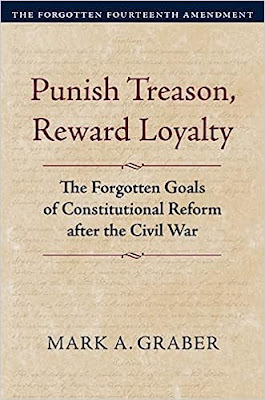
Mark A. Graber, Punish Treason, Reward Loyalty: The Forgotten Goals of Constitutional Reform after the Civil War (University of Kansas Press, 2023)
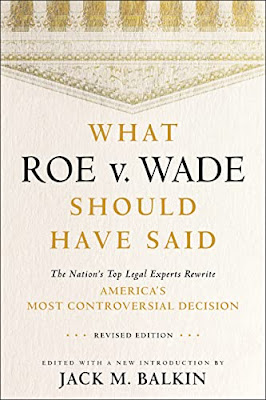
Jack M. Balkin, What Roe v. Wade Should Have Said: The Nation's Top Legal Experts Rewrite America's Most Controversial Decision - Revised Edition (NYU Press, 2023)

Andrew Koppelman, Burning Down the House: How Libertarian Philosophy Was Corrupted by Delusion and Greed (St. Martin’s Press, 2022)

Gerard N. Magliocca, Washington's Heir: The Life of Justice Bushrod Washington (Oxford University Press, 2022)
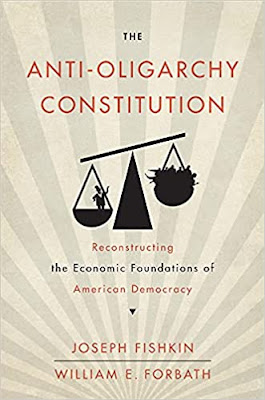
Joseph Fishkin and William E. Forbath, The Anti-Oligarchy Constitution: Reconstructing the Economic Foundations of American Democracy (Harvard University Press, 2022)
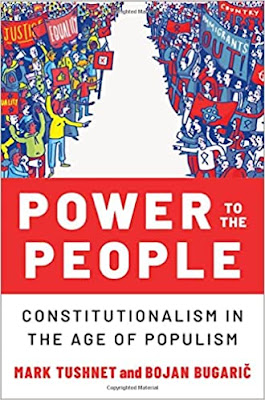
Mark Tushnet and Bojan Bugaric, Power to the People: Constitutionalism in the Age of Populism (Oxford University Press 2021).

Mark Philip Bradley and Mary L. Dudziak, eds., Making the Forever War: Marilyn B. Young on the Culture and Politics of American Militarism Culture and Politics in the Cold War and Beyond (University of Massachusetts Press, 2021).

Jack M. Balkin, What Obergefell v. Hodges Should Have Said: The Nation's Top Legal Experts Rewrite America's Same-Sex Marriage Decision (Yale University Press, 2020)

Frank Pasquale, New Laws of Robotics: Defending Human Expertise in the Age of AI (Belknap Press, 2020)

Jack M. Balkin, The Cycles of Constitutional Time (Oxford University Press, 2020)

Mark Tushnet, Taking Back the Constitution: Activist Judges and the Next Age of American Law (Yale University Press 2020).

Andrew Koppelman, Gay Rights vs. Religious Liberty?: The Unnecessary Conflict (Oxford University Press, 2020)

Ezekiel J Emanuel and Abbe R. Gluck, The Trillion Dollar Revolution: How the Affordable Care Act Transformed Politics, Law, and Health Care in America (PublicAffairs, 2020)

Linda C. McClain, Who's the Bigot?: Learning from Conflicts over Marriage and Civil Rights Law (Oxford University Press, 2020)
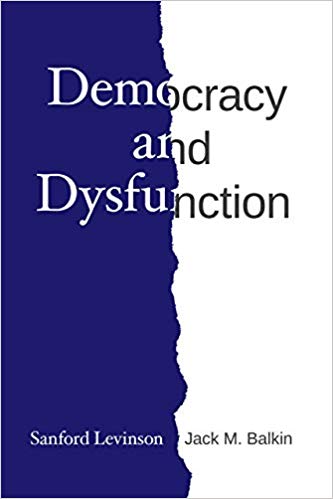
Sanford Levinson and Jack M. Balkin, Democracy and Dysfunction (University of Chicago Press, 2019)

Sanford Levinson, Written in Stone: Public Monuments in Changing Societies (Duke University Press 2018)

Mark A. Graber, Sanford Levinson, and Mark Tushnet, eds., Constitutional Democracy in Crisis? (Oxford University Press 2018)

Gerard Magliocca, The Heart of the Constitution: How the Bill of Rights became the Bill of Rights (Oxford University Press, 2018)

Cynthia Levinson and Sanford Levinson, Fault Lines in the Constitution: The Framers, Their Fights, and the Flaws that Affect Us Today (Peachtree Publishers, 2017)

Brian Z. Tamanaha, A Realistic Theory of Law (Cambridge University Press 2017)

Sanford Levinson, Nullification and Secession in Modern Constitutional Thought (University Press of Kansas 2016)

Sanford Levinson, An Argument Open to All: Reading The Federalist in the 21st Century (Yale University Press 2015)

Stephen M. Griffin, Broken Trust: Dysfunctional Government and Constitutional Reform (University Press of Kansas, 2015)

Frank Pasquale, The Black Box Society: The Secret Algorithms That Control Money and Information (Harvard University Press, 2015)

Bruce Ackerman, We the People, Volume 3: The Civil Rights Revolution (Harvard University Press, 2014)
Balkinization Symposium on We the People, Volume 3: The Civil Rights Revolution

Joseph Fishkin, Bottlenecks: A New Theory of Equal Opportunity (Oxford University Press, 2014)

Mark A. Graber, A New Introduction to American Constitutionalism (Oxford University Press, 2013)

John Mikhail, Elements of Moral Cognition: Rawls' Linguistic Analogy and the Cognitive Science of Moral and Legal Judgment (Cambridge University Press, 2013)

Gerard N. Magliocca, American Founding Son: John Bingham and the Invention of the Fourteenth Amendment (New York University Press, 2013)

Stephen M. Griffin, Long Wars and the Constitution (Harvard University Press, 2013)

Andrew Koppelman, The Tough Luck Constitution and the Assault on Health Care Reform (Oxford University Press, 2013)

James E. Fleming and Linda C. McClain, Ordered Liberty: Rights, Responsibilities, and Virtues (Harvard University Press, 2013)
Balkinization Symposium on Ordered Liberty: Rights, Responsibilities, and Virtues

Andrew Koppelman, Defending American Religious Neutrality (Harvard University Press, 2013)

Brian Z. Tamanaha, Failing Law Schools (University of Chicago Press, 2012)

Sanford Levinson, Framed: America's 51 Constitutions and the Crisis of Governance (Oxford University Press, 2012)

Linda C. McClain and Joanna L. Grossman, Gender Equality: Dimensions of Women's Equal Citizenship (Cambridge University Press, 2012)

Mary Dudziak, War Time: An Idea, Its History, Its Consequences (Oxford University Press, 2012)

Jack M. Balkin, Living Originalism (Harvard University Press, 2011)

Jason Mazzone, Copyfraud and Other Abuses of Intellectual Property Law (Stanford University Press, 2011)

Richard W. Garnett and Andrew Koppelman, First Amendment Stories, (Foundation Press 2011)

Jack M. Balkin, Constitutional Redemption: Political Faith in an Unjust World (Harvard University Press, 2011)

Gerard Magliocca, The Tragedy of William Jennings Bryan: Constitutional Law and the Politics of Backlash (Yale University Press, 2011)

Bernard Harcourt, The Illusion of Free Markets: Punishment and the Myth of Natural Order (Harvard University Press, 2010)

Bruce Ackerman, The Decline and Fall of the American Republic (Harvard University Press, 2010)
Balkinization Symposium on The Decline and Fall of the American Republic

Ian Ayres. Carrots and Sticks: Unlock the Power of Incentives to Get Things Done (Bantam Books, 2010)

Mark Tushnet, Why the Constitution Matters (Yale University Press 2010)

Ian Ayres and Barry Nalebuff: Lifecycle Investing: A New, Safe, and Audacious Way to Improve the Performance of Your Retirement Portfolio (Basic Books, 2010)
.jpg)
Jack M. Balkin, The Laws of Change: I Ching and the Philosophy of Life (2d Edition, Sybil Creek Press 2009)

Brian Z. Tamanaha, Beyond the Formalist-Realist Divide: The Role of Politics in Judging (Princeton University Press 2009)
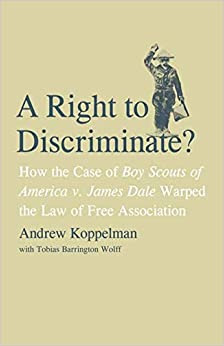
Andrew Koppelman and Tobias Barrington Wolff, A Right to Discriminate?: How the Case of Boy Scouts of America v. James Dale Warped the Law of Free Association (Yale University Press 2009)

Jack M. Balkin and Reva B. Siegel, The Constitution in 2020 (Oxford University Press 2009)

Heather K. Gerken, The Democracy Index: Why Our Election System Is Failing and How to Fix It (Princeton University Press 2009)

Mary Dudziak, Exporting American Dreams: Thurgood Marshall's African Journey (Oxford University Press 2008)

David Luban, Legal Ethics and Human Dignity (Cambridge Univ. Press 2007)

Ian Ayres, Super Crunchers: Why Thinking-By-Numbers is the New Way to be Smart (Bantam 2007)

Jack M. Balkin, James Grimmelmann, Eddan Katz, Nimrod Kozlovski, Shlomit Wagman and Tal Zarsky, eds., Cybercrime: Digital Cops in a Networked Environment (N.Y.U. Press 2007)

Jack M. Balkin and Beth Simone Noveck, The State of Play: Law, Games, and Virtual Worlds (N.Y.U. Press 2006)

Andrew Koppelman, Same Sex, Different States: When Same-Sex Marriages Cross State Lines (Yale University Press 2006)

Brian Tamanaha, Law as a Means to an End (Cambridge University Press 2006)

Sanford Levinson, Our Undemocratic Constitution (Oxford University Press 2006)

Mark Graber, Dred Scott and the Problem of Constitutional Evil (Cambridge University Press 2006)

Jack M. Balkin, ed., What Roe v. Wade Should Have Said (N.Y.U. Press 2005)

Sanford Levinson, ed., Torture: A Collection (Oxford University Press 2004)
Balkin.com homepage
Bibliography
Conlaw.net
Cultural Software
Writings
Opeds
The Information Society Project
BrownvBoard.com
Useful Links
Syllabi and Exams
