Balkinization
an unanticipated consequence of
Jack M. Balkin
Balkinization Symposiums: A Continuing List
E-mail:
Jack Balkin:
jackbalkin at yahoo.com
Bruce Ackerman
bruce.ackerman at yale.edu
Ian Ayres
ian.ayres at yale.edu
Corey Brettschneider
corey_brettschneider at brown.edu
Mary Dudziak
mary.l.dudziak at emory.edu
Joey Fishkin
joey.fishkin at gmail.com
Heather Gerken heather.gerken at yale.edu
Abbe Gluck abbe.gluck at yale.edu
Mark Graber
mgraber at law.umaryland.edu
Stephen Griffin
sgriffin at tulane.edu
Jonathan Hafetz
jonathan.hafetz at shu.edu
Jeremy Kessler
jkessler at law.columbia.edu
Andrew Koppelman
akoppelman at law.northwestern.edu
Marty Lederman
msl46 at law.georgetown.edu
Sanford Levinson
slevinson at law.utexas.edu
David Luban
david.luban at gmail.com
Gerard Magliocca
gmaglioc at iupui.edu
Jason Mazzone
mazzonej at illinois.edu
Linda McClain
lmcclain at bu.edu
John Mikhail
mikhail at law.georgetown.edu
Frank Pasquale
pasquale.frank at gmail.com
Nate Persily
npersily at gmail.com
Michael Stokes Paulsen
michaelstokespaulsen at gmail.com
Deborah Pearlstein
dpearlst at yu.edu
Rick Pildes
rick.pildes at nyu.edu
David Pozen
dpozen at law.columbia.edu
Richard Primus
raprimus at umich.edu
K. Sabeel Rahmansabeel.rahman at brooklaw.edu
Alice Ristroph
alice.ristroph at shu.edu
Neil Siegel
siegel at law.duke.edu
David Super
david.super at law.georgetown.edu
Brian Tamanaha
btamanaha at wulaw.wustl.edu
Nelson Tebbe
nelson.tebbe at brooklaw.edu
Mark Tushnet
mtushnet at law.harvard.edu
Adam Winkler
winkler at ucla.edu
Compendium of posts on Hobby Lobby and related cases
The Anti-Torture Memos: Balkinization Posts on Torture, Interrogation, Detention, War Powers, and OLC
The Anti-Torture Memos (arranged by topic)
Recent Posts
Populism and Progressivism, Traditionalism and Cosmopolitanism, and the Struggle over the Republican Party
More grist for the law professors' mill-- indicting a presidential candidate
Can the Constitution of Opportunity Carry the Day in American Politics?
Only One Place of Redress? How the Supreme Court Unleashed Racist Terror and Divided White from Black Workers
John Roberts, Ted Olson, and the Judicial Separation of Powers
Donald Trump and the Politics of Disjunction
The Public Utility Idea in a Progressive Constitutionalism of Equality
The most important and humane legal development in a long while
Fiscal Policy and Economic Inequality
The Second Freedmen's Bureau Bill's Constitution
Constitutional political economy in the New Gilded Age: A revival of legal realism?
Collective Laissez-Faire in the American Grain
Dividing Sovereignty: Commonwealth of Puerto Rico v. Sanchez Valle
Building Labor’s Constitution
Republicanism and the Constitution of Opportunity
Why Constitutional Political Economy?
The Great Forgetting
Reclaiming Constitutional Political Economy
Symposium on The Constitution and Economic Inequality
Asked and Answered: The Take Care Clause issue in U.S. v. Texas
Two more reasons why the "Take Care" argument in the DAPA case is a non-issue
An Argument Open to All: An Interview with Sanford Levinson
Is Ted Cruz a naturalized citizen?
![[Powered by Blogger]](https://lh3.googleusercontent.com/blogger_img_proxy/AEn0k_vd4xwXvbdtzACoCNs2PyP79UsgZmL58Z92fAgWpKT8YPDFV19oYCgCgupauMPKs33x2B3qeFgG7dMMbOG1N-G21gz4qcsJwTmXB9tj2rWd=s0-d)
Just A Few Blogs
ACS Blog
Alas, a Blog
Althouse
Arts and Letters Daily
Atrios (Eschaton)
Bill of Health
Buzzflash.com
Buzz Machine
Cato at Liberty
Juan Cole (Informed Comment)
Concurring Opinions
The Constitution in 2020
Corrente
Crooked Timber
Daily Howler
Daily Kos
Dana Boyd
Brad DeLong
Digby (Hullabaloo)
Discriminations
Daniel Drezner
Kevin Drum (Mother Jones)
Electrolite
En Banc
Eunomia (Daniel Larison)
Fafblog
Michael Froomkin (Discourse.net)
GovLab (Beth Noveck)
Rick Hasen (Election Law)
History News Network
How Appealing
Ignatz (Sam Heldman)
The Importance of (Ernie Miller)
Infolaw
Instapundit
International Economic Law and Policy Blog
IntLawGrrls
Jacob Levy
Jesus' General
Jurisdynamics
The Kitchen Cabinet
Mark Kleiman
Law Blog Central
Larry Lessig
Lawyers, Guns and Money
Liberal Oasis
Brian Leiter's Law School Reports
The Leiter Reports
Marginal Revolution
Megan McArdle
Memeorandum
Metafilter
Mirror of Justice
The New Republic
Newseum
No More Mister Nice Blog
Brendan Nyhan
Opinio Juris
Orcinus
The Originalism Blog
Pandagon
Passport (Foreign Policy)
Overcoming Bias
Political Animal (Washington Monthly)
Political Theory Daily Review
Political Wire (Taegan Goddard)
The Poor Man
Virginia Postrel
Prawfsblawg
Public Reason
Jonathan Rauch
Raw Story
Redstate
ReligiousLeftLaw.com
Reporters Committee For Freedom of the Press
Reproductive Rights Blog
Rothman's Roadmap to the Right of Publicity
SCOTUS Blog
Seeing the Forest
Clay Shirky
The Shifted Librarian
The Situationist
Larry Solum (Legal Theory)
Andrew Sullivan
Talking Points Memo
Talk Left
Tapped
Tbogg
TechPresident
The Paper Chase (Jurist)
Tom Paine
Tom Tomorrow (This Modern World)
Eve Tushnet
Uggabugga
University of Chicago Law School Faculty Blog
Unqualified Offerings
The Volokh Conspiracy
War and Piece (Laura Rozen)
Wampum
Oliver Willis
Wonkette
Written Description
Matthew Yglesias
Yin
Your Choice of Feeds
1. XML
powered by

2. Atom Feed
3. RSS 2.0
Populism and Progressivism, Traditionalism and Cosmopolitanism, and the Struggle over the Republican Party
JB
In a series of posts, Sean Trende has diagnosed the current split in the Republican Party as a conflict between cultural cosmpolitianism and cultural traditionalism. Back in 1995, I described a related split in terms of the opposition between populism and progressivism. In this context, "progressivism" stands for embrace of expertise, elite culture, and elite values--and not necessarily for left-wing or progressive social policies. Hence there are populist and "progressive" wings in both major political parties. Even though there are few liberal Republicans left, you have plenty of highly-educated elites and intellectuals in the Republican Party who believe in expertise and embrace elite values. They just disagree with the experts and elites on the left. The conservative counter-establishment, which includes conservative think tanks, policy organs, media organizations like National Review, and conservative academia-- is their natural home.
For the last generation or so the Republican political strategy has attempted to identify conservatism and the Republican Party with populism and cultural traditionalism, and to portray liberals and Democrats as "progressives" (in my language) or cultural cosmopolitans (in Trende's). This strategy has often been very effective, because the modern (post-Reagan) Democratic Party leadership has usually been more progressive than populist in its orientation. Nevertheless, this strategy has put many Republican elites in a bind, because their values and attitudes are often not really populist at all. They are cosmopolitan.
Nevertheless, conservative elites have been able to paper over these problems skillfully, by claiming to identify with and speak for the values and concerns of working class (usually white) Americans. For generations, very well-educated businesspeople and intellectuals have defied political gravity by arguing that their economic agenda of low taxes for the wealthy, deregulation, free trade, and immigration reform was also (or should be) the agenda of the conservative working class. Cosmopolitan conservative elites often paid lip service to culture war issues as the price of a very successful political alliance. This is conservative elites' version of the challenges that liberal elites faced in attempting to speak for the interests of working class and poor people, an association that conservative intellectuals have repeatedly and gleefully attacked. To the extent that these attacks succeeded, conservative elites were simply more successful than liberals in hiding the tensions within their own coalition.
That is, until now.
Donald Trump's candidacy has disrupted this strategy, and revealed the tension within the party clearly. He is appealing to cultural traditionalism or populism, capitalizing on resentment against elites and elite values on both the left and the right. Although he himself is a member of the elite (he loves to point out that he is very smart and went to Wharton) his style of speaking is demotic and blunt, and he comes across as someone in touch with populist concerns and populist values.
If The Donald did not exist, some other candidate would have figured out how to exploit the populist/progressive traditional/cosmopolitan divide within the Republican Party. Indeed, as Trende points out, Rick Santorum and Mike Huckabee offered earlier examples of the strategy. But Trump had the talent--and, let's admit it, the shamelessness--to pull it off powerfully and effectively. Even if he loses the Republican nomination, the damage to the Republican coalition has been done. Other politicians will figure out how they can also play on this divide to their personal advantage. Decades of clever attacks leveled against liberal elites for being out of touch and opposed to the interests of "real Americans" can pretty easily be reshaped and deployed against conservative elites. The Republican Party will be in a state of turmoil for some time to come.
Posted
12:15 PM
by JB [link]
More grist for the law professors' mill-- indicting a presidential candidate
JB
Over at the New Reform Club, Seth Barrett Tillman argues that law professors and media commentators are wasting their time speculating about Ted Cruz's eligibility, when there is an even more complicated set of issues that could provide endless grist for the scholarly mill: He asks what would happen if a major party candidate (say, Hillary Clinton) were indicted and/or convicted (a) before the party convention, (b) before the November election, (c) before the electors meet, (d) before inauguration, or (e) after inauguration.
Tillman's post is designed to generate discussion of Clinton's particular case. But the legal issues are more general. Although I doubt that Hillary Clinton will be indicted, you may recall that in August of 2015, former Texas Governor Rick Perry, who had announced his candidacy, was indicted by a Texas grand jury. He quickly dropped out of the race, but his legal troubles continue. If you don't like using Clinton as an example because you think she's been treated unfairly, imagine that Donald Trump or Marco Rubio were indicted for shady business dealings. Tillman is certainly right that the legal issues are at least as interesting as the meaning of "natural born citizen."
Posted
11:14 AM
by JB [link]
Can the Constitution of Opportunity Carry the Day in American Politics?
Guest Blogger
For the Symposium on the Constitution and Economic Inequality
Cynthia
Estlund
Posted
12:15 PM
by Guest Blogger [link]
Only One Place of Redress? How the Supreme Court Unleashed Racist Terror and Divided White from Black Workers
Guest Blogger
For the Symposium on the Constitution and Economic Inequality
Posted
3:00 PM
by Guest Blogger [link]
John Roberts, Ted Olson, and the Judicial Separation of Powers
Neil Siegel
Posted
1:37 PM
by Neil Siegel [link]
Donald Trump and the Politics of Disjunction
Gerard N. Magliocca
We've had an extended discussion on the blog about whether Barack Obama is a "reconstructive" President as described in the groundbreaking scholarship of Stephen Skowronek. Part of the answer turns on the outcome of 2016 presidential election. Will Obama's successor build on what he did or repudiate his legacy? That remains to be seen.
There is another way, though, of looking at this question. Skowronek's presidential typology says that political coalitions in decline tend to turn to outsiders who have, for lack of a better term, a reputation as a "Mr Fix-It" rather than deep connections to the party's ideology or constituencies. Past examples include Herbert Hoover, a self-made millionaire who (though it'a hard to remember now) was widely thought of as a problem solver before he was elected. Jimmy Carter is another example--he was an engineer by training--who was a classic outsider in 1976. On the losing side, there was Wendell Wilkie (the GOP nominee in 1940) who had never been elected to anything and was touted for his business success. These are the "disjunctive" presidents or presidential candidates.
The Republican Party went with this sort of strategy in 2012. Mitt Romney was mainly known as a success in business and as a highly competent manager (of, for example, the Winter Olympics). As Governor of Massachusetts for one term, he certainly did not come from the heartland of the GOP coalition and did not have broad government experience. There was a plausible advantage in this, though, as he also did not carry much of the baggage that a party insider or crusader would.
Now we are getting disjunction on steroids with Donald Trump. He is also pitching himself as "Mr Fix-It" without any significant commitment to the traditional ideology of the party or, of course, any service in office. He is presenting this as a plus, and certain party elites are in the process of deciding that this he be better than someone closely identified with the party's ideology--Ted Cruz. You can also contrast Trump's success with the weakness of the obvious Establishment candidate--Jeb Bush--to see how far the traditional formula for success in the GOP primary is falling short this time.
Why does this matter? Because disjunctive candidates only do well at the end of a particular coalition, which implies that the other side represents the start of a new one. But has that already happened with Obama's election, or will it happen after, say, President Trump has a disastrous term?
Posted
11:10 AM
by Gerard N. Magliocca [link]
(147) comments
The Public Utility Idea in a Progressive Constitutionalism of Equality
Guest Blogger
For the Symposium on the Constitution and Economic Inequality
Posted
9:00 AM
by Guest Blogger [link]
The most important and humane legal development in a long while
Marty Lederman
Like same-sex marriage, it looks as if this could be a sea-change that happens much more rapidly than any of us could have imagined in our wildest dreams. The very idea of reform was a political and jurisprudential nonstarter, in every branch of government, until very recently. And now, this. Thank goodness.
DOJ Report
Executive Summary
DOJ "Guiding Principles"
Posted
8:28 PM
by Marty Lederman [link]
Fiscal Policy and Economic Inequality
Guest Blogger
For the Symposium on the Constitution and Economic Inequality
Ajay K. Mehrotra
Posted
3:00 PM
by Guest Blogger [link]
The Second Freedmen's Bureau Bill's Constitution
Mark Graber
This paper focuses on the
crucial elements of post-Civil War constitutionalism scholars miss when they
give the place of pride to the Civil Rights Act at the expense of the Second
Freedmen’s Bureau Bill. The Republicans
who framed the Second Freedmen’s Bureau Bill understood that judicial action
could not eradicate slavery. Their
legislative and constitutional program recognized that persons could transition
from slaves to full citizens only if Congress aggressively exercised national
power under Section 2 of the Thirteenth Amendment. Legislation was necessary to provide former
slaves with various goods and services, the precise provision of which
depending on local circumstances and changing conditions. Given the need for a high degree of
nimbleness in the managing of that transition, entrenching crucial features of
the Freedmen’s Bureau Bill in a constitutional amendment that would be enforced
by the federal judiciary made little sense.
Instead, the Second Freedmen’s Bureau Bill was drafted by Republicans
who understood that Congress rather than the judiciary was expected to play the
lead role in removing all badges and incidents of slavery in American
constitutional life.
Posted
11:00 AM
by Mark Graber [link]
Constitutional political economy in the New Gilded Age: A revival of legal realism?
Guest Blogger
For the Symposium on the Constitution and Economic Inequality
Posted
9:00 AM
by Guest Blogger [link]
Collective Laissez-Faire in the American Grain
Guest Blogger
For the Symposium on the Constitution and Economic Inequality
Posted
3:00 PM
by Guest Blogger [link]
Dividing Sovereignty: Commonwealth of Puerto Rico v. Sanchez Valle
Guest Blogger
Posted
1:22 PM
by Guest Blogger [link]
Building Labor’s Constitution
Guest Blogger
For the Symposium on the Constitution and Economic Inequality
Kate Andrias
Posted
9:00 AM
by Guest Blogger [link]
Republicanism and the Constitution of Opportunity
JB
For the Symposium on the Constitution and Economic Inequality
A recurring question that Joey Fishkin and Wily Forbath are
likely to face in their work on the Constitution of Opportunity is what the
Constitution has to do with their argument. They argue that public
officials have a duty to promote economic opportunity and a broad-based middle class. They also argue that public officials have a duty to resist the exacerbation of economic inequality and the economic and political oligarchy that comes with it. But why is this a constitutional obligation?
Posted
1:50 PM
by JB [link]
Why Constitutional Political Economy?
Guest Blogger
For the Symposium on the Constitution and Economic Inequality
Frank Michelman
Posted
9:00 AM
by Guest Blogger [link]
The Great Forgetting
Guest Blogger
For the Symposium on the Constitution and Economic Inequality
Jed Purdy
Posted
1:00 PM
by Guest Blogger [link]
Reclaiming Constitutional Political Economy
Guest Blogger
For the Symposium on the Constitution and Economic Inequality
Posted
8:57 AM
by Guest Blogger [link]
Symposium on The Constitution and Economic Inequality
JB

The University of Texas Law Review is holding a conference on The Constitution and Economic Inequality on January 29 and 30th, 2016. Joey Fishkin and Willy Forbath are organizing the event.
Over the next week or so, Balkinization will publish short essays by some of the conference participants, who include:
Kate Andrias, University of Michigan Law School
Jack M. Balkin, Yale Law School
Cynthia Estlund, NYU School of Law
Joseph R. Fishkin, University of Texas School of Law
William E. Forbath, University of Texas School of Law
Cary C. Franklin, University of Texas School of Law
Robert W. Gordon, Stanford Law School
Mark Graber, University of Maryland Francis King Carey School of Law
David S. Grewal, Yale Law School
Robert. C. Hockett, Cornell University Law School
Olatunde Johnson, Columbia Law School
Jeremy Kessler, Columbia Law School
Ajay Mehrotra, American Bar Foundation
Frank I. Michelman, Harvard Law School
William J. Novak, University of Michigan Law School
James Pope, Rutgers School of Law — Newark
Jed Purdy, Duke University School of Law
K. Sabeel Rahman, Brooklyn Law School
Brishen Rogers, Temple University Beasley School of Law
Reva Siegel, Yale Law School
Ganesh Sitaraman, Vanderbilt University Law School
Zephyr Teachout, Fordham University School of Law
Posted
8:30 AM
by JB [link]
Asked and Answered: The Take Care Clause issue in U.S. v. Texas
Guest Blogger
As Marty has noted,
yesterday the Supreme Court granted certiorari in the DAPA case, and
generated headlines by adding an additional question: “Whether the
Guidance violates the Take Care Clause of the Constitution.” Texas's constitutional
argument is that: (i) the Secretary of the Department of Homeland
Security's DAPA Guidance--and the work authorization conferred upon DAPA
aliens, in particular--exceeds the authority granted in the relevant
immigration statutes; (ii) A President who exceeds his constitutional
authority violates the constitutional duty to “take care that the laws
be faithfully executed”; and thus, (iii) a President who exceeds his
statutory powers violates the Constitution.
Posted
7:12 PM
by Guest Blogger [link]
Two more reasons why the "Take Care" argument in the DAPA case is a non-issue
Marty Lederman
As you probably know by now, yesterday the Court granted the government's petition to hear the DAPA case, No. 15-674, Texas v. United States. It will be argued sometime between April 18th and 27th. In its order granting cert., the Court directed the parties to brief and argue the following question, in addition to those presented in the government's petition: “Whether the [DAPA] Guidance violates the Take Care Clause of the Constitution, Art. II, §3.” The Article II clause provides that the President "shall take Care that the Laws be faithfully executed."
This additional question is hardly "stunning," let alone a "bombshell." In its nominal brief in opposition, Texas had proposed amending the Questions Presented to include "[w]hether DAPA . . . violates the Constitution." The Court has now granted Texas's request, thereby signaling to the State that it is free to make a constitutional argument if it wishes to do so, even though the court of appeals did not reach that argument. Adding that "question" ensures that the Court will resolve the entire case this June, without leaving any issue dangling that the lower courts might use to revive the case in the event the Court rules in favor of the government.
As I've explained in earlier posts, however, there's nothing to the Take Care argument.
Read more »
Posted
1:47 PM
by Marty Lederman [link]
An Argument Open to All: An Interview with Sanford Levinson
JB

Posted
8:30 AM
by JB [link]
Is Ted Cruz a naturalized citizen?
John Mikhail
Posted
1:14 PM
by John Mikhail [link]
Books by Balkinization Bloggers

Gerard N. Magliocca, The Actual Art of Governing: Justice Robert H. Jackson's Concurring Opinion in the Steel Seizure Case (Oxford University Press, 2025)

Linda C. McClain and Aziza Ahmed, The Routledge Companion to Gender and COVID-19 (Routledge, 2024)

David Pozen, The Constitution of the War on Drugs (Oxford University Press, 2024)

Jack M. Balkin, Memory and Authority: The Uses of History in Constitutional Interpretation (Yale University Press, 2024)
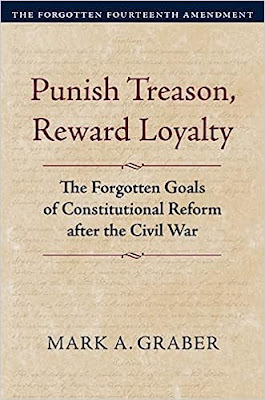
Mark A. Graber, Punish Treason, Reward Loyalty: The Forgotten Goals of Constitutional Reform after the Civil War (University of Kansas Press, 2023)
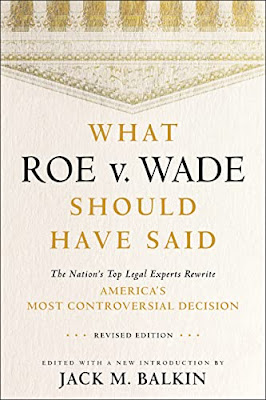
Jack M. Balkin, What Roe v. Wade Should Have Said: The Nation's Top Legal Experts Rewrite America's Most Controversial Decision - Revised Edition (NYU Press, 2023)

Andrew Koppelman, Burning Down the House: How Libertarian Philosophy Was Corrupted by Delusion and Greed (St. Martin’s Press, 2022)

Gerard N. Magliocca, Washington's Heir: The Life of Justice Bushrod Washington (Oxford University Press, 2022)
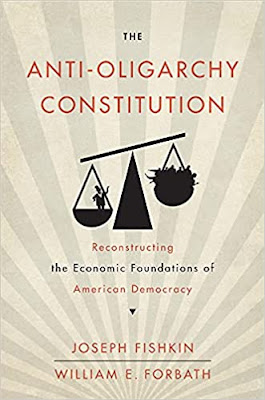
Joseph Fishkin and William E. Forbath, The Anti-Oligarchy Constitution: Reconstructing the Economic Foundations of American Democracy (Harvard University Press, 2022)
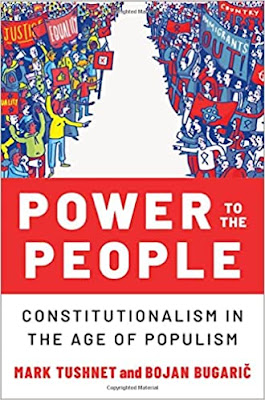
Mark Tushnet and Bojan Bugaric, Power to the People: Constitutionalism in the Age of Populism (Oxford University Press 2021).

Mark Philip Bradley and Mary L. Dudziak, eds., Making the Forever War: Marilyn B. Young on the Culture and Politics of American Militarism Culture and Politics in the Cold War and Beyond (University of Massachusetts Press, 2021).

Jack M. Balkin, What Obergefell v. Hodges Should Have Said: The Nation's Top Legal Experts Rewrite America's Same-Sex Marriage Decision (Yale University Press, 2020)

Frank Pasquale, New Laws of Robotics: Defending Human Expertise in the Age of AI (Belknap Press, 2020)

Jack M. Balkin, The Cycles of Constitutional Time (Oxford University Press, 2020)

Mark Tushnet, Taking Back the Constitution: Activist Judges and the Next Age of American Law (Yale University Press 2020).

Andrew Koppelman, Gay Rights vs. Religious Liberty?: The Unnecessary Conflict (Oxford University Press, 2020)

Ezekiel J Emanuel and Abbe R. Gluck, The Trillion Dollar Revolution: How the Affordable Care Act Transformed Politics, Law, and Health Care in America (PublicAffairs, 2020)

Linda C. McClain, Who's the Bigot?: Learning from Conflicts over Marriage and Civil Rights Law (Oxford University Press, 2020)
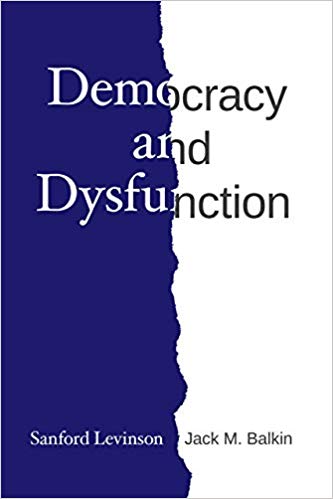
Sanford Levinson and Jack M. Balkin, Democracy and Dysfunction (University of Chicago Press, 2019)

Sanford Levinson, Written in Stone: Public Monuments in Changing Societies (Duke University Press 2018)

Mark A. Graber, Sanford Levinson, and Mark Tushnet, eds., Constitutional Democracy in Crisis? (Oxford University Press 2018)

Gerard Magliocca, The Heart of the Constitution: How the Bill of Rights became the Bill of Rights (Oxford University Press, 2018)

Cynthia Levinson and Sanford Levinson, Fault Lines in the Constitution: The Framers, Their Fights, and the Flaws that Affect Us Today (Peachtree Publishers, 2017)

Brian Z. Tamanaha, A Realistic Theory of Law (Cambridge University Press 2017)

Sanford Levinson, Nullification and Secession in Modern Constitutional Thought (University Press of Kansas 2016)

Sanford Levinson, An Argument Open to All: Reading The Federalist in the 21st Century (Yale University Press 2015)

Stephen M. Griffin, Broken Trust: Dysfunctional Government and Constitutional Reform (University Press of Kansas, 2015)

Frank Pasquale, The Black Box Society: The Secret Algorithms That Control Money and Information (Harvard University Press, 2015)

Bruce Ackerman, We the People, Volume 3: The Civil Rights Revolution (Harvard University Press, 2014)
Balkinization Symposium on We the People, Volume 3: The Civil Rights Revolution

Joseph Fishkin, Bottlenecks: A New Theory of Equal Opportunity (Oxford University Press, 2014)

Mark A. Graber, A New Introduction to American Constitutionalism (Oxford University Press, 2013)

John Mikhail, Elements of Moral Cognition: Rawls' Linguistic Analogy and the Cognitive Science of Moral and Legal Judgment (Cambridge University Press, 2013)

Gerard N. Magliocca, American Founding Son: John Bingham and the Invention of the Fourteenth Amendment (New York University Press, 2013)

Stephen M. Griffin, Long Wars and the Constitution (Harvard University Press, 2013)

Andrew Koppelman, The Tough Luck Constitution and the Assault on Health Care Reform (Oxford University Press, 2013)

James E. Fleming and Linda C. McClain, Ordered Liberty: Rights, Responsibilities, and Virtues (Harvard University Press, 2013)
Balkinization Symposium on Ordered Liberty: Rights, Responsibilities, and Virtues

Andrew Koppelman, Defending American Religious Neutrality (Harvard University Press, 2013)

Brian Z. Tamanaha, Failing Law Schools (University of Chicago Press, 2012)

Sanford Levinson, Framed: America's 51 Constitutions and the Crisis of Governance (Oxford University Press, 2012)

Linda C. McClain and Joanna L. Grossman, Gender Equality: Dimensions of Women's Equal Citizenship (Cambridge University Press, 2012)

Mary Dudziak, War Time: An Idea, Its History, Its Consequences (Oxford University Press, 2012)

Jack M. Balkin, Living Originalism (Harvard University Press, 2011)

Jason Mazzone, Copyfraud and Other Abuses of Intellectual Property Law (Stanford University Press, 2011)

Richard W. Garnett and Andrew Koppelman, First Amendment Stories, (Foundation Press 2011)

Jack M. Balkin, Constitutional Redemption: Political Faith in an Unjust World (Harvard University Press, 2011)

Gerard Magliocca, The Tragedy of William Jennings Bryan: Constitutional Law and the Politics of Backlash (Yale University Press, 2011)

Bernard Harcourt, The Illusion of Free Markets: Punishment and the Myth of Natural Order (Harvard University Press, 2010)

Bruce Ackerman, The Decline and Fall of the American Republic (Harvard University Press, 2010)
Balkinization Symposium on The Decline and Fall of the American Republic

Ian Ayres. Carrots and Sticks: Unlock the Power of Incentives to Get Things Done (Bantam Books, 2010)

Mark Tushnet, Why the Constitution Matters (Yale University Press 2010)

Ian Ayres and Barry Nalebuff: Lifecycle Investing: A New, Safe, and Audacious Way to Improve the Performance of Your Retirement Portfolio (Basic Books, 2010)
.jpg)
Jack M. Balkin, The Laws of Change: I Ching and the Philosophy of Life (2d Edition, Sybil Creek Press 2009)

Brian Z. Tamanaha, Beyond the Formalist-Realist Divide: The Role of Politics in Judging (Princeton University Press 2009)
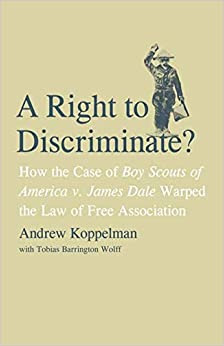
Andrew Koppelman and Tobias Barrington Wolff, A Right to Discriminate?: How the Case of Boy Scouts of America v. James Dale Warped the Law of Free Association (Yale University Press 2009)

Jack M. Balkin and Reva B. Siegel, The Constitution in 2020 (Oxford University Press 2009)

Heather K. Gerken, The Democracy Index: Why Our Election System Is Failing and How to Fix It (Princeton University Press 2009)

Mary Dudziak, Exporting American Dreams: Thurgood Marshall's African Journey (Oxford University Press 2008)

David Luban, Legal Ethics and Human Dignity (Cambridge Univ. Press 2007)

Ian Ayres, Super Crunchers: Why Thinking-By-Numbers is the New Way to be Smart (Bantam 2007)

Jack M. Balkin, James Grimmelmann, Eddan Katz, Nimrod Kozlovski, Shlomit Wagman and Tal Zarsky, eds., Cybercrime: Digital Cops in a Networked Environment (N.Y.U. Press 2007)

Jack M. Balkin and Beth Simone Noveck, The State of Play: Law, Games, and Virtual Worlds (N.Y.U. Press 2006)

Andrew Koppelman, Same Sex, Different States: When Same-Sex Marriages Cross State Lines (Yale University Press 2006)

Brian Tamanaha, Law as a Means to an End (Cambridge University Press 2006)

Sanford Levinson, Our Undemocratic Constitution (Oxford University Press 2006)

Mark Graber, Dred Scott and the Problem of Constitutional Evil (Cambridge University Press 2006)

Jack M. Balkin, ed., What Roe v. Wade Should Have Said (N.Y.U. Press 2005)

Sanford Levinson, ed., Torture: A Collection (Oxford University Press 2004)
Balkin.com homepage
Bibliography
Conlaw.net
Cultural Software
Writings
Opeds
The Information Society Project
BrownvBoard.com
Useful Links
Syllabi and Exams
