Balkinization
an unanticipated consequence of
Jack M. Balkin
Balkinization Symposiums: A Continuing List
E-mail:
Jack Balkin:
jackbalkin at yahoo.com
Bruce Ackerman
bruce.ackerman at yale.edu
Ian Ayres
ian.ayres at yale.edu
Corey Brettschneider
corey_brettschneider at brown.edu
Mary Dudziak
mary.l.dudziak at emory.edu
Joey Fishkin
joey.fishkin at gmail.com
Heather Gerken heather.gerken at yale.edu
Abbe Gluck abbe.gluck at yale.edu
Mark Graber
mgraber at law.umaryland.edu
Stephen Griffin
sgriffin at tulane.edu
Jonathan Hafetz
jonathan.hafetz at shu.edu
Jeremy Kessler
jkessler at law.columbia.edu
Andrew Koppelman
akoppelman at law.northwestern.edu
Marty Lederman
msl46 at law.georgetown.edu
Sanford Levinson
slevinson at law.utexas.edu
David Luban
david.luban at gmail.com
Gerard Magliocca
gmaglioc at iupui.edu
Jason Mazzone
mazzonej at illinois.edu
Linda McClain
lmcclain at bu.edu
John Mikhail
mikhail at law.georgetown.edu
Frank Pasquale
pasquale.frank at gmail.com
Nate Persily
npersily at gmail.com
Michael Stokes Paulsen
michaelstokespaulsen at gmail.com
Deborah Pearlstein
dpearlst at yu.edu
Rick Pildes
rick.pildes at nyu.edu
David Pozen
dpozen at law.columbia.edu
Richard Primus
raprimus at umich.edu
K. Sabeel Rahmansabeel.rahman at brooklaw.edu
Alice Ristroph
alice.ristroph at shu.edu
Neil Siegel
siegel at law.duke.edu
David Super
david.super at law.georgetown.edu
Brian Tamanaha
btamanaha at wulaw.wustl.edu
Nelson Tebbe
nelson.tebbe at brooklaw.edu
Mark Tushnet
mtushnet at law.harvard.edu
Adam Winkler
winkler at ucla.edu
Compendium of posts on Hobby Lobby and related cases
The Anti-Torture Memos: Balkinization Posts on Torture, Interrogation, Detention, War Powers, and OLC
The Anti-Torture Memos (arranged by topic)
Recent Posts
A Potential Workaround for Obamacare Subsidies
Versa project at Cardozo Law School publishes translations of Israeli Supreme Court opinions
A Marriage by Any Other Name: Why Civil Unions Should Receive Federal Recognition
the more things change . . .
New Developments in Originalist Theory
Hobby Lobby and the question for religious freedom
The Senate Torture Report: Accounting without Accountability
"Opinions on the Shape of the World Differ" Legal Reporting
Call for Papers: Sesquicentennial Conference -- The Thirteenth Amendment through the Lens of Class and Labor
The Bill of Rights Reconsidered
![[Powered by Blogger]](https://lh3.googleusercontent.com/blogger_img_proxy/AEn0k_vPL9Y6UiwVxtwIaqpCIeMhbNvoQYPlGHOEjU70MXUevJv7oXHoX5q9P725UlE8aQP9vn6cdxZYVNq2jG_qWb0v-Rz_139etIR9LXpkeD-a=s0-d)
Just A Few Blogs
ACS Blog
Alas, a Blog
Althouse
Arts and Letters Daily
Atrios (Eschaton)
Bill of Health
Buzzflash.com
Buzz Machine
Cato at Liberty
Juan Cole (Informed Comment)
Concurring Opinions
The Constitution in 2020
Corrente
Crooked Timber
Daily Howler
Daily Kos
Dana Boyd
Brad DeLong
Digby (Hullabaloo)
Discriminations
Daniel Drezner
Kevin Drum (Mother Jones)
Electrolite
En Banc
Eunomia (Daniel Larison)
Fafblog
Michael Froomkin (Discourse.net)
GovLab (Beth Noveck)
Rick Hasen (Election Law)
History News Network
How Appealing
Ignatz (Sam Heldman)
The Importance of (Ernie Miller)
Infolaw
Instapundit
International Economic Law and Policy Blog
IntLawGrrls
Jacob Levy
Jesus' General
Jurisdynamics
The Kitchen Cabinet
Mark Kleiman
Law Blog Central
Larry Lessig
Lawyers, Guns and Money
Liberal Oasis
Brian Leiter's Law School Reports
The Leiter Reports
Marginal Revolution
Megan McArdle
Memeorandum
Metafilter
Mirror of Justice
The New Republic
Newseum
No More Mister Nice Blog
Brendan Nyhan
Opinio Juris
Orcinus
The Originalism Blog
Pandagon
Passport (Foreign Policy)
Overcoming Bias
Political Animal (Washington Monthly)
Political Theory Daily Review
Political Wire (Taegan Goddard)
The Poor Man
Virginia Postrel
Prawfsblawg
Public Reason
Jonathan Rauch
Raw Story
Redstate
ReligiousLeftLaw.com
Reporters Committee For Freedom of the Press
Reproductive Rights Blog
Rothman's Roadmap to the Right of Publicity
SCOTUS Blog
Seeing the Forest
Clay Shirky
The Shifted Librarian
The Situationist
Larry Solum (Legal Theory)
Andrew Sullivan
Talking Points Memo
Talk Left
Tapped
Tbogg
TechPresident
The Paper Chase (Jurist)
Tom Paine
Tom Tomorrow (This Modern World)
Eve Tushnet
Uggabugga
University of Chicago Law School Faculty Blog
Unqualified Offerings
The Volokh Conspiracy
War and Piece (Laura Rozen)
Wampum
Oliver Willis
Wonkette
Written Description
Matthew Yglesias
Yin
Your Choice of Feeds
1. XML
powered by

2. Atom Feed
3. RSS 2.0
A Potential Workaround for Obamacare Subsidies
Gerard N. Magliocca
The Supreme Court will hear King v. Burwell in March, and I want to discuss a legal fiction that may become important for the case and for its aftermath if the Court rules against the Administration.
As readers of the blog know, King is about a section of the Affordable Care Act that says subsidies are available for health insurance only "through an Exchange established by the State." The Court is being asked to assess if "the State" is unambiguous given what the rest of the statute provides. If it is unambiguous, then insurance subsidies would be unavailable for people in the more than thirty states that have not set up an exchange and are instead relying on the federal exchange.
Let's assume for the sake of argument that "the State" is unambiguous. The relevant language says that an exchange must be established by a state, not that the state must operate the exchange. Thus, I would submit that a state could--consistent with the statute--establish an exchange and then delegate the authority to run that exchange to the federal government.
If I am correct, then willing states could respond to King by passing a one-page statute that does what I've said. Problem solved. What about unwilling states? My thought is that they could not argue against setting up their own exchange due to its complexity or expense. The only rationale for not setting up a state exchange along the lines that I am describing would be disagreement with the Act. In that case, state elections would become the forum for deciding the issue, which would at least have the benefit of making that issue transparent.
My final observation is that accepting this "formal state exchange" argument would make it easier for the Court to rule against the Administration, though it probably shouldn't. If states face no expense or burden to "establish" an exchange, then a congressional requirement that they do so for their citizens to get subsidies will not seem unreasonable. This makes an opinion going against the Administration easier to write for those Justices so inclined.
Posted
10:46 AM
by Gerard N. Magliocca [link]
(122) comments
Versa project at Cardozo Law School publishes translations of Israeli Supreme Court opinions
JB
The Cardozo Law School has just created a new website, Versa, devoted to the opinions of the Israeli Supreme Court. The site contains English translations of some of the court's most important decisions. The Versa website is part of a larger Israeli Supreme Court Project that is co-directed by Professors Michael Herz and Suzanne Last Stone.
Posted
9:30 AM
by JB [link]
A Marriage by Any Other Name: Why Civil Unions Should Receive Federal Recognition
Andrew Koppelman
The
federal government now recognizes same-sex marriages as triggering
rights and responsibilities under federal law. However, it still
generally refuses to recognize alternative legal statuses — civil unions
and domestic partnerships — that were created by states to serve as
functional marriages. Even though all the states that created such
alternative policies now permit same-sex couples to marry, this
misguided policy causes ongoing harms. Some same-sex couples who entered
into alternative relationships when marriage was not an option may now
lack the capacity to marry. Couples who have since married may also be
hurt by the federal government’s refusal to recognize civil unions or
domestic partnerships retroactively, even in situations where it is now
recognizing same-sex marriages retroactively.
In an essay that my coauthor, Prof. Deborah Widiss, and I have just posted on SSRN, we argue
that the current federal policy is based on a mindlessly literalist
approach to statutory interpretation that should be repudiated. Federal
law generally looks to state law to determine valid marriages, and the
state laws that created these alternative statuses defined them to be
fully equivalent to marriages in all respects. Couples who enter into
such unions thus make exactly the same legal commitments to each other
that couples who marry make to each other. Just as the federal
government routinely recognizes foreign marriages, even when called
something other than “marriage,” it should recognize state civil unions
or domestic partnerships that are likewise legally indistinguishable
from (other) marriages.
Posted
9:17 AM
by Andrew Koppelman [link]
the more things change . . .
Marty Lederman
Posted
9:28 AM
by Marty Lederman [link]
New Developments in Originalist Theory
JB
Over at the Liberty Law Blog, there is a very interesting symposium responding to Steve Smith's essay on Meanings or Decisions? -- Getting Originalism Back on Track. Steve is concerned that the turn to original meaning originalism was mistaken, in part because it made possible my fusion of living constitutionalism and originalism in Living Originalism. If people like me can join the original meaning club, he suggests, maybe it isn't worth being a member anymore. He wants to start over with a new term, like "original decisions originalism."
In one sense Steve is right, of course: once originalism moved to a focus on original public meaning and away from a focus on original intentions or original understanding, the distinction between original meaning and original expected applications was inevitable. So too was the intellectual synthesis that I produced in Living Originalism, showing that the best versions of originalism and living constitutionalism were just two sides of the same coin.
In fact, I was by no means the first to spot the likely consequences for original meaning originalism. Mark Greenberg and Harry Litman made this argument in 1998; a year later Randy Barnett made a similar move, as did Kim Roosevelt in 2006; and of course, Ronald Dworkin's notion of semantic originalism made the point even earlier still. The major problem for Steve is that going back to something like "original decisions originalism" is just going to dredge up the same problems as earlier versions of originalism that have since been abandoned.
I believe that there is no going back at this point. Originalism and living constitutionalism are now one nation, indivisible (with liberty and justice for all, we hope!)--and originalism, like humanity itself, is condemned to be free.
There are three responses to Steve's essay: One is by Michael Rappaport, The Original Decision and Abstract Originalism-- An Unbiased Approach to Originalism. Mike agrees with Steve Smith that my approach should be rejected, but he points out that Steve's move to original decisions won't work very well. Instead, he argues for his and John McGinnis's theory of original methods originalism, developed most fully in their new book, Originalism and the Good Constitution.
Read more »
Posted
5:35 PM
by JB [link]
Hobby Lobby and the question for religious freedom
Andrew Koppelman
Winnifred Fallers Sullivan is arguably the premier scholar of law and
religion in the United States. She brings to the field of law an
unparalleled degree of sophistication and historical and anthropological
knowledge. When she says that all religious freedom laws are rotten at the core, that claim has to be taken seriously.
The core of the problem, she writes, is the distorting effect of the
demand that the state distinguish the religious from the nonreligious.
The religious life of most Americans, “incredibly varied, creative, and
entrepreneurial,” has become so disconnected from the law’s
understanding of religion that the law should abandon the use of the
category, “religion.”
As Sullivan notes, the Religious Freedom Restoration Act (RFRA)—the basis of the Burwell v. Hobby Lobby suit—was a reaction to the “notorious” Employment Division v. Smith decision, which limited the scope of the free exercise clause of the First Amendment. There are reasons for the notoriety and Smith was widely condemned.
RFRA passed by overwhelming margins because most Americans thought that
the tradition of specifically religious accommodation was valuable.
Since Colonial times, Quakers have been exempted from oath-taking and
military service. Catholics were permitted to use sacramental wine
during Prohibition.
Our choices are clear: either we sometimes accommodate, or we never
accommodate. The argument for the latter option relies precisely on the
religious heterogeneity that Sullivan invokes.
I elaborate the argument in a piece just posted on The Immanent Frame, here.
Posted
12:38 PM
by Andrew Koppelman [link]
The Senate Torture Report: Accounting without Accountability
Jonathan Hafetz
In her speech on the Senate floor marking the Senate Select Committee on Intelligence’s release of its long-awaited report on the CIA’s Torture Program, Senator Dianne Feinstein (D-CA) declared that the report would “show the world that we are in fact a just and lawful society” and a society "governed by law." The Senate report does much, and much that is good, but what it does not do is vindicate either justice or law.
The report provides the most comprehensive examination to date of the CIA Torture Program. Above all, it helps strip away the layers of secrecy and expose the misrepresentations to better inform the American public what actions its government took in the name protecting its security. In that sense, the report serves an informational role vital to a democracy and the deliberative process on which it depends.
But accounting should not be confused with accountability. It is crucial to remember that the torture and other misconduct committed by U.S. officials was not simply immoral, barbaric, and counterproductive. It was also criminal, prohibited under both U.S. and international law. In other countries, detailed investigations into human rights violations helped lay the groundwork for subsequent prosecutions. (Argentina and Guatemala are two examples). But President Obama has already suggested that the Senate report will not cause him to reverse his original decision not to pursue a full criminal investigation. The President called the report’s findings “troubling,” but cautioned against “refighting old arguments” and, once again, urged the country to look forward, not backward.
To be sure, political winds in the U.S. may shift, or another country may prosecute U.S. officials under international law. (Prosecutions under universal jurisdiction have previously been attempted in several European countries). But history, not law, may well be the final arbiter of America’s Torture Program. If so, the report’s main contribution will be the factual record it provides to us now and to future generations.
Much of the information about the interrogation methods was already known, although the report includes many new details (from finding that more detainees had been water boarded than previously acknowledged to describing additional interrogation methods like “rectal feeding” and “rectal hydration”). The report’s more significant findings describe the degree to which the CIA mismanaged the detention program, quashed internal opposition, and misrepresented the program to Congress, to the President and senior administration officials, and to the American public (although, in my view, the report goes too far in absolving others outside the CIA). Most importantly, the report counters, in painstaking detail, the claims that “enhanced interrogation methods” produced valuable intelligence and saved lives, including the claim that such methods helped the U.S. find Osama bin Laden in Pakistan.
The report thus makes a compelling case that torture does not work. Most professional interrogators agree. While I confess to no such expertise, I have represented a number of detainees accused of terrorism and have always found that legitimate methods are the most effective way to get suspects to cooperate. Apologists will continue to defend the Torture Program, as the immediate backlash to the Senate report shows. But even if they could show torture had provided some useful information, it shouldn’t matter. The criminal prohibition against torture does not, and should not, rest on utilitarian arguments. And to the extent it does, it will remain vulnerable to the claims of the next Cheney or Tenet that torture works.
The United States is not the first society to confront the commission of grave crimes by the state. Other countries have committed torture and other atrocities, and done so on a much wider scale. In some instances, they have not opted for a traditional criminal law approach and instead pursued other accountability mechanisms. But, as Kevin Jon Heller observes, even a South-African-style Truth and Reconciliation Commission conditioned amnesty on admission of wrongdoing. Moreover, most other societies confronting a past of systematic, state-sponsored human rights violations are also transitioning from a period or internal armed conflict or a change in their political order. The fear is that prosecutions will derail that process.
While the opposition to criminal prosecutions remains undeniably intense, the U.S. faces no comparable choice between peace and justice. The trade-off is one of politics, not peace. And, so far, politics has trumped law. There are other ways for the U.S. to achieve a measure of accountability, from noncriminal sanctions against those responsible to providing remedies to victims. But to date other accountability mechanisms have been not taken hold. Instead, we are left with accountability through accounting.
And herein lies the Torture Report's central paradox. It is because the Senate report provides such devastating details into the Torture Program that the stakes for the rule of law are now so high. By demonstrating the depth and degree of America’s lawlessness, the Torture Program shines the light even more brightly on law’s absence in addressing the crimes of the past.
Posted
9:52 AM
by Jonathan Hafetz [link]
"Opinions on the Shape of the World Differ" Legal Reporting
Mark Tushnet
Several lawyers said the states could have a hard time convincing the federal courts that they could suffer specific harms as a result of Mr. Obama’s actions. Those harms are the legal foundation for them to bring the suit.
“The injury the states are alleging seems a bit speculative,” said Cristina Rodriguez, a professor of immigration and constitutional law at Yale Law School. “In many ways this is a political document,” she said of the suit, adding, “It feels more rhetorical than legal.”
Others counter that the suit is sound. Jay Sekulow, chief counsel of the American Center for Law and Justice who has argued several cases involving conservative causes before the Supreme Court, said that Mr. Obama had gone far beyond the bounds of executive discretion and that the lawsuit would demonstrate that. “The scope and breadth of what the president has done is so impressive that it changes the dynamic dramatically,” he said.
It's exam time, so here's a question (actually, not entirely non-serious) for our students: In what sense is "The scope and breadth of what the president has done is so impressive that it changes the dynamic dramatically" a legal argument, even one simplified for public consumption?
Posted
1:59 PM
by Mark Tushnet [link]
Call for Papers: Sesquicentennial Conference -- The Thirteenth Amendment through the Lens of Class and Labor
Guest Blogger
Paper proposals should focus on the Thirteenth Amendment and include class or labor as an important theme. Proposals addressing the relations (including relative priorities) and intersections of race, gender, and sexual orientation with class or labor are strongly encouraged. Proposals should be e-mailed to Rebecca.zietlow@utoledo.edu by January 10, 2015. We anticipate that the papers will be published in a law review symposium issue.
The Thirteenth Amendment Through The Lens of Class and Labor Conference is sponsored by the Fred T. Korematsu Center for Law and Equality at the Seattle University School of Law, the Seattle University School of Law, and the University of Washington School of Law. The conference will be held at the Seattle University School of Law on May 31- June 1, 2015, immediately following the annual meeting of the Law & Society Association.
Planning Committee for the Sesquicentennial Conference on the Thirteenth Amendment through the Lens of Class and Labor:
Posted
12:45 PM
by Guest Blogger [link]
The Bill of Rights Reconsidered
Gerard N. Magliocca
The draft of my revised paper on the history of the Bill of Rights is available for download here.
Posted
8:46 PM
by Gerard N. Magliocca [link]
(248) comments
Books by Balkinization Bloggers

Gerard N. Magliocca, The Actual Art of Governing: Justice Robert H. Jackson's Concurring Opinion in the Steel Seizure Case (Oxford University Press, 2025)

Linda C. McClain and Aziza Ahmed, The Routledge Companion to Gender and COVID-19 (Routledge, 2024)

David Pozen, The Constitution of the War on Drugs (Oxford University Press, 2024)

Jack M. Balkin, Memory and Authority: The Uses of History in Constitutional Interpretation (Yale University Press, 2024)
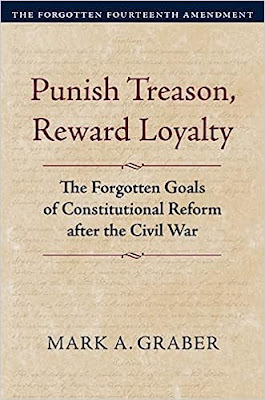
Mark A. Graber, Punish Treason, Reward Loyalty: The Forgotten Goals of Constitutional Reform after the Civil War (University of Kansas Press, 2023)
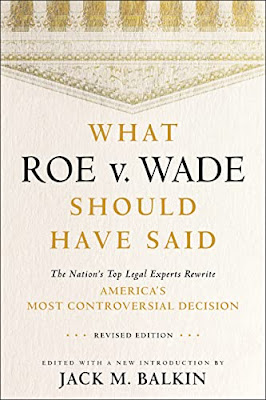
Jack M. Balkin, What Roe v. Wade Should Have Said: The Nation's Top Legal Experts Rewrite America's Most Controversial Decision - Revised Edition (NYU Press, 2023)

Andrew Koppelman, Burning Down the House: How Libertarian Philosophy Was Corrupted by Delusion and Greed (St. Martin’s Press, 2022)

Gerard N. Magliocca, Washington's Heir: The Life of Justice Bushrod Washington (Oxford University Press, 2022)
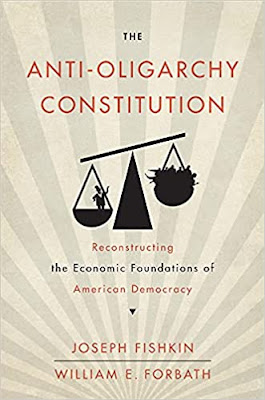
Joseph Fishkin and William E. Forbath, The Anti-Oligarchy Constitution: Reconstructing the Economic Foundations of American Democracy (Harvard University Press, 2022)
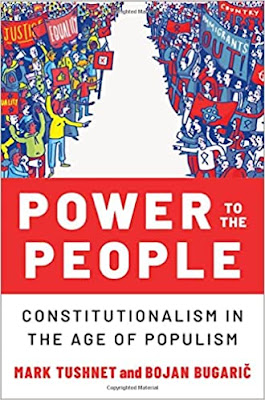
Mark Tushnet and Bojan Bugaric, Power to the People: Constitutionalism in the Age of Populism (Oxford University Press 2021).

Mark Philip Bradley and Mary L. Dudziak, eds., Making the Forever War: Marilyn B. Young on the Culture and Politics of American Militarism Culture and Politics in the Cold War and Beyond (University of Massachusetts Press, 2021).

Jack M. Balkin, What Obergefell v. Hodges Should Have Said: The Nation's Top Legal Experts Rewrite America's Same-Sex Marriage Decision (Yale University Press, 2020)

Frank Pasquale, New Laws of Robotics: Defending Human Expertise in the Age of AI (Belknap Press, 2020)

Jack M. Balkin, The Cycles of Constitutional Time (Oxford University Press, 2020)

Mark Tushnet, Taking Back the Constitution: Activist Judges and the Next Age of American Law (Yale University Press 2020).

Andrew Koppelman, Gay Rights vs. Religious Liberty?: The Unnecessary Conflict (Oxford University Press, 2020)

Ezekiel J Emanuel and Abbe R. Gluck, The Trillion Dollar Revolution: How the Affordable Care Act Transformed Politics, Law, and Health Care in America (PublicAffairs, 2020)

Linda C. McClain, Who's the Bigot?: Learning from Conflicts over Marriage and Civil Rights Law (Oxford University Press, 2020)
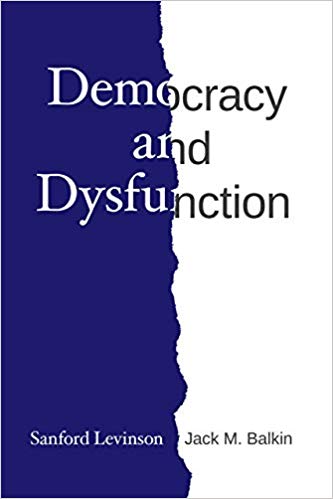
Sanford Levinson and Jack M. Balkin, Democracy and Dysfunction (University of Chicago Press, 2019)

Sanford Levinson, Written in Stone: Public Monuments in Changing Societies (Duke University Press 2018)

Mark A. Graber, Sanford Levinson, and Mark Tushnet, eds., Constitutional Democracy in Crisis? (Oxford University Press 2018)

Gerard Magliocca, The Heart of the Constitution: How the Bill of Rights became the Bill of Rights (Oxford University Press, 2018)

Cynthia Levinson and Sanford Levinson, Fault Lines in the Constitution: The Framers, Their Fights, and the Flaws that Affect Us Today (Peachtree Publishers, 2017)

Brian Z. Tamanaha, A Realistic Theory of Law (Cambridge University Press 2017)

Sanford Levinson, Nullification and Secession in Modern Constitutional Thought (University Press of Kansas 2016)

Sanford Levinson, An Argument Open to All: Reading The Federalist in the 21st Century (Yale University Press 2015)

Stephen M. Griffin, Broken Trust: Dysfunctional Government and Constitutional Reform (University Press of Kansas, 2015)

Frank Pasquale, The Black Box Society: The Secret Algorithms That Control Money and Information (Harvard University Press, 2015)

Bruce Ackerman, We the People, Volume 3: The Civil Rights Revolution (Harvard University Press, 2014)
Balkinization Symposium on We the People, Volume 3: The Civil Rights Revolution

Joseph Fishkin, Bottlenecks: A New Theory of Equal Opportunity (Oxford University Press, 2014)

Mark A. Graber, A New Introduction to American Constitutionalism (Oxford University Press, 2013)

John Mikhail, Elements of Moral Cognition: Rawls' Linguistic Analogy and the Cognitive Science of Moral and Legal Judgment (Cambridge University Press, 2013)

Gerard N. Magliocca, American Founding Son: John Bingham and the Invention of the Fourteenth Amendment (New York University Press, 2013)

Stephen M. Griffin, Long Wars and the Constitution (Harvard University Press, 2013)

Andrew Koppelman, The Tough Luck Constitution and the Assault on Health Care Reform (Oxford University Press, 2013)

James E. Fleming and Linda C. McClain, Ordered Liberty: Rights, Responsibilities, and Virtues (Harvard University Press, 2013)
Balkinization Symposium on Ordered Liberty: Rights, Responsibilities, and Virtues

Andrew Koppelman, Defending American Religious Neutrality (Harvard University Press, 2013)

Brian Z. Tamanaha, Failing Law Schools (University of Chicago Press, 2012)

Sanford Levinson, Framed: America's 51 Constitutions and the Crisis of Governance (Oxford University Press, 2012)

Linda C. McClain and Joanna L. Grossman, Gender Equality: Dimensions of Women's Equal Citizenship (Cambridge University Press, 2012)

Mary Dudziak, War Time: An Idea, Its History, Its Consequences (Oxford University Press, 2012)

Jack M. Balkin, Living Originalism (Harvard University Press, 2011)

Jason Mazzone, Copyfraud and Other Abuses of Intellectual Property Law (Stanford University Press, 2011)

Richard W. Garnett and Andrew Koppelman, First Amendment Stories, (Foundation Press 2011)

Jack M. Balkin, Constitutional Redemption: Political Faith in an Unjust World (Harvard University Press, 2011)

Gerard Magliocca, The Tragedy of William Jennings Bryan: Constitutional Law and the Politics of Backlash (Yale University Press, 2011)

Bernard Harcourt, The Illusion of Free Markets: Punishment and the Myth of Natural Order (Harvard University Press, 2010)

Bruce Ackerman, The Decline and Fall of the American Republic (Harvard University Press, 2010)
Balkinization Symposium on The Decline and Fall of the American Republic

Ian Ayres. Carrots and Sticks: Unlock the Power of Incentives to Get Things Done (Bantam Books, 2010)

Mark Tushnet, Why the Constitution Matters (Yale University Press 2010)

Ian Ayres and Barry Nalebuff: Lifecycle Investing: A New, Safe, and Audacious Way to Improve the Performance of Your Retirement Portfolio (Basic Books, 2010)
.jpg)
Jack M. Balkin, The Laws of Change: I Ching and the Philosophy of Life (2d Edition, Sybil Creek Press 2009)

Brian Z. Tamanaha, Beyond the Formalist-Realist Divide: The Role of Politics in Judging (Princeton University Press 2009)
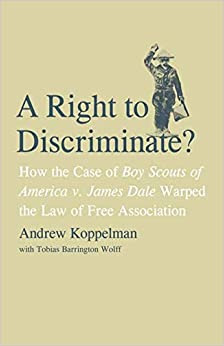
Andrew Koppelman and Tobias Barrington Wolff, A Right to Discriminate?: How the Case of Boy Scouts of America v. James Dale Warped the Law of Free Association (Yale University Press 2009)

Jack M. Balkin and Reva B. Siegel, The Constitution in 2020 (Oxford University Press 2009)

Heather K. Gerken, The Democracy Index: Why Our Election System Is Failing and How to Fix It (Princeton University Press 2009)

Mary Dudziak, Exporting American Dreams: Thurgood Marshall's African Journey (Oxford University Press 2008)

David Luban, Legal Ethics and Human Dignity (Cambridge Univ. Press 2007)

Ian Ayres, Super Crunchers: Why Thinking-By-Numbers is the New Way to be Smart (Bantam 2007)

Jack M. Balkin, James Grimmelmann, Eddan Katz, Nimrod Kozlovski, Shlomit Wagman and Tal Zarsky, eds., Cybercrime: Digital Cops in a Networked Environment (N.Y.U. Press 2007)
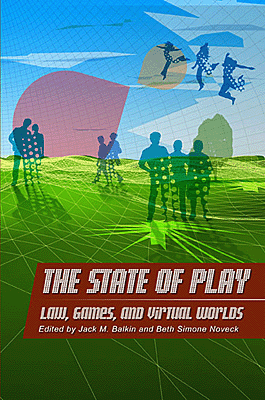
Jack M. Balkin and Beth Simone Noveck, The State of Play: Law, Games, and Virtual Worlds (N.Y.U. Press 2006)

Andrew Koppelman, Same Sex, Different States: When Same-Sex Marriages Cross State Lines (Yale University Press 2006)

Brian Tamanaha, Law as a Means to an End (Cambridge University Press 2006)

Sanford Levinson, Our Undemocratic Constitution (Oxford University Press 2006)

Mark Graber, Dred Scott and the Problem of Constitutional Evil (Cambridge University Press 2006)

Jack M. Balkin, ed., What Roe v. Wade Should Have Said (N.Y.U. Press 2005)

Sanford Levinson, ed., Torture: A Collection (Oxford University Press 2004)
Balkin.com homepage
Bibliography
Conlaw.net
Cultural Software
Writings
Opeds
The Information Society Project
BrownvBoard.com
Useful Links
Syllabi and Exams
