Balkinization
an unanticipated consequence of
Jack M. Balkin
Balkinization Symposiums: A Continuing List
E-mail:
Jack Balkin:
jackbalkin at yahoo.com
Bruce Ackerman
bruce.ackerman at yale.edu
Ian Ayres
ian.ayres at yale.edu
Corey Brettschneider
corey_brettschneider at brown.edu
Mary Dudziak
mary.l.dudziak at emory.edu
Joey Fishkin
joey.fishkin at gmail.com
Heather Gerken heather.gerken at yale.edu
Abbe Gluck abbe.gluck at yale.edu
Mark Graber
mgraber at law.umaryland.edu
Stephen Griffin
sgriffin at tulane.edu
Jonathan Hafetz
jonathan.hafetz at shu.edu
Jeremy Kessler
jkessler at law.columbia.edu
Andrew Koppelman
akoppelman at law.northwestern.edu
Marty Lederman
msl46 at law.georgetown.edu
Sanford Levinson
slevinson at law.utexas.edu
David Luban
david.luban at gmail.com
Gerard Magliocca
gmaglioc at iupui.edu
Jason Mazzone
mazzonej at illinois.edu
Linda McClain
lmcclain at bu.edu
John Mikhail
mikhail at law.georgetown.edu
Frank Pasquale
pasquale.frank at gmail.com
Nate Persily
npersily at gmail.com
Michael Stokes Paulsen
michaelstokespaulsen at gmail.com
Deborah Pearlstein
dpearlst at yu.edu
Rick Pildes
rick.pildes at nyu.edu
David Pozen
dpozen at law.columbia.edu
Richard Primus
raprimus at umich.edu
K. Sabeel Rahmansabeel.rahman at brooklaw.edu
Alice Ristroph
alice.ristroph at shu.edu
Neil Siegel
siegel at law.duke.edu
David Super
david.super at law.georgetown.edu
Brian Tamanaha
btamanaha at wulaw.wustl.edu
Nelson Tebbe
nelson.tebbe at brooklaw.edu
Mark Tushnet
mtushnet at law.harvard.edu
Adam Winkler
winkler at ucla.edu
Compendium of posts on Hobby Lobby and related cases
The Anti-Torture Memos: Balkinization Posts on Torture, Interrogation, Detention, War Powers, and OLC
The Anti-Torture Memos (arranged by topic)
Recent Posts
Why the Law Does Not (and Should Not) Allow Religiously Motivated Contractors to Discriminate Against Their LGBT Employees
A Modern Censure Resolution
Don't Buy the Cooperative-Federalism-Makes-Halbig-Logical Argument
Halbig, King, and the Limits of Reasonable Legal Disagreement
Confirmation that the Supreme Court's suggested fix will almost certainly not mollify the plaintiffs: Recent developments in the nonprofit challenges to the contraceptive coverage accommodation
Halbig as Opt-In Federalism
Halbig and hurting the innocent as a political tactic
Some Roundups on Halbig and King (the ObamaCare Subsidies Cases)
Some Thoughts on Halbig
Fourth Circuit Rules in FAVOR of Government in Obamacare Subsidies Case
The Loss in Halbig
Halbig decided [UPDATED -- King too!: quickest circuit split ever?]
The Anti-Partisan Principle
Rest in Peace, Dan Markel (1972-2014)
Hobby Lobby: Who, exactly, is exercising religion? And why does the contraceptive coverage rule burden that religious exercise?
Will the ACA litigation be decided based on a mistake?
Compendium of posts on Hobby Lobby, Zubik, and related cases [UPDATED through Nov. 8, 2015]
Unpacking the forthcoming RFRA challenges to the government's accommodation (with emphasis on self-insured plans)
![[Powered by Blogger]](https://lh3.googleusercontent.com/blogger_img_proxy/AEn0k_sAuS_8AqisMPMXezwcZqwJMpqJe9pufgyNFt8b-FKU_ap70Mqb00KeQJJLoQcFaBu3dWEX4aMdDIvssHYz6xQFO0oZFM8e2mG-SfJ7sFUH=s0-d)
Just A Few Blogs
ACS Blog
Alas, a Blog
Althouse
Arts and Letters Daily
Atrios (Eschaton)
Bill of Health
Buzzflash.com
Buzz Machine
Cato at Liberty
Juan Cole (Informed Comment)
Concurring Opinions
The Constitution in 2020
Corrente
Crooked Timber
Daily Howler
Daily Kos
Dana Boyd
Brad DeLong
Digby (Hullabaloo)
Discriminations
Daniel Drezner
Kevin Drum (Mother Jones)
Electrolite
En Banc
Eunomia (Daniel Larison)
Fafblog
Michael Froomkin (Discourse.net)
GovLab (Beth Noveck)
Rick Hasen (Election Law)
History News Network
How Appealing
Ignatz (Sam Heldman)
The Importance of (Ernie Miller)
Infolaw
Instapundit
International Economic Law and Policy Blog
IntLawGrrls
Jacob Levy
Jesus' General
Jurisdynamics
The Kitchen Cabinet
Mark Kleiman
Law Blog Central
Larry Lessig
Lawyers, Guns and Money
Liberal Oasis
Brian Leiter's Law School Reports
The Leiter Reports
Marginal Revolution
Megan McArdle
Memeorandum
Metafilter
Mirror of Justice
The New Republic
Newseum
No More Mister Nice Blog
Brendan Nyhan
Opinio Juris
Orcinus
The Originalism Blog
Pandagon
Passport (Foreign Policy)
Overcoming Bias
Political Animal (Washington Monthly)
Political Theory Daily Review
Political Wire (Taegan Goddard)
The Poor Man
Virginia Postrel
Prawfsblawg
Public Reason
Jonathan Rauch
Raw Story
Redstate
ReligiousLeftLaw.com
Reporters Committee For Freedom of the Press
Reproductive Rights Blog
Rothman's Roadmap to the Right of Publicity
SCOTUS Blog
Seeing the Forest
Clay Shirky
The Shifted Librarian
The Situationist
Larry Solum (Legal Theory)
Andrew Sullivan
Talking Points Memo
Talk Left
Tapped
Tbogg
TechPresident
The Paper Chase (Jurist)
Tom Paine
Tom Tomorrow (This Modern World)
Eve Tushnet
Uggabugga
University of Chicago Law School Faculty Blog
Unqualified Offerings
The Volokh Conspiracy
War and Piece (Laura Rozen)
Wampum
Oliver Willis
Wonkette
Written Description
Matthew Yglesias
Yin
Your Choice of Feeds
1. XML
powered by

2. Atom Feed
3. RSS 2.0
Why the Law Does Not (and Should Not) Allow Religiously Motivated Contractors to Discriminate Against Their LGBT Employees
Marty Lederman
Posted
5:16 PM
by Marty Lederman [link]
A Modern Censure Resolution
Gerard N. Magliocca
In 1834, the Senate passed a resolution censuring President Jackson for his "unconstitutional" decision to withdraw the Treasury's deposits from the Bank of the United States. The Senate argued that Jackson's unilateral executive action attacking the Bank was unauthorized by Congress. In 2014 we have a resolution from the House of Representatives authorizing a suit against President Obama claiming that his unilateral executive actions regarding the Affordable Care Act are unconstitutional. How are these resolutions related?
In both cases, the institutional action was a second-best solution to a political problem. The Censure Resolution, which I discuss at length in my book on Jacksonian Democracy, was an unorthodox reply to the fact that President Jackson's opponents could not impeach him since Democrats held the House of Representatives. Since they believed that the destruction of the Bank was a constitutional disaster and wanted to continue that debate in the next midterm elections, their solution was to take a formal position defending the Bank and castigating the President. Jackson (being Jackson) did not take this measure lightly--he issued a written Protest to the Censure Resolution denouncing the Senate's act as unconstitutional. That battle continued until Democrats were able to take control of the Senate and "expunge" the Censure Resolution from the Senate Journal in 1837. (They literally brought out the Journal and drew black lines around the Censure Resolution.)
Today House Republicans want to take another stand in the great constitutional controversy of the day--Obamacare--as they head into the midterms, but in their case impeachment is either politically unpalatable or dead on arrival in the Senate. Just passing a resolution attacking the President, though, lacks the punch that such an act had in the 1830s. (Why is an interesting question--probably because political honor was taken more seriously by men like Jackson who had fought in duels.) Thus, we get the modern equivalent, which is a lawsuit. This is more than a resolution, less than impeachment, and reflects the ongoing judicialization of politics.
Posted
9:43 AM
by Gerard N. Magliocca [link]
(85) comments
Don't Buy the Cooperative-Federalism-Makes-Halbig-Logical Argument
Abbe Gluck
I had hoped to take a day off blogging about Halbig and King (the ObamaCare Subsidies cases), but I cannot allow another inaccurate narrative about ObamaCare to take hold. Over at Volokh, my friend Ilya Somin argues that the holding in Halbig is not absurd because Congress uses statutory schemes all the time that try to incentivize states to administer federal law (and to penalize them if they don't). It is true we see schemes like that all the time--Medicaid is a prime example--but the insurance exchange design is NOT one of them. This federalism argument was made before the D.C. Circuit and even Judge Griffith didn't buy it in his ruling for the challengers. I tried to dispel this myth back in March, when I wrote the following on this blog:
"This
is not a conditional spending program analogous to Medicaid.
The challengers' strategy in
this round has been to contend that the subsidies are part of an
overarching ACA "carrots and sticks" strategy to lure states into
health reform and penalize them if they decline. On that version of
the story, it might make sense that subsidies would be unavailable in states
that do not run their own exchanges. In their view, the subsidies are therefore
exactly like the ACA’s Medicaid provision (from appellants’brief: “The ACA’s subsidy provision
offered an analogous ‘deal’ to entice states to establish Exchanges—because
Congress (wisely, in hindsight) knew it had to offer huge incentives for the
states to assume responsibility for that logistically nightmarish and
politically toxic task.”)
* * *
Posted
10:17 AM
by Abbe Gluck [link]
Halbig, King, and the Limits of Reasonable Legal Disagreement
Neil Siegel
I participated in the debates over the constitutionality of the Affordable Care Act (ACA). Although I thought the federal government had substantially stronger arguments on its side, I did not dismiss the arguments of those who disagreed with me. There often has been reasonable, irreconcilable disagreement over the meaning of the Constitution, and the Supreme Court had never before allowed Congress to impose a purchase mandate under the Commerce Clause or an exaction labeled a penalty under the Taxing Clause. I thought the “Lopez question” required an answer.
Halbig and King (plus the Indiana and Oklahoma cases) are different. I can accept as reasonable, even if ultimately unpersuasive, the argument that the relevant provisions of the ACA are ambiguous. What I cannot accept as reasonable or responsible, however, is the argument—accepted by the D.C. Circuit panel majority in Halbig—that the ACA Congress clearly and unambiguously accomplished what no Member of Congress, no one in the Congressional Budget Office, none of the four dissenting Justices in NFIB v. Sebelius, and no state official realized that Congress had accomplished when it passed the ACA: self-destructively limit the tax subsidies that make health insurance affordable for millions of Americans to those who have the good fortune of happening to reside in states that set up their own health insurance exchanges.
Yes, the statute provides that the subsidies are to be calculated in part based on the cost of the monthly premium for the health insurance plan that an individual buys “through an Exchange established by the State under [Section] 1311” of the ACA. 26 U.S.C. §36B(b). But for goodness sake, that is an odd place in the statute for Congress to say—no, for Congress to whisper—that subsidies are not available in federally facilitated exchanges, thereby placing the viability of the entire statute in jeopardy if state officials decline to create exchanges. The part of the law that determines who is eligible for the subsidies—as opposed to how they are to be calculated—does not distinguish between state and federally facilitated exchanges. See 26 U.S.C. §36B(a).
More importantly, Section 1311 purports to require each state to establish an exchange: “Each State shall, not later than January 1, 2014, establish an American Health Benefit Exchange (referred to in this title as an ‘Exchange’)[.]” The section then defines an “Exchange” as an entity that necessarily has been established by a state: “An Exchange shall be a governmental agency or nonprofit entity that is established by a State.” See also § 1563(b) (stating that “[t]he term ‘Exchange’ means an American Health Benefit Exchange established under [§] 1311”). Section 1321 later makes plain that Section 1311 must be taken stipulatively, not literally. That is, a state may, as a matter of fact, “elect” to establish an exchange or not, and if it does not, then the federal government “shall . . . establish and operate such Exchange within the State and the Secretary shall take such actions as are necessary to implement such other requirements” (my emphasis).
In other words, the part of the ACA that uses the “established by the State” language asserts by definition, regardless of the fact of the matter, that the state is establishing the exchange. Another part of the statute directs the federal government to stand in the shoes of the state—to be the state for purposes of the statutory language and structure—if a state as a matter of fact does not create an exchange.
No doubt, Congress could have been clearer. So what else is new? Cf. Bond v. United States, 134 S. Ct. 2077 (2014). And yes, that lack of perfect clarity may cause some interpreters reasonably to view the statute as ambiguous, as opposed to clearly favoring the government’s position. But it is not reasonable to conclude that the statute clearly and insanely says what the plaintiffs say it says.
In light of these straightforward statutory interpretation arguments, as well as other arguments offered by six of the eight federal judges to decide the question so far (including, by the way, a Republican appointee), how can it be maintained that the statute—as clear as day yet unbeknownst to anyone at the time—denies subsidies to individuals who purchase health insurance policies in federally run exchanges?
Some may conclude that I am not as tolerant of reasonable legal disagreement as I think I am or used to be. Others may conclude that I care too much about the draconian financial consequences for millions of Americans and insurance companies if this litigation succeeds.
I have considered these possibilities, and I have rejected them. The plaintiffs’ case is so weak and transparently political that it is dismaying to see it be taken seriously.
Posted
9:26 AM
by Neil Siegel [link]
Confirmation that the Supreme Court's suggested fix will almost certainly not mollify the plaintiffs: Recent developments in the nonprofit challenges to the contraceptive coverage accommodation
Marty Lederman
Posted
2:50 AM
by Marty Lederman [link]
Halbig as Opt-In Federalism
Joseph Fishkin
The commentary about Halbig so far has viewed it mainly through two lenses. Through one lens, most obviously, it’s a statutory interpretation case—one that illustrates some shortcomings of a certain hyper-formalistic, acontextual approach to reading statutory text. Through the other lens, Halbig is a political case: a highly charged proxy fight about Obamacare that illustrates how thin and permeable the membrane is between some judges’ substantive political views of a law and their interpretation of it.
I think Halbig is even more interesting through a third lens: as a federalism case.
Here, ironies abound. In NFIB v. Sebelius, the majority decided that the ACA’s Medicaid expansion raised constitutional questions because it put a gun to the head of the states: you will lose an enormous chunk of federal money unless you agree to expand Medicaid. To the utter consternation of the legislators who wrote and voted for the ACA, the 2-1 majority in the DC Circuit in Halbig has interpreted the exchange portion of the statute to similarly threaten states with a catastrophic loss of federal funds if they don’t comply with the federal government’s demands—this time, supposedly, the demand that the state set up an insurance exchange.
As many commentators (including other judges, in dissent in Halbig and in the majority in the 4th Circuit) have noted, it’s abundantly clear not only from the legislative history of the statute but also from other parts of its text that no such threat was ever actually contemplated. The whole point of the backup federal exchange was to give states a different kind of choice: they can either take control of (and responsibility for) the regulation of the new insurance plans in their state by establishing an exchange, or they can wash their hands of it, and let the federal government take the full credit and blame for the system that results. That was the kind of federalism the ACA had in mind: backstop federalism, in which every individual American would have access to the same substantive benefits, but they could be administered either in a cooperative-federalism way, or, in uncooperative red states, by the feds alone. This gives states real choices about how much involvement they want in the ACA’s new insurance system. It doesn’t give states the option to deprive their citizens of access to affordable health insurance.
But the Halbig panel majority doesn’t read the statute in terms of what subsidies the ACA, by its terms, intends to make available to individual citizens. Instead the panel majority manages to take the individual citizens out of the picture, and tell a simple story of a threatening federal government, holding a gun and demanding that the states set up an exchange or lose all subsidies. This analysis is overly simplistic in a couple of ways. For a start, it ignores where the gun is actually pointing. The analysis also manages to obscure the question of what a state actually has to do to set up an exchange “under” Section 1311. It may not be much at all, for reasons I discuss below, in which case the real story here is not one of the federal government requiring onerous action by states, but instead, one in which the Halbig court would turn what Congress intended as universal individual entitlement into a program of opt-in federalism, where the federal government might try to create a universal program, but it’s actually up to states to decide whether they want to opt in.
Read more »
Posted
1:30 AM
by Joseph Fishkin [link]
Halbig and hurting the innocent as a political tactic
Andrew Koppelman
Posted
1:05 PM
by Andrew Koppelman [link]
Some Roundups on Halbig and King (the ObamaCare Subsidies Cases)
Abbe Gluck
Much commentary has been posted in the past 24 hours on the Obamacare subsidies rulings. Here are just a few:
Emily Bazelon comments at Slate about how implausible it is, as the D.C. Circuit holding would have it, "that Congress included in Obamacare the seeds of its own destruction, giving naysaying governors the power to kill it—without ever saying so." I have my own op-ed at Politico, arguing that the opinion does a disservice to the credibility smart textualists have been trying to build for years and is not the way that complex laws should be interpreted in a well-functioning democracy. My piece also points out that the D.C. Circuit's reading of the statute contradicts the description of the exchanges by Justices Scalia, Kennedy, Thomas and Alito in the ACA Joint Dissent, which assumed the validity of the federal-exchange subsidies and understood that the statutory scheme depends on them.
Further on the health law academic front, Tim Jost has a post on the Health Affairs blog analyzing the opinion, as does Nicole Huberfeld at HealthLawProfBlog, and Nick Bagley at Incidental Economist.
Jonathan Cohn, Ezra Klein, and Wonkblog each have posts detailing how no one involved in the drafting the statute or reporting on its enactment over 2009 and 2010 sees any any proof of the story that the challengers are telling about what the ACA means or what Congress intended. As Klein writes:
"For Congress to write a law that provides for federal exchanges but doesn't permit money to flow through them would have been like Congress writing a transportation law that builds federal highways but doesn't allow cars, bikes or buses to travel on them. That was...not what Congress thought it was doing. As Jonathan Cohn writes, 'not once in the 16 months I reported on the formal congressional debate did any of the law's architects suggest they were thinking along these lines.' My experience was precisely the same: architects of the bill underestimated how many states would let the federal government run their exchanges, but they always thought there would be a few, and they always assumed those exchanges would feature subsidies. Everyone in Congress — including the Congressional Budget Office in its estimates of Obamacare's cost — assumed subsidies would flow through federal exchanges."
More to follow.....
Posted
10:44 AM
by Abbe Gluck [link]
Some Thoughts on Halbig
Gerard N. Magliocca
I posted after the oral argument in the DC Circuit to say that I thought the argument that prevailed there yesterday needed to be taken seriously, so now I feel compelled to talk about what comes next.
First, I think that there are four Justices who will be waiting on the front steps of the Court for the certiorari petition from the Fourth Circuit (which ruled in favor of the Administration on the same issue yesterday). Thus, the question of whether the DC Circuit will go en banc in Halbig is, to my mind, largely beside the point. In an ordinary case, one would expect the Justices to wait and see if a circuit split could be healed before acting, but this is not an ordinary case. The Justices who lost in 2012 on the individual mandate challenge would love to get another at-bat.
Second, the split yesterday supports my argument from last year that the Affordable Care Act remains unsettled law. The fact is that many statutes are poorly drafted or have errors. What normally happens when that is true? One option is for Congress to fix that problem. That cannot be done because the Republican Party is still overwhelmingly opposed to the Act. Another option is that the courts fix or overlook the drafting issue. That assumes, though, there is a consensus that the statute should be fixed, which is also lacking along partisan lines.
Third, I argue in my new draft article that the Chief Justice's opinion in NFIB is best understood as expressing a norm that it is wrong for the Justices of one party to invalidate the signature law of the other party. Does this convention include crippling the same law with statutory construction? The Chief Justice will have a year to mull that one over.
UPDATE: Typos in the original post are now corrected.
Posted
10:23 AM
by Gerard N. Magliocca [link]
(74) comments
Fourth Circuit Rules in FAVOR of Government in Obamacare Subsidies Case
Abbe Gluck
Making sure our readers keep up with this roller-coaster day in health reform land: The Fourth Circuit released its own opinion (3-0, with a strong concurrence from J. Davis) rejecting the subsidies challenge pending in that court right after the DC Circuit released its own opinion sustaining the same challenge there . The Fourth Circuit went with a straight Chevron argument, but indicated it thought the government had the better reading of the statutory text in any event. Judge Davis concurred specially to make the point that Chevron wasn't even necessary: that the statute clearly requires the subsidies on the federal exchanges. Of interest to statutory interpretation types (and along the lines of what I've been arguing in previous posts), Judge Davis also argued that this isn't a case of "textualism v. purposivism" or statutory text versus some amorphous concept of congressional intent. Davis argued that the text of the statute as a whole answers the question definitely in favor of the Government.
Posted
2:47 PM
by Abbe Gluck [link]
The Loss in Halbig
Abbe Gluck
As Marty notes, the opinion is out. Initial quick reaction, more to come: The opinion is terribly disappointing from a statutory interpretation perspective. It relies in part on irrelevant legislative history (from the HELP committee, whose bill wasn't even the basis for these provisions--the Finance committee's was) and gets it wrong anyway (as I argued here); it bends over backwards to come up with reasons why Congress might have intended this result (which we all know it certainly did not); and it attaches far too much significance to a line in the statute that expressly deems exchanges in the territories to be state exchanges and does not replicate the special deeming language for the federal exchanges. The territories language is boilerplate language used by Congress when talking about territories in statutes even beyond the ACA, and should have been attached no significance here. What's more, applying the exclusio unius presumption (that when Congress specifies X we can assume that it meant not to specify X elsewhere) to a statute as long and complicated as the ACA -- and one that did not go through the usual linguistic "clean up" process in Conference (as I wrote here) does a disservice to textualism and all those who have defended it over the years--turning it into a wooden unreasonable formalism rather than the sophisticated statutory analysis that textualists have been claiming they are all about.
Posted
11:00 AM
by Abbe Gluck [link]
Halbig decided [UPDATED -- King too!: quickest circuit split ever?]
Marty Lederman
2-1, Edwards dissenting, as oral argument suggested. I'm sure we'll have more on the opinion shortly here on the blog.
On the other hand . . . the Court of Appeals for the Fourth Circuit in King just decided the issue the other way!
Posted
10:18 AM
by Marty Lederman [link]
The Anti-Partisan Principle
Gerard N. Magliocca
I've posted the draft of my new paper here. Comments and criticism are always welcome.
Posted
5:04 PM
by Gerard N. Magliocca [link]
(3) comments
Rest in Peace, Dan Markel (1972-2014)
JB
Our deepest condolences to the family, friends and colleagues of Professor Dan Markel of Florida State (and Prawfsblawg), who was shot at his home in Tallahassee on Friday. The latest details are here. Paul Caron has a collection of links and other remembrances are here and here.
Posted
5:09 PM
by JB [link]
Hobby Lobby: Who, exactly, is exercising religion? And why does the contraceptive coverage rule burden that religious exercise?
Marty Lederman
As part of a terrific symposium on Hobby Lobby over at the Conglomerate, I published a post with that title today, focusing principally on some of the corporate-law questions that the Court unfortunately elides or confuses in Hobby Lobby.
Posted
5:12 PM
by Marty Lederman [link]
Will the ACA litigation be decided based on a mistake?
Guest Blogger
Posted
2:30 PM
by Guest Blogger [link]
Compendium of posts on Hobby Lobby, Zubik, and related cases [UPDATED through Nov. 8, 2015]
Marty Lederman
For our readers' convenience, I'm collecting here in one place links to all Balkinization posts about Hobby Lobby, Conestoga Wood, Notre Dame, and Little Sisters, et al., along with links to the briefs and oral argument in Hobby Lobby/Conestoga Wood and to a few other important posts about these cases. We'll try to keep the list relatively current as the litigation proceeds.
Marty Lederman's Posts on Hobby Lobby
Hobby Lobby Part I -- Framing the issues (Dec. 11, 2013)
Hobby Lobby Part II -- What's it all about? (contraception? abortifacients? other religious objections to elements of health insurance?) (Dec. 13, 2013)
Hobby Lobby Part III -- There is no "employer mandate" (Dec. 16, 2013)
Hobby Lobby Part III-A -- Does
federal law substantially pressure employers to offer health insurance
coverage in violation of religious obligations, even though there is no
“employer mandate”? (Dec. 28, 2013)
Hobby Lobby Part III-B -- Is it necessary that the government-imposed pressure to violate a religious obligation be substantial? (Jan. 8, 2014)
Hobby Lobby Part IV -- The myth of underinclusiveness (Jan. 21, 2014)
Hobby Lobby Part V -- Whose
Religious Exercise? Of corporations, for-profit employers, and
individual plaintiffs acting in their various corporate capacities (Jan. 28, 2014)
Hobby Lobby Part VI -- The parties' common ground . . . and a fundamental divide about religious exemptions for for-profit employers (Feb. 16, 2014)
Hobby Lobby Part VII -- Hobby Lobby's arguments on compelling interest and the alleged exemption "honeycomb" (Feb. 17, 2014)
Hobby Lobby Part VIII -- Hobby
Lobby's identification of the "precise religious exercise at issue
here," and some thoughts on whether federal law substantially burdens it (Feb. 19, 2014)
Hobby Lobby Part IX -- There
is no "employer mandate," redux: The plaintiffs' arguments about the
option of not offering an employee health insurance plan (Feb. 21, 2014)
How to Understand Hobby Lobby [on SCOTUSblog] (Feb. 23, 2014)
Hobby Lobby Part X -- A quick word on the Conestoga Wood reply brief (Mar. 12, 2014)
Hobby Lobby Part XI -- Governor Brewer’s Veto in Arizona . . . and Hobby Lobby (Mar. 12, 2014)
Hobby Lobby Part XII -- On Abortions and "Abortifacients" (Mar. 22, 2014)
Hobby Lobby Part XIII -- Shareholder claims, Professor Bainbridge, and the red herring of "insider reverse veil piercing" (Mar. 24, 2014)
Asking the Wrong Questions in Hobby Lobby [on the Conglomerate Blog] (Mar. 24, 2014)
The myth of "exemptions" that are said to undermine the government's compelling interests [on the Conglomerate Blog] (Mar. 25, 2014)
Hobby Lobby Part XIV -- How this week’s Sixth Circuit decision in a nonprofit case can inform the Supreme Court's "substantial burden" analysis in Hobby Lobby (June 14, 2014)
Hobby Lobby Part XV -- “There’s No Employer Mandate” Update: The Justices’ engagement at oral argument, and an important new Standard & Poor’s report (June 15, 2014)
Hobby Lobby Part XVI -- A half-dozen possibilities that shouldn't surprise you in today's decision (June 30, 2014)
Hobby Lobby Part XVII -- Upshot of the decision: A possible win-win solution (and now all eyes turn to Notre Dame) (July 1, 2014)
Hobby Lobby Part XVIII -- The one (potentially) momentous aspect of Hobby Lobby: Untethering RFRA from free exercise doctrine (July 6, 2014)
Who, exactly, is exercising religion? And why does the contraceptive coverage rule burden that religious exercise? [on the Conglomerate] (July 19, 2014)
The Augmented Contraception Coverage Regulations (and an NPRM on extension of the accommodation to some for-profit employers) (Aug. 22, 2014)
Update on the contraception coverage regulations and litigation (July 20, 2015)
* * * *
Marty Lederman's posts and other writings on Zubik and other nonprofit cases challenging the contraceptive-coverage accommodation
Not Quite Hobby Lobby: The Nonprofit Cases (including Little Sisters and Notre Dame), and Opting Out as Complicity [with UPDATE on Little Sisters "church plan" situation] (Jan. 1, 2014)
Government brief in Little Sisters (Jan. 3, 2014)
Little Sisters State of Play (Jan. 5, 2014)
Not With a Bang . . . (The Supreme Court wisely preserves the status quo in Little Sisters) (Jan. 24, 2014)
How This Week’s Sixth Circuit Decision in a
Nonprofit Case Can Inform the Supreme Court's "Substantial Burden"
Analysis in Hobby Lobby (June 14, 2014)
Is the Court’s attempt at a compromise order in Wheaton College based upon a misunderstanding of the law? [on SCOTUSblog] (July 4, 2014)
What next in Wheaton College? Is it also a "win/win" compromise? (July 4, 2014)
Unpacking the forthcoming RFRA challenges to the government's accommodation (with emphasis on self-insured plans) (July 18, 2014)
Confirmation that the Supreme Court's suggested fix will almost certainly not mollify the plaintiffs: Recent developments in the nonprofit challenges to the contraceptive coverage accommodation (July 24, 2014)
The Augmented Contraception Coverage Regulations (and an NPRM on extension of the accommodation to some for-profit employers) (Aug. 22, 2014)
Update on the contraception coverage regulations and litigation (July 20, 2015; further UPDATED Aug. 8 and Aug. 22, 2015)
First Government opposition brief in nonprofit cases challenging the contraceptive coverage accommodation (Aug. 13, 2015)
On to the Supreme Court: Status update on Roman Catholic Archbishop, Little Sisters, and the other nonprofit contraception accommodation cases (Sept. 30, 2015; UPDATED with Little Sisters reply brief)
Court grants all seven nonprofit petitions in contraceptive coverage cases, henceforth to be collectively referred to as "Zubik v. Burwell" (Nov. 6, 2015)
Who is the "Zubik" in Zubik v. Burwell . . . and why is he allegedly complicit in the use of contraception? (Nov. 8, 2015) [UPDATED with list and categorization of all 37 petitioners]
Brief of Amici Curiae Scholars of Religious Liberty Sarah Barringer Gordon, R. Kent
Greenawalt, Martin S. Lederman, Ira C. Lupu, and Robert W. Tuttle in Support of Respondents, Zubik v. Burwell, Nos. 14-1418, et al. (Feb. 17, 2016)
Reconstructing RFRA: The Contested Legacy of Religious Freedom Restoration, 125 YALE L.J. F. 416 (March 2016)
Update on Zubik--the nonprofit contraceptive case--and an online symposium on NeJaime and Siegel's Conscience Wars (March 20, 2016)
The Zubik oral argument (Part I): Of substantial burdens and "hijacking" (March 24, 2016)
The Zubik oral argument (Part II): Is the theoretical prospect of a new statutory "subsidized contraception-only exchange plan option" a less restrictive means of advancing the government's interests? (March 25, 2016)
Making sense of the supplemental filings in Zubik (Apr. 14, 2016)
The Zubik supplemental reply briefs (Apr. 21, 2016)
What to expect from the Zubik remand: a possible solution for "church plans," but otherwise no obvious common ground (May 17, 2016)
* * * *
The Briefs in Zubik, et al.
can all be found here.
The Briefs in Hobby Lobby and Conestoga Wood
can all be found here.
The Oral Argument transcript and audio
are here, and here, respectively
* * * *
Other Balkinization posts on Hobby Lobby, Wheaton College, et al.
Nelson Tebbe, Richard Schragger, and Micah Schwartzman, The Establishment Clause and the Contraception Mandate (Nov. 27, 2013)
Joey Fishkin, Hobby Lobby: Federal Agent (Nov. 30, 2013)
Nelson Tebbe, Richard Schragger, and Micah Schwartzman,
Hobby Lobby and the Establishment Clause, Part II: What Counts As A Burden on Employees? (Dec. 4, 2013)
Nelson Tebbe, Richard Schragger, and Micah Schwartzman,
Hobby Lobby and the Establishment Clause, Part III: Reconciling Amos and Cutter (Dec. 9, 2013)
Nelson Tebbe, Richard Schragger, and Micah Schwartzman,
Hobby Lobby and the Establishment Clause: Gedicks and the Government (Jan. 21, 2014)
David Gans, Can Corporations Exercise Religion?: A Response to Douglas Laycock (Feb. 20, 2014)
Priscilla Smith, Whose Faith Does RFRA Protect? Everyone’s, No One’s, Or Not Mine? (Mar. 24, 2014)
Andrew Koppelman, Invisible Women (Mar. 25, 2014)
Nelson Tebbe, Today's Oral Argument in Hobby Lobby (Mar. 25, 2014)
Gerard N. Magliocca, What the Affordable Care Act Subsidy Case Tells Us (Mar. 26, 2014)
Mark Tushnet, Shelby County and Hobby Lobby (Apr. 20, 2014)
Andrew Koppelman, Hobby Lobby, a small victory for women's rights (June 30, 2014)
Sandy Levinson,
Justice Ginsburg's inexplicable first two pages (June 30, 2014)
Joey Fishkin,
Hobby Lobby and the Politics of Recognition (June 30, 2014)
Jason Mazzone, Hobby Lobby as Separation of Powers (June 30, 2014)
Jason Mazzone,
Hobby Lobby: Breyer and Kagan (July 1, 2014)
Jason Mazzone, Horwitz on Hobby Lobby (and notes on Putnam and Campbell) (July 2, 2014)
Richard Schragger, Micah Schwartzman, and Nelson Tebbe, Not Bill Clinton’s RFRA (July 3, 2014)
Andrew Koppelman, Wheaton v. Hobby Lobby (July 4, 2014)
Sandy Levinson,
The elephant in the room (July 4, 2014)
Mark Tushnet,
Congress Enacted Single-Payer Health Care! (July 11, 2014)
* * * *
Other important online writing about Hobby Lobby
Eugene Volokh, My Hobby Lobby Posts, in a Single Word Document
Mark Tushnet, Do For-profit Corporations Have Rights of Religious Conscience?
Ira Lupu & Robert Tuttle, Religious freedom and savings constructions
Doug Laycock, Congress answered this question: Corporations are covered
Michael Dorf, Why is RFRA still valid against the federal government?
Tracy Fessenden, Contraception v. Religious Freedom: Hobby Lobby Heads to the Supreme Court
Pema Levy, When Is a Mandate Not a Mandate? Ask the Supreme Court
Walter Dellinger, Contraception as a test of equality
There are also a bunch of valuable posts over at Dorf on Law and on the Conglomerate.
Posted
3:16 AM
by Marty Lederman [link]
Unpacking the forthcoming RFRA challenges to the government's accommodation (with emphasis on self-insured plans)
Marty Lederman
Posted
2:33 PM
by Marty Lederman [link]
Books by Balkinization Bloggers

Gerard N. Magliocca, The Actual Art of Governing: Justice Robert H. Jackson's Concurring Opinion in the Steel Seizure Case (Oxford University Press, 2025)

Linda C. McClain and Aziza Ahmed, The Routledge Companion to Gender and COVID-19 (Routledge, 2024)

David Pozen, The Constitution of the War on Drugs (Oxford University Press, 2024)

Jack M. Balkin, Memory and Authority: The Uses of History in Constitutional Interpretation (Yale University Press, 2024)
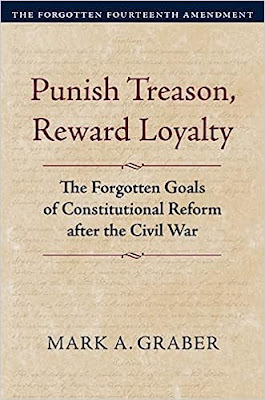
Mark A. Graber, Punish Treason, Reward Loyalty: The Forgotten Goals of Constitutional Reform after the Civil War (University of Kansas Press, 2023)
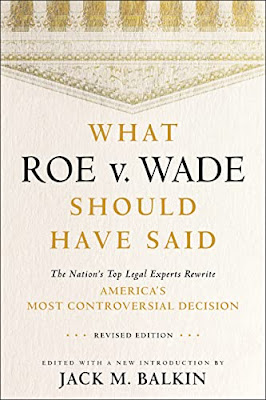
Jack M. Balkin, What Roe v. Wade Should Have Said: The Nation's Top Legal Experts Rewrite America's Most Controversial Decision - Revised Edition (NYU Press, 2023)

Andrew Koppelman, Burning Down the House: How Libertarian Philosophy Was Corrupted by Delusion and Greed (St. Martin’s Press, 2022)

Gerard N. Magliocca, Washington's Heir: The Life of Justice Bushrod Washington (Oxford University Press, 2022)
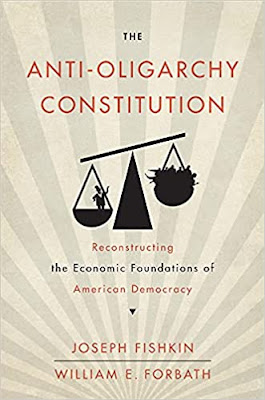
Joseph Fishkin and William E. Forbath, The Anti-Oligarchy Constitution: Reconstructing the Economic Foundations of American Democracy (Harvard University Press, 2022)
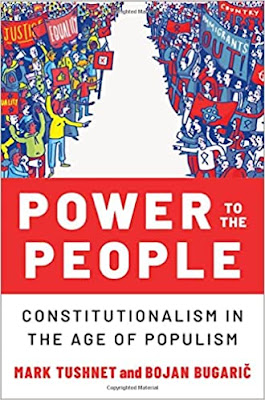
Mark Tushnet and Bojan Bugaric, Power to the People: Constitutionalism in the Age of Populism (Oxford University Press 2021).

Mark Philip Bradley and Mary L. Dudziak, eds., Making the Forever War: Marilyn B. Young on the Culture and Politics of American Militarism Culture and Politics in the Cold War and Beyond (University of Massachusetts Press, 2021).

Jack M. Balkin, What Obergefell v. Hodges Should Have Said: The Nation's Top Legal Experts Rewrite America's Same-Sex Marriage Decision (Yale University Press, 2020)

Frank Pasquale, New Laws of Robotics: Defending Human Expertise in the Age of AI (Belknap Press, 2020)

Jack M. Balkin, The Cycles of Constitutional Time (Oxford University Press, 2020)

Mark Tushnet, Taking Back the Constitution: Activist Judges and the Next Age of American Law (Yale University Press 2020).

Andrew Koppelman, Gay Rights vs. Religious Liberty?: The Unnecessary Conflict (Oxford University Press, 2020)

Ezekiel J Emanuel and Abbe R. Gluck, The Trillion Dollar Revolution: How the Affordable Care Act Transformed Politics, Law, and Health Care in America (PublicAffairs, 2020)

Linda C. McClain, Who's the Bigot?: Learning from Conflicts over Marriage and Civil Rights Law (Oxford University Press, 2020)
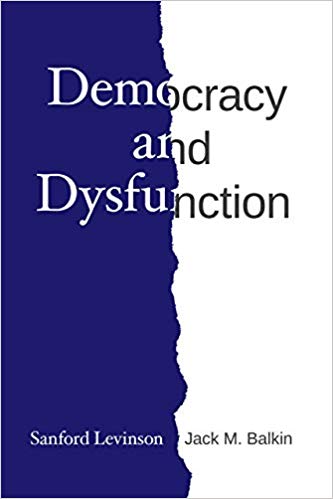
Sanford Levinson and Jack M. Balkin, Democracy and Dysfunction (University of Chicago Press, 2019)

Sanford Levinson, Written in Stone: Public Monuments in Changing Societies (Duke University Press 2018)

Mark A. Graber, Sanford Levinson, and Mark Tushnet, eds., Constitutional Democracy in Crisis? (Oxford University Press 2018)

Gerard Magliocca, The Heart of the Constitution: How the Bill of Rights became the Bill of Rights (Oxford University Press, 2018)

Cynthia Levinson and Sanford Levinson, Fault Lines in the Constitution: The Framers, Their Fights, and the Flaws that Affect Us Today (Peachtree Publishers, 2017)

Brian Z. Tamanaha, A Realistic Theory of Law (Cambridge University Press 2017)

Sanford Levinson, Nullification and Secession in Modern Constitutional Thought (University Press of Kansas 2016)

Sanford Levinson, An Argument Open to All: Reading The Federalist in the 21st Century (Yale University Press 2015)

Stephen M. Griffin, Broken Trust: Dysfunctional Government and Constitutional Reform (University Press of Kansas, 2015)

Frank Pasquale, The Black Box Society: The Secret Algorithms That Control Money and Information (Harvard University Press, 2015)

Bruce Ackerman, We the People, Volume 3: The Civil Rights Revolution (Harvard University Press, 2014)
Balkinization Symposium on We the People, Volume 3: The Civil Rights Revolution

Joseph Fishkin, Bottlenecks: A New Theory of Equal Opportunity (Oxford University Press, 2014)

Mark A. Graber, A New Introduction to American Constitutionalism (Oxford University Press, 2013)

John Mikhail, Elements of Moral Cognition: Rawls' Linguistic Analogy and the Cognitive Science of Moral and Legal Judgment (Cambridge University Press, 2013)

Gerard N. Magliocca, American Founding Son: John Bingham and the Invention of the Fourteenth Amendment (New York University Press, 2013)

Stephen M. Griffin, Long Wars and the Constitution (Harvard University Press, 2013)

Andrew Koppelman, The Tough Luck Constitution and the Assault on Health Care Reform (Oxford University Press, 2013)

James E. Fleming and Linda C. McClain, Ordered Liberty: Rights, Responsibilities, and Virtues (Harvard University Press, 2013)
Balkinization Symposium on Ordered Liberty: Rights, Responsibilities, and Virtues

Andrew Koppelman, Defending American Religious Neutrality (Harvard University Press, 2013)

Brian Z. Tamanaha, Failing Law Schools (University of Chicago Press, 2012)

Sanford Levinson, Framed: America's 51 Constitutions and the Crisis of Governance (Oxford University Press, 2012)

Linda C. McClain and Joanna L. Grossman, Gender Equality: Dimensions of Women's Equal Citizenship (Cambridge University Press, 2012)

Mary Dudziak, War Time: An Idea, Its History, Its Consequences (Oxford University Press, 2012)

Jack M. Balkin, Living Originalism (Harvard University Press, 2011)

Jason Mazzone, Copyfraud and Other Abuses of Intellectual Property Law (Stanford University Press, 2011)

Richard W. Garnett and Andrew Koppelman, First Amendment Stories, (Foundation Press 2011)

Jack M. Balkin, Constitutional Redemption: Political Faith in an Unjust World (Harvard University Press, 2011)

Gerard Magliocca, The Tragedy of William Jennings Bryan: Constitutional Law and the Politics of Backlash (Yale University Press, 2011)

Bernard Harcourt, The Illusion of Free Markets: Punishment and the Myth of Natural Order (Harvard University Press, 2010)

Bruce Ackerman, The Decline and Fall of the American Republic (Harvard University Press, 2010)
Balkinization Symposium on The Decline and Fall of the American Republic

Ian Ayres. Carrots and Sticks: Unlock the Power of Incentives to Get Things Done (Bantam Books, 2010)

Mark Tushnet, Why the Constitution Matters (Yale University Press 2010)

Ian Ayres and Barry Nalebuff: Lifecycle Investing: A New, Safe, and Audacious Way to Improve the Performance of Your Retirement Portfolio (Basic Books, 2010)
.jpg)
Jack M. Balkin, The Laws of Change: I Ching and the Philosophy of Life (2d Edition, Sybil Creek Press 2009)

Brian Z. Tamanaha, Beyond the Formalist-Realist Divide: The Role of Politics in Judging (Princeton University Press 2009)
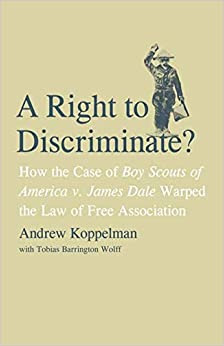
Andrew Koppelman and Tobias Barrington Wolff, A Right to Discriminate?: How the Case of Boy Scouts of America v. James Dale Warped the Law of Free Association (Yale University Press 2009)

Jack M. Balkin and Reva B. Siegel, The Constitution in 2020 (Oxford University Press 2009)

Heather K. Gerken, The Democracy Index: Why Our Election System Is Failing and How to Fix It (Princeton University Press 2009)

Mary Dudziak, Exporting American Dreams: Thurgood Marshall's African Journey (Oxford University Press 2008)

David Luban, Legal Ethics and Human Dignity (Cambridge Univ. Press 2007)

Ian Ayres, Super Crunchers: Why Thinking-By-Numbers is the New Way to be Smart (Bantam 2007)

Jack M. Balkin, James Grimmelmann, Eddan Katz, Nimrod Kozlovski, Shlomit Wagman and Tal Zarsky, eds., Cybercrime: Digital Cops in a Networked Environment (N.Y.U. Press 2007)
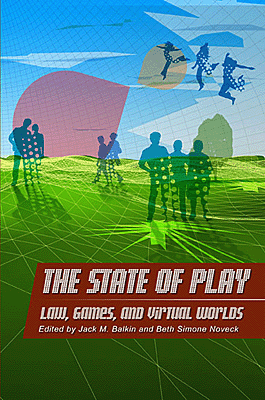
Jack M. Balkin and Beth Simone Noveck, The State of Play: Law, Games, and Virtual Worlds (N.Y.U. Press 2006)

Andrew Koppelman, Same Sex, Different States: When Same-Sex Marriages Cross State Lines (Yale University Press 2006)

Brian Tamanaha, Law as a Means to an End (Cambridge University Press 2006)

Sanford Levinson, Our Undemocratic Constitution (Oxford University Press 2006)

Mark Graber, Dred Scott and the Problem of Constitutional Evil (Cambridge University Press 2006)

Jack M. Balkin, ed., What Roe v. Wade Should Have Said (N.Y.U. Press 2005)

Sanford Levinson, ed., Torture: A Collection (Oxford University Press 2004)
Balkin.com homepage
Bibliography
Conlaw.net
Cultural Software
Writings
Opeds
The Information Society Project
BrownvBoard.com
Useful Links
Syllabi and Exams
