Balkinization
an unanticipated consequence of
Jack M. Balkin
Balkinization Symposiums: A Continuing List
E-mail:
Jack Balkin:
jackbalkin at yahoo.com
Bruce Ackerman
bruce.ackerman at yale.edu
Ian Ayres
ian.ayres at yale.edu
Corey Brettschneider
corey_brettschneider at brown.edu
Mary Dudziak
mary.l.dudziak at emory.edu
Joey Fishkin
joey.fishkin at gmail.com
Heather Gerken heather.gerken at yale.edu
Abbe Gluck abbe.gluck at yale.edu
Mark Graber
mgraber at law.umaryland.edu
Stephen Griffin
sgriffin at tulane.edu
Jonathan Hafetz
jonathan.hafetz at shu.edu
Jeremy Kessler
jkessler at law.columbia.edu
Andrew Koppelman
akoppelman at law.northwestern.edu
Marty Lederman
msl46 at law.georgetown.edu
Sanford Levinson
slevinson at law.utexas.edu
David Luban
david.luban at gmail.com
Gerard Magliocca
gmaglioc at iupui.edu
Jason Mazzone
mazzonej at illinois.edu
Linda McClain
lmcclain at bu.edu
John Mikhail
mikhail at law.georgetown.edu
Frank Pasquale
pasquale.frank at gmail.com
Nate Persily
npersily at gmail.com
Michael Stokes Paulsen
michaelstokespaulsen at gmail.com
Deborah Pearlstein
dpearlst at yu.edu
Rick Pildes
rick.pildes at nyu.edu
David Pozen
dpozen at law.columbia.edu
Richard Primus
raprimus at umich.edu
K. Sabeel Rahmansabeel.rahman at brooklaw.edu
Alice Ristroph
alice.ristroph at shu.edu
Neil Siegel
siegel at law.duke.edu
David Super
david.super at law.georgetown.edu
Brian Tamanaha
btamanaha at wulaw.wustl.edu
Nelson Tebbe
nelson.tebbe at brooklaw.edu
Mark Tushnet
mtushnet at law.harvard.edu
Adam Winkler
winkler at ucla.edu
Compendium of posts on Hobby Lobby and related cases
The Anti-Torture Memos: Balkinization Posts on Torture, Interrogation, Detention, War Powers, and OLC
The Anti-Torture Memos (arranged by topic)
Recent Posts
Citation Counts to Balkinization in Law Reviews (and what this says about changes in legal scholarship)
The Low Bar: He Was No Alberto Gonzales
Shorter Michael Mukaskey
Mukasey: "I can't contemplate any situation . . . "
Disdain
How Can the Legality of Waterboarding Depend on the Circumstances?
Obama’s Beef
Torture: "Reasonable People" Can Disagree
The Theory of a Preclusive Commander-in-Chief Power is Alive and Well
New Legislation Concerning Military Contractors Draws Presidential Signing Statement
When is it Permissible for the President to Ignore Legislative Intent?
The Poaching of Law Professors--Another Old Story
Do Avatars Dream of Civil Rights?
Bush's Legacy-- And Reagan's
Will We Know the Identity of the Democratic Nominee on the Morning of February 6th?
"Reforming our government"
This is Not a Blog (re: NYRB)
Michael Mukasey, Robert Jackson and George Orwell
Why Can't the Attorney General Simply Concede that Waterboarding is Torture?
Andrew Carnegie on "Death Taxes" and Other Matters
I'm Rich!
The Next Reconstructive Presidency
What's Wrong With This Picture of Legal Academia?
Remember the U.S. Attorney Scandal?
Mitt meditates on Martin Luther King
What Does Today's Holiday Have to Do With Commercial Paper?
What Some Constitutional Law Students are Thinking
Thurgood Marshall and Martin Luther King, Jr.
![[Powered by Blogger]](https://lh3.googleusercontent.com/blogger_img_proxy/AEn0k_vY6z7PUGu2E547MUBcxhPz6dmtvT0q5h4F8QixMu46Z83LCJs6kiAMK7xxY5qr8U7MPjoW-_ih33NjhIR1Bf6llXf56jwFUJFxIA615BZN=s0-d)
Just A Few Blogs
ACS Blog
Alas, a Blog
Althouse
Arts and Letters Daily
Atrios (Eschaton)
Bill of Health
Buzzflash.com
Buzz Machine
Cato at Liberty
Juan Cole (Informed Comment)
Concurring Opinions
The Constitution in 2020
Corrente
Crooked Timber
Daily Howler
Daily Kos
Dana Boyd
Brad DeLong
Digby (Hullabaloo)
Discriminations
Daniel Drezner
Kevin Drum (Mother Jones)
Electrolite
En Banc
Eunomia (Daniel Larison)
Fafblog
Michael Froomkin (Discourse.net)
GovLab (Beth Noveck)
Rick Hasen (Election Law)
History News Network
How Appealing
Ignatz (Sam Heldman)
The Importance of (Ernie Miller)
Infolaw
Instapundit
International Economic Law and Policy Blog
IntLawGrrls
Jacob Levy
Jesus' General
Jurisdynamics
The Kitchen Cabinet
Mark Kleiman
Law Blog Central
Larry Lessig
Lawyers, Guns and Money
Liberal Oasis
Brian Leiter's Law School Reports
The Leiter Reports
Marginal Revolution
Megan McArdle
Memeorandum
Metafilter
Mirror of Justice
The New Republic
Newseum
No More Mister Nice Blog
Brendan Nyhan
Opinio Juris
Orcinus
The Originalism Blog
Pandagon
Passport (Foreign Policy)
Overcoming Bias
Political Animal (Washington Monthly)
Political Theory Daily Review
Political Wire (Taegan Goddard)
The Poor Man
Virginia Postrel
Prawfsblawg
Public Reason
Jonathan Rauch
Raw Story
Redstate
ReligiousLeftLaw.com
Reporters Committee For Freedom of the Press
Reproductive Rights Blog
Rothman's Roadmap to the Right of Publicity
SCOTUS Blog
Seeing the Forest
Clay Shirky
The Shifted Librarian
The Situationist
Larry Solum (Legal Theory)
Andrew Sullivan
Talking Points Memo
Talk Left
Tapped
Tbogg
TechPresident
The Paper Chase (Jurist)
Tom Paine
Tom Tomorrow (This Modern World)
Eve Tushnet
Uggabugga
University of Chicago Law School Faculty Blog
Unqualified Offerings
The Volokh Conspiracy
War and Piece (Laura Rozen)
Wampum
Oliver Willis
Wonkette
Written Description
Matthew Yglesias
Yin
Your Choice of Feeds
1. XML
powered by

2. Atom Feed
3. RSS 2.0
Citation Counts to Balkinization in Law Reviews (and what this says about changes in legal scholarship)
JB
Orin Kerr found that law review citations to our friends at the Volokh Conspiracy have been increasing significantly over the years. Using the same methodology (citations to balkin.blogspot.com in Westlaw JLR database limited to each year) I discovered the same thing is true of Balkinization.
In 2003 we received 1 cite; in 2004 3 cites; in 2005 14 cites; in 2006 36 cites; and in 2007 49 cites. As Orin reminds us, some law journals have not yet published all their 2007 issues, so the final number for 2007 may be slightly higher.
These results suggest that blogging has become a more widespread and accepted practice in the legal academy. It's important to remember that people cite for many different reasons: to give credit for ideas, to criticize ideas, and as (persuasive) authority. My guess is that most of these citations fall into the first two categories, but that is true to many citations for law review articles as well.
I'm hoping that some enterprising scholar will do a study of citation practices to a selection of 20 or so well known legal blogs to see if the citation patterns for these two blogs reflect a general trend. (Perhaps it's already been done-- please let me know in the comments.)
If so, it suggests that something very interesting is happening in legal scholarship. The legal academy is gradually becoming acclimated to blogs as vehicles of scholarship and scholarly quality. But perhaps even more important: Blogs are not displacing standard form legal scholarship; rather they are being assimilated into the larger universe of legal writing and becoming part of the web of citations and authorities along with cases, treatises, law review articles, and casebooks.
This difference between displacement and assimilation is quite important for a number of reasons. When people cite to blogs, they are simultaneously inserting blog posts into a pre-existing economy of accreditation and salience. Put more simply, they are using the tools law professors already use to decide what's relevant and important to legal scholarship in order to decide which blog posts are relevant and important. Blogging has its own methods of accreditation and salience: linking practices are the most obvious example. But my point is that the old forms of accreditation and salience are not simply being shoved aside: rather they are also reaching out to include some parts (but, importantly, not other parts) of the blogosphere. We can see traditional legal scholarship thus evaluating and coopting new media, just as we can see new media entering into and challenging existing forms of legal scholarship.
In hindsight, of course, all of this makes perfect sense. People and institutions are already deeply invested in existing forms of publication and accreditation. Careers and reputations have been built and maintained based on the old tools and the old forms. Therefore there will be no dramatic revolution in the ways that law professors write and how they judge and accredit quality. Rather, what we will see is the use of old tools for new purposes extended to new forms of writing, and the gradual assimilation and coopation of new forms and tools to older purposes. A revolution in legal writing and legal scholarship is coming, driven by changes in technology, but it will be far more gradual than some people expected (or feared), and it will look quite different than people initially imagined.
Posted
2:40 PM
by JB [link]
(54) comments
The Low Bar: He Was No Alberto Gonzales
Marty Lederman
That's the best thing the New York Times has to say about Judge Mukasey's "see-no-evil" performance. For other reactions, see Scott Horton, Glenn Greenwald, and former DOJ official Shannen Coffin, who concedes that he "had serious reservations while I served in the administration . . . about appointing a former federal judge so unknown to many of us." After all, you know those federal judges: they've been known at times to think independently and not rubber-stamp everything an executive chooses to do. And heaven knows we don't want that in an Attorney General. What a relief, then, for Coffin, et al., to see Judge Mukasey toe the party line so faithfully: "It is pleasing to be proved so terribly wrong."
Posted
8:40 AM
by Marty Lederman [link]
(9) comments
Shorter Michael Mukaskey
JB
You're crazy if you think I'm going to admit that any of the interrogation practices previously performed by the Administration that just hired me are illegal. Saying that would suggest that people in the Administration violated the law and are subject to criminal prosecution, and that previous OLC opinions have condoned war crimes. The only thing I will tell you is that I sure hope we don't continue one of these practices in the future (lucky for me you haven't pressed me about the others!). But don't ask me to say that the President can't do any of them later on if he wants to. I mean, come on, guys, I just got here, you know? I just put new drapes in my office. I really don't want to have to get fired only three months after I started.
Oh, and by the way, the President, my boss, never violates the law. Got that?
Posted
7:11 AM
by JB [link]
(7) comments
Mukasey: "I can't contemplate any situation . . . "
Marty Lederman
In response to questions from Senator Specter concerning when, if at all, the President may rely on his Article II authorities to decline to abide by statutes or treaties, the Attorney General testified this morning that "I can't contemplate any situation in which this President would assert Article II authority to do something that the law forbids."
Oops. Perhaps the Attorney General didn't get the memo. Just two days earlier, the President issued a signing statement asserting the authority to "construe" (i.e., to ignore) certain provisions of the National Defense Authorization Act for Fiscal Year 2008 so as not to "inhibit" exercise of his Article II authorities. (See the detailed discussion here.) Judge Mukasey's Office of Legal Counsel and Office of Legislative Affairs undoubtedly cleared that signing statement (or even helped to draft it). Alas, there must have been bugs in the internal DOJ distribution system . . . .
Posted
8:36 PM
by Marty Lederman [link]
(16) comments
Disdain
Marty Lederman
Senator Feingold just asked Mukasey when he would share with the Committee -- even in closed session -- the legal explanations of why the CIA techniques are not unlawful. Mukasey's response: He won't, because it's classified. That is to say: The scope and application of this federal law is so secret that not even the legislators who enacted it can be permitted to understand it. Short version: Congress can take a hike.
Posted
12:40 PM
by Marty Lederman [link]
(26) comments
How Can the Legality of Waterboarding Depend on the Circumstances?
Marty Lederman
Senator Biden just asked the Attorney General how it could be that the legality of waterboarding depends on the "circumstances," as Mukasey wrote in his letter. Mukasey's response was revealing: He pointed to the "shocks the conscience" test under the Due Process Clause and the McCain Amendment, under which, Mukasey argued, the "cruelty" of the technique must be weighed against the potential benefits. (For more on the "shocks conscience" test, see David L.'s post here, and part 2 of this post of mine.)
Senator Biden did not understand how such sliding-scale variables could affect whether the technique is torture or not. Mukasey began to respond that he was not talking about the torture statute. He plainly thought the only relevant question was the "shocks the conscience" test. But that more fact-specific test is only relevant if one has already concluded that the broader, and more unequivocal prohibition of the Torture Act is inapposite.
What this reveals is that DOJ and Mukasey have concluded that waterboarding is categorically not torture, and is not "cruel treatment" under Common Article 3 (even though it is, by Mukasey's own lights, "cruel" -- go figure). Therefore the only question, in their view, is whether it shocks the conscience under the Due Process Clause. A careful parsing of Mukasey's letter confirms this: Mukasey did not write that whether waterboarding is torture depends on the circumstances; instead, he wrote that there are circumstances where "current law" would (and would not) prohibit waterboarding.
Mukasey apparently has concluded that OLC was correct that waterboarding is not torture because it does not entail physical suffering of "extended duration or persistence" (an untenable theory I discuss here).
Posted
11:13 AM
by Marty Lederman [link]
(18) comments
Obama’s Beef
Guest Blogger
Jeffrey K. Tulis
Whether Senator Obama has a well worked out domestic policy agenda and a detailed understanding of foreign policy is a lingering concern of democrats who find his inspirational rhetoric short on specific analyses, proposals, and plans. This concern has provided occasion for Senator Clinton and others to revive Walter Mondale’s famous question to Gary Hart, taken from a then popular TV commercial for a hamburger, “where’s the beef?” Obama may be tempted respond to the question by offering detailed counter-proposals to Senator Clinton’s plans for health care, immigration, the economy, campaign finance and any other issue she chooses to highlight. This would be a mistake both as tactical choice in the primaries, and in light of his impressive understanding of the place of the presidency in the constitutional order.
Instead, Senator Obama should emphasize the finer cut of beef that is already implicit in his own vision for a new kind of politics and a new kind of presidential leadership.
Just beneath the surface of Obama’s call for a new kind of leadership that transcends previous partisan divisions and old habits of political contestation is a new constitutional theory – or, perhaps more accurately, a better understanding of our Constitution whose meaning has been lost over time and whose principal political institutions have begun to decay. In Obama’s vision, presidential success is not measured by how many detailed policy proposals he can ram through Congress. Rather, his vision sets a new standard, that presidential success will be measured by an improved functioning of the government as a whole. In this vision, the details of policy are not as important as the principles that guide policy. In this vision, it is less important to secure ones preferred version of a bill than it is to mobilize Congress to solve the problem for which the legislation was designed.
In contrast, all recent presidents, and especially Senator Clinton, understand the President as the chief legislator, as the person and the place where legislation is made. She seems incensed that anyone not as technically skilled as she in legislative craftsmanship would think they are as qualified for election to the presidency. Obama understands that although the president needs to be very knowledgeable about public policy, to demonstrate that knowledge, and even, as president, to offer legislative proposals to the Congress – he has an instinctive sense that his job is to lead, not to legislate.
Obama knows instinctively that Senator Clinton did not learn the major lesson from the failure of her health care plan at the beginning of her husband’s term. For Obama, the lesson is that one does not take over the role of Congress, in secret meetings of unelected friends and colleagues and then insist that the presidential product be given a mere seal of approval by the Congress of the United States. He knows that presidential leadership is much more than a matter of bargaining from a strong position but includes, as well, facilitating the work of others. Obama knows that his job will be to initiate and nurture a legislative process. He will offer a plan, to be sure. He will use his plan to illustrate the principles he wishes to guide legislative craftsmanship: that all Americans have access to health insurance and that it be affordable. He will make speeches and he will call, meet, and cajole members of Congress. But he will not substitute “administration” for “deliberation.” If as Congress deliberates it becomes clear that Senator Clinton’s plan accomplishes his principled objectives better than his own plan, he will embrace it, praise it, and praise her. Obama seems to understand that this sort of scenario would represent success not only because the nation’s health care system would be improved, but also because it would signify that the government, not just the presidency but the government as a whole, was not broken anymore. He would show the world that some meaningful vision of democracy was still workable.
Senator Clinton seems to have drawn a very different lesson from her previous failure. She thinks she failed because her defeated plan was not enough (as policy and as political savvy), and she has deployed her considerable “policy wonk” talents in designing a new one and criticizing the alternatives. Having done all that work over the last twelve years, she is in position to take better advantage of the presidential “honeymoon” period to ram her improved plan through Congress. She doesn’t seem to understand that her “success” would come at the expense of the polity as a whole, deepening the pathology of an administrative “republic” that no longer appreciates the beauty and benefit of legislative deliberation. It is ironic that Senator Clinton’s extraordinary talent as a legislator could further undermine the status of Congress in our republic as she imports that view of the world into the White House and misunderstands the true meaning of presidential leadership in the American constitutional order.
Senator Obama has the beef, Senator Clinton the hamburger.
Posted
9:01 AM
by Guest Blogger [link]
(11) comments
Torture: "Reasonable People" Can Disagree
Marty Lederman
Not surprisingly, Attorney General Mukasey has proven George Orwell right: He refuses to say that waterboarding is unlawful -- sometimes it is; and sometimes . . . perhaps not. It all depends on the facts and circumstances. In a letter he issued last night, Mukasey wrote: "If this were an easy question, I would not be reluctant to offer my views on this subject. But, with respect, I believe it is not an easy question. There are some circumstances where current law would appear clearly to prohibit the use of waterboarding. Other circumstances would present a far closer question." But of course the Attorney General refuses to specify under just what circumstances waterboarding might not be designed to result in severe physical suffering (in which case it is criminal torture), or under what conditions it would not be "cruel treatment" (in which case it is a breach of Common Article 3 of the Geneva Conventions).
Oh, and by the way -- those other "enhanced interrogation techniques" in the CIA program, the ones that (unlike waterboarding) continue to be authorized -- such as hypothermia, stress positions, threats, sleep and sensory deprivation, etc.? Well, they're all perfectly ok, according to Mukasey. But he won't explain why, or even say what they are. And, in a sentence that will come as sweet music to defendants who are hereafter accused of violating the torture statute, the War Crimes Act, the UCMJ, etc. -- and that will undoubtedly make prosecutors in the Criminal Division at DOJ cringe -- the Attorney General writes that "reasonable people can disagree, and have disagreed, about these matters." Of course, he also refuses to identify any of these so-called "reasonable" people who "can disagree" about something so basic, obvious, and previously uncontroverted.
The Senators at today's hearing will undoubtedly raise a fuss about these circumlocutions. But they will not get anywhere if they focus on waterboarding, as such -- a technique that apparently is being held in abeyance, until it isn't -- without addressing the underlying problems: They should insist that the Administration publicly defend the legality of those techniques that are approved for CIA use; make public the OLC opinions underlying the program; and repudiate the critical (and indefensible) OLC conclusion that physical suffering can be "severe," and thus torture, only if the suffering is "of some extended duration or persistence as well as intensity." They should ask the Attorney General straight up: "Under what circumstances, exactly, would waterboarding, or stress positions, or hypothermia, etc., not result in severe physical pain or suffering?"
Of course, the Attorney General will do none of those things, and will not answer such questions, because DOJ continues to insist that the law itself must remain secret, opaque: It would, Mukasey insists, "tip off adversaries" to define "the limits and contours of generally worded laws" that circumscribe U.S. interrogation policies. Unless and until the Senators firmly reject this dangerous and radical notion that the "limits and contours" of our criminal laws and treaty obligations must remain secret, or until a new Executive disclaims such a theory of "secret law," we will remain hopelessly stalemated on the torture issue. (For previous discussion of why Congress should reject the Administration's insistence that these legal questions remain secret, see here and here. ). It is not enough for Senators to disagree with the Attorney General on the question of waterboarding -- if they do not insist on a public accounting of what our law does and does not prohibit, their objections will be futile.
Posted
8:11 AM
by Marty Lederman [link]
(16) comments
The Theory of a Preclusive Commander-in-Chief Power is Alive and Well
Marty Lederman
As Laura notes below, in his most recent signing statement the President has reserved the authority to disregard several "provisions" of the National Defense Authorization Act for Fiscal Year 2008. The President does not enumerate exactly which "provisions" those might be, except to single out sections 841, 846, 1079, and 1222 as those that "purport to impose requirements that could inhibit the President's ability to carry out his constitutional obligations to take care that the laws be faithfully executed, to protect national security, to supervise the executive branch, and to execute his authority as Commander in Chief." According to Bush, "the executive branch shall construe such provisions in a manner consistent with the constitutional authority of the President."
Section 841 establishes the "Commission on Wartime Contracting," which is given the duty to assess "the extent of the reliance of the Federal Government on contractors to perform functions (including security functions) in Iraq and Afghanistan and the impact of this reliance on the achievement of the objectives of the United States"; the contractors' performance; the extent of waste, fraud, and abuse under such contracts; and the appropriateness of the organizational structure, policies, practices, and resources of the Department of Defense and the Department of State for handling such contracting out.
That sounds pretty unconstitutional, doesn't it?
(Perhaps what the President objects to -- although he does not say -- is that the statute authorizes the Commission to "secure directly from the Department of Defense and any other department or agency of the Federal Government any information or assistance that the Commission considers necessary to enable the Commission to carry out [its duties].")
Section 846 clarifies some whistleblowing protections for employees of such contractors, and Inspector General investigations of reprisals against such employees.
Section 1079 provides that if the Chair or ranking minority member of an on Armed Services Committee makes a written request for any existing intelligence
assessment, report, estimate, or legal opinion relating to matters within the jurisdiction of such Committee, the recipient of that request, such as the head of any element of the intelligence community, has 45 days to provide such information, "unless the President determines that such document or information shall not be provided because the President is asserting a privilege pursuant to the Constitution of the United States." (What's wrong with that?)
Finally, and perhaps most importantly, section 1222 provides that "no funds appropriated pursuant to an authorization of appropriations in this Act may be obligated or expended . . . to establish any military installation or base for the purpose of providing for the permanent stationing of United States Armed Forces in Iraq" or "to exercise United States control of the oil resources of Iraq."
What do these objections mean, as a practical matter? The Administration will not say, reports the indefatigable Charlie Savage:Phillip Cooper, a political science professor at Portland State University, noted that Bush's statement does not clearly spell out the basis for any of his challenges. Cooper, who has been a pioneer in studying signing statements, said the vague language itself is a problem. "It is very hard for Congress or the American people to figure out what is supposed to happen and what the implications of this are," Cooper said. The White House did not respond to a Globe request to explain the objections in greater detail.
As my coauthor David Barron notes, however, the signing statement makes one thing clear: "What this shows is that they're continuing to assert the same extremely aggressive conception of the president's unilateral power to determine how and when U.S. force will be used abroad, and that's a dramatic departure from the American constitutional tradition." David and I have written much more about this subject, and that tradition, here.
Posted
7:46 AM
by Marty Lederman [link]
(6) comments
New Legislation Concerning Military Contractors Draws Presidential Signing Statement
Laura Dickinson
The President just signed the Defense Authorization Act, which has two provisions that are relevant to contractor accountability. The first, section 841, added through an amendment sponsored by Senators Webb and McCaskill, would establish an independent commission to study the waste, fraud, and abuse in wartime contracting. The second, section 846, would improve whistleblower protection for contractor employees who report abuses by contractors.
The only wrinkle, however, is that the President issued one of his infamous signing statements, singling out these and two other provisions that the White House says "purport to impose requirements that could inhibit the President’s ability to carry out his constitutional obligations to take care that the laws be faithfully executed, to protect national security, to supervise the executive branch, and to execute his authority as Commander in Chief." According to the statement, "[t]he executive branch shall construe such provisions in a manner consistent with the constitutional authority of the President."
Senator Webb has said that he’ll nonetheless move forward quickly to establish the commission.
Posted
12:09 AM
by Laura Dickinson [link]
(1) comments
When is it Permissible for the President to Ignore Legislative Intent?
Marty Lederman
A: When that intent is reflected only in a committee report, and not in statutory language.
In his State of the Union address last year, President Bush said this:[O]ver 90 percent of earmarks never make it to the floor of the House and Senate-they are dropped into committee reports that are not even part of the bill that arrives on my desk. You [Congress] didn't vote them into law. I didn't sign them into law. Yet, they're treated as if they have the force of law.
Notice the passive voice. Bush was complaining that earmarked spending "obligations" appearing only in committee reports, and not in enacted laws, "are treated as if they have the force of law." By whom are they so treated? By the President and the Executive branch agencies, which have historically acted in compliance with such "committee report earmarks." In other words, Bush had little to complain about then: He should have looked in the mirror. Like just about all Presidents before him, President Bush generally abided by report earmarks, even though he was under no legal obligation to do so. Why did he do it? Because it's long been part of the ordinary legislative/executive process of mutual accommodation, and he did not wish to unnecessarily make waves.
Well, this year President Bush has called Congress's bluff -- at least for the time being. In an Executive Order he issued today, Bush instructed federal agencies that, with respect to "all appropriations laws and other legislation enacted after the date of this order," the head of each agency must take "all necessary steps" to ensure that: (i) agency decisions to commit, obligate, or expend funds for any earmark are based on the text of laws, and in particular, are not based on language in any report of a committee of Congress, joint explanatory statement of a committee of conference of the Congress, statement of managers concerning a bill in the Congress, or any other non-statutory statement or indication of views of the Congress, or a House, committee, Member, officer, or staff thereof;
This does not mean that an agency must wholly ignore the wishes of congressional committees or members: It can take those wishes into account, but apparently only for their persuasive value on the "merits" of the funding, rather than because of the identity of the person or committee articulating the earmark. The agency's funding decisions must be based on "statutory criteria" (which can themselves include a very wide range of funding discretion), and "merit-based decision making."
(ii) agency decisions to commit, obligate, or expend funds for any earmark are based on authorized, transparent, statutory criteria and merit-based decision making, in the manner set forth in section II of OMB Memorandum M-07-10, dated February 15, 2007, to the extent consistent with applicable law; and
(iii) no oral or written communications concerning earmarks shall supersede statutory criteria, competitive awards, or merit-based decisionmaking.
This is a fairly bold move, but it is not unconstitutional for the Executive branch to ignore report-language earmarks that are not statutorily prescribed: "[A] fundamental principle of appropriations law is that where 'Congress merely appropriates lump sum amounts without statutorily restricting what can be done with those funds, a clear inference arises that it does not intend to impose legally binding restrictions, and indicia in committee reports and other legislative history as to how the funds should or are expected to be spent do not establish any legal requirements on' the agency." Lincoln v. Vigil, 508 U.S. at 192.
Of course, just because something is constitutional does not make it wise, or consistent with the extra-constitutional accommodations that are the daily lifeblood of relations between Congress and the Executive: "[A]n agency's decision to ignore congressional expectations may expose it to grave political consequences." Id. at 193. According to the New York Times, "congressional leaders of both parties . . . said Mr. Bush would provoke a huge outcry on Capitol Hill if he ignored [such] earmarks. Lawmakers, including the House Republican whip, Roy Blunt of Missouri, have cautioned the White House that a furor over earmarks could upend Mr. Bush’s hopes for cooperation with Congress on other issues, including efforts to revive the economy." President Bush has shrewdly acted in the final year of his second term, however, so that those grave consequences will primarily fall on his successors, not on him.
What can Congress do about this, other than to make life hard on Executive branch agencies by withdrawing its own cooperation on various matters? Well, it can place the earmarks in the statutory language itself. Or, more modestly, it might simply incorporate the committee-report language by reference in the terms of the bill, instructing an agency to, for example, "provide funding to those projects specified in [name of committee report]." If Congress were to so act, the Executive branch would be obligated to make such expenditures, which would render the new Executive Order something of a formality.
Posted
11:20 PM
by Marty Lederman [link]
(11) comments
The Poaching of Law Professors--Another Old Story
Brian Tamanaha
Legal academia in the early twentieth century was much like legal academia today in a surprising respect, noted by Harvard Law Professor Thomas Reed Powell: "The law schools get teachers by...robbing each other's hen-roosts." He continued:Once upon a time I heard of a school that did not pilfer from its neighbors not because it was too good to steal, but because it was too good to covet its neighbor's goods. This goodness was too good to maintain itself, and covetousness is now ubiquitous. The peripatetic pedagogue is considerably more common among juristic persons than among the lesser breeds without the law. Some have made what might be called a Cook's tour of the law schools. Robbing each other's hen-roosts is facilitated by the graduation in the salary scale from school to school and by these annual opportunities for getting acquainted. We can know a man by his larynx without waiting for the fruits from his fingers. Whatever the reason, most of our law schools now feed frequently on each other.
Such cannibalism is not of great importance to legal education as a whole. If it really worked out so that the choice viands were concentrated in a few larders, it would be a distinct detriment to legal education as a whole. No such menace appears to me imminent, notwithstanding what some take to be assumptions to the contrary. I hear of not a few larcenies that have inspired in the thieves a desire to make specific restitution. I hear of frequent attempted larcenies that have been frustrated notwithstanding the allurement of higher salaries. This competition of school with school may be bad for university budgets, but this has its brighter side....
On the whole it seems to me a good thing for legal education that teachers are not tethered too tightly....The school that loses a man it longs to keep is apt to take steps to make its post more attractive to others. Our law schools have grown in merit as their sister schools have grown in merit. The secure and satisfied school is in danger of stagnation.
Powell had intimate knowledge about the subject, as he had recently moved to Harvard from Columbia. [this was an Address, "The Recruiting of Law Teachers," delivered at the 1927 AALS conference].
Until reading this essay, I was under the impression that the current poaching of law professors among the top law schools was a uniquely modern phenomenon driven by US News. But that's clearly wrong.
The question remains whether this is good for legal academia. According to this article, recruiting wars are one factor driving (or being driven by) the ubiquitous fund raising campaigns now being conducted by elite law schools (in the $100 million plus range). The writer remarks that "more money has sparked a talent war among elite schools, with renowned professors hopscotching from Columbia to New York University to Harvard to Yale and back again, sometimes with attractive relocation packages." Sounds like a veritable Cook's tour.
Posted
1:30 PM
by Brian Tamanaha [link]
(3) comments
Do Avatars Dream of Civil Rights?
JB
Today, at 3:00pm EST, I'll be appearing in Second Life for a panel discussion entitled "Do Avatars Dream of Civil Rights?," which is about the legal rights of end users and administrators in virtual worlds. The panel is organized by the USC Institute for Network Culture and Global Kids and sponsored by the MacArthur Foundation.
Posted
10:35 AM
by JB [link]
(5) comments
Bush's Legacy-- And Reagan's
JB
Over at the Washington Post, Lou and Carl Cannon try to offer a balanced assessment of George W. Bush's Presidency, comparing him to Ronald Reagan, whom they have studied in depth. They argue that at least domestically, Bush was "a worthy inheritor of the Reagan mantle," especially in the area of tax cuts and judicial appointments. They don't blame him for increased federal spending and earmarks; although this seems to be overly generous, since he did promote his Medicare program heavily. Moreover, he was the leader of his party at a time when that party controlled both Congress and the Presidency, and, moreover, he had the veto power. If Bush had really wanted to limit the growth of federal spending, he could have used at least some political capital to do so.
And then of course, there is the Administration's incompetent response to Hurricane Katrina, which aptly symbolized its lack of seriousness about domestic policy and, perhaps more to the point, its lack of seriousness about the competent implementation of domestic policy. Would Reagan have handled a crisis like Katrina better? It is hard to imagine that he could have done worse. Cannon and Cannon do not take this into account. (Nor do they take into account the Administration's deregulatory policies that helped produce the current subprime crisis, a crisis that may send the country into recession as Bush leaves office. Perhaps this is premature, as the recession is not yet here. But the Bush Administration's refusal to rein in financial institutions has already produced a problem at least as serious as the S&L crisis created by deregulatory policies in the Reagan Administration, a crisis which, you may recall, led to an enormous bailout during the Administration of George H.W. Bush.)
In the foreign policy area, however, Cannon and Cannon agree that Bush was decidedly inferior to and different from Reagan:[Iraq] was Bush's war. We doubt it would have been Reagan's. Despite the widespread support for the 2003 invasion among Reaganites in Congress, our research has convinced us that Reagan -- prone to lower-key measures such as arming the Nicaraguan contras, burned from sending the Marines to Lebanon in 1983 and generally inclined to see the United States as a shining exemplar rather than a mailed conqueror -- would not have undertaken Bush's nation-building war.
When Reagan ran in 1980, many people worried that he would be a bellicose mad bomber, eager to go to war with the Soviets. As it turned out, he was much more inclined to outspend the Soviets and support proxy wars in Latin America than to engage in direct military confrontation, and he ended his term with what can only be described as radical agreements for reducing nuclear arms. By contrast, Bush has turned out to what people feared Reagan was: cocky, a high stakes gambler, altogether too sure of himself, and eager to use American forces to solve problems without sufficient planning and forethought. Indeed, had it not been for the recent national intelligence estimate, Bush (and his increasingly unhinged Vice President Dick Cheney) might have opened a third front in the Middle east wars by attacking Iran.
The Cannons say nothing about torture, or the mess at Guantanamo Bay, or the Administration's view that it could hold even American citizens in military prisons without any right to judicial review or the protections of the Bill of Rights, but surely these are among the sorry legacies of Bush's foreign policy.
The Cannons warn that it is entirely premature to judge Bush, since the reputation of some Presidents, like Harry Truman, improve based on later events. That may well be true of Bush, especially if there are a series of terror attacks after he leaves office, if the Iraq war ultimately succeeds (or, conversely, if a precipitous withdrawal leads to catastrophe). If the next several Presidents are even more incompetent than Bush now appears, or if we have a series of one term political failures, both Bush and Bill Clinton (already well regarded by many) will rise in the public's estimation.
Nevertheless, I think that the Cannons are correct to focus on the central fact that Bush has helped destroy both Republican hegemony and the Reagan coalition:In 1980 and 1984, Reagan's coattails carried hundreds of Republicans into seats in state legislatures. In eight years of Reagan's rule, the percentage of Americans who identified themselves as Republicans grew from 33 percent to 42, while the proportion of self-identified Democrats fell below 50 percent for the first time since the era of Franklin D. Roosevelt. These trends let the Republicans capture both houses of Congress in 1994 and hold them until 2006. Much of Newt Gingrich's famed "Contract With America" was drawn from Reagan's ideas, recycled from his second-term State of the Union addresses.
That is all in peril now. "It took 30 years to build the Reagan coalition," Catholic University political scientist John Kenneth White wrote on the eve of the 2006 midterm elections. "It has taken George W. Bush just two years to destroy it."
. . . .
Bush's approval rating is now in Carter territory, less than 30 percent of Americans hold a positive view of the Republican Party, and Democratic presidential candidates have overtaken the Republicans in campaign money, votes and crowds. The Republicans' chances of taking Congress back from the Democrats are slim. So we can indeed reach a short-term political judgment of George W. Bush: He is a disaster -- if not the worst president of all time, then at least the worst since Carter, Hoover or any other recent failure. But who knows how the story will end?
As I have detailed in my previous posts here, here, and here, I believe that Bush is the last president in the current political order shaped by Reagan. Comparisons to Carter and Hoover are therefore entirely appropriate, because each of them also was the last president in a political order, created by Roosevelt and McKinley, respectively. The Presidents who followed them, Roosevelt and Reagan, reshaped American politics significantly. If I am right about this, then the next president is likely to do so as well. Successful presidents of this sort greatly diminish the reputations of the presidents who immediately precede them. That means that Bush may look even worse than he does today.
Under this analysis, moreover, Bush is nothing like Truman. Truman is far closer to his father, George H. W. Bush. Just as Truman consolidated Roosevelt's foreign policy, ending World War II and setting America on a grand strategy of containment of Soviet communism, so too George H.W. Bush successfully maneuvered the world through the final days of the Cold War, the dismantling of the Soviet Union, and the creation of a post-Cold War Europe with a united Germany. George H.W. Bush, I think, gets insufficient credit for his remarkable diplomatic acumen and foreign policy leadership during this crucial period, but, I think, someday he will be honored for it, just as Truman was later honored for his foreign policy achievements. George W. Bush is clearly not like Harry Truman in this respect; he did not help Reagan's foreign policy succeed. Rather, he started a new foreign policy adventure in Iraq and-- at least to this point-- has failed miserably at it. Despite the success of the surge in temporarily dampening down violence, we are no closer to a political solution, and if Bush has his way, we will be wasting enormous amounts of resources keeping the peace in Iraq indefinitely.
If George W. Bush is like Carter and Hoover, the judgment of history will likely improve only if Bush becomes a valued public servant or contributor to public discussion later on. In this respect both Carter and Hoover were quite successful as ex-Presidents who engaged in significant public service (even if everyone did not agree with what they did). As time passed, many historians came to understand that Carter and Hoover were not fully to blame for their undoubted failures as President and that both were essentially upright and honest men who took office at the wrong time given their beliefs and tendencies. It will be interesting to see if George W. Bush follows the same path. Bush has so far suggested no inclination toward public service after he leaves the White House: rather, he has said that he just wants to make lots of money. He plans to burnish his reputation through his Presidential library.
Suppose, however, that Bush is not the last Republican President in the current political order. Suppose, for example, that McCain wins the Presidency in 2008, or that the Democrats win but that the next President proves seriously incompetent, serves only one term and the Republicans win the White House again. Under these circumstances, Bush's long term reputation will be somewhat better. He will not have destroyed the Republican coalition; it will struggle onward for a decade more. Perhaps the Republican President elected in 2012 will create a new political order. In that case, Bush will not be regarded as a complete failure but as a middling to poor President, like Benjamin Harrison, the last Republican president before McKinley (and who also won a majority of the electoral college while losing the popular vote).
Of course we cannot know the future. We only know the past, and even our view of the past is changed by what comes later on. Perhaps, despite what now appear to be significant failures, George W. Bush will later be regarded as a successful president. But right now the odds are not looking good.
Posted
8:56 AM
by JB [link]
(37) comments
Will We Know the Identity of the Democratic Nominee on the Morning of February 6th?
Marty Lederman
Almost assuredly not. In fact, neither Senator Clinton nor Senator Obama is likely to be even halfway to the required total of 2023 delegates by then, and the delegate difference between them on February 6th is likely to be quite small.
As of right now, Obama has 63 "pledged" delegates, to 48 for Clinton and 26 for John Edwards. On February 5th, 1688 further pledged delegates will be chosen, from 22 states, American Samoa, and Democrats abroad. Of those 1688 delegates, 1096 will be allocated on a congressional-district-level basis. And, as the New York Times reports today, the allocation rules are such that, where a particular district has an even number of delegates, they are likely to be split evenly between Clinton and Obama, except in those rare districts where one of those candidates fails to secure 30 percent of the vote. Therefore, the candidates are aiming their focus on those districts that have an odd number of delegates (e.g., one or three), in hopes that in those particular districts they will gain a one-delegate advantage over the other candidate! (This imperative of delegate-hunting at the retail level is less pronounced on the Republican side, where some states (e.g., New York, New Jersey and Missouri), and many districts, are winner-takes-all.)
Another 592 pledged delegates will be chosen on February 5th at the statewide level -- but even here, the splits between Clinton and Obama are not likely to be very large, except in those states, if any (perhaps, for example, Illinois and Georgia for Obama; New York and New Jersey for Clinton) where one candidate wins by a large margin.
As the Times notes:This new dynamic is not only challenging the way the candidates are approaching the contest, but is also throwing into confusion how the results of these contests should be judged, by the campaigns and by the news media that report on them. Given Democratic rules, it is entirely possible for one candidate to win a majority of Feb. 5 states, and enjoy the election night ratification that comes with a TV network map displaying the geographic sweep of that person’s accomplishment, while his (or her) opponent ends the night with the most delegates.
Moreover, it is highly likely that both Clinton and Obama will receive between 750 and 950 delegates on February 5th; that neither will be much, if at all, above 1000 delegates come February 6th; and that the difference between them on that date -- two weeks from Wednesday -- might be less than 100 delegates.
This means that the subsequent primaries will be much more important than most of us have long assumed. Some highlights: Louisiana/Nebraska/Washington on February 9th (158 pledged delegates)
But in those later contests, too, the total awarded delegates are likely to be very evenly split between Clinton and Obama, unless one of them has by then somehow been deemed a clearly established front-runner with overwhelming momentum. Accordingly, as the Times notes, we may be in for a "long-term slog."
Virginia, Maryland and D.C. on February 12th (168 pledged delegates)
Ohio/Rhode Island/Texas on March 4th (355 pledged delegates)
Pennsylvania on April 22d (151 pledged delegates)
Indiana and North Carolina on May 6th (157 pledged delegates).
Indeed, it is entirely possible that both Clinton and Obama will enter the Convention in Denver on August 25th with pledged delegates short of the 2023 needed to secure the nomination. (There will be 3253 pledged delegates in total.) In that case, the nomination may well be decided by the 796 unpledged, or so-called "super," delegates -- 397 members of the DNC; 300 members of Congress and Governors; and 99 others. Of these, about 200 have already announced their support for Senator Clinton, and about 100 have said they will support Senator Obama. But even if those 300 or so votes do not change (and there's no guarantee of that), the remaining 500 unpledged votes are up for grabs.
Posted
1:20 AM
by Marty Lederman [link]
(5) comments
"Reforming our government"
Sandy Levinson
A mantra of the Clintons' stump speeches is the desirability of "reforming our government." Thus she told the folks in Iowa on December 17 that "We need a new beginning when it comes to reforming our government." Bill returned to this last night in a Missouri speech trying to assuage Obama's rout of Hillary in South Carolina. And the Hllary web site includes a release on her endorsement last June by Illinois Rep. Jack Franks, who said, "When it comes to reforming our government to make it work for the people, Hillary Clinton is the best candidate to lead that change."
Needless to say, I'm no opponent of "reforming our government." What does send me up the wall, equally needless to say, is the fundamental unseriousness of any such mantra, whether articulated by the Clintons, John Edwards, or my own favorite, Barack Obama, that doesn't include even a side-glance at the Constitution itself as worthy of some reform. We don't have to rehearse all of the specific issues; I've more than had my say as to that in past posts. Nor do we have to rehearse whether a constitutional convention is possible or desirable. All I want is for some candidate to say that at least one single aspect of the Constitution--it would seem easiest to start with the electoral college and its incentive to engage in pander-politics directed at the "battleground states," plus its demonstrated proclivity for putting people in the White House without demonstrated majority support of the country (see, e.g., the elections of 1968 and 1992)--might have something to do with the present situation. Instead we get incantations about "reform" or "change" that boil down to the proposition that the cure for our ills is electing a particular person with a compatible "vision" and/or commitment to given issues. Would that elections, even ones "we" win, mattered so much. A better captain of the Titanic wouldn't have saved the ship once it hit the iceberg, and we know now that there were design problems that made the iceberg fatal. But, hey, rearranging the deck chairs is always fun, whatever the relevance.
Posted
5:47 PM
by Sandy Levinson [link]
(16) comments
This is Not a Blog (re: NYRB)
Mary L. Dudziak
An interesting picture of the blog world emerges from Sarah Boxer's essay "Blogs," in the February 14 issue of the New York Review of Books, now on-line and in your mailbox. What are blogs like? A characteristic feature is bloggy writing. According to Boxer, "Bloggers thrive on fragmented attention and dole it out too....And if they can't put quite the right inflection on a sentence, they'll often use an OMG (Oh my god!) or an emoticon, e.g., a smiley face :-) or a wink ;-) or a frown :-( instead of words." How do blogs operate? "The law of the blogosphere is Hobbesian: survival of the snarkiest." What are bloggers like? "Bloggers have fouler mouths, tougher hides, and cooler thesauruses than most of the people I've read in print." They are fixated on superheroes. Their writing is "grandiose, dreamy, private, free-associative, infantile, sexy, petty, dirty." OMG! What am I doing wrong? (LOL). There are, thankfully, many corners of the blogosphere. It doesn't paint an accurate picture to collapse us all into the sort of writing we may have enjoyed in 6th grade. To characterize the blog world this way is something like writing an essay on literature, but only taking up the romance novel. The kind of blogs Boxer writes about are an important cultural innovation (whether we like them or not), and there are common attributes across genres -- most importantly the issue of connection with sources in the rest of the web, something that has not yet effectively come to the on-line versions of traditional journalism. Even Boxer's essay lacks links to the blogs she mentions.
The blog world is also a place for writers who have things to say that won't make it into a newspaper, and sometimes things that need to be said more quickly than a print publication cycle would allow. Blogs like this really are blogs, not some second category of writers who don't have the hang of the genre yet.
Boxer's essay mentions, but does not really engage, a list of blog-related books, including Daniel Solove's important new work, The Future of Reputation: Gossip, Rumor, and Privacy on the Internet (Yale University Press). Others are: We've Got Blog: How Weblogs Are Changing Our Culture, ed. John Rodzvilla (Basic Books); Against the Machine: Being Human in the Age of the Electronic Mob by Lee Siegel (Spiegel and Grau); Republic.com 2.0 by Cass R. Sunstein (Princeton University Press); Blogwars by David D. Perlmutter (Oxford University Press); We're All Journalists Now: The Transformation of the Press and Reshaping of the Law in the Internet Age by Scott Gant (Free Press); Blog: Understanding the Information Reformation That's Changing Your World by Hugh Hewitt (Nelson Books); The Cult of the Amateur: How Today's Internet Is Killing Our Culture by Andrew Keen (Doubleday/Currency); Naked Conversations: How Blogs Are Changing the Way Businesses Talk with Customers by Robert Scoble and Shel Israel (Wiley); Blog! How the Newest Media Revolution Is Changing Politics, Business, and Culture by David Kline and Dan Burstein.
[More links to follow later -- this blogger has an off-line deadline today! ;-)]
Cross-posted from the Legal History Blog.
Posted
9:07 AM
by Mary L. Dudziak [link]
(14) comments
Michael Mukasey, Robert Jackson and George Orwell
Marty Lederman
The Attorney General has hung two portraits in his office -- of two of the very finest wartime English-language writers of the modern era:
The first is of Justice, and Attorney General, Robert Jackson, author of the famous Youngstown concurrence (mention of which was so conspicuously absent from DOJ memos earlier in the Bush Administration concerning presidential and legislative war powers).
A promising omen, perhaps? Jackson, of course, went from the Attorney General's office to the bench. One of the more important passages from his Steel Seizure opinion -- less famous than the tripartite scheme for assessing executive power, but in the view of some (cue Sandy), equally noteworthy -- is the opening paragraph, where Jackson explains that the view from the bench can be quite different from the perspective of a presidential advisor in wartime:That comprehensive and undefined presidential powers hold both practical advantages and grave dangers for the country will impress anyone who has served as legal adviser to a President in time of transition and public anxiety. While an interval of detached reflection may temper teachings of that experience, they probably are a more realistic influence on my views than the conventional materials of judicial decision which seem unduly to accentuate doctrine and legal fiction. But, as we approach the question of presidential power, we half overcome mental hazards by recognizing them. The opinions of judges, no less than executives and publicists, often suffer the infirmity of confusing the issue of a power's validity with the cause it is invoked to promote, of confounding the permanent executive office with its temporary occupant. The tendency is strong to emphasize transient results upon policies -- such as wages or stabilization -- and lose sight of enduring consequences upon the balanced power structure of our Republic.
In retrospect, we now know that this passage was written largely because Justice Jackson recognized that AG Jackson had engaged or acquiesced in some conduct that was very difficult, if not impossible, to defend -- most significantly, FDR's and Hoover's unlawful wiretapping; possibly also Jackson's own defense of the sale of destroyers to England (although personally I've come to think that was a closer legal question than many have assumed), and of the seizure of various domestic enterprises.
Michael Mukasey, of course, has moved in the opposite direction: from the bench to the Attorney General's office. What effect might his former judicial perspective have on the executive actor's ability to recognize and overcome "mental hazards," such as the natural tendency in times of crisis and anxiety to emphasize "transient results" over "enduring consequences"? Only time will tell.
The second portrait on Judge Mukasey's wall is of George Orwell. It seems that Judge Mukasey is a big fan of Orwell, especially of his renowned 1946 essay, "Politics and the English Language." Justice Department spokesman Peter Carr explained that when Mukasey was a judge, he assigned that essay to his incoming law clerks, and "[i]t's one of the first things our speechwriter received as well," said Carr.
In that essay, Orwell famously wrote of how, "[i]n our time, political speech and writing are largely the defence of the indefensible."
This coming Wednesday, during the DOJ oversight hearing, if the Attorney General is asked whether waterboarding is "torture" or "cruel treatment"; if he is asked whether stress positions and severe sleep and sensory deprivation are intended to result in "severe physical or mental pain or suffering"; and if he responds that those are difficult questions that can only be analyzed by careful parsing of (secret) OLC memos -- if he uses the euphemism "enhanced interrogation techniques," which comes from the German "verschärfte Vernehmung," a phrase coined by the Gestapo and the Sicherheitsdienst in 1937 -- it might be well to keep in mind what Orwell had to say about the degradation of speech as it is put to the task of defending the indefensible:Things like the continuance of British rule in India, the Russian purges and deportations, the dropping of the atom bombs on Japan, can indeed be defended, but only by arguments which are too brutal for most people to face, and which do not square with the professed aims of the political parties. Thus political language has to consist largely of euphemism, question-begging and sheer cloudy vagueness. Defenceless villages are bombarded from the air, the inhabitants driven out into the countryside, the cattle machine-gunned, the huts set on fire with incendiary bullets: this is called pacification. Millions of peasants are robbed of their farms and sent trudging along the roads with no more than they can carry: this is called transfer of population or rectification of frontiers. People are imprisoned for years without trial, or shot in the back of the neck or sent to die of scurvy in Arctic lumber camps: this is called elimination of unreliable elements. Such phraseology is needed if one wants to name things without calling up mental pictures of them.
[UPDATE: Much, much more on these topics from emptywheel and from Scott Horton.]
Posted
1:26 PM
by Marty Lederman [link]
(11) comments
Why Can't the Attorney General Simply Concede that Waterboarding is Torture?
Marty Lederman
Back during his confirmation hearings, I suggested that Michael Mukasey could and should address Senators' concerns about waterboarding by simply stating that it is unlawful torture (and cruel treatment), but that no CIA officials will be prosecuted for having followed contrary legal conclusions issued by OLC. Of course, he did not take that route; instead, he told Senators that he would review the relevant legal memoranda, and then prohibit any conduct that he concluded would be unlawful.
In a letter to the Attorney General this week, all ten Democrats on the Senate Judiciary Committee informed Mukasey that, since he has now had enough time to review the pertinent materials, and since the Director of Central Intelligence, Michael McConnell, has now stated that waterboarding would be torture if inflicited upon him, this question would be a primary topic of an oversight hearing to be held next Wednesday.
Mukasey, however, is now hinting that he may not answer the question.
Why not? Especially if, as reported, the CIA no longer uses the technique, what would be so difficult about Mukasey stating that it is, indeed, torture, but that no one will be prosecuted for reasonably relying on OLC legal analysis to the contrary?
At a panel convened on the Hill yesterday by the American Constitution Society, Scott Shane of the New York Times asked that very question. I ventured a two-part response, basically as follows:
1. Mukasey would probably have no problem telling the Senators that waterboarding is unlawful, except that in order to reach such a legal conclusion, he would almost certainly have to repudiate the legal rationale underlying OLC's contrary opinion -- and such a repudiation would undermine the legal basis for other of the "enhanced" CIA interrogation techniques, something Mukasey presumably does not want to do. For example, any analysis concluding that waterboarding is "cruel treatment" under Common Article 3 of the Geneva Convention would likely point to a similar conclusion with respect to other of the "enhanced" techniques. More importantly, in order to conclude that waterboarding is torture -- something that was clear the world over before this year and that was the U.S. understanding for more than a century -- Mukasey would almost certainly have to reject OLC's analysis that the infliction of physical suffering can be "severe," and thus torture, only if the suffering is "of some extended duration or persistence as well as intensity." That rationale -- which I have argued is dead wrong -- might well be the critical legal underpinning of other CIA techniques, as well. Thus, any Mukasey repudiations concerning waterboarding could well have ramifications for other parts of the secret CIA interrogation program. (This is admittedly just a guess: Techniques such as stress positions and hypothermia do result in physical suffering that is not only severe, but prolonged, as well; and so it is not clear how OLC might have reasoned that such techniques are not torture.)
All of which is to say (to, e.g., the Senate Judiciary Committee), that as a practical matter, the important question going forward is not whether waterboarding is torture (it is; and in any event, the CIA reportedly has now abandoned it). Instead, Mukasey should be asked:
-- whether hypothermia, threats, stress positions, and severe sensory and sleep deprivation are torture or cruel treatment; and
-- whether he agrees with OLC that, for purposes of the Torture Act, physical suffering cannot be "severe" unless it is of "extended duration or persistence."
2. Second, if Mukasey were to declare that waterboarding is torture, such a conclusion would, in effect, be a conspicuous public repudiation of the legal analysis confirmed by Stephen Bradbury, who the President has just re-nominated to be Assistant Attorney General for the Office of Legal Counsel. And that's something Mukasey does not want to do, because apparently he is four-square behind the nomination: According to the New York Times, "Steve Bradbury is one of the finest lawyers I’ve ever met," Mr. Mukasey said when asked if he supported the White House move. "I want to continue working with him."
Posted
7:59 AM
by Marty Lederman [link]
(13) comments
Andrew Carnegie on "Death Taxes" and Other Matters
Brian Tamanaha
It's terrific that the two parties have joined together for the public good in this time of financial stress to send checks to the American people, and give tax breaks (that is, "incentives") to corporations. At least we got past the eager opportunists who argued that because we need an immediate economic stimulus the Bush tax cuts set to expire three years hence should be made permanent now. Go figure.
In the spirit of bipartisanship, I thought it might be useful to recall the 1909 words of uber-capitalist Andrew Carnegie: A heavy progressive tax upon wealth at death of owner is not only desirable, it is strictly just. For after making full allowance for differences in men, it still remains true that contrasts in their wealth are infinitely greater than those existing between them in their different qualities, abilities, education and except the supreme few, their contributions to the world's work. It should be remembered always that wealth is not chiefly the product of the individual under present conditions, but largely the joint product of the community.
In the same essay, The Future of Labor, Carnegie advocated profit sharing with workers, the distribution of stock to workers (with a guarantee against loss), the setting of a minimum wage, among other progressive ideas. Workers should be treated as partners of management, not as dispensable labor, Carnegie argued, and he implemented several of these programs at US Steel.
Some may question his sincerity, but the important point is that a leading capitalist would champion these positions.
Posted
10:42 AM
by Brian Tamanaha [link]
(9) comments
I'm Rich!
Brian Tamanaha
I wanted to share the good news with everyone, which I just received in the below email:Catherine Jones
International Law Chambers
Barrister and Solicitor
London United Kingdom
I want to use this medium to inform you that your US$45 Million which was bequeathed to you by a benefactor as a Next of Kin has been approved for immediate release to you.
Due to the problems associated with transferring large sums of money from one country to another on a bank to bank basis, we have decided to have the funds delivered to you in cash with the aid of Diplomats who have the capability to do so.
Please note that the said funds have been bonded and packaged in such a way that no amount can be deducted from it and most importantly,the Diplomats do not know that the content of the consignment that they will be bringing to your country in the next 48 hours is cash.
It is therefore important you take note and do not make the mistake of divulging such information to the Diplomats.
Your Complete Residential address and your direct telephone numbers are needed immediately because the Diplomats will have to speak to you on phone when they arrive your country before proceeding to your residential address.
Forward the requested information so that I can release the information that you will use to identify yourself when the Diplomats arrive your city of residence.
Regards
Catherine Jones.
Yeehaa! That must have been my long lost Tamanaha second cousin who left Okinawa at a young age and made his fortune in the UK. I'll be sending my personal information forthwith (already quit my job). Show me the money!
[Type the rest of your post here.]
Posted
9:00 AM
by Brian Tamanaha [link]
(9) comments
The Next Reconstructive Presidency
JB
Over at the Washington Post, Eugene Robinson gets what is at stake in the 2008 election-- a reconstructive presidency:Obama's candidacy not only threatens to obliterate the dream of a Clinton Restoration. It also fundamentally calls into question Bill Clinton's legacy by making it seem . . . not really such a big deal.
That, I believe, is the unforgivable insult. The Clintons picked up on this slight well before Obama made it explicit with his observation that Ronald Reagan had "changed the trajectory of America in a way that Richard Nixon did not and in a way that Bill Clinton did not."
Let's take a moment to consider that remark. Whether it was advisable for Obama to play the role of presidential historian in the midst of a no-holds-barred contest for the Democratic nomination, it's hard to argue with what he said. I think Bill Clinton was a good president, at times very good. And I wouldn't have voted for Reagan if you'd held a gun to my head. But even I have to recognize that Reagan -- like Margaret Thatcher in Britain and Mikhail Gorbachev in the Soviet Union -- was a transformational figure, for better or worse.
Bill Clinton's brilliance was in the way he surveyed the post-Reagan landscape and figured out how to redefine and reposition the Democratic Party so that it became viable again. All the Democratic candidates who are running this year, including Obama, owe him their gratitude.
But Obama has set his sights higher, and implicit in his campaign is a promise, or a threat, to eclipse Clinton's accomplishments. Obama doesn't just want to piece together a 50-plus-1 coalition; he wants to forge a new post-partisan consensus that includes "Obama Republicans" -- the equivalent of the Gipper's "Reagan Democrats." You can call that overly ambitious or even naive, but you can't call it timid. Or deferential.
What Obama seems to be planning, at least given his rhetorical style, is a revamped Democratic coalition that is transformative in the same way that Reagan's and Roosevelt's coalitions were transformative. This is a very big ambition, and perhaps he can't achieve it, but the best way to get there is to try. Implicit in this attempt is the rejection of the Clinton strategy of triangulation-- living within the terms of the constitutional order created by Reaganism and doing the best one can in a political world hostile to the very word "liberalism." (Indeed, the contemporary use of the term "progressive" to mean "liberal" is a consequence of that same political world.). If Obama seriously means to get past Reaganism, that means getting past Clintonism as well.
Obama's goal, as best I can figure out, is precisely what Robinson suggests: to create a group of Obama Republicans/Independents who abandon the GOP because of the perceived failures of George W. Bush and company and who become more or less loyal Democratic voters for the foreseeable future. That strategy tends to work best with younger voters rather than old dogs who are unlikely to learn new political tricks; it is not surprising that Obama is appealing to precisely this group.
One might think that, by contrast, Hillary Clinton cannot achieve the same goal that Obama seeks (whether or not even he can achieve it), because she is too identified with her husband (the triangulator, the one who bought into the basic aspects of Reaganism), and is viewed as too partisan and too polarizing. That is, she cannot easily get past Reaganism because she can't get past Clintonism. At best she can just be another preemptive or oppositional president within the dominant political order. But that is too hasty a conclusion. If Clinton manages a decisive victory in 2008 along with increased majorities in Congress, she too, can be a reconstructive President. To change the direction of politics, everything depends on the margin of victory and strength of support in Congress. If the Reagan coalition is truly at an end, as I have argued in this blog, then either candidate has a chance at a reconstructive presidency. However, at least at this point, it looks as if Hillary Clinton is not aiming at such a transformation, even if she may be its beneficiary. That is to say, being a truly reconstructive figure will be much harder for her. Her husband, now currently on the stump for her, is a big reason why.
Of course, no such transformation may occur. The Democrats may lose once more: there may be another terror attack, or the economy may pull out of a tailspin. Or the Democrats may win with very small margins in Congress, crippled by Republican filibusters and internal squabbling, and the party will limp along for another four years, to be followed by more Republican hegemony. But at least right now, the chances of a new political order seem, well, intriguing to say the least. Even if such hopes do not come to pass, it is at least worth hoping.
Posted
5:42 PM
by JB [link]
(23) comments
What's Wrong With This Picture of Legal Academia?
Brian Tamanaha
In 1995, the Department of Justice filed an antitrust law suit against the American Bar Association alleging that law professors had been utilizing the accreditation process to engage in anti-competitive practices aimed at boosting their pay and reducing their teaching loads (among other things). Without admitting guilt, the ABA entered into a consent decree with the Department of Justice promising to cease such practices.
The accreditation process is justified as the means to insure a quality legal education so that the public will be served by competent lawyers. Oddly, in the very period in which law schools were being instructed to boost their professors’ pay (to attract highly qualified professors) and to cut their teaching hours (so they could do more academic research, which would presumably enhance their knowledge and teaching), the American Bar Association also produced the MacCrate Report, arguing that law schools were doing a poor job of training lawyers. The reason for this failure: law professors were occupied with academic matters while neglecting practical legal training for their students.
So in the mid-1990s the American Bar Association was simultaneously sponsoring two initiatives seemingly at odds: the accreditation process was being used to free up professors for more writing, while law schools were being criticized for spending too much time on academic work and not enough time teaching law students to become skilled lawyers.
When you think about it, the situation we have created is bizarre: law students attend law school to become lawyers (paying tens of thousands of dollars for the privilege); however, as the Report indicates, many law professors do not see it as their job to train lawyers—they are, rather, legal scholars; meanwhile, many judges dismiss the vast bulk of legal scholarship as useless for their purposes; and tons of articles are being published every year, 43% of which are not cited at all and almost eighty percent of which are cited fewer than 10 times. One final tidbit: it is an insult within legal academia to be branded as a school that “teaches for the bar”—notwithstanding that the daunting threshold hurdle every law student faces coming out of law school is to pass the damn bar exam.
It is with this background in mind that I raised skepticism last week about the apparent popularity of interdisciplinary studies within law schools. We can come up with explanations for why this initiative in law schools promises to make our students better lawyers, and maybe it will. [Critics who remarked that my objections exaggerated the costs associated with "interdisciplinary studies" may be right, although I had in mind all associated expenses.] But in light of the above recent history (Larry Solum gives an excellent historical account of contemporary legal academia from a more theoretical perspective; Leiter has an informative take here), it sounds like more of the same old story—law professors pursuing what they find interesting and beneficial.
Would legal academia look any different if we had not collectively engaged in actions designed to boost our pay and decrease our teaching loads [lest I appear like an ingrate, let me pause for a moment to thank my predecessors for making this the best job in the world!]?
In several important respects things would probably be about the same. Tuition at the elite law schools would likely be just as high as it is now, as would high pay and light teaching loads. These aspects, which took off after the consent decree and also happened at the undergraduate level, are more related to market factors and ranking competition than to anti-competitive conduct.
But I think there would be one crucial difference. The accreditation process was utilized to promote and force a single “academic” or research model on all law schools. All law schools were told to reduce teaching loads (from earlier highs of 15 to 18 hours a week) in order to free up writing, and schools were evaluated for their academic output. This sent a strong message to law schools about what matters (not teaching!), which was exacerbated by the “academic reputation rating” category utilized by US News. Now the conventional hiring wisdom is that the most important credential for a teaching position (in addition to having a degree from a top 5 school) is to have published a couple of articles after graduation (with having a PhD now surging in importance).
Law schools were inhibited from developing an alternative model, one which emphasizes producing well trained lawyers. Rather than taking pride in and building an identity around that—“We teach students to pass the bar and to be capable lawyers on the very first day out the door.”—law schools had to claim to be something more than (or other than) a place dedicated to educating lawyers for practice.
Most law schools now follow the elite model, striving to hire faculty and produce scholarship like research universities, when it might better serve the interests of many non-elite law schools and their students to concentrate on training good lawyers. Money now allocated to scholarship and research leaves would instead go to clinics and other practice training; professors would teach 15 hours or more a week; faculty would be hired for the desire and ability to train lawyers, not for scholarship; more law schools would look like Massachusetts School of Law (which the ABA has mightily resisted). Schools built around this alternative model would produce capable lawyers at a much lower tuition, which would be good for the students and good for society.
This vision of legal academia allows for a range of law schools, serving different needs and circumstances, rather than one academic model for all. It makes sense, but to succeed it must have the support of law professors.
Posted
12:29 PM
by Brian Tamanaha [link]
(34) comments
Remember the U.S. Attorney Scandal?
Marty Lederman
Well, it's far from over:The federal investigation into the firing of nine U.S. attorneys could jolt the political landscape ahead of the November elections, according to several people close to the inquiry.
I should add that I had the privilege of working with the DOJ Inspector General, Glenn Fine, both in the private sector and at Justice. He is one of the fairest, and most careful and thorough, lawyers I know. I'm confident that when his report is released, it will be very trustworthy.
* * * *
As potent as the congressional probes might be, they appear to be far narrower than a sprawling inquiry launched by the Justice Department’s Office of Inspector General (OIG) and the Office of Professional Responsibility (OPR). Investigators from these offices have been questioning whether senior officials lied to Congress, violated the criminal provisions in the Hatch Act, tampered with witnesses preparing to testify to Congress, obstructed justice, took improper political considerations into account during the hiring and firing of U.S. attorneys and created widespread problems in the department’s Civil Rights Division, according to several people familiar with the investigation.
The internal Justice Department probe cannot bring charges but can refer findings to a U.S. attorney for the District of Columbia or a special prosecutor, who could then pursue a criminal investigation. One source close to the investigation expects the offices to issue a scathing report within the next three months, but they have not announced a timeline for their joint inquiry.
Posted
10:18 PM
by Marty Lederman [link]
(3) comments
Mitt meditates on Martin Luther King
Sandy Levinson
Mitt Romney issued the following message concerning Martin Luther King: Every now and then I guess we all think realistically (Yes, sir) about that day when we will be victimized with what is life's final common denominator—that something that we call death. We all think about it. And every now and then I think about my own death and I think about my own funeral. And I don't think of it in a morbid sense. And every now and then I ask myself, "What is it that I would want said?" And I leave the word to you this morning. If any of you are around when I have to meet my day, I don’t want a long funeral. And if you get somebody to deliver the eulogy, tell them not to talk too long. (Yes) And every now and then I wonder what I want them to say. Tell them not to mention that I have a Nobel Peace Prize—that isn’t important. Tell them not to mention that I have three or four hundred other awards—that’s not important. Tell them not to mention where I went to school. (Yes) I'd like somebody to mention that day that Martin Luther King, Jr., tried to give his life serving others. (Yes) I'd like for somebody to say that day that Martin Luther King, Jr., tried to love somebody. Secondly, although it's true at one level that King "proved that one man with a dream can make a difference," it's even more true, I think, to say that he proved that one man with a dream who was capable of invigorating a mass movement that, among other things, engaged in civil disobedience and social disruption, could make a difference (especially with the ultimate support of such a visionary president as Lyndon B. Johnson). It is important to honor King, but it may be even more important to honor the far more anonymous, equally courageous, African-Americans (and, yes, white Americans) who put their bodies on the line and, in some cases, equally paid with their lives for daring to believe in the Declaration of Independence and its promise of equality (a promise strikingly lacking in our 1787 Constitution, as Thurgood Marshall explained during the Bicentennial). A drum major needs a marching band behind him (or her). Otherwise s/he is merely a tragic (or, indeed, ridiculous and self-deluded) figure. In honoring the drum major, we should honor his magnificent band as well, for they made Martin Luther King Day possible. My wife was in Birmingham last week interviewing now-middle-aged adults who 45 years ago participated in the "children's march" in Birmingham that, by drawing the crazed response from Bull Connor, finally moved the otherwise indifferent John F. Kennedy to recognize what was happening and to move toward introducing his Civil Rights Bill (that Johnson in fact got passed). Several of them, including one women who was eight years old at the time, recalled that King was capable through his quiet eloquence of dampening their own fears and creating what to me was an almost literally incredible sense of calm and inner peace. (That particular eighth-year-old spent a week in jail before being released.) And, lest we forget, he emphasized, above all, love and non-violence (notions that today seem to most of us the equivalent of "fairy tales") . Mitt is surely not the only American who should ponder the implications of the truly radical figure who was Martin Luther King."On this day, we honor the vision and legacy of Dr. Martin Luther King, Jr., who devoted his life to fulfilling the truth revealed at our nation's founding that all men are created equal. He proved that one man with a dream can make a difference. While we have made great strides, there is still much work to be done to ensure all Americans prosper economically, have access to affordable health care, and receive a quality education. The failure of our inner city schools is the great civil rights issue of our time.
Dr. King's life serves as an inspiration to all Americans and to liberty-loving people all over the world who aspire for freedom where it is threatened or does not exist."
I suppose it's a bit unfair to subject this to overly close analysis. Mitt is trying his best to honor a truly great man, and that's better than his ignoring the day. But there are two major problems that are worth at least a bit of analysis.
First, though Dr King no doubt believed in "liberty," I think it's fair to say that he defined himself primarily in terms of a striving for social justice, which is equivalent to liberty only among devoted libertarians. Might not Mitt (or his message writer) have used the word "justice" at least once? Perhaps he might have recalled (assuming he ever knew) the magnificent ending to the sermon that King preached at the Ebeneezer Baptist Church on February 4, 1968:
One can only wonder what King would have thought of Mitt's positions on, say, illegal immigrants, doubling the size of Guantanamo, or never finding a single individual during his governorship worthy of clemency (including a veteran who risked his life in Iraq but had shot a gun at someone else as a child).
I want you to say that day that I tried to be right on the war question. (Amen)
I want you to be able to say that day that I did try to feed the hungry. (Yes)
And I want you to be able to say that day that I did try in my life to clothe those who were naked. (Yes)
I want you to say on that day that I did try in my life to visit those who were in prison. (Lord)
I want you to say that I tried to love and serve humanity. (Yes)
Yes, if you want to say that I was a drum major, say that I was a drum major for justice. (Amen) Say that I was a drum major for peace. [emphasis added] (Yes) I was a drum major for righteousness. And all of the other shallow things will not matter. (Yes) I won't have any money to leave behind. I won't have the fine and luxurious things of life to leave behind. But I just want to leave a committed life behind. (Amen) And that's all I want to say.
If I can help somebody as I pass along,
If I can cheer somebody with a word or song,
If I can show somebody he's traveling wrong,
Then my living will not be in vain.
If I can do my duty as a Christian ought,
If I can bring salvation to a world once wrought,
If I can spread the message as the master taught,
Then my living will not be in vain.
Yes, Jesus, I want to be on your right or your left side, (Yes) not for any selfish reason. I want to be on your right or your left side, not in terms of some political kingdom or ambition. But I just want to be there in love and in justice and in truth and in commitment to others, so that we can make of this old world a new world.
Posted
9:58 PM
by Sandy Levinson [link]
(14) comments
What Does Today's Holiday Have to Do With Commercial Paper?
Ian Ayres
Here's a MLK cross-post from Freakonomics blog.
Posted
9:57 PM
by Ian Ayres [link]
(1) comments
What Some Constitutional Law Students are Thinking
Mark Graber
Grading constitutional law examinations provides an interesting window into what students are thinking and not thinking. As is the case with most professors, I find grading rather tedious, save for the occasional amusing mental typo. This year’s winner, on an examination that was quite good, was "the theory of the unitary executive gives the president the power to lead a rebellion against the United States." I hope no one tells Dick Cheney. Still, several points might be of broader interest and do not seem to be a violation of confidentiality.
The two questions that provoked the most dispute were over a law that required doctors to charge $200 for an abortion and a proposal to make the main room at a university an exact replica of the Sistine Chapel. Students got full credit as long as they used the "undue burden" standard for the first and for the second wrote something like "must have a predominantly secular purpose as seen by an objective observer." Still, the disagreement was rather vigorous. To some students undue burden and religious purpose were obvious. To others, the contrary result was as obvious.
I also asked the students to write a short essay on what case, presently good constitutional law in the United States, they would most like to see overruled. The number 2 choice, not surprisingly, was Kelo, the case in which the Supreme Court permitted New London to use the power of eminent domain for economic development. The number 1 choice, surprisingly, was Van Orden v. Perry, a case about whether the Ten Commandments could be placed in a public park outside the state capital in Texas. Not surprisingly, a number of students wrote about abortion, either giving reasons for overruling Roe v. Wade or Carhart v. Gonzales. Hardly anyone wrote on race and only one student on affirmative action.
Thinking about the choices, I suspect many students went for safety rather than political commitments. In public debate, we rarely use terms of opprobrium for persons who have strong feelings about the meaning of "public use" in the Fifth Amendment and classroom debates over constitutional "interior decorating" seem both remarkably civil and unrestrained. By comparison, generating any classroom discussion about race, one way or another has gotten increasingly difficult. No one wants to be seen as either a radical or a bigot. Perhaps, if my examinations are any indication, the real challenge on Martin Luther King Day is to find ways to teach students with different beliefs on race policy how to talk to each other
Posted
11:57 AM
by Mark Graber [link]
(17) comments
Thurgood Marshall and Martin Luther King, Jr.
Mary L. Dudziak
Martin Luther King, Jr., whose birthday is celebrated today, and civil rights litigator Thurgood Marshall, were rivals in the 1960s, and are often thought of through the lens of conflict within the civil rights community. But there were important moments when the two came together. It was not just that the NAACP and the Legal Defense Fund represented King, for example during the Montgomery Bus Boycott. In 1964, Marshall, who generally supported legal change rather than civil disobedience, himself demonstrated on behalf of King’s philosophy of social change. Here is a Federal judge, the very embodiment of our law, acting as though he had turned in his judicial robes for a pair of sneakers and a CORE sweatshirt. The spectacle is ludicrous and not a little hypocritical. The terrible danger of such an official endorsement of civil
The occasion was the 1964 triennial national convention of the Episcopal Church, held in St. Louis, Missouri. Marshall was the first African American delegate from the New York diocese to attend. The conference honored Martin Luther King Jr., who was about to leave for Norway to receive the Nobel Peace Prize. King addressed the convention, calling upon Episcopalians to help with the civil rights struggle in the South. Most applauded, but some white delegates refused either to stand for King or to applaud.
The trouble occurred afterward at the House of 
Marshall’s walkout made headlines in New York and St. Louis. The Right Reverend Horace W. B. Donegan, bishop of the Diocese of New York, was “distressed” over the “unfortunate” incident and urged Marshall to stay. But Marshall was upset and angry. Then, the St. Louis Globe-Democrat blasted Marshall for his walkout:
George L. Cadigan, bishop of Missouri, defended Marshall and publicly apologized on behalf of his city and his diocese, the host of the conference. Cadigan thought the attack on Marshall in the Globe-Democrat was unfair and ignored Christian teachings. The departure of Marshall, “our distinguished brother in Christ” was “a judgment on us all.”
This is a man who sits upon the United States Circuit Court of Appeals asking his church to encourage followers who violate selected laws “for reasons of conscience.” 
This endorsement would have been an invitation to anarchy!
Marshall was very angry when he got home to New York. But after sparking this controversy, he refused to comment on it. Reached at home in Manhattan, he told a reporter, “I just came out of there, that’s all. There are no conclusions to be drawn from that.”
There were important differences within the civil rights movement, and between Marshall and King. But just as the civil rights era changed America, it changed its participants. Perhaps King's national holiday is an appropriate time to reflect on the way, across what we usually think of as a divide between the movement and the lawyers, one leader supported another's message.
This passage is taken from Mary L. Dudziak, Exporting American Dreams: Thurgood Marshall's African Journey (Oxford University Press, forthcoming 2008).
Photo credits: Martin Luther King, Jr.; Thurgood Marshall addresses an NAACP conference.
Posted
9:38 AM
by Mary L. Dudziak [link]
(12) comments
Books by Balkinization Bloggers

Gerard N. Magliocca, The Actual Art of Governing: Justice Robert H. Jackson's Concurring Opinion in the Steel Seizure Case (Oxford University Press, 2025)

Linda C. McClain and Aziza Ahmed, The Routledge Companion to Gender and COVID-19 (Routledge, 2024)

David Pozen, The Constitution of the War on Drugs (Oxford University Press, 2024)

Jack M. Balkin, Memory and Authority: The Uses of History in Constitutional Interpretation (Yale University Press, 2024)
Mark A. Graber, Punish Treason, Reward Loyalty: The Forgotten Goals of Constitutional Reform after the Civil War (University of Kansas Press, 2023)
Jack M. Balkin, What Roe v. Wade Should Have Said: The Nation's Top Legal Experts Rewrite America's Most Controversial Decision - Revised Edition (NYU Press, 2023)

Andrew Koppelman, Burning Down the House: How Libertarian Philosophy Was Corrupted by Delusion and Greed (St. Martin’s Press, 2022)

Gerard N. Magliocca, Washington's Heir: The Life of Justice Bushrod Washington (Oxford University Press, 2022)
Joseph Fishkin and William E. Forbath, The Anti-Oligarchy Constitution: Reconstructing the Economic Foundations of American Democracy (Harvard University Press, 2022)
Mark Tushnet and Bojan Bugaric, Power to the People: Constitutionalism in the Age of Populism (Oxford University Press 2021).

Mark Philip Bradley and Mary L. Dudziak, eds., Making the Forever War: Marilyn B. Young on the Culture and Politics of American Militarism Culture and Politics in the Cold War and Beyond (University of Massachusetts Press, 2021).

Jack M. Balkin, What Obergefell v. Hodges Should Have Said: The Nation's Top Legal Experts Rewrite America's Same-Sex Marriage Decision (Yale University Press, 2020)

Frank Pasquale, New Laws of Robotics: Defending Human Expertise in the Age of AI (Belknap Press, 2020)

Jack M. Balkin, The Cycles of Constitutional Time (Oxford University Press, 2020)

Mark Tushnet, Taking Back the Constitution: Activist Judges and the Next Age of American Law (Yale University Press 2020).

Andrew Koppelman, Gay Rights vs. Religious Liberty?: The Unnecessary Conflict (Oxford University Press, 2020)

Ezekiel J Emanuel and Abbe R. Gluck, The Trillion Dollar Revolution: How the Affordable Care Act Transformed Politics, Law, and Health Care in America (PublicAffairs, 2020)

Linda C. McClain, Who's the Bigot?: Learning from Conflicts over Marriage and Civil Rights Law (Oxford University Press, 2020)
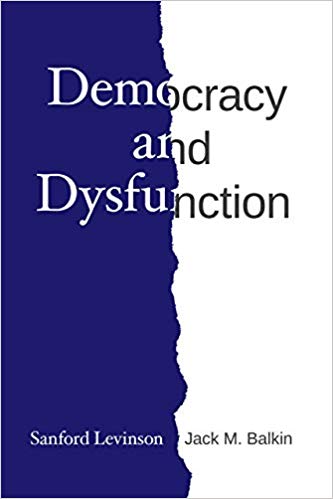
Sanford Levinson and Jack M. Balkin, Democracy and Dysfunction (University of Chicago Press, 2019)

Sanford Levinson, Written in Stone: Public Monuments in Changing Societies (Duke University Press 2018)

Mark A. Graber, Sanford Levinson, and Mark Tushnet, eds., Constitutional Democracy in Crisis? (Oxford University Press 2018)

Gerard Magliocca, The Heart of the Constitution: How the Bill of Rights became the Bill of Rights (Oxford University Press, 2018)

Cynthia Levinson and Sanford Levinson, Fault Lines in the Constitution: The Framers, Their Fights, and the Flaws that Affect Us Today (Peachtree Publishers, 2017)

Brian Z. Tamanaha, A Realistic Theory of Law (Cambridge University Press 2017)

Sanford Levinson, Nullification and Secession in Modern Constitutional Thought (University Press of Kansas 2016)

Sanford Levinson, An Argument Open to All: Reading The Federalist in the 21st Century (Yale University Press 2015)

Stephen M. Griffin, Broken Trust: Dysfunctional Government and Constitutional Reform (University Press of Kansas, 2015)

Frank Pasquale, The Black Box Society: The Secret Algorithms That Control Money and Information (Harvard University Press, 2015)

Bruce Ackerman, We the People, Volume 3: The Civil Rights Revolution (Harvard University Press, 2014)
Balkinization Symposium on We the People, Volume 3: The Civil Rights Revolution

Joseph Fishkin, Bottlenecks: A New Theory of Equal Opportunity (Oxford University Press, 2014)

Mark A. Graber, A New Introduction to American Constitutionalism (Oxford University Press, 2013)

John Mikhail, Elements of Moral Cognition: Rawls' Linguistic Analogy and the Cognitive Science of Moral and Legal Judgment (Cambridge University Press, 2013)

Gerard N. Magliocca, American Founding Son: John Bingham and the Invention of the Fourteenth Amendment (New York University Press, 2013)

Stephen M. Griffin, Long Wars and the Constitution (Harvard University Press, 2013)

Andrew Koppelman, The Tough Luck Constitution and the Assault on Health Care Reform (Oxford University Press, 2013)

James E. Fleming and Linda C. McClain, Ordered Liberty: Rights, Responsibilities, and Virtues (Harvard University Press, 2013)
Balkinization Symposium on Ordered Liberty: Rights, Responsibilities, and Virtues

Andrew Koppelman, Defending American Religious Neutrality (Harvard University Press, 2013)

Brian Z. Tamanaha, Failing Law Schools (University of Chicago Press, 2012)

Sanford Levinson, Framed: America's 51 Constitutions and the Crisis of Governance (Oxford University Press, 2012)

Linda C. McClain and Joanna L. Grossman, Gender Equality: Dimensions of Women's Equal Citizenship (Cambridge University Press, 2012)

Mary Dudziak, War Time: An Idea, Its History, Its Consequences (Oxford University Press, 2012)

Jack M. Balkin, Living Originalism (Harvard University Press, 2011)

Jason Mazzone, Copyfraud and Other Abuses of Intellectual Property Law (Stanford University Press, 2011)

Richard W. Garnett and Andrew Koppelman, First Amendment Stories, (Foundation Press 2011)

Jack M. Balkin, Constitutional Redemption: Political Faith in an Unjust World (Harvard University Press, 2011)

Gerard Magliocca, The Tragedy of William Jennings Bryan: Constitutional Law and the Politics of Backlash (Yale University Press, 2011)

Bernard Harcourt, The Illusion of Free Markets: Punishment and the Myth of Natural Order (Harvard University Press, 2010)

Bruce Ackerman, The Decline and Fall of the American Republic (Harvard University Press, 2010)
Balkinization Symposium on The Decline and Fall of the American Republic

Ian Ayres. Carrots and Sticks: Unlock the Power of Incentives to Get Things Done (Bantam Books, 2010)

Mark Tushnet, Why the Constitution Matters (Yale University Press 2010)

Ian Ayres and Barry Nalebuff: Lifecycle Investing: A New, Safe, and Audacious Way to Improve the Performance of Your Retirement Portfolio (Basic Books, 2010)
.jpg)
Jack M. Balkin, The Laws of Change: I Ching and the Philosophy of Life (2d Edition, Sybil Creek Press 2009)

Brian Z. Tamanaha, Beyond the Formalist-Realist Divide: The Role of Politics in Judging (Princeton University Press 2009)
Andrew Koppelman and Tobias Barrington Wolff, A Right to Discriminate?: How the Case of Boy Scouts of America v. James Dale Warped the Law of Free Association (Yale University Press 2009)

Jack M. Balkin and Reva B. Siegel, The Constitution in 2020 (Oxford University Press 2009)

Heather K. Gerken, The Democracy Index: Why Our Election System Is Failing and How to Fix It (Princeton University Press 2009)

Mary Dudziak, Exporting American Dreams: Thurgood Marshall's African Journey (Oxford University Press 2008)

David Luban, Legal Ethics and Human Dignity (Cambridge Univ. Press 2007)

Ian Ayres, Super Crunchers: Why Thinking-By-Numbers is the New Way to be Smart (Bantam 2007)

Jack M. Balkin, James Grimmelmann, Eddan Katz, Nimrod Kozlovski, Shlomit Wagman and Tal Zarsky, eds., Cybercrime: Digital Cops in a Networked Environment (N.Y.U. Press 2007)

Jack M. Balkin and Beth Simone Noveck, The State of Play: Law, Games, and Virtual Worlds (N.Y.U. Press 2006)

Andrew Koppelman, Same Sex, Different States: When Same-Sex Marriages Cross State Lines (Yale University Press 2006)

Brian Tamanaha, Law as a Means to an End (Cambridge University Press 2006)

Sanford Levinson, Our Undemocratic Constitution (Oxford University Press 2006)

Mark Graber, Dred Scott and the Problem of Constitutional Evil (Cambridge University Press 2006)

Jack M. Balkin, ed., What Roe v. Wade Should Have Said (N.Y.U. Press 2005)

Sanford Levinson, ed., Torture: A Collection (Oxford University Press 2004)
Balkin.com homepage
Bibliography
Conlaw.net
Cultural Software
Writings
Opeds
The Information Society Project
BrownvBoard.com
Useful Links
Syllabi and Exams

