Balkinization
an unanticipated consequence of
Jack M. Balkin
Balkinization Symposiums: A Continuing List
E-mail:
Jack Balkin:
jackbalkin at yahoo.com
Bruce Ackerman
bruce.ackerman at yale.edu
Ian Ayres
ian.ayres at yale.edu
Corey Brettschneider
corey_brettschneider at brown.edu
Mary Dudziak
mary.l.dudziak at emory.edu
Joey Fishkin
joey.fishkin at gmail.com
Heather Gerken heather.gerken at yale.edu
Abbe Gluck abbe.gluck at yale.edu
Mark Graber
mgraber at law.umaryland.edu
Stephen Griffin
sgriffin at tulane.edu
Jonathan Hafetz
jonathan.hafetz at shu.edu
Jeremy Kessler
jkessler at law.columbia.edu
Andrew Koppelman
akoppelman at law.northwestern.edu
Marty Lederman
msl46 at law.georgetown.edu
Sanford Levinson
slevinson at law.utexas.edu
David Luban
david.luban at gmail.com
Gerard Magliocca
gmaglioc at iupui.edu
Jason Mazzone
mazzonej at illinois.edu
Linda McClain
lmcclain at bu.edu
John Mikhail
mikhail at law.georgetown.edu
Frank Pasquale
pasquale.frank at gmail.com
Nate Persily
npersily at gmail.com
Michael Stokes Paulsen
michaelstokespaulsen at gmail.com
Deborah Pearlstein
dpearlst at yu.edu
Rick Pildes
rick.pildes at nyu.edu
David Pozen
dpozen at law.columbia.edu
Richard Primus
raprimus at umich.edu
K. Sabeel Rahmansabeel.rahman at brooklaw.edu
Alice Ristroph
alice.ristroph at shu.edu
Neil Siegel
siegel at law.duke.edu
David Super
david.super at law.georgetown.edu
Brian Tamanaha
btamanaha at wulaw.wustl.edu
Nelson Tebbe
nelson.tebbe at brooklaw.edu
Mark Tushnet
mtushnet at law.harvard.edu
Adam Winkler
winkler at ucla.edu
Compendium of posts on Hobby Lobby and related cases
The Anti-Torture Memos: Balkinization Posts on Torture, Interrogation, Detention, War Powers, and OLC
The Anti-Torture Memos (arranged by topic)
Recent Posts
Hamdan, Rasul, et al., Imperiled
![[Powered by Blogger]](https://lh3.googleusercontent.com/blogger_img_proxy/AEn0k_thVZ7Nxst8rl5GyTtHFudu3IFjQQRXobSNez4DUC3MbKv5uM-2D_0bnxPw4XPsKLjQrjzHWDS0WKA1Q4j-CPrc7gw9THXc3_vTPtUNk6hs=s0-d)
Just A Few Blogs
ACS Blog
Alas, a Blog
Althouse
Arts and Letters Daily
Atrios (Eschaton)
Bill of Health
Buzzflash.com
Buzz Machine
Cato at Liberty
Juan Cole (Informed Comment)
Concurring Opinions
The Constitution in 2020
Corrente
Crooked Timber
Daily Howler
Daily Kos
Dana Boyd
Brad DeLong
Digby (Hullabaloo)
Discriminations
Daniel Drezner
Kevin Drum (Mother Jones)
Electrolite
En Banc
Eunomia (Daniel Larison)
Fafblog
Michael Froomkin (Discourse.net)
GovLab (Beth Noveck)
Rick Hasen (Election Law)
History News Network
How Appealing
Ignatz (Sam Heldman)
The Importance of (Ernie Miller)
Infolaw
Instapundit
International Economic Law and Policy Blog
IntLawGrrls
Jacob Levy
Jesus' General
Jurisdynamics
The Kitchen Cabinet
Mark Kleiman
Law Blog Central
Larry Lessig
Lawyers, Guns and Money
Liberal Oasis
Brian Leiter's Law School Reports
The Leiter Reports
Marginal Revolution
Megan McArdle
Memeorandum
Metafilter
Mirror of Justice
The New Republic
Newseum
No More Mister Nice Blog
Brendan Nyhan
Opinio Juris
Orcinus
The Originalism Blog
Pandagon
Passport (Foreign Policy)
Overcoming Bias
Political Animal (Washington Monthly)
Political Theory Daily Review
Political Wire (Taegan Goddard)
The Poor Man
Virginia Postrel
Prawfsblawg
Public Reason
Jonathan Rauch
Raw Story
Redstate
ReligiousLeftLaw.com
Reporters Committee For Freedom of the Press
Reproductive Rights Blog
Rothman's Roadmap to the Right of Publicity
SCOTUS Blog
Seeing the Forest
Clay Shirky
The Shifted Librarian
The Situationist
Larry Solum (Legal Theory)
Andrew Sullivan
Talking Points Memo
Talk Left
Tapped
Tbogg
TechPresident
The Paper Chase (Jurist)
Tom Paine
Tom Tomorrow (This Modern World)
Eve Tushnet
Uggabugga
University of Chicago Law School Faculty Blog
Unqualified Offerings
The Volokh Conspiracy
War and Piece (Laura Rozen)
Wampum
Oliver Willis
Wonkette
Written Description
Matthew Yglesias
Yin
Your Choice of Feeds
1. XML
powered by

2. Atom Feed
3. RSS 2.0
Hamdan, Rasul, et al., Imperiled
Marty Lederman
Cross-posted from SCOTUSblog.
The Senate yesterday by a vote of 49-42 passed an amendment to the Defense Appropriations bill, offered by Lindsey Graham, section (d) of which would eliminate the statutory right of habeas corpus for alien detainees held by the Department of Defense at Guantanamo. This would, in effect, overrule the Supreme Court's June 2004 decision in Rasul v. Bush.
This amendment, if enacted, would by its terms appear to eliminate the jurisdiction of the courts -- and thus make meaningless the habeas petitions at issue -- in pending cases, such as, most importantly, the Hamdan case the Court decided to hear this week, and the extremely significant Rasul cases on remand, which are presently pending in the U.S. Court of Appeals for the D.C. Circuit. As Bobby Chesney explains in further detail, this would be a very momentous development, and would probably mean that most or all of the Administration's decisions on, and conduct regarding, detention, interrogation and abuse at GTMO, would be impervious to judicial review and oversight.
Continuing coverage over at Obsidian Wings. [UPATE: Katherine and hilzoy over at OW are in the midst of a series of posts responding to Senator Graham's arguments in support of his amendment. The first of those posts includes a link to Graham's statements on the Senate floor.]
Senator Bingaman reportedly will offer an amendment to the Graham Amendment on Monday that would delete the withdrawal of habeas; but if that effort fails, the New York Times reports that the Graham amendment is likely to pass the House as well and to be signed by the President.
It's conceivable that some of the GTMO detainees might still have a constitutional right to habeas -- but although the Rasul decision doesn't rule out the possibility, prevailing on such a constitutional claim would probably require the Court to overrule or sharply distinguish Johnson v. Eisentrager. Also, as Steve Vladeck explains here, there are complex Federal-Courts-final-exam-like questions about the constitutionality of the Graham Amendment itself. But the fate of such a constitutional challenge would be decidedly uncertain. Therefore the Graham Amendment could be a very serious development for several of the most important pending and future cases concerning the conflicts with Al Qaeda and the Taliban.
UPDATE: Mark Kleiman asks three questions. I'll provide some tentative answers that I think the proponents of the Graham Amendment would offer, and invite others to chime in in the comments section:
1. Can this be reconciled with the provision in Article 1, Section 9, forbidding the suspension of habeas corpus except in cases of rebellion or invasion?
A: The Graham Amendment almost certainly is intended, and would be construed, to withdraw only statutory habeas jurisdiction -- the sort currently authorized by 28 U.S.C. 2241, according to Rasul -- and not any jurisdiction to hear constitutional habeas petitions. I don't believe there's any caselaw on the question of whether the Suspension Clause of Article I, Section 9 applies to withdrawals of previously conferred statutory habeas -- but I'm doubtful: Typically (but not invariably), Congress can at point B take back a statutory benefit that it had conferred at Point A, including a statutory right to invoke federal court jurisdiction.
To be sure, if I'm right, courts would continue to have jurisdiction to hear constitutionally based habeas petitions. The problem, however, is that it's not clear that aliens overseas have constitutional rights to habeas -- not, in any event, unless the Court overrules or distinguishes Eisentrager.
2. If the Congress can deny aliens access to the courts to challenge their detention, what would keep it from doing the same to citizens?
A: Citizens undoubtedly do have a constitutional right to file habeas petitions in certain circumstances. Congress could eliminate that right, too, but in order to do so, it would have to find that public safety requires it, because of "Rebellion or Invasion." Article I, Section 9.
3. If the principle of court-stripping is valid, is there any Constitutional right that cannot be effectively abolished by a simple Congressional majority?
A. Congress isn't eliminating any substantive right, constitutional or otherwise. It is "only" eliminating a statutory right to file certain habeas petitions. Obviously, eliminating judicial review will have a dramatic impact on the ability of GTMO detainees to enforce any constitutional rights they may have -- but that only raises two further questions: (i) whether aliens overseas have constitutional rights (one of the principal questions in the pending Rasul/Al Odah case), and (ii) whether Congress must provide a judicial remedy for every violation of constitutional right.
Posted
6:24 AM
by Marty Lederman [link]
The detainees at Guantanamo have been there since early 2002. Their cases really begin then, and if they are entitled to relief they are entitled to it then. Meanwhile, their cases have been dragged out and obsfucated by the government with this long series of really silly and dishonest appeals.
Why isn't Graham's amendment an ex post facto law here?
And I hate to be a broken record, but when you are dealing with a set of policies and an administration that are broken records, it's difficult not to...
The Graham amendment is a war crime in direct violation of 18 USC 2441(c)(1-3) in reference to Geneva grave breaches, violations of Hague Annex art. 23(h), and Geneva common art. 3 -- just like the administration's policies are.
But I suppose that I should welcome the amendment, because I firmly believe that the constitutional grounds for overturning Eisentrager, Yamashita, and Quirin are overwhelming and clear. Each is in fact MOOT under the current laws.
And I submitted a sworn statement to the Judiciary Committee that included a 20 page commentary on the Hamdan decision and several earlier briefs and articles which get well into the details of that opinion; see:
J-Committee Statement
Let me close by saying that I thought the performance of Senators Graham and Kyl was was one of the most disgraceful things I've seen in the last four years.
Regards,
Charly

But, to make this (surely not slamdunk) claim, we will be left with more litigation, maybe years worth of it (see Padilla).
So, Sen. "Hypocrite" Graham is concerned with torture, huh?
"(c) Definition.-- As used in this section the term "war crime" means any conduct-- * * *
"(2) prohibited by Article 23, 25, 27, or 28 of the Annex to the Hague Convention IV, Respecting the Laws and Customs of War on Land, signed 18 October 1907[.]"
Geneva is included by (c)(1) & (c)(3), but Hague Annex Article 23(h) makes this all very plain:
"In addition to the prohibitions provided by special Conventions, it is especially forbidden * * * [t]o declare abolished, suspended, or inadmissible in a court of law the rights and actions of the nationals of the hostile party."
The U.S. Senate has no authority to violate that law: Senator Graham is aiding and abetting WAR CRIMES.
See also the Martens Clause (Hague IV 1907, preamble):
"According to the views of the High Contracting Parties, these provisions, the wording of which has been inspired by the desire to diminish the evils of war, as far as military requirements permit, are intended to serve as a general rule of conduct for the belligerents in their mutual relations and in their relations with the inhabitants.
"It has not, however, been found possible at present to concert regulations covering all the circumstances which arise in practice;
"On the other hand, the High Contracting Parties clearly do not intend that unforeseen cases should, in the absence of a written undertaking, be left to the arbitrary judgment of military commanders.
"Until a more complete code of the laws of war has been issued, the High Contracting Parties deem it expedient to declare that, in cases not included in the Regulations adopted by them, the inhabitants and the belligerents remain under the protection and the rule of the principles of the law of nations, as they result from the usages established among civilized peoples, from the laws of humanity, and the dictates of the public conscience.
"They declare that it is in this sense especially that Articles 1 and 2 of the Regulations adopted must be understood."
Noting that Hague Regulations ("HR") arts. 1-2 are precisely those dealing with POW status and have been replaced by Geneva III POWs arts. 4-5.
Geneva Common Article 3 and the ICCPR also stand against Sen. Grahams criminal proposal.
As to why a USAFR JAG Col, who should and undoubtedly does know this law would sponser such an outrageously dihonest and criminal amendment, my theory is simple: he was BOUGHT. Graham is amibitous and Bill Frist is planning on running for president. I think the deal is either he will be the VP candidate or the new Senate Majority leader.
Run 3 | Stick Run 2 | Return Man 2
Run 2 | Stick Run | Return Man | run 3 game | run 3 unblocked
Books by Balkinization Bloggers

Mark Tushnet and Bojan Bugaric, Constitutionalism and Its Discontents (University of Chicago Press, 2026)

Gerard N. Magliocca, The Actual Art of Governing: Justice Robert H. Jackson's Concurring Opinion in the Steel Seizure Case (Oxford University Press, 2025)

Linda C. McClain and Aziza Ahmed, The Routledge Companion to Gender and COVID-19 (Routledge, 2024)

David Pozen, The Constitution of the War on Drugs (Oxford University Press, 2024)

Jack M. Balkin, Memory and Authority: The Uses of History in Constitutional Interpretation (Yale University Press, 2024)
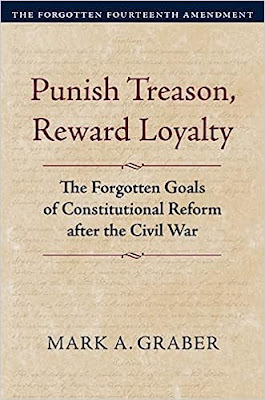
Mark A. Graber, Punish Treason, Reward Loyalty: The Forgotten Goals of Constitutional Reform after the Civil War (University of Kansas Press, 2023)
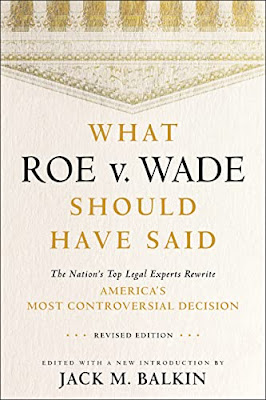
Jack M. Balkin, What Roe v. Wade Should Have Said: The Nation's Top Legal Experts Rewrite America's Most Controversial Decision - Revised Edition (NYU Press, 2023)

Andrew Koppelman, Burning Down the House: How Libertarian Philosophy Was Corrupted by Delusion and Greed (St. Martin’s Press, 2022)

Gerard N. Magliocca, Washington's Heir: The Life of Justice Bushrod Washington (Oxford University Press, 2022)
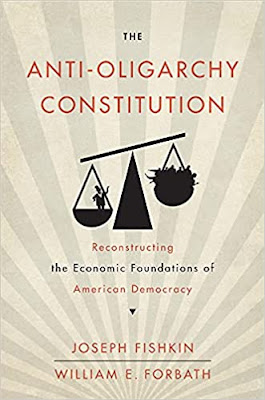
Joseph Fishkin and William E. Forbath, The Anti-Oligarchy Constitution: Reconstructing the Economic Foundations of American Democracy (Harvard University Press, 2022)
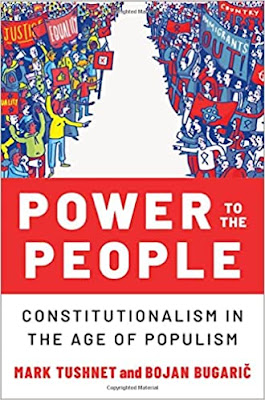
Mark Tushnet and Bojan Bugaric, Power to the People: Constitutionalism in the Age of Populism (Oxford University Press 2021).

Mark Philip Bradley and Mary L. Dudziak, eds., Making the Forever War: Marilyn B. Young on the Culture and Politics of American Militarism Culture and Politics in the Cold War and Beyond (University of Massachusetts Press, 2021).

Jack M. Balkin, What Obergefell v. Hodges Should Have Said: The Nation's Top Legal Experts Rewrite America's Same-Sex Marriage Decision (Yale University Press, 2020)

Frank Pasquale, New Laws of Robotics: Defending Human Expertise in the Age of AI (Belknap Press, 2020)

Jack M. Balkin, The Cycles of Constitutional Time (Oxford University Press, 2020)

Mark Tushnet, Taking Back the Constitution: Activist Judges and the Next Age of American Law (Yale University Press 2020).

Andrew Koppelman, Gay Rights vs. Religious Liberty?: The Unnecessary Conflict (Oxford University Press, 2020)

Ezekiel J Emanuel and Abbe R. Gluck, The Trillion Dollar Revolution: How the Affordable Care Act Transformed Politics, Law, and Health Care in America (PublicAffairs, 2020)

Linda C. McClain, Who's the Bigot?: Learning from Conflicts over Marriage and Civil Rights Law (Oxford University Press, 2020)
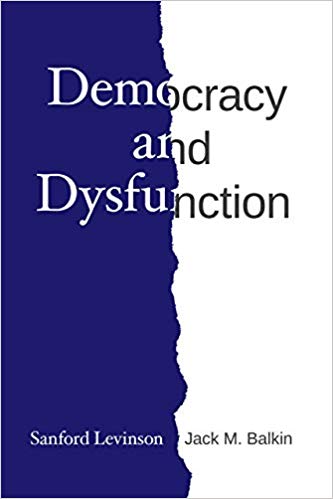
Sanford Levinson and Jack M. Balkin, Democracy and Dysfunction (University of Chicago Press, 2019)

Sanford Levinson, Written in Stone: Public Monuments in Changing Societies (Duke University Press 2018)

Mark A. Graber, Sanford Levinson, and Mark Tushnet, eds., Constitutional Democracy in Crisis? (Oxford University Press 2018)

Gerard Magliocca, The Heart of the Constitution: How the Bill of Rights became the Bill of Rights (Oxford University Press, 2018)

Cynthia Levinson and Sanford Levinson, Fault Lines in the Constitution: The Framers, Their Fights, and the Flaws that Affect Us Today (Peachtree Publishers, 2017)

Brian Z. Tamanaha, A Realistic Theory of Law (Cambridge University Press 2017)

Sanford Levinson, Nullification and Secession in Modern Constitutional Thought (University Press of Kansas 2016)

Sanford Levinson, An Argument Open to All: Reading The Federalist in the 21st Century (Yale University Press 2015)

Stephen M. Griffin, Broken Trust: Dysfunctional Government and Constitutional Reform (University Press of Kansas, 2015)

Frank Pasquale, The Black Box Society: The Secret Algorithms That Control Money and Information (Harvard University Press, 2015)

Bruce Ackerman, We the People, Volume 3: The Civil Rights Revolution (Harvard University Press, 2014)
Balkinization Symposium on We the People, Volume 3: The Civil Rights Revolution

Joseph Fishkin, Bottlenecks: A New Theory of Equal Opportunity (Oxford University Press, 2014)

Mark A. Graber, A New Introduction to American Constitutionalism (Oxford University Press, 2013)

John Mikhail, Elements of Moral Cognition: Rawls' Linguistic Analogy and the Cognitive Science of Moral and Legal Judgment (Cambridge University Press, 2013)

Gerard N. Magliocca, American Founding Son: John Bingham and the Invention of the Fourteenth Amendment (New York University Press, 2013)

Stephen M. Griffin, Long Wars and the Constitution (Harvard University Press, 2013)

Andrew Koppelman, The Tough Luck Constitution and the Assault on Health Care Reform (Oxford University Press, 2013)

James E. Fleming and Linda C. McClain, Ordered Liberty: Rights, Responsibilities, and Virtues (Harvard University Press, 2013)
Balkinization Symposium on Ordered Liberty: Rights, Responsibilities, and Virtues

Andrew Koppelman, Defending American Religious Neutrality (Harvard University Press, 2013)

Brian Z. Tamanaha, Failing Law Schools (University of Chicago Press, 2012)

Sanford Levinson, Framed: America's 51 Constitutions and the Crisis of Governance (Oxford University Press, 2012)

Linda C. McClain and Joanna L. Grossman, Gender Equality: Dimensions of Women's Equal Citizenship (Cambridge University Press, 2012)

Mary Dudziak, War Time: An Idea, Its History, Its Consequences (Oxford University Press, 2012)

Jack M. Balkin, Living Originalism (Harvard University Press, 2011)

Jason Mazzone, Copyfraud and Other Abuses of Intellectual Property Law (Stanford University Press, 2011)

Richard W. Garnett and Andrew Koppelman, First Amendment Stories, (Foundation Press 2011)

Jack M. Balkin, Constitutional Redemption: Political Faith in an Unjust World (Harvard University Press, 2011)

Gerard Magliocca, The Tragedy of William Jennings Bryan: Constitutional Law and the Politics of Backlash (Yale University Press, 2011)

Bernard Harcourt, The Illusion of Free Markets: Punishment and the Myth of Natural Order (Harvard University Press, 2010)

Bruce Ackerman, The Decline and Fall of the American Republic (Harvard University Press, 2010)
Balkinization Symposium on The Decline and Fall of the American Republic

Ian Ayres. Carrots and Sticks: Unlock the Power of Incentives to Get Things Done (Bantam Books, 2010)

Mark Tushnet, Why the Constitution Matters (Yale University Press 2010)

Ian Ayres and Barry Nalebuff: Lifecycle Investing: A New, Safe, and Audacious Way to Improve the Performance of Your Retirement Portfolio (Basic Books, 2010)
.jpg)
Jack M. Balkin, The Laws of Change: I Ching and the Philosophy of Life (2d Edition, Sybil Creek Press 2009)

Brian Z. Tamanaha, Beyond the Formalist-Realist Divide: The Role of Politics in Judging (Princeton University Press 2009)
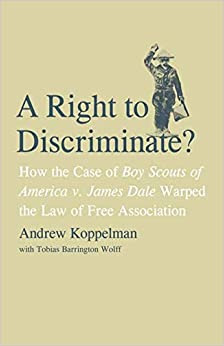
Andrew Koppelman and Tobias Barrington Wolff, A Right to Discriminate?: How the Case of Boy Scouts of America v. James Dale Warped the Law of Free Association (Yale University Press 2009)

Jack M. Balkin and Reva B. Siegel, The Constitution in 2020 (Oxford University Press 2009)

Heather K. Gerken, The Democracy Index: Why Our Election System Is Failing and How to Fix It (Princeton University Press 2009)

Mary Dudziak, Exporting American Dreams: Thurgood Marshall's African Journey (Oxford University Press 2008)

David Luban, Legal Ethics and Human Dignity (Cambridge Univ. Press 2007)

Ian Ayres, Super Crunchers: Why Thinking-By-Numbers is the New Way to be Smart (Bantam 2007)

Jack M. Balkin, James Grimmelmann, Eddan Katz, Nimrod Kozlovski, Shlomit Wagman and Tal Zarsky, eds., Cybercrime: Digital Cops in a Networked Environment (N.Y.U. Press 2007)
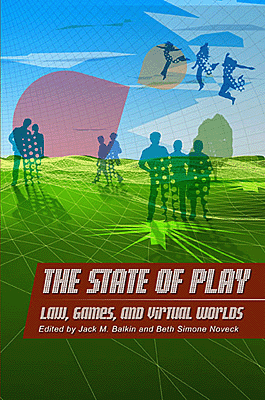
Jack M. Balkin and Beth Simone Noveck, The State of Play: Law, Games, and Virtual Worlds (N.Y.U. Press 2006)

Andrew Koppelman, Same Sex, Different States: When Same-Sex Marriages Cross State Lines (Yale University Press 2006)

Brian Tamanaha, Law as a Means to an End (Cambridge University Press 2006)

Sanford Levinson, Our Undemocratic Constitution (Oxford University Press 2006)

Mark Graber, Dred Scott and the Problem of Constitutional Evil (Cambridge University Press 2006)

Jack M. Balkin, ed., What Roe v. Wade Should Have Said (N.Y.U. Press 2005)

Sanford Levinson, ed., Torture: A Collection (Oxford University Press 2004)
Balkin.com homepage
Bibliography
Conlaw.net
Cultural Software
Writings
Opeds
The Information Society Project
BrownvBoard.com
Useful Links
Syllabi and Exams
