Balkinization
an unanticipated consequence of
Jack M. Balkin
Balkinization Symposiums: A Continuing List
E-mail:
Jack Balkin:
jackbalkin at yahoo.com
Bruce Ackerman
bruce.ackerman at yale.edu
Ian Ayres
ian.ayres at yale.edu
Corey Brettschneider
corey_brettschneider at brown.edu
Mary Dudziak
mary.l.dudziak at emory.edu
Joey Fishkin
joey.fishkin at gmail.com
Heather Gerken heather.gerken at yale.edu
Abbe Gluck abbe.gluck at yale.edu
Mark Graber
mgraber at law.umaryland.edu
Stephen Griffin
sgriffin at tulane.edu
Jonathan Hafetz
jonathan.hafetz at shu.edu
Jeremy Kessler
jkessler at law.columbia.edu
Andrew Koppelman
akoppelman at law.northwestern.edu
Marty Lederman
msl46 at law.georgetown.edu
Sanford Levinson
slevinson at law.utexas.edu
David Luban
david.luban at gmail.com
Gerard Magliocca
gmaglioc at iupui.edu
Jason Mazzone
mazzonej at illinois.edu
Linda McClain
lmcclain at bu.edu
John Mikhail
mikhail at law.georgetown.edu
Frank Pasquale
pasquale.frank at gmail.com
Nate Persily
npersily at gmail.com
Michael Stokes Paulsen
michaelstokespaulsen at gmail.com
Deborah Pearlstein
dpearlst at yu.edu
Rick Pildes
rick.pildes at nyu.edu
David Pozen
dpozen at law.columbia.edu
Richard Primus
raprimus at umich.edu
K. Sabeel Rahmansabeel.rahman at brooklaw.edu
Alice Ristroph
alice.ristroph at shu.edu
Neil Siegel
siegel at law.duke.edu
David Super
david.super at law.georgetown.edu
Brian Tamanaha
btamanaha at wulaw.wustl.edu
Nelson Tebbe
nelson.tebbe at brooklaw.edu
Mark Tushnet
mtushnet at law.harvard.edu
Adam Winkler
winkler at ucla.edu
Compendium of posts on Hobby Lobby and related cases
The Anti-Torture Memos: Balkinization Posts on Torture, Interrogation, Detention, War Powers, and OLC
The Anti-Torture Memos (arranged by topic)
Recent Posts
Harvard Law Review Symposium on Freedom of the Press
What the President is Willing to Fight For
The Comcast Case and Network Neutrality
Elana Kagan's Scholarship
SOPA and the Fight for Control of Online Content
Why Presidents Cannot Run Against the Court
VerGoogle's Plan to Lochnerize the Internet
Who Won the New Deal Confrontation Between FDR and the Court: The Presidency or the Court?
New Report Shows Links Between Public Opinion and Free Speech Protections
Challenging the Constitutional Framework for Media Regulation
Models for the Internet’s Future: Obama-Open or Julius-Closed
![[Powered by Blogger]](https://lh3.googleusercontent.com/blogger_img_proxy/AEn0k_vvLXtCbEpWp0v9iBGvWVOXegGzrFexM7akHnNvQqh-uHjtghIvwq9PjUH0WixoJqxxa_6AKMF13oFISPxO8pGyzKRH3bOPFfeVWoQ90oB_=s0-d)
Just A Few Blogs
ACS Blog
Alas, a Blog
Althouse
Arts and Letters Daily
Atrios (Eschaton)
Bill of Health
Buzzflash.com
Buzz Machine
Cato at Liberty
Juan Cole (Informed Comment)
Concurring Opinions
The Constitution in 2020
Corrente
Crooked Timber
Daily Howler
Daily Kos
Dana Boyd
Brad DeLong
Digby (Hullabaloo)
Discriminations
Daniel Drezner
Kevin Drum (Mother Jones)
Electrolite
En Banc
Eunomia (Daniel Larison)
Fafblog
Michael Froomkin (Discourse.net)
GovLab (Beth Noveck)
Rick Hasen (Election Law)
History News Network
How Appealing
Ignatz (Sam Heldman)
The Importance of (Ernie Miller)
Infolaw
Instapundit
International Economic Law and Policy Blog
IntLawGrrls
Jacob Levy
Jesus' General
Jurisdynamics
The Kitchen Cabinet
Mark Kleiman
Law Blog Central
Larry Lessig
Lawyers, Guns and Money
Liberal Oasis
Brian Leiter's Law School Reports
The Leiter Reports
Marginal Revolution
Megan McArdle
Memeorandum
Metafilter
Mirror of Justice
The New Republic
Newseum
No More Mister Nice Blog
Brendan Nyhan
Opinio Juris
Orcinus
The Originalism Blog
Pandagon
Passport (Foreign Policy)
Overcoming Bias
Political Animal (Washington Monthly)
Political Theory Daily Review
Political Wire (Taegan Goddard)
The Poor Man
Virginia Postrel
Prawfsblawg
Public Reason
Jonathan Rauch
Raw Story
Redstate
ReligiousLeftLaw.com
Reporters Committee For Freedom of the Press
Reproductive Rights Blog
Rothman's Roadmap to the Right of Publicity
SCOTUS Blog
Seeing the Forest
Clay Shirky
The Shifted Librarian
The Situationist
Larry Solum (Legal Theory)
Andrew Sullivan
Talking Points Memo
Talk Left
Tapped
Tbogg
TechPresident
The Paper Chase (Jurist)
Tom Paine
Tom Tomorrow (This Modern World)
Eve Tushnet
Uggabugga
University of Chicago Law School Faculty Blog
Unqualified Offerings
The Volokh Conspiracy
War and Piece (Laura Rozen)
Wampum
Oliver Willis
Wonkette
Written Description
Matthew Yglesias
Yin
Your Choice of Feeds
1. XML
powered by

2. Atom Feed
3. RSS 2.0
Harvard Law Review Symposium on Freedom of the Press
JB
The Harvard Law Review is hosting a symposium on Freedom of the Press on February 15th to celebrate the fiftieth anniversary of New York Times v. Sullivan.
Balkinization bloggers Mark Tushnet and Marvin Ammori will speak, and I will be presenting my recent paper, Old School/New School Speech Regulation.
Here is the schedule:
Harvard Law Review Symposium 2014: Freedom of the Press
A conference in celebration of the 50th anniversary of
New York Times Co. v. Sullivan, 376 U.S. 254 (1964).
February 15, 2014
Harvard Law School
Austin North
8:45 Breakfast
9:20 Introduction:
Mark Tushnet
Harvard Law School
“Reflections on the First Amendment and the Information Economy”
9:45 Panel 1:
Susan Crawford
Benjamin N. Cardozo School of Law
“First Amendment Common Sense”
Comments by Stuart Benjamin (Duke)
10:55 Panel 2:
Sonja R. West
University of Georgia School of Law
“Press Exceptionalism”
Comments by RonNell Andersen Jones (BYU) and by David Anderson (University of Texas)
12:10 Lunch
1:10 Panel 3:
Marvin Ammori
Fellow, New America Foundation
“Free Speech Lawyering in the Age of Google and Twitter”
Comments by Marjorie Heins (Free Expression Policy Project) and by Jonathan Zittrain (Harvard)
2:35 Panel 4:
Rebecca Tushnet
Georgetown University Law Center
“More than a Feeling: Emotion and the First Amendment”
Comments by Caroline Corbin (University of Miami)
3:45 Panel 5:
Jack Balkin
Yale Law School
"Old School/New School Speech Regulation"
Comments by Yochai Benkler (Harvard) and by Dawn Nunziato (George Washington University Law School)
5:00 Break
5:10 Open Panel
6:00 Dinner
Posted
4:55 PM
by JB [link]
What the President is Willing to Fight For
Frank Pasquale
Mike Konczal is one of the best finance bloggers, and has an unerring sense of the political realities behind fiscal reforms. He offers this perspective on the recent announcement of a federal pay freeze: Ezra Klein has three ways of looking at the freeze. . . . . 1) This is more unwise, unilateral bipartisanship, 2) This is a smart way to protect the federal workforce, 3) This is bad economics and bad policy. I think we should discuss a fourth option: President Obama thinks this is a really good idea and wants to spend political capital and energy to carry it out.
Read more »
Posted
10:59 AM
by Frank Pasquale [link]
The Comcast Case and Network Neutrality
Guest Blogger
John Blevins and Marvin Ammori
This past Monday, a group of law professors and public interest organizations (listed below) filed briefs in Comcast v. FCC in the DC Circuit court—a case with potentially enormous implications for the future of the open Internet. The briefs are available here and here.
For those unfamiliar with the case, here’s a very brief summary: In 2007, Comcast got caught interfering with applications on the Internet (specifically, it blocked its users’ uploads using peer-to-peer applications like BitTorrent). After initially denying any blocking—and then after several months of consumer complaints, terrible press coverage, and an FCC investigation with several public hearings—Comcast finally came clean and promised to stop.
In 2008, the FCC concluded that Comcast’s actions were illegal, violating federal policy set out in the Communications Act, and ordered the company to demonstrate that it had (as promised) discontinued these practices. Comcast then sued in the DC Circuit, arguing that the FCC’s Order was both procedurally defective and beyond the FCC’s jurisdictional authority.
The stakes of this litigation are high. If the DC Circuit vacates the FCC’s Order, the court will give every network provider in the nation the green light to adopt and expand Comcast’s discriminatory practices—a development that would undermine the basic level playing field that we expect on the Internet.
The decision could also undermine the FCC’s recent proposal to adopt rules governing and ensuring network neutrality. Indeed, if Comcast is right that the FCC wrongly claimed jurisdiction over network discrimination, then the FCC would have to return to Congress—where a Senate filibuster would loom large over any attempt to pass new legislation.
The two briefs filed yesterday, then, address different aspects of the overall argument supporting the FCC’s position.
The first—the Amici Brief submitted by Professors Jack Balkin, Jim Chen, Larry Lessig, Barbara van Schewick, and Tim Wu—illustrated the harmful policy consequences of reversing the FCC’s Order. In short, Amici explained why you should care about what Comcast did.
One of Amici’s primary arguments was that Comcast’s actions would cause real economic harm by raising the costs of innovating on the Internet.* In doing so, Comcast’s actions would transform the open Internet into a more “closed” network, closer in spirit to today’s cable network where uses are completely controlled and pre-approved by the network provider.
For background, the reason that innovation is easy and inexpensive on the Internet is because everyone on the Internet has traditionally followed shared, non-secret practices and protocols. The creators of Twitter, for instance, didn’t have to call network providers like Comcast for permission to introduce their application. They simply conformed their application to transparent, standard protocols—and then trusted that their new application would work on the network. This ease of innovation allows an extremely diverse set of people (from college students to Fortune 500 companies) to experiment, which paves the way for new markets and economic growth.
Actions like secret blocking would undermine these basic foundations for innovation by raising costs in numerous ways—and we list only a few examples here. In the brave new world of blocking, application innovators would be forced to waste time and resources tailoring their application to multiple networks, and to multiple providers’ idiosyncratic blocking practices. Blocking would also make it harder for new developers to obtain start-up funding, as testimony in the FCC’s record demonstrated. And it would likely trigger a wasteful arms race, as users and application developers focus their efforts on evading network filters.
Comcast’s discriminatory practices—if more widely adopted—would also distort competition among new applications and content. Traditionally, user-driven market forces have determined the success of failure of new applications. Comcast’s practices, however, foreshadow a troubling trend in which network providers start picking the “winners and losers” on the Internet based on their own individual motives.
Unfortunately, market competition is insufficient to address these problems because network providers have incentives to discriminate against certain applications, and because the Internet access market is extremely uncompetitive.
In short, the stakes of reversing the Order are high—indeed, a reversal could undermine, at a fundamental level, the features of the Internet that have made it so valuable.
The second brief was filed by public interest groups Free Press, Consumers Union, Consumer Federation of America, Public Knowledge, and was joined by technology start-up Vuze, Inc. and a group of for-profits and non-profits in favor of network neutrality called the Open Internet Coalition (which includes companies such as Google and Skype, among others). Media Access Project acted as counsel to some of the groups.
This brief focused on the (admittedly less sexy) issues at the core of the appeal—whether the FCC had the jurisdiction to act against Comcast and whether the FCC followed appropriate procedures.
For jurisdiction, the brief emphasized that, under Chevron, the FCC receives deference for interpreting the Communications Act, including interpreting the scope of its jurisdiction under that Act. This deference provides some certainty to industry and consumers. The FCC, for instance, has spent the last several years claiming to have jurisdiction over network neutrality issues. If those conclusions are entitled to no judicial deference when challenged, industry and consumers will be subject to increased uncertainty over the legal regime and who will enforce it.
Regarding procedure, Comcast essentially argues that that the FCC improperly enforced an administrative policy statement as though it were a rule. Agencies, however, have the discretion to choose to make policy through either rules or adjudications—here, it chose adjudication.
In acting through adjudication, agencies usually try to give notice to parties through a policy statement. That is exactly what the FCC did here and it’s pretty basic administrative law. The FCC, in fact, gave Comcast far more than enough process. In these respects, the brief complemented the FCC brief (pdf), filed two weeks earlier, which soundly refuted many of Comcast’s arguments.
For those interested in the fuller versions of these arguments, we’d encourage you to check out the briefs, which provide a lot more detail.
*The innovation arguments relied extensively on Professor van Schewick’s work and forthcoming book. The other scholars have also written on innovation and the Internet, notably in Lessig’s book The Future of Ideas.
John Blevins is an Assistant Professor of Law at South Texas College of Law in Houston, and also writes at Obsidian Wings, where this is cross-posted. He was Counsel to Amici. Marvin Ammori is the an Assistant Professor of Law at the University of Nebraska-Lincoln where he teaches cyberlaw and telecommunications law. He was Free Press’s first lawyer and the architect of the consumer case brought against Comcast at the FCC, now on appeal.
Posted
3:35 PM
by Guest Blogger [link]
Elana Kagan's Scholarship
Mark Tushnet
I'm glad the my friend Marvin Ammori has started a conversation about the merits of Elana Kagan's scholarship, rather than simply commenting on its quantity. I disagree with his interpretation of the article he discusses, and want to add something about her (in my view) quite spectacularly brilliant article on "Presidential Administration." (Disclosure: Kagan was Dean at Harvard when I joined the faculty; I assume that she played an important part in that decision; and she treated me quite well while we were both on the faculty.)
Posted
3:32 PM
by Mark Tushnet [link]
SOPA and the Fight for Control of Online Content
Frank Pasquale
I have an essay on the SOPA controversy at the Boston Review. My main point: SOPA and its ilk are terrible, but its opponents should rally behind a constructive alternative to promote funding for arts and culture. As I argue there:SOPA has spawned a powerful alliance of netizens to support basic principles of due process, free expression, and accountability online. But this battle is merely a prelude to a much more contested debate about the proper allocation of digital revenues. Like health care battles between providers and insurers, struggles between content owners and intermediaries will profoundly shape our common life. Stopping SOPA is only one small step toward preserving a fair, free, and democratic culture online.
For other commentary, here's Marvin Ammori, Danielle Citron, Gerard Magliocca, and Derek Bambauer.
Simulposted: Concurring Opinions.
Posted
2:11 PM
by Frank Pasquale [link]
Why Presidents Cannot Run Against the Court
Guest Blogger
Jared Goldstein
With the prospect that the Supreme Court may strike down the Affordable Care Act, many commentators, including Marvin Ammori on this blog, have argued that President Obama should “campaign against the Court.” It is not really a plausible campaign strategy.
Contrary to popular conception, Franklin Roosevelt did not campaign against the Court in 1936. Some of his advisers suggested that the reelection campaign should be devoted to challenging the Court’s rulings against the New Deal, but Roosevelt agreed with Felix Frankfurter that the administration’s disagreement with the Court was too abstract and complicated to be translated into a political campaign, and it would not excite the electorate. In fact, Roosevelt rarely mentioned the Supreme Court or its rulings during the 1936 campaign.
Read more »
Posted
9:52 AM
by Guest Blogger [link]
VerGoogle's Plan to Lochnerize the Internet
Frank Pasquale
There has been a lot of insightful commentary on the new Verizon/Google framework proposal; Marvin Ammori's post is a good place to start. Here are my "two cents" on the larger implications of this move from business cooperation to lobbying alliance.
1) The companies' CEOs have stated that, in their view, "A provider that offers a broadband Internet access service complying with [basic net neutrality] principles" should be able to "offer any other additional or differentiated services" free of net neutrality regulation. The key question here is the quality and cost of the "broadband Internet access service complying with [net neutrality] principles," as compared with the "additional services" that can be offered without net neutrality. In the best case scenario, most people use the compliant service for most traffic, and run "additional services" on top of it in order to access special content/apps. Unfortunately, I think it's far more likely that the net-neutrality-compliant service will gradually decline in quality, so that it's vestigial (like public broadcasting) or a poor program for poor people (ala Medicaid).
Read more »
Posted
11:11 AM
by Frank Pasquale [link]
Who Won the New Deal Confrontation Between FDR and the Court: The Presidency or the Court?
Rick Pildes
As supporters of President Obama in the aftermath of the health-care arguments continue to urge him to confront the Supreme Court more aggressively (see E.J. Dionne, here, and lawyer Marvin Ammori, here) , and as analogies to FDR's confrontation with the Court continue to mount, I want to continue to provide more of a revisionist historical perspective on the New Deal confrontation. In an earlier post, I noted that this confrontation occurred at a moment at which FDR was perhaps the most popular President in modern history and the Court was striking down a staggering array of federal statutes and presidential actions. Yet FDR nonetheless lost the confrontation, at least in the sense that his Court-packing legislation was defeated. I now want to turn to the aftermath of the confrontation and ask: which institution actually won the Court-packing fight? The conventional wisdom among constitutional academics, focused narrowly on the Court itself, is that FDR lost the battle, but won the war, since the Court soon acceded to the New Deal’s constitutionality. On this standard law-school narrative, FDR won the war because his attacks on the Court forced the Court to back down and change constitutional direction. Here is a different perspective that I provide in my article, Is The Supreme Court A "Majoritarian" Institution?: For those inclined to think the Court backed down because of the political pressure FDR brought to bear, it is important to keep in mind that FDR was able to make seven appointments to the Court between 1937 and 1943. Thus, we cannot know whether the Court acceded to the New Deal due to the pressure of public opinion and presidential attacks or simply the fortuity that FDR made so many appointments in such a short period. Of course, President Obama is not proposing legislation challenging the Court, let alone any measure as confrontational as the Court-packing plan. And public criticism of the Court's decisions, by the President or anyone else, is legitimate in a democracy. But while it's common wisdom to believe FDR defeated the Court, it might well be that the right perspective is that the Court defeated FDR -- and there is no doubt that the Court's independence and public support was enhanced as a result of this fight. As a political matter, then, when Presidents take on the Court, even in the mild form of criticizing the Court's decisions, Presidents walk a delicate line. For better or worse, even among those who disagree with the Court's decisions, there is a surprisingly deep reservoir of support for the Court as an institution (I will look at some of the data in another post). That doesn't mean Presidents shouldn't take on the Court; it does mean they should do so with adequate historical appreciation for the nature of the battle they are joining.But FDR’s legislative assault on the Court destroyed his political coalition, in Congress and nationally, and ended his ability to enact major domestic policy legislation, despite his huge electoral triumph in 1936. As a Fortune magazine poll in July 1937 put it: “The Supreme Court struggle had cut into the President’s popularity as no other issue ever had.” National health care, the next major item on FDR’s agenda, faded away. The progressive domestic policy agenda did not recover until 1964. Reflecting back, FDR’s second vice president, Henry Wallace, observed: “The whole New Deal really went up in smoke as a result of the Supreme Court fight.”
No rational politician, looking back at FDR’s attempt to bring the Court into line, other than through the ordinary appointments process, is likely to repeat FDR’s efforts. Thus, one can read the 1937 experience as suggesting that, for better or worse, judicial independence and the authority of the Court have become so entrenched in America that even the most popular politicians play with fire if they seek too directly to take on the power of the Court.
. . . FDR’s Court-packing plan was in dire shape politically long before the Court’s “switch in time” took the last wind out of that effort – despite the fact, as well, that the plan was the first piece of legislation FDR put forward after having just won the biggest landslide in American history. Two-thirds of the newspapers that had endorsed FDR came out immediately and vociferously against the plan. The most common charge was that FDR was seeking “dictatorial powers,” a particularly resonant charge. Telegrams to Congress, a leading gauge of public opinion at the time, flowed overwhelmingly, and with passionate intensity, against the plan. Some leading Progressive Democrats in the Senate, like Hiram Johnson and George Norris, quickly bolted from FDR and defended the Court’s independence; conservative Democrats wanted no part of the plan; a leading Western Democrat, Senator Burton Wheeler, announced he would lead the fight against the plan; FDR’s Vice President did little to conceal his disdain for Court packing; Republicans sat silently and let the Democratic Party tear itself apart. And the Court, too, has tools to fight back: Chief Justice Hughes sent a letter, with devastating effect, to the Senate Judiciary committee that took apart FDR’s justifications for Court packing.
Posted
6:40 PM
by Rick Pildes [link]
(20) comments
New Report Shows Links Between Public Opinion and Free Speech Protections
JB
Today the Information Society at Yale Law School published a white paper with appendices authored by Yale ISP Fellow Marvin Ammori. The study canvassas 50 years of social science research and concludes that although courts are traditionally believed to be a check on majorities, judicial protections for First Amendment rights depend in the long run on public support for freedom of speech and the press. As a result the white paper proposes a series of educational initiatives to help the public better understand how freedom of speech and freedom of the press safeguard democratic self-government. Research for the white paper was sponsored by a grant from the John S. and James L. Knight Foundation, which issued a statement announcing the white paper's findings today: The public is also much less protective of media rights than individual rights. That makes it less likely that the high court will rule for news organizations in First Amendment cases than it would in an environment of high public respect for the news media. The study points to a wide range of mechanisms by which public opinion affects judicial decisions, ranging from the appointments process — which shifts the median or “swing” Justice on the Supreme Court — to the fact that judges and Justices live in the same culture as everyone else. These effects may often be indirect, but over time they may matter a great deal. “We are now engaged in a really vital debate over civil liberties after 9/11, and it becomes ever more important for the public to show its support for our basic freedoms,” said [ISP Director Jack M.] Balkin, “It’s a time of challenge but also a time of opportunity. Courts can’t do everything by themselves, nor should we expect them to. If the public rises to the occasion and supports freedom of speech when it is threatened, the judiciary will be far more likely to protect this core freedom.” What is needed, the study says, are larger efforts to educate the public about the First Amendment. It proposes a model for educating students and the public on First Amendment issues, focusing on how free speech and a free press advance democracy and serve the public interest. The model education program should also educate the public about the difference between using social norms and social disapproval to regulate speech, and using the power of the state in the form of fines and criminal penalties. The best way to learn about freedom of speech, the study argues, is by doing. Individuals are more likely to support the sort of speech in which they themselves engage or could imagine engaging. Thus the study suggests that schools create programs that allow students to practice journalism and political expression, using new technologies such as blogs and podcasts. Even marginal improvements in public education may have important long term effects on public support for the First Amendment, the study concludes. Research suggests that the better educated individuals are, the more tolerant they are of even offensive and indecent speech, and the more willing they are to protect routine journalistic practices.Over time public support for free speech helps buttress — or undermine — existing legal protections. Public support for free speech tends to be strongest for speech that clearly promotes an informed citizenry and democratic self-governance. However, the public tends to have less tolerance for offensive speech and speech that it regards as extremist, particularly when it fails to see a connection to democracy.
Posted
10:46 AM
by JB [link]
(0) comments
Challenging the Constitutional Framework for Media Regulation
Marvin Ammori
Over the past few weeks, academics and lobbyists have been debating a First Amendment issue--namely, how the First Amendment applies to an Internet access rule called network neutrality (about the the rule, see here and here; about the First Amendment's application, see here and Jack Balkin's testimony).
Today, the trade publications report a potentially new development in the jurisprudence of First Amendment and media/Internet regulation: Cablevision willl apparently ask the Supreme Court to revisit (or narrow) a key Supreme Court case that casts a shadow over communications law--the second Turner Broadcasting v. FCC case, decided in 1997, and known to some as "Turner II."
Cablevision likely has a decent gamble based on court composition. Turner II was a 5-4 decision. Two Justices have since been replaced, O'Connor and Rehnquist. O'Connor wrote the principal dissent for Justices Thomas, Scalia, and Ginsburg; but Rehnquist was in the majority. If the new Justices, Roberts and Alito, vote with Justices Thomas and Scalia (as Cablevision hopes) , the decision flips 5 to 4 the other way.
Here, I will make only a few points about the potential import of this challenge. (I hope to add a few more words later about Turner II itself, which I believe problematic for various reasons.)
My main points are (1) this challenge reminds us that media & Internet cases are among the most important, though often overlooked, First Amendment cases for their impact on our democracy and American's lives, and (2) changes to Turner II's holdings have a potentially wide scope, covering hugely important media regulations
1. The First Amendment's application to 21st Century speech technologies is a question of central importance for our democracy. There are other important areas of First Amendment speech doctrine--indecency, hate speech, flag burning, incitement, campaign finance. But electronic media are often overlooked. Americans engage in/receive probably most of their speech through phone, TV, and Internet--getting most of their news and doing much of their political organizing through these technologies, rather than through paper newspapers, leaflets, or offensive street corner speech and burning flags. Yet free speech casebooks usually devote very few pages to key First Amendment cases involving media ownership rules (like FCC v NCCB regarding ownership of newspapers and broadcasters) and access rules (like Turner II itself, giving access to cable lines for broadcasters, or CBS v FCC, giving access to broadcast stations for politicians). These ownership and access laws, however, are centrally important to promoting the "basic tenet" of the First Amendment--fostering the widest dissemination of information from diverse and antagonistic sources.
Far worse, traditional First Amendment teaching treats such cases as "exceptional," "narrow," somehow "special"--rather than as integral to understanding the underlying structure of First Amendment doctrine. (Some scholars have demonstrated how media ownership and media access cases inform First Amendment theory, like Jack, Ed Baker, Yochai Benkler, Monroe Price, and Mark Tushnet.)
A decision like Turner II, which affects numerous ownership rules and access rules for major communications industries, is important for how Americans can speak to one another in our society--for what they hear and how they communicate about the health care bill, the financial bailout, global warming, reforming the Senate rules, and what's for dinner. It might not be as sexy as "bong hits for Jesus," but it matter greatly.
2. Turner II, which Cablevision hopes to challenge, has a wide (though uncertain) scope. So upending Turner II could raise questions about a lot of regulation.
That Turner II case sets of the test for whether the government has abridged the speech rights of giant cable corporations when it subjects those companies to ownership or access rules. Turner II upheld an access rule, namely a must-carry law requiring cable operators (like Comcast) to carry over-the-air broadcasters (like CBS, NBC, ABC, and Fox).
Turner II did so not by applying strict scrutiny for "content-based" rules (a wise choice), nor by applying a lower scrutiny (such as the scrutiny in FCC v. NCCB and Red Lion), but by adopting the content-neutral intermediate scrutiny test from US v. O'Brien, with an additional requirement of "substantial evidence." This intermediate test is known as the Turner test. (Cablevision's appeal would re-challenge the same must-carry rules, though a particular application of them.)
The long and short of it: a heightened scrutiny applies to access and ownership rules. Applying this heightened scrutiny to media regulations, rather than some lower level, makes courts more likely (if inclined) to strike down an ownership cap or an access rule. But ... those these rules foster wide dissemination of information from diverse and antagonistic sources, and should be encouraged by courts rather than undermined. These rules are at the heart of the Obama tech agenda. They're common throughout all of media and telecom regulation--pervading the Communications Act. So the Turner test could, if widely applicable, require heightened scrutiny for basic communications regulation.
The scope of Turner II is debatable. It applies to TV transmitted over cable lines, and maybe over phone lines too. It doesn't apply to TV delivered through terrestrial broadcasting or (in the DC Circuit, at least) to satellite broadcasting. Nor does it apply to phone service over mobile, phone, or cable lines--for example, common carriage regulation is not subject to heightened scrutiny for limiting phone companies' ability to block calls. No appellate court has applied the Turner test to Internet access services. net neutrality is an access rule because it provides "access" to all Americans who could otherwise be blocked by phone or cable companies in their speech. I assume regulating Internet access is subject to the same low scrutiny as common carrier regulation for phone calls.
Further, even though the Turner test applies for cable TV, the strictness of its application and the types of rules affected (price regulation? cable franchising?) are both subject to debate.
The debate wouldn't stop the most powerful media and telecom companies--and their many lawyers--from arguing that the Turner test applies to everything, that the test is actually very very strict (which the cable industry argues, though losing Turner II), and trying to expand that test to all business rules and to all Internet based technologies. You hear that the Turner test would invalidate network neutrality and even rules enabling you to use whatever cell phone or computer you want on a wireless network. The Turner test protects Comcast's right to buy NBC, Time Warner Cable's right to interfere with peer to peer technologies, etc.
If the Supreme Court takes the case, I'll have more to say. I'd also look forward to the broadcasters, who often disagree with me on the scope of their First Amendment rights, being in complete agreement with me in this case on the First Amendment rights of their competitors.
For now, that's what's at stake here if Cablevision convinces the Supreme Court to revisit or narrow the Turner II case. A reversal by the new Court could cast a different, darker, shadow on regulations regarding media conglomerates and those conglomerates' ability to control of speech.
Cross-posted at The Faster Times and ammori.org.
Posted
3:39 PM
by Marvin Ammori [link]
(4) comments
Models for the Internet’s Future: Obama-Open or Julius-Closed
Marvin Ammori
Apparently before the year is out, on Dec. 21, the Federal Communications Commission will issue rules to help shape the future of the Internet. In fact, the FCC Chairman may be circulating those rules to fellow commissioners on Wednesday, tomorrow. These rules will decide how much control AT&T, Verizon, and Comcast will have over the websites you can visit and the online software you can use. This rule will impact the future of businesses, political actors, and people who now rely on an uncontrolled, open Internet.
There are at least two competing regulatory models for the FCC to adopt.
Read more »
Posted
11:22 AM
by Marvin Ammori [link]
Books by Balkinization Bloggers

Gerard N. Magliocca, The Actual Art of Governing: Justice Robert H. Jackson's Concurring Opinion in the Steel Seizure Case (Oxford University Press, 2025)

Linda C. McClain and Aziza Ahmed, The Routledge Companion to Gender and COVID-19 (Routledge, 2024)

David Pozen, The Constitution of the War on Drugs (Oxford University Press, 2024)

Jack M. Balkin, Memory and Authority: The Uses of History in Constitutional Interpretation (Yale University Press, 2024)
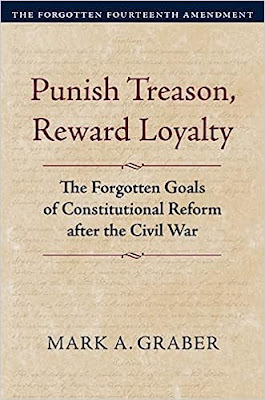
Mark A. Graber, Punish Treason, Reward Loyalty: The Forgotten Goals of Constitutional Reform after the Civil War (University of Kansas Press, 2023)
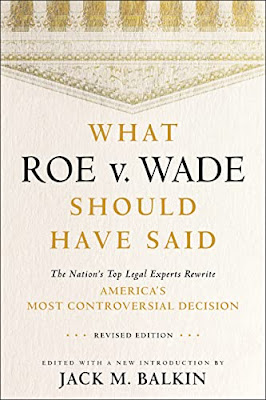
Jack M. Balkin, What Roe v. Wade Should Have Said: The Nation's Top Legal Experts Rewrite America's Most Controversial Decision - Revised Edition (NYU Press, 2023)

Andrew Koppelman, Burning Down the House: How Libertarian Philosophy Was Corrupted by Delusion and Greed (St. Martin’s Press, 2022)

Gerard N. Magliocca, Washington's Heir: The Life of Justice Bushrod Washington (Oxford University Press, 2022)
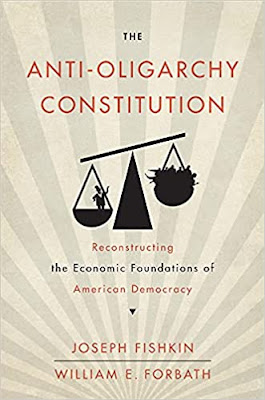
Joseph Fishkin and William E. Forbath, The Anti-Oligarchy Constitution: Reconstructing the Economic Foundations of American Democracy (Harvard University Press, 2022)
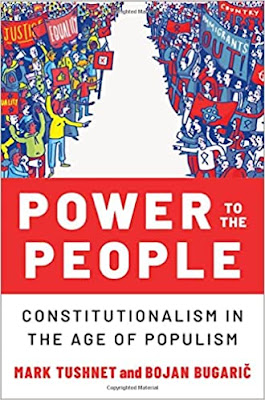
Mark Tushnet and Bojan Bugaric, Power to the People: Constitutionalism in the Age of Populism (Oxford University Press 2021).

Mark Philip Bradley and Mary L. Dudziak, eds., Making the Forever War: Marilyn B. Young on the Culture and Politics of American Militarism Culture and Politics in the Cold War and Beyond (University of Massachusetts Press, 2021).

Jack M. Balkin, What Obergefell v. Hodges Should Have Said: The Nation's Top Legal Experts Rewrite America's Same-Sex Marriage Decision (Yale University Press, 2020)

Frank Pasquale, New Laws of Robotics: Defending Human Expertise in the Age of AI (Belknap Press, 2020)

Jack M. Balkin, The Cycles of Constitutional Time (Oxford University Press, 2020)

Mark Tushnet, Taking Back the Constitution: Activist Judges and the Next Age of American Law (Yale University Press 2020).

Andrew Koppelman, Gay Rights vs. Religious Liberty?: The Unnecessary Conflict (Oxford University Press, 2020)

Ezekiel J Emanuel and Abbe R. Gluck, The Trillion Dollar Revolution: How the Affordable Care Act Transformed Politics, Law, and Health Care in America (PublicAffairs, 2020)

Linda C. McClain, Who's the Bigot?: Learning from Conflicts over Marriage and Civil Rights Law (Oxford University Press, 2020)
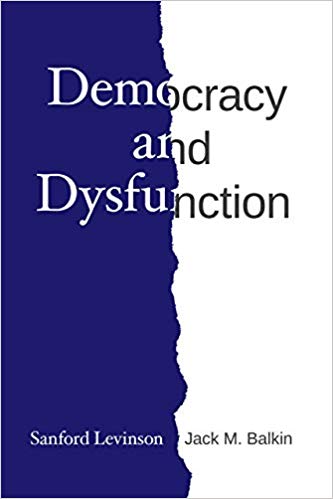
Sanford Levinson and Jack M. Balkin, Democracy and Dysfunction (University of Chicago Press, 2019)

Sanford Levinson, Written in Stone: Public Monuments in Changing Societies (Duke University Press 2018)

Mark A. Graber, Sanford Levinson, and Mark Tushnet, eds., Constitutional Democracy in Crisis? (Oxford University Press 2018)

Gerard Magliocca, The Heart of the Constitution: How the Bill of Rights became the Bill of Rights (Oxford University Press, 2018)

Cynthia Levinson and Sanford Levinson, Fault Lines in the Constitution: The Framers, Their Fights, and the Flaws that Affect Us Today (Peachtree Publishers, 2017)

Brian Z. Tamanaha, A Realistic Theory of Law (Cambridge University Press 2017)

Sanford Levinson, Nullification and Secession in Modern Constitutional Thought (University Press of Kansas 2016)

Sanford Levinson, An Argument Open to All: Reading The Federalist in the 21st Century (Yale University Press 2015)

Stephen M. Griffin, Broken Trust: Dysfunctional Government and Constitutional Reform (University Press of Kansas, 2015)

Frank Pasquale, The Black Box Society: The Secret Algorithms That Control Money and Information (Harvard University Press, 2015)

Bruce Ackerman, We the People, Volume 3: The Civil Rights Revolution (Harvard University Press, 2014)
Balkinization Symposium on We the People, Volume 3: The Civil Rights Revolution

Joseph Fishkin, Bottlenecks: A New Theory of Equal Opportunity (Oxford University Press, 2014)

Mark A. Graber, A New Introduction to American Constitutionalism (Oxford University Press, 2013)

John Mikhail, Elements of Moral Cognition: Rawls' Linguistic Analogy and the Cognitive Science of Moral and Legal Judgment (Cambridge University Press, 2013)

Gerard N. Magliocca, American Founding Son: John Bingham and the Invention of the Fourteenth Amendment (New York University Press, 2013)

Stephen M. Griffin, Long Wars and the Constitution (Harvard University Press, 2013)

Andrew Koppelman, The Tough Luck Constitution and the Assault on Health Care Reform (Oxford University Press, 2013)

James E. Fleming and Linda C. McClain, Ordered Liberty: Rights, Responsibilities, and Virtues (Harvard University Press, 2013)
Balkinization Symposium on Ordered Liberty: Rights, Responsibilities, and Virtues

Andrew Koppelman, Defending American Religious Neutrality (Harvard University Press, 2013)

Brian Z. Tamanaha, Failing Law Schools (University of Chicago Press, 2012)

Sanford Levinson, Framed: America's 51 Constitutions and the Crisis of Governance (Oxford University Press, 2012)

Linda C. McClain and Joanna L. Grossman, Gender Equality: Dimensions of Women's Equal Citizenship (Cambridge University Press, 2012)

Mary Dudziak, War Time: An Idea, Its History, Its Consequences (Oxford University Press, 2012)

Jack M. Balkin, Living Originalism (Harvard University Press, 2011)

Jason Mazzone, Copyfraud and Other Abuses of Intellectual Property Law (Stanford University Press, 2011)

Richard W. Garnett and Andrew Koppelman, First Amendment Stories, (Foundation Press 2011)

Jack M. Balkin, Constitutional Redemption: Political Faith in an Unjust World (Harvard University Press, 2011)

Gerard Magliocca, The Tragedy of William Jennings Bryan: Constitutional Law and the Politics of Backlash (Yale University Press, 2011)

Bernard Harcourt, The Illusion of Free Markets: Punishment and the Myth of Natural Order (Harvard University Press, 2010)

Bruce Ackerman, The Decline and Fall of the American Republic (Harvard University Press, 2010)
Balkinization Symposium on The Decline and Fall of the American Republic

Ian Ayres. Carrots and Sticks: Unlock the Power of Incentives to Get Things Done (Bantam Books, 2010)

Mark Tushnet, Why the Constitution Matters (Yale University Press 2010)

Ian Ayres and Barry Nalebuff: Lifecycle Investing: A New, Safe, and Audacious Way to Improve the Performance of Your Retirement Portfolio (Basic Books, 2010)
.jpg)
Jack M. Balkin, The Laws of Change: I Ching and the Philosophy of Life (2d Edition, Sybil Creek Press 2009)

Brian Z. Tamanaha, Beyond the Formalist-Realist Divide: The Role of Politics in Judging (Princeton University Press 2009)
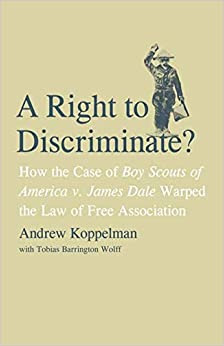
Andrew Koppelman and Tobias Barrington Wolff, A Right to Discriminate?: How the Case of Boy Scouts of America v. James Dale Warped the Law of Free Association (Yale University Press 2009)

Jack M. Balkin and Reva B. Siegel, The Constitution in 2020 (Oxford University Press 2009)

Heather K. Gerken, The Democracy Index: Why Our Election System Is Failing and How to Fix It (Princeton University Press 2009)

Mary Dudziak, Exporting American Dreams: Thurgood Marshall's African Journey (Oxford University Press 2008)

David Luban, Legal Ethics and Human Dignity (Cambridge Univ. Press 2007)

Ian Ayres, Super Crunchers: Why Thinking-By-Numbers is the New Way to be Smart (Bantam 2007)

Jack M. Balkin, James Grimmelmann, Eddan Katz, Nimrod Kozlovski, Shlomit Wagman and Tal Zarsky, eds., Cybercrime: Digital Cops in a Networked Environment (N.Y.U. Press 2007)
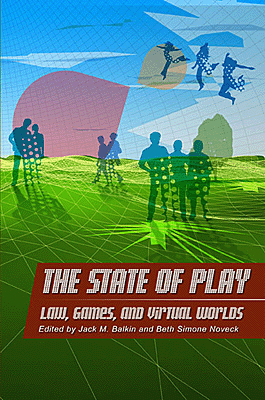
Jack M. Balkin and Beth Simone Noveck, The State of Play: Law, Games, and Virtual Worlds (N.Y.U. Press 2006)

Andrew Koppelman, Same Sex, Different States: When Same-Sex Marriages Cross State Lines (Yale University Press 2006)

Brian Tamanaha, Law as a Means to an End (Cambridge University Press 2006)

Sanford Levinson, Our Undemocratic Constitution (Oxford University Press 2006)

Mark Graber, Dred Scott and the Problem of Constitutional Evil (Cambridge University Press 2006)

Jack M. Balkin, ed., What Roe v. Wade Should Have Said (N.Y.U. Press 2005)

Sanford Levinson, ed., Torture: A Collection (Oxford University Press 2004)
Balkin.com homepage
Bibliography
Conlaw.net
Cultural Software
Writings
Opeds
The Information Society Project
BrownvBoard.com
Useful Links
Syllabi and Exams
