Balkinization
an unanticipated consequence of
Jack M. Balkin
Balkinization Symposiums: A Continuing List
E-mail:
Jack Balkin:
jackbalkin at yahoo.com
Bruce Ackerman
bruce.ackerman at yale.edu
Ian Ayres
ian.ayres at yale.edu
Corey Brettschneider
corey_brettschneider at brown.edu
Mary Dudziak
mary.l.dudziak at emory.edu
Joey Fishkin
joey.fishkin at gmail.com
Heather Gerken heather.gerken at yale.edu
Abbe Gluck abbe.gluck at yale.edu
Mark Graber
mgraber at law.umaryland.edu
Stephen Griffin
sgriffin at tulane.edu
Jonathan Hafetz
jonathan.hafetz at shu.edu
Jeremy Kessler
jkessler at law.columbia.edu
Andrew Koppelman
akoppelman at law.northwestern.edu
Marty Lederman
msl46 at law.georgetown.edu
Sanford Levinson
slevinson at law.utexas.edu
David Luban
david.luban at gmail.com
Gerard Magliocca
gmaglioc at iupui.edu
Jason Mazzone
mazzonej at illinois.edu
Linda McClain
lmcclain at bu.edu
John Mikhail
mikhail at law.georgetown.edu
Frank Pasquale
pasquale.frank at gmail.com
Nate Persily
npersily at gmail.com
Michael Stokes Paulsen
michaelstokespaulsen at gmail.com
Deborah Pearlstein
dpearlst at yu.edu
Rick Pildes
rick.pildes at nyu.edu
David Pozen
dpozen at law.columbia.edu
Richard Primus
raprimus at umich.edu
K. Sabeel Rahmansabeel.rahman at brooklaw.edu
Alice Ristroph
alice.ristroph at shu.edu
Neil Siegel
siegel at law.duke.edu
David Super
david.super at law.georgetown.edu
Brian Tamanaha
btamanaha at wulaw.wustl.edu
Nelson Tebbe
nelson.tebbe at brooklaw.edu
Mark Tushnet
mtushnet at law.harvard.edu
Adam Winkler
winkler at ucla.edu
Compendium of posts on Hobby Lobby and related cases
The Anti-Torture Memos: Balkinization Posts on Torture, Interrogation, Detention, War Powers, and OLC
The Anti-Torture Memos (arranged by topic)
Recent Posts
Can Congress Investigate Whether the President Has Complied with the Law?
How Did the Department of Defense Decide to Authorize Torture, Cruel Treatment, and Violations of the Uniform Code of Military Justice?
Law, Organizing (and Philanthropy) in the Radical Fund
Cities in the anti-global age?
Balkinization Symposium on City Power: Urban Governance in a Global Age
Marriage and Family Law Pluralism: Commentary on Eskridge and Riano’s Marriage Equality: From Outlaws to In-Laws

Just A Few Blogs
ACS Blog
Alas, a Blog
Althouse
Arts and Letters Daily
Atrios (Eschaton)
Bill of Health
Buzzflash.com
Buzz Machine
Cato at Liberty
Juan Cole (Informed Comment)
Concurring Opinions
The Constitution in 2020
Corrente
Crooked Timber
Daily Howler
Daily Kos
Dana Boyd
Brad DeLong
Digby (Hullabaloo)
Discriminations
Daniel Drezner
Kevin Drum (Mother Jones)
Electrolite
En Banc
Eunomia (Daniel Larison)
Fafblog
Michael Froomkin (Discourse.net)
GovLab (Beth Noveck)
Rick Hasen (Election Law)
History News Network
How Appealing
Ignatz (Sam Heldman)
The Importance of (Ernie Miller)
Infolaw
Instapundit
International Economic Law and Policy Blog
IntLawGrrls
Jacob Levy
Jesus' General
Jurisdynamics
The Kitchen Cabinet
Mark Kleiman
Law Blog Central
Larry Lessig
Lawyers, Guns and Money
Liberal Oasis
Brian Leiter's Law School Reports
The Leiter Reports
Marginal Revolution
Megan McArdle
Memeorandum
Metafilter
Mirror of Justice
The New Republic
Newseum
No More Mister Nice Blog
Brendan Nyhan
Opinio Juris
Orcinus
The Originalism Blog
Pandagon
Passport (Foreign Policy)
Overcoming Bias
Political Animal (Washington Monthly)
Political Theory Daily Review
Political Wire (Taegan Goddard)
The Poor Man
Virginia Postrel
Prawfsblawg
Public Reason
Jonathan Rauch
Raw Story
Redstate
ReligiousLeftLaw.com
Reporters Committee For Freedom of the Press
Reproductive Rights Blog
Rothman's Roadmap to the Right of Publicity
SCOTUS Blog
Seeing the Forest
Clay Shirky
The Shifted Librarian
The Situationist
Larry Solum (Legal Theory)
Andrew Sullivan
Talking Points Memo
Talk Left
Tapped
Tbogg
TechPresident
The Paper Chase (Jurist)
Tom Paine
Tom Tomorrow (This Modern World)
Eve Tushnet
Uggabugga
University of Chicago Law School Faculty Blog
Unqualified Offerings
The Volokh Conspiracy
War and Piece (Laura Rozen)
Wampum
Oliver Willis
Wonkette
Written Description
Matthew Yglesias
Yin
Your Choice of Feeds
1. XML
powered by

2. Atom Feed
3. RSS 2.0
Can Congress Investigate Whether the President Has Complied with the Law?
Marty Lederman
Attention, first-year ConLaw students who haven't yet taken your final exams!: You might want to consider how you'd answer that question.
No, really. You're no doubt wondering: Is that a trick question? Well, until today it would have been. But now . . .
The House Committee on Oversight and Reform recently asked Mazars USA LLP, one of Donald Trump's accountants, to provide documents and information relating to the firm’s preparation, review, and auditing of financial statements for Trump and his business entities. Mazars told the Committee that it couldn't voluntarily provide the requested documents without a subpoena, and so on April 15th the Committee issued a subpoena to Mazars for the documents.
Trump sued Mazars and the Committee Chairman (who was soon replaced as a defendant by the Committee itself), seeking to enjoin the Committee from enforcing its subpoena to Mazars.
This case doesn't raise any issues of executive privilege or immunity from legislative process. Trump's claim is entirely predicated, instead, on the argument that Congress lacks any legitimate investigative authority that could justify trying to obtain Trump's financial records from Mazars.
A couple of hours ago I attended a hearing that Judge Amit Mehta held on the merits of Trump v. House Committee on Oversight and Reform, No. 19-1136 (D.D.C.). Judge Mehta began his questioning of Trump's lawyer, Will Consovoy, in precisely the right place: He asked, one by one, whether Congress has the power to inquire into any or all of the four specific topics identified by Chairman Elijah Cummings in his memorandum to the Committee a month ago, explaining the basis for the request to Mazars. Cummings wrote that:
The Committee has full authority [1] to investigate whether the President may have engaged in illegal conduct before and during his tenure in office, [2] to determine whether he has undisclosed conflicts of interest that may impair his ability to make impartial policy decisions, [3] to assess whether he is complying with the Emoluments Clauses of the Constitution, and [4] to review whether he has accurately reported his finances to the Office of Government Ethics and other federal entities. The committee’s interest in these matters informs its review of multiple laws and legislative proposals under our jurisdiction, and to suggest otherwise is both inaccurate and contrary to the core mission of the committee to serve as an independent check on the Executive Branch.
Judge Mehta started from the end of this litany: Does Congress have authority to inquire into whether a president "has accurately reported his finances to the Office of Government Ethics?," he asked.
No, said Consovoy.
What about to assess whether the President is violating the Emoluments Clauses of the Constitution? After all, Judge Mehta noted, Article I, section 9 specifically provides that an officer can't accept any present, Emolument, Office, or Title, of any kind whatever, from any King, Prince, or foreign State, "without the Consent of the Congress."
No go, said Consovoy, Congress can't inquire into the President's possible acceptance of any foreign emoluments, either.
OK, but what about trying to determine whether Trump has undisclosed conflicts of interest that may impair his ability to be impartial in the conduct of his office?
Same answer.
(At this point the die was cast: Judge Mehta didn't get around to asking specifically about Congress's authority to investigate whether the President may have "engaged in illegal conduct before and during his tenure in office," because it wasn't hard to guess what Consovoy's response would have been. Indeed, according to my notes Consovoy did say at one point that Congress lacks any power to assess whether the President is violating the law!)
When it was his turn to argue, Counsel for the House Doug Letter explained why Chairman Cummings was right that "[t]he committee’s interest in these matters informs its review of multiple laws and legislative proposals under our jurisdiction"--which ought to be enough, in and of itself, to justify the subpoena.
But even apart from such "legislative" functions, Judge Mehta wondered, what about Congress's "informing function"--the power of Congress, which the Supreme Court has recognized, "to inquire into and publicize corruption, maladministration or inefficiency in agencies of the Government"? Watkins v. United States, 354 U.S. 178, 200 n.33 (1957). After all, as the Court noted in Watkins, id., "[f]rom the earliest times in its history, the Congress has assiduously performed an 'informing function' of this nature."
Consovoy conceded, as he had to in light of Watkins, that Congress has the power to inquire into and publicize corruption, maladministration or inefficiency in agencies--which are, Consovoy explained, entities created by Congress itself. However, Consovoy hastened to add, Congress does not enjoy a similar power to inquire into and publicize corruption, maladministration or inefficiency by the President.
Wait . . . WHAT? Congress lacks authority to investigate and publicize possible wrongdoing--corruption or maladministration--by the President? Did I hear that right? But cf. Nixon v. Administrator of General Services, 433 U.S, 425, 452-53 (1977) (explaining that Congress enacted a law requiring preservation of a president's records and tapes in order to, inter alia, secure "the American people's ability to reconstruct and come to terms with their history").
Apparently I did, because Judge Mehta, too, was incredulous. He asked Consovoy the obvious follow-up question: Does this mean that Congress's investigations into Watergate and Whitewater [and, I might add, Iran/Contra; etc.] were unconstitutional? Consovoy responded (if my notes are correct) that that would depend upon the basis for those investigations. It was "straightforward," said Judge Mehta: Congress was inquiring into possible violations of the law by the President. In that case, Consovoy said, then yes, perhaps Congress did overstep its authority. [That's my recollection of the substance of Consovoy's responses--not direct quotations. If anyone who attended has a different account, please let me know. Of course when the transcript becomes available I'll insert direct quotations.]
"Bold," "radical" and "unprecedented" don't begin to describe this line of argument. I'm not sure what does. Flabbergasting, I suppose.
I assume Consovoy--a very fine and accomplished advocate--will offer a less astounding, less categorical, answer to such questions when he next has an opportunity to brief them. But for now . . . wow.
As Judge Mehta's colloquy with Letter indicated, the case also raises questions about whether the particular subpoena at issue here is reasonably tailored to the Committee's legitimate inquiries, and whether the scope of the inquiries exceeds the Committee's jurisdiction. I don't know remotely enough about the facts of the case and the Committee's jurisdiction to offer any informed views on those questions.
[UPDATE: Charlie Savage's account of the hearing is, as usual, spot-on.]
Posted
6:21 PM
by Marty Lederman [link]
How Did the Department of Defense Decide to Authorize Torture, Cruel Treatment, and Violations of the Uniform Code of Military Justice?
Marty Lederman
The Senate Armed Services Committee is currently holding a hearing addressing that very question. The Committee has released several new, important documents relating to the question.
In late 2002, interrogators at GTMO were growing increasingly frustrated that certain detainees, especially Mohammad al-Qahtani, would not provide them with the sort of actionable intelligence they were hoping for. On September 25, 2002, David Addington, Jim Haynes, John Rizzo (Acting CIA General Counsel, Michael Chertoff, and others, visited GTMO and consulted with officials there about interrogations.
The next week, on October 2d, those officials convened, with CIA Associate General Counsel Jonathan Fredman, to review "Counter Resistance Strategy," at a meeting in which they contemplated the use of the aggressive "SERE" techniques. When Col. Cummings noted that they could not use sleep deprivation, Diane Beaver, a Staff Judge Advocate for the Joint Task Force 170/JTF, Guantanamo Bay, responded "Yes, we can -- with approval." Beaver noted that "we may need to curb the harsher operations while ICRC [the Red Cross] is around. Dave Becker noted that they had "many reports" of sleep deprivation being used at Bagram, in Afghanistan. Beaver's response?: "True, but officially it is not happening. It is not being reported officially. The ICRC is a serious concern." Cummings noted that the new Pysh Op plan had already been passed up the chain, and Jonathan Fredman of the CIA added that "DOJ has provided much guidance on this issue." Fredman then basically describes the August 2002 OLC torture memo in detail.
Then there was a discussion about whether to videotape the interrogation sessions. Beaver responded in the negative: "Videotapes are subject to too much scrutiny in court."
On October 11th, Beaver wrote her famous memo recommending the use of the enhanced techniques. Those techniques included many that were later approved for use on al-Qahtani: forced nudity, forced grooming, "[u]sing detainees['] individual phobias (such as fear of dogs) to induce stress," 20-hour interrogations, stress positions, and the use of mild physical contact such as grabbing, poking and light pushing. The proposed techniques also included waterboarding (the use of a wet towel and dripping water to induce the misperception of suffocation), and "scenarios designed to convince the detainee that death or severely painful consequences are imminent for him and/or his family."
The problem, of course, was the law. In addition to the torture statute, Beaver noted that the Uniform Code of Military Justice prohibits U.S. armed forces from, among other things, engaging in cruelty, oppression or maltreatment of prisoners (art. 93), assaulting prisoners (art. 128) (a prohibition that includes a demonstration of violence that results in reasonable apprehension of immediate bodily harm), and communicating a threat to wrongfully injure a detainee (art. 134). The UCMJ plainly prohibits many of the techniques the military wished to use against suspects such as al-Qahtani. Beaver wrote that "Article 128 is the article most likely to be violated because a simple assault can be consummated by an unlawful demonstration of violence which creates in the mind of another a reasonable apprehension of receiving immediate bodily harm, and a specific intent to actually inflict bodily harm is not required." Beaver then notes, almost in passing, that physical contact with a detainee "will technically constitute an assault under Article 128, UCMJ." In an earlier paragraph, Beaver is still more candid in acknowledging that physical contact, as well as the "water cure" version of waterboarding, "would constitute a per se violation of Article 128 (Assault)," and that threats of death "may also constitute a violation of Article 128, or also Article 134 (communicating a threat)."
Well, then, if some of the proposed techniques are acknowledged to be "per se" federal crimes, how was it that Beaver could then recommend their use and (in a cover memo) conclude that they "do not violate applicable federal law"? Here's the only clue in her memo: She writes that because of the "per se" prohibitions of the UCMJ, "[i]t would be advisable to have permission or immunity in advance from the convening authority, for military members utilizing these methods." No explanation here of the legal theory pursuant to which such ex ante "permission or immunity" to violate the law could be conferred. But Beaver clearly had been made aware of DOJ's conclusion that the President, as Commander in Chief, could simply authorize the overriding of mere statutes such as the UCMJ.
Beaver's memo went up the chain of command. On October 25, 2002, General Hill transmitted the memo to the Joint Chiefs -- but Hill, like Beaver, indicated that the law stood in the way. "I am uncertain," he wrote, "whether all the techniques . . . are legal under US law," and he expressed his "desire to have as many options as possible at my disposal and therefore request that Department of Defense and Department of Justice lawyers review" some of the techniques.
DOD General Counsel Jim Haynes and Secretary Rumsfeld did not act on the Hill memo for over a month. What happened in that time? Now we know: The JAGs of the Armed Services opined, in early November, that the use of the SERE techniques would likely violate criminal laws (the torture statute and/or the UCMJ), and, for good measure, would appear to also violate the President's directive that detainees be treated "humanely." (These lawyers did not understand what the President and Vice President meant by "humane.") Oh, and the use of those techniques would also undermine the ability to obtain convictions in any military commission proceedings. (Prescient, weren't they?)
OK, so Beaver and Hill both opined that the techniques would likely violate the law -- and the JAGs advised likewise. So what happened next?
Well, Jim Haynes consulted with Deputy Secretary Wolfowitz, Doug Feith and General Myers, after which, on November 27, 2002, he opined to Secretary Rumsfeld that all of the proposed techniques "may be legally available." (Haynes also advised that, for policy reasons, "a blanket approval" of waterboarding and threats of death "is not warranted at this time.")
Note that carefully: Haynes was advised by many lawyers, throughout the Pentagon, that the techniques would be unlawful -- after which, without explanation, he informed the Secretary that they all "may be legally available" -- and recommended approval of some of the most extreme techniques.
How could that possibly have happened?
Well, it's quite obvious what occurred here: Haynes, Rumsfeld, Wolowitz, Feith, Cambone, et al., had been made aware of OLC's opinion that the Commander in Chief could authorize any interrogation techniques, whether or not such conduct would violate any statutes or treaties. They had probably seen the August 2002 torture memo, and almost certainly were advised orally that OLC had in its back pocket 1001 legal theories -- topped off by the Commander in Chief argument --- why mere statutes and treaties posed no obstacle to the use of torture, cruel treatment, threats, and assaults. That is to say, they had received informal OLC advice that tracked the formal memo they eventually received from John Yoo on March 14, 2003.
After all, let's not forget that, as Seymour Hersh reported in 2004, Secretary Rumsfeld and Under-Secretary Cambone had, much earlier, established secret special access programs (SAPs) within DoD that were authorized to use rough treatment, and sexual humiliation, in interrogating not only suspected al Qaeda operatives in Afghanistan, but also the numerous persons rounded up as possible "insurgents" in Iraq. As Beaver, et al. well knew, these forces were already using cruel treatment in Afghanistan. (For a recent account of the nature of that treatment, see this latest McClatchy story.) And as the Fay Report explained, "CIA detention and interrogation practices [in Iraq] led to a loss of accountability, abuse, reduced interagency cooperation, and an unhealthy mystique that further poisoned the atmosphere at Abu Ghraib" (pp. 52-53). The CIA practices and techniques led to a "perception" that such techniques and practices "were suitable and authorized for DoD operations" (pp. 118-119).
Posted
9:43 AM
by Marty Lederman [link]
Law, Organizing (and Philanthropy) in the Radical Fund
Guest Blogger
For the Balkinization symposium on John Witt, The Radical Fund: How a Band of Visionaries and a Million Dollars Upended America (Simon and Schuster, 2025).
Benjamin
Sachs For anyone
interested in the contemporary labor movement, and in efforts at revitalizing
it, John Witt’s The Radical Fund is important reading. Indeed, the book is
uncanny in its relevance for contemporary labor movement trends, challenges,
and opportunities. One obvious way this is true goes to the core of the book’s
project: the contest in the early 20th century over the role of
philanthropy in supporting the labor movement, related with masterful
storytelling, sheds light on those same questions in contemporary practice. Indeed,
there are concrete lessons to be learned here. To take one example, the
importance of Brookwood Labor College (nearly forgotten today) to the sweep of
labor activism across these years – from the role it played in realizing Sidney
Hillman’s new unionism to the contribution it made to the success of the
sit-down strikes of the 1930s – suggests that philanthropic support for a
re-imagined system of labor education should be higher on philanthropy’s agenda
today. But it is
another aspect of The Radical Fund that I want to highlight: namely, the
history the book tells about the relationship between law and worker organizing.
This question of how law and organizing relate has been the focus for a set of
legal scholars over the last few decades and is now the subject of an extensive
body of scholarship. In addition to other essential historical work on the
subject, early works in the “law and organizing” literature proper include
Scott Cummings and Ingrid Eagly’s A Critical Reflection on Law and
Organizing and Jennifer Gordon’s book We Make the Road by Walking.
More recent work includes Greg Balz’ writing (e.g., Resurrecting the Rent
Strike Law), Cummings and Elmore’s Mobilizable Labor Law and a pair
of articles by Kate Andrias and me (Constructing Countervailing Power and
The Chicken-and-Egg of Law and Organizing) along with critiques of that
work like Catherine Fisk’s The Once and Future Countervailing Power of Labor.
The animating question in all this scholarship is how law can best be
understood and deployed by organizers to build power with and for workers.
Posted
9:30 AM
by Guest Blogger [link]
Cities in the anti-global age?
Guest Blogger
Scott Cummings
Scott Cummings is Robert Henigson Professor of Legal Ethics and Professor of Law at UCLA. You can reach him by e-mail at cummings at law.ucla.edu
Posted
9:30 AM
by Guest Blogger [link]
Balkinization Symposium on City Power: Urban Governance in a Global Age
JB

This week Balkinization will host an online symposium on Richard Schragger's new book, City Power: Urban Governance in a Global Age (Oxford University Press, 2016).
Participants will include Scott Cummings, Nestor Davidson, Richardson Dilworth, Lee Fennell, and Kathleen Morris. Richard will respond to their essays.
Posted
1:42 PM
by JB [link]
Marriage and Family Law Pluralism: Commentary on Eskridge and Riano’s Marriage Equality: From Outlaws to In-Laws
Guest Blogger
For the Balkinization symposium on William N. Eskridge, Jr., and Christopher Riano, Marriage Equality: From Outlaws to In-Laws (Yale University Press, 2020). Doug NeJaime Yesterday
I focused on the innovative and important LGBT family law work documented in
William Eskridge and Christopher Riano’s breathtaking book, Marriage
Equality: From Outlaws to In-Laws. I discussed domestic partnerships,
designated beneficiaries, second-parent adoption, parentage judgments, and
voluntary acknowledgments of parentage (VAPs). I did not discuss marriage. Yet
the book is an account of the path to marriage equality. Today, I’ll explore
the tension between the family law pluralism I addressed yesterday and the
fight for marriage equality at the heart of the book. Eskridge and Riano
carefully analyze this tension—detailing how LGBT efforts were channeled into
marriage and contemplating the legal regulation of families in a post-marriage
equality world.
Posted
9:30 AM
by Guest Blogger [link]
Books by Balkinization Bloggers

Mark Tushnet and Bojan Bugaric, Constitutionalism and Its Discontents (University of Chicago Press, 2026)

Gerard N. Magliocca, The Actual Art of Governing: Justice Robert H. Jackson's Concurring Opinion in the Steel Seizure Case (Oxford University Press, 2025)

Linda C. McClain and Aziza Ahmed, The Routledge Companion to Gender and COVID-19 (Routledge, 2024)

David Pozen, The Constitution of the War on Drugs (Oxford University Press, 2024)

Jack M. Balkin, Memory and Authority: The Uses of History in Constitutional Interpretation (Yale University Press, 2024)
Mark A. Graber, Punish Treason, Reward Loyalty: The Forgotten Goals of Constitutional Reform after the Civil War (University of Kansas Press, 2023)
Jack M. Balkin, What Roe v. Wade Should Have Said: The Nation's Top Legal Experts Rewrite America's Most Controversial Decision - Revised Edition (NYU Press, 2023)

Andrew Koppelman, Burning Down the House: How Libertarian Philosophy Was Corrupted by Delusion and Greed (St. Martin’s Press, 2022)

Gerard N. Magliocca, Washington's Heir: The Life of Justice Bushrod Washington (Oxford University Press, 2022)
Joseph Fishkin and William E. Forbath, The Anti-Oligarchy Constitution: Reconstructing the Economic Foundations of American Democracy (Harvard University Press, 2022)
Mark Tushnet and Bojan Bugaric, Power to the People: Constitutionalism in the Age of Populism (Oxford University Press 2021).

Mark Philip Bradley and Mary L. Dudziak, eds., Making the Forever War: Marilyn B. Young on the Culture and Politics of American Militarism Culture and Politics in the Cold War and Beyond (University of Massachusetts Press, 2021).

Jack M. Balkin, What Obergefell v. Hodges Should Have Said: The Nation's Top Legal Experts Rewrite America's Same-Sex Marriage Decision (Yale University Press, 2020)

Frank Pasquale, New Laws of Robotics: Defending Human Expertise in the Age of AI (Belknap Press, 2020)

Jack M. Balkin, The Cycles of Constitutional Time (Oxford University Press, 2020)

Mark Tushnet, Taking Back the Constitution: Activist Judges and the Next Age of American Law (Yale University Press 2020).

Andrew Koppelman, Gay Rights vs. Religious Liberty?: The Unnecessary Conflict (Oxford University Press, 2020)

Ezekiel J Emanuel and Abbe R. Gluck, The Trillion Dollar Revolution: How the Affordable Care Act Transformed Politics, Law, and Health Care in America (PublicAffairs, 2020)

Linda C. McClain, Who's the Bigot?: Learning from Conflicts over Marriage and Civil Rights Law (Oxford University Press, 2020)
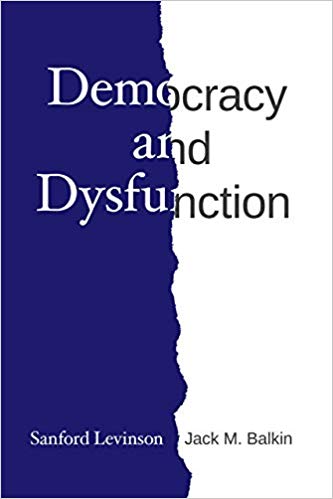
Sanford Levinson and Jack M. Balkin, Democracy and Dysfunction (University of Chicago Press, 2019)

Sanford Levinson, Written in Stone: Public Monuments in Changing Societies (Duke University Press 2018)

Mark A. Graber, Sanford Levinson, and Mark Tushnet, eds., Constitutional Democracy in Crisis? (Oxford University Press 2018)

Gerard Magliocca, The Heart of the Constitution: How the Bill of Rights became the Bill of Rights (Oxford University Press, 2018)

Cynthia Levinson and Sanford Levinson, Fault Lines in the Constitution: The Framers, Their Fights, and the Flaws that Affect Us Today (Peachtree Publishers, 2017)

Brian Z. Tamanaha, A Realistic Theory of Law (Cambridge University Press 2017)

Sanford Levinson, Nullification and Secession in Modern Constitutional Thought (University Press of Kansas 2016)

Sanford Levinson, An Argument Open to All: Reading The Federalist in the 21st Century (Yale University Press 2015)

Stephen M. Griffin, Broken Trust: Dysfunctional Government and Constitutional Reform (University Press of Kansas, 2015)

Frank Pasquale, The Black Box Society: The Secret Algorithms That Control Money and Information (Harvard University Press, 2015)

Bruce Ackerman, We the People, Volume 3: The Civil Rights Revolution (Harvard University Press, 2014)
Balkinization Symposium on We the People, Volume 3: The Civil Rights Revolution

Joseph Fishkin, Bottlenecks: A New Theory of Equal Opportunity (Oxford University Press, 2014)

Mark A. Graber, A New Introduction to American Constitutionalism (Oxford University Press, 2013)

John Mikhail, Elements of Moral Cognition: Rawls' Linguistic Analogy and the Cognitive Science of Moral and Legal Judgment (Cambridge University Press, 2013)

Gerard N. Magliocca, American Founding Son: John Bingham and the Invention of the Fourteenth Amendment (New York University Press, 2013)

Stephen M. Griffin, Long Wars and the Constitution (Harvard University Press, 2013)

Andrew Koppelman, The Tough Luck Constitution and the Assault on Health Care Reform (Oxford University Press, 2013)

James E. Fleming and Linda C. McClain, Ordered Liberty: Rights, Responsibilities, and Virtues (Harvard University Press, 2013)
Balkinization Symposium on Ordered Liberty: Rights, Responsibilities, and Virtues

Andrew Koppelman, Defending American Religious Neutrality (Harvard University Press, 2013)

Brian Z. Tamanaha, Failing Law Schools (University of Chicago Press, 2012)

Sanford Levinson, Framed: America's 51 Constitutions and the Crisis of Governance (Oxford University Press, 2012)

Linda C. McClain and Joanna L. Grossman, Gender Equality: Dimensions of Women's Equal Citizenship (Cambridge University Press, 2012)

Mary Dudziak, War Time: An Idea, Its History, Its Consequences (Oxford University Press, 2012)

Jack M. Balkin, Living Originalism (Harvard University Press, 2011)

Jason Mazzone, Copyfraud and Other Abuses of Intellectual Property Law (Stanford University Press, 2011)

Richard W. Garnett and Andrew Koppelman, First Amendment Stories, (Foundation Press 2011)

Jack M. Balkin, Constitutional Redemption: Political Faith in an Unjust World (Harvard University Press, 2011)

Gerard Magliocca, The Tragedy of William Jennings Bryan: Constitutional Law and the Politics of Backlash (Yale University Press, 2011)

Bernard Harcourt, The Illusion of Free Markets: Punishment and the Myth of Natural Order (Harvard University Press, 2010)

Bruce Ackerman, The Decline and Fall of the American Republic (Harvard University Press, 2010)
Balkinization Symposium on The Decline and Fall of the American Republic

Ian Ayres. Carrots and Sticks: Unlock the Power of Incentives to Get Things Done (Bantam Books, 2010)

Mark Tushnet, Why the Constitution Matters (Yale University Press 2010)

Ian Ayres and Barry Nalebuff: Lifecycle Investing: A New, Safe, and Audacious Way to Improve the Performance of Your Retirement Portfolio (Basic Books, 2010)

Jack M. Balkin, The Laws of Change: I Ching and the Philosophy of Life (2d Edition, Sybil Creek Press 2009)

Brian Z. Tamanaha, Beyond the Formalist-Realist Divide: The Role of Politics in Judging (Princeton University Press 2009)
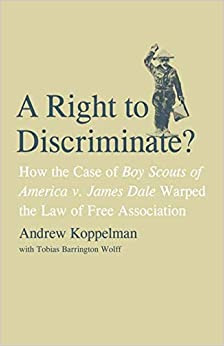
Andrew Koppelman and Tobias Barrington Wolff, A Right to Discriminate?: How the Case of Boy Scouts of America v. James Dale Warped the Law of Free Association (Yale University Press 2009)

Jack M. Balkin and Reva B. Siegel, The Constitution in 2020 (Oxford University Press 2009)

Heather K. Gerken, The Democracy Index: Why Our Election System Is Failing and How to Fix It (Princeton University Press 2009)

Mary Dudziak, Exporting American Dreams: Thurgood Marshall's African Journey (Oxford University Press 2008)

David Luban, Legal Ethics and Human Dignity (Cambridge Univ. Press 2007)

Ian Ayres, Super Crunchers: Why Thinking-By-Numbers is the New Way to be Smart (Bantam 2007)

Jack M. Balkin, James Grimmelmann, Eddan Katz, Nimrod Kozlovski, Shlomit Wagman and Tal Zarsky, eds., Cybercrime: Digital Cops in a Networked Environment (N.Y.U. Press 2007)
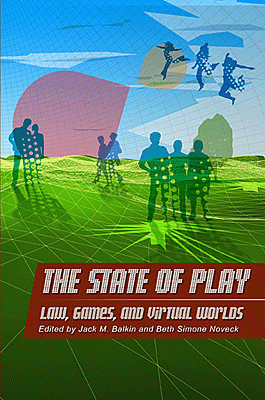
Jack M. Balkin and Beth Simone Noveck, The State of Play: Law, Games, and Virtual Worlds (N.Y.U. Press 2006)

Andrew Koppelman, Same Sex, Different States: When Same-Sex Marriages Cross State Lines (Yale University Press 2006)

Brian Tamanaha, Law as a Means to an End (Cambridge University Press 2006)

Sanford Levinson, Our Undemocratic Constitution (Oxford University Press 2006)

Mark Graber, Dred Scott and the Problem of Constitutional Evil (Cambridge University Press 2006)

Jack M. Balkin, ed., What Roe v. Wade Should Have Said (N.Y.U. Press 2005)

Sanford Levinson, ed., Torture: A Collection (Oxford University Press 2004)
Balkin.com homepage
Bibliography
Conlaw.net
Cultural Software
Writings
Opeds
The Information Society Project
BrownvBoard.com
Useful Links
Syllabi and Exams
