Balkinization
an unanticipated consequence of
Jack M. Balkin
Balkinization Symposiums: A Continuing List
E-mail:
Jack Balkin:
jackbalkin at yahoo.com
Bruce Ackerman
bruce.ackerman at yale.edu
Ian Ayres
ian.ayres at yale.edu
Corey Brettschneider
corey_brettschneider at brown.edu
Mary Dudziak
mary.l.dudziak at emory.edu
Joey Fishkin
joey.fishkin at gmail.com
Heather Gerken heather.gerken at yale.edu
Abbe Gluck abbe.gluck at yale.edu
Mark Graber
mgraber at law.umaryland.edu
Stephen Griffin
sgriffin at tulane.edu
Jonathan Hafetz
jonathan.hafetz at shu.edu
Jeremy Kessler
jkessler at law.columbia.edu
Andrew Koppelman
akoppelman at law.northwestern.edu
Marty Lederman
msl46 at law.georgetown.edu
Sanford Levinson
slevinson at law.utexas.edu
David Luban
david.luban at gmail.com
Gerard Magliocca
gmaglioc at iupui.edu
Jason Mazzone
mazzonej at illinois.edu
Linda McClain
lmcclain at bu.edu
John Mikhail
mikhail at law.georgetown.edu
Frank Pasquale
pasquale.frank at gmail.com
Nate Persily
npersily at gmail.com
Michael Stokes Paulsen
michaelstokespaulsen at gmail.com
Deborah Pearlstein
dpearlst at yu.edu
Rick Pildes
rick.pildes at nyu.edu
David Pozen
dpozen at law.columbia.edu
Richard Primus
raprimus at umich.edu
K. Sabeel Rahmansabeel.rahman at brooklaw.edu
Alice Ristroph
alice.ristroph at shu.edu
Neil Siegel
siegel at law.duke.edu
David Super
david.super at law.georgetown.edu
Brian Tamanaha
btamanaha at wulaw.wustl.edu
Nelson Tebbe
nelson.tebbe at brooklaw.edu
Mark Tushnet
mtushnet at law.harvard.edu
Adam Winkler
winkler at ucla.edu
Compendium of posts on Hobby Lobby and related cases
The Anti-Torture Memos: Balkinization Posts on Torture, Interrogation, Detention, War Powers, and OLC
The Anti-Torture Memos (arranged by topic)
Recent Posts
The Unbound Constitution Reconsidered: Skowronek’s Framework and History of Constitutional Reordering
![[Powered by Blogger]](https://lh3.googleusercontent.com/blogger_img_proxy/AEn0k_s94OTIxtTpv9l3r4Vdhcjmbw8XCBH8p29j5AnbS7-vWPSPbgJZPR_lMB3hzMW1YPdGHGVGL7ez6tfxkMo4xmV2iKrOw82OcLOP_YN_GsqZ=s0-d)
Just A Few Blogs
ACS Blog
Alas, a Blog
Althouse
Arts and Letters Daily
Atrios (Eschaton)
Bill of Health
Buzzflash.com
Buzz Machine
Cato at Liberty
Juan Cole (Informed Comment)
Concurring Opinions
The Constitution in 2020
Corrente
Crooked Timber
Daily Howler
Daily Kos
Dana Boyd
Brad DeLong
Digby (Hullabaloo)
Discriminations
Daniel Drezner
Kevin Drum (Mother Jones)
Electrolite
En Banc
Eunomia (Daniel Larison)
Fafblog
Michael Froomkin (Discourse.net)
GovLab (Beth Noveck)
Rick Hasen (Election Law)
History News Network
How Appealing
Ignatz (Sam Heldman)
The Importance of (Ernie Miller)
Infolaw
Instapundit
International Economic Law and Policy Blog
IntLawGrrls
Jacob Levy
Jesus' General
Jurisdynamics
The Kitchen Cabinet
Mark Kleiman
Law Blog Central
Larry Lessig
Lawyers, Guns and Money
Liberal Oasis
Brian Leiter's Law School Reports
The Leiter Reports
Marginal Revolution
Megan McArdle
Memeorandum
Metafilter
Mirror of Justice
The New Republic
Newseum
No More Mister Nice Blog
Brendan Nyhan
Opinio Juris
Orcinus
The Originalism Blog
Pandagon
Passport (Foreign Policy)
Overcoming Bias
Political Animal (Washington Monthly)
Political Theory Daily Review
Political Wire (Taegan Goddard)
The Poor Man
Virginia Postrel
Prawfsblawg
Public Reason
Jonathan Rauch
Raw Story
Redstate
ReligiousLeftLaw.com
Reporters Committee For Freedom of the Press
Reproductive Rights Blog
Rothman's Roadmap to the Right of Publicity
SCOTUS Blog
Seeing the Forest
Clay Shirky
The Shifted Librarian
The Situationist
Larry Solum (Legal Theory)
Andrew Sullivan
Talking Points Memo
Talk Left
Tapped
Tbogg
TechPresident
The Paper Chase (Jurist)
Tom Paine
Tom Tomorrow (This Modern World)
Eve Tushnet
Uggabugga
University of Chicago Law School Faculty Blog
Unqualified Offerings
The Volokh Conspiracy
War and Piece (Laura Rozen)
Wampum
Oliver Willis
Wonkette
Written Description
Matthew Yglesias
Yin
Your Choice of Feeds
1. XML
powered by

2. Atom Feed
3. RSS 2.0
The Unbound Constitution Reconsidered: Skowronek’s Framework and History of Constitutional Reordering
Guest Blogger
For the Balkinization symposium on Stephen Skowronek, The Adaptability Paradox: Political Inclusion and Constitutional Resilience (University of Chicago Press, 2025). Elizabeth Beaumont When Stephen Skowronek argues that the
civil rights revolution “unbound” the U.S. Constitution, he posits a troubling
paradox: America’s greatest democratic achievement—the sweeping inclusion of
the 1960s and 1970s—may have ended the system’s adaptive capacity. But does this diagnosis adequately capture
what happened after the 1960s? In this first post of a three-part series, I
engage Skowronek’s sophisticated historical-structural analysis while
highlighting important dimensions his framework underestimates or overlooks.
The civil rights revolution, I will argue in the next post, produced a
partially successful constitutional adaptation—one that generated new
institutional mechanisms and meaningful (if incomplete) cross-racial consensus.
Current dysfunctions stem less from “unbinding” than from a complex set of
post-inclusion stressors. Constitutional grounding, moreover, can emerge from
the accumulated meanings forged through successive civic struggles rather than
old exclusions. Since the framing of the U.S. Constitution, waves of reformers–
from Anti-Federalists, to free African Americans and anti-slavery activists, to
suffragists, labor activists, progressives, and civil rights activists– have
challenged undemocratic features of the system and pushed for inclusion and
transformative change. Their ideas and struggles have reshaped the political
community and launched constitutional reconstructions (see, e.g. Ackerman 1991,
Ritter 2006, Balkin 2011, Beaumont 2014). In his thought-provoking new book,
Stephen Skowronek turns our focus to crucial questions of how, and whether,
such reorderings were politically implemented. Were their goals carried forward
through stabilizing adaptations that anchored a new consensus, or were they
obstructed, redirected, and left unfulfilled? Skowronek draws unsettling
conclusions from his analysis of four historical eras of constitutional
development. His most sobering contention is that the resilience of the U.S.
Constitution is not only limited, but may be inseparable from its injustices:
earlier adaptations had been made possible by the very exclusions that
prevented full democratic citizenship for African Americans, women, and others,
by limiting the field of competing interests enough to enable minimum
consensus. On this account, although the
civil rights revolution of the 1960s-70s brought broad inclusiveness to
American democracy, it could not generate a successful constitutional
adaptation. Instead, he argues, the Constitution became “unbound,” loosened
from its founding structure and pulled back and forth in divisive conflicts,
eventually producing the present era of polarization, democratic backsliding,
and constitutional dysfunction. In this telling, the greatest achievement of
American democracy – the sweeping democratic expansion of the latter 20th
century – may have ended the constitutional system’s capacity for successful
reordering, with no clear way forward. By drawing on his far-ranging expertise in American politics and
taking a systems-level approach, Skowronek offers a sophisticated account of
broad patterns of constitutional change, boldly reconceptualizing the
development of constitutional democracy in the U.S. This includes potent
arguments regarding how new institutional mechanisms and “auxiliaries” may help
constitutional adaptations succeed by reorganizing governance and managing
conflict. His framework also provides a further, and powerful, challenge to
originalist accounts of the constitutional order. Yet his understanding of
“bounded resilience” and the criteria for judging the success or failure of a
constitutional adaptation raise questions. Skowronek’s Theoretical Framework: Adaptation, Consensus, and
Bounded Resilience The U.S celebrates having “the oldest continuously operating
constitution in the world,” but as Skowronek shows, this nearly 240-year record
has been enabled through a series of significant transformations and
“remodeling projects”(2,6). And, just as the initial U.S. Constitution was not
self-executing and required political action to carry it out, so, too, do
transformative constitutional changes require political follow-through
(95). Standing at the core of the book is Skowronek’s theoretical
framework and historical tracing of how constitutional transformations or
reorderings – reconfigurations of power, authority, and social relationships -
can be politically implemented or impeded. His analysis hinges on inferences
about serial adaptation and a trio of linked concepts and conditions:
reordering adaptation, (re)creation of constitutional consensus, and bounded
resilience. Constitutional adaptation is a combination of continuity and
change, a type of constrained, “resetting,” “steadying,” stabilizing change to
governing arrangements and relations that takes place over decades (9). To
carry out a reordering adaptation, political institutions need to create new
policies and extra-constitutional “auxiliary” arrangements while retaining many
features of the existing system and a connection to the “essential
characteristics” of the initial Constitution’s principles and structure (6,
10-16). These adaptations also depend on
constitutional consensus, the idea that some minimal agreement or shared
“common sense” about constitutional essentials is necessary for governing and
stability. When political institutions work to implement a reordering through a
synthesis of innovations, older institutional elements, and links to the
initial Constitution’s principles and framework, this helps recreate a
constitutional consensus around a new order. But Skowronek believes the U.S. Constitution does not have
unlimited adaptability; it has “bounded resilience.” In his conception, the system is
intranscendably bounded politically and socially, by agreements about constitutional
purposes and limits (such as what is beyond the reach of national governance),
and by social exclusions that long kept the most divisive conflicts – over
race, labor, and gender – off the national political agenda (31-35). In
Skowronek’s analysis, these exclusions were not simply political choices
resulting from the biases and social relations of the time, but played a
crucial stabilizing function, enabling constitutional consensus and resilience.
As he sees it, throughout most of U.S. history, extensive social exclusions
“served as a ballast, holding the system together and aiding in the redirection
of its energies (35). Exclusion, then, serves as morally and politically unjust
yet functional “management device” and consensus-building device: “[Exclusion] displaces conflicts over issues that would, if
fully engaged, threaten the regime’s survival, and it smooths the way toward
agreement on terms of contesting others. It’s not just that exclusions limit
the range of interests and opinions the government needs to manage. Rather, the
consensus is itself a tacit agreement about what lies beyond the reach of
shared principles. The shared interests in government, the “public” interests,
is sustained on mutual understandings of who and what are left out.”(34) Skowronek’s account of bounded resilience raises a critical
question: Were the social exclusions he identifies as morally repugnant but
necessary stabilizing ballasts truly necessary for stabilization? And were they
even very successful as “stabilizers” or did they generate the very civic
conflicts and struggles that repeatedly destabilized earlier settlements,
catalyzing transformative change? If exclusions served as management device for
constraining divisive conflicts, at least for a time, they also fueld sustained
challenges – from white working men, abolitionists, suffragists, labor
activists, civil rights activists –
challenges that would forge new constitutional meanings and precedents.
The formula of exclusion leading to system stability doesn’t seem to hold. Skowronek’ Historical Cases: Constitutional
Adaptation as Successes and Failures? Skowronek grounds this troubling theoretical framework through a
historical-structural approach — a systems-level analysis of pivotal
confrontations between older structures of power and authority and new
political developments that challenged them (8). He uses this historical
exploration to tie bounded resilience to the original Constitution and to
identify the conditions under which constitutional adaptation succeeds or
fails. Yet we will see that his assessment raises questions about criteria for
successful vs. unsuccessful adaptation, and whether constitutional adaptation
always involves some combination of successes and failures: both/and rather
than either/or. He begins by returning to constitutional creation and
ratification, which Skowronek views both as the two most extraordinary acts of
adaptive reordering in American political development, and as creating the
Constitution’s bounded resilience (14). These actions established a set of fundamental
principles (sometimes in tension, such as national supremacy and local
autonomy, or majority rule and minority protection) and a new foundational
structure spearheaded by federalism and separation of powers, as well as
judicial independence, bicameralism, the electoral college, Article V Amendment
process, and so on (15, 21). But this initial constitutional framework did not
exist in the abstract; it was embedded in the founding era’s political and
social milieu, including its extensive social exclusions (unpropertied men,
African Americans, women, Indigenous peoples, and others). Skowronek sees this combination of structure
+ social exclusions as creating the boundary conditions that would continue
shaping attempts for constitutional change: “Each breakthrough projected the
priority of inclusion onto a framework built to accommodate a more restricted
range of participants, and each successive adaptation to democratization has
had to reach farther afield to rationalize new governing arrangements”(23). Skowronek then takes us through a deeper dive into four
historical case studies to “nail down the dynamics of adaptation and its
limits” and understand what, other than constitutional principles alone, has
supported or undermined adaptive reordering (26). He argues that
post-constitutional adaptations have been very inconsistent, and the most
“fully articulated” and successful of these, in his assessment, are the party
state and administrative state (2, 17). He first examines 19th century expansion of political
participation to white men without property, and what he views as a successful
constitutional adaptation resulting in the “Party State,” which included
institutional renovations and new auxiliaries to the Constitution that managed
the incorporation of white male suffrage while suppressing issues of slavery to
stabilize a new constitutional order (40-41, 52-53). The second case turns to
the Reconstruction era, where, lacking sufficient consensus for reordering at
every level (national, Northern, and in the Republican party), the
transformative promises of the Thirteenth, Fourteenth, and Fifteenth Amendments
were “arrested and tightly contained in the follow-through” within a narrow
time frame (64). Instead of a successful
adaptive reordering of race relations, there was a major reordering of the
national economy (82). Next, Skowronek traces the 20th century expansions fueled by the
movements of the Progressive Era – farmers, labor, women’s rights and suffrage.
He interprets this as yielding successful adaptive reordering that “spanned
across decades” and became durable through the Administrative State, which
included new auxiliaries that managed demands for more direct democracy, labor
and economic rights, and an expanded role of national government while
maintaining Black exclusions (86-88).
Stability, again, came at the expense of democratic equality. The last and most consequential case is the civil rights
revolution of the 1960s and 70s, which achieved broad political inclusion and
nationally enforceable civil rights and political equality. Yet, in Skowronek's account, the civil rights movement and other
movements of this time not only failed to generate a new constitutional
consensus and stable adaptation, but ruptured the capacity for adaptation. It
wasn’t “just that no stabilizing formula took hold,” he says, but that the
institutional response reconfigured power and authority in ways that magnified
conflicts over constitutional essentials, unleashing sixty years of struggle
and “irresolution” (110-111). His general take is that the 1960s civil rights movement
dismantled federalism's barriers and enforced racial inclusion, followed by
subsequent rights struggles and legislation for women’s rights, LGBTQ+ rights,
disability rights. As a broad sweep of groups were incorporated into full
citizenship and equal rights, the constitutional system was “unbound” and lost
its key stabilizing constraints: social exclusions and the grounding of
constitutional principles and structure in the initial constitution. This,
then, gave rise to “the adaptability paradox” headlining the book, which is
roughly this: the continued expansion of democracy has been the “crowning
achievement” of the constitutional system and engine of its resilience, but has
also been the source of its current dysfunctions, and perhaps its undoing
(109-110). Skowronek suggests that now “the Constitution’s many contentious principles have been thrown
up for grabs to a wider array of participant interests, and inconsistencies
among those principles have been magnified in the process. The more we have
prioritized democracy, the harder it has gotten to find the common sense of the
old structure to recapture a set of shared purposes within it, to negotiate the
kind of system-level adjustments to alleviate stress, to secure another way
forward.” (22) The consequences, in Skowronek's view, have been severe and
perhaps irreversible. He sees the move to full inclusion as creating conditions
where federalism’s capacity to filter divisive conflicts is “shattered” and
constitutional principles are “up for grabs” by a wide range of competing
interests, which stokes conflict and insecurity. The result is zero-sum politics and
"calcified" divisions that now permeate contemporary politics (125,
117). Thus, Skowronek treats the Party State emerging from demands for
workingmen’s suffrage and the Administrative State emerging from Progressive
era efforts for democratization as overwhelmingly successful reorderings while
treating the civil rights revolution as categorically different. Not only did it fail to generate a successful
reordering, he suggests, but it created a mouting constitutional catastrophe.
This invites reconsideration. The Party State and Administrative State not only
both relied heavily on continued
exclusions (of African Americans, women, and others), which he emphasizes, but
they also gave rise to structural distortions that contribute to constitutional
dysfunctions and undermine democratic accountability in the present, such as
gerrymandering, primaries that empower extremes, and administrative capture.
If “successful” adaptations relied on exclusions
that fueled resentments, civic struggles, and subsequent constitutional
challenges, and if they also initiated or encouraged some significant
structural problems for the functioning of constitutional democracy, does this
not suggest that there are no thoroughly stabilizing constitutional
reorderings? It seems instead that all constitutional reorderings are
inevitably partial, contested, subject to backlash and ongoing pushback, and
result in mixed outcomes and unintended consequences. Rather than unmitigated
successes and failures, we might see differences in degrees of success, and in
the particular areas or types of failures.
The question of successful adaptation becomes especially salient when we
turn to the civil rights revolution, where Skowronek sees outright failure to
generate a new consensus. A closer look, however, reveals important
institutional innovations and civic mechanisms that partially met his criteria
for adaptation—points I develop in the next post. While Skowronek’s framework prompts questions about the role of exclusions and
his judgment of successful and unsuccessful adaptations, his analysis offers
two especially valuable contributions to our understanding of constitutional
development. Remaking Constitutional Meaning: The Extended Political Work of
Reordering Studies of constitutional transformation in the U.S. often
center on the achievement of formal amendments or landmark “superstatutes” with
less sustained attention to the extended, messy work of implementing change or
translating promised transformations into reality (see, e.g., Ackerman 1991,
2014, Beaumont 2014). One of Skowronek’s powerful contributions is to turn our
attention squarely to this crucial ongoing political work, and to broaden our
understanding of the institutions and arrangements required to carry
transformative reorderings forward, including new institutional mechanisms,
"auxiliaries," and stabilizing consensus. Skowronek’s approach brings insight and complexity
to our understanding of constitutional developments, particularly those related
to the rise of white male suffrage and to Progressive and New Deal era demands
for constitutional transformation. By emphasizing constitutional reordering as
an extended political process requiring new institutional arrangements,
governing formulas, and auxiliaries, Skowronek reorients our understanding of
how constitutional change actually works, and how long it can take. Reordering
cannot be achieved merely through challenges to the old system,
reinterpretations of constitutional principles, and articulations of new
constitutional goals, nor can it be achieved through initial adoption of
legislation or new judicial decisions
(28-29). Reordering requires extended political work over time, by multiple
political institutions, and through a combination of innovative mechnanisms and
adjustment of existing political instruments. For instance, the new
constitutional goals and commitments advanced by multiple Progressive Era
movements (labor activists, suffragists, farmers, and social reformers) were
neither fully nor immediately implemented through successful struggles for four
constitutional amendments achieved between 1913 and 1920 (the federal income
tax (16th), direct election of senators (17th), prohibition (18th), and women's
suffrage (19th). The follow-through on Progressive goals of reconfiguring
institutional arrangements and governance around social reform, democratic
accountability, and economic democracy extended over more than six decades. And
it was carried forward not only through an array of landmark legislation – from
the Pure Food and Drug Act and Federal Farm Act to the New Deal’s Fair Labor
Standards Act, Social Security Act, and National Labor Relations Act – but also
(and, for Skowronek, overwhelmingly) through a new administrative state with
new agencies, commissions, and regulatory bodies charged with overseeing new
programs and enforcing new regulations. Constitutional reordering, Skowronek
persuasively shows, comes not from amendments themselves but from this extended
and layered follow-through. This conclusion has far-reaching implications for
how we understand constitutional history and constitutional interpretation. The Further Challenge to Originalism The Adaptability Paradox’s account of repeated reordering
offers a further challenge to the strict versions of originalism favored by the
conservative legal movement. Strict
versions of originalism, such as Justice Antonin Scalia's original public
meaning approach, treat the constitutional understandings of 1787 or subsequent
ratification eras as a fixed and authoritative anchoring point for
interpretation (Scalia 1998). Skowronek’s historical study provides additional
illustrations of how “the Constitution’s operative meaning” and the “terms and
conditions of constitutional government” have been repeatedly remade through
reorderings, producing new constitutional meanings and consensus, each
displacing previous versions. Together, these historical aspects of
constitutional development undermine strict originalism's foundational premise:
the constitutional order originalism seeks to recover never operated through
text alone, never rested on a clear, fixed meaning, always depended on
political actions and arrangements beyond what the text specifies or the founders
could have anticipated, and repeatedly shifted as groups challenged and changed
the initial constitutional order and the recognized citizenry and electorate
expanded. Skowronek’s challenge extends
a growing body of scholarship on constitutional change and democratic
development (See also, for example, Ackerman 1991, 2014; Ritter 2006; Balkin 2011, Beaumont 2014, Gienapp 2018). The Adaptability Paradox gives us much to grapple
with, offering many insights while raising many questions and leaving some s
important dimensions of constitutional development underexamined, including his
treatment of the civil rights revolution. In the next post, I examine how that
era generated its own pragmatic adaptations through the rise of a civil and
social rights state—new institutional mechanisms, overlapping social programs,
and important (if contested) cross-racial buy-in—suggesting a partially
successful reordering that Skowronek’s framework underestimates. Elizabeth
Beaumont is Associate Professor of Politics and Legal Studies at University of
California, Santa Cruz. You can reach her at beaumont@ucsc.edu.
Posted
9:30 AM
by Guest Blogger [link]
Books by Balkinization Bloggers

Gerard N. Magliocca, The Actual Art of Governing: Justice Robert H. Jackson's Concurring Opinion in the Steel Seizure Case (Oxford University Press, 2025)

Linda C. McClain and Aziza Ahmed, The Routledge Companion to Gender and COVID-19 (Routledge, 2024)

David Pozen, The Constitution of the War on Drugs (Oxford University Press, 2024)

Jack M. Balkin, Memory and Authority: The Uses of History in Constitutional Interpretation (Yale University Press, 2024)
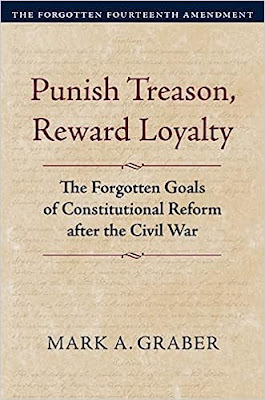
Mark A. Graber, Punish Treason, Reward Loyalty: The Forgotten Goals of Constitutional Reform after the Civil War (University of Kansas Press, 2023)
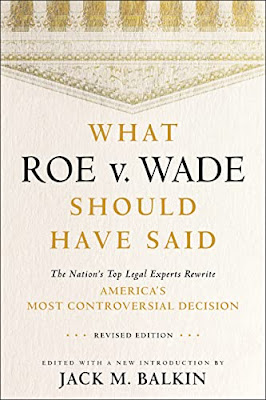
Jack M. Balkin, What Roe v. Wade Should Have Said: The Nation's Top Legal Experts Rewrite America's Most Controversial Decision - Revised Edition (NYU Press, 2023)

Andrew Koppelman, Burning Down the House: How Libertarian Philosophy Was Corrupted by Delusion and Greed (St. Martin’s Press, 2022)

Gerard N. Magliocca, Washington's Heir: The Life of Justice Bushrod Washington (Oxford University Press, 2022)
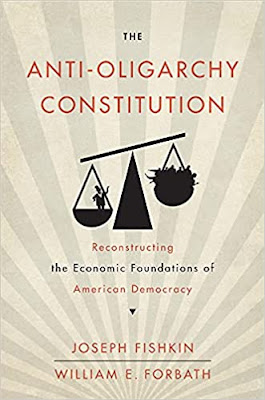
Joseph Fishkin and William E. Forbath, The Anti-Oligarchy Constitution: Reconstructing the Economic Foundations of American Democracy (Harvard University Press, 2022)
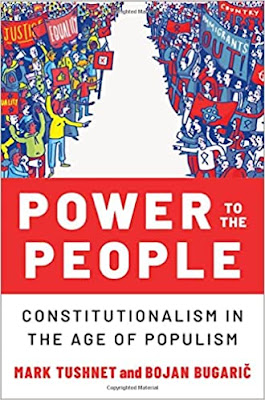
Mark Tushnet and Bojan Bugaric, Power to the People: Constitutionalism in the Age of Populism (Oxford University Press 2021).

Mark Philip Bradley and Mary L. Dudziak, eds., Making the Forever War: Marilyn B. Young on the Culture and Politics of American Militarism Culture and Politics in the Cold War and Beyond (University of Massachusetts Press, 2021).

Jack M. Balkin, What Obergefell v. Hodges Should Have Said: The Nation's Top Legal Experts Rewrite America's Same-Sex Marriage Decision (Yale University Press, 2020)

Frank Pasquale, New Laws of Robotics: Defending Human Expertise in the Age of AI (Belknap Press, 2020)

Jack M. Balkin, The Cycles of Constitutional Time (Oxford University Press, 2020)

Mark Tushnet, Taking Back the Constitution: Activist Judges and the Next Age of American Law (Yale University Press 2020).

Andrew Koppelman, Gay Rights vs. Religious Liberty?: The Unnecessary Conflict (Oxford University Press, 2020)

Ezekiel J Emanuel and Abbe R. Gluck, The Trillion Dollar Revolution: How the Affordable Care Act Transformed Politics, Law, and Health Care in America (PublicAffairs, 2020)

Linda C. McClain, Who's the Bigot?: Learning from Conflicts over Marriage and Civil Rights Law (Oxford University Press, 2020)
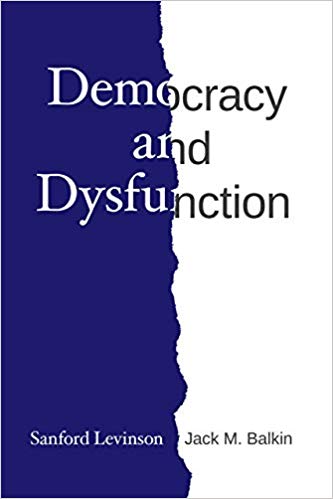
Sanford Levinson and Jack M. Balkin, Democracy and Dysfunction (University of Chicago Press, 2019)

Sanford Levinson, Written in Stone: Public Monuments in Changing Societies (Duke University Press 2018)

Mark A. Graber, Sanford Levinson, and Mark Tushnet, eds., Constitutional Democracy in Crisis? (Oxford University Press 2018)

Gerard Magliocca, The Heart of the Constitution: How the Bill of Rights became the Bill of Rights (Oxford University Press, 2018)

Cynthia Levinson and Sanford Levinson, Fault Lines in the Constitution: The Framers, Their Fights, and the Flaws that Affect Us Today (Peachtree Publishers, 2017)

Brian Z. Tamanaha, A Realistic Theory of Law (Cambridge University Press 2017)

Sanford Levinson, Nullification and Secession in Modern Constitutional Thought (University Press of Kansas 2016)

Sanford Levinson, An Argument Open to All: Reading The Federalist in the 21st Century (Yale University Press 2015)

Stephen M. Griffin, Broken Trust: Dysfunctional Government and Constitutional Reform (University Press of Kansas, 2015)

Frank Pasquale, The Black Box Society: The Secret Algorithms That Control Money and Information (Harvard University Press, 2015)

Bruce Ackerman, We the People, Volume 3: The Civil Rights Revolution (Harvard University Press, 2014)
Balkinization Symposium on We the People, Volume 3: The Civil Rights Revolution

Joseph Fishkin, Bottlenecks: A New Theory of Equal Opportunity (Oxford University Press, 2014)

Mark A. Graber, A New Introduction to American Constitutionalism (Oxford University Press, 2013)

John Mikhail, Elements of Moral Cognition: Rawls' Linguistic Analogy and the Cognitive Science of Moral and Legal Judgment (Cambridge University Press, 2013)

Gerard N. Magliocca, American Founding Son: John Bingham and the Invention of the Fourteenth Amendment (New York University Press, 2013)

Stephen M. Griffin, Long Wars and the Constitution (Harvard University Press, 2013)

Andrew Koppelman, The Tough Luck Constitution and the Assault on Health Care Reform (Oxford University Press, 2013)

James E. Fleming and Linda C. McClain, Ordered Liberty: Rights, Responsibilities, and Virtues (Harvard University Press, 2013)
Balkinization Symposium on Ordered Liberty: Rights, Responsibilities, and Virtues

Andrew Koppelman, Defending American Religious Neutrality (Harvard University Press, 2013)

Brian Z. Tamanaha, Failing Law Schools (University of Chicago Press, 2012)

Sanford Levinson, Framed: America's 51 Constitutions and the Crisis of Governance (Oxford University Press, 2012)

Linda C. McClain and Joanna L. Grossman, Gender Equality: Dimensions of Women's Equal Citizenship (Cambridge University Press, 2012)

Mary Dudziak, War Time: An Idea, Its History, Its Consequences (Oxford University Press, 2012)

Jack M. Balkin, Living Originalism (Harvard University Press, 2011)

Jason Mazzone, Copyfraud and Other Abuses of Intellectual Property Law (Stanford University Press, 2011)

Richard W. Garnett and Andrew Koppelman, First Amendment Stories, (Foundation Press 2011)

Jack M. Balkin, Constitutional Redemption: Political Faith in an Unjust World (Harvard University Press, 2011)

Gerard Magliocca, The Tragedy of William Jennings Bryan: Constitutional Law and the Politics of Backlash (Yale University Press, 2011)

Bernard Harcourt, The Illusion of Free Markets: Punishment and the Myth of Natural Order (Harvard University Press, 2010)

Bruce Ackerman, The Decline and Fall of the American Republic (Harvard University Press, 2010)
Balkinization Symposium on The Decline and Fall of the American Republic

Ian Ayres. Carrots and Sticks: Unlock the Power of Incentives to Get Things Done (Bantam Books, 2010)

Mark Tushnet, Why the Constitution Matters (Yale University Press 2010)

Ian Ayres and Barry Nalebuff: Lifecycle Investing: A New, Safe, and Audacious Way to Improve the Performance of Your Retirement Portfolio (Basic Books, 2010)
.jpg)
Jack M. Balkin, The Laws of Change: I Ching and the Philosophy of Life (2d Edition, Sybil Creek Press 2009)

Brian Z. Tamanaha, Beyond the Formalist-Realist Divide: The Role of Politics in Judging (Princeton University Press 2009)
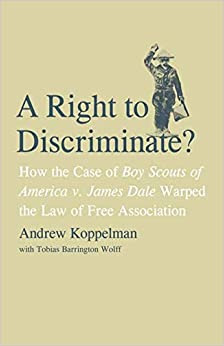
Andrew Koppelman and Tobias Barrington Wolff, A Right to Discriminate?: How the Case of Boy Scouts of America v. James Dale Warped the Law of Free Association (Yale University Press 2009)

Jack M. Balkin and Reva B. Siegel, The Constitution in 2020 (Oxford University Press 2009)

Heather K. Gerken, The Democracy Index: Why Our Election System Is Failing and How to Fix It (Princeton University Press 2009)

Mary Dudziak, Exporting American Dreams: Thurgood Marshall's African Journey (Oxford University Press 2008)

David Luban, Legal Ethics and Human Dignity (Cambridge Univ. Press 2007)

Ian Ayres, Super Crunchers: Why Thinking-By-Numbers is the New Way to be Smart (Bantam 2007)

Jack M. Balkin, James Grimmelmann, Eddan Katz, Nimrod Kozlovski, Shlomit Wagman and Tal Zarsky, eds., Cybercrime: Digital Cops in a Networked Environment (N.Y.U. Press 2007)
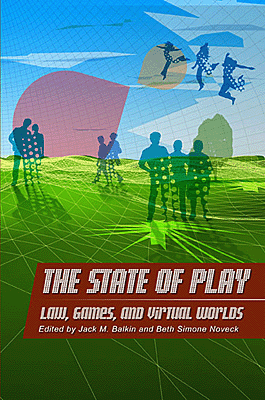
Jack M. Balkin and Beth Simone Noveck, The State of Play: Law, Games, and Virtual Worlds (N.Y.U. Press 2006)

Andrew Koppelman, Same Sex, Different States: When Same-Sex Marriages Cross State Lines (Yale University Press 2006)

Brian Tamanaha, Law as a Means to an End (Cambridge University Press 2006)

Sanford Levinson, Our Undemocratic Constitution (Oxford University Press 2006)

Mark Graber, Dred Scott and the Problem of Constitutional Evil (Cambridge University Press 2006)

Jack M. Balkin, ed., What Roe v. Wade Should Have Said (N.Y.U. Press 2005)

Sanford Levinson, ed., Torture: A Collection (Oxford University Press 2004)
Balkin.com homepage
Bibliography
Conlaw.net
Cultural Software
Writings
Opeds
The Information Society Project
BrownvBoard.com
Useful Links
Syllabi and Exams
