Balkinization
an unanticipated consequence of
Jack M. Balkin
Balkinization Symposiums: A Continuing List
E-mail:
Jack Balkin:
jackbalkin at yahoo.com
Bruce Ackerman
bruce.ackerman at yale.edu
Ian Ayres
ian.ayres at yale.edu
Corey Brettschneider
corey_brettschneider at brown.edu
Mary Dudziak
mary.l.dudziak at emory.edu
Joey Fishkin
joey.fishkin at gmail.com
Heather Gerken heather.gerken at yale.edu
Abbe Gluck abbe.gluck at yale.edu
Mark Graber
mgraber at law.umaryland.edu
Stephen Griffin
sgriffin at tulane.edu
Jonathan Hafetz
jonathan.hafetz at shu.edu
Jeremy Kessler
jkessler at law.columbia.edu
Andrew Koppelman
akoppelman at law.northwestern.edu
Marty Lederman
msl46 at law.georgetown.edu
Sanford Levinson
slevinson at law.utexas.edu
David Luban
david.luban at gmail.com
Gerard Magliocca
gmaglioc at iupui.edu
Jason Mazzone
mazzonej at illinois.edu
Linda McClain
lmcclain at bu.edu
John Mikhail
mikhail at law.georgetown.edu
Frank Pasquale
pasquale.frank at gmail.com
Nate Persily
npersily at gmail.com
Michael Stokes Paulsen
michaelstokespaulsen at gmail.com
Deborah Pearlstein
dpearlst at yu.edu
Rick Pildes
rick.pildes at nyu.edu
David Pozen
dpozen at law.columbia.edu
Richard Primus
raprimus at umich.edu
K. Sabeel Rahmansabeel.rahman at brooklaw.edu
Alice Ristroph
alice.ristroph at shu.edu
Neil Siegel
siegel at law.duke.edu
David Super
david.super at law.georgetown.edu
Brian Tamanaha
btamanaha at wulaw.wustl.edu
Nelson Tebbe
nelson.tebbe at brooklaw.edu
Mark Tushnet
mtushnet at law.harvard.edu
Adam Winkler
winkler at ucla.edu
Compendium of posts on Hobby Lobby and related cases
The Anti-Torture Memos: Balkinization Posts on Torture, Interrogation, Detention, War Powers, and OLC
The Anti-Torture Memos (arranged by topic)
Recent Posts
Reexamining the Civil Rights Revolution: Partial Adaptation and the Rise of a Civil and Social Rights State
![[Powered by Blogger]](https://lh3.googleusercontent.com/blogger_img_proxy/AEn0k_s2vepNhBUPZk1qZgQYJpvRh5sXr9QP9EArL-oixOU4COZxYmKYmA_VSJvThaKa47gLlnR8IJbP3Lzj0ythdDW88-dQRMT1bSMnSHB3Vu0-=s0-d)
Just A Few Blogs
ACS Blog
Alas, a Blog
Althouse
Arts and Letters Daily
Atrios (Eschaton)
Bill of Health
Buzzflash.com
Buzz Machine
Cato at Liberty
Juan Cole (Informed Comment)
Concurring Opinions
The Constitution in 2020
Corrente
Crooked Timber
Daily Howler
Daily Kos
Dana Boyd
Brad DeLong
Digby (Hullabaloo)
Discriminations
Daniel Drezner
Kevin Drum (Mother Jones)
Electrolite
En Banc
Eunomia (Daniel Larison)
Fafblog
Michael Froomkin (Discourse.net)
GovLab (Beth Noveck)
Rick Hasen (Election Law)
History News Network
How Appealing
Ignatz (Sam Heldman)
The Importance of (Ernie Miller)
Infolaw
Instapundit
International Economic Law and Policy Blog
IntLawGrrls
Jacob Levy
Jesus' General
Jurisdynamics
The Kitchen Cabinet
Mark Kleiman
Law Blog Central
Larry Lessig
Lawyers, Guns and Money
Liberal Oasis
Brian Leiter's Law School Reports
The Leiter Reports
Marginal Revolution
Megan McArdle
Memeorandum
Metafilter
Mirror of Justice
The New Republic
Newseum
No More Mister Nice Blog
Brendan Nyhan
Opinio Juris
Orcinus
The Originalism Blog
Pandagon
Passport (Foreign Policy)
Overcoming Bias
Political Animal (Washington Monthly)
Political Theory Daily Review
Political Wire (Taegan Goddard)
The Poor Man
Virginia Postrel
Prawfsblawg
Public Reason
Jonathan Rauch
Raw Story
Redstate
ReligiousLeftLaw.com
Reporters Committee For Freedom of the Press
Reproductive Rights Blog
Rothman's Roadmap to the Right of Publicity
SCOTUS Blog
Seeing the Forest
Clay Shirky
The Shifted Librarian
The Situationist
Larry Solum (Legal Theory)
Andrew Sullivan
Talking Points Memo
Talk Left
Tapped
Tbogg
TechPresident
The Paper Chase (Jurist)
Tom Paine
Tom Tomorrow (This Modern World)
Eve Tushnet
Uggabugga
University of Chicago Law School Faculty Blog
Unqualified Offerings
The Volokh Conspiracy
War and Piece (Laura Rozen)
Wampum
Oliver Willis
Wonkette
Written Description
Matthew Yglesias
Yin
Your Choice of Feeds
1. XML
powered by

2. Atom Feed
3. RSS 2.0
Reexamining the Civil Rights Revolution: Partial Adaptation and the Rise of a Civil and Social Rights State
Guest Blogger
For the Balkinization symposium on Stephen Skowronek, The Adaptability Paradox: Political Inclusion and Constitutional Resilience (University of Chicago Press, 2025). Elizabeth Beaumont My first post outlined Stephen Skowronek’s adaptability paradox and his sobering claim that the civil rights revolution ruptured the Constitution’s bounded resilience. On his telling, broad inclusion dissolved the social exclusions that once enabled stable constitutional reorderings, leaving power and authority reconfigured in ways that magnified rather than managed conflict. Here I undertake a reassessment of the civil rights revolution of the 1960s–70s. I argue that it can be seen as a partially successful adaptation, producing new institutional mechanisms and “auxiliaries” in the form of a “civil and social rights state,” alongside meaningful if contested cross-racial consensus on commitments to political inclusion and equality. Landmark statutes, Great Society social programs, administrative enforcement, litigation and judicial decisions, and civic mobilization contributed to significant, if incomplete, reordering. For Skowronek, the civil rights revolution marks the culmination of the adaptability paradox, and the point at which the constitutional system's bounded resilience was dissolved by broad democratization. As the body of "We the People" expanded toward broad inclusivity, encompassing not only white men, but African Americans, women, Indigenous peoples, racial and religious minorities, disabled people, LGBTQ+, and others, the U.S. constitutional system, on his account, lost its capacity for regeneration and spiralled into dysfunction. Although he wholeheartedly supports the civil rights revolution’s goals of inclusion and equality, Skowronek’s analysis of its political and constitutional consequences is almost entirely negative, seeing them as the root causes of destabilization. It can be easy to adopt a purely celebratory or uncritical stance toward the civil rights revolution, but Skowronek’s evaluation overcorrects in the other direction – underestimating the achievements and institutional innovations, overlooking the partial consensus achieved, and placing too much blame on the civil rights era for the current crisis. Reconsidering this history suggests a mixed picture, one that included many of the elements Skowronek associates with successful constitutional adaptation through the party state and administrative state. The Adaptability Paradox suggests three criteria for successful adaptation other than maintenance of social exclusions: new institutional mechanisms and arrangements (auxiliaries), constitutional common sense (minimum consensus), and connection to constitutional essentials (credible claims of fidelity). Skowronek posits that past reorderings leading to the party state and administrative state achieved these, while the civil rights revolution failed (3, 10). I argue instead that the civil rights revolution partially met each of these criteria, and gave rise to a partly successful adaptation through a new “civil and social rights state” that garnered important, if contested and incomplete, political consensus and that "pay[ed] homage to the original" by grounding transformative demands in the Constitution's own text and principles, invoking equal protection, due process, the Commerce Clause, and the Reconstruction Amendments (17-18). Although the rise of civil and social rights in the 1960s and 70s (and the new apparatuses for implementing and enforcing them) are often treated as distinct innovations, we can also see that their parallel initiation was not coincidental (see, e.g., Bok 1992). Rather, it involved intentional institutional responses to the civil rights revolution’s challenges to racial inequality, economic disparity, and extensive poverty in the U.S., an adaptation process in which Congress, President Johnson, key administrative agencies, and federal courts all played roles. The most famous political dimension of this was a series of landmark civil rights statutes, particularly the Civil Rights Act of 1964 and the Voting Rights Act of 1965, which prohibited racial discrimination, protected voting rights, and created both new enforcement and incentive mechanisms, including Title VI of the Civil Rights Act, created a nondiscrimination requirement that automatically applied to all federally funded programs. This legislation contributed to new executive agencies and offices to enforce these rights (such as the Equal Employment Opportunity Commission and Department of Justice Civil Rights Division, and a network of federal agencies charged with implementing and enforcing new civil rights requirements across the federal system) (see, e.g. Graham 1990). But a second, overlapping dimension of this adaptation of governing arrangements and relations involved creating “Great Society” social programs. President Johnson and Congress designed these programs to address poverty and inequality more broadly, but also included strategic tools for implementing civil rights through mechanisms of federal “carrots and sticks” over state and local entities. Medicare, the first nationalized health insurance (but limited to older Americans), created requirements for medical providers to comply with civil rights legislation, making it a civil rights vehicle as well (Reynolds 1997; Smith 2005). A series of new education laws and programs, too, responded to the civil rights movement by including intentional synergies for enforcing civil rights across K-16 schools, including significant new funding for K-12 schools and universities, and the launch of free preschool and a school breakfast program, all requiring recipient schools to adhere to civil rights requirements (Elementary and Secondary Education Act, the Higher Education Act of 1965, Project Head Start (1964), and the Child Nutrition Act (1966)) (Beaumont 2015, 974-975, Superfine 2013, Cross 2004). We can see how the deliberate pairing and intertwining of civil rights enforcement with universally available social programs and new federal funding for local education and communities was itself an innovative constitutional strategy. It encouraged cross-racial buy-in and what Smith and King (2014) have termed “racial policy alliances” to support the new constitutional order (see also Brown 1999, Quadagno 1994) Extending new benefits — Medicare, education funding, food assistance — to Americans of all races and classes while simultaneously using many of these benefits to leverage civil rights compliance and integrate segments of American life, helped construct a constitutional coalition that commanded broad popular support across racial lines and for a time across partisan ones. The emerging civil and social rights state also involved a greatly expanded role for the judicial branch and courts. Landmark Warren Court decisions, epitomized by Brown v. Board of Education (1954), began reinterpreting equal protection and other constitutional principles in line with arguments advanced by civil rights movements at a time when African Americans were widely prevented from voting. Even after the Voting Rights Act improved formal access to the ballot, because African Americans were a political minority, and the Supreme Court and federal courts were sometimes more receptive than legislatures. This use of judicial independence encouraged sustained litigation campaigns, and inspired similar legal strategies by women and other historically excluded and minority groups (Epp 1998, Anderson 2006, Mayeri 2011). While Supreme Court decisions receive far more attention, it may have been still more consequential that the political implementation of civil rights created private rights of action as a new, “decentralized” enforcement instrument. As Sean Farhang (2010) suggests, this innovation helped produce what could be termed a “litigation state” operating within or alongside the civil and social rights state. Farhang demonstrates that Congress deliberately included private litigation in the Civil Rights Act of 1964 (and in much civil and social rights legislation that followed) largely because it did not trust the President or administrative agencies to enforce these laws. This institutional innovation and its growth was in keeping with anti-statism and reluctance to further expand national bureaucracy, and it addressed some major failures of the New Deal settlements and the administrative state regarding racial inequality. It was also incentivized by inherited constitutional structures of federalism, separation of powers, and an independent judiciary. Shifting these features allowed Congress to enable protection for many rights – from prohibitions on racial discrimination in schools to sex discrimination in workplaces to rights to medicare or clean air – allowing new ways for rights to “work” by providing tools for litigation and legal mobilization that could be used in any community without depending on the executive branch or states (Burke 2002, see also Epp 1998, McCann 1994, Kagan 2001). It is common now to criticize the problems with “the litigious state” and recognize the many limits of the civil and social rights state (just as there are many criticisms of problems with the earlier party state and administrative state Skowronek holds up as success stories)(see, e.g. Rosenberg 1991, Fiorina 2009). Skowronek deepens the critiques by faulting the judicial and legal adaptations as sources of “judicial supremacy” and “adversarial legalism” that helped unbind the Constitution (125-134, 166). However, incorporating these mechanisms into the Civil Rights Act of 1964 and much subsequent rights legislation can be viewed as pragmatic, if not necessary, extra-constitutional innovations for a fragmented democracy. Without private enforcement mechanisms, civil rights protections likely would have remained largely unenforceable promises, subject to changes in presidential support, shifting administrative priorities, and resistance from state and local governments. As Farhang (2010) shows, the judicialization of civil rights enforcement was a deliberate and “functional” institutional choice in a fragmented political system – an extra-constitutional innovation that gave civil rights enforcement a durable foundation independent of shifting executive priorities. In Skowronek’s own terms, this can be understood as a partially successful constitutional auxiliary. We can also see that the new civil and social rights state incorporated important consensus-building, stabilizing, and constraining elements aimed to foster cross-racial consensus and constrain the scope of conflict. The reordering and its new legislation and government programs were framed around principles of equal opportunity, but emphasized ideas of “color-blind equal opportunity” and “democratic opportunity,” rather than race-specific repair (Smith and King 2024). This approach encouraged cross-racial buy-in, while also providing a limiting principle that helped contain the most expansive demands for social repair and redistribution, thereby enabling a broader political coalition for the new constitutional order. These consensus-building elements help explain the substantial public support for important elements of the civil and social rights state that polling data suggests long continued. The civil rights and social rights reconfiguration also achieved significant areas of political consensus that Skowronek does not acknowledge. For instance, after advocating and winning passage of the Civil Rights Act and running on a Great Society platform emphasizing some of the civil and social rights championed by the Civil Rights Movement, President Johnson was elected over Goldwater with 60% of the popular vote and 90% of the electoral vote, victories comparable to Roosevelt's landslides of 1932 and 1936. And national surveys indicated substantial, albeit uneven, public support for key elements of the new civil and social rights state. For the sweeping 1964 Civil Rights Act, October 1964 Gallup polls indicated 58% approval (31% disapproval); the 1965 Voting Rights Act had 76% favor in April 1965 (see Gallup Organization, 2020). Skowronek suggests a ‘precipitous collapse’ of Johnson’s consensus, but both in terms of subsequent civil rights legislation – often passed with some bi-partisan support – and in terms of subsequent public opinion surveys, some areas of consensus were sustained (139). For instance, in 2014, 80% of respondents viewed the Voting Rights Act as 'mostly good' for the country (Pew Research Center). And white opposition to segregation plummeted from around 66% in the 1960s to 4% in the 1980s (Smith and Sheatsley, 1984). As recently as 2008, majorities of whites and Blacks said the civil rights movement still impacts society positively (Pew Research Center). While significant divisions persisted on many issues, there are indications of some increase in public buy-in and at least minimal consensus for key issues and principles at stake in the civil and social rights reordering, including racial equality, voting rights, equal protection, and desegregation. Enduring public support for many Great Society programs across partisan lines also suggests the civil rights and social rights reordering achieved a significant degree of consensus in the general population. Despite polarization on many issues, Medicare enjoys the support of roughly 80-84% of Americans, including large majorities of Republicans (KFF; NAMI/Ipsos 2025); SNAP is viewed favorably by 64-78% of Americans across party lines (FMI 2025; Data for Progress 2025); Head Start commands the support of 72% of voters across the political spectrum, including bipartisan support in Congress (UpONE Insights/FFYF 2025); and free school breakfast and lunch programs are supported by 63-74% of voters, including majorities of Republicans (FRAC 2021; Data for Progress 2021). To be sure, the adaptations to the civil rights revolution had mixed outcomes, positive and negative, intended and unintended. New legislation and mechanisms for civil rights did help empower marginalized groups and provided new avenues for enforcement, but they also further increased national power, sparking debates over federalism and judicial power. Indeed, the significant limitations of the civil and social rights state are often critiqued by those who believe much more should have been done to address slavery and the social and economic harms that national, state, and colonial-era government had committed or legally sanctioned against African American since the 17th century (see, e.g. Bell 1992, Carbado and Gulati 2013, Darity and Mullen 2020). From the perspective of many African-Americans and other critics, the adaptations to the civil rights revolution have functioned very effectively to “stabilize” the limits of the civil and social rights state and exclude controversial issues related to race, slavery, poverty, and economic inequality. But Skowronek treats civil rights as a failed adaptation, even as the two successful adapations to democratic inclusion he identifies– the party state and the administrative state – could also be seen from the reverse perspective, as having contributed to distortions with the functioning of constitutional democracy, some of which persist into the present. Here, we might think of some parallels in unintended outcomes: the New Deal's administrative expansion generated the anti-statist and anti-regulatory critiques that fueled the conservative movement of the 1970s and 1980s; the civil rights revolution's expansion of rights and judicial enforcement generated critiques of adversarial legalism and judicial overreaching and contributed to the rise of the contemporary conservative movement. In both cases, backlash can be seen as a predictable political response to transformative constitutional change rather than evidence of failed adaptation. We can also think of some of the limitations of the party state as a stabilizer, and its problematic outcomes for constitutional democracy. Skowronek credits it with managing incorporation of white male suffrage and stabilizing a new constitutional order, but the party state ultimately failed to prevent the slide into the Civil War within two decades of its emergence. This adaptation also gave rise to institutional arrangements with problematic consequences, including the rise of primaries and gerrymandering. The primary system, for instance, was not only long used to exclude some from voting, particularly African Americans and other minorities, but its later expansions contributed to polarization because primaries tend to empower the most extreme and motivated partisans (Fiorina 2009). Party leaders in state legislatures have long used their power to gerrymander to create “safe” seats, but the growth of this capacity alongside the party state has increasingly allowed parties and politicians to ‘choose their voters,’ rather than voters choosing representatives, distorting legislative ideology and reducing responsiveness (Stephanopoulos 2017). The development of these features of the party state, originally designed to manage the inclusion of white male suffrage while suppressing divisive issues like slavery, illustrate how “successful” adaptations can also embed structural distortions that continue to undermine democratic accountability and responsiveness into the present. Thus, while Skowronek paints a sharp contrast between Civil Rights Era constitutional outcomes and the Progressive and New Deal era political settlements, it seems more plausible to see all of these struggles and settlements as leading to partial consensus and incremental buy-in, subject to ongoing divisions and backlashes. Another significant limitation of Skowronek’s assessment of the civil rights revolution comes from his top-down, state-centered approach. This perspective does not recognize the role of civic groups and social movements for pushing for particular areas of follow-through, nor does it consider how efforts to implement a new constitutional order inevitably face push back, reactive backlash, and often protracted tug-of-war involving opposing civic forces, political elites, and parties. A closer look at the civil rights era groups and movements suggests that Skowronek overlooks the degree to which they not only pushed for constitutional rights, but actively worked to gain wider acceptance and segments of support for commitments to inclusion and equality. Civic reformers have repeatedly served as “civic founders” or “co-founders” of constitutional transformations, not merely applying pressure from outside the system but also actively remaking constitutional meanings through sustained civic mobilization (Beaumont 2014). They developed and advocated new understandings of popular self-governance, rights, and citizenship that eventually reshaped the constitutional order, and, in the process they developed new civic associations and social relations (Beaumont 2014). The civil rights, feminist, and LGBT rights movements of the 1950s through the 1980s followed this general pattern. Each movement invoked existing constitutional principles (equal protection, due process, the guarantees of republican government) and strategically redeployed them to advance new claims. Each also created new civic organizations, including legal advocacy groups and “support structures” that undertook organized litigation campaigns (the NAACP Legal Defense Fund, the ACLU Women's Rights Project, LGBT legal advocacy organizations) contributing to a civic infrastructure that helped build new constitutional meanings and rights from below (Epp 1998, Beaumont 2014, Mayeri 2011, Andersen 2006, Francis 2014). Crucially, these movements did not simply assert constitutional claims. They also worked strategically to build broader political and social consensus around those claims, seeking to bring along not just movement activists but legal elites, legislators, sympathetic publics, and eventually significant portions of both political parties. Scholars have shown how the movements of the civil rights revolution worked strategically to build consensus around racial equality. Mary Dudziak (2000), for example, demonstrates that the civil rights movement strategically connected its goals to American democratic ideals and Cold War imperatives, building a broader consensus for reform that extended beyond the movement. Additionally, the NAACP's decades-long campaign against lynching and mob violence, documented by Megan Ming Francis (2014), shows how civic organizations built consensus through sustained public advocacy, legislative lobbying, and litigation long before the landmark legislation of the 1960s. Likewise, Serena Mayeri (2011) shows how the feminist movement strategically built on civil rights precedents to develop a new constitutional consensus around sex equality, explicitly connecting gender and race discrimination claims to broaden their coalition and constitutional legitimacy. In Skowronek’s own terms, such civic mechanisms – reframing constitutional principles, building coalitions, creating new civic and legal organizations, and connecting rights claims to broadly shared values– can be understood as important “auxiliaries” that helped carry constitutional reordering forward by fostering broader consensus and supporting implementation amid backlash. None of this is to say that the civil rights revolution achieved either the full aims of the movements that energized it or conditions of full constitutional consensus and stability. It has not, and disagreements over the civil and social rights state’s commitments to inclusion and equality have clearly contributed to the conflicts of the present era. Yet attributing the current political morass primarily to failed adaptation following the civil rights revolution overreaches in at least two important respects. First, as we have seen, Skowronek’s account overlooks the pragmatic innovations and partial successes of the civil and social rights state and the partial consensus it was able to garner around core commitments to political inclusion, equal protection, as well as some social welfare rights (particularly Medicare and Medicaid, food stamps, school breakfast and lunch). Second, Skowronek’s emphasis on the civil rights revolution’s ruptures to past settlements and incomplete adaptation as the root cause of present political and constitutional problems leaves much overlooked. It largely discounts the role of many subsequent forces and deliberate political choices that operated largely independently of the 1960’s-70’s constitutional legacies and are not reducible to bounded resilience — from 9/11 and its aftermath, to the internet and digital revolution, to rising economic dislocation and inequality. For instance, Skowronek attributes both judicialization and presidentialization of constitutional politics to systemic disruptions and loss of adaptive capacity following the civil rights revolution (203). But there is persuasive evidence that the greatest expansion of modern Presidential power did not emerge from or build directly on the civil rights revolution’s adaptations – which had helped to significantly expand civil liberties as well as equal protection. Rather, it burst forward after the 9/11 terrorist attacks, with President George W. Bush and his administration deliberately acting to increase presidential power and remove post-Watergate constraints, with subsequent presidents building on this new opportunity (Savage 2007, Goldsmith 2007). This significant reshaping of separation of powers reflected the operation of forces and political choices not satisfactorily explained as mere downstream effects of 1960s-70s “constitutional unbinding.” Thus, while the civil rights revolution undeniably transformed prior arrangements of governmental power and prior constitutional settlements and contributed to contemporary stresses, a more complete account must recognize subsequent developments as significant drivers in their own right. In the final post, I examine the multicausal post-inclusion stressors we face today and argue that civic constitutionalism offers a path toward renewed grounding in a broadly inclusive polity. Elizabeth Beaumont is Associate Professor of Politics and Legal Studies at University of California, Santa Cruz. You can reach her at beaumont@ucsc.edu.
Posted
9:30 AM
by Guest Blogger [link]
Books by Balkinization Bloggers

Gerard N. Magliocca, The Actual Art of Governing: Justice Robert H. Jackson's Concurring Opinion in the Steel Seizure Case (Oxford University Press, 2025)

Linda C. McClain and Aziza Ahmed, The Routledge Companion to Gender and COVID-19 (Routledge, 2024)

David Pozen, The Constitution of the War on Drugs (Oxford University Press, 2024)

Jack M. Balkin, Memory and Authority: The Uses of History in Constitutional Interpretation (Yale University Press, 2024)
Mark A. Graber, Punish Treason, Reward Loyalty: The Forgotten Goals of Constitutional Reform after the Civil War (University of Kansas Press, 2023)
Jack M. Balkin, What Roe v. Wade Should Have Said: The Nation's Top Legal Experts Rewrite America's Most Controversial Decision - Revised Edition (NYU Press, 2023)

Andrew Koppelman, Burning Down the House: How Libertarian Philosophy Was Corrupted by Delusion and Greed (St. Martin’s Press, 2022)

Gerard N. Magliocca, Washington's Heir: The Life of Justice Bushrod Washington (Oxford University Press, 2022)
Joseph Fishkin and William E. Forbath, The Anti-Oligarchy Constitution: Reconstructing the Economic Foundations of American Democracy (Harvard University Press, 2022)
Mark Tushnet and Bojan Bugaric, Power to the People: Constitutionalism in the Age of Populism (Oxford University Press 2021).

Mark Philip Bradley and Mary L. Dudziak, eds., Making the Forever War: Marilyn B. Young on the Culture and Politics of American Militarism Culture and Politics in the Cold War and Beyond (University of Massachusetts Press, 2021).

Jack M. Balkin, What Obergefell v. Hodges Should Have Said: The Nation's Top Legal Experts Rewrite America's Same-Sex Marriage Decision (Yale University Press, 2020)

Frank Pasquale, New Laws of Robotics: Defending Human Expertise in the Age of AI (Belknap Press, 2020)

Jack M. Balkin, The Cycles of Constitutional Time (Oxford University Press, 2020)

Mark Tushnet, Taking Back the Constitution: Activist Judges and the Next Age of American Law (Yale University Press 2020).

Andrew Koppelman, Gay Rights vs. Religious Liberty?: The Unnecessary Conflict (Oxford University Press, 2020)

Ezekiel J Emanuel and Abbe R. Gluck, The Trillion Dollar Revolution: How the Affordable Care Act Transformed Politics, Law, and Health Care in America (PublicAffairs, 2020)

Linda C. McClain, Who's the Bigot?: Learning from Conflicts over Marriage and Civil Rights Law (Oxford University Press, 2020)
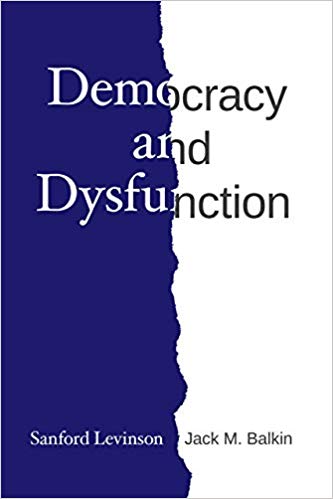
Sanford Levinson and Jack M. Balkin, Democracy and Dysfunction (University of Chicago Press, 2019)

Sanford Levinson, Written in Stone: Public Monuments in Changing Societies (Duke University Press 2018)

Mark A. Graber, Sanford Levinson, and Mark Tushnet, eds., Constitutional Democracy in Crisis? (Oxford University Press 2018)

Gerard Magliocca, The Heart of the Constitution: How the Bill of Rights became the Bill of Rights (Oxford University Press, 2018)

Cynthia Levinson and Sanford Levinson, Fault Lines in the Constitution: The Framers, Their Fights, and the Flaws that Affect Us Today (Peachtree Publishers, 2017)

Brian Z. Tamanaha, A Realistic Theory of Law (Cambridge University Press 2017)

Sanford Levinson, Nullification and Secession in Modern Constitutional Thought (University Press of Kansas 2016)

Sanford Levinson, An Argument Open to All: Reading The Federalist in the 21st Century (Yale University Press 2015)

Stephen M. Griffin, Broken Trust: Dysfunctional Government and Constitutional Reform (University Press of Kansas, 2015)

Frank Pasquale, The Black Box Society: The Secret Algorithms That Control Money and Information (Harvard University Press, 2015)

Bruce Ackerman, We the People, Volume 3: The Civil Rights Revolution (Harvard University Press, 2014)
Balkinization Symposium on We the People, Volume 3: The Civil Rights Revolution

Joseph Fishkin, Bottlenecks: A New Theory of Equal Opportunity (Oxford University Press, 2014)

Mark A. Graber, A New Introduction to American Constitutionalism (Oxford University Press, 2013)

John Mikhail, Elements of Moral Cognition: Rawls' Linguistic Analogy and the Cognitive Science of Moral and Legal Judgment (Cambridge University Press, 2013)

Gerard N. Magliocca, American Founding Son: John Bingham and the Invention of the Fourteenth Amendment (New York University Press, 2013)

Stephen M. Griffin, Long Wars and the Constitution (Harvard University Press, 2013)

Andrew Koppelman, The Tough Luck Constitution and the Assault on Health Care Reform (Oxford University Press, 2013)

James E. Fleming and Linda C. McClain, Ordered Liberty: Rights, Responsibilities, and Virtues (Harvard University Press, 2013)
Balkinization Symposium on Ordered Liberty: Rights, Responsibilities, and Virtues

Andrew Koppelman, Defending American Religious Neutrality (Harvard University Press, 2013)

Brian Z. Tamanaha, Failing Law Schools (University of Chicago Press, 2012)

Sanford Levinson, Framed: America's 51 Constitutions and the Crisis of Governance (Oxford University Press, 2012)

Linda C. McClain and Joanna L. Grossman, Gender Equality: Dimensions of Women's Equal Citizenship (Cambridge University Press, 2012)

Mary Dudziak, War Time: An Idea, Its History, Its Consequences (Oxford University Press, 2012)

Jack M. Balkin, Living Originalism (Harvard University Press, 2011)

Jason Mazzone, Copyfraud and Other Abuses of Intellectual Property Law (Stanford University Press, 2011)

Richard W. Garnett and Andrew Koppelman, First Amendment Stories, (Foundation Press 2011)

Jack M. Balkin, Constitutional Redemption: Political Faith in an Unjust World (Harvard University Press, 2011)

Gerard Magliocca, The Tragedy of William Jennings Bryan: Constitutional Law and the Politics of Backlash (Yale University Press, 2011)

Bernard Harcourt, The Illusion of Free Markets: Punishment and the Myth of Natural Order (Harvard University Press, 2010)

Bruce Ackerman, The Decline and Fall of the American Republic (Harvard University Press, 2010)
Balkinization Symposium on The Decline and Fall of the American Republic

Ian Ayres. Carrots and Sticks: Unlock the Power of Incentives to Get Things Done (Bantam Books, 2010)

Mark Tushnet, Why the Constitution Matters (Yale University Press 2010)

Ian Ayres and Barry Nalebuff: Lifecycle Investing: A New, Safe, and Audacious Way to Improve the Performance of Your Retirement Portfolio (Basic Books, 2010)
.jpg)
Jack M. Balkin, The Laws of Change: I Ching and the Philosophy of Life (2d Edition, Sybil Creek Press 2009)

Brian Z. Tamanaha, Beyond the Formalist-Realist Divide: The Role of Politics in Judging (Princeton University Press 2009)
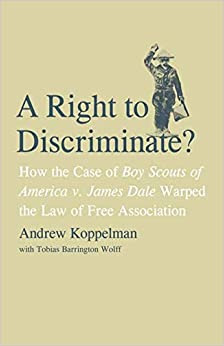
Andrew Koppelman and Tobias Barrington Wolff, A Right to Discriminate?: How the Case of Boy Scouts of America v. James Dale Warped the Law of Free Association (Yale University Press 2009)

Jack M. Balkin and Reva B. Siegel, The Constitution in 2020 (Oxford University Press 2009)

Heather K. Gerken, The Democracy Index: Why Our Election System Is Failing and How to Fix It (Princeton University Press 2009)

Mary Dudziak, Exporting American Dreams: Thurgood Marshall's African Journey (Oxford University Press 2008)

David Luban, Legal Ethics and Human Dignity (Cambridge Univ. Press 2007)

Ian Ayres, Super Crunchers: Why Thinking-By-Numbers is the New Way to be Smart (Bantam 2007)

Jack M. Balkin, James Grimmelmann, Eddan Katz, Nimrod Kozlovski, Shlomit Wagman and Tal Zarsky, eds., Cybercrime: Digital Cops in a Networked Environment (N.Y.U. Press 2007)
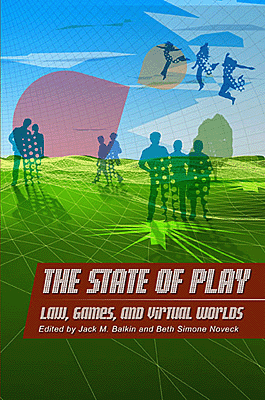
Jack M. Balkin and Beth Simone Noveck, The State of Play: Law, Games, and Virtual Worlds (N.Y.U. Press 2006)

Andrew Koppelman, Same Sex, Different States: When Same-Sex Marriages Cross State Lines (Yale University Press 2006)

Brian Tamanaha, Law as a Means to an End (Cambridge University Press 2006)

Sanford Levinson, Our Undemocratic Constitution (Oxford University Press 2006)

Mark Graber, Dred Scott and the Problem of Constitutional Evil (Cambridge University Press 2006)

Jack M. Balkin, ed., What Roe v. Wade Should Have Said (N.Y.U. Press 2005)

Sanford Levinson, ed., Torture: A Collection (Oxford University Press 2004)
Balkin.com homepage
Bibliography
Conlaw.net
Cultural Software
Writings
Opeds
The Information Society Project
BrownvBoard.com
Useful Links
Syllabi and Exams
