Balkinization
an unanticipated consequence of
Jack M. Balkin
Balkinization Symposiums: A Continuing List
E-mail:
Jack Balkin:
jackbalkin at yahoo.com
Bruce Ackerman
bruce.ackerman at yale.edu
Ian Ayres
ian.ayres at yale.edu
Corey Brettschneider
corey_brettschneider at brown.edu
Mary Dudziak
mary.l.dudziak at emory.edu
Joey Fishkin
joey.fishkin at gmail.com
Heather Gerken heather.gerken at yale.edu
Abbe Gluck abbe.gluck at yale.edu
Mark Graber
mgraber at law.umaryland.edu
Stephen Griffin
sgriffin at tulane.edu
Jonathan Hafetz
jonathan.hafetz at shu.edu
Jeremy Kessler
jkessler at law.columbia.edu
Andrew Koppelman
akoppelman at law.northwestern.edu
Marty Lederman
msl46 at law.georgetown.edu
Sanford Levinson
slevinson at law.utexas.edu
David Luban
david.luban at gmail.com
Gerard Magliocca
gmaglioc at iupui.edu
Jason Mazzone
mazzonej at illinois.edu
Linda McClain
lmcclain at bu.edu
John Mikhail
mikhail at law.georgetown.edu
Frank Pasquale
pasquale.frank at gmail.com
Nate Persily
npersily at gmail.com
Michael Stokes Paulsen
michaelstokespaulsen at gmail.com
Deborah Pearlstein
dpearlst at yu.edu
Rick Pildes
rick.pildes at nyu.edu
David Pozen
dpozen at law.columbia.edu
Richard Primus
raprimus at umich.edu
K. Sabeel Rahmansabeel.rahman at brooklaw.edu
Alice Ristroph
alice.ristroph at shu.edu
Neil Siegel
siegel at law.duke.edu
David Super
david.super at law.georgetown.edu
Brian Tamanaha
btamanaha at wulaw.wustl.edu
Nelson Tebbe
nelson.tebbe at brooklaw.edu
Mark Tushnet
mtushnet at law.harvard.edu
Adam Winkler
winkler at ucla.edu
Compendium of posts on Hobby Lobby and related cases
The Anti-Torture Memos: Balkinization Posts on Torture, Interrogation, Detention, War Powers, and OLC
The Anti-Torture Memos (arranged by topic)
Recent Posts
Liberation Day From Liberation Day
Originalism as Novelty and Our Merely De Facto President
Who Will be the Executor of Humphrey's Executor?
Emergency Powers in a Nutshell
The Weapons of the Weak Before the Movement
Did Race Distort the rule of Taft v. Hyatt?
Black Civil Rights and Black Corporate Rights
The Appellate Void and Trump v. CASA
Penningroth’s Achievement
The Government's "Domicile" Argument on Birth Citizenship
Legal Pluralism in “Before the Movement”
American Bar Association Silver Gavel Award for The Presidents and the People: Five Leaders Who Threatened Democracy and the Citizens Who Fought to Defend It (W.W. Norton, 2024)
Looking for Law in All the Wrong Places: Dylan Penningroth’s Before the Movement.
Balkinization Symposium on Dylan C. Penningroth, Before the Movement: The Hidden History of Black Civil Rights (Liveright, 2023).
Review It All
Academic Freedom of Law Reviews: Personal Statements Under Attack
Is the Librarian of Congress an Executive Official?
A Justice Souter Anecdote, or “Seeing a World in a Grain of Sand”
How to Avoid Accountability
Picking a Book Cover
What Did “Subject to the Jurisdiction of the United States” Mean in the Oregon Citizenship Legislation of 1872?
![[Powered by Blogger]](https://lh3.googleusercontent.com/blogger_img_proxy/AEn0k_v462Hr3YDAeN5G1cxaXID0e2AQvIA9aSlhxIbSsTCrHcOMvpl5WGZ0VR4LQ6YG6KSrb659GuSjVrJgVmzs9aS9nenKA2kSHrmLn5aVvS5m=s0-d)
Just A Few Blogs
ACS Blog
Alas, a Blog
Althouse
Arts and Letters Daily
Atrios (Eschaton)
Bill of Health
Buzzflash.com
Buzz Machine
Cato at Liberty
Juan Cole (Informed Comment)
Concurring Opinions
The Constitution in 2020
Corrente
Crooked Timber
Daily Howler
Daily Kos
Dana Boyd
Brad DeLong
Digby (Hullabaloo)
Discriminations
Daniel Drezner
Kevin Drum (Mother Jones)
Electrolite
En Banc
Eunomia (Daniel Larison)
Fafblog
Michael Froomkin (Discourse.net)
GovLab (Beth Noveck)
Rick Hasen (Election Law)
History News Network
How Appealing
Ignatz (Sam Heldman)
The Importance of (Ernie Miller)
Infolaw
Instapundit
International Economic Law and Policy Blog
IntLawGrrls
Jacob Levy
Jesus' General
Jurisdynamics
The Kitchen Cabinet
Mark Kleiman
Law Blog Central
Larry Lessig
Lawyers, Guns and Money
Liberal Oasis
Brian Leiter's Law School Reports
The Leiter Reports
Marginal Revolution
Megan McArdle
Memeorandum
Metafilter
Mirror of Justice
The New Republic
Newseum
No More Mister Nice Blog
Brendan Nyhan
Opinio Juris
Orcinus
The Originalism Blog
Pandagon
Passport (Foreign Policy)
Overcoming Bias
Political Animal (Washington Monthly)
Political Theory Daily Review
Political Wire (Taegan Goddard)
The Poor Man
Virginia Postrel
Prawfsblawg
Public Reason
Jonathan Rauch
Raw Story
Redstate
ReligiousLeftLaw.com
Reporters Committee For Freedom of the Press
Reproductive Rights Blog
Rothman's Roadmap to the Right of Publicity
SCOTUS Blog
Seeing the Forest
Clay Shirky
The Shifted Librarian
The Situationist
Larry Solum (Legal Theory)
Andrew Sullivan
Talking Points Memo
Talk Left
Tapped
Tbogg
TechPresident
The Paper Chase (Jurist)
Tom Paine
Tom Tomorrow (This Modern World)
Eve Tushnet
Uggabugga
University of Chicago Law School Faculty Blog
Unqualified Offerings
The Volokh Conspiracy
War and Piece (Laura Rozen)
Wampum
Oliver Willis
Wonkette
Written Description
Matthew Yglesias
Yin
Your Choice of Feeds
1. XML
powered by

2. Atom Feed
3. RSS 2.0
Liberation Day From Liberation Day
Gerard N. Magliocca
The Court of International Trade held today that most of the Administration's tariffs are unlawful. The Supreme Court might as well cancel its summer vacation. Presumably, the Administration will want review on the merits quickly. A stay pending appeal is not that helpful here, as no foreign nation will negotiate on trade issues when the legality of the tariffs is doubtful. We'll see if this decision pries Abrego Garcia loose from El Salvador, as I speculated a few weeks ago.
Posted
8:36 PM
by Gerard N. Magliocca [link]
(0) comments
Originalism as Novelty and Our Merely De Facto President
Mark Graber
Trump under Section 3 of the Fourteenth Amendment is merely de facto president of the US. And originalism is an effort to develop a novel interpretation of the Constitution, not one faithful to history. Click this link to find out why.
Posted
8:19 AM
by Mark Graber [link]
Who Will be the Executor of Humphrey's Executor?
Gerard N. Magliocca
One puzzle created by today's emergency order is that nobody now has a reason to bring the merits of overruling Humphrey's Executor to the Court. Anyone litigating this issue received a clear signal of the outcome. Why would they bring a case to the Court? Thus, it's possible that Humphrey's Executor will formally remain the law but be ignored in practice. The Court should have granted certiorari and simply overruled Humphrey's Executor on the slow-poke docket. A side note. This order is the first Supreme Court endorsement of central bank independence as a constitutional principle. That is no small thing, as I will explain in another post.
Posted
7:39 PM
by Gerard N. Magliocca [link]
(0) comments
Emergency Powers in a Nutshell
Gerard N. Magliocca
Justice Robert Jackson, concurring in Youngstown.The appeal, however, that we declare the existence of inherent powers ex necessitate to meet an emergency asks us to do what many think would be wise, although it is something the forefathers omitted. They knew what emergencies were, knew the pressures they engender for authoritative action, knew, too, how they afford a ready pretext for usurpation. We may also suspect that they suspected that emergency powers would tend to kindle emergencies.
Posted
7:19 AM
by Gerard N. Magliocca [link]
(0) comments
The Weapons of the Weak Before the Movement
Mark Graber
For the Balkinization symposium on Dylan C. Penningroth, Before the Movement: The Hidden History of Black Civil Rights (Liveright, 2023). The
rule of law provides the foundation for structuring elite domination and a
forge for fashioning the weapons of the weak.
The substance of law inevitably reflects the interests and values of the
lawmaking, law enforcing, and law interpreting class. One hardly needs to be a Marxist to
understand how the law of property, contract, and business associations privilege
those who have property to bestow by contract or protect by incorporation. The freedom of the press secures the rights
of those who have access to a press.
Elites that govern by law nevertheless provide a pathway by which the
less fortunate successfully make rights claims.
The Supreme Court vindicated Joseph Lochner’s right to work his
immigrant bakers more than ten hours a day, but the same justices would have
vindicated the right of those bakers to receive their contracted-for wages. A small incorporated black church in rural 1910
Alabama had the same limited liability as U.S. Steel.
Posted
9:30 AM
by Mark Graber [link]
Did Race Distort the rule of Taft v. Hyatt?
Guest Blogger
Ian Ayres
Posted
9:30 AM
by Guest Blogger [link]
Black Civil Rights and Black Corporate Rights
Guest Blogger
Dylan Penningroth’s long-awaited Before
the Movement: The Hidden History of Black Civil Rights is a masterful
re-telling of the development of the civil rights of African Americans from
Reconstruction through the Civil Rights Movement. This is a very welcome book,
which like Penningroth’s previous work seamlessly integrates personal
narrative, individual stories, and legal doctrine with broader themes. Expanding
on the revelations of his article “Slavery, Freedom, and Social Claims to
Property” (which I teach in my Race, Law, and Capitalism seminar, and which
invariably bowls the students over), Penningroth unsettles long held
assumptions about Black civil rights by showing how the newly-granted rights of
legal personhood during Reconstruction actually built on an established system
of property and contract “privileges” that enslaved people possessed.
Posted
9:30 AM
by Guest Blogger [link]
The Appellate Void and Trump v. CASA
Andrew Coan
At yesterday's birthright citizenship oral argument, several justices (most notably Justice Kagan) expressed concern about the appellate void I described back in March: What if the government loses in the district court or court of appeals and simply declines to appeal? In a clear-cut case, where the government loses across the board, this strategy could deprive the Supreme Court of appellate jurisdiction and thereby prevent the establishment of any nationally binding precedent. The government could then defy a lower court judgment, daring it to enforce contempt sanctions without the cooperation of the executive branch or backup from the Court. In a world without universal injunctions, the government would not need to go so far as defying lower court orders to exploit this appellate void. It could comply as to the plaintiffs, while refusing to treat any adverse lower court decision as binding precedent. If all of the government's losses are in district court, as might be the case for truly clear-cut constitutional violations, those decisions would not in fact establish any precedent, since district court decisions are non-precedential. In contexts where a class action is unavailable, this would leave anyone who lacks the wherewithal to bring their own suit without a judicial remedy. For something like the birthright citizenship order, such persons could number in the millions. This possibility has always been the strongest practical objection to universal injunction abolitionism and the narrow, private-law model of Article III that it rests upon. But the objection carries less force in a world where the government can be counted upon to appeal its defeats, preserving the Court's power to establish nationally binding precedents that are functionally indistinguishable from universal injunctions. Yesterday, the solicitor general insisted that we still live in that world. But the justices did not seem so sure. Nor did they seem sanguine about the possibility of widespread constitutional violations falling into the appellate void. The future of universal injunctions--and perhaps the birthright citizenship order--might turn on these questions.
Posted
4:05 PM
by Andrew Coan [link]
Penningroth’s Achievement
Guest Blogger
Posted
9:30 AM
by Guest Blogger [link]
The Government's "Domicile" Argument on Birth Citizenship
Gerard N. Magliocca
One thing that was clear from today's argument is that the Court will not reach the merits yet. After another argument in October, maybe. Or maybe not until the circuit courts have weighed in. The Solicitor General mentioned today the Government's merits argument rests in large part on the claim that "subject to the jurisdiction" in the Citizenship Clause requires that the parents of the children have a domicile within the United States. That's wrong for several reasons, but here's one that relates back to an argument that I made in some earlier posts. The children of "gypsies" were expressly mentioned as people who would get birth citizenship under the Citizenship Clause. Traditional "gypsies" did not have a domicile. Indeed, you might say that the lack of a domicile (e.g., "wandering band of gypsies") is what defined that group of people and explains why they were persecuted for centuries. You can't reconcile that with a domicile requirement for birth citizenship.
Posted
2:22 PM
by Gerard N. Magliocca [link]
(0) comments
Legal Pluralism in “Before the Movement”
Guest Blogger
For the Balkinization symposium on Dylan C. Penningroth, Before the Movement: The Hidden History of Black Civil Rights (Liveright, 2023). Mark Tushnet It’s
commonplace to observe that major civil rights organizations from the 1910s to
the 1960s received significant financial support from Black professionals and
businesspeople who provided services to the Black community. Often that
observation is coupled with comments about the ways in which that source of
funding gave the organizations’ programs a middle-class tilt. And it is also
sometimes coupled with the explanation: These contributors were insulated from
retaliation by the white community in ways that, for example, schoolteachers,
sharecroppers, and tenant farmers were not. Though he
doesn’t focus much on the phenomenon just described, Dylan Penningroth
foregrounds a deep explanation for it. Black professionals and businesspeople
had the resources they did because they had ordinary contract and property
rights, the same rights that whites had. And, indeed, a perhaps stronger point:
The professionals among them—the barbers, dentists, and insurance agents—were
often able to build their businesses because they had licenses from the
white-dominated state. And things
could have been different. Penningroth mentions an abortive effort to impose
licensing requirements for washer-women in Atlanta. Professional licensing
could have been administered as literacy requirements for voting were:
nominally neutral as to race but in practice racially discriminatory. As I’ll
argue, we can see hints of this sort of difference at several points in
Penningroth’s narrative.
Posted
11:00 AM
by Guest Blogger [link]
American Bar Association Silver Gavel Award for The Presidents and the People: Five Leaders Who Threatened Democracy and the Citizens Who Fought to Defend It (W.W. Norton, 2024)
Corey Brettschneider
The announcement is here.
Posted
2:26 PM
by Corey Brettschneider [link]
Looking for Law in All the Wrong Places: Dylan Penningroth’s Before the Movement.
Guest Blogger
Posted
12:30 PM
by Guest Blogger [link]
Balkinization Symposium on Dylan C. Penningroth, Before the Movement: The Hidden History of Black Civil Rights (Liveright, 2023).
JB
This week at Balkinization we are hosting a symposium on Dylan C. Penningroth's new book, Before the Movement: The Hidden History of Black Civil Rights (Liveright, 2023). At the conclusion, Dylan will respond to the commentators.
We have assembled a terrific group of commentators, including Evelyn Atkinson (Tulane), Ian Ayres (Yale), Mark Graber (Maryland), Steve Griffin (Tulane), Carol Rose (Yale), and Mark Tushnet (Harvard).
Posted
12:00 PM
by JB [link]
Review It All
David Pozen
By Katharina Pistor and
David Pozen Governance reform has
become the latest flashpoint in debates over the future of Columbia. Under
pressure from the Trump administration to “centralize” campus discipline and decisionmaking, our Board of Trustees has ordered a
faculty-led review of the University Senate as well as a more limited, consultant-led
review of its own “processes.”
While we commend the project of institutional introspection, singling out
academic senates for special scrutiny is a troubling development—and one that could
spread far beyond Columbia unless checked. Read more »
Posted
5:28 PM
by David Pozen [link]
Academic Freedom of Law Reviews: Personal Statements Under Attack
Tom Ginsburg
Academic freedom—classically defined as the freedom of
research and teaching—is a complicated idea, and one that has come under severe
attack in our era. One question that has not received much attention, is whether
academic freedom applies to the student editors of law reviews. Last year, Aziz
Z. Huq and I argued
that it does. This is because the academic discipline of law has delegated to
students its editorial judgement about what to publish. One could imagine an
alternative world in which law looked more like every other discipline in the
university, with journals edited by professional academics utilizing peer
review to screen articles. That is not our world, in part because we think that
there are pedagogical and intellectual benefits to be had from student-run
journals. One consequence is that, in their exercise of editorial judgement,
law review editors should be able to make their decisions independently, free
from pressure by the administration or faculty.
Posted
11:36 AM
by Tom Ginsburg [link]
Is the Librarian of Congress an Executive Official?
Gerard N. Magliocca
The Librarian of Congress joined the ranks of the suddenly unemployed last week. One fair question people might ask is, "Wait, didn't she work for Congress?" If so, how can she be fired by the President without cause? Past scholarship pointed out that the Library of Congress is an unusual institution that is neither legislative or executive. The Library serves members of Congress by, in effect, providing research assistance. But it also houses the Copyright Office, which performs regulatory functions like other administrative agencies. And it's a giant library and museum for the public. I doubt that the Librarian wields executive power that subjects her to at-will firing by the President. But we may see that tested in court soon. UPDATE: In the long run, maybe Congress will move the Copyright Office to, say, the Department of Commerce. Then the argument that the Librarian of Congress is an executive official would be weaker.
Posted
9:55 AM
by Gerard N. Magliocca [link]
(0) comments
A Justice Souter Anecdote, or “Seeing a World in a Grain of Sand”
Mark Tushnet
Editors of constitutional law casebooks scramble at the end
of each Term to edit the Court’s important opinions of the Term into a supplement
available for use in the fall semester. The task is exacerbated by the Court’s
tendency to clump important opinions in its last few opinion days. In the pre-electronic
early 1990s the best you could do, at least if you didn’t go to the Court to
pick up slip opinions, was to use the US Law Week, which typically published
opinions on the day they were released and was available from the library the
next day. The Court released its opinions in Lee v. Weisman on June
24, 1992. I edited it the next day, including substantial excerpts from Justice
Souter’s concurring opinion, which offered his views on the original
understanding of the First Amendment’s religion clauses. His opinion contained
a footnote contrasting Thomas Jefferson’s articulated views and his practice as
president. Arguing that Jefferson’s articulated views better expressed the
original understanding, the footnote added after its description of Jefferson’s
practice, “Homer nodded.”
Posted
7:58 PM
by Mark Tushnet [link]
How to Avoid Accountability
David Super
The cuts and chaos
generated by the Orwellian-named Department of Government Efficiency (DOGE) have
done lasting damage to the federal government’s ability to meet the nation’s
needs. The arbitrary arrests,
deportations, and renditions of immigrants and those perceived to be or
associated with immigrants have both caused immense, unnecessary hardship in
the short-term and debased this country’s moral authority for decades to
come. Yet beyond all
this devastation, these actions have had an additional destructive effect: distracting journalists and the public from
transformative legislation making its way through Congress. Even among politically engaged people, few
are aware that the most important social legislation since at least the
Affordable Care Act is on track to gut the most important parts of the social
safety net, reverse the central achievement of the Affordable Care Act, and so
vandalize our nation’s finances that major social initiatives may be
effectively unaffordable for a generation to come. This obscurity of President Trump’s “big
beautiful bill” is very much part of the plan:
everything about it has been designed to remain in the shadows until it
becomes too late.
Posted
5:32 PM
by David Super [link]
Picking a Book Cover
Gerard N. Magliocca
Let me take a moment to explain why I picked this cover for my new book. I rejected a standard portrait of a Justice enrobed. Instead, this is a photo of Jackson testifying before Congress in 1937. With this choice, I wanted emphasize the importance of Congress in the Youngstown concurrence and in general. I also wanted to make the point that proper governance involves thought and wide consultation for what Jackson described as the necessity "the law be made by parliamentary deliberations"
Posted
9:09 AM
by Gerard N. Magliocca [link]
(0) comments

What Did “Subject to the Jurisdiction of the United States” Mean in the Oregon Citizenship Legislation of 1872?
Guest Blogger
Michael L. Rosin In a
recent Balkinization post Gerard Magliocca noted that he could
find no example in federal law of “subject to the jurisdiction” not meaning “’subject to the law’ … or ‘subject to
legal authority’ of the United States.” This post discusses the use of “subject
to the jurisdiction” in an 1872 statute granting citizenship from birth.
This was the first such citizenship legislation enacted into law after the
drafting of the Fourteenth Amendment. It demonstrates that the phrase “subject
to the jurisdiction” meant “subject to the legal authority of the United
States.” If the phrase had meant “and not subject to any foreign power,” (the
interpretation the Trump Administration gives to the phrase in the Fourteenth
Amendment), the 1872 legislation would have had no effect.
Posted
9:11 AM
by Guest Blogger [link]
Books by Balkinization Bloggers

Gerard N. Magliocca, The Actual Art of Governing: Justice Robert H. Jackson's Concurring Opinion in the Steel Seizure Case (Oxford University Press, 2025)

Linda C. McClain and Aziza Ahmed, The Routledge Companion to Gender and COVID-19 (Routledge, 2024)

David Pozen, The Constitution of the War on Drugs (Oxford University Press, 2024)

Jack M. Balkin, Memory and Authority: The Uses of History in Constitutional Interpretation (Yale University Press, 2024)
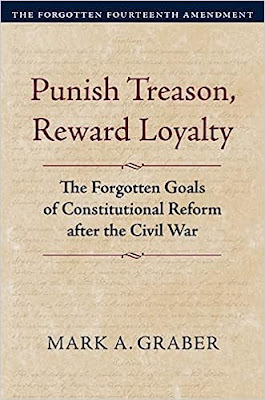
Mark A. Graber, Punish Treason, Reward Loyalty: The Forgotten Goals of Constitutional Reform after the Civil War (University of Kansas Press, 2023)
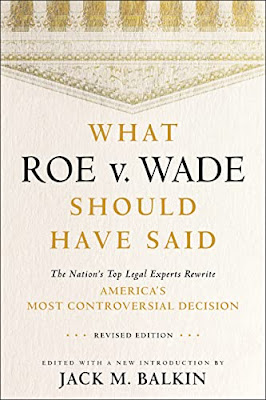
Jack M. Balkin, What Roe v. Wade Should Have Said: The Nation's Top Legal Experts Rewrite America's Most Controversial Decision - Revised Edition (NYU Press, 2023)

Andrew Koppelman, Burning Down the House: How Libertarian Philosophy Was Corrupted by Delusion and Greed (St. Martin’s Press, 2022)

Gerard N. Magliocca, Washington's Heir: The Life of Justice Bushrod Washington (Oxford University Press, 2022)
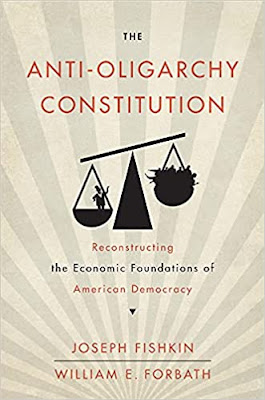
Joseph Fishkin and William E. Forbath, The Anti-Oligarchy Constitution: Reconstructing the Economic Foundations of American Democracy (Harvard University Press, 2022)
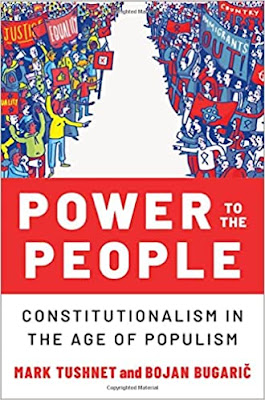
Mark Tushnet and Bojan Bugaric, Power to the People: Constitutionalism in the Age of Populism (Oxford University Press 2021).

Mark Philip Bradley and Mary L. Dudziak, eds., Making the Forever War: Marilyn B. Young on the Culture and Politics of American Militarism Culture and Politics in the Cold War and Beyond (University of Massachusetts Press, 2021).

Jack M. Balkin, What Obergefell v. Hodges Should Have Said: The Nation's Top Legal Experts Rewrite America's Same-Sex Marriage Decision (Yale University Press, 2020)

Frank Pasquale, New Laws of Robotics: Defending Human Expertise in the Age of AI (Belknap Press, 2020)

Jack M. Balkin, The Cycles of Constitutional Time (Oxford University Press, 2020)

Mark Tushnet, Taking Back the Constitution: Activist Judges and the Next Age of American Law (Yale University Press 2020).

Andrew Koppelman, Gay Rights vs. Religious Liberty?: The Unnecessary Conflict (Oxford University Press, 2020)

Ezekiel J Emanuel and Abbe R. Gluck, The Trillion Dollar Revolution: How the Affordable Care Act Transformed Politics, Law, and Health Care in America (PublicAffairs, 2020)

Linda C. McClain, Who's the Bigot?: Learning from Conflicts over Marriage and Civil Rights Law (Oxford University Press, 2020)
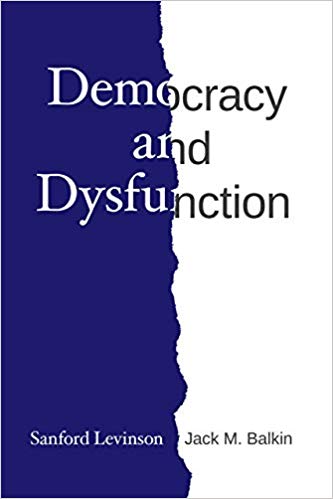
Sanford Levinson and Jack M. Balkin, Democracy and Dysfunction (University of Chicago Press, 2019)

Sanford Levinson, Written in Stone: Public Monuments in Changing Societies (Duke University Press 2018)

Mark A. Graber, Sanford Levinson, and Mark Tushnet, eds., Constitutional Democracy in Crisis? (Oxford University Press 2018)

Gerard Magliocca, The Heart of the Constitution: How the Bill of Rights became the Bill of Rights (Oxford University Press, 2018)

Cynthia Levinson and Sanford Levinson, Fault Lines in the Constitution: The Framers, Their Fights, and the Flaws that Affect Us Today (Peachtree Publishers, 2017)

Brian Z. Tamanaha, A Realistic Theory of Law (Cambridge University Press 2017)

Sanford Levinson, Nullification and Secession in Modern Constitutional Thought (University Press of Kansas 2016)

Sanford Levinson, An Argument Open to All: Reading The Federalist in the 21st Century (Yale University Press 2015)

Stephen M. Griffin, Broken Trust: Dysfunctional Government and Constitutional Reform (University Press of Kansas, 2015)

Frank Pasquale, The Black Box Society: The Secret Algorithms That Control Money and Information (Harvard University Press, 2015)

Bruce Ackerman, We the People, Volume 3: The Civil Rights Revolution (Harvard University Press, 2014)
Balkinization Symposium on We the People, Volume 3: The Civil Rights Revolution

Joseph Fishkin, Bottlenecks: A New Theory of Equal Opportunity (Oxford University Press, 2014)

Mark A. Graber, A New Introduction to American Constitutionalism (Oxford University Press, 2013)

John Mikhail, Elements of Moral Cognition: Rawls' Linguistic Analogy and the Cognitive Science of Moral and Legal Judgment (Cambridge University Press, 2013)

Gerard N. Magliocca, American Founding Son: John Bingham and the Invention of the Fourteenth Amendment (New York University Press, 2013)

Stephen M. Griffin, Long Wars and the Constitution (Harvard University Press, 2013)

Andrew Koppelman, The Tough Luck Constitution and the Assault on Health Care Reform (Oxford University Press, 2013)

James E. Fleming and Linda C. McClain, Ordered Liberty: Rights, Responsibilities, and Virtues (Harvard University Press, 2013)
Balkinization Symposium on Ordered Liberty: Rights, Responsibilities, and Virtues

Andrew Koppelman, Defending American Religious Neutrality (Harvard University Press, 2013)

Brian Z. Tamanaha, Failing Law Schools (University of Chicago Press, 2012)

Sanford Levinson, Framed: America's 51 Constitutions and the Crisis of Governance (Oxford University Press, 2012)

Linda C. McClain and Joanna L. Grossman, Gender Equality: Dimensions of Women's Equal Citizenship (Cambridge University Press, 2012)

Mary Dudziak, War Time: An Idea, Its History, Its Consequences (Oxford University Press, 2012)

Jack M. Balkin, Living Originalism (Harvard University Press, 2011)

Jason Mazzone, Copyfraud and Other Abuses of Intellectual Property Law (Stanford University Press, 2011)

Richard W. Garnett and Andrew Koppelman, First Amendment Stories, (Foundation Press 2011)

Jack M. Balkin, Constitutional Redemption: Political Faith in an Unjust World (Harvard University Press, 2011)

Gerard Magliocca, The Tragedy of William Jennings Bryan: Constitutional Law and the Politics of Backlash (Yale University Press, 2011)

Bernard Harcourt, The Illusion of Free Markets: Punishment and the Myth of Natural Order (Harvard University Press, 2010)

Bruce Ackerman, The Decline and Fall of the American Republic (Harvard University Press, 2010)
Balkinization Symposium on The Decline and Fall of the American Republic

Ian Ayres. Carrots and Sticks: Unlock the Power of Incentives to Get Things Done (Bantam Books, 2010)

Mark Tushnet, Why the Constitution Matters (Yale University Press 2010)

Ian Ayres and Barry Nalebuff: Lifecycle Investing: A New, Safe, and Audacious Way to Improve the Performance of Your Retirement Portfolio (Basic Books, 2010)
.jpg)
Jack M. Balkin, The Laws of Change: I Ching and the Philosophy of Life (2d Edition, Sybil Creek Press 2009)

Brian Z. Tamanaha, Beyond the Formalist-Realist Divide: The Role of Politics in Judging (Princeton University Press 2009)
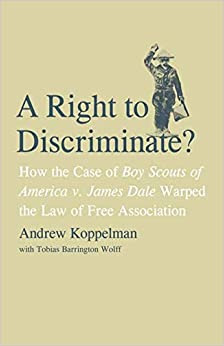
Andrew Koppelman and Tobias Barrington Wolff, A Right to Discriminate?: How the Case of Boy Scouts of America v. James Dale Warped the Law of Free Association (Yale University Press 2009)

Jack M. Balkin and Reva B. Siegel, The Constitution in 2020 (Oxford University Press 2009)

Heather K. Gerken, The Democracy Index: Why Our Election System Is Failing and How to Fix It (Princeton University Press 2009)

Mary Dudziak, Exporting American Dreams: Thurgood Marshall's African Journey (Oxford University Press 2008)

David Luban, Legal Ethics and Human Dignity (Cambridge Univ. Press 2007)

Ian Ayres, Super Crunchers: Why Thinking-By-Numbers is the New Way to be Smart (Bantam 2007)

Jack M. Balkin, James Grimmelmann, Eddan Katz, Nimrod Kozlovski, Shlomit Wagman and Tal Zarsky, eds., Cybercrime: Digital Cops in a Networked Environment (N.Y.U. Press 2007)
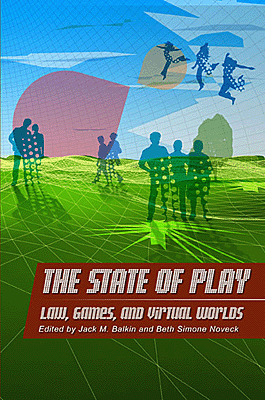
Jack M. Balkin and Beth Simone Noveck, The State of Play: Law, Games, and Virtual Worlds (N.Y.U. Press 2006)

Andrew Koppelman, Same Sex, Different States: When Same-Sex Marriages Cross State Lines (Yale University Press 2006)

Brian Tamanaha, Law as a Means to an End (Cambridge University Press 2006)

Sanford Levinson, Our Undemocratic Constitution (Oxford University Press 2006)

Mark Graber, Dred Scott and the Problem of Constitutional Evil (Cambridge University Press 2006)

Jack M. Balkin, ed., What Roe v. Wade Should Have Said (N.Y.U. Press 2005)

Sanford Levinson, ed., Torture: A Collection (Oxford University Press 2004)
Balkin.com homepage
Bibliography
Conlaw.net
Cultural Software
Writings
Opeds
The Information Society Project
BrownvBoard.com
Useful Links
Syllabi and Exams
