Balkinization
an unanticipated consequence of
Jack M. Balkin
Balkinization Symposiums: A Continuing List
E-mail:
Jack Balkin:
jackbalkin at yahoo.com
Bruce Ackerman
bruce.ackerman at yale.edu
Ian Ayres
ian.ayres at yale.edu
Corey Brettschneider
corey_brettschneider at brown.edu
Mary Dudziak
mary.l.dudziak at emory.edu
Joey Fishkin
joey.fishkin at gmail.com
Heather Gerken heather.gerken at yale.edu
Abbe Gluck abbe.gluck at yale.edu
Mark Graber
mgraber at law.umaryland.edu
Stephen Griffin
sgriffin at tulane.edu
Jonathan Hafetz
jonathan.hafetz at shu.edu
Jeremy Kessler
jkessler at law.columbia.edu
Andrew Koppelman
akoppelman at law.northwestern.edu
Marty Lederman
msl46 at law.georgetown.edu
Sanford Levinson
slevinson at law.utexas.edu
David Luban
david.luban at gmail.com
Gerard Magliocca
gmaglioc at iupui.edu
Jason Mazzone
mazzonej at illinois.edu
Linda McClain
lmcclain at bu.edu
John Mikhail
mikhail at law.georgetown.edu
Frank Pasquale
pasquale.frank at gmail.com
Nate Persily
npersily at gmail.com
Michael Stokes Paulsen
michaelstokespaulsen at gmail.com
Deborah Pearlstein
dpearlst at yu.edu
Rick Pildes
rick.pildes at nyu.edu
David Pozen
dpozen at law.columbia.edu
Richard Primus
raprimus at umich.edu
K. Sabeel Rahmansabeel.rahman at brooklaw.edu
Alice Ristroph
alice.ristroph at shu.edu
Neil Siegel
siegel at law.duke.edu
David Super
david.super at law.georgetown.edu
Brian Tamanaha
btamanaha at wulaw.wustl.edu
Nelson Tebbe
nelson.tebbe at brooklaw.edu
Mark Tushnet
mtushnet at law.harvard.edu
Adam Winkler
winkler at ucla.edu
Compendium of posts on Hobby Lobby and related cases
The Anti-Torture Memos: Balkinization Posts on Torture, Interrogation, Detention, War Powers, and OLC
The Anti-Torture Memos (arranged by topic)
Recent Posts
The Importance of Abusive Constitutional Borrowing: A Reply to Commentators
Section Four as an Anti-Default Rule
Can Abusive Borrowing Itself Be Abusive?
On New Autocrats, Imitation and Flattery
Beyond Comparative Constitutionalism: Abusive Legal Borrowing
What Are the Options on the Debt Limit?
Domesticating Constitutionalism
Balkinization Symposium on Rosalind Dixon and David Landau, Abusive Constitutional Borrowing
Section Four of the Fourteenth Amendment (again)
To Reform Social Media, Reform Informational Capitalism
Fishing, Not Catching, in the History of the Law
Constitution Day: Is September 17 the Right Choice?
Is the U.S. Constitution Up to the Task of Preserving American Democracy?
An Alternative Test for the Necessary and Proper Clause
Some Not Very Focused Preliminary Thoughts About the Shadow Docket (But Leading Up to Some Fundamentals about Constitutional Law)
![[Powered by Blogger]](https://lh3.googleusercontent.com/blogger_img_proxy/AEn0k_unneZUR1FtZMk86Qx0TmWRHsZrsCuWKVmjUpAa5A1yF17b1nELJktzLY4MgbJe4KgwIKZ_xiQ_8gqvFGiP67S3ptrL7sCHxEv8LiS9_V9S=s0-d)
Just A Few Blogs
ACS Blog
Alas, a Blog
Althouse
Arts and Letters Daily
Atrios (Eschaton)
Bill of Health
Buzzflash.com
Buzz Machine
Cato at Liberty
Juan Cole (Informed Comment)
Concurring Opinions
The Constitution in 2020
Corrente
Crooked Timber
Daily Howler
Daily Kos
Dana Boyd
Brad DeLong
Digby (Hullabaloo)
Discriminations
Daniel Drezner
Kevin Drum (Mother Jones)
Electrolite
En Banc
Eunomia (Daniel Larison)
Fafblog
Michael Froomkin (Discourse.net)
GovLab (Beth Noveck)
Rick Hasen (Election Law)
History News Network
How Appealing
Ignatz (Sam Heldman)
The Importance of (Ernie Miller)
Infolaw
Instapundit
International Economic Law and Policy Blog
IntLawGrrls
Jacob Levy
Jesus' General
Jurisdynamics
The Kitchen Cabinet
Mark Kleiman
Law Blog Central
Larry Lessig
Lawyers, Guns and Money
Liberal Oasis
Brian Leiter's Law School Reports
The Leiter Reports
Marginal Revolution
Megan McArdle
Memeorandum
Metafilter
Mirror of Justice
The New Republic
Newseum
No More Mister Nice Blog
Brendan Nyhan
Opinio Juris
Orcinus
The Originalism Blog
Pandagon
Passport (Foreign Policy)
Overcoming Bias
Political Animal (Washington Monthly)
Political Theory Daily Review
Political Wire (Taegan Goddard)
The Poor Man
Virginia Postrel
Prawfsblawg
Public Reason
Jonathan Rauch
Raw Story
Redstate
ReligiousLeftLaw.com
Reporters Committee For Freedom of the Press
Reproductive Rights Blog
Rothman's Roadmap to the Right of Publicity
SCOTUS Blog
Seeing the Forest
Clay Shirky
The Shifted Librarian
The Situationist
Larry Solum (Legal Theory)
Andrew Sullivan
Talking Points Memo
Talk Left
Tapped
Tbogg
TechPresident
The Paper Chase (Jurist)
Tom Paine
Tom Tomorrow (This Modern World)
Eve Tushnet
Uggabugga
University of Chicago Law School Faculty Blog
Unqualified Offerings
The Volokh Conspiracy
War and Piece (Laura Rozen)
Wampum
Oliver Willis
Wonkette
Written Description
Matthew Yglesias
Yin
Your Choice of Feeds
1. XML
powered by

2. Atom Feed
3. RSS 2.0
The Importance of Abusive Constitutional Borrowing: A Reply to Commentators
Guest Blogger
For the Balkinization symposium on Rosalind Dixon and David Landau, Abusive Constitutional Borrowing: Legal globalization and the subversion of liberal democracy (Oxford University Press, 2021). Rosalind
Dixon and David Landau We are deeply grateful to Kim Lane Scheppele, Oren
Tamir, Sam Issacharoff, and Alvin Cheung for so generously and carefully
engaging with our work, both at an earlier event at ICON-S and in
Balkinization. We are humbled that our work is being read by such a
distinguished group of commentators, as well as by the wide-ranging discussion
our work has sparked. The core contribution of Abusive
Constitutional Borrowing is to demonstrate the
many ways that authoritarians and would-be authoritarians can wield the core
designs, concepts, and doctrines of liberal democratic constitutionalism to
instead undermine democratic constitutionalism. The very tools used to protect
and promote democratic constitutionalism are often turned into potent weapons
to attack it. Perhaps the most important audience for our book, then, is the
comparative constitutional law community itself, as well as adjacent
communities like those found in international law and international human
rights. We intend our book as something of a warning about a dark side of our
fields, and as a call not to curtail efforts to promote liberal democratic
constitutionalism, but instead to redouble efforts in a way that is more
sensitive to the risks of abuse. For example, because many concepts intended to
promote liberal democracy can in fact be repurposed to attack it, scholars and
constitutional policymakers must be more alive to these risks. The possibility
of abuse is sometimes quite substantial. While no norm can be fully insured
against the risk of abuse, we do think that the community involved in
developing and promoting liberal democratic norms could often do a better job
of “abuse proofing” designs, concepts, and doctrines. To substantiate our claim, we draw on examples from
the heartland of liberal democracy. We devote chapters to rights and courts,
perhaps its main instantiations. We show for example how courts have used
militant democracy ideas to ban parties for antidemocratic ends in contexts
like Cambodia and Thailand, how the Supreme Court nullified the power of an
opposition-held legislature in Venezuela, and how gender quotas and hate speech
norms have helped to bolster Kagame’s authoritarian regime in Rwanda. We also
have a chapter on constituent power, arguably the theoretical underpinning of
modern constitutionalism. Here, for example, we study the use of a doctrine of
unconstitutional constitutional amendment to eliminate presidential term limits
by would-be autocrats, in a line of reasoning that has run through countries
such as Bolivia, Honduras, and Nicaragua in Latin America. Finally, we look at
recent attempts to abuse political constitutionalism and weak forms of judicial
review, ranging from Hungary and Poland in Eastern Europe to Israel.
Posted
9:30 AM
by Guest Blogger [link]
Section Four as an Anti-Default Rule
Gerard N. Magliocca
Here's another way to think about Section Four of the Fourteenth Amendment. The text, as read by the plurality opinion in Perry v. United States, denies to Congress or to the Treasury the power to default on our national bonds. What, though, does a "default" mean? It does not mean any haircut that bondholders might take. At some point a partial repudiation would constitute a default, but I'm not sure at what point. Stepping back for a moment, you could argue that the President should invoke Section Four simply to create a case on the question of whether Congress can constitutionally impose a debt ceiling that would cause a default. (The debt ceiling itself is not the problem, as a hypothetical Congress could say the United States would adopt a pay-as-you-go model for paying off old debt.) The problem (and not a small one) is that any borrowing while such a case is pending would be legally uncertain.
Posted
2:11 PM
by Gerard N. Magliocca [link]
(0) comments
Can Abusive Borrowing Itself Be Abusive?
Guest Blogger
For the Balkinization symposium on Rosalind Dixon and David Landau, Abusive Constitutional Borrowing: Legal globalization and the subversion of liberal democracy (Oxford University Press, 2021). Oren Tamir Professors
Rosalind Dixon & David Landau’s book Abusive Constitutional Borrowing:
Legal Globalization and the Subversion of Liberal Democracy is terrific,
and I expect it to quickly become a central—perhaps THE central—reference point
for research on the topic of what we have come to call, among many other
available labels, “constitutional retrogression” or “democratic backsliding.”
That the book is so great and insightful, and a pleasure to read on top of
that, is absolutely no surprise given the identity of its authors. Indeed, no
one who works in the field of comparative constitutional law (or, perhaps
better, comparative constitutional studies) could miss Dixon & Landau’s extensive and consistently
excellent work, both individually and as co-authors. I personally find myself
regularly going back to Dixon & Landau’s impressive corpus of work, which
would now include Abusive Constitutional Borrowing, for clarity,
insight, and inspiration. And I should take the opportunity presented by this symposium
to say that I’m immensely grateful for the leadership role that Dixon &
Landau take in the community of comparative constitutional law/studies, and
especially their interest in, and willingness to engage with, those of us who
are beginning to chart our own path in the field. I take Abusive
Constitutional Borrowing to be making two primary contributions to the
study of the phenomenon of democratic backsliding or constitutional
retrogression. The first contribution is what I think of as identifying the target
of concern in discussions of this topic and, importantly, significantly
narrowing it down. Dixon & Landau argue here that we should get worried when,
and only when, what they call the “minimum core” of constitutional
democracy is under real strain. This is essentially the adoption, as Dixon
& Landau suitably acknowledge, of a rather “thin” (even if not an extremely
thin) definition of constitutional democracy as the relevant target. That
definition includes regular, free, and fair multi-party elections, political
rights and freedoms for all citizens, and a set of institutional checks and
balances. And it leaves outside the scope of discussion in the context of
constitutional retrogression or democratic backsliding “thicker” conceptions of
what constitutional democracy might be thought to entail, and particularly
conceptions that incorporate various “goods” associated with liberal constitutional
democracy (including the rule of law as well as individual rights to freedom,
dignity, and equality beyond the political sphere). The book’s
second contribution—and the one that gets most of the explicit focus in it (and
of course give it its title)—is not about the target of concern but the technologies
through which our concerns might become realized. Here Dixon & Landau
tell us (building on their own previous work as well on crucial work by another leader in the field of
comparative constitutional law/studies, and a co-participant in this book
symposium, Professor Kim Lane Scheppele) that a key way that the “minimum core”
of constitutional democracy is indeed being jeopardized, and constitutional
retrogression or democratic backsliding occurs, is through a specific method:
that of abusive constitutional borrowing. In Dixon & Landau’s overarching
narrative, our time has witnessed the appearance of many ambitious, would-be
autocrats around the world who are plausibly understood as interested in
dramatically diminishing the “minimum core” of constitutional democracy and
causing constitutional retrogression or democratic backsliding. But to do that,
these would-be autocrats need not explicitly and transparently work outside of the
canon of constitutional democracy. Rather, they can do so from within,
by strategically appropriating the designs, concepts, and doctrines of
constitutional democracy itself to advance their desired authoritarian projects.
On the surface, these would-be autocrats certainly seem to talk the talk of
constitutional democracy. Once we drill down below the surface level, though,
we realize that they are far from willing to walk the walk of constitutional
democracy. Their use of these concepts, designs, and doctrines is extremely
shallow. As Dixon & Landau say, sometimes it’s pure sham. Sometimes it’s selective
and acontextual. And sometimes it’s “anti-purposive.”
Posted
9:30 AM
by Guest Blogger [link]
On New Autocrats, Imitation and Flattery
Guest Blogger
For the Balkinization symposium on Rosalind Dixon and David Landau, Abusive Constitutional Borrowing: Legal globalization and the subversion of liberal democracy (Oxford University Press, 2021). Kim Lane Scheppele Oscar Wilde could well have been
talking about a new generation of autocrats when he penned the aphorism that
“imitation is the sincerest form of flattery.” Earlier
generations of dictators toppled constitutional-democratic governments by
ordering tanks into the streets. But
coups are largely a thing of the past.
The new generation of autocrats topples constitutional-democratic
governments by ordering lawyers into action to write copycat constitutions and copycat
legislation designed to subvert the rule of law. By
imitating liberal constitutionalism (even as they are undermining it), the new
autocrats indirectly acknowledge that “[liberal] democracy is the only game in town.” They wouldn’t do what they do if they didn’t
recognize the normative power of the model that they mimic. New
autocrats aim not at revolution through force but at subversion through mimicry. Abusive
Constitutional Borrowing by Rosalind Dixon and David Landau documents the rise
of autocratic
legalism by showing how new autocrats now “borrow” constitutional ideas and
structures from “good” constitutional systems in order to use them in “bad” ways
(hence the “abuse”). From Venezuela to
Poland, from Rwanda to Thailand, from Hungary to Ecuador, from Fiji to Israel, the
pattern is clear. Aspirational
autocrats win elections – often freely and fairly the first time – and then set
about to destroy the bases of constitutional democracy that allowed them to come
to power in the first place. As these
autocrats dismantle constitutional democracy, however, they take pains to keep
up appearances, which masks to both domestic democratic publics and
international observers what is really going on. By the time that constitutional democracy is fatally
wounded, it is often too late to revive it. Dixon and Landau build their
powerful argument by developing a normative model against which to test the
transformations they document. They
identify a “minimum core” of constitutional democracy that includes regular,
free and competitive elections; respect for basic rights and freedoms; and the protection
of the institutions that guarantee both.
Then they assess the changes that they document against that
framework. Their model is elegant,
helpful and admirably neutral among different forms of liberal constitutional
order. For example, they don’t give
pride of place to “free speech” as American analyses often do, nor do they
check for “separation of powers” which can often be rather hard to identify in
parliamentary systems. Their thin
theory of constitutional democracy provides a clear anchor for their idea of
“abuse.” In their framework, constitutional-democratic
norms used to undermine constitutional democracy are deployed “abusively.”
Posted
9:30 AM
by Guest Blogger [link]
Beyond Comparative Constitutionalism: Abusive Legal Borrowing
Guest Blogger
For the Balkinization symposium on Rosalind Dixon and David Landau, Abusive Constitutional Borrowing: Legal globalization and the subversion of liberal democracy (Oxford University Press, 2021). Alvin Y.H. Cheung The street finds its own uses for things. - William Gibson, Burning Chrome There is broad
consensus that liberal democracy is in retreat, despite the spread and apparent
triumph of liberal democratic institutions and ideas in the late 20th
Century. Professors Dixon and Landau
turn this proposition on its head: they argue that autocrats are increasingly
adopting ideas and institutions of liberal democratic origin and deploying them
in anti-democratic ways. Abusive
Constitutional Borrowing provides a careful, systematic articulation of
that argument, and offers some promising (if slightly tentative) suggestions on
what to do about it. The true value of
the book, however, is far greater: the sceptical approach Landau and Dixon
adopt towards constitutional borrowing can be fruitfully applied outside
the realm of constitutions and constituionalism. Although the
entirety of Abusive Constitutional Borrowing merits careful reading, I
shall focus on two aspects of the book that deserve particular mention. First, the book persuasively lays out a
framework for thinking about different types of abusive constitutional
borrowing, centred on a “democratic minimum core.” In the context of rule of law indices, Mila
Versteeg
and Tom Ginsburg’s
study suggests that a major failing of such indices is that their conception of
the rule of law overlaps with other factors, such as human rights and the
absence of corruption. A relatively
parsimonious conception of democracy – a set of factors that are necessary (if
perhaps not sufficient) for democracies to function – will be more robust, or
at least more likely to attract consensus, than an everything-but-the-kitchen-sink
account. Second, Abusive
Constitutional Borrowing advocates a more critical approach to the practice
of comparative constitutional law, an approach Dixon and Landau refer to as
“global legal realism.” Abusive
practices, they argue, take advantage of the formalist and acontextual approach
that continues to dominate the transnational rule-of-law industry – an approach
that Kim Lane Scheppele has called a “checklist”
approach. Any effective response to
abusive constitutional borrowing will therefore have to be more sensitive to
context – both in terms of how discrete norms are implemented, and how they
function as part of a legal system. Put
more bluntly, practitioners of comparative constitutionalism must learn to
think like autocrats. This practice of
adversarial thinking – referred to in information security as “red teaming” –
is an accepted part of building computer infrastructure; Abusive
Constitutional Borrowing suggests that it should also be adopted in
developing constitutional infrastructure. I now turn to
consider the subtitle, “Legal Globalization and the Subversion of Liberal
Democracy.” The phenomena that Dixon and
Landau highlight in their introductory chapter have led not only to a
transnational constitutional order, but to a “transnational legal order”
(p 1, emphasis mine). As Dixon and
Landau argue, that transnational legal order has inspired creative
anti-democratic behaviour. However, that
creativity has not been confined to abusive constitutional borrowing. Three examples may
help illustrate the point. First, the
use of defamation litigation against government critics – a practice commonly
associated with Singapore – has spread to other semi-autocracies; in recent
years Poland and Brazil have the tactic against (among others) Professors Wojciech
Sadurski and Conrado
Hübner Mendes, respectively. Second,
most of the media and electoral reforms in Hungary that Scheppele documents in
“The Rule
of Law and the Frankenstate” did not involve changes to the
constitution. In particular, her account
of the creation of a new media regulator with superficial similarities to media
councils elsewhere in Europe demonstrates that wilfully perverse
transplantation is not confined to constitutional norms or institutions. Third, the mere fact that China’s
Anti-Monopoly Law (“AML”) was modelled on European or American
legislation offers no insight into how the AML regime actually operates. As Angela Zhang has argued in Chinese
Antitrust Exceptionalism, the PRC’s radically different institutional
and bureaucratic context has resulted in a very different system – one that
Beijing has used to further its own geopolitical objectives. This type of
abusive legal borrowing may well be even more pernicious than abusive
constitutional borrowing (an argument I develop at greater length in my
forthcoming article Legal Gaslighting). First, the presence of constitutional change
is likely to attract attention in a way that the alteration of (for instance) criteria
for company registration might not.
Second, the purpose of constitutional amendments is harder to disguise
than amendments to “ordinary” law.
Third, changes to “ordinary” law have the potential to affect many more
interactions between citizens and the State; to return to the example of
companies registration, the political capture of Hong Kong’s Companies Registry
(prior to Beijing’s
imposition of the “National Security Law” in 2020) had the practical effect
of impeding opposition parties’ ability to open bank accounts or rent office
premises. The true value of Abusive
Constitutional Borrowing does not lie merely in the light it sheds on
abusive constitutional borrowing. As the
examples above suggest, sophisticated autocrats are increasingly supplementing,
if not replacing, abusive constitutional borrowing with other forms of abusive
legal borrowing. Nonetheless, the latter
relies on the same transnational blind spots of formalism and acontextualism that
has empowered the former, and Abusive Constitutional Borrowing provides
a vocabulary and analytical approach that can be applied to both. As such, the book is an important
contribution not only to comparative constitutional law, but to the nascent
field of comparative public law. Alvin Y.H. Cheung (alvin.cheung@law.nyu.edu) is a SSHRC Postdoctoral
Fellow at McGill University Faculty of Law and a Non-Resident Affiliate of
NYU’s US-Asia Law Institute.
Posted
9:30 AM
by Guest Blogger [link]
What Are the Options on the Debt Limit?
David Super
The media is
starting to pay more attention to looming fiscal deadlines. Much of the coverage, however, takes what the
congressional leaders say at face value.
That is rarely a good plan. This
post seeks to untangle the options available to each side under congressional
procedure. To begin with, we should
be clear what major fiscal items are on Congress’s agenda. At the moment, these number four. First, with no
appropriations bills enacted for the fiscal year beginning October 1, a
continuing resolution (CR) will be needed to prevent a partial government
shutdown. Second, the Treasury has
reported that it will exhaust available accounting tricks to stay within the statutory
debt limit by late October; the debt limit therefore must be raised or suspended
to prevent the United States Government from defaulting on its legal
obligations. Third, the bipartisan infrastructure
bill passed by the Senate awaits action in the House. Finally, Democrats have begun committee work
in the House to advance a budget reconciliation bill to “Build Back Better” by
making investments in human infrastructure and reducing carbon emissions. Neither of these final two items have legal
deadlines, although political windows of opportunity can close quickly in this
town. The Democratic
leadership combined the first two items, putting a debt limit measure in the
continuing resolution to keep the government funded following October 1. Attaching debt limit increases to must-pass
legislation such as a CR has been a relatively common approach by both parties
in the past. Although increasing the
debt limit does not drive increases in the deficit – that is done by substantive
tax and spending bills – it commonly gets misunderstood by the public and
demagogued by some in the media. In a
new twist, some Republicans a few years ago started suggesting they would be
happy to have the country breach the debt limit, presumably to grab headlines
and demonstrate their independence from the financial elites that warn of the
consequences of default. Since the debt
limit has become so intensely politicized, even Members that understand its
importance have preferred not to vote for freestanding debt limit
legislation. House Republicans
voted en masse against the CR/debt limit bill, leaving Democrats to pass
it on their own. They did. More significantly,
Senate Republican Leader Mitch McConnell (R-KY) has insisted that Democrats
must pass any debt limit increase without any Republican votes. Senator McConnell agrees that the debt limit
should pass, but he insists no Republican votes will be available to do
so. He claims that this is the Democrats’
responsibility as the de facto majority party. Senator McConnell’s
insistence that majority party must provide all the votes to pass debt limit
increases has no plausible basis in history.
Democrats have routinely cooperated in raising the debt limit when
Republicans were in power. This has been
true even after deeply partisan upper-income or corporate tax cuts passed over
their objections and swelled the deficit to make increases in the debt limit
urgent. Indeed, had Democrats adopted
Senator McConnell’s policy, the nation might well have defaulted as some congressional
Republicans (e.g., much of the Freedom Caucus) consistently refuse to
vote for debt limit increases. And with
their commitment to preventing a default so clear, Democrats recognized that
debt limit legislation gave them no bargaining leverage and have not sought to
extract significant concessions in exchange for their votes on the debt
limit. By contrast, in 2011 Republican
threats not to raise the debt limit – when they held the majority in the House –
bludgeoned President Obama into agreeing to the deep budget cuts that culminated
in sequestration. Nor is the need
for this increase in the debt limit solely attributable to Democrats. Over the past four years, the deficit and the
national debt have been increased substantially by Republican legislation (the
2017 tax cuts), by Democratic legislation (the American Rescue Plan Act), and
by bipartisan legislation (last year’s several major coronavirus relief bills).
Although Senator
McConnell’s position has no serious historical support, senators are not bound
by history. And with the Democrats
consistently opposed to threatening default, he has no reason to worry about
similar tactics being used on him should he return to the majority after the
mid-term elections. So Democrats must
decide what to do about Senator McConnell’s position. Democrats have a
few choices. The simplest is to bring
the legislation that passed the House to the floor of the Senate. If Republicans do not filibuster, Democrats
can pass it without a single Republican vote.
That would meet Senator McConnell’s stated requirement. Senator Ted Cruz
(R-TX), however, seems likely to filibuster such legislation. Overcoming that filibuster and bringing the
CR/debt limit bill to a vote would then require sixty votes. Senator McConnell could allow ten of his
senators to vote to invoke cloture (cutting off the filibuster) and then have
all Republicans vote against final passage of the CR/debt limit bill. This, too, would seem to meet Senator
McConnell’s requirement that the legislation be passed entirely with Democratic
votes. The ten Republicans voting for
cloture would not be voting to raise the debt limit; they would be voting to
prevent a senator of their own party from preventing the Democrats from doing
what Senator McConnell has said he wants them to do: pass the CR/debt limit bill with their own
votes. If Republicans
actively obstruct passage of the CR/debt limit legislation, Democrats will have
to decide between moving a freestanding CR (which Senator McConnell has
indicated Republicans would not obstruct) and allowing a partial government
shutdown. Because padlocked national parks
are far more salient to the average voter than is anxiety in the financial
markets, Democrats may feel that this is a more suitable place to draw a line
in the sand to get Republicans to abandon their filibuster. If Republicans
succeed in blocking a debt limit increase or suspension as part of the CR –
either by forcing a partial government shutdown or by coercing Democrats into
moving a CR that does not address the debt limit – Democrats could, in theory,
move a debt limit increase through “budget reconciliation” procedures, which
bar filibusters. This appears to be what
Senator McConnell is trying to force them to do. It is not nearly as simple as it sounds. The content of a reconciliation
bill is dictated by the terms of the concurrent resolution on the budget for
the fiscal year in question. The
Democrats passed – on a party lines vote – a budget resolution to allow the Build
Back Better legislation to move through reconciliation procedures. Because they were planning to move the debt
limit increase on the CR, however, they put nothing in the budget resolution
authorizing a reconciliation bill to raise the debt limit. In order to move a
debt limit increase through expedited reconciliation procedures, Democrats
therefore would likely have to pass an amended version of the budget resolution
that included instructions to raise the debt limit. This they can do, but it would involve
several steps, each of which offers Republicans considerable opportunities for
obstruction and delay. Senator
McConnell, if he so chose, could expedite the process by declining to object to
the Democrats’ moving a debt limit reconciliation bill without a reconciliation
instruction authorizing them to do so.
He could still have all Republicans vote against that bill – fulfilling his
stated requirement – but reduce uncertainty in the financial markets by allowing
the debt limit to be raised more expeditiously.
If their current
divisions are any indication, the Democrats might not have their Build Back
Better reconciliation bill ready to pass before the need to raise the debt
limit becomes critical. This will not be
fatal. Section
310 of the Congressional Budget Act permits separate reconciliation bills
to change spending, to change revenues, and to increase the debt limit. The first two typically are combined – and will
be in the Build Back Better reconciliation bill – but the Democrats could move
a separate reconciliation bill containing only the debt limit increase. Of course, doing so would require Democrats
to vote on a stand-alone debt limit bill, something Members of both parties
have long been loathe to do (and generally shielded from doing by the leaders
of both parties). If a
miscalculation in this game of Fiscal Chicken exhausts the Treasury’s ability
to operate within the existing debt limit, President Biden would have several
options. One would be to determine that
section 4 of the Fourteenth Amendment makes the debt limit unenforceable when
it states that “The validity of the public debt of the United States,
authorized by law, including debts incurred for payment of pensions and
bounties for services in suppressing insurrection or rebellion, shall not be
questioned.” President Obama considered
and rejected
this approach in 2011, but President Biden has already broken with his former
boss in several important respects. If
President Biden did so, it is unclear who, if anyone, would have standing to
challenge his actions. The Supreme Court
seems unlikely to intervene to cause an immediate default; after all, the Court
has lately
expressed reluctance to take cases “present[ing] complex and novel antecedent
procedural questions”. A final note: although the debt limit increase could move
on its own, as part of the CR, or as part of reconciliation, the CR and
reconciliation cannot be combined. The Byrd
Rule limits spending provisions in reconciliation bills to those that would
change mandatory (commonly termed “entitlement”) spending. The appropriations needed to keep the
government operating that will be in the CR are overwhelmingly discretionary
(non-entitlement) spending and hence impermissible on a reconciliation
bill. Congress cannot pass one big “budget
bill” combining all these measures. @DavidASuper1
Posted
12:13 AM
by David Super [link]
Domesticating Constitutionalism
Guest Blogger
For the Balkinization symposium on Rosalind Dixon and David Landau, Abusive Constitutional Borrowing: Legal globalization and the subversion of liberal democracy (Oxford University Press, 2021). Samuel Issacharoff At first glance, the work of Ros Dixon and David Landau on
constitutional borrowing appears to be centered on the role of constitutions
and courts in securing or compromising democratic governance. As such, it is an invaluable contribution to
the growing literature on comparative constitutional law, one whose
institutional sophistication and deft international scale rewards the reader with
nuance and insight. At another level,
however, Abusive Constitutional Borrowing bears witness to the breaching
of what Madison termed “parchment barriers,” the aspirational commands of
constitutional law that translate imperfectly into the realities of power and
politics. The contemporary inquiry into comparative constitutional law
takes shape after the fall of the Soviet bloc and transformative events in
South Africa, Colombia, the Pacific Rim, and the list goes on. In each case, a heady if unstable mix emerged
featuring a new constitutional order, suddenly assertive constitutional courts,
uncertain political power based loosely on an electoral mandate, and a felt
need to at least gesture in the direction of the prevailing world consensus of
rights and tolerance. Constitutionalism
defined the boundaries of what Dixon and Landau call the “democratic minimum
core,” as well as the contested terrain of social rights. In the face of unsettled political power,
courts acting with a constitutional mandate took on an outsized role in
defining the new world order. The
democratic core could serve as the lower bound of permissible regulation of
politics, while rights claims provided the contested upper bound. In the upswing period of constitutionalism, borrowing lent
legitimacy to the assertion of exacting judicial review in countries bereft of
any tradition of powerful courts. In the
heyday of this borrowing, courts around the world could learn from the basic
structures doctrine of the Indian Supreme Court, from the wise preservation of
political accountability by the Colombian Constitutional Court, from the
sophisticated proportionality analysis of the South African Constitutional
Court, and from the overall judicial stewardship over the transition from
authoritarianism to democracy in countries around the world. Dixon and Landau chronicle the ebbing of the constitutional
tide. This is the moment in which, as
they introduce the study, “increasingly dense” global constitutionalism
coexists “with stagnation and backsliding in democratization …” Although their focus is largely on the
selective and acontextual use of doctrine in the service of illiberal aims,
their book memorializes the fading of constitutionalism in the face of
consolidated political power. For all
that comparative constitutionalists hail the 2010 decision of the Colombian
Court denying President Uribe a chance at a third term in office, the
intervening decade shows just what a momentary outlier that was. The Colombian decision remains the only
judicial intervention in Latin America denying an incumbent continued tenure,
and has been followed by noteworthy decisions striking down any term limits on
incumbents. The “rhetorical triumph” of
constitutionalism, their term, has repeatedly allowed a new form of
anti-liberal electoral politics to claim the mantle not only of majority
support but the authority of transnational fundamental principles of
governance.
Posted
9:30 AM
by Guest Blogger [link]
Balkinization Symposium on Rosalind Dixon and David Landau, Abusive Constitutional Borrowing
JB
At the conclusion, Ros and David will respond to the commentators.
This week at Balkinization we are hosting a symposium on Rosalind Dixon and David Landau's new book, Abusive Constitutional Borrowing: Legal globalization and the subversion of liberal democracy (Oxford University Press, 2021).
We have assembled a terrific group of commentators, including Alvin Cheung (McGill), Sam Issacharoff (NYU), Kim Scheppele (Princeton), and Oren Tamir (Harvard).
Posted
9:00 AM
by JB [link]
Section Four of the Fourteenth Amendment (again)
Gerard N. Magliocca
A decade ago when the debt ceiling was in the news, there was discussion about whether Section Four of the Fourteenth Amendment could authorize the President to, in effect, ignore the ceiling and issue new debt on his own authority to avoid a default. (When obscure parts of the Fourteenth Amendment are under discussion, Mark Graber and I are on the case.) I said then that it was highly unlikely that we would find ourselves in a situation where the Section Four issue would be presented. When the issue came up again in 2013, I wrote the following post, which has aged well and might be helpful now. (For more on Section 4 and the Supreme Court's interpretation of that provision in Perry v. United States, see my article on The Gold Clause Cases.) ---------------------------------------------------------------------------- Now that we are past the fiscal cliff, we can return to what everybody really wants to discuss--the debt ceiling. When Congress and the President sparred over this issue in 2011, there was a lot of debate about whether the President could unilaterally act (to raise taxes, borrow money, or slash spending), if the ceiling was not raised. Less attention was paid (including by me) about the threshold issue--what constitutes a violation of Section 4 of the Fourteenth Amendment, which holds that: "The validity of the public debt of the United States . . . shall not be questioned." Of course, it is possible that hitting the debt ceiling could, combined with other factors, present a different situation. If Congress made clear that the bond holders would not be made whole for any suspension, that would raise serious Section 4 questions. Or a suspension that dragged on for months might cross the line. But on Day One or Day 6, the President would not, in my view, be authorized to do anything because the Constitution would not be infringed.
Based on research that I wrote up in an article last year, my conclusion is that hitting the debt ceiling is not, by itself, a violation of Section 4. Why? Consider a hypothetical. Suppose we hit the ceiling and bond payments are suspended. A week later, the ceiling is lifted and Congress provides that the bond holders will be made whole for the missed payments. In that case, I would argue that the public debt has not been questioned in a substantial way and no constitutional violation has occurred.
Why do I add the qualification "in a substantial way?" Because in the years after Section 4 was ratified, Congress made changes to the value of the currency. (Paper money, gold and silver money, just a gold standard.) All of these reforms changed the value of our debts (sometimes to the detriment of the bond holder). Nobody thought, though, that this raised a Section 4 problem. From this, I glean that only a significant or substantial reduction in debt validity is a constitutional violation, not just any modification or reduction.
Posted
8:56 PM
by Gerard N. Magliocca [link]
To Reform Social Media, Reform Informational Capitalism
JB
I've posted my latest article, To Reform Social Media, Reform Informational Capitalism, on SSRN. Here is the abstract: Calls for altering First Amendment protections to deal with problems caused by social media are often misdirected. The problem is not First Amendment doctrines that protect harmful or false speech. The problem is the health of the digital public sphere: in particular, whether the digital public sphere, as currently constituted, adequately protects the values of political democracy, cultural democracy, and the growth and spread of knowledge. Instead of tinkering with First Amendment doctrines at the margins, we should focus on the industrial organization of digital media and the current business models of social media companies. Only a handful of social media companies currently dominate online discourse. In addition, the business models of social media companies give them incentives to act irresponsibly and amplify false and harmful content. The goals of social media regulation should therefore be twofold. The first goal should be to ensure a more diverse ecology of social media so that no single company’s construction or governance of the digital public sphere dominates. The second goal should be to give social media companies—or at least the largest and most powerful ones—incentives to become trusted and trustworthy organizations for facilitating, organizing, and curating public discourse. Competition law, consumer protection, and privacy reforms are needed to create a more diverse and pluralistic industry and to discourage business practices that undermine the digital public sphere. Given these goals, the focus should not be on First Amendment doctrines of content regulation, but on digital business models. To the extent that First Amendment doctrine requires any changes, one should aim at relatively recent decisions concerning commercial speech, data privacy, and telecommunications law that might make it harder for Congress to regulate digital businesses.
Posted
10:19 AM
by JB [link]
Fishing, Not Catching, in the History of the Law
Guest Blogger
John
Fabian Witt Some
readers may have noticed that my colleague Samuel Moyn and I have had a back and forth over the past couple weeks about
his much-discussed new book on the past, present, and future
of the laws of war. I’m grateful that some have thought the exchange edifying, and I might have let the
dialogue rest. We’ve had interesting
disagreements on the substance of the laws of war, which perhaps future
scholars and students will consider valuable starting points. But a different kind of disagreement – a
disagreement over method in historical scholarship -- prompts me to write this
short post. Here’s
Moyn’s most
astonishing passage: History
is always moral and political. In a new book, the international lawyer Anne
Orford rightly indicts historians for pretending otherwise—except that most
don’t. I never have written history as anything but politics by other means,
though Orford makes much of some rash (or strategic?) verbiage in one of my
books to the effect that it restored the “true history” of human rights. In his
review of “Humane,” Witt comparably says he has furnished the “real history” of
the laws of war. But what does his own narrative of the sun never setting on
the eternal dilemma of brutality versus humanity in war imply morally and
politically? Just
as Witt says, I am a melodramatic and moralizing writer….I can see the appeal
of Witt’s moral stance. But I simply do not find it compelling, especially
right now. As a response to an era of endless American war—however legally
humane—that has set the world far back, I prefer melodrama. We are no longer
dealing with John Yoo, whom we can now see as the advocate of a foregone
American tradition of brute and brutal force. Rather, our moral duty is to
confront the durable subsequent war of those who successfully pushed back
against that tradition in our time, rescuing war from war crimes and placing it
on legal footing through seeking (more) legal propriety in its conduct. And I
would prefer to be “stunned” by seeing that result challenged and overcome. Moyn
says that he “never” writes history “as anything but politics by other means.” He
rolls his eyes at my use of the phrase “real history” and chides himself for
having once rashly (or strategically) adopted a similar phrase himself. His work, he tells us, is a moralizing effort
to live up to the moral duties that his politics produces.
Posted
9:52 AM
by Guest Blogger [link]
Constitution Day: Is September 17 the Right Choice?
Jason Mazzone
Vik Amar and I have this essay on the designation of September 17 as Constitution Day. We explain that the date is not the only possible choice--nor even the best.
Posted
9:40 AM
by Jason Mazzone [link]
Is the U.S. Constitution Up to the Task of Preserving American Democracy?
JB
Posted
5:00 PM
by JB [link]
An Alternative Test for the Necessary and Proper Clause
Gerard N. Magliocca
The Administration's new vaccine mandate for private employers will surely be attacked in the courts. There will be a statutory challenge and a constitutional challenge. The constitutional challenge will be that the mandate runs afoul of the Chief Justice's controlling opinion in NFIB v. Sebelius, which reasoned that the individual health insurance mandate exceeded Congress's authority under the Commerce Clause and the Necessary and Proper Clause. With this background in mind, I came across an interesting passage in John Marshall's biography of George Washington. (I'm interested in Life of Washington because it was a joint project between Marshall and Bushrod Washington, who served as Marshall's editor for the book series.) At one point, the Chief Justice writes about the 1791 congressional debate on creating the First Bank of the United States. Here is what he said (before he wrote McCulloch v. Maryland): In asserting the authority of the legislature to pass the bill, gentlemen contended, that incidental as well as express powers must necessarily belong to every government: and that, when a power is delegated to effect particular objects, all the known and usual means of effecting them, must pass as incidental to it. To remove all doubt on this subject, the constitution of the United States had recognized the principle, by enabling congress to make all laws which may be necessary and proper for carrying into execution the powers vested in the government. They maintained the sound construction of this grant to be a recognition of an authority in the national legislature, to employ all the known and usual means for executing the powers vested in the government. Then they took a comprehensive view of those powers, and contended that a bank was a known and usual instrument by which several of them were exercised. I do not know if Marshall was quoting members of Congress or characterizing the issue in his own way. Either way, though, I think that "known and usual means" is a more helpful test for analyzing incidental powers (especially in light of over two centuries of practice) than the more typical formulations. For example, the thrust of the Chief Justice 's opinion in Sebelius was that a mandate to buy health insurance was unusual--it was not a "known and usual means" for exercising the commerce power. The same could be said for a federal vaccination mandate on private employers, if you assume that OSHA even has that power under the relevant statute. And so on.
Posted
8:09 AM
by Gerard N. Magliocca [link]
(0) comments
Some Not Very Focused Preliminary Thoughts About the Shadow Docket (But Leading Up to Some Fundamentals about Constitutional Law)
Mark Tushnet
The following thoughts were provoked by and during an interesting Roundtable chat convened by Neysun Mahboubi for something called the "Law and Governance" whatever (remember, I'm an "old" and that reaches the limit of what I can say about the event). 1. The shadow docket can't be eliminated. There's always going to be a need for some mechanism for immediate intervention by the Supreme Court to do something about an urgent problem (an impending execution, for example). And a great deal of what the justices have to do will have to be discretionary (to deal with claims that, while not frivolous, are quite unlikely to succeed, for example). I'm old enough to remember controversies associated with the as-et-unnamed shadow docket in connection with efforts to get the courts to "do something" about the Vietnam War, where "doing something" required really innovative doctrinal moves. So I doubt that there's a statutory "fix" to deal with what many see as today's problems with the shadow docket. 2. But something can be done by the Court itself. Here's a suggestion: When the Court divides sharply (5-4 or 6-3), the justices should grant review, expedite argument, and issue an order preserving the status quo. The first two steps are what the Court did in the capital case just granted. 3. But what status quo to preserve? The status quo ex ante the litigation, or the status quo post whatever action the lower court has taken (and which lower court -- the trial court or the appeals court)? In capital cases you want it to be ex ante the litigation (with an execution date set but not implemented until the conclusion of litigation). In the SB8 case critics want it to be, post the decision by the trial court to schedule a preliminary injunction but ante the decision by the court of appeals to order a stay of that hearing. (In most of the Vietnam cases people on my side of the political spectrum wanted it to be, post whatever favorable decision some rogue district judge issued.) 4. A thought (really tentative) about how to choose which status quo to preserve: Look at what contested legal questions you'd have to treat as serious but unsettled, and enter an order that "resolves" the fewest and/or least significant of them (where "resolves" means something like "expresses a tentative judgment that there's a decent chance that the beneficiary of the order will prevail on the merits"). That's not quite complete, because "likelihood of success on the merits" is only one consideration; the degree of irreparable harm pending final resolution of the case is another. (The Court's practice in capital cases suggests that the balance quite often, but not always, tips in favor of postponing the execution pending final decision.) 5. The problem with that suggestion, for folks on my side of the political spectrum, is that it might not produce a different result in the SB8 case. To vacate the court of appeals' order the Court would have "resolve" (in the sense I've specified) a pretty tricky question about whether Ex parte Young might end up being extended to cover the bounty-hunters. (I'm more or less satisfied that it should be, but there's no doubt that it's unsettled.) Not vacating the order wouldn't require "resolving" any unsettled questions. The difficulty then comes with the "irreparable harm" question, and I'm afraid that dealing with it is simply going to reproduce the political controversy the actual order generated. (Briefly, people on my side will say that there's enormous and irreparable harm to women in Texas who want to obtain post-heartbeat, pre-viability abortions; people on the other side will say that for each such woman there's a fetus who is [as they see it] going to be executed -- and there's the harm to the sovereign interests of the people of Texas as represented [imperfectly] in the legislature and the Governor's office.) Or, put another way, I doubt that here as elsewhere there's a politically neutral way to deal with both the substance of constitutional law (no news here) and its procedural implementation (no news here to people who understood what Felix Frankfurter was after in creating the field of federal jurisdiction, but maybe news to those who have internalized the watered-down version offered in the Hart & Wechsler tradition -- but that's another and even more complex story).
Posted
12:42 AM
by Mark Tushnet [link]
Books by Balkinization Bloggers

Gerard N. Magliocca, The Actual Art of Governing: Justice Robert H. Jackson's Concurring Opinion in the Steel Seizure Case (Oxford University Press, 2025)

Linda C. McClain and Aziza Ahmed, The Routledge Companion to Gender and COVID-19 (Routledge, 2024)

David Pozen, The Constitution of the War on Drugs (Oxford University Press, 2024)

Jack M. Balkin, Memory and Authority: The Uses of History in Constitutional Interpretation (Yale University Press, 2024)
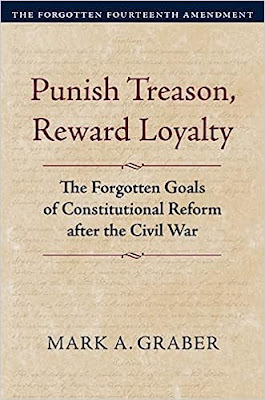
Mark A. Graber, Punish Treason, Reward Loyalty: The Forgotten Goals of Constitutional Reform after the Civil War (University of Kansas Press, 2023)
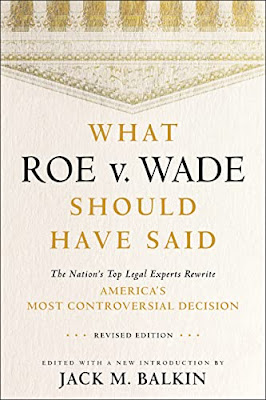
Jack M. Balkin, What Roe v. Wade Should Have Said: The Nation's Top Legal Experts Rewrite America's Most Controversial Decision - Revised Edition (NYU Press, 2023)

Andrew Koppelman, Burning Down the House: How Libertarian Philosophy Was Corrupted by Delusion and Greed (St. Martin’s Press, 2022)

Gerard N. Magliocca, Washington's Heir: The Life of Justice Bushrod Washington (Oxford University Press, 2022)
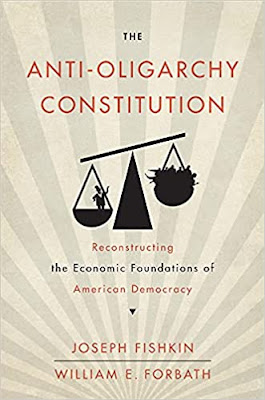
Joseph Fishkin and William E. Forbath, The Anti-Oligarchy Constitution: Reconstructing the Economic Foundations of American Democracy (Harvard University Press, 2022)
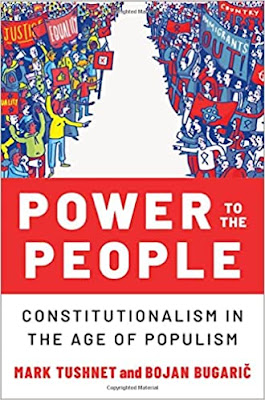
Mark Tushnet and Bojan Bugaric, Power to the People: Constitutionalism in the Age of Populism (Oxford University Press 2021).

Mark Philip Bradley and Mary L. Dudziak, eds., Making the Forever War: Marilyn B. Young on the Culture and Politics of American Militarism Culture and Politics in the Cold War and Beyond (University of Massachusetts Press, 2021).

Jack M. Balkin, What Obergefell v. Hodges Should Have Said: The Nation's Top Legal Experts Rewrite America's Same-Sex Marriage Decision (Yale University Press, 2020)

Frank Pasquale, New Laws of Robotics: Defending Human Expertise in the Age of AI (Belknap Press, 2020)

Jack M. Balkin, The Cycles of Constitutional Time (Oxford University Press, 2020)

Mark Tushnet, Taking Back the Constitution: Activist Judges and the Next Age of American Law (Yale University Press 2020).

Andrew Koppelman, Gay Rights vs. Religious Liberty?: The Unnecessary Conflict (Oxford University Press, 2020)

Ezekiel J Emanuel and Abbe R. Gluck, The Trillion Dollar Revolution: How the Affordable Care Act Transformed Politics, Law, and Health Care in America (PublicAffairs, 2020)

Linda C. McClain, Who's the Bigot?: Learning from Conflicts over Marriage and Civil Rights Law (Oxford University Press, 2020)
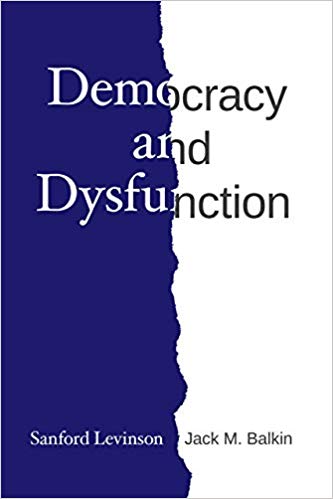
Sanford Levinson and Jack M. Balkin, Democracy and Dysfunction (University of Chicago Press, 2019)

Sanford Levinson, Written in Stone: Public Monuments in Changing Societies (Duke University Press 2018)

Mark A. Graber, Sanford Levinson, and Mark Tushnet, eds., Constitutional Democracy in Crisis? (Oxford University Press 2018)

Gerard Magliocca, The Heart of the Constitution: How the Bill of Rights became the Bill of Rights (Oxford University Press, 2018)

Cynthia Levinson and Sanford Levinson, Fault Lines in the Constitution: The Framers, Their Fights, and the Flaws that Affect Us Today (Peachtree Publishers, 2017)

Brian Z. Tamanaha, A Realistic Theory of Law (Cambridge University Press 2017)

Sanford Levinson, Nullification and Secession in Modern Constitutional Thought (University Press of Kansas 2016)

Sanford Levinson, An Argument Open to All: Reading The Federalist in the 21st Century (Yale University Press 2015)

Stephen M. Griffin, Broken Trust: Dysfunctional Government and Constitutional Reform (University Press of Kansas, 2015)

Frank Pasquale, The Black Box Society: The Secret Algorithms That Control Money and Information (Harvard University Press, 2015)

Bruce Ackerman, We the People, Volume 3: The Civil Rights Revolution (Harvard University Press, 2014)
Balkinization Symposium on We the People, Volume 3: The Civil Rights Revolution

Joseph Fishkin, Bottlenecks: A New Theory of Equal Opportunity (Oxford University Press, 2014)

Mark A. Graber, A New Introduction to American Constitutionalism (Oxford University Press, 2013)

John Mikhail, Elements of Moral Cognition: Rawls' Linguistic Analogy and the Cognitive Science of Moral and Legal Judgment (Cambridge University Press, 2013)

Gerard N. Magliocca, American Founding Son: John Bingham and the Invention of the Fourteenth Amendment (New York University Press, 2013)

Stephen M. Griffin, Long Wars and the Constitution (Harvard University Press, 2013)

Andrew Koppelman, The Tough Luck Constitution and the Assault on Health Care Reform (Oxford University Press, 2013)

James E. Fleming and Linda C. McClain, Ordered Liberty: Rights, Responsibilities, and Virtues (Harvard University Press, 2013)
Balkinization Symposium on Ordered Liberty: Rights, Responsibilities, and Virtues

Andrew Koppelman, Defending American Religious Neutrality (Harvard University Press, 2013)

Brian Z. Tamanaha, Failing Law Schools (University of Chicago Press, 2012)

Sanford Levinson, Framed: America's 51 Constitutions and the Crisis of Governance (Oxford University Press, 2012)

Linda C. McClain and Joanna L. Grossman, Gender Equality: Dimensions of Women's Equal Citizenship (Cambridge University Press, 2012)

Mary Dudziak, War Time: An Idea, Its History, Its Consequences (Oxford University Press, 2012)

Jack M. Balkin, Living Originalism (Harvard University Press, 2011)

Jason Mazzone, Copyfraud and Other Abuses of Intellectual Property Law (Stanford University Press, 2011)

Richard W. Garnett and Andrew Koppelman, First Amendment Stories, (Foundation Press 2011)

Jack M. Balkin, Constitutional Redemption: Political Faith in an Unjust World (Harvard University Press, 2011)

Gerard Magliocca, The Tragedy of William Jennings Bryan: Constitutional Law and the Politics of Backlash (Yale University Press, 2011)

Bernard Harcourt, The Illusion of Free Markets: Punishment and the Myth of Natural Order (Harvard University Press, 2010)

Bruce Ackerman, The Decline and Fall of the American Republic (Harvard University Press, 2010)
Balkinization Symposium on The Decline and Fall of the American Republic

Ian Ayres. Carrots and Sticks: Unlock the Power of Incentives to Get Things Done (Bantam Books, 2010)

Mark Tushnet, Why the Constitution Matters (Yale University Press 2010)

Ian Ayres and Barry Nalebuff: Lifecycle Investing: A New, Safe, and Audacious Way to Improve the Performance of Your Retirement Portfolio (Basic Books, 2010)
.jpg)
Jack M. Balkin, The Laws of Change: I Ching and the Philosophy of Life (2d Edition, Sybil Creek Press 2009)

Brian Z. Tamanaha, Beyond the Formalist-Realist Divide: The Role of Politics in Judging (Princeton University Press 2009)
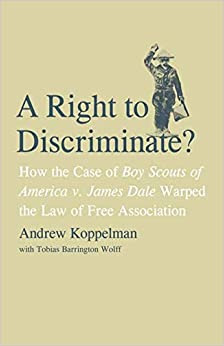
Andrew Koppelman and Tobias Barrington Wolff, A Right to Discriminate?: How the Case of Boy Scouts of America v. James Dale Warped the Law of Free Association (Yale University Press 2009)

Jack M. Balkin and Reva B. Siegel, The Constitution in 2020 (Oxford University Press 2009)

Heather K. Gerken, The Democracy Index: Why Our Election System Is Failing and How to Fix It (Princeton University Press 2009)

Mary Dudziak, Exporting American Dreams: Thurgood Marshall's African Journey (Oxford University Press 2008)

David Luban, Legal Ethics and Human Dignity (Cambridge Univ. Press 2007)

Ian Ayres, Super Crunchers: Why Thinking-By-Numbers is the New Way to be Smart (Bantam 2007)

Jack M. Balkin, James Grimmelmann, Eddan Katz, Nimrod Kozlovski, Shlomit Wagman and Tal Zarsky, eds., Cybercrime: Digital Cops in a Networked Environment (N.Y.U. Press 2007)
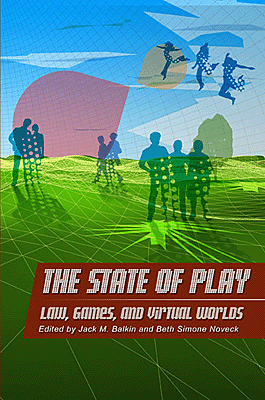
Jack M. Balkin and Beth Simone Noveck, The State of Play: Law, Games, and Virtual Worlds (N.Y.U. Press 2006)

Andrew Koppelman, Same Sex, Different States: When Same-Sex Marriages Cross State Lines (Yale University Press 2006)

Brian Tamanaha, Law as a Means to an End (Cambridge University Press 2006)

Sanford Levinson, Our Undemocratic Constitution (Oxford University Press 2006)

Mark Graber, Dred Scott and the Problem of Constitutional Evil (Cambridge University Press 2006)

Jack M. Balkin, ed., What Roe v. Wade Should Have Said (N.Y.U. Press 2005)

Sanford Levinson, ed., Torture: A Collection (Oxford University Press 2004)
Balkin.com homepage
Bibliography
Conlaw.net
Cultural Software
Writings
Opeds
The Information Society Project
BrownvBoard.com
Useful Links
Syllabi and Exams
