Balkinization
an unanticipated consequence of
Jack M. Balkin
Balkinization Symposiums: A Continuing List
E-mail:
Jack Balkin:
jackbalkin at yahoo.com
Bruce Ackerman
bruce.ackerman at yale.edu
Ian Ayres
ian.ayres at yale.edu
Corey Brettschneider
corey_brettschneider at brown.edu
Mary Dudziak
mary.l.dudziak at emory.edu
Joey Fishkin
joey.fishkin at gmail.com
Heather Gerken heather.gerken at yale.edu
Abbe Gluck abbe.gluck at yale.edu
Mark Graber
mgraber at law.umaryland.edu
Stephen Griffin
sgriffin at tulane.edu
Jonathan Hafetz
jonathan.hafetz at shu.edu
Jeremy Kessler
jkessler at law.columbia.edu
Andrew Koppelman
akoppelman at law.northwestern.edu
Marty Lederman
msl46 at law.georgetown.edu
Sanford Levinson
slevinson at law.utexas.edu
David Luban
david.luban at gmail.com
Gerard Magliocca
gmaglioc at iupui.edu
Jason Mazzone
mazzonej at illinois.edu
Linda McClain
lmcclain at bu.edu
John Mikhail
mikhail at law.georgetown.edu
Frank Pasquale
pasquale.frank at gmail.com
Nate Persily
npersily at gmail.com
Michael Stokes Paulsen
michaelstokespaulsen at gmail.com
Deborah Pearlstein
dpearlst at yu.edu
Rick Pildes
rick.pildes at nyu.edu
David Pozen
dpozen at law.columbia.edu
Richard Primus
raprimus at umich.edu
K. Sabeel Rahmansabeel.rahman at brooklaw.edu
Alice Ristroph
alice.ristroph at shu.edu
Neil Siegel
siegel at law.duke.edu
David Super
david.super at law.georgetown.edu
Brian Tamanaha
btamanaha at wulaw.wustl.edu
Nelson Tebbe
nelson.tebbe at brooklaw.edu
Mark Tushnet
mtushnet at law.harvard.edu
Adam Winkler
winkler at ucla.edu
Compendium of posts on Hobby Lobby and related cases
The Anti-Torture Memos: Balkinization Posts on Torture, Interrogation, Detention, War Powers, and OLC
The Anti-Torture Memos (arranged by topic)
Recent Posts
Written in Stone 2020
The Lost Court Decision that Could Have Resolved Texas v. California
Masks and Rights Talk
Bostock, LGBT Discrimination, and the Subtractive Moves
Ruling today in Soos v Cuomo
Eric Segall interviews me on Supreme Myths
Unoriginal Joke (Part III): Living Constitutionalism and Social Progress
Can This Administration Absolve Its Friends of Crime?
The Deeply Concerning, Misguided D.C. Circuit Mandamus Ruling in the Flynn Case
Optimistic Originalism, the Sequencing Problem, and Chris Green on the Sense-Reference Distinction (Part III)
Unbundling DACA and Unpacking Regents: What Chief Justice Roberts Got Right
AMA: Chris Green asks about "constitutional truthmakers"
Balkinization Symposium on Linda C. McClain, Who's the Bigot?: Learning from Conflicts over Marriage and Civil Rights Law: Collected Posts
A university faculty speaks its mind
Are oaths "absurd" or simply pathetic? Reflections of the Balkin-Green exchange
AMA: Chris Green asks about the Oath
A Barr-Trump Commission of Inquiry?
Stars Get the Calls
The Great Debate in the Conservative Legal Movement
Reply to Six Commentaries on Who’s the Bigot?
Protests/Religion: Soos v. Cuomo
AMA: Questions from Charles Barzun
Bracketing Bigotry
The dangerous Kavanaugh dissent in Bostock
Applying Basic Political and Legal Principles in Addressing Our Current Crisis
The Rhetoric of Bigotry: Hate, Insincerity, and Intolerance
Media Apocalypse, Episode 3: Rasmus Nielsen
Does Senator Graham Realize that (per President Trump and the SG) His Investigation of the Russia Investigation is Unconstitutional?
Who’s the Nazi?
The Law Reviews and Reconstruction: An Overly Optimistic World? (Part II)
![[Powered by Blogger]](https://lh3.googleusercontent.com/blogger_img_proxy/AEn0k_vH3j30RxXHiyaaeaA4Wenfy3UDi3agNQEYvZB61-CLI3vQef2YE1J7i2_VYtv2Je-Lskky0YvtOBrFolPZbHPtV_OyT-Iuxjn8sdNnZZEp=s0-d)
Just A Few Blogs
ACS Blog
Alas, a Blog
Althouse
Arts and Letters Daily
Atrios (Eschaton)
Bill of Health
Buzzflash.com
Buzz Machine
Cato at Liberty
Juan Cole (Informed Comment)
Concurring Opinions
The Constitution in 2020
Corrente
Crooked Timber
Daily Howler
Daily Kos
Dana Boyd
Brad DeLong
Digby (Hullabaloo)
Discriminations
Daniel Drezner
Kevin Drum (Mother Jones)
Electrolite
En Banc
Eunomia (Daniel Larison)
Fafblog
Michael Froomkin (Discourse.net)
GovLab (Beth Noveck)
Rick Hasen (Election Law)
History News Network
How Appealing
Ignatz (Sam Heldman)
The Importance of (Ernie Miller)
Infolaw
Instapundit
International Economic Law and Policy Blog
IntLawGrrls
Jacob Levy
Jesus' General
Jurisdynamics
The Kitchen Cabinet
Mark Kleiman
Law Blog Central
Larry Lessig
Lawyers, Guns and Money
Liberal Oasis
Brian Leiter's Law School Reports
The Leiter Reports
Marginal Revolution
Megan McArdle
Memeorandum
Metafilter
Mirror of Justice
The New Republic
Newseum
No More Mister Nice Blog
Brendan Nyhan
Opinio Juris
Orcinus
The Originalism Blog
Pandagon
Passport (Foreign Policy)
Overcoming Bias
Political Animal (Washington Monthly)
Political Theory Daily Review
Political Wire (Taegan Goddard)
The Poor Man
Virginia Postrel
Prawfsblawg
Public Reason
Jonathan Rauch
Raw Story
Redstate
ReligiousLeftLaw.com
Reporters Committee For Freedom of the Press
Reproductive Rights Blog
Rothman's Roadmap to the Right of Publicity
SCOTUS Blog
Seeing the Forest
Clay Shirky
The Shifted Librarian
The Situationist
Larry Solum (Legal Theory)
Andrew Sullivan
Talking Points Memo
Talk Left
Tapped
Tbogg
TechPresident
The Paper Chase (Jurist)
Tom Paine
Tom Tomorrow (This Modern World)
Eve Tushnet
Uggabugga
University of Chicago Law School Faculty Blog
Unqualified Offerings
The Volokh Conspiracy
War and Piece (Laura Rozen)
Wampum
Oliver Willis
Wonkette
Written Description
Matthew Yglesias
Yin
Your Choice of Feeds
1. XML
powered by

2. Atom Feed
3. RSS 2.0
Written in Stone 2020
Sandy Levinson
Posted
3:59 PM
by Sandy Levinson [link]
(130) comments
The Lost Court Decision that Could Have Resolved Texas v. California
Guest Blogger
Timothy Jost
As Texas v. California, the lawsuit seeking to invalidate the entire Affordable Care Act, continues its steady march toward a Supreme Court decision, the issue that has emerged as the most important in the case is that of severability—if the Court finds the individual mandate unconstitutional, as both the district court and Fifth Circuit did, how much of the rest of the ACA must be jettisoned with it?
Posted
9:30 AM
by Guest Blogger [link]
Masks and Rights Talk
David Super
I am struck right-wing
protesters’ repeated, adamant insistence that mask-wearing requirements
violate
the Bill
of Rights. The (utterly unfounded)
claims that it is unnecessary and the (abjectly paranoid) assertions of an
elite conspiracy to promote masks are sadly pretty ordinary in today’s
political environment. But the normative
“rights talk”, and the attempt to ground it in a conception of constitutional
law, seems different and worthy of more attention. I remain completely unpersuaded that mask
requirements offend any basic rights. But
as someone interested in popular constitutionalism, I feel the need to unpack this
specific invocation of the Bill of Rights.
What could it mean?
Posted
5:29 PM
by David Super [link]
Bostock, LGBT Discrimination, and the Subtractive Moves
Andrew Koppelman
Posted
1:50 PM
by Andrew Koppelman [link]
Ruling today in Soos v Cuomo
Jason Mazzone
I previously posted on Soos v Cuomo, the lawsuit by two Catholic priests and several Orthodox Jewish congregants challenging New York's continued restrictions on religious gatherings. I suggested that the First Amendment requires the state to explain why state officials have restricted religious gatherings but encouraged mass protests against police violence. I noted also the odd fact that in its initial response to the lawsuit New York failed even to address the issue much less explain the distinctions the state drew. Today the district court granted the plaintiffs' application for a preliminary injunction. The court's rationale is that the plaintiffs are likely to succeed on their claim that the state violated the Free Exercise Clause because in exempting (without discernible justification) certain non-religious activities, the state's purported risk-based regulations were not generally applicable. We'll see what happens in the likely appeal. Meanwhile, another lawsuit, Association of Jewish Camp Operators v. Cuomo, has now been filed, challenging the state's ban on Jewish overnight camps. It, too, makes the argument that New York has favored some expression over others in ways that do not reflect risks of transmission. A hearing is scheduled for next week.
Posted
1:15 PM
by Jason Mazzone [link]
Eric Segall interviews me on Supreme Myths
JB
Posted
10:30 AM
by JB [link]
Unoriginal Joke (Part III): Living Constitutionalism and Social Progress
Guest Blogger
Posted
9:30 AM
by Guest Blogger [link]
Can This Administration Absolve Its Friends of Crime?
David Super
Posted
4:32 PM
by David Super [link]
The Deeply Concerning, Misguided D.C. Circuit Mandamus Ruling in the Flynn Case
Marty Lederman
Originally posted at Just Security
Yesterday morning—in a stunning decision that broke from usual standards of judicial process and self-restraint—D.C. Circuit Judges Neomi Rao and Karen LeCraft Henderson granted Michael Flynn’s preemptive mandamus petition to shut down Judge Emmet Sullivan’s consideration of the government’s motion to dismiss the criminal charge against Flynn. The court ordered Judge Sullivan “to grant the government’s Rule 48(a) motion to dismiss” the charge before the judge even considers the merits of that motion, apparently in order to prevent him from convening a hearing on it. Judge Robert Wilkins dissented.
The oral argument gave little hint that this was coming. Indeed, Judge Henderson repeatedly noted both that Judge Sullivan hadn’t even had the chance to rule yet, and that Flynn could remedy any injury by appealing if and when Sullivan denied the government's motion and entered a judgment of conviction—both of which made mandamus a singularly inappropriate remedy here.
As I’ll explain below, the panel’s decision is plainly wrong and the en banc court of appeals will almost certainly reversed it if the case reaches that stage. But it now stands as the law of the D.C. Circuit, and everyone who cares about the state of the federal courts should take notice.
Before explaining why I believe it’s clear that the panel erred in several important respects, I should stress once again that I don’t really care much—and I think you shouldn’t either—whether Michael Flynn is ultimately convicted for willfully making false material statements in his January 24, 2017 interview with two FBI agents, or whether Flynn ever spends any time in prison (something that’s very unlikely in light of the President’s pardon power). In part this is because (as I’ve previously recounted) many acts of misfeasance by other actors in this affair—from the President to Attorney General Barr to former FBI Director Comey—have been more damaging to governmental functions and norms than Flynn’s false statements were; and in part it’s because Flynn’s lies to the FBI weren’t remotely his own most egregious actions, before or after January 24, 2017—indeed, they weren’t even the most damaging criminal offenses he committed.
Whatever one thinks of Flynn’s misconduct and whether it merits criminal punishment, however—and whatever you think of the damage Attorney General Barr has done to the reputation for the evenhanded administration of justice in the Executive Branch, including in the Flynn case itself (see also my second Flynn post)—in today’s decision Judges Rao and Henderson have touched a new nerve by damaging the integrity of the judicial process. And that raises an entirely different order of concern. [UPDATE: Orin Kerr is right that the decision is obviously redolent of Bush v. Gore, in that the higher court in each case "astonishing[ly]" "told the lower court to just flat out stop what it was doing." In Flynn, as in Bush v. Gore,
you would have expected the lower court to be able to rule on the motion. A motion to dismiss was filed, and the district court was considering it and wanted to hear different perspectives before ruling. Judges get motions, consider them, have hearings, and rule on them all the time. That's the way it normally works. Instead, the D.C. Circuit concluded that the district judge couldn't even consider the question. Merely having a hearing on how to decide the motion is a harm, the court concluded. And the court didn't trust the district court to approach the law the right way if they let him proceed in the normal way. So remarkably, the D.C. Circuit just took control and told the lower court to stop it.]
There are three major errors at the heart of Judge Rao’s opinion.
Read more »
Posted
11:36 AM
by Marty Lederman [link]
Optimistic Originalism, the Sequencing Problem, and Chris Green on the Sense-Reference Distinction (Part III)
Stephen Griffin
Posted
10:56 AM
by Stephen Griffin [link]
Unbundling DACA and Unpacking Regents: What Chief Justice Roberts Got Right
Guest Blogger
Posted
10:00 AM
by Guest Blogger [link]
AMA: Chris Green asks about "constitutional truthmakers"
JB
In this installment, Chris Green asks some very interesting theoretical questions about whether there is a single "constitutional truthmaker," and he proposes a single test that will decide all questions of constitutional interpretation.
Chris Green: Do you think there is unitary constitutional truthmaker (see https://ssrn.com/paper=2901157 ), i.e., a single reality that tells us when the Supreme Court’s constitutional interpretations are wrong? Is it possible to get from “text and principle” to a single reality that renders constitutional claims true or false? By my lights, “the principle expressed by the text in its original context” would do the job.
JB: By "truthmaker," I assume that you mean something that makes a proposition about the correct interpretation of the Constitution true. I would divide the concept of a truthmaker into necessary and sufficient conditions. Some things might be *necessary* to make a proposition about the interpretation of the Constitution true, while others would be *sufficient* to make it true.
I am an originalist. So I think that, in order to be true, an interpretation of the Constitution must be consistent with original meaning (in the thin sense). With respect to necessary conditions, then, I believe that there is a truthmaker.
But I do not think there is a single sufficient condition for an interpretation of the Constitution to be true. That is, I don't think there is a single criterion that ensures that a proposition, otherwise consistent with original meaning, is also the one true and correct interpretation of the Constitution. There are three reasons for this.
Read more »
Posted
9:30 AM
by JB [link]
Balkinization Symposium on Linda C. McClain, Who's the Bigot?: Learning from Conflicts over Marriage and Civil Rights Law: Collected Posts
JB

1. Jack Balkin, Introduction to the Symposium
2. Aziza Ahmed, Law, Bigotry, and Expertise
3. Randall Kennedy, Obama as “bigot”? Me as “bigot”? You as “bigot?
4. Cathleen Kaveny, Reason, Feeling, and Religion: A Response to Linda McClain
5. Andrew Koppelman, Who’s the Nazi?
6. Imer B. Flores, The Rhetoric of Bigotry: Hate, Insincerity, and Intolerance
7. Dale Carpenter, Bracketing Bigotry
8. Linda McClain, Reply to Six Commentaries on Who’s the Bigot?
Posted
9:30 AM
by JB [link]
A university faculty speaks its mind
Sandy Levinson
Approximately 80% of the faculty of the George Washington School of Law, including several of its former Deans, signed an extremely strong statement criticizing William Barr. To describe it as simply a "statement" is misleading, for it sets out an extensive bill of particulars lamenting the reality of William Barr as Attorney General. What makes the statement so striking, though, is the institutional connection between George Washington and William Barr. He received his law degree from that institution; he received an honorary degree twenty years later upon serving George H.W. Bush as Attorney General. He is also described as someone who has given generously and otherwise raised significant money for the Law School.
I have on other occasions indicated by deep and abiding respect for Michael Gerson, whom I've never had the honor of meeting. This former speechwriter for George W. Bush, an Evangelical Christian, has consistently and courageously criticized not only Donald J. Trump, but also many of his fell Evangelicals for in effect selling their souls to that truly despicable charlatan. Why I admire him is not only his views; I can find them articulated by, say, David Remnick in the New Yorker or Paul Krugman in the New York Times. But I'm confident that neither Remnick nor Krugman has lost any friends by their militant criticisms of Trump. That is surely not the case with Gerson, or other never-Trumpers like George Will, Jennifer Rubin, Max Boot, Bill Kristol (whom I used to despise because he was simply a lackey for the Republican Party, and, of course, George Conway. They have undoubtedly paid real personal costs that liberals have not paid in their criticisms of Trump. That is something worth honoring in these parlous times.
Similarly, the George Washington statement is powerful for reasons going beyond its words and de facto indictment. Many law professors, across the country, would no doubt agree with it and be willing to sign it if asked. But none of us would be making the same kind of powerful institutional statement, i.e., denouncing an illustrious alumnus and benefactor "simply" because he had disgraced the idea of how to live an honorable life as a lawyer. All universities have alums we are proud of and those that should make us cringe. It is not unthinkable that the 2024 race within the Republican Party will boil down to Harvard Law School alumnus Tom Cotton and Yale Law School graduate Josh Hawley, just as the Harvard Law School gave us both Barack Obama and Mitt Romney in 2012. Although individual faculty members of these (and other institutions) will no doubt express vigorous views, I would be astonished if a collective effort were made similar to that of the George Washington folks. Quite frankly, it represents a breach of modern decorum with regard to eminent--and monied--alums.
It is one thing for Oriel College at Oxford to take down its statue of Cecil Rhodes (assuming that finally happens). It would be quite another for the University to denounce its alumnus Boris Johnson for his mishandling of the Corid-19 virus or, for that matter, his rank dishonesty and mendacity with regard to arguing in behalf of Brexit (and lying to the Queen about proroguing Parliament). "Speaking truth to power" is not for the faint of heart--or university administrators seeking funds. But the signatories of the George Washington statement will be able to look in the mirror and know that they have stood up in defense of whatever the "rule of law" might actually mean in this post-Realist world. (See, e.g., Robert Jackson's opinion in Youngstown Steel, which I continue to believe is the best single opinion ever written as a truly "adult" discussion of the concept.)
Posted
6:40 PM
by Sandy Levinson [link]
Are oaths "absurd" or simply pathetic? Reflections of the Balkin-Green exchange
Sandy Levinson
Posted
4:43 PM
by Sandy Levinson [link]
(74) comments
AMA: Chris Green asks about the Oath
JB
This is the second installment in my AMA. Chris Green asked a number of interesting theoretical questions. I will answer them in installments. I change the order of the questions to group together questions that are about the same basic subject.
Chris's first question is about the Article VI oath, and, indirectly, the current debate among constitutional scholars about whether the oath commits everyone who takes it to a particular version of originalism.
Chris Green:What does “the Constitution” in our present-day Article VI oaths refer to, and why? (See https://ssrn.com/paper=3441234).
JB: Article VI requires that "The Senators and Representatives before mentioned, and the members of the several state legislatures, and all executive and judicial officers, both of the United States and of the several states, shall be bound by oath or affirmation, to support this Constitution." Article II requires the President to take an oath to "preserve, protect and defend the Constitution of the United States."
I read the President's Article II oath as consistent with the Article VI oath for all executive officers of the United States. This is true whether or not you you believe that the President is an "executive officer ... of the United States," because every executive officer who works under the President must take the Article VI oath.
There are two plausible answers to your question. One is that "this Constitution" refers to the best interpretation of the Constitution (as opposed to the current interpretation). The other is that "this Constitution" refers to the Constitution as an ongoing legal and political institution and says nothing about interpretation. Let me address both possibilities in turn.
Read more »
Posted
9:31 AM
by JB [link]
A Barr-Trump Commission of Inquiry?
Mark Tushnet
Posted
11:12 AM
by Mark Tushnet [link]
(61) comments
Stars Get the Calls
Gerard N. Magliocca
In response to some disappointing results in the Supreme Court this week, the President wondered aloud today on Twitter: "Do you get the impression that the Supreme Court doesn't like me?"
Sort of. A better way of putting this goes back to the Chief Justice's famous line in his confirmation hearing about being an umpire calling balls and strikes. As sports fans know all too well, though, star players gets more than their fair share of favorable calls. Perhaps that's because they command more respect from the referees. Perhaps it's because the referees think that they will get criticized more if they make a call against a star. Whatever the reason, that sort of bias is probably real.
A similar thought works for a president and the Supreme Court. Unpopular presidents fare worse in close cases that directly concern them. It's no coincidence that two of the leading decisions curbing presidential power (Youngstown and Nixon) came when President Truman and then President Nixon had approval ratings in the 20s. To some extent, this is just the Madisonian system: When one branch is weak the other branches try to take advantage. Strong presidents don't always win, of course, but they are more likely to win.
We won't know until the tax return cases are decided whether the Court is truly treating President Trump as a benchwarmer. But things are trending in that direction.
Posted
2:04 PM
by Gerard N. Magliocca [link]
(156) comments
The Great Debate in the Conservative Legal Movement
JB
There is a great ferment among conservative legal intellectuals these days. This post is summary of what I think is happening, written from the perspective of an outsider. Although I am an originalist, I am also a political liberal. But I have many friends in the conservative legal movement and because of my scholarly agenda, I watch developments in the movement with great interest.
Since the second half of the 20th century, American conservatism has been a fusion of different approaches, including libertarians, small government conservatives, business interests, national security hawks, social conservatives, religious conservatives and paleo-conservative or "Old Right" nationalists who tended to be anti-immigration and isolationist. People often fell into multiple camps, and their ideas sometimes shifted over time.
The conservative legal movement arose of of this fusion. Together and separately, these various groups in the conservative constellation sought and pushed for a jurisprudence that would promote their values and show why their political opponents' legal views were incorrect. This is hardly surprising. Every jurisprudential movement that I can think of has been associated with a politics. And the very idea of a conservative legal movement should be a tip-off that the goal of the movement was to promote... well, conservatism.
By the 1980s or so, originalism had become the lingua franca of the conservative legal movement, with textualism (especially in statutory construction) following shortly thereafter. One didn't have to be either an originalist or a textualist to be a conservative legal intellectual, but the language of originalism and textualism was a convenient shorthand to describe what conservatives were for (and, equally important, what they opposed). Over the years, conservative judges and legal intellectuals developed jurisprudential theories designed to promote and apply both originalism and textualism.
Read more »
Posted
11:31 AM
by JB [link]
Reply to Six Commentaries on Who’s the Bigot?
Linda McClain
For the symposium on Linda McClain, Who’s the
Bigot? Learning from Conflicts over Marriage and Civil Rights Law (Oxford
University Press, 2020).
Thanks very much to Sandy Levinson for organizing this
wonderful symposium on Who’s the Bigot?
and to Jack Balkin for providing space on Balkinization. I am grateful to
contributors Aziza Ahmed, Dale Carpenter, Imer Flores, Cathleen Kaveny, Randall
Kennedy, and Andrew Koppelman for their insightful and instructive comments. I
will address some general themes and then respond to a few specific points.
All of the commentators correctly observe the provocative
power of the term “bigot.” As Dale Carpenter succinctly puts it: “When it comes
to bigotry, Americans agree on three things: (1) bigotry is very bad; (2) they
are not themselves bigots; and (3) some other people, mostly those who disagree
with them, are bigots.” Both Imer Flores and Andy Koppelman stress how “toxic”
a charge of bigotry is. While I recognize the “conversation-stopping” force of the
charge of bigotry—and conclude that “the rhetoric of bigotry is sometimes
necessary and appropriate, but at other times, there are more constructive ways
to talk about prejudice, intolerance and discrimination”—Flores argues that
“the rhetoric of bigotry” can “never be appropriate” because of the dynamic of
“flipping the charges” so that the accuser is the real bigot. My book discusses this dynamic in several contexts,
including debates over the Civil Rights Act of 1964 and over LGBT rights today.
I am grateful to Carpenter for suggesting that the
best answer to the question of whether the rhetoric of bigotry is ever or
“never” appropriate “depends on the forum in which the charge is made.” He
helpfully recounts his own experience, in the campaign to defeat an anti-same
sex marriage ballot proposition in Minnesota, training volunteers whose mission
was to have “conversations” with voters to persuade them to vote against the
amendment. Carpenter recounts the
instruction that, “above all, nobody was to be called a bigot or have their
opposition labeled bigotry” because “this was a conversation-stopper, and our
side needed above all to have conversations” that opened the door to
understanding that “gay couples wanted to marry for the same basic reasons” the
people they were calling did. For the “young and mostly enthusiastic
volunteers,” this created some “cognitive dissonance,” since they believed that
opponents of same-sex marriage “were necessarily bigots” and that arguments
against same-sex marriage “were necessarily
rooted in bigotry or were pretexts for bigotry.” (Carpenter indicates he did not share this
view.) Happily, the campaign was successful. Carpenter attributes the
subsequent enactment of a law permitting same-sex marriage to the “groundwork
of persuasion” laid by the campaign. I share Carpenter’s conclusion that
hesitation to “call out bigotry” may be appropriate when the goal is persuasion
and conversation.
I also agree with Carpenter that “as a matter of
pragmatism, there are times when making actual progress toward equality entails
bracketing the question of bigotry.” He gives the example of finding common
ground to oppose discrimination based on its harmful effects without labeling
what motivates people to discriminate. Here, I suggest, attention to historical
context is helpful. During the debate over the Civil Rights Act of 1964, some
proponents did not hesitate to use the rhetoric of bigotry to insist that
ending discrimination in public accommodations and other areas of life was
necessary: in Senator Thomas Kuchel’s words,
“Our spirit is not narrow bigotry.” But precisely because racism now
stands—or should stand—as a primary example of properly-repudiated bigotry,
present-day rhetoric of bigotry is highly charged for it carries with it
evocations of this repudiated past.
Read more »
Posted
9:38 AM
by Linda McClain [link]
Protests/Religion: Soos v. Cuomo
Jason Mazzone
In a recent post I said that in order to justify its continued COVID-19 restrictions on social, religious and business activities, the government should have to explain why large numbers of individuals (many without masks and most not following social distancing protocols) have been able to assemble to protest police misconduct. I was therefore very interested to see how New York would respond to the lawsuit by two Catholic priests and several Orthodox Jewish congregants challenging the state’s restrictions on religious gatherings. A principal claim of the lawsuit is that by permitting large-scale policing protests the state cannot assert that its regulations are simply based on risk-based considerations and that the state is unconstitutionally disfavoring religion. Yesterday, New York filed its response to the plaintiffs’ application for preliminary injunctive relief. New York asserts that COVID-19 restrictions are based entirely on risk considerations and that it is treating religious gatherings the same as other gatherings that present comparable risks. I therefore read on to learn why protests against police practices do not pose COVID risks or why allowing the protests to proceed does not cast doubt on the constitutionality of restrictions imposed upon other gatherings. Astonishingly, New York says nothing at all about the protests. Nothing in its memorandum. Nothing in the attached declarations that set out the state’s rules and the reasons for them. Indeed, the word “protest” does not appear in any of the state’s submissions. It is hard to imagine the state’s lawyers didn’t see this aspect of the plaintiffs’ case or that the state is just conceding that it has no legal basis for treating policing-related protests differently from other gatherings. Ignoring the central claim of a lawsuit is a very peculiar litigation strategy. Argument is scheduled for tomorrow at 1 pm. Let’s see what New York has to say for itself.
Posted
3:10 PM
by Jason Mazzone [link]
AMA: Questions from Charles Barzun
JB
As a result of a Twitter exchange last week, I have agreed to answer questions from a group of constitutional scholars about my work. Here is the first set of questions from Charles Barzun. More installments will follow.
Charles Barzun: My questions come in the form of two hypotheticals, both of which go to what I see as a central tension in your book [Living Originalism], the nature of which I think will be clear.
Imagine that two justices, A and B, are both put on the Court within months of each other by the same President. Assume the selection and nomination process worked in precisely the way you describe in your book and that it followed a period of intense of broad-based social activism, channeled through party politics, in support of a fairly concrete constitutional agenda (which of course both justices denied any awareness of during the nomination hearings). Once on the Court, both Justices practice the “method of text and principles,” but they do so in different ways and for different reasons. In the cases relevant to the party’s constitutional agenda, Justice A carefully monitors the media (and social media) and tries to figure out what results the President, the party, and the activists want in the cases before her. Justice B, meanwhile, ignores the media and tries to read the briefs without being predisposed to a particular outcome. The result is that over the next several years, Justice A delivers results that make the party and activists happy nearly every time, whereas Justice B does so only some of the time. Other times, she reaches results frustrate the constitutional agenda of the political movement that resulted in her being placed on the Court.
Who is a better Justice, A or B? Why? (Note that this is not a question about interpretive method; both justices apply the method of text and principle).
Read more »
Posted
11:00 AM
by JB [link]
Bracketing Bigotry
Guest Blogger
For the symposium on Linda McClain, Who's the Bigot?: Learning from Conflicts over Marriage and Civil Rights Law (Oxford University Press, 2020).
Dale
Carpenter
Posted
9:30 AM
by Guest Blogger [link]
The dangerous Kavanaugh dissent in Bostock
Andrew Koppelman
Today, in Bostock v. Clayton County, the Supreme Court held that the Civil Rights Act of 1964 prohibits employment discrimination against gay and transgender people. That was obviously the right result, but three justices dissented. Brett Kavanaugh’s effort to evade the obvious conclusion was cleverer than Samuel Alito’s (which Clarence Thomas joined), but it was also more dangerous, because his approach would gut any law that aims to bring about significant social change.
I elaborate in a new piece at The American Prospect, here.
Posted
7:07 PM
by Andrew Koppelman [link]
Applying Basic Political and Legal Principles in Addressing Our Current Crisis
Guest Blogger
Robert Pushaw
America's ongoing racial strife should prompt deep reflection. Professors who have dedicated their careers to studying law, government, political science, and history should share their expertise by providing reasoned opinions, while humbly recognizing that we have limited policy influence. In this spirit, I have tried to identify certain core legal and political ideas and realities that Americans should keep in mind as we work through our current serious problems.
FIRST, in our constitutional democracy, governments must protect people from two harms: (1) criminal activity, particularly injury to one's person or property; and (2) discrimination or other abuse based on inherent characteristics, most notably race. American governments at all levels -- local, state, and federal -- have failed to adequately provide both kinds of protection.
SECOND, to remedy this problem at its most basic level, each government must properly train and deploy police and other law enforcement officials -- and hold them responsible when they use their positions of authority to violate people's rights to equal treatment and liberty. Such accountability has been lacking, especially in cities where governments have executed agreements with police unions that make it extremely difficult to discipline or remove offending officers. Derek Chauvin, whose killing of George Floyd ignited the current protests, is merely one example. The lack of accountability for bad cops also tarnishes the reputation of the many officers who courageously work to protect the public.
THIRD, when government officials abandon their duty of proper law enforcement, the urban poor -- particularly minority communities -- are especially vulnerable. During ordinary times, such government abdication often takes the form of allowing the use of unnecessary, excessive, and sometimes lethal force against African Americans and other groups. During times of unrest, such abdication means allowing criminal activity -- looting, arson, assault, and murder -- that has a hugely disproportionate impact on minority communities. History teaches that urban areas victimized by such misconduct recover extremely slowly, if at all.
FOURTH, governments must respect the constitutional rights of Americans to peacefully assemble and protest, but must also impose reasonable restrictions necessary to protect public health, safety, and welfare. Therefore, we should carefully distinguish legitimate protesters from those who are engaged in criminal activities.
FIFTH, Americans must continue their efforts to eliminate race discrimination in criminal justice, education, employment, housing, health care, and other areas. Reasonable people acting in good faith will disagree, however, on the best specific policies to achieve those goals. Therefore, we should work together to consider a variety of approaches, not demonize anyone who disagrees with us.
Robert Pushaw is James Wilson Endowed Professor of Constitutional Law at Pepperdine University Caruso School of Law. You can reach him by e-mail at robert.pushaw at pepperdine.edu
Posted
3:14 PM
by Guest Blogger [link]
The Rhetoric of Bigotry: Hate, Insincerity, and Intolerance
Guest Blogger
For the symposium on Linda McClain, Who's the Bigot?: Learning from Conflicts over Marriage and Civil Rights Law (Oxford University Press, 2020).
Posted
9:30 AM
by Guest Blogger [link]
Media Apocalypse, Episode 3: Rasmus Nielsen
JB
This episode of Media Apocalypse features Rasmus Nielsen, Director at the Reuters Institute for the Study of Journalism at Oxford. He talks with us about different models for public support of journalism. Rasmus is the coauthor (with Robert Gorwa and Madeleine de Cock Buningof) a November 2019 Reuters Institute Report: What can be done? Digital Media Policy Options for Europe (and beyond).
Posted
9:00 AM
by JB [link]
Does Senator Graham Realize that (per President Trump and the SG) His Investigation of the Russia Investigation is Unconstitutional?
Marty Lederman
The Senate Judiciary Committee is currently engaged in an investigation entitled "Oversight of the Crossfire Hurricane Investigation." ("Crossfire Hurricane" was the FBI investigation into Russian interference in the 2016 election.) On Thursday, the Committee voted 12-10 along party lines to authorize Committee Chair Lindsey Graham to unilaterally issue subpoenas related to this Judiciary Committee "oversight" investigation, including to 53 specifically named current and former officials from the FBI, DOJ and the Intelligence Community: Trisha Anderson, Brian Auten, James Baker, William Barr, Dana Boente, Jennifer Boone, John Brennan, James Clapper, Kevin Clinesmith, James Comey, Patrick Conlon, Michael Dempsey, Stuart Evans, Tashina Gauhar, Carl Ghattas, Curtis Heide, Kathleen Kavalec, David Laufman, Stephen Laycock, Jacob Lew, Loretta Lynch, Andrew McCabe, Mary McCord, Denis McDonough, Arthur McGlynn, Jonathan Moffa, Sally Moyer, Mike Neufield, Sean Newell, Victoria Nuland, Bruce Ohr, Nellie Ohr, Stephanie L. O’Sullivan, Lisa Page, Joseph Pientka, John Podesta, Samantha Power, E.W. “Bill” Priestap, Sarah Raskin, Steve Ricchetti, Susan Rice, Rod Rosenstein, Gabriel Sanz-Rexach, Nathan Sheets, Elizabeth Sherwood-Randall, Glenn Simpson, Steve Somma, Peter Strzok, Michael Sussman, Adam Szubin, Jonathan Winer, Christopher Wray, and Sally Yates.
According to both President Trump (in his personal capacity) and the Solicitor General of the United States, this Judiciary Committee investigation is unconstitutional, and therefore recipients of the subpoenas need not comply with them.
Read more »
Posted
3:26 PM
by Marty Lederman [link]
Who’s the Nazi?
Guest Blogger
For the symposium on Linda McClain, Who's the Bigot?: Learning from Conflicts over Marriage and Civil Rights Law (Oxford University Press, 2020).
Posted
9:30 AM
by Guest Blogger [link]
The Law Reviews and Reconstruction: An Overly Optimistic World? (Part II)
Stephen Griffin
Read more »
Posted
4:43 PM
by Stephen Griffin [link]
Books by Balkinization Bloggers

Gerard N. Magliocca, The Actual Art of Governing: Justice Robert H. Jackson's Concurring Opinion in the Steel Seizure Case (Oxford University Press, 2025)

Linda C. McClain and Aziza Ahmed, The Routledge Companion to Gender and COVID-19 (Routledge, 2024)

David Pozen, The Constitution of the War on Drugs (Oxford University Press, 2024)

Jack M. Balkin, Memory and Authority: The Uses of History in Constitutional Interpretation (Yale University Press, 2024)
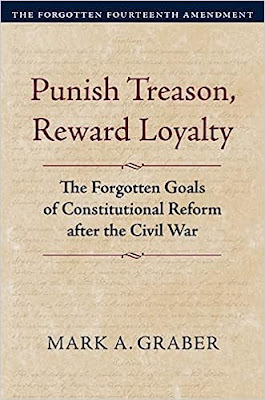
Mark A. Graber, Punish Treason, Reward Loyalty: The Forgotten Goals of Constitutional Reform after the Civil War (University of Kansas Press, 2023)
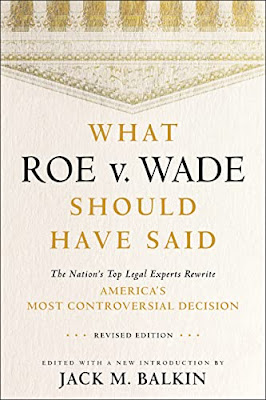
Jack M. Balkin, What Roe v. Wade Should Have Said: The Nation's Top Legal Experts Rewrite America's Most Controversial Decision - Revised Edition (NYU Press, 2023)

Andrew Koppelman, Burning Down the House: How Libertarian Philosophy Was Corrupted by Delusion and Greed (St. Martin’s Press, 2022)

Gerard N. Magliocca, Washington's Heir: The Life of Justice Bushrod Washington (Oxford University Press, 2022)
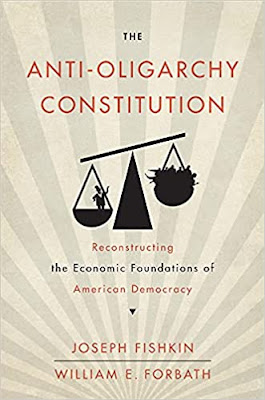
Joseph Fishkin and William E. Forbath, The Anti-Oligarchy Constitution: Reconstructing the Economic Foundations of American Democracy (Harvard University Press, 2022)
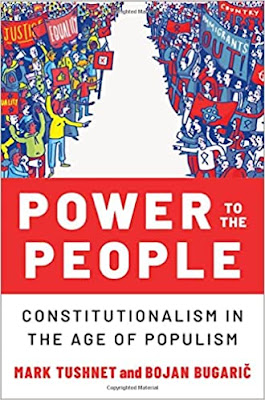
Mark Tushnet and Bojan Bugaric, Power to the People: Constitutionalism in the Age of Populism (Oxford University Press 2021).

Mark Philip Bradley and Mary L. Dudziak, eds., Making the Forever War: Marilyn B. Young on the Culture and Politics of American Militarism Culture and Politics in the Cold War and Beyond (University of Massachusetts Press, 2021).

Jack M. Balkin, What Obergefell v. Hodges Should Have Said: The Nation's Top Legal Experts Rewrite America's Same-Sex Marriage Decision (Yale University Press, 2020)

Frank Pasquale, New Laws of Robotics: Defending Human Expertise in the Age of AI (Belknap Press, 2020)

Jack M. Balkin, The Cycles of Constitutional Time (Oxford University Press, 2020)

Mark Tushnet, Taking Back the Constitution: Activist Judges and the Next Age of American Law (Yale University Press 2020).

Andrew Koppelman, Gay Rights vs. Religious Liberty?: The Unnecessary Conflict (Oxford University Press, 2020)

Ezekiel J Emanuel and Abbe R. Gluck, The Trillion Dollar Revolution: How the Affordable Care Act Transformed Politics, Law, and Health Care in America (PublicAffairs, 2020)

Linda C. McClain, Who's the Bigot?: Learning from Conflicts over Marriage and Civil Rights Law (Oxford University Press, 2020)
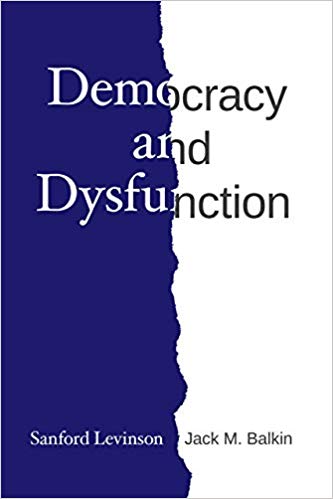
Sanford Levinson and Jack M. Balkin, Democracy and Dysfunction (University of Chicago Press, 2019)

Sanford Levinson, Written in Stone: Public Monuments in Changing Societies (Duke University Press 2018)

Mark A. Graber, Sanford Levinson, and Mark Tushnet, eds., Constitutional Democracy in Crisis? (Oxford University Press 2018)

Gerard Magliocca, The Heart of the Constitution: How the Bill of Rights became the Bill of Rights (Oxford University Press, 2018)

Cynthia Levinson and Sanford Levinson, Fault Lines in the Constitution: The Framers, Their Fights, and the Flaws that Affect Us Today (Peachtree Publishers, 2017)

Brian Z. Tamanaha, A Realistic Theory of Law (Cambridge University Press 2017)

Sanford Levinson, Nullification and Secession in Modern Constitutional Thought (University Press of Kansas 2016)

Sanford Levinson, An Argument Open to All: Reading The Federalist in the 21st Century (Yale University Press 2015)

Stephen M. Griffin, Broken Trust: Dysfunctional Government and Constitutional Reform (University Press of Kansas, 2015)

Frank Pasquale, The Black Box Society: The Secret Algorithms That Control Money and Information (Harvard University Press, 2015)

Bruce Ackerman, We the People, Volume 3: The Civil Rights Revolution (Harvard University Press, 2014)
Balkinization Symposium on We the People, Volume 3: The Civil Rights Revolution

Joseph Fishkin, Bottlenecks: A New Theory of Equal Opportunity (Oxford University Press, 2014)

Mark A. Graber, A New Introduction to American Constitutionalism (Oxford University Press, 2013)

John Mikhail, Elements of Moral Cognition: Rawls' Linguistic Analogy and the Cognitive Science of Moral and Legal Judgment (Cambridge University Press, 2013)

Gerard N. Magliocca, American Founding Son: John Bingham and the Invention of the Fourteenth Amendment (New York University Press, 2013)

Stephen M. Griffin, Long Wars and the Constitution (Harvard University Press, 2013)

Andrew Koppelman, The Tough Luck Constitution and the Assault on Health Care Reform (Oxford University Press, 2013)

James E. Fleming and Linda C. McClain, Ordered Liberty: Rights, Responsibilities, and Virtues (Harvard University Press, 2013)
Balkinization Symposium on Ordered Liberty: Rights, Responsibilities, and Virtues

Andrew Koppelman, Defending American Religious Neutrality (Harvard University Press, 2013)

Brian Z. Tamanaha, Failing Law Schools (University of Chicago Press, 2012)

Sanford Levinson, Framed: America's 51 Constitutions and the Crisis of Governance (Oxford University Press, 2012)

Linda C. McClain and Joanna L. Grossman, Gender Equality: Dimensions of Women's Equal Citizenship (Cambridge University Press, 2012)

Mary Dudziak, War Time: An Idea, Its History, Its Consequences (Oxford University Press, 2012)

Jack M. Balkin, Living Originalism (Harvard University Press, 2011)

Jason Mazzone, Copyfraud and Other Abuses of Intellectual Property Law (Stanford University Press, 2011)

Richard W. Garnett and Andrew Koppelman, First Amendment Stories, (Foundation Press 2011)

Jack M. Balkin, Constitutional Redemption: Political Faith in an Unjust World (Harvard University Press, 2011)

Gerard Magliocca, The Tragedy of William Jennings Bryan: Constitutional Law and the Politics of Backlash (Yale University Press, 2011)

Bernard Harcourt, The Illusion of Free Markets: Punishment and the Myth of Natural Order (Harvard University Press, 2010)

Bruce Ackerman, The Decline and Fall of the American Republic (Harvard University Press, 2010)
Balkinization Symposium on The Decline and Fall of the American Republic

Ian Ayres. Carrots and Sticks: Unlock the Power of Incentives to Get Things Done (Bantam Books, 2010)

Mark Tushnet, Why the Constitution Matters (Yale University Press 2010)

Ian Ayres and Barry Nalebuff: Lifecycle Investing: A New, Safe, and Audacious Way to Improve the Performance of Your Retirement Portfolio (Basic Books, 2010)
.jpg)
Jack M. Balkin, The Laws of Change: I Ching and the Philosophy of Life (2d Edition, Sybil Creek Press 2009)

Brian Z. Tamanaha, Beyond the Formalist-Realist Divide: The Role of Politics in Judging (Princeton University Press 2009)
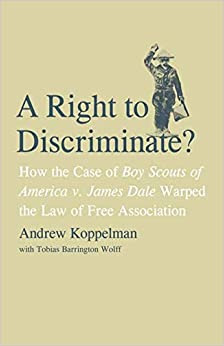
Andrew Koppelman and Tobias Barrington Wolff, A Right to Discriminate?: How the Case of Boy Scouts of America v. James Dale Warped the Law of Free Association (Yale University Press 2009)

Jack M. Balkin and Reva B. Siegel, The Constitution in 2020 (Oxford University Press 2009)

Heather K. Gerken, The Democracy Index: Why Our Election System Is Failing and How to Fix It (Princeton University Press 2009)

Mary Dudziak, Exporting American Dreams: Thurgood Marshall's African Journey (Oxford University Press 2008)

David Luban, Legal Ethics and Human Dignity (Cambridge Univ. Press 2007)

Ian Ayres, Super Crunchers: Why Thinking-By-Numbers is the New Way to be Smart (Bantam 2007)

Jack M. Balkin, James Grimmelmann, Eddan Katz, Nimrod Kozlovski, Shlomit Wagman and Tal Zarsky, eds., Cybercrime: Digital Cops in a Networked Environment (N.Y.U. Press 2007)
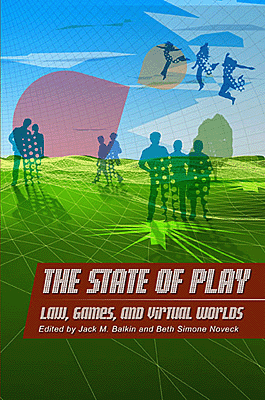
Jack M. Balkin and Beth Simone Noveck, The State of Play: Law, Games, and Virtual Worlds (N.Y.U. Press 2006)

Andrew Koppelman, Same Sex, Different States: When Same-Sex Marriages Cross State Lines (Yale University Press 2006)

Brian Tamanaha, Law as a Means to an End (Cambridge University Press 2006)

Sanford Levinson, Our Undemocratic Constitution (Oxford University Press 2006)

Mark Graber, Dred Scott and the Problem of Constitutional Evil (Cambridge University Press 2006)

Jack M. Balkin, ed., What Roe v. Wade Should Have Said (N.Y.U. Press 2005)

Sanford Levinson, ed., Torture: A Collection (Oxford University Press 2004)
Balkin.com homepage
Bibliography
Conlaw.net
Cultural Software
Writings
Opeds
The Information Society Project
BrownvBoard.com
Useful Links
Syllabi and Exams
