Balkinization
an unanticipated consequence of
Jack M. Balkin
Balkinization Symposiums: A Continuing List
E-mail:
Jack Balkin:
jackbalkin at yahoo.com
Bruce Ackerman
bruce.ackerman at yale.edu
Ian Ayres
ian.ayres at yale.edu
Corey Brettschneider
corey_brettschneider at brown.edu
Mary Dudziak
mary.l.dudziak at emory.edu
Joey Fishkin
joey.fishkin at gmail.com
Heather Gerken heather.gerken at yale.edu
Abbe Gluck abbe.gluck at yale.edu
Mark Graber
mgraber at law.umaryland.edu
Stephen Griffin
sgriffin at tulane.edu
Jonathan Hafetz
jonathan.hafetz at shu.edu
Jeremy Kessler
jkessler at law.columbia.edu
Andrew Koppelman
akoppelman at law.northwestern.edu
Marty Lederman
msl46 at law.georgetown.edu
Sanford Levinson
slevinson at law.utexas.edu
David Luban
david.luban at gmail.com
Gerard Magliocca
gmaglioc at iupui.edu
Jason Mazzone
mazzonej at illinois.edu
Linda McClain
lmcclain at bu.edu
John Mikhail
mikhail at law.georgetown.edu
Frank Pasquale
pasquale.frank at gmail.com
Nate Persily
npersily at gmail.com
Michael Stokes Paulsen
michaelstokespaulsen at gmail.com
Deborah Pearlstein
dpearlst at yu.edu
Rick Pildes
rick.pildes at nyu.edu
David Pozen
dpozen at law.columbia.edu
Richard Primus
raprimus at umich.edu
K. Sabeel Rahmansabeel.rahman at brooklaw.edu
Alice Ristroph
alice.ristroph at shu.edu
Neil Siegel
siegel at law.duke.edu
David Super
david.super at law.georgetown.edu
Brian Tamanaha
btamanaha at wulaw.wustl.edu
Nelson Tebbe
nelson.tebbe at brooklaw.edu
Mark Tushnet
mtushnet at law.harvard.edu
Adam Winkler
winkler at ucla.edu
Compendium of posts on Hobby Lobby and related cases
The Anti-Torture Memos: Balkinization Posts on Torture, Interrogation, Detention, War Powers, and OLC
The Anti-Torture Memos (arranged by topic)
Recent Posts
Academic Constitutional Theory and Judicial Constitutional Practice
Don't Mess with the Deep State
The military deep state
Can the Senate Subpoena the President?
The Umpire Analogy Does Not Work for Impeachment
Practical Equality and Rotten Compromises
Traditionalism and Anti-Novelty as Modes of Constitutional Interpretation: The Case of Tax-Exemption for Churches
The Dissent Option
The Proposed Senate Resolution is Unconstitutional
The People Who Don't Fit In
An Especially Harsh Government Shutdown is Increasingly Likely
“Low but solid ground in the struggle for equality”
Rudy Giuliani on the Stand
Symposium on Robert Tsai, Practical Equality
Well if it isn't Aaron Burr, sir. (Further on Cataline . . . and Trump.)
Cicero on Trump
It's So Difficult to Break Free of a Cult
It Doesn’t Say “Only”: A Textual Point About Impeachment
![[Powered by Blogger]](https://lh3.googleusercontent.com/blogger_img_proxy/AEn0k_ufybnUnJ_D3ciVd-hW0x1SDdiz7RKhwqj8_ChAgHZl3I-G-USA7R0MKZs4o9p-ckofzggfIWh2vB4TvBq1kHWF-bIHvib-RvqDB8A2jFih=s0-d)
Just A Few Blogs
ACS Blog
Alas, a Blog
Althouse
Arts and Letters Daily
Atrios (Eschaton)
Bill of Health
Buzzflash.com
Buzz Machine
Cato at Liberty
Juan Cole (Informed Comment)
Concurring Opinions
The Constitution in 2020
Corrente
Crooked Timber
Daily Howler
Daily Kos
Dana Boyd
Brad DeLong
Digby (Hullabaloo)
Discriminations
Daniel Drezner
Kevin Drum (Mother Jones)
Electrolite
En Banc
Eunomia (Daniel Larison)
Fafblog
Michael Froomkin (Discourse.net)
GovLab (Beth Noveck)
Rick Hasen (Election Law)
History News Network
How Appealing
Ignatz (Sam Heldman)
The Importance of (Ernie Miller)
Infolaw
Instapundit
International Economic Law and Policy Blog
IntLawGrrls
Jacob Levy
Jesus' General
Jurisdynamics
The Kitchen Cabinet
Mark Kleiman
Law Blog Central
Larry Lessig
Lawyers, Guns and Money
Liberal Oasis
Brian Leiter's Law School Reports
The Leiter Reports
Marginal Revolution
Megan McArdle
Memeorandum
Metafilter
Mirror of Justice
The New Republic
Newseum
No More Mister Nice Blog
Brendan Nyhan
Opinio Juris
Orcinus
The Originalism Blog
Pandagon
Passport (Foreign Policy)
Overcoming Bias
Political Animal (Washington Monthly)
Political Theory Daily Review
Political Wire (Taegan Goddard)
The Poor Man
Virginia Postrel
Prawfsblawg
Public Reason
Jonathan Rauch
Raw Story
Redstate
ReligiousLeftLaw.com
Reporters Committee For Freedom of the Press
Reproductive Rights Blog
Rothman's Roadmap to the Right of Publicity
SCOTUS Blog
Seeing the Forest
Clay Shirky
The Shifted Librarian
The Situationist
Larry Solum (Legal Theory)
Andrew Sullivan
Talking Points Memo
Talk Left
Tapped
Tbogg
TechPresident
The Paper Chase (Jurist)
Tom Paine
Tom Tomorrow (This Modern World)
Eve Tushnet
Uggabugga
University of Chicago Law School Faculty Blog
Unqualified Offerings
The Volokh Conspiracy
War and Piece (Laura Rozen)
Wampum
Oliver Willis
Wonkette
Written Description
Matthew Yglesias
Yin
Your Choice of Feeds
1. XML
powered by

2. Atom Feed
3. RSS 2.0
Academic Constitutional Theory and Judicial Constitutional Practice
Mark Tushnet
Posted
9:34 AM
by Mark Tushnet [link]
Don't Mess with the Deep State
Mark Tushnet
High-ranking long-term civil servants and national security bureaucrats have unsurprisingly been socialized into a role with two components, a procedural one dictating that they subordinate their personal views about policy to the views held by their political superiors and a substantive one consisting of the value-commitments their political superiors have had over a sustained period. These two components come apart when a disruptive president arrives on the scene. (To take an earlier and today less charged example, recall the comments when Reagan arrived about how difficult it was to change the direction of a battleship.) It should be no surprise to find that there's variation in the degree to which individual high-ranking civil servants and national security bureaucrats act in light of those two role-components. Nor is it surprising that individual calculations of the proper balance might shift as the possibility that the direction they are getting from their political superiors will change soon.
That seems to me what's been happening. Beyond that observation, a few additional comments. (1) I think it's interesting -- and to a person skeptical about the U.S. tradition of military intervention abroad in the name of national security troubling -- that the long-term civil servants and national security bureaucrats who have acted "against" Trump have done so because of his refusal to go along with as full-throated an interventionism as they appear to believe appropriate (and not because, for example, they believe that his relationship with Vladimir Putin is intrinsically troubling). Or, as conspiratorial Marxists used to say, maybe it's no accident that Trump's actions in Syria have amplified the Ukraine affair.
(2) Ordinarily small-d democrats would be hostile to anything like a deep state, for obvious reasons. A specific example is the ideal of civilian control of the military. Sometimes, though, the military -- and a "deep state" of some sort -- might serve a pro-democratic role. Ozal Varol's work on the pro-democratic coup is useful here. And concretely, Turkish president Erdogan's successful defeat of the Deep State there has not turned out well from a democratic point of view. I doubt that there are general criteria for assessing when a "deep state" is pro- or anti-democratic -- which is to say that Trump's invocation of "deep state" ideas and liberal responses to/dismissals of that invocation are both "merely" political claims about the underlying substance of Trump's policies. They are not deep or even superficial observations about proper institutional behavior in a democracy.
(3) Much more narrowly, and related to (1) above, I think it's interesting that, at least to this point, nothing similar to the reaction of the national security bureaucracy has been forthcoming with respect to domestic policy, and in particular from the Department of Justice. (As Koppelman's post suggests, the environmental bureaucracy has been put under control.) For all the celebration of the independence of the Southern District of New York, for example, collateral investigations there to the Mueller investigation appear to have been closed without result (nor, of course, have there been leaks on any significant scale). It would be really interesting were the Durham investigation to produce some minor charges in connection with its nominal subject and some major ones endorsing important aspects of the initial stages of the Mueller investigation. I don't rule out that possibility, because -- as I said at the beginning -- there is a deep state, and maybe (as his supporters regularly say, though not in terms) John Durham is a member of it. (At which point I have perhaps switched into "serious parody" mode.)
Posted
8:48 AM
by Mark Tushnet [link]
The military deep state
Andrew Koppelman
Posted
10:39 PM
by Andrew Koppelman [link]
Can the Senate Subpoena the President?
Gerard N. Magliocca
Suppose the House impeachment managers subpoena the President in the Senate trial. Would he be legally obligated to obey and be questioned? The Chief Justice may have to decide this issue.
An impeachment trial is not a criminal trial, where the privilege against self incrimination applies. The Senate proceeding is more analogous to a civil trial, where there is no such privilege unless the testimony in question might plausibly lead to criminal charges. As far as I know, neither President Johnson nor President Clinton were subpoenaed in their trials. I'm not sure why. The managers may have thought that the testimony would not help their case. Or they might have thought that the President could not be subpoenaed when he was the accused due to separation of powers concerns.
If the Chief Justice rules that the President can be subpoenaed, then he could, of course, refuse to comply. But this presents a problem. If the House of Representatives votes out an impeachment article based on the President's alleged obstruction of Congress (by refusing to comply with House subpoenas), he would be making that problem worse by also defying a Senate subpoena.
Posted
7:54 PM
by Gerard N. Magliocca [link]
(74) comments
The Umpire Analogy Does Not Work for Impeachment
Gerard N. Magliocca
I want to make a couple of additional points about the Chief Justice's role in the upcoming trial. One is that, as I read Article I, the Chief Justice is required to preside. He cannot recuse, as one article that I read today suggested. More important, some are suggesting that a Chief Justice plays a limited role in an impeachment trial, more akin to an umpire.
Let's be clear here. The Chief Justice could choose to exercise his broad discretion with restraint. He would then be following the model of his old boss Chief Justice Rehnquist during the Clinton trial. But Roberts could instead follow the precedent of Chief Justice Chase, who took a more muscular view of his authority in Andrew Johnson's impeachment trial. The upcoming trial will look more like the Johnson version than the Clinton version (for instance, there will be fact witnesses), which lends itself more to following Chase's example.
A broader point is in order here. The Chief Justice's famous comparison of a Justice to an umpire (with the connotation of restraint) strikes me as a poor fit with the role of a trial judge. I think many trial lawyers would scoff at the suggestion that trial judges are just umpires. Instead, these judges exercise enormous discretion depending on their view of the case. Appellate judges are (or ought to be) more restrained, but the Chief Justice will not be an appellate judge in the Senate.
Posted
11:12 AM
by Gerard N. Magliocca [link]
(91) comments
Practical Equality and Rotten Compromises
Mark Graber
Robert Tsai’s Practical Equality: Forging Justice in a
Divided Nation offers practical advice for progressives living in temporary
hard times. Progressives when they
cannot achieve a full loaf should eschew compromises that lock-in
inequalitarian commitments and find strategies that move the law forward while
leaving open the possibility of further progress. Brown v. Mississippi (1936) is
an excellent illustration of that strategy.
The Supreme Court in that case took a stick away from segregationists by
ruling out certain brutal modes of seeking confessions, almost exclusively used
when African-Americans were suspected of crime.
The justices did not, however, lend any legal sanction to other
practices that promoted racial subordination in the mid-twentieth century
polity. Craig v. Boren (1976) might
serve as an example of the strategy Tsai would have progressives avoid wherever
possible. The Supreme Court in that case
raised the standard for gender discriminations from rational scrutiny to immediate
scrutiny. In doing so, however, the justices
set a precedent against raising the standard for gender discriminations to
strict scrutiny.
Practical Equality provides sound advice for
progressives who are experiencing temporary setbacks on the road to Damascus. Professor Tsai has a rich grasp of
constitutional law, constitutional theory, constitutional politics and
constitutional history, all of which are employed in his effort to move
American politics progressively forward during times in which progressives need
allies to achieve even modest degrees of progress. He points out how in the past and at present
moving to various consensus norms can be means of achieving greater political
equality. Progressives can substitute
procedure for substance. They can
require that African-Americans be treated fairly in the criminal justice system
even when they cannot destroy the vestiges of Jim Crow. Progressives can substitute a safer equality
for a greater equality. They can seek to
wipe out racial discrimination in the capital punishment charging process even
when they cannot wipe out racial discrimination in the capital punishment
sentencing process. They can insist
progressive reformers speak freely even when too many in the audience are unwilling
to listen to their blandishments.
Professor Tsai’s advice works best during temporary hard
times for progressives. Progressives do
not want to lock-in inegalitarian practices during these periods because they
expect in the near future to make greater progress. This greater progress is in part a result of
expected greater increases in public support for egalitarian practices. The more persons over time who support
same-sex marriage, the less the backlash to laws and judicial decisions
legalizing same-sex marriage. This
greater progress is also in part a result of expected greater precedential
support for more egalitarian decisions. Brown
v Mississippi can be used to provide precedential support for striking down
other brutal practices in the criminal justice system directed primarily at
persons of color.
Practical egalitarian solutions may nevertheless privilege
political lock-ins by sanitizing inegalitarian practices even as they avoid
legal lock-ins by keeping broader legal questions open. Consider the constitutional politics of Brown
v Mississippi rather than only the
constitutional law. Students of southern
politics have documented how constitutional politics in the former Confederacy
was often a struggle between elites who favored a kinder, gentler racism that
would not alienate northerners thinking of doing business or perhaps moving to
Dixie and a more populist racism embodied by lynch law. Prominent southern elites may have opposed
national lynch laws, but the decline of lynching in the twentieth century was partly
due to the efforts of those favoring a kinder, gentler racism. Indeed, Professor Tsai points out that Brown
drew a dissent in the Mississippi state courts from a jurist who was no doubt a
kinder, gentler racist. This
constitutional politics highlights how judicial decisions forbidding brutal
practices in the criminal justice system that from a legal perspective promoted
a more egalitarian order may also from a political perspective have strengthen Jim
Crow by eliminated the worse abuses of a horribly abusive practice in ways that privileged more elite commitments to white supremacy. Racism without extra-legal violence has more
supporters than racism enforced by mobs.
Michael Klarman details how the death of segregation was hastened
considerably by the backlash to Brown v. Board of Education that
substantially weakened the power and authority of kinder, gentler racists. Southerners willing to live with Brown v. Mississippi had to be ousted from authority for northerners to insist on Brown v. Board of Education.
Practical equality solutions risk picking the low-hanging
fruit in ways that may make other harvests politically more difficult. Consider capital punishment. Most progressives are opposed to capital
punishment on principle. Many non-progressives are queasy about capital
punishment because they worry about executing innocent persons, think some
classes of persons (teenagers, the mentally ill) ought not be executed, or
believe that capital punishment is imposed in ways that discriminate against
persons of color. If given a choice
between capital punishment as practiced in the United States and no capital
punishment, the queasy moderates might choose no capital punishment. If, however, a series of laws and judicial
decisions sanitize capital punishment so that the chance of executing innocents
is minimized, the execution of sympathetic individuals is forbidden and
procedures are devised to reduce racism, the result might be increased support
for capital punishment. Sometimes the
effort you spend running a marathon makes the last miles easier; sometimes that
effort makes the last miles more difficult.
The same may be true for progressive reform. In theory, the next progressive steps are
left open. In practice, moving part way
to the goal may make further movement more difficult. Ask proponents of the ERA what happened when
the most offensive gender discriminations were removed from statutory books.
Rotten compromises may seem attractive during
times when locking in minimal commitments to equality seems more important than
avoiding locking in inegalitarian commitments. Reconsider Plessy v. Ferguson
from the perspective of the turn of the twentieth century. Professor Tsai and every other contemporary
scholar condemn that decision for locking in the principle that racial
segregation was constitutional. Plessy,
however, also locked in or at least provided foundations for the principle that
segregation had to be equal. As
Democratic speeches during the debates over the Civil Rights Act of 1871 and
1875 made clear, whether segregation had to be equal was not clear under the Fourteenth
Amendment. White supremacists in
Congress insisted that Congress had no power to regulate such domestic matters
as education and transportation, that states might bar children of color from
school altogether. No one will pretend
that segregation was equal in any way.
Nevertheless, a fair claim can be made that for fifty years, persons of
color in the Jim Crow South got a little more and only a little more than they
might have gotten because at the very least everyone had to pay lip-service to
the principle that segregation was equal and starkly inegalitarian forms of
inequality could be legally challenged, sometimes successfully.
Practical Equality provides progressives with an
extraordinary menu of possibilities for making progressive gains without making
progressive sacrifices, but not with the means of making the really rotten
compromises that national divisions may compel. Compromise may be the attractive alternative
when more benefits can be locked in by locking in perceived evils than by
practical equality solutions. Segregated
education may be better than no education. When the wind is blowing away from progressive
notions of equality, locking in some progressive policies in practice may be a better
alternative than keeping progressive utopias open in theory. Most controversially, to the extent
constitutions are compromises with evil rather than blueprints for the good
society, forging justice in a divided nation may require the really rotten
bargains that enable people with very different conceptions of equality and the
good society to share the same civic space.
Posted
6:54 AM
by Mark Graber [link]
Traditionalism and Anti-Novelty as Modes of Constitutional Interpretation: The Case of Tax-Exemption for Churches
Mark Tushnet
The characterization issue is a standard "level of generality" problem, and the general form of the solution to such problems is well-known: You can't solve a level of generality problem associated with some interpretive approach from within that approach itself. In connection with traditionalism, Jack Balkin noted the problem on this blog (so long ago that I lack the technical capacity to retrieve it!) in connection with Justice Scalia's suggestion that, in determining whether a practice was inconsistent with long-standing tradition, we should characterize the tradition at the most specific level available.
DeGirolami's approach is pretty clearly more suitable for upholding legislative actions than for invalidating them. On the "invalidation" side, traditionalism might be linked to the (emerging?) "anti-novelty" principle, according to which the fact that governments have refrained from doing something (again, a level of generality problem lurks) is an argument against the constitutionality of their doing so for the first time. (Leah Litman offers a good critique of the anti-novelty principle.)
But consider the following: denying tax-exempt status to religious institutions that discriminate against LGBTQ people in connection with their social service activities. (For a reason that I understand but that is mistaken, I have been associated with such proposal, about which -- until now -- I have not, as far as I can recall, written a word.) Put aside for the moment questions about what the precise scope of such a provision would be. Would a reasonably broad denial of tax-exempt status on this ground be unconstitutional?
The anti-novelty principle suggests that it might be. Legislatures have provided religion-based exemptions from even "core" civic obligations from the beginning, though the contours of the exemptions have sometimes been contested. These legislated exemptions include conscientious objection to military service and the "priest-penitent" evidentiary privilege. In a post-Smith world, though, these exemptions appear to be optional rather than mandatory. And, even in a pre-Smith world the exemptions might be explained as reflecting legislative judgments about what circumstances required for compelling governmental interests to be advanced (that is, judgments that the governmental interests wouldn't be unduly impaired by granting the exemptions). If so, a contemporary legislative judgment that imposing the regulation was needed to advance such goals would present a different case. (This is, of course, another variant on the "level of generality" problem.)
Hosanna-Tabor constitutionalizes exemptions for something even in a post-Smith world. Exactly what is constitutionalized, though, is unclear. Proponents of the "freedom of the church" reading of the case argue that a great deal is constitutionalized (though in my view they make too much of the highly technical question of whether the exemption question is "jurisdictional" under the relevant federal statutes). Bob Jones holds that an exemption for race-based discrimination is not constitutionally required, and Hobby Lobby seems to imply that even in a post-Smith world imposing a requirement not to discriminate on the basis of race would be a compelling governmental interest.
Note that one of Justice Scalia's concerns in Smith would be brought into play in the case I'm imagining. He worried -- properly, in my view -- about the problems the courts would face in saying that they agreed with the legislature's judgment that eliminating race-based discrimination was a compelling governmental interest but (in the present context, which is not one Justice Scalia appears expressly to have contemplated) that they had the power and indeed duty to disagree with a legislature's judgment that eliminating LGBTQ discrimination was also a compelling governmental interest.
I take a modest position here on the constitutional question I've flagged: I don't think that it is obviously unconstitutional under current or even pre-Smith doctrine. My thought is that work needs to be done on a bunch of issues associated with traditionalism in constitutional interpretation: the level of generality problem pretty clearly, and perhaps its connection to anti-novelty arguments. I look forward to DeGirolami's development of his ideas on these and related questions.
Posted
11:04 PM
by Mark Tushnet [link]
The Dissent Option
Guest Blogger
For the symposium on Robert Tsai, Practical Equality: Forging Justice in a Divided Nation (Norton 2019).
Nelson Tebbe
Nelson Tebbe is Professor of Law at Cornell University. You can reach him by e-mail at nt277 at cornell.edu
Posted
9:30 AM
by Guest Blogger [link]
The Proposed Senate Resolution is Unconstitutional
Gerard N. Magliocca
Earlier today, Senator Graham announced that he would introduce a Senate resolution condemning the House impeachment inquiry as unconstitutional. Senator's Graham's proposed resolution is itself unconstitutional. The Senate cannot carry out its constitutional obligation to "try all impeachments" if it is on record as pre-judging the case before any articles of impeachment have been drafted. Courts do not declare the guilt or innocence of someone before charges have even been filed. Talk about a kangaroo court.
Moreover, the Senate's own precedents deny the power that Senator Graham is claiming. In 1834, the Senate censured President Jackson for his conduct regarding the National Bank. Three years later, the Senate reversed that conclusion in the Expunging Resolution. The Expunging Resolution, which still stands, was based in part on the argument that the Senate could not pre-judge a possible impeachment from the House of Representatives. In 1834, the Senate had declared Jackson guilty, whereas Senator Graham wants his colleagues to declare the President not guilty. But the principle is the same. As an institution, the Senate is only permitted to express its views on potential impeachable conduct during an impeachment trial.
Individual senators are free to express any opinions that they want. But if Senator Graham's brings his resolution to the floor, the Senate parliamentarian should rule it out of order.
UPDATE: The fact that the House of Representatives also has the sole power of impeachment also implies that the Senate cannot comment on a pending inquiry.
Posted
12:16 PM
by Gerard N. Magliocca [link]
(78) comments
The People Who Don't Fit In
Guest Blogger
For the symposium on Robert Tsai, Practical Equality: Forging Justice in a Divided Nation (Norton 2019).
Susan Burgess
Robert
Tsai begins by dedicating his new book to “the misfits and the losers.” This put me in the mind of a quotation from
Margaret Atwood that is framed on my office desk: “Every utopia faces the same
problem: what do you do with the people
who don’t fit in?” Atwood has written
several novels about utopias that have gone badly wrong, most famously in The
Handmaid’s Tale, which has been made into a feature-length film twice, as
well as a very popular television series that is currently in its third season
on Hulu. As I was writing my review of Tsai’s book, I was also finishing
Margaret Atwood’s new novel, The Testaments, which is both a prequel and
a sequel to The Handmaid’s Tale. In an odd sort of way, these two works go
together go together quite nicely.
Susan Burgess is Distinguished Professor of Political Science at Ohio University. You can reach her by e-mail at burgess at ohio.edu
Posted
9:30 AM
by Guest Blogger [link]
An Especially Harsh Government Shutdown is Increasingly Likely
David Super
Prior to the end
of Fiscal Year 2019 on September 30, Congress passed and the President signed a
short-term continuing
resolution (“CR”) to keep the federal government operational through
November 21, 2019. At the time, the
House had passed
ten of the twelve annual appropriations bills needed to fund the federal
government (all but the intensely controversial Homeland Security bill and the
parochial Legislative Branch bill).
Then, and indeed even today, the Senate had passed none of the twelve bills.
The hope has been
that the House, the Senate, and the President would be able to agree on full-year
funding levels by November 21 or, failing that, a short additional CR would
provide the time needed. Increasingly,
however, it is appearing that no such agreement may be achieved and another
partial government shutdown is likely.
Moreover, if a shutdown does occur, it could do considerably more damage
even than the one that began in December 2018.
Several factors
make an appropriations impasse seem increasingly likely. First, an immense amount of work remains to
be done. Not only has the Senate not enacted
a single appropriations bill – it is trying to move several this week and
possibly next – but the House and Senate have yet to agree on even the broadest
outlines of how to divide up the available funds.
Each year when a
budget resolution or budget agreement sets an overall limit on the amounts that
may be appropriated for defense and non-defense discretionary programs, the
House and Senate Appropriations Committees divide up those funds among their
twelve subcommittees. This year, the
House and Senate did so quite differently.
The House would largely divide
the funds consistently with past years.
The Senate Appropriators, however, would significantly redistribute
funds away from anti-poverty and other human services programs. Thus, despite a modest increase in total
domestic discretionary funding for 2020 relative to 2019, the Senate
Appropriations Committee would cut
programs within the jurisdiction of its Labor-HHS-Education Subcommittee. Child care, Head Start, job training, family
planning, and education for disadvantaged children would be among the important
losers, as would the operating budget of the Social Security
Administration.
Some House-Senate
disagreements over subcommittee allocations are common – although generally not
ones of this magnitude – but ordinarily the two chambers reconcile their
differences much earlier in the year.
Until House and Senate appropriators do so, little work on drafting
individual appropriations bills is possible:
subcommittees cannot start to divide up their pots if they do not know
how big their respective pots will be.
The source of the delay is mysterious; it may reflect Senate Republicans
trying to determine whether the Administration has any particular targets it
wants them to meet.
Second, as the
Administration rolls out more and more rules and executive orders marking sharp
breaks from the past, the number of substantive “riders” – restrictions or
prohibitions on appropriations bills – that Democrats will be under pressure to
pursue will increase. Similarly, as new
disclosures about how the Administration has conducted foreign policy in
Ukraine, Syria, and elsewhere emerge, Members of both parties may want to
include more mandatory language in appropriations bills rather than relying on general
legislation prohibiting impoundments of appropriated funds. This will multiply the number and complexity
of disagreements that could lead to an impasse.
Third, President
Trump’s declaration of a state of emergency, and his transfer of money from
various military construction accounts to support border wall construction,
greatly expands the scope of the issues in any appropriations negotiations. Not only must opponents of spending money on
the border wall focus on that account but they also will want to defund, or statutorily
protect from transfer, a wide range of other accounts that the President might
raid. Some Republicans who favor the border
wall may nonetheless ally with Democrats to protect against transfers out of military
construction accounts important to them.
Finally, negotiations
on an appropriations deal seem likely to interact unfavorably with the impeachment
process. One might imagine that the
President would seek to avoid alienating persuadable voters and Senate
Republicans with a government shutdown.
To date, however, the President seems to be counting on fiery support
from his base to scare Senate Republicans with the threat of primary
challenges. That is likely to make him even
more reluctant to compromise. He also
has seemed unable or unwilling to compartmentalize his disputes with House
Democrats, who naturally will be among the major parties to a budget negotiation. The Democrats, for their part, may have
trouble persuading their constituents that they need to make deep compromises
to a President who seems on the ropes.
And some may be inclined to defund officials or agencies that have refused
to comply with subpoenas.
If a partial government
shutdown does occur, it is likely to be even more destructive than the one last
winter. The Congressional Budget Office (CBO)
estimated that that
shutdown cost the economy $11 billion. This
likely does not include a variety of non-monetized effects, such as loss of
morale to federal workers and inefficient or failed government procurement by
agencies that do much of their work by contract and were left with only a
little over half a year to seek bids and award contracts before the close of
the fiscal year. Nonetheless, a new
shutdown is likely to be worse in several respects.
First and most
obviously, it could well last longer as compromise remains elusive for the
reasons just discussed. Indeed, it may
be that the President will be wholly unwilling to compromise with House
Democrats so that the shutdown continues until twenty Republican senators (and,
even more difficult, sixty Republican representatives) are willing to vote to
override a presidential veto of funding legislation. (Of course, if the Senate can muster a two-thirds majority to
re-open the government, that might ease the way toward other votes requiring
similar super-majorities.)
Second, several major
appropriations bills had already been signed into law prior to last winter’s partial
shutdown. This year, as noted, no
appropriations bills have even passed the Senate, much less made their way
through a conference committee and across the President’s desk. Much more of the government will be affected.
Third, some programs
simply cannot wait for their funding this year.
Chief among these is the decennial census. Census spending is heavily front-loaded in
the fiscal year, with activities starting in Alaska in January and in the rest
of the country soon thereafter. If the
Census Bureau lacks funds to hire enumerators and take other steps to ensure
broad participation, the quality of this Census may be irretrievably
compromised. That might not bother
the Trump Administration, but it should alarm the rest of us. In addition, Medicaid funding is approaching
a cliff
in Puerto Rico and other U.S. territories that lack the secure funding stream
available to the fifty states and Washington, D.C. If they do not receive new funding soon, they
will have to shut down much of their programs in January.
Finally, in the
months since the last partial shutdown ended, the U.S. Government
Accountability Office (GAO) has ruled that some of the steps the Trump
Administration took to moderate the effects of that shutdown were
unlawful. Last month, GAO ruled that a contorted
scheme to pay February’s SNAP food assistance benefits in January violated the Anti-Deficiency
Act. (A more straightforward
approach to continuing SNAP benefits was available, but for whatever reason the
Administration did not take it.) And Tuesday, GAO ruled that the
Administration’s order for IRS employees to return to work to process tax
refunds also violated the Act. The
Anti-Deficiency Act provides serious criminal
penalties for knowing and willful violations. These GAO opinions undermine any federal
employees’ ability to claim that these schemes, if attempted again, were inadvertent
violations of the Act. The
Administration therefore may find it more difficult to persuade federal employees
to implement policies to soften the impact of any government shutdown. The President’s continued harsh criticism of
federal employees also might cause some to question whether he would sign
legislation paying them retroactively for unpaid work they did as “essential”
workers during a partial shutdown.
Posted
12:31 AM
by David Super [link]
“Low but solid ground in the struggle for equality”
Guest Blogger
For the symposium on Robert Tsai, Practical Equality: Forging Justice in a Divided Nation (Norton 2019).
Posted
10:00 AM
by Guest Blogger [link]
Rudy Giuliani on the Stand
Gerard N. Magliocca
The President's lawyer will be a star witness in the impeachment trial. His testimony, though, will present several challenges for Chief Justice Roberts and for the Senate. Let me run through some.
1. Can Rudy defend the President in the trial if he is also a witness?
In an ordinary trial, the answer would be no. Here I suppose the Chief Justice could allow Giuliani to perform both roles with the caution that this might be bad for the President's defense. But he could, I would think, also bar him from being a lawyer on the Senate floor.
2. What happens if Rudy takes the Fifth?
In a criminal trial, prosecutors can give a witness immunity and require testimony notwithstanding the Self-Incrimination Clause of the Fifth Amendment. Can the House managers do that? Not on their own surely. But what if the Senate passed a resolution promising immunity? And the Chief Justice says that this is binding. Put another way, what legal effect, if any, do the rulings of a High Court of impeachment have on criminal trials? I doubt that there is any helpful authority on this point, but the argument that the Senate should be able to secure useful testimony through immunity has force.
3. What happens if Rudy invokes attorney-client privilege?
Two odd aspects of the case intersect here. One is that Giuliani is the President's lawyer and a participant in the alleged high crimes and misdemeanors. How do you separate those roles? Next, how can these matters be considered confidentially? Unlike ordinary jurors, senators get to decide what evidence they hear (by voting on the Chief Justice's rulings). Thus, any privilege claim must be assessed by the entire Senate. How, then, can some information be excluded from consideration? The Chief Justice could instruct Senators not to consider certain evidence in rendering their verdict, but is that just an empty formalism?
Posted
9:44 AM
by Gerard N. Magliocca [link]
(97) comments
Symposium on Robert Tsai, Practical Equality
Mark Graber

This week at Balkinization we are hosting a symposium on Robert Tsai’s new book, Practical Equality: Forging Justice in a Divided Nation (Norton 2019).
Our commentators are Susan Burgess (Ohio Univeristy), George Thomas
(Claremont McKenna College), Nelson Tebbe (Cornell Law School), and me. Robert will respond at the end of the week.
Posted
9:30 AM
by Mark Graber [link]
Well if it isn't Aaron Burr, sir. (Further on Cataline . . . and Trump.)
Marty Lederman
À propos of Charles Fried's post invoking Cicero on Cataline, I couldn't help but recall once more what Alexander Hamilton wrote about Aaron Burr in his efforts in 1800-1801 to persuade his fellow Federalists serving in the House to actually vote for Hamilton's lifelong nemesis, Thomas Jefferson, for President. (I wrote more about this fascinating story here.) Notwithstanding his profound disagreements with Jefferson on virtually everything, Hamilton insisted that it wasn’t even a close call—that Burr would be far more dangerous to the Nation, for reasons that should sound painfully familiar. Here's some of what Hamilton wrote about Burr in his letters to his fellow Federalists. Uncanny, isn't it?:
■ “[T]there is nothing in his favour. His private character is not defended by his most partial friends. He is bankrupt beyond redemption except by the plunder of his country. His public principles have no other spring or aim than his own aggrandisement per fas et nefas. If he can, he will certainly disturb our institutions to secure to himself permanent power and with it wealth. He is truly the Cataline of America—& if I may credit Major Wilcocks, he has held very vindictive language respecting his opponents.” [to Oliver Wolcott, Dec. 16]
■ “The appointment of Burr as President would disgrace our Country abroad. No agreement with him could be relied upon. His private circumstances render disorder a necessary resource. His public principles offer no obstacle. His ambition aims at nothing short of permanent power and wealth in his own person.” [to Theodore Sedgwick, Dec. 22]
■ “Burr loves nothing but himself; thinks of nothing but his own aggrandizement, and will be content with nothing, short of permanent power in his own hands.” [to Harrison Gray Otis, Dec. 23]
■ “His ambition will not be content with those objects which virtuous men of either party will allot to it, and his situation and his habits will oblige him to have recourse to corrupt expedients, from which he will be restrained by no moral scruples. To accomplish his ends he must lean upon unprincipled men and will continue to adhere to the myrmidons who have hitherto seconded him. . . .
Can it be doubted that a man who has all his life speculated upon the popular prejudices will consult them in the object of a War when he thinks it expedient to make one? Can a man who despising democracy has chimed in with all its absurdities be diverted from the plan of Ambition which must have directed this course? They who suppose it must understand little of human nature.” [to Oliver Wolcott, late Dec.]
■ "[T]his man has no principle public or private. As a politician his sole spring of action is an inordinate ambition; as an individual he is believed by friends as well as foes to be without probity, and a voluptuary by system, with habits of expence that can be satisfied by no fair expedients. As to his talents, great management & cunning are the predominant features—he is yet to give proofs of those solid abilities which characterize the statesman. . . .
The maintenance of the existing institutions will not suit him, because under them his power will be too narrow & too precarious; yet the innovations he may attempt will not offer the substitute of a system durable & safe, calculated to give lasting prosperity, & to unite liberty with strength. It will be the system of the day, sufficient to serve his own turn, & not looking beyond himself. To execute this plan[,] as the good men of the country cannot be relied upon, the worst will be used.
Let it not be imagined that the difficulties of execution will deter, or a calculation of interest restrain. The truth is that under forms of Government like ours, too much is practicable to men who will without scruple avail themselves of the bad passions of human nature.
. . . [H]e cannot be satisfied with the regular emoluments of any office of our Government. Corrupt expedients will be to him a necessary resource. Will any prudent man offer such a president to the temptations of foreign gold? . . .
Let me add that I could scarcely name a discreet man of either party in our State, who does not think Mr Burr the most unfit man in the U. S. for the office of President. Disgrace abroad ruin at home are the probable fruits of his elevation.
For Heaven’s sake my dear Sir, exert yourself to the utmost to save our country from so great a calamity. Let us not be responsible for the evils which in all probability will follow the preference [for Burr]. All calculations that may lead to it must prove fallacious." [to James Bayard, Dec. 27]
■ “Of an ambition too irregular and inordinate to be content with institutions that leave his power precarious, he is of too bold and sanguine a temper to think any thing too hazardous to be attempted or two difficult to be accomplished.
As to [his] talents they are great for management and intrigue—but he is yet to give the first proofs that they are equal to the art of governing well.
As to his theory, no mortal can tell what it is. Institutions that would serve his own purpose (such as the Government of France of the present day) not such as would promise lasting prosperity and glory to the Country would be his preference because he cares only for himself and nothing for his Country or glory.
Certain that his irregular ambition cannot be supported by good men, he will court and employ the worst men of all parties as the most eligible instruments. Jacobinism in its most pernicious form will scourge the country. [to James Ross, Dec. 29]
■ “As to Burr these things are admitted and indeed cannot be denied, that he is a man of extreme & irregular ambition—that he is selfish to a degree which excludes all social affections & that he is decidedly profligate. . . .
[I]t is said . . . that he holds no pernicious theories, but is a mere “matter of fact man.” But is it a recommendation to have no theory? Can that man be a systematic or able statesman who has none? I believe not. No general principles will hardly work much better than erroneous ones. . . . Ambition without principle never was long under the guidance of good sense.” [to James Bayard, Jan. 16]
Posted
9:43 AM
by Marty Lederman [link]
Cicero on Trump
Guest Blogger
Charles Fried
--Cicero, First Cataline Oration
Charles Fried is Beneficial Professor of Law at Harvard Law School. You can reach him by e-mail at fried at law.harvard.edu
Posted
4:50 PM
by Guest Blogger [link]
It's So Difficult to Break Free of a Cult
Sandy Levinson
Posted
9:30 AM
by Sandy Levinson [link]
(85) comments
It Doesn’t Say “Only”: A Textual Point About Impeachment
Richard Primus
Posted
5:08 PM
by Richard Primus [link]
Books by Balkinization Bloggers

Gerard N. Magliocca, The Actual Art of Governing: Justice Robert H. Jackson's Concurring Opinion in the Steel Seizure Case (Oxford University Press, 2025)

Linda C. McClain and Aziza Ahmed, The Routledge Companion to Gender and COVID-19 (Routledge, 2024)

David Pozen, The Constitution of the War on Drugs (Oxford University Press, 2024)

Jack M. Balkin, Memory and Authority: The Uses of History in Constitutional Interpretation (Yale University Press, 2024)
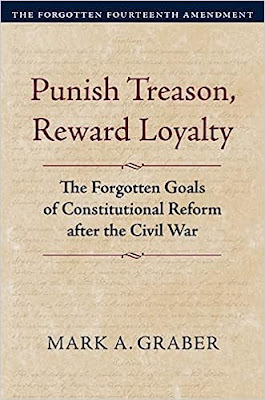
Mark A. Graber, Punish Treason, Reward Loyalty: The Forgotten Goals of Constitutional Reform after the Civil War (University of Kansas Press, 2023)
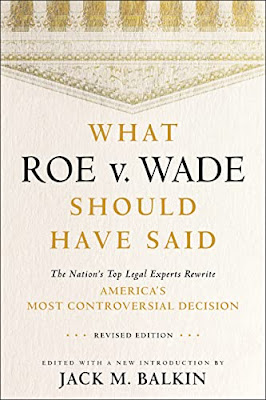
Jack M. Balkin, What Roe v. Wade Should Have Said: The Nation's Top Legal Experts Rewrite America's Most Controversial Decision - Revised Edition (NYU Press, 2023)

Andrew Koppelman, Burning Down the House: How Libertarian Philosophy Was Corrupted by Delusion and Greed (St. Martin’s Press, 2022)

Gerard N. Magliocca, Washington's Heir: The Life of Justice Bushrod Washington (Oxford University Press, 2022)
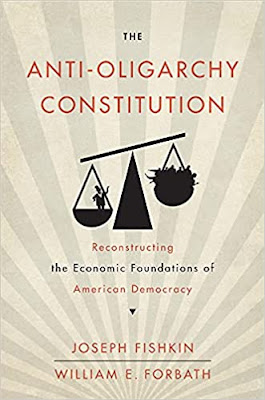
Joseph Fishkin and William E. Forbath, The Anti-Oligarchy Constitution: Reconstructing the Economic Foundations of American Democracy (Harvard University Press, 2022)
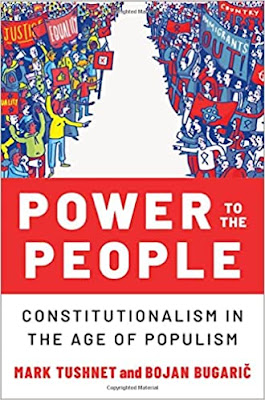
Mark Tushnet and Bojan Bugaric, Power to the People: Constitutionalism in the Age of Populism (Oxford University Press 2021).

Mark Philip Bradley and Mary L. Dudziak, eds., Making the Forever War: Marilyn B. Young on the Culture and Politics of American Militarism Culture and Politics in the Cold War and Beyond (University of Massachusetts Press, 2021).

Jack M. Balkin, What Obergefell v. Hodges Should Have Said: The Nation's Top Legal Experts Rewrite America's Same-Sex Marriage Decision (Yale University Press, 2020)

Frank Pasquale, New Laws of Robotics: Defending Human Expertise in the Age of AI (Belknap Press, 2020)

Jack M. Balkin, The Cycles of Constitutional Time (Oxford University Press, 2020)

Mark Tushnet, Taking Back the Constitution: Activist Judges and the Next Age of American Law (Yale University Press 2020).

Andrew Koppelman, Gay Rights vs. Religious Liberty?: The Unnecessary Conflict (Oxford University Press, 2020)

Ezekiel J Emanuel and Abbe R. Gluck, The Trillion Dollar Revolution: How the Affordable Care Act Transformed Politics, Law, and Health Care in America (PublicAffairs, 2020)

Linda C. McClain, Who's the Bigot?: Learning from Conflicts over Marriage and Civil Rights Law (Oxford University Press, 2020)
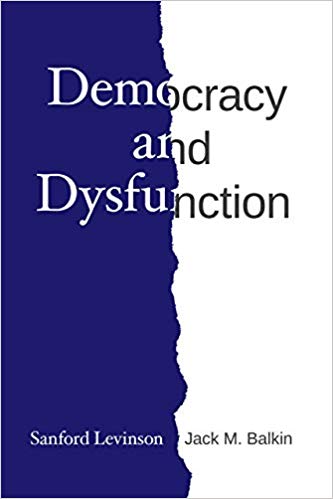
Sanford Levinson and Jack M. Balkin, Democracy and Dysfunction (University of Chicago Press, 2019)

Sanford Levinson, Written in Stone: Public Monuments in Changing Societies (Duke University Press 2018)

Mark A. Graber, Sanford Levinson, and Mark Tushnet, eds., Constitutional Democracy in Crisis? (Oxford University Press 2018)

Gerard Magliocca, The Heart of the Constitution: How the Bill of Rights became the Bill of Rights (Oxford University Press, 2018)

Cynthia Levinson and Sanford Levinson, Fault Lines in the Constitution: The Framers, Their Fights, and the Flaws that Affect Us Today (Peachtree Publishers, 2017)

Brian Z. Tamanaha, A Realistic Theory of Law (Cambridge University Press 2017)

Sanford Levinson, Nullification and Secession in Modern Constitutional Thought (University Press of Kansas 2016)

Sanford Levinson, An Argument Open to All: Reading The Federalist in the 21st Century (Yale University Press 2015)

Stephen M. Griffin, Broken Trust: Dysfunctional Government and Constitutional Reform (University Press of Kansas, 2015)

Frank Pasquale, The Black Box Society: The Secret Algorithms That Control Money and Information (Harvard University Press, 2015)

Bruce Ackerman, We the People, Volume 3: The Civil Rights Revolution (Harvard University Press, 2014)
Balkinization Symposium on We the People, Volume 3: The Civil Rights Revolution

Joseph Fishkin, Bottlenecks: A New Theory of Equal Opportunity (Oxford University Press, 2014)

Mark A. Graber, A New Introduction to American Constitutionalism (Oxford University Press, 2013)

John Mikhail, Elements of Moral Cognition: Rawls' Linguistic Analogy and the Cognitive Science of Moral and Legal Judgment (Cambridge University Press, 2013)

Gerard N. Magliocca, American Founding Son: John Bingham and the Invention of the Fourteenth Amendment (New York University Press, 2013)

Stephen M. Griffin, Long Wars and the Constitution (Harvard University Press, 2013)

Andrew Koppelman, The Tough Luck Constitution and the Assault on Health Care Reform (Oxford University Press, 2013)

James E. Fleming and Linda C. McClain, Ordered Liberty: Rights, Responsibilities, and Virtues (Harvard University Press, 2013)
Balkinization Symposium on Ordered Liberty: Rights, Responsibilities, and Virtues

Andrew Koppelman, Defending American Religious Neutrality (Harvard University Press, 2013)

Brian Z. Tamanaha, Failing Law Schools (University of Chicago Press, 2012)

Sanford Levinson, Framed: America's 51 Constitutions and the Crisis of Governance (Oxford University Press, 2012)

Linda C. McClain and Joanna L. Grossman, Gender Equality: Dimensions of Women's Equal Citizenship (Cambridge University Press, 2012)

Mary Dudziak, War Time: An Idea, Its History, Its Consequences (Oxford University Press, 2012)

Jack M. Balkin, Living Originalism (Harvard University Press, 2011)

Jason Mazzone, Copyfraud and Other Abuses of Intellectual Property Law (Stanford University Press, 2011)

Richard W. Garnett and Andrew Koppelman, First Amendment Stories, (Foundation Press 2011)

Jack M. Balkin, Constitutional Redemption: Political Faith in an Unjust World (Harvard University Press, 2011)

Gerard Magliocca, The Tragedy of William Jennings Bryan: Constitutional Law and the Politics of Backlash (Yale University Press, 2011)

Bernard Harcourt, The Illusion of Free Markets: Punishment and the Myth of Natural Order (Harvard University Press, 2010)

Bruce Ackerman, The Decline and Fall of the American Republic (Harvard University Press, 2010)
Balkinization Symposium on The Decline and Fall of the American Republic

Ian Ayres. Carrots and Sticks: Unlock the Power of Incentives to Get Things Done (Bantam Books, 2010)

Mark Tushnet, Why the Constitution Matters (Yale University Press 2010)

Ian Ayres and Barry Nalebuff: Lifecycle Investing: A New, Safe, and Audacious Way to Improve the Performance of Your Retirement Portfolio (Basic Books, 2010)
.jpg)
Jack M. Balkin, The Laws of Change: I Ching and the Philosophy of Life (2d Edition, Sybil Creek Press 2009)

Brian Z. Tamanaha, Beyond the Formalist-Realist Divide: The Role of Politics in Judging (Princeton University Press 2009)
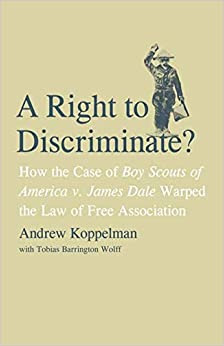
Andrew Koppelman and Tobias Barrington Wolff, A Right to Discriminate?: How the Case of Boy Scouts of America v. James Dale Warped the Law of Free Association (Yale University Press 2009)

Jack M. Balkin and Reva B. Siegel, The Constitution in 2020 (Oxford University Press 2009)

Heather K. Gerken, The Democracy Index: Why Our Election System Is Failing and How to Fix It (Princeton University Press 2009)

Mary Dudziak, Exporting American Dreams: Thurgood Marshall's African Journey (Oxford University Press 2008)

David Luban, Legal Ethics and Human Dignity (Cambridge Univ. Press 2007)

Ian Ayres, Super Crunchers: Why Thinking-By-Numbers is the New Way to be Smart (Bantam 2007)

Jack M. Balkin, James Grimmelmann, Eddan Katz, Nimrod Kozlovski, Shlomit Wagman and Tal Zarsky, eds., Cybercrime: Digital Cops in a Networked Environment (N.Y.U. Press 2007)

Jack M. Balkin and Beth Simone Noveck, The State of Play: Law, Games, and Virtual Worlds (N.Y.U. Press 2006)

Andrew Koppelman, Same Sex, Different States: When Same-Sex Marriages Cross State Lines (Yale University Press 2006)

Brian Tamanaha, Law as a Means to an End (Cambridge University Press 2006)

Sanford Levinson, Our Undemocratic Constitution (Oxford University Press 2006)

Mark Graber, Dred Scott and the Problem of Constitutional Evil (Cambridge University Press 2006)

Jack M. Balkin, ed., What Roe v. Wade Should Have Said (N.Y.U. Press 2005)

Sanford Levinson, ed., Torture: A Collection (Oxford University Press 2004)
Balkin.com homepage
Bibliography
Conlaw.net
Cultural Software
Writings
Opeds
The Information Society Project
BrownvBoard.com
Useful Links
Syllabi and Exams
