Balkinization
an unanticipated consequence of
Jack M. Balkin
Balkinization Symposiums: A Continuing List
E-mail:
Jack Balkin:
jackbalkin at yahoo.com
Bruce Ackerman
bruce.ackerman at yale.edu
Ian Ayres
ian.ayres at yale.edu
Corey Brettschneider
corey_brettschneider at brown.edu
Mary Dudziak
mary.l.dudziak at emory.edu
Joey Fishkin
joey.fishkin at gmail.com
Heather Gerken heather.gerken at yale.edu
Abbe Gluck abbe.gluck at yale.edu
Mark Graber
mgraber at law.umaryland.edu
Stephen Griffin
sgriffin at tulane.edu
Jonathan Hafetz
jonathan.hafetz at shu.edu
Jeremy Kessler
jkessler at law.columbia.edu
Andrew Koppelman
akoppelman at law.northwestern.edu
Marty Lederman
msl46 at law.georgetown.edu
Sanford Levinson
slevinson at law.utexas.edu
David Luban
david.luban at gmail.com
Gerard Magliocca
gmaglioc at iupui.edu
Jason Mazzone
mazzonej at illinois.edu
Linda McClain
lmcclain at bu.edu
John Mikhail
mikhail at law.georgetown.edu
Frank Pasquale
pasquale.frank at gmail.com
Nate Persily
npersily at gmail.com
Michael Stokes Paulsen
michaelstokespaulsen at gmail.com
Deborah Pearlstein
dpearlst at yu.edu
Rick Pildes
rick.pildes at nyu.edu
David Pozen
dpozen at law.columbia.edu
Richard Primus
raprimus at umich.edu
K. Sabeel Rahmansabeel.rahman at brooklaw.edu
Alice Ristroph
alice.ristroph at shu.edu
Neil Siegel
siegel at law.duke.edu
David Super
david.super at law.georgetown.edu
Brian Tamanaha
btamanaha at wulaw.wustl.edu
Nelson Tebbe
nelson.tebbe at brooklaw.edu
Mark Tushnet
mtushnet at law.harvard.edu
Adam Winkler
winkler at ucla.edu
Compendium of posts on Hobby Lobby and related cases
The Anti-Torture Memos: Balkinization Posts on Torture, Interrogation, Detention, War Powers, and OLC
The Anti-Torture Memos (arranged by topic)
Recent Posts
Why An American Veteran Urges Us To Get Out of Afghanistan
The Office of Legal Counsel on Hate Crimes Laws
Scalia's Biggest Problem isn't Brown, It's Bolling and Loving
The Blogosphere, the Mainstream Press, and the Fake Scalia Story
Justice Scalia comes clean on Brown v. Board of Education?
The Limits of Competition and the Rebirth of the Public Option
George Fletcher talks about The Bond
The Murderous Thugs We are Supporting in Afghanistan--and Why a Heroine Wants Us Out
REVISED - Military Commissions, Round 3
The Presidency and The Rise of the New Partisan Press
Kiyema v. Obama
Stearns and Zywicki, PUBLIC CHOICE CONCEPTS
On Objectivity and Personal Beliefs
Our Overseas Empire
And now the inevitable conservative argument that Obama's Nobel Prize is unconstitutional
The Supreme Court is All Business – Or Half-Business, Anyway
![[Powered by Blogger]](https://lh3.googleusercontent.com/blogger_img_proxy/AEn0k_toUsSKhakkrAlUdy7Y-dKesdRRtXDOFajXoWzEKzZVxsiOj_dh3My7KGqTRR6WDSAQtxdmlkagA4sD6swb8ZOwQob-mDLVbb8WIdk2w1nG=s0-d)
Just A Few Blogs
ACS Blog
Alas, a Blog
Althouse
Arts and Letters Daily
Atrios (Eschaton)
Bill of Health
Buzzflash.com
Buzz Machine
Cato at Liberty
Juan Cole (Informed Comment)
Concurring Opinions
The Constitution in 2020
Corrente
Crooked Timber
Daily Howler
Daily Kos
Dana Boyd
Brad DeLong
Digby (Hullabaloo)
Discriminations
Daniel Drezner
Kevin Drum (Mother Jones)
Electrolite
En Banc
Eunomia (Daniel Larison)
Fafblog
Michael Froomkin (Discourse.net)
GovLab (Beth Noveck)
Rick Hasen (Election Law)
History News Network
How Appealing
Ignatz (Sam Heldman)
The Importance of (Ernie Miller)
Infolaw
Instapundit
International Economic Law and Policy Blog
IntLawGrrls
Jacob Levy
Jesus' General
Jurisdynamics
The Kitchen Cabinet
Mark Kleiman
Law Blog Central
Larry Lessig
Lawyers, Guns and Money
Liberal Oasis
Brian Leiter's Law School Reports
The Leiter Reports
Marginal Revolution
Megan McArdle
Memeorandum
Metafilter
Mirror of Justice
The New Republic
Newseum
No More Mister Nice Blog
Brendan Nyhan
Opinio Juris
Orcinus
The Originalism Blog
Pandagon
Passport (Foreign Policy)
Overcoming Bias
Political Animal (Washington Monthly)
Political Theory Daily Review
Political Wire (Taegan Goddard)
The Poor Man
Virginia Postrel
Prawfsblawg
Public Reason
Jonathan Rauch
Raw Story
Redstate
ReligiousLeftLaw.com
Reporters Committee For Freedom of the Press
Reproductive Rights Blog
Rothman's Roadmap to the Right of Publicity
SCOTUS Blog
Seeing the Forest
Clay Shirky
The Shifted Librarian
The Situationist
Larry Solum (Legal Theory)
Andrew Sullivan
Talking Points Memo
Talk Left
Tapped
Tbogg
TechPresident
The Paper Chase (Jurist)
Tom Paine
Tom Tomorrow (This Modern World)
Eve Tushnet
Uggabugga
University of Chicago Law School Faculty Blog
Unqualified Offerings
The Volokh Conspiracy
War and Piece (Laura Rozen)
Wampum
Oliver Willis
Wonkette
Written Description
Matthew Yglesias
Yin
Your Choice of Feeds
1. XML
powered by

2. Atom Feed
3. RSS 2.0
Why An American Veteran Urges Us To Get Out of Afghanistan
Brian Tamanaha
Last weekend I posted about an extraordinarily courageous Afghan woman, Malalai Joya, who has criticized both the Taliban and the current government--the government we are fighting to save--for being dominated by rapacious warlords. For expressing these views, she was ejected from the Parliament and now lives under a death threat. Despite her personal jeopardy, Ms. Joya wants the US and NATO out of Afghanistan because our presence is fueling the bloodshed, prolonging and worsening their civil war, at the cost of more Afghan lives. A recent poll found that, consistent with the views expressed by Ms. Joya, 60% of the Afghan people want us to leave.
Several critics who commented on the post suggested that Ms. Joya is foolish or naive--that we can indeed save the Afghan people from their dual scourges (the Taliban and the warlords), and bring them freedom and democracy, if only more American troops were brought in. Given this apparent faith in the power of our military to work miracles, perhaps those who want us to remain and double-down on our commitment will consider the views expressed by Mr. Matthew Hoh, a combat veteran in Iraq, and former high ranking Foreign Service official in Afghanistan. As recently reported, Hoh resigned his position (despite career inducements to remain) because he thinks our mission there is fated to be a disaster. Here is an except from his resignation letter:The Pashtun insurgency, which is composed of multiple, seemingly infinite, local groups, is fed by what is perceived by Pashtun people as a continued and sustained assault, going back centuries, on Pashtun land, culture, traditions and religion by internal and external enemies. The U.S. and NATO presence and operations in Pashtun valleys and villages, as well as Afghan army and police units that are led and composed of non-Pashtun soliers and police, provide an occupation force against which the insurgency is justified. In both RC East and South, I have observed that the bulk of the insurgency fights not for the white banner of the Taliban, but rather against the presence of foreign soldiers and taxes imposed by an unrepresentative government in Kabul.
Mr. Hoh is an avowedly gung ho American patriot who believes in the U.S. military and wants us to succeed. Ms. Joya is fighting for women and the Afghan people at risk to her life. Although coming from such radically different perspectives, their respective analyses of the situation are precisely the same. And both urge us to get out--Mr. Hoh for the sake of America, Ms. Joya for the sake of the Afghan people.
The United States military presence in Afghanistan greatly contributes to the legitimacy and strategic message of the Pashtun insurgency. In a like manner our backing of the Afghan governmnet in its current form continues to distance the goverment from the people. The Afghan government's failings, particularly when weighed against the sacrifice of American lives and dollars, appear legion and metastatic:
* Glaring corruption and unabashed graft;
* A President whose confidants and chief advisors comprise drug lords and war crimes villains, who mock our own rule of law and counternarcotics efforts;
* A system of provincial and district leaders constituted of local power brokers, opportunists and strongmen allied to the United States solely for, and limited by, the value of our USAID and CERP contracts and whose own political and economic interests stand nothing to gain from any positive or genuine attempts at reconciliation; and
* The recent election process dominated by fraud and discredited by low voter turnout, which has created an enormous victory for our enemy who now claims a popular boycott and will call into question worldwide our government's military, economic, and diplomatic support for an invalid and illegitimate Afghan government.
....
Our forces, devoted and faithful, have been committed to conflict in an indefinite and unplanned manner that has become a cavalier, politically expedient and Pollyannaish misadventure.
Posted
11:56 AM
by Brian Tamanaha [link]
(83) comments
The Office of Legal Counsel on Hate Crimes Laws
JB
Yesterday, President Obama signed the Matthew Shepard and James Byrd, Jr., Hate Crimes Prevention Act, which expands the protection of federal hate crimes laws to include homosexuals.
The Office of Legal Counsel has issued an opinion explaining why the bill is constitutional. It is authored by Marty Lederman, who will be familiar to readers of this blog.
Posted
1:53 PM
by JB [link]
Scalia's Biggest Problem isn't Brown, It's Bolling and Loving
JB
Now that it is clear that Justice Scalia did not say that he would have dissented from Brown v. Board of Education, we can move on to the more genuinely interesting questions about Justice Scalia's views on race, originalism, and the Constitution.
Justice Scalia is well known for being deeply committed to the colorblindness principle (except, of course, where the rights of prisoners are involved). As a result he strongly associates himself with Justice Harlan's dissent in Plessy v. Ferguson, announcing that "Our Constitution is color-blind" and arguing that separate but equal facilities are unconstitutional (except, of course, prisons).
But even if Justice Scalia's methodology gets him to Brown v. Board of Education, it does not really justify much of modern equal protection law, including positions for which he has been the most ardent proponent.
This is not a claim that his views on race are not sincere; rather it is that they have little to do with his originalist methodology. Justice Scalia is, despite his protestations to the contrary, a living constitutionalist, just a very conservative one.
At the next public discussion with Justice Breyer, I hope people focus on what are really the hard race cases for Justice Scalia if he continues to maintain his version of original meaning originalism. (I should add that in my own version of originalism, these problems do not arise, because, unlike Scalia, I do not believe that we are bound by the original expected application of the text.).
First, although it's clear that Justice Scalia would not have upheld segregated schools in the states, it's not clear that he would be able to strike down segregated schools in the District of Columbia. In particular, we don't have a good sense of what Justice Scalia thinks of the originalist case for Bolling v. Sharpe, which held that the Due Process Clause of the Fifth Amendment, ratified in 1791, prohibits racial classifications by the federal government. Consider this: in 1791 black people were held in slavery. It's hard to argue that this clause, interpreted according to the expectations of the late eighteenth century generation that framed it, prevents the federal government from engaging in racial discrimination. Moreover, Justice Scalia has long been an opponent of reading the Due Process Clause to have substantive content. If so, why isn't Bolling v. Sharpe an impermissible form of substantive due process, as impermissible as, say, Roe v. Wade? If Justice Scalia believes that Bolling is correct, it can't be because of his originalist views. Rather, it is, as he would say, a case where courts just made new rights up.
And, of course, if Bolling falls, then so too must the Adarand decision, which held federal affirmative action programs to a standard of strict scrutiny. Indeed, Justice Scalia's view, stated in a concurrence to Adarand itself, is even stronger-- he believes that race conscious federal affirmative action is almost always unconstitutional; as he puts it, "government can never have a "compelling interest" in discriminating on the basis of race in order to "make up" for past racial discrimination in the opposite direction." But if so, what is the basis for that conclusion, given his views on original meaning originalism? It certainly is not consistent with the attitudes or actions of the framers in the Reconstruction Congress that enacted the Fourteenth Amendment. They passed various educational and welfare statutes designed for the benefit of blacks, including free blacks who had not been held in slavery.
Second, Justice Scalia has said that he stands with Justice Harlan, who dissented in Plessy v. Ferguson; In Plessy, Harlan famously argued that separate but equal facilities for railway passengers were unconstitutional. But Justice Harlan's views, like the views of the Fourteeth Amendment's framers, are quite unpalatable both to modern liberals and modern conservatives. Let's take a closer look at what Justice Harlan actually said in Plessy.
All the Justices in Plessy, including Harlan, shared basic assumptions about equality that also were the basis of the Reconstruction Amendments. The Justices of the Supreme Court, like the framers of the Fourteenth Amendment, distinguished between civil, political, and social equality.
Political equality was the equal right to vote and serve on juries. Civil equality was the equal right to make contracts, sue and be sued in courts, and own property. Social equality concerned rights of association and family formation.
The framers of the the Fourteenth and Fifteenth Amendments believed that these amendments guaranteed blacks civil equality and political equality, respectively, but not social equality. The classic example of social equality concerned interracial marriage and interracial sex. The framers and ratifiers of the Fourteenth amendment assumed that states could continue to outlaw miscegenation and interracial marriage. This was, in fact, an extremely explosive subject in 1868. Indeed, if the proponents of the Fourteenth Amendment had asserted that the Amendment prevented states from banning interracial sex or interracial marriage, it very likely could not have been ratified. They were therefore careful to dodge the question or suggest that the Amendment left this question to the states.
The distinction between civil, political and social equality explains what was really at issue in Plessy v. Ferguson. Was separation of the races in railway carriages a question of civil equality (like the equal right to make contracts) in which case it would be unconstitutional or a question of social equality (like issues of marriage and association), in which case separate facilities would be constitutional and only subject to a test of reasonableness?
In Plessy v. Ferguson, Harlan argued that the right to sit in a carriage or public conveyance was a question of civil equality, not a question of social equality. The majority disagreed, and held that who got to sit with whom was a matter of social equality; therefore blacks and whites could be separated. The Louisiana legislation requiring separate railway carriages only had to be reasonable and not designed to annoy or harass blacks.
It is important to stress that, like many other people in the nineteenth century, Justice Harlan also believed that the Constitution did not require that blacks be treated equally to whites where issues of social equality were concerned. He assumed that whites and blacks were not social equals, and probably never would be. This is in fact what he says in Plessy just before his famous language about the constitution being colorblind: "The white race deems itself to be the dominant race in this country. And so it is, in prestige, in achievements, in education, in wealth, and in power. So, I doubt not, it will continue to be for all time, if it remains true to its great heritage, and holds fast to the principles of constitutional liberty." When Harlan said that our Constitution is colorblind, he meant that it was colorblind as to civil and political equality, but not social equality.
(An aside: Harlan's notion of colorblindness did not extend to other races besides blacks and whites. His view was that "[t]he destinies of the two races, in this country, are indissolubly linked together," but "[t]here is a race so different from our own that we do not permit those belonging to it to become citizens of the United States. Persons belonging to it are, with few exceptions, absolutely excluded from our country. I allude to the Chinese race." In Harlan's view it was deeply unfair that "by the statute in question, a Chinaman can ride in the same passenger coach with white citizens of the United States, while citizens of the black race in Louisiana [cannot]." I am quite sure that Justice Scalia does not share these sentiments.)
Harlan's view that blacks do not enjoy social equality is clear from his own language in Plessy. Perhaps more to the point, Harlan also joined the unanimous majority opinion in Pace v. Alabama, which held that Alabama could punish interracial sex more stringently than sex between persons of the same race. The result in Pace is not surprising from the standpoint of the original understanding of the Fourteenth Amendment. Issues of marriage and sex were the paradigmatic examples of social equality.
In 1967, the Supreme Court overturned the rule of Pace in Loving v. Virginia, decided in 1967 during the high water mark of the Warren Court. The Court dodged the history of the original understanding by claiming that it was inconclusive (which is not the case.). It held Virginia's law prohibiting interracial marriage unconstitutional.
Even if, under Justice Scalia's methodology, Brown is correctly decided, it's hard to hold that Loving is. The generation that ratified the Fourteenth Amendment expected that laws banning interracial marriage and interracial sex would be constitutional.
(Another aside: The framers of the Fourteenth Amendment also expected that most laws treating married women differently from men would be constitutional. Does Justice Scalia agree? As far as I am aware, Justice Scalia has yet to rule in favor of a constitutional sex discrimination claim while he has been on the Supreme Court. (Please correct me if I am wrong about this.) I don't know whether this is simply because has found all of the particular sex equality claims before him unpersuasive or because he does not believe that heightened scrutiny should apply to sex classifications and believes that the 1970s sex equality cases are wrong. Once again, I do not doubt that Justice Scalia strongly believes in equality for men and women. Rather, I doubt that you can get to constitutional guarantees of sex equality based on his interpretive methodology.)
Bolling v. Sharpe and Loving v. Virginia pose the real problems for Justice Scalia's methodology when it comes to race. In public settings, people should stop asking him about Brown v. Board of Education. There are plenty of other difficulties with his theory of interpretation that he has yet to work out.
Posted
7:35 AM
by JB [link]
The Blogosphere, the Mainstream Press, and the Fake Scalia Story
JB
Alex Koppelman makes an interesting point about the fake Scalia-would-have-dissented-in-Brown story over at Salon, but I draw a different conclusion from it than he does:There's plenty of unfair criticism about blogs out there, but this is one area where the critics are absolutely right. Because of the nature of the medium and the pace of the blogosphere's news cycle, too many bloggers prioritize speed over quality, and they get burned on stories like this one as a result. In this case outlets like Huffington Post, Talking Points Memo, New York Magazine's Daily Intel blog and Political Wire, among others, all accepted the newspaper account uncritically and posted it.
But what happened in this case is that a mainstream media organization and a professional reporter with many years of experience bungled a story badly. Blogs, relying on the fact that this was supposed to have been a fact-checked story by a reputable mainstream news organization, linked to it and commented on it.
Everyone gets a story wrong sometimes, there's no avoiding that. But in this instance, the bloggers who picked up the article could and should have avoided the situation. Scalia was never directly quoted saying something like, "I think Brown v. Board of Education was wrongly decided. The article, or at least this part of it, relied on paraphrasing. On a big story like this one, the lack of a direct quote demands, even more than usual, some stringent fact-checking. Before posting, it's just good practice to look for a primary source -- video, audio or a transcript from the event -- not to mention to check against Scalia's previous statements and even call the court for comment. It may mean you have to wait a few minutes, even a few hours, before posting what others already have, but it's better to be right than to be fast.
Alex is completely correct that there's a responsibility to fact-check a story when something appears a little odd. (This story seemed strange to me when I first read it, so I thought it might be a misquote, and said so in my original post.) But in this case the original duty was that of the mainstream media organization that published the piece in the first place. And what is perhaps equally important, this professional organization, as far as I know, still has not apologized to Justice Scalia or done anything more than eliminate the incorrect passage, adding only an opaque reference to "an incorrect reference to Brown v. Board of Education" that gives no sense of the magnitude of the error or the damage to Justice Scalia's reputation.
It's all very well and good to criticize the blogosphere for sloppy reporting, but in this case, the fault lies elsewhere. Mainstream media often berate blogs for lax standards, but if they wish to do so they had better make sure they have adhered to professional standards. I mean, if the New York Times is going to report false and misleading claims about weapons of mass destruction (just to take a hypothetical example that would never happen in real life), whose fault is it, the Times or the blogosphere that it repeats the stories?
Posted
9:09 PM
by JB [link]
Justice Scalia comes clean on Brown v. Board of Education?
JB
UPDATE:
As I suspected, Justice Scalia did not say he would have dissented in Brown v. Board of Education in 1954. The newspaper account is incorrect and took his remarks out of context. The author of the article, Howard Fischer of Capitol Media Services, owes Justice Scalia an apology.
And I apologize for quoting this incorrect article in my original post.
Here is the video of the event:
At 23:45 Justice Scalia is clearly misquoted. He says that he stands with Justice Harlan, who dissented in Plessy v. Ferguson. He argues that the original meaning of the Fourteenth Amendment prohibits racial discrimination.
Here is the original posting, based on the inaccurate newspaper account:
* * * * *
Although Justice Antonin Scalia and I are both originalists, the two of us have quite different theories of original meaning. Scalia has generally looked to how the public would have applied the words of the Constitution at the time of their enactment, whereas I argue that fidelity to original meaning does not require fidelity to original expected application.
Under Scalia's version of original meaning orignalism, many modern civil rights decisions would come out the other way. In this recent report, Scalia is quoted as saying that he thinks Brown v. Board of Education was wrongly decided in 1954. (Hat tip to Christopher Rickerd for altering me to this article).
Prominent people's remarks are taken out of context in public settings, so perhaps Scalia was misquoted and will correct the error. But if this is what he actually said, at least he has the courage of his convictions:Using his "originalist'' philosophy, Scalia said he likely would have dissented from the historic 1954 Brown v. Board of Education decision that declared school segregation illegal and struck down the system of "separate but equal'' public schools. He said that decision, which overturned earlier precedent, was designed to provide an approach the majority liked better.
In a 2005 interview with Margret Talbot in the New Yorker, Scalia stated that he would have voted with the majority in 1954. What, if anything, produced his change of mind?
"I will stipulate that it will,'' Scalia said. But he said that doesn't make it right. "Kings can do some stuff, some good stuff, that a democratic society could never do,'' he continued.
"Hitler developed a wonderful automobile,'' Scalia said. "What does that prove?''
If the current report is accurate, it's worth asking whether Scalia would now rethink the decision in Bolling v. Sharpe-- holding that race discrimination violates the Due Process Clause of the Fifth Amendment (an amendment ratified in 1791, when slavery was prevalent). Bolling, to put it mildly, has far less justification than Brown according to Scalia's version of original meaning. It is hard to see how Scalia could think it correctly decided. And if Scalia would have dissented in both Brown and Bolling, what explains his very strongly held view that race-based affirmative action by both the states and the federal government is unconstitutional, since that position seems to rest on the authority of Brown and Bolling? Indeed, what explains his joining the recent decision in Parents Involved, in which the plurality insisted that voluntary integration plans produced by democratically elected bodies violated Brown v. Board of Education?
If you adopt my version of originalism, the method of text and principle, Brown and Bolling are not difficult cases at all. The question then is how to apply the principle against class legislation to race-based affirmative action or voluntary integration programs. And there are other version of originalism (for example, Michael McConnell's) that argue that Brown is correct as a matter of original meaning (although not Bolling). But Scalia does not even get this far in the analysis if we use his version of original meaning originalism.
What are Scalia's current views on these and other subjects? Perhaps his remarks were just taken out of context. I hope we'll learn more soon.
Posted
10:35 AM
by JB [link]
The Limits of Competition and the Rebirth of the Public Option
Frank Pasquale
It's now official--even Senate leaders are attaching a public option (albeit one with an opt-out) to their proposed health reform bill. Dan Balz of the WaPo asks, "What brought the public option back to life?" While Balz focuses on the chess game of Washington politics to explain the public option's resurgence, I detect deliberative democracy at work.
As Congressional committees have begun to specify exactly how "competition" among insurers would lower costs, they've realized that we need to do a lot more than increase regulatory scrutiny and add insurers to the mix. Rather, just as Medicare took care of elderly persons unlikely ever to be profitably covered by private insurers, a new option is needed to address the needs of impoverished or sick citizens unlikely ever to pay profitable premiums to Aetna, Cigna, and their ilk.
Why wasn't this apparent earlier? I think that closer scrutiny for a proposal to repeal the "antitrust exemption" for insurers has led to more serious consideration of what competition can and cannot do in the health care industry. As antitrust expert Tim Greaney explains, "the Supreme Court has narrowly interpreted McCarran-Ferguson requirement that only the 'business of insurance' is exempt; hence insurers’ actions vis a vis providers are not exempt." Lack of antitrust enforcement--and the market competition it's supposed to bring--can't fully explain insurers' failures here. Some commentators believe that application of antitrust laws to physicians and hospitals in the mid-1970s may even have spurred the development of a "medical-industrial complex" capable of displacing professional norms with profit-driven practices.
Mere promotion of competition, without more, also creates other dangers. Enforcing antitrust laws aggressively against insurers, while failing to balance that effort with similar scrutiny of providers, could lead to even higher health care costs. Do we really expect piecemeal antitrust enforcement, played out in fragmented and uncoordinated courts, to manage such balance? It is often the case that both providers and insurers are concentrated, powerful, and earning supracompetitive profits (whatever "supracompetitive" means in a realm so thoroughly marbled with regulation, subsidy, and barriers to entry).
Insurers are competing in many markets--they're just frequently doing so in ways that are socially unproductive. As I have noted before, there are effective competitive strategies for insurers that reduce social welfare overall. Given that the average insured stays in a plan for less than three years, the marketplace rewards insurers who put hurdles in front of expensive preventive care, or scramble to drop those with extensive medical needs. It also exacerbates the coverage crisis that necessitates health reform in the first place.
Genuine health reform will provide incentives for insurers to do things that actually improve individual and public health--programs such as transparent physician rating, preventive and chronic care programs, and intensive data analysis to promote evidence-based medicine. Like the V.A., a public option can be ordered to do such things. Moreover, it can be required to cover the costly or unprofitable individuals that private insurers won't touch. The government might "require" private health insurers to do the same, but I would not count on overwhelmed regulators to enforce such laws adequately.
Sadly, even when competition is exposed as an empty vessel, our language of discussing health care tends to gravitate back to it as an ideal. Fortunately, Daniel Callahan's recent essay on the "common good" as a justification for health reform provides a richer vocabulary of evaluation. Callahan has no illusions about transforming the current debate with a new language of moral evaluation, but his words are worth pondering:I have not painted a hopeful picture about the common good in American health care. That simply does not seem possible. An abiding suspicion of government, a belief in the free market as an engine of prosperity (and thus, by an illogical leap, as an engine of good health care), and the majority’s fear that they may lose the benefits they already have—all this leaves little room for an embrace of the common good. Solidarity, the value behind European health-care systems, seems to me the best basis for universal care, better than justice or rights. But the sense of solidarity required for serious health-care reform cannot be wished into existence. . . .
Suffering, disease, and death are our common lot. They ought to be dealt with as our common problem. It is a shame that the kind of empathy and mutual support that Adam Smith understood to be a requirement of morality have not, in our culture, been extended to health care—extended to one another in the recognition that we all have bodies that go awry and fail. Instead we are offered a consumer model, a national Walmart of medical choice where we are all sharp-eyed purchasers getting the best possible deal for ourselves. A construal of the common good as the freedom of consumers to get what they want, indifferent to the fate of others, is a cheap substitute for the real thing.
Callahan is too pessimistic about the viability of an appeal he's helped craft. As Catherine Arnst has argued, a moral case for health reform--as either compassion for others or self-interest properly understood--is essential in current debates. Even the most self-centered person can imagine losing a job, a spouse, or another source of insurance. It seems paradoxical to expect the very companies that deny such coverage to offer it under government fiat. A public option is a logical response to our market--and moral--failure to separate the experience of illness from anxiety over potential financial ruin. As the Health Care Experts Bureau at Campaign for America's Future recognizes, a public option is the key to demonstrating that the same commitments to cost containment, universality, and basic fairness evident in Medicare can be brought to Americans not presently served by the private insurance industry.
X-Posted: HRW
Posted
11:24 PM
by Frank Pasquale [link]
George Fletcher talks about The Bond
Guest Blogger
George Fletcher
[A Conversation with Columbia's George Fletcher about his first novel, The Bond, recently published in the U.K.:]
Q: You have written well over a dozen non-fiction books. Why were you inspired to write a novel?
A: About five years ago an article appeared in the New York Times explaining that many professors had written novels in order to explain their fields to undergraduates. This had been done a couple of time in economics, once in artificial intelligence, and I think once in architecture. No one had ever done this for law. The kinds of books we get on law all focus on trials or law firms – places where there is dramatic human interaction. No one in the field of fiction has taken on the law as the romance of ideas, but in fact it is the ideas that wed us to the law. This, I figured, was the great untold story. The problem was figuring out how to do it in a culture that is generally skeptical about ideas.
It occurs to me now that another experience I had in 2005-06 encouraged me to believe I could bring theoretical ideas to the page in a way that would engage readers. The JAG corps tapped me to help them on a case that challenged President Bush's policies in conducting trials of suspected terrorists before military trials. The army lawyers themselves were offended by Bush's shortcuts with the principles of criminal procedure worked out in the Uniform Code of Criminal Procedure. They had a glimmer of an idea but no developed argument about how they could win. I took over the intellectual side of the case and developed an argument that I thought was the best available but probably too theoretical to win. The funny thing is that my argument won four votes on the Supreme Court and we got a fifth vote from Justice Kennedy on a less theoretical point. The amazing thing is that we won – thee first time liberal lawyers won against the Bush Administration – and that we won on the high ground of intellectual argument.
This experience led me to believe that I had underestimated the ability of educated people to appreciate the theoretical side of the law. Therefore I had to try to win adherents to the beauty of theoretical argument by presenting it in the most palatable way possible – that is, by adding a story, mixing in a little romance and intrigue, and keeping readers waiting and wanting to find out what happens next.
Q: THE BOND is set at an Ivy League university in New York—a similar setting to Columbia University where you currently teach. How did you use your real life experiences to develop the narrative?
A: THE BOND draws on lots of local scenes and people. For example, I have two long scenes with the beloved Columbia philosopher Sydney Morgenbesser who died a few years ago. One scene is his 75th birthday party and I mention some of the famous people who came to pay homage to him – Robert Nozick, Edward Said, and Robert Silvers. Mentioning these people locates the story in time and space. The birthday did happen. The novel could have as well.
But by far, the most important factor in developing the narrative is the class I actually teach to the incoming post-graduate students. THE BOND follows part of the lesson plan for the class. The students from the class can recognize much of the material discussed in the book. But the actual students and the professor's dialogue with them are all fictional. There is no student in real life replicated in the novel. The characters in the novel are all composites of people I have known.
Q: You have said that anyone who has an interest in the law or is studying law would enjoy this book. How are you hoping the reading experience of THE BOND will contribute to learning about the law?
A: First, by reading the book, they will actually learn something about the way lawyers think. Whether they learn this or that rule of the Constitution is not important. What is important is the mode of intellectual interaction that thrives in law schools. It is a distinctive culture – highly verbal, competitive, obsessed with distinctions and analogies, and has a general sense of importance both of the people and the calling. I know of no other book that communicates both the value and the dark side of legal studies.
Q: THE BOND has a strong narrative beyond the classroom. How do you see THE BOND appealing to the general reader?
A: I like the mystery about the meaning of the title. If you look at the cover you think the relevant bond is between men and women. And the word "bond" is used many times in the novel to speak of special friendships and relationships. The real bond, however, is something much deeper and only becomes clear at the end. Reading the novel should be a journey of discovery about the depths of various human relationships.
Q: What other audiences beyond those involved in law do you see being attracted to the novel?
A: THE BOND should appeal to all people interested in political maneuvering in large organizations – that is what academic fights in law school are all about. People who like moral problems will find themselves engaged as well.
Q: What are some comparisons in literature, either names of books or authors that can be drawn with THE BOND? Why?
A: I think of myself as writing in the tradition of C.P. Snow and David Lodge, both English novelists who wrote about campus life. I never read much of Snow but Lodge has been one my favorites. He combines humor, authentic portrayal of campus life, and insights into the English profession, with solid narrative skills. It is not an accident that most campus novels are about English departments. It is something new to focus on a law school.
Some people might associate THE BOND with the successful book some years ago by Scott Turow called "One-L." It is a diary of the first year of the Harvard Law School. Other books have appeared in that genre. They are mostly complaints about the anxieties of being a law student. They are not of much value in communicating the life of ideas in the law.
Q: You have said that the last novel published most similar in genre to THE BOND was Sophie's World. Would you elaborate on how you think they compare?
A: The Story of Sophie's World is interesting. It was written by a Norwegian philosophy professor named Jostein Gaarder and first published in Europe. I read it originally in France, where it was a best seller. It finally made it across the Atlantic and succeeded here, but only the result, I believe, of its European popularity.
It is a bit of a mystery to me that the book succeeded at all. Its structure is a series of letters about the history of philosophy, each letter about a specific time period. There is no connection between the outside plot and the inner development of the letters. The outside plot is in fact rather trivial. It is about a girl waiting for letters from her father. I think the plot of THE BOND stands on its own as a valuable read. That is the sense in which I would like to be writing in the tradition of David Lodge. But if people find my discussion of the law as interesting as they found Gaarder's discussion of philosophy, I will be very happy indeed.
Q: Adam Gross is a strong protagonist and given the way the story ends is there a chance that you might want to expand his story in future book? What are your plans as a novelist?
A: I have the sequel to THE BOND thought out. Interestingly, however, it centers not on Adam but on Aschkin. In my mind, she turns out to be the heroine of THE BOND. In the end she travels to Jerusalem. That is where the new story unfolds. It is more in the nature of a murder mystery, which Aschkin solves, in cooperation with the local police, by applying material she learns in a local course about Biblical interpretation. It is called "The Bible Lesson." It takes the book of Genesis as a backdrop in much the way THE BOND relies on legal ideas as the background of the story. In neither case are the ideas an end in themselves. The ideas are important because they matter in the unfolding of the story and in the lives of the characters.
Posted
3:25 PM
by Guest Blogger [link]

The Murderous Thugs We are Supporting in Afghanistan--and Why a Heroine Wants Us Out
Brian Tamanaha
Malalai Joya is an incredibly courageous Afghan woman, only 30 years old, living under the constant threat of being killed because she dares to speak the truth. The people who want to kill her are the people we put into power in Afghanistan.
Ms. Joya lived in refugee camps in Iran and Pakistan during Taliban rule. She loved to read and wished to share this gift with other Afghan women. With the support of a charity, Ms. Joya snuck back into Afghanistan and opened a secret school to teach young girls to read. This was at great risk to her personal safety, for the Taliban would have punished her severely if they found her out, which nearly occurred on a number of occasions.
One would think, given this history, that she would be pleased about the ejection of the Taliban and its aftermath. Not so:Dust has been thrown into the eyes of the world by your governments [speaking to a British reporter]. You have not been told the truth. The situation now is as catastrophic as it was under the Taliban for women. Your governments have replaced the fundamentalist rule of the Taliban with another fundamentalist regime of warlords. [That is] what your soldiers are dying for. (quote from this piece in The Independent, October 21, 2009, which provides the material about Joya for this post).
The warlords of whom she speaks—our allies—are the ones who have openly threatened to kill her. She expects that they may well succeed.
We “won” the initial war against the Taliban by relying upon fighters supplied by warlords, supported by our special forces soldiers and backed by our heavy equipment and bombing capacity. CIA operatives were also on the ground distributing piles of money. Following the quick collapse of the Taliban government, we put into place a replacement government that was stocked at the highest levels with these very warlords. The Karzai government is as weak as the warlords are strong—and we have increased their power by funneling millions of dollars to them.
It’s natural for a military power to reward its allies in battle with plunder and power after victory, and that’s what we did. The problem is that we claimed to be bringing democracy and saving the Afghan people from tyranny, but the warlords have a long record of terrible behavior that predates the Taliban. Before the Taliban took over control of the government, the warlords were fighting one another for territory and control, destroying parts of the cities, killing many civilians, and raping women. Ms. Joya reminds us of this recent past:Most people in the West have been led to believe that the intolerance and brutality toward women in Afghanistan began with the Taliban regime. But this is a lie. Many of the worst atrocities were committed by the fundamentalist mujahedin during the civil war between 1992 and 1996. They introduced the laws oppressing women followed by the Taliban—and now they were marching back to power, supported by the United States. They immediately went back to their old habit of using rape to punish their enemies and reward their fighters.
Malalai Joya lives under a death threat because she publicly scorns the warlords and insists that they should not be allowed to hold high government positions. “They should instead be prosecuted in national and international courts,” she declares. (Details about the warlords that lend strong support to her assessment, and confirm her courageous opposition, are provided here.)
Although Afghan and US officials urged her to tone down her opposition to the warlords, the Afghan people praised her courage and feared for her life. She was elected to a seat in the Afghan parliament. In the parliament, Ms. Joya objected to a proposed law that would grant amnesty for all war crimes committed in Afghanistan in the past three decades, stating: “You criminals are simply giving yourselves a get-out-of-jail free card.” The members of parliament promptly voted to kick her out of parliament (with no objection from President Karzai).
Now you know more about the folks we are supporting in Afghanistan.
Ordinary Afghan people, according to Joya, feel “trapped between two enemies”: one enemy are the occupation forces dropping bombs on them (that’s us), and the other enemy are “the fundamentalist warlords and the Taliban.”
Although we enjoyed significant support in the population during the first few years of our presence, a recent poll indicates that 60% of Afghan people want NATO to immediately withdraw. Ms. Joya wants us to leave. Why would that be the case, you might wonder, since that would leave the Afghan people vulnerable to two repugnant forces, each worse than the other in different ways. They want us out of there, apparently, because we have failed to make things much better (dashing their initial hopes) and our presence feeds the violence. "Today, people are being killed [including by our bombs]--many, many war crimes," she observes. "The longer the foreign troops stay in Afghanistan doing what they are doing, the worse the eventual civil war will be for the Afghan people."
And they want us out of there because we are outsiders: heavy-handed, self-interested, poorly-informed interventionists in their tragic domestic struggle. The warlords and the Taliban are their own bad guys.
Posted
5:18 PM
by Brian Tamanaha [link]
(109) comments
REVISED - Military Commissions, Round 3
Deborah Pearlstein
Here follows a revised version of the blog I posted earlier today. It turns out the final version of the legislation that passed the House was largely untouched after all. The full text of the mammoth Defense Authorization Bill in which the military commissions legislation is included is available here; the military commissions provisions are found beginning at p. 979. Serves me right for trusting any old email headed "military commission legislation as passed." My sincere apologies to readers.
The revised take is somewhat more favorable: Unlike Congress’ incoherent efforts to prohibit the transfer of Guantanamo detainees to the United States for trial (which for the moment appear to have failed), and Lindsay Graham’s (similarly incoherent and now unsuccessful) efforts to require that certain detainees be tried in military commissions even if they could be prosecuted in federal criminal court (the opposite of the way the Supreme Court has traditionally understood military courts of necessity to work), the new military commissions legislation remains a mixed bag. It has some good changes, some not so good, and some provisions whose impact will have to be determined in practice.
The Good
There are certainly some improvements in this bill over the military commissions act passed by Congress in 2006, in the wake of the Supreme Court’s Hamdan decision declaring unlawful the first Bush Administration commissions (pursued without congressional authorization). For instance, the new law removes previous language prohibiting anyone from “invoking” the Geneva Conventions as a “source of rights” in any U.S. court. There is instead a much narrower provision denying any unprivileged enemy belligerent a cause of action under the Geneva Conventions. What’s the difference? If a court has jurisdiction over a detainee case already (because he’s seeking a writ of habeas corpus, or defending himself against criminal charges, etc.), the Geneva Conventions may be a source of rights. But the Conventions cannot of themselves get a detainee into court if he has no other reason for being there. At least Congress is no longer trying tell the courts to ignore large swaths of what is, in fact, the Supreme Law of the Land. U.S. Const., art. VI.
In addition to securing the prohibition on evidence obtained by torture or “cruel, inhuman or degrading treatment,” the Administration can also claim substantial victory in having inserted into the legislation the requirement that all statements must be “voluntary” to be admissible in commission proceedings. The interest in a voluntariness standard reflects the understanding that even if a detainee’s treatment didn’t rise to the level of “torture” or “cruel treatment” as a matter of law (evidence that is banned categorically), it might still be possible for evidence to be obtained by a level of coercion inconsistent with the Constitution – and as a result to be insufficiently reliable to justify criminal prosecution. The voluntariness protection in the new commissions bill allows for some exceptions – involving statements made at the point of capture – but it is unquestionably an improvement over the military commissions act of 2006.
The Bad
Slotted randomly into a “general provisions” section of the mammoth authorization bill – not in the military commissions subsection proper – is a provision that I would find truly appalling if not for its self-refuting non-applicability to the Department of Justice (the only agency to whom the provision would realistically apply in the first instance). Here’s the language: “Absent a court order requiring the reading of such statements, no member of the Armed Forces and no official or employee of the Department of Defense or a component of the intelligence community (other than the Department of Justice) may read to a foreign national who is captured or detained outside the United States as an enemy belligerent and is in the custody or under the effective control of the Department of Defense or otherwise under detention in a Department of Defense facility the statement required by Miranda v. Arizona (384 U.S. 436 (1966)), or otherwise inform such an individual of any rights that the individual may or may not have to counsel or to remain silent consistent with Miranda v. Arizona (384 U.S. 436 (1966)).”
The upshot, I imagine, is to make really really sure that no soldier or CIA agent ever reads anyone Miranda warnings. Nevermind if the occasion on which reading rights might make sense is years and miles removed from any actual battlefield, or if the simple reading of rights is all that stands in the way of welcoming a detainee to a lifetime of lawful imprisonment (after successful conviction in federal criminal court) rather than sending him off to Saudi Arabia for “rehabilitation.” To be clear, I do not mean to suggest that I think soldiers, for example, are somehow required to read combatant detainees Miranda warnings. Just the opposite: current law on Miranda warnings recognizes an exigency exception to the reading of such rights that surely extends to battlefield situations. And of course Miranda only comes into play at all if criminal prosecution becomes appropriate. But it is one thing to recognize that the law, appropriately, does not require the reading of such warnings. It is another thing to affirmatively prohibit their use – even if Mirandizing a detainee at some point would open up a possibility of prosecution that actually serves the national security interest of the United States. I don’t wish to overstate the point. Given that the provision excepts the Justice Department from its purview – such that any FBI agent is free to administer the relevant warnings if appropriate – I believe the provision is toothless enough to have no serious impact on actual operations to be of much concern. It seems important to note, nonetheless.
The Not So Good
The definition of who may be tried by military commission is broader than the definition (at least according to several of the federal district courts currently hearing Gitmo detainee habeas petitions) for who may be detained under the 2001 Authorization for the Use of Military Force (as informed by international humanitarian law/the law of war). Under the new law, those who may be tried by military commissions are described as “unprivileged enemy belligerents,” theoretically a law-of-war term, but here meaning not only individuals who have actually “engaged in hostilities against the United States,” but also individuals who have “purposefully and materially supported hostilities against the United States or its coalition partners.” As Judge Bates explained in his habeas opinion interpreting the AUMF and rejecting the notion that “material support” alone could qualify one for belligerent status (essentially permitting detention until the conclusion of the relevant armed conflict), there is no basis in the law of war for understanding “support” per se as sufficient to qualify one for belligerent status (as opposed to simply domestic criminal conduct). I’m pretty sure Judge Bates got this part right. The inclusion of a requirement that the support be “purposeful” is certainly wise, helping to ensure that not just any civilian taxpayer could be considered a belligerent (rather than a civilian, protected from, say, targeting). But it remains far from clear the material support language in this bill reflects any established law of war understanding.
Beyond the apparent mismatch between the military commission definition and international law, does the definition of unprivileged belligerent under the MCA have to match the definition of unprivileged belligerent under the AUMF? Well, if the new approach to counterterrorism is supposed to have the United States taking international law seriously, it would be nice if a consistent understanding of who may be subject to the laws of war – and who may not – were reflected in its statutory authority. Add this to the list of litigating issues.
The Uncertain
Which brings us to another piece of the new bill that doesn’t look good on paper: Despite its absence from any list of recognizable, international “war crimes,” “material support” is still a triable criminal offense by U.S. military commission. Indeed, while effectively insisting that “material support” is a war crime – the sole putative justification for having trials by military court rather than in civilian federal court – the bill expressly defines the war crime of military support to be identical to the civilian crime of materials support, prohibited (and well used) under the existing federal civilian criminal law. Not good. So why is this provision in my uncertain category, rather than just plain “not so good”? Well, the Obama Administration had opposed its inclusion in the revised legislation – a battle it evidently did not win on the Hill. And Assistant Attorney General David Kris suggested last week in remarks at an American Constitution Society event in Washington, D.C., that DOJ was still studying whether or not it could be pursued as a war crimes charge. So it appears still possible the Obama Administration may decide not to exercise the authority Congress is about to give it. In the interest of lending legitimacy (not to mention legality) to proceedings overall, it would be wise to refrain. Wiser still would’ve been a decision on Capitol Hill not to include the provision at all.
The same logic applies to the Administration’s apparent failure to secure a sunset provision in the current bill. Could the military commissions continue in perpetuity, even after Guantanamo itself is emptied? The text of the bill doesn’t settle it definitively. Might the President decide to abandon the new commission system after the Gitmo anvil is off his back? Perhaps. Far better, again, would have been something that clearly limited the duration of the commission as a matter of law – so the stricture would remain no matter who is President. And so Congress’ power to establish military courts under Article I were more plainly limited to the specific exigencies of a specific war.
Finally, how broad is the scope of review on appeal of commission verdicts to the U.S. Court of Appeals for the D.C. Circuit? The 2006 military commissions legislation granted only narrow review authority to the civilian Article III courts, permitting it to review commission convictions only to determine whether the verdict was consistent with commission rules or with the U.S. Constitution and laws. Review of factual findings, for example, seemed to be foreclosed altogether. Does the new law include review as to questions of fact, as well as law? The review provision is quirky: “The United States Court of Appeals for the District of Columbia Circuit may act under this section only with respect to the findings and sentence as approved by the convening authority and as affirmed or set aside as incorrect in law by the United States Court of Military Commission Review, and shall take action only with respect to matters of law, including the sufficiency of the evidence to support the verdict.” Given the availability of review for sufficiency of the evidence, an appeals court would be hard pressed to foreclose arguments about the facts entirely. We’ll have to see how deferential the courts are prepared to be as cases start to come their way.
Posted
8:18 PM
by Deborah Pearlstein [link]
(24) comments
The Presidency and The Rise of the New Partisan Press
JB
There has been much speculation about whether it will be advantageous politically for the Obama Administration to attempt to define Fox news as not a legitimate news organization.
I'd like to offer a different perspective of what is going on.
American journalism is in the middle of a great transition. Older models of journalism based on local newspaper monopolies and a small number of broadcast news sources have given way to a wide abundance of sources for journalism. This has occurred over the last thirty years; the Internet is the most salient cause, but in fact, as Fox News and Rush Limbaugh demonstrate, the prime movers were cable television and talk radio, respectively.
Telecommunications regulation imposed a fairness doctrine that mapped on to professional journalistic models of objectivity well into the 1980s. After its repeal, talk radio and Fox news became possible. Local newspaper monopolies, which were connected to control over classified advertising cause newspapers to maintain a version of journalistic objectivity even without a fairness doctrine.
In the current age, however, newspapers are in financial crisis, and talk radio and Fox News are ascendant. Models of journalism change with changes in the economic and social conditions that produce them; conceptions of professionalism and the social obligations of the media, in turn, develop alongside and in conversation with these transformations.
We have been witnessing the return of a twenty-first century version of the party presses of the late 18th and 19th centuries. These party presses have no obligation to be journalistically objective, and they are not. They may say, as Fox News does, that they separate out news coverage from editorial writing, as the Wall Street Journal has done for many years. But do not believe it. Fox News is not the Wall Street Journal (or at least, the pre-Murdoch owned Wall Street Journal). It is a party press, and its editorial coverage affects its news coverage, which should be obvious to anyone who watches it for even an hour or so.
This new form of journalism is not, strictly speaking, a "party press" in the early 19th century mold because it is not owned and operated directly or indirectly by a political party. It is, however, a "partisan press," because it is unabashedly partisan in its purposes and its product, including both editorial and news operations. Indeed the two operations increasingly merge in the new partisan press, as they did in the nineteenth century party press. (Fox's protestations that it keeps these two elements of its product rigidly separate cannot really be taken seriously. But these protestations have served an important function. It is how Fox initially introduced itself and legitimated itself within a world dominated by an older conception of journalism and existing professional standards.).
The new party press seeks to have it both ways: to be a party press and to participate in institutions that were designed for a mid-twentieth century version of so-called "objective" or middle of the road journalism. It seeks both to define news and to influence legacy journalistic organizations. As we have seen in recent comments by editors from the New York Times and the Washington Post about how it is important to pay attention to stories being developed by Fox News, the new party press has succeeded in this endeavor. It is driving news coverage ideologically while being able to say with a straight face that is just the same as legacy media that seek to maintain the mid-twentieth century model.
Moreover, several traditional news organizations, interpreting the Obama Administration's response to Fox News as an attack on journalism generally, including mid-twentieth century models, have come to the defense of Fox. This is especially ironic given that Fox represents a new partisan model that is attempting to displace and destroy their cherished model of "objective" journalism. Because traditional journalistic organizations have understood the Administration's push back against Fox an attack on journalism generally, and not as an attack on the newly emerging partisan press, these organizations, by rising to the defense of Fox News are helping to dig their own graves. Why, after all, should an organization like Fox have any incentive to be fair or objective when the Washington Post and the New York Times will fight to the death to preserve Fox's equal right to the special privileges enjoyed by traditional mass media organizations and their special access to politicians?
The issue we face today is how American Presidents will adapt to the rise of the new partisan press. Generally speaking, American Presidents, and politicians more generally, adapt to whatever forms of journalism surround them, trying to use them to their own advantage. The Bush Administration did not face particular difficulties in dealing with Fox News and talk radio, because these media were allies of the Republican Party and the conservative movement. Moreover, the Bush Administration had no incentives to recognize the new media as a new form of party press. Indeed, its incentives were to emphasize that Fox News was fair and balanced. The Clinton Administration did have incentives, this was earlier in the transformation of the media and the Administration had not really figured out the transformation and how to adapt to it.
Barack Obama's Administration is the first Administration that both faces a dominant and hostile new party press and has publicly recognized it as such. It is seeking to change politicians' (and Presidents') relationships to a media that has already changed for better or for worse. It is the first Presidency to recognize and adapt to the rise of a powerful party/partisan press, which, if the current decline of traditional newspapers continues, is likely to be an increasingly dominant form of journalism in this century.
Whether the Obama Administration's current strategy will be successful, it is clearly correct for it to identify and name the changed conditions under which future Presidents will have to operate.
The irony of the Administration's response to Fox News is its declaration that Fox is not a "legitimate" news organization. It is not a legitimate mid-twentieth century news organization. But it is a legitimate nineteenth century news organization and it could well be what twenty-first century news organizations increasingly look like. The concept of "legitimacy" in news gathering and reporting is not timeless and forever fixed; the point is that it is now very much up for grabs. What the Obama Administration is trading on in its attacks is the notion that "legitimate" journalism is "objective" twentieth century journalism, and since Fox is not that, it is not legitimate journalism. Fox, for its part, actually plays into this framing because it insists that it is fair and balanced and objective, when it is anything but. Fox has been trying to have it both ways since it began; the Obama Administration is now calling its bluff, and attempting to redefine it as not legitimate according to a previous (but increasingly challenged) conception of legitimate journalism.
In the long run, it will probably be better for the Administration and future Administrations not to say that Fox and its successors are not "legitimate" journalists, but that they are not actually objective journalists; instead they are members of a new party or partisan press. That model of the press may be legitimate in the twenty-first century, but politicians have no obligation to treat it as they treated an earlier model of journalism.
Posted
9:35 AM
by JB [link]
Kiyema v. Obama
Deborah Pearlstein
Cross-posted at Opinio Juris
In something of a surprise move, the Supreme Court decided today to grant cert in Kiyemba v. Obama – an enormously important case about whether or not the federal courts have the power to order Guantanamo detainees (whose writs of habeas corpus have been granted) released into the United States. The NYTimes story is here. The Justice Department’s statement on the grant is here.
From The Times story:The case concerns 17 men from the largely Muslim Uighur region of western China
who continue to be held although the government has determined that they pose no
threat to the United States.
Last October, a federal judge here ordered the men released. But a federal appeals court reversed that ruling in February, saying that judges do not have the power to override immigration laws and force the executive branch to release foreigners into the United States.
An appeal from the Uighurs has been pending in the Supreme Court since April, and it is not clear why the justices acted on it now. The Obama administration has sent some of the prisoners to Bermuda, and Palau has said it will accept most of the rest. But one prisoner apparently has nowhere to go.
The prisoners have said they fear they will be tortured or executed if they are returned to China, where they are viewed as terrorists.
The case presents the next logical legal question in the series of detainee cases to reach the court. Last year, in Boumediene v. Bush, the court ruled that federal judges have jurisdiction to hear habeas corpus claims from prisoners held at Guantánamo.
Posted
2:39 PM
by Deborah Pearlstein [link]
Stearns and Zywicki, PUBLIC CHOICE CONCEPTS
Mark Graber
I am honored to announce the publication of PUBLIC CHOICE CONCEPTS AND APPLICATIONS IN LAW by my colleague Maxwell Stearns and fellow Dartmouth alum Todd Zywicki. This is the wonderfully rare text that persons in the field ought to consider using when they teach and the rest of us ought to very seriously consider owning (and reading!). PUBLIC CHOICE has two virtues. The first is accessibility. Public choice concepts can be difficult for the uninitiated, particularly the uninitiated in law schools who are not exposed to economic perspectives on a regular basis. Stearns and Zywicki recognize that basics must be covered, covered slowly and covered clearly. The result is an excellent introduction for law students (and professors) to Arrow’s theorem, prisoners’ dilemmas of varying complexity, such Nash equilibrium games (we all say the movie) as Battle of the Sexes and Chicken, and median voter theory. For those of us who sometimes get lost in the public choice jargon, this is the authoritative and Dummies Guide reference. The text then highlights the remarkable number of arenas in which public choice scholars have sought to inform legal analysis. The text covers theories of judicial decision making, problems of regulation, the proper status of precedent, theories of democracy, questions about the common law and, unsurprisingly for those who know Professor Stearns, standing. More surprisingly, the text includes such critics of public choice theory as Ian Shapiro and Donald Green. PUBLIC CHOICE CONCEPTS is most assuredly not either a brief for conservatism or intellectual hegemony. Rather, Stearns and Zywicki seek to provide readers only with a set of tools that, combined with other tools, may make the legal universe more manageable for human beings.
PUBLIC CHOICE CONCEPTS is particularly welcomed for its comprehensive view of the legal universe. The law school curriculum parcels out different subject matters to different courses and professors. Students learn torts from a professor with, say, an historical bent, civil procedure from a critical feminist theorist, and contracts from a doctrinalist. We teach constitutional law one clause at a time. The result is that few students by graduation can make connections between different cases. They recognize trees, but have no idea of the forest. Akhil Amar in constitutional law is working hard to break down some of these conceptual barriers. Stearns and Zywicki are engaged in the same endeavor. The result is a fabulous guide to public choice thinking and scholarship that will inspire both students and professors to connect many dots in the legal world.
Posted
7:47 AM
by Mark Graber [link]
(6) comments
On Objectivity and Personal Beliefs
Mark Graber
During a recent conference, a very eminent and respect thinker, certainly one who has earned my respect, gave as an example of subjective judging, Justice Sonya Sotomayor’s comment that a wise Latina might make a better justice than a white male. Suppose Justice Sotomayor had instead informed a conference of justices (as I gather Justice Roberts has done) that persons with extensive experience as federal judges make better Supreme Court justices than persons who lack that experience. Would this also be an example of subjectivity? Suppose she had claimed that history majors made better justices than persons who majored in comparative literature. Or that we ought to prefer lawyers to non-lawyers. Are these claims subjective or objective? Does your answer depend on whether the claimant is right or wrong? On whether the speaker believes the right answer can be demonstrated to all rational persons? On whether the speaker believes all rational persons might regard the grounds for the statement as reasonable?
Consider some related ambiguities in assertions that justices should not employ their personal beliefs when making constitutional decisions. Consider three senses in which a justice might employ personal beliefs. First, by personal belief, we might mean a belief the justice holds. I believe one plus one is two. In that sense, my personal beliefs include certain mathematic propositions. Second, by personal belief, we might mean a belief the Justice is aware that all persons do not hold. I believe that persons have a constitutional right to same-sex marriage. You do not. Each of us thinks we have good reasons for our belief, but each of us recognizes we have not convinced the other. Third, by personal belief, we might mean a belief that is not based on reasons. I like the Yankees. I have friends (well not really good friends) who like the Red Sox. We do not even try to persuade the other because we think such beliefs are not rooted in reason.
Thinking about judicial beliefs in this way highlights difficulties with claims that justices should not employ personal beliefs when making legal decisions. Justices may obviously employ the first kind of personal beliefs, beliefs they hold along with all other rational beings. No justice claims to employ the third kind of personal beliefs, beliefs that are rooted in tastes rather than reason. Instead, all justices claim to employ the second kind of personal beliefs, beliefs that they think on based on sound reasons even though others disagree.
If I am correct on these matters, is the claim that Justice X employed personal beliefs no different than a claim that Justice X has not advanced good reasons for an argument? Similarly, when we claim Justice Sotomayor emphasized judicial subjectivity, are we doing any more than claiming we think her claims mistaken? As these examples and questions suggest, I suspect claims that a legal argument is subjective or based on personal beliefs do no work in constitutional commentary independent of analysis that the argument is wrong.
Posted
9:16 PM
by Mark Graber [link]
(37) comments
Our Overseas Empire
Guest Blogger
Alan Tauber
In 1898, with the signing of the Treaty of Paris and the end of the Spanish-American War, the United States became a colonial power. Over a century later, the overseas empire remains and has in fact grown substantially. Relying on Art. IV, Section 3 of the U.S. Constitution, Congress has set up a patchwork quilt of jurisdiction and control over the five US territories of Puerto Rico, the U.S. Virgin Islands, Guam, American Samoa and the Commonwealth of the Northern Mariana Islands.
These five territories have three different statuses under U.S. law and two different statuses internationally. The U.S. Virgin Islands, Guam and American Samoa remain on the United Nations’ list of “Non-Self-Governing Territories,” while Puerto Rico and the Northern Mariana Islands have commonwealth status, and are thus deemed to be self-governing, despite their continued standing as not destined for eventual statehood. This post aims to explain the varying positions of these territories within U.S. law and examine how we got to where we are.
Under U.S. law, territories can take one of several forms. First, a territory can be incorporated or unincorporated. Incorporation, within the territorial context, has been defined by the Supreme Court as destined for eventual statehood. As of now, all five U.S. territories are defined as unincorporated. Ever since the Court decided the “Insular Cases,” a series of cases from the turn of the 20th Century, this has meant that these territories are not full members of the Republic. In fact, the Supreme Court once famously described Puerto Rico as “foreign, in a domestic sense.” This distinction between incorporated and unincorporated territory has been used by the Court to deny equal rights to territorial citizens. For example, while fundamental constitutional rights, such as the First Amendment, apply fully to these territories, other, procedural rights, such as the Sixth Amendment’s guarantee of a trial by jury, do not. These rights apply only at the sufferance of Congress. Currently, Congress has extended the Constitution to all territories, although the 14th Amendment has limited application in the Commonwealth of the Northern Mariana Islands and American Samoa (more on this below).
The second distinction recognized by U.S. law is between organized and unorganized territories. An organized territory is one in which Congress has passed an organic act, setting up a system of government. Currently, the U.S. Virgin Islands and Guam are organized territories, with systems of government set up by federal statute. American Samoa remains an unorganized territory, operating under an indigenous system of government not directly regulated by Congress. Finally, Puerto Rico and the Northern Marianas are commonwealths, which indicates a higher level of political organization. However, any changes to the governing documents of these islands must be approved by Congress and the President. The exception is the Northern Marianas. Under the Covenant, it has the right to change its constitution without Congressional or Presidential approaval. Using this rubric, the territories can be classified thusly: Puerto Rico and the Northern Marianas are unincorporated commonwealths, Guam and the Virgin Islands are unincorporated organized territories and American Samoa is an unincorporated unorganized territory.
All five territories pay federal taxes. However, Congress has directed that any monies collected be returned to the islands for their own local use. This has led many to the mistaken impression that islanders are not required to pay federal taxes.
With the exception of Puerto Rico, all U.S. territories work with the Office of Insular Affairs in the Department of the Interior. This branch office works with the territories and is the primary contact point with the Executive Branch. This office also works with the three freely associated states of the Republic of the Marshall Islands, the Federated States of Micronesia and the Republic of Palau. These states differ from territories in that they are independent nations, but have signed a Compact of Free Association with the United States. Under these agreements, these nations remain independent, but rely on the United States to handle defense, funding grants and social services to the citizens of these island nations. All three were formerly in the Trust Territory of the Pacific Islands set up by the United Nations and administered by the United States.
Puerto Rico
Puerto Rico is the oldest of the territories, having come under U.S. power as part of the settlement with Spain at the end of the Spanish-American war. Citizenship was extended to the island via the Jones Act in 1917, when the government of the island was completely reorganized. Puerto Rico ratified its constitution in 1952, and Congress and the President approved it. Puerto Rico has held several referenda as to its political status in relation to the United States, and much of the island’s political life revolves around this question. Parties can be classified by their varying support for statehood, independence or commonwealth status.
The latest referendum took place in 1996. Puerto Ricans were faced with three choices – independence, statehood or an “enhanced commonwealth status” which was never clearly defined. The largest share of votes (over 48%) went to “None of the Above” indicating that a large plurality of Puerto Ricans are happy with their current status. Independence received the lowest share of the votes.
The current status allows Puerto Ricans to serve in the armed forces, but they cannot vote for their Commander-in-Chief. Puerto Rico has a non-voting delegate who serves in the House of Representatives. He is elected to a four year term, has speaking privileges and can introduce legislation. However, under the current system, while he may vote in committee, he may only vote on the House floor when his vote is not definitive. Under the previous administration, he had no voting privileges at all on the House floor.
Decisions by the Supreme Court of Puerto Rico were appealable to the First Circuit Court of Appeals. However, since 1961, direct appeal has been had to the Supreme Court.
The Commonwealth of the Northern Mariana Islands
The Commonwealth of the Northern Mariana Islands (CNMI) were originally part of the Pacific Trust Territory created by the UN and administered by the United States at the end of World War II. In 1976, the Trust Territory was ended and the various components were allowed to vote on their status. The CNMI entered into negotiations with the United States to achieve a commonwealth status similar to Puerto Rico’s. The Covenant that was eventually negotiated was passed by Congress and remains in effect today.
Under the Covenant, the CNMI enjoys a great deal of home rule. The majority of the protections of the Constitution apply to the Commonwealth, though for the first 25 years, land ownership was restricted solely to natives of the Islands, despite the 14th Amendment’s requirement of equal protection. Unlike Puerto Rico, the CNMI does not have a delegate in Congress. Rather, they have a “Resident Representative” who lobbies on behalf of the Islands, but does not have office space on Capitol Hill and does not serve on Congressional committees. Rather, he plays a role akin to a lobbyist. Citizens of the islands are citizens of the United States. He is elected by the people every four years and presents his credentials to the Secretary of State, much like an ambassador, although he retains none of the rights or privileges of such an office. This makes the citizens of the CNMI the only American citizens without a voice in Congress.
Decisions by the Supreme Court of the Northern Mariana Islands were appealable to the Ninth Circuit Court of Appeals. Since May 1, 2004, parties have had the right to appeal directly to the Supreme Court.
The U.S. Virgin Islands
The U.S. Virgin Islands were purchased from Denmark in 1917. Citizenship was granted to residents of the Virgin Islands in 1927. In the last eighty years, the organic statute has been overhauled twice, most recently in 1954. As of 2008, the Virgin Islands was making its fifth attempt to write its own constitution. The four previous attempts (in 1964, 1971, 1977 and 1980) failed to achieve the necessary votes for ratification. On May 29, 2009, the President of the Constitutional Convention submitted an approved draft to the Governor of the U.S. Virgin Islands.
Like Puerto Rico, the Virgin Islands have an elected, non-voting Congressional delegate. The delegate is elected every two years. They took part in the Democratic Primaries during the 2008 elections, but like other territories are not eligible to vote for President.
In January, 2007, the Supreme Court of the Virgin Islands became the highest court, assuming jurisdiction from the Superior Court. For its first 15 years, appeals are to the Third Circuit Court of Appeals. Beginning in 2022 (or sooner if Congress so directs), appeals will be directly to the U.S. Supreme Court.
Guam
Guam is another former member of the Trust Territory of the Pacific Islands. It was administered by the U.S. Navy until 1950, when President Truman signed the Organic Act, providing for civilian government for the first time in Guam’s history. A locally drafted Constitution was rejected by the populace in 1979. Since that time, no further effort has been made to write a Constitution for Guam. The island has elected to deal with its political status prior to drafting a constitution.
Like Puerto Rico, Guam has hosted a series of referenda on its political status. In the most recent referendum, statehood was rejected in favor of commonwealth status by 3-1. Despite these calls for commonwealth status, along with a UN mandate to establish a permanent status for the island, Guam remains an unincorporated, organized territory. Citizens of Guam are citizens of the United States.
Guam has a non-voting delegate in Congress. Like the Virgin Islands, this delegate is elected every two years, serves on Congressional committees and may cast non-deciding votes on the floor of the House of Representatives. Decisions from the Supreme Court of Guam are heard by the Ninth Circuit Court of Appeals.
American Samoa
American Samoa is the only unincorporated, unorganized territory of the United States. Congress has never passed an organic act for the islands and they are still governed using the indigenous matai system in a local legislature known as the Fono. American Samoa received the right to elect its own governor in 1980. Prior to that time, the Governor was appointed by the President. Unlike the other territories, citizens of American Samoa are merely American nationals, eligible for citizenship, but not granted such citizenship as a matter of right. Interestingly, unlike either Guam or the Virgin Islands, American Samoa has adopted its own Constitution and has been governed by it since 1967. American Samoa has its own Congressional delegate in the House of Representatives.
Because of its lack of organization, American Samoa is something of a legal black hole. Judges on the High Court of American Samoa are appointed and removed by the Secretary of the Interior. American Samoa is not part of the Ninth Circuit, or any judicial circuit, like the other Pacific Territories. Appeals from the Court are to the Secretary of the Interior alone. Federal criminal cases are heard by the District Court for the District of Hawaii. Currently, the High Court is the only Article II Court in existence. In July, 2009, the American Samoan delegate introduced legislation in the House that would create a federal court for American Samoa, removing jurisdiction from the District Court in Hawaii.
Conclusion
Overall, the situation in the territories remains much as it has for the last century. While some steps have been made, such as the fact that all five territories elect their governors, much work still remains to be done to bring the territories into equality with each other, let alone the states. Education remains the key issue for representatives of the territories. Until members of Congress and the public at large are better educated about the existence of, and challenges facing the territories, real problems will remain. It is my hope that this post will help start this process of education.
Alan Tauber is a Ph.D candidate in political science at the University of South Carolina.
Posted
2:00 PM
by Guest Blogger [link]
And now the inevitable conservative argument that Obama's Nobel Prize is unconstitutional
JB
Really, you can't make these things up. Ronald Rotunda and J. Peter Pham somehow convinced the Washington Post to give them space to explain why it's unconstitutional for our President to accept the Nobel Peace Prize.Article I, Section 9, of the Constitution, the emolument clause, clearly stipulates: "And no Person holding any Office of Profit or Trust under them, shall, without the Consent of the Congress, accept of any present, Emolument, Office, or Title, of any kind whatever, from any King, Prince or foreign State."
The argument appears to turn on whether the prize is retrospective or prospective, designed to reward past actions or encourage future ones. Rotunda and Pham's distinction between the donor's retrospective and prospective intentions has no basis in the text of the clause. It is simply a makeweight necessary to distinguish away all that inconvenient past history.
The award of the peace prize to a sitting president is not unprecedented. But Theodore Roosevelt and Woodrow Wilson received the honor for their past actions: Roosevelt's efforts to end the Russo-Japanese War, and Wilson's work in establishing the League of Nations. Obama's award is different. It is intended to affect future action. As a member of the Nobel Committee explained, the prize should encourage Obama to meet his goal of nuclear disarmament. It raises important legal questions for the second time in less than 10 months -- questions not discussed, much less adequately addressed anywhere else.
The five-member Nobel commission is elected by the Storting, the parliament of Norway. Thus the award of the peace prize is made by a body representing the legislature of a sovereign foreign state. There is no doubt that the Nobel Peace Prize is an "emolument" ("gain from employment or position," according to Webster).
In any case, one could have just as easily understood the prizes to Roosevelt and Wilson as attempting to influence behavior in the future as well as the award to Obama. Roosevelt and Wilson were, after all, sitting presidents whose actions could clearly affect other nations. Although Wilson received the prize near the end of his term when he was debilitated by a stroke, Roosevelt received the award in December 1906, with two years to go in his presidency. And what about Henry Kissinger, who was also awarded the prize in 1973 while holding an "Office of Profit or Trust" in the U.S. government, first as National Security Advisor, and then as Secretary of State? Surely the Nobel committee could be accused of attempting to influence Kissinger's later actions as Secretary of State. It's also worth noting that Charles Dawes won the Nobel Peace Prize in 1925 when he was Vice-President, and he continued to serve in that capacity until 1929.
In short, Rotunda's and Pham's distinction between awards for past and future conduct makes little sense in practice, because foreign governments might often reward past behavior in order to influence future behavior. But their argument is wrong for another reason. The Emoluments Clause allows Congress to consent to awards from foreign governments. And Congress has consented to the acceptance of the award through the Foreign Gifts and Decorations Act, in which Congress consents to "decorations" (i.e., awards like the Nobel Prize) "when it appears that to refuse the gift would likely cause offense or embarrassment or otherwise adversely affect the foreign relations of the United States." The money for such a gift is accepted on behalf of the United States.
I have previously noted the use of the Washington Post Op-ed section to argue that President Obama's health care initiatives are unconstitutional. As in that case, I think the arguments here equally frivolous.
This episode has led me to two conclusions. First, the Washington Post Op-Ed section does not appear to have a lawyer on hand to keep it from embarrassment. It does not take much research to discover that the argument in this piece is frivolous. But no research was done.
Second, I have noticed an increasing lack of seriousness among some members of the modern conservative movement. We see it in the tea party protests, in the work of talk show hosts and political commentators, but now even in the work of accomplished lawyers and intellectuals who should know better. It is one thing to disagree with a sitting president's policies, but in our deeply polarized and poisonous political environment, an increasing number of politicians, operatives, and intellectuals now proclaim almost reflexive opposition to anything associated with President Obama or anything he does, says, or supports. Indeed, in this case, Rotunda and Pham have gone well past arguing that things that President Obama favors are unconstitutional; now they argue that things are unconstitutional because somebody wants to honor him.
It is increasingly difficult to parody what politicians and intellectuals will now say or do. Anything one can think of is already topped by the Washington Post and Wall Street Journal editorial pages.
This may be good politics, but I doubt it. It is certainly not sound legal argument.
Posted
4:42 PM
by JB [link]
The Supreme Court is All Business – Or Half-Business, Anyway
Barry Friedman
Now that the Supreme Court’s 2009 Term is under way, it is interesting to look at how the docket is shaping up. Two categories of cases dominate: business cases and criminal cases. Business cases are roughly half the docket, and there’s a full plate of criminal issues as well. Let’s think about why that might be.
One obvious explanation is probably only partially correct. Given the downturn in the economy, and the fact that economic issues have dominated American politics over the past year or so, it is not surprising that these sorts of issues are heavily-represented on the Court’s docket. As is evident in my new book, The Will of the People: How Public Opinion Has Influenced the Supreme Court and Shaped the Meaning of the Constitution, the Court is usually embedded in the issues of greatest importance to the American people at any given point in time. (I’m cross-posting this at my book website if you care to leave comments.)
There are surely cases before the Court that grow out of the country’s financial troubles, most notably the challenge to the constitutionality of the Public Company Accounting Oversight Board. And the several cases involving debt collection and bankruptcy undoubtedly present themselves as more worthy of the Justices’ attention in the current economic climate.
Still, it takes time for issues of immediate public concern to blossom fully on the Court’s docket; most legal matters involving the economy are unlikely to have made it to the high court yet. Lots of this Term’s business cases have no obvious connection to current economic issues. Similarly, one might think that bad economic times breed criminal litigation, but the sorts of questions the Court is tackling – e.g., life without parole for juveniles, questions regarding sex offenders, and a spate of Miranda cases – have little to do with crime and the economy. (Besides, crime rates may be falling, not rising.)
The better answer rests in understanding the strategic interaction that takes place among the justices as they shape their docket. Cases appear on the docket when four justices vote to grant the writ of certiorari. Any justice voting to grant cert in a case should have the good sense to look ahead to what the vote count on the ultimate outcome is likely to be. If the case is “cert-worthy” by traditional criteria, but a justice is likely to lose big on the merits, the logical thing for her to do is vote to deny review. Political scientists call these “defensive denials.” (The alternative, when a justice knows he can win big, would be an “aggressive grant” – a case that might not be cert-worthy, but provides the opportunity for moving the law in a favored way.)
The present Court is in flux, and the justices are understandably wary about the way their colleagues will vote to resolve cases. The wild card, especially for conservatives in big cases, is Anthony Kennedy. The fact that he cannot necessarily be counted on to vote with them, might lead his conservative colleagues to avoid hearing these big ideological disputes. For the same reason, the left side of the bench would be similarly wary of the Man in the Middle and reluctant to take the same kind of cases.
In both business and criminal cases, however, ideology has not played out the same way as in many other sorts of issues. In the early years of the Roberts Court the justices were often unanimous in business cases. Although that sort of agreement has fallen by the wayside, and many business cases now are decided by close votes, those votes are not necessarily cast along typical ideological lines – the preemption cases of last Term being a good example. Similarly, the criminal cases often involve strange bedfellows. Many of the “liberal” justices can be quite conservative on criminal issues: Stephen Breyer is one example, and Sonia Sotomayor may prove another. And both Justice Scalia and Justice Thomas also have been known to jump sides on issues involving sentencing or the confrontation clause, to name but two.
So, a better explanation for the composition of the Court’s docket is that these are cases unlikely to divide the justices ideologically. Some of the cases are genuinely interesting or important ones, in which the outcome is not fore-ordained. The justices can vote to take these cases, and decide them in a deliberative way that is more in keeping with the public’s ideal of what the Court does. Other cases might be more predictable – the Miranda cases come to mind here – and yet there might be enough agreement on the Court to make it easy for the justices to grant cert in them as well.
From the justices’ perspective, business and criminal cases are a safe haven: that’s where we can expect to see the action.
Posted
7:33 AM
by Barry Friedman [link]
Books by Balkinization Bloggers

Gerard N. Magliocca, The Actual Art of Governing: Justice Robert H. Jackson's Concurring Opinion in the Steel Seizure Case (Oxford University Press, 2025)

Linda C. McClain and Aziza Ahmed, The Routledge Companion to Gender and COVID-19 (Routledge, 2024)

David Pozen, The Constitution of the War on Drugs (Oxford University Press, 2024)

Jack M. Balkin, Memory and Authority: The Uses of History in Constitutional Interpretation (Yale University Press, 2024)
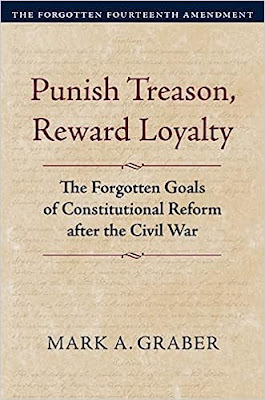
Mark A. Graber, Punish Treason, Reward Loyalty: The Forgotten Goals of Constitutional Reform after the Civil War (University of Kansas Press, 2023)
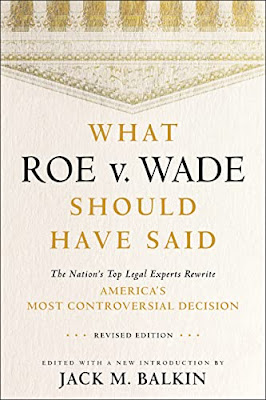
Jack M. Balkin, What Roe v. Wade Should Have Said: The Nation's Top Legal Experts Rewrite America's Most Controversial Decision - Revised Edition (NYU Press, 2023)

Andrew Koppelman, Burning Down the House: How Libertarian Philosophy Was Corrupted by Delusion and Greed (St. Martin’s Press, 2022)

Gerard N. Magliocca, Washington's Heir: The Life of Justice Bushrod Washington (Oxford University Press, 2022)
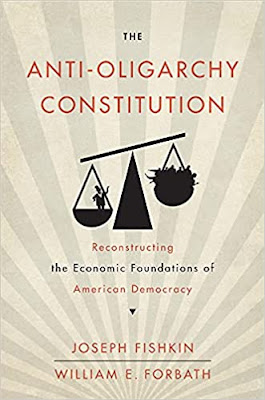
Joseph Fishkin and William E. Forbath, The Anti-Oligarchy Constitution: Reconstructing the Economic Foundations of American Democracy (Harvard University Press, 2022)
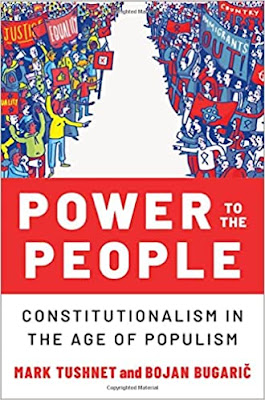
Mark Tushnet and Bojan Bugaric, Power to the People: Constitutionalism in the Age of Populism (Oxford University Press 2021).

Mark Philip Bradley and Mary L. Dudziak, eds., Making the Forever War: Marilyn B. Young on the Culture and Politics of American Militarism Culture and Politics in the Cold War and Beyond (University of Massachusetts Press, 2021).

Jack M. Balkin, What Obergefell v. Hodges Should Have Said: The Nation's Top Legal Experts Rewrite America's Same-Sex Marriage Decision (Yale University Press, 2020)

Frank Pasquale, New Laws of Robotics: Defending Human Expertise in the Age of AI (Belknap Press, 2020)

Jack M. Balkin, The Cycles of Constitutional Time (Oxford University Press, 2020)

Mark Tushnet, Taking Back the Constitution: Activist Judges and the Next Age of American Law (Yale University Press 2020).

Andrew Koppelman, Gay Rights vs. Religious Liberty?: The Unnecessary Conflict (Oxford University Press, 2020)

Ezekiel J Emanuel and Abbe R. Gluck, The Trillion Dollar Revolution: How the Affordable Care Act Transformed Politics, Law, and Health Care in America (PublicAffairs, 2020)

Linda C. McClain, Who's the Bigot?: Learning from Conflicts over Marriage and Civil Rights Law (Oxford University Press, 2020)
Sanford Levinson and Jack M. Balkin, Democracy and Dysfunction (University of Chicago Press, 2019)

Sanford Levinson, Written in Stone: Public Monuments in Changing Societies (Duke University Press 2018)

Mark A. Graber, Sanford Levinson, and Mark Tushnet, eds., Constitutional Democracy in Crisis? (Oxford University Press 2018)

Gerard Magliocca, The Heart of the Constitution: How the Bill of Rights became the Bill of Rights (Oxford University Press, 2018)

Cynthia Levinson and Sanford Levinson, Fault Lines in the Constitution: The Framers, Their Fights, and the Flaws that Affect Us Today (Peachtree Publishers, 2017)

Brian Z. Tamanaha, A Realistic Theory of Law (Cambridge University Press 2017)

Sanford Levinson, Nullification and Secession in Modern Constitutional Thought (University Press of Kansas 2016)

Sanford Levinson, An Argument Open to All: Reading The Federalist in the 21st Century (Yale University Press 2015)

Stephen M. Griffin, Broken Trust: Dysfunctional Government and Constitutional Reform (University Press of Kansas, 2015)

Frank Pasquale, The Black Box Society: The Secret Algorithms That Control Money and Information (Harvard University Press, 2015)

Bruce Ackerman, We the People, Volume 3: The Civil Rights Revolution (Harvard University Press, 2014)
Balkinization Symposium on We the People, Volume 3: The Civil Rights Revolution

Joseph Fishkin, Bottlenecks: A New Theory of Equal Opportunity (Oxford University Press, 2014)

Mark A. Graber, A New Introduction to American Constitutionalism (Oxford University Press, 2013)

John Mikhail, Elements of Moral Cognition: Rawls' Linguistic Analogy and the Cognitive Science of Moral and Legal Judgment (Cambridge University Press, 2013)

Gerard N. Magliocca, American Founding Son: John Bingham and the Invention of the Fourteenth Amendment (New York University Press, 2013)

Stephen M. Griffin, Long Wars and the Constitution (Harvard University Press, 2013)

Andrew Koppelman, The Tough Luck Constitution and the Assault on Health Care Reform (Oxford University Press, 2013)

James E. Fleming and Linda C. McClain, Ordered Liberty: Rights, Responsibilities, and Virtues (Harvard University Press, 2013)
Balkinization Symposium on Ordered Liberty: Rights, Responsibilities, and Virtues

Andrew Koppelman, Defending American Religious Neutrality (Harvard University Press, 2013)

Brian Z. Tamanaha, Failing Law Schools (University of Chicago Press, 2012)

Sanford Levinson, Framed: America's 51 Constitutions and the Crisis of Governance (Oxford University Press, 2012)

Linda C. McClain and Joanna L. Grossman, Gender Equality: Dimensions of Women's Equal Citizenship (Cambridge University Press, 2012)

Mary Dudziak, War Time: An Idea, Its History, Its Consequences (Oxford University Press, 2012)

Jack M. Balkin, Living Originalism (Harvard University Press, 2011)

Jason Mazzone, Copyfraud and Other Abuses of Intellectual Property Law (Stanford University Press, 2011)

Richard W. Garnett and Andrew Koppelman, First Amendment Stories, (Foundation Press 2011)

Jack M. Balkin, Constitutional Redemption: Political Faith in an Unjust World (Harvard University Press, 2011)

Gerard Magliocca, The Tragedy of William Jennings Bryan: Constitutional Law and the Politics of Backlash (Yale University Press, 2011)

Bernard Harcourt, The Illusion of Free Markets: Punishment and the Myth of Natural Order (Harvard University Press, 2010)

Bruce Ackerman, The Decline and Fall of the American Republic (Harvard University Press, 2010)
Balkinization Symposium on The Decline and Fall of the American Republic

Ian Ayres. Carrots and Sticks: Unlock the Power of Incentives to Get Things Done (Bantam Books, 2010)

Mark Tushnet, Why the Constitution Matters (Yale University Press 2010)

Ian Ayres and Barry Nalebuff: Lifecycle Investing: A New, Safe, and Audacious Way to Improve the Performance of Your Retirement Portfolio (Basic Books, 2010)
.jpg)
Jack M. Balkin, The Laws of Change: I Ching and the Philosophy of Life (2d Edition, Sybil Creek Press 2009)

Brian Z. Tamanaha, Beyond the Formalist-Realist Divide: The Role of Politics in Judging (Princeton University Press 2009)
Andrew Koppelman and Tobias Barrington Wolff, A Right to Discriminate?: How the Case of Boy Scouts of America v. James Dale Warped the Law of Free Association (Yale University Press 2009)

Jack M. Balkin and Reva B. Siegel, The Constitution in 2020 (Oxford University Press 2009)

Heather K. Gerken, The Democracy Index: Why Our Election System Is Failing and How to Fix It (Princeton University Press 2009)

Mary Dudziak, Exporting American Dreams: Thurgood Marshall's African Journey (Oxford University Press 2008)

David Luban, Legal Ethics and Human Dignity (Cambridge Univ. Press 2007)

Ian Ayres, Super Crunchers: Why Thinking-By-Numbers is the New Way to be Smart (Bantam 2007)

Jack M. Balkin, James Grimmelmann, Eddan Katz, Nimrod Kozlovski, Shlomit Wagman and Tal Zarsky, eds., Cybercrime: Digital Cops in a Networked Environment (N.Y.U. Press 2007)

Jack M. Balkin and Beth Simone Noveck, The State of Play: Law, Games, and Virtual Worlds (N.Y.U. Press 2006)

Andrew Koppelman, Same Sex, Different States: When Same-Sex Marriages Cross State Lines (Yale University Press 2006)

Brian Tamanaha, Law as a Means to an End (Cambridge University Press 2006)

Sanford Levinson, Our Undemocratic Constitution (Oxford University Press 2006)

Mark Graber, Dred Scott and the Problem of Constitutional Evil (Cambridge University Press 2006)

Jack M. Balkin, ed., What Roe v. Wade Should Have Said (N.Y.U. Press 2005)

Sanford Levinson, ed., Torture: A Collection (Oxford University Press 2004)
Balkin.com homepage
Bibliography
Conlaw.net
Cultural Software
Writings
Opeds
The Information Society Project
BrownvBoard.com
Useful Links
Syllabi and Exams
