Balkinization
an unanticipated consequence of
Jack M. Balkin
Balkinization Symposiums: A Continuing List
E-mail:
Jack Balkin:
jackbalkin at yahoo.com
Bruce Ackerman
bruce.ackerman at yale.edu
Ian Ayres
ian.ayres at yale.edu
Corey Brettschneider
corey_brettschneider at brown.edu
Mary Dudziak
mary.l.dudziak at emory.edu
Joey Fishkin
joey.fishkin at gmail.com
Heather Gerken heather.gerken at yale.edu
Abbe Gluck abbe.gluck at yale.edu
Mark Graber
mgraber at law.umaryland.edu
Stephen Griffin
sgriffin at tulane.edu
Jonathan Hafetz
jonathan.hafetz at shu.edu
Jeremy Kessler
jkessler at law.columbia.edu
Andrew Koppelman
akoppelman at law.northwestern.edu
Marty Lederman
msl46 at law.georgetown.edu
Sanford Levinson
slevinson at law.utexas.edu
David Luban
david.luban at gmail.com
Gerard Magliocca
gmaglioc at iupui.edu
Jason Mazzone
mazzonej at illinois.edu
Linda McClain
lmcclain at bu.edu
John Mikhail
mikhail at law.georgetown.edu
Frank Pasquale
pasquale.frank at gmail.com
Nate Persily
npersily at gmail.com
Michael Stokes Paulsen
michaelstokespaulsen at gmail.com
Deborah Pearlstein
dpearlst at yu.edu
Rick Pildes
rick.pildes at nyu.edu
David Pozen
dpozen at law.columbia.edu
Richard Primus
raprimus at umich.edu
K. Sabeel Rahmansabeel.rahman at brooklaw.edu
Alice Ristroph
alice.ristroph at shu.edu
Neil Siegel
siegel at law.duke.edu
David Super
david.super at law.georgetown.edu
Brian Tamanaha
btamanaha at wulaw.wustl.edu
Nelson Tebbe
nelson.tebbe at brooklaw.edu
Mark Tushnet
mtushnet at law.harvard.edu
Adam Winkler
winkler at ucla.edu
Compendium of posts on Hobby Lobby and related cases
The Anti-Torture Memos: Balkinization Posts on Torture, Interrogation, Detention, War Powers, and OLC
The Anti-Torture Memos (arranged by topic)
Recent Posts
Extreme Treatment Is Not “An Outrage Upon Personal Dignity” If We Urgently Need the Information (More Deceptive Legal Reasoning from the DoJ)
Charles Tilly
Senate Judiciary Hearing on Secret Law
What Does the Web Mean for Newspapers?
More on Puerto Rico's contribution to the Iraqi War and on participation in the national electoral process
Puerto Rico and the d(D)emocratic process
Facial ID's, Facial Challenges and In Your Face Politics
Solum on Semantic Originalism
Phony originalism and the Establishment Clause
The DOJ's trojan horse of "universal condemnation"
The Sad Decline of the Michigan Law Review's Books Issue
A Million People Sentenced to Madness?
Charles Taylor's neutrality
Selective Funding of Abortions For Racist Reasons
A Snapshot of Race in America
Affirmative Action Abortions
torture and "obliteration"
As we prepare to elect our next constitutional dictator
The Torture Papers
"The Underdeveloped Jurisprudence of the Forcing/Pouring Distinction"
Leiter on John Yoo
Why I'd Stick With Yale Clerks-- Some Econometric Ruminations
![[Powered by Blogger]](https://lh3.googleusercontent.com/blogger_img_proxy/AEn0k_taCDOqR5AwY6RJdXBAmGnvA9QGcNaaSjw11Hc4ehJjT29FvvDHaPrKnVn6cLrLCBoJ801FVXs16tPZtQn67278uhR7-ksKgD-4HnYQjJlg=s0-d)
Just A Few Blogs
ACS Blog
Alas, a Blog
Althouse
Arts and Letters Daily
Atrios (Eschaton)
Bill of Health
Buzzflash.com
Buzz Machine
Cato at Liberty
Juan Cole (Informed Comment)
Concurring Opinions
The Constitution in 2020
Corrente
Crooked Timber
Daily Howler
Daily Kos
Dana Boyd
Brad DeLong
Digby (Hullabaloo)
Discriminations
Daniel Drezner
Kevin Drum (Mother Jones)
Electrolite
En Banc
Eunomia (Daniel Larison)
Fafblog
Michael Froomkin (Discourse.net)
GovLab (Beth Noveck)
Rick Hasen (Election Law)
History News Network
How Appealing
Ignatz (Sam Heldman)
The Importance of (Ernie Miller)
Infolaw
Instapundit
International Economic Law and Policy Blog
IntLawGrrls
Jacob Levy
Jesus' General
Jurisdynamics
The Kitchen Cabinet
Mark Kleiman
Law Blog Central
Larry Lessig
Lawyers, Guns and Money
Liberal Oasis
Brian Leiter's Law School Reports
The Leiter Reports
Marginal Revolution
Megan McArdle
Memeorandum
Metafilter
Mirror of Justice
The New Republic
Newseum
No More Mister Nice Blog
Brendan Nyhan
Opinio Juris
Orcinus
The Originalism Blog
Pandagon
Passport (Foreign Policy)
Overcoming Bias
Political Animal (Washington Monthly)
Political Theory Daily Review
Political Wire (Taegan Goddard)
The Poor Man
Virginia Postrel
Prawfsblawg
Public Reason
Jonathan Rauch
Raw Story
Redstate
ReligiousLeftLaw.com
Reporters Committee For Freedom of the Press
Reproductive Rights Blog
Rothman's Roadmap to the Right of Publicity
SCOTUS Blog
Seeing the Forest
Clay Shirky
The Shifted Librarian
The Situationist
Larry Solum (Legal Theory)
Andrew Sullivan
Talking Points Memo
Talk Left
Tapped
Tbogg
TechPresident
The Paper Chase (Jurist)
Tom Paine
Tom Tomorrow (This Modern World)
Eve Tushnet
Uggabugga
University of Chicago Law School Faculty Blog
Unqualified Offerings
The Volokh Conspiracy
War and Piece (Laura Rozen)
Wampum
Oliver Willis
Wonkette
Written Description
Matthew Yglesias
Yin
Your Choice of Feeds
1. XML
powered by

2. Atom Feed
3. RSS 2.0
Extreme Treatment Is Not “An Outrage Upon Personal Dignity” If We Urgently Need the Information (More Deceptive Legal Reasoning from the DoJ)
Brian Tamanaha
Once again, the Bush Administration and the Justice Department have argued that whether an interrogation technique violates the Geneva Convention (as an “outrage upon personal dignity”) depends upon how badly we need the information (by our own assessment). The New York Times quotes the pertinent assertion:“The fact that an act is undertaken to prevent a threatened terrorist attack, rather than for the purposes of humiliation or abuse, would be relevant to a reasonable observer in measuring the outrageousness of the act,” said Brian A. Benczkowski, a deputy assistant attorney general, in the letter, which had not previously been made public.”
Benczkowski’s recent letter (thanks to How Appealing for the links) was the latest response in an exchange with Senator Ron Wyden, who has valiantly tried to pin down the Administration’s position on this question: “Are there instances in which the identity of a detainee, or the type of information that the detainee is assessed to possess, can help determine what sort of treatment would be considered human?”
The short answer Benczkowski gives (after much maneuvering) is “Yes” and “No.” (His most elaborate discussion, analyzed in this post, is here). The “No” part is that, regardless of the justification, the interrogators may not engage in “forcing an individual to perform sexual acts, threatening an individual with sexual mutilation, or using an individual as a human shield.” (set forth in Executive Order 13440). These are per se violations. They are described as “illustrations” of strictly prohibited actions, suggesting that more techniques might fall in this “No” category, but the real effect of this language is to leave everything else on the table.
Beyond those examples, the answer is “Yes”--the (perceived) need for the information is a factor in determining whether the interrogation technique is an “outrage upon the personal dignity” of the victim.
Accordingly, it might not be an “outrage upon the personal dignity” of a prisoner—for example, subjected to extreme cold, extreme periods of standing, or water boarding—when we have an urgent need for the information, while those same actions might well be a violation if we don’t have an urgent need for the information.
What’s odd about this is that the provision protects the “personal dignity” of victims, and from the victim’s standpoint the violation is not reduced by the felt urgency of the violator (not to mention that interrogators and their higher-ups will always feel, or at least claim, such urgency when resorting to extreme measures).
So how does the question get flipped around in this way? Here’s where Benczkowski’s argument gets desperate, and deceptive.
The desperate part is that Benczkowski’s only support for his argument on this point comes out of a 1999 trial court opinion issued in an obscure case, Prosecutor v. Aleksovski, by the International Criminal Tribunal for Yugoslavia.
A good rule of thumb is that any lawyer who cites an obscure trial court opinion is really stretching to find some supportive authority. That rule is softened here because Common Article 3 of the Geneva Convention has not been interpreted many times, but there are other interpretations of this provision (cited in the court’s opinion).
A second rule of thumb is that when you see citations to an obscure trial court opinion, you had better go read it because chances are the (desperate) lawyer lifted the language from the opinion in a way that twisted what the court said. (It can be found on the ICTY website).
That’s precisely what Mr. Benczkowski did.
He cites the case for this pivotal proposition: “To rise to the level of an outrage, the conduct must be ‘animated by contempt for the human dignity of another person’ and it must be so deplorable that the reasonable observer would recognize it as something that should be universally condemned.” (citing Sections 55-57 of opinion) And he relies upon the case for this additional point: Common Article 3 reflects “the common sense notion that a reasonable observer, in determining whether conduct should be deemed outrageous and particularly revolting, would take into account the circumstances surrounding the conduct, including what justifications might exist.” (citing Section 53.)
Purportedly relying upon the court’s opinion, Benczkowski thus established two crucial standards in determining whether the conduct is an “outrage upon personal dignity.” The first standard is that issue must be decided from the perspective of a “reasonable observer.” The second standard is that when asking this question one must consider “all the circumstances of the case” (including justifications for the action).
Benczkowski distorted what the court held on both points.
1. Benczkowski was right that the court imposed an “objective” “reasonable person” test, but it did not operate the way he claims.
There is a subjective component to this violation which requires that the victim actually feel humiliated. The court worried that extra-sensitive individuals might feel such humiliation for relatively minor conduct, which would not be fair to the accused. The court was concerned that “culpability would depend not upon the gravity of the act but wholly on the sensitivity of the victim.” So the court added this as a check: “an objective component to the actus reus is apposite: the humiliation of the victim must be so intense that the reasonable person would be outraged.” (Section 56).
The difference is subtle, but important. The test the Court formulated specifically looks at the humiliation of the victim to ask whether a reasonable person under those circumstances would be outraged—another way of formulating this is whether “a reasonable victim subjected to that conduct would have been outraged.”
But the test Benczkowski comes up with turns away from the victim entirely, and forgets about the humiliation. Instead, he focuses exclusively on the conduct, and escalates the test to this (extremely high standard): the conduct must be “so deplorable that the reasonable observer would recognize it as something that should be universally condemned.”
Although Benczkowski cites the Court for this proposition (he drops the quote marks when he injects his own special heightened test, but cites the Court at the end), the opinion says nothing even remotely close to this--with no mention of “universally condemned”. Benczkowski might have been confused about how to formulate the "reasonable person" standard (it is a bit tricky), but there is no question that he deliberately altered what the court required to state a much higher standard.
His treatment of the second standard is even more deceptive.
2. Benczkowski is right that a judgment about the “degrading” nature of the treatment must take into consideration “all the circumstances of the case.” This is the key point in his argument. He asserts that the “reasonable observer…would take into account the circumstances surrounding the conduct, including what justifications might exist.” That final clause--what justifications might exist--is what makes the (claimed) urgent need for the information a relevant factor in evaluating the conduct.
Benczkowski cites Section 53 of the Court’s opinion for this proposition. Here is the entire paragraph 53, so judge for yourself: It is also instructive to recount the general definition of the term “inhuman treatment” propounded by the ECHR, which to date is the only human rights monitoring body that defined the term: “ill-treatment must attain a minimum level of severity if it is to fall within the scope of Article 3 (ECHR). The assessment of this minimum is, in the nature of things, relative: it depends upon all the circumstances of the case, such as the duration of the treatment, its physical or mental effects and, in some cases, the sex, age, and state of the heath of the victim, etc.” The test offered by this definition is the level of suffering endured by the victim.
The court makes it absolutely clear that the phrase “all the circumstances” relates entirely to (and is bounded by) the “level of suffering endured by the victim.”
For Benczkowski to claim that this language in any way includes consideration of “what justifications might exist” for the ill-treatment is an outrageous distortion.
It is disgraceful that Justice Department lawyers would supply such deceptive legal analysis to a Senator.
The bottom line: whether an act is “torture” or an “outrage on personal dignity” has nothing to do with (is not in the least diminished by) how urgently we feel we need the information.
Posted
2:11 PM
by Brian Tamanaha [link]
(21) comments
Charles Tilly
Mary L. Dudziak

Tilly was just awarded the Albert Hirschman Prize from the Social Science Research Council. An interview with Tilly is here. Johann Peter Murmann's blog provides a guide to Tilly's writing about methodology and many links including one to the article How (and What) Are Historians Doing?
Cross-posted from the Legal History Blog.
Posted
10:28 AM
by Mary L. Dudziak [link]
(2) comments
Senate Judiciary Hearing on Secret Law
Marty Lederman
It's very interesting, and occurring now. Details, (eventually) testimony, and a link to the webcast here.
Posted
9:15 AM
by Marty Lederman [link]
(20) comments
What Does the Web Mean for Newspapers?
Neil Netanel
JB has graciously invited me to try my hand at blogging on information society issues. His invitation to blog follows on the publication of my book, Copyright's Paradox. So like many of you, I enter the blogosphere to discuss, elucidate, and (let's be honest) promote work produced in that venerable paradigm of old media, a hardcover book.
The interplay of digital and old media is a central theme of Copyright's Paradox. Copyright law serves as the field of major battles between digital and traditional media. In those copyright battles, Google is both a prime deep-pocket target of the old and able defender of the new. Newspapers have sued the multi-billion dollar upstart over Google News, book publishers have sued over Google Book Search, movie studios over Google’s YouTube, and, yes, adult magazines over Google Image Search. The outcomes will profoundly impact the shape of the media, how we receive and impart information, news, and opinion, and what types of speech are most salient to the public. Depending on how copyright law is configured, the new media may supplant the old or the traditional incumbents may stifle the new. Copyright is thus no less a part of national media and information policy than are the Telecommunications Act and the First Amendment.
I will expand upon copyright's role in a later post. Here I want to focus on newspapers and ask whether we should care about their demise. In a recent article in The New Yorker, Eric Alterman surveys the evidence and concludes that "it no longer requires a dystopic imagination to wonder who will have the dubious distinction of publishing America's last genuine newspaper." As he demonstrates, a primary cause for newspapers' rapid decline in advertising, readers, market value, and, indeed, sense of mission is the Internet.
The Internet makes the daily newspaper look slow and unresponsive. Young people in particular (only 19 percent of Americans under 34 even claim to look at a daily newspaper) prefer to surf the Web and log in to social network sites for up-to-date, easily digestible news bites. Even aside from lost readership, the Internet erodes newspaper advertising revenue. Craigslist has wiped out classified advertising. Online news aggregators, like Google News, usurp much other advertising. And for newspapers, moving online is no panacea; newspaper Web sites benefit from the growth of online advertising, but not nearly enough to replace revenue losses from circulation and print ads. Madison, Wisconsin's The Capital Times is but the first big city daily to abandon printing and move entirely online. That move is unlikely to stave off extinction.
Not all bemoan newspapers' demise. Many news bloggers and other self-styled online journalists trumpet their superiority over the mass media. Arianna Huffington, co-founder of the Huffington Post "Internet Newspaper," has been particularly relentless in attacking the mainstream news media for its lackluster reporting and prolonged servile acceptance of the Bush Administration's invasion of Iraq and domestic war on terror. And in his seminal book, The Wealth of Networks, Yochai Benkler argues that peer reporting from a multitude of online speakers does better than traditional news media both at bringing information and opinion to the fore and engendering an activist, autonomous citizenry.
Peer reporting and opinion no doubt form an invaluable component of public discourse, both in and of themselves and for calling traditional news media to brook for its failings. But blogs do not and cannot substitute for institutional news media in performing the still vital Fourth Estate function. As studies show, the blogosphere is largely parasitic on media coverage. Blogs from the Huffington Post on down engage in little original reporting and link to stories from the mainstream press far more than to other blogs. Online opinion also appears to be highly fractured and balkanized (with a lower case "b"). Conservative and liberal bloggers, for example, rarely link to blogs across the political divide–and even when they do, views from opposing camps can generally be found only by following a link; unlike newspaper op-eds and letters to the editor, they are not interspersed side by side. Bloggers also lack the financial resources for investigative reporting and fact-checking that mass media enjoy. Nor do they have the institutional commitment to accuracy. Indeed, stories have already surfaced of political and corporate operatives putting bloggers on their payroll or even masquerading as nonpartisan, objective bloggers themselves (present company excepted, of course!!).
Whatever their many foibles, in short, newspapers (or their online equivalent) are worth saving -- not at the expense of peer reporting but as cornerstones of investigative reporting, representing public opinion, and providing an exchange of view, on which democratic governance depends. How copyright law might enter into that equation, I save for a later post.
Posted
1:46 PM
by Neil Netanel [link]
(9) comments
More on Puerto Rico's contribution to the Iraqi War and on participation in the national electoral process
Sandy Levinson
I note for the record first that the International Herald Tribune lists "only" 33 deaths "from" Puerto Rico , which be accounted for by differentiating enlistees directly from the island, as against ethnic Puerto Ricans from New York or New Jersey, for example. Secondly, an interesting story in last year's Washington Post, on resistance to military recruiting in Puerto Rican schools, notes that In the 2003-06 period, 4,947 Puerto Rican men and women enlisted in the Army or Reserves, or approximately 123 people per 100,000 residents, according to Pentagon data. That is below the average contribution of U.S. states, and far below the numbers in states such as Alabama, Kansas, Montana, and Oklahoma, each of which enlists more than 200 men and women per 100,000, according to Army data."
I am curious whether those readers who believe it is just fine for Puerto Rico to be shut out of participation in our national political system (perhaps because, after all, a majority of Puerto Ricans have not yet indicated a preference for statehood and the considerably higher tax burden that would accompany statehood) are critical as of Senators Obama and Clinton for not having the integrity to denounce the award of 53 delegates to the Democratic convention (and Senator McCain for not denouncing the presence of 23 Puerto Rican delegates at the Republican convention)? Or is there a plausible theory--perhaps based on the notion that political parties are merely "private associations"--that justifies giving Puerto Rico these delegates but no participation at all in the final election?
I assume that any arguments about the participation rights of American citizens living in Puerto Rico, would also extend to Guam, with its nine delegates, American Samoa, and the Virgin Islands, also with nine delegates. There's also the interesting matter of the eleven delegates representing "Americans abroad," who may or may not have retained residency in American states and thus be entitled to cast absentee ballots. On the Republican side, American Samoa, Guam, the Virgin Islands, and the Northern Marianas each gets nine delegates. (I can find no evidence that the Democratic Party will be seating any delegates from the Northern Marianas. What does the Republican Party know that the Democratic Party does not? It is not, for example, that Northern Marianans are not US citizens, because they are. )
Posted
6:30 PM
by Sandy Levinson [link]
(13) comments
Puerto Rico and the d(D)emocratic process
Sandy Levinson
In an earlier post, I noted the possibility that Clinton and Obama might be paying visits to Puerto Rico. That now seems almost certain, given the closeness of the race and the fact that Puerto Rico has 53 delegates at the Democratic convention, only four less than Iowa's and 23 more than New Hampshire's (to mention only the two most notorious states in the primary process). For reasons given in that post, I'm actually quite pleased that the two candidates will be forced to offer some cogent comments about the world's largest remaining colony.
An enduring issue within American constitutional law involves the juristic location of Puerto Rico. Is it really part of the United States (like, say, Hawaii, far more distant from the US mainland than Puerto Rico), or is simply a "possession" of the US, with no right to participate in the nation's decisionmaking process? University of Virginia political scientist LarrySabato (who also, incidentally, believes that we need a new constitutional convention to correct the deficiencies of the existing Constitution, but I digress....) has written a column mentioning this point for the BBC, which includes the following: An ancillary issue is whether the U.S. territories, none of which has electoral college votes in November, should even be included in the party nominating system.
In an extremely close race, their delegates could decide the outcome of a presidential nomination, and potentially the Presidency itself. Should Puerto Rico, voting on 1 June, have more delegates than half the American states, as the Democrats have assigned?
Neither Clinton nor Obama will raise this concern, of course, but unbiased observers ought to do so. In most conventions, the territorial votes are a harmless matter, but every now and then, the unintended consequences of their inclusion could become enormous.
This is, of course, an extremely controversial, as well as interesting, issue. What he is suggesting, basically, is that Puerto Rican participation, like DC's electoral vote or, to take a closer example, student representation on faculty appointments committees or university boards of trustees, is really intended to be only "symbolic," not actually having any operative importance. (This obviously turned out almost to be not true in 2000, but, thanks to the Supreme Court, DC's 3 electoral votes turned out to be, as no doubt intended, irrelevant.) At no point in the past has anyone really had to be concerned with Puerto Rico's views re the parties' nominees. This will certainly be the case with Puerto Rico's 14 delegates to the Republican convention. One can be absolutely confident that straight-talking John McCain will say absolutely nothing interesting about the future of the world's largest remaining colony, since he has no incentive to do so. And, of course, this will be true in the final election, when Puerto Rico will return to the shadows of American politics. To take up Prof. Sabato's criticism is, I believe, to say that Puerto Rico should indeed remain only in the shadows. But the American president, whoever he or she turns out to be, will, for better and for worse, be Puerto Rico's president as well. As of October 15, 2007, "an estimated 68 Puerto Ricans have given their lives for Bush’s war against terror." That is only one reason that they are every bit as entitled as anyone living in one of the states to have views on who should occupy that office.
Posted
5:40 PM
by Sandy Levinson [link]
(8) comments
Facial ID's, Facial Challenges and In Your Face Politics
JB
In Crawford v. Marion County Election Board, the Supreme Court continues a trend of using the technical doctrines of facial challenges to swat away constitutional litigation and drive questions back to the political process. Whether you think that is a good or a bad thing depends on your view of whether the Indiana legislature was essentially limiting access to the ballot to certain classes of voters in order to help the Republican Party stay in power. If you think that the political process will take care of enfranchising these voters, you need not worry too much about the result. If, on the other hand, you think that the political process is being used to build in advantages for one party over another, there is greater reason to be concerned.
As Justice Stevens' plurality opinion points out, all of the Republicans in the Indiana General Assembly supported the bill, while all of the Democrats opposed it. That degree of polarization speaks volumes about the purposes behind the legislation, but the real question is what message you (or the Court) wants to hear. One of the most famous ideas in constitutional law is the idea taken from the Carolene Products decision: courts should closely scrutinize laws when government officials try to skew the rules of political competition to keep their party in power. It's hard to get better evidence of a concerted attempt to fix the voting rules on behalf of a particular party than in this case. I guess we would need a speech on the floor by the majority leader saying "This is designed to screw voters most likely to vote Democrat and throw us out of office." Indeed, even if there was such a speech, it's not clear that it would make a difference to the plurality's new rule. The rule of the case, apparently, is that there are no returns for a Carolene Products defect.
But of course, all this makes perfect sense if you think that the courts should generally stay out of voting rights litigation. That would explain why the Court has not been willing to review partisan gerrymanders. But it would not explain the Court's decision to strike down the poll tax, which was used for years to keep particular groups in power. And the real elephant in the room is Bush v. Gore, where five justices were clearly quite concerned that Florida's tabulation rules might be manipulated to help one party over another. (In that case, of course, the party benefited was the Democrats, and the Justices in the majority were conservative Republicans. Do we sense a pattern here?).
Like Carhart II, which upheld the federal partial-birth abortion ban against a facial challenge, Crawford leaves open an as-applied challenge by persons whose rights are inhibited by Indiana's voter ID rule; however such challenges will be expensive and difficult to raise in practice. (It's worth noting that the lineup of Justices in Carhart and Crawford is the same with the exception of Justice Stevens.). I tend to agree with Rick Hasen that Crawford gives a fairly strong signal to states that they can pass strongly partisan electoral regulation laws and the Court will look the other way if there is a fig leaf of a public minded purpose, substantiated by only the flimsiest of evidence. Marty points out that evidence of in-person voter fraud is pretty flimsy indeed.
And that brings up another interesting parallel between Crawford and Carhart II. In Carhart II, Justice Kennedy acknowledged that there were "no reliable data" to support the argument that women would be suffer mental or physical harm by agreeing to a partial birth abortion (as opposed to another method of abortion). Nevertheless, relying on Sandra Cano's amicus brief he assumed that some women would later regret their choices to have an abortion (not just partial birth abortions), and so he upheld the ban on partial birth abortions to keep women from making the wrong choice. In Crawford, Justice Stevens acknowledged that "[t]he record contains no evidence of any such fraud actually occurring in Indiana at any time in its history. Moreover, petitioners argue that provisions of the Indiana Criminal Code punishing such conduct as a felony provide adequate protection against the risk that such conduct will occur in the future." And yet based on two anecdotes, one from the 1800's, he upholds the statute.
Taking Crawford and Carhart together, we may conclude that these days you don't really need any empirical evidence to uphold limitations on constitutional rights against a facial challenge. All you need is truthiness. Don't get me wrong. Constitutional law has a place for truthiness. It may be all you need when legislatures only need to provide a rational basis for their actions. You can just make up stuff and the courts will defer to your stories. The question in this case, however, is whether Indiana's regulation of the right to vote should be judged by so lax a standard.
Posted
3:55 PM
by JB [link]
(51) comments
Solum on Semantic Originalism
Stephen Griffin
This is a somewhat lengthy post on Larry Solum’s massive intervention into the ongoing debates over originalism. Solum’s long article may prove to be a turning point, although I suspect he faces many hurdles in winning acceptance for his central contention that the foundations of originalism are firmly rooted in a semantic, factual, and non-normative account of the meaning of the Constitution. Except for the next paragraph, I will not attempt to summarize Solum’s article. A decent summary would probably take up 10-15 law review pages and, after all, this is a blog! I will raise some questions about Solum’s theory of originalism and make some comments, starting with questions I believe he can answer fairly easily and working up to problems I see as more difficult.
In the dance of arguments on originalism, Solum is right to point out that the debate has been almost entirely normative, analyzing the relationship of originalism to constitutional practice. Solum’s theory, in my view only hinted at in work by other scholars (and thus quite original), changes the focus to how meaning is determined as a fact. To put it one way, the Constitution of 1787 was a proposal that communicated a meaningful semantic message. That’s why the participants to the ratification conventions could have serious debates over whether the proposal should be adopted. So Solum’s four theses: (1) Fixation: the semantic content (linguistic meaning) of constitutional provisions is fixed at the time of framing and ratification; (2) Clause meaning: original public meaning provides the semantic content of constitutional provisions (with several important modifications); (3) Contribution: semantic content contributes (is directly relevant to) extant doctrines of constitutional law; (4) Fidelity (a normative claim): we have a defeasible obligation of fidelity to law. While these are Solum’s central theses, there are a number of other very important points and qualifications that I will try to note as relevant to the questions and comments I make below. And obviously I believe everyone interested in constitutional theory should read Solum’s great opus.
1. Solum provides a theory of how the various clauses (provisions) in the Constitution acquire meaning. But why is meaning limited to clauses? Articles might also have meaning, especially in relationship to one another. So some might view the message of Articles I, II, III as saying there should be three co-equal branches of government. And some view the entire Constitution as communicating a meaning best summarized in the Preamble. Is there a reason to limit meaning to clauses?
2. The Constitution is not annotated. Amendments were placed separately (not, as Madison wanted, inside the 1787 document) and do not have clauses that explain how they relate to the 1787 document. How do we synthesize the meaning of later amendments with the original document if their semantic meaning does not tell us how to do this?
3. Solum believes it follows from his theory (the four theses above) that the Supreme Court should link every decision to a constitutional clause. What are we to make of decisions based on general principles of federalism and separation of powers (principles such as respect for state sovereignty and non-aggrandizement)? Are we not able to decide cases invoking such principles simply because the word “federalism” and the phrase “separation of powers” do not literally appear in the Constitution?
4. Can there be disagreement over semantic content? I presume Solum thinks so because he hard-wires a distinction between clear and vague constitutional clauses into his analysis. Some clauses have clear semantic content such as the one limiting each state to two senators (and that’s not the baseball team!). Others, including most of those involved in litigation, are vague. He draws a further distinction between interpretation and construction. Interpretation determines meaning for non-vague clauses and construction does the same for vague clauses (relying on adoption context to determine meaning). But can there be disagreement over whether a clause is vague or not? Some framers might have believed the enumerated powers and the necessary and proper clause were not vague. I understand that vagueness for Solum is a matter of stipulation. But I wonder how far this can take us in understanding the Constitution if we start stipulating clauses as vague that the framers thought were clear and vice-versa. Also, I understand that the meaning of “interpretation” and “construction” are stipulated, but I don’t think they match practice. Whether this is a problem is hard to say, how construction works remains to be worked out.
5. Solum identifies Dworkin’s theory of constitutional interpretation as a competitor to his own. But I didn’t find one of Dworkin’s most famous claims clearly addressed. This is the idea that the abstract provisions of the Constitution, such as the equal protection clause, are not vague because they directly invoke important concepts of political morality. I know this idea was developed in greater detail in Chris Eisgruber’s 2001 book, perhaps also in Jim Fleming’s. I would be interested to see Solum’s response to these second-generation Dworkinians, as well as to this characteristic claim of Dworkin’s.
6. When he turns to normative theory, the fidelity thesis, Solum’s comments about interpretive pluralism (the theory I defend in “Rebooting Originalism”) are hard to fathom. Interpretive pluralism was at least partly a consequence of early constitutional interpreters perceiving accurately that the constitution was a unique kind of law, one not reducible to other forms. There were genuine questions of what sort of interpretive principles to bring to bear, questions that have been illuminated by Caleb Nelson and others. Working through these questions was necessary before the Constitution could be implemented routinely in courts of law. In this way, a variety of methods of interpretation contributed to the Constitution’s status as a rule of law and thus to the stability of American law as a whole.
7. Solum wants judicial opinions to be transparent and sincere. Here are some crucial points: “Supreme Court Justices have a special obligation to identify the relevant provisions of the Constitution when they write their opinions” (mentioned above). “If the opinion departs from original meaning, it should explain why and offer a justification.” “This means that if the opinion calls for an amending construction of the Constitution (a construction that alters the original public meaning), the opinion should identify the amendment construction, state the inconsistency, and then offer a justification for the departure from original meaning.” (p. 121) I take it as clear that none of these points are supported by current Supreme Court practice. So much the worse for the Court, originalists might say. But because Solum thinks these points follow uncontroversially from fidelity to law (which everyone on some level accepts) should he not be put to inquiry why they are not followed? Perhaps the rule of law is more complex than Solum allows, especially when the Constitution is the rule.
8. One important similarity among the originalist theories offered by Whittington, Barnett, and Solum is that they all end, in one form or another, by discussing the need to amend the Constitution when original meaning runs out. As the quotes above demonstrate, Solum thinks judges should frankly acknowledge when they are amending the Constitution. But suppose there were reasons why we have not typically responded, especially in the twentieth century and since the New Deal, with amendments to ratify fundamental changes in our constitutional order. Suppose those reasons were internal to the Constitution as a rule of law and exposed the more complex and uncertain features of the functioning of our constitutional system. Suppose we started not only from the reality that amendments are off the table as a practical matter but from the insight that this is generally a good thing (see Eisgruber’s 2001 book) or to be regretted but necessary to the new democratic constitutional order founded by the New Deal (see my book!). Then we might have a start on explaining, as I think Solum cannot, some central features of contemporary judicial practice. We would also have a purchase on understanding how ideas of the “living Constitution” became real and credible.
Posted 2:51 PM by Stephen Griffin [link] (5) comments
Phony originalism and the Establishment Clause
Andrew Koppelman
The "originalist" interpretations of the Establishment Clause by Supreme Court Justices William Rehnquist, Antonin Scalia, and Clarence Thomas are remarkably indifferent to the original purposes of that clause. Their arguments are a remarkable congeries of historical error and outright misrepresentation that happen to conveniently coincide with the political needs of the Republican coalition. This is not necessarily a criticism of originalism per se. However, the abuse of originalist scholarship that these judges have practiced raises questions about what originalist scholars are actually accomplishing.
These claims are developed in a new paper, “Phony Originalism and the Establishment Clause,” which I presented last week at a conference on originalism at Northwestern.
I came to the conference with some trepidation, since the conference had a formidable array of originalist scholars who are, for the most part, quite conservative and who I thought were therefore likely to give me a very hard time. (This blog’s fearless leader, Jack Balkin, was also present, carrying the flag of true originalism as always.) Imagine my surprise when the claims went entirely unchallenged. (I should say that the other conference papers were preoccupied with much more abstract questions of constitutional theory than the ones I was engaging with, so the fact that there wasn’t much dispute addressed to my paper may reveal more about the preoccupations of the other people there than the merits of my argument.)
I hadn’t planned on writing the paper until I was invited to the conference, but after thinking about it a bit I realized that I had become persuaded, while doing research focused on other questions, that these judges were producing really bad, result-driven historical arguments, and that nobody had said so with quite the emphasis that they deserved. The paper surveys the claims of each judge and compares those claims with the supporting evidence. The results aren’t pretty.
The “originalism” that one now finds on the Supreme Court is a phony originalism, opportunistically used to advance substantive positions that the judges find congenial. There are originalists who deserve to be taken seriously, but none of them are Supreme Court justices.
The judges’ disingenuousness raises the question what originalist scholars are, objectively, doing. One thing that originalist scholarship will certainly do is stir the pot of constitutional interpretation, turning up new and potentially revolutionary meanings for old provisions. Those new meanings may subsequently be refuted by subsequent scholarship. But those refutations don’t stop the judges from citing this work. The function of all this scholarship in the Supreme Court, then, is somewhat different than its authors intend: “originalist” justices opportunistically use the scholarship to attack areas of the law that they don’t like. Since the conclusions of historical scholarship shift over time, and since the judges are not constrained by the fact that a conclusion reached by some scholar at some time has since been refuted, the consequence is to broaden judicial discretion by presenting judges with a broad array of possible interpretations, each of which have sufficient originalist credentials to qualify for citation in the U.S. Reports.
In his classic work of anticommunist propaganda, Masters of Deceit, then-FBI Director J. Edgar Hoover lists the various types of supporters upon whom the Communist Party relied for its nefarious ends. “The fellow traveler, while not a member, actively supports (travels with) the Party’s program for a period of time.” Fellow travelers are valuable to the party precisely because they are not affiliated with it. “They are more valuable outside: as financial contributors, vocal mouthpieces, or contacts between Party officials and non-communists. They constitute, in fact, fronts for, and defenders of, the Communist Party.” The party also depends on the “dupe,” the person who “unknowingly is under Communist thought control and does the work of the Party.”
Hoover did not want to be too hard on the dupes. Most of them, he wrote, were “loyal, but deceived, citizens.” Most originalist scholars do not mean simply to be shills for the agenda of the Republican Party. They should, however, understand the function they are performing. They are being used.
Posted
2:04 PM
by Andrew Koppelman [link]
(39) comments
The DOJ's trojan horse of "universal condemnation"
Sandy Levinson
The lead story in Sunday's New York Times, on Justice Department letters in effect giving interrogators permission to engage in interrogation practices that are illegal under international (and US?) law includes the following paragraph:In one letter written Sept. 27, 2007, Mr. Benczkowski [a deputy assistant Attorney General] argued that “to rise to the level of an outrage” and thus be prohibited under the Geneva Conventions, conduct “must be so deplorable that the reasonable observer would recognize it as something that should be universally condemned.”
There is, of course, a certain logical paradox here: The very fact that the some US interrogator would suggest that some particular conduct is "reasonable" in some situation would, by definition, mean that there is not "universal" condemnnation of the practice. This is especially true if one accepts the DOJ argument that “The fact that an act is undertaken to prevent a threatened terrorist attack, rather than for the purpose of humiliation or abuse, would be relevant to a reasonable observer in measuring the outrageousness of the act.” Once one allows what might be termed "purity of utilitarian motive" to dominate the analysis, the game is over, for there will always be those who will argue that it is worth doing practically anything to forestall any "terrorist attack."
Indeed, as has been revealed over the past several years, there is no universal consensus on the proposition that torture is forbidden under all circumstances, whatever the UN Convention might say. One could look either to the practices of many of the countries that have signed the UN Convention, including practices of the United States, or look at the arguments made by people ranging from Richard Posner to Michael Walzer (to name only two contributors to the book that I edited). All one can really do is to say that those defending the propriety of torture under some circumstances are wrong in their arguments, and, frankly, the most important arguments on this point, if we'e talking about "condemnation," are moral rather than legal, at least if we're trying to influence public opinion instead of fellow lawyers.
In any event, no one should accept the DOJ "standard" for what counts as "deplorable," since under it (almost) nothing would fail their test. To take it seriously is the equivalent of accepting the Trojan Horse. One should always beware of the Bush Administration offering any "gifts."
Posted
12:58 AM
by Sandy Levinson [link]
(61) comments
The Sad Decline of the Michigan Law Review's Books Issue
Stephen Griffin
I used to look forward to the annual issue of the Michigan Law Review on "Survey of Books Related to the Law." A real service to scholars I thought. No longer. My area of scholarship is constitutional theory and as far as contheory is concerned the attitude of the last few "Books" issues seems to be: we don't care anymore. The list of significant contheory books not reviewed in MLR has become quite long. Indeed, MLR doesn't seem to be trying -- no longer are there sections dedicated to contheory or even conlaw. Consider some of the better contheory books to be published over the last few years:
Jack Balkin, What Roe v. Wade Should Have Said (2005)
Sotirios Barber and James E. Fleming, Constitutional Interpretation: The Basic Questions (2007)
James E. Fleming, Securing Constitutional Democracy (2006)
Mark Graber, Dred Scott and the Problem of Constitutional Evil (2006)
Sanford Levinson, Our Undemocratic Constitution (2006)
Walter F. Murphy, Constitutional Democracy (2006)
Keith E. Whittington, Political Foundations of Judicial Supremacy (2007)
And yes I could go on from here and no I'm not trying just to list contributors to this blog! But it's really a shame. Perhaps the "Books" issue had to cut back on the number of pages, etc., but dissing contheory does not seem to me to be a good way to carry it out.
And what books related to conlaw do they choose to review in the latest (April 2008) issue? Hint: not Jack Goldsmith's The Terror Presidency (2007) or Charlie Savage's Takeover: The Return of the Imperial Presidency (2007). No, the last two issues have featured scholars with the last name "Posner" and the current issue leads with "Yoo."
A sad state of affairs.
Posted
5:02 PM
by Stephen Griffin [link]
(7) comments
A Million People Sentenced to Madness?
David Luban
Salim Hamdan’s lawyers argue that his prolonged isolation in Guantánamo has driven him out of his mind, according to this news story:His defense team says he is suicidal, hears voices, has flashbacks, talks to himself and says the restrictions of Guantánamo "boil his mind."
The government denies it, partly by arguing that terrorists are manipulating their gullible defense lawyers with lies, partly with a little dose of Newspeak: “Guantánamo, a military spokeswoman said, does not have solitary confinement, only ‘single-occupancy cells.’” Well, that’s a relief! And maybe waterboarding is really “extreme surfing.” But then comes an even more amazing argument:
"He will shout at us," said his military defense lawyer, Lt. Cmdr. Brian L. Mizer. "He will bang his fists on the table."
His lawyers have asked a military judge to stop his case until Mr. Hamdan is placed in less restrictive conditions at Guantánamo, saying he cannot get a fair trial if he cannot focus on defending himself. The judge is to hear arguments as soon as Monday on whether he has the power to consider the claim.In response to questions, Cmdr. Pauline A. Storum, the spokeswoman for Guantánamo, asserted that detainees were much healthier psychologically than the population in American prisons. Commander Storum said about 10 percent could be found mentally ill, compared, she said with data showing that more than half of inmates in American correctional institutions had mental health problems.
Hey, what are they complaining about? We've only driven 10% of them insane; in civilian prisons we drive 50% of the inmates insane.
U.S. prisons have 2.3 million inmates - - see Adam Liptak's recent column here. If Cmdr. Storum is right, that means more than a million people driven into madness or near-madness in the grotesquely-named "corrections system." Perhaps a lot of those inmates had some form of mental illness before they went to prison. But even on the wild assumption that half of them did, it still means that our prison system is driving half a million inmates into mental illness. Under any reasonable definition, that should count as one of the world’s major human rights disasters. We would surely call it that if half a million people emerged from prison with tuberculosis that they didn’t have when they entered.
My colleague James Forman has several times remarked that virtually everything wrong with Guantánamo is wrong on a far greater scale in the domestic criminal justice system. That doesn’t mean that outrage about Guantánamo should be any less – but it certainly means that we ought to be equally outraged about a Madness Archipelago that drives hundreds of thousands of inmates insane.
Posted
4:29 PM
by David Luban [link]
(30) comments
Charles Taylor's neutrality
Andrew Koppelman
The distinguished philosopher (and, full disclosure, my Northwestern University colleague) Charles Taylor argues in a recent blog post on “The Immanent Frame” that, in a pluralistic society, “there are zones of a secular state in which the language used has to be neutral.” This is a strange claim, in light of an analysis he has offered elsewhere. Here I’d like to offer an interpretation of how this claim can make sense coming from him, of all people.
In a marvelous and too-little-known essay, Modes of Secularism, in Secularism and Its Critics (Rajeev Bhargava, ed., 1998), Taylor observes that there are three different strategies by which modern political philosophy has tried to cope with religious diversity. One, the “common ground strategy,” seeks to establish political ethics on the basis of premises shared across different confessional allegiances: what all Christians, or even all theists, believe. The difficulty with this approach is that as pluralism grows, the common ground shrinks. The universal sentiments of Christendom aren’t as universal as they once seemed. A second understanding, the “independent political ethic” strategy, seeks to abstract away from all our disagreements to something that is independent of them. The aim is to infer, from certain fundamental preconditions of modern political life, conclusions about how political life should be organized. Pluralism has also created a problem for this approach: we may want to ignore God only for political purposes, but if there are real live atheists in the society, then the state, by endorsing an ethic that is independent of religion, may appear to be taking their side on fundamental issues. The difficulties of both of these approaches, Taylor thinks, create the case for “overlapping consensus,” which does not seek any agreement about foundations, but only acceptance of certain political principles.
Taylor borrows the term “overlapping consensus” from John Rawls, but by it he means something considerably shallower, and therefore less necessarily committed to neutrality toward contested ideas of the good. Taylor thinks that “Rawls still tries to hold on to too much of the older independent ethic.” Rawls expects citizens not only to endorse a set of political principles, but also to accept a doctrine of political constructivism and just terms of cooperation. This, Taylor thinks, is too much to ask. As a schedule of rights, political liberalism for Taylor may suggest an independent political ethic. But any schedule of principles will need interpretation, and interpreters inevitably will do this in light of their comprehensive moral views. To that extent, they will inevitably partake of the common ground strategy.
Taylor’s analysis implies that absolute neutrality is unattainable. Any state position will rely on some common ground, and no common ground is universal.
The answer to this puzzle, I think, is to note that there exist a large variety of possible modes of neutrality. The absolute neutrality toward all conceptions of the good proposed by Ronald Dworkin and Bruce Ackerman are only one available flavor of neutrality.
The range of possible justifications for any version of neutrality is broad. The following is a crude taxonomy of typical strategies of argument. It probably does not exhaust the possibilities, and arguments for neutrality typically rely on more than one of these moves.
One strategy is the argument from moral pluralism, which holds that there are many good ways of life and that the state should not prefer any of these to any other. Another is the argument from futility, which holds that some perfectionist projects are doomed to failure. The argument from incompetence holds that the state should be neutral about things that it is likely to get wrong. The argument from civil peace proposes that some issues be removed from the political agenda in order to avoid destructive controversy. Finally, the argument from dignity argues that some political projects fail to properly respect citizens’ capacity for free choice.
Different formulations of these arguments have persuaded different people. Everyone probably accepts most of these five arguments for neutrality, at least in some form, as applied to some question. Conceptual analysis cannot, of course, say whether or in what form you ought to accept them. There is probably an infinite number of ways in which any of them could be formulated, and an infinite number of ways in which those formulations could be combined. Shifting from any formulation of each rationale to a slightly different one will probably yield a slightly different prescription for neutrality. Neutrality is not a fixed point, but a multidimensional space of possible positions. I develop this argument in an essay, The Fluidity of Neutrality, available here.
This is broadly consistent with the picture Taylor paints. Since obviously many of these argumentative moves toward neutrality are consistent with his claims – his book, A Secular Age, can be read as an extended argument from moral pluralism, here mediating between religiosity and secularism – there is a kind of neutrality appropriate for us. But its outlines are not definite, and will always be an object of negotiation. Taylor’s neutrality is not that of Dworkin and Ackerman. But for just that reason, it is more persuasive than theirs.
Posted
8:17 PM
by Andrew Koppelman [link]
(2) comments
Selective Funding of Abortions For Racist Reasons
JB
Mike Paulsen asks, provocatively, whether if one supports the morality and legality of abortion, one could logically condemn or prohibit private citizens from giving money to pregnant women to have abortions for the specific purpose of reducing the number of black babies (or female babies) that come into the world.But how could it be "genocide" to abort what is not a human life? Is this not a category mistake? Under the cruel "logic" of abortion rights rhetoric, the fetus has no racial identity, because the fetus has no human racial identity. There is therefore nothing wrong with abortion targeted at specific races. The pregnant woman may have a racial identity, but the aborted fetus has none.
. . . .
Abortion-rights supporters dare not admit that the aborted fetus has a racial identity that can be recognized as such or that he or she has a gender identity that can be recognized as such. For that would give away the game.
Mike's first claim is that it is impossible for supporters of abortion rights even to recognize that fetuses will develop into males or females, whites or blacks, because to do so would concede that they are human beings and that abortion is murder.
(By the way, my understanding is that it may be difficult to tell the racial identity of a person just from their DNA if (1) you can't see them and (2) you don't know who their parents are, but I will put that aside for the moment, because I assume that Mike can stipulate that the racial identity of the biological parents is known).
I don't see why there is any puzzle in acknowledging that some fetuses aborted are female and others male, any more than there is a puzzle in acknowledging that some fertilized ova which never implant are female and others male. Indeed, the same is true of frozen embryos in fertility clinics that are never implanted. People speak of the characteristics of such embryos all the time, but this does not commit them to the view that the frozen embryos are living human beings and that disposing of them is murder. (At the same time, the state can restrict who can dispose of frozen embryos-- for example, it can restrict this right to the biological parents.).
No one I know of who supports abortion rights denies that fertilized ova, blastocysts, embryos, and fetuses all have human DNA that codes for/develops as familiar human characteristics. Recognizing this fact does not, by itself concede that fetuses are identical to born infants or that abortion is murder. Nor is there any logical difficulty in acknowledging that a fetus, if carried to term, will be a boy or a girl, white or black.
Mike's second claim, it seems to me, is far more interesting and important. Suppose that some person or group of persons seeks to fund the abortions of poor women because of the likely race of the fetus (based on knowledge of the race of the biological parents) or because the fetus is developing as a female. So, a very rich white man announces publicly that he will pay for the abortion of any black women who wishes to abort her child because he wants to reduce the number of black babies born. Does the logic of abortion rights mean that the state cannot prohibit the funder from offering this deal on these terms, or, what is a different question, that the funder is doing nothing morally wrong in making the offer?
I don't see why the state cannot ban funders with certain bad intentions from making selective offers to pregnant women based on the identity of the child. Surely the state can make it illegal for a private party to give money to a pregnant women to abort a fetus on the basis of the funder's belief (correct or incorrect) that the fetus has a particular racial, religious or gender identity, or likely sexual orientation.
It does not matter that the woman who aborts has very different reasons for seeking the abortion-- for example, that she is emotionally and financially incapable of becoming a mother at this point in her life. We can condemn the funder's action as immoral-- and make them illegal-- even if we think the mother is making a very different and morally difficult decision and is also exercising a constitutional right.
The flaw in Mike's argument, as I see it, is this: selective funding of a third party's constitutional rights does not automatically receive the same degree of constitutional protection (or enjoy the same moral status) as the third party's exercise of those rights. Suppose that a private party offers to perform free sterilizations/vasectomies on blacks but not whites for the express purpose of limiting the number of black babies born in the future. The state may also prohibit this, even if the women and men who would take the money have perfectly good reasons for wanting to choose sterilization or vasectomy, and even if the right to do so is constitutionally protected. The state could well decide that private parties should not be permitted to engage in racial eugenics based on invidious motivations, even if there is a constitutional right for the individuals they fund to choose not to have children.
Nevertheless, behind Mike's hypotheticals is a deeper question: if we don't think that individual decisions to abort are per se immoral, what is morally wrong with private decisions to fund some people's reproductive choices and not others on a potentially massive scale? The answer is that what is morally wrong are certain forms of eugenics. The issues of when forms of genetic engineering are morally permissible are very difficult. However, we do not have to have a general theory of eugenics in order to conclude that it is wrong to engage in private eugenics for the specific purpose of reducing a particular racial group in the population out of a belief in the inferiority or undesirability of that racial group. The same, I would argue, is true of a concerted campaign to limit the births of men or women, gays or straights, or members of religious or ethnic communities. We can condemn such private eugenic campaigns to induce pregnant women to abort as immoral without concluding that all abortions are per se immoral.
Posted
7:41 PM
by JB [link]
(23) comments
A Snapshot of Race in America
Brian Tamanaha
A white man in a serious run for the presidency--Same old story.
A black man in a serious run for the presidency--Once in a lifetime event.
An innocent black man shot and killed by police; police acquitted--Same old story.
An innocent white man shot and killed by police; police acquitted--Once in a lifetime event.
Posted
6:02 PM
by Brian Tamanaha [link]
(6) comments
Affirmative Action Abortions
Michael Stokes Paulsen
An intrepid UCLA law student, acting as a "tester," recently called several Planned Parenthood offices and asked whether he could make a donation specifically to fund the abortion of black babies. The donations were enthusiastically welcomed. The tester's racist remarks -- he posed as someone concerned that there were too many black people, and that he did not want his children competing with them someday, because of affirmative action -- were, in several instances, embraced by the Planned Parenthood veeps and development officers with whom he spoke. One said his views were "understandable, understandable." Another said that her Planned Parenthood office would accept a donation for any reason. Could he specifically endow one race-specific, black abortion? Sure. The officials gave the tester the price and the address to which to send the check.
Unbelievable? You can watch the video / audio on YouTube. (I still haven't figured out how to post the link.) If it's a hoax, I haven't heard yet.
It's not really all that unbelievable when you think about it. The premise of America's legal regime of abortion, under Roe v. Wade, is that the unborn human fetus or embryo is not really human life at all. It's an "it." "It" is a potential human life, a mass of cells possessed of no moral worth and no standing within the human community. They are non-persons. How can it be wrong to kill a non-person, for whatever reason? There is certainly no legal, moral, or rational basis for distinguishing between "black" non-persons and "white" non-persons, is there?
Since none of these human fetuses qualifies as human life (under this view), why should it be thought wrong to wish to financially support the destruction of a particular sub-class of such nothings? Why should it be thought wrong for Planned Parenthood to accept -- or for that matter to solicit -- funds for abortions specifically performed for African-American pregnant women? Indeed, might this not be thought affirmative action of a certain type, assuring the availability of what is (after all) a legal right, financially, to members of minority racial communities?
It is, of course, hardly the case that minorities are underrepresented in abortions. African-American women reportedly are 13% of the child-bearing female population but account for 36% of the abortions. More than 1,400 black babies -- or if you prefer, fetuses -- are aborted each day in America. Since the early 1970s, abortions of black babies has reduced the African-American population in America by about one-third from what it otherwise likely would have been. Some have called this, quite plausibly, racial genocide.
But how could it be "genocide" to abort what is not a human life? Is this not a category mistake? Under the cruel "logic" of abortion rights rhetoric, the fetus has no racial identity, because the fetus has no human racial identity. There is therefore nothing wrong with abortion targeted at specific races. The pregnant woman may have a racial identity, but the aborted fetus has none.
The same of course holds true for what is an increasingly common practice in America: abortion for reasons of sex-selection. Under the logic of Roe v. Wade, and under the mission of Planned Parenthood, there is nothing wrong with abortion of female human fetuses because they are female. Abortion is permitted for any reason or no reason. So, abortion likewise should be permitted on the ground that (in a perverse reversal of a phrase usually uttered in joy) "It's a girl!" Because, it is really just an it.
All of this, of course, is law blinking reality. Of course an aborted black human fetus has a racial identity. Of course an aborted human baby was either male or female -- a boy or a girl. These are simple, unavoidable biological facts. (Aren't they?) Pity the poor human child-in-utero, who has enough biological humanity to have a race, and a sex, but not enough humanity to be treated as a member of the human community!
The tester's questions of Planned Parenthood open a window on the vicious, fictitious logic of legal abortion. Abortion-rights supporters dare not admit that the aborted fetus has a racial identity that can be recognized as such or that he or she has a gender identity that can be recognized as such. For that would give away the game.
Is there any way out of this for abortion defenders? Is there anything they think wrong, morally, with "affirmative action abortion funding"? If so, what exactly makes it wrong?
Posted
4:15 PM
by Michael Stokes Paulsen [link]
(43) comments
torture and "obliteration"
Sandy Levinson
My previous post concerns Hillary Clinton's reminder that the United States could "obliterate" Iran and that she is prepared to order just that--with or without the consent of Congress is manifestly unclear--should Iran attack Israel (though why only Israel--why not threaten obliteration if Iran invades Iraq, or Saudi Arabia, etc.?). I believe that her close-to-glee--she is, after all, trying to portray Obama as a Chablis-drinking wimp who would forbear from picking up his guns--in threatening to "obliterate" millions of innocent Iranis because of the acts of their leaders underscores a certain anomaly in our debates about the conduct of warfare at the present time.
There is a widespread consensus, shared, at least rhetorically, by the Bush Administration itself, that "torture" is forbidden and indefensible. That is precisely why so much of the debate concerns what, precisely, counts as torture. (For the record, let me state that I regard waterboarding, as well as extended sleep deprivation and much else, as torture.) But, of course, there is also the additional debate, sparked by the Yoo memorandum, as to whether the President, under extreme conditions, has the authority to order torture.
But why isn't there more debate, not only among academics but among the general public, about a) the morality of any military strategy that depends on "obliterating" millions of innocent people simply because they have the bad luck to be living in a country run by terrible leaders and b) the propriety of a view of presidential power that makes it possible for an ostensibly serious candidate for our nation's highest office so casually to threaten such obliteration should another country engage in behavior that, though no immediate threat to American security, we deem sufficiently awful? As awful as torture is, it really isn't the most awful thing that regularly occurs in the world, starting with "collateral damage" to innocent civilians as the result of "justified" military attacks, and going onward to the "destruction" that is at the basis of nuclear deterrence strategy (under the rubric "Mutually Assured Destruction").
Deterrence through threats of obliteration has the "virtue" of minimizing risk to our own military personnel. The same logic explains the reliance on bombing by Bill Clinton in the War against Serbia that he initiated without the consent of Congress. No doubt he saved American lives that would have been lost in ground warfare, but at the cost of innocent Serbian lives.
Imagine that Herman Kahn had been a member of the Berkeley faculty who, while working for the Defense Department, advised the construction of a "doomsday machine" that would take the decision to engage in a nuclear response to an attack out of the human decision-making process at all. After all, we might find literally "incredible" the assertion, by Hillary Clinton nor any other decent and non-sociopathic human being, that he/she would be willing to "obliterate" millions or, indeed, threaten the maintenance of human society itself in order to demonstrate adequate political resolve. (During my youth, this was the "better dead than red" debate.) Thus the need for taking the "decision" away from human beings and giving it to an impersonal machine. (For details, see Kahn's classic On Thermonuclear War.) Should he have been threatened with the loss of tenure for offering such advice, or is it, like all deterrence theory, intellectually and morally "acceptable" in a way that countenancing the legitimacy of even one instance of torture under an extreme set of facts is not? (Indeed, Kahn can easily be read to have "advocated" such a machine, as against Yoo's own claims, sincere or not, that he never "advocated" torture but, rather, engaged "only" in good-faith interpretation of notably difficult language given the Senate's "reservation" concerning the definition of torture.)
Also for the record, I am not a pacifist, and I believe that deterrence can be an important aspect of military strategy--thus my willingness, whatever my opposition to many Israeli policies, to accept the propriety of Israel's possessing nuclear weapons and issuing, no doubt sotto voce, credible threats of a willingness to use them if attacked. (This is, frankly, one reason why I'm not so worried about the prospect of Iran's gaining nuclear weapons, because I do believe that Iranian leadership is rational enough not to be attracted by a Gotterdamarung strategy. ) And I think that one of the explanations for the present debate about intelligence-gathering methods is precisely the realization that classic deterrence models don't work when the enemy is not a state with a locatable "address," but, rather, multi-national organizations that may have access to certain kinds of weaponry that in the past was indeed confined to "Westphalian states" that were subject to the rational logic of deterrence. On this, see my colleague Philip Bobbitt's new book Terror and Consent .
It is obviously important to continue to ferret out the Bush Administration's policies on torture. But there are other things we should be talking about as well with regard to America's willingness to kill innocent people as part of one's military tactics or ultimate strategy.
Do we really want as president someone who so casually evokes the "obliteration" of Others (I use the capitalization advisedly) even if, by stipulation, she promises to honor the "absolute" ban on torture (see her letter to the American Freedom Campaign).
Posted
11:32 AM
by Sandy Levinson [link]
(46) comments
As we prepare to elect our next constitutional dictator
Sandy Levinson
Whatever one thinks of the egregious George W. Bush, the powers of the President are not going to diminish in the next administration. None of the candidates, including my personal favorite Barack Obama, has given a serious speech suggesting that the President must recognize a far greater role for Congress in making fundamental decisions of war and peace.
In any event, one should take special note of Hillary Clinton's remarkable statement to ABC News, "I want the Iranians to know that if I'm the president, we will attack Iran. In the next 10 years, during which they might foolishly consider launching an attack on Israel, we would be able to totally obliterate them." This is the statement of someone running for constitutional dictatorship, not for a "republican form of government" presidency who might have said, for example, "as President, I will certainly urge the Congress to declare war on Iran should Iran attack Israel"--though one might wonder exactly why, since the brutal truth is that an attack on Israel, however egregious, would not constitute a serious security threat to the United States (which is why Israel very wisely has constructed its own nuclear deterrent instead of relying on the US and the vagaries of American domestic politics)--"though I recognize that that decision is ultimately for Congress to make."
Unfortunately, Obama, for reasons of domestic politics, cannot offer any criticism of this extraordinary truculent threat, lest he be viewed as soft on Iran or insufficiently supportive of Israel. And McCain, of course, has also exhibited a certain "irrational exuberance" with regard to the prospect of attacking Iran. So I guess it's just the case that in electing our next president/commander-in-chief/constitutional dictator, we are doing exactly what Congress did when passing the egregious "authorization" giving George W. Bush a blank check to go to war in Iraq. I certainly hope that our next p/c-i-c/c-d has the requisite judgment for that exalted office.
Posted
11:18 AM
by Sandy Levinson [link]
(19) comments
The Torture Papers
Marty Lederman
No, not the indispensable volume compiled a few years back by Karen Greenberg and Josh Dratel.
I'm referring to the more than seven thousand pages of documents still hidden within the Executive branch dealing with the CIA's "enhanced interrogation" practices and "black sites" and renditions programs. (This does not even include the DOD materials.) The documents are described in outline here and here (and in the other documents found here), and they include at least eight OLC final opinions and opinion letters in the period between September 2004 and February 2007 alone.
Which is to say: We've barely scratched the surface. And unless the next President chooses to permit a public accounting (quite doubtful, I suspect, since most of these documents are classified and the CIA will be very reluctant to declassify them), the burden will likely fall on historians many decades from now to reconstruct the full story of how the United States came to bless and implement an elaborate official practice of torture and cruelty. Those historians will have a lot of arduous archival work ahead of them, beginning, perhaps, with these 7000 pages.
Posted
2:02 AM
by Marty Lederman [link]
(5) comments
"The Underdeveloped Jurisprudence of the Forcing/Pouring Distinction"
Marty Lederman
There have been several accounts in recent days of the Vice President and several agency heads and other high government officials (Ashcroft, Rice, Powell, Tenet, Gonzales, Rumsfeld, et al.), convening meeting after meeting in which they deliberately and dispassionately formed a consensus that the United States should establish a systematized, bureaucratic regime of officially sanctioned waterboarding and other plainly proscribed war crimes.
These stories have struck me as old news: After all, last year the President himself publicly boasted of having personally authorized the CIA black sites program and its "enhanced interrogation techniques," which we know to have included waterboarding, hypothermia, stress positions, severe sleep and sensory deprivation, threats to detainees and their families, etc. -- all conduct that is prohibited by several legal norms and that this nation has traditionally prosecuted as war crimes when engaged in by others. If the President authorized it, well then it should come as no shock that there would first have been principals meetings at which this all-important program was discussed and recommended.
What is alarming -- grotesque, even -- is not that such meetings occurred, but that, as far as we know, no one at such meetings interrupted the flow of discussion to point out the obvious -- namely, that these were the highest officials of the most powerful nation on earth, calmly discussing torture and cruel treatment that has long been universally condemned and legally proscribed. The JAGs understood this immediately when the regime of official torture and cruelty seeped into the military. Jim Comey, when he got wind of it, warned DOJ colleagues that they would all be ashamed when the world eventually learned of it. For goodness' sake, as Robert Mueller testified today, even the FBI -- those cowardly, shrinking violets -- quickly recognized this for what it was. And it's not as if the CIA itself was sanguine about the legality of what it was being urged to do: According to a declaration of the information review officer for the CIA's clandestine service court in a current FOIA case, "[t]he CIA's purpose in requesting advice from OLC was the very likely prospect of criminal, civil, or administrative litigation against the CIA and CIA personnel who participate in the Program."
So why wasn't there any alarmed dissent -- a "Snap Out of It!" moment from Colin Powell, perhaps -- at the principals meetings? How could that not have occurered?
Of course, part of the explanation no doubt was the sheer panic and terror these officials felt in the wake of September 11th, with the prospect of further devastating attacks appearing to be all-too-feasible, and possibly imminent. But it's increasingly clear that another essential factor was that these government officials convinced themselves that this was program was all hunky-dory, and a world apart from the torture regimes with which they were familiar, because this time, the administrative regime was being sanctioned and overseen by trained professionals -- the best lawyers in the government, as well as physicians and psychologists.
So, for example, the principals were plainly moved by the insistence of OLC and the Department of Justice that there were countless sophisticated, heavily footnoted reasons why the numerous apparently pertinent legal limitations that would prevent the CIA program -- the Constitution, the Geneva Conventions, the Torture Statute, the Convention Against Torture, the UCMJ, the assault and maiming statutes, etc. -- did not, in fact, apply to this war, to this agency, to these detainees, to these secret locations, . . . to this Commander in Chief.
For instance, the Attorney General himself sat in on these meetings, and it appears that the nation's chief law enforcement officer assured the assembled participants (including himself) that when the Senate gave its advice and consent to the Convention Against Torture, it included a reservation "defin[ing] torture as something that leaves lasting scars or physical damage," such that "no, waterboarding does not violate international law." Yes, John Ashcroft insisted on this legal justification just the other day, as an explanation of how he could have approved waterboarding. Needless to say (well, it used to be needless, anyway), it ain't so -- there's no such Senate reservation about lasting scars or physical damage. But John Ashcroft continues to this day to believe that there was!
OK, but what about the very well-known fact that the "water treatment" was used by the Spanish Inquisition; by U.S. forces in the Philippines at the turn of the 20th Century; and by the Japanese in World War II -- and that in each case it was universally condemned as unlawful torture? Ashcroft's interlocutor the other day, one "Elsinora" at Knox College, asked him whether he was familiar with the judgment at the Tokyo Tribunal against Yukio Asano for having employed the "water treatment" in this manner, against American troops for purposes of obtaining intelligence information: "The victim was bound or otherwise secured in a prone position; and water was forced through his mouth and nostrils into his lungs and stomach." The allies sentenced Asano to fifteen years hard labor for this conduct. Here's the remarkable exchange between Elsinora and Ashcroft on the Asano precedent:
Elsinora: Since Yukio Asano was trying to get information to help defend his country--exactly what you, Mr. Ashcroft, say is acceptible for Americans to do--do you believe that his sentence was unjust?
ASHCROFT: Now, listen here. You're comparing apples and oranges, apples and oranges. We don't do anything like what you described.
Elsinora: I'm sorry, I was under the impression that we still use the method of putting a cloth over someone's face and pouring water down their throat...
ASHCROFT: "Pouring"! "Pouring"! Did you hear what she said?: "Putting a cloth over someone's face and pouring water on them."
That's not what you said before! Read that again, what you said before [about the Asano case]!
Elsinora: "The victim was bound or otherwise secured in a prone position; and water was forced through his mouth and nostrils into his lungs and stomach."
ASHCROFT: You hear that? You hear it? "Forced"! If you can't tell the difference between forcing and pouring...Does this college have an anatomy class? If you can't tell the difference between forcing and pouring... .
As my colleague David Luban put it today, this Ashcroft exchange -- and a virtually identical attempt by Steven Bradbury before Congress last month to distinguish U.S. waterboarding from that of the Spanish Inquisition -- confirms "the underdeveloped jurisprudence of the forcing/pouring distinction."
You see, the CIA apparently uses the less dangerous version of "waterboarding" -- not the Spanish Inquisition method, but the technqiue popularized by the French in Algeria, and by the Khmer Rouge -- involving the placing of a cloth or plastic wrap over or in the person's mouth, and pouring or dripping water onto the person's head. That's the civilized version of waterboarding -- the benign, anodyne, variant of the water treatment, the kind carefully administered by professionals. We would never dream of the barbaric practice of actually forcing the water into the nose and mouth.
"Apples and oranges."
Posted 1:02 AM by Marty Lederman [link] (53) comments
Leiter on John Yoo
Sandy Levinson
My colleague Brian Leiter offered an excellent discussion on April 18 of the John Yoo controversy. I must say I find it compelling in explaining why he is indeed entitled to benefit from valuable principles of academic freedom. The same principles that protect Yoo certainly protect any of his colleagues who wish to criticize--indeed, to denounce--him, but not to strip him of his employment at Berkeley.
Posted
11:48 PM
by Sandy Levinson [link]
(142) comments
Why I'd Stick With Yale Clerks-- Some Econometric Ruminations
Guest Blogger
John Donohue
[UPDATE of September 28, 2008:
My initial commentary of Royce de Rohan Barondes’s paper on error rates linked to judicial clerks criticized Barondes on a number of points, including an alleged failure to employ a fixed effect model in his estimation. Barondes has pointed out to me that although he never mentioned the words “fixed effects” in his initial paper – an omission that he has now corrected in the latest version of his paper released this month – the software command that he employed did in fact control for judge fixed effects. While I hope to have time to review the latest version of Barondes’ research in the future, I want to set the record straight vis-à-vis the original version, and accordingly I am reposting my initial critique (below), edited with overstrikes to identify the parts of that critique that are inaccurate in light of Barondes’s use of a fixed effects methodology.]
In my view, Justice Scalia blundered badly last week in his concurring opinion in Baze v. Rees when he ineptly attempted to suggest that the empirical evidence supported the view that the death penalty in the U.S. has deterred murder. My coauthor Justin Wolfers and I had shown that the evidence upon which Scalia rested his beliefs did not in fact support his conclusion. The empirical debate on the death penalty perfectly illustrates the conclusion that it is very easy to draw erroneous conclusions from statistical data. Donohue and Wolfers, “Uses and Abuses of Empirical Evidence in the Death Penalty Debate,” 58 Stanford Law Review 791 (2005).
Another illustration of empiricism gone astray is provided by a new working paper by Royce de Rohan Barondes, which adopts the following provocative title: "Want Your Opinions Questioned or Reversed? Hire a Yale Clerk." The man bites dog nature of the claim is sure to raise interest in the paper, since Yale is obviously one of the most elite law schools in the U.S., and the hardest to get into. Unfortunately, counterintuitive empirical results almost always turn out to be wrong if they are not based on an appropriate empirical methodology for the inquiry at hand. In my opinion, the methodology of the Barondes is flawed, and the conclusions drawn from this research are either incorrect or unfounded. My review of the Barondes paper (as well as my own personal experience with Yale Law students) affords little reason to believe that the value of a Yale Law clerk is less than the law school’s preeminent ranking would suggest.
Before turning to the problems in the paper, let me mention some good points. Barondes has collected data on judicial decisions by federal district court judges, along with information about the law clerks for these judges, and creatively thought to see if Shepherd’s Signals could give some inexpensive insight into the quality of the judicial decisions. This is all to the good. However, there are no shortcuts to knowledge, and I would encourage Barondes to spend more time examining the nature of the cases that are getting questioned by the Shepherd’s indicator (about which more will be said below). The primary problem with this study involves the nature of the econometric specification. Papers that fail adequately to address the difficult specification issues of endogeneity and omitted variable bias simply do not provide reliable estimates and therefore cannot be relied upon.
Barondes claims that he has found evidence that federal district court judicial opinions are reversed or questioned more when the authoring judge has a greater number of Yale Law clerks. The paper presents some interesting data concerning the roughly 13,000 judicial opinions written by 95 district court judges over a 56 month period , but it makes two major mis-steps. First, it ignores all of the recent lessons of why panel data analysis is a superior method for estimating causal influence than a simple cross section analysis. Second, even if the cross-sectional approach of the Barondes paper were not flawed, Barondes has overstated his results and has failed to control properly for various important factors, such as political affiliation of the judge [political affiliation is a fixed effect impounded in the conditional logit] that could well undermine his claims.
Let’s begin with the big problem of causal influence. Barondes uses “Shepherd’s Signals” as a quick device for identifying something problematic in the 13,000 opinions in his data set. Barondes concludes that judges with more Yale Law clerks tended to have more of these “problematic” signals, then we might expect given the high ranking of Yale Law School. Unfortunately, Barondes has failed to understand the likely causal relationships between behavior of judges in writing decisions that are more likely to be questioned and the process of selection of clerks. The judges almost surely drive the error rate and the clerks show up as “significant” in the regression because there is small, but possibly significant relationship between the type of judge that gets reversed and those who will select (and be attractive to) Yale law students.
Simple cross-section studies of the type that Barondes provides are not well-suited to teasing out causal relationships given the underlying links when some judges are both more likely to have these ostensibly negative signals, and somewhat more likely to hire Yale Law clerks. Barondes’ error is a bit like concluding that because the death penalty is almost nonexistent in the Northeast, which has the lowest murder rate in the country, and widespread in the South, which has the highest murder rate, this means that the death penalty causes murder.
While it is true that a simple cross-section correlation of execution rates and murders by state will naively suggest that more executions lead to more murder, this regression will almost certainly generate the wrong causal answer in suggesting that the death penalty massively increases the murder rate. A better approach would control for the fact that some states (e.g., Southern states) have persistently higher murders rates and then look to see what happens to murders in those states when executions rise or fall.Similarly, to tease out the effect of a Yale Law clerk, Barondes needs to hold the judge constant in the same way that we just said we have to hold the state constant to tease out the effect of an increase or decrease in executions. Interestingly, Barondes did have this data available, but he failed to use it. Specifically, he collected information on district court decisions written in two different 28 month time periods. A first cut at the question he wants to answer – what is the impact of having an additional Yale Law clerk on the likelihood of having an opinion questioned or reversed? – would simply compare for each judge the rate of negative signals in the second period minus the rate in the first period with the percentage of Yale Law clerks in the second period minus this percentage in the first term. A positive relationship might be taken as suggesting that more Yale Law students led to an increase in negative signals and a negative relationship would suggest the opposite – negative signals fall as Yale Law clerks area added.While this test would be better than what Barondes did, it is still not the best approach. To see why, note that Barondes shows that the 95 judges had more Yale law clerks in the second period than in the first (5 percent versus 2 percent). My prior suggested approach would control for the constant or fixed effect of each judge on the likelihood of negative ratings, but it would not control for any varying effect. Judges were getting older over the course of the two time periods, and they were also gaining experience. Might these factors influence the rate of negative signals? They well might, suggesting that a control for judge’s age should likely be included, which Barondes fails to do.
A 35 year old judge at the start of the first period may be getting better (and therefore less likely in the second time period to make mistakes that could lead to a negative signal) while a much older judge may be slowing down and thus experience an increase in errors in the second time period. There also may be constant effects each year (or each period) that make it more likely that cases written at that time will be reversed, and a control for those time fixed effects would be helpful. Only when the fixed effect of the judge, as well as the aging effect and time fixed effects have been controlled for, would we expect to be able to identify the impact of having a Yale law clerk on the rate of negative signals. Yet, Barondes controls for none of these factors.
With the large jump in Yale clerks in the second period, if aging or time effects (such as the switch from the Clinton to the Bush Administration which occurs during his second time period) could well be driving up reversals, which happen to correlate with the greater number of Yale Law clerks in the second time period. Thus, Barondes’ Yale Law clerk dummy is picking up three effects – aging of the judge, change in political administration and other time period effects, and any influence of the Yale law clerk – when he only wants to capture the last. Since Barondes also fails to correct for the dominant influence of the fixed attributes of the judge (judicial philosophy, political affiliation or ideology), the noise in Barondes’ coefficient estimate is great relative to the signal that he hopes to capture.
For those who thirst for econometric terminology, Barondes should have run a panel data model with judge and year fixed effects to see if the presence of Yale clerks influences the negative signal rate. (For example, if the judges with no Yale clerks had a 10 percent decline in their negative signal rate across the two periods (perhaps because they gained experience and were better judges), then if we saw a similar 10 percent decline in the negative signal rate of the judges who increased (or decreased) their number of Yale clerks, we would concluded that the clerks were not influencing the judges. On the other hand, if the judges who increased their hiring of Yale clerks over the period experienced a larger decline in the negative signal rate – say 15 percent – then we would conclude that having Yale clerks reduces the negative signal rate.) I would be extremely surprised if his result held up in such a model. Instead, his model simply correlates the negative signal rate with the presence of Yale clerks, which leaves us with the same problem of correlating high executions with high murder rates. We can have no confidence that a causal relationship was identified.
The probing reader might respond to this discussion by contending that it suggests that the problem is not that Yale clerks degrade the quality of judicial opinions but that judges who select Yale clerks are themselves defective. At this point another deficient aspect of the Barondes paper must be acknowledged: the paper is insufficiently nuanced in its failure to note that the term "negative" is imprecise. Indeed, the Shepherd’s Signals can identify two very different phenomena. This identifier might signal errors in understanding legal doctrine or following precedent -- the Barondes’ meaning -- as well as outcomes that would not necessarily be seen as pejorative. For example, a liberal judge like Judge Jon Newman in the early 1970s might have gotten lots of "negative" ratings as he was trying to push the law in a direction about which the Burger court was skeptical. Yet Newman is universally acknowledged to be an outstanding judge (who hired many Yale clerks). Ironically, then, some of the best judges might have high negative ratings. If these are the judges who are selecting Yale Law students (as Newman for one tended to do), then the true fact would be "pioneering judges tend to select Yale Law students," instead of "if you want to get reversed, choose a Yale Law clerk." The story is really that certain judges choose Yale Law students, not that ill-informed law clerks are leading judges into error. If Yale clerks tend to be liberal and prefer to work for liberal judges at a time when the Supreme Court is or becomes more conservative, it is not surprising that a somewhat higher proportion of opinions by judges have Yale clerks would be questioned by other (more conservative) judges.
Another way to highlight the dangers of the simple cross-section regression that Barondes runs is to consider a hypothetical (poorly designed) study of police effectiveness. The empiricist looks at all 911 calls and measures bad outcomes that occur during each police response. The bad researcher notices that in the calls for officer assistance in which the police commander sent the SWAT team in to deal with the problem, more people died than when the commander sent one of his school crossing guards. From this, the bad researcher then publishes a study with the headline: Want to deal with that hostage crisis? Forget the SWAT team and send Harry the crossing guard. Of course, it is the deadly situation that leads to the SWAT team being sent and to the high risk of fatalities; the SWAT team doesn't create the trouble, but is trying to deal with it. Conversely, no one is ever killed when Harry shows up because he is usually asked to go over when a cat is stuck up in a tree, not when terrorists have taken 35 people hostage and are threatening to blow them up.
Apart from its muddled causal story, the Barondes paper both oversells its own naïve findings and suffers from some other specification defects, in any event. The paper looks at the roughly 13,000 judicial decisions written by 95 federal district court judges (across two time spans of 2 years and four months) who provided school information for at least one law clerk in surveys of clerks done in 1997 and 2001. Roughly 8 percent of these opinions are given a Shepherd's "warning" or "questioned" indication. The author concludes that the likelihood of receiving this negative assessment will rise to 9.5 percent (based on my calculations from Barondes’ fn 48), even though a 95 percent confidence interval around this point estimate would include the possibility of a REDUCTION (rather than an increase) in the negative outcomes (because his point estimate is not statistically significant at the .05 level). In other words, the author's own finding is statistically weak.
Moreover, the advice to shun Yale Law students is unpersuasive even if the causal story were not muddled and the statistical evidence were strong rather than weak. The above estimate of a bump up in the "negative" rating assumes that you are selecting one extra Yale Law clerk and holding everything else constant, where some of the other factors in the model really can't be held constant. Specifically, if you are selecting a Yale Law clerk, it means you are not selecting some other clerk. Barondes found that the better ranked the law school from which the clerk comes, the LOWER the negative ratings. Obviously when a judge chooses a Yale Law clerk he or she is getting a clerk from a highly ranked law school. In fact, the "high ranked law school" effect leads to lower rates of negative indicators. Superficially, the paper claims that if you could get a student from a school other than Yale THAT IS AS HIGHLY RANKED AS YALE LAW SCHOOL, then you would get the benefit of the better school effect without the negative effect the author attributes to Yale. One could add controls for other top schools – perhaps Harvard and Stanford – and then test whether their estimated effects are different from the Yale control. Again, I doubt there will be a difference in the direction the author states. The provocative title of Barondes’ paper suggests that if you want the train to go off the tracks, hire a Yale law clerk, but this is just silly. The estimated effect is small and not robust, even if one accepts the author's interpretation (without the qualification of the better-school effect, which swamps the estimated Yale effect).
Barondes attempts in his Table 5 to deal with the issue raised in the previous paragraph (to be technical -- non-linearity in the quality of law school effect biasing the estimate of the top-ranked law school), but unlike Tables 4 and 6, which show 6 models, the author only shows 1 model in Table 5 (was this because the other models went against his thesis?). The author wants to compare Chicago favorably with Yale, but eyeballing it, I suspect that in almost all the models there is no statistical difference in the estimated effects for these two schools. Moreover, one un-named judge wrote about 1300 decisions (!) in the 4 year 8 month study period (about 10 percent of all the opinions written by the 95 judges), and when that judge is dropped, the Yale effect goes away entirely (Table 6, column 3) or loses significance (Table 4, column 3). (Why not name the judge? That would have been one of the most interesting tidbits of the paper.) In Table 6, column 3 the positive Yale coefficient is actually smaller than the positive Chicago coefficient (although both are statistically insignificant). Again, this suggests to me that judges, not clerks are likely driving the story.
My colleague Roberta Romano notes that Barondes speculates that Yale law clerks may know less legal doctrine because of the school’s famous emphasis on theory. But Romano points out that bar review passage rates would at least give a sense of whether Yale Law students are deficient in acquiring knowledge of legal doctrine. To test this I thought one might look at July 2007 bar passage rates by school for the single largest state. As it turns out, across all non-California law schools with at least 15 applicants, Yale had the highest bar passage rate (94.1 percent). California bar exam takers from the University of Chicago and Harvard did quite well, but their passage rates of 86 and 87 percent were clearly lower than that of Yale students. Yale law graduates are looking better all the time!
There are some features and anomalies that appear in the data that the author does not comment on. First, who are these 95 federal district court judges? Is there something unusual about them? Table 2 suggests that in the early year only 2 percent of their law clerks were from Yale and 1 percent were from Chicago. Four years later the percent had rise to 5 percent Yale and 6 percent Chicago. That is a large jump and should have been examined.
Second, while the paper is not entirely clear, there may be an odd matching of clerks to opinions. Barondes doesn't know with certainty that the Yalies are the ones writing the opinions that get reversed. (To follow in the fanciful vein of the paper, perhaps I should hypothesize that the Yale Law clerks are so dazzling that the other clerks fall apart and mess up more since they know they can't compete with the very best.). Also, it appears that the author looks at judicial opinions from 9/96 - 12/98 and 9/2000 - 12/2002 and links data on the clerks working for what I suspect is 9/96 - 8/98 and 9/2000 - 8/2002. In other words, the judicial decisions four months after the law clerk data ends are attributed to the prior law clerks (presumably on the theory that the previous clerks worked on those cases), but at the start of the clerkship period it is implicitly assumed that all judicial decisions are attributable to the current clerks. Again, no mention is made of this apparent inconsistency.
Third, roughly 15% of the time, cases receive a caution but the author doesn't show those results. Again, one wonders if these results were dropped because Yale effect did not appear there.
Fourth, Barondes controls for an interaction of his second time period and whether the Judge is a Republican appointee and a second interaction of the second time period and Democratic appointee. But when interaction terms are used one must include both of the constituent terms in the model (that is, separate controls for the second time period and for political affiliation). What would be better is to have a second period time dummy, a Republican time dummy, and an interaction of these two terms. See, Brambor, Thomas, William Roberts Clark and Matt Golder, “Understanding Interaction Models: Improving Empirical Analyses,” Political Analysis (2006) 14:63–82.
In sum, I am confident that a more suitable methodology than the one employed by Barondes would reveal that Yale Law clerks are extraordinarily capable and effective public servants. All judges will likely be pleased to hire them.
Posted
5:17 PM
by Guest Blogger [link]
(16) comments
Books by Balkinization Bloggers

Gerard N. Magliocca, The Actual Art of Governing: Justice Robert H. Jackson's Concurring Opinion in the Steel Seizure Case (Oxford University Press, 2025)

Linda C. McClain and Aziza Ahmed, The Routledge Companion to Gender and COVID-19 (Routledge, 2024)

David Pozen, The Constitution of the War on Drugs (Oxford University Press, 2024)

Jack M. Balkin, Memory and Authority: The Uses of History in Constitutional Interpretation (Yale University Press, 2024)
Mark A. Graber, Punish Treason, Reward Loyalty: The Forgotten Goals of Constitutional Reform after the Civil War (University of Kansas Press, 2023)
Jack M. Balkin, What Roe v. Wade Should Have Said: The Nation's Top Legal Experts Rewrite America's Most Controversial Decision - Revised Edition (NYU Press, 2023)

Andrew Koppelman, Burning Down the House: How Libertarian Philosophy Was Corrupted by Delusion and Greed (St. Martin’s Press, 2022)

Gerard N. Magliocca, Washington's Heir: The Life of Justice Bushrod Washington (Oxford University Press, 2022)
Joseph Fishkin and William E. Forbath, The Anti-Oligarchy Constitution: Reconstructing the Economic Foundations of American Democracy (Harvard University Press, 2022)
Mark Tushnet and Bojan Bugaric, Power to the People: Constitutionalism in the Age of Populism (Oxford University Press 2021).

Mark Philip Bradley and Mary L. Dudziak, eds., Making the Forever War: Marilyn B. Young on the Culture and Politics of American Militarism Culture and Politics in the Cold War and Beyond (University of Massachusetts Press, 2021).

Jack M. Balkin, What Obergefell v. Hodges Should Have Said: The Nation's Top Legal Experts Rewrite America's Same-Sex Marriage Decision (Yale University Press, 2020)

Frank Pasquale, New Laws of Robotics: Defending Human Expertise in the Age of AI (Belknap Press, 2020)

Jack M. Balkin, The Cycles of Constitutional Time (Oxford University Press, 2020)

Mark Tushnet, Taking Back the Constitution: Activist Judges and the Next Age of American Law (Yale University Press 2020).

Andrew Koppelman, Gay Rights vs. Religious Liberty?: The Unnecessary Conflict (Oxford University Press, 2020)

Ezekiel J Emanuel and Abbe R. Gluck, The Trillion Dollar Revolution: How the Affordable Care Act Transformed Politics, Law, and Health Care in America (PublicAffairs, 2020)

Linda C. McClain, Who's the Bigot?: Learning from Conflicts over Marriage and Civil Rights Law (Oxford University Press, 2020)
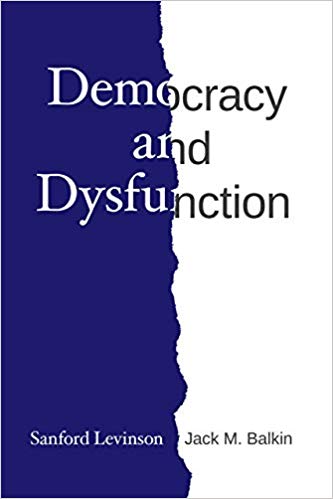
Sanford Levinson and Jack M. Balkin, Democracy and Dysfunction (University of Chicago Press, 2019)

Sanford Levinson, Written in Stone: Public Monuments in Changing Societies (Duke University Press 2018)

Mark A. Graber, Sanford Levinson, and Mark Tushnet, eds., Constitutional Democracy in Crisis? (Oxford University Press 2018)

Gerard Magliocca, The Heart of the Constitution: How the Bill of Rights became the Bill of Rights (Oxford University Press, 2018)

Cynthia Levinson and Sanford Levinson, Fault Lines in the Constitution: The Framers, Their Fights, and the Flaws that Affect Us Today (Peachtree Publishers, 2017)

Brian Z. Tamanaha, A Realistic Theory of Law (Cambridge University Press 2017)

Sanford Levinson, Nullification and Secession in Modern Constitutional Thought (University Press of Kansas 2016)

Sanford Levinson, An Argument Open to All: Reading The Federalist in the 21st Century (Yale University Press 2015)

Stephen M. Griffin, Broken Trust: Dysfunctional Government and Constitutional Reform (University Press of Kansas, 2015)

Frank Pasquale, The Black Box Society: The Secret Algorithms That Control Money and Information (Harvard University Press, 2015)

Bruce Ackerman, We the People, Volume 3: The Civil Rights Revolution (Harvard University Press, 2014)
Balkinization Symposium on We the People, Volume 3: The Civil Rights Revolution

Joseph Fishkin, Bottlenecks: A New Theory of Equal Opportunity (Oxford University Press, 2014)

Mark A. Graber, A New Introduction to American Constitutionalism (Oxford University Press, 2013)

John Mikhail, Elements of Moral Cognition: Rawls' Linguistic Analogy and the Cognitive Science of Moral and Legal Judgment (Cambridge University Press, 2013)

Gerard N. Magliocca, American Founding Son: John Bingham and the Invention of the Fourteenth Amendment (New York University Press, 2013)

Stephen M. Griffin, Long Wars and the Constitution (Harvard University Press, 2013)

Andrew Koppelman, The Tough Luck Constitution and the Assault on Health Care Reform (Oxford University Press, 2013)

James E. Fleming and Linda C. McClain, Ordered Liberty: Rights, Responsibilities, and Virtues (Harvard University Press, 2013)
Balkinization Symposium on Ordered Liberty: Rights, Responsibilities, and Virtues

Andrew Koppelman, Defending American Religious Neutrality (Harvard University Press, 2013)

Brian Z. Tamanaha, Failing Law Schools (University of Chicago Press, 2012)

Sanford Levinson, Framed: America's 51 Constitutions and the Crisis of Governance (Oxford University Press, 2012)

Linda C. McClain and Joanna L. Grossman, Gender Equality: Dimensions of Women's Equal Citizenship (Cambridge University Press, 2012)

Mary Dudziak, War Time: An Idea, Its History, Its Consequences (Oxford University Press, 2012)

Jack M. Balkin, Living Originalism (Harvard University Press, 2011)

Jason Mazzone, Copyfraud and Other Abuses of Intellectual Property Law (Stanford University Press, 2011)

Richard W. Garnett and Andrew Koppelman, First Amendment Stories, (Foundation Press 2011)

Jack M. Balkin, Constitutional Redemption: Political Faith in an Unjust World (Harvard University Press, 2011)

Gerard Magliocca, The Tragedy of William Jennings Bryan: Constitutional Law and the Politics of Backlash (Yale University Press, 2011)

Bernard Harcourt, The Illusion of Free Markets: Punishment and the Myth of Natural Order (Harvard University Press, 2010)

Bruce Ackerman, The Decline and Fall of the American Republic (Harvard University Press, 2010)
Balkinization Symposium on The Decline and Fall of the American Republic

Ian Ayres. Carrots and Sticks: Unlock the Power of Incentives to Get Things Done (Bantam Books, 2010)

Mark Tushnet, Why the Constitution Matters (Yale University Press 2010)

Ian Ayres and Barry Nalebuff: Lifecycle Investing: A New, Safe, and Audacious Way to Improve the Performance of Your Retirement Portfolio (Basic Books, 2010)
.jpg)
Jack M. Balkin, The Laws of Change: I Ching and the Philosophy of Life (2d Edition, Sybil Creek Press 2009)

Brian Z. Tamanaha, Beyond the Formalist-Realist Divide: The Role of Politics in Judging (Princeton University Press 2009)
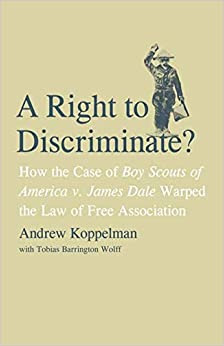
Andrew Koppelman and Tobias Barrington Wolff, A Right to Discriminate?: How the Case of Boy Scouts of America v. James Dale Warped the Law of Free Association (Yale University Press 2009)

Jack M. Balkin and Reva B. Siegel, The Constitution in 2020 (Oxford University Press 2009)

Heather K. Gerken, The Democracy Index: Why Our Election System Is Failing and How to Fix It (Princeton University Press 2009)

Mary Dudziak, Exporting American Dreams: Thurgood Marshall's African Journey (Oxford University Press 2008)

David Luban, Legal Ethics and Human Dignity (Cambridge Univ. Press 2007)

Ian Ayres, Super Crunchers: Why Thinking-By-Numbers is the New Way to be Smart (Bantam 2007)

Jack M. Balkin, James Grimmelmann, Eddan Katz, Nimrod Kozlovski, Shlomit Wagman and Tal Zarsky, eds., Cybercrime: Digital Cops in a Networked Environment (N.Y.U. Press 2007)

Jack M. Balkin and Beth Simone Noveck, The State of Play: Law, Games, and Virtual Worlds (N.Y.U. Press 2006)

Andrew Koppelman, Same Sex, Different States: When Same-Sex Marriages Cross State Lines (Yale University Press 2006)

Brian Tamanaha, Law as a Means to an End (Cambridge University Press 2006)

Sanford Levinson, Our Undemocratic Constitution (Oxford University Press 2006)

Mark Graber, Dred Scott and the Problem of Constitutional Evil (Cambridge University Press 2006)

Jack M. Balkin, ed., What Roe v. Wade Should Have Said (N.Y.U. Press 2005)

Sanford Levinson, ed., Torture: A Collection (Oxford University Press 2004)
Balkin.com homepage
Bibliography
Conlaw.net
Cultural Software
Writings
Opeds
The Information Society Project
BrownvBoard.com
Useful Links
Syllabi and Exams
