Balkinization
an unanticipated consequence of
Jack M. Balkin
Balkinization Symposiums: A Continuing List
E-mail:
Jack Balkin:
jackbalkin at yahoo.com
Bruce Ackerman
bruce.ackerman at yale.edu
Ian Ayres
ian.ayres at yale.edu
Corey Brettschneider
corey_brettschneider at brown.edu
Mary Dudziak
mary.l.dudziak at emory.edu
Joey Fishkin
joey.fishkin at gmail.com
Heather Gerken heather.gerken at yale.edu
Abbe Gluck abbe.gluck at yale.edu
Mark Graber
mgraber at law.umaryland.edu
Stephen Griffin
sgriffin at tulane.edu
Jonathan Hafetz
jonathan.hafetz at shu.edu
Jeremy Kessler
jkessler at law.columbia.edu
Andrew Koppelman
akoppelman at law.northwestern.edu
Marty Lederman
msl46 at law.georgetown.edu
Sanford Levinson
slevinson at law.utexas.edu
David Luban
david.luban at gmail.com
Gerard Magliocca
gmaglioc at iupui.edu
Jason Mazzone
mazzonej at illinois.edu
Linda McClain
lmcclain at bu.edu
John Mikhail
mikhail at law.georgetown.edu
Frank Pasquale
pasquale.frank at gmail.com
Nate Persily
npersily at gmail.com
Michael Stokes Paulsen
michaelstokespaulsen at gmail.com
Deborah Pearlstein
dpearlst at yu.edu
Rick Pildes
rick.pildes at nyu.edu
David Pozen
dpozen at law.columbia.edu
Richard Primus
raprimus at umich.edu
K. Sabeel Rahmansabeel.rahman at brooklaw.edu
Alice Ristroph
alice.ristroph at shu.edu
Neil Siegel
siegel at law.duke.edu
David Super
david.super at law.georgetown.edu
Brian Tamanaha
btamanaha at wulaw.wustl.edu
Nelson Tebbe
nelson.tebbe at brooklaw.edu
Mark Tushnet
mtushnet at law.harvard.edu
Adam Winkler
winkler at ucla.edu
Compendium of posts on Hobby Lobby and related cases
The Anti-Torture Memos: Balkinization Posts on Torture, Interrogation, Detention, War Powers, and OLC
The Anti-Torture Memos (arranged by topic)
Recent Posts
An Originalist Argument Against Rigid Originalism
![[Powered by Blogger]](https://lh3.googleusercontent.com/blogger_img_proxy/AEn0k_vwXn9vJSavvqkst6MVKlueSdOLeSxGM91bI9falHaetiT_Nl9WlzLhInHT9NerEk6LrxNcKxk0wQPUdojNDrUP5ku_Cvj6ZUWQaLwjml3O=s0-d)
Just A Few Blogs
ACS Blog
Alas, a Blog
Althouse
Arts and Letters Daily
Atrios (Eschaton)
Bill of Health
Buzzflash.com
Buzz Machine
Cato at Liberty
Juan Cole (Informed Comment)
Concurring Opinions
The Constitution in 2020
Corrente
Crooked Timber
Daily Howler
Daily Kos
Dana Boyd
Brad DeLong
Digby (Hullabaloo)
Discriminations
Daniel Drezner
Kevin Drum (Mother Jones)
Electrolite
En Banc
Eunomia (Daniel Larison)
Fafblog
Michael Froomkin (Discourse.net)
GovLab (Beth Noveck)
Rick Hasen (Election Law)
History News Network
How Appealing
Ignatz (Sam Heldman)
The Importance of (Ernie Miller)
Infolaw
Instapundit
International Economic Law and Policy Blog
IntLawGrrls
Jacob Levy
Jesus' General
Jurisdynamics
The Kitchen Cabinet
Mark Kleiman
Law Blog Central
Larry Lessig
Lawyers, Guns and Money
Liberal Oasis
Brian Leiter's Law School Reports
The Leiter Reports
Marginal Revolution
Megan McArdle
Memeorandum
Metafilter
Mirror of Justice
The New Republic
Newseum
No More Mister Nice Blog
Brendan Nyhan
Opinio Juris
Orcinus
The Originalism Blog
Pandagon
Passport (Foreign Policy)
Overcoming Bias
Political Animal (Washington Monthly)
Political Theory Daily Review
Political Wire (Taegan Goddard)
The Poor Man
Virginia Postrel
Prawfsblawg
Public Reason
Jonathan Rauch
Raw Story
Redstate
ReligiousLeftLaw.com
Reporters Committee For Freedom of the Press
Reproductive Rights Blog
Rothman's Roadmap to the Right of Publicity
SCOTUS Blog
Seeing the Forest
Clay Shirky
The Shifted Librarian
The Situationist
Larry Solum (Legal Theory)
Andrew Sullivan
Talking Points Memo
Talk Left
Tapped
Tbogg
TechPresident
The Paper Chase (Jurist)
Tom Paine
Tom Tomorrow (This Modern World)
Eve Tushnet
Uggabugga
University of Chicago Law School Faculty Blog
Unqualified Offerings
The Volokh Conspiracy
War and Piece (Laura Rozen)
Wampum
Oliver Willis
Wonkette
Written Description
Matthew Yglesias
Yin
Your Choice of Feeds
1. XML
powered by

2. Atom Feed
3. RSS 2.0
An Originalist Argument Against Rigid Originalism
Brian Tamanaha
James Madison wrote in Federalist 14:Is it not the glory of the people of America, that whilst they have paid a decent regard to the opinions of former times and other nations, they have not suffered a blind veneration for antiquity, for custom, or for names, to overrule the suggestions of their own good sense, the knowledge of their own situation, and the lessons of their own experience?
Madison was not presenting a theory of consitutional interpretation in this passage; rather, he was making a more general observation about the entire constitutional design.
On originalist terms, it is fair [and perhaps required] to ask whether a person who wrote these words would have signed up for a theory of interpretation, like Scalia's original meaning theory, if the result of such a theory would be a "veneration for antiquity...[or] names" that would "overrule the suggestions of [our] own good sense, the knowledge of our situation, and the lessons of [our] own experience"? What would Jefferson--who repeated that the world belongs to the living and not the dead--have thought about a theory of interpretation that directs us to search through two century old texts to divine answers to questions they never conceived of or entertained?
Interestingly--and once again demonstrating that originalist theories can operate at various levels of abstraction--this way of framing the issue shifts the question away from an inquiry into Madison's specific theory of how a written Constitution should be interpreted. Instead, it poses the more general question of whether Madison would have endorsed a particular original meaning theory of interpretation if, in practice (given the reality of the extreme difficulty and rarity of amending the constitution), it would commit our constitutional system to a decision-making process that relies upon old and spotty sources to trump our present knowledge and experience.
As Jack points out in his detailed posts on the subject, no one engaged in this discussion denies that the Constitution is binding law. The dispute is over how the language of that binding text should be interpreted. Relying upon the above quote (and other ideas circulating at the time, which can be found in Bailyn, To Begin the World Anew), my sense is that Madison (to invoke a venerated "name") would be on Jack's side, at least on the core proposition that the Constitution is a legal document for our time and should be interpreted as such.
I'm not a constitional theorist or a historian--so I'll duck now and get out of the way.
Posted
4:04 PM
by Brian Tamanaha [link]
Eight years later, in a letter to Jared Ingersoll, he said:
“It was in conformity with the view here taken of the respect due to deliberate and reiterated precedent, that the Bank of the United States, though on the original question held [by Madison] to be unconstitutional, received [Madison’s] executive signature in the year 1817. The act originally establishing a bank had undergone ample discussions in its passage through the several branches of the government. It had been carried into execution through a period of twenty years, with annual legislative recognition,--in one instance, indeed, with a positive ramification of it into a new state,--and with the entire acquiescence of all the local authorities, as well as of the nation at large; to all of which maybe added, a decreasing prospect of any change in the public opinion adverse to the constitutionality of such an institution. A veto from the executive, under these circumstances, with an admission of the expediency, and almost necessity, of the measure, would have been a defiance of all the obligations derived from a course of precedents amounting to the requisite evidence of the national judgment and intentions.” Madison to Jared Ingersoll, June 25, 1831.

The practical difficulties strike me as much greater. I have no idea how anyone would establish, as a factual matter, how the collective had reasoned in reaching its decision. We have that same problem with respect to Madison's own test, and I wish I could say there's agreement among scholars on that subject, but we both know there isn't.
Leaving that aside, the next issue becomes "who decides?". As things stand now, the SCOTUS does. Under your suggestion, would the Court continue to decide if interpretations adopted collectively (through Congress and the President, I suppose) were adopted in the proper sense? If so, is that any different than our current system?
It is important to maintain a key distinction, which I should have drawn more sharply.
It makes sense--and would be consistent with the Federalist 14 quote--that Madison would think it appropriate to be bound by original meaning (and original expectations) during his lifetime. Broadly speaking, this would continue to be drawing from and applying the knowledge and experience of their own (founding) generation.
The question I posed is whether Madison would have thought that this same interpretive strategy would make sense 200 years later. The statement I quote suggests otherwise. Your quotes, which relate to his views in connection with current isssues, do not answer this question (though his awareness of the natural changes of meaning over time is suggestive).
Again, this example of two very different (and equally justifiable) ways of framing the original meaning inquiry demonstates its problematic character.
Precisely: Madison was asserting that the people of today should not be bound by the dead hand of the past in drafting a constitution.
Judges, of course, are not drafting a constitution. They're applying one. Indeed, it's perfectly possible for a judge, by engaging in non-originalist "interpretation", to impose the dead hand of the past on a populace who'd rejected it in drafting the clauses he's charged with interpreting.
Hypothetically, a population might try to make a break with what had been the previous tradition of unlimited government, by adopting a constitution creating a limited government posessing only enumerated powers.
Only to be thwarted by a judiciary which "interprets" those limited grants of power so expansively as to recreate the unlimited government the people had consciously rejected.
Wouldn't that be ironic?
Thanks for clarifying. I did miss your point the first time around.
I think it's possible, almost, to square Madison's statements with a doctrine of "original meaning" similar to Randy Barnett's. Let me set out the argument first and then the important way in which Madison subverts it.
As you alluded to, Jefferson famously wrote to Madison (Sept. 6, 1789) and argued that the earth belongs to the living, that each generation could act only for itself and never bind succeeding ones. Jefferson being Jefferson, he carried this to its logical conclusion:
"On similar ground it may be proved that no society can make a perpetual constitution, or even a perpetual law. The earth belongs always to the living generation. They may manage it then, and what proceeds from it, as they please, during their usufruct. They are masters too of their own persons, and consequently may govern them as they please. But persons and property make the sum of the objects of government. The constitution and the laws of their predecessors extinguished them, in their natural course, with those whose will gave them being. This could preserve that being till it ceased to be itself, and no longer. Every constitution, then, and every law, naturally expires at the end of 19. years. If it be enforced longer, it is an act of force and not of right."
Madison, however, politely disagreed. In his reply of Feb. 4, 1790, he said,
"However applicable in Theory the doctrine may be to a Constitution, it seems liable in practice to some very powerful objections. Would not a Government so often revised become too mutable to retain those prejudices in its favor which antiquity inspires, and which are perhaps a salutary aid to the most rational Government in the most enlightened age? Would not such a periodical revision engender pernicious factions that might not otherwise come into existence? Would not, in fine, a Government depending for its existence beyond a fixed date, on some positive and authentic intervention of the Society itself, be too subject to the casualty and consequences of an actual interregnum?
***
I find no relief from these consequences, but in the received doctrine that a tacit assent may be given to established Constitutions and laws, and that this assent may be inferred, where no positive dissent appears. It seems less impracticable to remedy, by wise plans of Government, the dangerous operation of this doctrine, than to find a remedy for the difficulties inseparable from the other."
I think this response would be consistent with interpretation according to original meaning (or "sense", to use Madison's term).
I think his letter to Ingersoll, which I quoted above, can also be made consistent with this doctrine, subject to the exception I'll mention below. One way to view Madison's attitude about the Bank is to treat him as saying, "I personally thought that the Bank was unconstitutional. However, the actions of my fellow citizens over a long period of time have demonstrated that I was wrong about that. As a good democrat, I acceded to the majority view."
This is at least plausible, because there wouldn't be much doubt that Americans generally were applying the original meaning over that time frame -- it was so close in time to the ratification that no other meaning was possible.
But. Madison didn't stop with the theoretical justification for his about-face on the Bank. He also gave a practical reason (from the letter to Ingersoll): "with an admission of the expediency, and almost necessity, of the measure".
This was a policy reason. Policy reasons are NOT originalist (except in Prof. Balkin's application sense). Nor was this the only policy which Madison supported despite concerns about constitutionality. Examples include the Louisiana Purchase and judicial review.
I don't think there is an easy answer with Madison. My own view is that Madison was much more a pragmatist than a doctrinaire theorist, and a good democrat with real confidence in the people (as your quote from Federalist 14 shows). I think he'd happily aquiesce in text-and-principle. I doubt he'd ever agree to fix the applications of his Constitution to the conditions of 1789.
Given what I said above, I think you and I agree. If not, let me know.
Brett,
Hypothetically, a population might try to make a break with what had been the previous tradition of unlimited government, by adopting a constitution creating a limited government posessing only enumerated powers.
Only to be thwarted by a judiciary which "interprets" those limited grants of power so expansively as to recreate the unlimited government the people had consciously rejected.
This could only happen, of course, if the people themselves actually acted on the powers given them by the judiciary. Self-restraint is a trump card, and not playing it suggests the judges may have been right.
In other words, it stands in opposition to the spirit that motivates constitutions. Of course, it's not an original observation that the idea of constitutions is in fundamental conflict with more direct forms of democracy.
I agree, up to a point. I'd make two important distinctions.
First, many of the powers upheld by the Marshall court were powers of the Federal government vis a vis the states. I don't see those as involving fundamental rights, but as a question of which agent the people want to handle certain issues. As to such issues, I don't see much need for the courts to serve a counter-majoritarian function.
Second, the closer you get to the ratification, the more likely it is that the people who accepted and ratified it were simply expressing their own fundamental understanding of how the system was supposed to work. There may still need to be safeguards -- your point about constitutions and democracy is true -- but not necessarily on every issue. Some issues, as Madison showed with the bank, may just need to be settled by practice.
I say that textually-expressed sense fixes a particular function from possible worlds to constitutional outcomes--maybe that gives us the "boundedness," "containment," and "coherence" part. But it's up to the interpreter to figure out the facts of the world--i.e., to figure out which possible world to plug into that function, yielding the consitutional outcome itself. So maybe that gives us "free, unhampered access to the world" of the sort we want.
I interpret Madison's policy argument for the bank as consistent with what you say here. For that matter, the passage Brian quoted from Federalist 14 suggests that Madison recognized and applauded the "glory" of Americans in determining what world they chose.
If you agree, doesn't that make Madison's view pretty close to yours?
"[L]aws and institutions must go hand in hand with the progress of the human mind. As that becomes more developed, more enlightened, as new discoveries are made, new truths disclosed, and manners and opinions change with the change of circumstances, institutions must advance also, and keep pace with the times. We might as well require a man to wear still the same coat which fitted him when a boy, as civilized society to remain ever under the regimen of their barbarous ancestors."
http://www.monticello.org/reports/quotes/memorial.html
"I consider the foundation of the Constitution as laid on this ground: That “all powers not delegated to the United States by the Constitution, nor prohibited by it to the States, are reserved to the States or to the people.” [XIIth (sic -- 10th) amendment.] To take a single step beyond the boundaries thus specially drawn around the powers of Congress, is to take possession of a boundless field of power, no longer susceptible of any definition.
****
It is an established rule of construction where a phrase will bear either of two meanings, to give it that which will allow some meaning to the other parts of the instrument, and not that which would render all the others useless. Certainly no such universal power was meant to be given them. It was intended to lace them up straitly within the
enumerated powers, and those without which, as means, these powers could not be carried into effect. It is known that the very power now proposed as a means was rejected as an end by the Convention which formed the Constitution."
No, actually he isn't. Remember, it's not the position of originalists that the Constitution should never be changed. It's that it should be changed by formal amendment.
This isn't an argument about whether the Constitution should change, it's about whether Article V should be used or circumvented.
This isn't an argument about whether the Constitution should change, it's about whether Article V should be used or circumvented.
I understand. However, Jefferson's letter to Madison, which I quoted in part, specifically denies that a constitution can last longer than 19 years:
"Every constitution, then, and every law, naturally expires at the end of 19. years. If it be enforced longer, it is an act of force and not of right."
But it's also non-non-originalist, in the sense that non-originalists today are not claiming that the Constitution has expired, and can thus be ignored. They're claiming that it's still binding, but binds us to something nobody ever agreed to.
That's not Jefferson's each generation getting to make it's own decisions. That's a bait and switch.
My concern here is that the judiciary's Constitution has bee performing what amounts to a drunkard's walk away from the text. At what point does the judiciary's constitution get so far from the text, that the fact that the text was ratified no longer serves as any source of legitimacy for the judiciary's version?
The American people have a great amount of respect for the Constitution the courts claim to be ruling on the basis of. But what supplies the courts with legitimacy when they're close to the text, could strip them of it when they depart too far.
This is a threat I've never seen much indication non-originalists appreciate.
Agreed.
I suspect Jefferson was getting at something more like frequent amendment, or periodic constitutional conventions.
That's possible. It's also possible he had in mind some form of radical democracy. It's hard to know because Jefferson wasn't systematic and at various times made statements which appear to be inconsistent.
At what point does the judiciary's constitution get so far from the text, that the fact that the text was ratified no longer serves as any source of legitimacy for the judiciary's version?
***
This is a threat I've never seen much indication non-originalists appreciate.
I think non-originalists do address this and have several responses. I think everybody starts with the text. The problem only arises when people disagree on the meaning to give to that text.
As for the ratification issue, I subscribe to Madison's "tacit assent" principle. In my view, each generation tacitly agrees to the Constitutional text as then understood, including its historical development to that time.
Others, I'm sure, would give different answers. Prof. Balkin, as I understand him, agrees to accept the original ratification, but treats the text as stating very broad principles. The application of those principles can vary over time.
I'm sure there are other answers too. But I don't think it's fair to say that non-originalists "don't appreciate" the issue; they do, even if you may disagree with their solutions.
I'm not sure Madison was right in his letter to Lee, but that wasn't really what I meant by "historical development". By that I meant changes in the consensus understanding of meaning/application, as opposed to word definitions. For example, people now understand Brown to be good law, regardless what might have been the original understanding of the meaning/application of the 14A.
I think that most citizens apply a very pragmatic test to their loyalty. They grow up with, and accept, the society in which they live. They agree, tacitly, to follow the existing rules of that system, rather than rules which may have applied at some time in the past.
Again in my view, "the current system" includes the possibility of change. I didn't mean that meaning becomes frozen in time, but that people accept current meaning including the prospect of change within accepted rules.
Even if you're right for mere citizens, though, I think that officials who swear the Article VI oath have a duty to abide by the Constitution's own self-conception, which assigns to words like "now," and by extension its other language, the sense they had at the time of the framing.
I realized this distinction after your post above. I'm not sure that your argument is inconsistent with my version of "tacit assent". An oath-taker could, for example, understand the words "this Constitution" to mean "this Constitution as I understand what it means and how it functions today". Indefinite pronouns inevitably create such issues. To paraphrase Heraclitus, can two people ever point to "this" river and mean "the same" one?
That said, your point does have some force and I'm still thinking about it.
FWIW, my article has a big section on Brown. I think the original sense of the P&I clause, applied to the actual facts now, forbids segregation, but that's not something we can just take as a given.
That sounds very interesting, and I'd like to read it, but for some reason SSRN is not letting me download it.
1. The oath of office requires the President to "preserve, protect and defend the Constitution of the United States". Use of the more general "the" rather than the somewhat more specific "this" works in my favor.
2. Important features of our system have no textual support at all, but have been derived from structural or philosophical considerations. Examples include sovereignty of the people; the principle of majority/plurality rule; the right to vote for President; judicial review; the President's right to fire officers approved by the Senate; etc. Tacit assent theory incorporates these.
3. My tacit assent theory incorporates current applications as well as meaning.* I think that serves a valuable conservative/preservative function.
*To repeat, I don't mean that tacit assent freezes current applications in place. The accepted process for change is one of the features to which people assent.
Agreed. My tacit assent theory, because it incorporates historical developments since the founding, does not privilege the original ratification. In a sort of Jeffersonian sense, each generation ratifies for itself.
So I don't think the change suggests that the historicaly-embedded text itself is not supreme; in fact, when the President speaks those words, he is using a different sort of demonstrative expression, precisely because it is not the context in which the President utters those words that matters for setting what the Constitution is. As I see it, that time is the time the Constitution is adopted.
I'm not quite sure what you mean by "historically embedded text". If you mean the Constitution as it has historically developed through today, then I agree. If not -- if you're referring to the original meaning -- then I disagree in the sense that I interpret what the President is promising to do in this sense: he's promising to preserve, protect, and defend the Constitution as he understands what it means today. I'm speculating, of course, but I believe that's what Presidents actually think and what we listeners actually understand and expect.
The historic, textually-expressed sense of the constitutional language is the only thing that gets to count as the Article VI supreme law of the land. As a matter of political morality, sure, we may have consented tacitly to lots of other stuff too--they may be part of "our system" (a better example might be political parties)--but I'm mainly concerned about how to interpret the Constitution itself.
I'm not sure I agree with this, though the issue is moot if you interpret the actual text broadly enough to incorporate some of my examples. Just to pick one, I think that the principle of majority rule is fundamental even if the Constitution itself never uses those words. If you can derive that principle from the text, then we'd agree on the destination and just have some slightly different stories to tell of the journey.
Agreed. In Jefferson's words, "All, too, will bear in mind this sacred principle, that though the will of the majority is in all cases to prevail, that will to be rightful must be reasonable; that the minority possess their equal rights, which equal law must protect, and to violate would be oppression."
Our system limits majority rule in many ways, but we do expect it to prevail in most cases. For example, nobody believes that when the 17A calls for the election of Senators, it means that the outcome will be decided by a minority of voters. All of those nuances go into the affirmation which people tacitly give to our system even if they have no textual source in the Constitution.
obat kutil kelamin untuk ibu hamil
obat kutil kelamin tanpa operasi
obat kutil kelamin kaskus
obat kutil kelamin dokter
obat kutil kelamin mujarab
obat kutil kelamin di jakarta
obat kutil kelamin untuk wanita
obat kutil kelamin/jengger ayam
obat kutil kelamin surabaya
obat kutil kelamin yang ada di apotik
obat kutil kelamin bandung
Kapur sirih untuk obat kutil kelamin
Obat kutil kelamin medis
Obat menghilangkan kutil kelamin
Obat menyembuhkan kutil kelamin
Obat tradisional menyembuhkan kutil kelamin
Obat minum untuk kutil kelamin
Obat medis untuk kutil kelamin
Merek obat kutil kelamin
Obat kutil kelamin de nature
Nama obat kutil kelamin
Obat tradisional buat sipilis
Obat herbal buat sipilis
Obat dokter buat sipilis
Obat generik buat sipilis
Obat sipilis dengan bayam duri
Obat sipilis yang bagus
Obat china sipilis
Cara obat sipilis di apotik
Books by Balkinization Bloggers

Mark Tushnet and Bojan Bugaric, Constitutionalism and Its Discontents (University of Chicago Press, 2026)

Gerard N. Magliocca, The Actual Art of Governing: Justice Robert H. Jackson's Concurring Opinion in the Steel Seizure Case (Oxford University Press, 2025)

Linda C. McClain and Aziza Ahmed, The Routledge Companion to Gender and COVID-19 (Routledge, 2024)

David Pozen, The Constitution of the War on Drugs (Oxford University Press, 2024)

Jack M. Balkin, Memory and Authority: The Uses of History in Constitutional Interpretation (Yale University Press, 2024)
Mark A. Graber, Punish Treason, Reward Loyalty: The Forgotten Goals of Constitutional Reform after the Civil War (University of Kansas Press, 2023)
Jack M. Balkin, What Roe v. Wade Should Have Said: The Nation's Top Legal Experts Rewrite America's Most Controversial Decision - Revised Edition (NYU Press, 2023)

Andrew Koppelman, Burning Down the House: How Libertarian Philosophy Was Corrupted by Delusion and Greed (St. Martin’s Press, 2022)

Gerard N. Magliocca, Washington's Heir: The Life of Justice Bushrod Washington (Oxford University Press, 2022)
Joseph Fishkin and William E. Forbath, The Anti-Oligarchy Constitution: Reconstructing the Economic Foundations of American Democracy (Harvard University Press, 2022)
Mark Tushnet and Bojan Bugaric, Power to the People: Constitutionalism in the Age of Populism (Oxford University Press 2021).

Mark Philip Bradley and Mary L. Dudziak, eds., Making the Forever War: Marilyn B. Young on the Culture and Politics of American Militarism Culture and Politics in the Cold War and Beyond (University of Massachusetts Press, 2021).

Jack M. Balkin, What Obergefell v. Hodges Should Have Said: The Nation's Top Legal Experts Rewrite America's Same-Sex Marriage Decision (Yale University Press, 2020)

Frank Pasquale, New Laws of Robotics: Defending Human Expertise in the Age of AI (Belknap Press, 2020)

Jack M. Balkin, The Cycles of Constitutional Time (Oxford University Press, 2020)

Mark Tushnet, Taking Back the Constitution: Activist Judges and the Next Age of American Law (Yale University Press 2020).

Andrew Koppelman, Gay Rights vs. Religious Liberty?: The Unnecessary Conflict (Oxford University Press, 2020)

Ezekiel J Emanuel and Abbe R. Gluck, The Trillion Dollar Revolution: How the Affordable Care Act Transformed Politics, Law, and Health Care in America (PublicAffairs, 2020)

Linda C. McClain, Who's the Bigot?: Learning from Conflicts over Marriage and Civil Rights Law (Oxford University Press, 2020)
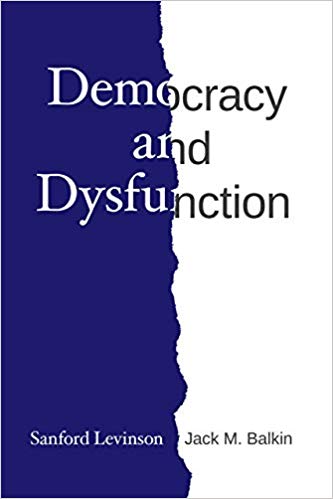
Sanford Levinson and Jack M. Balkin, Democracy and Dysfunction (University of Chicago Press, 2019)

Sanford Levinson, Written in Stone: Public Monuments in Changing Societies (Duke University Press 2018)

Mark A. Graber, Sanford Levinson, and Mark Tushnet, eds., Constitutional Democracy in Crisis? (Oxford University Press 2018)

Gerard Magliocca, The Heart of the Constitution: How the Bill of Rights became the Bill of Rights (Oxford University Press, 2018)

Cynthia Levinson and Sanford Levinson, Fault Lines in the Constitution: The Framers, Their Fights, and the Flaws that Affect Us Today (Peachtree Publishers, 2017)

Brian Z. Tamanaha, A Realistic Theory of Law (Cambridge University Press 2017)

Sanford Levinson, Nullification and Secession in Modern Constitutional Thought (University Press of Kansas 2016)

Sanford Levinson, An Argument Open to All: Reading The Federalist in the 21st Century (Yale University Press 2015)

Stephen M. Griffin, Broken Trust: Dysfunctional Government and Constitutional Reform (University Press of Kansas, 2015)

Frank Pasquale, The Black Box Society: The Secret Algorithms That Control Money and Information (Harvard University Press, 2015)

Bruce Ackerman, We the People, Volume 3: The Civil Rights Revolution (Harvard University Press, 2014)
Balkinization Symposium on We the People, Volume 3: The Civil Rights Revolution

Joseph Fishkin, Bottlenecks: A New Theory of Equal Opportunity (Oxford University Press, 2014)

Mark A. Graber, A New Introduction to American Constitutionalism (Oxford University Press, 2013)

John Mikhail, Elements of Moral Cognition: Rawls' Linguistic Analogy and the Cognitive Science of Moral and Legal Judgment (Cambridge University Press, 2013)

Gerard N. Magliocca, American Founding Son: John Bingham and the Invention of the Fourteenth Amendment (New York University Press, 2013)

Stephen M. Griffin, Long Wars and the Constitution (Harvard University Press, 2013)

Andrew Koppelman, The Tough Luck Constitution and the Assault on Health Care Reform (Oxford University Press, 2013)

James E. Fleming and Linda C. McClain, Ordered Liberty: Rights, Responsibilities, and Virtues (Harvard University Press, 2013)
Balkinization Symposium on Ordered Liberty: Rights, Responsibilities, and Virtues

Andrew Koppelman, Defending American Religious Neutrality (Harvard University Press, 2013)

Brian Z. Tamanaha, Failing Law Schools (University of Chicago Press, 2012)

Sanford Levinson, Framed: America's 51 Constitutions and the Crisis of Governance (Oxford University Press, 2012)

Linda C. McClain and Joanna L. Grossman, Gender Equality: Dimensions of Women's Equal Citizenship (Cambridge University Press, 2012)

Mary Dudziak, War Time: An Idea, Its History, Its Consequences (Oxford University Press, 2012)

Jack M. Balkin, Living Originalism (Harvard University Press, 2011)

Jason Mazzone, Copyfraud and Other Abuses of Intellectual Property Law (Stanford University Press, 2011)

Richard W. Garnett and Andrew Koppelman, First Amendment Stories, (Foundation Press 2011)

Jack M. Balkin, Constitutional Redemption: Political Faith in an Unjust World (Harvard University Press, 2011)

Gerard Magliocca, The Tragedy of William Jennings Bryan: Constitutional Law and the Politics of Backlash (Yale University Press, 2011)

Bernard Harcourt, The Illusion of Free Markets: Punishment and the Myth of Natural Order (Harvard University Press, 2010)

Bruce Ackerman, The Decline and Fall of the American Republic (Harvard University Press, 2010)
Balkinization Symposium on The Decline and Fall of the American Republic

Ian Ayres. Carrots and Sticks: Unlock the Power of Incentives to Get Things Done (Bantam Books, 2010)

Mark Tushnet, Why the Constitution Matters (Yale University Press 2010)

Ian Ayres and Barry Nalebuff: Lifecycle Investing: A New, Safe, and Audacious Way to Improve the Performance of Your Retirement Portfolio (Basic Books, 2010)
.jpg)
Jack M. Balkin, The Laws of Change: I Ching and the Philosophy of Life (2d Edition, Sybil Creek Press 2009)

Brian Z. Tamanaha, Beyond the Formalist-Realist Divide: The Role of Politics in Judging (Princeton University Press 2009)
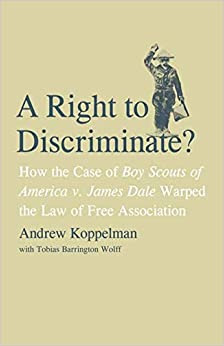
Andrew Koppelman and Tobias Barrington Wolff, A Right to Discriminate?: How the Case of Boy Scouts of America v. James Dale Warped the Law of Free Association (Yale University Press 2009)

Jack M. Balkin and Reva B. Siegel, The Constitution in 2020 (Oxford University Press 2009)

Heather K. Gerken, The Democracy Index: Why Our Election System Is Failing and How to Fix It (Princeton University Press 2009)

Mary Dudziak, Exporting American Dreams: Thurgood Marshall's African Journey (Oxford University Press 2008)

David Luban, Legal Ethics and Human Dignity (Cambridge Univ. Press 2007)

Ian Ayres, Super Crunchers: Why Thinking-By-Numbers is the New Way to be Smart (Bantam 2007)

Jack M. Balkin, James Grimmelmann, Eddan Katz, Nimrod Kozlovski, Shlomit Wagman and Tal Zarsky, eds., Cybercrime: Digital Cops in a Networked Environment (N.Y.U. Press 2007)
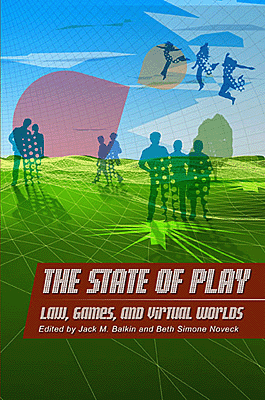
Jack M. Balkin and Beth Simone Noveck, The State of Play: Law, Games, and Virtual Worlds (N.Y.U. Press 2006)

Andrew Koppelman, Same Sex, Different States: When Same-Sex Marriages Cross State Lines (Yale University Press 2006)

Brian Tamanaha, Law as a Means to an End (Cambridge University Press 2006)

Sanford Levinson, Our Undemocratic Constitution (Oxford University Press 2006)

Mark Graber, Dred Scott and the Problem of Constitutional Evil (Cambridge University Press 2006)

Jack M. Balkin, ed., What Roe v. Wade Should Have Said (N.Y.U. Press 2005)

Sanford Levinson, ed., Torture: A Collection (Oxford University Press 2004)
Balkin.com homepage
Bibliography
Conlaw.net
Cultural Software
Writings
Opeds
The Information Society Project
BrownvBoard.com
Useful Links
Syllabi and Exams
