Balkinization
an unanticipated consequence of
Jack M. Balkin
Balkinization Symposiums: A Continuing List
E-mail:
Jack Balkin:
jackbalkin at yahoo.com
Bruce Ackerman
bruce.ackerman at yale.edu
Ian Ayres
ian.ayres at yale.edu
Corey Brettschneider
corey_brettschneider at brown.edu
Mary Dudziak
mary.l.dudziak at emory.edu
Joey Fishkin
joey.fishkin at gmail.com
Heather Gerken heather.gerken at yale.edu
Abbe Gluck abbe.gluck at yale.edu
Mark Graber
mgraber at law.umaryland.edu
Stephen Griffin
sgriffin at tulane.edu
Jonathan Hafetz
jonathan.hafetz at shu.edu
Jeremy Kessler
jkessler at law.columbia.edu
Andrew Koppelman
akoppelman at law.northwestern.edu
Marty Lederman
msl46 at law.georgetown.edu
Sanford Levinson
slevinson at law.utexas.edu
David Luban
david.luban at gmail.com
Gerard Magliocca
gmaglioc at iupui.edu
Jason Mazzone
mazzonej at illinois.edu
Linda McClain
lmcclain at bu.edu
John Mikhail
mikhail at law.georgetown.edu
Frank Pasquale
pasquale.frank at gmail.com
Nate Persily
npersily at gmail.com
Michael Stokes Paulsen
michaelstokespaulsen at gmail.com
Deborah Pearlstein
dpearlst at yu.edu
Rick Pildes
rick.pildes at nyu.edu
David Pozen
dpozen at law.columbia.edu
Richard Primus
raprimus at umich.edu
K. Sabeel Rahmansabeel.rahman at brooklaw.edu
Alice Ristroph
alice.ristroph at shu.edu
Neil Siegel
siegel at law.duke.edu
David Super
david.super at law.georgetown.edu
Brian Tamanaha
btamanaha at wulaw.wustl.edu
Nelson Tebbe
nelson.tebbe at brooklaw.edu
Mark Tushnet
mtushnet at law.harvard.edu
Adam Winkler
winkler at ucla.edu
Compendium of posts on Hobby Lobby and related cases
The Anti-Torture Memos: Balkinization Posts on Torture, Interrogation, Detention, War Powers, and OLC
The Anti-Torture Memos (arranged by topic)
Recent Posts
The Future of Free Expression, Part II-- Network Neutrality
![[Powered by Blogger]](https://lh3.googleusercontent.com/blogger_img_proxy/AEn0k_uAVyzu2voxRo4g2KMPJtIwJnbmJknpqoN2lpT5hN3H2yguaF22KExq2Dtzh2qfO_WfkMNHy-Pc_T8PfyXj5b0HSzV7cOjyepJbTmRy5Mnu=s0-d)
Just A Few Blogs
ACS Blog
Alas, a Blog
Althouse
Arts and Letters Daily
Atrios (Eschaton)
Bill of Health
Buzzflash.com
Buzz Machine
Cato at Liberty
Juan Cole (Informed Comment)
Concurring Opinions
The Constitution in 2020
Corrente
Crooked Timber
Daily Howler
Daily Kos
Dana Boyd
Brad DeLong
Digby (Hullabaloo)
Discriminations
Daniel Drezner
Kevin Drum (Mother Jones)
Electrolite
En Banc
Eunomia (Daniel Larison)
Fafblog
Michael Froomkin (Discourse.net)
GovLab (Beth Noveck)
Rick Hasen (Election Law)
History News Network
How Appealing
Ignatz (Sam Heldman)
The Importance of (Ernie Miller)
Infolaw
Instapundit
International Economic Law and Policy Blog
IntLawGrrls
Jacob Levy
Jesus' General
Jurisdynamics
The Kitchen Cabinet
Mark Kleiman
Law Blog Central
Larry Lessig
Lawyers, Guns and Money
Liberal Oasis
Brian Leiter's Law School Reports
The Leiter Reports
Marginal Revolution
Megan McArdle
Memeorandum
Metafilter
Mirror of Justice
The New Republic
Newseum
No More Mister Nice Blog
Brendan Nyhan
Opinio Juris
Orcinus
The Originalism Blog
Pandagon
Passport (Foreign Policy)
Overcoming Bias
Political Animal (Washington Monthly)
Political Theory Daily Review
Political Wire (Taegan Goddard)
The Poor Man
Virginia Postrel
Prawfsblawg
Public Reason
Jonathan Rauch
Raw Story
Redstate
ReligiousLeftLaw.com
Reporters Committee For Freedom of the Press
Reproductive Rights Blog
Rothman's Roadmap to the Right of Publicity
SCOTUS Blog
Seeing the Forest
Clay Shirky
The Shifted Librarian
The Situationist
Larry Solum (Legal Theory)
Andrew Sullivan
Talking Points Memo
Talk Left
Tapped
Tbogg
TechPresident
The Paper Chase (Jurist)
Tom Paine
Tom Tomorrow (This Modern World)
Eve Tushnet
Uggabugga
University of Chicago Law School Faculty Blog
Unqualified Offerings
The Volokh Conspiracy
War and Piece (Laura Rozen)
Wampum
Oliver Willis
Wonkette
Written Description
Matthew Yglesias
Yin
Your Choice of Feeds
1. XML
powered by

2. Atom Feed
3. RSS 2.0
The Future of Free Expression, Part II-- Network Neutrality
JB
In the first post in this series, I argued that the most important decisions affecting the future of freedom of speech in the digital age may not occur in judge-made constitutional law; many of them will be decisions about technological design, legislative and administrative regulations, the formation of new business models, and the collective activities of end-users. In the twenty-first century, the values of freedom of expression will become subsumed in an even larger set of concerns that I call knowledge and information policy.
My first example is the current debate over network neutrality. On August 1st the FCC held that Comcast illegally (and secretly) blocked the use of a file sharing service called BitTorrent, which is used to move large files across the Internet. The FCC held that broadband providers can't employ secret techniques to block traffic that have no demonstrated connection to reasonable network management policies like reducing network congestion. The FCC pointed out that Comcast was blocking BitTorrent regardless of the amount of traffic. (A more detailed ruling is expected shortly.)
This decision is quite important. In fact, it is as important as the Supreme Court's Reno decision in 1997, because it begins a serious legal movement toward network neutrality. And what is particularly noteworthy is that this decision comes not from a court construing the Constitution but from a federal administrative agency regulating the technical aspects of broadband services.
The goal of network neutrality is to keep digital networks open for many different kinds of content and for many different types of applications and services that people may devise in the future. Put another way, the goal of network neutrality is to ensure that the Internet, as much as possible, remains a general purpose data transport system through which many different kinds of content, services, and applications can flow.
What does the debate about network neutrality have to do with the First Amendment? Under current doctrine, the First Amendment doesn’t really say much about network neutrality one way or the other. And yet whether network providers can discriminate against content, sites and applications touches on important free speech values. Vast numbers of Americans now communicate with each other through broadband access; and we can expect that the percentage of communication through these digital networks will only increase over time. Network providers offer an indispensable service to the general public that makes much public (and private) communication possible. If network providers could discriminate against content and services flowing through their networks, they would be the most powerful censors in America. And since we live in what is effectively a cable-phone duopoly for broadband services, market competition would not necessarily counteract this censorship.
But the debate over network neutrality is about more than whether network providers can discriminate against certain types of content or services. In most cases large corporations won’t discriminate against communications because of their politics or their moral tone (although there have been a few well publicized exceptions, like Verizon's recent attempt to block short text messaging services from NARAL). Rather, most network discrimination will be for economic reasons—to favor business partners and protect incumbent business models.
Thus, the debate over network neutrality is really about the best way to spur competition and promote innovation. Defenders of network neutrality rules argue that digital networks will generate more useful applications in the future—and thus help people generate and distribute more information—if digital networks remain as neutral as possible between different kinds of content and applications.
If you want to promote the growth of new kinds of information services, including services we haven’t even imagined yet, it’s important to keep networks non-discriminatory rather than built to favor the current businesses that network providers are aligned with. While it’s true that network providers can be important sources of innovation, they may frown on new kind of products and services that they didn’t invent, that they don’t provide and that might threaten their existing ways of doing business. For example, AT&T was uninterested in developing Internet technologies decades ago because it would threaten their control of the phone system.
A non-discriminatory Internet decentralizes the sources of innovation, because everyone can create their own services and applications. People who are not affiliated with broadband companies can come up with the next eBay, Google, Blogger, YouTube, Flickr, or Facebook. None of these applications, as far as I am aware, originated with a broadband company.
This is all very well and good, you might say, but what does it have to do with the First Amendment? Why should promoting innovation matter to people who care about freedom of speech?
A system of free speech depends not only on the mere absence of state censorship but also on an infrastructure of free expression. The infrastructure of free expression includes the kinds of media and institutions for knowledge creation and dissemination that are available at any point in time. It also concerns the kinds of opportunities that are available for people to create and build technologies and institutions that other people can use for communication and association.
Two contemporary examples are Internet telephony and filesharing services like BitTorrent. These new applications—which allow people to communicate and trade information and files cheaply— were possible because entrepreneurs could lay new applications on top of Internet protocols. People could create them because the structure of the Internet allowed this sort of experimentation without getting anyone else’s permission in advance. By choosing a regulatory scheme that lets the Internet function more or less as a general data transport system we open up possibilities for a wide variety of new applications and services that can let people share information and opinions, build things together, and form online communities.
Consider, for example, the wide variety of social software sites that have sprung up on the Internet in the past decade. These include Web 2.0 sites like Facebook or Flickr. Such sites perform several different functions simultaneously. They are hosting sites for multimedia content (Flickr hosts photographs, for example, and Facebook can host a variety of different media); but they are also online community platforms that allow people to communicate with each other and pursue common interests and activities through online media. Policies that facilitate this kind of innovation—and that allow many people, not just network providers, to engage in it— better serve the interests of freedom of speech in the long run, even though such innovation policies don’t, at least on their face, seem to be about government censorship.
To be sure, advocates of network neutrality have often made their case before the public by focusing specifically about the dangers of content censorship. That may be easier for people steeped in our first amendment traditions to understand. Yet the larger question in the debate over network neutrality is innovation policy; that question has enormous implications for media access and for future opportunities to speak, listen, share information, and associate with others.
Posted
1:11 PM
by JB [link]

I'm pro net-neutrality and all that stuff, but I think that Bittorent raises issue other net neutrality matter do not raise. Specifically, whilst bittorrent does indeed have some legitimate use, the primary use for bittorent is to share illegal music and movies. Furthermore, it is exponentially more difficult to find those sharing files via bittorent than it is on services such as Napster, which is why the only real way to fight piracy over bittorent is to try to shut down the service.
Bittorent also poses more stress on the ISP than a regular website, or even other service such as gaming because of the large amount of traffic involved. Both of these(especially the former) are reasons to block the service unrelated to net neutrality.

If you want to promote the growth of new kinds of information services, including services we haven’t even imagined yet, it’s important to keep networks non-discriminatory ...
I understand what you're saying, but:
If you want to promote "new kinds of information services", you should block some of the ones we already have (whichis what Comcast did, by selectively blocking traffic on certain ports).
When you block such ports, you will encourage the users to develop "new" techniques of doing the same thing functionally (say, by setting up encapsulated private protocols which hide the port usage) so as not to incut the wrath of Comcast netcops. Not to say that this is productive or in society's best interests; in fact, FWIW, any such protocols or "private VPNs" that hide traffic type and content may make the gummint snoops' ability to listen in more difficult. ;-)
Cheers,
http://www.concurringopinions.com/archives/2007/09/black_box_agenc.html
Kang's article Race.net neutrality brings the cultural concerns into high relief. I have also tried to show the partiality (in the sense of both incompleteness and bias) of think tanks' analysis of the topic here:
http://www.concurringopinions.com/archives/2006/10/net_neutrality.html
Finally, here is an interesting article by Brett Frischmann connecting tech, econ, & the First Amendment in a way that may alleviate some of the concerns I raised above: http://papers.ssrn.com/sol3/papers.cfm?abstract_id=1082497
"[E]conomics may help explain speech and the First Amendment in more than a metaphoric way. This essay, written for the Law in a Networked World conference hosted by the University of Chicago Legal Forum, explores how the First amendment may operate to sustain a spillover rich networked environment. The essay focuses on (i) the economics of speech externalities and (ii) the functional role of the First Amendment in constraining the government's ability to force or enable actors to internalize externalities associated with their speech."
Corporations usually shy away from censorship of content for purely business reasons: The belief is that if you maintain a neutral pipe, you are not responsible (liable) for the content that flows in it, but as soon as you interfere on the basis of content, you become responsible for every idea that comes through your tubes. That is an expensive responsibility, since it requires a lot of equipment and people just to look at all that content.
Finally, just to mention two of your examples, the basic idea for services is often something that flows from service providers and communications companies, even when the final product does not. Google, for instance, is the latest (well, was) in a series of search engines, the first of which did arise in companies providing internet service (DEC, for instance). Flickr is, likewise, the latest interface innovation on an idea that arose in the camera companies and service providers, the original digital camera company is, in fact, a large internet service provider and communications giant, but not in this country (Sony).
A final barrier to free speech - in its form as stated here which is mixed with innovation - is money. Venture capital censors more ideas than anyone when it comes to innovation on the internet. The barriers to entry are very low, but only if you do not need to eat off your invention.
When you block such ports, you will encourage the users to develop "new" techniques of doing the same thing functionally (say, by setting up encapsulated private protocols which hide the port usage) so as not to incut the wrath of Comcast netcops.
I somehow think that JB meant to speak about innovation in a sense broader than playing dodgeball with port numbers (darknets notwithstanding). Blocking port numbers will just make people adept at switching port numbers - although that in itself spurs some really interesting developments. I also don't think the ends justify the means even if those ends are innovations. While darknets are pretty interesting, I think innovations like hyperlinks that automatically propagate changes are more interesting. It just seems like those kind of innovations grow better in a garden fertilized by something other than narrowminded policing.
ondelette wrote:
Finally, just to mention two of your examples, the basic idea for services is often something that flows from service providers and communications companies, even when the final product does not. Google, for instance, is the latest (well, was) in a series of search engines, the first of which did arise in companies providing internet service (DEC, for instance). Flickr is, likewise, the latest interface innovation on an idea that arose in the camera companies and service providers, the original digital camera company is, in fact, a large internet service provider and communications giant, but not in this country (Sony).
If one were to look at Internet traffic by volume of protocol, then the Internet is dominated by protocols whose roots are anywhere but in the halls of commercial origins. Bittorrent is the brainchild of Bram Cohen and filesharing goes back past FTP (Jon Postel and Joyce Reynolds both academics) to xmodem and CBBS - while Ward Christenson wasn't an academic it would be inaccurate to say that filesharing or bulletin board systems grew from a service provider or communications company. The notion that services and innovation flows from companies doesn't really stand up well under historical review.
I somehow think that JB meant to speak about innovation in a sense broader than playing dodgeball with port numbers (darknets notwithstanding). Blocking port numbers will just make people adept at switching port numbers - although that in itself spurs some really interesting developments. I also don't think the ends justify the means even if those ends are innovations.
I don't disagree. But that hardly means they haven't come up with something new (particularly if they do stuff more along the lines of evanescent private networks with encapsulation and encryptation, rather than just changing ports).
More to the point, the idea of "P2P file-sharing" rather than the centralised-server/user-client architecture of the older paradigms is an innovation in itself, even if it was done primarily with the idea of keeping "questionable" content off of readily identified and fewer main servers in the hands of corporations with nit-picking lawyers....
Cheers,
I dunno, I was only disputing the idea that companies like Google are responsible for the whole enchilada on innovation, when actually they stand on the shoulders of giants, and sometimes those giants are actually service providers and telecoms.
As for the whole debate about corporate v. academic, I usually like to stay out of it. I've watched far too many academic claims to having conceived and built the original arpanet, as if everyone else (BBN, Honeywell, ARPA) had a role similar to the gardener outside tending the ivy. In reality, it was an academic-corporate-government partnership, and so are the developments of many, many protocols, with many others developed in consortiums that contain the same mix. It's also very hard to say how many things flow from systems, UNIX for example, that seem to be newly invented but have extremely strong roots. If one looks at popular use of application, email reigns. It was invented at a company.
What I said above about venture capital holding court over new ideas could be said identically about academic credentialism. Point of fact is that innovation doesn't usually flow from establishments, it flows from countercultures. IP laws and contracts, however, favor establishments.
I don't think a business plan has anything to do with innovation, but there are very many who would disagree with me.
Cheers,
My favourite example of "partnership" was a newspaper article taped to one of the MIT AI lab PDP-10s, saying that Ted Kennedy had congratulated BBN for their contract for one of the first "interfaith message prcessors". ;-) We could use a few more of those nowadays....
Cheers,
The threat of censorship by the networks is certainly a big worry, but you are continuing to ignore the problem of arbitrary censorship of visitors' comments and contributions on blogs and other websites (notably Wikipedia).
Also, we need laws against the use of IP addresses to block access. IP address blocking is illegal or frowned upon in Europe.
Perversely, the dissenting comments most likely to be arbitrarily censored contain persuasive arguments and/or inconvenient facts. Dissenting comments that just contain unpersuasive arguments are usually allowed to remain as examples of the supposed weakness of the opposition....
Sometimes a cigar is just a smoke.
Cheers,
"... dissenting comments most likely to be arbitrarily censored contain persuasive arguments and/or inconvenient facts. Dissenting comments that just contain unpersuasive arguments are usually allowed to remain..."
Sometimes a cigar is just a smoke. And a deleted comment ....
Look, you're smart. You figure it out.
And with that helpful hint, I will say no more and encourage no more.
Cheers,
Look, you're smart. You figure it out. <<<<<<
And you're stupid.
I googled "sometimes a cigar is just a smoke" and most of what I found was "sometimes a cigar is just a cigar, " which seemed to have something to do with a cigar being a phallic symbol. But I could find nothing related to my comment. I can only presume that your statement is breathtaking inanity.
Books by Balkinization Bloggers

Mark Tushnet and Bojan Bugaric, Constitutionalism and Its Discontents (University of Chicago Press, 2026)

Gerard N. Magliocca, The Actual Art of Governing: Justice Robert H. Jackson's Concurring Opinion in the Steel Seizure Case (Oxford University Press, 2025)

Linda C. McClain and Aziza Ahmed, The Routledge Companion to Gender and COVID-19 (Routledge, 2024)

David Pozen, The Constitution of the War on Drugs (Oxford University Press, 2024)

Jack M. Balkin, Memory and Authority: The Uses of History in Constitutional Interpretation (Yale University Press, 2024)
Mark A. Graber, Punish Treason, Reward Loyalty: The Forgotten Goals of Constitutional Reform after the Civil War (University of Kansas Press, 2023)
Jack M. Balkin, What Roe v. Wade Should Have Said: The Nation's Top Legal Experts Rewrite America's Most Controversial Decision - Revised Edition (NYU Press, 2023)

Andrew Koppelman, Burning Down the House: How Libertarian Philosophy Was Corrupted by Delusion and Greed (St. Martin’s Press, 2022)

Gerard N. Magliocca, Washington's Heir: The Life of Justice Bushrod Washington (Oxford University Press, 2022)
Joseph Fishkin and William E. Forbath, The Anti-Oligarchy Constitution: Reconstructing the Economic Foundations of American Democracy (Harvard University Press, 2022)
Mark Tushnet and Bojan Bugaric, Power to the People: Constitutionalism in the Age of Populism (Oxford University Press 2021).

Mark Philip Bradley and Mary L. Dudziak, eds., Making the Forever War: Marilyn B. Young on the Culture and Politics of American Militarism Culture and Politics in the Cold War and Beyond (University of Massachusetts Press, 2021).

Jack M. Balkin, What Obergefell v. Hodges Should Have Said: The Nation's Top Legal Experts Rewrite America's Same-Sex Marriage Decision (Yale University Press, 2020)

Frank Pasquale, New Laws of Robotics: Defending Human Expertise in the Age of AI (Belknap Press, 2020)

Jack M. Balkin, The Cycles of Constitutional Time (Oxford University Press, 2020)

Mark Tushnet, Taking Back the Constitution: Activist Judges and the Next Age of American Law (Yale University Press 2020).

Andrew Koppelman, Gay Rights vs. Religious Liberty?: The Unnecessary Conflict (Oxford University Press, 2020)

Ezekiel J Emanuel and Abbe R. Gluck, The Trillion Dollar Revolution: How the Affordable Care Act Transformed Politics, Law, and Health Care in America (PublicAffairs, 2020)

Linda C. McClain, Who's the Bigot?: Learning from Conflicts over Marriage and Civil Rights Law (Oxford University Press, 2020)
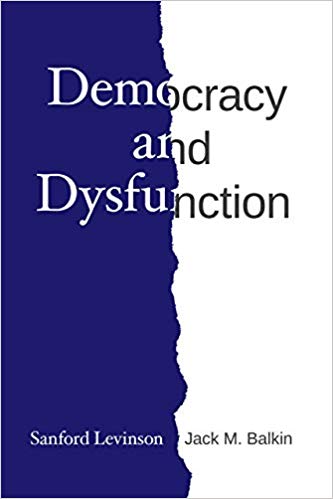
Sanford Levinson and Jack M. Balkin, Democracy and Dysfunction (University of Chicago Press, 2019)

Sanford Levinson, Written in Stone: Public Monuments in Changing Societies (Duke University Press 2018)

Mark A. Graber, Sanford Levinson, and Mark Tushnet, eds., Constitutional Democracy in Crisis? (Oxford University Press 2018)

Gerard Magliocca, The Heart of the Constitution: How the Bill of Rights became the Bill of Rights (Oxford University Press, 2018)

Cynthia Levinson and Sanford Levinson, Fault Lines in the Constitution: The Framers, Their Fights, and the Flaws that Affect Us Today (Peachtree Publishers, 2017)

Brian Z. Tamanaha, A Realistic Theory of Law (Cambridge University Press 2017)

Sanford Levinson, Nullification and Secession in Modern Constitutional Thought (University Press of Kansas 2016)

Sanford Levinson, An Argument Open to All: Reading The Federalist in the 21st Century (Yale University Press 2015)

Stephen M. Griffin, Broken Trust: Dysfunctional Government and Constitutional Reform (University Press of Kansas, 2015)

Frank Pasquale, The Black Box Society: The Secret Algorithms That Control Money and Information (Harvard University Press, 2015)

Bruce Ackerman, We the People, Volume 3: The Civil Rights Revolution (Harvard University Press, 2014)
Balkinization Symposium on We the People, Volume 3: The Civil Rights Revolution

Joseph Fishkin, Bottlenecks: A New Theory of Equal Opportunity (Oxford University Press, 2014)

Mark A. Graber, A New Introduction to American Constitutionalism (Oxford University Press, 2013)

John Mikhail, Elements of Moral Cognition: Rawls' Linguistic Analogy and the Cognitive Science of Moral and Legal Judgment (Cambridge University Press, 2013)

Gerard N. Magliocca, American Founding Son: John Bingham and the Invention of the Fourteenth Amendment (New York University Press, 2013)

Stephen M. Griffin, Long Wars and the Constitution (Harvard University Press, 2013)

Andrew Koppelman, The Tough Luck Constitution and the Assault on Health Care Reform (Oxford University Press, 2013)

James E. Fleming and Linda C. McClain, Ordered Liberty: Rights, Responsibilities, and Virtues (Harvard University Press, 2013)
Balkinization Symposium on Ordered Liberty: Rights, Responsibilities, and Virtues

Andrew Koppelman, Defending American Religious Neutrality (Harvard University Press, 2013)

Brian Z. Tamanaha, Failing Law Schools (University of Chicago Press, 2012)

Sanford Levinson, Framed: America's 51 Constitutions and the Crisis of Governance (Oxford University Press, 2012)

Linda C. McClain and Joanna L. Grossman, Gender Equality: Dimensions of Women's Equal Citizenship (Cambridge University Press, 2012)

Mary Dudziak, War Time: An Idea, Its History, Its Consequences (Oxford University Press, 2012)

Jack M. Balkin, Living Originalism (Harvard University Press, 2011)

Jason Mazzone, Copyfraud and Other Abuses of Intellectual Property Law (Stanford University Press, 2011)

Richard W. Garnett and Andrew Koppelman, First Amendment Stories, (Foundation Press 2011)

Jack M. Balkin, Constitutional Redemption: Political Faith in an Unjust World (Harvard University Press, 2011)

Gerard Magliocca, The Tragedy of William Jennings Bryan: Constitutional Law and the Politics of Backlash (Yale University Press, 2011)

Bernard Harcourt, The Illusion of Free Markets: Punishment and the Myth of Natural Order (Harvard University Press, 2010)

Bruce Ackerman, The Decline and Fall of the American Republic (Harvard University Press, 2010)
Balkinization Symposium on The Decline and Fall of the American Republic

Ian Ayres. Carrots and Sticks: Unlock the Power of Incentives to Get Things Done (Bantam Books, 2010)

Mark Tushnet, Why the Constitution Matters (Yale University Press 2010)

Ian Ayres and Barry Nalebuff: Lifecycle Investing: A New, Safe, and Audacious Way to Improve the Performance of Your Retirement Portfolio (Basic Books, 2010)
.jpg)
Jack M. Balkin, The Laws of Change: I Ching and the Philosophy of Life (2d Edition, Sybil Creek Press 2009)

Brian Z. Tamanaha, Beyond the Formalist-Realist Divide: The Role of Politics in Judging (Princeton University Press 2009)

Andrew Koppelman and Tobias Barrington Wolff, A Right to Discriminate?: How the Case of Boy Scouts of America v. James Dale Warped the Law of Free Association (Yale University Press 2009)

Jack M. Balkin and Reva B. Siegel, The Constitution in 2020 (Oxford University Press 2009)

Heather K. Gerken, The Democracy Index: Why Our Election System Is Failing and How to Fix It (Princeton University Press 2009)

Mary Dudziak, Exporting American Dreams: Thurgood Marshall's African Journey (Oxford University Press 2008)

David Luban, Legal Ethics and Human Dignity (Cambridge Univ. Press 2007)

Ian Ayres, Super Crunchers: Why Thinking-By-Numbers is the New Way to be Smart (Bantam 2007)

Jack M. Balkin, James Grimmelmann, Eddan Katz, Nimrod Kozlovski, Shlomit Wagman and Tal Zarsky, eds., Cybercrime: Digital Cops in a Networked Environment (N.Y.U. Press 2007)

Jack M. Balkin and Beth Simone Noveck, The State of Play: Law, Games, and Virtual Worlds (N.Y.U. Press 2006)

Andrew Koppelman, Same Sex, Different States: When Same-Sex Marriages Cross State Lines (Yale University Press 2006)

Brian Tamanaha, Law as a Means to an End (Cambridge University Press 2006)

Sanford Levinson, Our Undemocratic Constitution (Oxford University Press 2006)

Mark Graber, Dred Scott and the Problem of Constitutional Evil (Cambridge University Press 2006)

Jack M. Balkin, ed., What Roe v. Wade Should Have Said (N.Y.U. Press 2005)

Sanford Levinson, ed., Torture: A Collection (Oxford University Press 2004)
Balkin.com homepage
Bibliography
Conlaw.net
Cultural Software
Writings
Opeds
The Information Society Project
BrownvBoard.com
Useful Links
Syllabi and Exams
