Balkinization
an unanticipated consequence of
Jack M. Balkin
Balkinization Symposiums: A Continuing List
E-mail:
Jack Balkin:
jackbalkin at yahoo.com
Bruce Ackerman
bruce.ackerman at yale.edu
Ian Ayres
ian.ayres at yale.edu
Corey Brettschneider
corey_brettschneider at brown.edu
Mary Dudziak
mary.l.dudziak at emory.edu
Joey Fishkin
joey.fishkin at gmail.com
Heather Gerken heather.gerken at yale.edu
Abbe Gluck abbe.gluck at yale.edu
Mark Graber
mgraber at law.umaryland.edu
Stephen Griffin
sgriffin at tulane.edu
Jonathan Hafetz
jonathan.hafetz at shu.edu
Jeremy Kessler
jkessler at law.columbia.edu
Andrew Koppelman
akoppelman at law.northwestern.edu
Marty Lederman
msl46 at law.georgetown.edu
Sanford Levinson
slevinson at law.utexas.edu
David Luban
david.luban at gmail.com
Gerard Magliocca
gmaglioc at iupui.edu
Jason Mazzone
mazzonej at illinois.edu
Linda McClain
lmcclain at bu.edu
John Mikhail
mikhail at law.georgetown.edu
Frank Pasquale
pasquale.frank at gmail.com
Nate Persily
npersily at gmail.com
Michael Stokes Paulsen
michaelstokespaulsen at gmail.com
Deborah Pearlstein
dpearlst at yu.edu
Rick Pildes
rick.pildes at nyu.edu
David Pozen
dpozen at law.columbia.edu
Richard Primus
raprimus at umich.edu
K. Sabeel Rahmansabeel.rahman at brooklaw.edu
Alice Ristroph
alice.ristroph at shu.edu
Neil Siegel
siegel at law.duke.edu
David Super
david.super at law.georgetown.edu
Brian Tamanaha
btamanaha at wulaw.wustl.edu
Nelson Tebbe
nelson.tebbe at brooklaw.edu
Mark Tushnet
mtushnet at law.harvard.edu
Adam Winkler
winkler at ucla.edu
Compendium of posts on Hobby Lobby and related cases
The Anti-Torture Memos: Balkinization Posts on Torture, Interrogation, Detention, War Powers, and OLC
The Anti-Torture Memos (arranged by topic)
Recent Posts
Top State Department Lawyer Blogs About Guantanamo
![[Powered by Blogger]](https://lh3.googleusercontent.com/blogger_img_proxy/AEn0k_uJCc-Bf18XmhdC_ueJ3UjHXXKP3Xaf0fD4xLYbHKRH-n4T84theOF3eBKIMnkPt24YkXMuJwZwAJG1Hz6H5FwljA5gBQ8OQfe40iF5CHga=s0-d)
Just A Few Blogs
ACS Blog
Alas, a Blog
Althouse
Arts and Letters Daily
Atrios (Eschaton)
Bill of Health
Buzzflash.com
Buzz Machine
Cato at Liberty
Juan Cole (Informed Comment)
Concurring Opinions
The Constitution in 2020
Corrente
Crooked Timber
Daily Howler
Daily Kos
Dana Boyd
Brad DeLong
Digby (Hullabaloo)
Discriminations
Daniel Drezner
Kevin Drum (Mother Jones)
Electrolite
En Banc
Eunomia (Daniel Larison)
Fafblog
Michael Froomkin (Discourse.net)
GovLab (Beth Noveck)
Rick Hasen (Election Law)
History News Network
How Appealing
Ignatz (Sam Heldman)
The Importance of (Ernie Miller)
Infolaw
Instapundit
International Economic Law and Policy Blog
IntLawGrrls
Jacob Levy
Jesus' General
Jurisdynamics
The Kitchen Cabinet
Mark Kleiman
Law Blog Central
Larry Lessig
Lawyers, Guns and Money
Liberal Oasis
Brian Leiter's Law School Reports
The Leiter Reports
Marginal Revolution
Megan McArdle
Memeorandum
Metafilter
Mirror of Justice
The New Republic
Newseum
No More Mister Nice Blog
Brendan Nyhan
Opinio Juris
Orcinus
The Originalism Blog
Pandagon
Passport (Foreign Policy)
Overcoming Bias
Political Animal (Washington Monthly)
Political Theory Daily Review
Political Wire (Taegan Goddard)
The Poor Man
Virginia Postrel
Prawfsblawg
Public Reason
Jonathan Rauch
Raw Story
Redstate
ReligiousLeftLaw.com
Reporters Committee For Freedom of the Press
Reproductive Rights Blog
Rothman's Roadmap to the Right of Publicity
SCOTUS Blog
Seeing the Forest
Clay Shirky
The Shifted Librarian
The Situationist
Larry Solum (Legal Theory)
Andrew Sullivan
Talking Points Memo
Talk Left
Tapped
Tbogg
TechPresident
The Paper Chase (Jurist)
Tom Paine
Tom Tomorrow (This Modern World)
Eve Tushnet
Uggabugga
University of Chicago Law School Faculty Blog
Unqualified Offerings
The Volokh Conspiracy
War and Piece (Laura Rozen)
Wampum
Oliver Willis
Wonkette
Written Description
Matthew Yglesias
Yin
Your Choice of Feeds
1. XML
powered by

2. Atom Feed
3. RSS 2.0
Top State Department Lawyer Blogs About Guantanamo
Brian Tamanaha
The Legal Advisor to the State Department, John Bellinger, is guest blogging this week at Opinio Juris (the premier international law blog). Bellinger is articulating detailed legal justifications for the Bush Administration’s policies in connection with Guantanamo, torture, and related issues. To see some of the real world consequences of these policies, read this Washinton Post article about the many people still languishing in limbo at Guantanamo five years on.
Bellinger’s initial substantive post made this request of readers:My purpose is not to persuade readers to agree with Administration policies. But I would ask readers to engage in serious legal analysis. If you question our approach, I would ask you to consider whether a different approach is actually legally required or simply preferable as a matter of policy.
This request seems reasonable enough, but it is a bit tricky. He sets it up so that opponents are placed in one of two categories: an alternative to the Bush Administration’s position must be “legally required,” or it is a policy preference (and therefore can be ignored). “Legally required” is an extremely high standard, one not easily met in domestic law, never mind in international law. But there are other standards, for example: legally persuasive (supported by compelling legal arguments), or legally authoritative (consistent with rulings by international tribunals), or consistent with the legal interpretation shared by most of the rest of the world. A major problem with the Bush Administration’s positions on some of the critical issues is that they run afoul of these other standards, standards which many international observers consider appropriate.
Bellinger, of course, does not hold the Bush Administration to the same high standard that he applies to opponents, or even to the lower alternative standards that I suggest. As long as the Administration's position is “arguable,” that appears to be good enough.
Consider, for example, Bellinger’s earlier observations about Article 75 of the Geneva Protocol, which the US has heretofore consistently maintained is binding under customary international law: “Article 75 of Geneva Protocol I does set a generally minimum standard for people who do not benefit from other provisions of the Geneva Convention, and the U.S. has historically said that we think that is customary international law. We are looking at whether we think it is customary international law in this kind of a conflict. There is certainly a good argument that it is, always. But when it comes to customary international law, it is in things that you are customarily dealing with, and people have not had to customarily deal with armies of terrorists where the entire force of the army, not just a few people but the entire force of the army, is in fact intent not on fighting our armed forces, where sometimes guerrillas who have been contemplated by Geneva Protocol I…, but where the entire army of al-Qaeda is in fact intent on combating our civilians.
“So while you make a reasonable point, we have said that that’s customary international law in the past, we are looking at whether that’s appropriate, and we haven’t said that it isn’t, but we have not yet said that it is, because this really is in that regard -- dealing with people whose whole aim in life is to kill civilians -- is sort of a different situation.”
I guess Bellinger's explanation for why a provision we have previously (repeatedly) said is binding might not be binding on us in this situation is arguable (which is not to say that it is convincing), though it is telling that his words are hedged and twisted into a pretzel.
In another interview, Bellinger made the following statements about torture:State Department legal adviser John Bellinger said the US welcomed the dialogue and would try to answer the committee's [the Committee Against Torture, in Geneva, May 2006] questions.
It’s not clear how to interpret Bellinger’s denials. Various reports have indicated that prisoners in US custody have been subjected to stress positions (many hours standing in restraints), held in cold conditions and doused with cold water, and subjected to waterboarding. Is Bellinger denying that any of this took place (and how does he know?)? Or is he saying that this treatment does not constitute “abuse” or “torture” (which the Bush Administration has suggested implausibly in the past)? [Stimson, by the way, made national news in the past few days by attempting to intimidate the corporate lawyers who defend Guantanamo prisoners, which says a lot about his believability. And how many of those deaths have resulted in prosecution?]
But he said incidents of abuse were "not systemic" and urged the panel "not to believe every allegation that you've heard".
"Allegations about US military or intelligence activities have become so hyperbolic as to be absurd," he said.
US Deputy Assistant Secretary of Defense Charles Stimson said 120 detainees had died in Iraq and Afghanistan, 29 of whom might have been abused.
He said suspected cases were investigated and "appropriate action taken”.
If we are indeed fighting a new kind of war—the so-called “Global War on Terror”—it is essential that the US obtains international support in this effort. Right now we suffer from a lack of credibility.
Bellinger’s willingness to appear on a blog to articulate and defend the Bush Administration’s position on these issues is admirable. No doubt he will have an audience of international lawyers and government officials. Let’s hope one of his primary objectives is to rebuild US credibility. For that to happen, his legal justifications must be more than arguable, they must be legally persuasive and factually credible.
Check out his posts.
Posted
12:10 PM
by Brian Tamanaha [link]
My question, Professor, is how best to proceed after having thusly scuttled a premise which is so central to someone's argument. To say this standard is "extremely high" is extremely gracious. I would tend to say such a standard is suitable for Fow News consumers but is simply laughable in a legitimate legal venue. Nonetheless, the question remains, how best to engage known cheats of this nature? For I realize we ignore them at our peril.

In the administration's effort to obtain raw intelligence, officials said, it was easier to ship hundreds of men with unclear allegiances to a naval base in Cuba in early 2002 and ask the hard questions later. But with a government focused on interrogations, a bureaucracy lacking tolerance for risk and a detention policy under legal attack, the United States has found it difficult to free many of the detainees, regardless of the information it has on the threat they pose.
In part, the maladministration is hampered in "doing the right thing" because they are so unwilling to admit mistakes; to admit that they may, in certain cases, have done the wrong thing. The maladministration is remarkably thin-skinned and sesitive to substantive criticism. Acknowledgeing mistakes detracts from the public image of them and their competency and goodness, at a time when they know they're on perilous grounds, both morally and most important politically (their response to el Masri and Arar is just emblematic of that). The latter has driven maladministration policy from the start; they care about appearance, and they'll use any trick in the book to gussy things up on that count, including unabashed propaganda programs.
The question is whether there will come a "breaking point", a point at which the population undergoes a phase change and sees them as the connivers and hacks they are, and acts en masse to throw them out. Will they see the danger (to them) in time, and start a more conciliatory and apologetic course? Perhaps (and there are those in the Republican party that fear this and are pressing hard to avoid such a political disaster). But the signs are not good; from the recent disavowal of the Baker-Hamilton ISG report, to the firing of the nay-sayers, to the "all in" approach they've charted.
Cheers,

Also, can someone refer me to a good source on military or international law in such cases?
I think it depends on the specific issue. For example, torture is a case where the alternative is "legally required". FISA warrants also. In contrast, the exact type of hearing for detainees is more in the category of "legally consistent".
To make sure I understand you, are you saying an alternative is "legally required" in the case of torture of warrantless surveillance means that these practices are illegal? And, alternately, in the case of the type of hearings for detainees, a variety of types are allowed. What the Administration is offering may, indeed, be legal, but other types of hearings may be more commonly used, or better supported by law and precedent.
Am I understanding right?
In any event, when an agressor nation invading another country brings in people who were living in that country and took up arms against the agressor, I think it IS a requirement of the laws of war that they be treated as legal combatants and pows unless and until there is competent evidence to the contrary. Similarly, when a nation engages in the purchase of other individuals, not taken on the field of battle, or otherwise on the detention of persons who were rounded up in occupied territory but not taken on the battlefield, then there is a requirement for an actual Geneva compliant "real" status hearing.
It is very easy to understand why there is a strong negative reaction to these fairly self evident matters - matters which do not require anything in the manner of "giving terrorists more rights."
If anyone bought or taken was not actually an illegal combatant, it was unquestionable illegal and a war crime to ship them off to GITMO and to do any of the many things that have been catalogued.
So the first admission that even one person was sent to GITMO incorrectly is a prima facie war crime. That's why there is so much, and such disingenous, argument about the "power" and legal authority to handle "al-Qaeda" in this manner.
The bright shiney arugment to distract from the realities of legal authority to treat innocent civilians in this manner.
Has anyone, anywhere in DOJ, JAG or at State, formulated their legal argument for buying a non-combatant and shipping them, shackled like a slave, to GITMO for years of abuse?
Over and over there are admissions - varying only in number - that we bought and shipped people who were not terrorists, not Taliban and not even the broader "jihadist" unspecified category.
Where is the legal justification for that?
Yes.
And, alternately, in the case of the type of hearings for detainees, a variety of types are allowed.
Yes.
What the Administration is offering may, indeed, be legal, but other types of hearings may be more commonly used, or better supported by law and precedent.
Well, the Administration's idea of a hearing is, IMO, not adequate to meet the minimum, legally required, standard. The exact extent of the "extra" required for a minimally acceptable hearing could be the subject of reasonable debate.
Am I understanding right?
Basically, yes. The lawyers here and on other blogs tend to get caught up in a subject which they are familiar with and they don't make the distinctions all that clear to non-lawyer readers. We should do a better job of making it clear that legal arguments are rarely clear cut.
Nevertheless, most such arguments take place within a range of generally accepted possibilities. What's unusual about this Administration is its willingness to make arguments far outside that range. They are, IMO, as far outside the norm as, say, the communists were in the other direction.
Thanks. I will say, FWIW, that I have found most of the discussions here to be free of legalese and understandable. (That is why I have dared to post here).
QFE. (Same here.)
Cara mengobati kanker dengan herbal, Cara mengobati kanker dengan tradisional, Cara mengobati kanker dengan alami, Cara mengobati kanker dengan cepat, Cara mengobati kanker stadium 3, Cara mengobati kanker stadium 4, Cara mengobati kanker stadium awal, Cara mengobati kanker stadium 2, Cara mengobati kanker stadium akhir, Cara mengobati kanker tanpa ke dokter, Gambar obat kanker yang ampuh, Gambar obat kanker yang ampuh, Obat kanker ampuh dengan singkong, Cara mengobati kanker stadium awal tanpa operasi, Obat kanker manjur dari tumbuhan, Cara mengobati kanker stadium 1 tanpa operasi, Obat kanker ampuh dengan daun sirsak, Cara mengobati kanker stadium 2 tanpa operasi, Obat kanker paling mujarab yang efektif, Cara mengobati kanker stadium 3 tanpa operasi, Cara mengobati kanker stadium 3, Cara mengobati kanker stadium 4 tanpa operasi, Obat kanker paling manjur 2016, Cara mengobati kanker stadium akhir tanpa operasi, Pengobatan kanker mujarab tanpa operasi, Cara pengobatan kanker yang manjur, Pengobatan kanker manjur dan aman, Cara pengobatan kanker yang mujarab, Cara pengobatan kanker tanpa operasi, Cara pengobatan kanker yang ampuh, Obat kanker mujarab tanpa operasi, Obat kanker manjur tanpa operasi, Obat De Nature
obat herpes tradisional yang ampuh
obat herpes terbaik
obat herpes tangan
obat herpes tercepat
obat herpes tipe 2
obat herpes tradisional untuk bayi
obat herpes tenggorokan
obat herpes terbaru
obat herpes tablet
obat herpes tomcat
obat herpes tumbuhan
Kapur sirih untuk obat kutil kelamin
Obat kutil kelamin medis
Obat menghilangkan kutil kelamin
Obat menyembuhkan kutil kelamin
Obat tradisional menyembuhkan kutil kelamin
Obat minum untuk kutil kelamin
Obat medis untuk kutil kelamin
Merek obat kutil kelamin
Obat kutil kelamin de nature
Nama obat kutil kelamin
Obat tradisional buat sipilis
Obat herbal buat sipilis
Obat dokter buat sipilis
obat herbal kanker serviks ampuh
Obat herbal kanker serviks paten
obat herbal kanker serviks manjur
obat herbal kanker serviks mujarab
obat herbal kanker serviks terpercaya
obat herbal kanker servik
obat herbal kanker servik ampuh
obat herbal kanker servik manjur
Obat herbal kanker servik mujarab
obat herbal kanker servik paten
obat herbal kanker servik terpercaya
obat herbal herpes genital klik disini
Obat herbal herpes genital baca sekarang
obat herbal herpes genital manjur
obat herbal herpes genital ampuh
obat herbal herpes genital 2016
obat herpes genital herbal 2015
obat herpes genital herbal 2016
Obat herpes genital herbal bulan ini
obat herpes genital herbal klik sekarang
obat herpes genital herbal 1945
obat herpes genital herbal manjur
obat herbal herpes genital berkhasiat
Obat herbal herpes genital manjuur sembuh 2 hari
Obat herbal herpes genital manjuur sembuh 2 hari
Obat herbal herpes genital manjuur sembuh 2 hari
Obat herbal herpes genital manjuur sembuh 2 hari
Obat herbal herpes genital manjuur sembuh 2 hari
Obat herbal herpes genital manjuur sembuh 2 hari
Obat herbal herpes genital manjuur sembuh 2 hari
Obat herbal herpes genital manjuur sembuh 2 hari
Obat herbal herpes genital manjuur sembuh 2 hari
Obat herbal herpes genital manjuur sembuh 2 hari
Obat herbal herpes genital manjuur sembuh 2 hari
Obat herbal herpes genital manjuur sembuh 2 hari
Obat herbal herpes genital manjuur sembuh 2 hari
Obat herbal herpes genital manjuur sembuh 2 hari
Obat herbal herpes genital manjuur sembuh 2 hari
Obat herbal herpes genital manjuur sembuh 2 hari
obat kanker serviks manjur
obat kanker serviks manjur
obat kanker serviks manjur
obat kanker serviks manjur
obat kanker serviks manjur facebook
obat herpes genital manjur
obat herpes genital manjur
obat herpes genital manjur
obat herpes genital manjur
obat herpes genital manjur
obat herpes genital manjur
obat herpes genital manjur
obat herpes genital manjur
obat herpes genital manjur
obat herpes genital manjur
obat herpes genital manjur
obat herpes genital manjur
obat herpes genital manjur
obat herpes genital manjur
obat herpes genital manjur
obat herpes genital manjur
obat herpes genital manjur
obat herpes genital manjur
obat herpes genital manju
Obat herpes genital manjur
Obat herpes genital manujur di youtube
Obat kanker dan herpes di twitter
obat herpes genital manjur facebook
obat kanker serviks tradisional jawa sumatera
Obat kanker serviks tradisional sumatera
Obat kanker serviks tradisional kalimantan
obat kanker serviks tradisional herbal jawa
obat kanker serviks tradisional herbal jawa sumatera
obat kanker serviks tradisional herbal sumatera
obat kanker serviks tradisional herbal suku pedalaman
obat kanker serviks tradisional herbal suku pedalaman sumatra
Obat kanker serviks tradisional herbal suku jawa
obat kanker serviks tradisional herbal s
obat kanker serviks tradisional herbal suku minang
obat kanker serviks tradisional herbal suku sunda
Obat kanker serviks tradisional herbal suku irian
obat kanker serviks tradisional herbal suku dayak
obat kanker serviks tradisional herbal suku kubu
obat tradisional kanker serviks suku
obat kanker serviks tradisional herbal suku bugis
obat herbal herpes genital dompo
obat herbal herpes genital dompo simplex
Obat tradisional menyembuhkan kutil kelamin
Obat minum untuk kutil kelamin
Obat medis untuk kutil kelamin
Obat kutil kelamin DE NATURE
Merek obat kutil kelamin
Obat kutil kelamin de nature
Nama obat kutil kelamin
Nama salep obat kutil kelamin
Obat kutil kelamin tanpa operasi
Obat oles untuk kutil kelamin
Obat kutil di alat kelamin pria
Obat untuk kutil pada kelamin
Obat tradisional kutil pada kelamin
Obat penyakit kutil kelamin
Obat penghilang kutil kelamin
Obat perontok kutil kelamin
Obat tradisional kutil kelamin pada pria
Obat untuk penyakit kutil kelamin
Propolis untuk obat kutil kelamin
Obat alami untuk penyakit kutil kelamin
Obat kutil pd kelamin
Resep obat kutil kelamin
Obat anti sifilis
Obat sipilis dijual di apotik
Obat sipilis murah di apotik
Obat alami sipilis pada pria
Obat sifilis ampuh
Obat sipilis beli di apotik
Obat sipilis buat wanita
Obat sipilis buatan sendiri
Obat sipilis bagi wanita
Obat buat sipilis
Obat biotik sifilis
Obat antibiotik buat sipilis
Obat tradisional buat sipilis
Obat herbal buat sipilis
Obat dokter buat sipilis
Obat generik buat sipilis
Obat sipilis dengan bayam duri
Obat sipilis yang bagus
Obat buat sifilis
Obat sipilis.com
Obat sipilis ciprofloxacin
Obat china sipilis
obat kutil kelamin dan leher
obat alami menghilangkan kutil kelamin
obat tradisional untuk menghilangkan kutil kelamin
kumpulan obat kutil kelamin
obat tradisional kutil kelamin
obat penyakit kutil kelamin
obat tradisional untuk kutil kelamin
obat alami untuk menghilangkan kutil kelamin
obat alami kutil kelamin
Obat kencing nanah pria
Obat kencing nanah dan darah
Obat kencing nanah apotik
Obat kencing nanah antibiotik
Obat kencing nanah amoxicillin
Obat kencing nanah apa
Obat kencing nanah apa ya
Obat kencing nanah atau gonore
Obat kencing nanah akut
Obat kencing nanah ada di apotik
Obat kencing nanah di apotik umum
Obat kencing nanah paling ampuh
Obat kencing nanah yang ampuh
Obat kencing nanah secara alami
Obat kencing nanah bandung
Obat kencing nanah buatan sendiri
Obat kencing nanah yang bisa dibeli di apotik
Obat herbal untuk mengobati kencing nanah
Obat kencing nanah paling bagus
Obat kencing nanah yang bisa dibeli di apotek
Obat kencing nanah di apotik bebas
Obat kencing nanah yang dijual bebas
Books by Balkinization Bloggers

Gerard N. Magliocca, The Actual Art of Governing: Justice Robert H. Jackson's Concurring Opinion in the Steel Seizure Case (Oxford University Press, 2025)

Linda C. McClain and Aziza Ahmed, The Routledge Companion to Gender and COVID-19 (Routledge, 2024)

David Pozen, The Constitution of the War on Drugs (Oxford University Press, 2024)

Jack M. Balkin, Memory and Authority: The Uses of History in Constitutional Interpretation (Yale University Press, 2024)
Mark A. Graber, Punish Treason, Reward Loyalty: The Forgotten Goals of Constitutional Reform after the Civil War (University of Kansas Press, 2023)
Jack M. Balkin, What Roe v. Wade Should Have Said: The Nation's Top Legal Experts Rewrite America's Most Controversial Decision - Revised Edition (NYU Press, 2023)

Andrew Koppelman, Burning Down the House: How Libertarian Philosophy Was Corrupted by Delusion and Greed (St. Martin’s Press, 2022)

Gerard N. Magliocca, Washington's Heir: The Life of Justice Bushrod Washington (Oxford University Press, 2022)
Joseph Fishkin and William E. Forbath, The Anti-Oligarchy Constitution: Reconstructing the Economic Foundations of American Democracy (Harvard University Press, 2022)
Mark Tushnet and Bojan Bugaric, Power to the People: Constitutionalism in the Age of Populism (Oxford University Press 2021).

Mark Philip Bradley and Mary L. Dudziak, eds., Making the Forever War: Marilyn B. Young on the Culture and Politics of American Militarism Culture and Politics in the Cold War and Beyond (University of Massachusetts Press, 2021).

Jack M. Balkin, What Obergefell v. Hodges Should Have Said: The Nation's Top Legal Experts Rewrite America's Same-Sex Marriage Decision (Yale University Press, 2020)

Frank Pasquale, New Laws of Robotics: Defending Human Expertise in the Age of AI (Belknap Press, 2020)

Jack M. Balkin, The Cycles of Constitutional Time (Oxford University Press, 2020)

Mark Tushnet, Taking Back the Constitution: Activist Judges and the Next Age of American Law (Yale University Press 2020).

Andrew Koppelman, Gay Rights vs. Religious Liberty?: The Unnecessary Conflict (Oxford University Press, 2020)

Ezekiel J Emanuel and Abbe R. Gluck, The Trillion Dollar Revolution: How the Affordable Care Act Transformed Politics, Law, and Health Care in America (PublicAffairs, 2020)

Linda C. McClain, Who's the Bigot?: Learning from Conflicts over Marriage and Civil Rights Law (Oxford University Press, 2020)
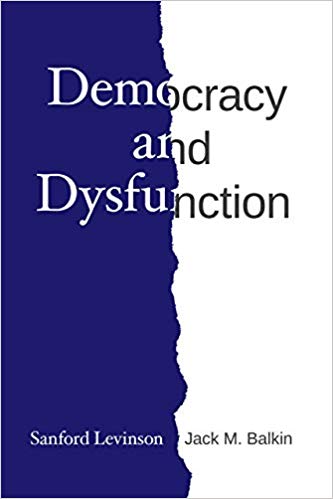
Sanford Levinson and Jack M. Balkin, Democracy and Dysfunction (University of Chicago Press, 2019)

Sanford Levinson, Written in Stone: Public Monuments in Changing Societies (Duke University Press 2018)

Mark A. Graber, Sanford Levinson, and Mark Tushnet, eds., Constitutional Democracy in Crisis? (Oxford University Press 2018)

Gerard Magliocca, The Heart of the Constitution: How the Bill of Rights became the Bill of Rights (Oxford University Press, 2018)

Cynthia Levinson and Sanford Levinson, Fault Lines in the Constitution: The Framers, Their Fights, and the Flaws that Affect Us Today (Peachtree Publishers, 2017)

Brian Z. Tamanaha, A Realistic Theory of Law (Cambridge University Press 2017)

Sanford Levinson, Nullification and Secession in Modern Constitutional Thought (University Press of Kansas 2016)

Sanford Levinson, An Argument Open to All: Reading The Federalist in the 21st Century (Yale University Press 2015)

Stephen M. Griffin, Broken Trust: Dysfunctional Government and Constitutional Reform (University Press of Kansas, 2015)

Frank Pasquale, The Black Box Society: The Secret Algorithms That Control Money and Information (Harvard University Press, 2015)

Bruce Ackerman, We the People, Volume 3: The Civil Rights Revolution (Harvard University Press, 2014)
Balkinization Symposium on We the People, Volume 3: The Civil Rights Revolution

Joseph Fishkin, Bottlenecks: A New Theory of Equal Opportunity (Oxford University Press, 2014)

Mark A. Graber, A New Introduction to American Constitutionalism (Oxford University Press, 2013)

John Mikhail, Elements of Moral Cognition: Rawls' Linguistic Analogy and the Cognitive Science of Moral and Legal Judgment (Cambridge University Press, 2013)

Gerard N. Magliocca, American Founding Son: John Bingham and the Invention of the Fourteenth Amendment (New York University Press, 2013)

Stephen M. Griffin, Long Wars and the Constitution (Harvard University Press, 2013)

Andrew Koppelman, The Tough Luck Constitution and the Assault on Health Care Reform (Oxford University Press, 2013)

James E. Fleming and Linda C. McClain, Ordered Liberty: Rights, Responsibilities, and Virtues (Harvard University Press, 2013)
Balkinization Symposium on Ordered Liberty: Rights, Responsibilities, and Virtues

Andrew Koppelman, Defending American Religious Neutrality (Harvard University Press, 2013)

Brian Z. Tamanaha, Failing Law Schools (University of Chicago Press, 2012)

Sanford Levinson, Framed: America's 51 Constitutions and the Crisis of Governance (Oxford University Press, 2012)

Linda C. McClain and Joanna L. Grossman, Gender Equality: Dimensions of Women's Equal Citizenship (Cambridge University Press, 2012)

Mary Dudziak, War Time: An Idea, Its History, Its Consequences (Oxford University Press, 2012)

Jack M. Balkin, Living Originalism (Harvard University Press, 2011)

Jason Mazzone, Copyfraud and Other Abuses of Intellectual Property Law (Stanford University Press, 2011)

Richard W. Garnett and Andrew Koppelman, First Amendment Stories, (Foundation Press 2011)

Jack M. Balkin, Constitutional Redemption: Political Faith in an Unjust World (Harvard University Press, 2011)

Gerard Magliocca, The Tragedy of William Jennings Bryan: Constitutional Law and the Politics of Backlash (Yale University Press, 2011)

Bernard Harcourt, The Illusion of Free Markets: Punishment and the Myth of Natural Order (Harvard University Press, 2010)

Bruce Ackerman, The Decline and Fall of the American Republic (Harvard University Press, 2010)
Balkinization Symposium on The Decline and Fall of the American Republic

Ian Ayres. Carrots and Sticks: Unlock the Power of Incentives to Get Things Done (Bantam Books, 2010)

Mark Tushnet, Why the Constitution Matters (Yale University Press 2010)

Ian Ayres and Barry Nalebuff: Lifecycle Investing: A New, Safe, and Audacious Way to Improve the Performance of Your Retirement Portfolio (Basic Books, 2010)
.jpg)
Jack M. Balkin, The Laws of Change: I Ching and the Philosophy of Life (2d Edition, Sybil Creek Press 2009)

Brian Z. Tamanaha, Beyond the Formalist-Realist Divide: The Role of Politics in Judging (Princeton University Press 2009)

Andrew Koppelman and Tobias Barrington Wolff, A Right to Discriminate?: How the Case of Boy Scouts of America v. James Dale Warped the Law of Free Association (Yale University Press 2009)

Jack M. Balkin and Reva B. Siegel, The Constitution in 2020 (Oxford University Press 2009)

Heather K. Gerken, The Democracy Index: Why Our Election System Is Failing and How to Fix It (Princeton University Press 2009)

Mary Dudziak, Exporting American Dreams: Thurgood Marshall's African Journey (Oxford University Press 2008)

David Luban, Legal Ethics and Human Dignity (Cambridge Univ. Press 2007)

Ian Ayres, Super Crunchers: Why Thinking-By-Numbers is the New Way to be Smart (Bantam 2007)

Jack M. Balkin, James Grimmelmann, Eddan Katz, Nimrod Kozlovski, Shlomit Wagman and Tal Zarsky, eds., Cybercrime: Digital Cops in a Networked Environment (N.Y.U. Press 2007)
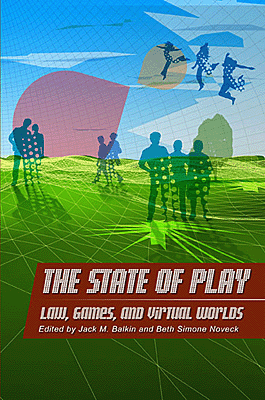
Jack M. Balkin and Beth Simone Noveck, The State of Play: Law, Games, and Virtual Worlds (N.Y.U. Press 2006)

Andrew Koppelman, Same Sex, Different States: When Same-Sex Marriages Cross State Lines (Yale University Press 2006)

Brian Tamanaha, Law as a Means to an End (Cambridge University Press 2006)

Sanford Levinson, Our Undemocratic Constitution (Oxford University Press 2006)

Mark Graber, Dred Scott and the Problem of Constitutional Evil (Cambridge University Press 2006)

Jack M. Balkin, ed., What Roe v. Wade Should Have Said (N.Y.U. Press 2005)

Sanford Levinson, ed., Torture: A Collection (Oxford University Press 2004)
Balkin.com homepage
Bibliography
Conlaw.net
Cultural Software
Writings
Opeds
The Information Society Project
BrownvBoard.com
Useful Links
Syllabi and Exams
