Balkinization
an unanticipated consequence of
Jack M. Balkin
Balkinization Symposiums: A Continuing List
E-mail:
Jack Balkin:
jackbalkin at yahoo.com
Bruce Ackerman
bruce.ackerman at yale.edu
Ian Ayres
ian.ayres at yale.edu
Corey Brettschneider
corey_brettschneider at brown.edu
Mary Dudziak
mary.l.dudziak at emory.edu
Joey Fishkin
joey.fishkin at gmail.com
Heather Gerken heather.gerken at yale.edu
Abbe Gluck abbe.gluck at yale.edu
Mark Graber
mgraber at law.umaryland.edu
Stephen Griffin
sgriffin at tulane.edu
Jonathan Hafetz
jonathan.hafetz at shu.edu
Jeremy Kessler
jkessler at law.columbia.edu
Andrew Koppelman
akoppelman at law.northwestern.edu
Marty Lederman
msl46 at law.georgetown.edu
Sanford Levinson
slevinson at law.utexas.edu
David Luban
david.luban at gmail.com
Gerard Magliocca
gmaglioc at iupui.edu
Jason Mazzone
mazzonej at illinois.edu
Linda McClain
lmcclain at bu.edu
John Mikhail
mikhail at law.georgetown.edu
Frank Pasquale
pasquale.frank at gmail.com
Nate Persily
npersily at gmail.com
Michael Stokes Paulsen
michaelstokespaulsen at gmail.com
Deborah Pearlstein
dpearlst at yu.edu
Rick Pildes
rick.pildes at nyu.edu
David Pozen
dpozen at law.columbia.edu
Richard Primus
raprimus at umich.edu
K. Sabeel Rahmansabeel.rahman at brooklaw.edu
Alice Ristroph
alice.ristroph at shu.edu
Neil Siegel
siegel at law.duke.edu
David Super
david.super at law.georgetown.edu
Brian Tamanaha
btamanaha at wulaw.wustl.edu
Nelson Tebbe
nelson.tebbe at brooklaw.edu
Mark Tushnet
mtushnet at law.harvard.edu
Adam Winkler
winkler at ucla.edu
Compendium of posts on Hobby Lobby and related cases
The Anti-Torture Memos: Balkinization Posts on Torture, Interrogation, Detention, War Powers, and OLC
The Anti-Torture Memos (arranged by topic)
Recent Posts
Two Texts: An Election Eve Meditation
![[Powered by Blogger]](https://lh3.googleusercontent.com/blogger_img_proxy/AEn0k_uwJ3YefYQd8tnv_72nZR4CFWKQbD0S1hPVdjKyxwHxYSp2iCNBbM9Yv0SMESYaTbJLikFhyCQ0sr-TdMk3Mi0DmSrw2D_0uetvOphrmX_G=s0-d)
Just A Few Blogs
ACS Blog
Alas, a Blog
Althouse
Arts and Letters Daily
Atrios (Eschaton)
Bill of Health
Buzzflash.com
Buzz Machine
Cato at Liberty
Juan Cole (Informed Comment)
Concurring Opinions
The Constitution in 2020
Corrente
Crooked Timber
Daily Howler
Daily Kos
Dana Boyd
Brad DeLong
Digby (Hullabaloo)
Discriminations
Daniel Drezner
Kevin Drum (Mother Jones)
Electrolite
En Banc
Eunomia (Daniel Larison)
Fafblog
Michael Froomkin (Discourse.net)
GovLab (Beth Noveck)
Rick Hasen (Election Law)
History News Network
How Appealing
Ignatz (Sam Heldman)
The Importance of (Ernie Miller)
Infolaw
Instapundit
International Economic Law and Policy Blog
IntLawGrrls
Jacob Levy
Jesus' General
Jurisdynamics
The Kitchen Cabinet
Mark Kleiman
Law Blog Central
Larry Lessig
Lawyers, Guns and Money
Liberal Oasis
Brian Leiter's Law School Reports
The Leiter Reports
Marginal Revolution
Megan McArdle
Memeorandum
Metafilter
Mirror of Justice
The New Republic
Newseum
No More Mister Nice Blog
Brendan Nyhan
Opinio Juris
Orcinus
The Originalism Blog
Pandagon
Passport (Foreign Policy)
Overcoming Bias
Political Animal (Washington Monthly)
Political Theory Daily Review
Political Wire (Taegan Goddard)
The Poor Man
Virginia Postrel
Prawfsblawg
Public Reason
Jonathan Rauch
Raw Story
Redstate
ReligiousLeftLaw.com
Reporters Committee For Freedom of the Press
Reproductive Rights Blog
Rothman's Roadmap to the Right of Publicity
SCOTUS Blog
Seeing the Forest
Clay Shirky
The Shifted Librarian
The Situationist
Larry Solum (Legal Theory)
Andrew Sullivan
Talking Points Memo
Talk Left
Tapped
Tbogg
TechPresident
The Paper Chase (Jurist)
Tom Paine
Tom Tomorrow (This Modern World)
Eve Tushnet
Uggabugga
University of Chicago Law School Faculty Blog
Unqualified Offerings
The Volokh Conspiracy
War and Piece (Laura Rozen)
Wampum
Oliver Willis
Wonkette
Written Description
Matthew Yglesias
Yin
Your Choice of Feeds
1. XML
powered by

2. Atom Feed
3. RSS 2.0
Two Texts: An Election Eve Meditation
Scott Horton
"It may be that despotizing moralists, in practice blundering, often violate rules of political prudence by taking or proposing decisions too quickly; but experience will gradually set them aright and lead them on to a better course. However, the moralizing politician, by glossing over principles of politics which are opposed to right with the pretext that human nature is not capable of the good as reason prescribes it, only makes reform impossible and perpetuates the violation of law.
"Instead of possessing the practical science they boast of, these politicians have only practices; they flatter the power which is then ruling so as not to be remiss in their private advantage, and they sacrifice the nation and, possibly, the whole world. This is the way of all professional lawyers (not legislators) when they go into politics. Their task is not to reason too nicely about the legislation but to execute the momentary commands on the statute books; consequently, the legal constitution in force at any time is to them the best, but when it is amended from above, this amendment always seems best, too. Thus everything is preserved in its accustomed mechanical order. Their adroitness in fitting into all circumstances gives them the illusion of being able to judge constitutional principles according to concepts of right (not empirically, but a priori). They make a great show of understanding men (which is certainly something to be expected of them, since they have to deal with so many) without understanding man and what can be made of him, for they lack the superior perspective of anthropological observation which is needed for this. If with these ideas they go into civil and international law, as reason prescribes it, they take this step in a spirit of chicanery, for they still follow their accustomed mechanical routine of despotically imposed coercive laws in a field where only concepts of reason can establish a legal compulsion according to the principles of freedom, under which alone a just and durable constitution is possible. In this field the pretended practical man thinks he can solve the problem of establishing such a constitution without the rational idea but solely from the experience he has had with what was previously the most lasting constitutions constitution which in many cases was opposed to the right.
"The maxims which he makes use of (though he does not divulge them) are, roughly speaking, the following sophisms:
"1. Fac et excusa. Seize every favorable opportunity for usurping the right of the state over its own people or over a neighboring people; the justification will be easier and more elegant ex post facto, and the power can be more easily glossed over, especially when the supreme power in the state is also the legislative authority which must be obeyed without argument. It is much more difficult to do the violence when one has first to wait upon the consideration of convincing arguments and to meet them with counterarguments. Boldness itself gives the appearance of inner conviction of the legitimacy of the deed, and the god of success is afterward the best advocate.
"2. Si fecisti, nega. What you have committed, deny that it was your fault--for instance, that you have brought your people to despair and hence to rebellion. Rather assert that it was due to the obstinacy of your subjects; or, if you have conquered a neighboring nation, say that the fault lies in the nature of man, who, if not met by force, can be counted on to make use of it to conquer you.
"3. Divide et impera. That is, if there are certain privileged persons in your nation who have chosen you as their chief (primus inter pares), set them at variance with one another and embroil them with the people. Show the latter visions of greater freedom, and all will soon depend on your untrammeled will. Or if it is foreign states that concern you, it is a pretty safe means to sow discord among them so that, by seeming to protect the weaker, you can conquer them one after another.
"Certainly no one is now the dupe of these political maxims, for they are already universally known. Nor are they blushed at, as if their injustice were too glaring, for great powers blush only at the judgment of other great powers but not at that of the common masses. It is not that they are ashamed of revealing such principles (for all of them are in the same boat with respect to the morality of their maxims); they are ashamed only when these maxims fail, for they still have political honor which cannot be disputed--and this honor is the aggrandizement of their power by whatever means.
"All these twistings and turnings of an immoral doctrine of prudence in leading men from their natural state of war to a state of peace prove at least that men in both their private and their public relationships cannot reject the concept of right or trust themselves openly to establish politics merely on the artifices of prudence. Thus they do not refuse obedience to the concept of public law, which is especially manifest in international law; on the contrary, they give all due honor to it, even when they are inventing a hundred pretenses and subterfuges to escape from it in practice, imputing its authority, as the source and union of all laws, to crafty force.
"Let us put an end to this sophism, if not to the injustice it protects, and force the false representatives of power to confess that they do not plead in favor of the right but in favor of might. This is revealed in the imperious tone they assume as if they themselves could command the right. Let us remove the delusion by which they and others are duped, and discover the supreme principle from which the intention to perpetual peace stems. Let us show that everything evil which stands in its way derives from the fact that the political moralist begins where the moral politician would correctly leave off, and that, since he thus subordinates principles to the end (putting the cart before the horse), he vitiates his own purpose of bringing politics into agreement with morality."
- Immanuel Kant, Zum ewigen Frieden – II. Anhang über die Mißhelligkeit zwischen Moral und Politik (1795) in Sämtliche Werke (Großherzog Wilhelm Ernst ed.), vol. 5, pp. 695-97
"Political realism refuses to identify the moral aspirations of a particular nation with the moral laws that govern the universe. As it distinguishes between truth and opinion, so it distinguishes between truth and idolatry. All nations are tempted--and few have been able to resist the temptation for long--to clothe their own particular aspirations and actions in the moral purposes of the universe. To know that nations are subject to the moral law is one thing, while to pretend to know with certainty what is good and evil in the relations among nations is quite another. There is a world of difference between the belief that all nations stand under the judgment of God, inscrutable to the human mind, and the blasphemous conviction that God is always on one's side and that what one wills oneself cannot fail to be willed by God also.
"The lighthearted equation between a particular nationalism and the counsels of Providence is morally indefensible, for it is that very sin of pride against which the Greek tragedians and the Biblical prophets have warned rulers and ruled. That equation is also politically pernicious, for it is liable to engender the distortion in judgment which, in the blindness of crusading frenzy, destroys nations and civilizations-in the name of moral principle, ideal, or God himself."
- Hans Morgenthau, Politics Among Nations: The Struggle for Power and Peace (New York: Alfred A. Knopf, 1978, pp. 10-11).
In one day, America votes. This election cannot be viewed as a series of individual candidates contesting specific seats, though American tradition counsels such an approach. It must instead be viewed as a referendum on George W. Bush, Dick Cheney and Donald Rumsfeld, the troika who have wielded America's awesome power in a series of historic misadventures. This is what Bush called an "accountability moment." As my friend Andrew Sullivan says, it is an opportunity for an intervention of the sort that social workers counsel for alcoholics and drug addicts. An intervention for those intoxicated with a lust for power. At this juncture it is important to see Bush and his conduct with some rigor and clarity, but also to consider the moral underpinnings of his actions. For this I propose that we look to the great moral philosopher Immanuel Kant, the man whose writings provided the fundamental architecture for the world order that emerged following the Second World War.
Kant welcomes the political moralist, but he warns us ardently of the moralizing politician, a species best viewed with great circumspection. In a fascinating passage of the Appendix on Divergences Between Politics and Morals, Kant gives us some practical tools. When can we distinguish between the two? How can we identify the wolf in sheep's clothing who presents himself on the public stage as a man of morals but in fact is morally corrupt? There is, writes Kant, a three-part test that gives us an unfailing peek at the political scoundrel.
First, does he seek every opportunity to assert the right of the state he controls over its own people and over other peoples? This is a question of aggrandizement of power, but for Kant it must be measured simultaneously – against his own people, and against other states.
Second, does he accept the principle of accountability for his own misdeeds – or does he in fact try to pass off to others every mistake that occurs?
Third, does he rule through the sowing of discord and division? After coming to power, does he identify other potential rivals to power and attack them or set them to battle, one against the other? Is he a "divider" or a "uniter" of his people?
America in its history has known great, mediocre and truly lamentable presidents. But in its entire history, America has had only one leader who clearly passes Kant's three-point test to detect the political scoundrel. His name is George W Bush. Is it even necessary to reherse the test?
First, Bush more than any other leader in the nation's history has asserted an ahistorical theory of presidential power, claiming ascendancy over the other branches of government and the right to act above the law, even in violation of the criminal law. This asserted tyrannical power is aimed both at the American republic, and even more menacingly, at states abroad. The fundamental strictures of skepticism and care are disregarded. The vital role of public debate and discourse as a precursor to use of the awesome war-making powers is corrupted. An Orwellian National Surveillance State is being crafted, the extent of which few in this country appreciate.
Second, Bush's refusal to accept responsibility for his erroneous judgments is now legendary. Hurricane Katrina was a defining moment for most Americans. But in this election, the war in Iraq reflects colossal, tragic misjudgments that have brought ruin and destruction to the Middle East and cost America immense blood and treasure. Yet, even now, Bush lies about the situation, talks about "winning" and "victory" and calls the performance of his Secretary of Defense "fantastic." (Which as Christopher Hitchens notes, it literally is, namely performance based on fantasy rather than reality).
Third, as the New York Times recently observed in an editorial, the historical moniker for Bush is now fixed: he is the Great Divider. No president has consciously worked to vilify his political rivals in quite so disgraceful and destructive a fashion as he has. He has been enabled in this horrifying project by a press which was pliant for six years, and only now shows ambiguous signs of awakening from an extended trance. Too late, perhaps.
Bush can be judged by his words and his conduct. More precisely, his words should be weighed against his conduct, as Hans Morgenthau writes. With some prompting from Greg Djerejian, I include his thoughts here for this proposition. Morgenthau may well be the anti-idealist; the anti-Kant. He is nevertheless a powerful and important thinker. And he too grasps the proper role of morality and the critical need to form careful judgments about those who cloak themselves in moralizing garb. Is his view fundamentally all that different from Kant's? Not on this point.
I fear for my country at this time. I fear for all of us and our world. Many of you may disagree with me. But I ask all to weigh this vote with care. This vote may be your last.
Posted
11:00 AM
by Scott Horton [link]
I'm usually on the other side of this conversation, trying to sound the alarm for what often seems the end of our valued and honorable way of life. But I try to moderate such thoughts.
If we stipulate that the PNAC powers that be are morally capable of consolidating power into a totaltarian system then it is too late anyway, because stipulating the will (and depravity) to betray the values of the nation, combined with the record of 2000 and 2004 elections, combined with the known Diebold partisanship, combined with the known Diebold security flaws, combined with the complicit media and an electorate so feckless as to be persuaded by statements such as Cheney's constant refrain that to vote Democrat is to vote for terror, well, all of that combined would mean we are too far gone.
We may be. There is an angle of analysis that says we have been too far gone for a long long time. But when we see the kinds of neo-con defection presented in the Vanity Fair article Professor Balkin linked to, when I think of the vast corporate interests which could not continue making profits as usual under a totalitarian regime, then I end up thinking that these are indeed dark and even evil times, but that we will weather them.
Perhaps the peasants on the slopes of Vesuvius had similar hopes as mine. I fear you are right in your assessment, but I tell myself it's premature. Peace.
ps: I can't recommend strongly enough looking into the killfile script for greasemonkey for firefox 2. I noticed on another thread that you are giving a couple of our best known trolls a very fair shot at interaction. At the risk of impertinence, it is the Liberal's greatest mistake, engaging ideological opponents who, rather than seeking legitimate dialectic in service of truth, are, in their own words, enaged in debate to persuade others to their world view. They're two very different criteria sets, with attendant differences in objectives and means, and to my eye the prime source of frustration and wasted effort by liberals is the time and energy wasted on the wrong people. With respect and gratitude, $.02.

Which party has the better plan on the war with Islamic fascism, taxes and your local issues?
The Donkeys who have the best chances of picking up seats are nearly all running as conservative light.
The candidate which most nearly reflects the views of most here is Ned Lamont and he is getting his lunch handed to him in a Deep Blue State by a pro war Donkey.
That is because heavy majorities of the voters support the various exercises of Presidential power which you decry from the NSA spying program to the MSA.
Vote your conscience one way or another, but realize that you have a choice and that choice does not involve Mr. Bush, who ran his last race in 2004.
I have to partially disagree. There are a fair number of House candidates that are running strongly against the war - and are winning. (I'm not going to take the time to link to info about each one - but I think a few minutes of digging should confirm what I am saying.)
Also, from what I understand, Lieberman is only winning because all (most) of the Republicans are voting for him - I mean he did lose the pimary to Lamont. So, at best you can say is majority of the country does reject the Lamont, "net roots," Democrats, but a majority does also reject Bush.
Robert Link :I'm usually on the other side of this conversation, trying to sound the alarm for what often seems the end of our valued and honorable way of life. But I try to moderate such thoughts.
Robert, I read Scott Horton as expressing certain fears -for the country. for all, for the world, without elaborating what he fears fall on them- and warning that this might be the last US election. These concerns, so stated, are very reasonable, in my opinion. He doesn’t make any predictions, one way or the other. That’s reasonable too, because there is no way to predict the things he appears to be worried about. Or if there is we haven’t figured it out yet. (In contrast, specific election outcomes can be predicted, with increasing accuracy.)
Your formula “If we stipulate that... etc., etc.” is interesting but it’s predictive utility hasn’t been verified, nor do we know how to verify it. Thus, with all respect, I cannot take comfort from your projection.
It seems to me that what will happen will be influenced by what has happened already, which is always the case. Obviously, we cannot change the past. We can influence developments by our actions, that is, by politics, which includes election campaigns, but is not limited to them.
For today and tomorrow, we want to deal GOP candidates as crushing a defeat as possible, by GOTV, as always, but also by assuring election integrity. The fact that this integrity battle is taking place at all diminishes the democratic legitimacy of our political system.
After that, we’ll see.
The outcome will be determined by our efforts, and of course those of our adversary. This is always so. What is new, and very bad, is that the character of our political system-whether the US is a constitutional democracy or some inferior form- is a contested issue in this election and for the foreseeable future. This is something I never anticipated.
Stuff happens.
obat herpes tradisional yang ampuh
obat herpes terbaik
obat herpes tangan
obat herpes tercepat
obat herpes tipe 2
obat herpes tradisional untuk bayi
obat herpes tenggorokan
obat herpes terbaru
obat herpes tablet
obat herpes tomcat
obat herpes tumbuhan
Kapur sirih untuk obat kutil kelamin
Obat kutil kelamin medis
Obat menghilangkan kutil kelamin
Obat menyembuhkan kutil kelamin
Obat tradisional menyembuhkan kutil kelamin
Obat minum untuk kutil kelamin
Obat medis untuk kutil kelamin
Merek obat kutil kelamin
Obat kutil kelamin de nature
Nama obat kutil kelamin
Obat tradisional buat sipilis
Obat herbal buat sipilis
Obat dokter buat sipilis
Obat sipilis dengan bayam duri
Obat sipilis yang bagus
Obat china sipilis
Cara obat sipilis di apotik
Cara obat sipilis pada pria
Cari obat sipilis
Contoh obat sipilis
http://agusus1.blogspot.com/
http://agusyafii.blogspot.com/
http://amateursexxxx.blogspot.co.id/
Obat sipilis Obat kutil kelamin obat wasirhttp://oplosanobatkutilkelamin.blogspot.com/
http://www.smaboy.com/u/obatkutil
http://tinyblogs.net/u/obatkutil/
http://tinyblogs.net/u/obatkutil/
http://obatkutil.blogszino.com/
http://obatkutil.over-blog.com/
http://obatkutilkelamin-tradisional.jimdo.com/
http://www.lautanindonesia.com/blog/obatkutilkelamindanjenggerayam/
http://obatkutilmanjur.weebly.com/
http://obatkutilampuh.livejournal.com/
http://obatkutilkelamintradisional123.blogdetik.com/
http://obatkutil12345.edublogs.org/
http://pengobatankutil.blog.planetbiru.com/
http://obatkutil.freeblog.biz/
http://batkutil.blog.com/
Obat kutil di sekitar kelamin
Obat farmasi untuk kutil kelamin
Obat generik untuk kutil kelamin
Obat kutil kelamin imiquimod
Jual obat kutil kelamin
Jual obat kutil kelamin murah
Obat kutil kelamin yg di jual di apotik
Jual obat penghilang kutil kelamin
Obat kimia kutil kelamin
Kapur sirih untuk obat kutil kelamin
Obat kutil kelamin medis
Obat menghilangkan kutil kelamin
Obat kutil kelamin tradisional
Obat kutil kelamin
Obat kutil kelamin wanita
Obat kutil kelamin di apotik
Obat kutil kelamin untuk ibu hamil
Obat kutil kelamin untuk wanita
Obat kutil kelamin mujarab
Obat kutil kelamin di anus
Obat kutil kelamin/jengger ayam
Obat kutil kelamin paling murah
obat gonore pada ibu hamil
obat gonore tradisional
obat gonore tenggorokan
obat gonore paling efektif
obat gonore pada wanita
obat gonore atau kencing nanah
obat gonore tenggorokan
obat gonore paling efektif
obat gonore pada wanita
obat gonore atau kencing nanah
obat gonore apa
obat alternatif gonore
obat gonore yang ampuh
obat gonore yg ampuh
obat gonore yang paling ampuh
obat gonore yang dijual di apotik
obat buat gonore
obat bakteri gonore
obat gonore dijual bebas
obat pembunuh bakteri gonore
buah obat gonore
obat gonore dan klamidia
obat gonore dokter
nama obat gonore di apotek
jenis obat gonore di apotik
harga obat gonore di apotik
merk obat gonore di apotik
obat sifilis dan gonore
fungsi obat gonore
obat gejala gonore
obat gonore untuk ibu hamil
obat gonore untuk wanita hamil
harga obat gonore
obat injeksi gonore
obat kutil kelamin yang ada di apotik
obat kutil kelamin yg dijual di apotik
obat kutil di kemaluan wanita
pengobatan kutil kelamin pada pria
pengobatan penyakit kutil kelamin pada pria
obat penyakit kutil pada kelamin pria
Pengobatan kutil kelamin aman dan tanpa operasi
obat kutil pada alat kelamin pria
pengobatan kutil kelamin
pengobatan kutil kelamin pada pria dan wanita
pengobatan kutil kelamin pria
pengobatan kutil kelamin wanita
pengobatan kutil kelamin dengan cuka apel
pengobatan kutil kelamin di anus
Cara mengobati kutil di kelamin wanita hamil
pengobatan kutil kelamin di bandung
obat kutil kelamin
obat kutil kelamin di apotik
obat kutil kelamin tradisional
obat kutil kelamin wanita
obat kutil kelamin apotik
obat kutil kelamin murah
obat kutil kelamin de nature
obat kutil kelamin untuk ibu hamil
obat kutil kelamin dokter
Cara mengobati jengger ayam dan kutil kelamin
Obat untuk kutil kelamin pada wanita
Pengobatan kutil pada kelamin pria
Ciri ciri kutil kelamin dan obatnya
Cara mengobati wasir dengan cepat
Cara mengobati wasir dengan propolis
Cara mengobati wasir tanpa obat
Cara mengobati wasir yang sudah parah
Cara mengobati wasir berdarah secara alami
Cara mengobati wasir luar secara alami
Cara mengobati wasir dengan lidah buaya
Cara mengobati wasir setelah melahirkan
Cara mengobati wasir luar tanpa operasi
Cara mengobati wasir alami
Cara mengobati wasir akut
Cara mengobati wasir atau ambeyen
Cara mengobati wasir/ambeyen
Cara mengobati wasir atau ambien
Cara mengobati wasir/ambien
Cara mengobati wasir yang alami
Cara mengobati penyakit wasir ambeyen
Obat tradisional menyembuhkan kutil kelamin
Obat minum untuk kutil kelamin
Obat medis untuk kutil kelamin
Obat kutil kelamin DE NATURE
Merek obat kutil kelamin
Obat kutil kelamin de nature
Nama obat kutil kelamin
Nama salep obat kutil kelamin
Obat kutil kelamin tanpa operasi
Obat oles untuk kutil kelamin
Obat kutil di alat kelamin pria
Obat untuk kutil pada kelamin
Obat tradisional kutil pada kelamin
Obat penyakit kutil kelamin
Obat penghilang kutil kelamin
Obat perontok kutil kelamin
Obat tradisional kutil kelamin pada pria
Obat untuk penyakit kutil kelamin
Propolis untuk obat kutil kelamin
Obat alami untuk penyakit kutil kelamin
Obat kutil pd kelamin
Resep obat kutil kelamin
Obat anti sifilis
Obat sipilis dijual di apotik
Obat sipilis murah di apotik
Obat alami sipilis pada pria
Obat sifilis ampuh
Obat sipilis beli di apotik
Obat sipilis buat wanita
Obat sipilis buatan sendiri
Obat sipilis bagi wanita
Obat buat sipilis
Obat biotik sifilis
Obat antibiotik buat sipilis
Obat tradisional buat sipilis
Obat herbal buat sipilis
Obat dokter buat sipilis
Obat generik buat sipilis
Obat sipilis dengan bayam duri
Obat sipilis yang bagus
Obat buat sifilis
Obat sipilis.com
Obat sipilis ciprofloxacin
Obat china sipilis
obat kutil kelamin dan leher
obat alami menghilangkan kutil kelamin
obat tradisional untuk menghilangkan kutil kelamin
kumpulan obat kutil kelamin
obat tradisional kutil kelamin
obat penyakit kutil kelamin
obat tradisional untuk kutil kelamin
obat alami untuk menghilangkan kutil kelamin
obat alami kutil kelamin
Obat kencing nanah pria
Obat kencing nanah dan darah
Obat kencing nanah apotik
Obat kencing nanah antibiotik
Obat kencing nanah amoxicillin
Obat kencing nanah apa
Obat kencing nanah apa ya
Obat kencing nanah atau gonore
Obat kencing nanah akut
Obat kencing nanah ada di apotik
Obat kencing nanah di apotik umum
Obat kencing nanah paling ampuh
Obat kencing nanah yang ampuh
Obat kencing nanah secara alami
Obat kencing nanah bandung
Obat kencing nanah buatan sendiri
Obat kencing nanah yang bisa dibeli di apotik
Obat herbal untuk mengobati kencing nanah
Obat kencing nanah paling bagus
Obat kencing nanah yang bisa dibeli di apotek
Obat kencing nanah di apotik bebas
Obat kencing nanah yang dijual bebas
Agen Judi Online Terpercaya
Books by Balkinization Bloggers

Gerard N. Magliocca, The Actual Art of Governing: Justice Robert H. Jackson's Concurring Opinion in the Steel Seizure Case (Oxford University Press, 2025)

Linda C. McClain and Aziza Ahmed, The Routledge Companion to Gender and COVID-19 (Routledge, 2024)

David Pozen, The Constitution of the War on Drugs (Oxford University Press, 2024)

Jack M. Balkin, Memory and Authority: The Uses of History in Constitutional Interpretation (Yale University Press, 2024)
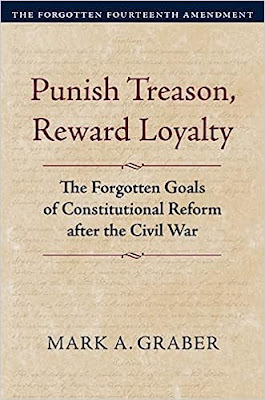
Mark A. Graber, Punish Treason, Reward Loyalty: The Forgotten Goals of Constitutional Reform after the Civil War (University of Kansas Press, 2023)
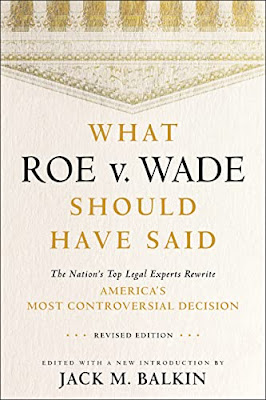
Jack M. Balkin, What Roe v. Wade Should Have Said: The Nation's Top Legal Experts Rewrite America's Most Controversial Decision - Revised Edition (NYU Press, 2023)

Andrew Koppelman, Burning Down the House: How Libertarian Philosophy Was Corrupted by Delusion and Greed (St. Martin’s Press, 2022)

Gerard N. Magliocca, Washington's Heir: The Life of Justice Bushrod Washington (Oxford University Press, 2022)
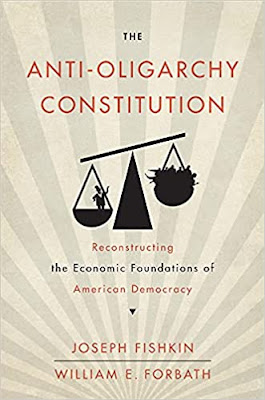
Joseph Fishkin and William E. Forbath, The Anti-Oligarchy Constitution: Reconstructing the Economic Foundations of American Democracy (Harvard University Press, 2022)
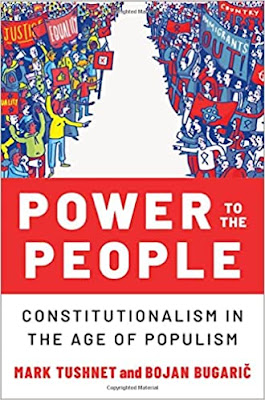
Mark Tushnet and Bojan Bugaric, Power to the People: Constitutionalism in the Age of Populism (Oxford University Press 2021).

Mark Philip Bradley and Mary L. Dudziak, eds., Making the Forever War: Marilyn B. Young on the Culture and Politics of American Militarism Culture and Politics in the Cold War and Beyond (University of Massachusetts Press, 2021).

Jack M. Balkin, What Obergefell v. Hodges Should Have Said: The Nation's Top Legal Experts Rewrite America's Same-Sex Marriage Decision (Yale University Press, 2020)

Frank Pasquale, New Laws of Robotics: Defending Human Expertise in the Age of AI (Belknap Press, 2020)

Jack M. Balkin, The Cycles of Constitutional Time (Oxford University Press, 2020)

Mark Tushnet, Taking Back the Constitution: Activist Judges and the Next Age of American Law (Yale University Press 2020).

Andrew Koppelman, Gay Rights vs. Religious Liberty?: The Unnecessary Conflict (Oxford University Press, 2020)

Ezekiel J Emanuel and Abbe R. Gluck, The Trillion Dollar Revolution: How the Affordable Care Act Transformed Politics, Law, and Health Care in America (PublicAffairs, 2020)

Linda C. McClain, Who's the Bigot?: Learning from Conflicts over Marriage and Civil Rights Law (Oxford University Press, 2020)
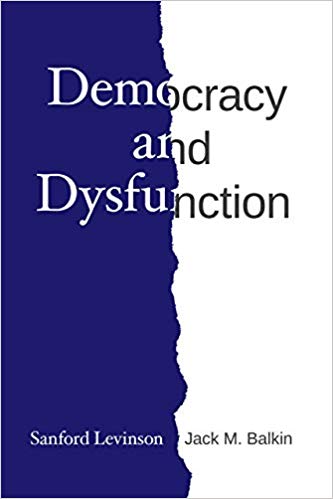
Sanford Levinson and Jack M. Balkin, Democracy and Dysfunction (University of Chicago Press, 2019)

Sanford Levinson, Written in Stone: Public Monuments in Changing Societies (Duke University Press 2018)

Mark A. Graber, Sanford Levinson, and Mark Tushnet, eds., Constitutional Democracy in Crisis? (Oxford University Press 2018)

Gerard Magliocca, The Heart of the Constitution: How the Bill of Rights became the Bill of Rights (Oxford University Press, 2018)

Cynthia Levinson and Sanford Levinson, Fault Lines in the Constitution: The Framers, Their Fights, and the Flaws that Affect Us Today (Peachtree Publishers, 2017)

Brian Z. Tamanaha, A Realistic Theory of Law (Cambridge University Press 2017)

Sanford Levinson, Nullification and Secession in Modern Constitutional Thought (University Press of Kansas 2016)

Sanford Levinson, An Argument Open to All: Reading The Federalist in the 21st Century (Yale University Press 2015)

Stephen M. Griffin, Broken Trust: Dysfunctional Government and Constitutional Reform (University Press of Kansas, 2015)

Frank Pasquale, The Black Box Society: The Secret Algorithms That Control Money and Information (Harvard University Press, 2015)

Bruce Ackerman, We the People, Volume 3: The Civil Rights Revolution (Harvard University Press, 2014)
Balkinization Symposium on We the People, Volume 3: The Civil Rights Revolution

Joseph Fishkin, Bottlenecks: A New Theory of Equal Opportunity (Oxford University Press, 2014)

Mark A. Graber, A New Introduction to American Constitutionalism (Oxford University Press, 2013)

John Mikhail, Elements of Moral Cognition: Rawls' Linguistic Analogy and the Cognitive Science of Moral and Legal Judgment (Cambridge University Press, 2013)

Gerard N. Magliocca, American Founding Son: John Bingham and the Invention of the Fourteenth Amendment (New York University Press, 2013)

Stephen M. Griffin, Long Wars and the Constitution (Harvard University Press, 2013)

Andrew Koppelman, The Tough Luck Constitution and the Assault on Health Care Reform (Oxford University Press, 2013)

James E. Fleming and Linda C. McClain, Ordered Liberty: Rights, Responsibilities, and Virtues (Harvard University Press, 2013)
Balkinization Symposium on Ordered Liberty: Rights, Responsibilities, and Virtues

Andrew Koppelman, Defending American Religious Neutrality (Harvard University Press, 2013)

Brian Z. Tamanaha, Failing Law Schools (University of Chicago Press, 2012)

Sanford Levinson, Framed: America's 51 Constitutions and the Crisis of Governance (Oxford University Press, 2012)

Linda C. McClain and Joanna L. Grossman, Gender Equality: Dimensions of Women's Equal Citizenship (Cambridge University Press, 2012)

Mary Dudziak, War Time: An Idea, Its History, Its Consequences (Oxford University Press, 2012)

Jack M. Balkin, Living Originalism (Harvard University Press, 2011)

Jason Mazzone, Copyfraud and Other Abuses of Intellectual Property Law (Stanford University Press, 2011)

Richard W. Garnett and Andrew Koppelman, First Amendment Stories, (Foundation Press 2011)

Jack M. Balkin, Constitutional Redemption: Political Faith in an Unjust World (Harvard University Press, 2011)

Gerard Magliocca, The Tragedy of William Jennings Bryan: Constitutional Law and the Politics of Backlash (Yale University Press, 2011)

Bernard Harcourt, The Illusion of Free Markets: Punishment and the Myth of Natural Order (Harvard University Press, 2010)

Bruce Ackerman, The Decline and Fall of the American Republic (Harvard University Press, 2010)
Balkinization Symposium on The Decline and Fall of the American Republic

Ian Ayres. Carrots and Sticks: Unlock the Power of Incentives to Get Things Done (Bantam Books, 2010)

Mark Tushnet, Why the Constitution Matters (Yale University Press 2010)

Ian Ayres and Barry Nalebuff: Lifecycle Investing: A New, Safe, and Audacious Way to Improve the Performance of Your Retirement Portfolio (Basic Books, 2010)
.jpg)
Jack M. Balkin, The Laws of Change: I Ching and the Philosophy of Life (2d Edition, Sybil Creek Press 2009)

Brian Z. Tamanaha, Beyond the Formalist-Realist Divide: The Role of Politics in Judging (Princeton University Press 2009)

Andrew Koppelman and Tobias Barrington Wolff, A Right to Discriminate?: How the Case of Boy Scouts of America v. James Dale Warped the Law of Free Association (Yale University Press 2009)

Jack M. Balkin and Reva B. Siegel, The Constitution in 2020 (Oxford University Press 2009)

Heather K. Gerken, The Democracy Index: Why Our Election System Is Failing and How to Fix It (Princeton University Press 2009)

Mary Dudziak, Exporting American Dreams: Thurgood Marshall's African Journey (Oxford University Press 2008)

David Luban, Legal Ethics and Human Dignity (Cambridge Univ. Press 2007)

Ian Ayres, Super Crunchers: Why Thinking-By-Numbers is the New Way to be Smart (Bantam 2007)

Jack M. Balkin, James Grimmelmann, Eddan Katz, Nimrod Kozlovski, Shlomit Wagman and Tal Zarsky, eds., Cybercrime: Digital Cops in a Networked Environment (N.Y.U. Press 2007)

Jack M. Balkin and Beth Simone Noveck, The State of Play: Law, Games, and Virtual Worlds (N.Y.U. Press 2006)

Andrew Koppelman, Same Sex, Different States: When Same-Sex Marriages Cross State Lines (Yale University Press 2006)

Brian Tamanaha, Law as a Means to an End (Cambridge University Press 2006)

Sanford Levinson, Our Undemocratic Constitution (Oxford University Press 2006)

Mark Graber, Dred Scott and the Problem of Constitutional Evil (Cambridge University Press 2006)

Jack M. Balkin, ed., What Roe v. Wade Should Have Said (N.Y.U. Press 2005)

Sanford Levinson, ed., Torture: A Collection (Oxford University Press 2004)
Balkin.com homepage
Bibliography
Conlaw.net
Cultural Software
Writings
Opeds
The Information Society Project
BrownvBoard.com
Useful Links
Syllabi and Exams
