Balkinization
an unanticipated consequence of
Jack M. Balkin
Balkinization Symposiums: A Continuing List
E-mail:
Jack Balkin:
jackbalkin at yahoo.com
Bruce Ackerman
bruce.ackerman at yale.edu
Ian Ayres
ian.ayres at yale.edu
Corey Brettschneider
corey_brettschneider at brown.edu
Mary Dudziak
mary.l.dudziak at emory.edu
Joey Fishkin
joey.fishkin at gmail.com
Heather Gerken heather.gerken at yale.edu
Abbe Gluck abbe.gluck at yale.edu
Mark Graber
mgraber at law.umaryland.edu
Stephen Griffin
sgriffin at tulane.edu
Jonathan Hafetz
jonathan.hafetz at shu.edu
Jeremy Kessler
jkessler at law.columbia.edu
Andrew Koppelman
akoppelman at law.northwestern.edu
Marty Lederman
msl46 at law.georgetown.edu
Sanford Levinson
slevinson at law.utexas.edu
David Luban
david.luban at gmail.com
Gerard Magliocca
gmaglioc at iupui.edu
Jason Mazzone
mazzonej at illinois.edu
Linda McClain
lmcclain at bu.edu
John Mikhail
mikhail at law.georgetown.edu
Frank Pasquale
pasquale.frank at gmail.com
Nate Persily
npersily at gmail.com
Michael Stokes Paulsen
michaelstokespaulsen at gmail.com
Deborah Pearlstein
dpearlst at yu.edu
Rick Pildes
rick.pildes at nyu.edu
David Pozen
dpozen at law.columbia.edu
Richard Primus
raprimus at umich.edu
K. Sabeel Rahmansabeel.rahman at brooklaw.edu
Alice Ristroph
alice.ristroph at shu.edu
Neil Siegel
siegel at law.duke.edu
David Super
david.super at law.georgetown.edu
Brian Tamanaha
btamanaha at wulaw.wustl.edu
Nelson Tebbe
nelson.tebbe at brooklaw.edu
Mark Tushnet
mtushnet at law.harvard.edu
Adam Winkler
winkler at ucla.edu
Compendium of posts on Hobby Lobby and related cases
The Anti-Torture Memos: Balkinization Posts on Torture, Interrogation, Detention, War Powers, and OLC
The Anti-Torture Memos (arranged by topic)
Recent Posts
The 1% solution and the marginalization of civil liberties
![[Powered by Blogger]](https://lh3.googleusercontent.com/blogger_img_proxy/AEn0k_uc55aagrR2kG7Xq-cBbWwzBQUcFjSFFoVF7KGlUm3a37Rby9emXqi1RpZLv4ZBu1HKFX-jKvPnWKqyJlrx5pxkuclO6a3Wmtd_hq0nuVM2=s0-d)
Just A Few Blogs
ACS Blog
Alas, a Blog
Althouse
Arts and Letters Daily
Atrios (Eschaton)
Bill of Health
Buzzflash.com
Buzz Machine
Cato at Liberty
Juan Cole (Informed Comment)
Concurring Opinions
The Constitution in 2020
Corrente
Crooked Timber
Daily Howler
Daily Kos
Dana Boyd
Brad DeLong
Digby (Hullabaloo)
Discriminations
Daniel Drezner
Kevin Drum (Mother Jones)
Electrolite
En Banc
Eunomia (Daniel Larison)
Fafblog
Michael Froomkin (Discourse.net)
GovLab (Beth Noveck)
Rick Hasen (Election Law)
History News Network
How Appealing
Ignatz (Sam Heldman)
The Importance of (Ernie Miller)
Infolaw
Instapundit
International Economic Law and Policy Blog
IntLawGrrls
Jacob Levy
Jesus' General
Jurisdynamics
The Kitchen Cabinet
Mark Kleiman
Law Blog Central
Larry Lessig
Lawyers, Guns and Money
Liberal Oasis
Brian Leiter's Law School Reports
The Leiter Reports
Marginal Revolution
Megan McArdle
Memeorandum
Metafilter
Mirror of Justice
The New Republic
Newseum
No More Mister Nice Blog
Brendan Nyhan
Opinio Juris
Orcinus
The Originalism Blog
Pandagon
Passport (Foreign Policy)
Overcoming Bias
Political Animal (Washington Monthly)
Political Theory Daily Review
Political Wire (Taegan Goddard)
The Poor Man
Virginia Postrel
Prawfsblawg
Public Reason
Jonathan Rauch
Raw Story
Redstate
ReligiousLeftLaw.com
Reporters Committee For Freedom of the Press
Reproductive Rights Blog
Rothman's Roadmap to the Right of Publicity
SCOTUS Blog
Seeing the Forest
Clay Shirky
The Shifted Librarian
The Situationist
Larry Solum (Legal Theory)
Andrew Sullivan
Talking Points Memo
Talk Left
Tapped
Tbogg
TechPresident
The Paper Chase (Jurist)
Tom Paine
Tom Tomorrow (This Modern World)
Eve Tushnet
Uggabugga
University of Chicago Law School Faculty Blog
Unqualified Offerings
The Volokh Conspiracy
War and Piece (Laura Rozen)
Wampum
Oliver Willis
Wonkette
Written Description
Matthew Yglesias
Yin
Your Choice of Feeds
1. XML
powered by

2. Atom Feed
3. RSS 2.0
The 1% solution and the marginalization of civil liberties
Sandy Levinson
An article in today's New York Times by a British writer, Christopher Caldwell, is, I suspect, symptomatic of the declining support for civil liberties even among elites. The key part of his article comes toward the end: "Blair’s opponents equate today’s civil liberties protections with core British values." Caldwell appears to believe that they are best conceived only as "temporary adjustments that were useful under certain specific circumstances in part of Europe between World War II and the late 20th century.
"Even before Sept. 11, social critics noted that our culture has tended to mistake relatively ephemeral 20th-century phenomena for eternal truths. " Caldwell offers an analogy to modernism in art, borrowed from the writings of art historian T.J. Clark. "Modernism, after all, was presented to every educated Westerner born after 1930 as a new canon that would permanently overshadow the old one. But one could infer from Clark’s reading that, after the fall of the Berlin Wall, much of 20th-century art and culture would be revealed as a timebound fad, albeit a big and influential one. As indeed it was. "
"Some of Britain’s Muslim leaders may also be susceptible to this mistake. Muslims have, after all, been present in Europe en masse for only a very few decades. Many community leaders have rightly understood that contemporary Britain’s commitment to multiculturalism and tolerance hardly amounts to a license of lawlessness. But not all. The sharp-tongued chairman of the Birmingham Central Mosque, Mohammad Naseem, greeted the worries about the potential mass murder of flying civilians with a cavalierness almost unbelievable under the circumstances. “With the track record of the police,” Naseem told The Guardian, “one doesn’t have much faith in the basis on which people are detained. And it poses the question whether the arrests are part of a political objective, by using Muslims as a target, using the perception of terrorism to usurp all our civil liberties and get more and more control while moving towards a totalitarian state.” Until five years ago, this kind of talk might have won him a few allies, as well as enemies. Now it is hard even to understand. If Naseem thinks that the rights of defendants are a cause around which 21st-century Britons will rally, he is making a minor misjudgment. If he thinks that the Britain he is addressing is the same Britain that existed from the 1940’s until a few years ago, eager to build bridges between communities and classes, no matter the cost, he is making a major one."
Perhaps one should commend the Times for opening its pages to all points of view. But Caldwell is not contributing the equivalent of an op-ed. He is a "contributing editor" of the Times Magazine, and one presumes that he is viewed as someone whose perceptions about politics should be taken with due seriousness. So the bottom line is whether Caldwell would just as easily condemn Judge Taylor and Laurence Tribe for believing that 21st century Americans should really care about rights of defendants and/or people suspected of complicity with terror. But we should ask ourselves what the right language of response is to Caldwell. Do we make arguments along the lines that we have to bear certain risks (including increasing the probability of serious terrorist incidents) in order to maintain a free society? Or do we say that respecting civil liberties does not in fact increase such risks? Is the latter argument really plausible? (Isn't it like arguing that criminals do not in fact ever go free (merely) because the constable blundered, to quote Cardozo's critique of exclusionary rules?) If we must address the former argument, how do we frankly confront what level of risk is worth running? (Regular readers of Balkinization will recognize the structural similarity of the argument to the debate about torture and whether there are ever any costs (as well as obvious moral gains) to an absolute prohibition on torture.)
This, then, brings me to my title and its reference to the 1% solution, which has gained currency because of its use--and implicit criticism--in Ron Suskind's recent book about the "Cheney doctrine," which is that we must engage in pre-emptive attacks whenever there is a 1% risk of something truly untoward happening. Many of Cheney's critics attacked that notion because of the way it leads to a paranoid form of politics. But don't we all engage in such analysis, depending on the magnitude of the risks involved? Lawyers in the audience will recognize this as the question posed by Learned Hand in his opinion in the Dennis case, in which he reconfigured the "clear and present danger" test to include a multiplication of the probability p by the gravity g of the risk. Obviously, if g approaches infinity, then the weighted number is very high even if p is quite low, including only 1%.
As Cass Sunstein and others have pointed out, many environmentalists, writing about global warming, embrace the "precautionary principle," which suggests that quite drastic action be taken even if there is only a relatively low risk of, say, rising ocean levels and the like. The strong appeal of Al Gore's movie, which I was much impressed by, ultimately rests on a version of the "1% solutioin."
So, returning to Caldwell, how do we decide what incursions on our liberties are worth paying, given very low p's but quite high g's? And how do we weigh in our analyses the costs c to individuals whose liberties are being infringed? Consider the triviality of no longer being able to bring toothpaste onto airplanes in carryons. For many, including myself, this is a considerable inconvenience that imposes considerable costs on each and every traveller in terms of time spent either checking (and then waiting around for) one's bag or having to purchase toothpaste whenever one arrives at one's destination. Presumably we accept the inconvenience because the cost to the "innocent" individual is very low. But what if c is considerably higher, involving deprivation of liberty for, say, 28 days, without a lawyer and confronting police interrogation? And so on. Caldwell apparently believes that the gravity of a blown-up plane is sufficiently close to, say, a Nazi takeover of Europe so that it justifies a similar decline in respect for civil liberties. Is he correct? As Bruce Ackerman argues in his new book, no one can seriously argue that al Qaeda is trying to displace the US government. But is an attempt functionally to shut down much of American society as we ordinary conceive it, including readily available air travel, to be dismissed "merely' because bin Laden is making no effort to march onto Washington and take over the White House?
I ask these as genuine questions. They are obviously linked to the rise of the National Surveillance State about which Jack and I have begun writing. How is what Foucault called the "gaze" of the state being "renormalized" to make decidedly "old-fashioned" the kind of respect for civil liberties, including the necessity for a decisive congressional role in their diminution, displayed in Judge Taylor's opinioni and Professor Tribe's defense?
A final analogy: Frank Michelman's perhaps best known article is his 1968 piece in the Harvard Law Review "Protecting the Poor Through the Fourteenth Amendment," in which he set out the basic arguments for "constitutionalizing" the welfare state. Cass Sunstein has recently argued that if Hubert Humphrey had won the 1968 election, then it is altogether possible that Michelman's vision (and FDR's call for a "Second Bill of Rights in 1944) would have been realized with the replacement of Warren, Fortas, Harlan and Black by judges quite diferent from Burger, Blackmun, Rehnquist and Powell. That obviously did not happen, and Michelman's arguments were decisively rejected by the Supreme Court in 1973. But the real point is that by the 1990s, Michelman's arguments were basically "unsayable," at least by "mainstream" law professors (including Michelman himself). Ronald Dworkin seemed almost to take delight in pointing out in 1996 that his "moral reading" of the Constitution didn't include anything so outlandish as "welfare rights," and most liberal law professors spent most of their time, like Dworkin, in demonstrating how the Constitution, properly read, protected sexual autonomy and reproductive choice. And, of course, it ws Clinton himself who led the attack on the "welfare system as we knew it." Similarly, if Bill Clinton had an agenda in his appointments to the bench, it was making sure that Roe would be protected (even though some of us believe that that has in fact worked contrary to the institutional interest of the Democratic Party). He might also have been concerned to protect affirmative action. Otherwise, he certainly exhibited no interest in the judicial expansion of welfare rights and was, moreover, the most anti-civil libertarian president since World War II, as seen in his willingness to support and sign various "anti-terrorism" legislation that basically eviscerated habeas corpus as a meaningful protection for criminal defendants deprived of their constitutional rights in state and federal courts.
So at what point will the "standard-form" ACLU arguments on civil liberties become equally marginalized and sound anachronistic? When will proponents of such views be told, dismissively, that they are sooo 20th century? And, more to the point, when will the proponents accept their own marginalization and stop making them? We're clearly not at that point yet. But, frankly, Professor Tribe, like myself, is now a "senior citizen," socialized in a different era. There are clearly some younger professors who are admirably continuing in that tradition. I think especially of David Cole and Neal Katyal. But how representative are they? And how representative are Christopher Caldwell and the legal academics who almost certainly share his views, including, say, Eric Posner and Adrien Vermeule? Who will more successfully shape the views of the next generation of lawyers (and law-oriented journalists and pundits)?
Posted
10:37 PM
by Sandy Levinson [link]
for example, any washington denizen (especially one with financial interests in the defense industry) will realize a huge benefit from deterring successful "nuculer" attacks on US cities. some will actually benefit from limitations on civil rights (think secrecy in government). but the economic/political elite have few if any family or friends likely to be in combat. so, their benefits from dramatic measures to prevent terrorist attacks are substantial and the costs to them are negligible.
this applies loosely to the issue raised about young lawyers and their commitment to equal opportunity/civil liberties. they probably also assume they will prosper in the society no matter what (abundance may be all they've ever known). those of us who were young in the 40s and 50s often had direct (altho not necessarily personal) experience with some deprivation (in my case, minor - humble but comfortable origins in segregated texas, though white) and could easily empathize with the less fortunate even as affluence enveloped us; ie, visceral sensitivity to the "cost" of inaction in providing equal opportunity, and strong appreciation of the "benefit" of opportunities largely undeserved (after all, one doesn't "choose" to be smart enough to qualify for scholarships, and admissions then were much less competitive). having little contact with contemporary youth, I don't know what their cost-benefit weights might be, but I have experienced many seemingly young blog commenters who apparently feel that whatever your station in life, it's "deserved" in some sense (or in my view, nonsense) of distorted libertarianism.

I can never look at the NRA's membership statistics, without reflecting that if the ACLU had made a different choice some years back, the NRA would still be a club for sportsmen, and the ACLU would be the several million member strong lobbying juggernaut, with a firm footing on both ends of the political spectrum.
According to Ira Glasser, who spoke at a supper club I was part of back in the early 80's, the decision was motivated by the threat of some major donors to defund the ACLU if it dared to defend that amendment. I suspect he was in a position to know.
Principled? Not on your life!
I asked my kid once why she was a conservative, when she takes after her mother in so much else. She said, that's easy, it was sitting at the National Cathedral, the highest hill in DC, on September 11 and watching the Pentagon burn. 9-11 is her living political memory. I then asked what she didn't like about liberals. Again, her answer was immediate - I'm sure she had honed it in arguments at school, usually, I would venture, with her teachers rather than fellow students.
I don't like liberals, she said, because they want to run your life on the one hand, and tell you what to do about everything, but then, on the other hand, they'll put you at risk and let the terrorists blow you up.
My darling daughter probably wouldn't know how articulate this, but I suspect she suspects that the rational for the two things she instinctively dislikes in liberals - the nanny state that bosses you around while failing to protect you - is really the same thing - ideologies of civil liberties and civil liberties that have somehow, in the lifetimes of both Sandy and me, morphed. I have long conversations to point out to her that the police are not always the good guys, that 24's Jack Bauer is not a good person and only on TV do his calculations about the value of torture always pay off; mean old Dad made her read 1984 and Brave New World this summer to make sure she understood that the state is not always good, and Daddy is a conservative.
(It's probably no surprise that the two books Renee has read the most times are Pride and Prejudice and the libertarian Robert Heinlein's The Puppet Masters.) Meet the rising 9-11 generation. Ken Anderson
The idea that civil liberties are a modern fashion is, in the first place, ahistorical. The irony is that it is Caldwell, and not those he criticizes, who is blowing with the winds of fashion.
Geof Stone's brilliant history "Perilous Times" painstakingly documents how many times we have plowed the present ground--what is now said to be undiscovered country, unique, sui generis, the world of "everything-changed-after-9/11," is just old political exigency dressed up in new clothes.
The present crisis is always worse than and different from any prior crisis. So we are always told, in order to justify the truncating of basic freedoms. And always, always, always to our detriment.
1) I am glad to be corrected by my friend Ken Anderson as to Caldwell's nationality. (I hope that you don't link me with George Allen in reckless imputations of "unAmericanness"!)
2) I tried to make it (relatively) clear that I remain a strong advocate of civil liberties. But it seems to me that those of us who do view ourselves as ardent defenders must concede that they are not "costless," even as we should extremely wary of accepting the cost-benefit analyses of those who simply underestimate the costs of suppression. That leads to the next point:
3) Cass Sunstein, in his very interesting book on the precautionary principle, indeed emphasized that one problem with it is that people who say there's a 1% chance of X and therefore we must act to prevent it often fail to take into account the costs of the suggested action itself. This, I think it is fair to say, is amply demonstrated by Iraq itself. One can condemn Cheney for his ostensible principle per se, or one can condemn him for his indefensible reliance on "best case" thinking and failing to take into account the potential costs of his own policies. But that doesn't affect the point that if a potential gravity g is high enough, then it is indeed rational to engage in highly costly measures even with only a 1% likelihood of the event's taking place. Richard Posner in his book Catastrophe offers the example of learning that an asteroid might come close to earth. Surely we would not dismiss doing some fairly drastic things to forestall a potential crash even if they were quite costly indeed. Which then leads to
5) We must be more candid in our estimation of the gravity of possible events. One of the first things I learned in the best course I ever had, Marc Franklin's torts class at the Stanford Law School in 1970, was that we factor in what Guido Calebresi called the "costs of accidents" into our decisions to set speed limits higher than the might be, to build bridges, skyscrapers, and the like. X numbers of "statistical deaths" just aren't a sufficient cost to forego the activities in question. We expect people to buy insurance, etc. There is no such thing as zero defects and perfect security. John Kerry, for one brief shining moment, actually tried to initiate a conversation about accepting that the "war on terrorism" would never be won and, therefore, that there would always be a certain amount of scary stuff in the world--the kind that Ken Anderson's daughter alluded to--but,characteristically, he didn't have the gumption to stay with it.
Finally, I am not "giving up" on maintaining a robust form of civil liberties. But Caldwell is surely right that that form does not pre-date the New Deal and, really, post-World War II in the US. Louis Brandeis had no trouble, apparently, upholding sending Eugene Debs to jail for opposing WWI, and the Supreme Court did nothing to prevent the similar jailing of top Communist leaders in 1951. So we have to ask ourselves what are the conditions under which a "civil liberties consciousness" arose and what conditions are necessary to maintain it. I do believe that it wil not be maintained if people get the impression that defenders of strong civil liberties simply don't recognize the potential risks run in protecting some people we have very good reason to believe are quite bad indeed. We need to explain better than we seem to be doing right now why those risks are acceptable.
"The strong appeal of Al Gore's movie, which I was much impressed by, ultimately rests on a version of the "1% [solution]."
No. Vice President Gore's movie rests on as near a certainty as science has to offer. There is no serious disagreement in the scientific community (apart from those whose livelihood depends on being contrarian) that global warming is happening and will continue to happen... no disagreement at all. All practicing climate scientists who once objected to the concept have retracted their reservations. Only the politically and financially motivated remain. Think what you will of Gore; his thesis in An Inconvenient Truth is unimpeachable. Call it the 99.9 percent solution, not the 1 percent solution.
That said, I have no intention of compromising on civil liberties, however "quaint" they may become. My age has not diminished, and will not diminish, my commitment.
Pointing out andecdotal examples of violations of civil liberties in the 1910s and 1950s is not evidence of a present or recent golden age of civil liberties. One can point out such violations in any decade since then (such as the black bag jobs done by the FBI against the Weatherman Underground in the 1970s). Caldwell's and Levinson's myopia prevent them from seeing that this tension between security and civil liberties has always been around, and will always be around.
The same could be said of racial integration of public schools. So what? The fundamental principle goes back to the founding documents of the nation, and before.
I also agree that there have always been committed civil libertarians throughout our history. Only in the relatively recent past, though, did they have enough social and political clout to capture the courts and mold general public sentiment.
Finally, the analogy to racial segregation is double-edged. Isn't it clear that the movement for genuinely moving toward integration, which, among other things, required busing and the consolidation of urban school districts, did not survive the 1970s, when the Supreme Court basically threw in the towel. I do not believe we are in any danger of returning to a formal regime of pre-Brown segregation--and one can point to much genuine progress that has been made in the past six decades since Harry Truman's courageous decision to desegregate the armed forces (at least as important, in my estimation, as Brown). But we obviously shouldn't be complacent about the state of race relations in the US today, and there is no particular reason to believe that the future wil be better.
I'm not sure why I'm being joined with Caldwell, except inasmuch as I believe that his column raises argument that civil libertarians must confront, not least because, as I argued, a "contributing editor" to the NYTimes Magazine (and a frequent contributor, I gather, to the Weekly Standard, an't be dismissed as an insignificant crank. I suspect I am willing for society to accept considerably more risks, re potential terrorist activity, than he is (and only in part becauses suppression of civil liberties, in addition to raising important questions per se, also may end up increasing risks because of the resentment in will create among people who might otherwise be friendly to us), but there does come a point when the risks could be too high. That, after all, is the premise behind accepting limits on the freedom of newspapers to publish upcoming troop movements and missions and the like. For the record, I think the Times was right to publish their various articles, but I take it that most of us would condemn--and possibly even support punishment of--the Times had it, for example, published an article naming a mole we had placed in al Qaeda. Am I off the mark in this last surmise?
"In today's Wall Street Journal, Judge Richard Posner laments the fact that the federal courts are available to adjudicate whether the President's methods of fighting the war on terror are consistent with the Constitution and laws of the United States."
Prior to the founding of your country Ben Franklin said "Those who would sacrifice essential liberties for a little temporary safety deserve neither liberty nor safety."
Ben, you will have to agree, is a pre-20th century figure.
Real Madrid vs Shakhtar Donetsk Live Stream
Real Madrid vs Shakhtar Donetsk Live Stream
Real Madrid vs Shakhtar Donetsk Live Streaming
Real Madrid vs Shakhtar Donetsk Live Streaming
Real Madrid vs Shakhtar Donetsk Live
Real Madrid vs Shakhtar Donetsk Live
Real Madrid vs Shakhtar Live Stream
Real Madrid vs Shakhtar Live Stream
Real Madrid vs Shakhtar Live Streaming
Real Madrid vs Shakhtar Live Streaming
Rosh Hashanah
Rosh Hashanah Wishes
Rosh Hashanah Prayers
Grandparents day 2015
Happy Grandparents day 2015
Grandparents day 2015 Wishes
National Grandparents day
Grandparents day 2015
Grandparents day 2015
Rugby World Cup
Rugby World Cup 2015
Live England vs Fiji Streaming
Rugby World Cup
Rugby World Cup 2015
Rugby World Cup
Rugby World Cup 2015
Rugby World Cup
Live Rugby World Cup Stream
Rugby World Cup 2015
England vs. Fiji Rugby World Cup Live match streaming 2015
Live England vs Fiji Streaming
obat kutil kelamin untuk ibu hamil
obat kutil kelamin tanpa operasi
obat kutil kelamin kaskus
obat kutil kelamin dokter
obat kutil kelamin mujarab
obat kutil kelamin di jakarta
obat kutil kelamin untuk wanita
obat kutil kelamin/jengger ayam
obat kutil kelamin surabaya
obat kutil kelamin yang ada di apotik
obat kutil kelamin bandung
Kapur sirih untuk obat kutil kelamin
Obat kutil kelamin medis
Obat menghilangkan kutil kelamin
Obat menyembuhkan kutil kelamin
Obat tradisional menyembuhkan kutil kelamin
Obat minum untuk kutil kelamin
Obat medis untuk kutil kelamin
Merek obat kutil kelamin
Obat kutil kelamin de nature
Nama obat kutil kelamin
Obat tradisional buat sipilis
Obat herbal buat sipilis
Obat dokter buat sipilis
Obat generik buat sipilis
Obat sipilis dengan bayam duri
Obat sipilis yang bagus
Obat china sipilis
Cara obat sipilis di apotik
Cari obat sipilis
Contoh obat sipilis
http://agusus1.blogspot.com/
http://agusyafii.blogspot.com/
http://amateursexxxx.blogspot.co.id/
Obat jengger ayam
obat jengger ayam pada wanita
obat jengger ayam pada anus
obat jengger ayam di anus
obat jengger ayam hitam
obat sakit jengger ayam
obat penyakit jengger ayam pada pria
obat penghilang jengger ayam
harga obat jengger ayam
obat apotik jengger ayam
obat dokter jengger ayam
obat herbal untuk jengger ayam
obat penyakit kulit jengger ayam
Cara mengobati jengger ayam ampuh
Cara paling ampuh mengobati gonore atau kencing nanah
nama obat gonore di apotek
obat oral gonore
obat gonore propolis
obat gonore pdf
obat penyakit gonore
obat paten gonore
obat penderita gonore
resep obat penyakit gonore
obat cina penyakit gonore
obat dari penyakit gonore
Books by Balkinization Bloggers

Gerard N. Magliocca, The Actual Art of Governing: Justice Robert H. Jackson's Concurring Opinion in the Steel Seizure Case (Oxford University Press, 2025)

Linda C. McClain and Aziza Ahmed, The Routledge Companion to Gender and COVID-19 (Routledge, 2024)

David Pozen, The Constitution of the War on Drugs (Oxford University Press, 2024)

Jack M. Balkin, Memory and Authority: The Uses of History in Constitutional Interpretation (Yale University Press, 2024)
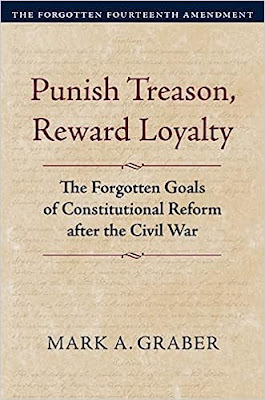
Mark A. Graber, Punish Treason, Reward Loyalty: The Forgotten Goals of Constitutional Reform after the Civil War (University of Kansas Press, 2023)
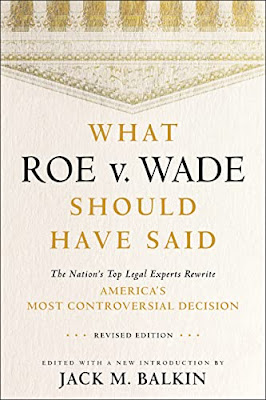
Jack M. Balkin, What Roe v. Wade Should Have Said: The Nation's Top Legal Experts Rewrite America's Most Controversial Decision - Revised Edition (NYU Press, 2023)

Andrew Koppelman, Burning Down the House: How Libertarian Philosophy Was Corrupted by Delusion and Greed (St. Martin’s Press, 2022)

Gerard N. Magliocca, Washington's Heir: The Life of Justice Bushrod Washington (Oxford University Press, 2022)
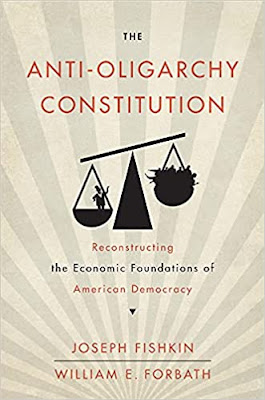
Joseph Fishkin and William E. Forbath, The Anti-Oligarchy Constitution: Reconstructing the Economic Foundations of American Democracy (Harvard University Press, 2022)
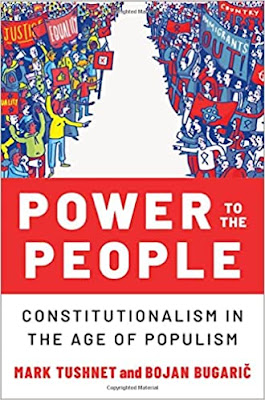
Mark Tushnet and Bojan Bugaric, Power to the People: Constitutionalism in the Age of Populism (Oxford University Press 2021).

Mark Philip Bradley and Mary L. Dudziak, eds., Making the Forever War: Marilyn B. Young on the Culture and Politics of American Militarism Culture and Politics in the Cold War and Beyond (University of Massachusetts Press, 2021).

Jack M. Balkin, What Obergefell v. Hodges Should Have Said: The Nation's Top Legal Experts Rewrite America's Same-Sex Marriage Decision (Yale University Press, 2020)

Frank Pasquale, New Laws of Robotics: Defending Human Expertise in the Age of AI (Belknap Press, 2020)

Jack M. Balkin, The Cycles of Constitutional Time (Oxford University Press, 2020)

Mark Tushnet, Taking Back the Constitution: Activist Judges and the Next Age of American Law (Yale University Press 2020).

Andrew Koppelman, Gay Rights vs. Religious Liberty?: The Unnecessary Conflict (Oxford University Press, 2020)

Ezekiel J Emanuel and Abbe R. Gluck, The Trillion Dollar Revolution: How the Affordable Care Act Transformed Politics, Law, and Health Care in America (PublicAffairs, 2020)

Linda C. McClain, Who's the Bigot?: Learning from Conflicts over Marriage and Civil Rights Law (Oxford University Press, 2020)
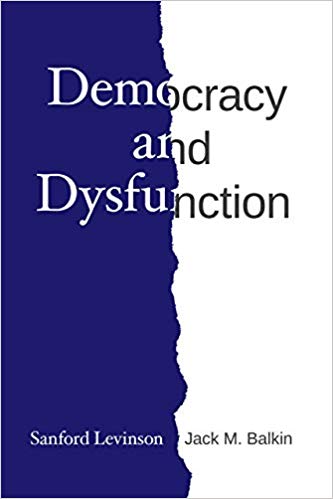
Sanford Levinson and Jack M. Balkin, Democracy and Dysfunction (University of Chicago Press, 2019)

Sanford Levinson, Written in Stone: Public Monuments in Changing Societies (Duke University Press 2018)

Mark A. Graber, Sanford Levinson, and Mark Tushnet, eds., Constitutional Democracy in Crisis? (Oxford University Press 2018)

Gerard Magliocca, The Heart of the Constitution: How the Bill of Rights became the Bill of Rights (Oxford University Press, 2018)

Cynthia Levinson and Sanford Levinson, Fault Lines in the Constitution: The Framers, Their Fights, and the Flaws that Affect Us Today (Peachtree Publishers, 2017)

Brian Z. Tamanaha, A Realistic Theory of Law (Cambridge University Press 2017)

Sanford Levinson, Nullification and Secession in Modern Constitutional Thought (University Press of Kansas 2016)

Sanford Levinson, An Argument Open to All: Reading The Federalist in the 21st Century (Yale University Press 2015)

Stephen M. Griffin, Broken Trust: Dysfunctional Government and Constitutional Reform (University Press of Kansas, 2015)

Frank Pasquale, The Black Box Society: The Secret Algorithms That Control Money and Information (Harvard University Press, 2015)

Bruce Ackerman, We the People, Volume 3: The Civil Rights Revolution (Harvard University Press, 2014)
Balkinization Symposium on We the People, Volume 3: The Civil Rights Revolution

Joseph Fishkin, Bottlenecks: A New Theory of Equal Opportunity (Oxford University Press, 2014)

Mark A. Graber, A New Introduction to American Constitutionalism (Oxford University Press, 2013)

John Mikhail, Elements of Moral Cognition: Rawls' Linguistic Analogy and the Cognitive Science of Moral and Legal Judgment (Cambridge University Press, 2013)

Gerard N. Magliocca, American Founding Son: John Bingham and the Invention of the Fourteenth Amendment (New York University Press, 2013)

Stephen M. Griffin, Long Wars and the Constitution (Harvard University Press, 2013)

Andrew Koppelman, The Tough Luck Constitution and the Assault on Health Care Reform (Oxford University Press, 2013)

James E. Fleming and Linda C. McClain, Ordered Liberty: Rights, Responsibilities, and Virtues (Harvard University Press, 2013)
Balkinization Symposium on Ordered Liberty: Rights, Responsibilities, and Virtues

Andrew Koppelman, Defending American Religious Neutrality (Harvard University Press, 2013)

Brian Z. Tamanaha, Failing Law Schools (University of Chicago Press, 2012)

Sanford Levinson, Framed: America's 51 Constitutions and the Crisis of Governance (Oxford University Press, 2012)

Linda C. McClain and Joanna L. Grossman, Gender Equality: Dimensions of Women's Equal Citizenship (Cambridge University Press, 2012)

Mary Dudziak, War Time: An Idea, Its History, Its Consequences (Oxford University Press, 2012)

Jack M. Balkin, Living Originalism (Harvard University Press, 2011)

Jason Mazzone, Copyfraud and Other Abuses of Intellectual Property Law (Stanford University Press, 2011)

Richard W. Garnett and Andrew Koppelman, First Amendment Stories, (Foundation Press 2011)

Jack M. Balkin, Constitutional Redemption: Political Faith in an Unjust World (Harvard University Press, 2011)

Gerard Magliocca, The Tragedy of William Jennings Bryan: Constitutional Law and the Politics of Backlash (Yale University Press, 2011)

Bernard Harcourt, The Illusion of Free Markets: Punishment and the Myth of Natural Order (Harvard University Press, 2010)

Bruce Ackerman, The Decline and Fall of the American Republic (Harvard University Press, 2010)
Balkinization Symposium on The Decline and Fall of the American Republic

Ian Ayres. Carrots and Sticks: Unlock the Power of Incentives to Get Things Done (Bantam Books, 2010)

Mark Tushnet, Why the Constitution Matters (Yale University Press 2010)

Ian Ayres and Barry Nalebuff: Lifecycle Investing: A New, Safe, and Audacious Way to Improve the Performance of Your Retirement Portfolio (Basic Books, 2010)
.jpg)
Jack M. Balkin, The Laws of Change: I Ching and the Philosophy of Life (2d Edition, Sybil Creek Press 2009)

Brian Z. Tamanaha, Beyond the Formalist-Realist Divide: The Role of Politics in Judging (Princeton University Press 2009)
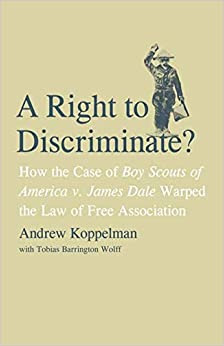
Andrew Koppelman and Tobias Barrington Wolff, A Right to Discriminate?: How the Case of Boy Scouts of America v. James Dale Warped the Law of Free Association (Yale University Press 2009)

Jack M. Balkin and Reva B. Siegel, The Constitution in 2020 (Oxford University Press 2009)

Heather K. Gerken, The Democracy Index: Why Our Election System Is Failing and How to Fix It (Princeton University Press 2009)

Mary Dudziak, Exporting American Dreams: Thurgood Marshall's African Journey (Oxford University Press 2008)

David Luban, Legal Ethics and Human Dignity (Cambridge Univ. Press 2007)

Ian Ayres, Super Crunchers: Why Thinking-By-Numbers is the New Way to be Smart (Bantam 2007)

Jack M. Balkin, James Grimmelmann, Eddan Katz, Nimrod Kozlovski, Shlomit Wagman and Tal Zarsky, eds., Cybercrime: Digital Cops in a Networked Environment (N.Y.U. Press 2007)
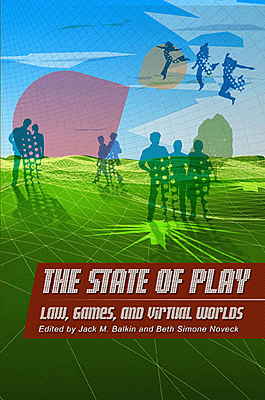
Jack M. Balkin and Beth Simone Noveck, The State of Play: Law, Games, and Virtual Worlds (N.Y.U. Press 2006)

Andrew Koppelman, Same Sex, Different States: When Same-Sex Marriages Cross State Lines (Yale University Press 2006)

Brian Tamanaha, Law as a Means to an End (Cambridge University Press 2006)

Sanford Levinson, Our Undemocratic Constitution (Oxford University Press 2006)

Mark Graber, Dred Scott and the Problem of Constitutional Evil (Cambridge University Press 2006)

Jack M. Balkin, ed., What Roe v. Wade Should Have Said (N.Y.U. Press 2005)

Sanford Levinson, ed., Torture: A Collection (Oxford University Press 2004)
Balkin.com homepage
Bibliography
Conlaw.net
Cultural Software
Writings
Opeds
The Information Society Project
BrownvBoard.com
Useful Links
Syllabi and Exams
