Balkinization
an unanticipated consequence of
Jack M. Balkin
Balkinization Symposiums: A Continuing List
E-mail:
Jack Balkin:
jackbalkin at yahoo.com
Bruce Ackerman
bruce.ackerman at yale.edu
Ian Ayres
ian.ayres at yale.edu
Corey Brettschneider
corey_brettschneider at brown.edu
Mary Dudziak
mary.l.dudziak at emory.edu
Joey Fishkin
joey.fishkin at gmail.com
Heather Gerken heather.gerken at yale.edu
Abbe Gluck abbe.gluck at yale.edu
Mark Graber
mgraber at law.umaryland.edu
Stephen Griffin
sgriffin at tulane.edu
Jonathan Hafetz
jonathan.hafetz at shu.edu
Jeremy Kessler
jkessler at law.columbia.edu
Andrew Koppelman
akoppelman at law.northwestern.edu
Marty Lederman
msl46 at law.georgetown.edu
Sanford Levinson
slevinson at law.utexas.edu
David Luban
david.luban at gmail.com
Gerard Magliocca
gmaglioc at iupui.edu
Jason Mazzone
mazzonej at illinois.edu
Linda McClain
lmcclain at bu.edu
John Mikhail
mikhail at law.georgetown.edu
Frank Pasquale
pasquale.frank at gmail.com
Nate Persily
npersily at gmail.com
Michael Stokes Paulsen
michaelstokespaulsen at gmail.com
Deborah Pearlstein
dpearlst at yu.edu
Rick Pildes
rick.pildes at nyu.edu
David Pozen
dpozen at law.columbia.edu
Richard Primus
raprimus at umich.edu
K. Sabeel Rahmansabeel.rahman at brooklaw.edu
Alice Ristroph
alice.ristroph at shu.edu
Neil Siegel
siegel at law.duke.edu
David Super
david.super at law.georgetown.edu
Brian Tamanaha
btamanaha at wulaw.wustl.edu
Nelson Tebbe
nelson.tebbe at brooklaw.edu
Mark Tushnet
mtushnet at law.harvard.edu
Adam Winkler
winkler at ucla.edu
Compendium of posts on Hobby Lobby and related cases
The Anti-Torture Memos: Balkinization Posts on Torture, Interrogation, Detention, War Powers, and OLC
The Anti-Torture Memos (arranged by topic)
Recent Posts
Remembering Ran Hirschl

Just A Few Blogs
ACS Blog
Alas, a Blog
Althouse
Arts and Letters Daily
Atrios (Eschaton)
Bill of Health
Buzzflash.com
Buzz Machine
Cato at Liberty
Juan Cole (Informed Comment)
Concurring Opinions
The Constitution in 2020
Corrente
Crooked Timber
Daily Howler
Daily Kos
Dana Boyd
Brad DeLong
Digby (Hullabaloo)
Discriminations
Daniel Drezner
Kevin Drum (Mother Jones)
Electrolite
En Banc
Eunomia (Daniel Larison)
Fafblog
Michael Froomkin (Discourse.net)
GovLab (Beth Noveck)
Rick Hasen (Election Law)
History News Network
How Appealing
Ignatz (Sam Heldman)
The Importance of (Ernie Miller)
Infolaw
Instapundit
International Economic Law and Policy Blog
IntLawGrrls
Jacob Levy
Jesus' General
Jurisdynamics
The Kitchen Cabinet
Mark Kleiman
Law Blog Central
Larry Lessig
Lawyers, Guns and Money
Liberal Oasis
Brian Leiter's Law School Reports
The Leiter Reports
Marginal Revolution
Megan McArdle
Memeorandum
Metafilter
Mirror of Justice
The New Republic
Newseum
No More Mister Nice Blog
Brendan Nyhan
Opinio Juris
Orcinus
The Originalism Blog
Pandagon
Passport (Foreign Policy)
Overcoming Bias
Political Animal (Washington Monthly)
Political Theory Daily Review
Political Wire (Taegan Goddard)
The Poor Man
Virginia Postrel
Prawfsblawg
Public Reason
Jonathan Rauch
Raw Story
Redstate
ReligiousLeftLaw.com
Reporters Committee For Freedom of the Press
Reproductive Rights Blog
Rothman's Roadmap to the Right of Publicity
SCOTUS Blog
Seeing the Forest
Clay Shirky
The Shifted Librarian
The Situationist
Larry Solum (Legal Theory)
Andrew Sullivan
Talking Points Memo
Talk Left
Tapped
Tbogg
TechPresident
The Paper Chase (Jurist)
Tom Paine
Tom Tomorrow (This Modern World)
Eve Tushnet
Uggabugga
University of Chicago Law School Faculty Blog
Unqualified Offerings
The Volokh Conspiracy
War and Piece (Laura Rozen)
Wampum
Oliver Willis
Wonkette
Written Description
Matthew Yglesias
Yin
Your Choice of Feeds
1. XML
powered by

2. Atom Feed
3. RSS 2.0
Remembering Ran Hirschl
Mark Graber
[For a memorial celebration of Ran Hirschl's life and scholarship at the University of Toronto, November 6, 2026. Updated version of what I published earlier in Balkinization, but worth sharing, particularly because I was unable to be physically pressent for the event] Ran Hirschl was a pathbreaking scholar, an even better
human being, and an even better friend. Words cannot capture his impact
on scholarship and on the lives of the numerous scholars he touched. These
excerpts from a letter on his behalf for a lifetime achievement award are a
weak attempt to do justice to him and his legacy. My comments remain in
the present tense because through his works, example, and encouragement, Ran
will always be with us. His scholarship and influence lives in our scholarship
to the point where we will often not be able to distinguish where his thought
ends and ours begins. Hirschl is the leading thinker on comparative
constitutionalism in the world. No political scientist in the
public law field, no political scientist in the comparative government field,
no law professor, and no member of any other discipline has come close to his
achievements. Each of Professor Hirschl’s books is acknowledged as
path-breaking. No one knows more about constitutional developments in
different parts of the world. No one has done more to inspire the
contemporary renaissance in comparative constitutionalism. No one has
played a greater leadership role in this comparative constitutionalism
revival. You could divide Hirschl’s resume in half and probably thirds
and each partition would have a powerful case for a lifetime achievement award
in numerous disciplines and in numerous fields within those disciplines. Hirschl has a stunning range of expertise, a range
that dwarfs any other scholar that I know of in political science or law.
One finds in his publications a sophisticated understanding of political
theory, all aspects of public law, and comparative politics. He has
mastered the literature on democratic theory, on constitutional interpretation,
on law and society, and on judicial politics. He is the master of the general
literature on comparative constitutional law and the specific constitutional
politics of almost every country with constitutional politics. His
chapter on case studies in Comparative Matters is an extraordinary
methodological piece, one I regular insist my students examine.
Hirschl’s capacity to know both the details of what almost every
constitutional court in the world is doing and to organize those details into
theoretically rich arguments is remarkable. Maybe somewhere in an obscure
province in India, high in the Andes mountains, or ten miles west of Victoria
Falls, a constitutional development exists that Hirschl does not know
about. But neither I nor any of the numerous reviewers of his works
identified this omission. I am confident Vulcan of Star Trek fame
is fiction, because Professor Hirschl has never discussed the Constitution of
Vulcan. His erudition extends far beyond law and political
science. Consider the first chapter of City, State: The
Constitutionalism and the Megacity. The chapter begins with an
extensive discussion of what almost every social science field has said about
cities for the past fifty years. Hirschl demonstrates a fluency in
subjects ranging from sociology to architecture that would do experts in those
field proud. Perhaps I need to get out more, but I cannot think of a
scholar in any field whose expertise ranges over so much political science, so
much law and so much scholarship as Professor Hirschl. The other books
are similar. Hirschl does not simply master law and political
science. He masters whatever disciplines are necessary to cast light on
his subject matters. Professor Hirschl’s forthcoming book, Constitutionalism
2050, points out that the traditional nation-state no longer serves to
manage central problems. The problems regimes face, from climate change
to globalization to pandemics are now international. Local national
governance, he observes, weakens human capacity to respond to these
problems. Constitutionalism must go global for the human race to
survive. Putting aside jealously, I had two thoughts when he was
presented. First, that he was again forcing scholars
to think anew about constitutionalism and, second, there would be another award
winning book in a few years. If you
wanted me to predict what living senior scholar would writing another award
winning book in the 2030s, Professor Hirschl would be my response. Professor Hirschl is a fellow of the Royal Society of
Canada, which is the equivalent of being a member of the American Academic for
the Arts and Sciences in the United States (both are academic halls of
fame). He has held distinguished chairs at the University of Toronto, the
University of Texas, and the Max Planck Institute in Germany, as well as
holding distinguished visitor chairs at the National University of Singapore,
New York University and Harvard Law School. He has won national and
global awards for scholarship and delivered addresses, often named, at almost
every major university in the world. He is a former Co-President of the
International Society of Public Law and one of the founders of that
organization. He has published many edited collections and nearly
one-hundred essays, many of which have been republished and translated
elsewhere. The evidence clearly indicates, I should add, that none of his
works seem to have been written by Christopher Marlowe. Professor Hirschl excels at all facets of the
academy. He was an award-winning teacher at Toronto. When I wrote
his recommendation for the Canada Research Chair, the University of Toronto
presented me with as strong a set of teaching evaluations, both for graduate
students and undergraduates, as I recall seeing. He has helped mentor the
younger generation of comparativists. You see Professor Hirschl’s name in
manuscripts by junior scholars warmly thanking him for the time and energy he
gave to reviewing junior manuscripts. He has been a leader in comparative
constitutionalism, not just as a scholar, but as a founder and leader of the
International Society of Public Law. Thanks in significant part to his
efforts, ICON-S is probably the most important site in the world for
comparative constitutionalism. Finally, on a personal note he is a warm
and trusted friend to many of us in the academy. Professor Hirschl has a global reputation for
excellence and as fine a global reputation for decency. He is an
outstanding teacher, mentor, colleague, and friend. As is appropriate for a lifetime achievement award
letter, I did not discuss my personal relationship with Ran. He was the ultimate mensch. Ran was a source of many ideas and a
cheerleader throughout. The paper I plan
to contribute to the volume we are presenting in his honor has three
substantive themes. First, The newest constitutionalism being developed by such
distinguished scholars as Tom Ginsburg, Aziz Huq, David Landau, and Rosalind
Dixon is another instance of hegemonic preservation. Second, hegemonic preservation is an
empirical judgment that elites are seeking to entrench certain values in light
of threats from rival coalition, not a normative attack on this political
strategy. Third, too often attempts at hegemonic
preservation risk substituting constitutional law substitutes for political
mobilization. I suspect some of you are
thinking, this is Ran’s voice, not yours. Guilty with explanation.
As I noted at the beginning of this talk, when commenting on the
political construction of judicial power, I can no longer tell when Ran’s
thought begins and my thought ends. I
can say with confidence that none of these ruminations, particularly
ruminations that are not simply US centric, would have been possible in the
absence of Ran’s scholarship, mentorship, and friendship. My only defense is that much of my work is
best thought of as Mark Graber/Ran Hirschl or, really, Mark Graber/Ran
Hirschl/Rogers Smith/Sandy Levinson/other people inside and outside of this
room. I suspect others might describe
their work similarly. Ran insisted that
his work was Ran Hirschl/Ayelet Shachar or, really, Ran Hirsch/Ayelet
Shachar/Tom Ginsburg/others inside and outside of this room. The lesson may be that while identifying the
scholarly contributions of a distinctive scholarly community is easy,
identifying the particular contribution of any scholar is next to
impossible. Ran Hirschl made enormous
contributions to the stock of ideas that are now the common property of our
community, even if none of us can claim that any unique parcel is distinctively
ours.
Posted
4:53 AM
by Mark Graber [link]
Books by Balkinization Bloggers

Mark Tushnet and Bojan Bugaric, Constitutionalism and Its Discontents (University of Chicago Press, 2026)

Gerard N. Magliocca, The Actual Art of Governing: Justice Robert H. Jackson's Concurring Opinion in the Steel Seizure Case (Oxford University Press, 2025)

Linda C. McClain and Aziza Ahmed, The Routledge Companion to Gender and COVID-19 (Routledge, 2024)

David Pozen, The Constitution of the War on Drugs (Oxford University Press, 2024)

Jack M. Balkin, Memory and Authority: The Uses of History in Constitutional Interpretation (Yale University Press, 2024)
Mark A. Graber, Punish Treason, Reward Loyalty: The Forgotten Goals of Constitutional Reform after the Civil War (University of Kansas Press, 2023)
Jack M. Balkin, What Roe v. Wade Should Have Said: The Nation's Top Legal Experts Rewrite America's Most Controversial Decision - Revised Edition (NYU Press, 2023)

Andrew Koppelman, Burning Down the House: How Libertarian Philosophy Was Corrupted by Delusion and Greed (St. Martin’s Press, 2022)

Gerard N. Magliocca, Washington's Heir: The Life of Justice Bushrod Washington (Oxford University Press, 2022)
Joseph Fishkin and William E. Forbath, The Anti-Oligarchy Constitution: Reconstructing the Economic Foundations of American Democracy (Harvard University Press, 2022)
Mark Tushnet and Bojan Bugaric, Power to the People: Constitutionalism in the Age of Populism (Oxford University Press 2021).

Mark Philip Bradley and Mary L. Dudziak, eds., Making the Forever War: Marilyn B. Young on the Culture and Politics of American Militarism Culture and Politics in the Cold War and Beyond (University of Massachusetts Press, 2021).

Jack M. Balkin, What Obergefell v. Hodges Should Have Said: The Nation's Top Legal Experts Rewrite America's Same-Sex Marriage Decision (Yale University Press, 2020)

Frank Pasquale, New Laws of Robotics: Defending Human Expertise in the Age of AI (Belknap Press, 2020)

Jack M. Balkin, The Cycles of Constitutional Time (Oxford University Press, 2020)

Mark Tushnet, Taking Back the Constitution: Activist Judges and the Next Age of American Law (Yale University Press 2020).

Andrew Koppelman, Gay Rights vs. Religious Liberty?: The Unnecessary Conflict (Oxford University Press, 2020)

Ezekiel J Emanuel and Abbe R. Gluck, The Trillion Dollar Revolution: How the Affordable Care Act Transformed Politics, Law, and Health Care in America (PublicAffairs, 2020)

Linda C. McClain, Who's the Bigot?: Learning from Conflicts over Marriage and Civil Rights Law (Oxford University Press, 2020)
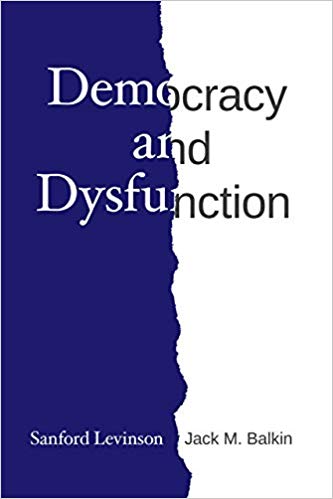
Sanford Levinson and Jack M. Balkin, Democracy and Dysfunction (University of Chicago Press, 2019)

Sanford Levinson, Written in Stone: Public Monuments in Changing Societies (Duke University Press 2018)

Mark A. Graber, Sanford Levinson, and Mark Tushnet, eds., Constitutional Democracy in Crisis? (Oxford University Press 2018)

Gerard Magliocca, The Heart of the Constitution: How the Bill of Rights became the Bill of Rights (Oxford University Press, 2018)

Cynthia Levinson and Sanford Levinson, Fault Lines in the Constitution: The Framers, Their Fights, and the Flaws that Affect Us Today (Peachtree Publishers, 2017)

Brian Z. Tamanaha, A Realistic Theory of Law (Cambridge University Press 2017)

Sanford Levinson, Nullification and Secession in Modern Constitutional Thought (University Press of Kansas 2016)

Sanford Levinson, An Argument Open to All: Reading The Federalist in the 21st Century (Yale University Press 2015)

Stephen M. Griffin, Broken Trust: Dysfunctional Government and Constitutional Reform (University Press of Kansas, 2015)

Frank Pasquale, The Black Box Society: The Secret Algorithms That Control Money and Information (Harvard University Press, 2015)

Bruce Ackerman, We the People, Volume 3: The Civil Rights Revolution (Harvard University Press, 2014)
Balkinization Symposium on We the People, Volume 3: The Civil Rights Revolution

Joseph Fishkin, Bottlenecks: A New Theory of Equal Opportunity (Oxford University Press, 2014)

Mark A. Graber, A New Introduction to American Constitutionalism (Oxford University Press, 2013)

John Mikhail, Elements of Moral Cognition: Rawls' Linguistic Analogy and the Cognitive Science of Moral and Legal Judgment (Cambridge University Press, 2013)

Gerard N. Magliocca, American Founding Son: John Bingham and the Invention of the Fourteenth Amendment (New York University Press, 2013)

Stephen M. Griffin, Long Wars and the Constitution (Harvard University Press, 2013)

Andrew Koppelman, The Tough Luck Constitution and the Assault on Health Care Reform (Oxford University Press, 2013)

James E. Fleming and Linda C. McClain, Ordered Liberty: Rights, Responsibilities, and Virtues (Harvard University Press, 2013)
Balkinization Symposium on Ordered Liberty: Rights, Responsibilities, and Virtues

Andrew Koppelman, Defending American Religious Neutrality (Harvard University Press, 2013)

Brian Z. Tamanaha, Failing Law Schools (University of Chicago Press, 2012)

Sanford Levinson, Framed: America's 51 Constitutions and the Crisis of Governance (Oxford University Press, 2012)

Linda C. McClain and Joanna L. Grossman, Gender Equality: Dimensions of Women's Equal Citizenship (Cambridge University Press, 2012)

Mary Dudziak, War Time: An Idea, Its History, Its Consequences (Oxford University Press, 2012)

Jack M. Balkin, Living Originalism (Harvard University Press, 2011)

Jason Mazzone, Copyfraud and Other Abuses of Intellectual Property Law (Stanford University Press, 2011)

Richard W. Garnett and Andrew Koppelman, First Amendment Stories, (Foundation Press 2011)

Jack M. Balkin, Constitutional Redemption: Political Faith in an Unjust World (Harvard University Press, 2011)

Gerard Magliocca, The Tragedy of William Jennings Bryan: Constitutional Law and the Politics of Backlash (Yale University Press, 2011)

Bernard Harcourt, The Illusion of Free Markets: Punishment and the Myth of Natural Order (Harvard University Press, 2010)

Bruce Ackerman, The Decline and Fall of the American Republic (Harvard University Press, 2010)
Balkinization Symposium on The Decline and Fall of the American Republic

Ian Ayres. Carrots and Sticks: Unlock the Power of Incentives to Get Things Done (Bantam Books, 2010)

Mark Tushnet, Why the Constitution Matters (Yale University Press 2010)

Ian Ayres and Barry Nalebuff: Lifecycle Investing: A New, Safe, and Audacious Way to Improve the Performance of Your Retirement Portfolio (Basic Books, 2010)

Jack M. Balkin, The Laws of Change: I Ching and the Philosophy of Life (2d Edition, Sybil Creek Press 2009)

Brian Z. Tamanaha, Beyond the Formalist-Realist Divide: The Role of Politics in Judging (Princeton University Press 2009)
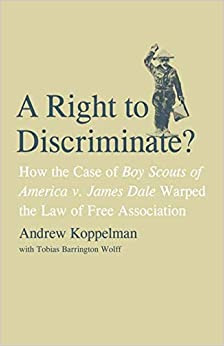
Andrew Koppelman and Tobias Barrington Wolff, A Right to Discriminate?: How the Case of Boy Scouts of America v. James Dale Warped the Law of Free Association (Yale University Press 2009)

Jack M. Balkin and Reva B. Siegel, The Constitution in 2020 (Oxford University Press 2009)

Heather K. Gerken, The Democracy Index: Why Our Election System Is Failing and How to Fix It (Princeton University Press 2009)

Mary Dudziak, Exporting American Dreams: Thurgood Marshall's African Journey (Oxford University Press 2008)

David Luban, Legal Ethics and Human Dignity (Cambridge Univ. Press 2007)

Ian Ayres, Super Crunchers: Why Thinking-By-Numbers is the New Way to be Smart (Bantam 2007)

Jack M. Balkin, James Grimmelmann, Eddan Katz, Nimrod Kozlovski, Shlomit Wagman and Tal Zarsky, eds., Cybercrime: Digital Cops in a Networked Environment (N.Y.U. Press 2007)
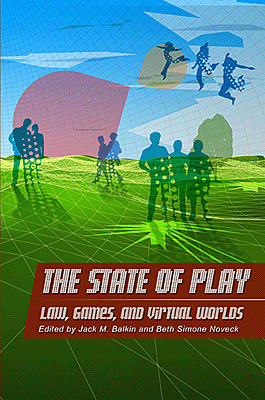
Jack M. Balkin and Beth Simone Noveck, The State of Play: Law, Games, and Virtual Worlds (N.Y.U. Press 2006)

Andrew Koppelman, Same Sex, Different States: When Same-Sex Marriages Cross State Lines (Yale University Press 2006)

Brian Tamanaha, Law as a Means to an End (Cambridge University Press 2006)

Sanford Levinson, Our Undemocratic Constitution (Oxford University Press 2006)

Mark Graber, Dred Scott and the Problem of Constitutional Evil (Cambridge University Press 2006)

Jack M. Balkin, ed., What Roe v. Wade Should Have Said (N.Y.U. Press 2005)

Sanford Levinson, ed., Torture: A Collection (Oxford University Press 2004)
Balkin.com homepage
Bibliography
Conlaw.net
Cultural Software
Writings
Opeds
The Information Society Project
BrownvBoard.com
Useful Links
Syllabi and Exams
