Balkinization
an unanticipated consequence of
Jack M. Balkin
Balkinization Symposiums: A Continuing List
E-mail:
Jack Balkin:
jackbalkin at yahoo.com
Bruce Ackerman
bruce.ackerman at yale.edu
Ian Ayres
ian.ayres at yale.edu
Corey Brettschneider
corey_brettschneider at brown.edu
Mary Dudziak
mary.l.dudziak at emory.edu
Joey Fishkin
joey.fishkin at gmail.com
Heather Gerken heather.gerken at yale.edu
Abbe Gluck abbe.gluck at yale.edu
Mark Graber
mgraber at law.umaryland.edu
Stephen Griffin
sgriffin at tulane.edu
Jonathan Hafetz
jonathan.hafetz at shu.edu
Jeremy Kessler
jkessler at law.columbia.edu
Andrew Koppelman
akoppelman at law.northwestern.edu
Marty Lederman
msl46 at law.georgetown.edu
Sanford Levinson
slevinson at law.utexas.edu
David Luban
david.luban at gmail.com
Gerard Magliocca
gmaglioc at iupui.edu
Jason Mazzone
mazzonej at illinois.edu
Linda McClain
lmcclain at bu.edu
John Mikhail
mikhail at law.georgetown.edu
Frank Pasquale
pasquale.frank at gmail.com
Nate Persily
npersily at gmail.com
Michael Stokes Paulsen
michaelstokespaulsen at gmail.com
Deborah Pearlstein
dpearlst at yu.edu
Rick Pildes
rick.pildes at nyu.edu
David Pozen
dpozen at law.columbia.edu
Richard Primus
raprimus at umich.edu
K. Sabeel Rahmansabeel.rahman at brooklaw.edu
Alice Ristroph
alice.ristroph at shu.edu
Neil Siegel
siegel at law.duke.edu
David Super
david.super at law.georgetown.edu
Brian Tamanaha
btamanaha at wulaw.wustl.edu
Nelson Tebbe
nelson.tebbe at brooklaw.edu
Mark Tushnet
mtushnet at law.harvard.edu
Adam Winkler
winkler at ucla.edu
Compendium of posts on Hobby Lobby and related cases
The Anti-Torture Memos: Balkinization Posts on Torture, Interrogation, Detention, War Powers, and OLC
The Anti-Torture Memos (arranged by topic)
Recent Posts
Review Essay, Diego Zambrano, How Americans Enforce the Law
![[Powered by Blogger]](https://lh3.googleusercontent.com/blogger_img_proxy/AEn0k_vgXyadOmP_1-dHXpu--1liqg4ap5SSsI-pdDF6euzmd4Y-nPFMWC_R0UsC-e5ttzqkVALaA0Sd9NN7SnOBBGe8i8GSh2vEQp_os0xzGUVA=s0-d)
Just A Few Blogs
ACS Blog
Alas, a Blog
Althouse
Arts and Letters Daily
Atrios (Eschaton)
Bill of Health
Buzzflash.com
Buzz Machine
Cato at Liberty
Juan Cole (Informed Comment)
Concurring Opinions
The Constitution in 2020
Corrente
Crooked Timber
Daily Howler
Daily Kos
Dana Boyd
Brad DeLong
Digby (Hullabaloo)
Discriminations
Daniel Drezner
Kevin Drum (Mother Jones)
Electrolite
En Banc
Eunomia (Daniel Larison)
Fafblog
Michael Froomkin (Discourse.net)
GovLab (Beth Noveck)
Rick Hasen (Election Law)
History News Network
How Appealing
Ignatz (Sam Heldman)
The Importance of (Ernie Miller)
Infolaw
Instapundit
International Economic Law and Policy Blog
IntLawGrrls
Jacob Levy
Jesus' General
Jurisdynamics
The Kitchen Cabinet
Mark Kleiman
Law Blog Central
Larry Lessig
Lawyers, Guns and Money
Liberal Oasis
Brian Leiter's Law School Reports
The Leiter Reports
Marginal Revolution
Megan McArdle
Memeorandum
Metafilter
Mirror of Justice
The New Republic
Newseum
No More Mister Nice Blog
Brendan Nyhan
Opinio Juris
Orcinus
The Originalism Blog
Pandagon
Passport (Foreign Policy)
Overcoming Bias
Political Animal (Washington Monthly)
Political Theory Daily Review
Political Wire (Taegan Goddard)
The Poor Man
Virginia Postrel
Prawfsblawg
Public Reason
Jonathan Rauch
Raw Story
Redstate
ReligiousLeftLaw.com
Reporters Committee For Freedom of the Press
Reproductive Rights Blog
Rothman's Roadmap to the Right of Publicity
SCOTUS Blog
Seeing the Forest
Clay Shirky
The Shifted Librarian
The Situationist
Larry Solum (Legal Theory)
Andrew Sullivan
Talking Points Memo
Talk Left
Tapped
Tbogg
TechPresident
The Paper Chase (Jurist)
Tom Paine
Tom Tomorrow (This Modern World)
Eve Tushnet
Uggabugga
University of Chicago Law School Faculty Blog
Unqualified Offerings
The Volokh Conspiracy
War and Piece (Laura Rozen)
Wampum
Oliver Willis
Wonkette
Written Description
Matthew Yglesias
Yin
Your Choice of Feeds
1. XML
powered by

2. Atom Feed
3. RSS 2.0
Review Essay, Diego Zambrano, How Americans Enforce the Law
Guest Blogger
For the Balkinization symposium on Diego Zambrano, How Americans Enforce the Law (Stanford University Press, 2026). James E. Pfander In
How Americans Enforce the Law, Diego Zambrano sets out to document and
to explain that distinctively American legal institution: the private lawsuit
aimed at the enforcement of public law. In
a book length treatment of the subject that combines careful study, elegant
theorizing, and inspired description, Zambrano provides an exceptionally
readable and engaging account of the history, current practice, and theoretical
justification of private litigation. We
get both the telling historical tidbit, in Zambrano’s account of the molasses trade
in eighteenth century British North America, and the compelling tectonic
explanation, in a theory of layered path dependence that helps us to see how we
arrived at this point. With its account
of laws, lawyers, and civil procedure, the book will appeal to longstanding
students and to new initiates seeking a better understanding of what private
civil litigation has come to mean in a country that contains multitudes. The author’s learning and vivid storytelling
make this book both a pleasure to read and a major scholarly accomplishment. Zambrano
finds value in private enforcement. Not
just its pedigree, which runs back to medieval England, and takes root in the
colonial and founding eras in America.
Not just in its lengthy list of supporters and defenders, which include
such notables as Adams, Jefferson, Madison. Not just in the sheer breadth of
its appearance in both state and federal legislation, what with Zambrano’s
survey of some 10,000 such statutes at the state level. But also in its ability to deliver the enforcement
goods. His contrast between the private
enforcement model of America and the government enforcement monopoly in France
leaves little doubt as to where his sympathies lie; Americans delivered more
effective justice more quickly for the victims of this country’s massive oil
spills than did the French bureaucracy for the victims of its major spill. But
Zambrano does not unstintingly praise our distinctively American model of
private enforcement. As he observes, [A]n English and colonial
tradition of informer suits created an accepted template, weak bureaucratic
capacity and wariness of government monopoly over enforcement periodically
renewed its appeal, and the powerful lawyers’ lobby (unique to the United
States) alongside modern civil procedure turned it into a mass-litigation
engine. While
he does not straight up reject the accounts of others, such as Robert Kagan’s
emphasis on the American tendency toward adversary legalism or Sean Farhang’s
account of the legislature’s use of private enforcement as a check on divided
government (current or anticipated), Zambrano takes these leading accounts on
board with a critical grain of salt. In his complex account of the layers of
law and policy that undergird private enforcement today, Zambrano comes back
time and again to a persisting fear of monopoly power. American elites, he explains, have
consistently resisted giving public officials “a monopoly on enforcement.” Private litigators confront different
incentives and realities; private lawsuits will target different violations
than public suits and will avoid regulatory capture problems. Why rely on one
model of enforcement, public or private, when you can have both? Both, Zambrano tells us, has been
Congress’s consistent choice. Since its
decision in 1914 to adopt both the Clayton Act and the Federal Trade Commission
Act, American legislators repeatedly chose “both bureaucratic expertise and
private litigation as complementary solutions.”
One sees this choice reflected in the great rights-conferring
legislation of the twentieth century, which includes the Fair Labor Standards
Act and the Civil Rights Act of 1964, both of which establish an agency to play
a supportive role but assign the task of litigation to private parties and
their lawyers. Private enforcement
succeeds in America in no small part because the private litigation ecosystem
incorporates wide-ranging tools of discovery, contingency-fee finance, and the
Rule 23 class action, all of which help to run the machine. Then, too, the fact that the private bar has
long been an effective lobbying force may help ease the choice of private
enforcement in Congress. Sometimes, things go awry. Private enforcement schemes can overstay
their welcome and introduce their own pathologies. Zambrano pulls no punches in criticizing the
excesses of private environmental enforcement, which he views as having erected
a virtually insurmountable barrier to affordable housing and other urban
construction needs. Here, Zambrano’s
talent for telling comparative assessment provides further insight; he explains
that other countries plan and complete major public infrastructure projects
more cheaply and expeditiously.
Generalizing, Zambrano devotes a chapter to how legislatures can get
private enforcement right. Since the
beginning, private enforcers have been driven by goals that do not always align
with the public interest. The challenge
lies in properly calibrating enforcement incentives and maintaining some
ongoing contact with the performance of private-enforcement regimes, instead of
taking a set-it-and-forget-it approach. Along the way, Zambrano tackles interesting
private enforcement puzzles. Perhaps
most intriguing, Zambrano explores why private enforcement has largely
disappeared from criminal law, especially at the federal level. Bureaucratic capacity certainly tells the
story in part; the DOJ has grown considerably since its creation after the
Civil War. But Zambrano also explains
that criminal matters may remain with the government for a set of structural
reasons. Victims of criminal behavior
cannot readily work together to secure private enforcement statutes; the
absence of interest group cohesion may undercut interest group support for any
change. Moreover, the modest financial
stakes in much criminal misconduct means that the private bar may have little interest
in pursuing the claims in question.
Zambrano’s complex answers capture more of the truth than simplistic
theories associated with the supposed demands of Article II’s provision for
presidential “care” in the faithful execution of the laws. Article II does not brook large in
Zambrano’s account, furnishing a baseline of presumed public enforcement that
Congress can supplement by supplying a private right to sue. Zambrano uses this construct of presumed
executive enforcement primacy to structure the legislative process as members
of Congress contemplate private enforcement.
On the list, Zambrano includes such sensible items as public enforcement
capacity, the risk of shifting priorities, the prospect of regulatory capture,
and the possibility of agency corruption.
All sensible questions that a thoughtful, deliberative, politically
balanced Congress might wish to take on board.
But complexity enters the picture as enforcement capacity changes along
with public priorities, yielding a stew of relevant considerations that may
defy even the most well-informed legislative engagement. That stew of considerations informs
Zambrano’s theory of layered path dependence.
He first offers a searching review of the competing accounts of Farhang
(legislative distrust of executive enforcement priorities) and Kagan (adversarial
legalism as a distinctively American habit), showing the many ways those
theories fail to account for several of the relevant moving parts. Synthesizing those moving parts occupies a
full chapter of Zambrano’s theory of American-style private enforcement. In
Zambrano’s telling, it was not one thing; it was this and this and this. Some readers may respond to the richness of
Zambrano’s origin and development story with a yearning for parsimony – a
simple account with fewer moving parts. But
like life and history, the development of American-style private enforcement was
contingent; it was dependent on a variety of factors that might have unfolded
in a different way. Perhaps without an
established bar to lobby for a private enforcement role, the progressives would
have abandoned private enforcement altogether in favor of the bureaucracy and
today’s world would look very different.
Perhaps without the deliberate choice in 1914 to create an FTC and a
regime of private enforcement, the use of both mechanisms of enforcement would not
have taken hold. If not entirely simple,
Zambrano’s account has the virtue of staying true to the sources and to his
command of the subject. And anyway, Zambrano gives us a parsimonious
bottom line: Americans distrust the
placement of an enforcement monopoly in the bureaucracy. While Zambrano has written elsewhere that the
history of private enforcement disproves any claim that Article II confers a
public law enforcement monopoly on the executive, this book treats the subject
more by way of example than by way of extended constitutional analysis. Zambrano shows a history of reliance on
private enforcement and then describes the decision of President Trump to deny
enforcement to legislation banning TikTok from the internet as every Congress’s
nightmare scenario. Congress enacted the
law, the Supreme Court approved its enforcement, and then President Trump
directed the DOJ to refrain from enforcing the law. Zambrano points out that, as with other convention-busting
instances of apparently arbitrary presidential conduct, this one represented an
exercise of the executive dispensation power -- – something that the English
rejected in their seventeenth-century declaration of rights and we rejected in
our eighteenth-century Constitution. The
Take Care Clause of Article II provides no license to dispense with law
enforcement but imposes a duty on the president to ensure enforcement. Alas, we have learned repeatedly during Trump
II that the president cannot be compelled to honor this Take Care duty. Zambrano shrewdly observes that a private
right of action could have solved the problem. James E. Pfander is Owen L. Coon Professor of Law at Northwestern Pritzker School of Law. You can reach him by e-mail at j-pfander@law.northwestern.edu.
Posted
9:30 AM
by Guest Blogger [link]
Books by Balkinization Bloggers

Mark Tushnet and Bojan Bugaric, Constitutionalism and Its Discontents (University of Chicago Press, 2026)

Gerard N. Magliocca, The Actual Art of Governing: Justice Robert H. Jackson's Concurring Opinion in the Steel Seizure Case (Oxford University Press, 2025)

Linda C. McClain and Aziza Ahmed, The Routledge Companion to Gender and COVID-19 (Routledge, 2024)

David Pozen, The Constitution of the War on Drugs (Oxford University Press, 2024)

Jack M. Balkin, Memory and Authority: The Uses of History in Constitutional Interpretation (Yale University Press, 2024)
Mark A. Graber, Punish Treason, Reward Loyalty: The Forgotten Goals of Constitutional Reform after the Civil War (University of Kansas Press, 2023)
Jack M. Balkin, What Roe v. Wade Should Have Said: The Nation's Top Legal Experts Rewrite America's Most Controversial Decision - Revised Edition (NYU Press, 2023)

Andrew Koppelman, Burning Down the House: How Libertarian Philosophy Was Corrupted by Delusion and Greed (St. Martin’s Press, 2022)

Gerard N. Magliocca, Washington's Heir: The Life of Justice Bushrod Washington (Oxford University Press, 2022)
Joseph Fishkin and William E. Forbath, The Anti-Oligarchy Constitution: Reconstructing the Economic Foundations of American Democracy (Harvard University Press, 2022)
Mark Tushnet and Bojan Bugaric, Power to the People: Constitutionalism in the Age of Populism (Oxford University Press 2021).

Mark Philip Bradley and Mary L. Dudziak, eds., Making the Forever War: Marilyn B. Young on the Culture and Politics of American Militarism Culture and Politics in the Cold War and Beyond (University of Massachusetts Press, 2021).

Jack M. Balkin, What Obergefell v. Hodges Should Have Said: The Nation's Top Legal Experts Rewrite America's Same-Sex Marriage Decision (Yale University Press, 2020)

Frank Pasquale, New Laws of Robotics: Defending Human Expertise in the Age of AI (Belknap Press, 2020)

Jack M. Balkin, The Cycles of Constitutional Time (Oxford University Press, 2020)

Mark Tushnet, Taking Back the Constitution: Activist Judges and the Next Age of American Law (Yale University Press 2020).

Andrew Koppelman, Gay Rights vs. Religious Liberty?: The Unnecessary Conflict (Oxford University Press, 2020)

Ezekiel J Emanuel and Abbe R. Gluck, The Trillion Dollar Revolution: How the Affordable Care Act Transformed Politics, Law, and Health Care in America (PublicAffairs, 2020)

Linda C. McClain, Who's the Bigot?: Learning from Conflicts over Marriage and Civil Rights Law (Oxford University Press, 2020)
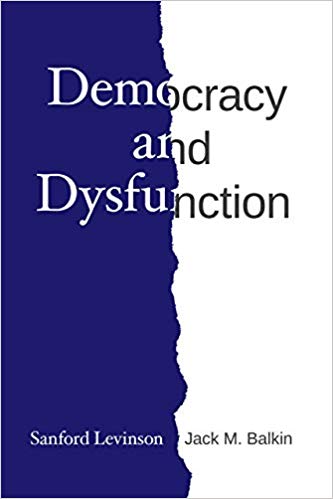
Sanford Levinson and Jack M. Balkin, Democracy and Dysfunction (University of Chicago Press, 2019)

Sanford Levinson, Written in Stone: Public Monuments in Changing Societies (Duke University Press 2018)

Mark A. Graber, Sanford Levinson, and Mark Tushnet, eds., Constitutional Democracy in Crisis? (Oxford University Press 2018)

Gerard Magliocca, The Heart of the Constitution: How the Bill of Rights became the Bill of Rights (Oxford University Press, 2018)

Cynthia Levinson and Sanford Levinson, Fault Lines in the Constitution: The Framers, Their Fights, and the Flaws that Affect Us Today (Peachtree Publishers, 2017)

Brian Z. Tamanaha, A Realistic Theory of Law (Cambridge University Press 2017)

Sanford Levinson, Nullification and Secession in Modern Constitutional Thought (University Press of Kansas 2016)

Sanford Levinson, An Argument Open to All: Reading The Federalist in the 21st Century (Yale University Press 2015)

Stephen M. Griffin, Broken Trust: Dysfunctional Government and Constitutional Reform (University Press of Kansas, 2015)

Frank Pasquale, The Black Box Society: The Secret Algorithms That Control Money and Information (Harvard University Press, 2015)

Bruce Ackerman, We the People, Volume 3: The Civil Rights Revolution (Harvard University Press, 2014)
Balkinization Symposium on We the People, Volume 3: The Civil Rights Revolution

Joseph Fishkin, Bottlenecks: A New Theory of Equal Opportunity (Oxford University Press, 2014)

Mark A. Graber, A New Introduction to American Constitutionalism (Oxford University Press, 2013)

John Mikhail, Elements of Moral Cognition: Rawls' Linguistic Analogy and the Cognitive Science of Moral and Legal Judgment (Cambridge University Press, 2013)

Gerard N. Magliocca, American Founding Son: John Bingham and the Invention of the Fourteenth Amendment (New York University Press, 2013)

Stephen M. Griffin, Long Wars and the Constitution (Harvard University Press, 2013)

Andrew Koppelman, The Tough Luck Constitution and the Assault on Health Care Reform (Oxford University Press, 2013)

James E. Fleming and Linda C. McClain, Ordered Liberty: Rights, Responsibilities, and Virtues (Harvard University Press, 2013)
Balkinization Symposium on Ordered Liberty: Rights, Responsibilities, and Virtues

Andrew Koppelman, Defending American Religious Neutrality (Harvard University Press, 2013)

Brian Z. Tamanaha, Failing Law Schools (University of Chicago Press, 2012)

Sanford Levinson, Framed: America's 51 Constitutions and the Crisis of Governance (Oxford University Press, 2012)

Linda C. McClain and Joanna L. Grossman, Gender Equality: Dimensions of Women's Equal Citizenship (Cambridge University Press, 2012)

Mary Dudziak, War Time: An Idea, Its History, Its Consequences (Oxford University Press, 2012)

Jack M. Balkin, Living Originalism (Harvard University Press, 2011)

Jason Mazzone, Copyfraud and Other Abuses of Intellectual Property Law (Stanford University Press, 2011)

Richard W. Garnett and Andrew Koppelman, First Amendment Stories, (Foundation Press 2011)

Jack M. Balkin, Constitutional Redemption: Political Faith in an Unjust World (Harvard University Press, 2011)

Gerard Magliocca, The Tragedy of William Jennings Bryan: Constitutional Law and the Politics of Backlash (Yale University Press, 2011)

Bernard Harcourt, The Illusion of Free Markets: Punishment and the Myth of Natural Order (Harvard University Press, 2010)

Bruce Ackerman, The Decline and Fall of the American Republic (Harvard University Press, 2010)
Balkinization Symposium on The Decline and Fall of the American Republic

Ian Ayres. Carrots and Sticks: Unlock the Power of Incentives to Get Things Done (Bantam Books, 2010)

Mark Tushnet, Why the Constitution Matters (Yale University Press 2010)

Ian Ayres and Barry Nalebuff: Lifecycle Investing: A New, Safe, and Audacious Way to Improve the Performance of Your Retirement Portfolio (Basic Books, 2010)
.jpg)
Jack M. Balkin, The Laws of Change: I Ching and the Philosophy of Life (2d Edition, Sybil Creek Press 2009)

Brian Z. Tamanaha, Beyond the Formalist-Realist Divide: The Role of Politics in Judging (Princeton University Press 2009)
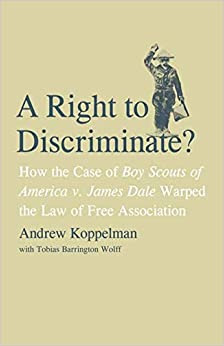
Andrew Koppelman and Tobias Barrington Wolff, A Right to Discriminate?: How the Case of Boy Scouts of America v. James Dale Warped the Law of Free Association (Yale University Press 2009)

Jack M. Balkin and Reva B. Siegel, The Constitution in 2020 (Oxford University Press 2009)

Heather K. Gerken, The Democracy Index: Why Our Election System Is Failing and How to Fix It (Princeton University Press 2009)

Mary Dudziak, Exporting American Dreams: Thurgood Marshall's African Journey (Oxford University Press 2008)

David Luban, Legal Ethics and Human Dignity (Cambridge Univ. Press 2007)

Ian Ayres, Super Crunchers: Why Thinking-By-Numbers is the New Way to be Smart (Bantam 2007)

Jack M. Balkin, James Grimmelmann, Eddan Katz, Nimrod Kozlovski, Shlomit Wagman and Tal Zarsky, eds., Cybercrime: Digital Cops in a Networked Environment (N.Y.U. Press 2007)
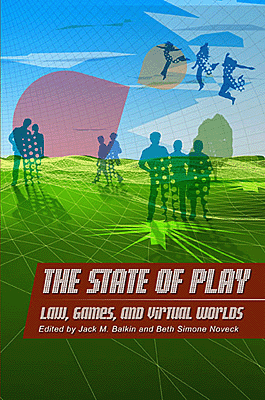
Jack M. Balkin and Beth Simone Noveck, The State of Play: Law, Games, and Virtual Worlds (N.Y.U. Press 2006)

Andrew Koppelman, Same Sex, Different States: When Same-Sex Marriages Cross State Lines (Yale University Press 2006)

Brian Tamanaha, Law as a Means to an End (Cambridge University Press 2006)

Sanford Levinson, Our Undemocratic Constitution (Oxford University Press 2006)

Mark Graber, Dred Scott and the Problem of Constitutional Evil (Cambridge University Press 2006)

Jack M. Balkin, ed., What Roe v. Wade Should Have Said (N.Y.U. Press 2005)

Sanford Levinson, ed., Torture: A Collection (Oxford University Press 2004)
Balkin.com homepage
Bibliography
Conlaw.net
Cultural Software
Writings
Opeds
The Information Society Project
BrownvBoard.com
Useful Links
Syllabi and Exams
