Balkinization
an unanticipated consequence of
Jack M. Balkin
Balkinization Symposiums: A Continuing List
E-mail:
Jack Balkin:
jackbalkin at yahoo.com
Bruce Ackerman
bruce.ackerman at yale.edu
Ian Ayres
ian.ayres at yale.edu
Corey Brettschneider
corey_brettschneider at brown.edu
Mary Dudziak
mary.l.dudziak at emory.edu
Joey Fishkin
joey.fishkin at gmail.com
Heather Gerken heather.gerken at yale.edu
Abbe Gluck abbe.gluck at yale.edu
Mark Graber
mgraber at law.umaryland.edu
Stephen Griffin
sgriffin at tulane.edu
Jonathan Hafetz
jonathan.hafetz at shu.edu
Jeremy Kessler
jkessler at law.columbia.edu
Andrew Koppelman
akoppelman at law.northwestern.edu
Marty Lederman
msl46 at law.georgetown.edu
Sanford Levinson
slevinson at law.utexas.edu
David Luban
david.luban at gmail.com
Gerard Magliocca
gmaglioc at iupui.edu
Jason Mazzone
mazzonej at illinois.edu
Linda McClain
lmcclain at bu.edu
John Mikhail
mikhail at law.georgetown.edu
Frank Pasquale
pasquale.frank at gmail.com
Nate Persily
npersily at gmail.com
Michael Stokes Paulsen
michaelstokespaulsen at gmail.com
Deborah Pearlstein
dpearlst at yu.edu
Rick Pildes
rick.pildes at nyu.edu
David Pozen
dpozen at law.columbia.edu
Richard Primus
raprimus at umich.edu
K. Sabeel Rahmansabeel.rahman at brooklaw.edu
Alice Ristroph
alice.ristroph at shu.edu
Neil Siegel
siegel at law.duke.edu
David Super
david.super at law.georgetown.edu
Brian Tamanaha
btamanaha at wulaw.wustl.edu
Nelson Tebbe
nelson.tebbe at brooklaw.edu
Mark Tushnet
mtushnet at law.harvard.edu
Adam Winkler
winkler at ucla.edu
Compendium of posts on Hobby Lobby and related cases
The Anti-Torture Memos: Balkinization Posts on Torture, Interrogation, Detention, War Powers, and OLC
The Anti-Torture Memos (arranged by topic)
Recent Posts
Response to Our Readers
![[Powered by Blogger]](https://lh3.googleusercontent.com/blogger_img_proxy/AEn0k_uRpiU_a2igLl0ht7FYpM9MdD6ZkH5JsYjMxEBDYUh_Il_1vfq_sd8JMRPVpp_xESH0QEyRlAnxwKXsVWvdj0RspkMiXPnBg_n1floIUNx0=s0-d)
Just A Few Blogs
ACS Blog
Alas, a Blog
Althouse
Arts and Letters Daily
Atrios (Eschaton)
Bill of Health
Buzzflash.com
Buzz Machine
Cato at Liberty
Juan Cole (Informed Comment)
Concurring Opinions
The Constitution in 2020
Corrente
Crooked Timber
Daily Howler
Daily Kos
Dana Boyd
Brad DeLong
Digby (Hullabaloo)
Discriminations
Daniel Drezner
Kevin Drum (Mother Jones)
Electrolite
En Banc
Eunomia (Daniel Larison)
Fafblog
Michael Froomkin (Discourse.net)
GovLab (Beth Noveck)
Rick Hasen (Election Law)
History News Network
How Appealing
Ignatz (Sam Heldman)
The Importance of (Ernie Miller)
Infolaw
Instapundit
International Economic Law and Policy Blog
IntLawGrrls
Jacob Levy
Jesus' General
Jurisdynamics
The Kitchen Cabinet
Mark Kleiman
Law Blog Central
Larry Lessig
Lawyers, Guns and Money
Liberal Oasis
Brian Leiter's Law School Reports
The Leiter Reports
Marginal Revolution
Megan McArdle
Memeorandum
Metafilter
Mirror of Justice
The New Republic
Newseum
No More Mister Nice Blog
Brendan Nyhan
Opinio Juris
Orcinus
The Originalism Blog
Pandagon
Passport (Foreign Policy)
Overcoming Bias
Political Animal (Washington Monthly)
Political Theory Daily Review
Political Wire (Taegan Goddard)
The Poor Man
Virginia Postrel
Prawfsblawg
Public Reason
Jonathan Rauch
Raw Story
Redstate
ReligiousLeftLaw.com
Reporters Committee For Freedom of the Press
Reproductive Rights Blog
Rothman's Roadmap to the Right of Publicity
SCOTUS Blog
Seeing the Forest
Clay Shirky
The Shifted Librarian
The Situationist
Larry Solum (Legal Theory)
Andrew Sullivan
Talking Points Memo
Talk Left
Tapped
Tbogg
TechPresident
The Paper Chase (Jurist)
Tom Paine
Tom Tomorrow (This Modern World)
Eve Tushnet
Uggabugga
University of Chicago Law School Faculty Blog
Unqualified Offerings
The Volokh Conspiracy
War and Piece (Laura Rozen)
Wampum
Oliver Willis
Wonkette
Written Description
Matthew Yglesias
Yin
Your Choice of Feeds
1. XML
powered by

2. Atom Feed
3. RSS 2.0
Response to Our Readers
Guest Blogger
For the Balkinization symposium on Mark Tushnet and Bojan Bugaric, Constitutionalism and Its Discontents (University of Chicago Press, 2026). Mark Tushnet and Bojan Bugaric As several contributors to this book review symposium emphasize, conventions are important elements in institutional designs that contribute to social and political stability. With that in mind we follow the convention of thanking all the contributors for the attention and seriousness they devoted to our book. We add one thing: a recognition that review symposia like this one are especially well-suited to the blog format even as the long-form blog has gone into serious decline. Coordinating a symposium via Substack would be difficult, even putting aside questions about paywalls and the like; doing so on Bluesky would be impossible; and maintaining a podcast or newsletter, whether paid or not, would require a different level of commitment than does maintaining a blog. So our thanks go to Jack Balkin as well for his continuing support for the long-form blog. We begin by noting that many contributors (alphabetically, Gamboa, Levinson, Nicola, Ragone, O’Cinneide) correctly pick up on something we think lies at the base of our analysis—an insistence that context matters. So, for example, our expressed preference for a “thin” constitution (however defined) can be displaced by thicker ones when circumstances require: an empowered constitutional court—one of Loughlin’s bugbears in the context with which he is concerned—might be appropriate when a nation is in the incipient stages of democratic decline, though as Levinson notes, we are skeptical about the proposition that institution designers will be able to create such a court that will be effective when needed (rather than captured too quickly) and will retreat when the exigency has passed. Here, too, though, context matters. Gamboa and Graber in different ways ask us—the community of scholars to whom our book is addressed—to consider the politics that might produce the Goldilocks solution. We have almost nothing to say about that in our book, apart from the fact that we advocate a greater role for politics, not law, aiming to provide solutions to accumulated problems of neoliberal politics of the last four decades, which make various populist responses thrive, and welcome further scholarly attention to that question, already addressed in other disciplines like political economy, sociology and political science. Similarly with other aspects of institutional design, in particular with the fear of the Frankenstate that Ragone raises. Assembling an institutional order from pieces drawn from other orders might produce a Frankenstate but might also give you a pretty good working constitution. And the interaction effects that produce a Frankenstate are typically so complex that one can’t be confident that something assembly that works badly in one context might not work decently well in another. We do report our sense that readers’ acknowledgement of the importance of context often comes with a perhaps residual sense that some aspects of institutional design are at least presumptively desirable everywhere at all times. Examples include empowered constitutional courts again, but also substantive commitments to somewhat thick assumed presuppositions about what democratic self-governance requires in the way of free expression and procedural regularity. Levinson has a somewhat longer list. We do not take the contributors to be committed to treating these matters of institutional design as inflexible steel bars but perhaps (forcing the metaphor) as pieces of balsa wood, somewhat supple but not bendable into any shape whatever. Here our reaction reverts to Freud: the psychology lying behind an analysis that leads to ego replacing id (not, pace O’Conneide, superego) is difficult—sometimes, as Freud suggested, interminable. Gargarella, Nicola, and O’Cinneide raise questions about our conclusion that the remedies for democratic decline—and, we think we should now add, the prospects for further democratic empowerment—lie in ordinary politics conducted by ordinary political parties. Nicola and O’Cinneide question whether parties as currently constituted are well-suited to conducting the kind of constitutional politics that leads to democratic revival and expansion. Gargarella argues that parties as currently organized are ill-adapted to new social conditions of radical economic dispersion and multiculturalism. To put the point somewhat awkwardly, we don’t really disagree with these observations. And we reiterate a point made in the book, that analysis of political parties is something that political scientists are far better at than we are. Nevertheless, our main intent in the book was to shift the attention from the obsession with “defensive legalism” toward greater engagement with politics, coming from political parties and other forms of political engagement. That said, we are currently working on a follow-up that will, we hope, address some of them. In that article we distinguish between the here-and-now and the ultimately desirable. The prescriptions for today’s center-left political parties we offer are short-term—how to begin to get out of the pickle we’re in. Gargarella in particular but also Purdy to some extent invite us to ask about the long term. We are happy to do so, again with the qualification about relative expertise. We note, though, an additional question: how do we get from here to there? On that we can point into direction of growing literature on law and political economy, offering fruitful conversation among lawyers about how to create legal prerequisites for open and democratic political renewal. We turn from themes running through several contributions to points made by four contributors. O’Cinneide denies that majoritarian preference can always provide a sufficient justification for exercising public power—which, in light of our insistence on context, is surely true. He suggests, though, that there is something like constitutional justification that always must be provided. No surprise: we are skeptical because of the risk that what counts as a constitutional justification will either start out as or eventually become the kind of thick constitutionalism we do oppose. Perhaps, though, we could construe his argument as, Start out pretty thin and then contest through ordinary politics every effort to thicken the demand for constitutional justification. So construed (which, we emphasize, is our construction not to be attributed to O’Cinneide), the argument runs up against the strongest of Graber’s points. Before getting to that, though, we want to point out something of an equivocation in Graber’s use of the term “entrenchment” to encompass legal, political, and cultural arrangements that can’t be displaced through ordinary majoritarian politics but can be displaced through sustained majoritarian or concentrated supermajoritarian politics. Some versions of Yale-associated accounts of the role of social movements in constitutional change are the prime examples of the former, formal constitutional amendments the prime example of the latter. Of course some results of ordinary politics are “sticky,” as we stress when arguing that making every institutional arrangement subject to ordinary politics won’t inevitably lead to chaos. Other than that, though, we’re not clear on what’s gained by lumping all these types of stickiness into the category “entrenchment.” Graber’s strongest point, we think, is that sometimes the ordinary political contestation over thickening the justificatory requirements will end up with thicker rather than thin ones. People like us might lose out in that political struggle. Graber’s example of Canadians and investors identifies the most difficult case for us—thickening that leads to a change in the composition of the governing bodies whose actions are the targets of ordinary politics. Once you give Canadians and investors a formal role in governance, you’re going to be stuck with it absent extraordinary political mobilization. Graber’s point identifies a central difficulty in pretty much all democratic theory. Who constitutes the demos that is to be self-governing? Discussions of the constitutionalization of the European Union asked whether Europe had a demos, though the consensus answer (“No”) doesn’t really address the theoretical question. Tushnet has a forthcoming short essay, “The Georgraphy of Constitutionalism,” that makes a stab at answering the question. He thinks that there’s no general theoretical answer but that things are path-dependent. Kif that’s right, our response to Graber’s strongest point is that the relevant politics can’t coherently be identified as majoritarian or otherwise (maybe applying the term to the politics that determines the boundaries of the demos is a category-mistake). Purdy frames our work with reference to “structures of feeling.” We appreciate the point and may have hinted at it in our appropriation of the term “liberalism of anxiety.” For him, one characteristic of contemporary society is “a collapse in trust.” That seems right to us, in which case we might ask how to rebuild trust (rather than how to construct a stable democratic polity in the absence of trust). In the follow-up article we referred to earlier, we’re working on ideas about radical decentralization coupled with “transborder” agreements to deal with issues associated with world-wide political economy as a way of rebuilding trust through face-to-face interactions and reciprocal agreements. But, we’re not yet able to defend that position against some rather obvious skeptical thoughts that will already have occurred to readers of this response! Finally, Loughlin mounts a severe attack on our argument. We were initially taken aback at its thrust because we thought we were operating within roughly the same conceptual space as his Against Constitutionalism. Some of his arguments seem to us based upon misreadings of our position, for example about the role of conventions, norms, and guidelines in stabilizing “thin” constitutional institutional arrangements. Rather than engage his arguments point-by-point, we’ll conclude by suggesting that Loughlin doesn’t have the courage of his convictions. His book develops arguments against a particular form of constitutionalism. We can be taken as asking, What purchase do those arguments have against the components of even a thin constitution, or a constitutionalism that survives after Loughlin’s critique of that particular form? And, we can be taken as answering, Exactly the same purchase. That is, if Loughlin’s right about what’s wrong with the form of constitutionalism he criticizes, people like us who take up his arguments are right about what’s wrong with constitutionalism full stop. Or, as we put it in our follow-up article, we think it completely defensible to take politics all the way down—not merely through “ordinary” policies but through the institutional arrangements that are taken to define the particular forms democracy takes in each polity. Again, we thank the contributors (and Balkinization) for providing us with the opportunity to engage with critical readers of our work, and hope that our responses add value to the book! Mark Tushnet is William Nelson Cromwell Professor of Law emeritus at Harvard Law School. You can reach him by e-mail at mtushnet@law.harvard.edu. Bojan Bugaric is Professor of Law at Sheffield School of Law. You can reach him by e-mail at b.bugaric@sheffield.ac.uk.
Posted
9:30 AM
by Guest Blogger [link]
Books by Balkinization Bloggers

Gerard N. Magliocca, The Actual Art of Governing: Justice Robert H. Jackson's Concurring Opinion in the Steel Seizure Case (Oxford University Press, 2025)

Linda C. McClain and Aziza Ahmed, The Routledge Companion to Gender and COVID-19 (Routledge, 2024)

David Pozen, The Constitution of the War on Drugs (Oxford University Press, 2024)

Jack M. Balkin, Memory and Authority: The Uses of History in Constitutional Interpretation (Yale University Press, 2024)
Mark A. Graber, Punish Treason, Reward Loyalty: The Forgotten Goals of Constitutional Reform after the Civil War (University of Kansas Press, 2023)
Jack M. Balkin, What Roe v. Wade Should Have Said: The Nation's Top Legal Experts Rewrite America's Most Controversial Decision - Revised Edition (NYU Press, 2023)

Andrew Koppelman, Burning Down the House: How Libertarian Philosophy Was Corrupted by Delusion and Greed (St. Martin’s Press, 2022)

Gerard N. Magliocca, Washington's Heir: The Life of Justice Bushrod Washington (Oxford University Press, 2022)
Joseph Fishkin and William E. Forbath, The Anti-Oligarchy Constitution: Reconstructing the Economic Foundations of American Democracy (Harvard University Press, 2022)
Mark Tushnet and Bojan Bugaric, Power to the People: Constitutionalism in the Age of Populism (Oxford University Press 2021).

Mark Philip Bradley and Mary L. Dudziak, eds., Making the Forever War: Marilyn B. Young on the Culture and Politics of American Militarism Culture and Politics in the Cold War and Beyond (University of Massachusetts Press, 2021).

Jack M. Balkin, What Obergefell v. Hodges Should Have Said: The Nation's Top Legal Experts Rewrite America's Same-Sex Marriage Decision (Yale University Press, 2020)

Frank Pasquale, New Laws of Robotics: Defending Human Expertise in the Age of AI (Belknap Press, 2020)

Jack M. Balkin, The Cycles of Constitutional Time (Oxford University Press, 2020)

Mark Tushnet, Taking Back the Constitution: Activist Judges and the Next Age of American Law (Yale University Press 2020).

Andrew Koppelman, Gay Rights vs. Religious Liberty?: The Unnecessary Conflict (Oxford University Press, 2020)

Ezekiel J Emanuel and Abbe R. Gluck, The Trillion Dollar Revolution: How the Affordable Care Act Transformed Politics, Law, and Health Care in America (PublicAffairs, 2020)

Linda C. McClain, Who's the Bigot?: Learning from Conflicts over Marriage and Civil Rights Law (Oxford University Press, 2020)
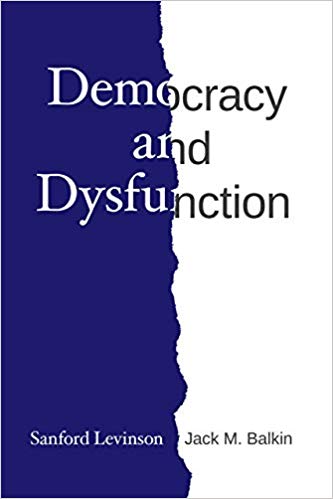
Sanford Levinson and Jack M. Balkin, Democracy and Dysfunction (University of Chicago Press, 2019)

Sanford Levinson, Written in Stone: Public Monuments in Changing Societies (Duke University Press 2018)

Mark A. Graber, Sanford Levinson, and Mark Tushnet, eds., Constitutional Democracy in Crisis? (Oxford University Press 2018)

Gerard Magliocca, The Heart of the Constitution: How the Bill of Rights became the Bill of Rights (Oxford University Press, 2018)

Cynthia Levinson and Sanford Levinson, Fault Lines in the Constitution: The Framers, Their Fights, and the Flaws that Affect Us Today (Peachtree Publishers, 2017)

Brian Z. Tamanaha, A Realistic Theory of Law (Cambridge University Press 2017)

Sanford Levinson, Nullification and Secession in Modern Constitutional Thought (University Press of Kansas 2016)

Sanford Levinson, An Argument Open to All: Reading The Federalist in the 21st Century (Yale University Press 2015)

Stephen M. Griffin, Broken Trust: Dysfunctional Government and Constitutional Reform (University Press of Kansas, 2015)

Frank Pasquale, The Black Box Society: The Secret Algorithms That Control Money and Information (Harvard University Press, 2015)

Bruce Ackerman, We the People, Volume 3: The Civil Rights Revolution (Harvard University Press, 2014)
Balkinization Symposium on We the People, Volume 3: The Civil Rights Revolution

Joseph Fishkin, Bottlenecks: A New Theory of Equal Opportunity (Oxford University Press, 2014)

Mark A. Graber, A New Introduction to American Constitutionalism (Oxford University Press, 2013)

John Mikhail, Elements of Moral Cognition: Rawls' Linguistic Analogy and the Cognitive Science of Moral and Legal Judgment (Cambridge University Press, 2013)

Gerard N. Magliocca, American Founding Son: John Bingham and the Invention of the Fourteenth Amendment (New York University Press, 2013)

Stephen M. Griffin, Long Wars and the Constitution (Harvard University Press, 2013)

Andrew Koppelman, The Tough Luck Constitution and the Assault on Health Care Reform (Oxford University Press, 2013)

James E. Fleming and Linda C. McClain, Ordered Liberty: Rights, Responsibilities, and Virtues (Harvard University Press, 2013)
Balkinization Symposium on Ordered Liberty: Rights, Responsibilities, and Virtues

Andrew Koppelman, Defending American Religious Neutrality (Harvard University Press, 2013)

Brian Z. Tamanaha, Failing Law Schools (University of Chicago Press, 2012)

Sanford Levinson, Framed: America's 51 Constitutions and the Crisis of Governance (Oxford University Press, 2012)

Linda C. McClain and Joanna L. Grossman, Gender Equality: Dimensions of Women's Equal Citizenship (Cambridge University Press, 2012)

Mary Dudziak, War Time: An Idea, Its History, Its Consequences (Oxford University Press, 2012)

Jack M. Balkin, Living Originalism (Harvard University Press, 2011)

Jason Mazzone, Copyfraud and Other Abuses of Intellectual Property Law (Stanford University Press, 2011)

Richard W. Garnett and Andrew Koppelman, First Amendment Stories, (Foundation Press 2011)

Jack M. Balkin, Constitutional Redemption: Political Faith in an Unjust World (Harvard University Press, 2011)

Gerard Magliocca, The Tragedy of William Jennings Bryan: Constitutional Law and the Politics of Backlash (Yale University Press, 2011)

Bernard Harcourt, The Illusion of Free Markets: Punishment and the Myth of Natural Order (Harvard University Press, 2010)

Bruce Ackerman, The Decline and Fall of the American Republic (Harvard University Press, 2010)
Balkinization Symposium on The Decline and Fall of the American Republic

Ian Ayres. Carrots and Sticks: Unlock the Power of Incentives to Get Things Done (Bantam Books, 2010)

Mark Tushnet, Why the Constitution Matters (Yale University Press 2010)

Ian Ayres and Barry Nalebuff: Lifecycle Investing: A New, Safe, and Audacious Way to Improve the Performance of Your Retirement Portfolio (Basic Books, 2010)
.jpg)
Jack M. Balkin, The Laws of Change: I Ching and the Philosophy of Life (2d Edition, Sybil Creek Press 2009)

Brian Z. Tamanaha, Beyond the Formalist-Realist Divide: The Role of Politics in Judging (Princeton University Press 2009)
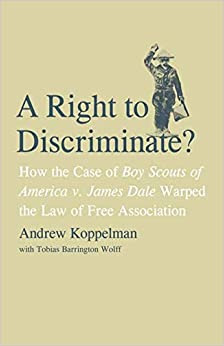
Andrew Koppelman and Tobias Barrington Wolff, A Right to Discriminate?: How the Case of Boy Scouts of America v. James Dale Warped the Law of Free Association (Yale University Press 2009)

Jack M. Balkin and Reva B. Siegel, The Constitution in 2020 (Oxford University Press 2009)

Heather K. Gerken, The Democracy Index: Why Our Election System Is Failing and How to Fix It (Princeton University Press 2009)

Mary Dudziak, Exporting American Dreams: Thurgood Marshall's African Journey (Oxford University Press 2008)

David Luban, Legal Ethics and Human Dignity (Cambridge Univ. Press 2007)

Ian Ayres, Super Crunchers: Why Thinking-By-Numbers is the New Way to be Smart (Bantam 2007)

Jack M. Balkin, James Grimmelmann, Eddan Katz, Nimrod Kozlovski, Shlomit Wagman and Tal Zarsky, eds., Cybercrime: Digital Cops in a Networked Environment (N.Y.U. Press 2007)

Jack M. Balkin and Beth Simone Noveck, The State of Play: Law, Games, and Virtual Worlds (N.Y.U. Press 2006)

Andrew Koppelman, Same Sex, Different States: When Same-Sex Marriages Cross State Lines (Yale University Press 2006)

Brian Tamanaha, Law as a Means to an End (Cambridge University Press 2006)

Sanford Levinson, Our Undemocratic Constitution (Oxford University Press 2006)

Mark Graber, Dred Scott and the Problem of Constitutional Evil (Cambridge University Press 2006)

Jack M. Balkin, ed., What Roe v. Wade Should Have Said (N.Y.U. Press 2005)

Sanford Levinson, ed., Torture: A Collection (Oxford University Press 2004)
Balkin.com homepage
Bibliography
Conlaw.net
Cultural Software
Writings
Opeds
The Information Society Project
BrownvBoard.com
Useful Links
Syllabi and Exams
