Balkinization
an unanticipated consequence of
Jack M. Balkin
Balkinization Symposiums: A Continuing List
E-mail:
Jack Balkin:
jackbalkin at yahoo.com
Bruce Ackerman
bruce.ackerman at yale.edu
Ian Ayres
ian.ayres at yale.edu
Corey Brettschneider
corey_brettschneider at brown.edu
Mary Dudziak
mary.l.dudziak at emory.edu
Joey Fishkin
joey.fishkin at gmail.com
Heather Gerken heather.gerken at yale.edu
Abbe Gluck abbe.gluck at yale.edu
Mark Graber
mgraber at law.umaryland.edu
Stephen Griffin
sgriffin at tulane.edu
Jonathan Hafetz
jonathan.hafetz at shu.edu
Jeremy Kessler
jkessler at law.columbia.edu
Andrew Koppelman
akoppelman at law.northwestern.edu
Marty Lederman
msl46 at law.georgetown.edu
Sanford Levinson
slevinson at law.utexas.edu
David Luban
david.luban at gmail.com
Gerard Magliocca
gmaglioc at iupui.edu
Jason Mazzone
mazzonej at illinois.edu
Linda McClain
lmcclain at bu.edu
John Mikhail
mikhail at law.georgetown.edu
Frank Pasquale
pasquale.frank at gmail.com
Nate Persily
npersily at gmail.com
Michael Stokes Paulsen
michaelstokespaulsen at gmail.com
Deborah Pearlstein
dpearlst at yu.edu
Rick Pildes
rick.pildes at nyu.edu
David Pozen
dpozen at law.columbia.edu
Richard Primus
raprimus at umich.edu
K. Sabeel Rahmansabeel.rahman at brooklaw.edu
Alice Ristroph
alice.ristroph at shu.edu
Neil Siegel
siegel at law.duke.edu
David Super
david.super at law.georgetown.edu
Brian Tamanaha
btamanaha at wulaw.wustl.edu
Nelson Tebbe
nelson.tebbe at brooklaw.edu
Mark Tushnet
mtushnet at law.harvard.edu
Adam Winkler
winkler at ucla.edu
Compendium of posts on Hobby Lobby and related cases
The Anti-Torture Memos: Balkinization Posts on Torture, Interrogation, Detention, War Powers, and OLC
The Anti-Torture Memos (arranged by topic)
Recent Posts
Discontent with Constitutionalism and Its Discontents
![[Powered by Blogger]](https://lh3.googleusercontent.com/blogger_img_proxy/AEn0k_t_sYJBD49XeR2ACd2fdQtxKOOp78tGI9hva8r6mDAjVozYF8Kxjdybsg2WhVZaw7q1ySzggWkzjeTW2MKxM-VMQ4yy3vvBXQv7MwCPXAPM=s0-d)
Just A Few Blogs
ACS Blog
Alas, a Blog
Althouse
Arts and Letters Daily
Atrios (Eschaton)
Bill of Health
Buzzflash.com
Buzz Machine
Cato at Liberty
Juan Cole (Informed Comment)
Concurring Opinions
The Constitution in 2020
Corrente
Crooked Timber
Daily Howler
Daily Kos
Dana Boyd
Brad DeLong
Digby (Hullabaloo)
Discriminations
Daniel Drezner
Kevin Drum (Mother Jones)
Electrolite
En Banc
Eunomia (Daniel Larison)
Fafblog
Michael Froomkin (Discourse.net)
GovLab (Beth Noveck)
Rick Hasen (Election Law)
History News Network
How Appealing
Ignatz (Sam Heldman)
The Importance of (Ernie Miller)
Infolaw
Instapundit
International Economic Law and Policy Blog
IntLawGrrls
Jacob Levy
Jesus' General
Jurisdynamics
The Kitchen Cabinet
Mark Kleiman
Law Blog Central
Larry Lessig
Lawyers, Guns and Money
Liberal Oasis
Brian Leiter's Law School Reports
The Leiter Reports
Marginal Revolution
Megan McArdle
Memeorandum
Metafilter
Mirror of Justice
The New Republic
Newseum
No More Mister Nice Blog
Brendan Nyhan
Opinio Juris
Orcinus
The Originalism Blog
Pandagon
Passport (Foreign Policy)
Overcoming Bias
Political Animal (Washington Monthly)
Political Theory Daily Review
Political Wire (Taegan Goddard)
The Poor Man
Virginia Postrel
Prawfsblawg
Public Reason
Jonathan Rauch
Raw Story
Redstate
ReligiousLeftLaw.com
Reporters Committee For Freedom of the Press
Reproductive Rights Blog
Rothman's Roadmap to the Right of Publicity
SCOTUS Blog
Seeing the Forest
Clay Shirky
The Shifted Librarian
The Situationist
Larry Solum (Legal Theory)
Andrew Sullivan
Talking Points Memo
Talk Left
Tapped
Tbogg
TechPresident
The Paper Chase (Jurist)
Tom Paine
Tom Tomorrow (This Modern World)
Eve Tushnet
Uggabugga
University of Chicago Law School Faculty Blog
Unqualified Offerings
The Volokh Conspiracy
War and Piece (Laura Rozen)
Wampum
Oliver Willis
Wonkette
Written Description
Matthew Yglesias
Yin
Your Choice of Feeds
1. XML
powered by

2. Atom Feed
3. RSS 2.0
Discontent with Constitutionalism and Its Discontents
Guest Blogger
For the Balkinization symposium on Mark Tushnet and Bojan Bugaric, Constitutionalism and Its Discontents (University of Chicago Press, 2026). Martin Loughlin My thoughts on Constitutionalism and Its Discontents,
the latest publication from Professors Tushnet and Bugaric, must be situated in
the context of their earlier book, Power
to the People. That book, I argued in Balkinization,
had failed to give a cogent answer to the basic question it sought to address,
namely, whether populism is inconsistent with constitutionalism. And the reason
was that the authors had not provided a clear statement of what those two key terms
mean. With respect to constitutionalism, they sought to avoid controversy by
presenting what they called a ‘thin’ account which could operate as ‘a least
common denominator’. But this account, I suggested, was not only as contentious
as so-called ‘thick’ accounts; it was also skewed in such a way that it would
not be accepted by constitutionalism’s most fervent advocates. Their thin
account could not differentiate between those who adhere to constitutionalism,
those who reject constitutionalism but uphold constitutional democracy, and
those who merely acknowledge the value of constitutional government. In their
response, the authors failed to engage with this issue other than indicating that
my understanding of constitutionalism was not suitable for their purpose. Since
the point I was making preceded the publication of my book, Against Constitutionalism, that seemed fair enough, because only
in that book was I able to make out the case that throughout the modern era constitutionalism
has carried a clear and widely understood meaning. It is, I argued, a liberal theory advocating
the need for the written constitution to include a particular set of
institutional arrangements that could restrain the power of majorities and set
in place a scheme of limited government so
that individual liberty might flourish. Distilling its elements, I proposed that
the theory asserted that the written constitution should accord with six basic
precepts: it establishes (1) a comprehensive scheme of (2) representative
government and (3) differentiated powers, which is
conceived (4) as having established a permanent framework that
takes effect (5) as fundamental law, and which ultimately leads to the
constitution being treated as the expression of a regime’s (6) collective
political identity.
Since
this formulation
was generated from studying the evolving modern practice and from accounts of
its adherents, I did not regard it
as particularly controversial.
It had also been widely accepted by other leading scholars. Consider, for
example, the work of Walter Murphy, doyen
of the Princeton school of constitutional scholarship. His 2007 book on constitutional democracy begins by recognizing the need to draw clear
distinctions between constitutionalism, constitutional democracy, and constitutional
government. Constitutionalism, he explains, ‘is a normative political creed
that endorses a special kind of political order’, an order founded on a
constitutional text containing a bill of rights and judicial review, upholding
respect for human dignity as the fundamental value, and adopting the doctrine
of the separation of powers. And he then shows that it is a type of regime that
must be distinguished from constitutional democracy. Indeed, he notes that those
who intend to study the role of constitutions dispassionately without being
seduced into accepting the ideology of constitutionalism must carefully
differentiate between ‘constitutionism’ and ‘constitutionalism’. But we might also refer to Professor Tushnet’s own book, Taking
the Constitution Away from the Courts. His discussion in that book implicitly
endorses my understanding of the concept of constitutionalism and adopts a
similarly sceptical view of its value. He cites positively Jefferson’s argument
about the dangers of one generation binding the next, doubts whether constitutions
‘are a good way of tying our hands’, notes that the argument for entrenchment ‘overlooks
the problem created by interpretive ambiguity’ and ridicules the opposing
argument that otherwise ‘all institutions [are] up for grabs at all times’
(pp.40-42). In a book carrying such a title and containing chapters entitled
‘against judicial supremacy’ and, even more radically, ‘against judicial
review’, it surely is not unreasonable to assume that Tushnet is ‘against
constitutionalism’. Following the publication of my book, the authors had
the opportunity to offer a more considered response to my Balkinization review.
One obvious criticism is that I had adopted
a contentious version of the concept and in a review essay – remarkably
entitled For
Constitutionalism – Mark Tushnet evidently thought so. Although generously
acknowledging that Against Constitutionalism is ‘a powerful critique of what [Loughlin]
rightly contends is the predominant form of constitutionalism in today’s
world’, he ruminated on ‘whether that is the only form constitutionalism
can take’ (p.15). Since I had argued that terms like ‘popular’ or ‘political
constitutionalism’ – versions they had been advocating – are misnomers, this perhaps
is not surprising. Yet, in a 40-page review essay, he does not make out a case
for an alternative version. Instead, his critique is pitched at the claim that my
book defends constitutional democracy against constitutionalism. But in
advancing that claim he crudely mischaracterises my views on constitutional
democracy. In the
Preface to Against
Constitutionalism I noted that constitutionalism
is often extolled but rarely defined. I explained that it ‘certainly expresses
a belief that order, freedom, and justice are best promoted in a regime whose
main characteristics are defined by a founding text elevated above the ordinary
cut and thrust of politics’, but that otherwise its meaning often remains
ambiguous. And here I must emphasize two points. First, that this is the only statement
to be found in the book that mentions the phrase ‘the ordinary cut and thrust
of politics’. Secondly, that that phrase is not made with reference to
constitutional democracy; it is used only to help identify a basic feature of
constitutionalism. It is a feature that the author of Taking the
Constitution Away from the Courts might find uncontroversial. But this is not how he reads it. In
his review essay, Tushnet not only invokes that phrase fifteen times,
but also asserts that I employ it as my definition of constitutional democracy.
Asking, rhetorically, what does ‘constitutional’ in that phrase signify, he
states: That statement requires a considerable amount of unpacking. Let’s
set to one side the gratuitous references to Weimar and street fighting; anyone
interested in my views on the nature of politics – which are far removed from
fighting, in streets or otherwise – might consult chapter 3 of The
Idea of Public Law. But he also makes the
unwarranted and unsubstantiated assumption that for me constitutional democracy
is a regime without an institutional infrastructure and in which everything is
reduced to the ‘ordinary cut and
thrust of politics’. Again, that same chapter of The Idea of Public Law provide
a corrective. How could that stance even be contemplated? Unless there are rules about
ruling, there is no regime. Why would I write books on public law that examine such
institutions as state, constitution and government if I held such a weird view?
What must I have been thinking in writing an essay on ‘Law
as Institution’? Why attribute to me what he recognizes as the
crazy notion that
‘all institutions [must be] up for grabs at all times’ when in Against
Constitutionalism (p.107) I explicitly state that constitutional democracy recognizes
that ‘the written constitution performs a critical role in providing a
framework for institutionalizing … social conflicts’? What causes him to
convert a phrase I use only in a preface and then only to illustrate the
character of constitutionalism into the epitome of my account of constitutional
democracy? I labour this point because following
his review, Tushnet and Bugaric use my book to ‘frame
the problem’ of Constitutionalism and Its Discontents. Their first chapter
suggests that I am ‘against a form
of constitutionalism [sic] specific to the circumstances of contemporary
society’ and that I support ‘a form of constitutionalism in which the
fundamentals of political organization are subject to determination by the
pulling and hauling of ordinary politics’ (p.7). Since this statement again
refers to my Preface statement, I fear what might follow when they ‘examine the
coherence of that position’ (p.7). I didn’t have to wait long to find out
because, introducing the theme of rules about ruling, they state that ‘Loughlin
wants to leave all questions [here we go again] to “the ordinary cut and thrust
of politics”’ (p.9). And, to the contrary, they argue that: Who
are they arguing against? This is not an argument against ‘against
constitutionalism’, nor an argument against constitutional democracy. Anyone
crazy enough to believe there are no rules is not even arguing against
constitutional government; they are against government! I understand that in
the USA trust in institutions has all but collapsed, but I don’t understand why
they seek to lay that anxiety on me. Their second chapter on ‘Democracy
Without Rules’ thus descends into nonsense. Democracy is a system of governing;
its character is obviously determined by rules. But they persist: ‘The
entrenched constitutionalism Loughlin argues against and the
constitution-as-statute occupy different points in a space of varieties of
constitutionalism.’ (p.23) It is true that I argue against constitutionalism
and that constitutionalism depends on entrenchment (see precept 4 above), but I
do not argue against entrenchment per se. Being a question of degree, to argue
against any form of entrenchment would amount to being opposed to
constitutional government. And as I make clear in Against Constitutionalism
(p.7): ‘The practices of constitutional government continue to exert a guiding
influence over many contemporary systems of government, including those of
France, Sweden, and the United Kingdom, which do not adhere to the precepts of
constitutionalism.’ Paul Starr expresses the basic point concisely in his book
on Entrenchment when explaining that democracy ‘abhors entrenched power’
but ‘a democratic government cannot exist without foundational rules that
determine how its institutions work’ (p.xiii). It’s so obvious that it needs no
further elaborating. In this second chapter Tushnet and Bugaric
deliberate over what they conceive to be various forms of constitutionalism.
And they reach a surprising conclusion: To
be clear, here they come out as being against constitutionalism! They try to fudge this by claiming that
‘constitutionalism is most often said to be primarily or largely about imposing
limits on the ability of governing officials to act arbitrarily’ (p.30). Not so:
pace McIlwain, that is a statement of the purpose of constitutional
government, not constitutionalism. Their ruminations then extend to the rise of
authoritarianism and the reasons for, and the limitations of, institutional
safeguards. On this I have nothing to add to what I argued in Against
Constitutionalism: that populism is best seen as a syndrome, a symptom of dissatisfaction
to the ways in which across the world constitutional democracies are being
reshaped by constitutionalism. Is it fanciful to think that, ultimately,
Tushnet and Bugaric
do not disagree? All of this is by way of saying that I
find their argument puzzling. Tushnet’s apparent antagonism towards my thesis
runs counter to much of his earlier work. Sure, I reject their use of
adjectival qualifiers – whether popular constitutionalism, thin
constitutionalism or whatever – as offending Occam’s razor. But if it were
simply a disagreement about semantics, they might just say so. I persist with my
claim, though, because it is only once constitutionalism is more precisely specified
that the trajectory of global developments can be more clearly identified. And I
suspect there’s more to it than a disagreement over the meaning of a term. Tushnet’s
twentieth century writings about the USA provided a more vehement critique of
constitutionalism than my rather conservative defence of constitutional
democracy against rampant constitutionalism offers. But he has since become a celebrated
pioneer of comparative constitutional studies, a subject with global
aspirations that, in many quarters at least, presents itself as a twenty-first
century incarnation of Cold War Liberalism. Go figure. Martin Loughlin is Emeritus Professor of Public Law at
the London School of Economics & Political Science. You can reach him by
e-mail at m.loughlin@lse.ac.uk.Loughlin’s
answer is, We decide how to decide by the ordinary cut and thrust of politics
(and, specifically, not by relying upon decisions about how to decide made by a
constitution’s framers or by contemporary judges). Yet, one might object, we
should hope that Loughlin doesn’t really mean “cut and thrust” in a literal
sense— fighting in the streets with swords and their contemporary equivalent
(even if in periods of extreme social and political stress such as Weimar
Germany street violence might become part of the daily political landscape). If
not fighting, though, ordinary politics even about constitutional matters has
to be conducted through some institutional forms. And, one might worry, those
institutional forms might not be well-suited for preserving or deepening the
constitutional dimension of constitutional democracy. (p.28)
Ordinary
political contestation occurs within a framework of rules about ruling. Lack of
entrenchment means that there is no stable framework within which political contestation
can occur. It means that everything about politics, including the rules and
norms for conducting it, is up for grabs. (p.16)
Entrenched
constitutions, thin constitutions, and constitutions-as-statutes have
upside benefits accompanied by downside costs. Where one comes out on the
choice between them depends upon one’s assessment of the size and probabilities
of the benefits and risks. We don’t think it obvious, to say the least, that in
all circumstances the calculations come out against treating constitutions as
ordinary statutes. Of course, doing so disrupts the way we’re used to thinking
about the constitution. And we don’t propose it simply because we think that
constitutional entrenchment is basically a bad idea—though we do. We propose it
because, in our view, in many circumstances the relevant calculation comes out
against entrenched constitutions. (p.27)
Posted
9:30 AM
by Guest Blogger [link]
Books by Balkinization Bloggers

Gerard N. Magliocca, The Actual Art of Governing: Justice Robert H. Jackson's Concurring Opinion in the Steel Seizure Case (Oxford University Press, 2025)

Linda C. McClain and Aziza Ahmed, The Routledge Companion to Gender and COVID-19 (Routledge, 2024)

David Pozen, The Constitution of the War on Drugs (Oxford University Press, 2024)

Jack M. Balkin, Memory and Authority: The Uses of History in Constitutional Interpretation (Yale University Press, 2024)
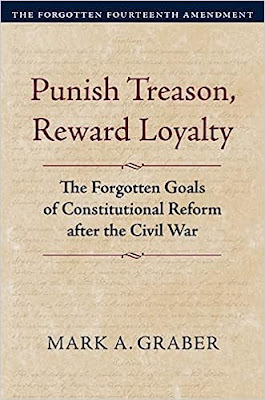
Mark A. Graber, Punish Treason, Reward Loyalty: The Forgotten Goals of Constitutional Reform after the Civil War (University of Kansas Press, 2023)
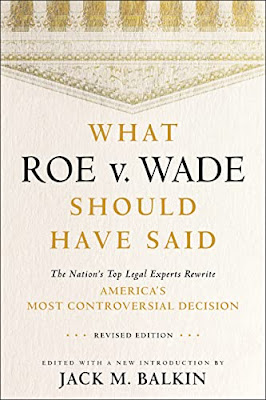
Jack M. Balkin, What Roe v. Wade Should Have Said: The Nation's Top Legal Experts Rewrite America's Most Controversial Decision - Revised Edition (NYU Press, 2023)

Andrew Koppelman, Burning Down the House: How Libertarian Philosophy Was Corrupted by Delusion and Greed (St. Martin’s Press, 2022)

Gerard N. Magliocca, Washington's Heir: The Life of Justice Bushrod Washington (Oxford University Press, 2022)
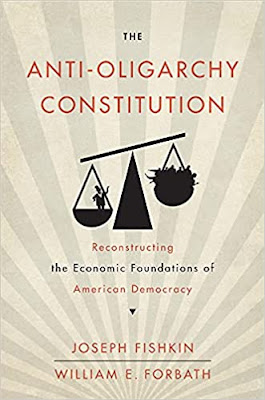
Joseph Fishkin and William E. Forbath, The Anti-Oligarchy Constitution: Reconstructing the Economic Foundations of American Democracy (Harvard University Press, 2022)
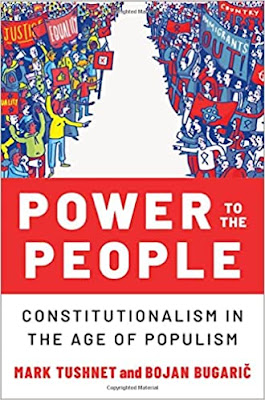
Mark Tushnet and Bojan Bugaric, Power to the People: Constitutionalism in the Age of Populism (Oxford University Press 2021).

Mark Philip Bradley and Mary L. Dudziak, eds., Making the Forever War: Marilyn B. Young on the Culture and Politics of American Militarism Culture and Politics in the Cold War and Beyond (University of Massachusetts Press, 2021).

Jack M. Balkin, What Obergefell v. Hodges Should Have Said: The Nation's Top Legal Experts Rewrite America's Same-Sex Marriage Decision (Yale University Press, 2020)

Frank Pasquale, New Laws of Robotics: Defending Human Expertise in the Age of AI (Belknap Press, 2020)

Jack M. Balkin, The Cycles of Constitutional Time (Oxford University Press, 2020)

Mark Tushnet, Taking Back the Constitution: Activist Judges and the Next Age of American Law (Yale University Press 2020).

Andrew Koppelman, Gay Rights vs. Religious Liberty?: The Unnecessary Conflict (Oxford University Press, 2020)

Ezekiel J Emanuel and Abbe R. Gluck, The Trillion Dollar Revolution: How the Affordable Care Act Transformed Politics, Law, and Health Care in America (PublicAffairs, 2020)

Linda C. McClain, Who's the Bigot?: Learning from Conflicts over Marriage and Civil Rights Law (Oxford University Press, 2020)
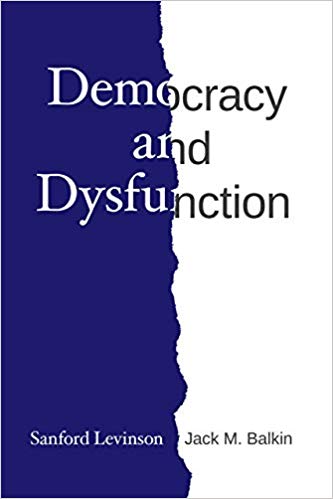
Sanford Levinson and Jack M. Balkin, Democracy and Dysfunction (University of Chicago Press, 2019)

Sanford Levinson, Written in Stone: Public Monuments in Changing Societies (Duke University Press 2018)

Mark A. Graber, Sanford Levinson, and Mark Tushnet, eds., Constitutional Democracy in Crisis? (Oxford University Press 2018)

Gerard Magliocca, The Heart of the Constitution: How the Bill of Rights became the Bill of Rights (Oxford University Press, 2018)

Cynthia Levinson and Sanford Levinson, Fault Lines in the Constitution: The Framers, Their Fights, and the Flaws that Affect Us Today (Peachtree Publishers, 2017)

Brian Z. Tamanaha, A Realistic Theory of Law (Cambridge University Press 2017)

Sanford Levinson, Nullification and Secession in Modern Constitutional Thought (University Press of Kansas 2016)

Sanford Levinson, An Argument Open to All: Reading The Federalist in the 21st Century (Yale University Press 2015)

Stephen M. Griffin, Broken Trust: Dysfunctional Government and Constitutional Reform (University Press of Kansas, 2015)

Frank Pasquale, The Black Box Society: The Secret Algorithms That Control Money and Information (Harvard University Press, 2015)

Bruce Ackerman, We the People, Volume 3: The Civil Rights Revolution (Harvard University Press, 2014)
Balkinization Symposium on We the People, Volume 3: The Civil Rights Revolution

Joseph Fishkin, Bottlenecks: A New Theory of Equal Opportunity (Oxford University Press, 2014)

Mark A. Graber, A New Introduction to American Constitutionalism (Oxford University Press, 2013)

John Mikhail, Elements of Moral Cognition: Rawls' Linguistic Analogy and the Cognitive Science of Moral and Legal Judgment (Cambridge University Press, 2013)

Gerard N. Magliocca, American Founding Son: John Bingham and the Invention of the Fourteenth Amendment (New York University Press, 2013)

Stephen M. Griffin, Long Wars and the Constitution (Harvard University Press, 2013)

Andrew Koppelman, The Tough Luck Constitution and the Assault on Health Care Reform (Oxford University Press, 2013)

James E. Fleming and Linda C. McClain, Ordered Liberty: Rights, Responsibilities, and Virtues (Harvard University Press, 2013)
Balkinization Symposium on Ordered Liberty: Rights, Responsibilities, and Virtues

Andrew Koppelman, Defending American Religious Neutrality (Harvard University Press, 2013)

Brian Z. Tamanaha, Failing Law Schools (University of Chicago Press, 2012)

Sanford Levinson, Framed: America's 51 Constitutions and the Crisis of Governance (Oxford University Press, 2012)

Linda C. McClain and Joanna L. Grossman, Gender Equality: Dimensions of Women's Equal Citizenship (Cambridge University Press, 2012)

Mary Dudziak, War Time: An Idea, Its History, Its Consequences (Oxford University Press, 2012)

Jack M. Balkin, Living Originalism (Harvard University Press, 2011)

Jason Mazzone, Copyfraud and Other Abuses of Intellectual Property Law (Stanford University Press, 2011)

Richard W. Garnett and Andrew Koppelman, First Amendment Stories, (Foundation Press 2011)

Jack M. Balkin, Constitutional Redemption: Political Faith in an Unjust World (Harvard University Press, 2011)

Gerard Magliocca, The Tragedy of William Jennings Bryan: Constitutional Law and the Politics of Backlash (Yale University Press, 2011)

Bernard Harcourt, The Illusion of Free Markets: Punishment and the Myth of Natural Order (Harvard University Press, 2010)

Bruce Ackerman, The Decline and Fall of the American Republic (Harvard University Press, 2010)
Balkinization Symposium on The Decline and Fall of the American Republic

Ian Ayres. Carrots and Sticks: Unlock the Power of Incentives to Get Things Done (Bantam Books, 2010)

Mark Tushnet, Why the Constitution Matters (Yale University Press 2010)

Ian Ayres and Barry Nalebuff: Lifecycle Investing: A New, Safe, and Audacious Way to Improve the Performance of Your Retirement Portfolio (Basic Books, 2010)
.jpg)
Jack M. Balkin, The Laws of Change: I Ching and the Philosophy of Life (2d Edition, Sybil Creek Press 2009)

Brian Z. Tamanaha, Beyond the Formalist-Realist Divide: The Role of Politics in Judging (Princeton University Press 2009)
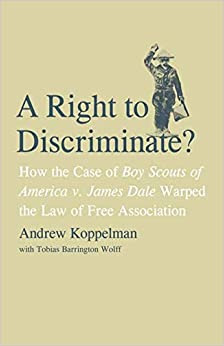
Andrew Koppelman and Tobias Barrington Wolff, A Right to Discriminate?: How the Case of Boy Scouts of America v. James Dale Warped the Law of Free Association (Yale University Press 2009)

Jack M. Balkin and Reva B. Siegel, The Constitution in 2020 (Oxford University Press 2009)

Heather K. Gerken, The Democracy Index: Why Our Election System Is Failing and How to Fix It (Princeton University Press 2009)

Mary Dudziak, Exporting American Dreams: Thurgood Marshall's African Journey (Oxford University Press 2008)

David Luban, Legal Ethics and Human Dignity (Cambridge Univ. Press 2007)

Ian Ayres, Super Crunchers: Why Thinking-By-Numbers is the New Way to be Smart (Bantam 2007)

Jack M. Balkin, James Grimmelmann, Eddan Katz, Nimrod Kozlovski, Shlomit Wagman and Tal Zarsky, eds., Cybercrime: Digital Cops in a Networked Environment (N.Y.U. Press 2007)
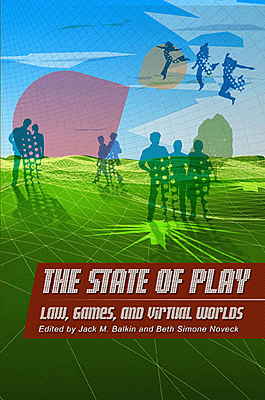
Jack M. Balkin and Beth Simone Noveck, The State of Play: Law, Games, and Virtual Worlds (N.Y.U. Press 2006)

Andrew Koppelman, Same Sex, Different States: When Same-Sex Marriages Cross State Lines (Yale University Press 2006)

Brian Tamanaha, Law as a Means to an End (Cambridge University Press 2006)

Sanford Levinson, Our Undemocratic Constitution (Oxford University Press 2006)

Mark Graber, Dred Scott and the Problem of Constitutional Evil (Cambridge University Press 2006)

Jack M. Balkin, ed., What Roe v. Wade Should Have Said (N.Y.U. Press 2005)

Sanford Levinson, ed., Torture: A Collection (Oxford University Press 2004)
Balkin.com homepage
Bibliography
Conlaw.net
Cultural Software
Writings
Opeds
The Information Society Project
BrownvBoard.com
Useful Links
Syllabi and Exams
