Balkinization
an unanticipated consequence of
Jack M. Balkin
Balkinization Symposiums: A Continuing List
E-mail:
Jack Balkin:
jackbalkin at yahoo.com
Bruce Ackerman
bruce.ackerman at yale.edu
Ian Ayres
ian.ayres at yale.edu
Corey Brettschneider
corey_brettschneider at brown.edu
Mary Dudziak
mary.l.dudziak at emory.edu
Joey Fishkin
joey.fishkin at gmail.com
Heather Gerken heather.gerken at yale.edu
Abbe Gluck abbe.gluck at yale.edu
Mark Graber
mgraber at law.umaryland.edu
Stephen Griffin
sgriffin at tulane.edu
Jonathan Hafetz
jonathan.hafetz at shu.edu
Jeremy Kessler
jkessler at law.columbia.edu
Andrew Koppelman
akoppelman at law.northwestern.edu
Marty Lederman
msl46 at law.georgetown.edu
Sanford Levinson
slevinson at law.utexas.edu
David Luban
david.luban at gmail.com
Gerard Magliocca
gmaglioc at iupui.edu
Jason Mazzone
mazzonej at illinois.edu
Linda McClain
lmcclain at bu.edu
John Mikhail
mikhail at law.georgetown.edu
Frank Pasquale
pasquale.frank at gmail.com
Nate Persily
npersily at gmail.com
Michael Stokes Paulsen
michaelstokespaulsen at gmail.com
Deborah Pearlstein
dpearlst at yu.edu
Rick Pildes
rick.pildes at nyu.edu
David Pozen
dpozen at law.columbia.edu
Richard Primus
raprimus at umich.edu
K. Sabeel Rahmansabeel.rahman at brooklaw.edu
Alice Ristroph
alice.ristroph at shu.edu
Neil Siegel
siegel at law.duke.edu
David Super
david.super at law.georgetown.edu
Brian Tamanaha
btamanaha at wulaw.wustl.edu
Nelson Tebbe
nelson.tebbe at brooklaw.edu
Mark Tushnet
mtushnet at law.harvard.edu
Adam Winkler
winkler at ucla.edu
Compendium of posts on Hobby Lobby and related cases
The Anti-Torture Memos: Balkinization Posts on Torture, Interrogation, Detention, War Powers, and OLC
The Anti-Torture Memos (arranged by topic)
Recent Posts
Constitutionalism's Contemporary Critics
![[Powered by Blogger]](https://lh3.googleusercontent.com/blogger_img_proxy/AEn0k_tKu5KvH3aTCIiuQLqKrF80zzJZNZnN7-EgOgdHPjYZIom9whI8v-3s9-uEH8jdFxGpMpvRNbM9A0wnGjpD_7Ejxq_0ECGGRjIZWEN2swyP=s0-d)
Just A Few Blogs
ACS Blog
Alas, a Blog
Althouse
Arts and Letters Daily
Atrios (Eschaton)
Bill of Health
Buzzflash.com
Buzz Machine
Cato at Liberty
Juan Cole (Informed Comment)
Concurring Opinions
The Constitution in 2020
Corrente
Crooked Timber
Daily Howler
Daily Kos
Dana Boyd
Brad DeLong
Digby (Hullabaloo)
Discriminations
Daniel Drezner
Kevin Drum (Mother Jones)
Electrolite
En Banc
Eunomia (Daniel Larison)
Fafblog
Michael Froomkin (Discourse.net)
GovLab (Beth Noveck)
Rick Hasen (Election Law)
History News Network
How Appealing
Ignatz (Sam Heldman)
The Importance of (Ernie Miller)
Infolaw
Instapundit
International Economic Law and Policy Blog
IntLawGrrls
Jacob Levy
Jesus' General
Jurisdynamics
The Kitchen Cabinet
Mark Kleiman
Law Blog Central
Larry Lessig
Lawyers, Guns and Money
Liberal Oasis
Brian Leiter's Law School Reports
The Leiter Reports
Marginal Revolution
Megan McArdle
Memeorandum
Metafilter
Mirror of Justice
The New Republic
Newseum
No More Mister Nice Blog
Brendan Nyhan
Opinio Juris
Orcinus
The Originalism Blog
Pandagon
Passport (Foreign Policy)
Overcoming Bias
Political Animal (Washington Monthly)
Political Theory Daily Review
Political Wire (Taegan Goddard)
The Poor Man
Virginia Postrel
Prawfsblawg
Public Reason
Jonathan Rauch
Raw Story
Redstate
ReligiousLeftLaw.com
Reporters Committee For Freedom of the Press
Reproductive Rights Blog
Rothman's Roadmap to the Right of Publicity
SCOTUS Blog
Seeing the Forest
Clay Shirky
The Shifted Librarian
The Situationist
Larry Solum (Legal Theory)
Andrew Sullivan
Talking Points Memo
Talk Left
Tapped
Tbogg
TechPresident
The Paper Chase (Jurist)
Tom Paine
Tom Tomorrow (This Modern World)
Eve Tushnet
Uggabugga
University of Chicago Law School Faculty Blog
Unqualified Offerings
The Volokh Conspiracy
War and Piece (Laura Rozen)
Wampum
Oliver Willis
Wonkette
Written Description
Matthew Yglesias
Yin
Your Choice of Feeds
1. XML
powered by

2. Atom Feed
3. RSS 2.0
Constitutionalism's Contemporary Critics
Sandy Levinson
For the Balkinization symposium on Mark Tushnet and Bojan Bugaric, Constitutionalism and Its Discontents (University of Chicago Press, 2026). For some years, the American legal academy has shared
two basic presuppositions. The first is
that the United States Constitution basically constitutes American identity as
well as establishing a particular political system. This means, among other
things, that is that their most important task is to search for the uniquely
correct theory of interpreting the national Constitution (and therefore, what
it means to be “an American”). I have praised Jack Balkin's Living
Originalism as not only the best book written on American
"constitutional interpretation," but also, I hoped, the last book
that would in fact be published on the subject. Alas, that has not been
the case. If anything, the “interpretation wars” have only become more intense,
given the insistence of a majority of the Supreme Court, in good faith or not,
on “originalism” as the royal road to understanding the Constitution.is that
their most important task is to search for the uniquely correct theory of
interpreting the national Constitution. But a second presupposition, is that the
Constitution is worthy of great praise, indeed, an empirical cause for much of
what has gone right for the United States over the past 239 years. The Founders are often praised as brilliant
architects of an effective system. This
entails for many the belief that “constitutional design” is itself a crucial
topic, especially in the post-World War II era when most countries, with the
glaring exception of the United States, were engaged in significant efforts at
what might be called “transformations” of their foundational documents or, in
the case of “post-colonial” countries, drafting brand new constitutions. However, we are now seeing a somewhat different
development within a wing of the legal academy.
Consider the strikingly titled Against Constitutionialism, published
in 2022 by Martin Loughlin, now an emeritus professor at the London School of
Economics. The key syllable is the final
one, the "ism." For Loughlin argued that contemporary
constitutions have been cluttered up with too many provisions. That is, they are poorly designed, in part
because the clutter entails, practically speaking, that their "interpretation"
became the province of judges who in turn imposed their own understandings of
inevitably controversial--and what participants in the interpretation wars
often called "indeterminate"--clauses. Loughlin accepted the
desirability of minimal constitutions that might, for
example, only set out who actually was authorized to make (and thus coerce
others through) laws, how they would be selected, and how long they could
remain in office. Otherwise, constitutions would be quite silent on what
precisely they could or could not do. Those decisions would be left up to
ordinary politics. The remedy for legislation one did not like would
presumably be "voting the rascals out" at the next election, not racing
off to the courthouse looking for judicial disapproval of actions taken.
Down this latter road lay what the late Ran Hirschl memorably termed
"juristocracy," evoking overtones of both “aristocracy” and
“autocracy” (and definitely not “democracy”). Now come Mark Tushnet and Bojan Bugaric, who, like
Loughlin, valorize ordinary politics as the method of resolving fundamental
disputes in a complex society. To the extent that more complex constitutions
are important at all, as opposed to creating what Mark Tushnet once described
as simply “noise” of relatively little importance, they are at least as likely
to be detrimental as positive, especially if positivity is linked with
“progressive” politics. To the extent
that constitutions are attempts to take certain issues "off the
table" as impervious to ordinary politics, the authors are skeptical, if
not outright hostile. Constitutionalism and Its Discontents
suggests, with acknowledgment to Sigmund Freud, that constitutions and “constitutional
interpretation" may more be neuroses to be overcome than a genuine solution
for our problems. We should, the authors suggest, “scal[e] back our
expectations for constitutionalism," which "might reduce some of our
discontents. Doing so, though won't eliminate" them. "The most
we can hope for, and it is no small thing, is to replace deep discontent with
moderate anxiety.” Freud would presumably approve their “hope to replace
'misery [with] common unhappiness'" (p. 155). Still, they do see
a role for constitutions, even if they might be viewed as allies of Loughlin in
cautioning us against fetishizing them and turning them as
"isms." One of Tushnet's many previous books, Taking
the Constitution Away from the Courts, can be read as a defense of
what has come to be called "popular constitutionalism" as against
what I have termed the "constitutional catholicism" articulated perhaps
most memorably in the joint opinion of Justices Kennedy, O’Connor, and Souter
now more than three decades ago in the Casey case reaffirming (at least
a version) of Roe v. Wade. Judges, they said, had a duty to issue (and
then to respect) binding edicts; citizens in turn had a duty to accept their
status as binding. However, "protestant
constitutionalism" rejects such a role by judges (and duty by obedient
citizens). It is analogous to the radical dissenters who posited the
"priesthood of all believers." Anyone within the spiritual community is
entitled to read the relevant materials and to come to their own conclusions as
to their meaning. Indeed, a previous book by these two coauthors, Power
to the People: Constitutionalism in the
Age of Populism, was an explicit critique of the attack on “populism”
leveled by many members of the legal academy and political theorists. But "popular constitutionalism" is
congruent with the notion that the central task of the participant is
interpreting what are in fact complicated sacred texts. So even “popular
constitutionalism” plays on the notion that the Constitution provides a source
of what a speaker might hope to serve as knock-down arguments against
opponents. "What part of 'equal
protection' do you not understand?! "'No law' means 'no law,' damn
it!" And so on. “Minimal constitutionalism,” on the
other hand, leaves relatively little to argue about. Thus, for example, there is no real debate
about the “meaning” of the clause setting out the terms of national
office. The length of the American
presidential term is “obviously” four years—just read Article II. One can debate vigorously about the wisdom of
this provision, but that very different topic from debating its “meaning.” Still, for better or worse, institutional
courts do play special roles in almost all political systems.
One message of the two World Wars, especially for Europeans, was the importance
not only of canonical written constitutions, but also the desirability of
creating what were commonly called "constitutional courts" to serve
as guardians of these constitutions. To be sure, that was not
universal. The Netherlands rejected the idea of American-style judicial
review, but they were the exception to what became a general rule. That
is part of the "ism" that Loughlin criticizes. Tushnet and Bugaric set out their thesis very
early on: "The argument of the book as a whole is that
constitutionalism is beset by the paradox that it aims to both empower
democratic self-government and limit the exercise of that power" (p.
3). That is, "liberal constitutionalism" especially is grounded
on a fear of governmental excess, leading directly to the traditional identification
of constitutionalism with "limited government." Almost by
definition, this places limits on what democratic majorities might wish to
accomplish. But Tushnet and Bugaric recognize as well that many
contemporary constitutionalists, almost always, as they are themselves, on the
left, wish not only to “limit” potential mischief, but also also to make
constitutions "programmatic" by requiring certain
programs. Thus almost all constitutions drafted after World War II
include provisions ostensibly requiring the state to supply certain goods and
services, including education, health, access to jobs, or, more recently, a
clean and healthy environment. One source of popular dissatisfaction is
often the patent failure of actual political systems to live up to these
apparent aspirations, in part, of course, because of the very limitations
placed on the practical ability of government to act. What is striking is the skepticism that Tushnet and Bugaric express both about limitations and
requirements. At very outset they tell their readers, "[W]e
shouldn’t place too much hope in constitutional design as a method for dealing
with the ever-present risk of democratic decline" (p. 3). Tushnet is,
with Mark Graber, Antonia Baraggia, and myself, the co-editor of what, come
next year, will be the second of two books published by the Oxford University
Press under the title "Constitutional Democracy in
Crisis?" Essays assess contemporary developments on all continents
save Antarctica. Even if some of the three-dozen essays offer a critique
of the "chicken-little" mentality and suggest that perhaps we're only
going through a relatively predictable cycle of democratic ebbs after some
significant flows following, say, the demise of the Soviet Union or the end of
apartheid in South Africa, the overall tone of the book is quite somber.
And, if one does fear that constitutional democracy is undergoing a significant
crisis, defined by doctors as the moment when a patient will possibly die
should the fever not break or some organ start working again, then the question
becomes Lenin's from long ago: What is to be done? No one, these
authors tell us, should look to constitutional forms or to judges to save
us. "The alternative to
constitutionalism"--again the "ism" is crucial--"is a
vigorous democratic politics in which a wide range of value positions--including
values rooted in a nation’s constitution---and an equally wide range of policy
positions contend for support by a majority." (p. 5). Democratic
elections should have consequences, which is often not the
case in the United States given the multitude of "checks and
balances" and “veto points” standing in the way of genuinely democratic
empowerment. To be sure, the losers will often be unhappy about these
consequences, sometimes very unhappy. But the answer, in
the words of Joe Hill a century ago, is "Don't Mourn [or race off to the
courthouse]. Organize!” Perhaps barroom arguments can
still occur about the meanings of the genuinely inspiring aspirations set out
in the Preamble to the Constitution. But no one should think that these
are anything other than invitations to intense and perhaps acrimonious
conversations. They are what political philosophers call
"essentially contested concepts," which means, by definition, that
there will never be agreed upon final answers.
Conversation (or politics) is all there is, and to ask judges to provide
"final" answers is chimerical.
Loughlin and Tushnet & Bugaric have made me question how extensive a
notion of constitutionalism I should continue to support, but they are not, at
least in my reading, genuine opponents of the very idea of looking to constitutions
as providing the basis for at least some kinds of political “settlements.” Perhaps the most practical problem facing
supporters of “minimal” constitutionalism is deciding how truly minimal they
can be with regard to what one might consider the most basic predicate of the
“democracy” that all of these authors defend.
NYU’s Samuel Issacharoff, a co-editor of the tellingly (and I believe
misleadingly) titled casebook The Law of Democracy, rightly emphasizes the
importance of election systems and the all-important willingness of losers to
accept defeat gracefully and to begin organizing, peacefully, for the next
election. But we have all learned that a “democratic election system” is not a
self-evident concept. One must decide,
among other things, who can participate and under what conditions will
elections take place (e.g., how easy or difficult will the actual act of voting
be)? There are also a multitude of
questions with regard to the amount of time the winners should be allowed to
occupy their offices (and thus to pass laws that will inevitably antagonize
many of the losers). The United States
is “exceptional” in making its “representatives” face the voters every two
years. It was common in recent years--as against the "founding" period--to view such
frequent elections as a “bug” and not a “feature” of American politics. This year, however, I suspect that most
readers of this review will view the “midterms”--and the fact that every single Representative must face the electorate--as perhaps the salvation of an
embattled republic. Similarly, the oft-expressed disdain for the fact that all
elections in the United States are in fact conducted by state and local
officials is being repudiated by many today, who are altogether relieved that
Donald J. Trump and his minions cannot in fact exercise what would be scary
control of these election processes. But
one can still believe that reliance on state and local officials, many of them
highly partisan, many others simply inexperienced and underfunded, presents
deep problems. So consider the fact that
one of Tushnet’s other books, The New Fourth Branch, presents an
admiring account of countries, including Mexico, that have in effect attempted
to constitutionalize an independent agency entrusted with assuring the honest
conduct of elections. Even a “minimal constitution” might nonetheless have to
establish an institution relatively impervious to ordinary politics, inasmuch
as elections (and constitutions) establish the stage settings within which the
drama of democratic politics, often characterized by rancor, takes place. “Constitutional design,” like so many aspects of politics, is ultimately a
search for the Goldilocks point of a “just right” rigidity—and to believe that
the “right answer” at time T will still be the case at T+1 or, even more
absurdly, at T+10. One might well agree
that the U.S. Constitution (and many others) are out of balance and that
“juristocracy” is, for a variety of reasons, not the answer. But even minimal constitutions profess the
ability to establish basic—and relatively binding—rules as to how “politics”
will be defined and carried out. So can
“we”—and who constitute the “we” is obviously itself a crucial question—agree
on what constitutes “minimalism”? When does “minimalism” mean potential
surrender to the mob; concomitantly, when do limits on the ability of “We the People”
to engage in a system of majority rule devoid of multiple “checks and balances”
serve less to preserve fundamental liberties or achieving necessary political
concord among conflicting groups and instead become illegitimate “veto points”
that privilege stasis over needed change?
Moreover, it is essential that a contemporary student of “constitutional
design” pay attention to latter-day critics of election-focused “representative
democracy,” such as Yale’s Helene Landemore, and take seriously not only the
appeal, to some, of so-called “direct democracy,” but also, and far more
interestingly, of integrating some forms of “lottocracy,” i.e., selection of at
least some governing officials by lottery.
One might well want to “constitutionalize many of these decisions, for
at least some period of time, rather than leave them to the rough-and-tumble of
ordinary politics in which there is always a clear-and-present danger that the
“ins” will wish to rig the next election in order to maintain themselves in
power. All electoral systems have
practical consequences. It is not that
they are “above politics,” but one can still wish, at the very least, to make
changing such systems more difficult than passing ordinary legislation, and
that is basically what “constitutions” do. One
might well agree that we should, as a country, embark on the therapy that
Tushnet and Bogarich counsel, one of whose lessons is to accept inevitable
disappointments. But we’re not ready to
terminate it. Instead, we might agree
with Philip Roth’s fictional therapist, Dr. Spielvogel, who ended Portnoy’s
Complaint, (perhaps) quoting Freud: “Now ve shall perhaps begin?” One might well hope that Constitutionalism
and Its Discontents will begin several long overdue discussions even if it
by no means constitutes the last word.
Posted
9:30 AM
by Sandy Levinson [link]
Books by Balkinization Bloggers

Mark Tushnet and Bojan Bugaric, Constitutionalism and Its Discontents (University of Chicago Press, 2026)

Gerard N. Magliocca, The Actual Art of Governing: Justice Robert H. Jackson's Concurring Opinion in the Steel Seizure Case (Oxford University Press, 2025)

Linda C. McClain and Aziza Ahmed, The Routledge Companion to Gender and COVID-19 (Routledge, 2024)

David Pozen, The Constitution of the War on Drugs (Oxford University Press, 2024)

Jack M. Balkin, Memory and Authority: The Uses of History in Constitutional Interpretation (Yale University Press, 2024)
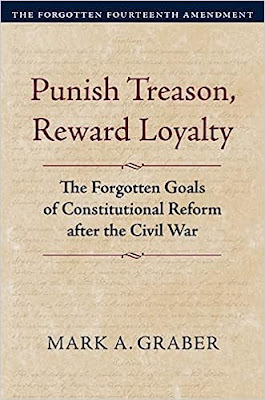
Mark A. Graber, Punish Treason, Reward Loyalty: The Forgotten Goals of Constitutional Reform after the Civil War (University of Kansas Press, 2023)
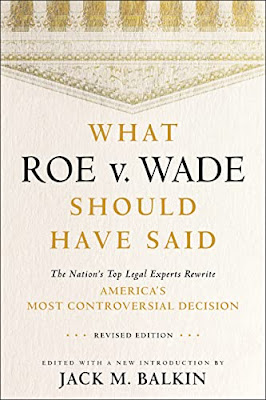
Jack M. Balkin, What Roe v. Wade Should Have Said: The Nation's Top Legal Experts Rewrite America's Most Controversial Decision - Revised Edition (NYU Press, 2023)

Andrew Koppelman, Burning Down the House: How Libertarian Philosophy Was Corrupted by Delusion and Greed (St. Martin’s Press, 2022)

Gerard N. Magliocca, Washington's Heir: The Life of Justice Bushrod Washington (Oxford University Press, 2022)
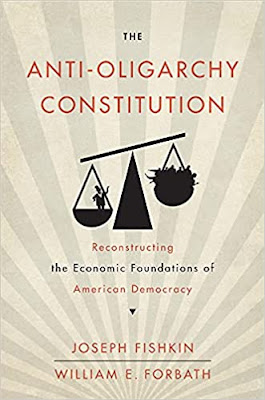
Joseph Fishkin and William E. Forbath, The Anti-Oligarchy Constitution: Reconstructing the Economic Foundations of American Democracy (Harvard University Press, 2022)
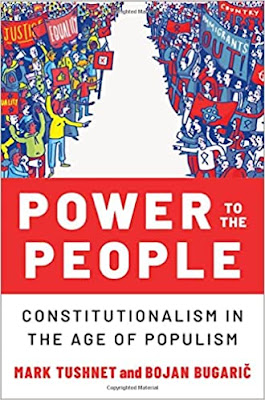
Mark Tushnet and Bojan Bugaric, Power to the People: Constitutionalism in the Age of Populism (Oxford University Press 2021).

Mark Philip Bradley and Mary L. Dudziak, eds., Making the Forever War: Marilyn B. Young on the Culture and Politics of American Militarism Culture and Politics in the Cold War and Beyond (University of Massachusetts Press, 2021).

Jack M. Balkin, What Obergefell v. Hodges Should Have Said: The Nation's Top Legal Experts Rewrite America's Same-Sex Marriage Decision (Yale University Press, 2020)

Frank Pasquale, New Laws of Robotics: Defending Human Expertise in the Age of AI (Belknap Press, 2020)

Jack M. Balkin, The Cycles of Constitutional Time (Oxford University Press, 2020)

Mark Tushnet, Taking Back the Constitution: Activist Judges and the Next Age of American Law (Yale University Press 2020).

Andrew Koppelman, Gay Rights vs. Religious Liberty?: The Unnecessary Conflict (Oxford University Press, 2020)

Ezekiel J Emanuel and Abbe R. Gluck, The Trillion Dollar Revolution: How the Affordable Care Act Transformed Politics, Law, and Health Care in America (PublicAffairs, 2020)

Linda C. McClain, Who's the Bigot?: Learning from Conflicts over Marriage and Civil Rights Law (Oxford University Press, 2020)
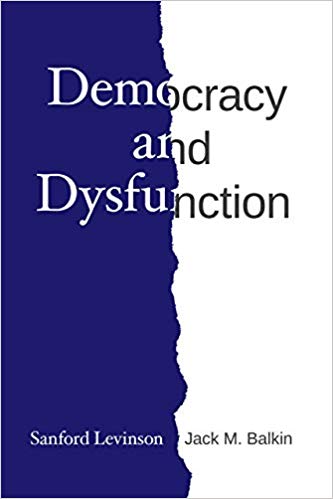
Sanford Levinson and Jack M. Balkin, Democracy and Dysfunction (University of Chicago Press, 2019)

Sanford Levinson, Written in Stone: Public Monuments in Changing Societies (Duke University Press 2018)

Mark A. Graber, Sanford Levinson, and Mark Tushnet, eds., Constitutional Democracy in Crisis? (Oxford University Press 2018)

Gerard Magliocca, The Heart of the Constitution: How the Bill of Rights became the Bill of Rights (Oxford University Press, 2018)

Cynthia Levinson and Sanford Levinson, Fault Lines in the Constitution: The Framers, Their Fights, and the Flaws that Affect Us Today (Peachtree Publishers, 2017)

Brian Z. Tamanaha, A Realistic Theory of Law (Cambridge University Press 2017)

Sanford Levinson, Nullification and Secession in Modern Constitutional Thought (University Press of Kansas 2016)

Sanford Levinson, An Argument Open to All: Reading The Federalist in the 21st Century (Yale University Press 2015)

Stephen M. Griffin, Broken Trust: Dysfunctional Government and Constitutional Reform (University Press of Kansas, 2015)

Frank Pasquale, The Black Box Society: The Secret Algorithms That Control Money and Information (Harvard University Press, 2015)

Bruce Ackerman, We the People, Volume 3: The Civil Rights Revolution (Harvard University Press, 2014)
Balkinization Symposium on We the People, Volume 3: The Civil Rights Revolution

Joseph Fishkin, Bottlenecks: A New Theory of Equal Opportunity (Oxford University Press, 2014)

Mark A. Graber, A New Introduction to American Constitutionalism (Oxford University Press, 2013)

John Mikhail, Elements of Moral Cognition: Rawls' Linguistic Analogy and the Cognitive Science of Moral and Legal Judgment (Cambridge University Press, 2013)

Gerard N. Magliocca, American Founding Son: John Bingham and the Invention of the Fourteenth Amendment (New York University Press, 2013)

Stephen M. Griffin, Long Wars and the Constitution (Harvard University Press, 2013)

Andrew Koppelman, The Tough Luck Constitution and the Assault on Health Care Reform (Oxford University Press, 2013)

James E. Fleming and Linda C. McClain, Ordered Liberty: Rights, Responsibilities, and Virtues (Harvard University Press, 2013)
Balkinization Symposium on Ordered Liberty: Rights, Responsibilities, and Virtues

Andrew Koppelman, Defending American Religious Neutrality (Harvard University Press, 2013)

Brian Z. Tamanaha, Failing Law Schools (University of Chicago Press, 2012)

Sanford Levinson, Framed: America's 51 Constitutions and the Crisis of Governance (Oxford University Press, 2012)

Linda C. McClain and Joanna L. Grossman, Gender Equality: Dimensions of Women's Equal Citizenship (Cambridge University Press, 2012)

Mary Dudziak, War Time: An Idea, Its History, Its Consequences (Oxford University Press, 2012)

Jack M. Balkin, Living Originalism (Harvard University Press, 2011)

Jason Mazzone, Copyfraud and Other Abuses of Intellectual Property Law (Stanford University Press, 2011)

Richard W. Garnett and Andrew Koppelman, First Amendment Stories, (Foundation Press 2011)

Jack M. Balkin, Constitutional Redemption: Political Faith in an Unjust World (Harvard University Press, 2011)

Gerard Magliocca, The Tragedy of William Jennings Bryan: Constitutional Law and the Politics of Backlash (Yale University Press, 2011)

Bernard Harcourt, The Illusion of Free Markets: Punishment and the Myth of Natural Order (Harvard University Press, 2010)

Bruce Ackerman, The Decline and Fall of the American Republic (Harvard University Press, 2010)
Balkinization Symposium on The Decline and Fall of the American Republic

Ian Ayres. Carrots and Sticks: Unlock the Power of Incentives to Get Things Done (Bantam Books, 2010)

Mark Tushnet, Why the Constitution Matters (Yale University Press 2010)

Ian Ayres and Barry Nalebuff: Lifecycle Investing: A New, Safe, and Audacious Way to Improve the Performance of Your Retirement Portfolio (Basic Books, 2010)
.jpg)
Jack M. Balkin, The Laws of Change: I Ching and the Philosophy of Life (2d Edition, Sybil Creek Press 2009)

Brian Z. Tamanaha, Beyond the Formalist-Realist Divide: The Role of Politics in Judging (Princeton University Press 2009)
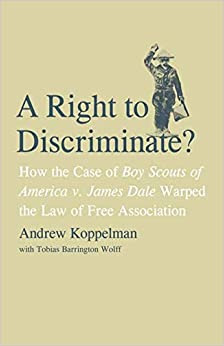
Andrew Koppelman and Tobias Barrington Wolff, A Right to Discriminate?: How the Case of Boy Scouts of America v. James Dale Warped the Law of Free Association (Yale University Press 2009)

Jack M. Balkin and Reva B. Siegel, The Constitution in 2020 (Oxford University Press 2009)

Heather K. Gerken, The Democracy Index: Why Our Election System Is Failing and How to Fix It (Princeton University Press 2009)

Mary Dudziak, Exporting American Dreams: Thurgood Marshall's African Journey (Oxford University Press 2008)

David Luban, Legal Ethics and Human Dignity (Cambridge Univ. Press 2007)

Ian Ayres, Super Crunchers: Why Thinking-By-Numbers is the New Way to be Smart (Bantam 2007)

Jack M. Balkin, James Grimmelmann, Eddan Katz, Nimrod Kozlovski, Shlomit Wagman and Tal Zarsky, eds., Cybercrime: Digital Cops in a Networked Environment (N.Y.U. Press 2007)
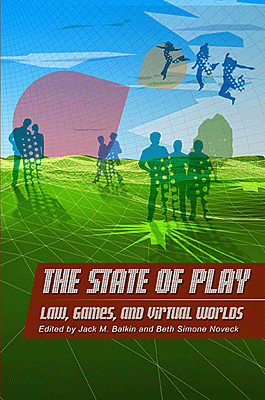
Jack M. Balkin and Beth Simone Noveck, The State of Play: Law, Games, and Virtual Worlds (N.Y.U. Press 2006)

Andrew Koppelman, Same Sex, Different States: When Same-Sex Marriages Cross State Lines (Yale University Press 2006)

Brian Tamanaha, Law as a Means to an End (Cambridge University Press 2006)

Sanford Levinson, Our Undemocratic Constitution (Oxford University Press 2006)

Mark Graber, Dred Scott and the Problem of Constitutional Evil (Cambridge University Press 2006)

Jack M. Balkin, ed., What Roe v. Wade Should Have Said (N.Y.U. Press 2005)

Sanford Levinson, ed., Torture: A Collection (Oxford University Press 2004)
Balkin.com homepage
Bibliography
Conlaw.net
Cultural Software
Writings
Opeds
The Information Society Project
BrownvBoard.com
Useful Links
Syllabi and Exams
