Balkinization
an unanticipated consequence of
Jack M. Balkin
Balkinization Symposiums: A Continuing List
E-mail:
Jack Balkin:
jackbalkin at yahoo.com
Bruce Ackerman
bruce.ackerman at yale.edu
Ian Ayres
ian.ayres at yale.edu
Corey Brettschneider
corey_brettschneider at brown.edu
Mary Dudziak
mary.l.dudziak at emory.edu
Joey Fishkin
joey.fishkin at gmail.com
Heather Gerken heather.gerken at yale.edu
Abbe Gluck abbe.gluck at yale.edu
Mark Graber
mgraber at law.umaryland.edu
Stephen Griffin
sgriffin at tulane.edu
Jonathan Hafetz
jonathan.hafetz at shu.edu
Jeremy Kessler
jkessler at law.columbia.edu
Andrew Koppelman
akoppelman at law.northwestern.edu
Marty Lederman
msl46 at law.georgetown.edu
Sanford Levinson
slevinson at law.utexas.edu
David Luban
david.luban at gmail.com
Gerard Magliocca
gmaglioc at iupui.edu
Jason Mazzone
mazzonej at illinois.edu
Linda McClain
lmcclain at bu.edu
John Mikhail
mikhail at law.georgetown.edu
Frank Pasquale
pasquale.frank at gmail.com
Nate Persily
npersily at gmail.com
Michael Stokes Paulsen
michaelstokespaulsen at gmail.com
Deborah Pearlstein
dpearlst at yu.edu
Rick Pildes
rick.pildes at nyu.edu
David Pozen
dpozen at law.columbia.edu
Richard Primus
raprimus at umich.edu
K. Sabeel Rahmansabeel.rahman at brooklaw.edu
Alice Ristroph
alice.ristroph at shu.edu
Neil Siegel
siegel at law.duke.edu
David Super
david.super at law.georgetown.edu
Brian Tamanaha
btamanaha at wulaw.wustl.edu
Nelson Tebbe
nelson.tebbe at brooklaw.edu
Mark Tushnet
mtushnet at law.harvard.edu
Adam Winkler
winkler at ucla.edu
Compendium of posts on Hobby Lobby and related cases
The Anti-Torture Memos: Balkinization Posts on Torture, Interrogation, Detention, War Powers, and OLC
The Anti-Torture Memos (arranged by topic)
Recent Posts
The State of the Article V Convention Battle
![[Powered by Blogger]](https://lh3.googleusercontent.com/blogger_img_proxy/AEn0k_t-WPdA5t7OxFDKfEoxf_IKwO79_Qq_Oocku4flVfZ8Gs3dgDzyOVrZtp5EPt8lrQl4BxlmhSmXpRm4UiLzhjbhIcSP_wnCzkzP5osqSGp1=s0-d)
Just A Few Blogs
ACS Blog
Alas, a Blog
Althouse
Arts and Letters Daily
Atrios (Eschaton)
Bill of Health
Buzzflash.com
Buzz Machine
Cato at Liberty
Juan Cole (Informed Comment)
Concurring Opinions
The Constitution in 2020
Corrente
Crooked Timber
Daily Howler
Daily Kos
Dana Boyd
Brad DeLong
Digby (Hullabaloo)
Discriminations
Daniel Drezner
Kevin Drum (Mother Jones)
Electrolite
En Banc
Eunomia (Daniel Larison)
Fafblog
Michael Froomkin (Discourse.net)
GovLab (Beth Noveck)
Rick Hasen (Election Law)
History News Network
How Appealing
Ignatz (Sam Heldman)
The Importance of (Ernie Miller)
Infolaw
Instapundit
International Economic Law and Policy Blog
IntLawGrrls
Jacob Levy
Jesus' General
Jurisdynamics
The Kitchen Cabinet
Mark Kleiman
Law Blog Central
Larry Lessig
Lawyers, Guns and Money
Liberal Oasis
Brian Leiter's Law School Reports
The Leiter Reports
Marginal Revolution
Megan McArdle
Memeorandum
Metafilter
Mirror of Justice
The New Republic
Newseum
No More Mister Nice Blog
Brendan Nyhan
Opinio Juris
Orcinus
The Originalism Blog
Pandagon
Passport (Foreign Policy)
Overcoming Bias
Political Animal (Washington Monthly)
Political Theory Daily Review
Political Wire (Taegan Goddard)
The Poor Man
Virginia Postrel
Prawfsblawg
Public Reason
Jonathan Rauch
Raw Story
Redstate
ReligiousLeftLaw.com
Reporters Committee For Freedom of the Press
Reproductive Rights Blog
Rothman's Roadmap to the Right of Publicity
SCOTUS Blog
Seeing the Forest
Clay Shirky
The Shifted Librarian
The Situationist
Larry Solum (Legal Theory)
Andrew Sullivan
Talking Points Memo
Talk Left
Tapped
Tbogg
TechPresident
The Paper Chase (Jurist)
Tom Paine
Tom Tomorrow (This Modern World)
Eve Tushnet
Uggabugga
University of Chicago Law School Faculty Blog
Unqualified Offerings
The Volokh Conspiracy
War and Piece (Laura Rozen)
Wampum
Oliver Willis
Wonkette
Written Description
Matthew Yglesias
Yin
Your Choice of Feeds
1. XML
powered by

2. Atom Feed
3. RSS 2.0
The State of the Article V Convention Battle
David Super
Yesterday I
suggested that progressives should reconsider the wisdom of increasing the
weight and impact of decisions made in the current political environment. Although supported by only a small minority
of progressives, efforts to call an Article V convention are the most dramatic
efforts to raise the stakes. They also
are the most irresponsible. Progressive
proponents of an Article V convention initially insisted that a convention was essential
to campaign finance reform. This did not
make much sense for several reasons, including the relative unpopularity of
their vision of such reform with the public and the difficulty of devising politically
plausible reforms that corporations and the ultra-rich could not readily evade. Most
significantly, a progressive outcome from an Article V convention is
effectively precluded by the solid majority that the American Legislative
Exchange Council (ALEC) and its allies would hold in such a convention. The Center for Media and Democracy surveyed
all fifty states’ laws and found
that Republicans would have complete control over twenty-eight state
delegations, Democrats would have complete control over eighteen, and four delegations
would likely require both Republican and Democratic assent for their
selection. (Those states might prove
unable to choose any delegates.) Only one
state – Rhode Island – provides for popular election of delegates. We therefore would get a convention
completely controlled by whomever the Republican legislative leaders of the
various red states sought to send (most likely themselves) with no need to
compromise, trade votes, or otherwise give progressives the time of day. Even a blue wave election in November will
not give Democrats a majority of the states and is highly unlikely to deprive
Republicans of their majority. Not surprisingly,
then, the progressive Article V convention effort championed by WolfPAC has run
aground. It peaked in 2016 with just
five states – all of them deep blue – and is now down to two states with active
Article V applications. Many progressives sensibly
abandoned the project. Those that
continued to support a convention found themselves in a bit of a jam. One response has been, in essence, “trust
me”: proponents insisting that they are
confident that Republican domination of a prospective convention can somehow be
overcome while not offering the barest hint of how that might occur. With laws on delegate selection on the books
and ALEC-aligned Republican majorities having no conceivable reason to change
them, something more than “trust me” seems in order before the country takes to
colossal gamble of opening up its fundamental document to amendment by moneyed
interests. Indeed, even if
all the ALEC-aligned legislatures miraculously saw the light and amended their
laws to allow popular election of delegates, it is far from clear that
progressives would prevail. The
twenty-sixth-most-liberal state is probably North Carolina, which has a solidly
Republican legislature and Republicans winning most state elections. Several more-liberal states (such as Arizona,
Georgia, New Hampshire, and Wisconsin) also have Republican legislatures while
still more (such as Maine, Michigan, Minnesota, Nevada, and Pennsylvania)
remain very competitive for Republicans.
Progressives would have to run the table of these states’ delegations
unless they could turn one or more even more conservative states, such as
Florida or Iowa. A convention would be a
progressives’ nightmare. (Many progressives
sensibly oppose one-state-one-vote rules for a convention, but those rules
benefit many more states than they hurt.
Some progressives hope that the convention will agree to require a
supermajority to act without offering any plausible reason why Republican
legislators would voluntarily surrender control, least of all in today’s
bare-knuckled political environment.) Perhaps
recognizing the implausibility of the “trust me” approach, progressive
convention proponents are increasingly declaring that an Article V convention
is inevitable so progressives might as well accept that and start preparing for
it: “the convention is likely coming
regardless and disengagement only guarantees progressives have no voice in the
process”. Both halves of this claim
are problematic. It is far from clear
what “preparation” progressives could do now that would meaningfully affect
what an ALEC-controlled convention might do.
I have heard no concrete suggestions.
And ALEC’s ability
to trigger a convention without progressive collaboration is highly
dubious. To be sure, it has been spending
prodigious sums promoting an Article V convention for many years. (The figures below include various groups
promoting a convention for a balanced budget amendment, groups affiliated with
the Convention of States Project (CoSP), and those promoting a convention to
enact congressional term limits. They do
not include any additional funds that ALEC may be spending directly.) Yet despite all
that spending, the ALEC-aligned groups have stalled at 28 states, six short of
the constitutional two-thirds threshold.
Over the past decade or so, ALEC-aligned groups claim to have secured Article
V applications from all but three red states, but convention opponents have rescinded
applications in every blue one. With the
purple states more or less evenly split, it is difficult to see a path for
ALEC-aligned groups to get to 34 states honestly even under generous counting
rules. (The tallies presented here
accept proponents’ calculations at face value; the continued viability of
applications passed over four decades ago, and some state-specific aggregation
and interpretation issues, will be for Congress to resolve if proponents start
to move a resolution to call a convention.
The designation of states below as “purple” is admittedly subjective, relying
primarily on elections for state offices.)
ALEC’s allies
began reaching a similar conclusion around 2017 as the last of the blue state
applications from the 1970s and 1980s were being rescinded. They therefore started developing
increasingly far-fetched versions of “fuzzy math” to reach the threshold. They tried arbitrarily designating
applications passed over a century ago for entirely different purposes as
“plenary”, supposedly seeking a convention on any topic. They claimed to have six such ancient
applications in states that had rejected their proposals. Five of those six have now been
rescinded. One prominent
voice in the ALEC-aligned world argued that Congress should disregard states’
rescissions of Article V applications under the doctrine of “mistake”. He argued that states acted in response to
what he regards as misconceptions about Article V, such as concern about a
“runaway convention.” Few others
embraced this idea, perhaps recognizing what a Democratic Congress might do
with the power to override state legislation on the grounds of “mistake” (e.g.,
force Medicaid expansion under the Affordable Care Act). ALEC’s allies then
insisted that all Article V applications should be counted, regardless of their
purpose. This would reverse Congress’s
longstanding policy of counting applications together only when they specified
the same purpose for a convention. Had
Congress followed the “all applications count” principle, we would have had an
Article V convention in 1907 and every year since until 2025. Over a century of wildly different Congresses
rejecting this theory, and of states acting on the assumption that applications
could only be aggregated if their purposes matched, casts this theory’s legitimacy
into great doubt. Nonetheless, several progressive
states have responded by rescinding old, dusty applications. At this writing, more than one-third of the
states have no active Article V applications at all. The ALEC-aligned
groups now seem to have settled on the “time machine” theory. Recognizing that they do not have the
requisite two-thirds of the states today, they insist that, by retroactively
applying their “fuzzy math” theories, they can say their forebears reached this
threshold in 1979. On this theory,
numerous Congresses, including those led by ardent ALEC allies and ones with
majority support for a Balanced Budget Amendment, have been asleep at the
switch for almost half a century. Of
course, this means that the ALEC-aligned advocacy groups were also asleep at
the switch for most of this time and that all their fundraising appeals to help
them get the remaining states they need were, well, unfounded. Supporters of an
Article V convention to promulgate a balanced budget amendment, congressional
term limits, or limitations on federal powers – the three core principles found
in ALEC-aligned Article V applications – have filed litigation seeking to
compel Congress to call an Article V convention on the “time machine” theory,
to no avail. They reportedly are
preparing new litigation to the same effect.
How they will avoid the Political Question Doctrine, or
establish that a federal court can order Congress to exercise its
constitutional powers, is difficult to see.
And even if they could get heard on the merits, they have little basis
for saying that Congress has been wrong for over a century in how it has
counted Article V applications. With its path to
34 states largely blocked and little prospect of prevailing in court, ALEC’s
remaining hope depends on winning over just enough gullible progressives. Progressive Article V groups have begun to
work with ALEC-supported ones on the state level. For example, they introduced a resolution in
Maine that would apply for an Article V convention for both term limits and
campaign finance reform. A few years
ago, a Democratic state senator gave ALEC a tie on an Article V application in
Montana. U.S. House Budget
Committee Chairman Jodey Arrington has repeatedly introduced concurrent resolutions
to call an Article V convention on the “time machine” theory. Republicans lack the votes to move such a
resolution on their own – one prominent House conservative wrote a book
entitled The Con
of the Con-Con – but might prevail if progressive proponents persuade a
few Democrats that an Article V convention could be a good thing. The cynicism of
the ALEC-aligned convention supporters is difficult to overstate. They insist that the risk of a runaway
convention has been “debunked” and that a convention would somehow be confined
to the purposes specified in states’ applications. (They do not explain who would enforce these
limits or on what authority.) Yet they
now propose to count together all applications for all purposes, including some
that conservatives would loathe. If the
convention is allowed to consider any topic in a state application then world
federal government is on the table. Their mock conventions and fundraising appeals
promote constitutional changes having nothing to do with fiscal responsibility,
limiting federal powers, or term limits – such as capping the Supreme Court at
nine justices or eliminating birthright citizenship. Moreover, at the
same time they insist that the ratification process will protect us against
untoward amendments ALEC-aligned proponents seem to have settled on public
referenda as their preferred ratification process. This is not one of the options Article V
provides, but apparently they envision the referenda being accompanied by the election
of slates of state ratification convention delegates who would be legally bound
to follow the results of the referendum, much as voters invisibly choose
presidential electors. ALEC’s ability to
package superficially attractive but meaningless “progressive” provisions with
core parts of its agenda, and the ability of its ultra-rich backers to flood
the airwaves in advance of such referenda, should not be minimized. I have yet to see progressive Article V
convention supporters engage seriously with this threat. In short, the
long, difficult, exhausting effort to prevent ALEC from triggering an Article V
convention that it would control has accomplished a great deal. ALEC does not have a path to a convention that
does not involve picking up almost all the purple states or securing Democratic
defections in Congress. If progressives
recognize this threat for what it is, ALEC cannot prevail. But if progressives wish-cast a convention as
the solution to what ails us, they could mislead just enough state or federal
Democratic legislators to bring this disaster down upon our already-reeling
nation. @DavidASuper1
@DavidASuper.bsky.social
Posted
10:19 PM
by David Super [link]


Books by Balkinization Bloggers

Mark Tushnet and Bojan Bugaric, Constitutionalism and Its Discontents (University of Chicago Press, 2026)

Gerard N. Magliocca, The Actual Art of Governing: Justice Robert H. Jackson's Concurring Opinion in the Steel Seizure Case (Oxford University Press, 2025)

Linda C. McClain and Aziza Ahmed, The Routledge Companion to Gender and COVID-19 (Routledge, 2024)

David Pozen, The Constitution of the War on Drugs (Oxford University Press, 2024)

Jack M. Balkin, Memory and Authority: The Uses of History in Constitutional Interpretation (Yale University Press, 2024)
Mark A. Graber, Punish Treason, Reward Loyalty: The Forgotten Goals of Constitutional Reform after the Civil War (University of Kansas Press, 2023)
Jack M. Balkin, What Roe v. Wade Should Have Said: The Nation's Top Legal Experts Rewrite America's Most Controversial Decision - Revised Edition (NYU Press, 2023)

Andrew Koppelman, Burning Down the House: How Libertarian Philosophy Was Corrupted by Delusion and Greed (St. Martin’s Press, 2022)

Gerard N. Magliocca, Washington's Heir: The Life of Justice Bushrod Washington (Oxford University Press, 2022)
Joseph Fishkin and William E. Forbath, The Anti-Oligarchy Constitution: Reconstructing the Economic Foundations of American Democracy (Harvard University Press, 2022)
Mark Tushnet and Bojan Bugaric, Power to the People: Constitutionalism in the Age of Populism (Oxford University Press 2021).

Mark Philip Bradley and Mary L. Dudziak, eds., Making the Forever War: Marilyn B. Young on the Culture and Politics of American Militarism Culture and Politics in the Cold War and Beyond (University of Massachusetts Press, 2021).

Jack M. Balkin, What Obergefell v. Hodges Should Have Said: The Nation's Top Legal Experts Rewrite America's Same-Sex Marriage Decision (Yale University Press, 2020)

Frank Pasquale, New Laws of Robotics: Defending Human Expertise in the Age of AI (Belknap Press, 2020)

Jack M. Balkin, The Cycles of Constitutional Time (Oxford University Press, 2020)

Mark Tushnet, Taking Back the Constitution: Activist Judges and the Next Age of American Law (Yale University Press 2020).

Andrew Koppelman, Gay Rights vs. Religious Liberty?: The Unnecessary Conflict (Oxford University Press, 2020)

Ezekiel J Emanuel and Abbe R. Gluck, The Trillion Dollar Revolution: How the Affordable Care Act Transformed Politics, Law, and Health Care in America (PublicAffairs, 2020)

Linda C. McClain, Who's the Bigot?: Learning from Conflicts over Marriage and Civil Rights Law (Oxford University Press, 2020)
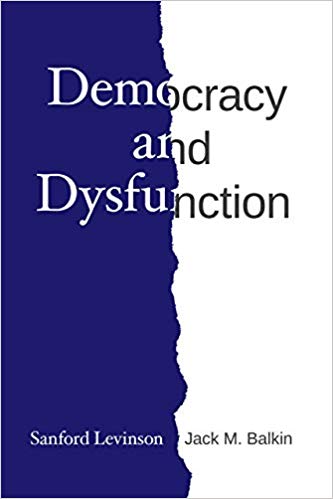
Sanford Levinson and Jack M. Balkin, Democracy and Dysfunction (University of Chicago Press, 2019)

Sanford Levinson, Written in Stone: Public Monuments in Changing Societies (Duke University Press 2018)

Mark A. Graber, Sanford Levinson, and Mark Tushnet, eds., Constitutional Democracy in Crisis? (Oxford University Press 2018)

Gerard Magliocca, The Heart of the Constitution: How the Bill of Rights became the Bill of Rights (Oxford University Press, 2018)

Cynthia Levinson and Sanford Levinson, Fault Lines in the Constitution: The Framers, Their Fights, and the Flaws that Affect Us Today (Peachtree Publishers, 2017)

Brian Z. Tamanaha, A Realistic Theory of Law (Cambridge University Press 2017)

Sanford Levinson, Nullification and Secession in Modern Constitutional Thought (University Press of Kansas 2016)

Sanford Levinson, An Argument Open to All: Reading The Federalist in the 21st Century (Yale University Press 2015)

Stephen M. Griffin, Broken Trust: Dysfunctional Government and Constitutional Reform (University Press of Kansas, 2015)

Frank Pasquale, The Black Box Society: The Secret Algorithms That Control Money and Information (Harvard University Press, 2015)

Bruce Ackerman, We the People, Volume 3: The Civil Rights Revolution (Harvard University Press, 2014)
Balkinization Symposium on We the People, Volume 3: The Civil Rights Revolution

Joseph Fishkin, Bottlenecks: A New Theory of Equal Opportunity (Oxford University Press, 2014)

Mark A. Graber, A New Introduction to American Constitutionalism (Oxford University Press, 2013)

John Mikhail, Elements of Moral Cognition: Rawls' Linguistic Analogy and the Cognitive Science of Moral and Legal Judgment (Cambridge University Press, 2013)

Gerard N. Magliocca, American Founding Son: John Bingham and the Invention of the Fourteenth Amendment (New York University Press, 2013)

Stephen M. Griffin, Long Wars and the Constitution (Harvard University Press, 2013)

Andrew Koppelman, The Tough Luck Constitution and the Assault on Health Care Reform (Oxford University Press, 2013)

James E. Fleming and Linda C. McClain, Ordered Liberty: Rights, Responsibilities, and Virtues (Harvard University Press, 2013)
Balkinization Symposium on Ordered Liberty: Rights, Responsibilities, and Virtues

Andrew Koppelman, Defending American Religious Neutrality (Harvard University Press, 2013)

Brian Z. Tamanaha, Failing Law Schools (University of Chicago Press, 2012)

Sanford Levinson, Framed: America's 51 Constitutions and the Crisis of Governance (Oxford University Press, 2012)

Linda C. McClain and Joanna L. Grossman, Gender Equality: Dimensions of Women's Equal Citizenship (Cambridge University Press, 2012)

Mary Dudziak, War Time: An Idea, Its History, Its Consequences (Oxford University Press, 2012)

Jack M. Balkin, Living Originalism (Harvard University Press, 2011)

Jason Mazzone, Copyfraud and Other Abuses of Intellectual Property Law (Stanford University Press, 2011)

Richard W. Garnett and Andrew Koppelman, First Amendment Stories, (Foundation Press 2011)

Jack M. Balkin, Constitutional Redemption: Political Faith in an Unjust World (Harvard University Press, 2011)

Gerard Magliocca, The Tragedy of William Jennings Bryan: Constitutional Law and the Politics of Backlash (Yale University Press, 2011)

Bernard Harcourt, The Illusion of Free Markets: Punishment and the Myth of Natural Order (Harvard University Press, 2010)

Bruce Ackerman, The Decline and Fall of the American Republic (Harvard University Press, 2010)
Balkinization Symposium on The Decline and Fall of the American Republic

Ian Ayres. Carrots and Sticks: Unlock the Power of Incentives to Get Things Done (Bantam Books, 2010)

Mark Tushnet, Why the Constitution Matters (Yale University Press 2010)

Ian Ayres and Barry Nalebuff: Lifecycle Investing: A New, Safe, and Audacious Way to Improve the Performance of Your Retirement Portfolio (Basic Books, 2010)
.jpg)
Jack M. Balkin, The Laws of Change: I Ching and the Philosophy of Life (2d Edition, Sybil Creek Press 2009)

Brian Z. Tamanaha, Beyond the Formalist-Realist Divide: The Role of Politics in Judging (Princeton University Press 2009)
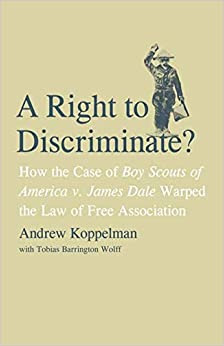
Andrew Koppelman and Tobias Barrington Wolff, A Right to Discriminate?: How the Case of Boy Scouts of America v. James Dale Warped the Law of Free Association (Yale University Press 2009)

Jack M. Balkin and Reva B. Siegel, The Constitution in 2020 (Oxford University Press 2009)

Heather K. Gerken, The Democracy Index: Why Our Election System Is Failing and How to Fix It (Princeton University Press 2009)

Mary Dudziak, Exporting American Dreams: Thurgood Marshall's African Journey (Oxford University Press 2008)

David Luban, Legal Ethics and Human Dignity (Cambridge Univ. Press 2007)

Ian Ayres, Super Crunchers: Why Thinking-By-Numbers is the New Way to be Smart (Bantam 2007)

Jack M. Balkin, James Grimmelmann, Eddan Katz, Nimrod Kozlovski, Shlomit Wagman and Tal Zarsky, eds., Cybercrime: Digital Cops in a Networked Environment (N.Y.U. Press 2007)

Jack M. Balkin and Beth Simone Noveck, The State of Play: Law, Games, and Virtual Worlds (N.Y.U. Press 2006)

Andrew Koppelman, Same Sex, Different States: When Same-Sex Marriages Cross State Lines (Yale University Press 2006)

Brian Tamanaha, Law as a Means to an End (Cambridge University Press 2006)

Sanford Levinson, Our Undemocratic Constitution (Oxford University Press 2006)

Mark Graber, Dred Scott and the Problem of Constitutional Evil (Cambridge University Press 2006)

Jack M. Balkin, ed., What Roe v. Wade Should Have Said (N.Y.U. Press 2005)

Sanford Levinson, ed., Torture: A Collection (Oxford University Press 2004)
Balkin.com homepage
Bibliography
Conlaw.net
Cultural Software
Writings
Opeds
The Information Society Project
BrownvBoard.com
Useful Links
Syllabi and Exams
