Balkinization
an unanticipated consequence of
Jack M. Balkin
Balkinization Symposiums: A Continuing List
E-mail:
Jack Balkin:
jackbalkin at yahoo.com
Bruce Ackerman
bruce.ackerman at yale.edu
Ian Ayres
ian.ayres at yale.edu
Corey Brettschneider
corey_brettschneider at brown.edu
Mary Dudziak
mary.l.dudziak at emory.edu
Joey Fishkin
joey.fishkin at gmail.com
Heather Gerken heather.gerken at yale.edu
Abbe Gluck abbe.gluck at yale.edu
Mark Graber
mgraber at law.umaryland.edu
Stephen Griffin
sgriffin at tulane.edu
Jonathan Hafetz
jonathan.hafetz at shu.edu
Jeremy Kessler
jkessler at law.columbia.edu
Andrew Koppelman
akoppelman at law.northwestern.edu
Marty Lederman
msl46 at law.georgetown.edu
Sanford Levinson
slevinson at law.utexas.edu
David Luban
david.luban at gmail.com
Gerard Magliocca
gmaglioc at iupui.edu
Jason Mazzone
mazzonej at illinois.edu
Linda McClain
lmcclain at bu.edu
John Mikhail
mikhail at law.georgetown.edu
Frank Pasquale
pasquale.frank at gmail.com
Nate Persily
npersily at gmail.com
Michael Stokes Paulsen
michaelstokespaulsen at gmail.com
Deborah Pearlstein
dpearlst at yu.edu
Rick Pildes
rick.pildes at nyu.edu
David Pozen
dpozen at law.columbia.edu
Richard Primus
raprimus at umich.edu
K. Sabeel Rahmansabeel.rahman at brooklaw.edu
Alice Ristroph
alice.ristroph at shu.edu
Neil Siegel
siegel at law.duke.edu
David Super
david.super at law.georgetown.edu
Brian Tamanaha
btamanaha at wulaw.wustl.edu
Nelson Tebbe
nelson.tebbe at brooklaw.edu
Mark Tushnet
mtushnet at law.harvard.edu
Adam Winkler
winkler at ucla.edu
Compendium of posts on Hobby Lobby and related cases
The Anti-Torture Memos: Balkinization Posts on Torture, Interrogation, Detention, War Powers, and OLC
The Anti-Torture Memos (arranged by topic)
Recent Posts
Fiscal Floundering
![[Powered by Blogger]](https://lh3.googleusercontent.com/blogger_img_proxy/AEn0k_s1kNvNzhnJf9qkvjMm_cmV8b6zmX4h9LLT831v3NzTxNwgJZiNLyMONc62QFeFDvyYd0LvwM-XXjCaOLw2JP8UVkDjCZhCfg91CaPepMIW=s0-d)
Just A Few Blogs
ACS Blog
Alas, a Blog
Althouse
Arts and Letters Daily
Atrios (Eschaton)
Bill of Health
Buzzflash.com
Buzz Machine
Cato at Liberty
Juan Cole (Informed Comment)
Concurring Opinions
The Constitution in 2020
Corrente
Crooked Timber
Daily Howler
Daily Kos
Dana Boyd
Brad DeLong
Digby (Hullabaloo)
Discriminations
Daniel Drezner
Kevin Drum (Mother Jones)
Electrolite
En Banc
Eunomia (Daniel Larison)
Fafblog
Michael Froomkin (Discourse.net)
GovLab (Beth Noveck)
Rick Hasen (Election Law)
History News Network
How Appealing
Ignatz (Sam Heldman)
The Importance of (Ernie Miller)
Infolaw
Instapundit
International Economic Law and Policy Blog
IntLawGrrls
Jacob Levy
Jesus' General
Jurisdynamics
The Kitchen Cabinet
Mark Kleiman
Law Blog Central
Larry Lessig
Lawyers, Guns and Money
Liberal Oasis
Brian Leiter's Law School Reports
The Leiter Reports
Marginal Revolution
Megan McArdle
Memeorandum
Metafilter
Mirror of Justice
The New Republic
Newseum
No More Mister Nice Blog
Brendan Nyhan
Opinio Juris
Orcinus
The Originalism Blog
Pandagon
Passport (Foreign Policy)
Overcoming Bias
Political Animal (Washington Monthly)
Political Theory Daily Review
Political Wire (Taegan Goddard)
The Poor Man
Virginia Postrel
Prawfsblawg
Public Reason
Jonathan Rauch
Raw Story
Redstate
ReligiousLeftLaw.com
Reporters Committee For Freedom of the Press
Reproductive Rights Blog
Rothman's Roadmap to the Right of Publicity
SCOTUS Blog
Seeing the Forest
Clay Shirky
The Shifted Librarian
The Situationist
Larry Solum (Legal Theory)
Andrew Sullivan
Talking Points Memo
Talk Left
Tapped
Tbogg
TechPresident
The Paper Chase (Jurist)
Tom Paine
Tom Tomorrow (This Modern World)
Eve Tushnet
Uggabugga
University of Chicago Law School Faculty Blog
Unqualified Offerings
The Volokh Conspiracy
War and Piece (Laura Rozen)
Wampum
Oliver Willis
Wonkette
Written Description
Matthew Yglesias
Yin
Your Choice of Feeds
1. XML
powered by

2. Atom Feed
3. RSS 2.0
Fiscal Floundering
David Super
Our nation
continues its transition from congressional to presidential fiscal control. Retainers of the ancièn regime (“Members
of Congress” to you) fumble around looking for something to do as the
Administration becomes increasingly assertive.
No single recent event moved me to write, but putting several pieces
together reveals a picture that is worth noting. The congressional
appropriations process is rapidly falling apart. Lacking the filibuster, House minorities have
virtually no independent power when the majority is united. The House Republican Caucus is vehemently
opposed to negotiating with Democrats so House Republican appropriators write extreme
bills that can keep their Members on board but have no chance of getting the
Senate Democratic votes needed to overcome the filibuster. This makes House appropriators of both
parties increasingly ineffective. For the past
several years, then, appropriations bills were effectively negotiated in the
Senate. This may be much more difficult
this year because the Senate Appropriations Chair is one of the most endangered
Republicans and can neither afford to alienate swing voters nor depress turnout
in the MAGA base. President Trump
also threw a monkey wrench into the process of writing appropriations bills with
his demand
for a 44% increase in war spending in a single year. This half-trillion-dollar increase is far
more than the total combined
spending of welfare, Supplemental Security Income, nutrition assistance, foster
care, child care subsidies, the Earned Income Credit, the Child Tax Credit, and
unemployment compensation for next year.
To accommodate anything
resembling this spending surge, appropriators must either further increase the
deficit or wreck the rest of the budget.
One might think that House Republicans would opt for deficit spending, with
almost all having thrown fiscal caution to the wind in enacting last summer’s
upper-income tax cut legislation. For
the moment, at least, an assortment of fair-weather fiscal hawks are insisting
that the defense increase be offset with cuts in domestic spending. (Reportedly some have already told Republican
leaders what favors for their districts would suffice to induce another round
of fiscal amnesia.) But any
appropriations bills that transferred anything remotely resembling this amount
of money from domestic to defense spending could never get the Democratic votes
necessary to surmount a Senate filibuster.
That leaves both House and Senate Republican appropriators stuck. With many people suspecting that President
Trump will veto any appropriations bill that does not contain the
voter-suppressing SAVE Act, few have much incentive to take bold, risky
decisions to move appropriations. Speaker Mike Johnson
has tried to break this impasse by proposing that they move a large part of the
defense increase through special majoritarian “reconciliation” procedures. This is getting to be quite a habit. Republicans invoked reconciliation to pass
their upper-income tax cuts last summer without Democratic votes and then did
so again this spring to provide opulent funding with no accountability to the
Department of Homeland Security and its immigration enforcement agencies. Why not go for a hat trick? Procedurally,
Republicans can indeed return to that well a third time in one Congress. (The Congressional Budget Act limits how
often the majority may invoke reconciliation, but they can make this one
work.) Politically, however, forcing Republicans
to cast vote after vote to fund a wildly unpopular, failed war is not very
attractive. Moreover, reconciliation rules
give Senate Democrats two separate opportunities to force numerous votes on
politically uncomfortable amendments. Practically,
reconciliation consumes a lot of floor time, which is scarce with nervous
Members eager to go home to shore up their re-election prospects. And institutionally, the habit of addressing more
and more difficult spending questions through hyperpartisan reconciliation sends
the appropriators, particularly the genuinely bipartisan Senate Appropriations
Committee, steadily toward irrelevance. House Republicans
have been looking desperately for offsets to make a military reconciliation bill
look less like the budget-buster that it would be. Reportedly they tried claiming that an
increase in state anti-fraud administrative money would yield savings from fewer
fraudulent payments in anti-poverty programs; following longstanding scorekeeping
principles,
the Congressional Budget Office refused to attribute any savings to this scheme
as these programs already have extremely low fraud rates. At present, Republicans lack the votes even
to start the reconciliation process in either chamber. Unable to move
either regular appropriations bills or a partial substitute via reconciliation,
attention is turning to the “continuing resolution” that will have to be enacted
to prevent a partial government shutdown on October 1. These bills typically freeze funding at the
prior year’s nominal-dollar level, which stresses agencies due to inflation. In crafting continuing resolutions, the
parties typically negotiate a modest number of “anomalies”, deviations from the
freeze level to reflect unusual funding needs (such as major disasters or the
decennial Census). The Administration
just submitted its list
of proposed anomalies to Congress. It is
instructive. Not surprisingly, it is
trying to smuggle in as much of its military spending request as possible into
the anomalies process. It also seeks retroactive
congressional approval of impoundments of domestic programs’ funds that it has
already implemented. It is urgently
seeking a $30 million increase in funding for the Department of Justice to
pursue “fraud”; since returning to office, the Trump Administration has used vague,
unfounded
accusations of fraud to justify harassing and defunding blue states that it
particularly detests (while ignoring far more serious integrity problems in red
states). The Administration’s request accelerates
the availability of disaster response funds, reportedly at the insistence of a
North Carolina Republican threatening to withhold his vote from fiscal
legislation. And it seeks an additional
$113 million for the National Park System to cover the costs of the President’s
250th anniversary celebration.
I certainly hope nobody tells the waste-fraud-and-abuse people what the attendance
at that celebration was. (I would not be
surprised if there was an Arc d’Trump hiding in that budget request as well.) Implicitly signaling
that bipartisan agreements on appropriations will be increasingly rare, some
senators in both parties are working on legislation
to regularize impasses. Proposals’ details
vary, but most would automatically activate a continuing resolution with less
money than programs need to continue providing current services. Making this the default will give those
seeking budget cuts even less reason to negotiate appropriations bills and forcing
programs’ proponents to make concessions to avoid automatic cuts. This will set domestic programs’ funding on
course to ratchet down over time. Ending
individually negotiated continuing resolutions also will eliminate one of the
few vehicles still available for restraining the Administration’s worst
excesses, such as its forthcoming rule politicizing
the federal grants process. Government
shutdowns are costly and messy, but they are also our primary means of getting
the electorate to adjudicate the parties’ genuine disagreements. Just as the disappearance of trials deprives
civil litigants of benchmarks for valuing their cases, so, too, the absence of verdicts
from the electorate on government shutdown would leave the parties with little guidance
on how they should limit their demands.
This would make partisan divisions even sharper and more
intractable. To end on a
positive note, I would encourage those interested in an example of Congress acting
fairly forcefully to restrain the Administration’s impoundments of appropriated
funds to read my recent op-ed
with Cerin Lindgrensavage. @DavidASuper.bsky.social
@DavidASuper1
Posted
6:41 PM
by David Super [link]
Books by Balkinization Bloggers

Gerard N. Magliocca, The Actual Art of Governing: Justice Robert H. Jackson's Concurring Opinion in the Steel Seizure Case (Oxford University Press, 2025)

Linda C. McClain and Aziza Ahmed, The Routledge Companion to Gender and COVID-19 (Routledge, 2024)

David Pozen, The Constitution of the War on Drugs (Oxford University Press, 2024)

Jack M. Balkin, Memory and Authority: The Uses of History in Constitutional Interpretation (Yale University Press, 2024)
Mark A. Graber, Punish Treason, Reward Loyalty: The Forgotten Goals of Constitutional Reform after the Civil War (University of Kansas Press, 2023)
Jack M. Balkin, What Roe v. Wade Should Have Said: The Nation's Top Legal Experts Rewrite America's Most Controversial Decision - Revised Edition (NYU Press, 2023)

Andrew Koppelman, Burning Down the House: How Libertarian Philosophy Was Corrupted by Delusion and Greed (St. Martin’s Press, 2022)

Gerard N. Magliocca, Washington's Heir: The Life of Justice Bushrod Washington (Oxford University Press, 2022)
Joseph Fishkin and William E. Forbath, The Anti-Oligarchy Constitution: Reconstructing the Economic Foundations of American Democracy (Harvard University Press, 2022)
Mark Tushnet and Bojan Bugaric, Power to the People: Constitutionalism in the Age of Populism (Oxford University Press 2021).

Mark Philip Bradley and Mary L. Dudziak, eds., Making the Forever War: Marilyn B. Young on the Culture and Politics of American Militarism Culture and Politics in the Cold War and Beyond (University of Massachusetts Press, 2021).

Jack M. Balkin, What Obergefell v. Hodges Should Have Said: The Nation's Top Legal Experts Rewrite America's Same-Sex Marriage Decision (Yale University Press, 2020)

Frank Pasquale, New Laws of Robotics: Defending Human Expertise in the Age of AI (Belknap Press, 2020)

Jack M. Balkin, The Cycles of Constitutional Time (Oxford University Press, 2020)

Mark Tushnet, Taking Back the Constitution: Activist Judges and the Next Age of American Law (Yale University Press 2020).

Andrew Koppelman, Gay Rights vs. Religious Liberty?: The Unnecessary Conflict (Oxford University Press, 2020)

Ezekiel J Emanuel and Abbe R. Gluck, The Trillion Dollar Revolution: How the Affordable Care Act Transformed Politics, Law, and Health Care in America (PublicAffairs, 2020)

Linda C. McClain, Who's the Bigot?: Learning from Conflicts over Marriage and Civil Rights Law (Oxford University Press, 2020)
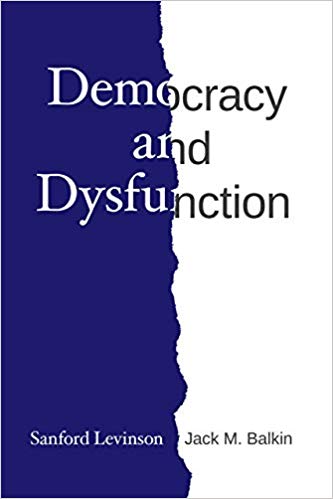
Sanford Levinson and Jack M. Balkin, Democracy and Dysfunction (University of Chicago Press, 2019)

Sanford Levinson, Written in Stone: Public Monuments in Changing Societies (Duke University Press 2018)

Mark A. Graber, Sanford Levinson, and Mark Tushnet, eds., Constitutional Democracy in Crisis? (Oxford University Press 2018)

Gerard Magliocca, The Heart of the Constitution: How the Bill of Rights became the Bill of Rights (Oxford University Press, 2018)

Cynthia Levinson and Sanford Levinson, Fault Lines in the Constitution: The Framers, Their Fights, and the Flaws that Affect Us Today (Peachtree Publishers, 2017)

Brian Z. Tamanaha, A Realistic Theory of Law (Cambridge University Press 2017)

Sanford Levinson, Nullification and Secession in Modern Constitutional Thought (University Press of Kansas 2016)

Sanford Levinson, An Argument Open to All: Reading The Federalist in the 21st Century (Yale University Press 2015)

Stephen M. Griffin, Broken Trust: Dysfunctional Government and Constitutional Reform (University Press of Kansas, 2015)

Frank Pasquale, The Black Box Society: The Secret Algorithms That Control Money and Information (Harvard University Press, 2015)

Bruce Ackerman, We the People, Volume 3: The Civil Rights Revolution (Harvard University Press, 2014)
Balkinization Symposium on We the People, Volume 3: The Civil Rights Revolution

Joseph Fishkin, Bottlenecks: A New Theory of Equal Opportunity (Oxford University Press, 2014)

Mark A. Graber, A New Introduction to American Constitutionalism (Oxford University Press, 2013)

John Mikhail, Elements of Moral Cognition: Rawls' Linguistic Analogy and the Cognitive Science of Moral and Legal Judgment (Cambridge University Press, 2013)

Gerard N. Magliocca, American Founding Son: John Bingham and the Invention of the Fourteenth Amendment (New York University Press, 2013)

Stephen M. Griffin, Long Wars and the Constitution (Harvard University Press, 2013)

Andrew Koppelman, The Tough Luck Constitution and the Assault on Health Care Reform (Oxford University Press, 2013)

James E. Fleming and Linda C. McClain, Ordered Liberty: Rights, Responsibilities, and Virtues (Harvard University Press, 2013)
Balkinization Symposium on Ordered Liberty: Rights, Responsibilities, and Virtues

Andrew Koppelman, Defending American Religious Neutrality (Harvard University Press, 2013)

Brian Z. Tamanaha, Failing Law Schools (University of Chicago Press, 2012)

Sanford Levinson, Framed: America's 51 Constitutions and the Crisis of Governance (Oxford University Press, 2012)

Linda C. McClain and Joanna L. Grossman, Gender Equality: Dimensions of Women's Equal Citizenship (Cambridge University Press, 2012)

Mary Dudziak, War Time: An Idea, Its History, Its Consequences (Oxford University Press, 2012)

Jack M. Balkin, Living Originalism (Harvard University Press, 2011)

Jason Mazzone, Copyfraud and Other Abuses of Intellectual Property Law (Stanford University Press, 2011)

Richard W. Garnett and Andrew Koppelman, First Amendment Stories, (Foundation Press 2011)

Jack M. Balkin, Constitutional Redemption: Political Faith in an Unjust World (Harvard University Press, 2011)

Gerard Magliocca, The Tragedy of William Jennings Bryan: Constitutional Law and the Politics of Backlash (Yale University Press, 2011)

Bernard Harcourt, The Illusion of Free Markets: Punishment and the Myth of Natural Order (Harvard University Press, 2010)

Bruce Ackerman, The Decline and Fall of the American Republic (Harvard University Press, 2010)
Balkinization Symposium on The Decline and Fall of the American Republic

Ian Ayres. Carrots and Sticks: Unlock the Power of Incentives to Get Things Done (Bantam Books, 2010)

Mark Tushnet, Why the Constitution Matters (Yale University Press 2010)

Ian Ayres and Barry Nalebuff: Lifecycle Investing: A New, Safe, and Audacious Way to Improve the Performance of Your Retirement Portfolio (Basic Books, 2010)
.jpg)
Jack M. Balkin, The Laws of Change: I Ching and the Philosophy of Life (2d Edition, Sybil Creek Press 2009)

Brian Z. Tamanaha, Beyond the Formalist-Realist Divide: The Role of Politics in Judging (Princeton University Press 2009)
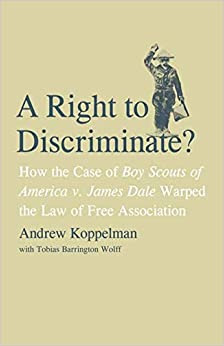
Andrew Koppelman and Tobias Barrington Wolff, A Right to Discriminate?: How the Case of Boy Scouts of America v. James Dale Warped the Law of Free Association (Yale University Press 2009)

Jack M. Balkin and Reva B. Siegel, The Constitution in 2020 (Oxford University Press 2009)

Heather K. Gerken, The Democracy Index: Why Our Election System Is Failing and How to Fix It (Princeton University Press 2009)

Mary Dudziak, Exporting American Dreams: Thurgood Marshall's African Journey (Oxford University Press 2008)

David Luban, Legal Ethics and Human Dignity (Cambridge Univ. Press 2007)

Ian Ayres, Super Crunchers: Why Thinking-By-Numbers is the New Way to be Smart (Bantam 2007)

Jack M. Balkin, James Grimmelmann, Eddan Katz, Nimrod Kozlovski, Shlomit Wagman and Tal Zarsky, eds., Cybercrime: Digital Cops in a Networked Environment (N.Y.U. Press 2007)
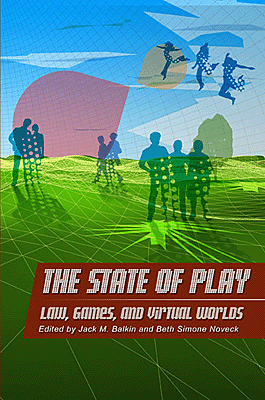
Jack M. Balkin and Beth Simone Noveck, The State of Play: Law, Games, and Virtual Worlds (N.Y.U. Press 2006)

Andrew Koppelman, Same Sex, Different States: When Same-Sex Marriages Cross State Lines (Yale University Press 2006)

Brian Tamanaha, Law as a Means to an End (Cambridge University Press 2006)

Sanford Levinson, Our Undemocratic Constitution (Oxford University Press 2006)

Mark Graber, Dred Scott and the Problem of Constitutional Evil (Cambridge University Press 2006)

Jack M. Balkin, ed., What Roe v. Wade Should Have Said (N.Y.U. Press 2005)

Sanford Levinson, ed., Torture: A Collection (Oxford University Press 2004)
Balkin.com homepage
Bibliography
Conlaw.net
Cultural Software
Writings
Opeds
The Information Society Project
BrownvBoard.com
Useful Links
Syllabi and Exams
