Balkinization
an unanticipated consequence of
Jack M. Balkin
Balkinization Symposiums: A Continuing List
E-mail:
Jack Balkin:
jackbalkin at yahoo.com
Bruce Ackerman
bruce.ackerman at yale.edu
Ian Ayres
ian.ayres at yale.edu
Corey Brettschneider
corey_brettschneider at brown.edu
Mary Dudziak
mary.l.dudziak at emory.edu
Joey Fishkin
joey.fishkin at gmail.com
Heather Gerken heather.gerken at yale.edu
Abbe Gluck abbe.gluck at yale.edu
Mark Graber
mgraber at law.umaryland.edu
Stephen Griffin
sgriffin at tulane.edu
Jonathan Hafetz
jonathan.hafetz at shu.edu
Jeremy Kessler
jkessler at law.columbia.edu
Andrew Koppelman
akoppelman at law.northwestern.edu
Marty Lederman
msl46 at law.georgetown.edu
Sanford Levinson
slevinson at law.utexas.edu
David Luban
david.luban at gmail.com
Gerard Magliocca
gmaglioc at iupui.edu
Jason Mazzone
mazzonej at illinois.edu
Linda McClain
lmcclain at bu.edu
John Mikhail
mikhail at law.georgetown.edu
Frank Pasquale
pasquale.frank at gmail.com
Nate Persily
npersily at gmail.com
Michael Stokes Paulsen
michaelstokespaulsen at gmail.com
Deborah Pearlstein
dpearlst at yu.edu
Rick Pildes
rick.pildes at nyu.edu
David Pozen
dpozen at law.columbia.edu
Richard Primus
raprimus at umich.edu
K. Sabeel Rahmansabeel.rahman at brooklaw.edu
Alice Ristroph
alice.ristroph at shu.edu
Neil Siegel
siegel at law.duke.edu
David Super
david.super at law.georgetown.edu
Brian Tamanaha
btamanaha at wulaw.wustl.edu
Nelson Tebbe
nelson.tebbe at brooklaw.edu
Mark Tushnet
mtushnet at law.harvard.edu
Adam Winkler
winkler at ucla.edu
Compendium of posts on Hobby Lobby and related cases
The Anti-Torture Memos: Balkinization Posts on Torture, Interrogation, Detention, War Powers, and OLC
The Anti-Torture Memos (arranged by topic)
Recent Posts
Facing the Fundamental Choice: A Stronger or Weaker Federal Administration?
![[Powered by Blogger]](https://lh3.googleusercontent.com/blogger_img_proxy/AEn0k_spaNDlEPOXYGNGZgKDbDU6yzNX-WaOh0Rnmb2CVcGzQk2Sd25Dc_BakWhRaPLdpjNcMILom1erZMfP-P-knSYR9fzSZOeO2qDoVsB2FY79=s0-d)
Just A Few Blogs
ACS Blog
Alas, a Blog
Althouse
Arts and Letters Daily
Atrios (Eschaton)
Bill of Health
Buzzflash.com
Buzz Machine
Cato at Liberty
Juan Cole (Informed Comment)
Concurring Opinions
The Constitution in 2020
Corrente
Crooked Timber
Daily Howler
Daily Kos
Dana Boyd
Brad DeLong
Digby (Hullabaloo)
Discriminations
Daniel Drezner
Kevin Drum (Mother Jones)
Electrolite
En Banc
Eunomia (Daniel Larison)
Fafblog
Michael Froomkin (Discourse.net)
GovLab (Beth Noveck)
Rick Hasen (Election Law)
History News Network
How Appealing
Ignatz (Sam Heldman)
The Importance of (Ernie Miller)
Infolaw
Instapundit
International Economic Law and Policy Blog
IntLawGrrls
Jacob Levy
Jesus' General
Jurisdynamics
The Kitchen Cabinet
Mark Kleiman
Law Blog Central
Larry Lessig
Lawyers, Guns and Money
Liberal Oasis
Brian Leiter's Law School Reports
The Leiter Reports
Marginal Revolution
Megan McArdle
Memeorandum
Metafilter
Mirror of Justice
The New Republic
Newseum
No More Mister Nice Blog
Brendan Nyhan
Opinio Juris
Orcinus
The Originalism Blog
Pandagon
Passport (Foreign Policy)
Overcoming Bias
Political Animal (Washington Monthly)
Political Theory Daily Review
Political Wire (Taegan Goddard)
The Poor Man
Virginia Postrel
Prawfsblawg
Public Reason
Jonathan Rauch
Raw Story
Redstate
ReligiousLeftLaw.com
Reporters Committee For Freedom of the Press
Reproductive Rights Blog
Rothman's Roadmap to the Right of Publicity
SCOTUS Blog
Seeing the Forest
Clay Shirky
The Shifted Librarian
The Situationist
Larry Solum (Legal Theory)
Andrew Sullivan
Talking Points Memo
Talk Left
Tapped
Tbogg
TechPresident
The Paper Chase (Jurist)
Tom Paine
Tom Tomorrow (This Modern World)
Eve Tushnet
Uggabugga
University of Chicago Law School Faculty Blog
Unqualified Offerings
The Volokh Conspiracy
War and Piece (Laura Rozen)
Wampum
Oliver Willis
Wonkette
Written Description
Matthew Yglesias
Yin
Your Choice of Feeds
1. XML
powered by

2. Atom Feed
3. RSS 2.0
Facing the Fundamental Choice: A Stronger or Weaker Federal Administration?
David Super
Barely a day
passes when I do not see some new plan for an anticipated “restoration” after
President Trump leaves office. As 2029
approaches, I am sure we will see many more.
Alas, I have yet to see a plan that thoughtfully engages with what
should be the most foundational question in this process: do we seek a strong federal administration or
a weak one? Or, put another way, is the
goal to strengthen majoritarianism or to protect minorities that the majority
may wish to trample? The right answer
to this question depends on how anti-MAGA thinkers envision the future. If they seek to empower future majorities and
the party that controls the presidency and Congress, presumably they believe
that they will hold majority power for the foreseeable future once Donald Trump
passes – or at least that a stronger executive will allow them to build more
than MAGA can destroy when holding the reins.
The goal of this strategy presumably would be to make it impossible for
the Republican Party to dominate power until it moderates and rededicates
itself to democratic values, much as voters made Democrats wander in the
wilderness for twenty of the twenty-four years between 1968 to 1992 because
they perceived the party as being too far left.
Alternatively, if anti-MAGA
thinkers believe that control of the federal government is likely to alternate
frequently, they should limit the powers of any majority and support devices
that allow minorities to block actions harmful to them. This would be particularly true if they believe
that MAGA is more efficient at destroying than they are at building. Of course, Democrats
want to be a persistent majority and believe they should have the
majority of the electorate’s support.
But neither of those is the question.
The question is one of prediction:
do MAGA’s opponents believe they actually will be the majority? And, related, will they make maintaining
majority electoral support their top priority?
If so, then plans like dismantling the filibuster and remaking the
Supreme Court might make practical sense.
If not, those moves would be disastrous.
I see no reason to
believe that Democrats will persistently hold a majority in years to come: I am convinced that Donald J. Trump will not
be the last president to seriously threaten this country’s democracy in the
near future. Further, I believe the liberal-progressive
movement, as it currently stands, is structurally incapable of doing what is
necessary to have a plausible chance of preventing another ruthless MAGA
president from taking office. I
therefore regard progressive proposals to raise the stakes for elections as not
just misguided but profoundly reckless. To start,
alternating control of the White House would continue an entrenched recent
pattern. Democrats have won half of the
last two, four, six, eight, and ten presidential elections. The last Democrat to secure 53% of the
popular vote was Lyndon Johnson over sixty years ago; in the intervening years,
Republicans have surpassed 53% three times.
Although some progressives like to point to President Trump’s relatively
low popular vote totals, in both 2016 and 2024 extremely conservative
candidates won about 51% of the vote while candidates on the left took 49%; the
two elections differed primarily as to which coalition was more fractured. Even with the economy staggering and hundreds
of thousands dying as the Trump Administration fumbled its response to the
pandemic – failures that would have obliterated a Democratic candidate – President
Trump still received almost 47% of the vote in 2020. To be sure,
President Trump is quite unpopular now, but he will not be on the ballot
again. And his deep unpopularity has not
translated into corresponding support for Democrats: at this writing, only 38% of voters think
well of Democrats compared with 55% hostile to them. That is all but indistinguishable from
Republicans’ 39% to 56% unfavorability
rating. This is not the stuff of which
dynasties are made. But current
unpopularity is far from the biggest reason to think that Democrats will not be
able to keep MAGA Republicans out of power.
The Establishment and Progressive Wings of the Democratic Party would do
well to adopt the Gingham Dog and the Calico Cat as their mascots.
Each seems to view the marginalization of the other as a necessary
predicate step to battling Donald Trump.
Neither shows much willingness to accept that, with the country almost
evenly divided between Left and Right, defeating MAGA Republicanism is only
possible if both moderates and progressives enthusiastically
engage. If either faction is vanquished,
both will be vanquished. To keep MAGA from
regaining the reins of power, Establishment Democrats need to stop freaking out
when progressive constituencies elect progressives. And to keep MAGA from regaining the reins of
power, Progressive Democrats need to stop endangering seats in purple or red
constituencies by applying purity tests to candidates there. Both need to stop supporting
awful
people
just because they mouth their faction’s affirmations. Although we may
disagree about which positions so alienate moderates that they will cost
the Party votes, it defies reality (and a vast political science literature) to
insist that no such positions exist.
Similarly, although we may disagree about which positions are so
denigrating to the value of human life that they will alienate progressives and
cost the Party votes, it defies reality (and the everyday experience with people
who have been insulted) to insist that no such positions exist. Yet Democrats lack
any workable mechanism to discuss together which positions are too electorally
toxic and to discourage those in the relevant faction from weighing the Party
down with those positions. Instead, any
reticence by Establishment Democrats is attacked as betrayal – likely causing
some progressives to withhold their votes – while any complaints about denigrating
statements are denounced as attempts at “political correctness” – likely alienating
some moderates. If they regain
power, Democrats naturally will want to implement their program. Parts of that program are broadly popular,
but parts definitely are not. They likely
can afford to pursue some unpopular initiatives, but if they launch too many
they will lose too many voters.
Conversely, if they slavishly follow the polls rather than ever leading,
they will disappoint progressives and lose voter turnout in the next
election. Rather than being reflexively
bold or reflexively timid, they must prioritize carefully. Alas, Democrats also
lack a workable mechanism for prioritizing their coalition’s initiatives to
avoid alienating too many voters at once.
Indeed, a great many progressives refuse to acknowledge that such trade-offs
exist They fail to see that the middle- and long-term consequences of enacting multiple
deeply unpopular measures at once can be devastating for vulnerable people,
such as the immigrants and low-income people targeted when voters sweep MAGA
back into power. Conversely, many
Establishment Democrats seem to reject any initiatives that lead voters out of
their comfort zones, condemning the Party to always playing from behind and
losing the enthusiasm of the many low-engagement progressive voters. Compromises are the
life blood of coalition politics. Alas, compromise
is largely infeasible with loud voices condemning any concessions “betrayal.” Many progressives’ fierce objection
to the Build Back Better Act, which would have been the most transformative
social legislation in at least a decade and perhaps half a century, shows the
near-impossibility of crafting compromises that do not split the Party. And the constant denunciation of deals for
what they do not include persuades low-information voters that Democratic
officeholders are hopeless and not worth voting for. All these problems
might be remediable if the leaders of the various factions could negotiate definitive
deals. Unfortunately, neither major
faction has leaders who can and do command broad deference. Establishment Democrats have Minority Leaders
Schumer and Jeffries, but neither has demonstrated, or even sought, the
authority to commit their faction to compromises. Progressives have even less deference to
leaders: Sen. Sanders did negotiate a
common program with nominee-apparent Biden in 2020, but neither he nor
Representative Ocasio-Cortez have made any regular practice of seeking deals
with Party leaders. In practice, because
many progressive social media influencers’ click-rates, and incomes, depend on raising
hyperbolic criticisms, any progressive leaders attempting such negotiations
would likely pay a high reputational price.
This is not to say
that the Democratic factions can never come together to defeat the MAGA threat
to our country. They did in 2020 when,
led by African-American primary voters in South Carolina, they nominated a
career politician with
a thoroughly
uninspiring
record. But the infrequency and brevity of these truces
demonstrate that far too many Democrats see intra-party warfare, and advancing their
policy programs even at great electoral risk, as more pressing than definitively
defeating MAGA’s threats to our country’s core principles and the well-being of
vulnerable people at home and abroad. We
are, for example, a far cry from the Hungarian progressives who cleared
the field for non-Orban conservatives to end their country’s sixteen years of
creeping authoritarianism or the Chileans who united behind a moderate
conservative to end Pinochet’s rule. As long as
defeating MAGA remains only a conditional or intermittent priority – and in
particular as long as the two main factions remain determined to subjugate one
another in the pursuit of wholly unrealistic general election strategies – we
will keep getting MAGA presidents and MAGA Congresses. And because the second Trump Administration
has clearly demonstrated that destroying programs and institutions is far
easier and faster than building them, any accomplishments Democrats may achieve
during their brief interludes in power will be extremely fleeting. Democrats will not get far with any plans
that depend on selling the trustworthiness of our federal government to other nations,
to potential grant recipients here or abroad, or to prospective federal
employees that do not want to suffer what hundreds of thousands did
over the past year and a half. This country
elected Donald Trump twice; unless we can show a fundamental change in the
structure of our politics, nobody is going to believe this was merely a fluke. We seem well on our
way to an eight-year cycle in which Democrats have broad control for two years,
a Democratic president is hobbled by one or both chambers of Congress for another
two years, a MAGA president has broad control for two years, and the MAGA
president remains in power but lacks a solid congressional majority for the
final two years. Programs Democrats
pass in their two years of dominance will barely be getting organized when a
Republican Congress begins to starve them of resources and MAGA legal groups
sue to block their implementation. The
programs will have accomplished little by the time the next MAGA president eliminates
them. Democrats can enact civil rights,
environmental, and consumer protection laws during their ascendancy; by the
time those laws take effect and violations can be investigated and prosecuted,
the Democratic president’s term will be about half-over. Many violators’ appeals likely will not be
exhausted before the next MAGA president pardons them. Little will have been accomplished. By contrast, the lives ruined or ended during
MAGA administrations will not somehow be restored when that president leaves
office. Even if one is
certain that Democrats can dominate national politics if (fill in the blank) “progressives
stop taking extreme positions” or “the Establishment fights more vigorously”,
it is obvious that neither group is going to change its stripes anytime
soon. Until we are collectively willing
to choose a moderate but stable regime that negotiates progress among pro-democratic
factions, the current boom-and-bust cycle will continue. And while it does, all plans should focus on
protecting political minorities and limiting the power of transitory majorities
– even though Democrats will sometimes be in that majority. @DavidASuper.bsky.social
@DavidASuper1
Posted
10:48 PM
by David Super [link]
Books by Balkinization Bloggers

Gerard N. Magliocca, The Actual Art of Governing: Justice Robert H. Jackson's Concurring Opinion in the Steel Seizure Case (Oxford University Press, 2025)

Linda C. McClain and Aziza Ahmed, The Routledge Companion to Gender and COVID-19 (Routledge, 2024)

David Pozen, The Constitution of the War on Drugs (Oxford University Press, 2024)

Jack M. Balkin, Memory and Authority: The Uses of History in Constitutional Interpretation (Yale University Press, 2024)
Mark A. Graber, Punish Treason, Reward Loyalty: The Forgotten Goals of Constitutional Reform after the Civil War (University of Kansas Press, 2023)
Jack M. Balkin, What Roe v. Wade Should Have Said: The Nation's Top Legal Experts Rewrite America's Most Controversial Decision - Revised Edition (NYU Press, 2023)

Andrew Koppelman, Burning Down the House: How Libertarian Philosophy Was Corrupted by Delusion and Greed (St. Martin’s Press, 2022)

Gerard N. Magliocca, Washington's Heir: The Life of Justice Bushrod Washington (Oxford University Press, 2022)
Joseph Fishkin and William E. Forbath, The Anti-Oligarchy Constitution: Reconstructing the Economic Foundations of American Democracy (Harvard University Press, 2022)
Mark Tushnet and Bojan Bugaric, Power to the People: Constitutionalism in the Age of Populism (Oxford University Press 2021).

Mark Philip Bradley and Mary L. Dudziak, eds., Making the Forever War: Marilyn B. Young on the Culture and Politics of American Militarism Culture and Politics in the Cold War and Beyond (University of Massachusetts Press, 2021).

Jack M. Balkin, What Obergefell v. Hodges Should Have Said: The Nation's Top Legal Experts Rewrite America's Same-Sex Marriage Decision (Yale University Press, 2020)

Frank Pasquale, New Laws of Robotics: Defending Human Expertise in the Age of AI (Belknap Press, 2020)

Jack M. Balkin, The Cycles of Constitutional Time (Oxford University Press, 2020)

Mark Tushnet, Taking Back the Constitution: Activist Judges and the Next Age of American Law (Yale University Press 2020).

Andrew Koppelman, Gay Rights vs. Religious Liberty?: The Unnecessary Conflict (Oxford University Press, 2020)

Ezekiel J Emanuel and Abbe R. Gluck, The Trillion Dollar Revolution: How the Affordable Care Act Transformed Politics, Law, and Health Care in America (PublicAffairs, 2020)

Linda C. McClain, Who's the Bigot?: Learning from Conflicts over Marriage and Civil Rights Law (Oxford University Press, 2020)
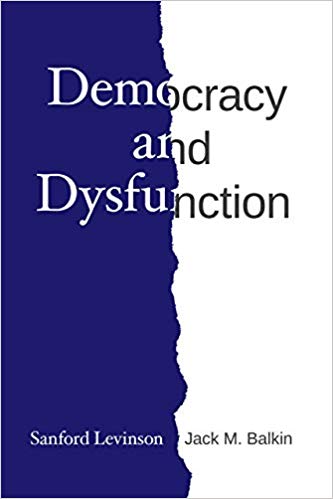
Sanford Levinson and Jack M. Balkin, Democracy and Dysfunction (University of Chicago Press, 2019)

Sanford Levinson, Written in Stone: Public Monuments in Changing Societies (Duke University Press 2018)

Mark A. Graber, Sanford Levinson, and Mark Tushnet, eds., Constitutional Democracy in Crisis? (Oxford University Press 2018)

Gerard Magliocca, The Heart of the Constitution: How the Bill of Rights became the Bill of Rights (Oxford University Press, 2018)

Cynthia Levinson and Sanford Levinson, Fault Lines in the Constitution: The Framers, Their Fights, and the Flaws that Affect Us Today (Peachtree Publishers, 2017)

Brian Z. Tamanaha, A Realistic Theory of Law (Cambridge University Press 2017)

Sanford Levinson, Nullification and Secession in Modern Constitutional Thought (University Press of Kansas 2016)

Sanford Levinson, An Argument Open to All: Reading The Federalist in the 21st Century (Yale University Press 2015)

Stephen M. Griffin, Broken Trust: Dysfunctional Government and Constitutional Reform (University Press of Kansas, 2015)

Frank Pasquale, The Black Box Society: The Secret Algorithms That Control Money and Information (Harvard University Press, 2015)

Bruce Ackerman, We the People, Volume 3: The Civil Rights Revolution (Harvard University Press, 2014)
Balkinization Symposium on We the People, Volume 3: The Civil Rights Revolution

Joseph Fishkin, Bottlenecks: A New Theory of Equal Opportunity (Oxford University Press, 2014)

Mark A. Graber, A New Introduction to American Constitutionalism (Oxford University Press, 2013)

John Mikhail, Elements of Moral Cognition: Rawls' Linguistic Analogy and the Cognitive Science of Moral and Legal Judgment (Cambridge University Press, 2013)

Gerard N. Magliocca, American Founding Son: John Bingham and the Invention of the Fourteenth Amendment (New York University Press, 2013)

Stephen M. Griffin, Long Wars and the Constitution (Harvard University Press, 2013)

Andrew Koppelman, The Tough Luck Constitution and the Assault on Health Care Reform (Oxford University Press, 2013)

James E. Fleming and Linda C. McClain, Ordered Liberty: Rights, Responsibilities, and Virtues (Harvard University Press, 2013)
Balkinization Symposium on Ordered Liberty: Rights, Responsibilities, and Virtues

Andrew Koppelman, Defending American Religious Neutrality (Harvard University Press, 2013)

Brian Z. Tamanaha, Failing Law Schools (University of Chicago Press, 2012)

Sanford Levinson, Framed: America's 51 Constitutions and the Crisis of Governance (Oxford University Press, 2012)

Linda C. McClain and Joanna L. Grossman, Gender Equality: Dimensions of Women's Equal Citizenship (Cambridge University Press, 2012)

Mary Dudziak, War Time: An Idea, Its History, Its Consequences (Oxford University Press, 2012)

Jack M. Balkin, Living Originalism (Harvard University Press, 2011)

Jason Mazzone, Copyfraud and Other Abuses of Intellectual Property Law (Stanford University Press, 2011)

Richard W. Garnett and Andrew Koppelman, First Amendment Stories, (Foundation Press 2011)

Jack M. Balkin, Constitutional Redemption: Political Faith in an Unjust World (Harvard University Press, 2011)

Gerard Magliocca, The Tragedy of William Jennings Bryan: Constitutional Law and the Politics of Backlash (Yale University Press, 2011)

Bernard Harcourt, The Illusion of Free Markets: Punishment and the Myth of Natural Order (Harvard University Press, 2010)

Bruce Ackerman, The Decline and Fall of the American Republic (Harvard University Press, 2010)
Balkinization Symposium on The Decline and Fall of the American Republic

Ian Ayres. Carrots and Sticks: Unlock the Power of Incentives to Get Things Done (Bantam Books, 2010)

Mark Tushnet, Why the Constitution Matters (Yale University Press 2010)

Ian Ayres and Barry Nalebuff: Lifecycle Investing: A New, Safe, and Audacious Way to Improve the Performance of Your Retirement Portfolio (Basic Books, 2010)
.jpg)
Jack M. Balkin, The Laws of Change: I Ching and the Philosophy of Life (2d Edition, Sybil Creek Press 2009)

Brian Z. Tamanaha, Beyond the Formalist-Realist Divide: The Role of Politics in Judging (Princeton University Press 2009)

Andrew Koppelman and Tobias Barrington Wolff, A Right to Discriminate?: How the Case of Boy Scouts of America v. James Dale Warped the Law of Free Association (Yale University Press 2009)

Jack M. Balkin and Reva B. Siegel, The Constitution in 2020 (Oxford University Press 2009)

Heather K. Gerken, The Democracy Index: Why Our Election System Is Failing and How to Fix It (Princeton University Press 2009)

Mary Dudziak, Exporting American Dreams: Thurgood Marshall's African Journey (Oxford University Press 2008)

David Luban, Legal Ethics and Human Dignity (Cambridge Univ. Press 2007)

Ian Ayres, Super Crunchers: Why Thinking-By-Numbers is the New Way to be Smart (Bantam 2007)

Jack M. Balkin, James Grimmelmann, Eddan Katz, Nimrod Kozlovski, Shlomit Wagman and Tal Zarsky, eds., Cybercrime: Digital Cops in a Networked Environment (N.Y.U. Press 2007)

Jack M. Balkin and Beth Simone Noveck, The State of Play: Law, Games, and Virtual Worlds (N.Y.U. Press 2006)

Andrew Koppelman, Same Sex, Different States: When Same-Sex Marriages Cross State Lines (Yale University Press 2006)

Brian Tamanaha, Law as a Means to an End (Cambridge University Press 2006)

Sanford Levinson, Our Undemocratic Constitution (Oxford University Press 2006)

Mark Graber, Dred Scott and the Problem of Constitutional Evil (Cambridge University Press 2006)

Jack M. Balkin, ed., What Roe v. Wade Should Have Said (N.Y.U. Press 2005)

Sanford Levinson, ed., Torture: A Collection (Oxford University Press 2004)
Balkin.com homepage
Bibliography
Conlaw.net
Cultural Software
Writings
Opeds
The Information Society Project
BrownvBoard.com
Useful Links
Syllabi and Exams
