Balkinization
an unanticipated consequence of
Jack M. Balkin
Balkinization Symposiums: A Continuing List
E-mail:
Jack Balkin:
jackbalkin at yahoo.com
Bruce Ackerman
bruce.ackerman at yale.edu
Ian Ayres
ian.ayres at yale.edu
Corey Brettschneider
corey_brettschneider at brown.edu
Mary Dudziak
mary.l.dudziak at emory.edu
Joey Fishkin
joey.fishkin at gmail.com
Heather Gerken heather.gerken at yale.edu
Abbe Gluck abbe.gluck at yale.edu
Mark Graber
mgraber at law.umaryland.edu
Stephen Griffin
sgriffin at tulane.edu
Jonathan Hafetz
jonathan.hafetz at shu.edu
Jeremy Kessler
jkessler at law.columbia.edu
Andrew Koppelman
akoppelman at law.northwestern.edu
Marty Lederman
msl46 at law.georgetown.edu
Sanford Levinson
slevinson at law.utexas.edu
David Luban
david.luban at gmail.com
Gerard Magliocca
gmaglioc at iupui.edu
Jason Mazzone
mazzonej at illinois.edu
Linda McClain
lmcclain at bu.edu
John Mikhail
mikhail at law.georgetown.edu
Frank Pasquale
pasquale.frank at gmail.com
Nate Persily
npersily at gmail.com
Michael Stokes Paulsen
michaelstokespaulsen at gmail.com
Deborah Pearlstein
dpearlst at yu.edu
Rick Pildes
rick.pildes at nyu.edu
David Pozen
dpozen at law.columbia.edu
Richard Primus
raprimus at umich.edu
K. Sabeel Rahmansabeel.rahman at brooklaw.edu
Alice Ristroph
alice.ristroph at shu.edu
Neil Siegel
siegel at law.duke.edu
David Super
david.super at law.georgetown.edu
Brian Tamanaha
btamanaha at wulaw.wustl.edu
Nelson Tebbe
nelson.tebbe at brooklaw.edu
Mark Tushnet
mtushnet at law.harvard.edu
Adam Winkler
winkler at ucla.edu
Compendium of posts on Hobby Lobby and related cases
The Anti-Torture Memos: Balkinization Posts on Torture, Interrogation, Detention, War Powers, and OLC
The Anti-Torture Memos (arranged by topic)
Recent Posts
Is the New “Weaponization” Compensation Fund Lawful?
![[Powered by Blogger]](https://lh3.googleusercontent.com/blogger_img_proxy/AEn0k_sCHUJjLQSVCcmTHAU4fd2yOitJf_SD52k_4MS0Y5uum-hFbAVSnOJF4JGgPzUp0_sz4gUtdSnZZ-UcRZ5U683FYS_ZJsQxz18we0S7tmhJ=s0-d)
Just A Few Blogs
ACS Blog
Alas, a Blog
Althouse
Arts and Letters Daily
Atrios (Eschaton)
Bill of Health
Buzzflash.com
Buzz Machine
Cato at Liberty
Juan Cole (Informed Comment)
Concurring Opinions
The Constitution in 2020
Corrente
Crooked Timber
Daily Howler
Daily Kos
Dana Boyd
Brad DeLong
Digby (Hullabaloo)
Discriminations
Daniel Drezner
Kevin Drum (Mother Jones)
Electrolite
En Banc
Eunomia (Daniel Larison)
Fafblog
Michael Froomkin (Discourse.net)
GovLab (Beth Noveck)
Rick Hasen (Election Law)
History News Network
How Appealing
Ignatz (Sam Heldman)
The Importance of (Ernie Miller)
Infolaw
Instapundit
International Economic Law and Policy Blog
IntLawGrrls
Jacob Levy
Jesus' General
Jurisdynamics
The Kitchen Cabinet
Mark Kleiman
Law Blog Central
Larry Lessig
Lawyers, Guns and Money
Liberal Oasis
Brian Leiter's Law School Reports
The Leiter Reports
Marginal Revolution
Megan McArdle
Memeorandum
Metafilter
Mirror of Justice
The New Republic
Newseum
No More Mister Nice Blog
Brendan Nyhan
Opinio Juris
Orcinus
The Originalism Blog
Pandagon
Passport (Foreign Policy)
Overcoming Bias
Political Animal (Washington Monthly)
Political Theory Daily Review
Political Wire (Taegan Goddard)
The Poor Man
Virginia Postrel
Prawfsblawg
Public Reason
Jonathan Rauch
Raw Story
Redstate
ReligiousLeftLaw.com
Reporters Committee For Freedom of the Press
Reproductive Rights Blog
Rothman's Roadmap to the Right of Publicity
SCOTUS Blog
Seeing the Forest
Clay Shirky
The Shifted Librarian
The Situationist
Larry Solum (Legal Theory)
Andrew Sullivan
Talking Points Memo
Talk Left
Tapped
Tbogg
TechPresident
The Paper Chase (Jurist)
Tom Paine
Tom Tomorrow (This Modern World)
Eve Tushnet
Uggabugga
University of Chicago Law School Faculty Blog
Unqualified Offerings
The Volokh Conspiracy
War and Piece (Laura Rozen)
Wampum
Oliver Willis
Wonkette
Written Description
Matthew Yglesias
Yin
Your Choice of Feeds
1. XML
powered by

2. Atom Feed
3. RSS 2.0
Is the New “Weaponization” Compensation Fund Lawful?
David Super
President Trump,
his older sons, and his business have filed several claims against the United
States Government that he controls. On
May 18, 2026, the Department of Justice announced
that plaintiffs’ lawyers, whom President Trump controls, and defendants’
lawyers, whom he also controls, have settled some claims. Under this agreement, the Government would
establish a fund to pay compensation to individuals who allege they were
victims of improper “weaponization” of the federal government during President
Biden’s administration. Although widely
reported to be for persons who were tried and convicted for crimes relating to
the January 6, 2021, assault on Congress, the settlement agreement
does not specifically mention that attack and allows anyone who feels they were
victimized to file a claim. The
agreement does not designate any amount of money to go to this fund, although
Acting Attorney General Todd Blanche’s announcement says it will receive $1.776
billion. (The settlement also,
unconvincingly, tries to shield the payments it makes from taxation.) The Administration has made clear it does not
intend to seek approval or an appropriation from Congress. This post examines the legality of this arrangement.
One simple answer
is that section 4 of the Fourteenth Amendment declares
that “neither the United States nor any State shall assume or pay any debt or
obligation incurred in aid of insurrection or rebellion against the United
States … but all such debts, obligations and claims shall be held illegal and
void.” The unprecedented attack on
Congress on January 6 was an “insurrection or rebellion against the United
States”. Any purported debts perpetrators
might file likely were incurred in aid of that insurrection and therefore that
are “illegal and void”. To be sure, the
purported debts are not for the costs of the insurrection itself but rather to
compensate for the lawful punishment the insurrectionists subsequently suffered
for their acts. The sequence, however,
should not matter: the law long has recognized
liability for acts assisting perpetrators of crimes occurring entirely after
the crimes were committed. To be sure, some people
who did not participate in the January 6 insurrection may claim to have been
victims of other federal abuses. Section
4 would not bar relief for them. Nonetheless,
they – as well as the January 6 claimants – would be barred from receiving money
from this fund for other reasons. Article
I, section 9, clause 7 of the U.S. Constitution
provides that “No Money shall be drawn from the Treasury, but in Consequence of
Appropriations made by Law”. Similarly,
the Anti-Deficiency Act provides
that “Except as specified in this subchapter or any other provision of law, an
officer or employee of the United States Government or of the District of
Columbia government may not…make or
authorize an expenditure or obligation exceeding an amount available in an
appropriation or fund for the expenditure or obligation”. Violations of the Anti-Deficiency Act carry criminal
penalties. Therefore, Justice
Department officials involved in creating or administering the proposed fund
would face serious personal jeopardy if they cannot identify a congressional
appropriation permitting these expenditures or feel confident they will be
included in a future pardon. Acting Attorney
General Blanche’s statement declares that the Administration will make these
payments under the Judgment
Fund, a permanent uncapped appropriation for paying judgments against the
United States Government. The drafting
of the settlement agreement, however, may preclude that. Section IV.A directs Acting Attorney General
Blanche to issue an order within 30 days of the agreement that “shall establish
funding” for the program. Section VII
then states that the settlement agreement and the accompanying orders of the
Attorney General “constitute[] the entire agreement of the Parties, and no prior
statement, representation, agreement, or understanding, oral or written, that is
not contained herein, will have any force or effect.” Thus, the settlement agreement does not
require any particular level of funding and any side agreement on the $1.776
billion figure has no legal effect.
Acting Attorney General Blanche could have fully complied with the
settlement agreement by designating one dollar for the fund. His voluntary choice to provide more than was
obligated was not necessary to settle these cases and hence is not covered by
the Judgment Fund. Yet even without
these technical blunders, the Administration’s broader theory cannot withstand
scrutiny. It is arguing, in essence,
that the mere act of filing a lawsuit against the Government allows President
Trump to fully circumvent the Appropriations Clause and the Anti-Deficiency Act
by “settling” for any spending he desires.
He thus could file a meritless lawsuit against the Government he
controls and then “settle” for taxpayers’ dollars to build his ornate ballroom,
to fund his grand
“Arc d’Trump”, or even to pay for foreign wars that Congress declines to
fund. As in the case of
other Administration legal theories that purport to confer transformative
powers onto the President, we should ask ourselves whether the Framers, or
Congress, or the courts, have really left such a spectacular loophole in our
system of checks and balances. In some
instances, the answer may be that our forebears failed to imagine presidential
power being exercised with such blatant dishonesty and bad faith. But often close examination of the
controlling legal materials shows that the purported sweeping powers are a
phantom. The Judgment
Fund provides an appropriation to pay a “judgment, award, or settlement”
under any of ten specified federal laws or a decision of a board of contract
appeals. Six of the enumerated statutes are
obviously
inapplicable
to
this
situation. Section
2677 allows settlement of claims under section
1346(b), but the latter strictly limits recoveries to “injury or loss of
property, or personal injury or death”, a much narrower set of harms than the
settlement agreement contemplates, and further limits recoveries by persons
incarcerated after felony convictions. Section
2672 is similarly limited to claims for “injury or loss of property or
personal injury or death”. Section
2517 is limited to judgments of the Court of Federal Claims, not
settlements. That leaves section
2414. That section, too, primarily
addresses court judgments. It does,
however, provide that “[e]xcept as otherwise provided by law, compromise
settlements of claims referred to the Attorney General for defense of imminent
litigation or suits against the United States, or against its agencies or
officials upon obligations or liabilities of the United States, made by the
Attorney General or any person authorized by him, shall be settled and paid in
a manner similar to judgments in like causes and appropriations or funds
available for the payment of such judgments are hereby made available for the
payment of such compromise settlements.”
This is the only possible basis for accessing the Judgment Fund here. Section 2414’s
permission to pay settlements of claims, however, is subject to limits in other
laws. One such federal statute is section
1359 of Title 28, which provides that “[a] district court shall not have
jurisdiction of a civil action in which any party, by assignment or otherwise,
has been improperly or collusively made or joined to invoke the jurisdiction of
such court.” President Trump suing the
U.S. Government, which he completely controls under the Unified Executive
Theory he has tirelessly invoked, would strike many as a collusive attempt to
invoke the jurisdiction of the federal court to facilitate a settlement of his liking. President Trump acknowledged
that this litigation appears to be brought against himself. Another such
statute is section
530B(a) of Title 28, which provides that “An attorney for the Government
shall be subject to State laws and rules, and local Federal court rules,
governing attorneys in each State where such attorney engages in that
attorney's duties, to the same extent and in the same manner as other attorneys
in that State.” Florida
Bar Rule 4-3.1 prohibits meritless or frivolous litigation; Rule 4-3.3
requires candor toward the tribunal.
District of Columbia Rules 3.1
and 3.3
are similar. Litigation in which the
same individual controls both sides is inherently misleading to the court and
does not call for the adversarial resolution of any questions of fact or law. As the U.S.
Supreme Court has said,
litigation in which the same person controls both sides “is not in any real
sense adversary. It does not assume the ‘honest and actual antagonistic
assertion of rights’ to be adjudicated – a safeguard essential to the integrity
of the judicial process”. The Supreme
Court of Florida has cautioned
against “connivance in [the] defeat” of a party, which certainly occurs when
the plaintiff has full control over the defense. It warned
that “[t]he fairness of the system is undermined when the alignment of
interests in the litigation is not what it appears to be.” Acting Attorney
General Blanche’s press release cites a settlement the Obama Administration
made with Native Americans as precedent for its actions here. That case, and many others, did settle
litigation against the federal government with moneys from the Judgment
Fund. That settlement, however, did not result
from litigation where the same individual controlled both sides of the
litigation. And that settlement was
approved by a judge while the settlement of President Trump’s litigation was
hustled through this week to save the parties from having to file briefs the
court sought on whether they have sufficient adversity to secure federal
jurisdiction. A series of
memoranda from the Justice Department’s Office of Legal Counsel make clear that
the Judgment Fund is not available to pay collusive settlements. As summarized in a 2023 memorandum from
the Associate Attorney General (with citations omitted): A settlement must conform to any
applicable statutory limitations and serve the "best interests" of the
United States. The President's
constitutional obligation to take care that the laws be faithfully executed
"necessarily serves to limit the exercise of the Attorney General's
settlement authority so that it does not become a dispensing power." OLC
has therefore concluded that the Department may compromise claims only if the
Department makes a "good faith assessment" that a court could find
the government liable. Further, the Judgment Fund is available for the payment
of a settlement only if "the cause ofaction that gave rise to the
settlement could have resulted in a final money judgment." And, relatedly,
the Judgment Fund may not be used to pay for the settlement of claims that, if they
resulted in a judgment against the government, would "impose costs on the
government, but [would] not require the United States to make specific cash
disbursements" to certain parties, such as a "judgment[] that
required the United States to furnish subsidized housing, or that required the
United States to correct structural defects in housing." These strictures
ensure that the potential use of the Judgment Fund does not "encourage
settlements that would not otherwise be in the interest of the United
States." OLC has cautioned
that we should “not lightly attribute to Congress an intent to create a
structure that might encourage settlements that would not be in the interest of
the United States.” Tapping the Judgment
Fund to pay for settlements of non-adversarial litigation does that with a vengeance.
When extravagant
legal theories that defy logic and the Constitution seem too good to be true,
they often are. @DavidASuper1
@DavidASuper.bsky.social
Posted
12:21 AM
by David Super [link]
Books by Balkinization Bloggers

Mark Tushnet and Bojan Bugaric, Constitutionalism and Its Discontents (University of Chicago Press, 2026)

Gerard N. Magliocca, The Actual Art of Governing: Justice Robert H. Jackson's Concurring Opinion in the Steel Seizure Case (Oxford University Press, 2025)

Linda C. McClain and Aziza Ahmed, The Routledge Companion to Gender and COVID-19 (Routledge, 2024)

David Pozen, The Constitution of the War on Drugs (Oxford University Press, 2024)

Jack M. Balkin, Memory and Authority: The Uses of History in Constitutional Interpretation (Yale University Press, 2024)
Mark A. Graber, Punish Treason, Reward Loyalty: The Forgotten Goals of Constitutional Reform after the Civil War (University of Kansas Press, 2023)
Jack M. Balkin, What Roe v. Wade Should Have Said: The Nation's Top Legal Experts Rewrite America's Most Controversial Decision - Revised Edition (NYU Press, 2023)

Andrew Koppelman, Burning Down the House: How Libertarian Philosophy Was Corrupted by Delusion and Greed (St. Martin’s Press, 2022)

Gerard N. Magliocca, Washington's Heir: The Life of Justice Bushrod Washington (Oxford University Press, 2022)
Joseph Fishkin and William E. Forbath, The Anti-Oligarchy Constitution: Reconstructing the Economic Foundations of American Democracy (Harvard University Press, 2022)
Mark Tushnet and Bojan Bugaric, Power to the People: Constitutionalism in the Age of Populism (Oxford University Press 2021).

Mark Philip Bradley and Mary L. Dudziak, eds., Making the Forever War: Marilyn B. Young on the Culture and Politics of American Militarism Culture and Politics in the Cold War and Beyond (University of Massachusetts Press, 2021).

Jack M. Balkin, What Obergefell v. Hodges Should Have Said: The Nation's Top Legal Experts Rewrite America's Same-Sex Marriage Decision (Yale University Press, 2020)

Frank Pasquale, New Laws of Robotics: Defending Human Expertise in the Age of AI (Belknap Press, 2020)

Jack M. Balkin, The Cycles of Constitutional Time (Oxford University Press, 2020)

Mark Tushnet, Taking Back the Constitution: Activist Judges and the Next Age of American Law (Yale University Press 2020).

Andrew Koppelman, Gay Rights vs. Religious Liberty?: The Unnecessary Conflict (Oxford University Press, 2020)

Ezekiel J Emanuel and Abbe R. Gluck, The Trillion Dollar Revolution: How the Affordable Care Act Transformed Politics, Law, and Health Care in America (PublicAffairs, 2020)

Linda C. McClain, Who's the Bigot?: Learning from Conflicts over Marriage and Civil Rights Law (Oxford University Press, 2020)
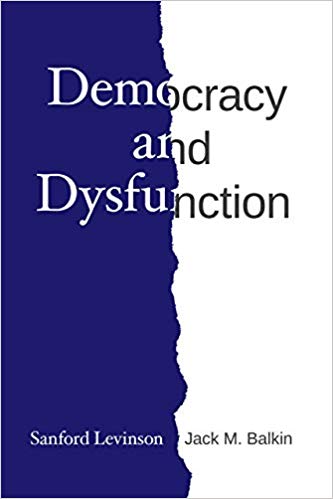
Sanford Levinson and Jack M. Balkin, Democracy and Dysfunction (University of Chicago Press, 2019)

Sanford Levinson, Written in Stone: Public Monuments in Changing Societies (Duke University Press 2018)

Mark A. Graber, Sanford Levinson, and Mark Tushnet, eds., Constitutional Democracy in Crisis? (Oxford University Press 2018)

Gerard Magliocca, The Heart of the Constitution: How the Bill of Rights became the Bill of Rights (Oxford University Press, 2018)

Cynthia Levinson and Sanford Levinson, Fault Lines in the Constitution: The Framers, Their Fights, and the Flaws that Affect Us Today (Peachtree Publishers, 2017)

Brian Z. Tamanaha, A Realistic Theory of Law (Cambridge University Press 2017)

Sanford Levinson, Nullification and Secession in Modern Constitutional Thought (University Press of Kansas 2016)

Sanford Levinson, An Argument Open to All: Reading The Federalist in the 21st Century (Yale University Press 2015)

Stephen M. Griffin, Broken Trust: Dysfunctional Government and Constitutional Reform (University Press of Kansas, 2015)

Frank Pasquale, The Black Box Society: The Secret Algorithms That Control Money and Information (Harvard University Press, 2015)

Bruce Ackerman, We the People, Volume 3: The Civil Rights Revolution (Harvard University Press, 2014)
Balkinization Symposium on We the People, Volume 3: The Civil Rights Revolution

Joseph Fishkin, Bottlenecks: A New Theory of Equal Opportunity (Oxford University Press, 2014)

Mark A. Graber, A New Introduction to American Constitutionalism (Oxford University Press, 2013)

John Mikhail, Elements of Moral Cognition: Rawls' Linguistic Analogy and the Cognitive Science of Moral and Legal Judgment (Cambridge University Press, 2013)

Gerard N. Magliocca, American Founding Son: John Bingham and the Invention of the Fourteenth Amendment (New York University Press, 2013)

Stephen M. Griffin, Long Wars and the Constitution (Harvard University Press, 2013)

Andrew Koppelman, The Tough Luck Constitution and the Assault on Health Care Reform (Oxford University Press, 2013)

James E. Fleming and Linda C. McClain, Ordered Liberty: Rights, Responsibilities, and Virtues (Harvard University Press, 2013)
Balkinization Symposium on Ordered Liberty: Rights, Responsibilities, and Virtues

Andrew Koppelman, Defending American Religious Neutrality (Harvard University Press, 2013)

Brian Z. Tamanaha, Failing Law Schools (University of Chicago Press, 2012)

Sanford Levinson, Framed: America's 51 Constitutions and the Crisis of Governance (Oxford University Press, 2012)

Linda C. McClain and Joanna L. Grossman, Gender Equality: Dimensions of Women's Equal Citizenship (Cambridge University Press, 2012)

Mary Dudziak, War Time: An Idea, Its History, Its Consequences (Oxford University Press, 2012)

Jack M. Balkin, Living Originalism (Harvard University Press, 2011)

Jason Mazzone, Copyfraud and Other Abuses of Intellectual Property Law (Stanford University Press, 2011)

Richard W. Garnett and Andrew Koppelman, First Amendment Stories, (Foundation Press 2011)

Jack M. Balkin, Constitutional Redemption: Political Faith in an Unjust World (Harvard University Press, 2011)

Gerard Magliocca, The Tragedy of William Jennings Bryan: Constitutional Law and the Politics of Backlash (Yale University Press, 2011)

Bernard Harcourt, The Illusion of Free Markets: Punishment and the Myth of Natural Order (Harvard University Press, 2010)

Bruce Ackerman, The Decline and Fall of the American Republic (Harvard University Press, 2010)
Balkinization Symposium on The Decline and Fall of the American Republic

Ian Ayres. Carrots and Sticks: Unlock the Power of Incentives to Get Things Done (Bantam Books, 2010)

Mark Tushnet, Why the Constitution Matters (Yale University Press 2010)

Ian Ayres and Barry Nalebuff: Lifecycle Investing: A New, Safe, and Audacious Way to Improve the Performance of Your Retirement Portfolio (Basic Books, 2010)
.jpg)
Jack M. Balkin, The Laws of Change: I Ching and the Philosophy of Life (2d Edition, Sybil Creek Press 2009)

Brian Z. Tamanaha, Beyond the Formalist-Realist Divide: The Role of Politics in Judging (Princeton University Press 2009)
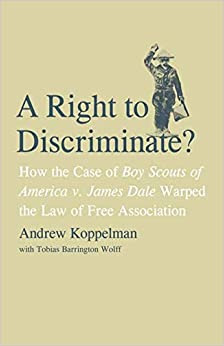
Andrew Koppelman and Tobias Barrington Wolff, A Right to Discriminate?: How the Case of Boy Scouts of America v. James Dale Warped the Law of Free Association (Yale University Press 2009)

Jack M. Balkin and Reva B. Siegel, The Constitution in 2020 (Oxford University Press 2009)

Heather K. Gerken, The Democracy Index: Why Our Election System Is Failing and How to Fix It (Princeton University Press 2009)

Mary Dudziak, Exporting American Dreams: Thurgood Marshall's African Journey (Oxford University Press 2008)

David Luban, Legal Ethics and Human Dignity (Cambridge Univ. Press 2007)

Ian Ayres, Super Crunchers: Why Thinking-By-Numbers is the New Way to be Smart (Bantam 2007)

Jack M. Balkin, James Grimmelmann, Eddan Katz, Nimrod Kozlovski, Shlomit Wagman and Tal Zarsky, eds., Cybercrime: Digital Cops in a Networked Environment (N.Y.U. Press 2007)
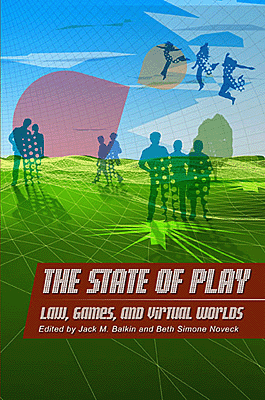
Jack M. Balkin and Beth Simone Noveck, The State of Play: Law, Games, and Virtual Worlds (N.Y.U. Press 2006)

Andrew Koppelman, Same Sex, Different States: When Same-Sex Marriages Cross State Lines (Yale University Press 2006)

Brian Tamanaha, Law as a Means to an End (Cambridge University Press 2006)

Sanford Levinson, Our Undemocratic Constitution (Oxford University Press 2006)

Mark Graber, Dred Scott and the Problem of Constitutional Evil (Cambridge University Press 2006)

Jack M. Balkin, ed., What Roe v. Wade Should Have Said (N.Y.U. Press 2005)

Sanford Levinson, ed., Torture: A Collection (Oxford University Press 2004)
Balkin.com homepage
Bibliography
Conlaw.net
Cultural Software
Writings
Opeds
The Information Society Project
BrownvBoard.com
Useful Links
Syllabi and Exams
