Balkinization
an unanticipated consequence of
Jack M. Balkin
Balkinization Symposiums: A Continuing List
E-mail:
Jack Balkin:
jackbalkin at yahoo.com
Bruce Ackerman
bruce.ackerman at yale.edu
Ian Ayres
ian.ayres at yale.edu
Corey Brettschneider
corey_brettschneider at brown.edu
Mary Dudziak
mary.l.dudziak at emory.edu
Joey Fishkin
joey.fishkin at gmail.com
Heather Gerken heather.gerken at yale.edu
Abbe Gluck abbe.gluck at yale.edu
Mark Graber
mgraber at law.umaryland.edu
Stephen Griffin
sgriffin at tulane.edu
Jonathan Hafetz
jonathan.hafetz at shu.edu
Jeremy Kessler
jkessler at law.columbia.edu
Andrew Koppelman
akoppelman at law.northwestern.edu
Marty Lederman
msl46 at law.georgetown.edu
Sanford Levinson
slevinson at law.utexas.edu
David Luban
david.luban at gmail.com
Gerard Magliocca
gmaglioc at iupui.edu
Jason Mazzone
mazzonej at illinois.edu
Linda McClain
lmcclain at bu.edu
John Mikhail
mikhail at law.georgetown.edu
Frank Pasquale
pasquale.frank at gmail.com
Nate Persily
npersily at gmail.com
Michael Stokes Paulsen
michaelstokespaulsen at gmail.com
Deborah Pearlstein
dpearlst at yu.edu
Rick Pildes
rick.pildes at nyu.edu
David Pozen
dpozen at law.columbia.edu
Richard Primus
raprimus at umich.edu
K. Sabeel Rahmansabeel.rahman at brooklaw.edu
Alice Ristroph
alice.ristroph at shu.edu
Neil Siegel
siegel at law.duke.edu
David Super
david.super at law.georgetown.edu
Brian Tamanaha
btamanaha at wulaw.wustl.edu
Nelson Tebbe
nelson.tebbe at brooklaw.edu
Mark Tushnet
mtushnet at law.harvard.edu
Adam Winkler
winkler at ucla.edu
Compendium of posts on Hobby Lobby and related cases
The Anti-Torture Memos: Balkinization Posts on Torture, Interrogation, Detention, War Powers, and OLC
The Anti-Torture Memos (arranged by topic)
Recent Posts
Pluralist Modalities in Originalist Clothing: Thoughts on Arguments in Trump v. Barbara
![[Powered by Blogger]](https://lh3.googleusercontent.com/blogger_img_proxy/AEn0k_sXzxFpz6kheeN0A33gWETXJlt91Q-7_maldgkDxrXyUJuesfVYVM_O7PzMmryhWVQhm9V6i6dcaW5xSEclpT4NVPYDItUm4TFCjblE7RHa=s0-d)
Just A Few Blogs
ACS Blog
Alas, a Blog
Althouse
Arts and Letters Daily
Atrios (Eschaton)
Bill of Health
Buzzflash.com
Buzz Machine
Cato at Liberty
Juan Cole (Informed Comment)
Concurring Opinions
The Constitution in 2020
Corrente
Crooked Timber
Daily Howler
Daily Kos
Dana Boyd
Brad DeLong
Digby (Hullabaloo)
Discriminations
Daniel Drezner
Kevin Drum (Mother Jones)
Electrolite
En Banc
Eunomia (Daniel Larison)
Fafblog
Michael Froomkin (Discourse.net)
GovLab (Beth Noveck)
Rick Hasen (Election Law)
History News Network
How Appealing
Ignatz (Sam Heldman)
The Importance of (Ernie Miller)
Infolaw
Instapundit
International Economic Law and Policy Blog
IntLawGrrls
Jacob Levy
Jesus' General
Jurisdynamics
The Kitchen Cabinet
Mark Kleiman
Law Blog Central
Larry Lessig
Lawyers, Guns and Money
Liberal Oasis
Brian Leiter's Law School Reports
The Leiter Reports
Marginal Revolution
Megan McArdle
Memeorandum
Metafilter
Mirror of Justice
The New Republic
Newseum
No More Mister Nice Blog
Brendan Nyhan
Opinio Juris
Orcinus
The Originalism Blog
Pandagon
Passport (Foreign Policy)
Overcoming Bias
Political Animal (Washington Monthly)
Political Theory Daily Review
Political Wire (Taegan Goddard)
The Poor Man
Virginia Postrel
Prawfsblawg
Public Reason
Jonathan Rauch
Raw Story
Redstate
ReligiousLeftLaw.com
Reporters Committee For Freedom of the Press
Reproductive Rights Blog
Rothman's Roadmap to the Right of Publicity
SCOTUS Blog
Seeing the Forest
Clay Shirky
The Shifted Librarian
The Situationist
Larry Solum (Legal Theory)
Andrew Sullivan
Talking Points Memo
Talk Left
Tapped
Tbogg
TechPresident
The Paper Chase (Jurist)
Tom Paine
Tom Tomorrow (This Modern World)
Eve Tushnet
Uggabugga
University of Chicago Law School Faculty Blog
Unqualified Offerings
The Volokh Conspiracy
War and Piece (Laura Rozen)
Wampum
Oliver Willis
Wonkette
Written Description
Matthew Yglesias
Yin
Your Choice of Feeds
1. XML
powered by

2. Atom Feed
3. RSS 2.0
Pluralist Modalities in Originalist Clothing: Thoughts on Arguments in Trump v. Barbara
Guest Blogger
James Fox Like most observers I listened to the oral
arguments in Trump v. Barbara for signals about the possible vote
alignment in the challenge to President Trump’s Executive
Order declaring that birthright citizenship under the fourteenth amendment
no longer applies to children whose parents are in the United States without authorization
or long-term domicile. I left the argument thinking about how this quintessential
originalist dispute in fact revealed the justices shifting around in a sea of
rhetorical modalities, and how the scant efforts to attend to all the
modalities inhibits argument and analysis. As the case has been presented in the briefing, in the lower
courts, and in much of the legal social mediasphere, it is almost entirely
an originalism debate. The opponents of Trump’s Executive Order have a lot of text
and ratifying history on their side, the leading precedent
is largely originalist in character, the main supporters of the EO have
developed long-winded
originalist arguments on the fly and themselves are getting strong pushback
for that effort by fellow
conservative originalists as well as liberal
scholars. The oral arguments reflected
a lot of this, of course. But I also thought they revealed important ways
in which all the modalities (here thinking primarily of Philip
Bobbitt’s modalities but not limited to them) were lurking in the
background. Here are some thoughts on that reaction to the argument, with a
focus mainly on the justices’ questions. For the government Solicitor
General John Sauer argued that the modern experience with unauthorized
immigration reveals the necessity of interpreting the text to exclude children
of undocumented parents from citizenship. Roberts shot it down with the above originalist-style
quip. But Roberts is not an originalist.
Indeed, this quip borders on hilarity from the author of Shelby County v.
Holder’s equal state sovereignty principle, which he used to override a
congressional power that itself has deep originalist roots, to say nothing of the
muscular presidential immunity he crafted in Trump v. United States,
which exists nowhere is either text or contemporaneous historical meanings. At bottom this is Roberts being a
pluralist. Here the originalist ideal of a “fixed” constitution does the work
he appears to want. Roberts is artful in
his pluralism, able to craft phrases to capture a point that distracts from
questions of whether there is interpretive coherence in his jurisprudence. I
suspect he also here is poking at Alito, who appeared to fully support Sauer’s
evolving principles argument. Justice Alito’s Living Constitutionalism Alito presented a transparently
living constitutionalist defense of the government’s position. Alito tossed Sauer a lifeline by making one
of originalism’s common arguments to address the problem of text across time.
The basic idea is that originalism always allows adaptation to new
technologies, e.g. applying the fourth amendment to
GPS signals or applying the second amendment to handguns (Alito actually
used the less helpful analogy of theft statutes applying to microwaves). Alito
tried to shoehorn into this evolving technologies idea some kind of “evolving
laws” concept whereby the fact that federal law has changed over time to create
new categories of approved and prohibited migration, or that the migration
patterns themselves have changed, somehow analogizes to advances in technology.
And while there may be intellectual value in seeing law as a
technology, that’s not at all Alito’s point. Obviously this move gives away
the game of originalism, since Alito is really saying that evolving social and
political norms should carry strong interpretive weight as against historical
and textual evidence. This is precisely what Alito and the Court rejected in New
York State Rifle & Pistol Association v. Bruen where it mandated an
absurdly low level of generality when considering legal and social changes to
gun regulation over time (changes that themselves were tracking the very
technological changes to firearms the Court so blithely accepts). Ultimately, the evolving textual
application Alito is going for here is just living constitutionalism done
poorly (because not done openly). Similarly, Alito later hypothesized some
version of a sleeper-cell, scary-alien enemy: would a child of an Iranian
national be a birth citizen if he also had an obligation to serve in the
Iranian military? Again, not originalism
but instead an odd kind of prudential bogyman argument. Notably he made no
effort to distinguish interpretation and construction or fence off construction
zones to do any of this work. Justice Kavanaugh and Section Five Kavanaugh explicitly asked Sauer to
comment on congressional powers under Section Five of the fourteenth amendment,
and directed advocates to the 1952/1940 statute where congress,
in detailing a broader range of paths to citizenship, parrots the fourteenth
amendment’s birth citizenship clause. Before arguments I thought some justices
might take this route to avoid the constitutional question and hold that the EO
was beyond the president’s power under this statute, which, given
its history, pretty clearly adopted the broad reading of birthright
citizenship. But the way this played out I suspect the move instead may be to open
a path for congressional power under Section Five to define the exceptions
encompassed by the “subject to the jurisdiction” proviso. This potentially connects Kavanaugh’s line of
questioning with Justice Barrett’s. Any development of this more structural
path would require significant engagement with this Court’s anemic
view of congress’ Section Five power and with how it overlaps with
the congressional powers over naturalization, so I am not sure how enthusiastic
Kavanaugh was about this. But he was clearly thinking about it. Justice Barrett & the Exceptions Barrett seemed very interested in
trying to extract a principle from the three exceptions to birthright
citizenship evident in the drafting history and in United States v. Wong
Kim Ark: children of diplomats, children born in territory under foreign
occupation, and children of Native Americans under tribal jurisdiction. But why? When dealing with exceptions one
need not find rules for them – the pertinent principles are derived from the
main rule (here, citizenship by birthright) and exceptions can just be that – isolated
exceptions (or as Roberts said, “quirky” and “idiosyncratic”). You only really need a sub-principle
connecting the exceptions if you want to open the possibility of applying the
subprinciple to other situations, that is, if you want to make new exceptions.
Perhaps she is thinking only of explaining why the administration’s proposed
exceptions – children born to parents who are not legally present or are
temporarily present – fail. But this would be a cumbersome way to say the
government’s applications don’t fit long-established exceptions. When combined
with her questions about congressional powers and with Kavanaugh’s similar questions,
this may suggest a path to a holding that leaves open some room for
congressional expansion and contraction of the exceptions under some unifying theory. Justice Gorsuch: I am the expert on Indian law here,
folks Sauer absolutely had to know that
since the exclusion of members of Native American tribes was one of the three recognized
bases for the “subject to the jurisdiction” proviso, Gorsuch would have
thoughts. He has repeatedly shown himself to be, at least in his own mind, the
expert about and champion
of Indian law on the Court. Yet when Gorsuch asked Sauer if his domiciliary
theory of how the exceptions to birth citizenship can change over time meant
that all Native Americans born within the international borders of the United
States are citizens under the fourteenth amendment (as opposed to merely the
1924 statute), Sauer said he had not thought about the question. Bad advocacy prep aside, what was
Gorsuch’s point? Was it to show that Sauer’s theory of exception expansion
makes no sense as original meaning? Or was it instead to suggest that congress
exercised its Section Five power in the 1924 Act by contracting the exceptions,
which might also mean congress has the power to expand them as well? Or was Gorsuch hinting that the doctrinal
history of Native exclusion Sauer relied on no longer holds? Gorsuch pressed
this point with Cecillia Wang for the ACLU, who said the fourteenth amendment
was best seen as a constitutional floor for citizenship that congress can
expand. I was not sure whether Gorsuch
bought the floor idea or not. But Gorsuch’s self-conception as the Indian law
justice will undoubtedly affect how he sees and analyzes the meaning of the
clause and the proviso, likely pulling him away from Thomas’s inclination
toward an anti-Dred-Scott-and-nothing-else interpretation. Justice Thomas: Dred Scott and only Dred Scott Thomas primed Sauer with a softball
about Dred Scott, and said almost nothing else after that, so it is
difficult to know where he stood. Perhaps his question was merely a way to help
Sauer make an obvious point that the citizenship clause was significantly, if
not primarily, about undoing Taney’s holding that Black people can never be
United States citizens. And maybe Thomas did not realize Sauer would run so far
with that ball as to cite the Mississippi Slave Code in support of his
argument, thus apparently finding a way to side with the confederacy even while
rejecting Dred Scott. Ultimately Sauer’s
argument – echoed in Trump’s
claims – is that the Black citizenship purpose of the clause also limits
the reach of the clause beyond that purpose. Thomas seemed inclined to this
later when he asked a question expressing doubt that the framing of the
amendment had anything to do with immigration. This is fundamentally a reactionary
view of the amendment, one which holds that it served only to secure basic
rights for newly freed and free Black Americans and cannot be used to do anything
else, a view wrapped in a slavery-only view of the Reconstruction amendments
generally. Thomas could easily lean into
that view given his “Let him alone” misreading
of Frederick Douglass. But he could also be persuaded by a somewhat broader
view connected to at least some of the conservative originalists critics of the
EO such as Keith Whittington and Michael
Ramsey. It is hard to see him being willing to recognize citizenship
protections for children of parents not lawfully present, but he also did not
show an inclination toward Alito’s free-ranging originalism-only-in-name
approach either. Thomas has shown no hesitancy in adopting questionable
historical readings of the fourteenth amendment framing period, and I see
no reason to think he won’t do so here. Thomas also prompted Sauer to the
argument that somehow the word reside – which comes at the end of the
Citizenship Clause and refers to how someone who is a United States citizen by
birth under the first part of the sentence also establishes their parallel but
subordinate citizenship in a state.
Sauer pumped this up into an argument that “subject to the jurisdiction”
inherently includes some long-term proof of residence and therefore domicile (a
word appearing precisely nowhere in the text). Such a reading is grammatically
and semantically bizarro. Perhaps Thomas is flirting with it, but I would be
surprised to see it appear even in a dissenting opinion. Sometimes textualist arguments are too
tortured to even be tried. Liberal Wing – Don’t muddy the waters you drink from My sense of how Justices Jackson,
Kagan, and Sotomayor approached their questioning was they had a sense that
enough of their colleagues supported the ACLU challenge that it was best not to
stir things up too much. Jackson was all over Sauer’s claim
that congress can set forth new exceptions – and in fact did so when it made
immigration illegal for large groups of people starting in the 1870s and 1880s.
I think she was the most bothered by the prospect of some sort of Section Five
power to rewrite “subject to the jurisdiction” to basically swallow the “born .
. . in” rule. She reacted firmly against
the suggestion that the framers and ratifiers would have meant this language to
allow for that radical move. Jackson also got after Sauer about
the pragmatics of the EO. When she said “are we bringing pregnant women in for
depositions?” she articulated in striking terms the prudential problems with
the EO and the incredibly destabilizing costs it would impose. While Jackson is
not at all hesitant to address fourteenth amendment original meanings, she
seemed also to have little truck with any of Sauer’s more living constitutionalist
gestures. Sotomayor presented the most
doctrinal questioning, asking about more recent cases that suggest a long-standing
assumption by the Court that the exceptions are narrow and the main principle
broad (although she oddly stumbled on the timing and perhaps holding of a 19th
century Indian law precedent). It was striking how little this line of analysis
arose. Depending on how broadly the Court decides to read Wong Kim Ark,
these subsequent cases, along with the traditional practice of the federal
government over that time, could foreclose even the slightest crack in the
birthright rule proposed by Sauer. I look for this precedential mode to play
more of a role in the eventual opinion, especially if authored by Roberts or
Kagan. Kagan, revealing her own pluralist
approach, emphasized with Sauer that several modalities – text, history,
traditional practice, precedent – all point against his revisionist theory and
so require much more persuasive evidence than he presents. I sensed she was
trying to find common rhetorical ground with the Chief here. This also backed
Sauer into the corner where he misrepresented
a 1921 law review article in a failed effort to say the traditions and
practices were not uniform. Another place where I thought Kagan
was trying to work of a mind with Roberts was where they both pressed Wang on
the many references to “domicile” in Wong Kim Ark. This is probably the
biggest hurdle in countering Sauer’s argument, and both seemed interested in a
good articulation of why domicile is not at the very least a limitation on Wong
Kim Ark’s holding, if not itself an essential part of the holding (which
Sauer claims). I am not sure they got that answer in oral argument. Justice
Jackson stepped in to provide one by saying the Wong Kim Ark Court may
have stressed the fact of the parents’ domicile to gain public acceptance of
the opinion that was, by its holding, unusually generous toward an
often-despised immigrant group. (Kagan and Roberts would do well to read
John Mikhail’s Balkinization
post and linked work on the weakness of the domicile argument.) I mentioned at the top that I thought all of Bobbitt’s
modalities were in play. The only one not really discussed, I think, was ethos,
or the ethical social norms modality. It often happens that this “public
values” modality operates sub rosa, present but unarticulated. That seemed true here as well. Because of
course the whole thing about the first sentence of the fourteenth amendment is
its value-asserting preference for a radical birth equality. That’s what
overturning Dred Scott was about. It’s what Reconstruction was about.
It’s what the New Birth of Freedom and mass slave liberation was about. And, on
the other side, the barely contained reason behind Alito’s dislike of the
concept of birth citizenship and Trump’s open political justifications for effectively
abandoning it are values-based norms of what it means to be an American, either
conceived in a must-be-law-abiding sense or as a part of a darker vision of a
Herrenvolk democracy. The problem is we have limited and ever-shrinking paths
to articulating those reasons within constitutional law discourse. Yet these
reasons are the basis of this conflict politically, and to the extent contested
constitutional law is largely political law, they are at the heart here too. That matters, because when the ACLU wins this
case – as they will – an opinion that simply says “the text and history tell us
so” speaks very differently than one that says “the text and history express
some of our most cherished national values and here they are.” While an originalist decision could have the
potential to also speak in ethos, I fear it won’t, and we will be poorer for
that. James Fox is a professor of law at Stetson University
College of Law. He can be reached at fox@law.stetson.edu
Posted
12:00 PM
by Guest Blogger [link]
Books by Balkinization Bloggers

Mark Tushnet and Bojan Bugaric, Constitutionalism and Its Discontents (University of Chicago Press, 2026)

Gerard N. Magliocca, The Actual Art of Governing: Justice Robert H. Jackson's Concurring Opinion in the Steel Seizure Case (Oxford University Press, 2025)

Linda C. McClain and Aziza Ahmed, The Routledge Companion to Gender and COVID-19 (Routledge, 2024)

David Pozen, The Constitution of the War on Drugs (Oxford University Press, 2024)

Jack M. Balkin, Memory and Authority: The Uses of History in Constitutional Interpretation (Yale University Press, 2024)
Mark A. Graber, Punish Treason, Reward Loyalty: The Forgotten Goals of Constitutional Reform after the Civil War (University of Kansas Press, 2023)
Jack M. Balkin, What Roe v. Wade Should Have Said: The Nation's Top Legal Experts Rewrite America's Most Controversial Decision - Revised Edition (NYU Press, 2023)

Andrew Koppelman, Burning Down the House: How Libertarian Philosophy Was Corrupted by Delusion and Greed (St. Martin’s Press, 2022)

Gerard N. Magliocca, Washington's Heir: The Life of Justice Bushrod Washington (Oxford University Press, 2022)
Joseph Fishkin and William E. Forbath, The Anti-Oligarchy Constitution: Reconstructing the Economic Foundations of American Democracy (Harvard University Press, 2022)
Mark Tushnet and Bojan Bugaric, Power to the People: Constitutionalism in the Age of Populism (Oxford University Press 2021).

Mark Philip Bradley and Mary L. Dudziak, eds., Making the Forever War: Marilyn B. Young on the Culture and Politics of American Militarism Culture and Politics in the Cold War and Beyond (University of Massachusetts Press, 2021).

Jack M. Balkin, What Obergefell v. Hodges Should Have Said: The Nation's Top Legal Experts Rewrite America's Same-Sex Marriage Decision (Yale University Press, 2020)

Frank Pasquale, New Laws of Robotics: Defending Human Expertise in the Age of AI (Belknap Press, 2020)

Jack M. Balkin, The Cycles of Constitutional Time (Oxford University Press, 2020)

Mark Tushnet, Taking Back the Constitution: Activist Judges and the Next Age of American Law (Yale University Press 2020).

Andrew Koppelman, Gay Rights vs. Religious Liberty?: The Unnecessary Conflict (Oxford University Press, 2020)

Ezekiel J Emanuel and Abbe R. Gluck, The Trillion Dollar Revolution: How the Affordable Care Act Transformed Politics, Law, and Health Care in America (PublicAffairs, 2020)

Linda C. McClain, Who's the Bigot?: Learning from Conflicts over Marriage and Civil Rights Law (Oxford University Press, 2020)
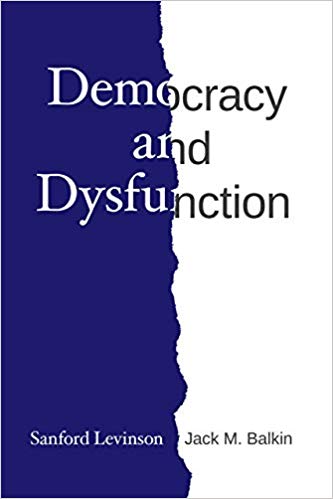
Sanford Levinson and Jack M. Balkin, Democracy and Dysfunction (University of Chicago Press, 2019)

Sanford Levinson, Written in Stone: Public Monuments in Changing Societies (Duke University Press 2018)

Mark A. Graber, Sanford Levinson, and Mark Tushnet, eds., Constitutional Democracy in Crisis? (Oxford University Press 2018)

Gerard Magliocca, The Heart of the Constitution: How the Bill of Rights became the Bill of Rights (Oxford University Press, 2018)

Cynthia Levinson and Sanford Levinson, Fault Lines in the Constitution: The Framers, Their Fights, and the Flaws that Affect Us Today (Peachtree Publishers, 2017)

Brian Z. Tamanaha, A Realistic Theory of Law (Cambridge University Press 2017)

Sanford Levinson, Nullification and Secession in Modern Constitutional Thought (University Press of Kansas 2016)

Sanford Levinson, An Argument Open to All: Reading The Federalist in the 21st Century (Yale University Press 2015)

Stephen M. Griffin, Broken Trust: Dysfunctional Government and Constitutional Reform (University Press of Kansas, 2015)

Frank Pasquale, The Black Box Society: The Secret Algorithms That Control Money and Information (Harvard University Press, 2015)

Bruce Ackerman, We the People, Volume 3: The Civil Rights Revolution (Harvard University Press, 2014)
Balkinization Symposium on We the People, Volume 3: The Civil Rights Revolution

Joseph Fishkin, Bottlenecks: A New Theory of Equal Opportunity (Oxford University Press, 2014)

Mark A. Graber, A New Introduction to American Constitutionalism (Oxford University Press, 2013)

John Mikhail, Elements of Moral Cognition: Rawls' Linguistic Analogy and the Cognitive Science of Moral and Legal Judgment (Cambridge University Press, 2013)

Gerard N. Magliocca, American Founding Son: John Bingham and the Invention of the Fourteenth Amendment (New York University Press, 2013)

Stephen M. Griffin, Long Wars and the Constitution (Harvard University Press, 2013)

Andrew Koppelman, The Tough Luck Constitution and the Assault on Health Care Reform (Oxford University Press, 2013)

James E. Fleming and Linda C. McClain, Ordered Liberty: Rights, Responsibilities, and Virtues (Harvard University Press, 2013)
Balkinization Symposium on Ordered Liberty: Rights, Responsibilities, and Virtues

Andrew Koppelman, Defending American Religious Neutrality (Harvard University Press, 2013)

Brian Z. Tamanaha, Failing Law Schools (University of Chicago Press, 2012)

Sanford Levinson, Framed: America's 51 Constitutions and the Crisis of Governance (Oxford University Press, 2012)

Linda C. McClain and Joanna L. Grossman, Gender Equality: Dimensions of Women's Equal Citizenship (Cambridge University Press, 2012)

Mary Dudziak, War Time: An Idea, Its History, Its Consequences (Oxford University Press, 2012)

Jack M. Balkin, Living Originalism (Harvard University Press, 2011)

Jason Mazzone, Copyfraud and Other Abuses of Intellectual Property Law (Stanford University Press, 2011)

Richard W. Garnett and Andrew Koppelman, First Amendment Stories, (Foundation Press 2011)

Jack M. Balkin, Constitutional Redemption: Political Faith in an Unjust World (Harvard University Press, 2011)

Gerard Magliocca, The Tragedy of William Jennings Bryan: Constitutional Law and the Politics of Backlash (Yale University Press, 2011)

Bernard Harcourt, The Illusion of Free Markets: Punishment and the Myth of Natural Order (Harvard University Press, 2010)

Bruce Ackerman, The Decline and Fall of the American Republic (Harvard University Press, 2010)
Balkinization Symposium on The Decline and Fall of the American Republic

Ian Ayres. Carrots and Sticks: Unlock the Power of Incentives to Get Things Done (Bantam Books, 2010)

Mark Tushnet, Why the Constitution Matters (Yale University Press 2010)

Ian Ayres and Barry Nalebuff: Lifecycle Investing: A New, Safe, and Audacious Way to Improve the Performance of Your Retirement Portfolio (Basic Books, 2010)
.jpg)
Jack M. Balkin, The Laws of Change: I Ching and the Philosophy of Life (2d Edition, Sybil Creek Press 2009)

Brian Z. Tamanaha, Beyond the Formalist-Realist Divide: The Role of Politics in Judging (Princeton University Press 2009)
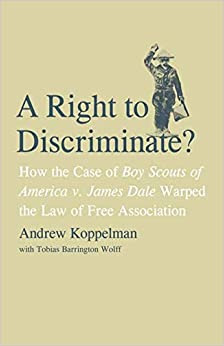
Andrew Koppelman and Tobias Barrington Wolff, A Right to Discriminate?: How the Case of Boy Scouts of America v. James Dale Warped the Law of Free Association (Yale University Press 2009)

Jack M. Balkin and Reva B. Siegel, The Constitution in 2020 (Oxford University Press 2009)

Heather K. Gerken, The Democracy Index: Why Our Election System Is Failing and How to Fix It (Princeton University Press 2009)

Mary Dudziak, Exporting American Dreams: Thurgood Marshall's African Journey (Oxford University Press 2008)

David Luban, Legal Ethics and Human Dignity (Cambridge Univ. Press 2007)

Ian Ayres, Super Crunchers: Why Thinking-By-Numbers is the New Way to be Smart (Bantam 2007)

Jack M. Balkin, James Grimmelmann, Eddan Katz, Nimrod Kozlovski, Shlomit Wagman and Tal Zarsky, eds., Cybercrime: Digital Cops in a Networked Environment (N.Y.U. Press 2007)
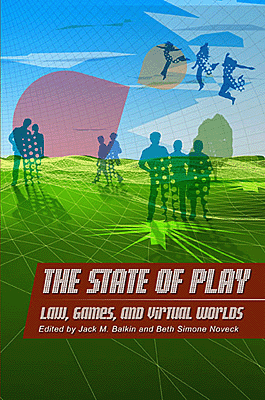
Jack M. Balkin and Beth Simone Noveck, The State of Play: Law, Games, and Virtual Worlds (N.Y.U. Press 2006)

Andrew Koppelman, Same Sex, Different States: When Same-Sex Marriages Cross State Lines (Yale University Press 2006)

Brian Tamanaha, Law as a Means to an End (Cambridge University Press 2006)

Sanford Levinson, Our Undemocratic Constitution (Oxford University Press 2006)

Mark Graber, Dred Scott and the Problem of Constitutional Evil (Cambridge University Press 2006)

Jack M. Balkin, ed., What Roe v. Wade Should Have Said (N.Y.U. Press 2005)

Sanford Levinson, ed., Torture: A Collection (Oxford University Press 2004)
Balkin.com homepage
Bibliography
Conlaw.net
Cultural Software
Writings
Opeds
The Information Society Project
BrownvBoard.com
Useful Links
Syllabi and Exams
