Balkinization
an unanticipated consequence of
Jack M. Balkin
Balkinization Symposiums: A Continuing List
E-mail:
Jack Balkin:
jackbalkin at yahoo.com
Bruce Ackerman
bruce.ackerman at yale.edu
Ian Ayres
ian.ayres at yale.edu
Corey Brettschneider
corey_brettschneider at brown.edu
Mary Dudziak
mary.l.dudziak at emory.edu
Joey Fishkin
joey.fishkin at gmail.com
Heather Gerken heather.gerken at yale.edu
Abbe Gluck abbe.gluck at yale.edu
Mark Graber
mgraber at law.umaryland.edu
Stephen Griffin
sgriffin at tulane.edu
Jonathan Hafetz
jonathan.hafetz at shu.edu
Jeremy Kessler
jkessler at law.columbia.edu
Andrew Koppelman
akoppelman at law.northwestern.edu
Marty Lederman
msl46 at law.georgetown.edu
Sanford Levinson
slevinson at law.utexas.edu
David Luban
david.luban at gmail.com
Gerard Magliocca
gmaglioc at iupui.edu
Jason Mazzone
mazzonej at illinois.edu
Linda McClain
lmcclain at bu.edu
John Mikhail
mikhail at law.georgetown.edu
Frank Pasquale
pasquale.frank at gmail.com
Nate Persily
npersily at gmail.com
Michael Stokes Paulsen
michaelstokespaulsen at gmail.com
Deborah Pearlstein
dpearlst at yu.edu
Rick Pildes
rick.pildes at nyu.edu
David Pozen
dpozen at law.columbia.edu
Richard Primus
raprimus at umich.edu
K. Sabeel Rahmansabeel.rahman at brooklaw.edu
Alice Ristroph
alice.ristroph at shu.edu
Neil Siegel
siegel at law.duke.edu
David Super
david.super at law.georgetown.edu
Brian Tamanaha
btamanaha at wulaw.wustl.edu
Nelson Tebbe
nelson.tebbe at brooklaw.edu
Mark Tushnet
mtushnet at law.harvard.edu
Adam Winkler
winkler at ucla.edu
Compendium of posts on Hobby Lobby and related cases
The Anti-Torture Memos: Balkinization Posts on Torture, Interrogation, Detention, War Powers, and OLC
The Anti-Torture Memos (arranged by topic)
Recent Posts
Confronting Current Constitutional Dysfunctions: Civic Constitutionalism and the Adaptability Paradox
![[Powered by Blogger]](https://lh3.googleusercontent.com/blogger_img_proxy/AEn0k_u7R6EMV7E98kmEI6x5tNniCwWhHiUhafJTvFFg7NaFSfR7d5d7VZv4dc2xniCvDkInAeSNp8ts-BJ-ir_eBbyZ-4MMMuzFV-PlY8M-wrH5=s0-d)
Just A Few Blogs
ACS Blog
Alas, a Blog
Althouse
Arts and Letters Daily
Atrios (Eschaton)
Bill of Health
Buzzflash.com
Buzz Machine
Cato at Liberty
Juan Cole (Informed Comment)
Concurring Opinions
The Constitution in 2020
Corrente
Crooked Timber
Daily Howler
Daily Kos
Dana Boyd
Brad DeLong
Digby (Hullabaloo)
Discriminations
Daniel Drezner
Kevin Drum (Mother Jones)
Electrolite
En Banc
Eunomia (Daniel Larison)
Fafblog
Michael Froomkin (Discourse.net)
GovLab (Beth Noveck)
Rick Hasen (Election Law)
History News Network
How Appealing
Ignatz (Sam Heldman)
The Importance of (Ernie Miller)
Infolaw
Instapundit
International Economic Law and Policy Blog
IntLawGrrls
Jacob Levy
Jesus' General
Jurisdynamics
The Kitchen Cabinet
Mark Kleiman
Law Blog Central
Larry Lessig
Lawyers, Guns and Money
Liberal Oasis
Brian Leiter's Law School Reports
The Leiter Reports
Marginal Revolution
Megan McArdle
Memeorandum
Metafilter
Mirror of Justice
The New Republic
Newseum
No More Mister Nice Blog
Brendan Nyhan
Opinio Juris
Orcinus
The Originalism Blog
Pandagon
Passport (Foreign Policy)
Overcoming Bias
Political Animal (Washington Monthly)
Political Theory Daily Review
Political Wire (Taegan Goddard)
The Poor Man
Virginia Postrel
Prawfsblawg
Public Reason
Jonathan Rauch
Raw Story
Redstate
ReligiousLeftLaw.com
Reporters Committee For Freedom of the Press
Reproductive Rights Blog
Rothman's Roadmap to the Right of Publicity
SCOTUS Blog
Seeing the Forest
Clay Shirky
The Shifted Librarian
The Situationist
Larry Solum (Legal Theory)
Andrew Sullivan
Talking Points Memo
Talk Left
Tapped
Tbogg
TechPresident
The Paper Chase (Jurist)
Tom Paine
Tom Tomorrow (This Modern World)
Eve Tushnet
Uggabugga
University of Chicago Law School Faculty Blog
Unqualified Offerings
The Volokh Conspiracy
War and Piece (Laura Rozen)
Wampum
Oliver Willis
Wonkette
Written Description
Matthew Yglesias
Yin
Your Choice of Feeds
1. XML
powered by

2. Atom Feed
3. RSS 2.0
Confronting Current Constitutional Dysfunctions: Civic Constitutionalism and the Adaptability Paradox
Guest Blogger
For the Balkinization symposium on Stephen Skowronek, The Adaptability Paradox: Political Inclusion and Constitutional Resilience (University of Chicago Press, 2025). Elizabeth Beaumont In this third and final post of the series, I argue that today’s constitutional stresses stem less from the “unbinding” Stephen Skowronek identifies than from a broader constellation of post-inclusion challenges—extreme polarization, economic inequality, technological disruption, and deliberate political choices that have strained democratic governance across many systems. Skowronek’s framework illuminates real challenges with the conflicts that can arise from democratization in a highly pluralist constitutional democracy, but it risks overstating the civil rights revolution as the primary cause while underestimating alternative sources of constitutional grounding. The history of civic constitutionalism suggests a different possibility than Skowronek’s bleak prognosis: a contentious yet regenerative process of civic struggle and consensus-building. There is growing agreement among legal and political scholars that the U.S. is facing a serious constitutional crisis, with many contributing factors identified (see, e.g., Ackerman 2010, Mann and Ornstein 2012, Levitsky and Ziblatt 2018). Skowronek's analysis offers a different, older, and counterintuitive diagnosis rooted in American constitutional development: bounded resilience, serial adaptations that progressively loosened the constitutional framework, and the democratic breakthroughs of the civil rights revolution that ultimately "unbound" the Constitution from its earlier stabilizing exclusions (21-22). This provocative and important argument demands continued engagement. Yet as insightful and impressive as Skowronek’s account is, it functions less as a complete explanation than as one significant strand in a more complex and multicausal account. Reexamining the civil rights revolution shows that it produced a partially successful constitutional adaptation through the rise of a civil and social rights state, complete with new institutional mechanisms, auxiliaries, and meaningful (if incomplete) cross-racial consensus. Many contemporary dysfunctions stem from subsequent forces– economic inqualities and dislocation, 9/11 and its aftermath and deliberate expansions of executive power, the internet and digital revolution— that are not reducible to civil rights-era “unbinding” or fallouts. That a similar pattern of democratic conflicts and strain is visible across countries with markedly different constitutional structures and developmental trajectories suggests that bounded resilience is at most one dimension of a more complex and multicausal crisis (see, e.g., Levitsky and Ziblatt 2018, Nord et al 2025). Structural Tensions and Post-Inclusion Stressors The U.S. constitutional system contains deep tensions around democracy. At the time of its adoption, it was the most democratic in existence, in terms of its system of popular representation. Yet it was also designed with numerous undemocratic elements that prevented or created barriers to broad or equal democratic inclusion, representation, or influence over governance. Some of these problematic features have been nullified or transformed through pushes for greater inclusion – such as the three-fifths clause and the indirect election of senators – while others remain, contributing undemocratic and dysfunctional politics, such as the Electoral College, equal Senate representation, life tenure for Supreme Court justices, and the high bar for formal constitutional amendment (see, e.g. Dahl 2003, Levinson 2006). These structural features, combined with pathologies such as the campaign finance system, surely bear some responsiblity for current political dysfunctions, and should be widely debated as targets for constitutional reform. Yet Americans are too often encouraged to view the founders’ Constitution as beyond critique or reform rather than to learn about and debate its “fault lines,” examine how important and transformative struggles for constitutional change have been for our past, or consider how civic mobilization could lead to constitutional reform in the present (see, e.g., Levinson 2020, Beaumont 2023). Alternative Sources of Constitutional Grounding Skowronek's portrayal of an “unbound” Constitution highlights the risk that full inclusion could strip away grounding for constitutional principles, leading to "mutually unacceptable futures" without shared interests. But this framing rests on a particular, and contestable, understanding of what constitutional grounding requires. Skowronek's conception of bounded resilience depends on a specific kind of grounding: social exclusions, structural constraints, and agreements about what lies beyond the reach of national governance. Historically, these groundings were unjust, as Skowronek acknowledges, but he sees them as functionally stabilizing. This assessment, however, may underestimate how such exclusions invited civic conflicts and constitutional challenges that ultimately destabilized earlier settlements. In U.S. history, maintaining exclusions and inequalities, such as those based on race, gender, class, or religion, may have provided some limited or temporary stabilization, but also often fueled conflict and destabilized constitutional orders, as seen in the lead-up to and outbreak of the Civil War, labor unrest, and civil rights struggles. But constitutional systems can be grounded in other ways: through a shared appreciation of the trajectory of constitutional history, the accumulated meanings and practices forged through successive waves of civic vision and struggle, and the political and social landmarks that have emerged from those, ranging from pivotal amendments and statutes to evolving civic norms and public understandings of core principles. Skowronek's portrayal of the Constitution as having become merely an "abstract matrix of possibilities" underestimates how the accumulated history of constitutional debate and democratic achievement provides concrete reference points for contemporary constitutional contests (122). The abolitionists' reinterpretation of equal protection, the suffragists' arguments about democratic inclusion, the civil rights movement's vision of equal citizenship are all constitutional resources that can help inform and ground contemporary debates. As Jack Balkin (2011) argues, each generation's constitutional struggles build on and respond to the accumulated meanings of prior generations rather than starting from scratch. Far from a void, this legacy, built through successive civic struggles, social movements, political leadership, and institutional innovations, offers resources for grounding constitutional principles in broader and more democratically legitimate terms (Beaumont 2014). Civic Constitutionalism as a Regenerative Path The question the adaptability paradox ultimately presents, then, is not whether constitutional grounding is possible in a fully inclusive polity, but what type of grounding is possible and through what processes it may be forged. One crucial mechanism for regrounding is civic constitutionalism– the ongoing work of civic actors and social movements in reframing constitutional principles, building new coalitions, and forging new constitutional common sense. A deep concern with Skowronek’s framework of bounded resilience and an adaptability paradox, coming to a head with the civil rights revolution, is its implication that the American system of constitutional democracy cannot successfully move beyond its roots in a highly exclusionary political order. In contrast, participants in civic struggles, from Anti-Federalists to white working men and laborers, from abolitionists, freedmen, and suffragists to feminists and LGBTQ+ activists, have insisted that these changes were not only possible, but necessary to realize the system’s own principles of popular sovereignty, equal citizenship, and justice (Balkin 2011; Beaumont 2014). The current dysfunctions of the American constitutional system no longer include legalized social exclusions, but they do include persistent democratic inequalities structural problems and multiple post-inclusion stressors: extreme partisan polarization and intensification of zero-sum conflict; rising economic disparity and insecurity that fuel resentment and populist mobilization; the expansion of executive power and presidentialization of politics (accelerated after 9/11 and further entrenched in subsequent administrations); and the distorting effects of structural features such as gerrymandering, the Senate’s malapportionment, the Electoral College, and an increasingly politicized judiciary. While these problems have been intensified by the constitutional changes and social conflicts that followed the civil rights revolution, as Skowronek's framework pushes us to recognize, they are not reducible to that “unbinding.” They also reflect ongoing institutional tensions, technological and economic transformations, and deliberate political choices that have strained constitutional democracy in the U.S., and in many other countries. ….. Skowronek suggests a tragic dilemma at the heart of American constitutionalism: if constitutional resilience and stability have depended on maintaining some social exclusions, and if sweeping democratic inclusion prevents stable adaptation, then we appear caught between two incompatible goals: a fully inclusive democracy, or a constitutionally stable one. Which do we prioritize? Or, how can we make our way toward having both? Skowronek’s prognosis is bleak, offering “little reassuring to cling to” (3). He warns that while “the priority of democracy has become unassailable,” if “American democracy has become nothing more than a cold civil war, and the Constitution is but a conduit for contestation, the future looks rocky indeed”(116). Yet history points toward a different possibility. The very civic actors and social movements that have repeatedly sought to refound the constitutional order, even though it seemed impossible to change, suggest a path forward: a continued contentious yet regenerative process of civic struggle and consensus-building. Both are needed to align the Constitution with the more expansive democracy we have become– and the one we might yet come to be (Beaumont 2014). The question is whether we can summon sufficient civic energy and effective leadership to meet the current dysfunctions. Elizabeth Beaumont is Associate Professor of Politics and Legal Studies at University of California, Santa Cruz. You can reach her at beaumont@ucsc.edu. References Ackerman, Bruce. 1991. We the People. Vol. 1, Foundations. Cambridge, MA: Belknap Press of Harvard University Press. Ackerman, Bruce. 2010. “The Decline and Fall of the American Republic. New Haven, CT: Yale University Press. Ackerman, Bruce. 2014. We the People. Vol. 3, The Civil Rights Revolution. Cambridge, MA: Belknap Press of Harvard University Press. https://doi.org/10.4159/harvard.9780674416499 Andersen, Ellen Ann. 2006. Out of the Closets and into the Courts: Legal Opportunity Structure and Gay Rights Litigation. Ann Arbor: University of Michigan Press. Balkin, Jack M. 2011. Living Originalism. Cambridge, MA: Belknap Press of Harvard University Press. Beaumont, Elizabeth. 2014. The Civic Constitution: Civic Visions and Struggles in the Path toward Constitutional Democracy. New York: Oxford University Press. https://doi.org/10.1017/S0034670515000182) Beaumont, Elizabeth. 2015. “Education and the Constitution: Defining the Contours of Governance, Rights, and Citizenship.” In The Oxford Handbook of the U.S. Constitution, edited by Mark Tushnet, Sanford Levinson, and Mark A. Graber, 845–864. New York: Oxford University Press. https://doi.org/10.1093/oxfordhb/9780190245757.013.46 Beaumont, Elizabeth. 2023. “Civic Education and Faultlines of Constitutional Democracy.” Balkinization. April 24, 2023. https://balkin.blogspot.com/2023/04/civic-education-and-faultlines-of.html. Bell, Derrick A. 1992. Faces at the Bottom of the Well: The Permanence of Racism. New York: Basic Books. Bok, Marcia. 1992. Civil Rights and the Social Programs of the 1960s: The Social Justice Functions of Social Policy. New York: Praeger. Brown, Michael K. 1999. Race, Money, and the American Welfare State. Ithaca, NY: Cornell University Press. Burke, Thomas F. 2002. Lawyers, Lawsuits, and Legal Rights: The Battle over Litigation in American Society. Berkeley: University of California Press. Carbado, Devon W., and Mitu Gulati. 2013. Acting White? Rethinking Race in Post-Racial America. New York: Oxford University Press. Cross, Christopher T. 2004. Political Education: National Policy Comes of Age. New York: Teachers College Press. Dahl, Robert A. How Democratic Is the American Constitution? 2nd ed. New Haven, CT: Yale University Press, 2003. Darity, William A., Jr., and A. Kirsten Mullen. 2020. From Here to Equality: Reparations for Black Americans in the Twenty-First Century. Chapel Hill: University of North Carolina Press. https://doi.org/10.5149/9781469654997_darity. Data for Progress. 2021. “Voters Support Free School Meals.” Data for Progress poll/report. (No DOI; gray literature). Data for Progress. 2025. SNAP/public opinion polling. Data for Progress. Dudziak, Mary L. 2000. Cold War Civil Rights: Race and the Image of American Democracy. Princeton, NJ: Princeton University Press. Epp, Charles R. 1998. The Rights Revolution: Lawyers, Activists, and Supreme Courts in Comparative Perspective. Chicago: University of Chicago Press. https://doi.org/10.7208/chicago/9780226772424.001.0001. Farhang, Sean. 2010. The Litigation State: Public Regulation and Private Lawsuits in the U.S. Princeton, NJ: Princeton University Press. Fiorina, Morris P., and Samuel J. Abrams. Disconnect: The Breakdown of Representation in American Politics. Norman: University of Oklahoma Press, 2009. Francis, Megan Ming. 2014. Civil Rights and the Making of the Modern American State. New York: Cambridge University Press. https://doi.org/10.1017/CBO9781139583749. Gallup Organization. 2020. “Gallup Vault: Americans Narrowly OK’d 1964 Civil Rights Law.” July 29, 2020. https://news.gallup.com/vault/316130/gallup-vault-americans-narrowly-1964-civil-rights-law.aspx. Gallup Organization. “Gallup Vault: Americans Side With Voting Rights Reforms.” March 23, 2016. https://news.gallup.com/vault/190259/gallup-vault-americans-side-voting-rights-reforms.aspx. Gienapp, Jonathan. 2018. The Second Creation: Fixing the American Constitution in the Founding Era. Cambridge, MA: Belknap Press of Harvard University Press. Goldsmith, Jack. The Terror Presidency: Law and Judgment Inside the Bush Administration. New York: W. W. Norton, 2007. Graham, Hugh Davis. 1990. The Civil Rights Era: Origins and Development of National Policy, 1960–1972. New York: Oxford University Press. KFF (Kaiser Family Foundation). 2025. Medicare/public opinion polling. KFF. Levinson, Sanford. 2006. Our Undemocratic Constitution: Where the Constitution Goes Wrong (and How We the People Can Correct It). New York: Oxford University Press, 2006. Levinson, Sanford, and Cynthia Levinson. Fault Lines in the Constitution: The Framers, Their Fights, and the Flaws That Affect Us Today. Boston: Beacon Press, 2017. Levitsky, Steven, and Daniel Ziblatt. 2018. How Democracies Die. New York: Crown. Mayeri, Serena. 2011. Reasoning from Race: Feminism, Law, and the Civil Rights Revolution. Cambridge, MA: Harvard University Press. Mann, Thomas E., and Norman J. Ornstein. 2012. It’s Even Worse Than It Looks: How the American Constitutional System Collided with the New Politics of Extremism. New York: Basic Books. McCann, Michael W. 1994. Rights at Work: Pay Equity Reform and the Politics of Legal Mobilization. Chicago: University of Chicago Press. https://doi.org/10.7208/chicago/9780226555720.001.0001. NAMI/Ipsos. 2025. Medicare/public opinion polling. NAMI/Ipsos. Nord, Marina, David Altman, Fabio Angiolillo, Tiago Fernandes, Ana Good God, and Staffan I. Lindberg. 2025. Democracy Report 2025: 25 Years of Autocratization – Democracy Trumped? University of Gothenburg: V-Dem Institute. https://www.v-dem.net/documents/60/V-dem-dr__2025_lowres.pdf. Pew Research Center. “Race, Ethnicity and Campaign ’08.” January 17, 2008. https://www.pewresearch.org/social-trends/2008/01/17/race-ethnicity-and-campaign-08/. Quadagno, Jill. 1994. The Color of Welfare: How Racism Undermined the War on Poverty. New York: Oxford University Press. Reynolds, P. Preston. 1997. “The Federal Government’s Use of Title VI and Medicare to Racially Integrate Hospitals in the United States, 1963 through 1967.” American Journal of Public Health 87 (11): 1850–58. https://doi.org/10.2105/ajph.87.11.1850. Ritter, Gretchen. 2006. The Constitution as Social Design: Gender and Civic Membership in the American Constitutional Order. Stanford, CA: Stanford University Press. Rosenberg, Gerald N. 1991. The Hollow Hope: Can Courts Bring About Social Change? Chicago: University of Chicago Press. Savage, Charles. 2007. Takeover: The Return of the Imperial Presidency and the Subversion of American Democracy. Scalia, Antonin. 1998. “Common-Law Courts in a Civil-Law System: The Role of United States Federal Courts in Interpreting the Constitution and Laws.” In A Matter of Interpretation: Federal Courts and the Law, edited by Amy Gutmann, 3–47. Princeton, NJ: Princeton University Press. Smith, David Barton. 2005. “Racial and Ethnic Health Disparities and the Unfinished Civil Rights Agenda.” Health Affairs 24 (2): 317–24. Smith, Tom W., and Paul B. Sheatsley. 1984. “American Attitudes toward Race Relations,” Public Opinion 7 (October/November): 14–15, 50–53. Smith, Rogers M., and Desmond King. 2014. “Racial Policy Alliances and the American Presidency.” In The Oxford Handbook of the American Presidency, ed. George Edwards and William Howell. New York: Oxford University Press. Smith, Rogers M., and Desmond King. 2024. America’s New Racial Battle Lines: Protect versus Repair. Chicago: University of Chicago Press. Stephanopoulos, Nicholas. 2017. “The Causes and Consequences of Gerrymandering.” William & Mary Law Review 59: 2115. Superfine, Benjamin M. 2013. Equality in Education Law and Policy, 1954–2010. Cambridge: Cambridge University Press. https://doi.org/10.1017/CBO9781139583749. UpONE Insights/FFYF. 2025. Head Start/public opinion polling. UpONE Insights/FFYF.
Posted
9:30 AM
by Guest Blogger [link]
Books by Balkinization Bloggers

Gerard N. Magliocca, The Actual Art of Governing: Justice Robert H. Jackson's Concurring Opinion in the Steel Seizure Case (Oxford University Press, 2025)

Linda C. McClain and Aziza Ahmed, The Routledge Companion to Gender and COVID-19 (Routledge, 2024)

David Pozen, The Constitution of the War on Drugs (Oxford University Press, 2024)

Jack M. Balkin, Memory and Authority: The Uses of History in Constitutional Interpretation (Yale University Press, 2024)
Mark A. Graber, Punish Treason, Reward Loyalty: The Forgotten Goals of Constitutional Reform after the Civil War (University of Kansas Press, 2023)
Jack M. Balkin, What Roe v. Wade Should Have Said: The Nation's Top Legal Experts Rewrite America's Most Controversial Decision - Revised Edition (NYU Press, 2023)

Andrew Koppelman, Burning Down the House: How Libertarian Philosophy Was Corrupted by Delusion and Greed (St. Martin’s Press, 2022)

Gerard N. Magliocca, Washington's Heir: The Life of Justice Bushrod Washington (Oxford University Press, 2022)
Joseph Fishkin and William E. Forbath, The Anti-Oligarchy Constitution: Reconstructing the Economic Foundations of American Democracy (Harvard University Press, 2022)
Mark Tushnet and Bojan Bugaric, Power to the People: Constitutionalism in the Age of Populism (Oxford University Press 2021).

Mark Philip Bradley and Mary L. Dudziak, eds., Making the Forever War: Marilyn B. Young on the Culture and Politics of American Militarism Culture and Politics in the Cold War and Beyond (University of Massachusetts Press, 2021).

Jack M. Balkin, What Obergefell v. Hodges Should Have Said: The Nation's Top Legal Experts Rewrite America's Same-Sex Marriage Decision (Yale University Press, 2020)

Frank Pasquale, New Laws of Robotics: Defending Human Expertise in the Age of AI (Belknap Press, 2020)

Jack M. Balkin, The Cycles of Constitutional Time (Oxford University Press, 2020)

Mark Tushnet, Taking Back the Constitution: Activist Judges and the Next Age of American Law (Yale University Press 2020).

Andrew Koppelman, Gay Rights vs. Religious Liberty?: The Unnecessary Conflict (Oxford University Press, 2020)

Ezekiel J Emanuel and Abbe R. Gluck, The Trillion Dollar Revolution: How the Affordable Care Act Transformed Politics, Law, and Health Care in America (PublicAffairs, 2020)

Linda C. McClain, Who's the Bigot?: Learning from Conflicts over Marriage and Civil Rights Law (Oxford University Press, 2020)
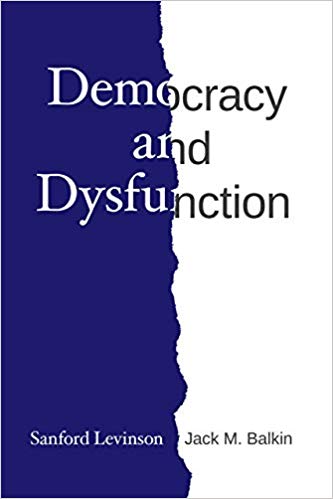
Sanford Levinson and Jack M. Balkin, Democracy and Dysfunction (University of Chicago Press, 2019)

Sanford Levinson, Written in Stone: Public Monuments in Changing Societies (Duke University Press 2018)

Mark A. Graber, Sanford Levinson, and Mark Tushnet, eds., Constitutional Democracy in Crisis? (Oxford University Press 2018)

Gerard Magliocca, The Heart of the Constitution: How the Bill of Rights became the Bill of Rights (Oxford University Press, 2018)

Cynthia Levinson and Sanford Levinson, Fault Lines in the Constitution: The Framers, Their Fights, and the Flaws that Affect Us Today (Peachtree Publishers, 2017)

Brian Z. Tamanaha, A Realistic Theory of Law (Cambridge University Press 2017)

Sanford Levinson, Nullification and Secession in Modern Constitutional Thought (University Press of Kansas 2016)

Sanford Levinson, An Argument Open to All: Reading The Federalist in the 21st Century (Yale University Press 2015)

Stephen M. Griffin, Broken Trust: Dysfunctional Government and Constitutional Reform (University Press of Kansas, 2015)

Frank Pasquale, The Black Box Society: The Secret Algorithms That Control Money and Information (Harvard University Press, 2015)

Bruce Ackerman, We the People, Volume 3: The Civil Rights Revolution (Harvard University Press, 2014)
Balkinization Symposium on We the People, Volume 3: The Civil Rights Revolution

Joseph Fishkin, Bottlenecks: A New Theory of Equal Opportunity (Oxford University Press, 2014)

Mark A. Graber, A New Introduction to American Constitutionalism (Oxford University Press, 2013)

John Mikhail, Elements of Moral Cognition: Rawls' Linguistic Analogy and the Cognitive Science of Moral and Legal Judgment (Cambridge University Press, 2013)

Gerard N. Magliocca, American Founding Son: John Bingham and the Invention of the Fourteenth Amendment (New York University Press, 2013)

Stephen M. Griffin, Long Wars and the Constitution (Harvard University Press, 2013)

Andrew Koppelman, The Tough Luck Constitution and the Assault on Health Care Reform (Oxford University Press, 2013)

James E. Fleming and Linda C. McClain, Ordered Liberty: Rights, Responsibilities, and Virtues (Harvard University Press, 2013)
Balkinization Symposium on Ordered Liberty: Rights, Responsibilities, and Virtues

Andrew Koppelman, Defending American Religious Neutrality (Harvard University Press, 2013)

Brian Z. Tamanaha, Failing Law Schools (University of Chicago Press, 2012)

Sanford Levinson, Framed: America's 51 Constitutions and the Crisis of Governance (Oxford University Press, 2012)

Linda C. McClain and Joanna L. Grossman, Gender Equality: Dimensions of Women's Equal Citizenship (Cambridge University Press, 2012)

Mary Dudziak, War Time: An Idea, Its History, Its Consequences (Oxford University Press, 2012)

Jack M. Balkin, Living Originalism (Harvard University Press, 2011)

Jason Mazzone, Copyfraud and Other Abuses of Intellectual Property Law (Stanford University Press, 2011)

Richard W. Garnett and Andrew Koppelman, First Amendment Stories, (Foundation Press 2011)

Jack M. Balkin, Constitutional Redemption: Political Faith in an Unjust World (Harvard University Press, 2011)

Gerard Magliocca, The Tragedy of William Jennings Bryan: Constitutional Law and the Politics of Backlash (Yale University Press, 2011)

Bernard Harcourt, The Illusion of Free Markets: Punishment and the Myth of Natural Order (Harvard University Press, 2010)

Bruce Ackerman, The Decline and Fall of the American Republic (Harvard University Press, 2010)
Balkinization Symposium on The Decline and Fall of the American Republic

Ian Ayres. Carrots and Sticks: Unlock the Power of Incentives to Get Things Done (Bantam Books, 2010)

Mark Tushnet, Why the Constitution Matters (Yale University Press 2010)

Ian Ayres and Barry Nalebuff: Lifecycle Investing: A New, Safe, and Audacious Way to Improve the Performance of Your Retirement Portfolio (Basic Books, 2010)
.jpg)
Jack M. Balkin, The Laws of Change: I Ching and the Philosophy of Life (2d Edition, Sybil Creek Press 2009)

Brian Z. Tamanaha, Beyond the Formalist-Realist Divide: The Role of Politics in Judging (Princeton University Press 2009)
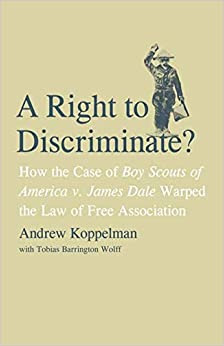
Andrew Koppelman and Tobias Barrington Wolff, A Right to Discriminate?: How the Case of Boy Scouts of America v. James Dale Warped the Law of Free Association (Yale University Press 2009)

Jack M. Balkin and Reva B. Siegel, The Constitution in 2020 (Oxford University Press 2009)

Heather K. Gerken, The Democracy Index: Why Our Election System Is Failing and How to Fix It (Princeton University Press 2009)

Mary Dudziak, Exporting American Dreams: Thurgood Marshall's African Journey (Oxford University Press 2008)

David Luban, Legal Ethics and Human Dignity (Cambridge Univ. Press 2007)

Ian Ayres, Super Crunchers: Why Thinking-By-Numbers is the New Way to be Smart (Bantam 2007)

Jack M. Balkin, James Grimmelmann, Eddan Katz, Nimrod Kozlovski, Shlomit Wagman and Tal Zarsky, eds., Cybercrime: Digital Cops in a Networked Environment (N.Y.U. Press 2007)
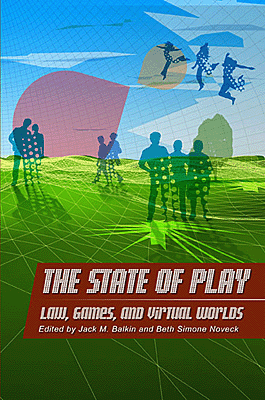
Jack M. Balkin and Beth Simone Noveck, The State of Play: Law, Games, and Virtual Worlds (N.Y.U. Press 2006)

Andrew Koppelman, Same Sex, Different States: When Same-Sex Marriages Cross State Lines (Yale University Press 2006)

Brian Tamanaha, Law as a Means to an End (Cambridge University Press 2006)

Sanford Levinson, Our Undemocratic Constitution (Oxford University Press 2006)

Mark Graber, Dred Scott and the Problem of Constitutional Evil (Cambridge University Press 2006)

Jack M. Balkin, ed., What Roe v. Wade Should Have Said (N.Y.U. Press 2005)

Sanford Levinson, ed., Torture: A Collection (Oxford University Press 2004)
Balkin.com homepage
Bibliography
Conlaw.net
Cultural Software
Writings
Opeds
The Information Society Project
BrownvBoard.com
Useful Links
Syllabi and Exams
