Balkinization
an unanticipated consequence of
Jack M. Balkin
Balkinization Symposiums: A Continuing List
E-mail:
Jack Balkin:
jackbalkin at yahoo.com
Bruce Ackerman
bruce.ackerman at yale.edu
Ian Ayres
ian.ayres at yale.edu
Corey Brettschneider
corey_brettschneider at brown.edu
Mary Dudziak
mary.l.dudziak at emory.edu
Joey Fishkin
joey.fishkin at gmail.com
Heather Gerken heather.gerken at yale.edu
Abbe Gluck abbe.gluck at yale.edu
Mark Graber
mgraber at law.umaryland.edu
Stephen Griffin
sgriffin at tulane.edu
Jonathan Hafetz
jonathan.hafetz at shu.edu
Jeremy Kessler
jkessler at law.columbia.edu
Andrew Koppelman
akoppelman at law.northwestern.edu
Marty Lederman
msl46 at law.georgetown.edu
Sanford Levinson
slevinson at law.utexas.edu
David Luban
david.luban at gmail.com
Gerard Magliocca
gmaglioc at iupui.edu
Jason Mazzone
mazzonej at illinois.edu
Linda McClain
lmcclain at bu.edu
John Mikhail
mikhail at law.georgetown.edu
Frank Pasquale
pasquale.frank at gmail.com
Nate Persily
npersily at gmail.com
Michael Stokes Paulsen
michaelstokespaulsen at gmail.com
Deborah Pearlstein
dpearlst at yu.edu
Rick Pildes
rick.pildes at nyu.edu
David Pozen
dpozen at law.columbia.edu
Richard Primus
raprimus at umich.edu
K. Sabeel Rahmansabeel.rahman at brooklaw.edu
Alice Ristroph
alice.ristroph at shu.edu
Neil Siegel
siegel at law.duke.edu
David Super
david.super at law.georgetown.edu
Brian Tamanaha
btamanaha at wulaw.wustl.edu
Nelson Tebbe
nelson.tebbe at brooklaw.edu
Mark Tushnet
mtushnet at law.harvard.edu
Adam Winkler
winkler at ucla.edu
Compendium of posts on Hobby Lobby and related cases
The Anti-Torture Memos: Balkinization Posts on Torture, Interrogation, Detention, War Powers, and OLC
The Anti-Torture Memos (arranged by topic)
Recent Posts
Skowronek on American Democracy: Gridlock, Presidentialism, and Democratic Faith
![[Powered by Blogger]](https://lh3.googleusercontent.com/blogger_img_proxy/AEn0k_tbMCcOJvaEliwPoM3KCvzDjHY_WlRRkTPddR796yKKuXir9fHeNUzoTmVwwzLCSAP9RTn2tqzJnEz_i-F6UbsFEJ_Gh-Nc_4vN53ePIUaa=s0-d)
Just A Few Blogs
ACS Blog
Alas, a Blog
Althouse
Arts and Letters Daily
Atrios (Eschaton)
Bill of Health
Buzzflash.com
Buzz Machine
Cato at Liberty
Juan Cole (Informed Comment)
Concurring Opinions
The Constitution in 2020
Corrente
Crooked Timber
Daily Howler
Daily Kos
Dana Boyd
Brad DeLong
Digby (Hullabaloo)
Discriminations
Daniel Drezner
Kevin Drum (Mother Jones)
Electrolite
En Banc
Eunomia (Daniel Larison)
Fafblog
Michael Froomkin (Discourse.net)
GovLab (Beth Noveck)
Rick Hasen (Election Law)
History News Network
How Appealing
Ignatz (Sam Heldman)
The Importance of (Ernie Miller)
Infolaw
Instapundit
International Economic Law and Policy Blog
IntLawGrrls
Jacob Levy
Jesus' General
Jurisdynamics
The Kitchen Cabinet
Mark Kleiman
Law Blog Central
Larry Lessig
Lawyers, Guns and Money
Liberal Oasis
Brian Leiter's Law School Reports
The Leiter Reports
Marginal Revolution
Megan McArdle
Memeorandum
Metafilter
Mirror of Justice
The New Republic
Newseum
No More Mister Nice Blog
Brendan Nyhan
Opinio Juris
Orcinus
The Originalism Blog
Pandagon
Passport (Foreign Policy)
Overcoming Bias
Political Animal (Washington Monthly)
Political Theory Daily Review
Political Wire (Taegan Goddard)
The Poor Man
Virginia Postrel
Prawfsblawg
Public Reason
Jonathan Rauch
Raw Story
Redstate
ReligiousLeftLaw.com
Reporters Committee For Freedom of the Press
Reproductive Rights Blog
Rothman's Roadmap to the Right of Publicity
SCOTUS Blog
Seeing the Forest
Clay Shirky
The Shifted Librarian
The Situationist
Larry Solum (Legal Theory)
Andrew Sullivan
Talking Points Memo
Talk Left
Tapped
Tbogg
TechPresident
The Paper Chase (Jurist)
Tom Paine
Tom Tomorrow (This Modern World)
Eve Tushnet
Uggabugga
University of Chicago Law School Faculty Blog
Unqualified Offerings
The Volokh Conspiracy
War and Piece (Laura Rozen)
Wampum
Oliver Willis
Wonkette
Written Description
Matthew Yglesias
Yin
Your Choice of Feeds
1. XML
powered by

2. Atom Feed
3. RSS 2.0
Skowronek on American Democracy: Gridlock, Presidentialism, and Democratic Faith
Guest Blogger
For the Balkinization symposium on Stephen Skowronek, The Adaptability Paradox: Political Inclusion and Constitutional Resilience (University of Chicago Press, 2025). Andrea Scoseria Katz Having read several earlier versions of Stephen Skowronek’s The
Adaptability Paradox, I was struck by the book’s preface, with this
arresting new ending: This book is going into production just
as a new administration is about to take charge. The elections of 2024 have
brought our constitutional institutions into a highly charged partisan
alignment, and detailed plans for a thoroughgoing shake-up are already in hand.
[T]he following pages offer a view from the precipice. Next steps are ripe with
hazard. The outlook is frightening. But we did not arrive here suddenly. The
situation at hand did not arise out of the blue. The Adaptability Paradox
is about how we reached this point. At the time those words were written, Donald Trump had already organized
a failed electoral coup, twice been impeached, faced multiple criminal charges
and numerous civil lawsuits—and been reelected to the nation’s highest office. Even
this gave little sense of what lay ahead. Just one long and chaotic year into his
second term, Trump has gone further than any other president in using his
formal authority to cripple, politicize, and weaponize the power of the federal
government. He has emptied out whole agencies, prosecuted political enemies, strongarmed
universities and the legal profession into compliance with his agenda, set a
federal police force against American citizens, started a unilateral war of
choice, and bid to interfere with the upcoming midterm elections. How, as Skowronek asks, did we reach this point? The Adaptability Paradox
has much to say about Trump’s causes, and his consequences. In a book fond of paradoxes, the Rights Revolution of the
1960s and ‘70s is one more, the moment that American democracy both became complete
and started to fall apart. With all comers admitted to the deliberative arena, no
issue was off the table, shared premises dwindled, and constitutional politics became
a series of existential clashes in which every side believed it could not afford
to lose. “With full inclusion,” Skowronek writes, “security is in short supply,
there is no discounting who is next in charge, and those same separations and
checks have been weaponized to vent irreconcilable differences” (204). It seems to me that Trump, a democratically elected
president who threatens to destroy democracy, is symptomatic of the same paradox.
Scholars have convincingly depicted his election as a rejection,
by the masses, of the very values of tolerance and inclusivity that underpinned
the Rights Revolution’s perfected democracy. Others have shown that his simplified Manichean narratives and overweening paternalism speaks to a broader fatigue among voters with democracy
(whether democracy as it exists right now, or as a system itself). For voters sick of the complexity of democracy, Trump is a
president par excellence. Their grievances are real. The solution, however, is
not. Consider this account of our government: the president
mandates, by the stroke of the pen, some policy change that is sold to the
American people as transformative (“the Green New Deal” “Make America Great
Again”). Inevitably, it fails to meet
the moment. The White House changes hands in an election,
the prior policy is disavowed and dismantled, and the cycle begins again.
Trump typifies the pattern, but Skowronek, a longtime student of the
presidency, has been drawing out this link for years. His work has shown that,
over the span of American history, social movements,
channeled by the president (Jacksonian democracy, Lincolnian nationalism, the
New Deal, Reaganism) have remade the office and the face of government alike. Those
cycles of revolution grew progressively more attenuated over the years as the
hedge of institutions surrounding the office thickened, leading to the
dismaying possibility that even the president—the only institution today that seems capable of decisive
action—has lost its capacity for revolution. In two strands of my recent work—on judicial
usurpation of the constitutional order,
and on the democratic mobilization
that once pushed back against constitutional fetishism—I’ve
criticized the shallowness of American democracy’s present form. Skowronek’s
paradox suggests that these twin phenomena may derive from a lack of belief in
democracy itself. (Skowronek sees too much inclusion as the problem; one might
also blame gaping income inequality,
the broken party system,
technological change,
and the rise of the modern conservative legal movement, with its deregulatory ambitions,
racial retrenchment,
and its phalanx of judges
aiming squarely at Congress’s prerogatives to reorder the state). Either way,
absent democratic faith—in Congress, elections, or the basic legitimacy of
outcomes—the nation has resorted to quick fixes: presidential overpromising,
judicial activism, the false of promise of extra-constitutional adaptability
itself. These stopgaps have driven us into a corner. Courts and the president, I believe, are not pure usurpers.
They are, at least in part, filling the void left by our own ambivalence toward
self-rule. As I argued in my work on the Progressive Era, it was not always so.
The great progressive reform movements turned, not to executive power or judicial
creativity, but to Article V, managing to push across four system-altering amendments
between 1913 and 1920 in a broader era of “constitutional tinkering.” Many reforms
proposals targeted the countermajoritarian features of the constitutional order
itself: the Electoral College, lifetime judicial tenure, indirect Senate
elections. The Progressives, in other words, did what Skowronek
implies is now impossible: they tried to adapt the Constitution through
democratic mobilization rather than through extra-constitutional adaptation.
And they had real, if incomplete, success. Why could they do it? Partly, of course, by virtue of the
ballast Skowronek describes: theirs was a dramatically exclusionary democracy,
and that exclusion constrained and stabilized their mobilizations in ways they
could not fully see. But partly, I think, because they trusted the democratic
process enough to stake their reform agenda on it. They believed that a
mobilized, informed citizenry could change its own Constitution. This is where Skowronek leaves us at the most vertiginous
edge. He suggests the current moment is genuinely unprecedented: prior
generations stabilized constitutional change through exclusion, but that
stabilizer is gone and cannot decently be restored. The question, as I read
him, is whether we can do something no generation of Americans has ever done: sustain
democratic self-governance on genuinely inclusive terms. The answer has to lie, if it lies anywhere, in elections. Elections,
to be sure, require trust. But the Progressives found themselves, too, penned
in by a divided society and captured institutions. Their saving grace was a “fierce discontent”
that forced a fractious and fractured society into a coalition that lasted long
enough to force along the Constitution’s rusty Article V machinery. Today,
Trump is unpopular,
and huge problems—climate change, AI, security and the global order—remain
unsolved. A fierce discontent is coming. Skowronek asks whether we can adapt. The more precise question
may be whether, when crisis comes, we can recover our trust in democracy, the
Constitution, and ourselves. Andrea Scoseria Katz is Associate Professor
of Law at WashU; she can be reached at andrea.katz@washu.edu.
Posted
9:30 AM
by Guest Blogger [link]
Books by Balkinization Bloggers

Gerard N. Magliocca, The Actual Art of Governing: Justice Robert H. Jackson's Concurring Opinion in the Steel Seizure Case (Oxford University Press, 2025)

Linda C. McClain and Aziza Ahmed, The Routledge Companion to Gender and COVID-19 (Routledge, 2024)

David Pozen, The Constitution of the War on Drugs (Oxford University Press, 2024)

Jack M. Balkin, Memory and Authority: The Uses of History in Constitutional Interpretation (Yale University Press, 2024)
Mark A. Graber, Punish Treason, Reward Loyalty: The Forgotten Goals of Constitutional Reform after the Civil War (University of Kansas Press, 2023)
Jack M. Balkin, What Roe v. Wade Should Have Said: The Nation's Top Legal Experts Rewrite America's Most Controversial Decision - Revised Edition (NYU Press, 2023)

Andrew Koppelman, Burning Down the House: How Libertarian Philosophy Was Corrupted by Delusion and Greed (St. Martin’s Press, 2022)

Gerard N. Magliocca, Washington's Heir: The Life of Justice Bushrod Washington (Oxford University Press, 2022)
Joseph Fishkin and William E. Forbath, The Anti-Oligarchy Constitution: Reconstructing the Economic Foundations of American Democracy (Harvard University Press, 2022)
Mark Tushnet and Bojan Bugaric, Power to the People: Constitutionalism in the Age of Populism (Oxford University Press 2021).

Mark Philip Bradley and Mary L. Dudziak, eds., Making the Forever War: Marilyn B. Young on the Culture and Politics of American Militarism Culture and Politics in the Cold War and Beyond (University of Massachusetts Press, 2021).

Jack M. Balkin, What Obergefell v. Hodges Should Have Said: The Nation's Top Legal Experts Rewrite America's Same-Sex Marriage Decision (Yale University Press, 2020)

Frank Pasquale, New Laws of Robotics: Defending Human Expertise in the Age of AI (Belknap Press, 2020)

Jack M. Balkin, The Cycles of Constitutional Time (Oxford University Press, 2020)

Mark Tushnet, Taking Back the Constitution: Activist Judges and the Next Age of American Law (Yale University Press 2020).

Andrew Koppelman, Gay Rights vs. Religious Liberty?: The Unnecessary Conflict (Oxford University Press, 2020)

Ezekiel J Emanuel and Abbe R. Gluck, The Trillion Dollar Revolution: How the Affordable Care Act Transformed Politics, Law, and Health Care in America (PublicAffairs, 2020)

Linda C. McClain, Who's the Bigot?: Learning from Conflicts over Marriage and Civil Rights Law (Oxford University Press, 2020)
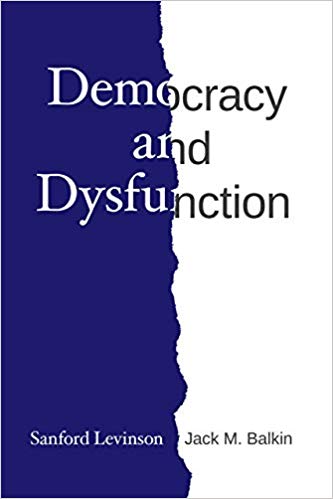
Sanford Levinson and Jack M. Balkin, Democracy and Dysfunction (University of Chicago Press, 2019)

Sanford Levinson, Written in Stone: Public Monuments in Changing Societies (Duke University Press 2018)

Mark A. Graber, Sanford Levinson, and Mark Tushnet, eds., Constitutional Democracy in Crisis? (Oxford University Press 2018)

Gerard Magliocca, The Heart of the Constitution: How the Bill of Rights became the Bill of Rights (Oxford University Press, 2018)

Cynthia Levinson and Sanford Levinson, Fault Lines in the Constitution: The Framers, Their Fights, and the Flaws that Affect Us Today (Peachtree Publishers, 2017)

Brian Z. Tamanaha, A Realistic Theory of Law (Cambridge University Press 2017)

Sanford Levinson, Nullification and Secession in Modern Constitutional Thought (University Press of Kansas 2016)

Sanford Levinson, An Argument Open to All: Reading The Federalist in the 21st Century (Yale University Press 2015)

Stephen M. Griffin, Broken Trust: Dysfunctional Government and Constitutional Reform (University Press of Kansas, 2015)

Frank Pasquale, The Black Box Society: The Secret Algorithms That Control Money and Information (Harvard University Press, 2015)

Bruce Ackerman, We the People, Volume 3: The Civil Rights Revolution (Harvard University Press, 2014)
Balkinization Symposium on We the People, Volume 3: The Civil Rights Revolution

Joseph Fishkin, Bottlenecks: A New Theory of Equal Opportunity (Oxford University Press, 2014)

Mark A. Graber, A New Introduction to American Constitutionalism (Oxford University Press, 2013)

John Mikhail, Elements of Moral Cognition: Rawls' Linguistic Analogy and the Cognitive Science of Moral and Legal Judgment (Cambridge University Press, 2013)

Gerard N. Magliocca, American Founding Son: John Bingham and the Invention of the Fourteenth Amendment (New York University Press, 2013)

Stephen M. Griffin, Long Wars and the Constitution (Harvard University Press, 2013)

Andrew Koppelman, The Tough Luck Constitution and the Assault on Health Care Reform (Oxford University Press, 2013)

James E. Fleming and Linda C. McClain, Ordered Liberty: Rights, Responsibilities, and Virtues (Harvard University Press, 2013)
Balkinization Symposium on Ordered Liberty: Rights, Responsibilities, and Virtues

Andrew Koppelman, Defending American Religious Neutrality (Harvard University Press, 2013)

Brian Z. Tamanaha, Failing Law Schools (University of Chicago Press, 2012)

Sanford Levinson, Framed: America's 51 Constitutions and the Crisis of Governance (Oxford University Press, 2012)

Linda C. McClain and Joanna L. Grossman, Gender Equality: Dimensions of Women's Equal Citizenship (Cambridge University Press, 2012)

Mary Dudziak, War Time: An Idea, Its History, Its Consequences (Oxford University Press, 2012)

Jack M. Balkin, Living Originalism (Harvard University Press, 2011)

Jason Mazzone, Copyfraud and Other Abuses of Intellectual Property Law (Stanford University Press, 2011)

Richard W. Garnett and Andrew Koppelman, First Amendment Stories, (Foundation Press 2011)

Jack M. Balkin, Constitutional Redemption: Political Faith in an Unjust World (Harvard University Press, 2011)

Gerard Magliocca, The Tragedy of William Jennings Bryan: Constitutional Law and the Politics of Backlash (Yale University Press, 2011)

Bernard Harcourt, The Illusion of Free Markets: Punishment and the Myth of Natural Order (Harvard University Press, 2010)

Bruce Ackerman, The Decline and Fall of the American Republic (Harvard University Press, 2010)
Balkinization Symposium on The Decline and Fall of the American Republic

Ian Ayres. Carrots and Sticks: Unlock the Power of Incentives to Get Things Done (Bantam Books, 2010)

Mark Tushnet, Why the Constitution Matters (Yale University Press 2010)

Ian Ayres and Barry Nalebuff: Lifecycle Investing: A New, Safe, and Audacious Way to Improve the Performance of Your Retirement Portfolio (Basic Books, 2010)
.jpg)
Jack M. Balkin, The Laws of Change: I Ching and the Philosophy of Life (2d Edition, Sybil Creek Press 2009)

Brian Z. Tamanaha, Beyond the Formalist-Realist Divide: The Role of Politics in Judging (Princeton University Press 2009)
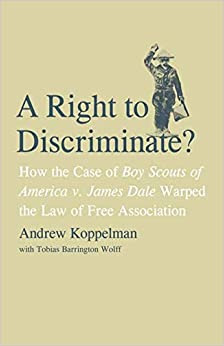
Andrew Koppelman and Tobias Barrington Wolff, A Right to Discriminate?: How the Case of Boy Scouts of America v. James Dale Warped the Law of Free Association (Yale University Press 2009)

Jack M. Balkin and Reva B. Siegel, The Constitution in 2020 (Oxford University Press 2009)

Heather K. Gerken, The Democracy Index: Why Our Election System Is Failing and How to Fix It (Princeton University Press 2009)

Mary Dudziak, Exporting American Dreams: Thurgood Marshall's African Journey (Oxford University Press 2008)

David Luban, Legal Ethics and Human Dignity (Cambridge Univ. Press 2007)

Ian Ayres, Super Crunchers: Why Thinking-By-Numbers is the New Way to be Smart (Bantam 2007)

Jack M. Balkin, James Grimmelmann, Eddan Katz, Nimrod Kozlovski, Shlomit Wagman and Tal Zarsky, eds., Cybercrime: Digital Cops in a Networked Environment (N.Y.U. Press 2007)
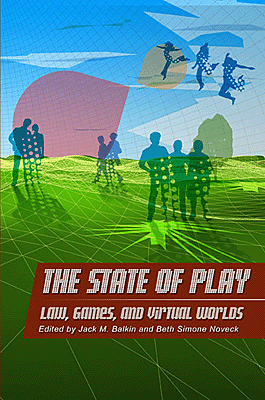
Jack M. Balkin and Beth Simone Noveck, The State of Play: Law, Games, and Virtual Worlds (N.Y.U. Press 2006)

Andrew Koppelman, Same Sex, Different States: When Same-Sex Marriages Cross State Lines (Yale University Press 2006)

Brian Tamanaha, Law as a Means to an End (Cambridge University Press 2006)

Sanford Levinson, Our Undemocratic Constitution (Oxford University Press 2006)

Mark Graber, Dred Scott and the Problem of Constitutional Evil (Cambridge University Press 2006)

Jack M. Balkin, ed., What Roe v. Wade Should Have Said (N.Y.U. Press 2005)

Sanford Levinson, ed., Torture: A Collection (Oxford University Press 2004)
Balkin.com homepage
Bibliography
Conlaw.net
Cultural Software
Writings
Opeds
The Information Society Project
BrownvBoard.com
Useful Links
Syllabi and Exams
