Balkinization
an unanticipated consequence of
Jack M. Balkin
Balkinization Symposiums: A Continuing List
E-mail:
Jack Balkin:
jackbalkin at yahoo.com
Bruce Ackerman
bruce.ackerman at yale.edu
Ian Ayres
ian.ayres at yale.edu
Corey Brettschneider
corey_brettschneider at brown.edu
Mary Dudziak
mary.l.dudziak at emory.edu
Joey Fishkin
joey.fishkin at gmail.com
Heather Gerken heather.gerken at yale.edu
Abbe Gluck abbe.gluck at yale.edu
Mark Graber
mgraber at law.umaryland.edu
Stephen Griffin
sgriffin at tulane.edu
Jonathan Hafetz
jonathan.hafetz at shu.edu
Jeremy Kessler
jkessler at law.columbia.edu
Andrew Koppelman
akoppelman at law.northwestern.edu
Marty Lederman
msl46 at law.georgetown.edu
Sanford Levinson
slevinson at law.utexas.edu
David Luban
david.luban at gmail.com
Gerard Magliocca
gmaglioc at iupui.edu
Jason Mazzone
mazzonej at illinois.edu
Linda McClain
lmcclain at bu.edu
John Mikhail
mikhail at law.georgetown.edu
Frank Pasquale
pasquale.frank at gmail.com
Nate Persily
npersily at gmail.com
Michael Stokes Paulsen
michaelstokespaulsen at gmail.com
Deborah Pearlstein
dpearlst at yu.edu
Rick Pildes
rick.pildes at nyu.edu
David Pozen
dpozen at law.columbia.edu
Richard Primus
raprimus at umich.edu
K. Sabeel Rahmansabeel.rahman at brooklaw.edu
Alice Ristroph
alice.ristroph at shu.edu
Neil Siegel
siegel at law.duke.edu
David Super
david.super at law.georgetown.edu
Brian Tamanaha
btamanaha at wulaw.wustl.edu
Nelson Tebbe
nelson.tebbe at brooklaw.edu
Mark Tushnet
mtushnet at law.harvard.edu
Adam Winkler
winkler at ucla.edu
Compendium of posts on Hobby Lobby and related cases
The Anti-Torture Memos: Balkinization Posts on Torture, Interrogation, Detention, War Powers, and OLC
The Anti-Torture Memos (arranged by topic)
Recent Posts
Separation of Powers: How to Preserve Liberty in Troubled Times -- A Critical Reading
![[Powered by Blogger]](https://lh3.googleusercontent.com/blogger_img_proxy/AEn0k_t-gGHcUVOTevXKDSegItaWvsa9zzrk9DuH9gyo30ezs3VBCZDhnrPhN1KCveqjScdwgK-JZBRBOledLMCXBX8a6G0uGM3UNzxtZzt0ED6E=s0-d)
Just A Few Blogs
ACS Blog
Alas, a Blog
Althouse
Arts and Letters Daily
Atrios (Eschaton)
Bill of Health
Buzzflash.com
Buzz Machine
Cato at Liberty
Juan Cole (Informed Comment)
Concurring Opinions
The Constitution in 2020
Corrente
Crooked Timber
Daily Howler
Daily Kos
Dana Boyd
Brad DeLong
Digby (Hullabaloo)
Discriminations
Daniel Drezner
Kevin Drum (Mother Jones)
Electrolite
En Banc
Eunomia (Daniel Larison)
Fafblog
Michael Froomkin (Discourse.net)
GovLab (Beth Noveck)
Rick Hasen (Election Law)
History News Network
How Appealing
Ignatz (Sam Heldman)
The Importance of (Ernie Miller)
Infolaw
Instapundit
International Economic Law and Policy Blog
IntLawGrrls
Jacob Levy
Jesus' General
Jurisdynamics
The Kitchen Cabinet
Mark Kleiman
Law Blog Central
Larry Lessig
Lawyers, Guns and Money
Liberal Oasis
Brian Leiter's Law School Reports
The Leiter Reports
Marginal Revolution
Megan McArdle
Memeorandum
Metafilter
Mirror of Justice
The New Republic
Newseum
No More Mister Nice Blog
Brendan Nyhan
Opinio Juris
Orcinus
The Originalism Blog
Pandagon
Passport (Foreign Policy)
Overcoming Bias
Political Animal (Washington Monthly)
Political Theory Daily Review
Political Wire (Taegan Goddard)
The Poor Man
Virginia Postrel
Prawfsblawg
Public Reason
Jonathan Rauch
Raw Story
Redstate
ReligiousLeftLaw.com
Reporters Committee For Freedom of the Press
Reproductive Rights Blog
Rothman's Roadmap to the Right of Publicity
SCOTUS Blog
Seeing the Forest
Clay Shirky
The Shifted Librarian
The Situationist
Larry Solum (Legal Theory)
Andrew Sullivan
Talking Points Memo
Talk Left
Tapped
Tbogg
TechPresident
The Paper Chase (Jurist)
Tom Paine
Tom Tomorrow (This Modern World)
Eve Tushnet
Uggabugga
University of Chicago Law School Faculty Blog
Unqualified Offerings
The Volokh Conspiracy
War and Piece (Laura Rozen)
Wampum
Oliver Willis
Wonkette
Written Description
Matthew Yglesias
Yin
Your Choice of Feeds
1. XML
powered by

2. Atom Feed
3. RSS 2.0
Separation of Powers: How to Preserve Liberty in Troubled Times -- A Critical Reading
Guest Blogger
Roberto Gargarella Separation
of Powers. How to Preserve Liberty in Troubled Times, by Cass
Sunstein. (The MIT Press, 2026) Introduction Separation
of Powers is the latest book published by Cass Sunstein (I am
writing this review in March 2026). As expected, the book, which deals with a
well-chosen and highly relevant subject, brings together many of the virtues
and problems that distinguish Sunstein’s most recent work. Let me begin with
the virtues: it is a clear, didactic book, written by a brilliant author, full
of ideas, and one of the most knowledgeable about the technical literature and
jurisprudence of our time. To all this, we can add another advantage, visible
in the author's latest works, which is that Sunstein incorporates into his
qualified approach the experience and knowledge accumulated during his time in
public service (Sunstein served as administrator of the White House Office of
Information and Regulatory Affairs (OIRA) between 2009 and 2012). Regarding its
problems, I will limit myself to pointing out one particular difficulty,
because it underlies this entire new book. Sunstein has been developing a
peculiar mode of argumentation, in which he asserts a thesis or describes a
fact, only to later begin qualifying his assertions until he shows the
plausibility of the contrary thesis or description. This form of
‘back-and-forth’ argumentation reaches an extreme in this book. This is to the
point that what could be thought of as the very central thesis of the entire
book, that is a statement about the fundamental value of the separation of
powers -against the Schmittian defense of a discretionary executive- is refuted
on the very last page of the text, where he states: ‘Nothing in this book can
be counted as an objection to the grant of a high degree of discretionary power
to the president’ (p. 128). For my taste, too much. Let me
now critically examine some of the central points of this timely book, which I
would like to comment or challenge. I will divide my study into two parts: the
first mainly focused on the issue of democracy, and the second mainly related
to the Executive Branch. I.
DEMOCRACY Separation
of powers and checks and balances. The first thing I would mention is that I find
striking that a book entirely devoted to thinking about the fundamental
principle of the separation of powers, does not take the trouble to better
define its object of study. Sunstein puts forward some interesting theses (for
example, that the separation of powers is an ‘umbrella concept’ that includes
six types of separation of powers, p. 4), but he does not substantiate or
justify his peculiar approach to the subject: these are postulates or
categorical statements, which receive not much additional support. I understand
that Sunstein wants, in his own way, to focus primarily -or almost exclusively-
on the analysis of the separation of powers. However, two things strike me as
particularly noteworthy. First, it is surprising that a book that is dedicated
to study the principle of separation of powers does not pause to examine the
relationship between that principle and the notion of ‘checks and balances.’
Much more than that: the crucial principle of checks and balances—which
represents nothing less than the specific way in which American constitutionalism
intervened, modified, and reconstructed Locke's proposal of the separation of
powers—is only mentioned in passing, three times throughout the entire book (on
pages 5-6, 121, and 152). The
omission is surprising, given the current American debate on the subject (i.e.,
the debate about the ‘major questions doctrine’ and the ‘exclusive’ powers of
each branch of government). That discussion needs to closely engage with the
principle of ‘checks and balances,’ which requires each branch to partially assume
some of the powers of the other branches of government. Much more than that:
for the current state of American jurisprudence, with its “originalist” roots,
it seems crucial to recognize that one of the main institutional innovations of
the ‘framing period’ was the abandonment of the radical English thesis on the strict
separation of powers (a thesis such as that defended by Thomas Paine in
Pennsylvania, Paine 1989) and its replacement by another alternative that
promoted partial overlap, permanent interrelation and mutual control between
the different branches.[1] This innovation was
masterfully explained by Maurice Vile (another author who, strangely, is not
cited here) in his classic book on the separation of powers (Vile 1967). The use
of history and deliberative democracy. Although for several decades I have advocated a
normative conception akin to dialogic democracy (influenced, at least in part,
by Cass Sunstein himself, in Chicago), I find problems with the ways in which
Sunstein grounds it (Gargarella 2022). In particular, I would object to the
historical anchor that the author seeks to give to the deliberative conception.
The notion of deliberative democracy seems so central and foundational to his
proposal that, from the very beginning of the book, Sunstein states that ‘consistent
with the founding conception of republicanism, the Constitution and the system
of separation of powers aimed to create a deliberative democracy—one that
combined accountability with reason-giving in the public domain’ (pp. 2 and
3). Of course, this issue, like most of the topics addressed in this work (and
this poses a problem for the critical analysis of the book), has already been
presented by the author in a variety of previous works, and for a long time (in
particular, Sunstein 1993). Sunstein supports the idea that the ‘founding
fathers’ sought (something like) a deliberative democracy, resorting to
isolated quotes from Madison or Hamilton that are not enough to challenge the
current understanding of the matter. I am referring to the common assumption
that politicians such as Madison subscribed to (something like) a “pluralist”
conception of democracy (Dahl 1956). In other words, the “founding fathers”
seemed to subscribe to a conception of democracy that theorists in the field,
nowadays (do not identify with, but rather) contrast or oppose to the
deliberative ideal (Held 1987). In any case, it is not my interest here to
dispute that question (did the ‘founding fathers’ subscribe to a deliberative
ideal? really?). I would just limit myself to point out that Sunstein should
make a greater argumentative effort before simply asserting this controversial
point (that the “founding fathers” wanted to promote something like a
deliberative democracy). On the other hand, I would like to suggest that this
is not a minor issue, because, by claiming such a pedigree for his position, Sunstein
puts his critics in an uncomfortable position: How can one criticize a
particular institution or practice that, according to the specialist, was
wholeheartedly embraced by the ‘founding fathers’? In short, I see a problem in
the way Sunstein (once again) puts history at the service of his theory and,
therefore, in the way that narrative is then used in the argument.[2] An
elitist reading of deliberative democracy. Another problem I see in
the book, related to the previous ones, has to do with the normative theory of
deliberative democracy —the deliberative conception—that serves as its
foundation. Here, once again, we face a conceptual problem: we find a notion
that is called upon to play a central role in Separation of Powers
—deliberative democracy— but which is not properly defined or characterized
(see also Sunstein 1988, 1991, 1993). This obviously implies a significant difficulty,
particularly when, as we have seen, the historical basis offered in support of
the idea of deliberative democracy is very weak. Beyond this, the indications
presented in the book about how deliberative democracy is conceived refer, in
my opinion, to an unattractive, elitist position. Sunstein speaks of a
conception that combines ‘accountability with reason-giving in the public
domain’ (p. 3). This approach is curious because, on the one hand, it shows a
clear Habermasian reminiscence, through its emphasis on the notions of ‘reason
giving’ and ‘public domain’ (although Jürgen Habermas is not cited in the book,
as he was in the author's previous works). However, this same notion sidesteps
the core of Habermas's definition on the subject, which refers to the
intervention of ‘all those potentially affected’ (Habermas 1996, 1998). This
omission is not explained in the book, but it is understandable: Sunstein is
ultimately subscribing to a Burkean or elitist notion of deliberation, as characterized
by James Fishkin, one of the academic authorities on democratic theory (Fishkin
2009, 2011). Fishkin speaks of “elite deliberation” when it focuses exclusively
on the process of “reason-giving” by experts, committees of specialists,
technical groups, etc. Meanwhile, Fishkin reserves the concept of “deliberative
democracy” for those cases in which the process of exchanging reasons reaches
or seeks to reach, as far as possible, “all those potentially affected”. In
conclusion, I see a problem in Sunstein's lack of a precise characterization of
“deliberative democracy”, and I believe that this problem is exacerbated
because, in fact, he ends up mistakenly calling “deliberative democracy” what
theorists such as Fishkin (and I) would call “elite deliberation”. Of course,
any author can embrace the normative foundations they prefer—we are not dealing
here with a merely ‘ideological’ critique. The problem is that, here, it is not
clear what this view of democracy means and implies, or where it comes from or
where it is grounded. Beyond what has been said, it should be emphasized that
Sunstein's conception of democracy refers to a notion that is controversial, at
least within contemporary theory, but which is called upon to play – as we
shall see shortly – a fundamental role in the rest of the book's argument
(i.e., supporting, for example, the discretion of the executive branch, based
on ‘deliberative’ reasons that the traditional dialogical theory—that of
Habermas or Carlos Nino—would challenge). Ultimately, what is at stake here is
a major problem, one that I cannot address as I would like to (a problem that,
in truth, affects much of contemporary doctrine) namely the collapse of
democracy in constitutionalism (or in the three branches of government). Like
so many contemporary authors, Sunstein seems to conflate the ideas of
constitutionalism and democracy (Ginsburg & Huq 2018). II.
THE EXECUTIVE BRANCH Epistemic
democracy and the executive branch (‘by far the most knowledgeable’).
Seeking to continue the Habermasian legacy, many of us have advocated
for an epistemic justification of democracy (Nino 1991, Cohen 1986, Gargarella
2022). This view takes as its starting point the notion, proposed by John
Stuart Mill, that each person is ‘the best judge of their own interests’ (Mill
1859, Dahl 1956). Hence the value of a non-elitist, but deliberative,
conception of democracy, which seeks to consider, as much as possible, the
‘point of view of all those potentially affected’ (Habermas 1996). For the
epistemic conception, then, the justification of democracy is linked to its
capacity for achieving impartiality -which is associated with the inclusion and
processing of the diverse points of view existing in the community. From this
perspective, a process of broad public discussion has greater ‘epistemic power’
than a legislative discussion; just as a legislative discussion has greater
“epistemic power” than a unilateral decision by the executive. This is simply
because such processes of inclusive deliberation reduce the risks of partiality/discretion
or, in other words, maximize the chances of deciding impartially. However,
as anticipated, the epistemic view described is not the conception of democracy
implicit in the Federalist Papers or in Sunstein's works, which, as we
have said, hold a rather opposite view, that of elitist deliberation. From the
latter perspective, then, the above equation is reversed. Now, the executive
branch (a single-person political branch that, to begin with, does not
structurally incorporate the views of the country's entire geographical
diversity, as Congress does) is described in a way that transforms its manifest
disadvantages into virtues of its functioning. By taking this perspective, for
example, Alexander Hamilton was able to say of the President that: ‘a single
well-directed man by a single understanding, cannot be distracted by that
diversity of views, feelings and interests, which frequently distract and warp
the resolutions of a collective body’ (Federalist Papers n. 76).
Similarly, and despite recognizing the risks of presidential discretion (‘the
most dangerous branch’), group polarization, the “deep state”, or the
‘happy talk’ to which the President is subjected (chapter 6), Sunstein argues
forcefully in his book that ‘the executive is by far the most knowledgeable’
(p. 37), or that ‘the informational advantages of the executive branch are an
essential part of thinking about the contemporary system of separation of
powers’ (p. 40). Both
Sunstein's assertions and the way he supports them are highly controversial. In
particular, the way he (dis)qualifies the epistemic abilities of Congress,
after extolling those of the President, seems somewhat astonishing (at least
from my perspective). He acknowledges that members of Congress can also obtain
information through hearings or by consulting experts. However, he adds, ‘members
of Congress are also generalists, their staffs are relatively small, and they
have to focus on re-election’ (p. 45). And what about the President? -I
would ask him. Are Presidents not particularly interested in the next elections
(or in a possible re-election)? Having pointed this out (I do not think it is
right to resist certain interventions by Congress on the grounds of defects
that, in the case of the Executive, seem to operate as virtues), I would say
that, beyond the possibilities of surrounding oneself with experts and
specialists, the differential value in favor of open public discussion, or
legislative discussion, lies in the fact that those settings help us to become
exposed to the greatest possible diversity (geographical, ideological, etc.). That is
why, for major decisions (and also for major questions), the inclusive
discussion praised by Habermas has great (epistemic) advantages. Let us
imagine, for example, that the decision to go to war against state X is being
debated. It will make all the difference in the world whether the decision is
made by a single executive (even surrounded by multiple technical teams) or by
a body with representatives from all parts of the country. Only the latter
alternative allows us to know what they think about it, for example, the
parents who will be forced to send their children to die on the battlefield. Or
let us think, to take a closer case, of COVID-19 and the pandemic. Then, the
large technical teams convened by the executive (doctors, epidemiologists,
etc.) came to play a central role in the critical decisions made (lockdown,
etc.), which resulted—unsurprisingly—in unduly biased options that tended to simply
dismiss crucial issues such as, for example, the consequences that long
lockdown could have on the mental health of minors; or the significance that
‘lockdown and handwashing’ mandates could have on poor populations living in
overcrowded conditions or without access to water (Gargarella 2020a, Gargarella
2020b) . Ultimately, (deliberative) democracy sees expert discussion, which may
eventually favor the executive branch at its discretion, as more of a problem
than a virtue. Deliberative democracy therefore unreservedly prefers and favors
inclusive processes of public discussion. The real
world of the separation of powers: institutional motivations and incentives. The
last point I want to refer to has to do with Sunstein's appeals to the ‘real’
functioning of institutions. In the book, for example, Sunstein is keen to make
it clear that ‘we are speaking of the real world of the separation of powers’
(p. 46). Of course, all of us (even those who, like me, prefer to work within
the strict framework of a ‘regulatory ideal’) recognize the value of a
“contextual” approach to the issue (one that is sensitive to time and space).
However, as always, everything ultimately depends on the ‘how’—how that
‘contextual’ analysis is carried out. In
general terms, I would say that American legal doctrine shows, among its
virtues, a tendency to think ‘contextually.’ However, this healthy tendency
often represents also a risk: that of theory becoming locked into (or
fascinated by) certain ‘grand narratives’ (and ‘counter-narratives’) with
historical roots. I would mention two of these “grand narratives,” in
particular. On the one hand, part of the doctrine, interested in defending
(certain modes of) judicial review has become anchored or trapped within the
“grand narrative” of the Warren Court. It therefore assumes that there are
reasons to think of an exercise of judicial function that insists on or revives
the forms of judicial review typical of a specific period in history—that of
the Court led by Earl Warren, which became a champion of civil and political
rights (Fiss 1976, Ely 1980). On the other hand, another part of the doctrine
has remained trapped within the ‘grand narrative’ of the Roosevelt presidency,
the New Deal, and rulings such as Chevron, and continues to think of
constitutional law as if it were possible to reproduce, at this time, the type
of regulatory state that was characteristic of the early 20th century (Sunstein
seemed, for a long time, to subscribe to this narrative, i.e., Sunstein 1990).
In this book, Sunstein presents us another ‘grand narrative,’ which is, in a
way, the opposite of the previous one. It would be (what I would call here) a
counter-narrative (rooted in the old doctrine of non-delegation, and anchored
today in the support of the major questions doctrine, chaps. 9 and 10) that
tells us that the main constitutional problem of our time is that ‘after the
New Deal, the United States has seen the rise of a “headless fourth branch”’
(p. 60) -a counter-narrative that makes ‘an effort to restore a (perceived)
status quo ante’ (pp. 59-60). However,
Sunstein's valuable vocation, usually exhibited in thinking about
constitutional law in a ‘situated’ manner and linked to the real world,
is expressed in this book in a way that I consider exaggerated or
inappropriate. Perhaps because it starts from theoretical assumptions that are
now more provisional or “movable”, or because it approaches constitutional law
in a way that is too closely tied to the historical context, Sunstein's theory
becomes, in the end, too dependent on the actual practice. Sunstein’s approach
seem to find difficulties for distancing itself from the practice and then,
consequently, to subject it to criticism. Hence the tendency, so common in this
book, to make a strong theoretical or empirical statement, only to immediately
refute or dilute it in the light of ‘real practice’. Thus, speaking of the
executive branch, Sunstein can conclude his analysis (alluding to Trump II and)
by saying that ‘if the president really were X, then the picture I have offered
here would not be realistic’ (p. 56); or, referring to the current,
ultra-conservative Supreme Court, he can conclude his analysis by saying that ‘on
those assumptions, judicial review would not be a good idea’ (ibid.). The
greatest risk is that his next step will be Hegelian, and Sunstein will come to
argue, as Hegel did in his Philosophy of Right, that ‘what is rational
is real, and what is real is rational’ (Hegel 2012). Conclusion In the
preceding pages, I have presented and critically discussed some of the central
points of Cass Sunstein's new book, Separation of Powers. Like all his
books, this one stands out for the creativity, originality, and knowledge of
its author, who today enriches his studies with a Hartian ‘internal point of
view’: that of the doctrinaire who was able to look at the “regulatory state”
from within. In this review, I was interested in focusing on some of the
various problems I found in the text, in the hope that such comments will serve
to continue this long and enlightened conversation to which Sunstein has been
inviting us for so many productive decades. Roberto Gargarella is Senior Researcher at CONICET (Argentina) and Visiting Professor at the University Pompeu Fabra, Barcelona. You can reach him by e-mail at robert@utdt.edu BIBLIOGRAPHY Cohen, J.
(1986), “An Epistemic Conception of Democracy,” Ethics, Vol. 97, No. 1, Oct. Dahl, R.
(1956), A Preface to Democratic Theory, Chicago:
The University of Chicago Press. Ely, J.
(1980), Democracy and Distrust, Cambridge: Harvard University Press. Fishkin,
J. S. (2009). When the People Speak: Deliberative Democracy and Public
Consultation. Oxford: Oxford University Press. Fishkin,
J. S. (2011). “Deliberative Democracy and Constitutions.” Social Philosophy
and Policy, 28(1), 242–260. Fiss, O.
(1976), “Groups and the Equal Protection Clause,” Philosophy and Public Affairs, 5 (2): 107-177. Gargarella, R. (2020a) “Argentina: Facing Coronavirus
in the Shadow of the Rule of Law” Bill of Health. Harvard Law, https://blog.petrieflom.law.harvard.edu/2020/06/08/argentina-global-responses-covid19/ Gargarella, R. (2020b) “The Fight Against COVID-19
in Argentina: Executive vs Legislative Branch,” Verfassungsblog. On Matters
Constitutional (1/6/2020), https://verfassungsblog.de/author/roberto-gargarella/ Gargarella,
R. (2022), The Law as a Conversation Among Equals, Cambridge: Cambridge
University Press. “Back to the sources. Review of Cass Sunstein’s Interpreting
the Constitution,” Balkinization Blog, Dec. 18th (2023), https://balkin.blogspot.com/search?q=gargarella Ginsburg,
T.; Huq, A. (2018), How to save a
Constitutional Democracy, Chicago: The University of Chicago Press. Habermas,
J. [1992] (1996), Between Facts and Norms, (Original Faktizität und
Geltung), trans. W. Rehg, MIT Press, Cambridge, MA. Habermas,
J., (1998). The inclusion of the other:
Studies in political theory, Cambridge, MA: The MIT Press. Hamilton,
A.; Madison, J.; Jay, J. (1988), The
Federalist Papers, New York: Bantam Books. Hegel, W.
(2012), The Philosophy of Right, London, Lexicos Publ. Mill, J.
[1859] 2003, On Liberty, London:
Dover Publications Inc. Nino, C.
(1991), The Ethics of Human Rights,
Oxford: Oxford University Press. Paine, T.
(1989), Political Witings, ed. by B.
Kucklick, Cambridge: Cambridge University Press. Pettit,
P. (2012), On the People’s Terms, Cambridge: Cambridge University Press. Sunstein,
C. (1988), “Beyond the Republican Revival,” 97 Yale L. J. 1539. Sunstein,
C. (1991), “Preferences and Politics” 20 Philosophy
and Public Affairs 3. Sunstein,
C. (1993), The Partial Constitution, Cambridge:
Harvard University Press. Vile,
M.J.C. (1967), Constitutionalism and the
Separation of Powers, Indianapolis: Liberty Fund. [1] This is why, for example, in Federalist Papers
No. 47, Madison quoted Montesquieu to say that the Frenchman ‘did not mean that
these departments ought to have no PARTIAL AGENCY in, or no CONTROL over, the
acts of each other’; and this is why (perhaps in the most quoted paragraph of
the famous Federalist Papers No. 51) Madison spoke of the need to ensure
that each branch of government could resist encroachments of the others; and,
in that sense, that ‘ambition must be made to counteract ambition’. [2] I feel about Sunstein and deliberative democracy in
constitutional theory something similar to what I feel about Philip Pettit and
the principle of non-domination in political philosophy. For Pettit, it is also
essential to say that a central and controversial principle of his
theory—freedom as non-domination—actually has strong historical support.
According to him, this controversial idea of freedom finds support in ‘the
Roman Republic,’ in ‘medieval and Renaissance Italy,’ in ‘Europe and Great
Britain’ in the 17th and 18th centuries, and eventually in ‘Revolutionary
America’ (Pettit 2012). However, this fundamental claim is highly disputable,
and the proclaimed historical anchor (which could provide solidity to this
assertion) is difficult to sustain in light of the actual historical data we
have.
Posted
8:30 AM
by Guest Blogger [link]
Books by Balkinization Bloggers

Mark Tushnet and Bojan Bugaric, Constitutionalism and Its Discontents (University of Chicago Press, 2026)

Gerard N. Magliocca, The Actual Art of Governing: Justice Robert H. Jackson's Concurring Opinion in the Steel Seizure Case (Oxford University Press, 2025)

Linda C. McClain and Aziza Ahmed, The Routledge Companion to Gender and COVID-19 (Routledge, 2024)

David Pozen, The Constitution of the War on Drugs (Oxford University Press, 2024)

Jack M. Balkin, Memory and Authority: The Uses of History in Constitutional Interpretation (Yale University Press, 2024)
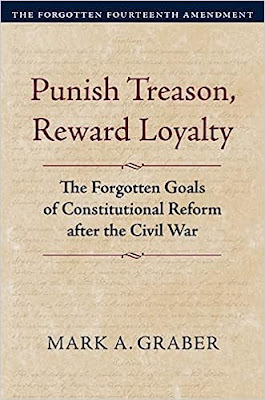
Mark A. Graber, Punish Treason, Reward Loyalty: The Forgotten Goals of Constitutional Reform after the Civil War (University of Kansas Press, 2023)
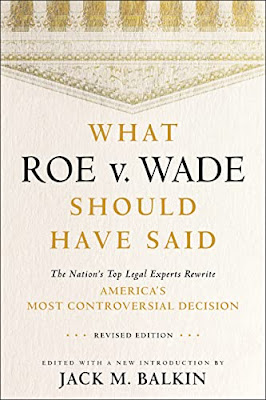
Jack M. Balkin, What Roe v. Wade Should Have Said: The Nation's Top Legal Experts Rewrite America's Most Controversial Decision - Revised Edition (NYU Press, 2023)

Andrew Koppelman, Burning Down the House: How Libertarian Philosophy Was Corrupted by Delusion and Greed (St. Martin’s Press, 2022)

Gerard N. Magliocca, Washington's Heir: The Life of Justice Bushrod Washington (Oxford University Press, 2022)
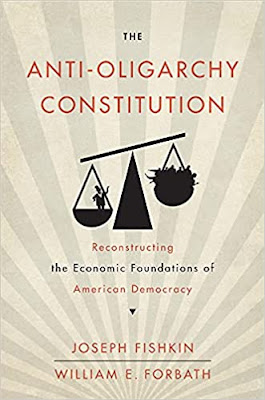
Joseph Fishkin and William E. Forbath, The Anti-Oligarchy Constitution: Reconstructing the Economic Foundations of American Democracy (Harvard University Press, 2022)
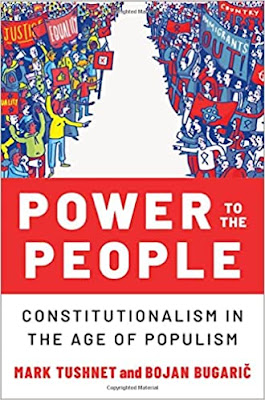
Mark Tushnet and Bojan Bugaric, Power to the People: Constitutionalism in the Age of Populism (Oxford University Press 2021).

Mark Philip Bradley and Mary L. Dudziak, eds., Making the Forever War: Marilyn B. Young on the Culture and Politics of American Militarism Culture and Politics in the Cold War and Beyond (University of Massachusetts Press, 2021).

Jack M. Balkin, What Obergefell v. Hodges Should Have Said: The Nation's Top Legal Experts Rewrite America's Same-Sex Marriage Decision (Yale University Press, 2020)

Frank Pasquale, New Laws of Robotics: Defending Human Expertise in the Age of AI (Belknap Press, 2020)

Jack M. Balkin, The Cycles of Constitutional Time (Oxford University Press, 2020)

Mark Tushnet, Taking Back the Constitution: Activist Judges and the Next Age of American Law (Yale University Press 2020).

Andrew Koppelman, Gay Rights vs. Religious Liberty?: The Unnecessary Conflict (Oxford University Press, 2020)

Ezekiel J Emanuel and Abbe R. Gluck, The Trillion Dollar Revolution: How the Affordable Care Act Transformed Politics, Law, and Health Care in America (PublicAffairs, 2020)

Linda C. McClain, Who's the Bigot?: Learning from Conflicts over Marriage and Civil Rights Law (Oxford University Press, 2020)
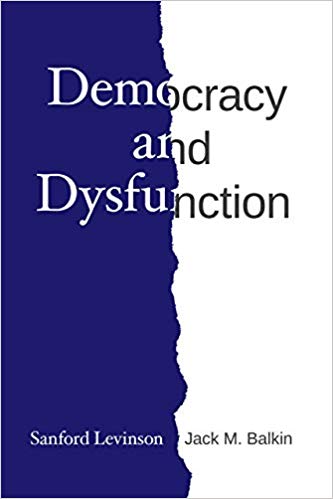
Sanford Levinson and Jack M. Balkin, Democracy and Dysfunction (University of Chicago Press, 2019)

Sanford Levinson, Written in Stone: Public Monuments in Changing Societies (Duke University Press 2018)

Mark A. Graber, Sanford Levinson, and Mark Tushnet, eds., Constitutional Democracy in Crisis? (Oxford University Press 2018)

Gerard Magliocca, The Heart of the Constitution: How the Bill of Rights became the Bill of Rights (Oxford University Press, 2018)

Cynthia Levinson and Sanford Levinson, Fault Lines in the Constitution: The Framers, Their Fights, and the Flaws that Affect Us Today (Peachtree Publishers, 2017)

Brian Z. Tamanaha, A Realistic Theory of Law (Cambridge University Press 2017)

Sanford Levinson, Nullification and Secession in Modern Constitutional Thought (University Press of Kansas 2016)

Sanford Levinson, An Argument Open to All: Reading The Federalist in the 21st Century (Yale University Press 2015)

Stephen M. Griffin, Broken Trust: Dysfunctional Government and Constitutional Reform (University Press of Kansas, 2015)

Frank Pasquale, The Black Box Society: The Secret Algorithms That Control Money and Information (Harvard University Press, 2015)

Bruce Ackerman, We the People, Volume 3: The Civil Rights Revolution (Harvard University Press, 2014)
Balkinization Symposium on We the People, Volume 3: The Civil Rights Revolution

Joseph Fishkin, Bottlenecks: A New Theory of Equal Opportunity (Oxford University Press, 2014)

Mark A. Graber, A New Introduction to American Constitutionalism (Oxford University Press, 2013)

John Mikhail, Elements of Moral Cognition: Rawls' Linguistic Analogy and the Cognitive Science of Moral and Legal Judgment (Cambridge University Press, 2013)

Gerard N. Magliocca, American Founding Son: John Bingham and the Invention of the Fourteenth Amendment (New York University Press, 2013)

Stephen M. Griffin, Long Wars and the Constitution (Harvard University Press, 2013)

Andrew Koppelman, The Tough Luck Constitution and the Assault on Health Care Reform (Oxford University Press, 2013)

James E. Fleming and Linda C. McClain, Ordered Liberty: Rights, Responsibilities, and Virtues (Harvard University Press, 2013)
Balkinization Symposium on Ordered Liberty: Rights, Responsibilities, and Virtues

Andrew Koppelman, Defending American Religious Neutrality (Harvard University Press, 2013)

Brian Z. Tamanaha, Failing Law Schools (University of Chicago Press, 2012)

Sanford Levinson, Framed: America's 51 Constitutions and the Crisis of Governance (Oxford University Press, 2012)

Linda C. McClain and Joanna L. Grossman, Gender Equality: Dimensions of Women's Equal Citizenship (Cambridge University Press, 2012)

Mary Dudziak, War Time: An Idea, Its History, Its Consequences (Oxford University Press, 2012)

Jack M. Balkin, Living Originalism (Harvard University Press, 2011)

Jason Mazzone, Copyfraud and Other Abuses of Intellectual Property Law (Stanford University Press, 2011)

Richard W. Garnett and Andrew Koppelman, First Amendment Stories, (Foundation Press 2011)

Jack M. Balkin, Constitutional Redemption: Political Faith in an Unjust World (Harvard University Press, 2011)

Gerard Magliocca, The Tragedy of William Jennings Bryan: Constitutional Law and the Politics of Backlash (Yale University Press, 2011)

Bernard Harcourt, The Illusion of Free Markets: Punishment and the Myth of Natural Order (Harvard University Press, 2010)

Bruce Ackerman, The Decline and Fall of the American Republic (Harvard University Press, 2010)
Balkinization Symposium on The Decline and Fall of the American Republic

Ian Ayres. Carrots and Sticks: Unlock the Power of Incentives to Get Things Done (Bantam Books, 2010)

Mark Tushnet, Why the Constitution Matters (Yale University Press 2010)

Ian Ayres and Barry Nalebuff: Lifecycle Investing: A New, Safe, and Audacious Way to Improve the Performance of Your Retirement Portfolio (Basic Books, 2010)
.jpg)
Jack M. Balkin, The Laws of Change: I Ching and the Philosophy of Life (2d Edition, Sybil Creek Press 2009)

Brian Z. Tamanaha, Beyond the Formalist-Realist Divide: The Role of Politics in Judging (Princeton University Press 2009)
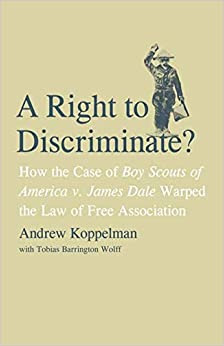
Andrew Koppelman and Tobias Barrington Wolff, A Right to Discriminate?: How the Case of Boy Scouts of America v. James Dale Warped the Law of Free Association (Yale University Press 2009)

Jack M. Balkin and Reva B. Siegel, The Constitution in 2020 (Oxford University Press 2009)

Heather K. Gerken, The Democracy Index: Why Our Election System Is Failing and How to Fix It (Princeton University Press 2009)

Mary Dudziak, Exporting American Dreams: Thurgood Marshall's African Journey (Oxford University Press 2008)

David Luban, Legal Ethics and Human Dignity (Cambridge Univ. Press 2007)

Ian Ayres, Super Crunchers: Why Thinking-By-Numbers is the New Way to be Smart (Bantam 2007)

Jack M. Balkin, James Grimmelmann, Eddan Katz, Nimrod Kozlovski, Shlomit Wagman and Tal Zarsky, eds., Cybercrime: Digital Cops in a Networked Environment (N.Y.U. Press 2007)
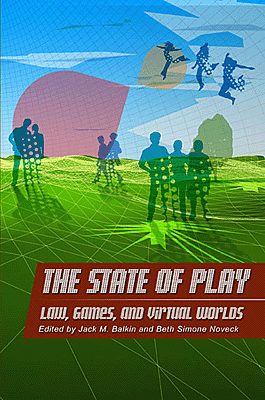
Jack M. Balkin and Beth Simone Noveck, The State of Play: Law, Games, and Virtual Worlds (N.Y.U. Press 2006)

Andrew Koppelman, Same Sex, Different States: When Same-Sex Marriages Cross State Lines (Yale University Press 2006)

Brian Tamanaha, Law as a Means to an End (Cambridge University Press 2006)

Sanford Levinson, Our Undemocratic Constitution (Oxford University Press 2006)

Mark Graber, Dred Scott and the Problem of Constitutional Evil (Cambridge University Press 2006)

Jack M. Balkin, ed., What Roe v. Wade Should Have Said (N.Y.U. Press 2005)

Sanford Levinson, ed., Torture: A Collection (Oxford University Press 2004)
Balkin.com homepage
Bibliography
Conlaw.net
Cultural Software
Writings
Opeds
The Information Society Project
BrownvBoard.com
Useful Links
Syllabi and Exams
