Balkinization
an unanticipated consequence of
Jack M. Balkin
Balkinization Symposiums: A Continuing List
E-mail:
Jack Balkin:
jackbalkin at yahoo.com
Bruce Ackerman
bruce.ackerman at yale.edu
Ian Ayres
ian.ayres at yale.edu
Corey Brettschneider
corey_brettschneider at brown.edu
Mary Dudziak
mary.l.dudziak at emory.edu
Joey Fishkin
joey.fishkin at gmail.com
Heather Gerken heather.gerken at yale.edu
Abbe Gluck abbe.gluck at yale.edu
Mark Graber
mgraber at law.umaryland.edu
Stephen Griffin
sgriffin at tulane.edu
Jonathan Hafetz
jonathan.hafetz at shu.edu
Jeremy Kessler
jkessler at law.columbia.edu
Andrew Koppelman
akoppelman at law.northwestern.edu
Marty Lederman
msl46 at law.georgetown.edu
Sanford Levinson
slevinson at law.utexas.edu
David Luban
david.luban at gmail.com
Gerard Magliocca
gmaglioc at iupui.edu
Jason Mazzone
mazzonej at illinois.edu
Linda McClain
lmcclain at bu.edu
John Mikhail
mikhail at law.georgetown.edu
Frank Pasquale
pasquale.frank at gmail.com
Nate Persily
npersily at gmail.com
Michael Stokes Paulsen
michaelstokespaulsen at gmail.com
Deborah Pearlstein
dpearlst at yu.edu
Rick Pildes
rick.pildes at nyu.edu
David Pozen
dpozen at law.columbia.edu
Richard Primus
raprimus at umich.edu
K. Sabeel Rahmansabeel.rahman at brooklaw.edu
Alice Ristroph
alice.ristroph at shu.edu
Neil Siegel
siegel at law.duke.edu
David Super
david.super at law.georgetown.edu
Brian Tamanaha
btamanaha at wulaw.wustl.edu
Nelson Tebbe
nelson.tebbe at brooklaw.edu
Mark Tushnet
mtushnet at law.harvard.edu
Adam Winkler
winkler at ucla.edu
Compendium of posts on Hobby Lobby and related cases
The Anti-Torture Memos: Balkinization Posts on Torture, Interrogation, Detention, War Powers, and OLC
The Anti-Torture Memos (arranged by topic)
Recent Posts
Politics and Legal Arguments Can Coexist: a Reply to Drall and Moyn
![[Powered by Blogger]](https://lh3.googleusercontent.com/blogger_img_proxy/AEn0k_uREm1mvmpP6rzd-4C-kEZ18h0UaZg2YEjxLMjIO5md1UyWKs9hHReK5ywdEUvfWO8QKs4evWk87NI-6iUhHMuK59lm2oqTW-EdtC8zdJ20=s0-d)
Just A Few Blogs
ACS Blog
Alas, a Blog
Althouse
Arts and Letters Daily
Atrios (Eschaton)
Bill of Health
Buzzflash.com
Buzz Machine
Cato at Liberty
Juan Cole (Informed Comment)
Concurring Opinions
The Constitution in 2020
Corrente
Crooked Timber
Daily Howler
Daily Kos
Dana Boyd
Brad DeLong
Digby (Hullabaloo)
Discriminations
Daniel Drezner
Kevin Drum (Mother Jones)
Electrolite
En Banc
Eunomia (Daniel Larison)
Fafblog
Michael Froomkin (Discourse.net)
GovLab (Beth Noveck)
Rick Hasen (Election Law)
History News Network
How Appealing
Ignatz (Sam Heldman)
The Importance of (Ernie Miller)
Infolaw
Instapundit
International Economic Law and Policy Blog
IntLawGrrls
Jacob Levy
Jesus' General
Jurisdynamics
The Kitchen Cabinet
Mark Kleiman
Law Blog Central
Larry Lessig
Lawyers, Guns and Money
Liberal Oasis
Brian Leiter's Law School Reports
The Leiter Reports
Marginal Revolution
Megan McArdle
Memeorandum
Metafilter
Mirror of Justice
The New Republic
Newseum
No More Mister Nice Blog
Brendan Nyhan
Opinio Juris
Orcinus
The Originalism Blog
Pandagon
Passport (Foreign Policy)
Overcoming Bias
Political Animal (Washington Monthly)
Political Theory Daily Review
Political Wire (Taegan Goddard)
The Poor Man
Virginia Postrel
Prawfsblawg
Public Reason
Jonathan Rauch
Raw Story
Redstate
ReligiousLeftLaw.com
Reporters Committee For Freedom of the Press
Reproductive Rights Blog
Rothman's Roadmap to the Right of Publicity
SCOTUS Blog
Seeing the Forest
Clay Shirky
The Shifted Librarian
The Situationist
Larry Solum (Legal Theory)
Andrew Sullivan
Talking Points Memo
Talk Left
Tapped
Tbogg
TechPresident
The Paper Chase (Jurist)
Tom Paine
Tom Tomorrow (This Modern World)
Eve Tushnet
Uggabugga
University of Chicago Law School Faculty Blog
Unqualified Offerings
The Volokh Conspiracy
War and Piece (Laura Rozen)
Wampum
Oliver Willis
Wonkette
Written Description
Matthew Yglesias
Yin
Your Choice of Feeds
1. XML
powered by

2. Atom Feed
3. RSS 2.0
Politics and Legal Arguments Can Coexist: a Reply to Drall and Moyn
Guest Blogger
Paul Gowder Constitutional practice, whether in the courtroom or in
the academy, has lots of problems, but one of the main ones is dealing with its
dual character as law and politics. Perhaps that’s a controversial
claim—certainly it would be controversial to a pure legal realist or an
attitudinalist across the hall in political science. I guess it might be
controversial to a classical formalist too, but I’m not convinced any of those
still exist. Outside those fairly small groups, I take it that we
mostly agree that constitutional law is political in virtue of the following
two features (at least): (1.a) The outputs are influenced by politics. That is,
judges’ and justices’ decisions depend in part on their ideology; and (1.b) The inputs are influenced by politics. That is, the
legal arguments that advocates make are influenced by, among other things,
social movement advocacy, doctrinal entrepreneurship (the most famous recent
example, which Drall and Moyn discuss at length, being the surprise
impermissibility of ordering people into commerce), and extended programs of
strategic advocacy and theory-building motivated by political goals, whether
carried out by Charles Hamilton Houston, Ruth Bader Ginsburg, or Leonard Leo. I take it that we also mostly agree that constitutional
law is legal in virtue of the following four features: (2.a) The enterprise is conducted in the language of law
and legal reasons. Lawyers and judges aren’t permitted to just say “because I
said so” or “because I’m a Republican”; those constraints establish outer
bounds on the permissible positions one might take. For obvious examples,
reestablishing chattel slavery, banning the Republican Party, or electing a
19-year-old president are off the table, regardless of one’s politics—but so
are many less extreme things. We can call this the “minimal baseline” of
constitutional law as law. (2.b) Regardless of whether or not one thinks that
constitutional arguments have truth value (one of my skeptical Northwestern
colleagues regularly insists in the faculty lounge that they don’t),
constitutional arguments can be better or worse than one another for legal
reasons, either with respect to some higher-level interpretive theory (one can
do originalism better or worse) or with respect to the minimal baseline (any argument
that entails that Dred Scott is still good law is, all else being equal, worse
than an argument that does not do so). (2.c) As a consequence of the previous two features, it is
sometimes impossible for a participant in the enterprise of constitutional law,
who takes that enterprise seriously and in good faith, to defend their
preferred political outcomes from within that enterprise. I happen to think
that the malapportionment of the Senate is terrible, outrageously unjust, and
undemocratic, but there is no good faith pathway for me to argue that it is
unconstitutional. (2.d) The previous three features are valuable for all of
the standard reasons that people defend the practice of constitutional law (for
example that it limits the stakes of ordinary politics, or that it permits
certain kinds of democratic coordination), and legal professionals of all kinds
are rightly subject to criticism, from within the norms of constitutional law,
for undermining them, including by intentionally trying to make the worse arguments appear
to be the better. If those things are true, then 2.c-d constitute a
normative limitation on 1.b. Consider a concrete example. I might convince some
rich people to fund an organization dedicated to spending a few decades seeding
the idea that the First Amendment permits the government to ban a political
party if that party has veered in a sufficiently authoritarian direction. But
doing so would be a violation of the (justified) norms of the social practice
of constitutional law. That isn’t just a crazy hypothetical. Recall that other
liberal democracies, most notably Germany, have banned political parties
associated with world-historical
evils or the collapse of their own political liberty. It might very well be
the case that banning the Republican Party or at least a kind of forced
de-MAGAification would be the all-things-considered best way to restore our
democratic order, consistent with the insights of the position known to other
fields as militant
democracy. Nonetheless, I would be rightly subject to harsh professional
criticism for arguing that the First Amendment permits such a thing. Claiming that the First Amendment permits full-fledged
militant democracy would be improper—a betrayal of the enterprise of
constitutional law and the role morality of a legal scholar—even if such
entrepreneurship ultimately succeeded and the bad arguments convinced some
court to agree. Because any arguments for banning a political party being
constitutionally permissible would be extraordinarily bad, articulating them
wouldn’t even be playing by the rules of constitutional law at all. (To be
clear, I don’t claim that this is true of all bad constitutional law arguments.
Rather, the claim is that there is a degree of badness beyond the pale of
permissibility—and for the sake of argument it seems safe to assume that any
conceivable argument for the permissibility of banning a political party under
our current constitution would reach that degree of badness.) Instead, it would
be dressing up a policy or even a political argument as a legal argument, an
act of bad faith and dishonesty. That doesn’t mean that I can’t argue for banning the
Republican Party. I might argue that we need to amend the First Amendment, or disobey
it, or even that we’re in a Civil-War-esque constitutional rupture where
the ordinary rules go out of the window. But I may not legitimately argue for
banning the Republican Party from within normal constitutional interpretive
methods. What then is the obligation of the rest of us when someone
violates that normative limitation by engaging in constitutional
entrepreneurship so beyond the pale that it ceases to be constitutional
argument at all? This quite naturally brings us to the problem of birthright
citizenship and to the
second post by Pranjal Drall and Samuel Moyn in these very “pages” on that
subject. Drall and Moyn seem to think that those of us who have
attempted to argue against what they characterize as the “revisionist” movement
on the right have erred. (In the first post they accuse us of LARPing.
Ok?) But it’s far from clear what the error is. They divide us into two groups. The first group consists of those who have in some sense
taken the arguments of the likes of John Eastman and Ilan Wurman seriously and
chose to address them in what Drall and Moyn call “ordinary scholarly terms.”
Folks like Keith Whittington have written careful arguments from within the
idiom of originalism, qua the interpretive approach claimed by most of the
opponents of birthright citizenship and a majority of the Supreme Court.
Non-originalist historians like Martha Jones have aptly pointed out that the
task of interpreting the Fourteenth Amendment ought to have something to do
with what the Black people who fought for citizenship were trying to do. But
for Drall and Moyn this comes off as some kind of delusion. Careful
originalists like Whittington are accused of trying “to live a current
political struggle as a star-crossed quest for an apolitical and determinate
answer about how the past bears on the present,” while the historians “are
tempted to mistake apolitical professionalism for a guarantee of determinate
results.” (That one’s particularly odd. I’ve never once met a historian who has
been willing to concede that looking to the past yields “a guarantee of
determinate” anything.) In the other group are “Professors Evan Bernick, Anthony
Michael Kreis, Jed Shugerman, and other allied liberal and progressive critics”
(by that last clause Drall and Moyn appear to mean, uh, me) who recognize that
there’s a political game afoot and have been willing to say so. The members of
this second group, according to Drall and Moyn, have done something “far less
defensible”: we’ve recognized, openly and explicitly, that there’s politics
going on, and have nonetheless allowed ourselves to be “drawn onto the terrain
of those they initially dismissed as incompetent or ridiculous–as if there was
no other choice for responding to the legal politics of their enemies.” As far as
can be discerned, what being “drawn onto their terrain” amounts to is
addressing their legal arguments—showing, for example, that they get the
history wrong or that they hold themselves to the standards of originalist
methodology but fail to meet those standards. (By post three it becomes
impossible to tell whether the problem is that we’re making legal arguments at
all or that we’re entertaining the originalist sort in particular: Drall and
Moyn decry “responding to the argument on legalist and originalist terms,” as
if doing one is just as bad as doing the other.) This is really puzzling. If anything resembling the model
of constitutional law’s dual political and legal character that I sketched
above is true, then the reason that the anti-citizenship position is so
incompetent and ridiculous is because the arguments are so bad. Claiming that
the position is incompetent and ridiculous is a kind of promissory note
redeemed by carefully pointing out the way that the arguments fail. That’s our
literal job. Moreover, the evidence for the arguments being nakedly
political again goes through their badness. There’s other evidence too, of
course, like the fact that that all these old rejected arguments suddenly got
rediscovered right after Donald Trump issued an executive order. But if the
arguments were reasonable interpretations of the law then a charitable
interpreter might nonetheless conclude that they were sincere efforts at
filling out the content of our shared legal commitments. Because they’re not
reasonable interpretations of the law, it becomes much more plausible to think
that they’re just naked power grabs by one political team. (For the same
reasons they at least raise the suspicion of outright corruption, that is, that
at least some of the people making arguments against citizenship are doing not
out of honest belief but out of a desire to demonstrate loyalty to the guy who
currently has the power to hand out fantastic life-tenured patronage jobs.) In other words, the whole enterprise of recognizing that
constitutional law is operating in this case on the political rather than the
legal end of the spectrum depends on critical engagement with the claim by its
politicizers to be doing something lawlike. Moreover, why are Drall and Moyn so confident that the
effort by the birthright politicizers to shift the Overton window to include
their lousy arguments was successful? Isn’t it a good idea to contest those
efforts, by, yet again, carefully pointing out how those arguments fail even on
their own terms? Put differently, why on earth would recognizing the attack on
birthright citizenship as nakedly political oblige those who wish to defend it
to cede the “terrain” of legal argumentation to its betrayers? Ultimately Drall and Moyn are playing coy with us, hinting
that there is, in their words, some “other choice for responding to the legal
politics of [our] enemies,” but never bothering to say what that other choice
is. I can’t help but suspect that the reason is because the other choices are
all far from satisfactory. Even in Part
3, where we had been promised the strategy, what Drall and Moyn tell us to
do is to “argu[e] for birthright citizenship politically and in principle.”
But that’s not a strategy, it’s just a platitude. First of all, there isn’t any particular reason to think
that the people on the other side of our current politics (including the
majority of the Supreme Court), who by Drall and Moyn’s assumption are
uninterested in whether or not the legal arguments are any good, are going to
be any more interested in hearing arguments from principle. Second, we have been offering arguments from principle
with our legal arguments. For example, in the
paper that Anthony, Evan and I wrote, we not only argued that the
“revisionists” have done their history and their originalism badly, we also
argued that poking holes in the longstanding and traditional rule of birthright
citizenship would undermine the stability of citizenship itself and all kinds
of other legal rights, creating huge amounts of arbitrary power to be turned on
the vulnerable. We also directly argued against the weird kind of moralizing
that some of the advocates of ruining birthright citizenship have offered: both
Epstein
and Vermeule
have claimed that birthright citizenship somehow confers a morally
objectionable reward on a wrongdoer, but we explained that this position both
rests on a confused and bigoted understanding of undocumented immigrants (the
empirically false premise that undocumented immigrants are all people who snuck
across the border to procure some illicit benefit) and amounts to punishing
children for the sins of their parents. That’s an argument on the domain of
principle. Similarly, the Jones/Masur
amicus brief that Drall and Moyn seem so skeptical of makes the principle
underneath the Black struggle for citizenship clear. They remind us that Douglass and other free Black Americans knew precisely
why their long-held vision for a sweeping, democratic birthright principle
needed to be written into the Constitution: without it, the whims of political
authorities would govern citizenship, and large groups of American-born people
might be deemed non-citizens and therefore subject to removal or banishment
from the country without process or cause, to arbitrary arrests, to exclusion
from courts, and other abuses. Some of those who chose to engage with the legal
process went further. The U.S.
Conference of Catholic Bishops submitted an amicus brief that outright
argued that the Catholic principle of human dignity required the preservation
of birthright citizenship. All of those examples are arguments about principle,
not merely the technical machinery of originalism or anything else that Drall
and Moyn are so against. Third, why does it have to be one or the other? Can’t we
hold two or even three thoughts in our heads at the same time? The arguments
for undermining birthright citizenship are garbage, legally speaking (even from
within originalist methodology) and they would create a moral and
practical catastrophe, and they’re dangerous politically speaking such
that we need to be making political alliances to stop them because once you
start down the pathway of declaring that some people lose their citizenship you
very quickly end up conferring on racists and fascists the power to kick out
anyone who they don’t like. Those are all true. Liberal and progressive legal scholars don’t need to be a
monolith. Drall and Moyn suggest that engaging directly with the arguments of
the other side “requires collusion on interpretive method, which moves our
jurisprudence to the right.” But there is no “our jurisprudence.” We have
multiple jurisprudences. Forgive me for once again using the paper that Evan,
Anthony and I wrote as an example. The three of us, progressives all, have
almost entirely disjoint approaches to the field of constitutional law. Evan’s
a serious originalist who has co-authored with Randy Barnett. Anthony’s
expertise and focus is more aligned with traditional historians, to the point
that he’s a fellow of the Royal Historical Society. And I’m a political
theorist who thinks the right way to do constitutional law starts with the
problem of democratic
legitimacy and that this requires an explicitly
radical, tactical and reconstructive approach to the past. (I did not
sign participate in any amicus brief because I’m pretty sure my views would
make the current Supreme Court majority recoil in horror.) The paper we wrote
quite self-consciously aimed to demonstrate that the case against ruining
birthright citizenship can be made from all three standpoints, and while
simultaneously “call[ing] out the revisionism as a political project rather
than a scholarly one, and … attack[ing] the good faith of the elite legal
actors on the other side pretending otherwise.” Right now we’re in a moral and political catastrophe, and
the other side seems to think that their bad legal arguments are going to help
them perpetrate that catastrophe. They are deploying frivolous legal arguments
in order to hurt the most vulnerable among us, in witting or unwitting league
with a racist
political movement that believes that immigration is a conspiracy to turn
American culture non-white and non-Christian for unspecified nefarious
purposes. (One thing that Drall and Moyn notably lack is a theory of why the
other side feels the need to make all those arguments if they’re just
epiphenomenal.) Assuming that our —under the circumstances I’ll go along with
the troublingly Schmittian language that Drall and Moyn use and say—“enemies”
are not fools, and experience those arguments as serving some function, even if
merely permitting the Supreme Court (if it turns out to be inclined to decide
in their favor for political reasons) something plausible-sounding to say to
explain its abuse of power. But then it requires something more than postmodern
ironic distance to justify letting them offer those arguments uncontested. In response to this, Drall and Moyn seem to think that
somehow contesting the bad arguments makes the matters worse. Post 3 contains
the clearest statement of this position: “We seem to forget that the
revisionists do not need to win the argument cleanly. They just need the argument
to be plausible and liberals, by responding to the argument on legalist and
originalist terms, make it easy for the Supreme Court to treat it as an open
question.” But how precisely is that supposed to work? The
(frivolous) legal arguments have already been uttered. We can’t stuff them back
into Pandora’s box by ignoring them. Right now the choices available to us are
to let the legal arguments go unanswered or to answer them. If we simply let them go unanswered, the right-wing
Supreme Court majority, should it be so malicious as to wish to rule against
the newborns, is free not only to “to treat it as an open question” but even to
treat it as a question that is settled the wrong way—to say “oh, well
everyone kind of assumed after Wong Kim Ark that birthright citizenship applied
to the children of undocumented immigrants, but only because nobody did the
research to check. Now our far-right originalist buddies have actually looked
in the archives, and lo and behold, it doesn’t. Case closed!” By contrast, what is the consequence of answering the
arguments? Drall and Moyn sometimes write as if doing so lends them some kind
of legitimacy, sort of like the legend about Lyndon Johnson once spreading a
nasty sexual rumor about one of his opponents and a pig in order to “make the
sonofabitch deny it.” But that’s not plausible. Neither Donald Trump nor Samuel
Alito are likely to conclude that the arguments of their allies become more
plausible because we feel the need to respond to them. As our host pointed out a
few years ago in The Cycles of Constitutional Time, one of the features
of our current constitutional crisis/rot is that the elite social networks of
the bench, bar, and academy have split, so that Sam Alito is much more likely
to care whether Randy Barnett says his arguments are plausible than whether I
or Sam Moyn do. Permit me to suggest that there are two more hopeful
possibilities for what might come of our deigning to respond directly to the
arguments of the other side: (1) The
most hopeful possibility is that our arguments might have some effectiveness on
the margins. Even modeling them as pure political actors, Supreme Court
justices could have preferences over multiple political dimensions—for example,
their preferred policy outcomes and their perceived legitimacy. John Roberts
and Amy Coney Barrett might prefer to create a bunch of stateless newborns, but
their preference for doing so might be insufficiently intense to overcome their
reluctance to subject themselves to public embarrassment by signing on to legal
arguments that are demonstrably (because we’ve bothered to demonstrate it)
garbage even from within their own preferred interpretive theory. (2) The
less hopeful possibility is that at least a malicious Supreme Court majority
would be forced to say visibly dumb or wicked things in order to confront our
arguments (if only because they’ll be in Justice Sotomayor’s or Justice
Jackson’s dissent). Doing so would at least be better than the alternative, for
those visibly dumb or wicked things can then provide the basis for future
political and legal action down the line, when the political environment is
more favorable. We can build a record for the case to be reversed. To be clear, I absolutely agree with Drall and Moyn
that we need to be doing politics in addition to law. As we all know, the
domain of possibility for the Supreme Court is constrained by what other
officials and ultimately the general public are willing to accept. But that
doesn’t mean that it’s a good idea to ignore the legal arguments. One big problem is that pure politics about basic
questions of membership and civic identity without the guardrails of law tends
to very quickly devolve into gunplay. Indeed, as the commentators from diverse political teams
who have compared the anti-citizenship position to Dred Scott
might observe, we had a whole Civil War the last time the Supreme Court and raw
politics conspired to create a class of internal stateless without the rights
associated with citizenship. It may be that things are so bad that we’re on the gunplay
path anyway. But that doesn’t mean we have to give up on all efforts to avoid
it. Forgive me for thinking that part of the point of the Fourteenth Amendment
and our generally positive attitude toward it is to not give the Confederates a
do-over. Relatedly, I also don’t quite understand how you consolidate the gains
of the gun-toting kinds of politics without being willing to at least sometimes
do constitutional-law-as-law. I had been under the impression that another big
part of the point of the Fourteenth Amendment—albeit one that did not manage to
take hold even partially for many decades after its enactment—was to permit
the Freedpeople and their Unionist allies to set the guns down. Moreover, even agreeing, as I do, with Drall and Moyn that
political contestation and arguments from principle are necessary components of
the fight against the mad movement to create a bunch of stateless newborns,
there isn’t any particular reason to think that their audience—a bunch of law
professors and historians—has any particular comparative advantage in doing
principle or politics. What are we supposed to be doing right now? One approach, characteristic of a certain kind of legal
realism/critical legal studies pose, is to gaze down on the whole thing with a
kind of Olympian detachment, like an old-school anthropologist observing the
quaint customs of the tribe that call themselves “constitutional lawyers.” (Or,
god forbid, “liberals.”) Look at how they use all those magic words and pretend
that they have meaning. We, the enlightened ones, know that it’s all just
superstitious ritual meant to propitiate the gods because the tribesfolk are
too primitive to understand that the real cause of the crop failure and the
fascism is the means of production or something. Maybe this also counsels
engaging in some kind of political critique of the enterprise of conditional
law altogether. In the first post Drall and Moyn go so far as to dismiss the
enterprise of offering legal arguments as “legalist,” as if that’s a bad thing
or some kind of tragic concession to the other side. At its worst, the Olympian approach to constitutional law
just amounts to the neglect not only of the internal point of view on the
business we’re all in but also of the real human beings who are hurt by it. We
can tut-tut at the libs and their false consciousness and praise ourselves for
not sullying our lips with anything so clueless as constitutional legal
argumentation while ICE drags babies straight from the maternity ward and puts
them on a plane to whichever dictatorship has a sweatshop with room for them. At its best, the Olympian approach to constitutional law
might be paired with some putatively effective mode of extra-legal political action.
Perhaps we should all just quit our jobs and become organizers. Or we could
take a page from the Silicon Valley effective altruists (at least the ones who
aren’t in prison) and keep our jobs, but only do constitutional law ironically
while donating our salaries to some group of children of undocumented
immigrants. And surely such political action is a good thing. But if that’s all
that we’re supposed to be doing right now, then it’s hard to see how we’re any
better positioned to do it than anyone else, and we probably ought to quit our
jobs and go do something productive with our time. (On the effective altruist
version of the strategy, we ought to go get corporate law jobs to have more
money to donate.) Perhaps I’m wrong. Perhaps Drall and Moyn do think that
there’s some other way that we can, by carrying out our functions as lawyers
and constitutional scholars, serve the innocent people who are at risk of
having their rights and basic human interests ripped away by this regime with
the active collaboration of our morally depraved colleagues. But until they
explain what that other option is, I will continue to believe that critically
engaging with bad arguments for evil political programs that have been
laundered through the forms of constitutional law is just doing our damn jobs.
And as long as there is some possibility, however remote, that someone with
power, wearing a black robe or otherwise, might be sufficiently embarrassed by
the clear weakness of the arguments for brutalizing the most vulnerable people
in our midst relative to the arguments against brutalizing them to hesitate
before deporting a single newborn, it seems to me that our jobs are worth
doing. Paul Gowder is the Frederic P. Vose Professor of Law at
Northwestern University and most relevantly for present purposes one of the
co-authors, with Evan D. Bernick and Anthony M. Kreis of Birthright
Citizenship and the Dunning School of Unoriginal Meanings. You can reach him by e-mail at
Posted
9:00 AM
by Guest Blogger [link]
Books by Balkinization Bloggers

Mark Tushnet and Bojan Bugaric, Constitutionalism and Its Discontents (University of Chicago Press, 2026)

Gerard N. Magliocca, The Actual Art of Governing: Justice Robert H. Jackson's Concurring Opinion in the Steel Seizure Case (Oxford University Press, 2025)

Linda C. McClain and Aziza Ahmed, The Routledge Companion to Gender and COVID-19 (Routledge, 2024)

David Pozen, The Constitution of the War on Drugs (Oxford University Press, 2024)

Jack M. Balkin, Memory and Authority: The Uses of History in Constitutional Interpretation (Yale University Press, 2024)
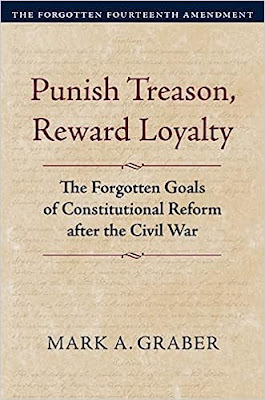
Mark A. Graber, Punish Treason, Reward Loyalty: The Forgotten Goals of Constitutional Reform after the Civil War (University of Kansas Press, 2023)
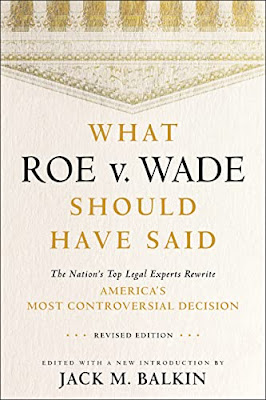
Jack M. Balkin, What Roe v. Wade Should Have Said: The Nation's Top Legal Experts Rewrite America's Most Controversial Decision - Revised Edition (NYU Press, 2023)

Andrew Koppelman, Burning Down the House: How Libertarian Philosophy Was Corrupted by Delusion and Greed (St. Martin’s Press, 2022)

Gerard N. Magliocca, Washington's Heir: The Life of Justice Bushrod Washington (Oxford University Press, 2022)
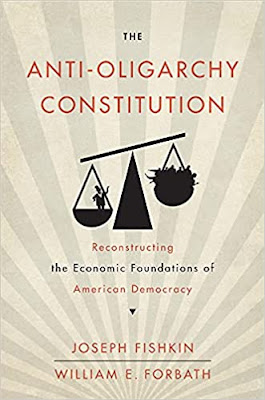
Joseph Fishkin and William E. Forbath, The Anti-Oligarchy Constitution: Reconstructing the Economic Foundations of American Democracy (Harvard University Press, 2022)
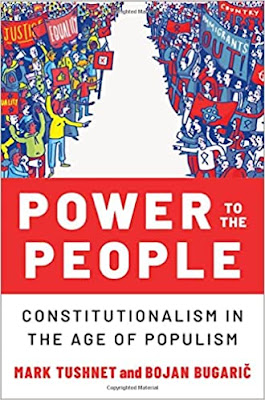
Mark Tushnet and Bojan Bugaric, Power to the People: Constitutionalism in the Age of Populism (Oxford University Press 2021).

Mark Philip Bradley and Mary L. Dudziak, eds., Making the Forever War: Marilyn B. Young on the Culture and Politics of American Militarism Culture and Politics in the Cold War and Beyond (University of Massachusetts Press, 2021).

Jack M. Balkin, What Obergefell v. Hodges Should Have Said: The Nation's Top Legal Experts Rewrite America's Same-Sex Marriage Decision (Yale University Press, 2020)

Frank Pasquale, New Laws of Robotics: Defending Human Expertise in the Age of AI (Belknap Press, 2020)

Jack M. Balkin, The Cycles of Constitutional Time (Oxford University Press, 2020)

Mark Tushnet, Taking Back the Constitution: Activist Judges and the Next Age of American Law (Yale University Press 2020).

Andrew Koppelman, Gay Rights vs. Religious Liberty?: The Unnecessary Conflict (Oxford University Press, 2020)

Ezekiel J Emanuel and Abbe R. Gluck, The Trillion Dollar Revolution: How the Affordable Care Act Transformed Politics, Law, and Health Care in America (PublicAffairs, 2020)

Linda C. McClain, Who's the Bigot?: Learning from Conflicts over Marriage and Civil Rights Law (Oxford University Press, 2020)
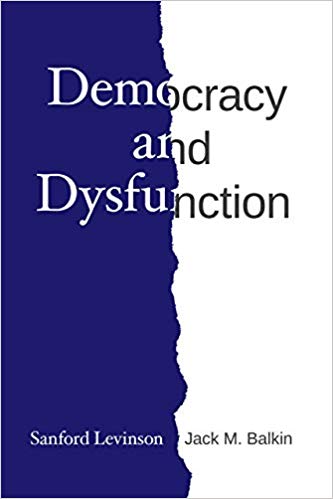
Sanford Levinson and Jack M. Balkin, Democracy and Dysfunction (University of Chicago Press, 2019)

Sanford Levinson, Written in Stone: Public Monuments in Changing Societies (Duke University Press 2018)

Mark A. Graber, Sanford Levinson, and Mark Tushnet, eds., Constitutional Democracy in Crisis? (Oxford University Press 2018)

Gerard Magliocca, The Heart of the Constitution: How the Bill of Rights became the Bill of Rights (Oxford University Press, 2018)

Cynthia Levinson and Sanford Levinson, Fault Lines in the Constitution: The Framers, Their Fights, and the Flaws that Affect Us Today (Peachtree Publishers, 2017)

Brian Z. Tamanaha, A Realistic Theory of Law (Cambridge University Press 2017)

Sanford Levinson, Nullification and Secession in Modern Constitutional Thought (University Press of Kansas 2016)

Sanford Levinson, An Argument Open to All: Reading The Federalist in the 21st Century (Yale University Press 2015)

Stephen M. Griffin, Broken Trust: Dysfunctional Government and Constitutional Reform (University Press of Kansas, 2015)

Frank Pasquale, The Black Box Society: The Secret Algorithms That Control Money and Information (Harvard University Press, 2015)

Bruce Ackerman, We the People, Volume 3: The Civil Rights Revolution (Harvard University Press, 2014)
Balkinization Symposium on We the People, Volume 3: The Civil Rights Revolution

Joseph Fishkin, Bottlenecks: A New Theory of Equal Opportunity (Oxford University Press, 2014)

Mark A. Graber, A New Introduction to American Constitutionalism (Oxford University Press, 2013)

John Mikhail, Elements of Moral Cognition: Rawls' Linguistic Analogy and the Cognitive Science of Moral and Legal Judgment (Cambridge University Press, 2013)

Gerard N. Magliocca, American Founding Son: John Bingham and the Invention of the Fourteenth Amendment (New York University Press, 2013)

Stephen M. Griffin, Long Wars and the Constitution (Harvard University Press, 2013)

Andrew Koppelman, The Tough Luck Constitution and the Assault on Health Care Reform (Oxford University Press, 2013)

James E. Fleming and Linda C. McClain, Ordered Liberty: Rights, Responsibilities, and Virtues (Harvard University Press, 2013)
Balkinization Symposium on Ordered Liberty: Rights, Responsibilities, and Virtues

Andrew Koppelman, Defending American Religious Neutrality (Harvard University Press, 2013)

Brian Z. Tamanaha, Failing Law Schools (University of Chicago Press, 2012)

Sanford Levinson, Framed: America's 51 Constitutions and the Crisis of Governance (Oxford University Press, 2012)

Linda C. McClain and Joanna L. Grossman, Gender Equality: Dimensions of Women's Equal Citizenship (Cambridge University Press, 2012)

Mary Dudziak, War Time: An Idea, Its History, Its Consequences (Oxford University Press, 2012)

Jack M. Balkin, Living Originalism (Harvard University Press, 2011)

Jason Mazzone, Copyfraud and Other Abuses of Intellectual Property Law (Stanford University Press, 2011)

Richard W. Garnett and Andrew Koppelman, First Amendment Stories, (Foundation Press 2011)

Jack M. Balkin, Constitutional Redemption: Political Faith in an Unjust World (Harvard University Press, 2011)

Gerard Magliocca, The Tragedy of William Jennings Bryan: Constitutional Law and the Politics of Backlash (Yale University Press, 2011)

Bernard Harcourt, The Illusion of Free Markets: Punishment and the Myth of Natural Order (Harvard University Press, 2010)

Bruce Ackerman, The Decline and Fall of the American Republic (Harvard University Press, 2010)
Balkinization Symposium on The Decline and Fall of the American Republic

Ian Ayres. Carrots and Sticks: Unlock the Power of Incentives to Get Things Done (Bantam Books, 2010)

Mark Tushnet, Why the Constitution Matters (Yale University Press 2010)

Ian Ayres and Barry Nalebuff: Lifecycle Investing: A New, Safe, and Audacious Way to Improve the Performance of Your Retirement Portfolio (Basic Books, 2010)
.jpg)
Jack M. Balkin, The Laws of Change: I Ching and the Philosophy of Life (2d Edition, Sybil Creek Press 2009)

Brian Z. Tamanaha, Beyond the Formalist-Realist Divide: The Role of Politics in Judging (Princeton University Press 2009)
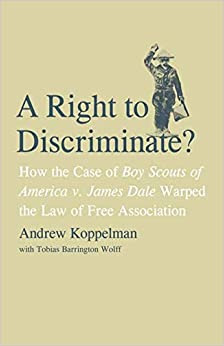
Andrew Koppelman and Tobias Barrington Wolff, A Right to Discriminate?: How the Case of Boy Scouts of America v. James Dale Warped the Law of Free Association (Yale University Press 2009)

Jack M. Balkin and Reva B. Siegel, The Constitution in 2020 (Oxford University Press 2009)

Heather K. Gerken, The Democracy Index: Why Our Election System Is Failing and How to Fix It (Princeton University Press 2009)

Mary Dudziak, Exporting American Dreams: Thurgood Marshall's African Journey (Oxford University Press 2008)

David Luban, Legal Ethics and Human Dignity (Cambridge Univ. Press 2007)

Ian Ayres, Super Crunchers: Why Thinking-By-Numbers is the New Way to be Smart (Bantam 2007)

Jack M. Balkin, James Grimmelmann, Eddan Katz, Nimrod Kozlovski, Shlomit Wagman and Tal Zarsky, eds., Cybercrime: Digital Cops in a Networked Environment (N.Y.U. Press 2007)
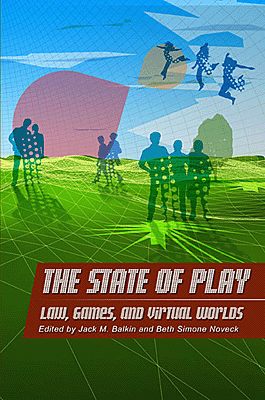
Jack M. Balkin and Beth Simone Noveck, The State of Play: Law, Games, and Virtual Worlds (N.Y.U. Press 2006)

Andrew Koppelman, Same Sex, Different States: When Same-Sex Marriages Cross State Lines (Yale University Press 2006)

Brian Tamanaha, Law as a Means to an End (Cambridge University Press 2006)

Sanford Levinson, Our Undemocratic Constitution (Oxford University Press 2006)

Mark Graber, Dred Scott and the Problem of Constitutional Evil (Cambridge University Press 2006)

Jack M. Balkin, ed., What Roe v. Wade Should Have Said (N.Y.U. Press 2005)

Sanford Levinson, ed., Torture: A Collection (Oxford University Press 2004)
Balkin.com homepage
Bibliography
Conlaw.net
Cultural Software
Writings
Opeds
The Information Society Project
BrownvBoard.com
Useful Links
Syllabi and Exams
