Balkinization
an unanticipated consequence of
Jack M. Balkin
Balkinization Symposiums: A Continuing List
E-mail:
Jack Balkin:
jackbalkin at yahoo.com
Bruce Ackerman
bruce.ackerman at yale.edu
Ian Ayres
ian.ayres at yale.edu
Corey Brettschneider
corey_brettschneider at brown.edu
Mary Dudziak
mary.l.dudziak at emory.edu
Joey Fishkin
joey.fishkin at gmail.com
Heather Gerken heather.gerken at yale.edu
Abbe Gluck abbe.gluck at yale.edu
Mark Graber
mgraber at law.umaryland.edu
Stephen Griffin
sgriffin at tulane.edu
Jonathan Hafetz
jonathan.hafetz at shu.edu
Jeremy Kessler
jkessler at law.columbia.edu
Andrew Koppelman
akoppelman at law.northwestern.edu
Marty Lederman
msl46 at law.georgetown.edu
Sanford Levinson
slevinson at law.utexas.edu
David Luban
david.luban at gmail.com
Gerard Magliocca
gmaglioc at iupui.edu
Jason Mazzone
mazzonej at illinois.edu
Linda McClain
lmcclain at bu.edu
John Mikhail
mikhail at law.georgetown.edu
Frank Pasquale
pasquale.frank at gmail.com
Nate Persily
npersily at gmail.com
Michael Stokes Paulsen
michaelstokespaulsen at gmail.com
Deborah Pearlstein
dpearlst at yu.edu
Rick Pildes
rick.pildes at nyu.edu
David Pozen
dpozen at law.columbia.edu
Richard Primus
raprimus at umich.edu
K. Sabeel Rahmansabeel.rahman at brooklaw.edu
Alice Ristroph
alice.ristroph at shu.edu
Neil Siegel
siegel at law.duke.edu
David Super
david.super at law.georgetown.edu
Brian Tamanaha
btamanaha at wulaw.wustl.edu
Nelson Tebbe
nelson.tebbe at brooklaw.edu
Mark Tushnet
mtushnet at law.harvard.edu
Adam Winkler
winkler at ucla.edu
Compendium of posts on Hobby Lobby and related cases
The Anti-Torture Memos: Balkinization Posts on Torture, Interrogation, Detention, War Powers, and OLC
The Anti-Torture Memos (arranged by topic)
Recent Posts
“Adaptability” as a constitutional norm (and problem): Reflections on a Skowronekian Constitution
![[Powered by Blogger]](https://lh3.googleusercontent.com/blogger_img_proxy/AEn0k_vpN2EClLGysumRMzORLu2VYlvYu1GhltPu0aBr8BYvyUqduSOuwD7Vhey6ofEYmORZBP7WnUH_sIidESBlFanNydv7zG3ZkV6inF1w9VP0=s0-d)
Just A Few Blogs
ACS Blog
Alas, a Blog
Althouse
Arts and Letters Daily
Atrios (Eschaton)
Bill of Health
Buzzflash.com
Buzz Machine
Cato at Liberty
Juan Cole (Informed Comment)
Concurring Opinions
The Constitution in 2020
Corrente
Crooked Timber
Daily Howler
Daily Kos
Dana Boyd
Brad DeLong
Digby (Hullabaloo)
Discriminations
Daniel Drezner
Kevin Drum (Mother Jones)
Electrolite
En Banc
Eunomia (Daniel Larison)
Fafblog
Michael Froomkin (Discourse.net)
GovLab (Beth Noveck)
Rick Hasen (Election Law)
History News Network
How Appealing
Ignatz (Sam Heldman)
The Importance of (Ernie Miller)
Infolaw
Instapundit
International Economic Law and Policy Blog
IntLawGrrls
Jacob Levy
Jesus' General
Jurisdynamics
The Kitchen Cabinet
Mark Kleiman
Law Blog Central
Larry Lessig
Lawyers, Guns and Money
Liberal Oasis
Brian Leiter's Law School Reports
The Leiter Reports
Marginal Revolution
Megan McArdle
Memeorandum
Metafilter
Mirror of Justice
The New Republic
Newseum
No More Mister Nice Blog
Brendan Nyhan
Opinio Juris
Orcinus
The Originalism Blog
Pandagon
Passport (Foreign Policy)
Overcoming Bias
Political Animal (Washington Monthly)
Political Theory Daily Review
Political Wire (Taegan Goddard)
The Poor Man
Virginia Postrel
Prawfsblawg
Public Reason
Jonathan Rauch
Raw Story
Redstate
ReligiousLeftLaw.com
Reporters Committee For Freedom of the Press
Reproductive Rights Blog
Rothman's Roadmap to the Right of Publicity
SCOTUS Blog
Seeing the Forest
Clay Shirky
The Shifted Librarian
The Situationist
Larry Solum (Legal Theory)
Andrew Sullivan
Talking Points Memo
Talk Left
Tapped
Tbogg
TechPresident
The Paper Chase (Jurist)
Tom Paine
Tom Tomorrow (This Modern World)
Eve Tushnet
Uggabugga
University of Chicago Law School Faculty Blog
Unqualified Offerings
The Volokh Conspiracy
War and Piece (Laura Rozen)
Wampum
Oliver Willis
Wonkette
Written Description
Matthew Yglesias
Yin
Your Choice of Feeds
1. XML
powered by

2. Atom Feed
3. RSS 2.0
“Adaptability” as a constitutional norm (and problem): Reflections on a Skowronekian Constitution
Sandy Levinson
For the Balkinization symposium on Stephen Skowronek, The Adaptability Paradox: Political Inclusion and Constitutional Resilience (University of Chicago Press, 2025). There is much that one can say
about Stephen Skowronek’s important new book, which I read in manuscript and
immediately began assigning, in part, to courses I taught on reforming the
United States Constitution at the Harvard Law School. One of its many virtues is its accessibility
to all potential audiences. It deserves
a wide readership and, more to the point, discussion. What I want to do here is to focus very
closely on the title of the book: The Adaptability Paradox: Political Inclusion and Constituitonal Resilience.
The “paradox” he points to suggests some very disturbing features of
American constitutionalism from its outset to the present day. It is becoming ever more clear that
the United States, at its founding moment(s), whether 1619, 1776, 1787, or even
1868, could hardly be described as a “democracy” under even capacious 21st
century notions of that term. The United
States is well described as a “herrenvolk democracy” for much of our
history. As Mark Graber has demonstrated
in a forthcoming essay addressing the “democratic decline” within the United
States, one should recognize that most of American history features attempts by
ruling elites to resist the democratic impulse, save perhaps those linked with
white males. So the present “democratic
decline” should be dated from 1970 or so, when, for the first time in our
history, one might plausibly describe the United States as a “democracy.” And much of American domestic politics should
be understood as the bitter conflict between those who applauded the
developments of the 1960s and those determined to resist them and, if possible,
roll them back. With regard to “inclusion,” begin
only with the notion of “universal” suffrage and the degree to which that
requires accepting the “adaptability” it signifies . Even if one recognizes that no rational
person would support truly “universal” suffrage—think only of
five-year-olds!—the notion is now a “term of art” referring to the absence of
restrictions based on race, gender, religion, and class. (Age, as already noted, is something
else.) All, of course, were present in
18th century America and some survived well into the 20th
century. Akhil Reed Amar may be correct
that the elections for delegates to the state ratifying conventions in 1787-88
were the most “democratic” in world history up to that point, but that only
underscores the relative recency in world history of the concept of “government
by the people” (as distinguished, say, from “government for the
people, itself also a break from earlier notions of class rule). “Government” in 1787 America was clearly
limited to rule by white men, almost all of them, practically speaking,
Protestant and propertied. Eighty years
later, the Congress that proposed the 15th Amendment rejected a
proposal that the ban on racial limitations be extended to the ability to serve
in office; it was a hard sell for many even to agree to suspending that bar for
the basic right to vote. And, of course,
in too many ways the Amendment simply became what Madison had earlier called a
“parchment barrier,” to be breached by “legal” mechanisms like poll taxes or
literacy tests, as well as overt intimidation and violence. Only with the passage of the now-being-gutted
Voting Rights Act of 1965 did “universal suffrage” with regard to race become even
close to an actuality in the United States.
We should also remember that many female suffragists opposed both the
Fourteenth and Fifteenth Amendments because their proponents (and the texts)
simply disregarded the fact of women’s being excluded from participation in
their own governance. That came along
only in 1920. Moreover,
whatever the remarkable diversity of American life even from the beginning,
however dated, it has only increased in my own lifetime. I was born in 194 under the continuing regime
of the 1924 immigration act that functionally prevented few other than Northern
Europeans from entering the country.
The United States certainly did not cover itself with glory with regard
to welcoming Jews (and others) driven away from Germany in the 1930s. All of us are well aware of the importance of
the Civil Rights Act of 1964 and the Voting Rights Act of 1965. But equal attention should be paid to the
repeal of the 1924 Act in 1965, which opened American borders—and generated a
host of issues surrounding the notion of “inclusion”—as had never been the case
before. Europe as a source of immigrants
was quickly supplanted by Mexico and Latin America, as well as by Asia and
Africa. What
all of this means is that many of the central issues of American politics,
including their constitutional dimensions, involve the degree to which a
decidedly non-homogeneous populace of immigrants, who upon attaining
citizenship also become voters participating in the process of self-governance,
will be genuinely included (and welcomed) rather than being viewed as sources
of disruption and, indeed, danger to preserving some notion of a “real America”
based on ascriptive identity. Rogers
Smith in his invaluable book Civic Ideals identified the tension, from
the beginning, between a universalistic liberalism that talked the language of
natural rights enjoyed by all human beings, who were ostensibly equal—this is
the optimistic reading of the Declaration of Independence—and a distinctly
non-liberal tradition based on “ascriptive” identity. Whether it’s true that for every
universalistic liberal, there was a JD Vance speaking the language of blood and
soil (and, usually, religion), that has been a continuing battle, both
intellectual and, not infrequently, quite literal, in American life. One should recall that important elements of
the Republican Party that elected Abraham Lincoln came from the rabidly anti-immigrant
Know Nothing Party. And one should also
remember that Lincoln, who genuinely hated slavery, was also an avid supporter
of the American Colonization Society and, as late as 1862, was still entreaties
Black notables in Washington to lead what Mitt Romney might have called a
movement of “voluntary self-deportation” to Panama (or Haiti, Liberia, or ….)
rather than remain in the United States.
In this Lincoln emulated Thomas Jefferson, who justified his lack of any
action with regard to ending slavery on the basis that he could not envision a
post-enslavement United States that required Blacks and whites to live together
in harmony. Those
attracted to “family metaphors” in politics, such as references to the
“American family,” might imagine the the “adaptability” issues that are
presented by what we still often call “intermarriage,” whether racial, ethnic,
or religious. Strongly Orthodox Jews,
for example, respond to what sociologists term exogenous marriages by saying
Kaddish, the prayer for the dead, for the miscreant out-marrier. No doubt there are similar responses in some
other religious communities. A staple of
literature is a child being “disowned” by parents for violating parental
assumptions about proper marriage partners.
“Adaptation” to frustrated expectations may be difficult if one lives
within a belief system that privileges homogeneity (or various hierarchies
within non-homogenous orders). What is
true at the “micro-stage” of family relations can obviously take place at the
macro-level of societies and particularly those states that conceive of
themselves as “nation-states” that, by definition, involve shared attributes
other than the coincidence of sharing territorial membership. Some
families, of course, do display “resilience.”
The minimal criterion is what might be called toleration and acceptance,
even if not complete emotional acceptance.
Beyond that, of course, is perhaps what Nietzsche might have called
“transvaluation” in which a family that had previously cherished its
homogeneity now develops a genuine appreciation for pluralism and
diversity. George H. W. Bush was,
perhaps, speaking with typical awkwardness when he referred to his “Mexican
granddaughter,” the child of Jeb Bush and his Mexican-American wife, but there
appeared to be little doubt that the patrician Bush genuinely cherished his
progeny. All of
this being recognized, we should acknowledge that “resilience” is easier for
some than for others, and it is therefore not surprising that a country built
on a multi-century legacy of proclaimed homogeneity and superiority would have
trouble adapting to, and even more certainly cheerfully accepting, a
significantly new reality. I very often quote the following passage
from John Jay’s Federalist 2, who expressed his great “pleasure” that Providence has been pleased to give this one
connected country to one united people--a people descended from the same
ancestors, speaking the same language, professing the same religion, attached
to the same principles of government, very similar in their manners and
customs, and who, by their joint counsels, arms, and efforts, fighting side by
side throughout a long and bloody war, have nobly established general liberty
and independence. I also always note not only that Jay was a notably
intelligent member of the Founding generation—he would go on to become the
country’s first Chief Justice of the United States Supreme Court, which he left
to serve as governor of New York—but also that, as a New Yorker, he was most
certainly aware that the Constitution had quickly been translated after its
public debut in September 1787 into Dutch so that the descendants of those
families who had settled New Amsterdam (before its being conquered by the British
and renamed after the Duke of York) could understand it and decide, when voting
for delegates to the state ratifying convention, whom to support as between its
proponents (like Jay) and opponents. He
probably knew as well that it had been translated into German for the benefit
of the roughly one-third of that state’s population who, to the consternation
of Benjamin Franklin, continued to speak their native language and seemed
reluctance to assimilate into a Pennsylvania culture dominated by those who identified
with Great Britain. One might
hypothesize that Jay wrote what he himself had to recognize as a remarkably
tendentious and inaccurate description of the actualities of America in 1787
because he realized that the Constitution would be a much harder sell, in New
York and elsewhere, if he forthrightly acknowledged that it was establishing a
polity in which a newly empowered central government would have vast new powers
over every single member of the ostensibly singular “People” in whose name the
Constitution was being “ordained.”
Agrippa, an anti-Federalist from Massachusetts, expressed his deep
skepticism that a single government could establish genuinely legitimate rule
over the “peoples” spread out from what is now Maine to the southern border of
Georgia. Even if enslavement had not so
obviously divided the United States and created a “house divided” that would
ultimately destroy the existing Union, there were many other differences that
might challenge one’s appetite for “inclusion.”
Massachusetts had, of course, earlier driving Roger Williams out of the
state to what became Rhode Island, as well as hanging four Quakers for their
heresy. Not surprisingly, Massachusetts
maintained an established (Congregational) church until 1833. One plausible way to read the First
Amendment’s ban on established religion is as limiting Congress’s power
to interfere with the various religious preferences or establishments that were
still present when the Amendment was added to the Constitution in 1791. It is a
reality of American political life in 2026 that we continue to be rent not only
by racial and ethnic cleavages, but also by a fundamental cleavage between
those who yearn for a “Christian Nationalist” America—like predecessors who
supported overtly amending the Constitution by declaring the United States to
be a “Christian Nation”—and those who are basically horrified by such a
vision. This latter group ranges from
full-blown secularists to Christians like, say, New York Times columnist David
French who continue to support a strong separation between church and
state. Skowronek
introduces the “adaptability paradox” as follows (p. 23): Each breakthrough projected the priority of
inclusion onto a framework built to accommodate a more restricted range of
participants, and each successive adaptation to democratization has had to
reach farther afield to rationalize new governing arrangements. The text abides beside a long history of
development that has pressed the boundaries of constitutional plausibility and
political credibility. The “paradox” is perhaps that we as a society envision the
Constitution as the foundation not only of unity, but also as stability through
time. Thus the allure of what some of us
regard as a patently indefensible notion of “originalism” that fixes the
Constitution’s meaning in the dictionaries published either at the turn of the
19th century or, for some, 1868.
Antonin Scalia proudly defended a “dead” Constitution because the very
idea of a “living Constitution” seemed to challenge why we might want a constitution
in the first place, which was to tie us down, to supply what Jefferson called
“chains” that would prevent us from violating its commands or breaching its
limits. “Adaptability” was not Scalia’s
priority! But John Marshall was
certainly correct when he wrote, in McCulloch v. Maryland, that we must
never forget that the Constitution was “designed to endure,” and that such
endurance was possible only so long as “it was adapted to the various crises of
human affairs.” That sentence itself
continues to be of enduring importance, and insofar as various sorts of
“inclusions” are viewed as among the “crises” facing the United States, it will
capture a fundamental feature of American political debate and concrete
political actions.
Posted
9:30 AM
by Sandy Levinson [link]
Books by Balkinization Bloggers

Mark Tushnet and Bojan Bugaric, Constitutionalism and Its Discontents (University of Chicago Press, 2026)

Gerard N. Magliocca, The Actual Art of Governing: Justice Robert H. Jackson's Concurring Opinion in the Steel Seizure Case (Oxford University Press, 2025)

Linda C. McClain and Aziza Ahmed, The Routledge Companion to Gender and COVID-19 (Routledge, 2024)

David Pozen, The Constitution of the War on Drugs (Oxford University Press, 2024)

Jack M. Balkin, Memory and Authority: The Uses of History in Constitutional Interpretation (Yale University Press, 2024)
Mark A. Graber, Punish Treason, Reward Loyalty: The Forgotten Goals of Constitutional Reform after the Civil War (University of Kansas Press, 2023)
Jack M. Balkin, What Roe v. Wade Should Have Said: The Nation's Top Legal Experts Rewrite America's Most Controversial Decision - Revised Edition (NYU Press, 2023)

Andrew Koppelman, Burning Down the House: How Libertarian Philosophy Was Corrupted by Delusion and Greed (St. Martin’s Press, 2022)

Gerard N. Magliocca, Washington's Heir: The Life of Justice Bushrod Washington (Oxford University Press, 2022)
Joseph Fishkin and William E. Forbath, The Anti-Oligarchy Constitution: Reconstructing the Economic Foundations of American Democracy (Harvard University Press, 2022)
Mark Tushnet and Bojan Bugaric, Power to the People: Constitutionalism in the Age of Populism (Oxford University Press 2021).

Mark Philip Bradley and Mary L. Dudziak, eds., Making the Forever War: Marilyn B. Young on the Culture and Politics of American Militarism Culture and Politics in the Cold War and Beyond (University of Massachusetts Press, 2021).

Jack M. Balkin, What Obergefell v. Hodges Should Have Said: The Nation's Top Legal Experts Rewrite America's Same-Sex Marriage Decision (Yale University Press, 2020)

Frank Pasquale, New Laws of Robotics: Defending Human Expertise in the Age of AI (Belknap Press, 2020)

Jack M. Balkin, The Cycles of Constitutional Time (Oxford University Press, 2020)

Mark Tushnet, Taking Back the Constitution: Activist Judges and the Next Age of American Law (Yale University Press 2020).

Andrew Koppelman, Gay Rights vs. Religious Liberty?: The Unnecessary Conflict (Oxford University Press, 2020)

Ezekiel J Emanuel and Abbe R. Gluck, The Trillion Dollar Revolution: How the Affordable Care Act Transformed Politics, Law, and Health Care in America (PublicAffairs, 2020)

Linda C. McClain, Who's the Bigot?: Learning from Conflicts over Marriage and Civil Rights Law (Oxford University Press, 2020)
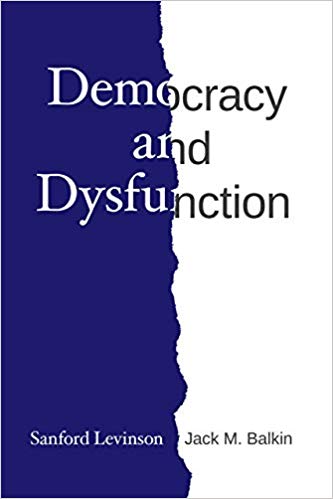
Sanford Levinson and Jack M. Balkin, Democracy and Dysfunction (University of Chicago Press, 2019)

Sanford Levinson, Written in Stone: Public Monuments in Changing Societies (Duke University Press 2018)

Mark A. Graber, Sanford Levinson, and Mark Tushnet, eds., Constitutional Democracy in Crisis? (Oxford University Press 2018)

Gerard Magliocca, The Heart of the Constitution: How the Bill of Rights became the Bill of Rights (Oxford University Press, 2018)

Cynthia Levinson and Sanford Levinson, Fault Lines in the Constitution: The Framers, Their Fights, and the Flaws that Affect Us Today (Peachtree Publishers, 2017)

Brian Z. Tamanaha, A Realistic Theory of Law (Cambridge University Press 2017)

Sanford Levinson, Nullification and Secession in Modern Constitutional Thought (University Press of Kansas 2016)

Sanford Levinson, An Argument Open to All: Reading The Federalist in the 21st Century (Yale University Press 2015)

Stephen M. Griffin, Broken Trust: Dysfunctional Government and Constitutional Reform (University Press of Kansas, 2015)

Frank Pasquale, The Black Box Society: The Secret Algorithms That Control Money and Information (Harvard University Press, 2015)

Bruce Ackerman, We the People, Volume 3: The Civil Rights Revolution (Harvard University Press, 2014)
Balkinization Symposium on We the People, Volume 3: The Civil Rights Revolution

Joseph Fishkin, Bottlenecks: A New Theory of Equal Opportunity (Oxford University Press, 2014)

Mark A. Graber, A New Introduction to American Constitutionalism (Oxford University Press, 2013)

John Mikhail, Elements of Moral Cognition: Rawls' Linguistic Analogy and the Cognitive Science of Moral and Legal Judgment (Cambridge University Press, 2013)

Gerard N. Magliocca, American Founding Son: John Bingham and the Invention of the Fourteenth Amendment (New York University Press, 2013)

Stephen M. Griffin, Long Wars and the Constitution (Harvard University Press, 2013)

Andrew Koppelman, The Tough Luck Constitution and the Assault on Health Care Reform (Oxford University Press, 2013)

James E. Fleming and Linda C. McClain, Ordered Liberty: Rights, Responsibilities, and Virtues (Harvard University Press, 2013)
Balkinization Symposium on Ordered Liberty: Rights, Responsibilities, and Virtues

Andrew Koppelman, Defending American Religious Neutrality (Harvard University Press, 2013)

Brian Z. Tamanaha, Failing Law Schools (University of Chicago Press, 2012)

Sanford Levinson, Framed: America's 51 Constitutions and the Crisis of Governance (Oxford University Press, 2012)

Linda C. McClain and Joanna L. Grossman, Gender Equality: Dimensions of Women's Equal Citizenship (Cambridge University Press, 2012)

Mary Dudziak, War Time: An Idea, Its History, Its Consequences (Oxford University Press, 2012)

Jack M. Balkin, Living Originalism (Harvard University Press, 2011)

Jason Mazzone, Copyfraud and Other Abuses of Intellectual Property Law (Stanford University Press, 2011)

Richard W. Garnett and Andrew Koppelman, First Amendment Stories, (Foundation Press 2011)

Jack M. Balkin, Constitutional Redemption: Political Faith in an Unjust World (Harvard University Press, 2011)

Gerard Magliocca, The Tragedy of William Jennings Bryan: Constitutional Law and the Politics of Backlash (Yale University Press, 2011)

Bernard Harcourt, The Illusion of Free Markets: Punishment and the Myth of Natural Order (Harvard University Press, 2010)

Bruce Ackerman, The Decline and Fall of the American Republic (Harvard University Press, 2010)
Balkinization Symposium on The Decline and Fall of the American Republic

Ian Ayres. Carrots and Sticks: Unlock the Power of Incentives to Get Things Done (Bantam Books, 2010)

Mark Tushnet, Why the Constitution Matters (Yale University Press 2010)

Ian Ayres and Barry Nalebuff: Lifecycle Investing: A New, Safe, and Audacious Way to Improve the Performance of Your Retirement Portfolio (Basic Books, 2010)
.jpg)
Jack M. Balkin, The Laws of Change: I Ching and the Philosophy of Life (2d Edition, Sybil Creek Press 2009)

Brian Z. Tamanaha, Beyond the Formalist-Realist Divide: The Role of Politics in Judging (Princeton University Press 2009)
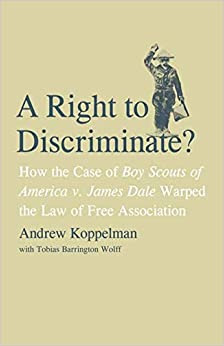
Andrew Koppelman and Tobias Barrington Wolff, A Right to Discriminate?: How the Case of Boy Scouts of America v. James Dale Warped the Law of Free Association (Yale University Press 2009)

Jack M. Balkin and Reva B. Siegel, The Constitution in 2020 (Oxford University Press 2009)

Heather K. Gerken, The Democracy Index: Why Our Election System Is Failing and How to Fix It (Princeton University Press 2009)

Mary Dudziak, Exporting American Dreams: Thurgood Marshall's African Journey (Oxford University Press 2008)

David Luban, Legal Ethics and Human Dignity (Cambridge Univ. Press 2007)

Ian Ayres, Super Crunchers: Why Thinking-By-Numbers is the New Way to be Smart (Bantam 2007)

Jack M. Balkin, James Grimmelmann, Eddan Katz, Nimrod Kozlovski, Shlomit Wagman and Tal Zarsky, eds., Cybercrime: Digital Cops in a Networked Environment (N.Y.U. Press 2007)
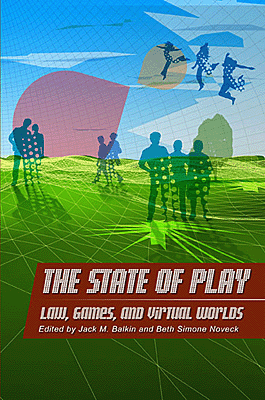
Jack M. Balkin and Beth Simone Noveck, The State of Play: Law, Games, and Virtual Worlds (N.Y.U. Press 2006)

Andrew Koppelman, Same Sex, Different States: When Same-Sex Marriages Cross State Lines (Yale University Press 2006)

Brian Tamanaha, Law as a Means to an End (Cambridge University Press 2006)

Sanford Levinson, Our Undemocratic Constitution (Oxford University Press 2006)

Mark Graber, Dred Scott and the Problem of Constitutional Evil (Cambridge University Press 2006)

Jack M. Balkin, ed., What Roe v. Wade Should Have Said (N.Y.U. Press 2005)

Sanford Levinson, ed., Torture: A Collection (Oxford University Press 2004)
Balkin.com homepage
Bibliography
Conlaw.net
Cultural Software
Writings
Opeds
The Information Society Project
BrownvBoard.com
Useful Links
Syllabi and Exams
