Balkinization
an unanticipated consequence of
Jack M. Balkin
Balkinization Symposiums: A Continuing List
E-mail:
Jack Balkin:
jackbalkin at yahoo.com
Bruce Ackerman
bruce.ackerman at yale.edu
Ian Ayres
ian.ayres at yale.edu
Corey Brettschneider
corey_brettschneider at brown.edu
Mary Dudziak
mary.l.dudziak at emory.edu
Joey Fishkin
joey.fishkin at gmail.com
Heather Gerken heather.gerken at yale.edu
Abbe Gluck abbe.gluck at yale.edu
Mark Graber
mgraber at law.umaryland.edu
Stephen Griffin
sgriffin at tulane.edu
Jonathan Hafetz
jonathan.hafetz at shu.edu
Jeremy Kessler
jkessler at law.columbia.edu
Andrew Koppelman
akoppelman at law.northwestern.edu
Marty Lederman
msl46 at law.georgetown.edu
Sanford Levinson
slevinson at law.utexas.edu
David Luban
david.luban at gmail.com
Gerard Magliocca
gmaglioc at iupui.edu
Jason Mazzone
mazzonej at illinois.edu
Linda McClain
lmcclain at bu.edu
John Mikhail
mikhail at law.georgetown.edu
Frank Pasquale
pasquale.frank at gmail.com
Nate Persily
npersily at gmail.com
Michael Stokes Paulsen
michaelstokespaulsen at gmail.com
Deborah Pearlstein
dpearlst at yu.edu
Rick Pildes
rick.pildes at nyu.edu
David Pozen
dpozen at law.columbia.edu
Richard Primus
raprimus at umich.edu
K. Sabeel Rahmansabeel.rahman at brooklaw.edu
Alice Ristroph
alice.ristroph at shu.edu
Neil Siegel
siegel at law.duke.edu
David Super
david.super at law.georgetown.edu
Brian Tamanaha
btamanaha at wulaw.wustl.edu
Nelson Tebbe
nelson.tebbe at brooklaw.edu
Mark Tushnet
mtushnet at law.harvard.edu
Adam Winkler
winkler at ucla.edu
Compendium of posts on Hobby Lobby and related cases
The Anti-Torture Memos: Balkinization Posts on Torture, Interrogation, Detention, War Powers, and OLC
The Anti-Torture Memos (arranged by topic)
Recent Posts
The Judicial Restoration(?) of Democracy
![[Powered by Blogger]](https://lh3.googleusercontent.com/blogger_img_proxy/AEn0k_tl4o1px6NjFF8r_pIcVHIr8OMWrz8H1z2PPoydcURkwSZARhesAR95DM76loB0t_XC4bA5tVvTAUkmeLfId02pTEPEUE_m4exxU5-AXvj-=s0-d)
Just A Few Blogs
ACS Blog
Alas, a Blog
Althouse
Arts and Letters Daily
Atrios (Eschaton)
Bill of Health
Buzzflash.com
Buzz Machine
Cato at Liberty
Juan Cole (Informed Comment)
Concurring Opinions
The Constitution in 2020
Corrente
Crooked Timber
Daily Howler
Daily Kos
Dana Boyd
Brad DeLong
Digby (Hullabaloo)
Discriminations
Daniel Drezner
Kevin Drum (Mother Jones)
Electrolite
En Banc
Eunomia (Daniel Larison)
Fafblog
Michael Froomkin (Discourse.net)
GovLab (Beth Noveck)
Rick Hasen (Election Law)
History News Network
How Appealing
Ignatz (Sam Heldman)
The Importance of (Ernie Miller)
Infolaw
Instapundit
International Economic Law and Policy Blog
IntLawGrrls
Jacob Levy
Jesus' General
Jurisdynamics
The Kitchen Cabinet
Mark Kleiman
Law Blog Central
Larry Lessig
Lawyers, Guns and Money
Liberal Oasis
Brian Leiter's Law School Reports
The Leiter Reports
Marginal Revolution
Megan McArdle
Memeorandum
Metafilter
Mirror of Justice
The New Republic
Newseum
No More Mister Nice Blog
Brendan Nyhan
Opinio Juris
Orcinus
The Originalism Blog
Pandagon
Passport (Foreign Policy)
Overcoming Bias
Political Animal (Washington Monthly)
Political Theory Daily Review
Political Wire (Taegan Goddard)
The Poor Man
Virginia Postrel
Prawfsblawg
Public Reason
Jonathan Rauch
Raw Story
Redstate
ReligiousLeftLaw.com
Reporters Committee For Freedom of the Press
Reproductive Rights Blog
Rothman's Roadmap to the Right of Publicity
SCOTUS Blog
Seeing the Forest
Clay Shirky
The Shifted Librarian
The Situationist
Larry Solum (Legal Theory)
Andrew Sullivan
Talking Points Memo
Talk Left
Tapped
Tbogg
TechPresident
The Paper Chase (Jurist)
Tom Paine
Tom Tomorrow (This Modern World)
Eve Tushnet
Uggabugga
University of Chicago Law School Faculty Blog
Unqualified Offerings
The Volokh Conspiracy
War and Piece (Laura Rozen)
Wampum
Oliver Willis
Wonkette
Written Description
Matthew Yglesias
Yin
Your Choice of Feeds
1. XML
powered by

2. Atom Feed
3. RSS 2.0
The Judicial Restoration(?) of Democracy
Guest Blogger
For the Balkinization Symposium on David Sloss, People v. The Court: The Next Revolution in Constitutional Law (Cambridge University Press, 2025). Mark Rush In
The People v. the Court, David Sloss has rolled several potentially
separate books into a single tour de force of the current, disappointing state of
American democracy and the role of the Supreme Court in fostering that
decline. He covers numerous topics,
including There are numerous other threads in
Sloss’s argument that are driven by his desire to return governing power to “We
the People.” He would do this by reining in judicial power, returning governing
power to the elected branches, and ensuring that the electoral process clearly translates the
popular will into governing authority that the people can hold accountable. In
the space of a short blog post, it is impossible to address the many aspects of
Sloss’s arguments. (I do this in more
detail in my more extensive review forthcoming in Constitutional Commentary). Accordingly, I will therefore address what I
regard as a meta-theme that, I think, embraces Sloss’s capacious work: the scope and definition of judicial (and, by extension, governmental) power in an era of extraordinary private power (exercised by tech firms, social media and powerful individuals) and unprecedented challenges (such as climate change and pandemics) to all governments.
Sloss’s
is a noble endeavor and his are noble goals.
However, in the end one wonders whether the Supreme Court has actually
had the power he suggests and whether it could exercise sufficient power to
repair the problems of American democracy.
On the one hand, he identifies particular decisions that pushed the
country towards the contemporary state of democracy in which it finds
itself. On the other, I wonder whether
the Supreme Court could have done much to stem the tide of democratization (or,
at least, deconcentration) of political power that characterized campaign reforms in the 1970s. No doubt, the court could have taken a
stronger stand against gerrymandering and supported congressional attempts to
constrain campaign spending by deciding cases such as Buckley v. Valeo,
Rucho v. Common Cause, Shelby County v. Holder, and
Citizens United differently. On the other, Congress certainly has had
and retains the power to respond to adverse Supreme Court decisions with new
legislation. Congress also could bring
pressure to bear against gerrymandering in the states. It is one of three coequal branches that has
the power to check and balance the other two.
But, Congress has not done so. David
suggests that we would have a better Congress if the court had rendered
decisions in a manner that strengthened the electoral process and enabled the
people to hold it more accountable. I do
wonder whether this would have made much difference. This is not to strike a nihilist tone.
Instead, I raise this doubt in the context of a constitutional system that does
constrain the power of the government.
By my lights, private power has amplified so rapidly and to such an
extent over the last half century that government actually finds itself in a
situation in which it needs to acquire or reacquire enough power to enable it
to control private actors and play referee among them. This power
shift has taken place outside the scope of the constitution in a political universe that is expanding and filling with financially-
and technologically enhanced private powers that rival those of the
government. With that in mind, I suggest
that David’s calls to return governmental control to “We the People” in the way
he hopes may be too late or, simply, manifest a vision of government that is
antiquated. Unless government gains tremendous
power relative to 1) private powers and 2) commensurate with the unprecedented
challenges facing the challenges of the 21st century, strengthening
democratic processes may prove meaningless if, in the end, the scope of
politics renders those democratic processes essentially performative. So,
I wonder how Sloss’s Supreme Court would be able to exercise enough power to control
congress and the private actors that clearly exercise disproportionate control
over elections and information. This is
a constitutional system grounded in the Madisonian vision of an extended
republic comprised of countless, competing factions. Somehow, Madison conceived that elected
officials would be able to separate themselves from and govern those factional
forces that put them into office. Sloss echoes
this. Accordingly,
he calls upon Congress to add teeth to the human rights treaties that it and
the Supreme Court could use to protect human rights: Congress could strengthen democratic control
over federal lawmaking, without weakening protection of human rights, by
removing the [non-self-executing] declarations from human rights treaties and
encouraging courts to apply those treaties, instead of applying the
Constitution, to protect fundamental rights. (134) Similarly, he envisions the creation
of a National Endowment for Fact-Checking (102) that, somehow, would be
insulated from factional influence and could therefore oversee the production
and dissemination of quality information for the electorate. But,
what force would change the mind of a Congress that already rendered such
treaties non-self-executing? What power
could that National Endowment exercise in a constitutional universe occupied by
social media platforms and private actors such as Elon Musk, Jeff Bezos, George
Soros, and others? National politics are
not affected by international and cyberforces. The
reforms of the nomination process, the weakening of political parties, the
evolution of campaign spending, and the advent of social media have so
decentralized political power that it is easy to draw a line from the early
1970s to the election of Donald Trump and the media and information landscape
that lacks any “epistemic authority” to check and filter information (98 ff.). Kathleen Bawn, et al. described this
democratized, privately-controlled politics in this way in 2012: interest
groups and activists are the key actors, and coalitions of groups develop
common agendas and screen candidates for party nominations based on loyalty to
their agendas. This theoretical stance contrasts with currently dominant
theories, which view parties as controlled by election-minded politicians. The
difference is normatively important because parties dominated by interest
groups and activists are less responsive to voter preferences, even to the
point of taking advantage of lapses in voter attention to politics.[1]
(2012) In such a system, elected officials
act as members of “cartels” that seek to perpetuate their time in office by
erecting barriers to entry from potential competitors.[2] Granted, Sloss calls upon the Court to abide
by Ely’s political process jurisprudence and break up cartel-like practices
such as gerrymandering, discriminatory campaign spending laws, and so
forth. But, to the extent that powerful
private actors can control the political process, they also have the capacity
to respond to judicial decisions that would undermine that control. Sloss hopes that the implementation of his suggestions would empower the
masses to control political elites by electing legislators who would ignore the
latter in favor of the former. Somehow,
the Supreme Court could render decisions that would bring this about. But, it is only the supreme Court—not
the supreme branch of government.
Sloss’s criticisms of the court’s assertions of interpretive supremacy
in Cooper v. Aaron and City of Boerne v. Flores
would seem to undermine one’s hopes that a stronger Supreme Court could control
the political forces that dominate the electoral and legislative process. While, I share his hopes, I do wonder whether
and how the Supreme Court could tap such a reservoir of power, exercise supreme
authority for a short time to rectify the democratic process, and then simply
cede that power in hopes that, somehow, private power would not return and
continue to grow as it has in the past 50 years. In
the end, I agree with much of Sloss’s diagnosis of what ails contemporary American
democracy. Alas, American democracy
manifests the same symptoms that characterize democratic “backsliding” around
the world. This is not a new phenomenon.
Fareed Zakaria detailed the rise of illiberal democracies more than a quarter
century ago.[3] The pandemic required governments to centralize
power[4] in
the face of one unprecedented global crisis while the looming threat of climate
change would, some say, justify the perpetuation of that same “creeping
authoritarianism” (7) Sloss decries.[5] Thus,
in a world characterized by unprecedented private power and challenges of
unprecedented global scope, one wonders whether a return to the democratic
vision Sloss sets forth is possible. It
may be the case that the world has advanced further along the spectrum ranging
from anarchy to authoritarianism than scholars care to acknowledge. If so, than a democratic vision such as
Sloss’s may prove to be anachronistic even if it is attainable. In such a world, recalibrating the balance of
power between courts and the elected branches will matter little if, together,
they do not have the capacity to address global threats and private power. Mark
Rush is Waxberg Professor of Politics and Law, Director of International
Education, Washington and Lee University. You can reach him by e-mail at rushm@wlu.edu. [1][1][1] Bawn, Kathleen, et
al. 2012. “A Theory of Political
Parties: Groups, Policy Demands and Nominations in American
Politics.” Perspectives on Politics
10: 571-597. [2] Katz, Richard S. and
Peter Mair. 1995. “Changing Models of
Party Organization and Party Democracy: the Emergence of the Cartel Party.”, Party
Politics 1: 5-31. [3] Zakaria, Fareed.
“The Rise of Illiberal Democracy” Foreign Affairs 76 (1999): 22-43. . [4] Riberi, Pablo, ed.
Pandemocracy in Latin American: Revisiting the Political and Constitutional
Dimension of the Pandemic. Bloomsbury.
Available: https://www.bloomsbury.com/in/pandemocracy-in-latin-america-9781509965281/
. Last Accessed 25 November 2025. [5] Mittiga, Ross. 2021.
“Political Legitimacy, Authoritarianism, and Climate Change.” 113 American
Political Science Review. Available: https://www.cambridge.org/core/journals/american-political-science-review/article/abs/political-legitimacy-authoritarianism-and-climate-change/E7391723A7E02FA6D536AC168377D2DE
Posted
9:30 AM
by Guest Blogger [link]
Books by Balkinization Bloggers

Mark Tushnet and Bojan Bugaric, Constitutionalism and Its Discontents (University of Chicago Press, 2026)

Gerard N. Magliocca, The Actual Art of Governing: Justice Robert H. Jackson's Concurring Opinion in the Steel Seizure Case (Oxford University Press, 2025)

Linda C. McClain and Aziza Ahmed, The Routledge Companion to Gender and COVID-19 (Routledge, 2024)

David Pozen, The Constitution of the War on Drugs (Oxford University Press, 2024)

Jack M. Balkin, Memory and Authority: The Uses of History in Constitutional Interpretation (Yale University Press, 2024)
Mark A. Graber, Punish Treason, Reward Loyalty: The Forgotten Goals of Constitutional Reform after the Civil War (University of Kansas Press, 2023)
Jack M. Balkin, What Roe v. Wade Should Have Said: The Nation's Top Legal Experts Rewrite America's Most Controversial Decision - Revised Edition (NYU Press, 2023)

Andrew Koppelman, Burning Down the House: How Libertarian Philosophy Was Corrupted by Delusion and Greed (St. Martin’s Press, 2022)

Gerard N. Magliocca, Washington's Heir: The Life of Justice Bushrod Washington (Oxford University Press, 2022)
Joseph Fishkin and William E. Forbath, The Anti-Oligarchy Constitution: Reconstructing the Economic Foundations of American Democracy (Harvard University Press, 2022)
Mark Tushnet and Bojan Bugaric, Power to the People: Constitutionalism in the Age of Populism (Oxford University Press 2021).

Mark Philip Bradley and Mary L. Dudziak, eds., Making the Forever War: Marilyn B. Young on the Culture and Politics of American Militarism Culture and Politics in the Cold War and Beyond (University of Massachusetts Press, 2021).

Jack M. Balkin, What Obergefell v. Hodges Should Have Said: The Nation's Top Legal Experts Rewrite America's Same-Sex Marriage Decision (Yale University Press, 2020)

Frank Pasquale, New Laws of Robotics: Defending Human Expertise in the Age of AI (Belknap Press, 2020)

Jack M. Balkin, The Cycles of Constitutional Time (Oxford University Press, 2020)

Mark Tushnet, Taking Back the Constitution: Activist Judges and the Next Age of American Law (Yale University Press 2020).

Andrew Koppelman, Gay Rights vs. Religious Liberty?: The Unnecessary Conflict (Oxford University Press, 2020)

Ezekiel J Emanuel and Abbe R. Gluck, The Trillion Dollar Revolution: How the Affordable Care Act Transformed Politics, Law, and Health Care in America (PublicAffairs, 2020)

Linda C. McClain, Who's the Bigot?: Learning from Conflicts over Marriage and Civil Rights Law (Oxford University Press, 2020)
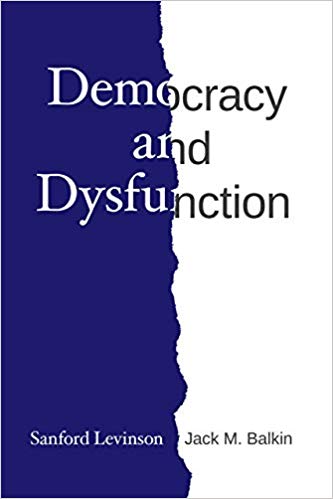
Sanford Levinson and Jack M. Balkin, Democracy and Dysfunction (University of Chicago Press, 2019)

Sanford Levinson, Written in Stone: Public Monuments in Changing Societies (Duke University Press 2018)

Mark A. Graber, Sanford Levinson, and Mark Tushnet, eds., Constitutional Democracy in Crisis? (Oxford University Press 2018)

Gerard Magliocca, The Heart of the Constitution: How the Bill of Rights became the Bill of Rights (Oxford University Press, 2018)

Cynthia Levinson and Sanford Levinson, Fault Lines in the Constitution: The Framers, Their Fights, and the Flaws that Affect Us Today (Peachtree Publishers, 2017)

Brian Z. Tamanaha, A Realistic Theory of Law (Cambridge University Press 2017)

Sanford Levinson, Nullification and Secession in Modern Constitutional Thought (University Press of Kansas 2016)

Sanford Levinson, An Argument Open to All: Reading The Federalist in the 21st Century (Yale University Press 2015)

Stephen M. Griffin, Broken Trust: Dysfunctional Government and Constitutional Reform (University Press of Kansas, 2015)

Frank Pasquale, The Black Box Society: The Secret Algorithms That Control Money and Information (Harvard University Press, 2015)

Bruce Ackerman, We the People, Volume 3: The Civil Rights Revolution (Harvard University Press, 2014)
Balkinization Symposium on We the People, Volume 3: The Civil Rights Revolution

Joseph Fishkin, Bottlenecks: A New Theory of Equal Opportunity (Oxford University Press, 2014)

Mark A. Graber, A New Introduction to American Constitutionalism (Oxford University Press, 2013)

John Mikhail, Elements of Moral Cognition: Rawls' Linguistic Analogy and the Cognitive Science of Moral and Legal Judgment (Cambridge University Press, 2013)

Gerard N. Magliocca, American Founding Son: John Bingham and the Invention of the Fourteenth Amendment (New York University Press, 2013)

Stephen M. Griffin, Long Wars and the Constitution (Harvard University Press, 2013)

Andrew Koppelman, The Tough Luck Constitution and the Assault on Health Care Reform (Oxford University Press, 2013)

James E. Fleming and Linda C. McClain, Ordered Liberty: Rights, Responsibilities, and Virtues (Harvard University Press, 2013)
Balkinization Symposium on Ordered Liberty: Rights, Responsibilities, and Virtues

Andrew Koppelman, Defending American Religious Neutrality (Harvard University Press, 2013)

Brian Z. Tamanaha, Failing Law Schools (University of Chicago Press, 2012)

Sanford Levinson, Framed: America's 51 Constitutions and the Crisis of Governance (Oxford University Press, 2012)

Linda C. McClain and Joanna L. Grossman, Gender Equality: Dimensions of Women's Equal Citizenship (Cambridge University Press, 2012)

Mary Dudziak, War Time: An Idea, Its History, Its Consequences (Oxford University Press, 2012)

Jack M. Balkin, Living Originalism (Harvard University Press, 2011)

Jason Mazzone, Copyfraud and Other Abuses of Intellectual Property Law (Stanford University Press, 2011)

Richard W. Garnett and Andrew Koppelman, First Amendment Stories, (Foundation Press 2011)

Jack M. Balkin, Constitutional Redemption: Political Faith in an Unjust World (Harvard University Press, 2011)

Gerard Magliocca, The Tragedy of William Jennings Bryan: Constitutional Law and the Politics of Backlash (Yale University Press, 2011)

Bernard Harcourt, The Illusion of Free Markets: Punishment and the Myth of Natural Order (Harvard University Press, 2010)

Bruce Ackerman, The Decline and Fall of the American Republic (Harvard University Press, 2010)
Balkinization Symposium on The Decline and Fall of the American Republic

Ian Ayres. Carrots and Sticks: Unlock the Power of Incentives to Get Things Done (Bantam Books, 2010)

Mark Tushnet, Why the Constitution Matters (Yale University Press 2010)

Ian Ayres and Barry Nalebuff: Lifecycle Investing: A New, Safe, and Audacious Way to Improve the Performance of Your Retirement Portfolio (Basic Books, 2010)
.jpg)
Jack M. Balkin, The Laws of Change: I Ching and the Philosophy of Life (2d Edition, Sybil Creek Press 2009)

Brian Z. Tamanaha, Beyond the Formalist-Realist Divide: The Role of Politics in Judging (Princeton University Press 2009)
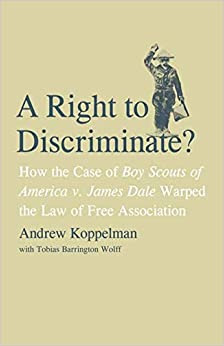
Andrew Koppelman and Tobias Barrington Wolff, A Right to Discriminate?: How the Case of Boy Scouts of America v. James Dale Warped the Law of Free Association (Yale University Press 2009)

Jack M. Balkin and Reva B. Siegel, The Constitution in 2020 (Oxford University Press 2009)

Heather K. Gerken, The Democracy Index: Why Our Election System Is Failing and How to Fix It (Princeton University Press 2009)

Mary Dudziak, Exporting American Dreams: Thurgood Marshall's African Journey (Oxford University Press 2008)

David Luban, Legal Ethics and Human Dignity (Cambridge Univ. Press 2007)

Ian Ayres, Super Crunchers: Why Thinking-By-Numbers is the New Way to be Smart (Bantam 2007)

Jack M. Balkin, James Grimmelmann, Eddan Katz, Nimrod Kozlovski, Shlomit Wagman and Tal Zarsky, eds., Cybercrime: Digital Cops in a Networked Environment (N.Y.U. Press 2007)
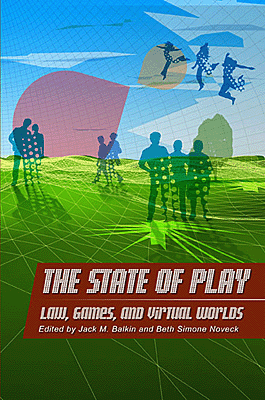
Jack M. Balkin and Beth Simone Noveck, The State of Play: Law, Games, and Virtual Worlds (N.Y.U. Press 2006)

Andrew Koppelman, Same Sex, Different States: When Same-Sex Marriages Cross State Lines (Yale University Press 2006)

Brian Tamanaha, Law as a Means to an End (Cambridge University Press 2006)

Sanford Levinson, Our Undemocratic Constitution (Oxford University Press 2006)

Mark Graber, Dred Scott and the Problem of Constitutional Evil (Cambridge University Press 2006)

Jack M. Balkin, ed., What Roe v. Wade Should Have Said (N.Y.U. Press 2005)

Sanford Levinson, ed., Torture: A Collection (Oxford University Press 2004)
Balkin.com homepage
Bibliography
Conlaw.net
Cultural Software
Writings
Opeds
The Information Society Project
BrownvBoard.com
Useful Links
Syllabi and Exams
