Balkinization
an unanticipated consequence of
Jack M. Balkin
Balkinization Symposiums: A Continuing List
E-mail:
Jack Balkin:
jackbalkin at yahoo.com
Bruce Ackerman
bruce.ackerman at yale.edu
Ian Ayres
ian.ayres at yale.edu
Corey Brettschneider
corey_brettschneider at brown.edu
Mary Dudziak
mary.l.dudziak at emory.edu
Joey Fishkin
joey.fishkin at gmail.com
Heather Gerken heather.gerken at yale.edu
Abbe Gluck abbe.gluck at yale.edu
Mark Graber
mgraber at law.umaryland.edu
Stephen Griffin
sgriffin at tulane.edu
Jonathan Hafetz
jonathan.hafetz at shu.edu
Jeremy Kessler
jkessler at law.columbia.edu
Andrew Koppelman
akoppelman at law.northwestern.edu
Marty Lederman
msl46 at law.georgetown.edu
Sanford Levinson
slevinson at law.utexas.edu
David Luban
david.luban at gmail.com
Gerard Magliocca
gmaglioc at iupui.edu
Jason Mazzone
mazzonej at illinois.edu
Linda McClain
lmcclain at bu.edu
John Mikhail
mikhail at law.georgetown.edu
Frank Pasquale
pasquale.frank at gmail.com
Nate Persily
npersily at gmail.com
Michael Stokes Paulsen
michaelstokespaulsen at gmail.com
Deborah Pearlstein
dpearlst at yu.edu
Rick Pildes
rick.pildes at nyu.edu
David Pozen
dpozen at law.columbia.edu
Richard Primus
raprimus at umich.edu
K. Sabeel Rahmansabeel.rahman at brooklaw.edu
Alice Ristroph
alice.ristroph at shu.edu
Neil Siegel
siegel at law.duke.edu
David Super
david.super at law.georgetown.edu
Brian Tamanaha
btamanaha at wulaw.wustl.edu
Nelson Tebbe
nelson.tebbe at brooklaw.edu
Mark Tushnet
mtushnet at law.harvard.edu
Adam Winkler
winkler at ucla.edu
Compendium of posts on Hobby Lobby and related cases
The Anti-Torture Memos: Balkinization Posts on Torture, Interrogation, Detention, War Powers, and OLC
The Anti-Torture Memos (arranged by topic)
Recent Posts
Virginia Is For Vengeance
Symposium Response Part 2: Centering and de-centering race
Symposium Response Part 1: The strange career of civil rights
Balkinization Symposium on Serena Mayeri, Marital Privilege-- Collected Posts
Oral Argument as Eulogy
Response to Commentators
Jawboning Late Night: A Lesson in How Corporate Consolidation Creates Free Speech Problems
Marital Privilege and Immigration Law
The Problem of "Popular" "Sovereignty"
From Status to Function
Marital Supremacy, Liberalization & Privilege
The Administration’s Self-Created Inability to Make a Deal
Understanding the Roots of Today’s Marital Inequality
Promoting Equality and Marriage
Selective Service and Illegal Aliens
The State of Impoundment Litigation Now
The Staying Power of Marriage Inequality
![[Powered by Blogger]](https://lh3.googleusercontent.com/blogger_img_proxy/AEn0k_vQcTcIBxc11umMN5u89DF9o1uR4M1yMzwBestQQPxP-yrnFfvUrHzrtmiVWTK-hQ8GjCfS1bytOcrLkwVJ87gj5DEysnY9gau-uEVxtqbR=s0-d)
Just A Few Blogs
ACS Blog
Alas, a Blog
Althouse
Arts and Letters Daily
Atrios (Eschaton)
Bill of Health
Buzzflash.com
Buzz Machine
Cato at Liberty
Juan Cole (Informed Comment)
Concurring Opinions
The Constitution in 2020
Corrente
Crooked Timber
Daily Howler
Daily Kos
Dana Boyd
Brad DeLong
Digby (Hullabaloo)
Discriminations
Daniel Drezner
Kevin Drum (Mother Jones)
Electrolite
En Banc
Eunomia (Daniel Larison)
Fafblog
Michael Froomkin (Discourse.net)
GovLab (Beth Noveck)
Rick Hasen (Election Law)
History News Network
How Appealing
Ignatz (Sam Heldman)
The Importance of (Ernie Miller)
Infolaw
Instapundit
International Economic Law and Policy Blog
IntLawGrrls
Jacob Levy
Jesus' General
Jurisdynamics
The Kitchen Cabinet
Mark Kleiman
Law Blog Central
Larry Lessig
Lawyers, Guns and Money
Liberal Oasis
Brian Leiter's Law School Reports
The Leiter Reports
Marginal Revolution
Megan McArdle
Memeorandum
Metafilter
Mirror of Justice
The New Republic
Newseum
No More Mister Nice Blog
Brendan Nyhan
Opinio Juris
Orcinus
The Originalism Blog
Pandagon
Passport (Foreign Policy)
Overcoming Bias
Political Animal (Washington Monthly)
Political Theory Daily Review
Political Wire (Taegan Goddard)
The Poor Man
Virginia Postrel
Prawfsblawg
Public Reason
Jonathan Rauch
Raw Story
Redstate
ReligiousLeftLaw.com
Reporters Committee For Freedom of the Press
Reproductive Rights Blog
Rothman's Roadmap to the Right of Publicity
SCOTUS Blog
Seeing the Forest
Clay Shirky
The Shifted Librarian
The Situationist
Larry Solum (Legal Theory)
Andrew Sullivan
Talking Points Memo
Talk Left
Tapped
Tbogg
TechPresident
The Paper Chase (Jurist)
Tom Paine
Tom Tomorrow (This Modern World)
Eve Tushnet
Uggabugga
University of Chicago Law School Faculty Blog
Unqualified Offerings
The Volokh Conspiracy
War and Piece (Laura Rozen)
Wampum
Oliver Willis
Wonkette
Written Description
Matthew Yglesias
Yin
Your Choice of Feeds
1. XML
powered by

2. Atom Feed
3. RSS 2.0
Virginia Is For Vengeance
Gerard N. Magliocca
Presidents sometimes try to wield the criminal law against their political opponents. It never works. Jefferson went after Aaron Burr. That failed. FDR targeted Andrew Mellon. That was a flop. And so on. The Comey indictment (and the others that will surely be brought) will meet the same end. The Mellon example is instructive. He was our most powerful Treasury Secretary not named Hamilton. Mellon was also wealthy. FDR wanted him prosecuted on criminal tax fraud charges. Robert Jackson, newly arrived at the DOJ, objected that a criminal charge was unwise and unwarranted. He was overruled. A federal grand jury in Pittsburgh then refused to indict Mellon, which was a major embarrassment for the Government. A civil tax case ensued that was still going on after Mellon died. Grand juries work best when they are asked to indict well-known members of a local community on flimsy charges. Mellon was famous in Pittsburgh because (you might say) he owned half of town. James Comey, by contrast, is not a local celebrity. He just lives in Virginia. Nevertheless, the grand jury asked to indict Comey rejected one of the Government's three charges. That is unusual. There is some confusion about what else happened, which should come as no surprise given the resignation of the prior interim U.S. Attorney. Comey's defense attorneys must be licking their chops.
Posted
6:59 AM
by Gerard N. Magliocca [link]
(0) comments
Symposium Response Part 2: Centering and de-centering race
Guest Blogger
For the Balkinization symposium on Dylan C. Penningroth, Before the Movement: The Hidden History of Black Civil Rights (Liveright, 2023). Dylan C. Penningroth
Looking at the Symposium overall, I think these posts have
drawn out what I hope is a creative tension in the book’s approach to race. On
the one hand, the book invites law scholars to move race and race relations toward
the center of the curriculum and the profession. But then it asks historians,
and especially African American historians, in essence to de-center race
relations. There were both conceptual and pragmatic reasons behind this dual
approach. Conceptually, I felt that the history of race had too often been
conflated with the history of Black people, and that this conflation inadvertently
wound up treating African Americans instrumentally—as something more like a
window into the soul of America than as people worth studying in themselves. From
a purely pragmatic point of view, using local court records practically
compelled me to think hard about centering race: the overwhelming majority of
the cases involving Black people were between Black people. Obviously, white
supremacy produced these skewed proportions, and yet it seemed important to
take seriously what Black-Black cases had to say, especially when I saw other
kinds of sources saying similar things. It is by now axiomatic that Black
people fought for “independence in their working lives,” autonomy for “their
families and communities,” and “equal citizenship” in the body politic.[1] But what did autonomy mean
to a Black tenant farmer like Nate Shaw (Ned Cobb) who said that his own father
treated him “just like slavery”? What did equal citizenship mean to Black women
who were treated as second-class citizens in their churches and fraternal
orders, the citizenship that mattered most (or at least most immediately) to Black
people before the movement?
Posted
9:30 AM
by Guest Blogger [link]
Symposium Response Part 1: The strange career of civil rights
Guest Blogger
For the Balkinization symposium on Dylan C. Penningroth, Before the Movement: The Hidden History of Black Civil Rights (Liveright, 2023). Dylan C. Penningroth Many thanks to Jack Balkin and Balkinization for
hosting this symposium. I’m grateful to Carol Rose, Evelyn Atkinson, Ian Ayres,
Mark Graber, Mark Tushnet, and Steve Griffin for taking the time to read and
provide such probing comments on Before the Movement. It has taken me
awhile to post my response, in part because it has been so much fun to absorb
and learn from their comments. The contributors
beautifully bring out several of the book’s main themes, and space allows me to
touch on only some of their constructive critiques. The first, as Professor
Griffin notes, is how Black people used and thought about law from the 1830s to
the 1970s, how a subset of nineteenth-century rights and privileges came to be
understood as “civil rights,” and how that term, over the next century or so,
slowly came to stand for the principles of nondiscrimination and
anti-humiliation that animate much of modern civil rights law. If had been more
daring and witty, I might have titled the book “The Strange Career of Civil
Rights.”[1] The second theme is the sources I used to tell this
story. Of course, I am far from the first historian to go asking big questions of
small courts. Since the early 2000s, a number of legal historians have made the
trek to the courthouse door, including Laura Edwards, Melvin Ely, Sarah
Barringer Gordon, Martha Jones, Anne Twitty, Kimberly Welch and, more recently,
Sarah L. H. Gronningsater.
Aside from the physical and logistical challenges of researching in
under-funded facilities that are not really “archives,”[2] all of us have confronted
the analytic and conceptual challenges of taking the legalities latent in local
court records and relating them to the “mandarin materials,” as Robert Gordon
termed them, of appellate case law, statutes, and treatises.[3] But increasingly, on days
when I walked past the inevitable Confederate statue to beg another circuit
clerk’s permission to rummage around in the courthouse attic, I felt the
presence of a different intellectual tradition than perhaps the ones we had
been trained in; that we were actually following
in the footsteps of earlier generations of Black historians, who had to negotiate
with the gatekeepers of official records in the unfathomably harsher
environment of the 1930s and 40s. Only a few of those earlier historians were
professional scholars, like Luther Porter Jackson. Mostly they were lay
historians—church officers, like A.M.E. Bishop Richard R. Wright,[4] or
lawyer-memoirists, like Thomas Calhoun Walker,[5] or
keepers of family history, like my great-great-uncle Thomas Holcomb. What they wanted
to demonstrate was that, right in the maw of a nation dedicated to white
supremacy, “free Negroes” and their descendants had “made a record” of
achievement in education, landownership, and trade.[6] And they
believed that record entitled them to “the good will and respect of [their]
neighbors and fellow citizens,”[7] as
Jackson put it—or what activists called “public rights”[8] or “first-class
citizenship.”[9]
These earlier Black historians’ linking of common-law rights to “classes” of
citizenship eventually helped inform my argument about how the idea of civil
rights changed. Often stuffed with thumbnail sketches and hopeful statistics
about Black churches and property ownership and literacy, these works were more
than mere “encyclopedic pep talks” or “storehouses of uplift ideology” in the
mold of Booker T. Washington.[10] Whatever
else they were, they also hinted at a history of Black legal thought, one that
seemed to me to be in dialogue with questions of racial justice but not
contained by them. More immediately, those early Black historians seemed to
suggest that there were certain continuities across the gulf of the Civil War: that
white people more or less took it for granted that Black people could own and
trade things.[11] That, at least in the
realm of civil rights, the transformation came gradually, raggedly, and perhaps
rife with irony. We might explain this continuity in terms of ideology—specifically,
white people’s investment in the belief that law was not (just) an instrument
of class power. More frequently, as Professor Graber points out, I look to Derrick
Bell’s interest-convergence theory. This was a “triumph of informal property
over formal law,” Professor Rose writes, where wide swaths of white southerners—including
huge numbers of non-slaveowning whites—enjoyed easy access to cheap, convenient
goods and services from enslaved Black people, an enjoyment procured not (just)
through “brute compulsion” but through legal marginality and indeterminacy.[12] White southerners benefited
precisely from the law’s refusal to speak clearly and consistently about slaves’
property and contracts. (To which I would add that there are uncomfortable
resonances with the benefits American citizens enjoy from the work of
undocumented immigrants today.)
Posted
9:30 AM
by Guest Blogger [link]
Balkinization Symposium on Serena Mayeri, Marital Privilege-- Collected Posts
JB
Here are the collected posts for our Balkinization symposium on Serena Mayeri, Marital Privilege: Marriage, Inequality, and the Transformation of American Law (Yale University Press, 2025). 1. Jack Balkin, Introduction to the Symposium 2. Kimberly Mutcherson, The Staying Power of Marriage Inequality 3. Julie C. Suk, Promoting Equality and Marriage 4. Clare Huntington, Understanding the Roots of Today’s Marital Inequality 5. William N. Eskridge Jr., Marital Supremacy, Liberalization & Privilege 6. Douglas NeJaime, From Status to Function 7. Kristin Collins, Marital Privilege and Immigration Law 8. Serena Mayeri, Response to Commentators
Posted
1:00 PM
by JB [link]
Oral Argument as Eulogy
Gerard N. Magliocca
In Gideon v. Wainwright, Justice Harlan concurred that Betts v. Brady should be overruled but complained that Betts "is entitled to a more respectful burial." The same could be said for Humphrey's Executor, either on the interim docket or when Trump v. Slaughter is decided. That said, I'm not sure whether to envy the attorney who will argue Slaughter. That person will surely lose. But going in knowing that you will lose may provide the freedom to say whatever you want.
Posted
12:07 PM
by Gerard N. Magliocca [link]
(0) comments
Response to Commentators
Guest Blogger
For the Balkinization symposium on Serena Mayeri, Marital Privilege: Marriage, Inequality, and the Transformation of American Law (Yale University Press, 2025). Serena Mayeri I am immensely grateful to each
of the symposium participants for taking time to engage so thoughtfully with
this book, and for the countless ways their intellectual influence and personal
generosity enriched the project over the dozen-plus years of its gestation. I
can’t possibly do justice here to each set of comments, much less the authors’
own scholarly oeuvres and impact, so offer just a few reflections on some of
the themes their posts raise.
Posted
9:30 AM
by Guest Blogger [link]
Jawboning Late Night: A Lesson in How Corporate Consolidation Creates Free Speech Problems
Guest Blogger
Daniel Browning ABC Pulls Kimmel Off the Air On Wednesday, September 17th, ABC
announced its decision to pull “Jimmy Kimmel Live!” off the air
indefinitely following Kimmel’s monologue about Charlie Kirk’s assassination. Disney’s decision came shortly after FCC chairman Brendan
Carr made the following thinly veiled threats against ABC. Carr also called
on licensed broadcasters to “push back on” networks and “preempt” content
that does not serve local communities. Sure enough, Nexstar, which owns many
ABC affiliate stations, announced
that it would “preempt ‘Jimmy Kimmel Live!’ for the foreseeable future.” ABC
suspended Kimmel shortly thereafter. Jawboning and the First Amendment As other commentators have observed,
Kimmel’s suspension appears to be a paradigm case of “jawboning”—where
the government indirectly censors expression by pressuring some private
intermediary to censor the expression directly. Just last year, in N.R.A. v.
Vullo, the Court
reaffirmed that government jawboning can violate the First Amendment
whenever it coerces a private intermediary to censor speech. In Vullo,
a state official offered not to prosecute an insurance underwriter, Lloyd’s,
for regulatory infractions in exchange for Lloyd’s’ agreement to sever ties with
the N.R.A. The Court held that, by offering the inducement in order to punish the
N.R.A.’s speech, Vullo had engaged in unconstitutional coercion. After Vullo, the constitutionality of government
exhortations for private intermediaries to interfere with a third-party’s
speech turns on whether the government’s communication is persuasive
(constitutional) or coercive (unconstitutional). Why the Kimmel Case Raises Important First Amendment
Issues Other
commentators have called for Kimmel to bring a First Amendment challenge
against the government, on the theory that FCC Chair Carr’s threats against
broadcasters were unconstitutionally coercive. In some ways, this does seem to be an easy case. Carr makes
vague comments that appear to threaten networks and broadcasters, and ABC
suspended Kimmel shortly thereafter. Thus, Kimmel might have an easier
time establishing standing than did the various plaintiffs in Murthy v.
Missouri. The Court in Murthy held
that the various plaintiffs lacked standing, in large part, because they could
not show that government pressure caused their injuries. The social
media platforms, Justice Barrett reasoned, “had independent incentives to
moderate content.” In other ways, though, the Kimmel case raises to the fore
important complexities that the Court has not adequately addressed in its
jawboning jurisprudence. Doctrinally, the coercion/persuasion rule, as developed in Bantam
Books and Vullo provides very little guidance to courts in
adjudicating jawboning claims. Conceptually, there is a huge gap between
government communications that could rightly be labeled “persuasive” and
communications that could be called “coercive.” Consider an example that arose in the Murthy litigation—President
Biden’s comment that social media platforms were “killing
people” by allowing users to spread misinformation. Persuasion or coercion?
I, for one, couldn’t say. The problem here is that there are myriad forms of
government pressure that are neither persuasive nor coercive—but are rather
somewhere in between. While Vullo settles the question in clear cases where
government pressure can be easily identified as coercion or persuasion, it
leaves courts without clear guidance in cases, perhaps like the one here, where
government pressure occupies the space between coercion and persuasion. The much larger, more systemic problem, however, is that the
modern corporate law infrastructure makes jawboning both much more effective
and much more difficult to challenge in court. Because traditional media is increasingly
owned by a small handful of firms, government jawboning is increasingly
likely to prove effective, for two reasons. First, the government can hold out a regulatory carrot (as
relevant in the Kimmel case, approval
of an acquisition) in exchange for “voluntarily” censoring expression. For
corporate executives, the cost of censorship will be much cheaper than the cost
of drawing the government’s ire, especially as the arms race to add
subsidiaries creates more nodes at which the government can leverage its regulatory
authority. Second, the consolidation of smaller firms into large
mega-firms (like Disney) decreases the cost to the government of targeting
disfavored expression. The government only needs to pressure a small handful of
firms rather than many. The corporate landscape that makes jawboning more effective
also makes it more challenging for speakers to bring successful First Amendment
jawboning claims. It can often make good business sense for highly
consolidated and diversified firms to censor speech even irrespective of
government pressure. For example, before deciding to suspend Kimmel, Disney CEO
Robert Iger reportedly
was hearing from advertisers who feared a conservative firestorm and from
Disney employees who reported receiving threats. And because Disney owns an
array of subsidiaries, Disney executives had to worry about a Kimmel-related
boycott of their theme parks, cruises, merchandise, and other programming. These
non-governmental pressures very well could’ve given Disney executives “independent
incentives” to suspend Kimmel. So What Can be Done? Doctrinally, the
Court in jawboning cases should focus more on whether the government
harbored an unconstitutional
motive—whether the government intended to censor unfavorable
expression—than on whether the government’s communication could be labeled
coercive or persuasive. In the alternative, the Court should provide further
guidance on how to determine whether the government’s communication with the
private intermediary rises to the level of unconstitutional coercion. More systemically, we should begin to think about corporate
consolidation and oligopoly as a free speech problem. As firms become more
consolidated and diversified, traditional media, which is crucial for public discourse,
becomes more vulnerable to indirect government censorship. A more durable solution than relying on courts to police
government jawboning would involve, first, consumers increasing the costs to
firms of capitulating to the government. This bottom-up solution, which would
require citizen-consumers to mobilize to protect free speech values, has
already proven somewhat
effective in the boycott of Target over ending its DEI policies. Indeed,
there is some
evidence that consumers have already begun to penalize Disney for their
capitulation. Second, taking a more top-down approach, a future Democratic
administration should charge the FCC and FTC with considering the free speech
implications of corporate consolidation and diversification. Daniel Browning is a JD Candidate at Yale Law School and a PhD Candidate at Princeton University. You can reach him by e-mail at Daniel.browning@yale.edu.
Posted
8:00 AM
by Guest Blogger [link]
Marital Privilege and Immigration Law
Guest Blogger
For the Balkinization symposium on Serena Mayeri, Marital Privilege: Marriage, Inequality, and the Transformation of American Law (Yale University Press, 2025). Kristin
Collins Serena
Mayeri’s excellent new book Marital Privilege charts the transformation
of marriage as a central fixture in American law and social policy from the
1960s to 2003. Starting in the 1960s, various groups and individuals challenged
marriage’s hold on Americans’ options for family formation, their sex lives, and
their access to state created entitlements and benefits. These challenges were not
part of an organized political or legal movement, as one often finds in stories
of legal transformation, but they were numerous and sustained. Liberal
feminists challenged the sex-asymmetrical rights and duties that marriage
entailed. Black feminists were focused on securing greater autonomy in deciding
whether and when to have children – in or out of marriage – and sought supportive
communities rather than government surveillance. Mothers and fathers argued that
the status designation of illegitimacy harmed children, in part by creating a
legal presumption that their fathers had no interest in their wellbeing.
Individuals who sought to form non-traditional families challenged family-based
zoning laws and housing regulations that were premised on the marital family
norm. Lesbian and gay couples struggled for legal recognition and rights in
just about every domain of life. Perhaps most famously, individuals who sought
to marry across the color line challenged restrictions on interracial marriage.
With
these challenges to the regulation of marriage and its legal primacy in view, Mayeri
identifies a puzzle: For a good 40 years, as marriage’s place in American law
and social policy was contested from multiple directions, and as marriage rates
declined, marriage nevertheless remained (and remains) a privileged status in
American law. How to explain this outcome? Mayeri argues that even as challenges
to marriage’s primacy succeeded in eliminating its more pronounced
discriminatory features, those challenges also helped to sustain the privileged
legal status of marriage. Moreover, she concludes, as “marriage declined among
less affluent Americans, marital status law intensified racial and economic
inequality.” Mayeri
offers abundant evidence to support her thesis, but she is also quick to
acknowledge that the historical sources she has amassed tell a complicated
story. Not only were the sundry challenges to marital status law uncoordinated,
many of the key players in her book disagreed about the role that marriage
should play in social policy and how its contours should be determined and
policed. Here, I will add to the complexity of this story by focusing on a
specific field of regulation: immigration.
Posted
9:30 AM
by Guest Blogger [link]
The Problem of "Popular" "Sovereignty"
JB
Sandy Levinson and I have uploaded a draft of our latest essay, The Problem of "Popular" "Sovereignty," to SSRN. Here is the abstract:
Sovereignty has theological origins: kings claimed a divine right to rule. The idea of sovereignty eventually becomes secularized, and monarchical sovereignty gives way to a new concept—popular sovereignty. Thinkers such as Hobbes and Locke tried to rationalize government authority by grounding it in the consent of a unified people. This merely replaced one fiction with another, because it assumed that “the people” exist as a coherent, self-aware entity that is capable of bestowing legitimate authority on a government.
A crucial distinction between sovereignty and government underpins all theories of popular sovereignty. The people are sovereign, but they delegate governance to representative institutions that purportedly act on their behalf. The popular sovereign is therefore perpetually a sleeping sovereign. The distinction between sovereignty and government creates persistent problems: (1) How can a sleeping sovereign awaken to revise or replace a government that resists reform? (2) Who gets to define “the people,” and how are claims of peoplehood operationalized? (3) How does one prevent populism from exploiting the sovereignty/government divide to justify exclusionary or authoritarian practices? (4) What structures can ensure that those who govern do so as faithful agents of the people?
These problems are not aberrations of popular sovereignty but structural features of the concept. Popular sovereignty—like the divine right of kings before it—functions ideologically to mask the exercise of power by elites. In diverse, complex, and populous modern states like the United States, the limitations of the idea that the people rule become ever more obvious and acute. The decline in representative fidelity, rising political polarization, and growing distrust in institutions all stem in part from the widening gap between the ideals of popular rule and the lived reality of democratic governance.
It is possible that the twentieth-century model of popular sovereignty may be reaching its theoretical limits. Just as monarchic sovereignty gave way to popular sovereignty, new pressures—from the complexity of modern governance to digital technology—may eventually yield a post-popular-sovereignty model of politics. As anomalies mount—dysfunctional representation, democratic backsliding, elite capture—a new paradigm may be necessary. Technocracy is one possible successor, but it lacks legitimacy and public trust.
Although sovereignty has always been rested on a fiction, it remains central to how people legitimate political authority. Rather than discard it, defenders of democracy must reimagine it for a changing society. They must engage in continual reinvention of constitutional structures and democratic practices. The American experiment in governance must once again embrace bold constitutional reform. Constitutional creativity will be essential to revitalizing the legitimacy of democratic governance in the 21st century.
Posted
11:00 AM
by JB [link]
From Status to Function
Guest Blogger
For the Balkinization symposium on Serena Mayeri, Marital Privilege: Marriage, Inequality, and the Transformation of American Law (Yale University Press, 2025). Douglas NeJaime In Marital
Privilege, Serena Mayeri masterfully shows how challenges to the legal
centrality of marriage—and to a specifically heterosexual,
gender-differentiated view of marriage—only partially succeeded in altering the
content of marriage and its relevance to legal rights and obligations.
Ultimately, courts credited claims, particularly on behalf of women and
same-sex couples, that made marriage itself a more inclusive and egalitarian
institution. But courts rejected claims, particularly on behalf of single
parents and poor women of color, that would have reduced marriage’s role in
channeling benefits to families. As Mayeri shows, challenges to the understanding
of marriage that pervaded law and policy in the mid-twentieth century changed
the content of marriage in important ways but, in the end, left marriage’s primacy
intact. For
all the distinctions between the regulation of marital and nonmarital life that
Mayeri meticulously analyzes, there is a striking continuity that Marital
Privilege surfaces. Both inside and outside marriage, to varying degrees,
the law shifted away from formal, categorical, status-based regulation toward functional
regulation. As advocates for this functional approach argued, the law should treat
spouses, partners, and parents “based on what they did rather than who they
were.” (p. 81) Across the book, Mayeri unearths a rich array of functional
approaches that arose to meet the challenges that confronted marriage and its
privilege status. Although scholars have identified and analyzed functional
approaches in various settings, Mayeri’s work to synthesize these approaches
across domains is novel and important. And it has significant implications for
debates raging today over the wisdom of adopting functional standards to
address nonmarital couples and parent-child relationships.
Posted
9:30 AM
by Guest Blogger [link]
Marital Supremacy, Liberalization & Privilege
Guest Blogger
For the Balkinization symposium on Serena Mayeri, Marital Privilege: Marriage, Inequality, and the Transformation of American Law (Yale University Press, 2025). William N. Eskridge Jr. In Marital Privilege (2025), Serena Mayeri documents many
of the ways that the American law of marriage was transformed between 1960 and
2000 (and somewhat beyond). Earlier scholars have demonstrated how the extensive
liberalization of family law was accompanied by policies channeling
relationships into what policymakers and most citizens have considered socially
productive forms, primarily marriage.[1] In
the new millennium, demographers have shown that marriage remains popular among
well-to-do and professional couples but is declining among lower-income and working-class
couples.[2] Critical
scholars have argued that the many discriminations against nonmarriage are
constitutionally or normatively wrong and have criticized the disparate racial
and income effect of what Melissa Murray calls “nonmarriage inequality.”[3] Building
upon and adding to this scholarship, Professor Mayeri argues that the “marriage
supremacy” regime holding sway in 1960 had by the new millennium collapsed and had
given way to a legal regime of “marital privilege” (pp. 6, 112, 318) that,
obviously, benefits the “Haves” in our society and, less obviously, often harms
the “Have Nots” (pp. 316-18).[4] This
new, discriminatory regime has been challenged by many progressive lawyers and
their clients, but largely without success in court.
Posted
9:30 AM
by Guest Blogger [link]
The Administration’s Self-Created Inability to Make a Deal
David Super
Throughout Anglo-American
history, various kinds of people have been incapable of entering into legally binding
contracts. This has included enslaved
persons, married women during the coverture era, children, and persons deemed
to lack mental capacity or otherwise under the control of others. In each case, the inability to contract has
been understood as quite debilitating.
Courts upholding aggressive freedom-of-contract regimes have insisted that the
ability to enter into enforceable contracts is key to gaining wealth and power. It therefore is
remarkable that the Trump Administration has worked so hard to render itself
incapable of entering into enforceable deals.
Its inability to enter into binding contracts with private businesses, non-profits,
and state and local governments – the result of its so-far successful
insistence that it may cancel any contract merely because its policy
preferences have changed – will have profound implications for the provision of
public services for decades to come. Its
self-created inability to enter into binding agreements with foreign governments
– e.g., casually casting aside trade agreements, including ones
it negotiated – will significantly curtail this country's ability to get its
way in world affairs. And, most
immediately, its self-created inability to enter into binding agreements with
Members of Congress may prevent an agreement to prevent a partial government
shutdown after September 30. The latter effect
is not widely understood. Since taking
office, this Administration has impounded – simply refused to spend – several hundreds
of billions
of dollars Congress has appropriated for the current fiscal year. A few of these impoundments the
Administration has publicly announced.
The great bulk of them have been done quietly, without complying with
the procedures required
under the Impoundment Control Act (ICA).
Indeed, the
Administration endeavored to conceal the extent of its impoundments by brazenly
violating a statute requiring it to make public the “apportionment” decisions
transmitting appropriated funds to federal agencies. When the D.C. Circuit finally compelled
it to release its apportionments, they turned out to be chock full of restrictions
on spending wholly unauthorized by statute that effectively made it impossible
for funds to be spent. Among these were
a requirement that agencies seek the Office of Management and Budget’s approval
for a “spending plan” prior to obligating funds, giving OMB a vehicle for interposing
more obstacles undisclosed to Congress or the public. By law, apportionments are only supposed “to prevent
obligation or expenditure at a rate that would indicate a necessity for a
deficiency or supplemental appropriation”. The Administration’s
demonstrated unwillingness to abide by appropriation laws makes a deal to
prevent a government shutdown on October 1 exceedingly difficult. When temporary appropriations expired in
March, Republicans refused to negotiate a new bill with Democrats. Instead, they simply tabled a bill of their
own that purported to continue programs’ funding at prior levels. It did not:
it shifted several billion dollars from other programs into the
Administration’s priorities. Democrats
nonetheless supplied the votes necessary to enact the legislation because this
seemed the best way to protect funding for important programs. Since then,
however, the Administration has repeatedly disregarded funding levels in the
legislation that it wrote. It turns out,
then, that enacting the Administration’s bill did not, in fact, protect funding
for key domestic and international programs.
In addition, the request the Administration submitted in June to rescind
funding from international programs and public broadcasting clawed back billions
that had been a significant part of why Democrats voted for the legislation. Although Democrats’ ability to filibuster
gives them leverage over the passage of appropriations bills, the ICA prevents
filibusters and so allows rescissions to pass on party-lines votes. Thus, the
Administration has created a situation in which any promises of funding it
makes to achieve bipartisan agreement on appropriations bills are utterly
unenforceable: it can either rescind the
money on a party-lines vote or simply ignore the appropriations
altogether. We can hope that the courts eventually
will enjoin the Administration’s impoundments, but to date they have thrown
one obstacle after another in the way of challengers – reinforcing the sense
that, even if codified in law, the Administration’s promises are effectively
unenforceable. Lest anyone doubt
its intentions, the Administration recently released dramatic revisions in OMB Circular A-11,
a venerable (and heretofore mostly unremarkable) document setting out the
Administration’s understanding of the rules for formulating and implementing
budgets. Among other things, the new
A-11 declares that the Administration may disregard the ICA for “delays in
obligations or expenditures [to] change the scope or design of existing
programs, or develop policies concerning program implementation to align with
Administration policy.” It also declares
that the Administration may freeze appropriated funds for 45 days merely by
submitting a request for rescission to Congress even if the funds will lapse
before those 45 days expire. (This is
the “pocket rescission” theory that finds no
support in the text of the ICA and raises serious
constitutional concerns.) Thus, the
Administration may simply sit on funds for most of the year under the guise of reworking
the program “to align with Administration policy” and then submit a formal rescission
request to Congress at the end of the year.
If Congress approves the request, the funds are rescinded; if Congress
rejects the request or simply fails to act, the funds lapse. Either way, the appropriation accomplishes
nothing for the people it was intended to help. Thus, Democrats have no reason to believe that
the numbers in the appropriations bill for which they vote will mean anything
in the real world, especially if they exceed the amounts in the President’s
budget proposal. At the moment,
Republican leaders are refusing to negotiate with Democrats, bowing to President
Trump’s wishes. They may intend to present Democrats with
another take-it-or-leave it bill as they did in March. It is too early to
predict if Democrats would vote for a short-term continuing resolution to
prevent a shutdown on October 1: a host
of political, legal, and technical factors affect when is the best time for a
confrontation. But Democrats should not
regard any concessions they receive in full-year appropriations bills as
meaningful unless those bills include concrete measures both to prevent
President Trump from impounding the funds and to prevent Republicans from
rescinding on a partisan basis funds that were approved on a bipartisan
vote. One vehicle for
doing this is an amendment
that Oregon Senator Jeff Merkley proposed to make the ICA inapplicable to
spending for federal fiscal year 2026 (apart from the ICA’s language
disavowing any interpretation that curtails rights under other laws). Superficially, abandoning the ICA may seem strange. The ICA, however, is a law seeking to protect
Congress’s institutional prerogatives, and neither congressional Republicans nor
the D.C.
Circuit have given those prerogatives serious weight. The current Comptroller General has shown no
appetite for suing to enforce the ICA even as he chronicles the Administration’s
ICA violations, and he is about to be replaced
by a Trump appointee. Absent a clear
indication of the Supreme Court’s willingness to respond to the Administration’s
abuses of the law, the ICA is best set aside to simplify and expedite litigation. This would focus attention on the Administration’s
violations of statutes authorizing programs and appropriating funds for
them. The Court unanimously found such
laws binding in Train
v. City of New York in 1975. Without this or
some other measure improving the enforceability of appropriations acts and
blocking partisan rescissions, no deal will be worth the paper on which it is
written. As many businesses can tell
you, negotiating contracts with someone lacking the capacity to make binding
commitments is a fool’s errand. @DavidASuper.bsky.social @DavidASuper1
Posted
11:43 PM
by David Super [link]
Understanding the Roots of Today’s Marital Inequality
Guest Blogger
Clare Huntington
On a research leave in the fall
of 2019, I was in Aalborg, Denmark, presenting my work on inequality to a group
of Nordic scholars. Every time I mentioned “nonmarital families,” I saw blank
stares around the room. When I asked about the confusion, a scholar explained
that a nonmarital family is not a distinct family form. Rather it is the same
family at a different point in time. A couple will start living together, have
a child, get married, and then have a second child. And although the marriage
may be personally significant, it has limited legal effect. Before and after
marriage, a couple enjoys considerable state support and benefits, as
individuals and as a family.
Posted
9:30 AM
by Guest Blogger [link]
Promoting Equality and Marriage
Guest Blogger
For the Balkinization symposium on Serena Mayeri, Marital Privilege: Marriage, Inequality, and the Transformation of American Law (Yale University Press, 2025). Julie C. Suk The “Transformation of American Law”
that drives Serena Mayeri’s monumental book, Marital
Privilege, is the shift from marriage as the supreme distributive mechanism
across various areas of law towards marriage as a mere privilege within legal
regimes that continue to distribute unequally, though less so. This “transformation,” as Mayeri tells us in
the book’s conclusion, was not of the seismic shift variety; it was a “preservation
through transformation” of the oppressive inequalities produced by marital
supremacy (p. 324). Through an impressive synthesis of Supreme Court decisions,
legal scholarship, and the archives of litigants, lawyers, judges, and social
movement actors from the 1960s to the present, Marital Privilege
explains how and why laws benefiting marriage and the marital family still contribute
causally to the material disadvantage of poor, Black, immigrant, and other
disfavored people.
Posted
9:30 AM
by Guest Blogger [link]
Selective Service and Illegal Aliens
Gerard N. Magliocca
I did not realize until today that male illegal aliens in the relevant age range are required by federal law to register for Selective Service (in other words, the draft). I don't know how many actually do register, but this requirement strikes me as rather interesting in the context of the birthright citizenship debate. I'll mull that over and elaborate down the road.
Posted
8:39 AM
by Gerard N. Magliocca [link]
(0) comments
The State of Impoundment Litigation Now
David Super
The past few weeks
have gone a long way toward framing the key questions that will decide whether
the Trump Administration’s massive impoundment effort succeeds where President
Nixon’s failed. This post surveys what
we have learned. At the outset, we
must divide impoundments into three distinct sets. First, the Administration has stopped payment
on billions of dollars that were already obligated through numerous programs. This has occurred primarily through the
purported cancellation of grants and contracts.
Some of these have involved efforts the Administration dislikes, such as
combating climate change; others appear to have been eliminated more or less
randomly when they caught the eye of an ignorant twenty-something empowered by
Elon Musk’s Department of Government Efficiency (DOGE). The second and
largest set of impoundments involve refusals to obligate and spend money
Congress has appropriated for a wide range of programs. Here again, sometimes the impoundments’
motivation is clear; often, it appears utterly capricious. An Administration that targets
the Enola Gay for promoting gender identities is capable of anything. Finally, the
smallest set of impoundments are those for which the Administration partially
followed the procedures in the Impoundment Control Act to seek Congress’s
permission. After unlawfully impounding
the funds for many months – in violation of the Act’s requirement
that the President notify Congress at the time he determines that he does not
want to spend moneys – he finally followed the Act’s procedures in June,
sending up a rescission request that congressional Republicans largely
rubber-stamped.
Posted
12:45 AM
by David Super [link]
The Staying Power of Marriage Inequality
Guest Blogger
For the Balkinization symposium on Serena Mayeri, Marital Privilege: Marriage, Inequality, and the Transformation of American Law (Yale University Press, 2025). Kimberly Mutcherson Serena Mayeri’s meticulously researched book,
Marital Privilege, traces the history of the shift from marriage supremacy to
marital privilege in the U.S. through the many legal cases that shaped the
marriage landscape from the 1960s into the 2000s . She shows the extent to
which marriage is a legal transaction as much as (perhaps sometimes more than) an
expression of love and devotion between two people. It shapes the lives of
people who marry and equally shapes the lives of people who opt not to marry or
who cannot marry. While acknowledging significant victories along the way, Mayeri
traces how movements have relegated many of the most egregious elements of
marriage supremacy to the dustbin of history (anti-miscegenation laws), but she
also reveals how marriage still reigns as a most favored legal status for
people who build lives together, especially if they have children. She reminds
us of how marriage law encourages conformity in family structure, incentivizes
preferred behaviors (childbearing only when married), and protects government
coffers by privatizing the costs of care. There is incredible richness in Mayeri’s
book, far more than I can cover for purposes of this symposium, so I want to
highlight a few themes that I found particularly powerful while reading the
book and that strike me as especially pertinent for those committed to a more
egalitarian future for family building in the United States. The first theme is
the consistent throughline of family, reproduction, and parenting as sites of
sustained racial oppression in the U.S. In a time when efforts to erase and
distort history flow from the highest ranks of government, the enduring relationship
between marriage law, white supremacy, racism, patriarchy, and wealth
accumulation cannot be underplayed.
Posted
9:30 AM
by Guest Blogger [link]
Books by Balkinization Bloggers

Gerard N. Magliocca, The Actual Art of Governing: Justice Robert H. Jackson's Concurring Opinion in the Steel Seizure Case (Oxford University Press, 2025)

Linda C. McClain and Aziza Ahmed, The Routledge Companion to Gender and COVID-19 (Routledge, 2024)

David Pozen, The Constitution of the War on Drugs (Oxford University Press, 2024)

Jack M. Balkin, Memory and Authority: The Uses of History in Constitutional Interpretation (Yale University Press, 2024)
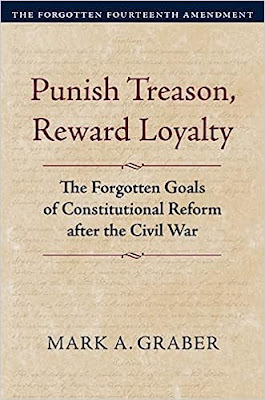
Mark A. Graber, Punish Treason, Reward Loyalty: The Forgotten Goals of Constitutional Reform after the Civil War (University of Kansas Press, 2023)
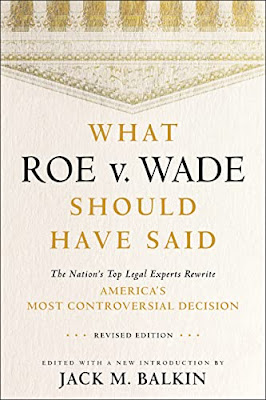
Jack M. Balkin, What Roe v. Wade Should Have Said: The Nation's Top Legal Experts Rewrite America's Most Controversial Decision - Revised Edition (NYU Press, 2023)

Andrew Koppelman, Burning Down the House: How Libertarian Philosophy Was Corrupted by Delusion and Greed (St. Martin’s Press, 2022)

Gerard N. Magliocca, Washington's Heir: The Life of Justice Bushrod Washington (Oxford University Press, 2022)
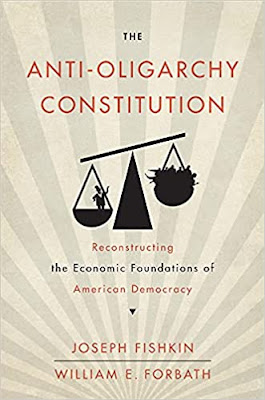
Joseph Fishkin and William E. Forbath, The Anti-Oligarchy Constitution: Reconstructing the Economic Foundations of American Democracy (Harvard University Press, 2022)
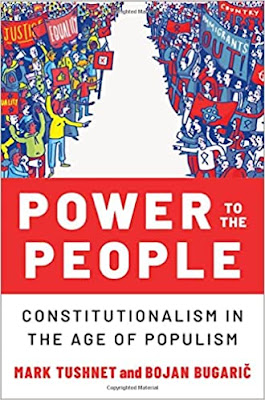
Mark Tushnet and Bojan Bugaric, Power to the People: Constitutionalism in the Age of Populism (Oxford University Press 2021).

Mark Philip Bradley and Mary L. Dudziak, eds., Making the Forever War: Marilyn B. Young on the Culture and Politics of American Militarism Culture and Politics in the Cold War and Beyond (University of Massachusetts Press, 2021).

Jack M. Balkin, What Obergefell v. Hodges Should Have Said: The Nation's Top Legal Experts Rewrite America's Same-Sex Marriage Decision (Yale University Press, 2020)

Frank Pasquale, New Laws of Robotics: Defending Human Expertise in the Age of AI (Belknap Press, 2020)

Jack M. Balkin, The Cycles of Constitutional Time (Oxford University Press, 2020)

Mark Tushnet, Taking Back the Constitution: Activist Judges and the Next Age of American Law (Yale University Press 2020).

Andrew Koppelman, Gay Rights vs. Religious Liberty?: The Unnecessary Conflict (Oxford University Press, 2020)

Ezekiel J Emanuel and Abbe R. Gluck, The Trillion Dollar Revolution: How the Affordable Care Act Transformed Politics, Law, and Health Care in America (PublicAffairs, 2020)

Linda C. McClain, Who's the Bigot?: Learning from Conflicts over Marriage and Civil Rights Law (Oxford University Press, 2020)
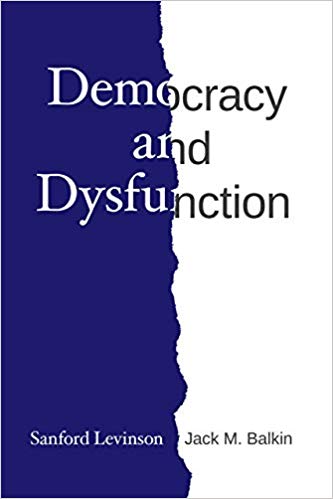
Sanford Levinson and Jack M. Balkin, Democracy and Dysfunction (University of Chicago Press, 2019)

Sanford Levinson, Written in Stone: Public Monuments in Changing Societies (Duke University Press 2018)

Mark A. Graber, Sanford Levinson, and Mark Tushnet, eds., Constitutional Democracy in Crisis? (Oxford University Press 2018)

Gerard Magliocca, The Heart of the Constitution: How the Bill of Rights became the Bill of Rights (Oxford University Press, 2018)

Cynthia Levinson and Sanford Levinson, Fault Lines in the Constitution: The Framers, Their Fights, and the Flaws that Affect Us Today (Peachtree Publishers, 2017)

Brian Z. Tamanaha, A Realistic Theory of Law (Cambridge University Press 2017)

Sanford Levinson, Nullification and Secession in Modern Constitutional Thought (University Press of Kansas 2016)

Sanford Levinson, An Argument Open to All: Reading The Federalist in the 21st Century (Yale University Press 2015)

Stephen M. Griffin, Broken Trust: Dysfunctional Government and Constitutional Reform (University Press of Kansas, 2015)

Frank Pasquale, The Black Box Society: The Secret Algorithms That Control Money and Information (Harvard University Press, 2015)

Bruce Ackerman, We the People, Volume 3: The Civil Rights Revolution (Harvard University Press, 2014)
Balkinization Symposium on We the People, Volume 3: The Civil Rights Revolution

Joseph Fishkin, Bottlenecks: A New Theory of Equal Opportunity (Oxford University Press, 2014)

Mark A. Graber, A New Introduction to American Constitutionalism (Oxford University Press, 2013)

John Mikhail, Elements of Moral Cognition: Rawls' Linguistic Analogy and the Cognitive Science of Moral and Legal Judgment (Cambridge University Press, 2013)

Gerard N. Magliocca, American Founding Son: John Bingham and the Invention of the Fourteenth Amendment (New York University Press, 2013)

Stephen M. Griffin, Long Wars and the Constitution (Harvard University Press, 2013)

Andrew Koppelman, The Tough Luck Constitution and the Assault on Health Care Reform (Oxford University Press, 2013)

James E. Fleming and Linda C. McClain, Ordered Liberty: Rights, Responsibilities, and Virtues (Harvard University Press, 2013)
Balkinization Symposium on Ordered Liberty: Rights, Responsibilities, and Virtues

Andrew Koppelman, Defending American Religious Neutrality (Harvard University Press, 2013)

Brian Z. Tamanaha, Failing Law Schools (University of Chicago Press, 2012)

Sanford Levinson, Framed: America's 51 Constitutions and the Crisis of Governance (Oxford University Press, 2012)

Linda C. McClain and Joanna L. Grossman, Gender Equality: Dimensions of Women's Equal Citizenship (Cambridge University Press, 2012)

Mary Dudziak, War Time: An Idea, Its History, Its Consequences (Oxford University Press, 2012)

Jack M. Balkin, Living Originalism (Harvard University Press, 2011)

Jason Mazzone, Copyfraud and Other Abuses of Intellectual Property Law (Stanford University Press, 2011)

Richard W. Garnett and Andrew Koppelman, First Amendment Stories, (Foundation Press 2011)

Jack M. Balkin, Constitutional Redemption: Political Faith in an Unjust World (Harvard University Press, 2011)

Gerard Magliocca, The Tragedy of William Jennings Bryan: Constitutional Law and the Politics of Backlash (Yale University Press, 2011)

Bernard Harcourt, The Illusion of Free Markets: Punishment and the Myth of Natural Order (Harvard University Press, 2010)

Bruce Ackerman, The Decline and Fall of the American Republic (Harvard University Press, 2010)
Balkinization Symposium on The Decline and Fall of the American Republic

Ian Ayres. Carrots and Sticks: Unlock the Power of Incentives to Get Things Done (Bantam Books, 2010)

Mark Tushnet, Why the Constitution Matters (Yale University Press 2010)

Ian Ayres and Barry Nalebuff: Lifecycle Investing: A New, Safe, and Audacious Way to Improve the Performance of Your Retirement Portfolio (Basic Books, 2010)
.jpg)
Jack M. Balkin, The Laws of Change: I Ching and the Philosophy of Life (2d Edition, Sybil Creek Press 2009)

Brian Z. Tamanaha, Beyond the Formalist-Realist Divide: The Role of Politics in Judging (Princeton University Press 2009)
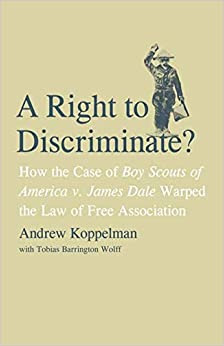
Andrew Koppelman and Tobias Barrington Wolff, A Right to Discriminate?: How the Case of Boy Scouts of America v. James Dale Warped the Law of Free Association (Yale University Press 2009)

Jack M. Balkin and Reva B. Siegel, The Constitution in 2020 (Oxford University Press 2009)

Heather K. Gerken, The Democracy Index: Why Our Election System Is Failing and How to Fix It (Princeton University Press 2009)

Mary Dudziak, Exporting American Dreams: Thurgood Marshall's African Journey (Oxford University Press 2008)

David Luban, Legal Ethics and Human Dignity (Cambridge Univ. Press 2007)

Ian Ayres, Super Crunchers: Why Thinking-By-Numbers is the New Way to be Smart (Bantam 2007)

Jack M. Balkin, James Grimmelmann, Eddan Katz, Nimrod Kozlovski, Shlomit Wagman and Tal Zarsky, eds., Cybercrime: Digital Cops in a Networked Environment (N.Y.U. Press 2007)
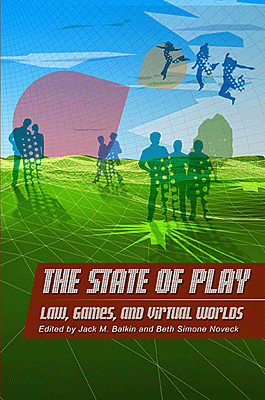
Jack M. Balkin and Beth Simone Noveck, The State of Play: Law, Games, and Virtual Worlds (N.Y.U. Press 2006)

Andrew Koppelman, Same Sex, Different States: When Same-Sex Marriages Cross State Lines (Yale University Press 2006)

Brian Tamanaha, Law as a Means to an End (Cambridge University Press 2006)

Sanford Levinson, Our Undemocratic Constitution (Oxford University Press 2006)

Mark Graber, Dred Scott and the Problem of Constitutional Evil (Cambridge University Press 2006)

Jack M. Balkin, ed., What Roe v. Wade Should Have Said (N.Y.U. Press 2005)

Sanford Levinson, ed., Torture: A Collection (Oxford University Press 2004)
Balkin.com homepage
Bibliography
Conlaw.net
Cultural Software
Writings
Opeds
The Information Society Project
BrownvBoard.com
Useful Links
Syllabi and Exams
