Balkinization
an unanticipated consequence of
Jack M. Balkin
Balkinization Symposiums: A Continuing List
E-mail:
Jack Balkin:
jackbalkin at yahoo.com
Bruce Ackerman
bruce.ackerman at yale.edu
Ian Ayres
ian.ayres at yale.edu
Corey Brettschneider
corey_brettschneider at brown.edu
Mary Dudziak
mary.l.dudziak at emory.edu
Joey Fishkin
joey.fishkin at gmail.com
Heather Gerken heather.gerken at yale.edu
Abbe Gluck abbe.gluck at yale.edu
Mark Graber
mgraber at law.umaryland.edu
Stephen Griffin
sgriffin at tulane.edu
Jonathan Hafetz
jonathan.hafetz at shu.edu
Jeremy Kessler
jkessler at law.columbia.edu
Andrew Koppelman
akoppelman at law.northwestern.edu
Marty Lederman
msl46 at law.georgetown.edu
Sanford Levinson
slevinson at law.utexas.edu
David Luban
david.luban at gmail.com
Gerard Magliocca
gmaglioc at iupui.edu
Jason Mazzone
mazzonej at illinois.edu
Linda McClain
lmcclain at bu.edu
John Mikhail
mikhail at law.georgetown.edu
Frank Pasquale
pasquale.frank at gmail.com
Nate Persily
npersily at gmail.com
Michael Stokes Paulsen
michaelstokespaulsen at gmail.com
Deborah Pearlstein
dpearlst at yu.edu
Rick Pildes
rick.pildes at nyu.edu
David Pozen
dpozen at law.columbia.edu
Richard Primus
raprimus at umich.edu
K. Sabeel Rahmansabeel.rahman at brooklaw.edu
Alice Ristroph
alice.ristroph at shu.edu
Neil Siegel
siegel at law.duke.edu
David Super
david.super at law.georgetown.edu
Brian Tamanaha
btamanaha at wulaw.wustl.edu
Nelson Tebbe
nelson.tebbe at brooklaw.edu
Mark Tushnet
mtushnet at law.harvard.edu
Adam Winkler
winkler at ucla.edu
Compendium of posts on Hobby Lobby and related cases
The Anti-Torture Memos: Balkinization Posts on Torture, Interrogation, Detention, War Powers, and OLC
The Anti-Torture Memos (arranged by topic)
Recent Posts
Making Policy Based on Falsehoods: The Federal Government vs UCLA
No Ordinary Opinion Announcement
A Grand Jury Will Not Indict a Thrown Ham Sandwich
What *are* the legal questions at issue in Trump's purported removal of Lisa Cook from the Federal Reserve Board?
Casebooks, Canons, and Constitutional Memory
Where Impoundment Litigation Stands after NIH v. APHA
Trump Has Found a Cruel New Way to Attack Trans Veterans
The D.C. Circuit’s Tangled Impoundment Decision
Parody or Reality? You Decide
Macedo and Lee’s “In Covid’s Wake” (long post)
Balkinization Symposiums-- A Continuing List
Enforcing Article Four, Section Two
Patterns in Slashing Food Assistance
Supreme Court Lecture--September 25th
![[Powered by Blogger]](https://lh3.googleusercontent.com/blogger_img_proxy/AEn0k_vQHR5QyAMpmfpM49tTDtygkwAwAHI2Gf1bOnilDs2SkuJGb7QAiGQxwPoDcFh7Nv8YT_aX9LaBzyLFPfAvpNrDyWDqJkF8eCT1Kl2obat6=s0-d)
Just A Few Blogs
ACS Blog
Alas, a Blog
Althouse
Arts and Letters Daily
Atrios (Eschaton)
Bill of Health
Buzzflash.com
Buzz Machine
Cato at Liberty
Juan Cole (Informed Comment)
Concurring Opinions
The Constitution in 2020
Corrente
Crooked Timber
Daily Howler
Daily Kos
Dana Boyd
Brad DeLong
Digby (Hullabaloo)
Discriminations
Daniel Drezner
Kevin Drum (Mother Jones)
Electrolite
En Banc
Eunomia (Daniel Larison)
Fafblog
Michael Froomkin (Discourse.net)
GovLab (Beth Noveck)
Rick Hasen (Election Law)
History News Network
How Appealing
Ignatz (Sam Heldman)
The Importance of (Ernie Miller)
Infolaw
Instapundit
International Economic Law and Policy Blog
IntLawGrrls
Jacob Levy
Jesus' General
Jurisdynamics
The Kitchen Cabinet
Mark Kleiman
Law Blog Central
Larry Lessig
Lawyers, Guns and Money
Liberal Oasis
Brian Leiter's Law School Reports
The Leiter Reports
Marginal Revolution
Megan McArdle
Memeorandum
Metafilter
Mirror of Justice
The New Republic
Newseum
No More Mister Nice Blog
Brendan Nyhan
Opinio Juris
Orcinus
The Originalism Blog
Pandagon
Passport (Foreign Policy)
Overcoming Bias
Political Animal (Washington Monthly)
Political Theory Daily Review
Political Wire (Taegan Goddard)
The Poor Man
Virginia Postrel
Prawfsblawg
Public Reason
Jonathan Rauch
Raw Story
Redstate
ReligiousLeftLaw.com
Reporters Committee For Freedom of the Press
Reproductive Rights Blog
Rothman's Roadmap to the Right of Publicity
SCOTUS Blog
Seeing the Forest
Clay Shirky
The Shifted Librarian
The Situationist
Larry Solum (Legal Theory)
Andrew Sullivan
Talking Points Memo
Talk Left
Tapped
Tbogg
TechPresident
The Paper Chase (Jurist)
Tom Paine
Tom Tomorrow (This Modern World)
Eve Tushnet
Uggabugga
University of Chicago Law School Faculty Blog
Unqualified Offerings
The Volokh Conspiracy
War and Piece (Laura Rozen)
Wampum
Oliver Willis
Wonkette
Written Description
Matthew Yglesias
Yin
Your Choice of Feeds
1. XML
powered by

2. Atom Feed
3. RSS 2.0
Making Policy Based on Falsehoods: The Federal Government vs UCLA
Joseph Fishkin
What happens when the government makes policy based on falsehoods? As our present administration’s unrelenting destruction of American ideals and institutions grinds onward, I find myself returning often to this question. I realize now that I completely failed to grasp the significance of the moment, on President Trump’s first day in office in January 2017, when he sent Sean Spicer out to the podium to defend an obviously false claim about the size of the crowd at his inauguration. This had no policy implications, and at the time, it struck me as more embarrassing than dangerous. That was a failure of imagination on my part. It was an early effort to bully the national media into accepting what team Trump then briefly called “alternative facts.”
Posted
11:13 AM
by Joseph Fishkin [link]
No Ordinary Opinion Announcement
Gerard N. Magliocca
Next Term, the Supreme Court will rule on the legality of the Administration's tariffs. This will be a market moving event, to say the least. Elsewhere I've pointed out that the usual practice of issuing merits decisions at 10AM without notice will be a disaster for this case. The Court should either give notice of the decision day or do what amounts to the same thing by scheduling the announcement before or after market hours. The precedent here is the Gold Clause Cases. At a certain point after argument, the Court scheduled an opinion day and announced that those opinions would not be coming out that day. When the next opinion day was scheduled, they made no such announcement. Thus, everyone knew that the decision was coming then. The Court should follow that example or something comparable in this unusual situation.
Posted
7:46 PM
by Gerard N. Magliocca [link]
(0) comments
A Grand Jury Will Not Indict a Thrown Ham Sandwich
Gerard N. Magliocca
I was surprised to learn that a federal grand jury in Washington DC declined to indict on a felony charge the DOJ employee who threw a sandwich at a federal agent. This suggests that there is a potential limit on the Administration's ability to enforce its "crime emergency" policies in the District. The grand jury requirement of the Fifth Amendment remains unincorporated. Perhaps examples like this will cause people to rethink that exception, which is hard to justify on anything other than a modern belief that grand juries serve no valuable purpose in protecting innocent people or preventing overcharging by prosecutors.
Posted
11:17 AM
by Gerard N. Magliocca [link]
(0) comments
What *are* the legal questions at issue in Trump's purported removal of Lisa Cook from the Federal Reserve Board?
Marty Lederman
I dunno know about "between 10 and 20," but Mark is right: Trump's action does indeed raise a slew of legal questions, most of which haven't been emphasized or even identified by observers in the past couple of days.
The Court is aware that if the (mistaken) rationale and underpinnings of its decisions in cases such as Seila Law, Wilcox and Boyle were correct--in particular, if Article II truly did afford the President "all of" the Executive power--it would mean that the President could remove members of the Federal Reserve Board simply because they do not vote as he directs or wishes them to vote on questions of interest rates. The Court realizes how dangerous that would be, and therefore it appears to be casting about for some basis, however unprincipled, for a "Fed exception."
Posted
5:51 PM
by Marty Lederman [link]
Casebooks, Canons, and Constitutional Memory
JB
Sandy Levinson and I have uploaded a draft of our latest essay, Casebooks, Canons, and Constitutional Memory, to SSRN. Here is the abstract: Why edit a constitutional law casebook? One might want to shape how professors teach the subject and how students learn it. But the influence of casebook editors is limited. Most students at most law schools will never practice constitutional law, and those that do probably deal with subjects not in the standard introductory course. Editing a casebook involves the construction of a canon. The canon in literature is organized around great works of excellence. By contrast, the canon in constitutional casebooks does not reflect the best opinions ever written; instead it reflects generations of political and legal struggles over the Constitution. There are three kinds of canons in constitutional law, and in constitutional law casebooks: (1) the pedagogical canon of materials that students need to know to be well-trained lawyers; (2) the cultural literacy canon of materials that citizens need to know to understand their constitutional system; and (3) the constitutional theory canon of materials that are grist for the mill of serious academic discussion. Each of these canons has a politics, and different casebooks may align themselves with different political and legal visions and movements. Casebooks are also sites of collective memory. A casebook foregrounds what teachers and students are likely to focus on and remember. What is left out of teaching materials is more likely to be forgotten. Hence constitutional law casebook authors are almost inevitably memory entrepreneurs, who seek to get people to remember certain things or remember them differently. But casebook editors are hardly all-powerful memory entrepreneurs. Authors must work with their coauthors to decide what materials to include and delete in successive editions. Casebook authors face serious constraints from publishers. Publishers demand frequent new editions to undercut sales of used casebooks; and they want casebooks to be ever shorter and simpler to understand. Perhaps most important, casebook authors feel obliged to cover contemporary issues in constitutional law. Those issues are not in their control. They are shaped by the continuous interaction and collision between the political branches and the courts, and especially the United States Supreme Court. In this way the Supreme Court exercises vast control over the content and organization of constitutional law casebooks. This creates important problems of constitutional memory. If the Supreme Court overrules a line of cases, those cases are likely to be flushed down the memory hole unless casebook editors are willing to sacrifice other valued content. The Supreme Court constantly destroys existing canons of constitutional law and reconstitutes them through its choice of cases to decide. Casebook authors must carefully consider how much of this constant churning and change is noise and how much is genuinely important and lasting for understanding the U.S. Constitution. This makes casebook authors' limited choices about what to remember especially important. At most, by placing certain materials before professors and students, casebook authors can provide opportunities to recall and absorb what is most important about our constitutional traditions. Yet what others do with those materials--and those memories--is ultimately beyond casebook authors' control.
Posted
9:30 AM
by JB [link]
Where Impoundment Litigation Stands after NIH v. APHA
David Super
For months, those challenging the Trump
Administration’s massive impoundment of appropriated funds have been left to try
to divine deep meanings from cryptic orders on the Supreme Court’s shadow
docket. Now, in National Institutes of Health
v. American Public Health Association, we have important if incomplete
answers about one important branch of impoundment litigation. This post seeks to put NIH v. APHA into
context and anticipate next steps in this kind of litigation. I will leave the legal merits of the Court’s
disposition for others to assess. The Trump Administration’s impoundments
can be divided into three categories.
First, it has sought to cancel or ignore legal obligations the federal
government has already assumed. Second,
it has refused to obligate appropriated funds.
And third, it proposed a package of proposed rescissions to Congress
under the Impoundment Control Act and received a largely favorable action under
the ICA’s expedited procedures. Although
billions of dollars are at stake in each category, the second is by far the
largest. The impoundments in NIH v. APHA were
in the first category: already obligated
funds. The issues in the second category
(funds withheld prior to obligation) are quite different and therefore will see
only modest effects from this decision.
Posted
1:07 AM
by David Super [link]
Trump Has Found a Cruel New Way to Attack Trans Veterans
Andrew Koppelman
I explain in a new column at Slate.
Posted
4:20 PM
by Andrew Koppelman [link]
The D.C. Circuit’s Tangled Impoundment Decision
David Super
On August 13, a panel
of the U.S. Court of Appeals for the District of Columbia Circuit handed down
an opinion
on President Trump’s impoundment of foreign assistance funds. This case is significant because it is the
first one squarely raising the legality of impoundments per se, as
opposed to deficient reasons for impoundment, to reach an appellate court. Unfortunately, the case arrived in a rather confused
posture, and the panel’s opinion added considerably to that confusion. Because this case is likely to draw
considerable attention, it merits close analysis. Two sets of
plaintiffs sued to overturn the President’s impoundment of billions of dollars
of foreign assistance funds. Between
them, the plaintiffs raised ten claims, no two of
which are truly duplicative. As is commonly
true in such cases, some of these claims were much stronger than others. The district court chose to engage with, and grant preliminary
relief on, some of these claims while declining to address the others as
unnecessary to support its order. Unfortunately,
the claims with which the district court engaged were not the best. The case
therefore arrived in the D.C. Circuit with the better claims against
impoundment not clearly presented for decision.
The Government threw in some theories for the first time in its reply
brief, which the court allowed, and then the court itself added to confusion by
saying it was going to analyze one claim and then proceeding to analyze another,
far weaker, one. The result is so
tangled that future courts and litigants will likely be able to secure scant
guidance from the panel’s opinion (or, indeed, from the dissent, which is confined
by the same tangled framing).
Posted
5:16 PM
by David Super [link]
Parody or Reality? You Decide
Gerard N. Magliocca
August 11, 2025 Jarrett B. Perlow Clerk of the Court U.S. Court of Appeals for the Federal Circuit 717 Madison Place, NW Washington, DC 20439 Re: Rule 28(j) Letter in V.O.S. Selections, et al. v. Trump, et al., Nos. 25-1812, 25-1813 – Pertinent and Significant Authority Arising Since Our Briefs Were Filed Dear Mr. Perlow: On July 27, after stating his intention to impose IEEPA tariffs, President Trump announced the largest trade agreement in history with the 27-nation European Union, America’s most significant trading partner. See Alex Gangitano, Trump, EU’s von der Leyen strike trade deal for 15 percent tariffs, The Hill (July 27, 2025). President Trump entered historic agreements with Indonesia, the Philippines, and Japan on July 22; and with the United Kingdom on May 8. These agreements support our request for a stay if the Court affirms. Opening Br.5, 54-60; Reply Br.27-30. Suddenly revoking the President’s tariff authority under IEEPA would have catastrophic consequences for our national security, foreign policy, and economy. The President believes that our country would not beable to pay back the trillions of dollars that other countries have already committed to pay, which could lead to financial ruin. Other tariff authorities that the President could potentially use are short-term, not nearly as powerful, and would render America captive to the abuses that it has endured from far more aggressive countries. There is no substitute for the tariffs and deals that President Trump has made. One year ago, the United States was a dead country, and now, because of the trillions of dollars being paid by countries that have so badly abused us, America is a strong, financially viable, and respected country again. If the United States were forced to pay back the trillions of dollars committed to us, America could go from strength to failure the moment such an incorrect decision took effect. These deals for trillions of dollars have been reached, and other countries have committed to pay massive sums of money. If the United States were forced to unwind these historic agreements, the President believes that a forced dissolution of the agreements could lead to a 1929-style result. In such a scenario, people would be forced from their homes, millions of jobs would be eliminated, hard-working Americans would lose their savings, and even Social Security and Medicare could be threatened. In short, the economic consequences would be ruinous, instead of unprecedented success. Sincerely, D. John Sauer D. John Sauer Solicitor General /s/ Brett Shumate Brett Shumate Assistant Attorney General
Posted
12:52 PM
by Gerard N. Magliocca [link]
(0) comments
Macedo and Lee’s “In Covid’s Wake” (long post)
Stephen Griffin
Stephen Macedo and Frances Lee, distinguished
political scientists who teach at Princeton, have published a deeply provocative look
at the nation’s response to the Covid pandemic.
The book is based on extensive medical research and sorts through
the effectiveness of the different policy responses to Covid in the fifty
states. Their analysis is thought-provoking
and frustrating at the same time. “In
Covid’s Wake” is really two books. The
first is an evaluation of how “elites,” especially medical and scientific
elites, but also academic and media elites, gave advice on what was at best
partial knowledge while striving to avoid any reasoned debate with those who
disagreed. The second is an evaluation
of state and national policymaking during the Covid crisis. With respect to the latter, although Macedo
and Lee evaluate decision making by the nation’s governors, they
studiously avoid evaluating national policymaking, most especially
decisions made by President Trump. The
result is an odd mix of startling revelations and sharp elbows analysis
combined with a studied lack of curiosity about how national decisions are made
in crises, both during Covid and in the past. I’ll begin by citing an example of Macedo
and Lee’s startling research from near the end of the book. For those who followed the Covid policy
debates, this should be of interest. They
summarize an article in one of the journals of the American Medical Association
which argued that action needs to be taken against physicians who spread
“misinformation” about Covid. Macedo and
Lee say that some claims cited in the article are indeed erroneous such as
“assertions that exaggerate the risks of vaccines or that make false claims
about vaccine ineffectiveness.” (276)
But they go on to argue that other assertions of “misinformation” are
made too broadly by the article’s authors, including: (1) the virus originated
in a laboratory in China as part of a NIH study; (2) government and public
health officials withheld key information; (3) effectiveness of masks was
doubtful; (4) natural infection and recovery contribute to population immunity;
(5) Government actors were contacting social media companies telling them what
to censor. Keep in mind that the point is that the authors
of the journal article are certain that these five points are "misinformation." In response, Macedo and
Lee invoke the lessons learned in their prior chapters: “Readers of this book will
already know that those five categories of supposed ‘misinformation’ may
actually be correct, or, at minimum, within the scope of reasonable
disagreement.” (277) Macedo and Lee
provide evidence worthy of serious consideration against all five points. In so doing, they upend what I suspect are
the assumptions of many “informed” Americans about what happened in the
pandemic. There’s more, much more to Macedo
and Lee’s account which almost amounts to an alternative history of Covid. Some notable examples: prior to Covid, most
studies did not recommend non-pharmaceutical interventions (known as “NPIs” –
that is, lockdowns, school closings, and social measures such as masks and
distancing). Democratic governments
panicked and followed the example of . . . China (?), an extremely
repressive regime. Experts stigmatized
disagreement with measures on which, before Covid, there was no widespread
agreement. The different measures taken
by governors of red and blue states made no difference to Covid mortality. The cost of the interventions was incredibly
high, especially for essential workers, young people, and the poor. Inequality increased. And no one shows any interest in learning
from this experience, especially in academia. This is quite a list. And it’s something of a challenge to explain
why their analysis strikes me nonetheless as frustratingly partial and for that reason not
terribly helpful. But that’s why I’m
writing this post.
Posted
8:14 PM
by Stephen Griffin [link]
Balkinization Symposiums-- A Continuing List
JB
Over the the years we've done dozens of symposiums here at Balkinization. This list offers a summary of the books and subjects we've covered. We will continue to add links to earlier symposiums as well as updating the list with new ones. For each symposium, the date assigned is the date of the last in the series of posts. Many thanks to all of the people who've written for us over the years. You have enriched legal scholarship with your efforts.
Posted
9:30 AM
by JB [link]
Enforcing Article Four, Section Two
Gerard N. Magliocca
By one reckoning, there are a group of fugitives in Illinois who are wanted alive and able to answer a quorum call in Texas. Article Four, Section Two says a state must extradite any person charged with a crime to the state making the charge if that state's executive authority demands extradition. Assume that some formal indictment or information must be made before this provision is triggered. Let's also assume that the Clause is operative if the fugitives flee in anticipation of a criminal charge rather than only after being charged. (The latter is the more natural reading of the text, but maybe that will be litigated.) Can the federal courts enforce Article Four, Section Two? Is there any precedent for issuing an injunction against a state governor to return a fugitive to another state? I have no idea.
Posted
11:17 AM
by Gerard N. Magliocca [link]
(2) comments
Patterns in Slashing Food Assistance
David Super
The One Big
Beautiful Bill Act (OBBBA) that Congress passed this summer represents the
third massive cutting spree in the history of the Supplemental Nutrition
Assistance Program (SNAP, formerly food stamps). The first came in three laws enacted under
President Reagan in 1981-82, by far the largest of which was the Omnibus Budget
Reconciliation Act of 1981 (OBRA 1981).
The second was another pair of laws enacted in 1995-96, dominated by the
Personal Responsibility and Work Opportunity Reconciliation Act of 1996 (PRWORA
or “the 1996 welfare law”). This post
seeks insight into attitudes about anti-poverty programs by comparing the
three. It concludes that no meaningful
theme unites these three episodes beyond the desire to fund tax cuts delivering
most of their benefits to the affluent.
In other words, no enduring disagreements separate liberals and
conservatives on anti-poverty policy except that many Republicans regard assuring
adequate nutrition for low-income people is not an essential governmental
function. OBRA 1981 was
passed by a Republican Senate and a House coalition of Republicans and conservative Democrats, signed by a Republican
President. PRWORA was passed by a
Republican Congress but signed by a Democratic President and, at his urging, gained a
great many congressional Democrats' votes. OBBBA was passed on essentially party-lines
votes, with one Republican in each chamber dissenting over objections to the
cuts to anti-poverty programs. In 1981, a group
of anti-poverty Senate Republicans led by Senator Bob Dole fought back against
the proposed cuts that they believed would do the most damage to the program
and the low-income people who depend on it.
(Those dismissing Senator Dole’s food stamp advocacy as merely serving
Kansas farmers badly underestimate the man.
Among other things, he spent enormous amounts of political capital,
risking his later ascension to be Senate Majority Leader, fighting Senator
Jesse Helms to replace cuts hitting the poorest of the poor with ones affecting
households somewhat better-able to bear the loss. Those shifts did not change anything from
farmers’ point of view.) Pro-food stamp
Democrats also led the House delegation in the conference committee, although they
were badly undermined by having repeatedly lost floor votes to the coalition
President Reagan had assembled. In 1995-96,
Republicans on the House and Senate Agriculture Committees started out amenable
to some food stamp cuts, but demands from Speaker Newt Gingrich’s leadership
far surpassed the level they supported.
They lost intra-party battles on the depth of the cuts, but Reps. Pat
Roberts and Bill Emerson, along with Sen. Richard Lugar, remained open
throughout the process to ideas for how to reduce the hardship the cuts would
inflict on low-income households. Leaders
of both the House and Senate Agriculture Committees fought and won intra-party
battles to prevent the program from being block-granted. This year, House
and Senate Agriculture Committee Republicans decided early among themselves
about how they wanted to slash SNAP and largely tuned out dissenting voices,
including those from within their Party.
Even on questions of drafting clarity, they largely froze out external
voices. Ultimately Senate Republican
Leader John Thune needed to exempt Alaska from some of the harshest provisions
in the bill to win Senator Lisa Murkowski’s vote; the Committee did as it was
told but did not take the occasion to reconsider any of its policies for the
remainder of the country. Each of these
three episodes resulted in estimated reductions of about one-fifth in projected
spending. The composition of those cuts,
however, was very different. President Reagan’s
theme was stripping benefits from the working poor. He insisted that he was maintaining a “safety
net for the truly needy”, but in food stamps and other programs he sought to
reduce or eliminate benefits for low-income working families. This played beautifully into Speaker
Gingrich’s hands a decade later as he complained that very few families
receiving welfare or food stamps were working.
Gingrich cited that as justification for slashing the programs
further. As students in my
Public Welfare Law course could tell you, targeting benefits on those most in
need and providing incentives for efforts to reduce need are opposite policies
that must be balanced when designing any anti-poverty program. President Reagan was a targeter; Speaker
Gingrich was all about incentives while refusing to acknowledge, of course,
that he was repudiating President Reagan’s legacy. Some prominent Democrats, including Senator
Daniel Patrick Moynihan, have focused on targeting; others, such as Professor
David Ellwood, have focused laser-like on incentives. OBBBA has no consistent
philosophical valence in either direction between targeting and incentives. Its authors complained
about people were getting benefits who did not need them – evidently a
reference to the low-wage workers states had begun to serve through some flexibility
PRWORA granted. But they also complained
that more SNAP recipients should be working.
(Research
shows that the overwhelming majority of SNAP recipients who can work do,
although they often turn to SNAP for help during gaps in employment, which are
common because low-skilled workers typically can obtain only unstable jobs.) Thus, on the one
hand, its rules terminating aid to those who had than three months with less
than half-time employment during any three-year period will hurt some of the
most needy: those with the least
skills. On the other hand, its
provisions shifting benefit costs to states are explicitly intended to
discourage those states from adopting options that broaden the program’s reach
among low-wage workers. Just as the three
episodes of food assistance cutting show no consistency in their philosophies
about the best use of program funds, they also diverge on federalism. States did not feature prominently in debates
about President Reagan’s food assistance cuts.
Many states, including those with Republican governors, expressed
concern about losing federal aid for their low-income people. The Gingrich
Revolution, by contrast, placed states on a pedestal. It offered them greater control over
programs’ funds in exchange for less total money. States eagerly grabbed this deal to liquidate
the Aid to Families with Dependent Children program. Many balked about taking Medicaid or food
stamps, seeing few politically palatable opportunities to cut, but Gingrich
leveraged the threat of block-granting to force through massive food stamp cuts
within the existing program structure. OBBBA takes the
opposite approach, lambasting states for sabotaging and maladministering the
program. This Republican pivot to
condemning states counterbalances a pivot by SNAP advocates following the 1996
welfare law. After decades of seeking to
buttress uniform national standards in SNAP, the lesson they learned
from 1995-96 was that improvements in SNAP are more politically sustainable
with the states’ support. Republicans
apparently have reached similar conclusions and are hoping that forcing states
to pay a share of SNAP benefit costs will discourage states from supporting
liberalizations and could cause some states to drop out of the program
altogether. This does follow the 1995-96
model of imposing financial inducements for states to shoulder the blame for
benefit cuts rather than legislating them directly. But a serious version of federalism it is
not. The only major
through-line in the means of extracting savings from SNAP is increasing
dependence on bureaucratic disentitlement.
OBRA 1981 required working households to fill out and submit elaborate
reports of their earnings every month during a narrow window of days. When households made mistakes, or state
agencies became backlogged, the households were automatically cut off. This system caused so much chaos that a
cross-section of states as well as advocates clamored for its elimination;
President Reagan signed legislation making it a state option late in his
Administration. OBRA 1981 also
imposed draconian fiscal penalties on states for overissuing benefits to
households. Because improper denials did
not factor into these error rates, a “when in doubt, deny” attitude grew among
many human services offices.
Overwhelming complaints from over forty states caused the Reagan
Administration to negotiate a drastic reduction in these penalties (followed by
further administrative reductions in the George H.W. Bush Administration and
legislative reductions approved by George W. Bush). PRWORA pioneered a
new kind of “work requirement”.
Previously, public welfare programs’ work requirements directed
beneficiaries to “workfare” or other assignments; if the beneficiaries did as
instructed, they kept their benefits. Most
states disliked these programs as being administratively burdensome to operate
and serving little purpose as employable food stamp recipients already had
strong motivations to find jobs to pay their rent and other non-food
bills. Congressional Republicans were
dissatisfied with the numbers of food stamp recipients working so they kept the
disqualification rule but eliminated the requirement that recipients be given
the chance to work for continued benefits.
States’ distaste for
running work programs overwhelmed whatever moral responsibility they felt for
food stamp recipients who were willing to work but unable to find half-time
jobs. Many others who actually were
working half-time or more failed to navigate states’ bureaucratic requirements
for proving those hours. Hundreds of
thousands of desperately poor childless individuals between the ages of 18 and
49 were denied aid. Even when they
became eligible again, many failed to realize that or simply understood that
they were no longer welcome in SNAP. Food bankers and other
emergency food providers regarded this as a disaster, but OBBBA’s drafters apparently
found this story inspiring. They
expanded this workless “work requirement” to childless individuals up to age 65
and to families with children age 14 and up.
Coupling this with ferocious penalties on states for serving someone
whom federal auditors find not to have documented sufficient hours, the
bureaucratic barriers to documenting work are likely to multiply. Anti-poverty
programs can only be stable with substantial bipartisan support. Making significant program design sacrifices to
secure that support is worthwhile
even when one party dominates the levers of power. Unfortunately, the absence of coherent conservative
policy preferences concerning food assistance that emerges from these three
episodes makes a viable path to bipartisan compromise difficult to
discern. @DavidASuper.bsky.social
@DavidASuper1
Posted
9:13 PM
by David Super [link]
Supreme Court Lecture--September 25th
Gerard N. Magliocca
The Supreme Court Historical Society awarded the Griswold Prize to Washington's Heir. I'll give a lecture at the Court on September 25th at 6PM to accept the award. The lecture is tentatively titled: "Sanctuary of the Law: Bushrod Washington's Circuit Court." I hope that some of you in the DC area can attend, and I will post further details when I get them.
Posted
7:53 AM
by Gerard N. Magliocca [link]
(0) comments
Books by Balkinization Bloggers

Gerard N. Magliocca, The Actual Art of Governing: Justice Robert H. Jackson's Concurring Opinion in the Steel Seizure Case (Oxford University Press, 2025)

Linda C. McClain and Aziza Ahmed, The Routledge Companion to Gender and COVID-19 (Routledge, 2024)

David Pozen, The Constitution of the War on Drugs (Oxford University Press, 2024)

Jack M. Balkin, Memory and Authority: The Uses of History in Constitutional Interpretation (Yale University Press, 2024)
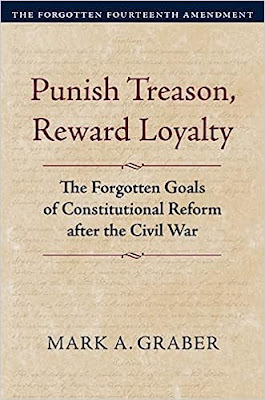
Mark A. Graber, Punish Treason, Reward Loyalty: The Forgotten Goals of Constitutional Reform after the Civil War (University of Kansas Press, 2023)
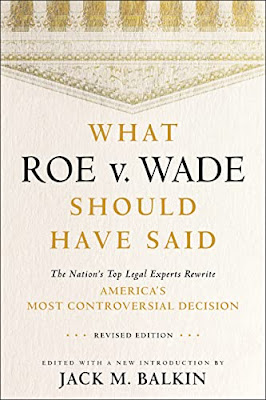
Jack M. Balkin, What Roe v. Wade Should Have Said: The Nation's Top Legal Experts Rewrite America's Most Controversial Decision - Revised Edition (NYU Press, 2023)

Andrew Koppelman, Burning Down the House: How Libertarian Philosophy Was Corrupted by Delusion and Greed (St. Martin’s Press, 2022)

Gerard N. Magliocca, Washington's Heir: The Life of Justice Bushrod Washington (Oxford University Press, 2022)
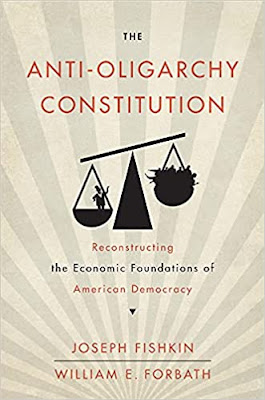
Joseph Fishkin and William E. Forbath, The Anti-Oligarchy Constitution: Reconstructing the Economic Foundations of American Democracy (Harvard University Press, 2022)
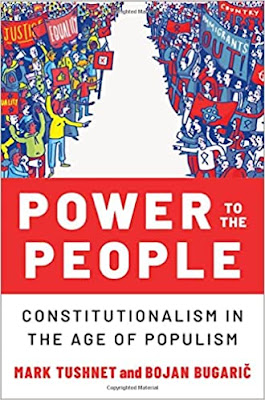
Mark Tushnet and Bojan Bugaric, Power to the People: Constitutionalism in the Age of Populism (Oxford University Press 2021).

Mark Philip Bradley and Mary L. Dudziak, eds., Making the Forever War: Marilyn B. Young on the Culture and Politics of American Militarism Culture and Politics in the Cold War and Beyond (University of Massachusetts Press, 2021).

Jack M. Balkin, What Obergefell v. Hodges Should Have Said: The Nation's Top Legal Experts Rewrite America's Same-Sex Marriage Decision (Yale University Press, 2020)

Frank Pasquale, New Laws of Robotics: Defending Human Expertise in the Age of AI (Belknap Press, 2020)

Jack M. Balkin, The Cycles of Constitutional Time (Oxford University Press, 2020)

Mark Tushnet, Taking Back the Constitution: Activist Judges and the Next Age of American Law (Yale University Press 2020).

Andrew Koppelman, Gay Rights vs. Religious Liberty?: The Unnecessary Conflict (Oxford University Press, 2020)

Ezekiel J Emanuel and Abbe R. Gluck, The Trillion Dollar Revolution: How the Affordable Care Act Transformed Politics, Law, and Health Care in America (PublicAffairs, 2020)

Linda C. McClain, Who's the Bigot?: Learning from Conflicts over Marriage and Civil Rights Law (Oxford University Press, 2020)
Sanford Levinson and Jack M. Balkin, Democracy and Dysfunction (University of Chicago Press, 2019)

Sanford Levinson, Written in Stone: Public Monuments in Changing Societies (Duke University Press 2018)

Mark A. Graber, Sanford Levinson, and Mark Tushnet, eds., Constitutional Democracy in Crisis? (Oxford University Press 2018)

Gerard Magliocca, The Heart of the Constitution: How the Bill of Rights became the Bill of Rights (Oxford University Press, 2018)

Cynthia Levinson and Sanford Levinson, Fault Lines in the Constitution: The Framers, Their Fights, and the Flaws that Affect Us Today (Peachtree Publishers, 2017)

Brian Z. Tamanaha, A Realistic Theory of Law (Cambridge University Press 2017)

Sanford Levinson, Nullification and Secession in Modern Constitutional Thought (University Press of Kansas 2016)

Sanford Levinson, An Argument Open to All: Reading The Federalist in the 21st Century (Yale University Press 2015)

Stephen M. Griffin, Broken Trust: Dysfunctional Government and Constitutional Reform (University Press of Kansas, 2015)

Frank Pasquale, The Black Box Society: The Secret Algorithms That Control Money and Information (Harvard University Press, 2015)

Bruce Ackerman, We the People, Volume 3: The Civil Rights Revolution (Harvard University Press, 2014)
Balkinization Symposium on We the People, Volume 3: The Civil Rights Revolution

Joseph Fishkin, Bottlenecks: A New Theory of Equal Opportunity (Oxford University Press, 2014)

Mark A. Graber, A New Introduction to American Constitutionalism (Oxford University Press, 2013)

John Mikhail, Elements of Moral Cognition: Rawls' Linguistic Analogy and the Cognitive Science of Moral and Legal Judgment (Cambridge University Press, 2013)

Gerard N. Magliocca, American Founding Son: John Bingham and the Invention of the Fourteenth Amendment (New York University Press, 2013)

Stephen M. Griffin, Long Wars and the Constitution (Harvard University Press, 2013)

Andrew Koppelman, The Tough Luck Constitution and the Assault on Health Care Reform (Oxford University Press, 2013)

James E. Fleming and Linda C. McClain, Ordered Liberty: Rights, Responsibilities, and Virtues (Harvard University Press, 2013)
Balkinization Symposium on Ordered Liberty: Rights, Responsibilities, and Virtues

Andrew Koppelman, Defending American Religious Neutrality (Harvard University Press, 2013)

Brian Z. Tamanaha, Failing Law Schools (University of Chicago Press, 2012)

Sanford Levinson, Framed: America's 51 Constitutions and the Crisis of Governance (Oxford University Press, 2012)

Linda C. McClain and Joanna L. Grossman, Gender Equality: Dimensions of Women's Equal Citizenship (Cambridge University Press, 2012)

Mary Dudziak, War Time: An Idea, Its History, Its Consequences (Oxford University Press, 2012)

Jack M. Balkin, Living Originalism (Harvard University Press, 2011)

Jason Mazzone, Copyfraud and Other Abuses of Intellectual Property Law (Stanford University Press, 2011)

Richard W. Garnett and Andrew Koppelman, First Amendment Stories, (Foundation Press 2011)

Jack M. Balkin, Constitutional Redemption: Political Faith in an Unjust World (Harvard University Press, 2011)

Gerard Magliocca, The Tragedy of William Jennings Bryan: Constitutional Law and the Politics of Backlash (Yale University Press, 2011)

Bernard Harcourt, The Illusion of Free Markets: Punishment and the Myth of Natural Order (Harvard University Press, 2010)

Bruce Ackerman, The Decline and Fall of the American Republic (Harvard University Press, 2010)
Balkinization Symposium on The Decline and Fall of the American Republic

Ian Ayres. Carrots and Sticks: Unlock the Power of Incentives to Get Things Done (Bantam Books, 2010)

Mark Tushnet, Why the Constitution Matters (Yale University Press 2010)

Ian Ayres and Barry Nalebuff: Lifecycle Investing: A New, Safe, and Audacious Way to Improve the Performance of Your Retirement Portfolio (Basic Books, 2010)
.jpg)
Jack M. Balkin, The Laws of Change: I Ching and the Philosophy of Life (2d Edition, Sybil Creek Press 2009)

Brian Z. Tamanaha, Beyond the Formalist-Realist Divide: The Role of Politics in Judging (Princeton University Press 2009)
Andrew Koppelman and Tobias Barrington Wolff, A Right to Discriminate?: How the Case of Boy Scouts of America v. James Dale Warped the Law of Free Association (Yale University Press 2009)

Jack M. Balkin and Reva B. Siegel, The Constitution in 2020 (Oxford University Press 2009)

Heather K. Gerken, The Democracy Index: Why Our Election System Is Failing and How to Fix It (Princeton University Press 2009)

Mary Dudziak, Exporting American Dreams: Thurgood Marshall's African Journey (Oxford University Press 2008)

David Luban, Legal Ethics and Human Dignity (Cambridge Univ. Press 2007)

Ian Ayres, Super Crunchers: Why Thinking-By-Numbers is the New Way to be Smart (Bantam 2007)

Jack M. Balkin, James Grimmelmann, Eddan Katz, Nimrod Kozlovski, Shlomit Wagman and Tal Zarsky, eds., Cybercrime: Digital Cops in a Networked Environment (N.Y.U. Press 2007)
Jack M. Balkin and Beth Simone Noveck, The State of Play: Law, Games, and Virtual Worlds (N.Y.U. Press 2006)

Andrew Koppelman, Same Sex, Different States: When Same-Sex Marriages Cross State Lines (Yale University Press 2006)

Brian Tamanaha, Law as a Means to an End (Cambridge University Press 2006)

Sanford Levinson, Our Undemocratic Constitution (Oxford University Press 2006)

Mark Graber, Dred Scott and the Problem of Constitutional Evil (Cambridge University Press 2006)

Jack M. Balkin, ed., What Roe v. Wade Should Have Said (N.Y.U. Press 2005)

Sanford Levinson, ed., Torture: A Collection (Oxford University Press 2004)
Balkin.com homepage
Bibliography
Conlaw.net
Cultural Software
Writings
Opeds
The Information Society Project
BrownvBoard.com
Useful Links
Syllabi and Exams
