Balkinization
an unanticipated consequence of
Jack M. Balkin
Balkinization Symposiums: A Continuing List
E-mail:
Jack Balkin:
jackbalkin at yahoo.com
Bruce Ackerman
bruce.ackerman at yale.edu
Ian Ayres
ian.ayres at yale.edu
Corey Brettschneider
corey_brettschneider at brown.edu
Mary Dudziak
mary.l.dudziak at emory.edu
Joey Fishkin
joey.fishkin at gmail.com
Heather Gerken heather.gerken at yale.edu
Abbe Gluck abbe.gluck at yale.edu
Mark Graber
mgraber at law.umaryland.edu
Stephen Griffin
sgriffin at tulane.edu
Jonathan Hafetz
jonathan.hafetz at shu.edu
Jeremy Kessler
jkessler at law.columbia.edu
Andrew Koppelman
akoppelman at law.northwestern.edu
Marty Lederman
msl46 at law.georgetown.edu
Sanford Levinson
slevinson at law.utexas.edu
David Luban
david.luban at gmail.com
Gerard Magliocca
gmaglioc at iupui.edu
Jason Mazzone
mazzonej at illinois.edu
Linda McClain
lmcclain at bu.edu
John Mikhail
mikhail at law.georgetown.edu
Frank Pasquale
pasquale.frank at gmail.com
Nate Persily
npersily at gmail.com
Michael Stokes Paulsen
michaelstokespaulsen at gmail.com
Deborah Pearlstein
dpearlst at yu.edu
Rick Pildes
rick.pildes at nyu.edu
David Pozen
dpozen at law.columbia.edu
Richard Primus
raprimus at umich.edu
K. Sabeel Rahmansabeel.rahman at brooklaw.edu
Alice Ristroph
alice.ristroph at shu.edu
Neil Siegel
siegel at law.duke.edu
David Super
david.super at law.georgetown.edu
Brian Tamanaha
btamanaha at wulaw.wustl.edu
Nelson Tebbe
nelson.tebbe at brooklaw.edu
Mark Tushnet
mtushnet at law.harvard.edu
Adam Winkler
winkler at ucla.edu
Compendium of posts on Hobby Lobby and related cases
The Anti-Torture Memos: Balkinization Posts on Torture, Interrogation, Detention, War Powers, and OLC
The Anti-Torture Memos (arranged by topic)
Recent Posts
Religious Liberty as a Judicial Autoimmune Disorder: The Supreme Court Repudiates Its Own Authority in Kennedy v. Bremerton School District
The Relevance of Anti-Federalist Advocacy to Original Meaning
Damn the Torpedoes: Disqualifying Donald Trump
Procrastination Isn't Always Wisdom
The Flawed Arguments for Privileging Federalist over Anti-Federalist Advocacy as Evidence of Original Meaning
The Original Meaning of "Federalism"
The Politics of Disqualifying Trump
Not Too Hot, Not Too Cold, and Not At All
Public-Meaning Originalism and Speaker Sincerity
The Definition of an Insurrection
Interpreting Ratification
The Sleeping Giant is Awake
Baude and Paulsen on Section Three of the Fourteenth Amendment
The Burdens of Judgment
Frederick Douglass as Constitutionalist
Can the Voters Pardon Donald Trump?
![[Powered by Blogger]](https://lh3.googleusercontent.com/blogger_img_proxy/AEn0k_vY6z7PUGu2E547MUBcxhPz6dmtvT0q5h4F8QixMu46Z83LCJs6kiAMK7xxY5qr8U7MPjoW-_ih33NjhIR1Bf6llXf56jwFUJFxIA615BZN=s0-d)
Just A Few Blogs
ACS Blog
Alas, a Blog
Althouse
Arts and Letters Daily
Atrios (Eschaton)
Bill of Health
Buzzflash.com
Buzz Machine
Cato at Liberty
Juan Cole (Informed Comment)
Concurring Opinions
The Constitution in 2020
Corrente
Crooked Timber
Daily Howler
Daily Kos
Dana Boyd
Brad DeLong
Digby (Hullabaloo)
Discriminations
Daniel Drezner
Kevin Drum (Mother Jones)
Electrolite
En Banc
Eunomia (Daniel Larison)
Fafblog
Michael Froomkin (Discourse.net)
GovLab (Beth Noveck)
Rick Hasen (Election Law)
History News Network
How Appealing
Ignatz (Sam Heldman)
The Importance of (Ernie Miller)
Infolaw
Instapundit
International Economic Law and Policy Blog
IntLawGrrls
Jacob Levy
Jesus' General
Jurisdynamics
The Kitchen Cabinet
Mark Kleiman
Law Blog Central
Larry Lessig
Lawyers, Guns and Money
Liberal Oasis
Brian Leiter's Law School Reports
The Leiter Reports
Marginal Revolution
Megan McArdle
Memeorandum
Metafilter
Mirror of Justice
The New Republic
Newseum
No More Mister Nice Blog
Brendan Nyhan
Opinio Juris
Orcinus
The Originalism Blog
Pandagon
Passport (Foreign Policy)
Overcoming Bias
Political Animal (Washington Monthly)
Political Theory Daily Review
Political Wire (Taegan Goddard)
The Poor Man
Virginia Postrel
Prawfsblawg
Public Reason
Jonathan Rauch
Raw Story
Redstate
ReligiousLeftLaw.com
Reporters Committee For Freedom of the Press
Reproductive Rights Blog
Rothman's Roadmap to the Right of Publicity
SCOTUS Blog
Seeing the Forest
Clay Shirky
The Shifted Librarian
The Situationist
Larry Solum (Legal Theory)
Andrew Sullivan
Talking Points Memo
Talk Left
Tapped
Tbogg
TechPresident
The Paper Chase (Jurist)
Tom Paine
Tom Tomorrow (This Modern World)
Eve Tushnet
Uggabugga
University of Chicago Law School Faculty Blog
Unqualified Offerings
The Volokh Conspiracy
War and Piece (Laura Rozen)
Wampum
Oliver Willis
Wonkette
Written Description
Matthew Yglesias
Yin
Your Choice of Feeds
1. XML
powered by

2. Atom Feed
3. RSS 2.0
Religious Liberty as a Judicial Autoimmune Disorder: The Supreme Court Repudiates Its Own Authority in Kennedy v. Bremerton School District
Andrew Koppelman
Today’s Supreme Court is so predisposed to find discrimination against religion that it declared it to be present in a case where the discriminator was obeying the Court’s own commands. In Kennedy v. Bremerton, the defendant school district and the lower federal courts had faithfully followed Supreme Court authority. The Court had, until then, consistently insisted that lower courts are bound by Supreme Court precedent. In Kennedy, the Court attacked the basis of its own authority.
Posted
9:05 PM
by Andrew Koppelman [link]
The Relevance of Anti-Federalist Advocacy to Original Meaning
Andrew Coan
Anti-Federalist advocacy during the ratification debates has been sorely neglected in the applied originalist literature on the Constitution’s original public meaning. This is a major methodological flaw with important–and counterintuitive–consequences for our understanding of federal power today.
Under public-meaning originalism, it is the objective communicative content of the Constitution that is binding on contemporary interpreters. That communicative content is not determined by the subjective understandings, purposes, intentions, or extra-textual promises of the Federalists who supported the Constitution. It is determined by the semantic, or conventional, meaning of the Constitution’s words and phrases, as “contextually enriched” by widespread background assumptions of the day. The broad readings of federal power espoused by Anti-Federalists are every bit as probative of this communicative content as the narrow readings of federal power proffered by the Federalists. Political victors hold no monopoly on the public meaning of language.
There is more. During the ratification debates, Anti-Federalists interpretations of the scope of national power were probably more candid than Federalist interpretations. Anti-Federalists were also remarkably clear-eyed in their identification of the Constitution’s nationalist features, even in the face of Federalist obfuscation. Indeed, the Constitution described in their attacks bears a much closer resemblance to the Constitution discussed inside the Philadelphia Convention than does the Constitution described in Federalist advocacy. All of this makes Anti-Federalist advocacy significantly more probative of the Constitution’s original public meaning than has generally been recognized.
This might seem like an attempt to rehabilitate Anti-Federalist skepticism of federal power as an important input in originalist interpretation. In fact, the opposite is true. Anti-Federalists did strongly oppose and fear a strong national government with broad legislative powers to address all national problems. But that is exactly what they read the Constitution to create. This is far and away the most important contribution Anti-Federalists made to our understanding of the Constitution’s original public meaning. For a fuller account, see our new paper, “Interpreting Ratification” here.
Posted
9:00 AM
by Andrew Coan [link]
Damn the Torpedoes: Disqualifying Donald Trump
Mark Graber
The qualifications for officeholding are among the
undemocratic, or at least antimajoritarian features of the Constitution of the
United States. Electoral College
majorities are barred from selecting as president a person who is less than
thirty-five years old, not born in the United States, not a citizen of the
United States, not a resident of the United States for at least fourteen years, or, while or after holding
various federal or state offices, participated in an insurrection or rebellion against the United States. Good
reason exists for thinking such qualifications a bad idea. John Seary has an interesting book arguing
that younger Americans ought to be constitutionally permitted to hold various
offices. Sandy Levinson and others think
the constitutional bar on persons born abroad creates second-class
citizens. Perhaps electoral college
majorities ought to decide whether former insurrectionists should hold
office. Section 3 of the Fourteenth
Amendment may be a bad idea whose time has passed if that time ever came. If popular majorities want to keep in office
a police chief who urged the assassination of police officers or elect a president who as president fomented an insurrection in order to
maintain office, the meaning of majoritarianism may be that they should have
their way. Holmes famously said his job
was to lead his fellows to Hell if that was their chosen direction. The
zeitgeist among some authors seems to be that disqualifying Donald
Trump under Section 3 is the bad idea, not that barring insurrectionists from
office is a bad idea or that qualifications for the presidency are a bad
idea. This claim comes in two
flavors. The first is that disqualification decisions should be made by Congress and certainly not by local election judges or state
secretaries of state. Local decision-making risks minoritarian extremism and checkerboard solutions, where Trump is on the ballot in some states and
not others. The second is that MAGA
forces must be defeated electorally. Disqualification will increase the
possibility of a civil war or at least civil disruption in the United States
initiated by violent members of the far right who perceive that their hero has been treated unfairly. A
congressional statute organizing disqualifying would be nice, but disqualification
for insurrection is in legal principle no different from disqualification for
being underage or not a citizen. No one clamored
for a federal statute preventing lawsuits disqualifying Barack Obama on the alleged
ground that he was born in Kenya. No one
insists on a federal statute before younger Americans are disqualified. American law at present permits checkerboard solutions, perhaps initiated by political extremists in state offices, respecting whether a candidate is constitutionally qualified for the presidency. No one until recently complained, even though we could easily imagine a national controversy over whether a person had actually resided in the United States for fourteen years or, purely hypothetically, whether a candidate for the presidency was born in Kenya. There is no law preventing a federal statute from being framed, debated, and passed immediately after our Representatives and Senators read this blog post (all members of Congress read Balkinization regularly). That Congress is gridlocked is hardly a reason to mandate political actors outside of Congress stay their hand. One reason for constitutionalizing the principle
that insurrectionists cannot hold office was the fear that Reconstruction Republicans
might temporarily lose control of Congress and statutes mandating
disqualification (and racial equality) would be repealed. The framers may have assumed legislative primacy, but they did not think all other actors could do was complain when Congress dithered. The
Supreme Court can also swoop in and make a decision creating a rule for the
entire country. Steven Vladeck will be
the first person to tell you that has been known to happen. The
MAGA crowd will be upset if Donald Trump is disqualified in some states. Some may turn to violence. They will be upset if Donald Trump is
disqualified in all states by the procedure of your choosing. Some may turn to violence. They will be upset if Donald Trump loses a
close election. Etc. They will be upset if Donald Trump loses an
election that every expert agrees is not particularly close. Etc., etc. The MAGA crowd would be as upset if Donald Trump was disqualified because unconverted evidence demonstrated, lo and behold, that he was born in Kenya. We are dealing with the kid in the schoolyard who
threw a temper tantrum and yelled “Cheater” whenever he or she lost. The kid yelled "Cheater" when the umpire called a close pitch a strike and when the final score was 15-1. Finding rules that
appeased that kid was pointless. The best you could do was apply the rules you thought fair and prepare to deal with the temper
tantrum when the kid lost. That MAGA must be
defeated politically in the long run does not debar any short-term solution. Trump will throw variations on the same temper-tantrum if he is disqualified as an insurrectionist in some states, disqualified as an insurrectionist in all states, disqualifying for being born in Kenya, or loses the presidential election from anywhere between one and four billion votes. If you think as a matter of constitutional
law or principle people who participate in an insurrection against the
government should not hold government office and that Donald Trump
participated in an insurrection against the government, you should endorse the
Section 3 process and be prepared for the fall out that will occur no matter
how MAGA forces are defeated.
Posted
3:26 PM
by Mark Graber [link]
Procrastination Isn't Always Wisdom
Gerard N. Magliocca
I want to respond to an argument, exemplified by Ross Douthat's recent column in The New York Times, against using Section Three to disqualify Trump. (Andrew Coan offered some thoughtful comments on that argument in a post the other day). The argument is a practical one that says exclusion is dangerous in a democracy. It's wiser to just let the voters decide. David French has a column responding that this would be "appeasing" Trump's supporters. I don't like that loaded term. I have a different take. The "let the voters decide" argument is basically just a sophisticated version of kicking the can. Kicking the can is sometimes a wise solution. Maybe things will just work themselves out. Let's take a wait-and-see posture when the action being contemplated is broad. Thus, I understand the skepticism that some people have about disqualification, especially if they have only just started thinking about that option. The problem is that we've tried kicking the can on Trump's misconduct more than once. And things have gotten worse, not better. Let's go back to February 2020. An argument for a Senate acquittal in the first impeachment trial was "Let the voters decide." And that made sense. It was an election year. The case that Trump committed a high crime and misdemeanor was not so clear. (Indeed, I said in a post here that I was not convinced that he should be convicted.) The voters did decide, but then Trump refused to accept that verdict and (allegedly) committed crimes and (in my view) engaged in insurrection to stay in power. Now let's revisit February 2021. An argument for acquittal in the second Trump impeachment was "Let the voters decide." He was out of office, so the only point of an impeachment was to disqualify him from serving again. But the next election was three years away. Was it really necessary to bar him from office? Maybe he wouldn't run again. Maybe the voters wouldn't support him. Let's kick the can again. This did not work either. Instead, we face the dilemma of a strong presidential candidate under multiple criminal indictments, which creates an unprecedented and volatile situation heading into next year. Now many of the same people want to kick the can again. Don't apply Section Three to Trump. Let the voters decide. What could go wrong? At this point, this is just magical thinking. The third time is not the charm. UPDATE: I've added links to the Douthat and French columns. They are excellent presentations of the opposing views on this issue.
Posted
9:27 AM
by Gerard N. Magliocca [link]
(0) comments
The Flawed Arguments for Privileging Federalist over Anti-Federalist Advocacy as Evidence of Original Meaning
Andrew Coan
As we explained in a previous post, Anti-Federalist advocacy during the ratification debates sheds significant light on the background assumptions that informed and "contextually enriched" the Constitution’s original public meaning. More specifically, that advocacy is strong evidence that many competent speakers of late Eighteenth-Century American English read the Constitution to create a government empowered to address all national problems. Nevertheless, the legal literature overwhelmingly focuses on Federalist interpretations of the Constitution, disparaging or dismissing—when it does not completely ignore—Anti-Federalist interpretations. Originalists, like other interpreters, routinely take Federalist statements at face value, rarely if ever considering whether such statements should be discounted as campaign advocacy or weighed against Anti-Federalist advocacy as evidence of original meaning. This focus and credulity is mostly taken for granted and unexplained.
Scholars who have explicitly addressed the question have offered three arguments for privileging Federalist over Anti-Federalist advocacy. The first is that Federalists won the contest over ratification and their stated views should be treated as controlling for that reason. The second is that Federalist advocacy of limited government constituted a binding promise, on which the ratifying public was entitled to—and did, in fact—rely. The third is that Federalist advocacy must necessarily have persuaded the “marginal ratifiers” whose votes put ratification over the top and whose understandings should therefore be taken as authoritative. Evaluated on their own terms, all three of these arguments have serious and probably fatal flaws. More important, all of them are grounded in some variation of the intentionalist approach that modern originalism has rejected. None is grounded in original public meaning or consistent with public-meaning originalism.
For a fuller account, see our new article, “Interpreting Ratification,” here.
Posted
8:00 AM
by Andrew Coan [link]
The Original Meaning of "Federalism"
Andrew Coan
In a new paper called “Interpreting Ratification,” we challenge this conventional wisdom. Our challenge emerges from a historical account of the ratification debates that is in many ways familiar but emphasizes crucial nuances of nomenclature and background legal understandings that constitutional scholars have largely overlooked. In particular, the majority of delegates to the Philadelphia Convention clearly and expressly distinguished between a national government established by the People of the United States and a federal compact between sovereign states like the Articles of Confederation. They opted for the former in lopsided fashion, providing powerful evidence that the background assumptions of enumerationism did not go without saying in the founding era. To the contrary, an important subset of the ratifying generation—the nationalist Framers and their followers—understood the Constitution according to a very different set of background assumptions. Further, the text that the Convention ultimately agreed on left ambiguous whether the enumerated powers of the new national government were exhaustive or illustrative.
“Enumerationism” is the doctrine that the Constitution limits the United States government to its enumerated powers, and stops short of authorizing that government to address all national problems. The extent of the government’s powers, and the corresponding argument for a bill of rights to limit those powers, were the predominant issues in the ratification debates of 1787 and 1788. Anti-Federalist opponents of the Constitution objected that it could easily be read to grant sweeping implied and general powers to the new national government. In response, the Constitution’s Federalist proponents insisted that the government it established was unambiguously enumerationist. These Federalist protestations are nearly always taken at face value as powerful evidence supporting the claim that the Constitution’s original meaning was indeed enumerationist.
Posted
8:00 AM
by Andrew Coan [link]
The Politics of Disqualifying Trump
Andrew Coan
Ross Douthat has waded into the Section Three conversation, siding with Eric Segall against his fellow conservatives Will Baude and Michael Stokes Paulsen. In particular, Douthat worries that "not enough people do clearly see what’s risked in these kinds of proceedings, that many of Trump’s opponents still regard some form of legal action as a trump card." I don't agree with all of Douthat's analysis, but I share his core concern, which I expressed in a post on January 12, 2021: What about the actual politics of invoking Section Three? One possibility, perhaps the most likely, is that a legal bar on future federal office-holding would prevent a third Trump campaign from ever getting off the ground (assuming he has not already taken care of this himself). But there is another, darker possibility. If Trump wants to run again and retains--or regains--the loyalty of his base, such a bar would effectively foreclose a large and highly motivated segment of the American public from pursuing its goals through electoral politics. That is a momentous and highly fraught step for any democracy to take. It is perilously close to banning one of the two major political parties. Douthat is strongly skeptical of attempts to invoke Section Three. My own view is more equivocal. Section Three is unpredictable and dangerous, but so are the alternatives. As my original post concluded: The broader point is a familiar one. No legal strategy, however apparently decisive, is capable of dissolving the dangers inherent in our deep national divide. The only possible solutions are political, though law is a powerful, if double-edged, tool for reshaping our politics. Section Three is one more example. This is not an argument against its invocation, merely for proceeding with our eyes open. I have changed my mind about many things in the past two years, but there is not much I would change about this post if I were writing it today.
Posted
8:00 AM
by Andrew Coan [link]
Not Too Hot, Not Too Cold, and Not At All
Gerard N. Magliocca
One objection to applying Section Three of the Fourteenth Amendment to Donald Trump is that democracy requires that he be permitted to run. I have a draft paper responding to this argument, though I will be revising that in light of Trump's quadruple indictment and the Baude and Paulsen paper. But let me tackle one aspects of that now. There is no limiting principle to the democracy argument against Section Three. Suppose that Trump was doing poorly in the polls. Then people would say: "Oh, he shouldn't be disqualified. There's no harm in letting him run. Democracy will resolve the issue." Now suppose that he was doing well in the polls. Then people would say: "Oh, he shouldn't be disqualified. There's a harm in not letting him run. Vox populi, Vox Dei." Where, then, is the sweet spot in between where he should be disqualified? The answer is that there is none and there cannot be one under the strong form of the democracy principle. Some people are candid about this. Alan Dershowitz, for example, has an essay arguing that we should ignore Section Three. There are constitutional precedents for this. They are just bad ones that are almost all about the Reconstruction Amendments. I'm quite unimpressed with the claim that we should not apply the text as written because too many people will be upset. We've seen that tragedy before. UPDATE: Here is my latest essay on Section Three, in which I explain why an appropriate state Secretary of State would be acting in a non-partisan way by declaring Trump ineligible now.
Posted
11:30 AM
by Gerard N. Magliocca [link]
(0) comments
Public-Meaning Originalism and Speaker Sincerity
Andrew Coan
The question of speaker sincerity has been curiously neglected in the originalist literature. But it is crucially important for evaluating most primary-source evidence of original public meaning—notwithstanding the common refrain that subjective intentions or motives are irrelevant.
Sincere statements about the Constitution’s meaning from the founding era are good evidence of the content the text actually communicated to the speaker and probably some other members of the ratifying public. Insincere statements that misrepresent the speaker’s understanding—or deliberately obscure the ambiguity of that understanding—are not good evidence of this kind. By definition, they do not reflect what the speaker actually understood the constitutional text to mean. This does not make such statements irrelevant. Rather, they are evidence of the meanings that the speaker believed a founding-era audience would find plausible. But insincere statements are also evidence that the speaker—and probably some other members of the ratifying public—believed the text was better read to communicate a different, or less determinate, meaning.
Of course, the available evidence will not always permit a confident conclusion about the sincerity of particular interpretive claims. But as in any high-stakes political contest, the temptation to make insincere or strategic claims during the ratification debates was enormous. This makes it crucial, whenever possible, to compare the statements made in those debates to the views that the advocates expressed in other settings more conducive to candor—e.g., in private letters or at the Philadelphia Convention, where the delegates were bound by a vow of confidentiality. When those views differ from the views that advocates publicly expressed, it is the former that provide stronger evidence of original public meaning by revealing the actual interpretive views of competent and contemporaneous English speakers about the Constitution’s communicative content.
Posted
8:00 AM
by Andrew Coan [link]
The Definition of an Insurrection
Gerard N. Magliocca
One comment that people make about Section Three is that an insurrection only involves an attempt to overthrow the government or widespread resistance to government authority. But that's not true, If you look at what people in the ante-bellum era described as insurrections, events that fell well short of that standard (and well short of what happened on January 6th) were called insurrections. Let me give a simple example. The federal criminal insurrection statute does not define that term. But there are state criminal insurrection statues that do. Here is Iowa's. Does January 6th meet this standard? Of course it does. Now that doesn't mean that Iowa's law is the constitutional standard. But Iowa's more modest standard fits well within ante-bellum discourse. More to come . . .An insurrection is three or more persons acting in concert and using physical violence against persons or property, with the purpose of interfering with, disrupting, or destroying the government of the state or any subdivision thereof, or to prevent any executive, legislative, or judicial officer or body from performing its lawful function.
Posted
9:24 AM
by Gerard N. Magliocca [link]
(0) comments
Interpreting Ratification
Andrew Coan
(coauthored by David S. Schwartz) For two centuries, constitutional interpreters have relied on statements from the ratification debates—especially The Federalist—as persuasive authority in constitutional interpretation. This reliance, which has only increased with the rise of public-meaning originalism, mistakes Federalist campaign literature and oratory for objective and disinterested constitutional interpretation, and mistakenly dismisses the interpretations of Anti-Federalists as irrelevant. All of this significantly undermines a principled originalist case for limiting federal power. It also calls into question the resolving power of originalism as a practical method for deciding controversial cases. Both of these implications would represent seismic shifts in U.S. constitutional law. You can read the whole thing here.
Here is the abstract:
Posted
8:00 AM
by Andrew Coan [link]
The Sleeping Giant is Awake
Gerard N. Magliocca
In 1867, Senator Charles Sumner described the Guarantee Clause as "a sleeping giant" awakened by the Civil War that gave Congress the power to erase slavery's stain. In 2023, Section Three of the Fourteenth Amendment is the sleeping giant awakened by the January 6th insurrection (and by Will Baude and Michael Stokes Paulsen) that gives courts the power to erase Donald Trump's stain. I am very grateful for the excellent new article by Professors Baude and Paulsen and for the incredible response to their work. (Over 28,000 downloads by last count!) Until recently, only a hanful of scholars took Section Three and its application to Trump seriously. (Mark Graber, Bruce Ackerman, Josh Blackman, Seth Barrett Tillman, and myself). Five is great for a dinner party, but not for considering a vital constitutional question. We need a lot more discussion to help the Supreme Court and the country reach the best decision possible. And make no mistake--this issue will be at the Court soon and must be decided on the merits to avoid electoral chaos. I am also confident that Trump will have a fair opportunity to contest the claim that he is ineligible to serve in office. I say that because I testified in the Section Three eligibility hearing for Representative Marjorie Taylor-Greene last year. She also testified, both sides were represented by able counsel, and the ALJ issued a thoughtful opinion concluding that she was eligible. His ruling was affirmed on appeal. The sky did not fall by letting state officials carry out their constitutional duties. I'll have more to say about Baude/Paulsen and some of the responses to their paper next week. UPDATE: I’ve tweaked this post since the first draft, in part because the download figure keeps shooting up.
Posted
10:15 PM
by Gerard N. Magliocca [link]
(0) comments
Baude and Paulsen on Section Three of the Fourteenth Amendment
Gerard N. Magliocca
The paper is here. The New York Times article is here. Here is the Abstract: Section Three of the Fourteenth Amendment forbids holding office by former office holders who then participate in insurrection or rebellion. Because of a range of misperceptions and mistaken assumptions, Section Three’s full legal consequences have not been appreciated or enforced. This article corrects those mistakes by setting forth the full sweep and force of Section Three. UPDATE: My papers on Section Three are here and here.
First, Section Three remains an enforceable part of the Constitution, not limited to the Civil War, and not effectively repealed by nineteenth century amnesty legislation. Second, Section Three is self-executing, operating as an immediate disqualification from office, without the need for additional action by Congress. It can and should be enforced by every official, state or federal, who judges qualifications. Third, to the extent of any conflict with prior constitutional rules, Section Three repeals, supersedes, or simply satisfies them. This includes the rules against bills of attainder or ex post facto laws, the Due Process Clause, and even the free speech principles of the First Amendment. Fourth, Section Three covers a broad range of conduct against the authority of the constitutional order, including many instances of indirect participation or support as “aid or comfort.” It covers a broad range of former offices, including the Presidency. And in particular, it disqualifies former President Donald Trump, and potentially many others, because of their participation in the attempted overthrow of the 2020 presidential election.
Posted
7:20 PM
by Gerard N. Magliocca [link]
(0) comments
The Burdens of Judgment
Andrew Coan
Posted
9:32 AM
by Andrew Coan [link]
Frederick Douglass as Constitutionalist
JB
Sandy Levinson and I have posted a draft of our latest essay, Frederick Douglass as Constitutionalist, on SSRN. Here is the abstract: Frederick Douglass is an important symbol in American constitutional memory, cited in U.S. Supreme Court opinions and invoked by people with very different political ideologies. In this essay, we explore Douglass's constitutional philosophy by contrasting his views about fidelity to the U.S. Constitution and the rule of law with those of Abraham Lincoln and those of John Brown, who led the 1859 raid on Harper's Ferry, Virginia to incite an armed revolt against slavery. Douglass's views about the U.S. Constitution changed over the years, and were often in tension with each other, but he was at best an ambivalent constitutionalist. In many respects his views about the Constitution were closer to those of John Brown, who believed that violence was necessary to redeem constitutional government, than those of Abraham Lincoln, who advocated obedience to law in his Springfield Lyceum speech and who accepted slavery as the price of constitutional government in his First Inaugural address. Although politicians and judges today may prefer a sanitized version of Frederick Douglass, his actual views about how faithful one should be to an unjust constitution raise important questions for us today.
Posted
11:46 AM
by JB [link]
Can the Voters Pardon Donald Trump?
Gerard N. Magliocca
A narrative is emerging that the criminal cases against Donald Trump mean that the next election will be about whether the voters want to pardon him. David French had an op-ed in The New York Times last week in which he said that 2024 is a choice between Trump and the rule of law. This narrative is wrong. Trump cannot be pardoned by the voters unless he is eligible to be elected. The Section Three/14th Amendment issue must be resolved in his favor (or Congress must give him amnesty) before the voters can render a judgment. In a sense, an organic two-step process is developing to test the application of the criminal law to a major presidential candidate. We are facing these difficult choices in part because prosecutors are exercising their discretion foolishly. The Senate's failure to convict in the second impeachment trial and Congress's failure to provide for a swift resolution of the Section Three issue created a vacuum for the criminal law to fill. But that is not an excuse. The pending cases should not have been brought. If Trump is convicted and then elected, people will stop saying Pyhrric victory and start saying Smithic victory. UPDATE: Some readers asked me to say more about why the criminal cases are mistaken. Since there are many cases and I have many reasons, I'll need another post for that. For now, though, consider this famous explanation of why prosecuting a former president is a bad idea.
Posted
12:04 PM
by Gerard N. Magliocca [link]
(0) comments
Books by Balkinization Bloggers

Gerard N. Magliocca, The Actual Art of Governing: Justice Robert H. Jackson's Concurring Opinion in the Steel Seizure Case (Oxford University Press, 2025)

Linda C. McClain and Aziza Ahmed, The Routledge Companion to Gender and COVID-19 (Routledge, 2024)

David Pozen, The Constitution of the War on Drugs (Oxford University Press, 2024)

Jack M. Balkin, Memory and Authority: The Uses of History in Constitutional Interpretation (Yale University Press, 2024)
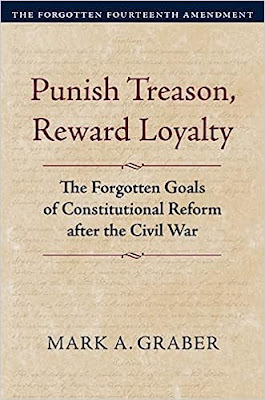
Mark A. Graber, Punish Treason, Reward Loyalty: The Forgotten Goals of Constitutional Reform after the Civil War (University of Kansas Press, 2023)
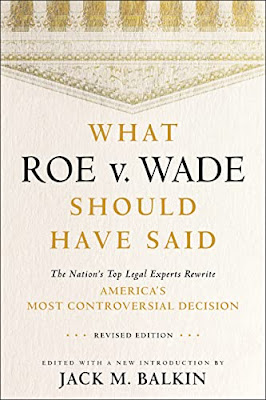
Jack M. Balkin, What Roe v. Wade Should Have Said: The Nation's Top Legal Experts Rewrite America's Most Controversial Decision - Revised Edition (NYU Press, 2023)

Andrew Koppelman, Burning Down the House: How Libertarian Philosophy Was Corrupted by Delusion and Greed (St. Martin’s Press, 2022)

Gerard N. Magliocca, Washington's Heir: The Life of Justice Bushrod Washington (Oxford University Press, 2022)
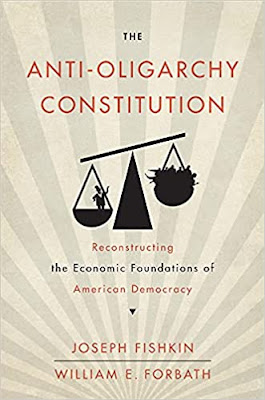
Joseph Fishkin and William E. Forbath, The Anti-Oligarchy Constitution: Reconstructing the Economic Foundations of American Democracy (Harvard University Press, 2022)
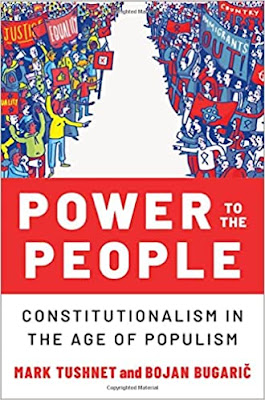
Mark Tushnet and Bojan Bugaric, Power to the People: Constitutionalism in the Age of Populism (Oxford University Press 2021).

Mark Philip Bradley and Mary L. Dudziak, eds., Making the Forever War: Marilyn B. Young on the Culture and Politics of American Militarism Culture and Politics in the Cold War and Beyond (University of Massachusetts Press, 2021).

Jack M. Balkin, What Obergefell v. Hodges Should Have Said: The Nation's Top Legal Experts Rewrite America's Same-Sex Marriage Decision (Yale University Press, 2020)

Frank Pasquale, New Laws of Robotics: Defending Human Expertise in the Age of AI (Belknap Press, 2020)

Jack M. Balkin, The Cycles of Constitutional Time (Oxford University Press, 2020)

Mark Tushnet, Taking Back the Constitution: Activist Judges and the Next Age of American Law (Yale University Press 2020).

Andrew Koppelman, Gay Rights vs. Religious Liberty?: The Unnecessary Conflict (Oxford University Press, 2020)

Ezekiel J Emanuel and Abbe R. Gluck, The Trillion Dollar Revolution: How the Affordable Care Act Transformed Politics, Law, and Health Care in America (PublicAffairs, 2020)

Linda C. McClain, Who's the Bigot?: Learning from Conflicts over Marriage and Civil Rights Law (Oxford University Press, 2020)
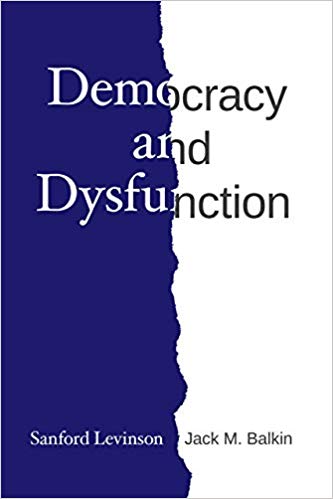
Sanford Levinson and Jack M. Balkin, Democracy and Dysfunction (University of Chicago Press, 2019)

Sanford Levinson, Written in Stone: Public Monuments in Changing Societies (Duke University Press 2018)

Mark A. Graber, Sanford Levinson, and Mark Tushnet, eds., Constitutional Democracy in Crisis? (Oxford University Press 2018)

Gerard Magliocca, The Heart of the Constitution: How the Bill of Rights became the Bill of Rights (Oxford University Press, 2018)

Cynthia Levinson and Sanford Levinson, Fault Lines in the Constitution: The Framers, Their Fights, and the Flaws that Affect Us Today (Peachtree Publishers, 2017)

Brian Z. Tamanaha, A Realistic Theory of Law (Cambridge University Press 2017)

Sanford Levinson, Nullification and Secession in Modern Constitutional Thought (University Press of Kansas 2016)

Sanford Levinson, An Argument Open to All: Reading The Federalist in the 21st Century (Yale University Press 2015)

Stephen M. Griffin, Broken Trust: Dysfunctional Government and Constitutional Reform (University Press of Kansas, 2015)

Frank Pasquale, The Black Box Society: The Secret Algorithms That Control Money and Information (Harvard University Press, 2015)

Bruce Ackerman, We the People, Volume 3: The Civil Rights Revolution (Harvard University Press, 2014)
Balkinization Symposium on We the People, Volume 3: The Civil Rights Revolution

Joseph Fishkin, Bottlenecks: A New Theory of Equal Opportunity (Oxford University Press, 2014)

Mark A. Graber, A New Introduction to American Constitutionalism (Oxford University Press, 2013)

John Mikhail, Elements of Moral Cognition: Rawls' Linguistic Analogy and the Cognitive Science of Moral and Legal Judgment (Cambridge University Press, 2013)

Gerard N. Magliocca, American Founding Son: John Bingham and the Invention of the Fourteenth Amendment (New York University Press, 2013)

Stephen M. Griffin, Long Wars and the Constitution (Harvard University Press, 2013)

Andrew Koppelman, The Tough Luck Constitution and the Assault on Health Care Reform (Oxford University Press, 2013)

James E. Fleming and Linda C. McClain, Ordered Liberty: Rights, Responsibilities, and Virtues (Harvard University Press, 2013)
Balkinization Symposium on Ordered Liberty: Rights, Responsibilities, and Virtues

Andrew Koppelman, Defending American Religious Neutrality (Harvard University Press, 2013)

Brian Z. Tamanaha, Failing Law Schools (University of Chicago Press, 2012)

Sanford Levinson, Framed: America's 51 Constitutions and the Crisis of Governance (Oxford University Press, 2012)

Linda C. McClain and Joanna L. Grossman, Gender Equality: Dimensions of Women's Equal Citizenship (Cambridge University Press, 2012)

Mary Dudziak, War Time: An Idea, Its History, Its Consequences (Oxford University Press, 2012)

Jack M. Balkin, Living Originalism (Harvard University Press, 2011)

Jason Mazzone, Copyfraud and Other Abuses of Intellectual Property Law (Stanford University Press, 2011)

Richard W. Garnett and Andrew Koppelman, First Amendment Stories, (Foundation Press 2011)

Jack M. Balkin, Constitutional Redemption: Political Faith in an Unjust World (Harvard University Press, 2011)

Gerard Magliocca, The Tragedy of William Jennings Bryan: Constitutional Law and the Politics of Backlash (Yale University Press, 2011)

Bernard Harcourt, The Illusion of Free Markets: Punishment and the Myth of Natural Order (Harvard University Press, 2010)

Bruce Ackerman, The Decline and Fall of the American Republic (Harvard University Press, 2010)
Balkinization Symposium on The Decline and Fall of the American Republic

Ian Ayres. Carrots and Sticks: Unlock the Power of Incentives to Get Things Done (Bantam Books, 2010)

Mark Tushnet, Why the Constitution Matters (Yale University Press 2010)

Ian Ayres and Barry Nalebuff: Lifecycle Investing: A New, Safe, and Audacious Way to Improve the Performance of Your Retirement Portfolio (Basic Books, 2010)
.jpg)
Jack M. Balkin, The Laws of Change: I Ching and the Philosophy of Life (2d Edition, Sybil Creek Press 2009)

Brian Z. Tamanaha, Beyond the Formalist-Realist Divide: The Role of Politics in Judging (Princeton University Press 2009)
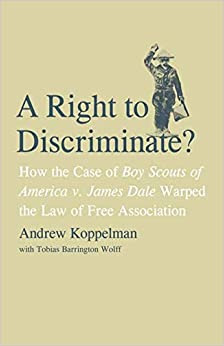
Andrew Koppelman and Tobias Barrington Wolff, A Right to Discriminate?: How the Case of Boy Scouts of America v. James Dale Warped the Law of Free Association (Yale University Press 2009)

Jack M. Balkin and Reva B. Siegel, The Constitution in 2020 (Oxford University Press 2009)

Heather K. Gerken, The Democracy Index: Why Our Election System Is Failing and How to Fix It (Princeton University Press 2009)

Mary Dudziak, Exporting American Dreams: Thurgood Marshall's African Journey (Oxford University Press 2008)

David Luban, Legal Ethics and Human Dignity (Cambridge Univ. Press 2007)

Ian Ayres, Super Crunchers: Why Thinking-By-Numbers is the New Way to be Smart (Bantam 2007)

Jack M. Balkin, James Grimmelmann, Eddan Katz, Nimrod Kozlovski, Shlomit Wagman and Tal Zarsky, eds., Cybercrime: Digital Cops in a Networked Environment (N.Y.U. Press 2007)
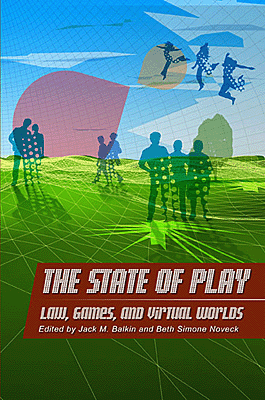
Jack M. Balkin and Beth Simone Noveck, The State of Play: Law, Games, and Virtual Worlds (N.Y.U. Press 2006)

Andrew Koppelman, Same Sex, Different States: When Same-Sex Marriages Cross State Lines (Yale University Press 2006)

Brian Tamanaha, Law as a Means to an End (Cambridge University Press 2006)

Sanford Levinson, Our Undemocratic Constitution (Oxford University Press 2006)

Mark Graber, Dred Scott and the Problem of Constitutional Evil (Cambridge University Press 2006)

Jack M. Balkin, ed., What Roe v. Wade Should Have Said (N.Y.U. Press 2005)

Sanford Levinson, ed., Torture: A Collection (Oxford University Press 2004)
Balkin.com homepage
Bibliography
Conlaw.net
Cultural Software
Writings
Opeds
The Information Society Project
BrownvBoard.com
Useful Links
Syllabi and Exams
