Balkinization
an unanticipated consequence of
Jack M. Balkin
Balkinization Symposiums: A Continuing List
E-mail:
Jack Balkin:
jackbalkin at yahoo.com
Bruce Ackerman
bruce.ackerman at yale.edu
Ian Ayres
ian.ayres at yale.edu
Corey Brettschneider
corey_brettschneider at brown.edu
Mary Dudziak
mary.l.dudziak at emory.edu
Joey Fishkin
joey.fishkin at gmail.com
Heather Gerken heather.gerken at yale.edu
Abbe Gluck abbe.gluck at yale.edu
Mark Graber
mgraber at law.umaryland.edu
Stephen Griffin
sgriffin at tulane.edu
Jonathan Hafetz
jonathan.hafetz at shu.edu
Jeremy Kessler
jkessler at law.columbia.edu
Andrew Koppelman
akoppelman at law.northwestern.edu
Marty Lederman
msl46 at law.georgetown.edu
Sanford Levinson
slevinson at law.utexas.edu
David Luban
david.luban at gmail.com
Gerard Magliocca
gmaglioc at iupui.edu
Jason Mazzone
mazzonej at illinois.edu
Linda McClain
lmcclain at bu.edu
John Mikhail
mikhail at law.georgetown.edu
Frank Pasquale
pasquale.frank at gmail.com
Nate Persily
npersily at gmail.com
Michael Stokes Paulsen
michaelstokespaulsen at gmail.com
Deborah Pearlstein
dpearlst at yu.edu
Rick Pildes
rick.pildes at nyu.edu
David Pozen
dpozen at law.columbia.edu
Richard Primus
raprimus at umich.edu
K. Sabeel Rahmansabeel.rahman at brooklaw.edu
Alice Ristroph
alice.ristroph at shu.edu
Neil Siegel
siegel at law.duke.edu
David Super
david.super at law.georgetown.edu
Brian Tamanaha
btamanaha at wulaw.wustl.edu
Nelson Tebbe
nelson.tebbe at brooklaw.edu
Mark Tushnet
mtushnet at law.harvard.edu
Adam Winkler
winkler at ucla.edu
Compendium of posts on Hobby Lobby and related cases
The Anti-Torture Memos: Balkinization Posts on Torture, Interrogation, Detention, War Powers, and OLC
The Anti-Torture Memos (arranged by topic)
Recent Posts
One Update/Correction
It's Power, not Theory, that Keeps the Left from Having its own Constitutionalism
"History" and History in Students for Fair Admissions
Constitutional Democracy Without Constitutionalism
On Brackeen and the Value of Careful History: A Response to Lorianne Updike Toler
Constitutionalism vs. Constitutional Democracy
Balkinization Symposium on Martin Loughlin, Against Constitutionalism
Poor Justice Story
Balkinization Symposium on Christian Fritz, Monitoring American Federalism-- Collected Posts
Interposition as a Tool Used to Monitor American Federalism
Donald Trump's Ineligibility for the first GOP Presidential Debate
Interposition, Intention, and Intellectual History
Rescuing Interposition
Brackeen’s Missteps & The Need for Neutral History
Branching Out from Legislative Resistance
The Twisted History Of An “Original” Concept
Where We are in Political Time - Biden's Reconstructive Strategy
States of Denial
Where We are in Political Time - The Post- Reagan Interregnum and Trump's Revolutionary Politics
Christian Fritz on The Continuing Mysteries (and Challenges) of Constitutional Politics in a Federal System
Balkinization Symposium on Christian Fritz, Monitoring American Federalism
The House Freedom Caucus is Revolting
![[Powered by Blogger]](https://lh3.googleusercontent.com/blogger_img_proxy/AEn0k_vQcTcIBxc11umMN5u89DF9o1uR4M1yMzwBestQQPxP-yrnFfvUrHzrtmiVWTK-hQ8GjCfS1bytOcrLkwVJ87gj5DEysnY9gau-uEVxtqbR=s0-d)
Just A Few Blogs
ACS Blog
Alas, a Blog
Althouse
Arts and Letters Daily
Atrios (Eschaton)
Bill of Health
Buzzflash.com
Buzz Machine
Cato at Liberty
Juan Cole (Informed Comment)
Concurring Opinions
The Constitution in 2020
Corrente
Crooked Timber
Daily Howler
Daily Kos
Dana Boyd
Brad DeLong
Digby (Hullabaloo)
Discriminations
Daniel Drezner
Kevin Drum (Mother Jones)
Electrolite
En Banc
Eunomia (Daniel Larison)
Fafblog
Michael Froomkin (Discourse.net)
GovLab (Beth Noveck)
Rick Hasen (Election Law)
History News Network
How Appealing
Ignatz (Sam Heldman)
The Importance of (Ernie Miller)
Infolaw
Instapundit
International Economic Law and Policy Blog
IntLawGrrls
Jacob Levy
Jesus' General
Jurisdynamics
The Kitchen Cabinet
Mark Kleiman
Law Blog Central
Larry Lessig
Lawyers, Guns and Money
Liberal Oasis
Brian Leiter's Law School Reports
The Leiter Reports
Marginal Revolution
Megan McArdle
Memeorandum
Metafilter
Mirror of Justice
The New Republic
Newseum
No More Mister Nice Blog
Brendan Nyhan
Opinio Juris
Orcinus
The Originalism Blog
Pandagon
Passport (Foreign Policy)
Overcoming Bias
Political Animal (Washington Monthly)
Political Theory Daily Review
Political Wire (Taegan Goddard)
The Poor Man
Virginia Postrel
Prawfsblawg
Public Reason
Jonathan Rauch
Raw Story
Redstate
ReligiousLeftLaw.com
Reporters Committee For Freedom of the Press
Reproductive Rights Blog
Rothman's Roadmap to the Right of Publicity
SCOTUS Blog
Seeing the Forest
Clay Shirky
The Shifted Librarian
The Situationist
Larry Solum (Legal Theory)
Andrew Sullivan
Talking Points Memo
Talk Left
Tapped
Tbogg
TechPresident
The Paper Chase (Jurist)
Tom Paine
Tom Tomorrow (This Modern World)
Eve Tushnet
Uggabugga
University of Chicago Law School Faculty Blog
Unqualified Offerings
The Volokh Conspiracy
War and Piece (Laura Rozen)
Wampum
Oliver Willis
Wonkette
Written Description
Matthew Yglesias
Yin
Your Choice of Feeds
1. XML
powered by

2. Atom Feed
3. RSS 2.0
One Update/Correction
Gerard N. Magliocca
In a post last month, I said that Couy Griffin had filed a certiorari petition challenged his disqualification under Section Three of the Fourteenth Amendment. This petition, though, was never docketed. I'm not sure if that's because the petition was filed improperly or because Griffin (after drafting the petition, which I have) decided not to go forward. Anyway, if I learn more I'll pass that along.
Posted
11:16 AM
by Gerard N. Magliocca [link]
(0) comments
It's Power, not Theory, that Keeps the Left from Having its own Constitutionalism
Guest Blogger
For the Balkinization symposium on Martin Loughlin, Against Constitutionalism (Harvard University Press, 2022). Paul Gowder Martin Loughlin has produced a magisterial work of constitutional theory, which weaves intellectual history and an incisive analysis of our present condition into a highly challenging case against modern conceptions of constitutional governance. However, when the erudition (which I hasten to repeat, is immense and valuable) is stripped away, the core seems to me to be a familiar argument, one that has been a recurrent theme of left critique of constitutional law for decades at this point.
Posted
9:30 AM
by Guest Blogger [link]
"History" and History in Students for Fair Admissions
Mark Graber
Justice Clarence Thomas’s
concurring opinion in Students for Fair Admissions, Inc. v. President and Fellows
of Harvard College (2023) (SFFA) demonstrates why originalism as
practiced is a vehicle for judges to import their policy preferences into constitutional
law rather than a constraint on constitutional decision making. Thomas begins with an exaggerated account
of the conventional, but mistaken wisdom that the point of the Fourteenth Amendment
was to provide constitutional foundations for the Civil Rights Act of
1866. He blithely dismisses the
consensus view among nineteenth century legal historians that Republicans were
color-conscious in favor of a colorblind account of Reconstruction that has gained no traction among professional historians. Thomas then rummages through Reconstruction
history baldly declaring Republican assertions on removing discriminations
against persons of color as demonstrating commitments to colorblindness and the many
Republican assertions on laws benefitting persons of color as exceptions to this more general principle. By this measure, we might declare that the Oakland Athletics are the best team in baseball, point to the twenty games they have won while treating their sixty losses as exceptional. If this is
objective history, we should prefer judges who make no pretense of writing
their politics into law without distorting the history we teach our students. The opinions in SFFA
uniformly adopt the conventional, but mistaken view that the point of the
Fourteenth Amendment was to provide constitutional foundations for the Civil
Rights Act of 1866. As I demonstrate in Punish Treason, Reward Loyalty: The Forgotten Goals of Constitutional Reform after the Civil War (shipping next week!), the point of the Fourteenth Amendment was
to ensure loyal persons controlled the national government and the governments
of former confederate states. Proponents
of free labor and racial equality sought constitutional reform because the
unamended constitution provided former confederate states with thirty
extra seats in the House of Representatives and thirty extra votes in the
Electoral College for former slaves denied the ballot. This representational boon would enable a coalition
of former slaveholders and northern Democrats to establish the control of the
national government necessary to repeal all civil rights acts and make the
Thirteenth Amendment a nullity. Although
Thomas claims without citation that “many” proponents of racial equality had
doubts about the constitutionality of Section 1 of the Civil Rights Act of 1866,
Representative John Bingham of Ohio was the only person who voted for the
Fourteenth Amendment who expressed these doubts on the floor of Congress. Many Republicans expressed doubts about a
rejected version of Section 1, but there appears to be only one other Representative
who supported the Fourteenth Amendment and had constitutional doubts about the final
first paragraph of the Civil Rights Act. Had Thomas relied
on mistaken conventional wisdom among legal historians throughout his opinion,
that would have been a feature rather than a bug. Judges are not professional historians. They are not supposed to adjudicate disputes among historians (or accept my not yet published revisionist work as authoritative, even though I and two other people think it is). Originalism constrains judges only when
justices rely on conventional wisdom among historians. When justices deviate from that conventional
wisdom, they inevitably deviate in ways that reflect their political
priors. Thomas, in particular, abandons
conventional wisdom that supports progressive outcomes. His SFFA opinion is a particularly
gruesome example. Thomas exhibits
his disdain for history when he observes “it
appears increasingly in vogue to embrace an “antisubordination” view of the
Fourteenth Amendment: that the Amendment forbids only laws that hurt, but not
help, blacks.” This is the view of most
historians and was ably articulated by an amicus brief by legal historians
filed in SFFA. They point out that constitutional law in the 1860s did not adopt a banned category understanding of equality. Rather, government could make distinctions among different groups of citizens only when those distinctions were based on real distinctions between people (i.e., gender) and served the public interest. Republicans acted on this principle when providing special benefits to persons of color, because only persons of color had been enslaved and victims of the slave system. An objective
originalist would rely on this history, which Justice Sonia Sotomayor convincingly
discusses in her dissent. Thomas calls historians "faddish" and cites one article published in a student edited law review that takes his position. The main alternate to this conventional wisdom does not help
Thomas. I could not sign the historian’s
brief because I believe that for most framers other than John Bingham, the
relevant constitutional provision was the Thirteenth Amendment. Reconstruction Republicans understood Section
2 of the Thirteenth Amendment as empowering Congress to eradicate slavery and
the slave system by passing legislation that enabled African-Americans to
become full citizens of the United States.
Given that only African-Americans had been enslaved and that a slave
system involved substantial discrimination against free persons of color,
Congress was empowered under the Thirteenth Amendment to pass legislation that
benefitted only African-Americans who had been enslaved and persons of color
who had been victims of the slave system. The difference between those
historians who are Thirteenth Amendment revisions and the historians brief in SFFA,
however, is limited to what amendment Republicans in 1866 thought supported
remedial color-conscious legislation. The leading
contemporary legal historians who have studied Reconstruction agree that the Republicans who
framed the post-Civil War Amendments were color-conscious as well as
colorblind. Thomas rejects
conventional history by taking the same slapdash approach to the evidence as
characterizes his majority opinion in New York State Rifle & Pistol
Association v. Bruen (2022). Bruen
acknowledged many instances of state and territorial regulations banning
carrying weapons in public, but then pronounced them inconsistent with a
general rule, derived from no more sources, that persons had a right to carry
weapons in public. SFFA acknowledges
that the Congress that framed the Fourteenth Amendment passed various laws
providing special benefits to persons of color, but then concludes that these
were exceptions to the rule of colorblindness.
Thomas cannot find a single instance in which a sponsor of the
Fourteenth Amendment explicitly rejected a measure providing special benefits
for persons of color on the ground that such measures were inconsistent with
constitutional commitments to equality.
The practice was simple. When
Republicans prohibiting discriminations against persons
of color, they spoke the language of colorblindness. When they were considering how to help
persons of color become full citizens of the United States, they spoke the
language of color consciousness. General laws should be colorblind, but laws that have the specific purpose of transitioning former disadvantaged groups into full citizenship may acknowledge the distinctive characteristics of that group. This is
a basic confusion that historians avoid, but apparently not justices who confuse a
Supreme Court appointment with the conferral of a PhD. Value-voting on apex courts is inevitable. History best serves as a data point than a command. Perhaps the color-conscious programs of Reconstruction outlived their usefulness a century ago. Perhaps colorblindness is the best road to full citizenship at present. These are questions for the present to answer. But we are unlikely to achieve the best answers by conjuring up an imaginary past that suits our priors and then declaring that past authoritative.
Posted
9:19 AM
by Mark Graber [link]
Constitutional Democracy Without Constitutionalism
Guest Blogger
For the Balkinization symposium on Martin Loughlin, Against Constitutionalism (Harvard University Press, 2022). Julie C. Suk Martin Loughlin’s Against
Constitutionalism begins with the compelling, if surprising insight that
constitutionalism is neither a necessary nor sufficient feature of
constitutional democracy. Loughlin
presents an important and much-needed intellectual history of constitutional
theory, from the American revolutionary constitutionalism that grew out of
Enlightenment political theory to constitutionalism that remade continental
Europe after World War II and the defeat of Nazism. While Loughlin maintains
that “constitutional democracy remains our best hope of maintaining the
conditions of civilized existence” (24), the reinvigoration of
constitutionalism may be a reason for pessimism rather than optimism.
Posted
9:30 AM
by Guest Blogger [link]
On Brackeen and the Value of Careful History: A Response to Lorianne Updike Toler
Guest Blogger
W. Tanner Allread On June 15, Indian Country breathed a collective sigh of
relief when the Supreme Court upheld the constitutionality of the Indian Child
Welfare Act in Haaland
v. Brackeen. But as tribal leaders and
advocates celebrated the majority opinion, legal scholars quickly turned to
dissecting the opinions, their
use of history, and their
adherence to originalism. On this
blog, Professor Lorianne Updike Toler critiqued all of the Brackeen
opinions for their selective use of history and called for the presentation of “neutral”
history to courts as a solution.
However, Updike Toler makes her own misstep in her post: she implies
that her own history is neutral, reproducing the same selection bias for
which she critiques the Justices. And in
Indian Law, labeling your historical account as the neutral one that
courts should follow can have far-reaching consequences. For sure, historians always strive to be neutral in their
work, in the sense of seeking truth with integrity and not allowing personal
biases to infect their analyses.
However, the search for neutrality—or more commonly referred to as
“objectivity”—in history has haunted
the historical profession since its inception in the nineteenth century. That’s because each individual history can
never be truly objective: it requires interpretation and source selection,
relies on skewed and incomplete archival materials, and cannot be truly
divorced from the political and social contexts in which it is written. Thus, rather than using “neutrality” as an indicator of good
history, historians use factors such as credibility, thoroughness, and
care. The quality of history mostly
relies on the evidence used, scholars’ transparency regarding sources and their
limitations, and persuasiveness based on interpretations and context. To the extent that any historical account could
be called “neutral,” that characterization would arise from these factors. And crucially, “neutrality” is a label that
only has value when others apply it to your work, not when you claim it for
yourself.
Posted
2:00 PM
by Guest Blogger [link]
Constitutionalism vs. Constitutional Democracy
Guest Blogger
For the Balkinization symposium on Martin Loughlin, Against Constitutionalism (Harvard University Press, 2022). Yasmin Dawood In a sweeping and provocative new book, Against
Constitutionalism, Martin Loughlin argues that the concept of constitutionalism
has evolved from a relatively limited set of principles into a full-blown,
totalizing philosophy of government. Against Constitutionalism is a
brilliant book—an erudite study not only of the historical evolution of the
concept of constitutionalism but also of the contested meanings of associated concepts,
including sovereignty, constituent power, and the state. The book is anchored
by an extensive engagement with a wide array of philosophers, theorists, and
legal scholars. While it is impossible to do justice to the breadth of
Loughlin’s arguments in this short essay, there is no doubt that Against
Constitutionalism is a must-read book for anyone who is interested in the
fate of constitutional democracy. What is distinctive about Against
Constitutionalism is that it provides a systemic account of
constitutionalism by carefully unpacking the evolution of this concept since
the Enlightenment. Loughlin notes that constitutionalism is usually taken to
mean that the “main characteristics of a regime are defined by a founding text
that is elevated above the ordinary cut and thrust of politics.” Additional
ideas under the constitutionalism umbrella include limits on arbitrary power,
the rule of law, limited government, and the protection of rights. But for Loughlin,
constitutionalism is best understood as a distinctive ideology that not only
provides the rules by which government is regulated but also encompasses the
very essence of collective identity. He argues that constitutionalism is “now
an over powerful theory of state building, rapidly becoming the world’s most
influential contemporary philosophy of government.” Loughlin’s ambition in the
book is to “capture the spirit of constitutionalism” and to show that
constitutionalism “has become the primary medium through which an insulated
elite, while paying lip service to the claims of democracy, is able to
perpetuate its authority to rule.”
Posted
1:30 PM
by Guest Blogger [link]
Balkinization Symposium on Martin Loughlin, Against Constitutionalism
JB
At the conclusion, Martin will respond to the commentators.
This week at Balkinization we are hosting a symposium on Martin Loughlin's new book, Against Constitutionalism (Harvard University Press, 2022).
We have assembled a terrific group of commentators, including Yasmin Dawood (Toronto), Joey Fishkin (UCLA), Paul Gowder (Northwestern), Sandy Levinson (Texas), Julie Suk (Fordham), and myself.
Posted
1:00 PM
by JB [link]
Poor Justice Story
Gerard N. Magliocca
A theme in my Bushrod Washington book is that Justice Story is overrated. He tended to shoot from the hip in a way that generated some brilliant insights but more clunkers. Today in Moore v. Harper, the Court dismissed Justice Story's comment against its reading of the Elections Clause this way: "Story’s comment elicited little discussion, and reflects the views of a jurist who, although 'a brilliant and accomplished man, . . . was not a member of the Founding generation.' U. S. Term Limits, Inc. v. Thornton, 514 U. S. 779, 856 (1995) (THOMAS, J., dissenting)." Ouch.
Posted
12:41 PM
by Gerard N. Magliocca [link]
(0) comments
Balkinization Symposium on Christian Fritz, Monitoring American Federalism-- Collected Posts
JB
2. Sandy Levinson, Christian Fritz on The Continuing Mysteries (and Challenges) of Constitutional Politics in a Federal System 3. Alison L. LaCroix, States of Denial 4. Edward A. Purcell, Jr., The Twisted History Of An “Original” Concept 5. Jessica Bulman-Pozen, Branching Out from Legislative Resistance 6. David S. Schwartz, Rescuing Interposition 7. Grace Mallon, Interposition, Intention, and Intellectual History 8. Christian G. Fritz, Interposition as a Tool Used to Monitor American Federalism
Here are the collected posts for our Balkinization symposium on Christian Fritz, Monitoring American Federalism: The History of State Legislative Resistance (Cambridge University Press, 2023).
1. Jack Balkin, Introduction to the Symposium
Posted
9:30 AM
by JB [link]
Interposition as a Tool Used to Monitor American Federalism
Guest Blogger
For the Balkinization symposium on Christian G. Fritz, Monitoring American Federalism: The History of State Legislative Resistance (Cambridge University Press, 2023). Christian
G. Fritz Jack
Balkin deserves huge thanks for organizing this symposium on Monitoring
American Federalism: The History of State Legislative Resistance. I am
grateful for the engagement of all of the commentators. Their close reading of
the book and their thoughtful observations and questions have given me, and the
readers of this symposium, much to think about as we continue to wrestle with
the dynamic nature of American federalism. Three
broad issues emerge from the comments. First, is the question of how to define
interposition? Second, is the “slippery slope” question: does the concept of
interposition inevitably invite or lead to nullification and secession? And
third, does interposition have relevance today? My response below is primarily
directed towards those three issues.
Posted
9:30 AM
by Guest Blogger [link]
Donald Trump's Ineligibility for the first GOP Presidential Debate
Gerard N. Magliocca
The first Republican presidential debate will be on August 23rd. To qualify for the debate under the party's rules, you have to be constitutionally eligible to run for President. Under that criterion, another candidate qualified for the debate would be within his or her rights to challenge Donald Trump's participation due to Section Three of the Fourteenth Amendment. This may explain why press reports indicate that Trump is thinking about skipping the first debate. He would thereby avoid such a challenge (for the time being).
Posted
8:30 AM
by Gerard N. Magliocca [link]
(0) comments
Interposition, Intention, and Intellectual History
Guest Blogger
Posted
9:30 AM
by Guest Blogger [link]
Rescuing Interposition
Guest Blogger
For the Balkinization symposium on Christian G. Fritz, Monitoring American Federalism: The History of State Legislative Resistance (Cambridge University Press, 2023). David
S. Schwartz Christian
Fritz’s impressive new book, Monitoring American Federalism, examines the
antebellum history of “interposition” by state legislatures to resist purported
federal intrusions on their sovereign prerogatives. Professor Fritz offers an
illuminating narrative history that recounts numerous episodes of state
legislative resistance of various sorts. Some of these have been largely
overlooked by constitutional scholars; I was fascinated to learn, for example, that
the right of states to question the constitutionality of federal laws through merely
declaratory resolutions was sharply contested in the early republic. Many other
episodes are well known, but take on a subtly and significantly different cast
when viewed, as Professor Fritz views them, as part of a pattern of a
particular form of state resistance. His narrative of the legislative debates
leading to the Virginia and Kentucky Resolutions is invaluable. Also noteworthy
is Professor Fritz’s suggestion that a protocol of state legislative
interposition was outlined, in inchoate form at least, in The Federalist.
All these make Professor Fritz’s book a worthy contribution to the literature
of the constitutional history and development of U.S. ideas of federalism, by adding
to our historical knowledge base about federalism. I found greater
value in Monitoring American Federalism as a historical narrative than
as an argument that reframes our thinking about federalism. The book seems to
comprise two distinct, but closely-related and largely overlapping claims: one
defending James Madison, and the other defending state “interposition.” The
more compact thesis argues that a longstanding concept of “interposition,”
expressed in its most developed form by Madison in the Virginia Resolutions of
1798 and the Virginia Report of 1800, was distorted and misunderstood by the
“nullifiers” of the late 1820s and early 1830s. The supposed distortion of
interposition was expounded by John C. Calhoun and other proponents of the
“South Carolina doctrine” that undergirded the Nullification Crisis of 1832-33.
This argument by Professor Fritz would, by itself, be sufficiently important to
sustain a book of this length, and the compact thesis (subtle pun there) is
successful insofar as it offers a salient and closely argued claim that must be
taken seriously. Although Professor Fritz’s argument will likely be
well-received by Madison scholars, most of whom are Madison admirers and some
of whom are Madison apologists, I’m unpersuaded for reasons I will explain. The other claim
functions somewhat as a large container, with the more compact Madison defense
rattling around inside. This is the “history of state legislative resistance” promised
in the book’s subtitle, and while the narrative is quite rich, its overarching
argument is less of a thesis than an enveloping normative haze. Professor Fritz
seems to be suggesting that what he defines as “interposition” is on balance a
good thing, and that its continuing practice somehow demonstrates, or perhaps
ensures, that “the national government cannot do whatever it wants and ride roughshod
over the states.” (p. 306) The key to the
book, therefore, is Professor Fritz’s definition of interposition. This, he
says, consists entirely (and merely) of state legislatures “sounding the alarm”
about unconstitutional federal laws and taking a limited set of steps stopping
short of nullification or other tangible resistance measures: issuing
declaratory resolutions, corresponding with other state legislatures, rallying
public opinion, lobbying Congress, and—if necessary—pursuing constitutional amendment.
With this definition before us, I’ll consider the two claims in turn.
Posted
9:30 AM
by Guest Blogger [link]
Brackeen’s Missteps & The Need for Neutral History
Guest Blogger
Posted
9:00 AM
by Guest Blogger [link]
Branching Out from Legislative Resistance
Guest Blogger
Posted
9:30 AM
by Guest Blogger [link]
The Twisted History Of An “Original” Concept
Guest Blogger
For the Balkinization symposium on Christian G. Fritz, Monitoring American Federalism: The History of State Legislative Resistance (Cambridge University Press, 2023). Edward A. Purcell, Jr. In Monitoring American
Federalism Christian G. Fritz has written a thorough and insightful study
of the role states and state legislatures have played in using ideas of
“interposition” to “monitor” the federal system and check overreaching by the
federal government. While the book
concentrates on the decades from ratification to the Civil War, its last pages
sketch its story briefly up to the present. Three central theses deserve
note. First, the book argues that
interposition was an “original” idea that emerged in the ratification debate. Promoted by both Alexander Hamilton and James
Madison in the Federalist, it evolved over the centuries into a variety
of forms and continues to operate today in the practice of American
federalism. Second, the book insists that
“nullification” was not part of original interpositionism but began to develop
only in the early decades of the nineteenth century under the spur of slavery
and ultimately the leadership of John C. Calhoun. Originally interposition referred only to the
right and duty of states and their legislatures to lodge protests, petition
Congress, and circularize other states in warning that some action of the
national government transgressed constitutional limits. It was a procedural device intended to play a
“benign and logical role” in the federal system (37). Third, the book focuses on Madison
and argues that he maintained a consistent theoretical position from his Federalist
essays through the Virginia Resolutions and his Report of 1800 and on to the
1830s when he rejected nullification and repudiated Calhoun’s theories. In spite of his consistency, the different
contexts in which he addressed interposition and the “convoluted words” he
sometimes used meant that his ideas were commonly misunderstood and often
purposely twisted. This was especially
true for his “language about the theoretical right of the sovereign people to
interpose in the last resort,” Professor Fritz specifies. Indulging “his need to declare a principle of
constitutional theory,” Madison “unwittingly provided the raw materials for
future constitutional catastrophe” (127).
Posted
9:30 AM
by Guest Blogger [link]
Where We are in Political Time - Biden's Reconstructive Strategy
JB
In yesterday's post on where we are in political time, I explained that we are currently in an interregnum following the collapse of the Reagan regime with two different candidates for reconstructive leadership, one by Trump, and the other by Biden and the Democrats. In the last post, I discussed the Trumpist alternative. In this post, I'll discuss Biden's approach to the interregnum. Joe Biden's strategy for forming a new regime has been the opposite of Trump's Where Trump presents himself as a revolutionary, Biden presents himself as the apostle of sane, stable government, as the protector of democracy, and as the restorer of a sense of political unity and common purpose. Is it possible to become a reconstructive leader when what you promise is a return to normalcy and you are not at the head of a rising social movement? That does not exactly fit past examples of reconstructive leadership, but only time will tell. Reconstructive leaders from Jefferson onward have tried to present themselves as unifiers, even if their actual policies were revolutionary and partisan.
Posted
11:00 AM
by JB [link]
States of Denial
Guest Blogger
Posted
9:30 AM
by Guest Blogger [link]
Where We are in Political Time - The Post- Reagan Interregnum and Trump's Revolutionary Politics
JB
My 2020 book, The Cycles of Constitutional Time, was finished in late 2019 and I made minor adjustments in 2020, just as the pandemic was starting but before the 2020 election and the January 6th, 2021 coup attempt. It's only three and a half years ago but it seems like ages. In Cycles I argued that the Reagan regime was ending and that a new regime would form in the next five to ten years, probably one with the Democrats as the dominant party, although there was a chance that Trump would form a new Republican regime organized around White Christian nationalism. What do things look like today?
Posted
11:00 AM
by JB [link]
Christian Fritz on The Continuing Mysteries (and Challenges) of Constitutional Politics in a Federal System
Sandy Levinson
For the Balkinization symposium on Christian G. Fritz, Monitoring American Federalism: The History of State Legislative Resistance (Cambridge University Press, 2023). Christian Fritz’s is one of the
relatively few historians who have taken with suitable seriousness the
implications of “popular sovereignty” and the idea that governmental legitimacy
is presumptively dependent on the continued commitment by “we the people” to
the acts of governments that may act in our name because they have been
authorized to do so by the sovereign demos.
His earlier book, American
Sovereigns: The People and America's Constitutional Tradition Before the Civil
War (2007) demonstrated the continued
possession by many Americans of a sense of their sovereign authority. They were not content to become the “sleeping
sovereigns” envisioned by Thomas Hobbes, which was most certainly the vision of
the Framers with regard to the Constitution of 1787. Just read Federalist 63 and the proud
assertion by Madison that the actual demos has no role whatsoever to
play in making any concrete decisions.
Everything will be done through “representatives.” As Fritz so well establishes, though, in
their capacity as citizens of states, Americans often viewed themselves
as genuine agents, not at all confined to a comatose reality. Instead, they felt themselves free to act on
the premise set out in the Declaration of Independence that they had the right
to “alter and abolish” governments at will if that appeared conducive to
achieving their public happiness. Acting on such
beliefs, they seceded not only from the British Empire in 1776, but also from
New York and New Hampshire to construct Vermont. Later, far more unsuccessfully, there were
attempts by citizens of several other states to found new breakaway states of
Franklin or Transylvania. Or, perhaps
more significantly, citizens of several states, including Kentucky, felt
altogether entitled to organize new constitutional conventions to amend or supplant existing state
constitutions, whatever formal authorization might (or might not) be found in
the existing state constitutions. All
the while, of course, the national citizenry has basically remained asleep,
acceding to Madison’s devout wish, in Federalist 49, that they
“venerate” the United States Constitution and, in effect, never even think of
having a second national convention. Fritz’s new book, Monitoring
American Federalism: The History of
State Legislative Resistance, is also essential reading. It casts tremendous new light on the
actualities of the American federal system.
The “state legislative resistance” alluded to in the title is alleged
overreach by a would-be dominant national government. The vision expressed is not at all filing
lawsuits in federal courts, but instead a far more active “interposition” by
state legislatures, deemed to be thoroughly “representative” of their
constituents, that attempt, in Fritz’s key metaphor, to “sound the alarm” about
threats to the American constitutional order posed by national overreach.
Posted
9:30 AM
by Sandy Levinson [link]
Balkinization Symposium on Christian Fritz, Monitoring American Federalism
JB
At the conclusion, Chris will respond to the commentators.
This week at Balkinization we are hosting a symposium on Christian Fritz's new book, Monitoring American Federalism: The History of State Legislative Resistance (Cambridge University Press, 2023).
We have assembled a terrific group of commentators, including Jessica Bulman-Pozen (Columbia), Alison LaCroix (Chicago), Sandy Levinson (Texas), Grace Mallon (Oxford), Edward Purcell (New York Law School), and David Schwartz (Wisconsin).
Posted
9:00 AM
by JB [link]
The House Freedom Caucus is Revolting
David Super
I could not
resist. Last week, eleven House Members aligned
with the House Freedom Caucus voted down the “rule” allowing debate on several
hyper-partisan Republican message bills.
Because all Democrats also opposed the rule – a resolution limiting time
and amendments in a debate – the rule failed.
The Republican rebels told the leadership they would block any other
rule sent to the floor, and the House largely shut down. Speaker Kevin
McCarthy worked through the week to try to win back the dissidents, to no
avail. He and House Majority Leader
Steve Scalise then traded blame in the news media. That is not altogether surprising as Rep.
Scalise has spent the year watching Rep. McCarthy like a cat eying the failing
door to a canary’s cage. Eventually, the
leadership sent Members home with no prospect of being able to hold votes. Last night, the
Freedom Caucus rebels agreed to support a rule to allow a few select bills to
move forward. No doubt they were moved
by the importance of these measures: to
prohibit the government from outlawing gas stoves (which it has no plans to
do), to completely break administrative law (not being satisfied with the
efforts of the Supreme Court and agency sclerosis in that regard), and to
prevent federal agencies from outlawing gun braces favored by mass shooters. The rebels indicated that this was a one-off agreement
and they would continue to prevent the leadership from bringing most
legislation to the floor until they perceived a return to the power-sharing
agreement they believe they negotiated in January in exchange for making Rep.
McCarthy speaker. The immediate
effect of this rebellion is real but hardly cosmic. None of the bills they blocked has any chance
of passing becoming law, even in modified form.
Because bipartisan compromise has become hypertoxic in the GOP, most of
the House’s “work” consists of labor-intensive publicity stunts, never designed
to change this nation’s laws. Even bills
that are real, such as appropriations bills, do not need to pass for several
months. House and Senate appropriators have
often worked out de facto conference agreements on bills that had passed
neither chamber. And the House still
has several ways to pass legislation.
Legislation with substantial bipartisan support can be brought up under
a motion to suspend the rules. Suspension
requires a 2/3 majority, but that does not require any Freedom Caucus votes. The Republican leadership also could
negotiate with Democrats on rules to bring legislation to the floor. By tradition, the majority party refuses to negotiate
with the minority about the terms of a rule and the minority party unanimously
votes against that rule. Nothing in the
structure of House procedure, however, entrenches that tradition. Democrats will not agree to rules to bring up
absurd Republican messaging bills, but they would on significantly bipartisan bills
and they might even on some bills with wholly Republican support if given a
fair chance to offer amendments. If this
episode opens the door to the kind of negotiated procedural agreements that are
common in the Senate, it will make the House a much better place. Nonetheless, this
is enough of a thorn in the leadership’s side that this impasse surely will not
last. The Freedom Caucus Members’ anger
springs in part from their dissatisfaction with the debt limit deal Speaker
McCarthy negotiated with President Biden.
They are demanding that the House unilaterally reduce discretionary
spending far below the agreed-upon levels.
And on Monday, House Appropriations Chair Kay Granger promised
to do just that. The White House howled
that this violates the Biden-McCarthy agreement. It is difficult to
predict where appropriations will end up. This obviously illustrates the pitfalls of bitter
opponents reaching an agreement that they know from the start will be represented
very differently by both sides. Speaker
McCarthy did this with the Freedom Caucus in January and again with President
Biden last month. I suspect he is busily
trying to do it a third time with the Freedom Caucus now. The levels Rep.
Granger is proposing could force Members to vote for painful cuts that interest
groups and donors may dislike. If they
believe that those cuts will not survive negotiations with the Senate and the White
House, they may resist “walking the plank for nothing.” On the other hand, Rep. Granger may be able
to take most of the cuts out of environmental, anti-poverty, civil rights, and
other activities largely undefended by Republican-aligned interest groups. Freedom Caucus
Members may be satisfied with voting for austere appropriations bills in the
House and accept conference agreements conforming to the Biden-McCarthy
agreement, but that would be out of character.
Therefore, a government shutdown seems very possible in October. Because Democrats agreed to an automatic,
year-round continuing resolution with one-percent nominal (about five percent
real) across-the-board cuts if full appropriations bills are not agreed by
January 1, they may be reluctant to pass stop-gap extensions postponing the
shutdown deeper into the fall. On the
other hand, the prospect of a five-percent real cut in defense spending may
bring Republicans with bases or defense factories in their districts to the
bargaining table. Papering over unresolved
differences through his phantom
agreement with Speaker McCarthy did allow President Biden to avoid a national
default. A partial government shutdown
will be far less damaging to the nation and hence a better venue for this fight. On the other hand, using technical means or
the Fourteenth Amendment to smite the debt limit dragon once and for all would
have accomplished the same thing – and would have avoided the other substantive
and rhetorical
concessions be made in that deal. More broadly, the
Freedom Caucus revolt is taking us incrementally closer to a de facto
multi-party system. Speaker McCarthy
lacks a loyal majority and will need the support of either the Freedom Caucus
or the Democrats to pass anything. Overwhelmingly
he will choose to negotiate with the Freedom Caucus because many of his
loyalists are vulnerable to primaries should they vote with Democrats and
because significant Republican support is needed in the Senate for anything to
become law. But the more the Freedom
Caucus begins to act like an independent party, and the more it changes House
rules and customs to accommodate its desire to exercise an independent check on
Speaker McCarthy, the more other factions may be inclined to do the same in the
future. As someone who believes our nation’s
political differences are now too broad to be accommodated within two parties –
and someone who believes most Republicans will not denounce right-wing demagogues
without a safe political home in another party – I regard that as good
news. One immediate
lesson I hope progressives will take from the Freedom Caucus’s revolt is that it
is both wrong and dangerous to assume that the far right is foolish. Some Freedom Caucus Members certainly are
(although some Democrats are not the brightest bulbs in the chandelier,
either). But overall, the Freedom Caucus
Members have shown impressive strategic judgment. Perhaps most importantly, while some of its
Members were blocking Speaker McCarthy’s accession in January and bringing the
House to a halt last week, others with just as extreme views – such as Reps.
Jim Jordan and Marjorie Taylor Greene – have been gaining influence within the
leadership by steadfastly defending the Speaker. If we end up seeing social programs and
general government cut much more than President Biden claimed his deal allowed,
I hope some progressives will ask themselves if they really are so much smarter
than Reps. Andy Biggs and Marjorie Taylor Greene. The far right’s effective inside-outside game
demands a much more strategic response than posting videos in which this or
that conservative is inarticulate or gets “taken down” by some progressive. @DavidASuper1
Posted
10:59 AM
by David Super [link]
Books by Balkinization Bloggers

Gerard N. Magliocca, The Actual Art of Governing: Justice Robert H. Jackson's Concurring Opinion in the Steel Seizure Case (Oxford University Press, 2025)

Linda C. McClain and Aziza Ahmed, The Routledge Companion to Gender and COVID-19 (Routledge, 2024)

David Pozen, The Constitution of the War on Drugs (Oxford University Press, 2024)

Jack M. Balkin, Memory and Authority: The Uses of History in Constitutional Interpretation (Yale University Press, 2024)
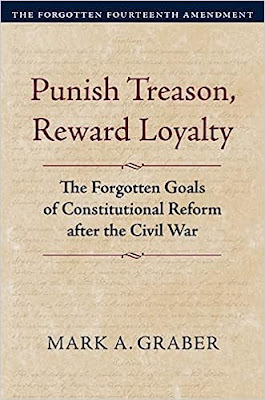
Mark A. Graber, Punish Treason, Reward Loyalty: The Forgotten Goals of Constitutional Reform after the Civil War (University of Kansas Press, 2023)
Jack M. Balkin, What Roe v. Wade Should Have Said: The Nation's Top Legal Experts Rewrite America's Most Controversial Decision - Revised Edition (NYU Press, 2023)

Andrew Koppelman, Burning Down the House: How Libertarian Philosophy Was Corrupted by Delusion and Greed (St. Martin’s Press, 2022)

Gerard N. Magliocca, Washington's Heir: The Life of Justice Bushrod Washington (Oxford University Press, 2022)
Joseph Fishkin and William E. Forbath, The Anti-Oligarchy Constitution: Reconstructing the Economic Foundations of American Democracy (Harvard University Press, 2022)
Mark Tushnet and Bojan Bugaric, Power to the People: Constitutionalism in the Age of Populism (Oxford University Press 2021).

Mark Philip Bradley and Mary L. Dudziak, eds., Making the Forever War: Marilyn B. Young on the Culture and Politics of American Militarism Culture and Politics in the Cold War and Beyond (University of Massachusetts Press, 2021).

Jack M. Balkin, What Obergefell v. Hodges Should Have Said: The Nation's Top Legal Experts Rewrite America's Same-Sex Marriage Decision (Yale University Press, 2020)

Frank Pasquale, New Laws of Robotics: Defending Human Expertise in the Age of AI (Belknap Press, 2020)

Jack M. Balkin, The Cycles of Constitutional Time (Oxford University Press, 2020)

Mark Tushnet, Taking Back the Constitution: Activist Judges and the Next Age of American Law (Yale University Press 2020).

Andrew Koppelman, Gay Rights vs. Religious Liberty?: The Unnecessary Conflict (Oxford University Press, 2020)

Ezekiel J Emanuel and Abbe R. Gluck, The Trillion Dollar Revolution: How the Affordable Care Act Transformed Politics, Law, and Health Care in America (PublicAffairs, 2020)

Linda C. McClain, Who's the Bigot?: Learning from Conflicts over Marriage and Civil Rights Law (Oxford University Press, 2020)
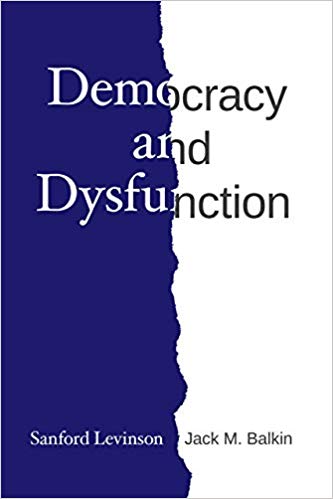
Sanford Levinson and Jack M. Balkin, Democracy and Dysfunction (University of Chicago Press, 2019)

Sanford Levinson, Written in Stone: Public Monuments in Changing Societies (Duke University Press 2018)

Mark A. Graber, Sanford Levinson, and Mark Tushnet, eds., Constitutional Democracy in Crisis? (Oxford University Press 2018)

Gerard Magliocca, The Heart of the Constitution: How the Bill of Rights became the Bill of Rights (Oxford University Press, 2018)

Cynthia Levinson and Sanford Levinson, Fault Lines in the Constitution: The Framers, Their Fights, and the Flaws that Affect Us Today (Peachtree Publishers, 2017)

Brian Z. Tamanaha, A Realistic Theory of Law (Cambridge University Press 2017)

Sanford Levinson, Nullification and Secession in Modern Constitutional Thought (University Press of Kansas 2016)

Sanford Levinson, An Argument Open to All: Reading The Federalist in the 21st Century (Yale University Press 2015)

Stephen M. Griffin, Broken Trust: Dysfunctional Government and Constitutional Reform (University Press of Kansas, 2015)

Frank Pasquale, The Black Box Society: The Secret Algorithms That Control Money and Information (Harvard University Press, 2015)

Bruce Ackerman, We the People, Volume 3: The Civil Rights Revolution (Harvard University Press, 2014)
Balkinization Symposium on We the People, Volume 3: The Civil Rights Revolution

Joseph Fishkin, Bottlenecks: A New Theory of Equal Opportunity (Oxford University Press, 2014)

Mark A. Graber, A New Introduction to American Constitutionalism (Oxford University Press, 2013)

John Mikhail, Elements of Moral Cognition: Rawls' Linguistic Analogy and the Cognitive Science of Moral and Legal Judgment (Cambridge University Press, 2013)

Gerard N. Magliocca, American Founding Son: John Bingham and the Invention of the Fourteenth Amendment (New York University Press, 2013)

Stephen M. Griffin, Long Wars and the Constitution (Harvard University Press, 2013)

Andrew Koppelman, The Tough Luck Constitution and the Assault on Health Care Reform (Oxford University Press, 2013)

James E. Fleming and Linda C. McClain, Ordered Liberty: Rights, Responsibilities, and Virtues (Harvard University Press, 2013)
Balkinization Symposium on Ordered Liberty: Rights, Responsibilities, and Virtues

Andrew Koppelman, Defending American Religious Neutrality (Harvard University Press, 2013)

Brian Z. Tamanaha, Failing Law Schools (University of Chicago Press, 2012)

Sanford Levinson, Framed: America's 51 Constitutions and the Crisis of Governance (Oxford University Press, 2012)

Linda C. McClain and Joanna L. Grossman, Gender Equality: Dimensions of Women's Equal Citizenship (Cambridge University Press, 2012)

Mary Dudziak, War Time: An Idea, Its History, Its Consequences (Oxford University Press, 2012)

Jack M. Balkin, Living Originalism (Harvard University Press, 2011)

Jason Mazzone, Copyfraud and Other Abuses of Intellectual Property Law (Stanford University Press, 2011)

Richard W. Garnett and Andrew Koppelman, First Amendment Stories, (Foundation Press 2011)

Jack M. Balkin, Constitutional Redemption: Political Faith in an Unjust World (Harvard University Press, 2011)

Gerard Magliocca, The Tragedy of William Jennings Bryan: Constitutional Law and the Politics of Backlash (Yale University Press, 2011)

Bernard Harcourt, The Illusion of Free Markets: Punishment and the Myth of Natural Order (Harvard University Press, 2010)

Bruce Ackerman, The Decline and Fall of the American Republic (Harvard University Press, 2010)
Balkinization Symposium on The Decline and Fall of the American Republic

Ian Ayres. Carrots and Sticks: Unlock the Power of Incentives to Get Things Done (Bantam Books, 2010)

Mark Tushnet, Why the Constitution Matters (Yale University Press 2010)

Ian Ayres and Barry Nalebuff: Lifecycle Investing: A New, Safe, and Audacious Way to Improve the Performance of Your Retirement Portfolio (Basic Books, 2010)
.jpg)
Jack M. Balkin, The Laws of Change: I Ching and the Philosophy of Life (2d Edition, Sybil Creek Press 2009)

Brian Z. Tamanaha, Beyond the Formalist-Realist Divide: The Role of Politics in Judging (Princeton University Press 2009)
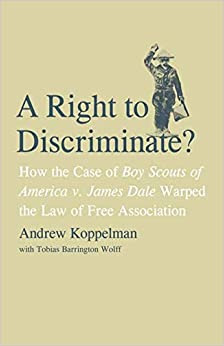
Andrew Koppelman and Tobias Barrington Wolff, A Right to Discriminate?: How the Case of Boy Scouts of America v. James Dale Warped the Law of Free Association (Yale University Press 2009)

Jack M. Balkin and Reva B. Siegel, The Constitution in 2020 (Oxford University Press 2009)

Heather K. Gerken, The Democracy Index: Why Our Election System Is Failing and How to Fix It (Princeton University Press 2009)

Mary Dudziak, Exporting American Dreams: Thurgood Marshall's African Journey (Oxford University Press 2008)

David Luban, Legal Ethics and Human Dignity (Cambridge Univ. Press 2007)

Ian Ayres, Super Crunchers: Why Thinking-By-Numbers is the New Way to be Smart (Bantam 2007)

Jack M. Balkin, James Grimmelmann, Eddan Katz, Nimrod Kozlovski, Shlomit Wagman and Tal Zarsky, eds., Cybercrime: Digital Cops in a Networked Environment (N.Y.U. Press 2007)
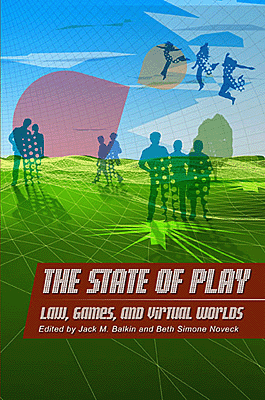
Jack M. Balkin and Beth Simone Noveck, The State of Play: Law, Games, and Virtual Worlds (N.Y.U. Press 2006)

Andrew Koppelman, Same Sex, Different States: When Same-Sex Marriages Cross State Lines (Yale University Press 2006)

Brian Tamanaha, Law as a Means to an End (Cambridge University Press 2006)

Sanford Levinson, Our Undemocratic Constitution (Oxford University Press 2006)

Mark Graber, Dred Scott and the Problem of Constitutional Evil (Cambridge University Press 2006)

Jack M. Balkin, ed., What Roe v. Wade Should Have Said (N.Y.U. Press 2005)

Sanford Levinson, ed., Torture: A Collection (Oxford University Press 2004)
Balkin.com homepage
Bibliography
Conlaw.net
Cultural Software
Writings
Opeds
The Information Society Project
BrownvBoard.com
Useful Links
Syllabi and Exams
