Balkinization
an unanticipated consequence of
Jack M. Balkin
Balkinization Symposiums: A Continuing List
E-mail:
Jack Balkin:
jackbalkin at yahoo.com
Bruce Ackerman
bruce.ackerman at yale.edu
Ian Ayres
ian.ayres at yale.edu
Corey Brettschneider
corey_brettschneider at brown.edu
Mary Dudziak
mary.l.dudziak at emory.edu
Joey Fishkin
joey.fishkin at gmail.com
Heather Gerken heather.gerken at yale.edu
Abbe Gluck abbe.gluck at yale.edu
Mark Graber
mgraber at law.umaryland.edu
Stephen Griffin
sgriffin at tulane.edu
Jonathan Hafetz
jonathan.hafetz at shu.edu
Jeremy Kessler
jkessler at law.columbia.edu
Andrew Koppelman
akoppelman at law.northwestern.edu
Marty Lederman
msl46 at law.georgetown.edu
Sanford Levinson
slevinson at law.utexas.edu
David Luban
david.luban at gmail.com
Gerard Magliocca
gmaglioc at iupui.edu
Jason Mazzone
mazzonej at illinois.edu
Linda McClain
lmcclain at bu.edu
John Mikhail
mikhail at law.georgetown.edu
Frank Pasquale
pasquale.frank at gmail.com
Nate Persily
npersily at gmail.com
Michael Stokes Paulsen
michaelstokespaulsen at gmail.com
Deborah Pearlstein
dpearlst at yu.edu
Rick Pildes
rick.pildes at nyu.edu
David Pozen
dpozen at law.columbia.edu
Richard Primus
raprimus at umich.edu
K. Sabeel Rahmansabeel.rahman at brooklaw.edu
Alice Ristroph
alice.ristroph at shu.edu
Neil Siegel
siegel at law.duke.edu
David Super
david.super at law.georgetown.edu
Brian Tamanaha
btamanaha at wulaw.wustl.edu
Nelson Tebbe
nelson.tebbe at brooklaw.edu
Mark Tushnet
mtushnet at law.harvard.edu
Adam Winkler
winkler at ucla.edu
Compendium of posts on Hobby Lobby and related cases
The Anti-Torture Memos: Balkinization Posts on Torture, Interrogation, Detention, War Powers, and OLC
The Anti-Torture Memos (arranged by topic)
Recent Posts
Citizenship, Civil Rights, and the (Grass)Roots of Constitutional Revolution
The Antebellum Civil Rights Movement And The Antislavery Background Of The Fourteenth Amendment
Civil Rights Without Slavery
Rights, Power, and the First Civil Rights Movement
New Restrictions on “Teaching” Critical Race Theory, and the Use-Mention Distinction Again
Thinking Forward: Civil Rights Before the Fourteenth Amendment
Balkinization Symposium on Kate Masur, Until Justice Be Done
Nussbaum on Sexual Assault: A Mini-Mini Review
N-Word Issues Revisited, and the "Use-Mention" Distinction Questioned
A Constitutional Whodunit
Senator Manchin, Justice Breyer, and the Madisonian Delusion
America's first immigration crisis: The implications of taking Indigenous Nationhood seriously
Illinois Law Review: Biden's First 100 Days
![[Powered by Blogger]](https://lh3.googleusercontent.com/blogger_img_proxy/AEn0k_ujeqzdhBZKnQmhCVOalHNofE43qP4vuxoFtGT5KvvEaxT6y2m5zNS3tZey_eHi4MfyY6j3ZnZ-QUp64QnhttoRdxB6Z8wr_qQC87uaK7Wy=s0-d)
Just A Few Blogs
ACS Blog
Alas, a Blog
Althouse
Arts and Letters Daily
Atrios (Eschaton)
Bill of Health
Buzzflash.com
Buzz Machine
Cato at Liberty
Juan Cole (Informed Comment)
Concurring Opinions
The Constitution in 2020
Corrente
Crooked Timber
Daily Howler
Daily Kos
Dana Boyd
Brad DeLong
Digby (Hullabaloo)
Discriminations
Daniel Drezner
Kevin Drum (Mother Jones)
Electrolite
En Banc
Eunomia (Daniel Larison)
Fafblog
Michael Froomkin (Discourse.net)
GovLab (Beth Noveck)
Rick Hasen (Election Law)
History News Network
How Appealing
Ignatz (Sam Heldman)
The Importance of (Ernie Miller)
Infolaw
Instapundit
International Economic Law and Policy Blog
IntLawGrrls
Jacob Levy
Jesus' General
Jurisdynamics
The Kitchen Cabinet
Mark Kleiman
Law Blog Central
Larry Lessig
Lawyers, Guns and Money
Liberal Oasis
Brian Leiter's Law School Reports
The Leiter Reports
Marginal Revolution
Megan McArdle
Memeorandum
Metafilter
Mirror of Justice
The New Republic
Newseum
No More Mister Nice Blog
Brendan Nyhan
Opinio Juris
Orcinus
The Originalism Blog
Pandagon
Passport (Foreign Policy)
Overcoming Bias
Political Animal (Washington Monthly)
Political Theory Daily Review
Political Wire (Taegan Goddard)
The Poor Man
Virginia Postrel
Prawfsblawg
Public Reason
Jonathan Rauch
Raw Story
Redstate
ReligiousLeftLaw.com
Reporters Committee For Freedom of the Press
Reproductive Rights Blog
Rothman's Roadmap to the Right of Publicity
SCOTUS Blog
Seeing the Forest
Clay Shirky
The Shifted Librarian
The Situationist
Larry Solum (Legal Theory)
Andrew Sullivan
Talking Points Memo
Talk Left
Tapped
Tbogg
TechPresident
The Paper Chase (Jurist)
Tom Paine
Tom Tomorrow (This Modern World)
Eve Tushnet
Uggabugga
University of Chicago Law School Faculty Blog
Unqualified Offerings
The Volokh Conspiracy
War and Piece (Laura Rozen)
Wampum
Oliver Willis
Wonkette
Written Description
Matthew Yglesias
Yin
Your Choice of Feeds
1. XML
powered by

2. Atom Feed
3. RSS 2.0
Citizenship, Civil Rights, and the (Grass)Roots of Constitutional Revolution
Guest Blogger
For the Symposium on Kate Masur, Until Justice Be Done: America's First Civil Rights Movement, From the Revolution to Reconstruction (W. W. Norton & Company, 2021). William J. Novak In an influential article on “History and the Social
Sciences,” Richard Hofstadter set an imposing standard for judging the best
historical work. Channeling the
anxieties of every historian, Hofstadter criticized both traditional narrative
histories where authors “rarely hesitate to retell a story that is already
substantially known” as well as historical monographs that left readers “with
misgivings as to whether that part of it which is new is truly
significant.” “Substantially new” and
“truly significant” thus became the ever-evasive standard of excellence for
professional historical research and writing. Kate Masur’s Until Justice Be Done: America’s First
Civil Rights Movement passes Hofstadter’s stress test with flying
colors. She tells us something decidedly
new – uncovering in unparalleled detail an entire antebellum civil rights movement
dedicated to the cause of securing the rights of free African Americans against
a raft of racially discriminatory state laws, northern as well as
southern. And she tells us something
truly significant – providing a new and utterly convincing account of the
historical roots of the Civil Rights Act of 1866 and the Fourteenth
Amendment. This book will forever change
the way we think about the history of citizenship, civil rights, constitutional
change, and the long struggle for racial justice in America. It is impossible to overstate the accomplishment
here. This is one of those extremely
rare books that enters into a legal-constitutional field of complexity,
confusion, and not infrequent error, and with a painstaking research effort in
numerous new primary sources, brings order and clarity. Oliver Wendell Holmes used to say that the
mark of masters is “that facts which before lay scattered in an inorganic mass,
when they shoot through them the magnetic current of their thought, leap into
an organic order, and live and bear fruit.”
I got something of that feeling when reading this book.
Posted
9:30 AM
by Guest Blogger [link]
The Antebellum Civil Rights Movement And The Antislavery Background Of The Fourteenth Amendment
Guest Blogger
For the Symposium on Kate Masur, Until Justice Be Done: America's First Civil Rights Movement, From the Revolution to Reconstruction (W. W. Norton & Company, 2021). Michael Les Benedict Kate Masur’s Until
Justice Be Done is a major contribution to the history of the conflict over
rights in the United States. It will be
the standard account of African American’s struggle for equal rights from the
turn of the nineteenth century through the ratification of the Reconstruction-era
amendments to the Constitution. As such, it provides a new perspective on the origins of
the Civil War constitutional amendments and the intention of the American
people in framing and ratifying them. Masur’s account deepens historians’ understanding of the
antislavery movement in several very significant ways. First, Masur gives us a new account of
the origins of the Civil War-era constitutional amendments. The classic view has been that there were antislavery
origins to those amendments. The great works
that recovered those origins were titled The Antislavery Origins of the
Fourteenth Amendment and “The Early Antislavery Backgrounds of the
Fourteenth Amendment.”[1] Both harkened back to abolitionist arguments
articulated by white abolitionists like Alvan Stewart, William Goodell, and
Lysander Spooner that slavery itself was unconstitutional and
unconstitutionally deprived Americans of the rights to free speech, free press,
petition, assembly, and due process of law.
William Wiecek’s classic The Sources of Antislavery Constitutionalism
in America likewise attended only to the white abolitionists who developed
the antislavery constitutional argument.[2] Frederick Douglass rated one mention, as
newspaper editor rather than theorist. The
natural conclusion one draws after reading Until Justice Be Done is that
the origins of the Fourteenth and Fifteen Amendments lie not so much in
antislavery constitutionalism but in what she calls “the first civil rights
movement”—the black-led movement for equal rights that ran from the Revolution
through the Civil War and into Reconstruction
(I prefer “equal rights” to “civil rights” as a descriptor of the
movement Masur chronicles). This leads to Masur’s
second contribution. Masur implicitly
but clearly distinguishes between the antislavery movement per se and
the movement for equal rights. This
insight is one of those jaw-dropping ones that makes apparent what had been
implicit in recent studies of antebellum black activism. Until now, historians have conceived of the
great crisis of the mid-nineteenth century in terms of the antislavery
movement. Most of the historiography has
concentrated on abolitionism. We have
numerous accounts of the Garrisonians. For
a long time they were credited with creating the intellectual, moral, and
political environment in which Northerners finally confronted slavery. The Garrisonians famously eschewed politics in
favor of “moral suasion” in their campaign against slavery, bitterly condemning
the “political abolitionists” who disagreed with their approach. Historians
have begun to argue that it was the political abolitionists rather than the
Garrisonians, who brought slavery to an end.
All these accounts treat calls for equal rights as an element of the
antislavery campaign, with the Garrisonians especially committed and political
abolitionists more ambivalent. In recent years
scholars have chronicled the work of black activists, stressing their quest for
recognition as citizens, their demand to be considered Americans rather than
outsiders.[3] But Masur’s is the first synthetic account,
and the first to conceive of these activities as a civil rights movement
complementing but separate from the antislavery movement. While the campaign against slavery and the
campaign against racially discriminatory laws were related, they were not the
same thing. The distinction was
illustrated most clearly in 1865, when Garrison successfully called upon the
American Anti-Slavery Society to disband and discontinued The Liberator,
while his old co-agitator Wendell Phillips insisted that the struggle would not
be over until black Americans had equal rights. I had never understood how Garrison could be
so obtuse until I read Masur’s work. Now
I understand that for Garrison, the issue was slavery not equal rights. He sympathized with equal rights for
everybody, and the Anti-Slavery Society took a firm stand for equal rights not
only for blacks but for women. Garrisonians
regularly called for equality of rights for freed people among their
resolutions condemning slavery. But the
issue was slavery. Equal Rights was ancillary.
Get rid of slavery, and equal rights
would follow. That was not the view of
the black leaders of the civil rights movement.
They were contesting racially discriminatory laws in the North. Garrison might think that these would
dissolve once they no longer were needed to buttress slavery. Black northerners knew better. Although white
abolitionists sympathized, it was black northerners who drove the campaign for equal
rights. Whites dominated the antislavery
movement, with black northerners giving important and often crucial
support. (African Americans accounted
for three-quarters of the subscribers to The Liberator, for
example.) A few black Americans, most
famously Frederick Douglass, were leaders in both movements. But Masur’s work indicates that we will
understand developments better if we conceive of the two movements separately
rather than as one. It is appropriate
for historians to speak of abolitionists and their black allies. In describing he civil rights movement, Masur
speaks of African Americans and “their white allies.” There is a logic to this. The black movement for equal rights was aimed
at discrimination in the North more than at slavery in the South. It grew explosively in the 1840s and 1850s after
black northerners initiated the black convention movement. These conventions represented, as their
titles demonstrated, the “colored citizens” of the northern states in which
they were called.[4]
Their resolutions and addresses to white
northerners complained about the humiliating legal discrimination they faced. Of course, there would be a resolution or two
denouncing slavery, but the focus was on equal rights in the North. The
national conventions were called by the state conventions and reflected their
concentration on securing equal rights in the states. The Thirteenth Amendment was the culmination
of the white-led antislavery movement.
The Fourteenth and Fifteenth Amendments were the culmination of the black-led
equal rights movement.
Posted
9:30 AM
by Guest Blogger [link]
Civil Rights Without Slavery
Guest Blogger
For the Symposium on Kate Masur, Until Justice Be Done: America's First Civil Rights Movement, From the Revolution to Reconstruction (W. W. Norton & Company, 2021). Kunal Parker Until Justice Be Done is
a monumental book. Mapping out what she calls
“America’s first civil rights movement,” Kate Masur explores the fraught
history of multiple efforts, public and private, legal and political, by Whites
and Blacks, to demand citizenship and equality for free Blacks between the American
Revolution and the Civil War. Decades of
struggle, rewarded by successes and visited with failures, would culminate in
the Thirteenth, Fourteenth, and Fifteenth amendments to the U.S. Constitution. What
free Blacks were up against was daunting.
Around 1800, as the number of free Blacks began to grow as a result of
emancipation in the North and manumission in the South, states and territories
all over the country began to seek ways of excluding and removing free Blacks. Free states repurposed centuries-old
restrictions on the movement of the poor to new effect. They demanded bonds and sureties of free
black entrants, excluded free Blacks from poor relief and public schools, and
threw in a bunch of other restrictions for good measure, including prohibiting
Blacks from testifying against Whites. In
the country’s capital and in the slave South, things were far worse. Free Blacks who could not provide adequate account
of themselves found themselves thrown in jail, the threat of being sold into
slavery looming over them. Black sailors
on ships docked at Southern ports were forced into prison until their ships
left port. Throughout this period, the
question of whether free Blacks were citizens of the United States—as opposed
to of individual states--remained a hotly debated question. Free black suffrage was the exception rather
than the norm. Free Blacks faced many of
the legal disabilities faced by non-citizens and for many purposes fared
considerably worse than white aliens. The
American Colonization Society was at the forefront of public and private
efforts to transport free Blacks out of the country.
Posted
9:30 AM
by Guest Blogger [link]
Rights, Power, and the First Civil Rights Movement
Guest Blogger
For the Symposium on Kate Masur, Until Justice Be Done: America's First Civil Rights Movement, From the Revolution to Reconstruction (W. W. Norton & Company, 2021). Laura F. Edwards Kate Masur’s Until Justice Be
Done: America’s First Civil Rights Movement is a stunning accomplishment. In
this post, I first want to highlight the book’s historiographical
contributions, which reshape conventional assumptions about political
participation and the relationship between law and politics in the first half
of the nineteenth century. Then I want to step back and consider broader
implications that the analysis raises, but that Masur does not develop as fully,
with an invitation for her to engage with these issues in her response. While building on an important,
growing body scholarship that foregrounds African Americans’ political activism
between the Revolution and the Civil War, Masur adds an important, new
dimension to this story. As she shows, white Americans allied with African
Americans to build a successful movement that placed civil rights and racial
equality at the center of political debate at this time. The timing is crucial
here. In conventional narratives, it is assumed that few white Americans, even
those who supported the abolition of slavery, questioned racial inequality—or
if they did, they did not organize in opposition to it. Such efforts would only
come later, in the aftermath of the Confederacy’s defeat in the Civil War. Even
then, support would be short-lived, based as much in a desire to punish white
Confederates as it was in a principled commitment to elevate the legal status
of African Americans. Masur shows that opposition to racial inequality had much
deeper roots than previously thought. Activists not only saw immediate results
within free states in the decades preceding the Civil War, but also shaped
federal policy afterwards. Why has this movement been
forgotten? One reason is that we have
been looking in the wrong places, namely the federal level, where legal and political
historians have tended to focus their analyses—at least until recently. Slavery,
not racial equality, dominated debate at the federal level. Questions about
racial equality appeared less often for good reason. Within the federal system,
as it was defined in first half of the nineteenth century, the federal
government’s reach did not extend to such issues in as direct a way as was the
case with slavery. It was the states that had purview over racially based
restrictions, given their jurisdiction over the wide range of issues affecting
the public order and the legal status of individuals. Joining an emerging body
of work that has complicated our understanding of the new republic’s governing
dynamics, Masur follows the jurisdictional lines of the federal system and shifts
the focus from the federal government to states, where conflicts over racial
restrictions were both enacted and challenged. The evidence of this first civil
rights movement had been hiding in plain sight. The conceptual originality of
Masur’s work, however, does not end there. The evidence of this civil right
movement may have been hiding in plain sight, but the materials did not present
themselves as obviously political. Nor did all the various pieces of the puzzle
even seem related, scattered as they were across time and space. Putting events
in Ohio together with those in Massachusetts and New York is not exactly
standard methodological procedure in the world of nineteenth-century history. What
makes the work so brilliant is Masur’s ability to connect seemingly unrelated
events in different states: from the institution of racial restrictions through
poor laws to state campaigns against those restrictions to, ultimately, the
push to change the entire balance of power in the federal system so as to override
state restrictions.
Posted
9:30 AM
by Guest Blogger [link]
New Restrictions on “Teaching” Critical Race Theory, and the Use-Mention Distinction Again
Mark Tushnet
Statutes described as restricting the teaching of critical
race theory are both ignorant and stupid. Are they unconstitutional, though? That’s
not as clear to me as it appears to be to others. As with many things constitutional, details matter. The
Oklahoma statute says that schools can’t “make part of a course” seven listed
concepts, including that “an individual, by virtue of his or her race or sex,
is inherently racist, sexist or oppressive, whether consciously or
unconsciously” (the other “concepts” are similarly described). What exactly does this bar? On its face, teaching the truth
of that concept but not (again on its face) describing the arguments some
analysts (“critical race theorists”) have made about U.S. society and history.
Roughly speaking, a teacher can mention the concepts but can’t use them. The Idaho statute forbids any course from requiring students
to “affirm, adopt, or adhere” to a number of “tenets” defined as part of
critical race theory. Again, teaching about those tenets isn’t barred by
the face of the statute. Frankly, as a now-retired teacher, I’d be – and I think I
was – more than reluctant to require my students to “affirm, adopt, or adhere
to” anything – including the idea that the First Amendment was overall a
good or a bad thing, much less that some specific decision was right or wrong. I understand, though, that some teachers might reasonably think
that getting students to forcefully advocate for a position (with which they
might disagree) is a good way to get them to understand the position. And, it
might be that under some interpretations of the statutes that pedagogic
practice might be subject to sanction. In light of constitutional concerns they
shouldn’t be interpreted to do so. But, finally, uncertainty about the scope of the statutes
might make them unconstitutionally vague (in a First Amendment context) or
(more problematically) overbroad (more problematic because the statutes are
readily subject to narrowing constructions that rely on the use-mention
distinction as I have above). My bottom line is that the statutes might be unconstitutionally vague but that they aren't obvious violations of the substantive First Amendment principle barring the government fro imposing sanctions on speech because of its content.
Posted
9:00 AM
by Mark Tushnet [link]
Thinking Forward: Civil Rights Before the Fourteenth Amendment
Guest Blogger
Allison Brownell Tirres
Kate Masur’s terrific new book Until Justice Be Done:
America’s First Civil Rights Movement, from the Revolution to Reconstruction
does many important things, among them paint a vivid portrait of a dynamic,
multifaceted and multiracial movement for the end of slavery and for the equal
rights of all people, regardless of race. Masur has done extraordinary work in
the archives, revealing networks of activism and advocacy across the country,
from key urban areas like New York and Philadelphia to far-flung settlements in
the states that emerged from the Northwest Territory. She traces the movement
through newspapers, pamphlets, petitions, diaries, court documents, and
legislative records. Some of the characters and turning points of this history
will be familiar to readers with some knowledge of antebellum history (see,
e.g., Frederick Douglass, Dred Scott and the Missouri Compromise), but
many will not. The book decenters the more familiar story of the abolition
movement and the lead up to Civil War. New stories rise to prominence, such as
the struggle over the rights of free Black sailors and the use of the
petitioning power to force lawmakers to consider expanding rights. This deeply
researched work reveals the failures, accomplishments and contradictions of
this effort over several decades, providing a rich description of people on the
move, the constant struggles they faced and the adaptations they made along the
way.
Posted
10:30 AM
by Guest Blogger [link]
Balkinization Symposium on Kate Masur, Until Justice Be Done
JB

We have assembled a terrific group of commentators, including Laura Edwards (Princeton), Mark Graber (Maryland), Michael Les Bendict (Ohio State), Sanford Levinson (Texas), Gerard Magliocca (Indiana), William Novack (Michigan), Kunal Parker (Miami), and Allison Tirres (DePaul).
At the conclusion, Kate will respond to the commentators.
Posted
10:00 AM
by JB [link]
Nussbaum on Sexual Assault: A Mini-Mini Review
Mark Tushnet
I just finished Martha Nussbaum’s new book, Citadels
of Pride: Sexual Assault, Accountability, and Reconciliation. As the title
indicates, Nussbaum argues that a culture of male dominance and sexual assault/harassment
is rooted in (the sin of) pride – “habitually thinking oneself above others and thinking that others do not fully count.”
After developing her account of the connection between male pride and sexual
assault/harassment/domination, Nussbaum describes the current law on sexual
assault and harassment, and in a final section offers case studies of sexual harassment
(and worse) in the federal judiciary, the arts, and sports. I am not the target reader for the second and third
sections, which will be informative and of interest to non-lawyer readers. (I
have some minor comments on those sections at the end of this mini-mini review.)
I want to focus on the first, more philosophical section, and in particular on
Nussbaum’s methodology and the conclusions she draws from her methods. Nussbaum is of course interested in the way passions and emotions do
and should figure in our normative lives. Here she turns that interest into
something like a diagnostic inquiry: What passions and emotions lead men to create
and then engage in a culture of sexual harassment? As I’ve said, her answer is,
Pride. How does she come up with that answer? One possibility, not
pursued here, might be to engage in clinical observations of and interviews
with men who do and don’t engage in sexual assault and harassment. Instead,
Nussbaum engages in which I think of as imaginative projective introspection.
Relying on a wide reading of contemporary and past accounts of sexual
harassment and assault, Nussbaum tries to project herself into the men’s minds
(both harassers and non-harassers), and – once there – to think about
(introspect) their emotional lives. That in turns leads her to “pride.” Whether the account succeeds depends, I think, on the interaction between Nussbaum's literary and rhetorical skill, and the presuppositions of her readers. I personally think that she didn’t introspect deeply
enough. (What follows reflects my interest in Freudian-inflected depth
psychology, but I don’t think that anything much turns where I got the ideas
that I offer.) For Nussbaum pride – the foundation in her account – is an
attitude of hierarchical superiority (again, “thinking oneself above others”). My
introspection leads me to think that the deeper foundation is male sense of inferiority
to women, that we men lack some important things that women have. (For me, that’s
connected to the differences between male and female bodies, but again I don’t
insist on that point.) We men then react to our sense of inferiority by
creating an imaginary superiority that in turn leads to pride. So, in sum, I don’t disagree with the conclusions Nussbaum
draws from her analysis of pride; I think, though, that “pride” (and a sense of
superiority) isn’t the “primitive,” so to speak, in the account. [Comments on the second and third parts of the book: The discussion
of law is fine, although – reflecting I think the culture of Nussbaum’s home
institution – Chicago figures larger in the story than it probably should. At
one point Nussbaum suffered a brain freeze and describes Herbert Wechsler and Charles
Hamilton Houston as federal judges. I appreciated Nussbaum’s sensitive though brief accounts of the virtues of great performance in the arts and
sports. In the end, I thought that her chapter on sports was more than a bit
padded, perhaps because – I don’t know this for a fact – Nussbaum is a sports
fan. The chapter is mostly about the academic corruption of Division I university
sports, with material about sexual assault and harassment tagged on.] As should be obvious, I found the book thought-provoking.
Posted
8:50 PM
by Mark Tushnet [link]
N-Word Issues Revisited, and the "Use-Mention" Distinction Questioned
Mark Tushnet
A recent article
by philosopher Gerald Dworkin (brought to my attention by Brian Leiter) provokes
these thoughts about recent controversies, some in law schools, about the
n-word. Dworkin helpfully describes what I had thought was the most important first
step in thinking about those controversies, the distinction between use and
mention. But, almost in passing, he suggests the possibility that drawing that
distinction actually might not be all that helpful. The idea behind the distinction is this: A person who uses
the n-word inflicts harm of a certain sort, which I’ll call – I think
accurately, but I don’t think anything turns on whether I’m using the term
correctly – semantic harm. A person who mentions the n-word doesn’t
inflict semantic harm. The usual argument about the use-mention distinction in this context goes as follows. Noting the difference between use and mention doesn’t tell us what to do in
response to the semantic harm but whatever we think we should do about it, we
shouldn’t do the same thing when semantic harm doesn’t occur. (There’s of
course a non-trivial argument, which Dworkin lays out, that we shouldn’t do
anything about the harm caused by mentions – and because all issues about
regulating speech involve figuring out what to do when speech inflicts harm,
the mere fact that harm occurs doesn’t justify regulation.) Dworkin mentions, so to speak, controversies over the use of
the word “niggardly,” but doesn’t build them into his analysis. People avoid
using that word (or at least might reasonably avoid using it) even though it
has no relation to the n-word either etymologically or semantically, because
they believe that some listeners will hear the sounds of the word
and experience harm. Here the harm isn’t semantic, of course. Instead, it
involves what I’ll call “phonic” harm: A person experiences harm simply upon
hearing the sounds that constitute the word. Now, suppose, as I suspect is true, that the neural
mechanism linking semantics to harm is different from the neural mechanism
linking phonics to harm. The phonic harm occurs when the word is mentioned. If that
harm is roughly similar to the semantic harm inflicted when the word is used,
then the use-mention distinction doesn’t help us figure out what to do in
response to the harm (because, again, it occurs in cases of mention). One possibility is that the semantic harm is similar to
but in some sense worse than the phonic harm, so that – for example –
regulation of uses, which combine semantic and phonic harm, might be justified
even though regulation of mentions, which cause only phonic harm, would not
be. Working that possibility out requires some analysis of the sense in which semantic harm is worse than phonic harm -- and I'm pretty confident that such an analysis would make sense to me. I now think, though, that the use-mention distinction alone doesn't get the job completely done.
Posted
9:00 PM
by Mark Tushnet [link]
A Constitutional Whodunit
Gerard N. Magliocca
I am at Mount Vernon conducting some final research for my Bushrod Washington biography and I came across something new (at least to me) that others find want to examine. In December 1801, five anonymous essays appeared in the Washington (Georgetown) Federalist newspaper attacking the proposed repeal of the Judiciary Act of 1801, which created the "midnight judges." The essays argued, in part, that the repeal was an unconstitutional assault on an independent judiciary. They were signed "A Friend of the Constitution." My eyes opened wide when I saw that. Why? Because that was the title of the anonymous essays that John Marshall wrote in 1819 to defend McCulloch v. Maryland. This raises an obvious question--Did the Chief Justice also write the 1801 essays? Another alternative is that his partner in surreptitiously publishing the 1819 essays--Bushrod Washington--was the author of the 1801 essays. An unpublished manuscript at the Mount Vernon library asserts that either Marshall or Bushrod was their author, though without citing any direct evidence. I'll see if I can find any. UPDATE: The essays are sometimes attributed to William Cranch. I'm trying to see why that is so.
Posted
2:05 PM
by Gerard N. Magliocca [link]
(0) comments
Senator Manchin, Justice Breyer, and the Madisonian Delusion
Sandy Levinson
Both Senator Joseph Manchin of West Virginia and Justice Stephen Breyer can, I believe, be viewed in terms of the Madisonian hope--or delusion--of staving off factional partisanship by relying instead on the virtuous impulses of what we today might describe as "bi-partisan" and public-spirited leaders. One should not disdain this desire. Madison was clearly on to something when, in Federalist 10, he bewailed "factions" as collectivities committed not to the public good, but, instead, to their own selfish interests. That, of course, is what political parties can be viewed as, and there is widespread agreement that the Madison of 1787, like Washington and most other luminaries, were trying to stave off the development of political parties. One can easily say that Madison and Washington were delusional in their hope, not to mention illustrating the propensity of all of us to define our own particular desires with "the public good." In any event, the only interesting controversy among historians is dating exactly when the Madisonian fantasy collapsed. Some would say as early as the first couple of Congresses and the debate, in particular, over the chartering of the first Bank of the United States, where Madison led the attack on Hamilton's brainchild. Others might say the election of 1796; everyone would agree that by 1800 it was in complete shambles and, like Humpty Dumpty, would never be put back together. But it is still possible to say that "partisanship," though completely explicable and even productive, has its downsides as well. There is no evidence that either Senator Manchin or Justice Breyer is an ignorant fool in emphasizing the importance of moving away from our present polarization. That being said, however, one can say that even if not foolish, they are still nonetheless subject to justified criticism in refusing to recognize what is obviously true, for better and, certainly, for worse about our contemporary polity. They are making the best--i.e., a Madisonian (or "Publian") society of leaders selflessly committed above all to the "common good"--the enemy of the good. So what is "the good" in this context: The answer is a political system that, at least over the next few years, is basically controlled by the Democratic Party, given that the GOP has become largely a fascistic cult of personality around the truly malevolent figure of Donald J. Trump and the necessity to support his Goebellian big lie concerning the integrity of the election. I suspect that Manchin, as an experienced practicing politician realizes this. His resistance to "partisanship" can in part be explained by his tenuous position in West Virginia itself, the most Trumpista state in the Union, apparently. Breyer's position must find a different explanation, and I think the basic answer lies in his being a very bright technocrat--he has taught at the Kennedy School as well as the Harvard Law School--who really buys fully into the Hegelian/Frankfurterian ideal of a class of civil servants, including judges, who transcend "the political thicket" and can make judgments faithful to the public interest and/or "the rule of law." In some ways, Breyer is more interesting than Ginsburg, who I think had become simply a form of megalomaniac at the end, encouraged to accept the view of her acolytes that she was truly indispensable and irreplaceable. Breyer, on the other hand, is more the instantiation of a particular ideological vision. Whether this makes him more admirable, or even more dangerous, than Ginsburg is truly debatable.
Posted
12:30 PM
by Sandy Levinson [link]
America's first immigration crisis: The implications of taking Indigenous Nationhood seriously
Sandy Levinson
First things first: I strongly recommend to everyone Mary Sarah Bilder's new article, Without Doors: Native Nations and the Convention, which has just appeared in a truly remarkable symposium in the Fordham Law Review on The Federalist Constitution. I've not yet read all of the articles, but the three I've read so far are absolutely terrific, in every way. Bilder focuses on the role that delegates from Indigenous Nations played at the Philadelphia Convention and then afterward in the early days of the Washington Administration. By looking "without doors," i.e., outside the locked confines of the Convention itself, she demonstrates the genuine, and important, presence of delegates from a number of Indigenous Nations at the Convention and their influence on the drafting of the Constitution. A lot of potted histories of the Convention, including my own, will have to be rewritten in light of her article. What I find most fascinating, though, and triggers this post, is the degree to which the article focuses on what I'm now going to start describing as "America's first immigration crisis." It is derived from the fact that Indigenous Nations rightly feared the incursion on their lands--which they considered their "sovereign territory," not part of the United States of America juridically--by rapacious white settlers. Many, of course, had understandably supported the British in their own efforts to prevent American secession from the British Empire. London had announced in 1763 a ban on further settlement west of the Alleghenies by settlers wishing to move west. Needless to say, this didn't go over very well with the settler community. The 1619 Project understandably focuses on the reality of white supremacy and American Blacks. But Bilder brings to bear the importance of understanding the at least equally important reality of Indigenous Nations who were equally suspicious of their treatment at the hands of white would-be hegemons. Although none of the Nations seemingly suggested "building a wall" to keep out white settlement, one suspects they would have been receptive to the idea. (One ever present possibility, of course, was the use of violence against insistent would-be settlers.). One of the many virtues of the article is that it tests many of one's own presuppositions about immigration. Like many contemporary liberals, I tend toward quite open borders, wishing to welcome not only political refugees fearing persecution (broadly defined), but also persons, like my own ancestors, simply seeking a better life for themselves and their children. And no one could doubt that America was initially built on a de facto reality of significantly open borders, at least if one were not a "vicious pauper," in the language of Mayor of New York v. Miln (1837). And, as a political liberal, I tend ultimately to focus on "individual flourishing" and to be suspicious of states and other would-be hegemonic institutions speaking in behalf of maintaining a unified political culture. But, in the context of this article, I find myself sympathetic to the wishes of Indigenous Nations to keep out settlers. In any event, one of the major developments at the Convention, as Bilder demonstrates, was the exclusion of states ("sovereign" or not) from having any role in negotiating with or making policies involving American Indians. As it turned out, of course, this is part of the Constitution that might be described as a "parchment barrier" with regard to providing genuine protection for the Indigenous Nations that actually trusted the Americans. One of the provisions of much-discussed Treaty of Hopewell promised that Indigenous Nations would be allowed to send "delegates" to Congress. This obviously did not happen. (And even if it had, one can be sure that, as with the District of Columbia and Puerto Rico, they would have had no vote and concomitantly little actual influence). One of the obvious differences between American Blacks and members of Indigenous Nations is that most of the former, I am quite confident, sought, like Frederick Douglass, personal autonomy and full membership within the American political community. For the latter, though, personal autonomy had to be understood within the context of the very particular Nations within whom they were socialized and lived; more to the point, what they wanted to political autonomy in the form of genuine "sovereignty" of their respective Nations. Although many treaties promised Native Americans the possibility of citizenship, that was not really their primary focus or desire. Sitting Bull was not striving to become an American. He wanted to lead an independent Lakota Sioux Nation, a juridical equal to the United States of America (and with no duty to take account of a subordinate entity like Montana or South Dakota). It is totally unclear to me what the precise implications are for contemporary policy. Bilder is a careful historian, trying to reconstruct the past as it was understood by the people actually living then. She is not an "originalist" pretending to generate contemporary understandings based on what occurred over two centuries ago. Still, it is clear that any "Indian lives matter" movement would inevitably have to take a somewhat different form from "Black lives matter" or most other standard-form social movements. I doubt that many courses in American constitutional law treat in any depth the reality of Indigenous Nations and their relationship to the United States Constitution. There may be mention of Marshall's dictum about their being "domestic dependent sovereigns,' but that is usually it. There's just "not time" to treat the issue in any depth. There are a bunch of contemporary "Indian rights" cases dealing with tribal autonomy, but, as Justice Thomas altogether accurately suggested, the actual treatment by the Court of tribal "sovereignty" is altogether incoherent and schizophrenic. Judith Resnik has suggested for some years that "American federalism" ought to be recognized as consisting of three levels--nation, states, and Native American tribes. More than ever, I think she is quite right, and it is illuminating to apply such an analysis to the analysis of membership rules and immigration.
Posted
7:23 PM
by Sandy Levinson [link]
Illinois Law Review: Biden's First 100 Days
Jason Mazzone
The Illinois Law Review has just published an online symposium on President Biden's First 100 Days in office. Forty contributors offer their assessments of the administration's activities so far and their views of what lies ahead. Lots of good insights across a wide range of issues.
Posted
10:20 AM
by Jason Mazzone [link]
Books by Balkinization Bloggers

Gerard N. Magliocca, The Actual Art of Governing: Justice Robert H. Jackson's Concurring Opinion in the Steel Seizure Case (Oxford University Press, 2025)

Linda C. McClain and Aziza Ahmed, The Routledge Companion to Gender and COVID-19 (Routledge, 2024)

David Pozen, The Constitution of the War on Drugs (Oxford University Press, 2024)

Jack M. Balkin, Memory and Authority: The Uses of History in Constitutional Interpretation (Yale University Press, 2024)
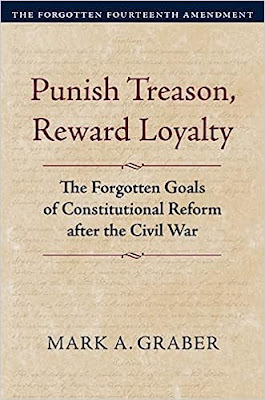
Mark A. Graber, Punish Treason, Reward Loyalty: The Forgotten Goals of Constitutional Reform after the Civil War (University of Kansas Press, 2023)
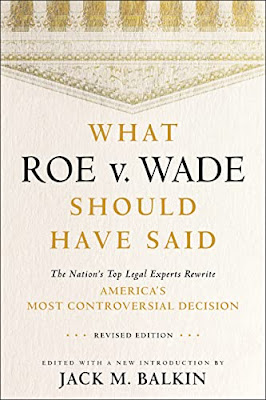
Jack M. Balkin, What Roe v. Wade Should Have Said: The Nation's Top Legal Experts Rewrite America's Most Controversial Decision - Revised Edition (NYU Press, 2023)

Andrew Koppelman, Burning Down the House: How Libertarian Philosophy Was Corrupted by Delusion and Greed (St. Martin’s Press, 2022)

Gerard N. Magliocca, Washington's Heir: The Life of Justice Bushrod Washington (Oxford University Press, 2022)
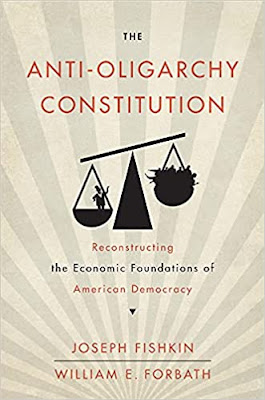
Joseph Fishkin and William E. Forbath, The Anti-Oligarchy Constitution: Reconstructing the Economic Foundations of American Democracy (Harvard University Press, 2022)
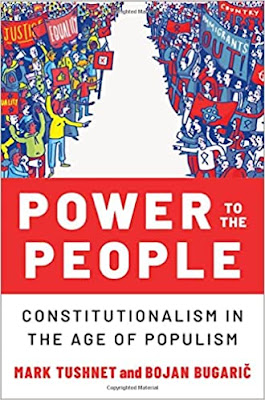
Mark Tushnet and Bojan Bugaric, Power to the People: Constitutionalism in the Age of Populism (Oxford University Press 2021).

Mark Philip Bradley and Mary L. Dudziak, eds., Making the Forever War: Marilyn B. Young on the Culture and Politics of American Militarism Culture and Politics in the Cold War and Beyond (University of Massachusetts Press, 2021).

Jack M. Balkin, What Obergefell v. Hodges Should Have Said: The Nation's Top Legal Experts Rewrite America's Same-Sex Marriage Decision (Yale University Press, 2020)

Frank Pasquale, New Laws of Robotics: Defending Human Expertise in the Age of AI (Belknap Press, 2020)

Jack M. Balkin, The Cycles of Constitutional Time (Oxford University Press, 2020)

Mark Tushnet, Taking Back the Constitution: Activist Judges and the Next Age of American Law (Yale University Press 2020).

Andrew Koppelman, Gay Rights vs. Religious Liberty?: The Unnecessary Conflict (Oxford University Press, 2020)

Ezekiel J Emanuel and Abbe R. Gluck, The Trillion Dollar Revolution: How the Affordable Care Act Transformed Politics, Law, and Health Care in America (PublicAffairs, 2020)

Linda C. McClain, Who's the Bigot?: Learning from Conflicts over Marriage and Civil Rights Law (Oxford University Press, 2020)
Sanford Levinson and Jack M. Balkin, Democracy and Dysfunction (University of Chicago Press, 2019)

Sanford Levinson, Written in Stone: Public Monuments in Changing Societies (Duke University Press 2018)

Mark A. Graber, Sanford Levinson, and Mark Tushnet, eds., Constitutional Democracy in Crisis? (Oxford University Press 2018)

Gerard Magliocca, The Heart of the Constitution: How the Bill of Rights became the Bill of Rights (Oxford University Press, 2018)

Cynthia Levinson and Sanford Levinson, Fault Lines in the Constitution: The Framers, Their Fights, and the Flaws that Affect Us Today (Peachtree Publishers, 2017)

Brian Z. Tamanaha, A Realistic Theory of Law (Cambridge University Press 2017)

Sanford Levinson, Nullification and Secession in Modern Constitutional Thought (University Press of Kansas 2016)

Sanford Levinson, An Argument Open to All: Reading The Federalist in the 21st Century (Yale University Press 2015)

Stephen M. Griffin, Broken Trust: Dysfunctional Government and Constitutional Reform (University Press of Kansas, 2015)

Frank Pasquale, The Black Box Society: The Secret Algorithms That Control Money and Information (Harvard University Press, 2015)

Bruce Ackerman, We the People, Volume 3: The Civil Rights Revolution (Harvard University Press, 2014)
Balkinization Symposium on We the People, Volume 3: The Civil Rights Revolution

Joseph Fishkin, Bottlenecks: A New Theory of Equal Opportunity (Oxford University Press, 2014)

Mark A. Graber, A New Introduction to American Constitutionalism (Oxford University Press, 2013)

John Mikhail, Elements of Moral Cognition: Rawls' Linguistic Analogy and the Cognitive Science of Moral and Legal Judgment (Cambridge University Press, 2013)

Gerard N. Magliocca, American Founding Son: John Bingham and the Invention of the Fourteenth Amendment (New York University Press, 2013)

Stephen M. Griffin, Long Wars and the Constitution (Harvard University Press, 2013)

Andrew Koppelman, The Tough Luck Constitution and the Assault on Health Care Reform (Oxford University Press, 2013)

James E. Fleming and Linda C. McClain, Ordered Liberty: Rights, Responsibilities, and Virtues (Harvard University Press, 2013)
Balkinization Symposium on Ordered Liberty: Rights, Responsibilities, and Virtues

Andrew Koppelman, Defending American Religious Neutrality (Harvard University Press, 2013)

Brian Z. Tamanaha, Failing Law Schools (University of Chicago Press, 2012)

Sanford Levinson, Framed: America's 51 Constitutions and the Crisis of Governance (Oxford University Press, 2012)

Linda C. McClain and Joanna L. Grossman, Gender Equality: Dimensions of Women's Equal Citizenship (Cambridge University Press, 2012)

Mary Dudziak, War Time: An Idea, Its History, Its Consequences (Oxford University Press, 2012)

Jack M. Balkin, Living Originalism (Harvard University Press, 2011)

Jason Mazzone, Copyfraud and Other Abuses of Intellectual Property Law (Stanford University Press, 2011)

Richard W. Garnett and Andrew Koppelman, First Amendment Stories, (Foundation Press 2011)

Jack M. Balkin, Constitutional Redemption: Political Faith in an Unjust World (Harvard University Press, 2011)

Gerard Magliocca, The Tragedy of William Jennings Bryan: Constitutional Law and the Politics of Backlash (Yale University Press, 2011)

Bernard Harcourt, The Illusion of Free Markets: Punishment and the Myth of Natural Order (Harvard University Press, 2010)

Bruce Ackerman, The Decline and Fall of the American Republic (Harvard University Press, 2010)
Balkinization Symposium on The Decline and Fall of the American Republic

Ian Ayres. Carrots and Sticks: Unlock the Power of Incentives to Get Things Done (Bantam Books, 2010)

Mark Tushnet, Why the Constitution Matters (Yale University Press 2010)

Ian Ayres and Barry Nalebuff: Lifecycle Investing: A New, Safe, and Audacious Way to Improve the Performance of Your Retirement Portfolio (Basic Books, 2010)
.jpg)
Jack M. Balkin, The Laws of Change: I Ching and the Philosophy of Life (2d Edition, Sybil Creek Press 2009)

Brian Z. Tamanaha, Beyond the Formalist-Realist Divide: The Role of Politics in Judging (Princeton University Press 2009)
Andrew Koppelman and Tobias Barrington Wolff, A Right to Discriminate?: How the Case of Boy Scouts of America v. James Dale Warped the Law of Free Association (Yale University Press 2009)

Jack M. Balkin and Reva B. Siegel, The Constitution in 2020 (Oxford University Press 2009)

Heather K. Gerken, The Democracy Index: Why Our Election System Is Failing and How to Fix It (Princeton University Press 2009)

Mary Dudziak, Exporting American Dreams: Thurgood Marshall's African Journey (Oxford University Press 2008)

David Luban, Legal Ethics and Human Dignity (Cambridge Univ. Press 2007)

Ian Ayres, Super Crunchers: Why Thinking-By-Numbers is the New Way to be Smart (Bantam 2007)

Jack M. Balkin, James Grimmelmann, Eddan Katz, Nimrod Kozlovski, Shlomit Wagman and Tal Zarsky, eds., Cybercrime: Digital Cops in a Networked Environment (N.Y.U. Press 2007)
Jack M. Balkin and Beth Simone Noveck, The State of Play: Law, Games, and Virtual Worlds (N.Y.U. Press 2006)

Andrew Koppelman, Same Sex, Different States: When Same-Sex Marriages Cross State Lines (Yale University Press 2006)

Brian Tamanaha, Law as a Means to an End (Cambridge University Press 2006)

Sanford Levinson, Our Undemocratic Constitution (Oxford University Press 2006)

Mark Graber, Dred Scott and the Problem of Constitutional Evil (Cambridge University Press 2006)

Jack M. Balkin, ed., What Roe v. Wade Should Have Said (N.Y.U. Press 2005)

Sanford Levinson, ed., Torture: A Collection (Oxford University Press 2004)
Balkin.com homepage
Bibliography
Conlaw.net
Cultural Software
Writings
Opeds
The Information Society Project
BrownvBoard.com
Useful Links
Syllabi and Exams
