Balkinization
an unanticipated consequence of
Jack M. Balkin
Balkinization Symposiums: A Continuing List
E-mail:
Jack Balkin:
jackbalkin at yahoo.com
Bruce Ackerman
bruce.ackerman at yale.edu
Ian Ayres
ian.ayres at yale.edu
Corey Brettschneider
corey_brettschneider at brown.edu
Mary Dudziak
mary.l.dudziak at emory.edu
Joey Fishkin
joey.fishkin at gmail.com
Heather Gerken heather.gerken at yale.edu
Abbe Gluck abbe.gluck at yale.edu
Mark Graber
mgraber at law.umaryland.edu
Stephen Griffin
sgriffin at tulane.edu
Jonathan Hafetz
jonathan.hafetz at shu.edu
Jeremy Kessler
jkessler at law.columbia.edu
Andrew Koppelman
akoppelman at law.northwestern.edu
Marty Lederman
msl46 at law.georgetown.edu
Sanford Levinson
slevinson at law.utexas.edu
David Luban
david.luban at gmail.com
Gerard Magliocca
gmaglioc at iupui.edu
Jason Mazzone
mazzonej at illinois.edu
Linda McClain
lmcclain at bu.edu
John Mikhail
mikhail at law.georgetown.edu
Frank Pasquale
pasquale.frank at gmail.com
Nate Persily
npersily at gmail.com
Michael Stokes Paulsen
michaelstokespaulsen at gmail.com
Deborah Pearlstein
dpearlst at yu.edu
Rick Pildes
rick.pildes at nyu.edu
David Pozen
dpozen at law.columbia.edu
Richard Primus
raprimus at umich.edu
K. Sabeel Rahmansabeel.rahman at brooklaw.edu
Alice Ristroph
alice.ristroph at shu.edu
Neil Siegel
siegel at law.duke.edu
David Super
david.super at law.georgetown.edu
Brian Tamanaha
btamanaha at wulaw.wustl.edu
Nelson Tebbe
nelson.tebbe at brooklaw.edu
Mark Tushnet
mtushnet at law.harvard.edu
Adam Winkler
winkler at ucla.edu
Compendium of posts on Hobby Lobby and related cases
The Anti-Torture Memos: Balkinization Posts on Torture, Interrogation, Detention, War Powers, and OLC
The Anti-Torture Memos (arranged by topic)
Recent Posts
The Cycles of Constitutional Time and the 2020 Election
What is the Presidency?
Balkinization Symposium on Adam Cox and Cristina Rodriguez, The President and Immigration Law
Covid, masks, and the freedom to drive drunk
Section Two of the Fourteenth Amendment and Presidential Electors
The Fulton v. City of Philadelphia Oral Argument: Interracial Marriage as a Constitutional Lodestar— or Third Rail?—in Reasoning about Religiously-Motivated Discrimination
The U.S. Constitution and the problem of Constituent Power
Reclaiming the Race Analogy in Fulton v. City of Philadelphia
State Legislatures and Presidential Electors
What Georgia voters need to know
Trump v. New York
Two important acknowledgements in the ACA case
Richard Nixon on the 1960 Election
Before (and Before and Before) Severability
Would the 2017 Congress have thought that its zeroing out of the Section 5000A payment would cause anyone to purchase unwanted insurance?
A further note on severability and the ACA
Gluck v. Mazzone on ACA Severability
Mitch McConnell might not endanger the planet
Severability in California v. Texas: Significance of What Congress Did in 2017?
The Affordable Care Act Does Not Have An Inseverability Clause
Thoughts on the Fulton Oral Argument
The Reagan Regime Lives On
The Margin of Litigation, the Margin of Error, and the Margin of Organizing
What Fulton v. Philadelphia Is--and Isn't--About
Regime Change: My Essay on The Cycles of Constitutional Time in WaPo
![[Powered by Blogger]](https://lh3.googleusercontent.com/blogger_img_proxy/AEn0k_tUIC0nwRx6dtX5m9VcuQQBGLGZ48LAjQM936wDSe-gy6gY4jcDej3jXwlBNZgD5Wq9SwTPCfWPCuy3a2UJQub91Wzctzy6l8YvXTmH31zO=s0-d)
Just A Few Blogs
ACS Blog
Alas, a Blog
Althouse
Arts and Letters Daily
Atrios (Eschaton)
Bill of Health
Buzzflash.com
Buzz Machine
Cato at Liberty
Juan Cole (Informed Comment)
Concurring Opinions
The Constitution in 2020
Corrente
Crooked Timber
Daily Howler
Daily Kos
Dana Boyd
Brad DeLong
Digby (Hullabaloo)
Discriminations
Daniel Drezner
Kevin Drum (Mother Jones)
Electrolite
En Banc
Eunomia (Daniel Larison)
Fafblog
Michael Froomkin (Discourse.net)
GovLab (Beth Noveck)
Rick Hasen (Election Law)
History News Network
How Appealing
Ignatz (Sam Heldman)
The Importance of (Ernie Miller)
Infolaw
Instapundit
International Economic Law and Policy Blog
IntLawGrrls
Jacob Levy
Jesus' General
Jurisdynamics
The Kitchen Cabinet
Mark Kleiman
Law Blog Central
Larry Lessig
Lawyers, Guns and Money
Liberal Oasis
Brian Leiter's Law School Reports
The Leiter Reports
Marginal Revolution
Megan McArdle
Memeorandum
Metafilter
Mirror of Justice
The New Republic
Newseum
No More Mister Nice Blog
Brendan Nyhan
Opinio Juris
Orcinus
The Originalism Blog
Pandagon
Passport (Foreign Policy)
Overcoming Bias
Political Animal (Washington Monthly)
Political Theory Daily Review
Political Wire (Taegan Goddard)
The Poor Man
Virginia Postrel
Prawfsblawg
Public Reason
Jonathan Rauch
Raw Story
Redstate
ReligiousLeftLaw.com
Reporters Committee For Freedom of the Press
Reproductive Rights Blog
Rothman's Roadmap to the Right of Publicity
SCOTUS Blog
Seeing the Forest
Clay Shirky
The Shifted Librarian
The Situationist
Larry Solum (Legal Theory)
Andrew Sullivan
Talking Points Memo
Talk Left
Tapped
Tbogg
TechPresident
The Paper Chase (Jurist)
Tom Paine
Tom Tomorrow (This Modern World)
Eve Tushnet
Uggabugga
University of Chicago Law School Faculty Blog
Unqualified Offerings
The Volokh Conspiracy
War and Piece (Laura Rozen)
Wampum
Oliver Willis
Wonkette
Written Description
Matthew Yglesias
Yin
Your Choice of Feeds
1. XML
powered by

2. Atom Feed
3. RSS 2.0
The Cycles of Constitutional Time and the 2020 Election
JB
This morning Professor Donna Lyons from Trinity College Dublin interviewed me about my new book, The Cycles of Constitutional Time, and how the book's argument helps us to understand the consequences of the 2020 election.
Posted
3:55 PM
by JB [link]
What is the Presidency?
Guest Blogger
Daphna Renan What is the presidency in American public
law? Current debates tend to focus on the constitutional powers of the presidential
office and the authority of Congress to restrict them. In The President and
Immigration Law, Professors Adam Cox and Cristina Rodríguez argue that, if
the goal is to understand and assess presidential power in its contemporary
form, we are looking in the wrong place. Presidential power results from the mass
of statutory authorities—some broad and substantial, some textually specific or
seemingly inconsequential—developed over time. But if this power derives from the
interbranch process that underlies legislation, it is distinctively
presidential in practice. Presidents do not merely apply legal authorities when
they enforce statutes. Presidents reinvent these statutory schemes in “their
own lights” (p. 8). Conforming immigration enforcement to the principle of
legislative supremacy, the authors tell us, “would not just repudiate a few
initiatives of recent administrations”; rather, it would “call into question
the legality of decades of executive branch policymaking that has shaped the
very nature of the American polity” (p. 202). Presidential power thus emerges
from the discretion that presidents create in the interstices of complex
statutory regimes. The book’s central argument is
framed in connection to U.S. immigration law—and the descriptive account it
presents in that context is nuanced and illuminating. But its conceptual apparatus
is more far-reaching still. The modern presidency draws power not from some
founding-era conception of a royal prerogative but from the crevices of cumulative—at
times, contradictory—statutory material. There is nothing inherent or immutable
about this presidency. Nor anything “original” about its design. Instead, it is
the product of layers of contingent political battles and provisional
settlements. These legal understandings have a foothold in the myriad
provisions of the U.S. Code. But they are reinvented over time by the executive
branch itself, in ways that have enabled the presidency to implement, rethink,
and reimagine the substantive goals of the state.
Posted
9:30 AM
by Guest Blogger [link]
Balkinization Symposium on Adam Cox and Cristina Rodriguez, The President and Immigration Law
JB
We have assembled a terrific group of commentators, including Pratheepan Gulasekaram (Santa Clara), Aziz Huq (Chicago), Peter Markowitz (Cardozo), Daphna Renan (Harvard), Shalev Roisman (Arizona), Bijal Shah (Arizona State), Peter Shane (Ohio State), and Robert Tsai (B.U.). At the conclusion, Adam and Cristina will respond to the commentators.
This week at Balkinization we are hosting a symposium on Adam Cox and Cristina Rodriguez's new book, The President and Immigration Law (Oxford University Press, 2020).
Posted
9:00 AM
by JB [link]
Covid, masks, and the freedom to drive drunk
Andrew Koppelman
Does freedom mean the right to refuse to wear a mask during the Covid
pandemic? Many Americans think so. It is Donald Trump’s most important
legacy. Here’s one implication that is
too little noticed: if that is what
freedom means, then we owe drunk drivers an apology.
Posted
3:39 PM
by Andrew Koppelman [link]
Section Two of the Fourteenth Amendment and Presidential Electors
Gerard N. Magliocca
To build upon my prior post about the constitutional doubts that exist about the authority of a state legislature to appoint presidential electors after the election was held in a manner inconsistent with the popular vote in that state, consider Section Two of Fourteenth Amendment: The most sensible reading of this provision is that a state legislature that usurps the popular vote for presidential electors in a state forfeits the state's right to representation in the House of Representatives and (arguably) in the Electoral College itself except for the two votes each state gets for its two Senators. Such a state legislature would be denying the right to vote to everyone in the state by treating the election as a non-binding beauty contest when the people voted on the assumption that their vote was binding. Granted, you could say that Section Two permits a state legislature to appoint presidential electors after the election in defiance of the people--the state must just accept the representation penalty. Maybe, but the penalty is severe. More broadly, the point is that state legislatures do not have plenary authority over the appointment of presidential electors after the election is held. Either they face a harsh penalty or other independent constitutional provisions should be read as prohibiting such an action entirely. States test these constitutional limits at their peril.[W]hen the right to vote at any election for the choice of electors for President and Vice President of the United States . . . is denied to any of the male inhabitants of such state, being and citizens of the United States, or in any way abridged, except for participation in rebellion, or other crime, the basis of representation therein shall be reduced in the proportion which the number of such male citizens shall bear to the whole number of male citizens twenty-one years of age in such state.
Posted
8:53 PM
by Gerard N. Magliocca [link]
(0) comments
The Fulton v. City of Philadelphia Oral Argument: Interracial Marriage as a Constitutional Lodestar— or Third Rail?—in Reasoning about Religiously-Motivated Discrimination
Linda McClain
I agree with Professor Kyle C. Velte’s insightful post on
this blog, “Reclaiming the Race Analogy in
Fulton v. City of Philadelphia” (Friday, November 13), in which she insists
on the appropriateness of the analogy between religious opposition to
interracial marriage and—more broadly—to racial integration and present-day religious
opposition to same-sex marriage and—more broadly—to providing goods and
services to same-sex couples. Reflecting
on the recent oral argument before the U.S. Supreme Court in Fulton, Velte suggests that how some
Justices view the aptness of the race discrimination/sexual orientation analogy
may shape their approach to the case. Professor Velte’s post draws on arguments in
an amicus brief that she authored, submitted in Fulton on behalf of respondents and joined by several legal
scholars (including me). The brief urges the Court that civil rights-era
precedents such as Newman v. Piggie Park Enterprises (1968) are relevant to present-day
controversies over claims to religious exemptions to antidiscrimination laws
and cautioned against arguments—advanced earlier in Masterpiece Cakeshop v. Colorado Civil Rights Commission—that any
analogy to Piggie Park was inapt
because yesterday’s religious
segregationist was obviously a bigot, with “fringe” beliefs, while today’s
religious believers in traditional marriage are sincere, with decent and
honorable beliefs. As Professor Velte
argues in her post (and as I have elaborated in Who’s the Bigot?), this supposed disanalogy sets the stage for a further
argument: if business owners (like Jack Phillips) or religious social service
agencies (like Catholic Social Services, in Fulton)
who sincerely object to same-sex marriage are denied exemptions from state or
local antidiscrimination laws, they are being branded and treated as bigots
argument. In this post, I offer additional analysis of the prominent role
played by the race analogy in the Fulton
oral argument. To be sure, no one used the express rhetoric of bigotry in the Fulton oral argument. However, the idea that Catholic Social
Services (CSS) was being branded as a bigot because Philadelphia would not
allow it to continue its contract as a foster care agency (FCA) unless it agreed
to comply with the Fair Practices Ordinance and certify same-sex couples for
foster care placements was implicit in
remarks by Deputy Assistant Attorney General Hashim Mooppan (U.S. Department of
Justice), who appeared as amicus curiae in support of CSS and the other petitioners.
Justice Alito’s questioning and statements also implied such a charge. Similarly,
although Piggie Park did not make an
appearance, several justices raised the race analogy in the form of questions
about religious objections to interracial marriage. Counsel for the parties and
the various justices sharply disagreed about the force of this analogy. For Mooppan
and for Lori Windham, counsel for petitioners, as well as for some of the
conservative justices, Loving v. Virginia
seemed less of a constitutional lodestar and more akin to a third rail on
the subway: to be avoided as so inapt as to be incendiary and dangerous. For the City’s attorneys and some of the
liberal justices, the example of interracial marriage featured as a fixed
point, or lodestar, that should guide reasoning about government’s compelling
interest in ending discrimination on grounds other than race. In effect, this dual approach reprised
Obergefell v. Hodges (2015): Loving was a constitutional lodestar in
Justice Kennedy’s majority opinion holding that same-sex couples had a
fundamental right to marry, while the dissenters argued that Loving in no way supported such a
holding and that such reasoning from race would vilify sincere religious
believers in traditional (man-woman) marriage as bigots. In the Fulton oral
argument, several justices raised the interracial marriage hypothetical, pondering
how to draw lines concerning what sorts of religious beliefs might receive
exemptions from the City of Philadelphia’s nondiscrimination law (the Fair
Practices Ordinance) if the Court reversed the Third Circuit and upheld CSS’s
free exercise claim. Further, some wondered how religious objections to
interracial marriage would fare if the Court abandoned Employment Division v. Smith, as CSS has urged it to do, and
adopted a stricter form of scrutiny for any
law that burdened the free exercise of religion.
Posted
10:40 PM
by Linda McClain [link]
The U.S. Constitution and the problem of Constituent Power
Sandy Levinson
I just finished teaching a reading course (by Zoom) at the Harvard Law School on "Reforming the U.S. Constitution: Is it Desirable? Is it Possible?" Although we (the roughly ten students and myself) did not agree on exactly what reforms might be desirable, there was general agreement that at least some might well be. Indeed, I assigned materials across the ideological spectrum, including the so-called "Texas Plan" put forth by Texas Governor Greg Abbott that advocates nine important structural changes--one of them similar to that advocated by Georgetown Law Professor Randy Barnett that would allow state legislatures to nullify federal legislation--and Lloyd Cutler's article from 1980, "To Form A Government," that advocated a number of changes to strengthen what he thought was a unduly weak presidency. The final reading was an excellent new book, MAKING A NEW AMERICAN CONSTITUTION, by George William Van Cleve, currently a visiting scholar at Georgetown and the author of previous excellent books on American constitutional history. The book was self-published and is available on Amazon, but it clearly would have been published by a first-rate academic press had Van Cleve been willing to wait what probably would have been up to a year for the publication process to work. Given the tenor of the times, his decision to self-publish is readily understandable, for his book in fact is a public service. (Full disclosure: I was happy to write an enthusiastic Foreword to the book, and Balkinization regular Mark Graber also contributed a strong blurb, as did University of Virginia history professor emeritus Peter Onuf. In some ways, the book can be compared to the Declaration of Independence. That is, much of consists of the equivalent of a "long train of abuses," or, perhaps more accurately, a "bill of particulars" with regard to the disconnect between the nature of the challenges facing us today as a society and the capacity of the existing Constitution to provide any hope for needed changes. Obviously, Van Cleve and I share a lot of concerns about the extent to which the 1787 Constitution constructs an excess of veto points that rig the political system in favor of maintaining the status quo. (Recall that I remain upset with Bernie Sanders for posturing as a "revolutionary" without once ever informing his younger supporters that significant constitutional reform is a predicate condition to achieving the reforms that he advocated.) Van Cleve does a far better job than I have done of amassing evidence of the challenges we face, especially with regard to the consequences of economic inequality and the great advantages enjoyed by the well-off (nowhere better illustrated, of course, than in the current pandemic, where the contrast between the haves and have-nots is stunning, especially if the former are willing, unlike Donald J. Trump, to follow even minimal guidelines like wearing masks and maintaining social distance).
Posted
4:58 PM
by Sandy Levinson [link]
(0) comments
Reclaiming the Race Analogy in Fulton v. City of Philadelphia
Guest Blogger
Kyle C.
Velte The Supreme Court held oral argument last
week in Fulton v. City of Philadelphia, a case asking whether
a taxpayer-funded foster care agency may turn away same-sex couples who wish to
be foster parents because of the agency’s sincere religious objection to
certifying same-sex couples. A Philadelphia ordinance—the Fair Practices
Ordinance—and the contract that
a family foster care agency such
as CSS must sign with the city prohibit
such agencies from discriminating against these same-sex couples. But CSS is
asking the Court to find that the First Amendment’s free exercise and free
speech clauses require the city to grant it an exemption from complying. The oral argument showed that some of the
Justices may believe the case turns on the extent to which an analogy to race discrimination
is appropriate in religious exemption cases involving sexual
orientation discrimination. Justice
Barrett articulated the widespread consensus that the Court would soundly
reject a claim for a religious exemption to discriminate based on race (“I
think we would agree that there’s really not any circumstance we can think of
in which racial discrimination would be permitted as a religious exemption.”). Yet today’s exemptions seekers, as well
as some of the justices, bristle at the comparison to the Supreme Court’s 1968
decision in Newman v. Piggie Park
Enterprises, which referred
to a restaurant owner’s claim for a religious exemption to a law prohibiting
race discrimination as “patently frivolous,” even in an era in which the
Court applied a form of “heightened scrutiny” to Free Exercise claims.
Those
seeking exemptions from sexual orientation non-discrimination laws today contend
that litigants in the 1960s who opposed interracial marriage or racial
integration on religious grounds were bigoted racists, while their own claims
are based on honorable religious beliefs. After setting up this
dichotomy, today’s exemption seekers argue that the race analogy must fail.
Otherwise, they contend, they will be improperly and inaccurately branded as
bigots. Many opponents of the race analogy
rely on dicta from Obergefell—that
“[m]any who deem same-sex marriage to be wrong reach that conclusion based on
decent and honorable religious or philosophical premises, and neither they nor
their beliefs are disparaged here”—to support this normative objection to the
race analogy. During the Fulton oral
argument, Justice Alito referred to this Obergefell
passage to support his own opposition to the race analogy: “Didn’t the Court in
Obergefell say exactly that? Didn’t
the Court say that there are honorable and respectable reasons for continuing
to oppose same-sex marriage? Would the Court say the same thing about
interracial marriage?” Moreover, Counselor to the Solicitor General Mooppan suggested
that the Loving v. Virginia Court
would “never” have suggested that there were “honorable and respectable reasons”
for opposing interracial marriage, like the Obergefell
Court suggested was acceptable vis-à-vis same-sex marriage. This is incorrect as a matter of
historical fact: Significant segments of mainstream society of the 1960s
considered religious objections to racial integration decent and honorable. Many legal scholars, including most recently Linda
McClain in her book, Who’s the Bigot?
Learning from Conflicts Over Marriage and Civil Rights Law,[1]
and me in a forthcoming article,[2] have
noted that in the 1960s, opponents of the Civil Rights Act of 1964 (“CRA”) made
religiously grounded arguments similar to the arguments of today’s exemption
seekers. Importantly, these religious beliefs were sincere and mainstream.[3] This
history stands in contrast to the understanding of Justice Alito and SG
Counselor Mooppan at the Fulton oral
argument.
Posted
6:30 PM
by Guest Blogger [link]
State Legislatures and Presidential Electors
Gerard N. Magliocca
There is a notion floating around in some media reports that state legislatures in the closest states of the presidential elections have the power to, in effect, overturn the will of the people in those states or decide that the reported results were somehow fraudulent and should not be recognized. This is incorrect. First, there is language in Chiafalo v. Washington that casts doubt upon the constitutionality of such an act. In that case about state authority over presidential electors, the Court stated at a couple of points that the idea of state legislatures naming electors directly was an obsolete relic. Second, Chiafalo relied heavily on longstanding practice as a gloss on a state's power to appoint electors. And there is no precedent for a state legislature to appoint electors after a state's presidential election was held. The examples where legislatures directly appointed electors (early in our history) all occurred in the absence of a presidential election in that state. Even in the disputed elections of 1876 and 2000, no state legislature countermanded the state's election authorities and ordered a different result. Third, even if you think that the state legislative does have that sort of retrospective power, the Court in Chiafalo made clear that a state's authority to name presidential electors is subject to review by the courts. Thus, an equal protection claim arguing that a state legislature appointment decision lacked a rational basis would be justiciable. The legislature would then have to produce actual evidence of irregularities or fraud to support its decision.
Posted
3:44 PM
by Gerard N. Magliocca [link]
(0) comments
What Georgia voters need to know
Andrew Koppelman
Trump's voters cared about the economy more than they cared about anything else. That's why, in the upcoming Georgia Senate runoffs, they should vote for Democrats. I explain in a new piece at The Hill, here.
Posted
2:08 PM
by Andrew Koppelman [link]
Trump v. New York
Gerard N. Magliocca
Let's look ahead to the argument in Trump v. New York, which is scheduled for November 30th. Trump challenges the President's request to the Secretary of Commerce for two tabulations of each state's population for the next congressional reapportionment. One figure is the total population of each state (excluding Indians not taxed) as defined by Section Two of the Fourteenth Amendment. The other is the same figure reduced by the estimated number of people who are here illegally. The President is required by law to report a population figure to Congress prior to January 20th, and he could choose to use either figure if the challenge in Trump is rejected. There is a strong argument that the plaintiffs in Trump lack standing. But if the Court chooses to reach the merits, there are several problems with the Government's position that I want to discuss briefly. 1. There is no count of people here illegally. There is only a guess. The census did not, of course, ask people about citizenship because the Government lost that case in the Supreme Court. Nor did the census ask about other aspects of legal status. Whatever discretion the President has in determining each state's population should extend only to actual counts. Making those determinations based on guesses is the very definition of arbitrary, especially given the constitutional language about enumeration in the census. 2. Assuming that the President's discretion in determining population figures does includes guesses, the Government provides no limiting principle for that discretion. The arguments advanced in the Acting Solicitor General's brief could easily justify the exclusion of lawful permanent residents, for example. 3. The principal case upon which the Government relies, Franklin v. Massachusetts, cuts against their position. Franklin held that the President's discretion in determining state population totals could be exercised to be more inclusive by counting military personnel overseas as living in their home states. The Court emphasized the "broad connotations" of counting people for the population figures. None of this is consistent with the President's exercise of discretion to exclude a broad swath of people from the counts for the first time. 4. There is no textual support for the Government's position. And there is nothing in the original public meaning to support their arguments. Meanwhile, there is a longstanding practice of counting people here illegally in the population figures for reapportionment. I look forward to seeing briefing from the challengers, as they have not yet submitted their materials.
Posted
1:42 PM
by Gerard N. Magliocca [link]
(0) comments
Two important acknowledgements in the ACA case
Marty Lederman
As my fellow amicus Mike Dorf explains, it appears likely the Supreme Court will rule for California and the House of Representatives in California v. Texas either by holding that no plaintiff has suffered an article III injury or by holding that even if there's a plaintiff with standing and even if the amended Section 5000A is unconstitutional, that provision is severable from the remainder of the Affordable Care Act. Either of those holdings would be correct. As Mike and I have argued, however, if the Court finds that at least one plaintiff has standing, the easiest and most straightforward way to resolve the case would be for the Court simply to hold that the 2017 Congress did what it intended to do and what everyone inside and outside Congress understood it to have done--namely, to eliminate any coercive force of Section 5000A rather than to enact an "individual mandate" to purchase ACA-compliant health insurance. I've already written more than enough about this argument on Balkinization and in our amicus brief. Here, I'd simply like to flag two important concessions about Section 5000A that occurred during Tuesday's oral argument.
Posted
8:20 AM
by Marty Lederman [link]
Richard Nixon on the 1960 Election
Gerard N. Magliocca
One of the curiosities in my library at home is a first edition of Richard Nixon's book Six Crises. In that memoir, Nixon discussed the 1960 presidential campaign and the allegations of voter fraud by Democrats. He then explained why he decided not to demand a recount (on page 413): If I were to demand a recount, the organization of the new Administration and the orderly transfer of responsibility from the old to the new might be delayed for months. The situation within the entire Federal Government would be chaotic. Those in the old Administration would not know how to act--or with what clear powers and responsibilities--and those being appointed by [John F.] Kennedy to positions in the new Administration would have the same difficulty making any plans. Then too, the bitterness that would be engendered by such a maneuver on my part would, in my opinion, have done incalculable and lasting damage throughout the country. And finally, I could think of no worse example for nations abroad, who for the first time were trying to put free electoral procedures into effect, than that of the United States wrangling over the results of our presidential election, and even suggesting that the presidency itself could be stolen by thievery at the ballot box, It is difficult enough to get defeated candidates in some of the newly independent countries to abide by the verdict of the electorate. If we could not continue to set a good example in this respect in the United States, I could see that there would be open-season for shooting at the validity of free elections throughout the world. Consequently, I made the decision not to support the contest and recount charges. I know that this greatly disappointed many of my best friends and most ardent supporters--but I could see for myself no other responsible course of action.
Posted
9:38 PM
by Gerard N. Magliocca [link]
(0) comments
Before (and Before and Before) Severability
Neil Siegel
Given all of the focus on severability in Texas v. California, it's worth bearing in mind how much the Supreme Court would have to get wrong in order to reach the issue of severability. 1. Standing is a real stretch. If people have it because they feel coerced even though they aren't, then standing is not the important constitutional principle that we thought it was, as Jonathan Adler ably explains. 2. Even if there is standing, Congress does not require an enumerated power to force no one to do anything, as Marty Lederman and I have separately explained. 3. Even if (1) there is standing and (2) Congress does require an enumerated power to force no one to do anything, the "mandate" remains better understood as a condition attached to a tax for purposes of Congress's taxing power. As explained in my analysis with Robert Cooter of the Taxing Clause -- which the Chief Justice's opinion in NFIB v. Sebelius tracks almost entirely -- exactions fall within the scope of Congress's taxing authority if but only if they are non-coercive, meaning that individuals subject to the exaction have a reasonable financial choice to reject what the government wants them to do and to pay the exaction instead. Reducing the payment for going without health insurance from around $700 (in NFIB) to $0 (now) makes it less coercive and therefore still a tax. In other words, what matters most for purposes of the Taxing Clause is whether an exaction is coercive, not whether it raises revenue. With non-$0 exactions, taxes raise revenue just because they are non-coercive. The two run together. With $0 exactions, taxes do not raise revenue even though they are not coercive. But the reason such exactions do not raise revenue is that they are $0, not that they are coercive and therefore outside the scope of the taxing power. 4. Even if (1) there is standing and (2) Congress does require an enumerated power to force no one to do anything and (3) the taxing power no longer supports the "mandate," the rest of the statute is severable --and obviously so -- for the reasons explained by many others.
Posted
9:50 AM
by Neil Siegel [link]
Would the 2017 Congress have thought that its zeroing out of the Section 5000A payment would cause anyone to purchase unwanted insurance?
Marty Lederman
With apologies to readers who have no desire to get so far down into the weeds ... Yes, Jason, of course I realize that the Court will probably not reach the severability question unless it first finds that the amended Section 5000A imposes a mandate to purchase insurance and that such a mandate is unconstitutional. Which is one reason I've argued that the Court should simply hold that 5000A doesn't mandate insurance maintenance and be done with it. (It might be possible for the Court to reach the severability question without resolving the 5000A question (the avoidance canon and all that), but I agree that the most likely sequence is that the Court will consider 5000A first.) It does not follow, however, that the 2017 Congress would have assumed that Section 5000A would coerce or even induce anyone to purchase unwanted insurance. Every member of that Congress--especially the Republicans who sponsored and approved the zeroing out of the Shared Responsibility Payment--realized, as did everyone else, that five Justices of the Court had just concluded that Congress lacks the constitutional authority to enact a mandate to maintain insurance. Therefore even if some consumers would -- unreasonably -- read Section 5000A to mandate purchase of insurance, it'd be absurd for any of them to actually purchase insurance based upon that reading -- just as no one feels compelled to comply with the dozens/hundreds of statutes that remain "on the books" today after the Court has declared them to be unconstitutional. All of which is to say that, whatever one's views might be on the best reading of Section 5000A, no one in 2017 could reasonably have believed that the amendment would cause anyone to purchase insurance--and no one in Congress did think that. And yet Congress retained all the rest of the ACA, anyway--a fact that, as Abbe argued, is sufficient to find that the rest is severable.
Posted
9:17 AM
by Marty Lederman [link]
A further note on severability and the ACA
Jason Mazzone
I appreciate Marty’s comments on my earlier post about severability and the ACA. I don’t find Marty's analysis persuasive, however, because he mixes merits with severability. In discussing congressional intent, the central inquiry in most approaches to severability, Marty reasons that no reasonable person would understand the ACA after 2017 to impose an insurance mandate. He says also that anybody who thought it did would know that, under what Marty calls the “de facto holding” of NFIB v Sebelius, such a mandate would be an unconstitutional command. For reasons Vik Amar, Evan Caminker and I have explained here, NFIB did not hold that Congress lacks power to command the purchase of insurance and the Court has not in any other case decided the question either. But we can set that issue aside for present purposes. What matters for this short response is that the Court will only get to severability if (in addition to determining the plaintiffs have established injury and the other elements of standing) it finds that there is no saving construction and that the amended ACA can only be understood to command the purchase of insurance in violation of the Constitution. In other words, the severability discussion requires assuming the Court has rejected Marty’s reading of the amended statute—that is, assuming that the Court has found that not only would reasonable people understand the statute to require (unconstitutionally) the purchase of insurance but that there is no reasonable construction that it does not. That is the reading that must be assumed if we are to discuss severability. And the question then becomes: would Congress want the rest of the ACA to survive if its command to purchase insurance (again, that is how the amended ACA must be read for severability to be triggered) were held unconstitutional? What Congress did in 2017 doesn’t answer that question. (Vik, Evan and I have written about some other aspects of California v. Texas that we think the parties and amici overlook or get wrong here, here, and here. We have two more installments in our series coming soon.)
Posted
5:01 PM
by Jason Mazzone [link]
Gluck v. Mazzone on ACA Severability
Marty Lederman
In a pair of posts earlier today, Abbe Gluck and Jason Mazzone discuss the question of whether the remainder of the Affordable Care Act is "severable" from Section 5000A in the event the Supreme Court declares that Section 5000A is unconstitutional by virtue of a 2017 amendment to that provision. As I understand him, Jason agrees with Abbe on all of the textual and structural arguments she offers for severability in the second half of her post. So do I. And therefore in some sense their dispute is much ado about nothing: There's consensus among us, and virtually every other serious observer, that the "finding" enacted by the 2010 Congress in 42 U.S.C. 18091(2)(I), which remains in the Act after the 2017 amendment--stating that “[t]he [minimum coverage] requirement [in Section 5000A] is essential to creating effective health insurance markets in which improved health insurance products that are guaranteed issue and do not exclude coverage of pre-existing conditions can be sold”--would not require invalidation of the entire Act, or even of the "guaranteed issue" and "community rating" provisions of the Act (the so-called "preexisting conditions protections"), upon a finding that Section 5000A is unconstitutional. Even so, Jason takes issue with another argument for severability that Abbe flags earlier in her post--namely, that there's no need for the Court to intuit, or assume, what the 2017 Congress would have, or must have, intended with respect to the enforceability of the rest of the ACA if Section 5000A no longer induces individuals to purchase ACA-complaint health insurance--no need to closely parse the text and context of Section 18091(2)(I)--because we already know what the 2017 Congress thought: It understood, says Abbe, that Section 5000A would no longer coerce anyone to buy insurance, and it nonetheless decided to leave the rest of the Act intact, assuming and knowing full well that all those other provisions would remain operative and enforceable even while Section 5000A was rendered a dead letter. Jason's retort, if I understand him correctly, is: Not so fast. Even if the 2017 Congress deliberately repealed the only means by which the government could enforce Section 5000A's so-called "mandate" to maintain insurance, the Court has to accept (for purposes of severability analysis) the predicate of the plaintiffs' argument, which is that the 2017 Congress assumed the amended Section 5000A would, in fact, cause some or many people to purchase insurance they otherwise wouldn't purchase: We have to assume, according to Jason, that the 2017 Congress "was counting on the mandatory nature of the insurance requirement (and the resulting sense of legal obligation among the citizenry)"--even in the absence of any enforcement mechanism--to keep the number of people procuring insurance high enough to make the other parts of the Act function as intended." That's not right. There's no basis for thinking, or even assuming, that the 2017 Congress thought anyone would feel compelled to purchase insurance by virtue of the 2017 amendment to Section 5000A. For one thing, no reasonable person would read the amended Section 5000A to create even a statutory "requirement," or "obligation"--a "mandate"--to purchase insurance. As I've explained in this space countless times and elaborate in my amicus brief with Mike Dorf, the only reasonable reading of the 2017 Amendment--the reading that the President, every member of Congress, every media source, and the entire public have understood from December 2017 to the present day--is that the 2017 Congress and Donald Trump did not enact a "mandate" to maintain insurance; to the contrary, the whole point of that amendment was to eliminate any coercive effect of Section 5000A by offering individuals a lawful choice between purchasing insurance and doing nothing. (And as Mike and I argue in our brief, that simple holding is enough to resolve the case, without the need even to reach the question of severability.) There's simply no reason at all to think that the 2017 Congress believed that anyone (no reasonable person, anyway) would purchase unwanted insurance because of a "sense of legal obligation" engendered by the 2017 statutory amendment. But even if there were some such unreasonable people out there (such as, perhaps, the individual plaintiffs in the case) who mistakenly read the amended Section 5000A to require them to purchase insurance, those people--like the plaintiffs themselves--would also know that such a mandate would be unconstitutional per the views of a majority of the Court in NFIB v. Sebelius. Indeed, everyone in the case, from the plaintiffs to the federal government to the Justices to the petitioners, agrees that if Section 5000A were a mandate it would be unconstitutional under the de facto holding of NFIB. Therefore no one would reasonably conclude that they had a legal obligation to purchase insurance for that independent reason (i.e., because Congress lacked any power to require such an obligation), even if they mistakenly concluded had tried to do (or had inadvertently done) just that in its 2017 amendment to Section 5000A. Either way, it wouldn't be reasonable for anyone to purchase insurance because of a perceived legal obligation to do so resulting from the 2017 amendment: either the statute wouldn't require it (which is correct) or, even if it does, the statute was then outside Congress's authority to enact. As it happens, and not surprisingly, that's what everyone in Congress reasonably believed, too, about what individuals would do in the wake of the 2017 amendment. And yet that 2017 Congress, knowing that the amended Act wouldn't cause any reasonable people to purchase insurance, nevertheless chose to retain the pre-existing conditions provisions of the ACA--and the rest of the Act, too. Abbe is therefore right that that's an independent and sufficient reason to find severability, even without resort to the additional slam-dunk arguments she offers in the bulk of her post. _______________ P.S. That said, I think Abbe herself modestly contributes to the misunderstanding by repeating certain common mischaracterizations of what the NFIB Court and the 2017 Congress did. She writes, for example, that the Court in NFIB "upheld the mandate as constitutional under Congress’ taxing power because it was enforced by a tax penalty." But that's not right. As Mike and I explain, the Court upheld Section 5000A under Congress' taxing power because it concluded that that provision was best read not to contain a mandate, let alone a mandate enforced by a "penalty." To the contrary, the Court found that the "shared responsibility payment" was a tax rather than a penalty for disregarding a "mandate," and that payment of that tax was one of two options that Congress had made legally available to individuals. Abbe also writes that "it’s possible the Court will decide the entire case by simply holding the mandate is still a tax, even though its penalty has been dialed back to zero for now (it can always be increased)." But the "mandate" was never a "tax." What the Court held was that because the personal responsibility payment was a tax option, there was no mandate at all. Nor did Congress "dial back" "its penalty" to zero, because, again, there wasn't any penalty--merely a tax. Finally the 2017 Congress did, indeed, zero out the payment amount, but that doesn't mean that option in Subsection 5000A(b)--pay $0--is "still a tax." Obviously, it's not a tax--it's an option to do nothing. And therefore it's not the taxing power that affords Congress the authority to tell people to "do nothing." Yet, as Mike and I explain, it is well within Congress' authority both to repeal or reduce a tax, and to offer people a lawful choice between maintaining insurance and doing nothing.
Posted
3:18 PM
by Marty Lederman [link]
(0) comments
Mitch McConnell might not endanger the planet
Andrew Koppelman
Mitch McConnell, who will almost certainly remain as
Senate Majority Leader, is now at the peak of his power. No longer constrained by the need to defer to
Donald Trump, he is the new de facto head of the Republican Party. He will block any legislation that would help
the Democrats keep the presidency. How can
Biden work with someone like that? Climate change is the direst threat that the human race
has faced in centuries. Biden’s plans to
address it are in big
trouble. But he might still be able
to accomplish a lot, as long as Republicans think he won’t get much political
credit for it.
Posted
1:42 PM
by Andrew Koppelman [link]
Severability in California v. Texas: Significance of What Congress Did in 2017?
Jason Mazzone
In her recent interesting post on severability in California v. Texas, Professor Gluck writes that "the fact that the 2017 Congress left the rest of the ACA standing gives us the strongest evidence possible that Congress intended the statute to survive" if the insurance mandate (now without a potential tax penalty) were found unconstitutional. The ACA defenders make a similar point in their briefs. It can't be right. We certainly know that in 2017 when Congress eliminated the potential tax penalty it must have wanted to preserve the other provisions of the ACA because that is what Congress actually did. But we can't also say that Congress in 2017 would have wanted those other provisions to survive if the amended (to reduce the potential tax penalty to zero) mandate provision were invalidated. As Vik Amar, Evan Caminker and I recently wrote on this issue: The ACA’s defenders argue that the obvious and compelling indication of congressional preference is what Congress actually did in 2017. We agree that 2017, rather than 2010, is the proper focus of the inquiry into congressional intent. It was, after all, the 2017 Congress that (under the challengers’ theory) introduced the constitutional infirmity; we think it proper to ask what the Congress at the time the constitutional flaw arose would have wanted the rest of the Act to look like had it foreseen that courts would determine that zeroing-out of the tax penalty made the insurance requirement constitutionally invalid. . . . And when we look at what Congress did in 2017, we see that it left in place every other provision of the ACA. For the ACA’s defenders, that would seem to end the matter. But this is too quick. The challengers’ severability theory, which must be engaged on its own terms, is essentially that Congress, after eliminating the tax penalty, was counting on the mandatory nature of the insurance requirement (and the resulting sense of legal obligation among the citizenry) to keep the number of people procuring insurance high enough to make the other parts of the Act function as intended. Whether that theory is plausible—as a matter of the post-amendment statutory text or as a matter of reasonable factual economic expectation by Congress—is another matter . . . . But the ACA’s defenders must confront the theory head-on. They cannot avoid the challengers’ argument, which says that invalidating the requirement undermines Congress’s 2017 actual intent, simply by observing that Congress could have repealed, but did not repeal, the entire ACA when it acted three years ago.
Posted
12:05 PM
by Jason Mazzone [link]
The Affordable Care Act Does Not Have An Inseverability Clause
Abbe Gluck
There are a lot of
troubling things about California v. Texas, the existential challenge to
the Affordable Care Act (ACA) coming to the Supreme Court next week. At the
highest level, as I have explained elsewhere in a bipartisan amicus brief,
the ACA’s opponents are asking the Court to overrule the democratically
expressed decision of Congress—after 70 failed attempts to repeal the ACA—to
let the ACA stand without an enforceable insurance-purchase mandate. At a more detailed level, the ACA’s opponents
attempt to mislead the Court, and the public, into believing that Congress
somehow inserted an express direction in the law to strike down the entire
2,000- page ACA if the mandate is ruled unconstitutional. The ACA has no such “inseverability clause.”
The language the opponents cite is language Congress used for an entirely
different purpose—to explain why the mandate was a permissible exercise of
Congress’s commerce power, and those arguments were rejected by the
Court in 2012. The language has nothing
to do with inseverability and in fact, is completely different from the words Congress
consistently uses throughout the U.S. Code when it actually directs courts to
render statutes inseverable. The Barrett hearings made
“severability” a household name, as far as legal doctrines go. Severability is
a settled doctrine of statutory interpretation that guides courts in deciding
what to do with the rest of a statute when one provision is invalidated. As
reaffirmed in two different Supreme Court opinions last term—one by Chief
Justice Roberts and one by Justice Kavanaugh—the doctrine mandates a “strong
presumption” in favor of severing—that is, excising
only the offensive provision—and letting the rest of the statute stand unless
Congress expressly indicates otherwise.
Both Justices analogized the rule to a “scalpel
rather than a bulldozer,” emphasizing the Court’s “decisive
preference for surgical severance rather than wholesale destruction, even in
the absence of a severability clause.” Applied faithfully to the
ACA, the severability doctrine clearly dictates that, should the Court invalidate
the mandate, the rest of the ACA—which, remember, includes not only
pre-existing conditions protections, but also the Medicaid expansion; the new
Medicare drug benefits; the insurance subsidies that benefit families making up
to some $100,000 a year; the prohibition on annual and lifetime caps and copays
for preventative care and the allowance for young adults to stay on parents’
plans for everyone (not just those on government programs); the public health
provisions; the generic biologic provisions; and so much more—all survives.
Posted
6:50 AM
by Abbe Gluck [link]
Thoughts on the Fulton Oral Argument
Marty Lederman
Early yesterday I published a long post here in which I tried to identify the various arguments that are salient in the Fulton case--and those that shouldn't be. The fascinating and wide-ranging oral argument in the case yesterday raised virtually all of the issues I discussed. As I suspected, the Justices didn't seem too interested in whether they should overrule Employment Division v. Smith, because the outcome in this case doesn't turn on that question, in either direction. Many of the Justices appeared to be troubled by Philadelphia's refusal to contract with Catholic Social Services (CSS) to be a Family Foster Care Agency (FCA) unless CSS agrees not to discriminate against same-sex couples when it certifies whether particular applicants are qualified to be foster parents for children in the City's custody. As far as I could tell, however, the Justices were anything but settled about how to situate those concerns within the Court's Free Exercise doctrines--indeed, they expressed deep uncertainty about just which of those doctrines is, and is not, pertinent to the case. So I thought I'd offer a few additional thoughts here on the major themes of the oral argument. So as not to make this post overly long, I'll assume familiarity with my post from yesterday, where I discuss some of these matters in greater detail.
Posted
9:10 PM
by Marty Lederman [link]
(0) comments
The Reagan Regime Lives On
Gerard N. Magliocca
While the result of the election is unclear, one thing is clear: We are still in the Reagan Regime. The Reagan Revolution has nine lives. Some conservatives thought that Bush 41 was the killer. Others blamed the compassionate conservatism of Bush 43. I thought initially that the 2008 election was the end. Or the run-up to 2016. Or maybe this year. No dice. The GOP will (absent some incredible results in Georgia) control the Senate in the next Congress and probably in the one other that. And there's the newly beefed-up Roberts Court. To be fair to Jack, his terrific new book does not say that 2020 would be the transition point. We might, though, need to rethink when that transition will come. President Trump's increased strength in Florida and Texas suggests the possibility that the Reagan coalition can be reconstituted organically. Perhaps the pandemic is the only thing that prevented the President's reelection. Put another way, Larry Hogan was not far off the mark in voting for Ronald Reagan, if you take that as a prediction of the actual winner.
Posted
8:27 AM
by Gerard N. Magliocca [link]
(0) comments
The Margin of Litigation, the Margin of Error, and the Margin of Organizing
Joseph Fishkin
A few thoughts on President Biden's likely margin — too small to please Democrats, for sure, but I think, large enough to fall outside the "margin of litigation," which is very good news for the country — here in a blog post at TPM Cafe.
Posted
4:07 PM
by Joseph Fishkin [link]
What Fulton v. Philadelphia Is--and Isn't--About
Marty Lederman
Later this morning, the Supreme Court will hear argument in the most significant Religion Clause case of the Term, Fulton v. City of Philadelphia, No. 19-123. The principal question in the case is whether the City of Philadelphia may insist that a city contractor involved in helping the City with its foster care program must comply with a term of the contract that forbids discriminating against prospective foster-care parents on the basis of their sexual orientation, where the contractor has a religious objection to dealing with same-sex couples. Many public descriptions of the case, and of the questions it presents, have been misleading or confused. In this post, I’ll try to clarify what the case is, and is not, about.
Posted
2:39 AM
by Marty Lederman [link]
(0) comments
Regime Change: My Essay on The Cycles of Constitutional Time in WaPo
JB
In today's Washington Post, I have an essay about why we are on the verge of a fundamental shift in American politics. The argument is based on my new book, The Cycles of Constitutional Time. Here is the opening: Things look increasingly bad for American democracy. But beneath today’s political despair and confusion are powerful undercurrents of change. Historically, U.S. politics has been characterized by the rise and fall of dominant coalitions, by long cycles of polarization and depolarization and by episodes of political decay followed by periods of reform and renewal. These cycles of constitutional time offer us lessons for understanding our current condition — and a bit of hope. American politics seems especially fraught today because we are nearing the end of the Republican Party’s long political dominance, and the old order is fighting change with every last ounce of its strength. Even so, demographic shifts and changes in public opinion seem to herald a new regime with a new dominant coalition and a new dominant party, most likely the Democrats. That is not the only problem. The United States has been suffering from a long period of mounting political polarization, and for the past several decades our constitutional system has decayed into an oligarchical and corrupt politics with growing inequalities of wealth. But we have also faced this dangerous combination before — in the first Gilded Age at the end of the 19th century. That period ultimately gave way to the reforms of the Progressive Era. We are now in our second Gilded Age, and increasing disgust with inequality, corruption and oligarchy in our time has already begun to produce mobilizations for political reform, akin to the first decades of the 20th century.
Posted
9:42 AM
by JB [link]
Books by Balkinization Bloggers

Gerard N. Magliocca, The Actual Art of Governing: Justice Robert H. Jackson's Concurring Opinion in the Steel Seizure Case (Oxford University Press, 2025)

Linda C. McClain and Aziza Ahmed, The Routledge Companion to Gender and COVID-19 (Routledge, 2024)

David Pozen, The Constitution of the War on Drugs (Oxford University Press, 2024)

Jack M. Balkin, Memory and Authority: The Uses of History in Constitutional Interpretation (Yale University Press, 2024)
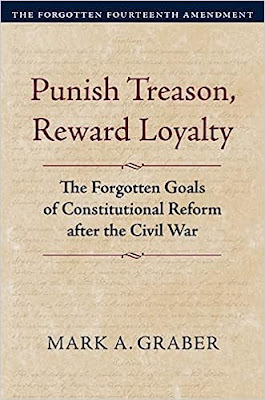
Mark A. Graber, Punish Treason, Reward Loyalty: The Forgotten Goals of Constitutional Reform after the Civil War (University of Kansas Press, 2023)
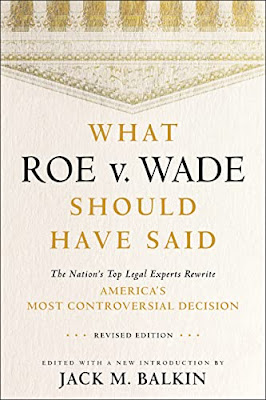
Jack M. Balkin, What Roe v. Wade Should Have Said: The Nation's Top Legal Experts Rewrite America's Most Controversial Decision - Revised Edition (NYU Press, 2023)

Andrew Koppelman, Burning Down the House: How Libertarian Philosophy Was Corrupted by Delusion and Greed (St. Martin’s Press, 2022)

Gerard N. Magliocca, Washington's Heir: The Life of Justice Bushrod Washington (Oxford University Press, 2022)
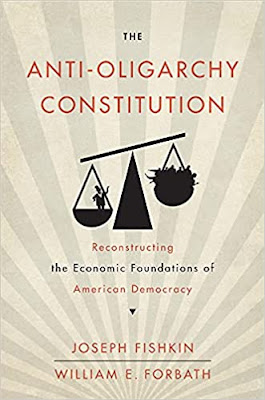
Joseph Fishkin and William E. Forbath, The Anti-Oligarchy Constitution: Reconstructing the Economic Foundations of American Democracy (Harvard University Press, 2022)
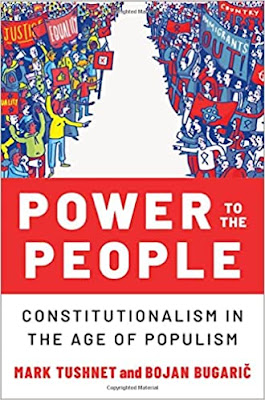
Mark Tushnet and Bojan Bugaric, Power to the People: Constitutionalism in the Age of Populism (Oxford University Press 2021).

Mark Philip Bradley and Mary L. Dudziak, eds., Making the Forever War: Marilyn B. Young on the Culture and Politics of American Militarism Culture and Politics in the Cold War and Beyond (University of Massachusetts Press, 2021).

Jack M. Balkin, What Obergefell v. Hodges Should Have Said: The Nation's Top Legal Experts Rewrite America's Same-Sex Marriage Decision (Yale University Press, 2020)

Frank Pasquale, New Laws of Robotics: Defending Human Expertise in the Age of AI (Belknap Press, 2020)

Jack M. Balkin, The Cycles of Constitutional Time (Oxford University Press, 2020)

Mark Tushnet, Taking Back the Constitution: Activist Judges and the Next Age of American Law (Yale University Press 2020).

Andrew Koppelman, Gay Rights vs. Religious Liberty?: The Unnecessary Conflict (Oxford University Press, 2020)

Ezekiel J Emanuel and Abbe R. Gluck, The Trillion Dollar Revolution: How the Affordable Care Act Transformed Politics, Law, and Health Care in America (PublicAffairs, 2020)

Linda C. McClain, Who's the Bigot?: Learning from Conflicts over Marriage and Civil Rights Law (Oxford University Press, 2020)
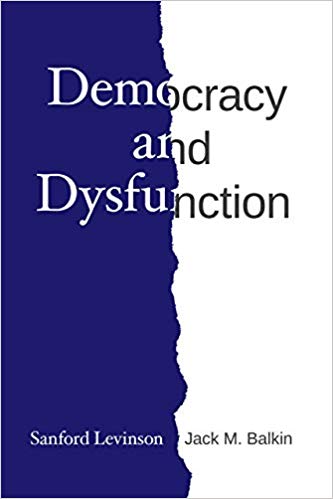
Sanford Levinson and Jack M. Balkin, Democracy and Dysfunction (University of Chicago Press, 2019)

Sanford Levinson, Written in Stone: Public Monuments in Changing Societies (Duke University Press 2018)

Mark A. Graber, Sanford Levinson, and Mark Tushnet, eds., Constitutional Democracy in Crisis? (Oxford University Press 2018)

Gerard Magliocca, The Heart of the Constitution: How the Bill of Rights became the Bill of Rights (Oxford University Press, 2018)

Cynthia Levinson and Sanford Levinson, Fault Lines in the Constitution: The Framers, Their Fights, and the Flaws that Affect Us Today (Peachtree Publishers, 2017)

Brian Z. Tamanaha, A Realistic Theory of Law (Cambridge University Press 2017)

Sanford Levinson, Nullification and Secession in Modern Constitutional Thought (University Press of Kansas 2016)

Sanford Levinson, An Argument Open to All: Reading The Federalist in the 21st Century (Yale University Press 2015)

Stephen M. Griffin, Broken Trust: Dysfunctional Government and Constitutional Reform (University Press of Kansas, 2015)

Frank Pasquale, The Black Box Society: The Secret Algorithms That Control Money and Information (Harvard University Press, 2015)

Bruce Ackerman, We the People, Volume 3: The Civil Rights Revolution (Harvard University Press, 2014)
Balkinization Symposium on We the People, Volume 3: The Civil Rights Revolution

Joseph Fishkin, Bottlenecks: A New Theory of Equal Opportunity (Oxford University Press, 2014)

Mark A. Graber, A New Introduction to American Constitutionalism (Oxford University Press, 2013)

John Mikhail, Elements of Moral Cognition: Rawls' Linguistic Analogy and the Cognitive Science of Moral and Legal Judgment (Cambridge University Press, 2013)

Gerard N. Magliocca, American Founding Son: John Bingham and the Invention of the Fourteenth Amendment (New York University Press, 2013)

Stephen M. Griffin, Long Wars and the Constitution (Harvard University Press, 2013)

Andrew Koppelman, The Tough Luck Constitution and the Assault on Health Care Reform (Oxford University Press, 2013)

James E. Fleming and Linda C. McClain, Ordered Liberty: Rights, Responsibilities, and Virtues (Harvard University Press, 2013)
Balkinization Symposium on Ordered Liberty: Rights, Responsibilities, and Virtues

Andrew Koppelman, Defending American Religious Neutrality (Harvard University Press, 2013)

Brian Z. Tamanaha, Failing Law Schools (University of Chicago Press, 2012)

Sanford Levinson, Framed: America's 51 Constitutions and the Crisis of Governance (Oxford University Press, 2012)

Linda C. McClain and Joanna L. Grossman, Gender Equality: Dimensions of Women's Equal Citizenship (Cambridge University Press, 2012)

Mary Dudziak, War Time: An Idea, Its History, Its Consequences (Oxford University Press, 2012)

Jack M. Balkin, Living Originalism (Harvard University Press, 2011)

Jason Mazzone, Copyfraud and Other Abuses of Intellectual Property Law (Stanford University Press, 2011)

Richard W. Garnett and Andrew Koppelman, First Amendment Stories, (Foundation Press 2011)

Jack M. Balkin, Constitutional Redemption: Political Faith in an Unjust World (Harvard University Press, 2011)

Gerard Magliocca, The Tragedy of William Jennings Bryan: Constitutional Law and the Politics of Backlash (Yale University Press, 2011)

Bernard Harcourt, The Illusion of Free Markets: Punishment and the Myth of Natural Order (Harvard University Press, 2010)

Bruce Ackerman, The Decline and Fall of the American Republic (Harvard University Press, 2010)
Balkinization Symposium on The Decline and Fall of the American Republic

Ian Ayres. Carrots and Sticks: Unlock the Power of Incentives to Get Things Done (Bantam Books, 2010)

Mark Tushnet, Why the Constitution Matters (Yale University Press 2010)

Ian Ayres and Barry Nalebuff: Lifecycle Investing: A New, Safe, and Audacious Way to Improve the Performance of Your Retirement Portfolio (Basic Books, 2010)
.jpg)
Jack M. Balkin, The Laws of Change: I Ching and the Philosophy of Life (2d Edition, Sybil Creek Press 2009)

Brian Z. Tamanaha, Beyond the Formalist-Realist Divide: The Role of Politics in Judging (Princeton University Press 2009)
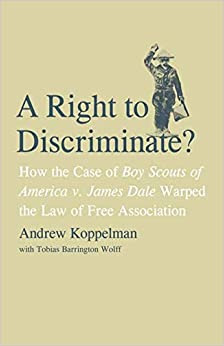
Andrew Koppelman and Tobias Barrington Wolff, A Right to Discriminate?: How the Case of Boy Scouts of America v. James Dale Warped the Law of Free Association (Yale University Press 2009)

Jack M. Balkin and Reva B. Siegel, The Constitution in 2020 (Oxford University Press 2009)

Heather K. Gerken, The Democracy Index: Why Our Election System Is Failing and How to Fix It (Princeton University Press 2009)

Mary Dudziak, Exporting American Dreams: Thurgood Marshall's African Journey (Oxford University Press 2008)

David Luban, Legal Ethics and Human Dignity (Cambridge Univ. Press 2007)

Ian Ayres, Super Crunchers: Why Thinking-By-Numbers is the New Way to be Smart (Bantam 2007)

Jack M. Balkin, James Grimmelmann, Eddan Katz, Nimrod Kozlovski, Shlomit Wagman and Tal Zarsky, eds., Cybercrime: Digital Cops in a Networked Environment (N.Y.U. Press 2007)
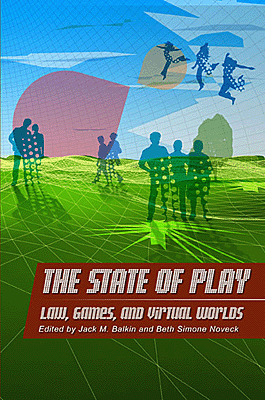
Jack M. Balkin and Beth Simone Noveck, The State of Play: Law, Games, and Virtual Worlds (N.Y.U. Press 2006)

Andrew Koppelman, Same Sex, Different States: When Same-Sex Marriages Cross State Lines (Yale University Press 2006)

Brian Tamanaha, Law as a Means to an End (Cambridge University Press 2006)

Sanford Levinson, Our Undemocratic Constitution (Oxford University Press 2006)

Mark Graber, Dred Scott and the Problem of Constitutional Evil (Cambridge University Press 2006)

Jack M. Balkin, ed., What Roe v. Wade Should Have Said (N.Y.U. Press 2005)

Sanford Levinson, ed., Torture: A Collection (Oxford University Press 2004)
Balkin.com homepage
Bibliography
Conlaw.net
Cultural Software
Writings
Opeds
The Information Society Project
BrownvBoard.com
Useful Links
Syllabi and Exams
