Balkinization
an unanticipated consequence of
Jack M. Balkin
Balkinization Symposiums: A Continuing List
E-mail:
Jack Balkin:
jackbalkin at yahoo.com
Bruce Ackerman
bruce.ackerman at yale.edu
Ian Ayres
ian.ayres at yale.edu
Corey Brettschneider
corey_brettschneider at brown.edu
Mary Dudziak
mary.l.dudziak at emory.edu
Joey Fishkin
joey.fishkin at gmail.com
Heather Gerken heather.gerken at yale.edu
Abbe Gluck abbe.gluck at yale.edu
Mark Graber
mgraber at law.umaryland.edu
Stephen Griffin
sgriffin at tulane.edu
Jonathan Hafetz
jonathan.hafetz at shu.edu
Jeremy Kessler
jkessler at law.columbia.edu
Andrew Koppelman
akoppelman at law.northwestern.edu
Marty Lederman
msl46 at law.georgetown.edu
Sanford Levinson
slevinson at law.utexas.edu
David Luban
david.luban at gmail.com
Gerard Magliocca
gmaglioc at iupui.edu
Jason Mazzone
mazzonej at illinois.edu
Linda McClain
lmcclain at bu.edu
John Mikhail
mikhail at law.georgetown.edu
Frank Pasquale
pasquale.frank at gmail.com
Nate Persily
npersily at gmail.com
Michael Stokes Paulsen
michaelstokespaulsen at gmail.com
Deborah Pearlstein
dpearlst at yu.edu
Rick Pildes
rick.pildes at nyu.edu
David Pozen
dpozen at law.columbia.edu
Richard Primus
raprimus at umich.edu
K. Sabeel Rahmansabeel.rahman at brooklaw.edu
Alice Ristroph
alice.ristroph at shu.edu
Neil Siegel
siegel at law.duke.edu
David Super
david.super at law.georgetown.edu
Brian Tamanaha
btamanaha at wulaw.wustl.edu
Nelson Tebbe
nelson.tebbe at brooklaw.edu
Mark Tushnet
mtushnet at law.harvard.edu
Adam Winkler
winkler at ucla.edu
Compendium of posts on Hobby Lobby and related cases
The Anti-Torture Memos: Balkinization Posts on Torture, Interrogation, Detention, War Powers, and OLC
The Anti-Torture Memos (arranged by topic)
Recent Posts
In Defense of the Chief Justice's Execution of His Responsibilities in NFIB v. Sebelius
"The Chief" -- What It Actually Tells Us About John Roberts's Vote in the Initial ACA Case
Justice Frankfurter’s Misplaced Legitimacy Concerns in the Reapportionment Cases
Some Thoughts on Last Week's Fourth Circuit Argument in MD/DC v. Trump
The Anti-Constitutionality of Court-Packing
Impeachment and the Mueller Report
Learning from the AOC Phenomenon
Friends with odious beliefs
Court-Packing Common Sense
Shamleless self-promotion
A Wealth Tax is Constitutional
Understanding the President’s Budget Proposal
Republicans['] Own Constitutional Discourse
![[Powered by Blogger]](https://lh3.googleusercontent.com/blogger_img_proxy/AEn0k_ugF7Qa18jmjIVjQsKP4adO0P8ycXovbXTUfUu5VYzXF4rIpdK27jqm-DnpvN4PwdojOv_Ggc1F_XWB7loZqgt5wl2yoIB77rwysDoJwgWC=s0-d)
Just A Few Blogs
ACS Blog
Alas, a Blog
Althouse
Arts and Letters Daily
Atrios (Eschaton)
Bill of Health
Buzzflash.com
Buzz Machine
Cato at Liberty
Juan Cole (Informed Comment)
Concurring Opinions
The Constitution in 2020
Corrente
Crooked Timber
Daily Howler
Daily Kos
Dana Boyd
Brad DeLong
Digby (Hullabaloo)
Discriminations
Daniel Drezner
Kevin Drum (Mother Jones)
Electrolite
En Banc
Eunomia (Daniel Larison)
Fafblog
Michael Froomkin (Discourse.net)
GovLab (Beth Noveck)
Rick Hasen (Election Law)
History News Network
How Appealing
Ignatz (Sam Heldman)
The Importance of (Ernie Miller)
Infolaw
Instapundit
International Economic Law and Policy Blog
IntLawGrrls
Jacob Levy
Jesus' General
Jurisdynamics
The Kitchen Cabinet
Mark Kleiman
Law Blog Central
Larry Lessig
Lawyers, Guns and Money
Liberal Oasis
Brian Leiter's Law School Reports
The Leiter Reports
Marginal Revolution
Megan McArdle
Memeorandum
Metafilter
Mirror of Justice
The New Republic
Newseum
No More Mister Nice Blog
Brendan Nyhan
Opinio Juris
Orcinus
The Originalism Blog
Pandagon
Passport (Foreign Policy)
Overcoming Bias
Political Animal (Washington Monthly)
Political Theory Daily Review
Political Wire (Taegan Goddard)
The Poor Man
Virginia Postrel
Prawfsblawg
Public Reason
Jonathan Rauch
Raw Story
Redstate
ReligiousLeftLaw.com
Reporters Committee For Freedom of the Press
Reproductive Rights Blog
Rothman's Roadmap to the Right of Publicity
SCOTUS Blog
Seeing the Forest
Clay Shirky
The Shifted Librarian
The Situationist
Larry Solum (Legal Theory)
Andrew Sullivan
Talking Points Memo
Talk Left
Tapped
Tbogg
TechPresident
The Paper Chase (Jurist)
Tom Paine
Tom Tomorrow (This Modern World)
Eve Tushnet
Uggabugga
University of Chicago Law School Faculty Blog
Unqualified Offerings
The Volokh Conspiracy
War and Piece (Laura Rozen)
Wampum
Oliver Willis
Wonkette
Written Description
Matthew Yglesias
Yin
Your Choice of Feeds
1. XML
powered by

2. Atom Feed
3. RSS 2.0
In Defense of the Chief Justice's Execution of His Responsibilities in NFIB v. Sebelius
Neil Siegel
As Mark Tushnet's astute post points out, Joan Biskupic's recent biography of Chief Justice John Roberts does not actually establish that the Chief Justice changed his mind on any constitutional question in the case, let alone that he moved from doing "law" to doing "politics." It is all the more unfortunate that unsupported accusations about the Chief Justice's "political" behavior in NFIB v. Sebelius keep being made when he was right on the law in upholding the minimum coverage provision in the Affordable Care Act (ACA) as a condition attached to a federal tax (the shared responsibility payment) that was valid because non-coercive.
The Chief Justice was right on the law in another, related way. He ultimately resisted as dispositive the rhetorical framing of the constitutional debate by opponents of the minimum coverage provision as either Commerce Clause legislation or unconstitutional. It is easy to forget now how brilliantly those who sought to bring down the ACA captured the public imagination and even the legal culture with their broccoli hypothetical and commerce-or-nothing characterization. The very term "individual mandate," which is not in the statute, implies that the only enumerated power available to Congress was the Commerce Clause (or the Necessary and Proper Clause). A different phrase, such as "modest financial incentive to obtain a minimum level of health insurance," which is what the statute actually accomplished, does not similarly scream commerce or nothing.
Read more »
Posted
12:24 PM
by Neil Siegel [link]
"The Chief" -- What It Actually Tells Us About John Roberts's Vote in the Initial ACA Case
Mark Tushnet
Here's what Biskupic says: At the conference discussion on the case, Roberts "felt just as strongly about the commerce-clause power as did the other four in the majority." He "voted to uphold the Medicaid expansion, yet he expressed some tentativeness on this provision." "No vote had been taken related to congressional taxing power."
Then Roberts began to draft his opinion. His draft maintained the position he had taken at the conference, that the individual mandate could not be sustained under the commerce clause. He apparently thought that this would invalidate only two provisions, community rating and coverage of preexisting conditions. [Justice Kennedy (correctly, I think) rejected that position, taking the view that without those provisions the entire system would be unsustainable (and so should fall because the two provisions were inseverable from the entire system). But this, it seems to me, is peripheral to the "changed his mind" story.]
After working on the commerce clause issue, "in mid-April, Roberts moved into new territory" -- the possibility of construing the individual mandate as a tax and upholding the mandate under that clause.
"Roberts decided that he could make a case for the taxing-power grounds." "By early May," he was drafting an opinion doing just that.
This account DOESN'T SHOW THAT ROBERTS CHANGED HIS MIND on anything. He thought from the beginning that the mandate was unconstitutional under the commerce clause, and continued to think that. And he hadn't thought anything at all about the tax issue, but when he turned his mind to it, he concluded that the mandate could be construed as a tax and as such was constitutional.
What about Medicaid expansion? Remember, he "expressed some tentativeness" about its constitutionality. Biskupic doesn't say much about Roberts's thinking about this issue as he worked on his opinion, but it's seems reasonably clear that his view about "coercion" was the way he converted his initial tentativeness into a holding.
Biskupic writes, "Breyer and Kagan disagreed with Roberts's new thinking on Medicaid, but they were pragmatists." "They were willing to meet him halfway" "if there was a chance that Roberts would cast the critical vote to uphold" the individual mandate. And, she says, "negotiations in May were such that they still considered that a shaky proposition." The implication here is that Breyer and Kagan voted with Roberts on limiting the Medicaid expansion to solidify his vote on the tax issue. The timeline here is fuzzy, and -- in my view -- without additional information (such as identification of the sources she had and the precise statements they made),* the account seems to me not entirely plausible or consistent with the dynamics of opinion-drafting. [To put it as clearly as possible, it strikes me as highly unlikely that anyone said or thought, "I/he (John Roberts) will drop the section on the tax issue unless they/we (Breyer and Kagan) go along with me/him on Medicaid expansion."] And maybe it's worth pointing out that, on this account, the only people who "changed their minds" were Breyer and Kagan.
The most parsimonious explanation is consistent with the account Biskupic provides: The justices -- all of them -- voted as they did because that's what they thought the best view of the law required. (Just to be clear, that doesn't mean that I think they were just calling balls and strikes. Their best view of what the law requires is political all the way down -- but it is also, as Justice Kagan said, law all the way down too.)
* I personally would be skeptical were the material to be sourced to law clerks, who generally think they understand the Court's dynamics better than they actually do.
Posted
11:11 PM
by Mark Tushnet [link]
Justice Frankfurter’s Misplaced Legitimacy Concerns in the Reapportionment Cases
Neil Siegel
A major concern expressed during the partisan gerrymandering litigation before the Supreme Court over the past two terms has been that the Court’s public legitimacy may suffer if it holds that federal courts may adjudicate the merits of political gerrymandering claims. For example, at oral argument earlier this week, former U.S. Solicitor General Paul Clement, who was arguing against the justiciability of such claims, ominously warned the Justices that “once you get into the political thicket, you will not get out and you will tarnish the image of this Court for the other cases where it needs that reputation for independence so people can understand the fundamental difference between judging and all other politics.” (I doubt Mr. Clement meant to imply that judging is a form of politics, but that is what he did imply.)
In invoking the “political thicket,” Mr. Clement was channeling Justice Felix Frankfurter, who many decades earlier had warned his colleagues to keep the courts out of controversies over legislative reapportionment, lest the Court’s legitimacy be imperiled. Mr. Clement was likely speaking first and foremost to Chief Justice John Roberts, who has himself emphasized the importance of maintaining the Court’s public legitimacy as a general matter and who has also expressed specific legitimacy concerns about judicial review of partisan gerrymanders.
One potential response to Mr. Clement is that the Court should simply do its job of interpreting the Constitution and let the legitimacy chips fall where they may. For those (like myself) who believe that judicial statesmanship defines a virtue in the role of a judge, however, that is not an especially persuasive argument. Good judges, on this view, will take some account of the conditions of the public legitimacy of the law they declare—not all of the time, of course, but in momentous cases. Institutional suicide is no more admirable in judicial life than in political life.
A better response to Mr. Clement is that Justice Frankfurter’s dire predictions about the consequences for the Court’s legitimacy of subjecting malapportioned legislatures to judicial review, although not unreasonable at the time, turned out to be wrong—spectacularly and almost immediately wrong. In this post, I will first document that Justice Frankfurter’s fears were misguided, and I will then offer three reasons why. There are potential lessons here for the partisan gerrymandering cases currently pending before the Court.
Read more »
Posted
3:56 PM
by Neil Siegel [link]
Some Thoughts on Last Week's Fourth Circuit Argument in MD/DC v. Trump
John Mikhail
Posted
3:15 PM
by John Mikhail [link]
The Anti-Constitutionality of Court-Packing
Neil Siegel
Posted
10:29 AM
by Neil Siegel [link]
Impeachment and the Mueller Report
Stephen Griffin
Now that Attorney General Barr has given us the basic conclusions of the Mueller Report, attention may turn to Congress's separate responsibility to determine whether President Trump has committed an impeachable offense. Unfortunately, the way the president's opponents framed the issue around potential findings of criminality may have severely undermined any subsequent impeachment effort. I analyze the historical trend toward emphasizing criminality or other violations of law in presidential impeachments in this article, which I have just updated on SSRN. It is forthcoming in the Connecticut Law Review.
The point I find interesting, both in past impeachments and the present imbroglio around President Trump, is that basing impeachments solely on findings of criminality is not what the framers wrote, designed, wanted, expected, or any other test we would care to apply to the historical evidence. The high crimes and misdemeanors standard was not limited to criminality, although a few commentators in American history have argued as such. But once the Constitution was put into practice, so to speak, political consensus was hard to find absent the violation of a federal law or the commission of a federal crime. That is why the inquiry into conspiracy and obstruction of justice has come to dominate the discussion with respect to Trump. From an eighteenth-century perspective, what should happen is an evaluation of Trump's behavior using a common understanding of what constitutes a violation of the public trust. Absent that common understanding, we are stuck with a federal criminal law approach to impeachment. But as many have noted, asking whether President Trump has committed a crime distracts attention from his many other actions which raise serious ethical, legal, and constitutional concerns. Even if Speaker Pelosi decides not to initiate an impeachment inquiry, there is still much for the House to investigate.
Posted
6:02 PM
by Stephen Griffin [link]
Learning from the AOC Phenomenon
David Super
Posted
9:40 PM
by David Super [link]
Friends with odious beliefs
Andrew Koppelman
Posted
5:05 PM
by Andrew Koppelman [link]
Court-Packing Common Sense
Gerard N. Magliocca
There is chatter these days among Democrats about Court-packing. While the norm that there should be nine and only nine Justices is entitled to great respect, I am not going to sit here and say that there can never be an exception. The present circumstances, though, are not at all exceptional.
When Court-packing (or Lords-packing in Great Britain) was seriously considered in the past, the proponents had won multiple successive elections by considerable margins. As a result, they could credibly claim that the people had spoken and that the unelected opposition must stand aside or be swamped with new members. The people suggesting this idea now have a different understanding. They seem to be saying that winning one election by any margin is good enough to justify enacting a Court-packing statute. I think that is simply wrong and contrary to constitutional democracy. There is also no logical stopping point. When the other party wins unified control of the White House and the Congress, they will add more Justices of their own, citing the "one and done" precedent. And so on.
One wonders, BTW, whether some future Democratic president might give Merrick Garland a recess appointment to the Court for some short period, as a symbolic repudiation of what is seen by many as the unfair treatment that he received.
Posted
12:50 PM
by Gerard N. Magliocca [link]
(73) comments
Shamleless self-promotion
Sandy Levinson
I have recently published two short pieces on our present constitutional situation. One is part of a symposium in the Newark Star-Ledger, where five scholars were asked to suggest possible reforms in our constitutional order. I suggested that the exclusive reliance of the national constitution on representative government should be complemented by processes allowing some direct democracy. A second is part of a Cato Institute symposium built around an excellent essay by Gene Healy arguing that we should take impeachment much more seriously than we do as a way of disciplining presidents. I argue that Healy should complement his emphasis on the Impeachment Clause by advocating changing the Constitution to allow displacement of presidents by votes or no confidence in Congress or, indeed, recall elections as in Wisconsin or California. Nothing in these pieces should really surprise anyone familiar with my overall approach to things, though you should find some of the other essays of genuine interest.
Posted
2:18 PM
by Sandy Levinson [link]
(58) comments
A Wealth Tax is Constitutional
Guest Blogger
Calvin H. Johnson
Posted
11:00 AM
by Guest Blogger [link]
Understanding the President’s Budget Proposal
David Super
Posted
12:17 AM
by David Super [link]
Republicans['] Own Constitutional Discourse
David Pozen
Julian
Nyarko, Eric Talley, and I have just posted a new paper
that uses computational methods to investigate the ideological and partisan
structure of constitutional discourse on the floor of Congress (and secondarily
in newspaper editorials). The headline finding is that constitutional discourse
has grown much more polarized over the past four decades. In fact, it has
polarized at least as rapidly as nonconstitutional discourse. How can computational
methods show this? Relative to the early and mid-twentieth century, it has become
substantially easier for an algorithmic classifier to predict, based solely on the semantic content of a
constitutional utterance, whether a Republican/conservative or a
Democrat/liberal is speaking.

Posted
2:48 PM
by David Pozen [link]
Books by Balkinization Bloggers

Gerard N. Magliocca, The Actual Art of Governing: Justice Robert H. Jackson's Concurring Opinion in the Steel Seizure Case (Oxford University Press, 2025)

Linda C. McClain and Aziza Ahmed, The Routledge Companion to Gender and COVID-19 (Routledge, 2024)

David Pozen, The Constitution of the War on Drugs (Oxford University Press, 2024)

Jack M. Balkin, Memory and Authority: The Uses of History in Constitutional Interpretation (Yale University Press, 2024)
Mark A. Graber, Punish Treason, Reward Loyalty: The Forgotten Goals of Constitutional Reform after the Civil War (University of Kansas Press, 2023)
Jack M. Balkin, What Roe v. Wade Should Have Said: The Nation's Top Legal Experts Rewrite America's Most Controversial Decision - Revised Edition (NYU Press, 2023)

Andrew Koppelman, Burning Down the House: How Libertarian Philosophy Was Corrupted by Delusion and Greed (St. Martin’s Press, 2022)

Gerard N. Magliocca, Washington's Heir: The Life of Justice Bushrod Washington (Oxford University Press, 2022)
Joseph Fishkin and William E. Forbath, The Anti-Oligarchy Constitution: Reconstructing the Economic Foundations of American Democracy (Harvard University Press, 2022)
Mark Tushnet and Bojan Bugaric, Power to the People: Constitutionalism in the Age of Populism (Oxford University Press 2021).

Mark Philip Bradley and Mary L. Dudziak, eds., Making the Forever War: Marilyn B. Young on the Culture and Politics of American Militarism Culture and Politics in the Cold War and Beyond (University of Massachusetts Press, 2021).

Jack M. Balkin, What Obergefell v. Hodges Should Have Said: The Nation's Top Legal Experts Rewrite America's Same-Sex Marriage Decision (Yale University Press, 2020)

Frank Pasquale, New Laws of Robotics: Defending Human Expertise in the Age of AI (Belknap Press, 2020)

Jack M. Balkin, The Cycles of Constitutional Time (Oxford University Press, 2020)

Mark Tushnet, Taking Back the Constitution: Activist Judges and the Next Age of American Law (Yale University Press 2020).

Andrew Koppelman, Gay Rights vs. Religious Liberty?: The Unnecessary Conflict (Oxford University Press, 2020)

Ezekiel J Emanuel and Abbe R. Gluck, The Trillion Dollar Revolution: How the Affordable Care Act Transformed Politics, Law, and Health Care in America (PublicAffairs, 2020)

Linda C. McClain, Who's the Bigot?: Learning from Conflicts over Marriage and Civil Rights Law (Oxford University Press, 2020)
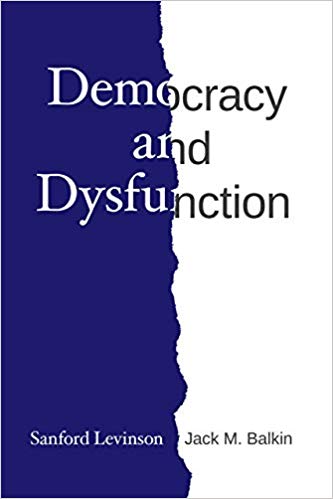
Sanford Levinson and Jack M. Balkin, Democracy and Dysfunction (University of Chicago Press, 2019)

Sanford Levinson, Written in Stone: Public Monuments in Changing Societies (Duke University Press 2018)

Mark A. Graber, Sanford Levinson, and Mark Tushnet, eds., Constitutional Democracy in Crisis? (Oxford University Press 2018)

Gerard Magliocca, The Heart of the Constitution: How the Bill of Rights became the Bill of Rights (Oxford University Press, 2018)

Cynthia Levinson and Sanford Levinson, Fault Lines in the Constitution: The Framers, Their Fights, and the Flaws that Affect Us Today (Peachtree Publishers, 2017)

Brian Z. Tamanaha, A Realistic Theory of Law (Cambridge University Press 2017)

Sanford Levinson, Nullification and Secession in Modern Constitutional Thought (University Press of Kansas 2016)

Sanford Levinson, An Argument Open to All: Reading The Federalist in the 21st Century (Yale University Press 2015)

Stephen M. Griffin, Broken Trust: Dysfunctional Government and Constitutional Reform (University Press of Kansas, 2015)

Frank Pasquale, The Black Box Society: The Secret Algorithms That Control Money and Information (Harvard University Press, 2015)

Bruce Ackerman, We the People, Volume 3: The Civil Rights Revolution (Harvard University Press, 2014)
Balkinization Symposium on We the People, Volume 3: The Civil Rights Revolution

Joseph Fishkin, Bottlenecks: A New Theory of Equal Opportunity (Oxford University Press, 2014)

Mark A. Graber, A New Introduction to American Constitutionalism (Oxford University Press, 2013)

John Mikhail, Elements of Moral Cognition: Rawls' Linguistic Analogy and the Cognitive Science of Moral and Legal Judgment (Cambridge University Press, 2013)

Gerard N. Magliocca, American Founding Son: John Bingham and the Invention of the Fourteenth Amendment (New York University Press, 2013)

Stephen M. Griffin, Long Wars and the Constitution (Harvard University Press, 2013)

Andrew Koppelman, The Tough Luck Constitution and the Assault on Health Care Reform (Oxford University Press, 2013)

James E. Fleming and Linda C. McClain, Ordered Liberty: Rights, Responsibilities, and Virtues (Harvard University Press, 2013)
Balkinization Symposium on Ordered Liberty: Rights, Responsibilities, and Virtues

Andrew Koppelman, Defending American Religious Neutrality (Harvard University Press, 2013)

Brian Z. Tamanaha, Failing Law Schools (University of Chicago Press, 2012)

Sanford Levinson, Framed: America's 51 Constitutions and the Crisis of Governance (Oxford University Press, 2012)

Linda C. McClain and Joanna L. Grossman, Gender Equality: Dimensions of Women's Equal Citizenship (Cambridge University Press, 2012)

Mary Dudziak, War Time: An Idea, Its History, Its Consequences (Oxford University Press, 2012)

Jack M. Balkin, Living Originalism (Harvard University Press, 2011)

Jason Mazzone, Copyfraud and Other Abuses of Intellectual Property Law (Stanford University Press, 2011)

Richard W. Garnett and Andrew Koppelman, First Amendment Stories, (Foundation Press 2011)

Jack M. Balkin, Constitutional Redemption: Political Faith in an Unjust World (Harvard University Press, 2011)

Gerard Magliocca, The Tragedy of William Jennings Bryan: Constitutional Law and the Politics of Backlash (Yale University Press, 2011)

Bernard Harcourt, The Illusion of Free Markets: Punishment and the Myth of Natural Order (Harvard University Press, 2010)

Bruce Ackerman, The Decline and Fall of the American Republic (Harvard University Press, 2010)
Balkinization Symposium on The Decline and Fall of the American Republic

Ian Ayres. Carrots and Sticks: Unlock the Power of Incentives to Get Things Done (Bantam Books, 2010)

Mark Tushnet, Why the Constitution Matters (Yale University Press 2010)

Ian Ayres and Barry Nalebuff: Lifecycle Investing: A New, Safe, and Audacious Way to Improve the Performance of Your Retirement Portfolio (Basic Books, 2010)
.jpg)
Jack M. Balkin, The Laws of Change: I Ching and the Philosophy of Life (2d Edition, Sybil Creek Press 2009)

Brian Z. Tamanaha, Beyond the Formalist-Realist Divide: The Role of Politics in Judging (Princeton University Press 2009)
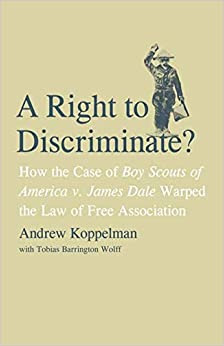
Andrew Koppelman and Tobias Barrington Wolff, A Right to Discriminate?: How the Case of Boy Scouts of America v. James Dale Warped the Law of Free Association (Yale University Press 2009)

Jack M. Balkin and Reva B. Siegel, The Constitution in 2020 (Oxford University Press 2009)

Heather K. Gerken, The Democracy Index: Why Our Election System Is Failing and How to Fix It (Princeton University Press 2009)

Mary Dudziak, Exporting American Dreams: Thurgood Marshall's African Journey (Oxford University Press 2008)

David Luban, Legal Ethics and Human Dignity (Cambridge Univ. Press 2007)

Ian Ayres, Super Crunchers: Why Thinking-By-Numbers is the New Way to be Smart (Bantam 2007)

Jack M. Balkin, James Grimmelmann, Eddan Katz, Nimrod Kozlovski, Shlomit Wagman and Tal Zarsky, eds., Cybercrime: Digital Cops in a Networked Environment (N.Y.U. Press 2007)
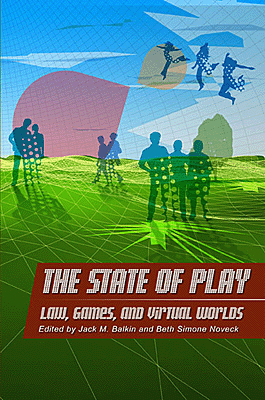
Jack M. Balkin and Beth Simone Noveck, The State of Play: Law, Games, and Virtual Worlds (N.Y.U. Press 2006)

Andrew Koppelman, Same Sex, Different States: When Same-Sex Marriages Cross State Lines (Yale University Press 2006)

Brian Tamanaha, Law as a Means to an End (Cambridge University Press 2006)

Sanford Levinson, Our Undemocratic Constitution (Oxford University Press 2006)

Mark Graber, Dred Scott and the Problem of Constitutional Evil (Cambridge University Press 2006)

Jack M. Balkin, ed., What Roe v. Wade Should Have Said (N.Y.U. Press 2005)

Sanford Levinson, ed., Torture: A Collection (Oxford University Press 2004)
Balkin.com homepage
Bibliography
Conlaw.net
Cultural Software
Writings
Opeds
The Information Society Project
BrownvBoard.com
Useful Links
Syllabi and Exams
