Balkinization
an unanticipated consequence of
Jack M. Balkin
Balkinization Symposiums: A Continuing List
E-mail:
Jack Balkin:
jackbalkin at yahoo.com
Bruce Ackerman
bruce.ackerman at yale.edu
Ian Ayres
ian.ayres at yale.edu
Corey Brettschneider
corey_brettschneider at brown.edu
Mary Dudziak
mary.l.dudziak at emory.edu
Joey Fishkin
joey.fishkin at gmail.com
Heather Gerken heather.gerken at yale.edu
Abbe Gluck abbe.gluck at yale.edu
Mark Graber
mgraber at law.umaryland.edu
Stephen Griffin
sgriffin at tulane.edu
Jonathan Hafetz
jonathan.hafetz at shu.edu
Jeremy Kessler
jkessler at law.columbia.edu
Andrew Koppelman
akoppelman at law.northwestern.edu
Marty Lederman
msl46 at law.georgetown.edu
Sanford Levinson
slevinson at law.utexas.edu
David Luban
david.luban at gmail.com
Gerard Magliocca
gmaglioc at iupui.edu
Jason Mazzone
mazzonej at illinois.edu
Linda McClain
lmcclain at bu.edu
John Mikhail
mikhail at law.georgetown.edu
Frank Pasquale
pasquale.frank at gmail.com
Nate Persily
npersily at gmail.com
Michael Stokes Paulsen
michaelstokespaulsen at gmail.com
Deborah Pearlstein
dpearlst at yu.edu
Rick Pildes
rick.pildes at nyu.edu
David Pozen
dpozen at law.columbia.edu
Richard Primus
raprimus at umich.edu
K. Sabeel Rahmansabeel.rahman at brooklaw.edu
Alice Ristroph
alice.ristroph at shu.edu
Neil Siegel
siegel at law.duke.edu
David Super
david.super at law.georgetown.edu
Brian Tamanaha
btamanaha at wulaw.wustl.edu
Nelson Tebbe
nelson.tebbe at brooklaw.edu
Mark Tushnet
mtushnet at law.harvard.edu
Adam Winkler
winkler at ucla.edu
Compendium of posts on Hobby Lobby and related cases
The Anti-Torture Memos: Balkinization Posts on Torture, Interrogation, Detention, War Powers, and OLC
The Anti-Torture Memos (arranged by topic)
Recent Posts
Taking Section Two of the Fourteenth Amendment Seriously
Count All the People
Understanding the Cycles of Constitutional Time, or, Why Things Are Going to Get Better
Accountability for the Internet of Torts
Introducing the Internet of Torts
The Rulification of Penalty Kicks—and a Reform Proposal
Exacerbating the real error in Abood: Is there any justification, "originalist" or otherwise, for the Court's holding in Janus that deducting agency fees abridges the freedom of speech?
Hitlerian aspects of Trumpism
Birthright Citizenship and the 14th Amendment
A Question for Judge Kavanaugh
Vladimir Putin Follows Legal Blogs
The Loss of the Filibuster and Judicial Confirmation Reform
The Unintended Consequences of Originalism
Talking about Judge Kavanaugh as a Justice
"Repealing" Roe v. Wade
Brett Kavanaugh's Cliches
The 150th Anniversary of the Fourteenth Amendment
Treating Republicans like...
The Political Economy of Freedom of Speech in the Second Gilded Age
"Orthodox" Catholic Judges and Roe v. Wade: A Comment on Coney & Garvey
Interviewing Potential Supreme Court Nominees
Contrary to Popular Belief, the Court Did Not Hold that the Travel Ban is Lawful—Anything But. (Which Makes Its Ruling, Justice Kennedy’s Deference, and the President’s Enforcement of the Ban Even More Indefensible.)
![[Powered by Blogger]](https://lh3.googleusercontent.com/blogger_img_proxy/AEn0k_vd4xwXvbdtzACoCNs2PyP79UsgZmL58Z92fAgWpKT8YPDFV19oYCgCgupauMPKs33x2B3qeFgG7dMMbOG1N-G21gz4qcsJwTmXB9tj2rWd=s0-d)
Just A Few Blogs
ACS Blog
Alas, a Blog
Althouse
Arts and Letters Daily
Atrios (Eschaton)
Bill of Health
Buzzflash.com
Buzz Machine
Cato at Liberty
Juan Cole (Informed Comment)
Concurring Opinions
The Constitution in 2020
Corrente
Crooked Timber
Daily Howler
Daily Kos
Dana Boyd
Brad DeLong
Digby (Hullabaloo)
Discriminations
Daniel Drezner
Kevin Drum (Mother Jones)
Electrolite
En Banc
Eunomia (Daniel Larison)
Fafblog
Michael Froomkin (Discourse.net)
GovLab (Beth Noveck)
Rick Hasen (Election Law)
History News Network
How Appealing
Ignatz (Sam Heldman)
The Importance of (Ernie Miller)
Infolaw
Instapundit
International Economic Law and Policy Blog
IntLawGrrls
Jacob Levy
Jesus' General
Jurisdynamics
The Kitchen Cabinet
Mark Kleiman
Law Blog Central
Larry Lessig
Lawyers, Guns and Money
Liberal Oasis
Brian Leiter's Law School Reports
The Leiter Reports
Marginal Revolution
Megan McArdle
Memeorandum
Metafilter
Mirror of Justice
The New Republic
Newseum
No More Mister Nice Blog
Brendan Nyhan
Opinio Juris
Orcinus
The Originalism Blog
Pandagon
Passport (Foreign Policy)
Overcoming Bias
Political Animal (Washington Monthly)
Political Theory Daily Review
Political Wire (Taegan Goddard)
The Poor Man
Virginia Postrel
Prawfsblawg
Public Reason
Jonathan Rauch
Raw Story
Redstate
ReligiousLeftLaw.com
Reporters Committee For Freedom of the Press
Reproductive Rights Blog
Rothman's Roadmap to the Right of Publicity
SCOTUS Blog
Seeing the Forest
Clay Shirky
The Shifted Librarian
The Situationist
Larry Solum (Legal Theory)
Andrew Sullivan
Talking Points Memo
Talk Left
Tapped
Tbogg
TechPresident
The Paper Chase (Jurist)
Tom Paine
Tom Tomorrow (This Modern World)
Eve Tushnet
Uggabugga
University of Chicago Law School Faculty Blog
Unqualified Offerings
The Volokh Conspiracy
War and Piece (Laura Rozen)
Wampum
Oliver Willis
Wonkette
Written Description
Matthew Yglesias
Yin
Your Choice of Feeds
1. XML
powered by

2. Atom Feed
3. RSS 2.0
Taking Section Two of the Fourteenth Amendment Seriously
Gerard N. Magliocca
Building on Professor Fishkin's post, my new article on Section Two of the Fourteenth Amendment was published today. Section Two gets far less attention than Section One, but Section Two is vital for two reasons. The first is that this is the source of the rule that all persons shall be counted for purposes of national representation. (Litigation is pending in the Southern District of New York on whether the Commerce Department's proposal to add a citizenship question to the next census is unlawful in part because that decision was made to discourage an accurate count of non-citizens).
The other reason Section Two is worth studying is that the system used in 2011 to reapportion representatives among the states was unconstitutional. Reapportionment is not as glamorous as gerrymandering. Nonetheless, the question of how representatives are allocated among the states matters and the constitutional violation is hiding in plain sight. As the Article explains, Section Two of the Fourteenth Amendment says that the states shall be penalized in their representation if certain conditions are met. The reapportionment statutes, however, bar the imposition of any such penalty. These statutes are therefore invalid. (There is more to the article than this syllogism, of course.)
Unless Congress corrects this defect by 2021, it is my hope that some states will challenge the next reapportionment on constitutional grounds using the theory laid out in the paper.
Posted
11:31 AM
by Gerard N. Magliocca [link]
(47) comments
Count All the People
Joseph Fishkin
The Fourteenth Amendment sets out a simple rule for the interstate allocation of political power in the United States: “Representatives shall be apportioned among the several States according to their respective numbers, counting the whole number of persons in each State, excluding Indians not taxed.” With this sentence, 150 years ago this month, the Constitution obliterated the three-fifths clause. Later, just under a century ago, we incorporated all Native Americans into the body politic by statute, so there are no more “Indians not taxed.” These changes have wrought a beautifully straightforward rule: our federal government allocates political power according to “the whole number of persons.” Not just the citizens. Not just the adults. Not just the people with valid immigration status, or the people a state has decided in its wisdom to make eligible to vote. All persons.
This hard-won bedrock constitutional principle structures the entire American political order under our feet. But that doesn’t mean Americans are all aware of it or understand it. To some Americans today (especially a lot of Republicans) it seems kind of crazy that we count non-voters such as children and even non-citizens, regardless of immigration status, in allocating political power. If they can’t vote, these critics ask, why do they count?
That way of thinking is now underwriting a flurry of profoundly ill-conceived activism by Republicans across the country who are aiming in a variety of ways to circumscribe the set of persons who count in our processes for allocating political power. One line of attack is a political lawsuit aiming to persuade the Census Bureau to violate the Constitution by refusing to count undocumented immigrants at all. (The lawsuit of course claims that the Constitution requires, rather than prohibits, this never-before-tried exclusionary practice.) Another line of attack aims to redraw state and local district lines so that instead of counting all the people, they count only citizens or eligible voters or some other measure. The highest-profile line of attack to date emanates from within the Trump administration, which is attempting to add a citizenship question to the Census in an effort to make such exclusionary redistricting easier for states and localities—while at the same time, in a fortuitous nativist twofer, suppressing the Census count itself in immigrant communities. The partisan stakes in all this are mostly pretty obvious (although not entirely). But sometimes the commentary about partisan effects obscures the underlying constitutional principle at stake.
Today in the Washington Post, I have an op ed offering a defense of the principle that we should count all the people. It’s pretty short; the defense is condensed. If you’re interested in a more in-depth discussion, you can take a look at this essay I recently published in a symposium in the William & Mary Law Review. It seems to me that we are now in the early stages of a twenty-first century reckoning with the question of who counts—on the Census, in apportionment, and across federal and state redistricting. The core underlying questions across these domains are fairly consistent. I think there are strong justifications for leaving in place the settlement reached in 1789 and 1868, later magnified outward by the core reapportionment revolution decisions of 1964: we count all the people, and we all count equally. I also think there is far more work to be done in this area. This debate is just beginning. I write this blog post in the hope that some readers may decide to write in this area.
Posted
3:56 PM
by Joseph Fishkin [link]
Understanding the Cycles of Constitutional Time, or, Why Things Are Going to Get Better
JB
I have posted my latest article, The Recent Unpleasantness: Understanding the Cycles of Constitutional Time, on SSRN. This is the written version of the 2017 Addison C. Harris Lecture at the University of Indiana. Here is the abstract:
This article, originally given as the 2017 Addison C. Harris Lecture at Indiana University, analyzes recent events in terms of three great cycles of change in American constitutional history. The first is the cycle of the rise and fall of political regimes. The second is the cycle of polarization and depolarization. The third is the cycle of the decay and renewal of republican government--the cycle of constitutional rot. Each of these cycles operates on a different time scale. Their interaction generates "constitutional time."
Many commentators worry that the United States is in a period of constitutional crisis, or that American democracy is doomed. These fears, although understandable, are overstated. America is not in a constitutional crisis, although it is suffering from a fairly severe case of constitutional rot, connected to rising polarization and economic inequality.
Our current difficulties are a temporary condition. They stem from the fact that the Reagan regime that has structured American politics since the 1980s is dying, but a new regime has yet to be born. This is a difficult, agonizing, and humbling transition; and its difficulty is enhanced by the fact that, unlike the last transition, it occurs at the peak of a cycle of polarization and at the low point of a cycle of constitutional rot. For that reason, the transition to a new political regime is likely to be especially difficult. But we will get through it. And when we get through it, about five to ten years from now, American politics will look quite different.
Political renewal is hardly foreordained: it will require persistence and political effort. The point of this lecture is to offer a bit of hope in difficult times. If people misunderstand our situation, and conclude that American decline is inevitable, they may unwittingly help to make that fate a reality; but if they understand the cycles of constitutional time, they may come to believe that their democracy can be redeemed, and do their part to realize that worthy goal.
Posted
4:50 PM
by JB [link]
Accountability for the Internet of Torts
Guest Blogger
Rebecca Crootof
Posted
9:00 AM
by Guest Blogger [link]
Introducing the Internet of Torts
Guest Blogger
Crossposted at Law and Political Economy
Posted
5:50 PM
by Guest Blogger [link]
The Rulification of Penalty Kicks—and a Reform Proposal
David Pozen
Posted
9:44 AM
by David Pozen [link]
(7) comments
Exacerbating the real error in Abood: Is there any justification, "originalist" or otherwise, for the Court's holding in Janus that deducting agency fees abridges the freedom of speech?
Marty Lederman
On the final day of its Term last month, a 5-4 majority of the Court in Janus v. AFSCME overruled the four-decades-old Abood decision and held that when a state deducts a so-called "agency fee" from the paychecks of public employees who are not union members, and conveys that fee to the union for purposes of representing the bargaining unit (e.g., for collective bargaining and grievance processing), the state violates the employees' rights under the Free Speech Clause. In its 1977 decision in Abood the Court had drawn a distinction among different categories of union activities: It held that although the Free Speech Clause prohibits a state from using nonmembers' funds to subsidize a union's political and ideological activities, it could deduct a fee from employees' salary for the portion of union dues attributable to activities that are “germane to [the union’s] duties as collective bargaining representative." The Janus Court reversed the latter part of the Abood holding, so that such deductions are now deemed an unconstitutional violation of the Free Speech Clause through and through, no matter what the union does with the money.
The most striking thing about Justice Alito's majority opinion--to me, anyway--is that the Court majority was willing (quite eager, in fact) to overrule such a well-entrenched precedent without providing virtually any basis for thinking that the fee deduction "abridges" anyone's actual speech. As many scholars have long explained (including my colleagues Greg Klass and David Luban, as well as, more recently, Will Baude and Eugene Volokh), Justice Alito is right that "Abood was poorly reasoned"--but in the other direction. The original sin of Abood was not the Court's failure to prohibit agency fees for collective bargaining functions, but instead in holding that employee deductions can implicate the Free Speech Clause in cases where there's no compelled association (no one is required to join the union), no possibility of any misattribution of the organization's speech to the objecting payers, and the payment in question is not triggered by the objector's own speech (as in Tornillo and PG&E).
One would think that surely would have been reason enough for the Court not to extend Abood's purported Free Speech limitations to the context of fees for services actually rendered . . . but apparently not. Instead, the Court doubles down on, and thereby greatly exacerbates, Abood's error.
I wrote above that the Court provides "virtually" no basis for thinking that the Illinois agency fee deduction "abridges" anyone's actual speech. The qualifier ("virtually") is necessary because Justice Alito's opinion does offer one reason, and one reason alone--a singular quotation from a 1786 state law. That quotation isn't really on point, however--and, even read more expansively than is warranted, it can't possibly bear the weight of authority the Court assigns to it as a basis for concluding that the Illinois deduction of agency fees abridges employees' freedom of speech.
Alito begins with a brief explanation for the Court's compelled speech doctrine:
When speech is compelled, ... individuals are coerced into betraying their convictions. Forcing free and independent individuals to endorse ideas they find objectionable is
So far, so good: If the state compels an individual to actually say something that betrays her convictions--the classic case being the compulsion of the young Jehovah's Witness students in Barnette to attest their allegiance to the United States, contrary to their genuine beliefs--there's a First Amendment problem. But so what? After all, Illinois is not forcing its employees to say anything about AFSCME, about the subject matter or bona fides of the union's negotiations, or about anything else--let alone to attest to a belief in something they don't believe (nor even to display unwanted government speech as they move throughout the day, as in Wooley v. Maynard). So what's the constitutional problem?
always demeaning, and for this reason, one of our landmark free speech cases said that a law commanding “involuntary affirmation” of objected-to beliefs would require “even more immediate and urgent grounds” than a law demanding silence. [quoting West Virginia v. Barnette].
Well, Justice Alito then simply asserts, as if night followed day, that "[c]ompelling a person to subsidize the speech of other private speakers raises similar First Amendment concerns" (emphasis added, and citing three modern cases, including Abood, that are no more explanatory than Janus). Why? Here's the entirety of his reasoning:
As Jefferson famously put it, “to compel a man to furnish contributions of money for the propagation of opinions which he disbelieves and abhor[s] is sinful and tyrannical.” A Bill for Establishing Religious Freedom, in 2 Papers of Thomas Jefferson 545 (J. Boyd ed. 1950) (emphasis deleted and footnote omitted).
That's it. A single quotation from a Virginia statute drafted by Thomas Jefferson and enacted by the Virginia legislature five years before the First Amendment was ratified. Similarly, a few pages later Alito again cites the same sentence from the 1786 Virginia bill as alleged support for the Court's insistence that overruling Abood and holding that the agency fee is unconstitutional is consistent with "the original understanding of the First Amendment":
[P]rominent members of the founding generation condemned laws requiring public employees to affirm or support beliefs with which they disagreed. As noted, Jefferson denounced compelled support for such beliefs as "sinful and tyrannical," and others
expressed similar views.
Who are these "others" in the founding generation who allegedly expressed "similar views"? Alito cites only two: Noah Webster and Oliver Ellsworth (both of whom were invoked in the amicus brief of certain California teachers). But neither of those men suggested that compelled payments are unconstitutional, let alone violations of the Free Speech Clause. Ellsworth wrote in 1787 that laws requiring people to “make a public declaration of … belief … in order to qualify themselves for public employments” were “useless, tyrannical, and peculiarly unfit for the people of this country”--but of course Illinois does not require its employees to make any declaration of belief, public or otherwise. Similarly, in 1790 Webster condemned “test laws, oaths of … abjuration, and partial exclusions from civil offices” as “instruments of slavery” and “badge[s] of tyranny.” He didn't write anything at all about compelled payments.
And so it turns out that the only support for the Court's central assumption--that compelling a person to subsidize the speech of other private speakers raises First Amendment concerns "similar" to compelled speech itself--is a single statement in a Jefferson-penned Virginia statute from 1786. That isolated sentence would hardly be enough to demonstrate that the Illinois deductions implicate the Free Speech Clause even if it were right on point. But it's not.
First of all, the "sinful and tyrannical" statement does not purport to have anything to do with freedom of speech. Nor has the Court ever treated the statement as reflecting a general constitutional prohibition--Free Speech-based or otherwise--on compelling a person to "furnish contributions of money for the propagation of opinions which he disbelieves and abhor[s]": after all, we are all often are required to subsidize the propagation of opinions that we do not share, or that we even abhor. Every few hours, for example, my tax dollars are used to subsidize statements and tweets by Donald Trump that I find odious and that the government could never require or coerce me to say myself.
The quotation in question, and the Virginia Bill more broadly, was widely understood to reflect an antiestablishment limit on the state's use of treasury funds to fund churches. That's why the bill itself was entitled "An act for establishing religious freedom." And so, for a very long time, the Court used the Jefferson quotation as part of its justification for reading the Establishment Clause of the First Amendment as prohibiting state funding of religious establishments.* Notably, the Court has recently even abandoned this principle, in Trinity Lutheran Church v. Comer. And of course Justice Alito does not conclude that the Illinois law violates the Establishment Clause.
One other thing, too: Even if the Virginia Bill quotation were taken literally, and for all it might be worth, the Court simply assumes, without discussion, that the Illinois law at issue in Janus involves compelling objecting employees to "furnish contributions of money" to the union. But that's not necessarily so. The employees, after all, never receive the money in question, and therefore are never required to "contribute" it--they don't cut a check to the union. Instead, the State of Illinois itself notes a "deduction" on the paycheck it provides to employees and then itself conveys the amount of that deduction to the union. To be sure, Illinois has denominated that fee to be nominally part of the employee's "wages" in the first instance. Imagine, however, that instead of doing so, Illinois simply negotiated for a lower employees' salary (correlated to the amount of the fee), and then cut a check to the union from the state treasury in that same amount in order to facilitate the union's collective bargaining activities. That alternative mechanism would result in exactly the same transfer of funds from the state to the union, without the formality of calling the fee a "deduction" from employee "wages." (The only reason Illinois does not do so is that Illinois law itself prohibits it. See Daniel Hemel and David Louk for further thoughts about such an alternative mechanism.) The First Amendment obviously would not prohibit that system, and the Jefferson quotation would not describe it, under any understanding. It therefore is, at a minimum, strange to think that the Free Speech Clause kicks in simply because Illinois chooses to deem the fee part of never-received employee "wages" in the first instance. As Justice Scalia wrote for the Court in Johanns v. Livestock Marketing Ass'n (2005), the constitutionality of a compelled funding scheme should not turn on "the Government's mode of accounting."** (Aaron Tang suggests that the availability of such a "workaround" only confirms the unconstitutionality of an agency-fee deduction because it demonstrates that the state has less restrictive ways of accomplishing its ends. As I see it, however, the two ways are equally "restrictive," in that they are substantively, as well as functionally, identical, and neither requires any employees to, in Tang's words, "give financial support directly to an organization advancing objectionable messages," let alone to "speak." See also Ben Sachs for further thoughts on why "agency fees are not properly understood as payments made by employees to unions.")
But even if you don't buy this argument about the lack of any transfer of money by the complaining employees, the Jefferson quotation is hardly a basis for any Free Speech Clause concern, for the reasons explained above. And yet Justice Alito offers nothing other than that quotation as a justification for finding any constitutional infirmity. (The bulk of the opinion is devoted to assessing the state interest, once the Court has already concluded that heightened constitutional scrutiny applies.)
I'm genuinely curious: Does anyone--especially, but not limited to, originalists--think that the "sinful and tyrannical" quotation does the trick, or that there's any other basis, neglected by the Court, for concluding that the Free Speech Clause prohibits the state from compelling its nonunion employees to make payments to third parties for expression that the employees disapprove?
I can certainly understand why some people might think such compelled payments are terrible policy--perhaps even "sinful and tyrannical" in certain circumstances. Property-rights fanciers might even think that "[i]t is against all reason and justice,” and thus perhaps even unconstitutional, to "entrust a legislature" to "take[] property from A. and give[] it to B." (Calder v. Bull (1798) (Chase, J.)). Although I wouldn't agree with such views, and they wouldn't describe current doctrine, at least they'd be understandable.
But a violation of the Free Speech Clause? One that's so plain that it justifies abandoning stare decisis with respect to a 41-year-old precedent that's been repeatedly reaffirmed?
Isn't that an idea that all true originalists and textualists should abandon? If so, what explains the votes of, e.g., Justices Thomas and Gorsuch? (That last one is a rhetorical question. For a sense of what the answer might be, see footnote 7 of the Court's opinion.)
[UPDATE: It has been brought to my attention that Mike Ramsey has, in fact, commendably written about why Janus/Abood are "very problematic from an originalist perspective":
To an originalist, constitutional rights come with the extent and limits recognized at the time of adoption, whatever we may now think of them. But that observation highlights the crucial point: no one (so far as I am aware) has shown that compelled payments were understood as contrary to "the freedom of speech" at the relevant time.
Of course, no one has shown that compelled payments are consistent with "the freedom of speech" either. But as Volokh and Baude argue, Abood held that some compelled payments are consistent with the freedom of speech. To overrule that conclusion, the Court would seem to need some evidence it was wrong -- and an originalist should need some originalist evidence.
The reasons that Janus is a problem for originalism, then, it that the originalist-oriented Justices seem likely to overrule Abood without any originalist reasons for doing so. That outcome, if it occurs, weakens originalism by suggesting that it is just a tool for conservative results, to be discarded when it does not lead to conservative results. Originalism would emerge much stronger if Janus came out the other way (or if at least someone in the majority in Janus explained its originalist foundation).]
__________________
* In Janus, Alito also cites footnote 15 of Teachers v. Hudson (1986), but that footnote merely repeats the quotation from the Virginia religious freedom bill, together with a similar disestablishment quotation from Madison ("Who does not see . . . [t]hat the same authority which can force a citizen to contribute three pence only of his property for the support of any one establishment may force him to conform to any other establishment in all cases whatsoever?").
** Imagine, for example, that a state runs both an arts festival, at which it offers opera performances, and a grant program to private parties engaged in cutting-edge arts and humanities. The state decides to use proceeds from the former to fund the latter. One alternative is that it might designate a small portion of opera ticket sales--denominated a "deduction"--and then transfer such "deducted" funds to other artists and groups, some of which engage in expression that's disfavored by many ticket-buying opera-goers. Alternatively, it could simply raise the opera ticket prices slightly and then make payments out of the state treasury to those same grant recipients, much to the chagrin of the objecting opera fanciers. Is there any reason to think that the Free Speech Clause prohibits the former scheme but not the latter?
Posted
8:51 AM
by Marty Lederman [link]
Hitlerian aspects of Trumpism
Sandy Levinson
One should begin with the obvious point that Donald Trump is not Adolf Hitler. Trump has no obvious commitments beyond self-aggrandizement. In foreign policy, he seems to be far more an isolationist than someone eager to expand American influence (save through trade wars). He is more than willing to engage in dog whistles to white supremacy, but even his most vitriolic opponents, among whom I'd count myself, do not believe he has set out a path to a Final Solution, etc.
So why bother to engage in the undoubtedly incendiary comparison of Donald Trump and Hitler? The quick answer involves a page from a new book I'm currently reading, Benjamin Carter Hett's THE DEATH OF DEMOCRACY: HITLER'S RISE TO POWER AND THE DOWNFALL OF THE WEMAR REPUBLIC, a short well-written overview of what was obviously one of the key moments of 20th century political and social history. The striking discussion occurs on p. 38:
.... While working as a reporter in Munich, Konrad Heiden, a Social Democratic journalist and Hitler's first important biographer, witnessed Hitler speaking many times. "At the highpoints of his speeches," Heiden wrote, "he is seduced by himself, and whether he is speaking the purest truth or the fattest lies, what he says is, in that moment, so completely the expression of his being . . . that even from the lie an aura of authenticity floods over the listener." On the other hand, Hitler's finance minister, Count Lutz Schwerin von Krosigk, observed, "He wasn't even honest towards his most intimate confidants. ... In my opinion, he was so thoroughly untruthful that he could no longer recognize the difference between lies and truth."
And, of course, as Hett notes, it was Hitler (and Goebbels) who emphasized the importance of the "big lie." "In 'the greatness of the lie there is always a certain element of credibility,' Hitler explains, 'because the broad masses of a people can be more easily corrupted in the deeper reaches of their hearts' than consciously or deliberately. 'In the primitive simplicity of their minds they more readily fall victims to the big lie than the small lie, since they themselves sometimes lie about small things but would be too ashamed of lies that were too big.'"
It has been reported, in part based on a statement by hist first wife Ivana and seemingly confirmed by Donald, that a friend had given him a copy of Hitler's speeches (as distinguished from Mein Kampf). The crucial point is that it can scarcely be denied that we have a pathological liar as president who has seemingly turned that into a feature of his political success. What is more ominous, in many ways, is the willingness of the GOP to serve as collective useful idiots in Trump's behalf (in order to get the judges they want and tax cuts for the rich), not to mention the stunning support that Trump continues to receive from the Republican base.
Many "sophisticates" in 1933 believed that they could control the clown who had become Chancellor and therefore gain their own objectives. Trump might not be Hitler, save in his propensity to lie, but Ryan or McConnell etc. may be the von Papens who believed that they could successfully ride the tiger. They should be consigned to the 10th circle of hell even ahead of Trump, since as a pathological narcissist he really can't help himself, whatever the consequences for the American constitutional order. What excuses do Ryan and McConnell have?
Posted
6:41 PM
by Sandy Levinson [link]
(42) comments
Birthright Citizenship and the 14th Amendment
Gerard N. Magliocca
Michael Anton is a former official in the Trump Administration. He is best known for writing (under the pseudonym Publius Decius Mus) the "Flight 93" essay during the 2016 presidential campaign, in which he slandered the memories of the passengers of that doomed flight on September 11th, 2001 by comparing their courage to people who should vote for Donald Trump.
In today's Washington Post, Anton celebrates the 150th anniversary of the Fourteenth Amendment by distorting its first sentence. In "Citizenship Shouldn't Be A Birthright," Anton argues that the original understanding of that text excludes people born here to illegal immigrant parents from citizenship. Section One of the Fourteenth Amendment provides: "All persons born or naturalized in the United States, and subject to the jurisdiction thereof, are citizens of the United States thereof . . ." Anton says that "subject to the jurisdiction" means "not owing allegiance to another country," which would thus exclude children born here to illegal immigrant parents. (Why children born here owe their allegiance to another country is not explained, but that's just one of the many problems with Anton's article.)
I wrote a law review article ten years ago explaining why Anton's argument is wrong. You can read that paper here. "Subject to the jurisdiction," means exactly what you would think from reading that phrase--"subject to American law." Illegal immigrants are, of course, subject to American law. That is why they can be deported. And why their children born here are citizens.
Suppose you are not convinced by my article. After all, I don't support President Trump. So I give you Judge James Ho, named by the President to the Fifth Circuit last year. Judge Ho has impeccable originalist credentials, as a law clerk to Justice Thomas, the Solicitor General of Texas, and a leading private practitioner before he took the bench. When he was in practice, Judge Ho demolished the Anton argument is a couple of published articles (such as here and here). Look at a key passage:
Proponents of ending birthright citizenship claim that aliens--lawful and unlawful--are not "subject to the jurisdiction" of the U.S. because they swear no allegiance to the United States. But neither the text nor the history of the 14th Amendment supports this conclusion.
When a person is "subject to the jurisdiction" of a court of law, that person is required to obey the orders of that court. The meaning of the phrase is simple: One is "subject to the jurisdiction" of another whenever one is obliged to obey the laws of another. The test is obedience, not allegiance.
The "jurisdiction" requirement excludes only those who are not required to obey U.S. law. This concept, like much of early U.S. law, derives from English common law. Under common law, foreign diplomats and enemy soldiers are not legally obliged to obey our law, and thus their offspring are not entitled to citizenship at birth. The 14th Amendment merely codified this common law doctrine.
Members of the 39th Congress debated the wisdom of guaranteeing birthright citizenship --but no one disputed the amendment's meaning. Opponents conceded--indeed, warned -- that it would grant citizenship to the children of those who "owe [the U.S.] no allegiance." Amendment supporters agreed that only members of Indian tribes, ambassadors, foreign ministers and others not "subject to our laws" would fall outside the amendment's reach.
Thus, Anton's claim that "judges faithful to their oaths will have no choice but to agree" that birthright citizenship does not extend to the children born here to illegal immigrant parents is preposterous. Mr. Anton is free, like anyone else, to support for a constitutional amendment that restricts birthright citizenship. He cannot, though, escape the truth that the Constitution as written rejects his view.
Posted
9:09 PM
by Gerard N. Magliocca [link]
(34) comments
A Question for Judge Kavanaugh
Gerard N. Magliocca
I have never met Judge Brett Kavanaugh. I know him only by reputation. And his reputation is stellar. He is a fine circuit judge and is obviously qualified to sit on the Supreme Court. Moreover, I have supported the confirmation of every Supreme Court nominee during my professional career except Harriet Miers, who was in my view manifestly unqualified for such a position.
Nevertheless, there is something that bothers me about Judge Kavanaugh. Hopefully someone will ask him about this subject during his confirmation hearings. In his speech thanking the President, Judge Kavanaugh said "No president has ever consulted more widely or talked with more people from more backgrounds to seek input about a Supreme Court nomination."
Now if I wrote that sentence in law review article, the first question I would have to answer is: "What is the basis for that statement?" In other words, why do I think this is true? In Kavanaugh's case, the answer is that he cannot possibly know that what he said is true. First, he was not privy to all of the President's conversations about the nomination. Second, he was not privy to the vast majority of the conversations about prior nominations. Third, I see no reason to think that the statement is true.
This leads to a rather unfortunate conclusion. Judge Kavanaugh's first statement to the American people as a Supreme Court nominee was either sloppy, false, or dictated to him by the White House. (It sounds a lot more like something that the President would say.) I don't think this is praiseworthy.
To be fair, Prime Minister Hacker once pointed out that "press statements aren't made under oath." I can certainly understand that hyperbole can happen after receiving the honor of a lifetime. But I think that the Judge might want to consult a little more widely before he makes the same claim under oath.
Posted
1:34 PM
by Gerard N. Magliocca [link]
(50) comments
Vladimir Putin Follows Legal Blogs
Gerard N. Magliocca
One remarkable portion of Chris Wallace's interview with the Russian President yesterday is that Putin explained that he was aware of the argument that Special Counsel's Mueller's appointment is unlawful. (Presumably Putin was referring to Steve Calabresi's argument, as I'm unaware of another.) President Putin proceeded to misstate that argument, as he said Mueller's appointment "by Congress" might be illegal under "American legislation." Perhaps Putin didn't have time (with the World Cup and all) to read George Conway's reply to Calabresi.
Who knew constitutional law professors had such a global reach.
Posted
3:03 PM
by Gerard N. Magliocca [link]
(23) comments
The Loss of the Filibuster and Judicial Confirmation Reform
David Super
Posted
12:42 PM
by David Super [link]
The Unintended Consequences of Originalism
Gerard N. Magliocca
The nomination of Judge Kavanaugh to the Supreme Court will raise the profile of originalism in public life, though his confirmation hearings and some of his subsequent opinions. Many people are understandably focused on how a more originalist approach would influence doctrine (say on Roe v. Wade). I want to discuss briefly a different effect that originalism may have on the wider culture.
In May, Illinois ratified the ERA. The lead sponsor of that effort in the state House of Representatives explained on the floor that the amendment was necessary because the Constitution as written does not protect equal rights for women. His authority for that proposition was Justice Scalia. In 2011, Justice Scalia gave an interview in which he said: "Certainly the Constitution does not require discrimination on the bass of sex. The only issue is whether it prohibits it. It doesn't. Nobody ever thought that's what it meant. Nobody ever voted for that." The Illinois Representative offered this as support for the argument that the ERA is necessary to protect sex equality. (In what we in the trade call "ironic," this same representative was accused of sexual harassment the next day and resigned his party leadership post in the Legislature.)
One way of describing this argument is fear-mongering. The doctrine is there for sex equality. And a Supreme Court full of originalists is unlikely to repudiate those precedents. Nevertheless, it would be hard to deny that many people might worry (rightly or wrongly) about a constitutional rollback of gender equality. There are two plausible responses. One is to oppose the confirmation of certain types of Justices. The other is to ratify the ERA and make Justice Scalia's comment obsolete. Thus, an unintended consequence of changing the balance of the Court may be a new Article Five amendment.
Broadly speaking, this development is consistent with the originalist vision. The Constitution should be formally amended rather than changed significantly through interpretation. Taken seriously, an originalist Constitution ought to be much longer than the one we have. The ERA would be a start.
Posted
11:24 AM
by Gerard N. Magliocca [link]
(52) comments
Talking about Judge Kavanaugh as a Justice
Mark Tushnet
Posted
11:57 AM
by Mark Tushnet [link]
"Repealing" Roe v. Wade
Mark Tushnet
Posted
11:37 AM
by Mark Tushnet [link]
Brett Kavanaugh's Cliches
Mark Graber
UPDATE: Several people have noted that the Minnesota Law Review article in question declares only that Kavanaugh has "serious questions" about whether a president can be criminally indicted. But, the very slightly modified version of the argument goes, a textualist ought not have serious questions, since the text nowhere indicates presidential (or congressional or judicial) immunity from criminal process. Such immunity might make common sense and might be consistent with purposive interpretation, but then we are discussing judicial discretion rather than calling balls and strikes.
Posted
8:58 AM
by Mark Graber [link]
The 150th Anniversary of the Fourteenth Amendment
Gerard N. Magliocca
On July 9th 1868, the Fourteenth Amendment became part of the Constitution. Abraham Lincoln once said that the Constitution is the silver frame that surrounds the golden apple of the Declaration of Independence. Since Section 1 of the Fourteenth Amendment put Jefferson's language on equality into our higher law, I often wonder whether we should think of John Bingham's text as the golden apple and the rest of the Constitution as the silver frame.
On this anniversary, the President will make his next nomination to the Supreme Court. Tonight and in the coming weeks we will hear a great deal about keeping faith with the Founders. Unfortunately, when many people refer to the Founders they mean only the drafters of the flawed document ratified in 1788. They are either unaware or dismissive of the people who saved the Constitution in 1868. We should keep faith with them as well.
In describing Section One of the Fourteenth Amendment to voters in Ohio, Bingham said this:
No state shall deny to any person, no matter whence he comes, or how poor, how weak, how simple--no matter how friendless--no State shall deny to any person within its jurisdiction the equal protection of the laws. If there be any man here who objects to a proposition so just as that, I would like him to rise in his place and let his neighbors look at him and see what manner of man he is. [Nobody stood.]
Posted
11:00 AM
by Gerard N. Magliocca [link]
(87) comments
Treating Republicans like...
Mark Tushnet
Posted
11:04 AM
by Mark Tushnet [link]
The Political Economy of Freedom of Speech in the Second Gilded Age
JB
We are now well into America’s Second Gilded Age. The First Gilded Age was the era of industrial capitalism that begins in the 1870s and 1880s and continued through the first years of the 20th century, ultimately giving way to the reforms of the Progressive Era. The First Gilded Age produced huge fortunes, political corruption, and vast inequalities of wealth, so much so that people became concerned that they would endanger American democracy.
The Second Gilded Age begins, more or less, with the beginning of the digital revolution in the mid-1980s, but it really takes off in the early years of the Internet Age in the mid to late 1990s, and it continues to the present day--characterized by the rise of social media, and the development and implementation of algorithms, artificial intelligence, and robotics. For this reason I call our present era the Algorithmic Society.
If the First Gilded Age is the age of industrial capitalism, the Second Gilded Age is the age of digital or informational capitalism. It too has produced great fortunes and led to concerns that increasing concentrations of wealth and economic inequality are endangering American democracy. Like the First Gilded Age, it is also a time of deep political corruption and despair about the future of American democracy. It has not yet produced a second Progressive Era, yet every day I see signs that this is where we are headed.
There is a large literature criticizing the judicial doctrines of the First Amendment, and how they are slanted toward the interests of corporations (and capital generally) in the Second Gilded Age. The most obvious examples are the federal courts’ recent decisions on commercial speech and campaign finance regulation. These are interesting and important topics, but they are not the subject of this blog post.
My focus here is on the political economy of free speech in the digital age. The basic question is this: How does our political and economic system pay for a digital public sphere? It pays for it largely through digital surveillance and through finding ever new ways to make money out of personal data. Digital capitalism in the Second Gilded Age features an implicit bargain: a seemingly unbounded freedom to speak in exchange for the right to surveil, govern, and manipulate end-users.
The recent Facebook/Cambridge Analytica controversy is a characteristic scandal of the Second Gilded Age. That is because it laid bare how social media companies make their money and how they shape the public sphere in the process. The scandal also reveals a basic problem of freedom of speech in the Second Gilded Age: Digital privacy undergirds our freedom of expression, but the way we pay for freedom of expression perpetually threatens our digital privacy. This is the irony of the digital era: An era that promised unbounded opportunities for freedom of expression is also an era of increasing digital control and surveillance. The same technological advances allow both results. The infrastructure of digital free expression is also the infrastructure of digital surveillance.
Read more »
Posted
8:35 PM
by JB [link]
"Orthodox" Catholic Judges and Roe v. Wade: A Comment on Coney & Garvey
Mark Tushnet
The following is exceptionally long and likely to be somewhere between controversial and incendiary, though I really don't take a position on the questions I attempt to lay out.
Read more »
Posted
9:21 AM
by Mark Tushnet [link]
Interviewing Potential Supreme Court Nominees
Mark Tushnet
First, for a long time (I think) an interview would be unnecessary because the President would already know, personally, the potential nominees. The pool consisted of politicians well-known on the national scene (Franklin Roosevelt knew Hugo Black, Dwight Eisenhower knew Earl Warren, George W.Bush knew Clarence Thomas), prominent judges who moved in presidential circles giving speeches and the like (Warren Burger), and prominent members of the bar who moved in those same circles (Owen Roberts, Lewis F. Powell). The development of "the interview" might then reflect changes on both sides of the table: on the President's side, weaker screening before the President's nomination and election, reducing the President's exposure to people in the pool; and on the potential nominees' side, an increasing institutional differentiation between the judiciary and the executive branch -- or, perhaps, the hiving off of expertise within the executive branch of knowledge about who should be in the pool.
Second, most processes involving personal interviews involve a "selector" who knows the qualities sought in a candidate and, importantly, has some reason to think that s/he has the ability to rank candidates along the relevant dimensions (sometimes with input from others in the executive suite). It's not obvious to me that Presidents have that ability, as is suggested by news reports and retrospective interviewing that stress whether the President felt a personal chemistry with the nominee. That makes sense to me. There's no reason to think that a President can do a good job of ranking candidates according to their legal ability, for example (and any decent screening process will whittle down the field to people who get over some "basic ability" hurdle -- including, I have to say, Harriet Miers and others sometimes listed as "unqualified" in news and historical accounts.) A candidate's ability to generate personal chemistry is a relevant characteristic to the extent that it bears on the way in which the person will interact with future colleagues on the Court. But the social group that is the Court is very different from any social group with which a President will be familiar, and (even discounting for the highly artificial nature of "the interview," which characterizes all interview processes) an ability to generate personal chemistry with the President has, I suspect, almost no predictive value about the candidate's potential role inside the Court.
So, third, my sense is that the interview is a combination of the theatricalization of the Presidency, demonstrating to an observing world that the President and not his staff is indeed the real decision-maker, and a sort of Weberian bureaucratization of the selection process, just another box to tick off. (There may well be some scholarly work on "the interview," though the most important work on how lists are generated and winnowed down doesn't deal with it.)
Posted
2:17 AM
by Mark Tushnet [link]
Contrary to Popular Belief, the Court Did Not Hold that the Travel Ban is Lawful—Anything But. (Which Makes Its Ruling, Justice Kennedy’s Deference, and the President’s Enforcement of the Ban Even More Indefensible.)
Marty Lederman
Not
surprisingly, most early reports of the Supreme Court’s decision last Tuesday
in Trump v.
Hawaii dramatically pronounced that the Supreme Court had declared
President Trump’s “Travel Ban III” to be “valid” or “lawful” or
“constitutional.” The President himself
excitedly tweeted: “SUPREME COURT UPHOLDS TRUMP TRAVEL BAN. Wow!”
Posted
7:07 AM
by Marty Lederman [link]
Books by Balkinization Bloggers

Gerard N. Magliocca, The Actual Art of Governing: Justice Robert H. Jackson's Concurring Opinion in the Steel Seizure Case (Oxford University Press, 2025)

Linda C. McClain and Aziza Ahmed, The Routledge Companion to Gender and COVID-19 (Routledge, 2024)

David Pozen, The Constitution of the War on Drugs (Oxford University Press, 2024)

Jack M. Balkin, Memory and Authority: The Uses of History in Constitutional Interpretation (Yale University Press, 2024)
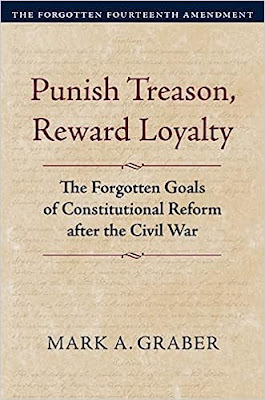
Mark A. Graber, Punish Treason, Reward Loyalty: The Forgotten Goals of Constitutional Reform after the Civil War (University of Kansas Press, 2023)
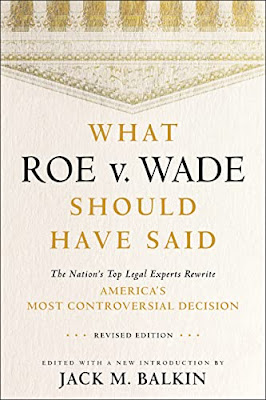
Jack M. Balkin, What Roe v. Wade Should Have Said: The Nation's Top Legal Experts Rewrite America's Most Controversial Decision - Revised Edition (NYU Press, 2023)

Andrew Koppelman, Burning Down the House: How Libertarian Philosophy Was Corrupted by Delusion and Greed (St. Martin’s Press, 2022)

Gerard N. Magliocca, Washington's Heir: The Life of Justice Bushrod Washington (Oxford University Press, 2022)
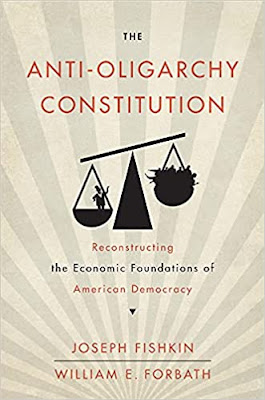
Joseph Fishkin and William E. Forbath, The Anti-Oligarchy Constitution: Reconstructing the Economic Foundations of American Democracy (Harvard University Press, 2022)
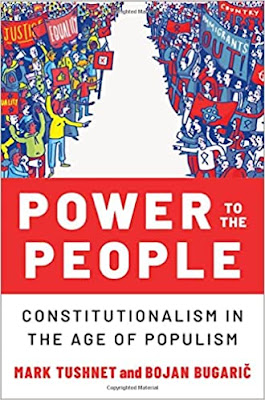
Mark Tushnet and Bojan Bugaric, Power to the People: Constitutionalism in the Age of Populism (Oxford University Press 2021).

Mark Philip Bradley and Mary L. Dudziak, eds., Making the Forever War: Marilyn B. Young on the Culture and Politics of American Militarism Culture and Politics in the Cold War and Beyond (University of Massachusetts Press, 2021).

Jack M. Balkin, What Obergefell v. Hodges Should Have Said: The Nation's Top Legal Experts Rewrite America's Same-Sex Marriage Decision (Yale University Press, 2020)

Frank Pasquale, New Laws of Robotics: Defending Human Expertise in the Age of AI (Belknap Press, 2020)

Jack M. Balkin, The Cycles of Constitutional Time (Oxford University Press, 2020)

Mark Tushnet, Taking Back the Constitution: Activist Judges and the Next Age of American Law (Yale University Press 2020).

Andrew Koppelman, Gay Rights vs. Religious Liberty?: The Unnecessary Conflict (Oxford University Press, 2020)

Ezekiel J Emanuel and Abbe R. Gluck, The Trillion Dollar Revolution: How the Affordable Care Act Transformed Politics, Law, and Health Care in America (PublicAffairs, 2020)

Linda C. McClain, Who's the Bigot?: Learning from Conflicts over Marriage and Civil Rights Law (Oxford University Press, 2020)
Sanford Levinson and Jack M. Balkin, Democracy and Dysfunction (University of Chicago Press, 2019)

Sanford Levinson, Written in Stone: Public Monuments in Changing Societies (Duke University Press 2018)

Mark A. Graber, Sanford Levinson, and Mark Tushnet, eds., Constitutional Democracy in Crisis? (Oxford University Press 2018)

Gerard Magliocca, The Heart of the Constitution: How the Bill of Rights became the Bill of Rights (Oxford University Press, 2018)

Cynthia Levinson and Sanford Levinson, Fault Lines in the Constitution: The Framers, Their Fights, and the Flaws that Affect Us Today (Peachtree Publishers, 2017)

Brian Z. Tamanaha, A Realistic Theory of Law (Cambridge University Press 2017)

Sanford Levinson, Nullification and Secession in Modern Constitutional Thought (University Press of Kansas 2016)

Sanford Levinson, An Argument Open to All: Reading The Federalist in the 21st Century (Yale University Press 2015)

Stephen M. Griffin, Broken Trust: Dysfunctional Government and Constitutional Reform (University Press of Kansas, 2015)

Frank Pasquale, The Black Box Society: The Secret Algorithms That Control Money and Information (Harvard University Press, 2015)

Bruce Ackerman, We the People, Volume 3: The Civil Rights Revolution (Harvard University Press, 2014)
Balkinization Symposium on We the People, Volume 3: The Civil Rights Revolution

Joseph Fishkin, Bottlenecks: A New Theory of Equal Opportunity (Oxford University Press, 2014)

Mark A. Graber, A New Introduction to American Constitutionalism (Oxford University Press, 2013)

John Mikhail, Elements of Moral Cognition: Rawls' Linguistic Analogy and the Cognitive Science of Moral and Legal Judgment (Cambridge University Press, 2013)

Gerard N. Magliocca, American Founding Son: John Bingham and the Invention of the Fourteenth Amendment (New York University Press, 2013)

Stephen M. Griffin, Long Wars and the Constitution (Harvard University Press, 2013)

Andrew Koppelman, The Tough Luck Constitution and the Assault on Health Care Reform (Oxford University Press, 2013)

James E. Fleming and Linda C. McClain, Ordered Liberty: Rights, Responsibilities, and Virtues (Harvard University Press, 2013)
Balkinization Symposium on Ordered Liberty: Rights, Responsibilities, and Virtues

Andrew Koppelman, Defending American Religious Neutrality (Harvard University Press, 2013)

Brian Z. Tamanaha, Failing Law Schools (University of Chicago Press, 2012)

Sanford Levinson, Framed: America's 51 Constitutions and the Crisis of Governance (Oxford University Press, 2012)

Linda C. McClain and Joanna L. Grossman, Gender Equality: Dimensions of Women's Equal Citizenship (Cambridge University Press, 2012)

Mary Dudziak, War Time: An Idea, Its History, Its Consequences (Oxford University Press, 2012)

Jack M. Balkin, Living Originalism (Harvard University Press, 2011)

Jason Mazzone, Copyfraud and Other Abuses of Intellectual Property Law (Stanford University Press, 2011)

Richard W. Garnett and Andrew Koppelman, First Amendment Stories, (Foundation Press 2011)

Jack M. Balkin, Constitutional Redemption: Political Faith in an Unjust World (Harvard University Press, 2011)

Gerard Magliocca, The Tragedy of William Jennings Bryan: Constitutional Law and the Politics of Backlash (Yale University Press, 2011)

Bernard Harcourt, The Illusion of Free Markets: Punishment and the Myth of Natural Order (Harvard University Press, 2010)

Bruce Ackerman, The Decline and Fall of the American Republic (Harvard University Press, 2010)
Balkinization Symposium on The Decline and Fall of the American Republic

Ian Ayres. Carrots and Sticks: Unlock the Power of Incentives to Get Things Done (Bantam Books, 2010)

Mark Tushnet, Why the Constitution Matters (Yale University Press 2010)

Ian Ayres and Barry Nalebuff: Lifecycle Investing: A New, Safe, and Audacious Way to Improve the Performance of Your Retirement Portfolio (Basic Books, 2010)
.jpg)
Jack M. Balkin, The Laws of Change: I Ching and the Philosophy of Life (2d Edition, Sybil Creek Press 2009)

Brian Z. Tamanaha, Beyond the Formalist-Realist Divide: The Role of Politics in Judging (Princeton University Press 2009)
Andrew Koppelman and Tobias Barrington Wolff, A Right to Discriminate?: How the Case of Boy Scouts of America v. James Dale Warped the Law of Free Association (Yale University Press 2009)

Jack M. Balkin and Reva B. Siegel, The Constitution in 2020 (Oxford University Press 2009)

Heather K. Gerken, The Democracy Index: Why Our Election System Is Failing and How to Fix It (Princeton University Press 2009)

Mary Dudziak, Exporting American Dreams: Thurgood Marshall's African Journey (Oxford University Press 2008)

David Luban, Legal Ethics and Human Dignity (Cambridge Univ. Press 2007)

Ian Ayres, Super Crunchers: Why Thinking-By-Numbers is the New Way to be Smart (Bantam 2007)

Jack M. Balkin, James Grimmelmann, Eddan Katz, Nimrod Kozlovski, Shlomit Wagman and Tal Zarsky, eds., Cybercrime: Digital Cops in a Networked Environment (N.Y.U. Press 2007)
Jack M. Balkin and Beth Simone Noveck, The State of Play: Law, Games, and Virtual Worlds (N.Y.U. Press 2006)

Andrew Koppelman, Same Sex, Different States: When Same-Sex Marriages Cross State Lines (Yale University Press 2006)

Brian Tamanaha, Law as a Means to an End (Cambridge University Press 2006)

Sanford Levinson, Our Undemocratic Constitution (Oxford University Press 2006)

Mark Graber, Dred Scott and the Problem of Constitutional Evil (Cambridge University Press 2006)

Jack M. Balkin, ed., What Roe v. Wade Should Have Said (N.Y.U. Press 2005)

Sanford Levinson, ed., Torture: A Collection (Oxford University Press 2004)
Balkin.com homepage
Bibliography
Conlaw.net
Cultural Software
Writings
Opeds
The Information Society Project
BrownvBoard.com
Useful Links
Syllabi and Exams
